

Do word-level skills show cross-linguistic transfer and predict bilingual reading?
Open accessThe DOI matches its Crossref record; 60 of the 60 references it cites were found in a registry or an index; 5 of the 57 sources its claims cite were checked for support.
Abstract
This study tests whether vocabulary and other word-level skills transfer across Chinese and English in bilingual learners.
Overview
CoChat Summary
TL;DR
This study tested cross-linguistic transfer of word-level skills and reading comprehension in 179 Cantonese-English bilingual children in Hong Kong. Morphological compounding and reading comprehension transferred across Chinese and English, whereas vocabulary and word reading did not.
Key findings
- Chinese and English morphological compounding were moderately correlated (r = .53, p < .001), and reading comprehension was moderately correlated (r = .35, p < .001); Chinese and English vocabulary were not correlated (p > .05), and word reading was only weakly correlated (r = .19, p < .05).
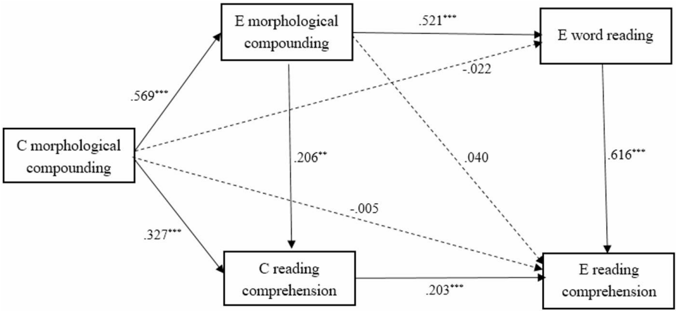
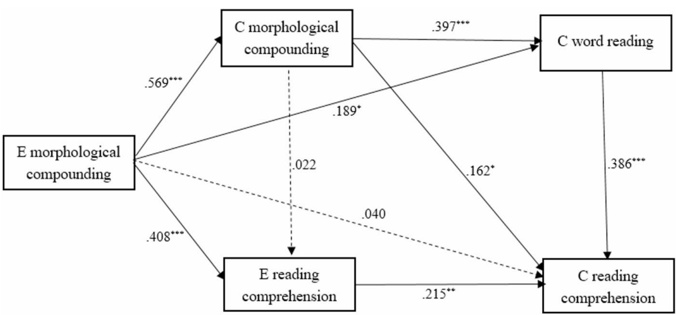
- Chinese morphological compounding affected English word reading indirectly through English morphological compounding (standardized β = .297, p < .001) and did not directly affect English word reading; English morphological compounding affected Chinese word reading directly (β = .189, p < .05) and indirectly through Chinese morphological compounding (β = .226, p < .001).
- Chinese morphological compounding affected English reading comprehension via English morphological compounding and word reading and via Chinese reading comprehension, explaining about 7.7% of the variance in English reading comprehension; English morphological compounding affected Chinese reading comprehension in similar ways and explained approximately 14.6% of the variance in Chinese reading comprehension.
- Vocabulary and word reading did not predict reading comprehension across languages; Chinese vocabulary and word reading did not predict English reading comprehension, and vice versa.
Methods
- 179 Cantonese-speaking children (92 boys, 87 girls), ages 8.06–10.27 years (M = 9.03, SD = 0.59), with 87 in Grade 3 and 92 in Grade 4, from a Hong Kong public primary school; Cantonese was the instructional language and English was taught as a subject for around 6–8 h per week.
- Measures included Raven’s Colored Progressive Matrices; Chinese/English receptive vocabulary (PPVT-4 adapted, 24 items each), expressive vocabulary (CELF-5, 15 items each), morphological compounding (Chinese 10 testing items; English 14 testing items), word reading (Chinese 150 two-character words; English 95 items maximum), and reading comprehension (Chinese maximum 28; English maximum 30).
- Analyses used SPSS for descriptive statistics, partial correlations controlling grade and intelligence, and hierarchical regressions; MPlus 8.1 was used for path analyses/SEM with maximum likelihood estimation, controlling grade and intelligence.
Limitations
- Stated: findings may not generalize to more similar language pairs (e.g., Dutch-English) or to contexts with different English exposure; participants were Cantonese-speaking Hong Kong children with relatively rich ESL exposure.
- Stated: only morphological compounding, vocabulary, and word reading were tested; phonological awareness and working memory were not considered; the cross-sectional design cannot show whether word-level skills enhance reading development across languages; reading comprehension in each language was tested with one measure only.
- Evident: the study drew from a single school with a narrow grade/age range; Chinese expressive vocabulary had the lowest reported reliability (Cronbach’s α = .61, within the overall range of .61–.98).
Model-written summary. Check it against the paper before relying on it.
Integrity signals
Registry
Cites
Statistics
Figures
Verification
Claims the paper makes
3 Valid · 1 Not valid · 38 Not checked · 106 Own results and interpretations
The cited sources support only part of this claim — read each source’s verdict below.
In the paper
“This finding is aligned with previous findings (Tabors et al., 2003; Mohamed et al., 2025 ; Xie et al., 2022) and supports the time-on-task hypothesis that the vocabulary development in each language is mainly through the exposure to that language and is largely independent of vocabulary development in another language (Quiroz et al., 2010).”
What the sources say
- Not matchedcites Tabors et al., 2003
An author–year citation the paper’s reference list doesn’t settle. We don’t search these by name.
- Partly supportedcites Mohamed et al., 2025 matched to “Exploring the Impact of Family Socio-Economic Status on Children’s Bilingual Abilities Among Arab Families” (2025) sourceExperimental — accuracy not yet measured
In Section 2.3 (Data Analyses) our copy states only a hedged expectation drawn from other work — 'vocabulary may not be transferred as vocabulary is mainly determined by exposure to the specific language (Quiroz et al., 2010; see Chung et al., 2019; Gottardo et al., 2021)' — and it explicitly anticipates no correlation for Arabic–English grammar, not vocabulary. The Results (Section 3) narrate the zero-order correlations that were significant (within-language vocabulary–grammar rs ≥ 0.45; English vocabulary–English reading r ≥ 0.29; Arabic vocabulary–Arabic fluency r = 0.31; cross-language word reading rs ≥ 0.51) but never state that Arabic and English vocabulary were uncorrelated, and Table 2's cell values are not rendered in our copy. So the general point attributed to Mohamed et al. (2025) — that vocabulary in the two languages is largely independent — is present in the paper as a borrowed, hedged premise, while the specific empirical null-correlation finding the citing sentence attributes to it is not established here; the study is also Arabic–English, not Chinese–English. (LLM, conf=0.68)
- Supportedcites Xie et al., 2022 matched to “Exploring the Genetic and Environmental Etiologies of Phonological Awareness, Morphological Awareness, and Vocabulary Among Chinese–English Bilingual Children: The Moderating Role of Second Language Instruction” (2022) source
The Descriptive statistics and correlations section states that Chinese and English vocabulary abilities did not correlate with each other. This directly supports the finding attributed to Xie et al.; the sentence cites Quiroz et al. separately for the time-on-task explanation. (LLM, conf=0.94)
plain- Asserted: passes — The authors put it forward as true.
- Checkable: passes — It can be checked against evidence.
- Load-bearing: unclear — It is unclear whether the paper’s conclusions depend on it.
- Based: passes — The paper gives a reason why it holds.
- Not matched
Every source the paper cites for this claim was checked and supports it.
In the paper
“On the contrary, a study by Sun et al. (2022) on Spanish-English and Chinese-English bilingual children did not show that morphological awareness in the heritage languages (Spanish and Chinese) directly or indirectly predict English word reading through English morphological awareness.”
What the sources say
- Supportedcites Sun et al., 2022 matched to “What’s in a word? Cross-linguistic influences on Spanish–English and Chinese–English bilingual children’s word reading development” (2022) source
The Results (Research Question 2) report no significant direct effect of heritage-language morphological awareness on English word reading in either bilingual group. Indirect effects mediated by English morphological awareness approached but did not meet significance thresholds. The Discussion likewise states that no direct or mediated relations were found for English word reading. (LLM, conf=0.95)
plain- Asserted: passes — The authors put it forward as true.
- Checkable: passes — It can be checked against evidence.
- Load-bearing: passes — The paper’s conclusions depend on it.
- Based: passes — The paper gives a reason why it holds.
- Supported
Every source the paper cites for this claim was checked and supports it.
In the paper
“By contrast, a study by Wagley et al. (2022) on Spanish-English children indicated the prediction of L1 reading comprehension from L2 word reading.”
What the sources say
- Supportedcites Wagley et al., 2022 matched to “Contributions of bilingual home environment and language proficiency on children’s Spanish–English reading outcomes” (2022) source
In the Discussion section, “Bilingual word reading and reading comprehension” (page unavailable), the authors report that English word reading was positively associated with Spanish reading comprehension. This supports the cited claim about L2 word reading predicting L1 reading comprehension in the Spanish–English children studied. (LLM, conf=0.91)
hedgedstates an association- Asserted: passes — The authors put it forward as true.
- Checkable: passes — It can be checked against evidence.
- Load-bearing: passes — The paper’s conclusions depend on it.
- Based: passes — The paper gives a reason why it holds.
- Supported
The cited sources that could be checked couldn’t confirm or dispute this claim.
In the paper
“In addition, morphological compounding contributes to syntactic skills by possibly facilitating the understanding of word order and sentence structure (Xie & Yeung, 2024).”
What the sources say
- Could not verifycites Xie & Yeung, 2024 matched to “Examining the dimensionality of vocabulary in English as a second language in Chinese children” (2025) sourceExperimental — accuracy not yet measured
The Introduction discusses vocabulary breadth and depth, while the Discussion passage concerns elaborating word meanings; neither addresses morphological compounding as a contributor to syntactic skills. Searches for compounding, word order, sentence structure, and syntactic awareness found no passage supporting the proposed mechanism. Page numbers were not available in our copy. (LLM, conf=0.73)
hedgedstates a possible cause- Asserted: passes — The authors put it forward as true.
- Checkable: passes — It can be checked against evidence.
- Load-bearing: unclear — It is unclear whether the paper’s conclusions depend on it.
- Based: passes — The paper gives a reason why it holds.
- Could not verify
A result the paper reports from its own data — it cites no other source for it, so there is none to check. The quote shows it is in the paper.
In the paper
“Vocabulary and word reading did not affect reading comprehension across the languages.”
plain- Asserted: passes — The authors put it forward as true.
- Checkable: passes — It can be checked against evidence.
- Load-bearing: passes — The paper’s conclusions depend on it.
- Based: passes — The paper gives a reason why it holds.
105 more claims
Create a free account to see all 148 claims and to verify the 1 reference still open.
- The quote only partly states this claim. 3
- It may state two separate claims as one. 16
- Probably not a substantial claim. 26
Self-check
Percentages, sums and reported differences re-computed from the paper’s own numbers.
Each contradiction between two passages listed here was confirmed by an independent check.
Rated minor: it would not touch a result — a value no result rests on, a p-value that stays on the same side of the significance level, or a conflict that is clerical, resolved elsewhere in the paper, or outside its own findings.
In the paper
§ Results
“Chinese morphological compounding explained 16.5% of the variance in Chinese reading comprehension.”
§ Results
“To see whether English morphological compounding contributed to Chinese word reading above Chinese morphological compounding, we did sixth model by entering Chinese morphological compounding after controlling for grade and intelligence.”
Citations
Cites
Linguistic Interdependence and the Educational Development of Bilingual Children
Cummins, J. (1979) · Review of Educational Research · doi:10.2307/1169960 · Cited by 3,318 · cited 4×
“The results of path analyses show that morphological compounding can be transferred between Chinese and English, supporting the interdependence hypothesis (Cummins, 1979 ) and echoing the previous findings (Ke & Xiao, 2015; Lin et al., 2018 ; Xie et al., 2022).”
InfluentialHoover, W. A., & Gough, P. B. (1990) · Reading and Writing · doi:10.1007/bf00401799 · Cited by 2,956
The Phonology of Standard Chinese
Duanmu, S. (2007) · doi:10.1093/oso/9780199215782.001.0001 · Cited by 1,157
The Acquisition of Reading Comprehension Skill
Perfetti, C. A., Landi, N., & Oakhill, J. (2008) · The Science of Reading: A Handbook · doi:10.1002/9780470757642.ch13 · Cited by 934
Morphological awareness uniquely predicts young children's Chinese character recognition.
McBride-Chang, C., Shu, H., Zhou, A., Wat, C. P., & Wagner, R. K. (2003) · Journal of Educational Psychology · doi:10.1037/0022-0663.95.4.743 · Cited by 498
The Morphology of Chinese: A Linguistic and Cognitive Approach
Packard, J. L. (2000) · doi:10.1017/cbo9780511486821 · Cited by 460
Melby‐Lervåg, M., & Lervåg, A. (2011) · Journal of Research in Reading · doi:10.1111/j.1467-9817.2010.01477.x · Cited by 371
The role of morphological awareness in children's vocabulary acquisition in English
McBRIDE–CHANG, C., WAGNER, R. K., MUSE, A., CHOW, B. W.-Y., & SHU, H. (2005) · Applied Psycholinguistics · doi:10.1017/s014271640505023x · Cited by 351
Contribution of morphological awareness to Chinese-English biliteracy acquisition.
Wang, M., Cheng, C., & Chen, S.-W. (2006) · Journal of Educational Psychology · doi:10.1037/0022-0663.98.3.542 · Cited by 342 · cited 6×
“Several studies showed a significant relation between Chinese and English word reading (Tong & McBride-Chang, 2010; Wang et al., 2006a); whereas some other studies did not show this relation (Gottardo et al., 2006; Wang et al., 2009b).”
InfluentialHulin, C., Cudeck, R., Netemeyer, R., Dillon, W. R., McDonald, R., & Bearden, W. (2001) · Journal of Consumer Psychology · doi:10.1207/s15327663jcp1001&2_05 · Cited by 336
Learning to Read Across Languages
(2008) · doi:10.4324/9780203935668 · Cited by 333
Morphological awareness, phonological awareness, and reading in English-Arabic bilingual children.
Saiegh-Haddad, E., & Geva, E. (2008) · Reading and Writing · doi:10.1007/s11145-007-9074-x · Cited by 306
Ramirez, G., Chen, X., Geva, E., & Kiefer, H. (2010) · Reading and Writing · doi:10.1007/s11145-009-9203-9 · Cited by 249
Crossover: The role of morphological awareness in French immersion children's reading.
Deacon, S. H., Wade-Woolley, L., & Kirby, J. (2007) · Developmental Psychology · doi:10.1037/0012-1649.43.3.732 · Cited by 249
Korean-English biliteracy acquisition: Cross-language phonological and orthographic transfer.
Wang, M., Park, Y., & Lee, K. R. (2006) · Journal of Educational Psychology · doi:10.1037/0022-0663.98.1.148 · Cited by 209
Chung, S. C., Chen, X., & Geva, E. (2019) · Journal of Neurolinguistics · doi:10.1016/j.jneuroling.2018.01.003 · Cited by 203
Deacon, S. H., Kieffer, M. J., & Laroche, A. (2014) · Scientific Studies of Reading · doi:10.1080/10888438.2014.926907 · Cited by 202 · cited 1×
“Morphological awareness and vocabulary contribute to both word reading and reading comprehension (Deacon et al., 2014 ; Kieffer et al., 2013 ; Xie et al., 2024).”
McBride-Chang, C., & Suk-Han Ho, C. (2005) · Scientific Studies of Reading · doi:10.1207/s1532799xssr0902_2 · Cited by 194
WANG, M., YANG, C., & CHENG, C. (2009) · Applied Psycholinguistics · doi:10.1017/s0142716409090122 · Cited by 185
The importance of morphological awareness in Korean–English biliteracy acquisition
Wang, M., Ko, I. Y., & Choi, J. (2009) · Contemporary Educational Psychology · doi:10.1016/j.cedpsych.2008.12.002 · Cited by 180
PATTERSON, J. L. (2002) · Applied Psycholinguistics · doi:10.1017/s0142716402004010 · Cited by 173
Quiroz, B. G., Snow, C. E., & Zhao, J. (2010) · International Journal of Bilingualism · doi:10.1177/1367006910370919 · Cited by 169 · cited 5×
“Hence, to enlarge vocabulary size in each language, it is important to listen and read more in each language as language exposure is important for vocabulary development (Quiroz et al., 2010 ).”
InfluentialNakamoto, J., Lindsey, K. A., & Manis, F. R. (2008) · Scientific Studies of Reading · doi:10.1080/10888430802378526 · Cited by 169 · cited 1×
“The relation between L1 and L2 reading comprehension has been shown, regardless of the bilingual language pair (Chuang et al., 2012; Li et al., 2012; Nakamoto et al., 2008).”
Toward Integrative Reading Science: The Direct and Indirect Effects Model of Reading
Kim, Y.-S. G. (2020) · Journal of Learning Disabilities · doi:10.1177/0022219420908239 · Cited by 166
Chinese-English biscriptal reading: cognitive component skills across orthographies
Tong, S. X., & McBride-Chang, C. A. (2009) · Reading and Writing · doi:10.1007/s11145-009-9211-9 · Cited by 136
Metalinguistic skills and vocabulary knowledge in Chinese (L1) and English (L2)
McBride-Chang, C. A., Cheung, H., Chow, B. W., Chow, C., & Choi, L. (2006) · Reading and Writing · doi:10.1007/s11145-005-5742-x · Cited by 126
Sun-Alperin, M. K., & Wang, M. (2011) · Reading and Writing · doi:10.1007/s11145-009-9221-7 · Cited by 126 · cited 1×
“The studies focusing on two Latin alphabetic languages indicated cross-linguistic transfer of orthographic skills (Commissaire et al., 2011 ; Sun-alperin & Wang, 2011); whereas such cross-linguistic transfer may not exist between two languages, where the writing systems are contrasted.”
KIEFFER, M. J., BIANCAROSA, G., & MANCILLA-MARTINEZ, J. (2013) · Applied Psycholinguistics · doi:10.1017/s0142716411000920 · Cited by 105 · cited 2×
“Word-level skills are found to be important in reading (e.g., Kieffer et al., 2013; Xie & Yeung, 2022, 2025a, b).”
Gottardo, A., Chiappe, P., Yan, B., Siegel, L., & Gu, Y. (2006) · Educational Psychology · doi:10.1080/01443410500341098 · Cited by 103
Abu-Rabia, S., & Siegel, L. S. (2003) · Reading and Writing · doi:10.1023/a:1025838029204 · Cited by 90
Li, T., McBride-Chang, C., Wong, A., & Shu, H. (2012) · Journal of Educational Psychology · doi:10.1037/a0026445 · Cited by 86
Kim, Y. G., Guo, Q., Liu, Y., Peng, Y., & Yang, L. (2019) · Reading Research Quarterly · doi:10.1002/rrq.262 · Cited by 79
Cross-Language Transfer of Reading Ability: Evidence From Taiwanese Ninth-Grade Adolescents
Chuang, H.-K., Joshi, R. M., & Dixon, L. Q. (2012) · Journal of Literacy Research · doi:10.1177/1086296x11431157 · Cited by 74 · cited 2×
“The relation between L1 and L2 reading comprehension has been shown, regardless of the bilingual language pair (Chuang et al., 2012; Li et al., 2012; Nakamoto et al., 2008).”
Reading Comprehension Difficulties in Chinese–English Bilingual Children
Tong, X., McBride, C. A., Shu, H., & Ho, C. S. (2017) · Dyslexia · doi:10.1002/dys.1566 · Cited by 67
Kim, Y.-S. G., & Piper, B. (2019) · Reading and Writing · doi:10.1007/s11145-018-9889-7 · Cited by 62 · cited 3×
“…morphological skills contribute to language comprehension, especially the understanding of syntax and sentence meaning (Kim, 2020 ; Xie & Yeung, 2024), which may in turn predict reading comprehension across languages, given that comprehension skills are transferrable (Kim & Piper, 2019).”
InfluentialDiscourse‐level reading comprehension in Chinese children: what is the role of syntactic awareness?
Tong, X., Tong, S. X., Shu, H., Chan, S., & McBride-Chang, C. A. (2013) · Journal of Research in Reading · doi:10.1111/1467-9817.12016 · Cited by 52
Gottardo, A., Chen, X., & Huo, M. R. Y. (2021) · Reading Research Quarterly · doi:10.1002/rrq.410 · Cited by 50 · cited 8×
“A number of empirical studies have supported the interdependence hypothesis by showing that morphological and phonological awareness in an L1 and an L2 are associated, regardless of the bilingual language pair (Gottardo et al., 2021 ; Ke & Xiao, 2015 ; Xie et al., 2022).”
InfluentialSun, X., Zhang, K., Marks, R. A., Nickerson, N., Eggleston, R. L., Yu, C.-L., Chou, T.-L., Tardif, T., & Kovelman, I. (2022) · Child Development · doi:10.1111/cdev.13666 · Cited by 49 · cited 4×
“Due to this feature, morphological awareness in Chinese is mostly assessed via the awareness of morpheme compounding (e.g., Lin et al., 2018; Sun et al., 2022 ; Xie et al., 2022).”
InfluentialCommissaire, E., Duncan, L. G., & Casalis, S. (2011) · Journal of Research in Reading · doi:10.1111/j.1467-9817.2010.01473.x · Cited by 45 · cited 1×
“The studies focusing on two Latin alphabetic languages indicated cross-linguistic transfer of orthographic skills (Commissaire et al., 2011 ; Sun-alperin & Wang, 2011); whereas such cross-linguistic transfer may not exist between two languages, where the writing systems are contrasted.”
Gottardo, A., Javier, C., Farnia, F., Mak, L., & Geva, E. (2014) · Written Language & Literacy · doi:10.1075/wll.17.1.04got · Cited by 44
Common and distinct cognitive bases for reading in English–Cantonese bilinguals
LUK, G., & BIALYSTOK, E. (2008) · Applied Psycholinguistics · doi:10.1017/s0142716407080125 · Cited by 43 · cited 2×
“…cannot be transferred when intelligence was controlled for; and this hypothesis was based on the time-on-task hypothesis (Quiroz et al., 2010 ) and previous findings on the transferability between Chinese and English in vocabulary and word reading (e.g., Luk & Bialystok, 2008 ; Xie et al., 2022).”
Cross-linguistic transfer of morphological awareness between Chinese and English
Ke, S., & Xiao, F. (2015) · Language Awareness · doi:10.1080/09658416.2015.1114624 · Cited by 41 · cited 4×
“Regarding the methodology of investigation, most studies investigated cross-linguistic transfer via the correlations (e.g., Ke & Xiao, 2015; McBride-Chang et al., 2006); however, correlations alone do not indicate the direction of relationships.”
InfluentialLin, C. Y., Cheng, C., & Wang, M. (2018) · Reading and Writing · doi:10.1007/s11145-017-9775-8 · Cited by 38 · cited 8×
“These findings echo the findings of Lin et al.’s ( 2018) study.”
InfluentialYeung, S. S., & Savage, R. S. (2019) · Journal of Learning Disabilities · doi:10.1177/0022219419894563 · Cited by 38
Self-citationZhang, D., Chin, C. F., & Li, L. (2016) · Applied Psycholinguistics · doi:10.1017/s0142716416000278 · Cited by 35
Morphological awareness in biliteracy acquisition: A study of young Chinese EFL readers
Zhang, D., Koda, K., & Sun, X. (2014) · International Journal of Bilingualism · doi:10.1177/1367006912450953 · Cited by 33 · cited 5×
“Although several studies suggested that L1 word-level skills contributed to L2 reading comprehension (e.g., Li et al., 2012; Zhang et al., 2014), these studies did not indicate the question of how.”
InfluentialTong, X., McBride, C., Ho, C. S.-H., Waye, M. M. Y., Chung, K. K. H., Wong, S. W. L., & Chow, B. W. Y. (2018) · Reading and Writing · doi:10.1007/s11145-017-9771-z · Cited by 29 · cited 1×
“This test has been used among Hong Kong children many times before, and good psychometric properties have been shown (e.g., Tong et al., 2018a).”
Xie, Q., & Yeung, S. S. (2022) · Learning and Instruction · doi:10.1016/j.learninstruc.2022.101682 · Cited by 28
Self-citationMarks, R. A., Sun, X., López, E. M., Nickerson, N., Hernandez, I. E., Caruso, V. C., Satterfield, T., & Kovelman, I. (2022) · International Journal of Bilingual Education and Bilingualism · doi:10.1080/13670050.2022.2090226 · Cited by 25
Xie, Q., Zheng, M., Ho, C. S.-H., McBride, C., Fong, F. L. W., Wong, S. W. L., & Chow, B. W.-Y. (2022) · Behavior Genetics · doi:10.1007/s10519-021-10096-2 · Cited by 24 · cited 8×
“…cannot be transferred when intelligence was controlled for; and this hypothesis was based on the time-on-task hypothesis (Quiroz et al., 2010 ) and previous findings on the transferability between Chinese and English in vocabulary and word reading (e.g., Luk & Bialystok, 2008 ; Xie et al., 2022).”
InfluentialSelf-citationCross-Linguistic Morphological Awareness in Chinese Heritage Language Reading Acquisition
Zhang, H. S., & Koda, K. (2020) · Journal of Psycholinguistic Research · doi:10.1007/s10936-020-09722-7 · Cited by 23
Ke, S. E., & Koda, K. (2021) · Applied Psycholinguistics · doi:10.1017/s014271642100031x · Cited by 22
Wagley, N., Marks, R. A., Bedore, L. M., & Kovelman, I. (2022) · Child Development · doi:10.1111/cdev.13748 · Cited by 22 · cited 2×
“By contrast, a study by Wagley et al. (2022) on Spanish-English children indicated the prediction of L1 reading comprehension from L2 word reading.”
Xie, Q., Cai, Y., & Yeung, S. S. (2022) · Reading and Writing · doi:10.1007/s11145-022-10360-9 · Cited by 22
Self-citationHumble, S., Dixon, P., Gittins, L., & Counihan, C. (2024) · Education Sciences · doi:10.3390/educsci14030274 · Cited by 10
Xie, Q., & Yeung, S. S. (2023) · Reading and Writing · doi:10.1007/s11145-023-10412-8 · Cited by 10
Self-citationMohamed, A., Xie, Q., Opoku, M. P., & Cheikhmous, A. (2025) · Education Sciences · doi:10.3390/educsci15040516 · Cited by 5 · cited 2×
“This finding is aligned with previous findings (Tabors et al., 2003; Mohamed et al., 2025 ; Xie et al., 2022) and supports the time-on-task hypothesis that the vocabulary development in each language is mainly through the exposure to that language and is largely independent of vocabulary…”
Self-citationXie, Q., & Yeung, S. S. (2025) · PLoS ONE · doi:10.1371/journal.pone.0334529 · Cited by 4
Self-citationExamining the dimensionality of vocabulary in English as a second language in Chinese children
Xie, Q., & Yeung, S. S.-S. (2025) · Journal of Child Language · doi:10.1017/s0305000924000096 · Cited by 4 · cited 1×
“Word-level skills are found to be important in reading (e.g., Kieffer et al., 2013; Xie & Yeung, 2022, 2025a, b).”
Self-citationTong, X., McBride, C., Ho, C. S.-H., et al. (2018) · Reading and Writing · doi:10.1007/s11145-017-9812-7
Research works printed but not linked: 10
- Chen, T. M., Dell, G. S., & Chen, J. Y. (2004). A cross-linguistic study of phonological units: Syllables emerge from the statistics of Mandarin Chinese, but not from the statistics of English. Proceedings of the Annual Meeting of the Cognitive Science Society , 26 (216-229). h t t p s : / / e s c h o l a r s h i p . o r g / u c / i t e m / 9 4 r 0 c 4 s 4
- Dunn, L. M., & Dunn, D. M. (2007). PPVT-4: Peabody picture vocabulary test . Pearson Assessments.
- Gravetter, F., & Wallnau, L. (2014). Essentials of statistics for the behavioral sciences (8th ed.). Wadsworth.
- Ho, C. S. H., Chan, D. W. O., Tsang, S. M., & Lee, S. H. (2000). The Hong Kong test of specific learning difficulties in reading and writing (HKT-SpLD) manual. Hong Kong Specific Learning Difficulties Team.
- Koda, K. (2008). Impacts of prior literacy experience on learning to read in a second language. In K. Koda, & A. M. Zehler (Eds.), Learning to read across languages: Cross-linguistic relationships in first- and second-language literacy development (pp. 68-96). Routledge. - Lado, R. (1957). Linguistics across cultures: Applied linguistics for language teachers . University of Michigan Press.
- McBride-Chang, C., Cheung, H., Chow, B. W. Y., Chow, C. S. L., & Choi, L. (2006). Metalinguistic skills and vocabulary knowledge in Chinese (L1) and English (L2). Reading and Writing, 19(7), 695–716. https://doi.org/10.1007/s11145-005-5742-x · DOI
- Perfetti, C. A. (1985). Reading ability . Oxford University Press.
- Raven, J., Raven, J. C., & Court, J. (2003). Manual for Raven's progressive matrices and vocabulary scales . Harcourt Assessment.
- Tabors, P. O., Páez, M. M., & López, L. M. (2003). Dual language abilities of bilingual four-year olds: Initial findings from the early childhood study of language and literacy development of spanish-speaking children. NABE Journal of Research and Practice, 1(1), 70–91.
- Wiig, E. H., Semel, E., & Secord, W. A. (2013). Clinical evaluation of language fundamentals-Version 5 . Pearson.
Metadata
- Authors
- Xie, Q., & Yeung, S. S.-S.
- Affiliations
- Australian Catholic University (AU)
- Education University of Hong Kong (HK)
- Corresponding author
- Yeung, Susanna Siu-sze
- Venue
- Reading and Writing
- Published
- 2026-02-05
- Volume
- 39
- Issue
- 8
- Pages
- 3275-3299
- ISSN
- 0922-4777 (ISSN-L)
- 1573-0905
- OpenAlex
- W7127986538
- Semantic Scholar
- d2e0565beafe285b47abcf62bf04fa2757f88f29
- Cited by
- 0
- References
- 59
- FWCI
- 0.00
- Type
- journal article
- Language
- en
- Open access
- hybrid
- doi.org
- Licence
- cc-by
- creativecommons.org/licenses/by/4.0 (tdm)
- creativecommons.org/licenses/by/4.0 (vor)
- Locations
- Reading and Writing (publishedVersion, cc-by)
- Funders
- The Education University of Hong Kong
- Topics
- Social Sciences › Psychology › Developmental and Educational Psychology › Reading and Literacy Development
- Social Sciences › Psychology › Developmental and Educational Psychology › Second Language Acquisition and Learning
- Social Sciences › Psychology › Developmental and Educational Psychology › Language Development and Disorders
- Keywords
- language transfer, bilingual reading, vocabulary, word reading, reading comprehension, Chinese-English bilingual children, mediation, second language reading
About these checks
Registry, retraction, Cites and statistics results are computed, not judged, with one exception: a printed reference that no index lists is read once by a model before it counts as a citation error. Claims are extracted by a model and kept only when their quote appears verbatim in the text; each cited source is then checked, with a model’s help, for whether it says what the claim relies on. Those verdicts can be wrong — read the claim’s quote and the cited source before relying on one.
The claim verdicts this report counts are experimental: their accuracy is not yet measured.
A language model drew the claims from the paper on 2026-10-10, under version 3 of the claim definition (model deepseek-v4.1-flash, prompt extract-v3).
A second model labelled each claim on 2026-10-10 (model jev-1.13-20260917, definition revision gold-guideline-v0.2).
Cited sources are checked with a language model’s help (qwen3.8-omni-flash and gpt-6-sol).
Statistics and arithmetic are recomputed, not judged.
Confidence bands are shown only for fields calibrated on our annotated test set. None is calibrated yet, so no band is shown.
What counts as a claim ›How we measure confidence ›How we check this ›
Are you an author, or do you see a problem with this page? Request a review
Data sources
Bibliographic data: Semantic Scholar, OpenAlex, Crossref.
Contains information from the Semantic Scholar Academic Graph Datasets, made available under the ODC Attribution License (ODC-BY 1.0).
Semantic Scholar’s data is described in: Kinney, R., et al. (2023). The Semantic Scholar Open Data Platform. arXiv:2301.10140.
