

A Database and Evaluation Methodology for Optical Flow
Open accessThe DOI matches its Crossref record; 110 of the 112 references it cites were found in a registry or an index; 2 of the 68 sources its claims cite were checked for support.
Abstract
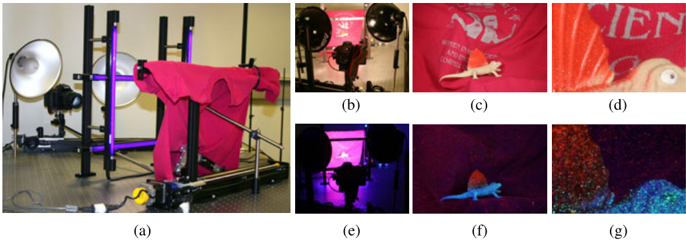
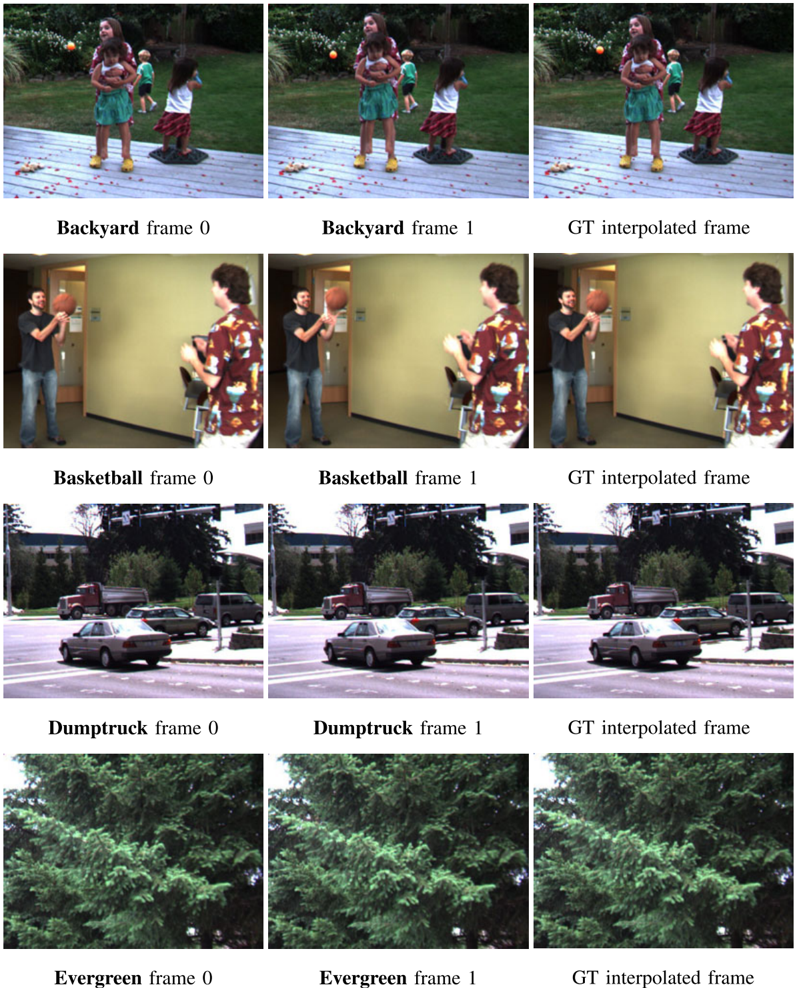
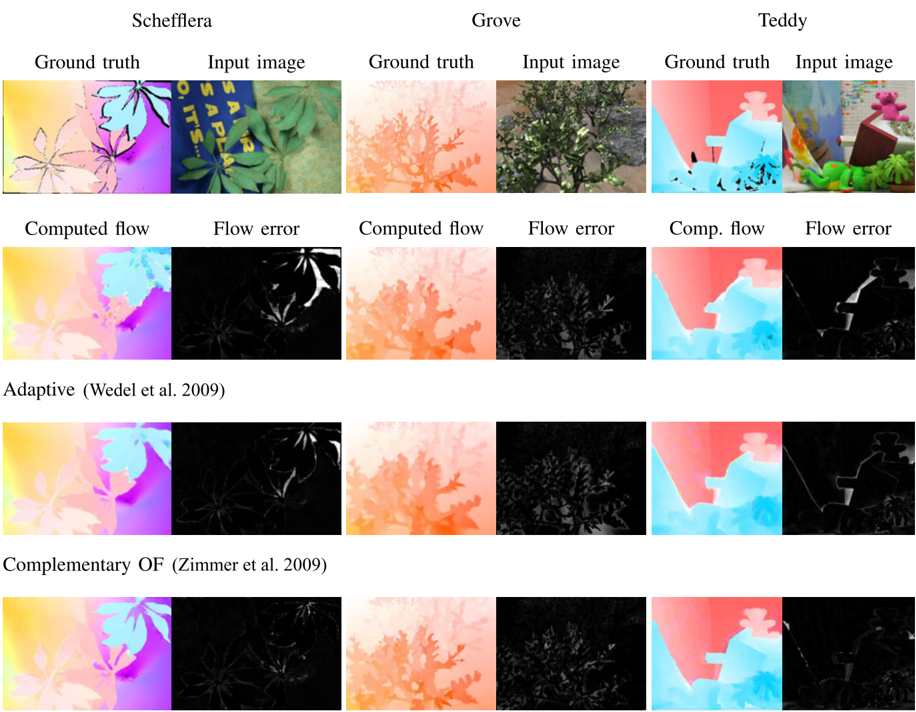
The quantitative evaluation of optical flow algorithms by Barron et al. (1994) led to significant advances in performance. The challenges for optical flow algorithms today go beyond the datasets and evaluation methods proposed in that paper. Instead, they center on problems associated with complex natural scenes, including nonrigid motion, real sensor noise, and motion discontinuities. We propose a new set of benchmarks and evaluation methods for the next generation of optical flow algorithms. To that end, we contribute four types of data to test different aspects of optical flow algorithms: (1) sequences with nonrigid motion where the ground-truth flow is determined by tracking hidden fluorescent texture, (2) realistic synthetic sequences, (3) high frame-rate video used to study interpolation error, and (4) modified stereo sequences of static scenes. In addition to the average angular error used by Barron et al., we compute the absolute flow endpoint error, measures for frame interpolation error, improved statistics, and results at motion discontinuities and in textureless regions.
Overview
CoChat Summary
TL;DR
The paper introduces a new optical flow benchmark of four data types (hidden fluorescent texture, realistic synthetic, high-speed interpolation, and modified stereo) plus an extended evaluation methodology with endpoint error, interpolation error, robustness/accuracy statistics, and region masks. It reports that performance improved substantially over the preliminary 2007 study, but motion discontinuities and diverse datasets remain difficult, and top flow methods still lag top stereo methods on the modified Teddy stereo data.
Key findings
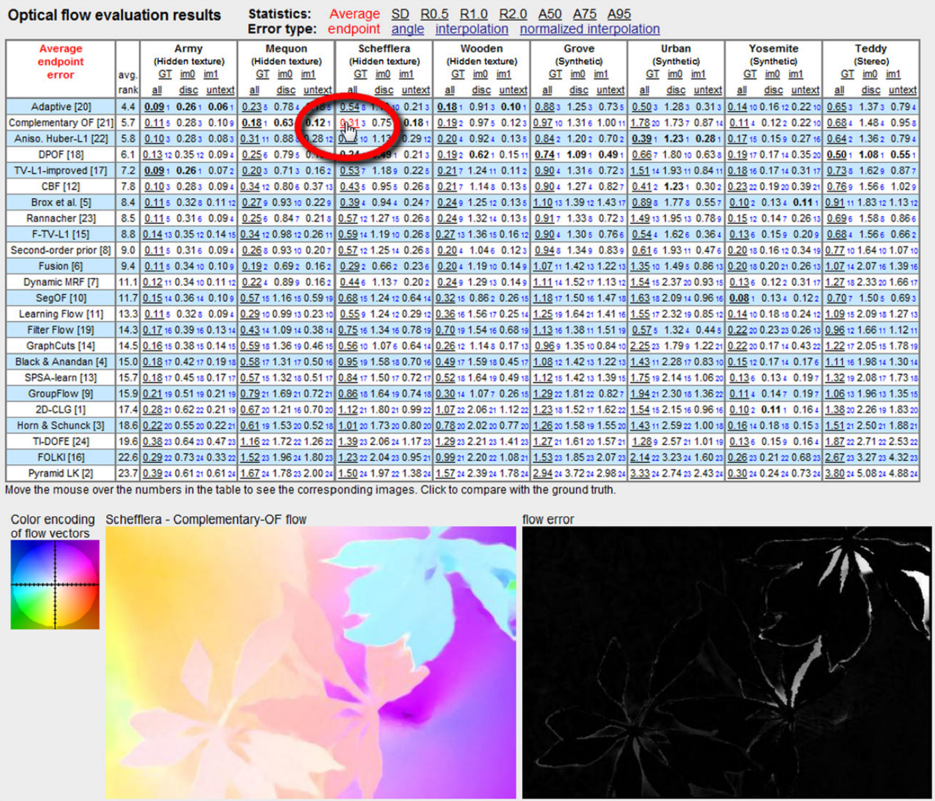
- The benchmark contains 12 training and 12 test sequences; test ground truth is withheld except for Yosemite. As of December 2009 the online evaluation contained results for 24 published methods, all using only 2 input frames and 10 using color.
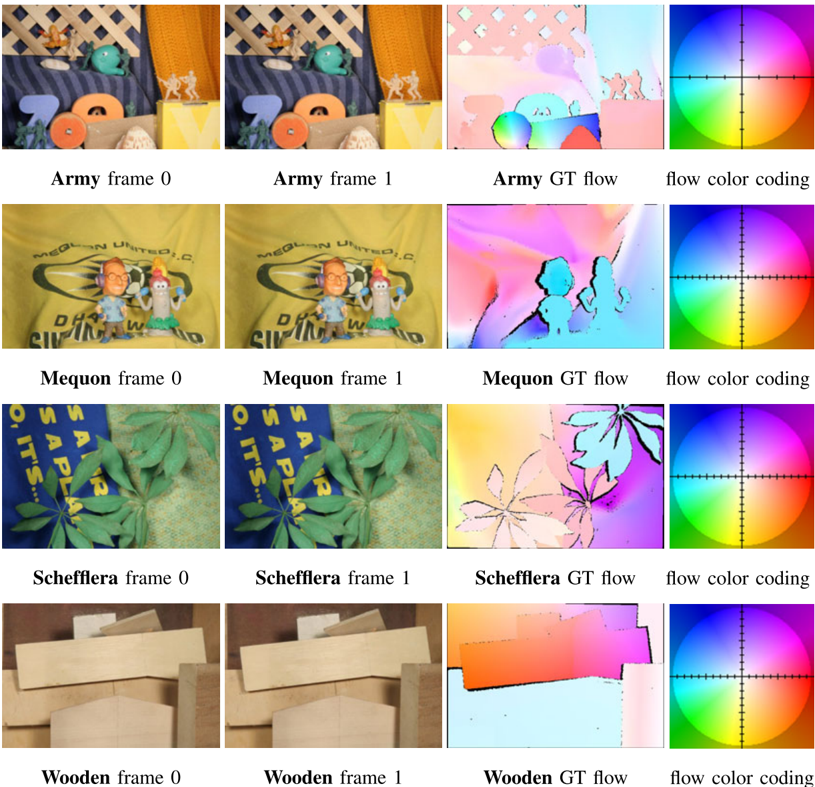
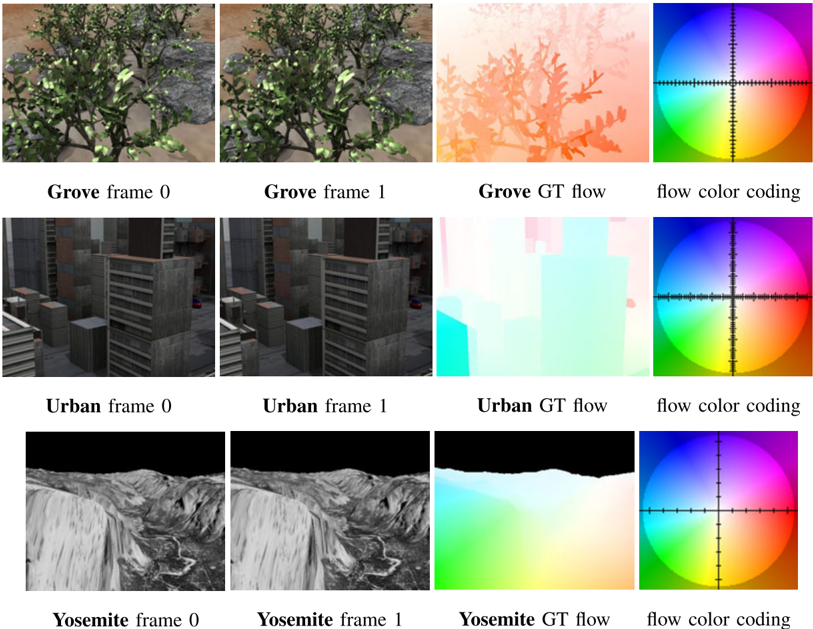
- Best average endpoint error (Avg. EE) improved dramatically over 2D-CLG (Bruhn et al. 2005): Army 0.28→0.09, Mequon 0.67→0.18, Schefflera 1.12→0.24, Wooden 1.07→0.18, Grove 1.23→0.74, Urban 1.54→0.39, Yosemite 0.10→0.08, Teddy 1.38→0.50. Best Avg. EE was below 0.2 pixels on four datasets (Yosemite, Army, Mequon, Wooden).
- Endpoint error (EE) and angular error (AE) rankings were highly correlated (r = 0.989), but the paper argues EE should be preferred: Complementary OF on Urban had Avg. AE 4.64° (rank 6) but Avg. EE 1.78 pixels (rank 20), because AE downweights large motions.
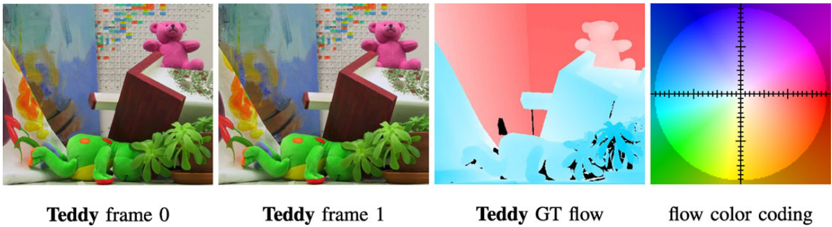
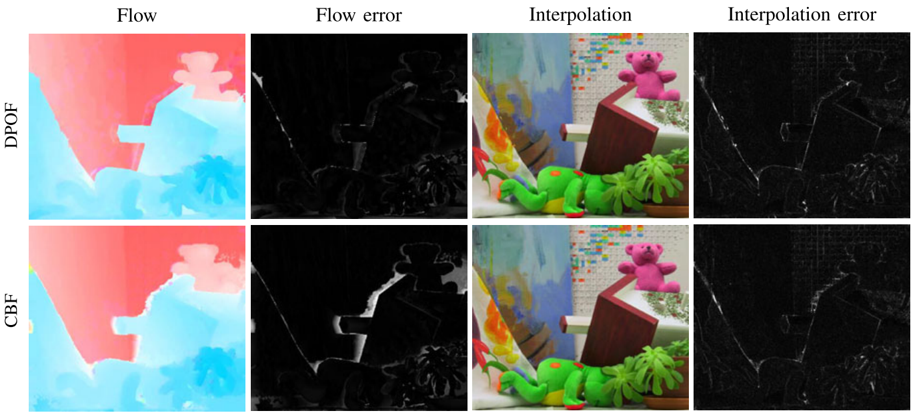
- Motion discontinuity (Disc) regions were the hardest; textureless (Untext) regions were typically easiest. Dataset results were less correlated, with Yosemite poorly or negatively correlated with others. Flow and interpolation errors were only moderately correlated (Avg4 EE vs Avg4 IE r = 0.763). On Teddy, top stereo methods outperformed top flow methods: median lowest-five R1.0 was 9.9 for flow vs 6.5 for stereo in All regions (34% reduction), and 27.6 vs 10.0 in Disc regions (64% reduction).
Methods
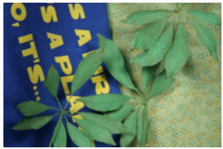
- Four data types were collected: (1) real nonrigid scenes with dense ground truth from hidden fluorescent texture, captured with a Canon EOS 20D at 3504×2336, downsampled every 40th visible-light frame by factor 6 to 584×388, with SSD tracking (15×15 windows), forward/backward crosschecking, and Lucas-Kanade subpixel refinement; (2) realistic synthetic scenes rendered with 3Delight at 640×480, with ground truth from a custom shader and dominant-cluster flow selection; (3) high-speed video for frame interpolation captured with a PointGrey Dragonfly Express at 60 fps, providing every other frame and retaining intermediate frames as ground truth; and (4) modified stereo data (Teddy) from structured light, cropped to make the disparity range roughly symmetric.
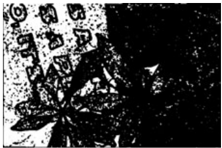
- Evaluation metrics include average angular error (AE), absolute flow endpoint error (EE), interpolation error (IE), and gradient-normalized interpolation error (NE). Statistics include averages, robustness measures R_X, and percentile accuracy measures A_X, computed over All, Disc, and Untext region masks.
- Analysis used the online evaluation at http://vision.middlebury.edu/flow/, comparing 24 published methods across metrics, statistics, masks, and datasets, with Pearson correlations between rankings and comparisons to state-of-the-art stereo methods on Teddy.
Limitations
- The paper states that the hidden fluorescent texture scenes are laboratory scenes, not real-world scenes, and have no motion blur due to stop-motion capture; ground truth is unavailable where cross-checking failed, especially occluded regions, and the measured ground truth is not perfect, though significant errors are limited to a small fraction of pixels. Synthetic sequences were generated without motion blur. The modified stereo ground truth is only accurate to 0.25 pixels, and algorithms may exploit the knowledge that motions are horizontal; overfitting to rigid data should be visible across the 12 evaluation images. Interpolation ground truth is an intermediate image, not a flow field, so the flow definition is apparent motion.
- The paper also states that no single method yet achieves strong performance across a wide variety of datatypes, that any dataset has a limited lifespan, and that future studies should include more challenging realistic synthetic data, longer sequences, and more difficult materials, illumination changes, atmospheric effects, and transparency.
- Evident from the text: the online tables do not provide an overall ranking among methods; runtimes are not normalized for programming environment, CPU speed, cores, or hardware acceleration; algorithms are required to produce dense flow and cannot submit confidence maps or sparse/incomplete fields; all 24 published methods used only 2 frames despite 8-frame sequences being available; and the paper cannot definitively answer whether temporal smoothing is less suited to the more challenging sequences.
Model-written summary. Check it against the paper before relying on it.
Integrity signals
Registry
Cites
Statistics
Figures

Verification
Claims the paper makes
2 Valid · 16 Not valid · 58 Not checked · 185 Own results and interpretations
A result the paper states — it cites no source for it, so there is none to check. The quote shows it is in the paper.
In the paper
“Rather than collecting a single type of data (with its inherent limitations) we instead collected four different types of data, each satisfying a different subset of desirable properties.”
plain- Asserted: passes — The authors put it forward as true.
- Checkable: passes — It can be checked against evidence.
- Load-bearing: passes — The paper’s conclusions depend on it.
- Based: passes — The paper gives a reason why it holds.
A result the paper states — it cites no source for it, so there is none to check. The quote shows it is in the paper.
In the paper
“Using the combination of fluorescent paint, downsampling high-resolution images, and sequential tracking of small motions, we are able to obtain dense, subpixel accurate ground truth for a nonrigid scene.”
plainstates a cause- Asserted: passes — The authors put it forward as true.
- Checkable: passes — It can be checked against evidence.
- Load-bearing: passes — The paper’s conclusions depend on it.
- Based: passes — The paper gives a reason why it holds.
A result the paper reports from its own data — it cites no other source for it, so there is none to check. The quote shows it is in the paper.
In the paper
“To allow for measures that predict performance on such tasks, we collected a variety of data suitable for frame interpolation.”
plainstates a cause- Asserted: passes — The authors put it forward as true.
- Checkable: passes — It can be checked against evidence.
- Load-bearing: passes — The paper’s conclusions depend on it.
- Based: passes — The paper gives a reason why it holds.
A result the paper reports from its own data — it cites no other source for it, so there is none to check. The quote shows it is in the paper.
In the paper
“We have developed a technique for capturing imagery of nonrigid scenes with ground-truth optical flow.”
plain- Asserted: passes — The authors put it forward as true.
- Checkable: passes — It can be checked against evidence.
- Load-bearing: passes — The paper’s conclusions depend on it.
- Based: passes — The paper gives a reason why it holds.
A result the paper states — it cites no source for it, so there is none to check. The quote shows it is in the paper.
In the paper
“To go beyond previous synthetic ground truth (e.g., the Yosemite sequence), we generated two types of fairly complex synthetic outdoor scenes.”
plain- Asserted: passes — The authors put it forward as true.
- Checkable: passes — It can be checked against evidence.
- Load-bearing: passes — The paper’s conclusions depend on it.
- Based: passes — The paper gives a reason why it holds.
96 more claims
Create a free account to see all 261 claims and every source verdict.
- Probably not a substantial claim. 114
- It may state two separate claims as one. 76
- The quote only partly states this claim. 6
Claims other papers make about this one
Each is checked against this paper’s own text: does it say what the citing paper says it does?
The source backs part of the claim, not all of it — or backs it for a different population, condition or comparison.
In the citing paper
“Notable works include the Middlebury dataset (Baker et al, 2011) and the KITTI datasets (Geiger et al, 2012; Menze and Geiger, 2015), but due to the difficulty of computing accurate ground truth, these have been restricted to 8 and 2 · 200 pairs of frames, respectively (the latter are also limited by the special driving setting).”
From What Makes Good Synthetic Training Data for Learning Disparity and Optical Flow Estimation? (2018) · cites this paper as Baker et al, 2011
Experimental — accuracy not yet measured
Citations
Cites
The pascal visual object classes (VOC) challenge
Everingham, M., Van Gool, L., Williams, C. K. I., Winn, J., & Zisserman, A. (2010) · International Journal of Computer Vision · doi:10.1007/s11263-009-0275-4 · Cited by 19,599
Proceedings of IEEE Conference on Computer Vision and Pattern Recognition
(1993) · doi:10.1109/cvpr.1993 · Cited by 17,667
Proceedings of IEEE International Conference on Computer Vision
(1995) · Proceedings of IEEE International Conference on Computer Vision · doi:10.1109/iccv.1995.466933 · Cited by 12,860
(1981) · Cited by 11,963
Horn, B. K. P., & Schunck, B. G. (1981) · Artificial Intelligence · doi:10.1016/0004-3702(81)90024-2 · Cited by 10,312
Horn, B. K., & Schunck, B. G. (1981) · SPIE Proceedings · doi:10.1117/12.965761 · Cited by 7,394 · cited 2×
“A baseline approach is to use an L2 norm as in the Horn and Schunck algorithm (Horn and Schunck 1981):”
BackgroundMethodFast approximate energy minimization via graph cuts
Boykov, Y., Veksler, O., & Zabih, R. (2001) · IEEE Transactions on Pattern Analysis and Machine Intelligence · doi:10.1109/34.969114 · Cited by 6,988
A Taxonomy and Evaluation of Dense Two-Frame Stereo Correspondence Algorithms
Scharstein, D., & Szeliski, R. (2002) · International Journal of Computer Vision · doi:10.1023/a:1014573219977 · Cited by 6,740 · cited 10×
“Many areas of computer vision, such as stereo [63], face recognition [28, 55, 68], and object recognition [23, 24], have challenging datasets to track the progress made by leading algorithms and to stimulate new ideas.”
BackgroundMethodResultInfluentialSelf-citationProceedings European Conference on Computer Vision 2002
Heyden, A., Sparr, G., Nielsen, M., & Johansen, P. (2002) · Lund University Publications (Lund University) · Cited by 5,153
From few to many: illumination cone models for face recognition under variable lighting and pose
Georghiades, A. S., Belhumeur, P. N., & Kriegman, D. J. (2001) · IEEE Transactions on Pattern Analysis and Machine Intelligence · doi:10.1109/34.927464 · Cited by 4,912 · cited 1×
“Many areas of computer vision, such as stereo (Scharstein and Szeliski 2002), face recognition (Philips et al. 2005; Sim et al. 2003; Gross et al. 2008; Georghiades et al. 2001), and object recognition (Fei-Fei et al.”
Background
Research works printed but not linked: 4
- Anandan, P., & Weiss, R. (1985). Introducing smoothness constraint in a matching approach for the computation of displacement fields. In Proceedings of the DARPA image understanding workshop (pp. 186-196).
- Bleyer, M., & Chambon, S. (2010). Does color really help in dense stereo matching? In Proceedings of the international symposium 3D data processing, visualization and transmission .
- Lempitsky, V., Roth, S., & Rother, C. (2008). Fusion flow: discretecontinuous optimization for optical flow estimation. In Proceedings of the IEEE conference on computer vision and pattern recognition .
- Rannacher, J. (2009). Realtime 3D motion estimation on graphics hardware . Undergraduate thesis, Heidelberg University.
Cited by
Items 1,801–1,900 of 2,273
Sani, S. I. A., Alhassan, J. K., & Mohammed, A. S. (2022) · Lecture notes on data engineering and communications technologies · doi:10.1007/978-3-030-93453-8_13 · Cited by 1
Becker, F., Petrab, S., & Schnörr, C. (2014) · Springer eBooks · doi:10.1007/978-3-642-27795-5_38-3 · Cited by 2
Magnor, M. A., Grau, O., Sorkine‐Hornung, O., & Theobalt, C. (2015) · A K Peters/CRC Press eBooks · doi:10.1201/b18154-30 · Cited by 1
Time analysis of regional structure of large-scale particle using an interactive visual system
Zhang, Y., Li, G., & Shan, G. (2022) · Visual Informatics · doi:10.1016/j.visinf.2022.03.004 · Cited by 1
Perception in Autonomous Driving
Liu, S., Li, L., Tang, J., Wu, S., & Gaudiot, J. (2020) · Synthesis lectures on computer science · doi:10.1007/978-3-031-01805-3_3 · Cited by 2
Robust Anomaly Detection in CCTV Surveillance
Scholtz, T., & Ngxande, M. (2022) · EPiC series in computing · doi:10.29007/dfjs · Cited by 1
Xu, C., Li, H., Li, Z., Chen, X., Rathore, A. S., Zhang, H., Wang, K., & Xu, W. (2022) · IEEE International Conference on Healthcare Informatics (ICHI) · doi:10.1109/ichi54592.2022.00053 · Cited by 4
“After the OMF disambiguation process, the finally obtained OMF is represented as an RGB frame through the Hue-SaturationValue color space using a similar approach introduced in [33].”
MethodA Cutting-Plane Method for Sublabel-Accurate Relaxation of Problems with Product Label Spaces
Ye, Z., Haefner, B., Quéau, Y., Möllenhoff, T., & Cremers, D. (2022) · International Journal of Computer Vision · doi:10.1007/s11263-022-01704-7 · Cited by 2
“The input images (Baker et al., 2011; Martin et al., 2001) are degraded with the same setting as above.”
BackgroundMethodInfluentialiPhone 240fps Video Dataset for Various Model Training Tasks
Shimizu, J., Komatsu, S., Kobayashi, S., Sun, H., & Katto, J. (2023) · International Conference on Consumer Electronics · doi:10.1109/icce56470.2023.10043423 · Cited by 3
“Datasets for tasks such as optical flow [2, 3], frame interpolation [2, 4], super resolution [4, 5, 6], object tracking [7, 8, 9, 10, 11, 12, 13], and video prediction [14, 15, 16] have played an important role in the development of deep learning models.”
BackgroundHigh-altitude parabolic detection method based on GMM model and SORT algorithm
Shi, Y., Luo, Q., Zhang, T., & Hao, C. Y. (2022) · doi:10.1109/iip57348.2022.00059 · Cited by 1
Motion segmentation in Moving Camera Videos using Velocity Guided Optical Flow Normalization
Adinugroho, S., & Gofuku, A. (2023) · International Conference on Graphics and Signal Processing (ICGSP) · doi:10.1145/3606283.3606284 · Cited by 1
“Unlike semantic segmentation, motion segmentation takes color-coded optical flow image [3], instead of RGB image from a camera and produces binary segmentation mask for motion and static classes.”
MethodUncertainty-Guided Spatial Pruning Architecture for Efficient Frame Interpolation
Cheng, R., Jiang, X., He, R., Zhou, S., Tan, W., & Yan, B. (2023) · ACM International Conference on Multimedia (ACM MM) · doi:10.1145/3581783.3611752 · Cited by 1
“We first illustrate our statistical observations regarding the VFI results of the Middlebury [2] and Vimeo90K [3] training datasets.”
MethodMonitoring Sleep-Related Breathing Disorders with Optical Flow
Mikhnova, O. (2023) · Lecture notes in networks and systems · doi:10.1007/978-3-031-39777-6_1 · Cited by 1
Lee, Y., Lee, E., Lee, M., Byeon, J., Ahn, H., & Sim, D. (2023) · Journal of Broadcast Engineering · doi:10.5909/jbe.2023.28.4.410 · Cited by 1
GCK-Maps: A Scene Unbiased Representation for Efficient Human Action Recognition
Nicora, E., Pastore, V. P., & Noceti, N. (2023) · Lecture notes in computer science · doi:10.1007/978-3-031-43148-7_6 · Cited by 1
Study of Various Deep Learning Models for COVID-19 Detection Based on Fractional Order Optical Flow
Singh, B., Khan, M., & Kumar, P. (2023) · International Conference on Computing, Communication and Networking Technologies (ICCCNT) · doi:10.1109/icccnt56998.2023.10306509 · Cited by 1
“The estimated OF fields are converted into colour maps in accordance with the colour encoding scheme in [22].”
MethodArbitrary Timestep Video Frame Interpolation with Time-Dependent Decoding
Zhang, H., Ren, D., Yan, Z., & Zuo, W. (2024) · Mathematics · doi:10.3390/math12020303 · Cited by 2
Video frame interpolation via spatial multi‐scale modelling
Qu, Z., Liu, W., Cui, L., & Yang, X. (2024) · IET Computer Vision · doi:10.1049/cvi2.12281 · Cited by 1
Parameter Reduction of Kernel-Based Video Frame Interpolation Methods Using Multiple Encoders
Khalifeh, I., Murn, L., & Ebroul Izquierdo, M. (2024) · IEEE Journal on Emerging and Selected Topics in Circuits and Systems · doi:10.1109/jetcas.2024.3395418 · Cited by 2
“The model that achieves the closest performance to the median on Middlebury [42], Vimeo90K [26], DAVIS [43] and UCF101 [44] is selected.”
MethodVideo frame interpolation based on depthwise over-parameterized recurrent residual convolution
Yang, X., Liu, W., & Wang, S. (2024) · Journal of Electronic Imaging · doi:10.1117/1.jei.33.4.043036 · Cited by 1
Quantifying and Learning Static vs. Dynamic Information in Deep Spatiotemporal Networks
Kowal, M., Siam, M., Islam, M. A., Bruce, N. D. B., Wildes, R. P., & Derpanis, K. G. (2024) · IEEE Transactions on Pattern Analysis and Machine Intelligence · doi:10.1109/tpami.2024.3462291 · Cited by 10
“To do this, we represent flow with a color coding [45] and then randomly perturb the hue and saturation which correspond to the direction and magnitude, respectively.”
Regularizing Dynamic Radiance Fields with Kinematic Fields
Im, W., Cha, G., Lee, S., Lee, J., Seon, J., Wee, D., & Yoon, S. (2024) · Lecture notes in computer science · doi:10.1007/978-3-031-72933-1_18 · Cited by 1
Hu, W. T., Yang, L., Zhang, Y., et al. (2025) · Experiments in Fluids · doi:10.1007/s00348-025-03957-7 · Cited by 1
“…normalized interpolation error (IE), defined as the root-mean-square difference between the ground-truth image and the estimated interpolated image (Baker et al. 2011): where N is the number of pixels, I GT ( x , y ) is the ground-truth image captured from the background with the flow, and I ( x ,…”
DMRFlow: 4D Radar Scene Flow Estimation With Decoupled Matching and Refinement
Zhai, M., Bao, B.-K., & Xiang, X. (2025) · IEEE Transactions on Circuits and Systems for Video Technology · doi:10.1109/tcsvt.2025.3546274 · Cited by 1
Gadirov, H., Roerdink, J. B. T. M., & Frey, S. (2025) · IEEE Transactions on Visualization and Computer Graphics · doi:10.1109/tvcg.2025.3561091 · Cited by 9
“…all—e.g.,inthecaseofanexperimentwithoutdedicatedflow measurementsorwhensuchinformationcouldnotbestored duetospaceconstraints—FLINTcanestimatehigh-quality opticalflowfromscientificdataasanadditionalmodalityfor analysis(e.g.,usingflowglyphsorintegrallinesallowsto effectivelypresenttemporalchanges).”
2D/3D Image Capture and Representation
Krig, S. (2025) · Springer eBooks · doi:10.1007/978-981-99-3393-8_1 · Cited by 1
Intermittent control and retinal optic flow when maintaining a curvilinear path
Nguyen, B., & Benderius, O. (2025) · Scientific Reports · doi:10.1038/s41598-025-02402-3
“There are a plethora of optic flow or scene flow (visual motion flow in three dimensions) estimation methods with varying accuracy and compute performance, especially since the recent introduction of black-box deep learning approaches 61–63 .”
Lavín-Delgado, J. E., Gómez-Aguilar, J. F., Pérez‐Careta, E., Olivares-Peregrino, V. H., & Jimenez, J. T. (2025) · Advances in Complex Systems · doi:10.1142/s1793962325500539 · Cited by 1
Perception of nonrigid structures from motion using tracking image gradient vectors
Takeichi, H., Suzuki, W., Yamashita, W., et al. (2025) · Frontiers in Psychology · doi:10.3389/fpsyg.2025.1586648 · Cited by 1
“…proposed, including gradient-and feature-based approaches (Tu et al., 2019; differential techniques versus region-based matching as referred to by Barron et al., 1994; continuous optimization with prior versus discrete optimization, as corresponding to the categorization by Baker et al., 2011).”
Optical Flow Computation in the Presence of Spatially-Varying Motion Blur
Daraei, M. H. (2014) · Lecture notes in computer science · doi:10.1007/978-3-319-14249-4_14 · Cited by 4
“Baker et al, [8] introduce evaluation methods, as well as visualization tools for flow fields.”
MethodLow-complexity message-passing algorithms for distributed computation
Wainwright, M. J., & Noorshams, N. (2013) · Cited by 1
Hassner, T., Mayzels, V., & Zelnik‐Manor, L. (2015) · Springer eBooks · doi:10.1007/978-3-319-23048-1_3 · Cited by 1
Regularization Terms for Motion Estimation
Lepoittevin, Y., & Herlin, I. (2016) · doi:10.5220/0005712104560464 · Cited by 1
“Motion is displayed with the color code of the Middlebury data base described by Baker et al. (Baker et al., 2011).”
MethodA Video Descriptor Using Orientation Tensors and Shape-Based Trajectory Clustering
Caetano, F. A., Vieira, M. B., & da Silva, R. L. D. S. (2016) · International Journal of Image and Graphics · doi:10.1142/s0219467816500170 · Cited by 1
An alternating direction method for optical flow estimation with lp regularization
Zon, N., & Kiryati, N. (2016) · doi:10.1109/icsee.2016.7806158 · Cited by 1
“Table I presents quantitative comparison between optical flow estimation using TV-l1 regularization [21], [22] and the proposed method on the RubberWhale image from the Middlebury dataset [1].”
BackgroundMethodInfluentialRobust and Efficient Tracking with Large Lens Distortion for Vehicular Technology Applications
Lin, C.-T., Chen, L.-T., Cheng, P.-W., et al. (2016) · IEEE Vehicular Technology Conference · doi:10.1109/vtcfall.2016.7881204 · Cited by 1
“These include both feature-based (2 and 3 rows) and flow-based (4 row) trackers, and trackers emphasizing accuracy with multiple mechanisms to guard against incidental environmental variation (as in SIFT [2], SURF [3] and optical flow [1],[8]) and trackers emphasizing efficiency that trades off some safeguard for spee…”
BackgroundReflectance-aware optical flow
Dahlan, H. A., Hancock, E. R., & Smith, W. A. P. (2016) · Proceedings - International Conference on Pattern Recognition/Proceedings/International Conference on Pattern Recognition · doi:10.1109/icpr.2016.7900070 · Cited by 2
Huang, Y.-L. (2017) · Springer eBooks · doi:10.1007/978-3-319-59274-9_6 · Cited by 1
Adaptive Motion Pooling and Diffusion for Optical Flow Computation
Medathati, N. V. K., Chessa, M., Masson, G. S., Kornprobst, P., & Solari, F. (2017) · Lecture notes in computer science · doi:10.1007/978-3-319-70742-6_6 · Cited by 1
“Optical flow are represented using the color from [1].”
MethodContext-adaptive matching for optical flow
Zu, Y., Tang, W., Bao, X., et al. (2017) · Multimedia Tools and Applications · doi:10.1007/s11042-017-5386-2 · Cited by 1
“The effectiveness and efficiency of our approach achieve state-of-art on MPI-Sintel [12], KITTI [15, 26] and Middleburg [2].”
InfluentialLocal-global mixed patch matching framework
Yu, M., Hai, Z., & Zhou, C. (2017) · IEEE International Conference on Signal Processing, Communications and Computing (ICSPCC) · doi:10.1109/icspcc.2017.8242494 · Cited by 1
“One method is to search the target patches in a limited range [1,9], termed the local patch matching.”
MethodIskandarani, M. Z. (2017) · 2017 Computing Conference · doi:10.1109/sai.2017.8252160 · Cited by 1
“For large displacements descriptor matching and nearest neighbor search are used to initialize the continuous refinement This more sophisticated initialization is proved to significantly improve results [8-9].”
MethodRobust method in photogrammetric reconstruction of geometric primitives in solid modeling
Yang, X. S. (2017) · doi:10.7282/t3wm1hkk · Cited by 1
“More recent work was proposed in [22] which extracted dense correspondences.”
BackgroundLee, J., Kim, C., Choi, S., et al. (2018) · IEEE International Symposium on Circuits and Systems proceedings · doi:10.1109/iscas.2018.8351177 · Cited by 1
“As a result, the overlapping length is set to 5 pixels, through experiments on Middlebury dataset [6].”
MethodMotion Estimation and Segmentation of Natural Phenomena
Chen, D., Li, W., & Hall, P. M. (2018) · Pure (University of Bath) · Cited by 3
Speed Increasing of FOE Calculation in Autonomous Vehicle Control Systems
Kolupaev, A. V., Metelyov, A., Prozorov, D., et al. (2018) · IEEE East-West Design & Test Symposium (EWDTS) · doi:10.1109/ewdts.2018.8524815 · Cited by 1
“Therefore brightness is often used in practice [4-6].”
An Empirical Evaluation Study on the Training of SDC Features for Dense Pixel Matching
Schuster, R., Wasenmüller, O., Unger, C., & Stricker, D. (2019) · IEEE/CVF Conference on Computer Vision and Pattern Recognition Workshops (CVPRW) · doi:10.1109/cvprw.2019.00174 · Cited by 1
“The original SDC model was trained with a mixture of data from KITTI [20], Sintel [3], HD1K [16], Middlebury (MB) [22, 2], and ETH3D [23].”
BackgroundMethodInfluentialEvaluation of unsupervised optical flow methods for deep learning in real world datasets
Marez, D., & Harguess, J. D. (2019) · doi:10.1117/12.2519228 · Cited by 1
Local Optical Flow Considering Object Boundaries by Adaptive Window Positioning
Kah, A., & Narroschke, M. (2019) · IEEE International Conference on Multimedia and Expo (ICME) · doi:10.1109/icme.2019.00278 · Cited by 1
Variational Optical Flow: Warping and Interpolation Revisited
Radow, G., & Breuß, M. (2019) · Lecture notes in computer science · doi:10.1007/978-3-030-29888-3_33 · Cited by 1
Iterative Optical Flow Refinement for High Resolution Images
Mühlhausen, M., Wöhler, L., Albuquerque, G., & Magnor, M. A. (2019) · Proceedings - International Conference on Image Processing · doi:10.1109/icip.2019.8803727 · Cited by 2
“many benchmarks [5, 6, 7] were established to measure the quality of new techniques.”
BackgroundCrowd Segmentation Using SimpleFlow
Yang, H., Zhao, H.-A., & Zhou, P. (2017) · International Conference on Network and Information Systems for Computers (ICNISC) · doi:10.1109/icnisc.2017.00031 · Cited by 1
“The SimpleFlow has higher accuracy and shorter run time than other optical flows which are indicated in reference [5].”
BackgroundReversibility Error of Image Interpolation Methods: Definition and Improvements
Briand, T. (2019) · Image Processing On Line · doi:10.5201/ipol.2019.277 · Cited by 1
“Grayscale version of the RubberWhale image from the Middlebury database [2]”
MethodAutonomous Vehicles and Mechatronics Education
Marzano, G., Martinovs, A., & Ušča, S. (2020) · Lecture notes in intelligent transportation and infrastructure · doi:10.1007/978-3-030-39688-6_38 · Cited by 2
A proper generalized decomposition approach for optical flow estimation
Hamidi, A. E., Saleh, M., Papadakis, N., et al. (2020) · Mathematical Methods in the Applied Sciences · doi:10.1002/mma.6275 · Cited by 1
“16 The tested Middlebury collection includes eight data sets composed of a reference image, images to register, and the associated groundtruth motion field.”
BackgroundVideo Folding: Increased Framerate for Semi-Repetitive Sequences
May, C., Oliveira, M. M., & Aliaga, D. G. (2020) · IEEE Transactions on Visualization and Computer Graphics · doi:10.1109/tvcg.2020.2992670 · Cited by 1
“Forward warping techniques can be found in frame interpolation [1], [4] and view interpolation [19], [21].”
BackgroundTrack color space-time interest points in video
Bellamine, I., Silkan, H., & Tmiri, A. (2020) · Multimedia Tools and Applications · doi:10.1007/s11042-020-09037-8 · Cited by 1
SRC3: A Video Dataset for Evaluating Domain Mismatch
Sato, J., Mediavilla, C., Ward, C. M., & Parameswaran, S. (2019) · IEEE Applied Imagery Pattern Recognition Workshop · doi:10.1109/aipr47015.2019.9174589 · Cited by 2
“This issue was circumvented by the introduction of datasets such as MPI-Sintel [4] and Middlebury datasets [5].”
MethodSelf-Driving Car Expert System
Shingare, S., Jagtap, R., Rawal, P., et al. (2018) · Cited by 1
Stereo Matching Based on Features of Image Patch
Zhou, S. S., He, L., Zhu, M., Li, Z., Zhang, L., & Mizumachi, M. (2021) · IIAE International Conference on Industrial Application Engineering (ICIAE) · doi:10.12792/iciae2021.006 · Cited by 2
“After extracting features from the neural network and performing post-processing for different mismatching pixels, the output disparity map of the proposed method has a good performance on the Middlebury dataset [6].”
MethodSuper-Resolution: 1. Multi-Frame-Based Approach
Petrova, X. Y. (2021) · Signals and communication technology · doi:10.1007/978-3-030-66741-2_1 · Cited by 1
Pang, S., Zhang, X., Li, H., et al. (2021) · Applied Optics · doi:10.1364/ao.424238 · Cited by 1
Semi-Automatic 2D to 3D Video Conversion
Pohl, P., & Tolstaya, E. V. (2021) · Signals and communication technology · doi:10.1007/978-3-030-66741-2_4 · Cited by 1
Residual Learning of Video Frame Interpolation Using Convolutional LSTM
Suzuki, K., & Ikehara, M. (2021) · Proceedings - International Conference on Pattern Recognition/Proceedings/International Conference on Pattern Recognition · doi:10.1109/icpr48806.2021.9412470 · Cited by 1
“In Table II, we evaluate our method on the Middlebury Other benchmark [21].”
MethodInfluentialStereo Matching Based on Features of Image Patch
Zhou, S. S., Li, H., Zhu, M., et al. (2021) · Journal of the Institute of Industrial Applications Engineers · doi:10.12792/jiiae.9.91 · Cited by 1
Motion Estimation with L0 Norm Regularization
Chen, J., Cai, Z., Xie, X., & Lai, J. (2021) · International Conference on Virtual Reality · doi:10.1109/icvr51878.2021.9483834 · Cited by 1
Multi-Kernel Deformable 3D Convolution for Video Super-Resolution
Dou, T., Yu, X., & Zhao, J. (2021) · IEEE International Symposium on Broadband Multimedia Systems and Broadcasting (BMSB) · doi:10.1109/bmsb53066.2021.9547068 · Cited by 1
Krig, S. (2016) · Springer eBooks · doi:10.1007/978-3-319-33762-3_3 · Cited by 1
Ten Questions for a Theory of Vision
Gori, M. (2022) · Frontiers in Computer Science · doi:10.3389/fcomp.2021.701248 · Cited by 1
“Early studies on this problem (see Horn and Schunck 1981), along with related improvements (see e.g., Baker et al., 2011) suggests to determine the velocity fi eld by enforcing brightness invariance.”
BackgroundExploring Novel Optical Properties with Attention Mechanism for Gait Recognition
Sabih, M., Vishwakarma, D. K., & Kumar, N. (2022) · International Conference on Computing Methodologies and Communication (ICCMC) · doi:10.1109/iccmc53470.2022.9754051 · Cited by 2
SIFTpack: A Compact Representation for Efficient SIFT Matching
Gilinsky, A., & Zelnik‐Manor, L. (2015) · Springer eBooks · doi:10.1007/978-3-319-23048-1_6 · Cited by 1
AAGAN: Accuracy-Aware Generative Adversarial Network for Supervised Tasks
Yun, I., Lee, H.-J., & Rhee, C. E. (2022) · IEEE Transactions on Circuits and Systems for Video Technology · doi:10.1109/tcsvt.2022.3172998 · Cited by 3
“MB in 556 Table IV indicates Middlebury dataset [58].”
BackgroundVision Pipelines and Optimizations
Krig, S. (2016) · Springer eBooks · doi:10.1007/978-3-319-33762-3_8 · Cited by 2
Video Motion: Finding Complete Motion Paths for Every Visible Point
Ricco, S. (2013) · DukeSpace (Duke University) · Cited by 1
Modeling Shape, Appearance and Self-Occlusions for Articulated Object TrackingPreprint
Yang, Y., & Sundaramoorthi, G. (2012) · arXiv (Cornell University) · Cited by 1
Notes on a New Philosophy of Empirical SciencePreprint
Burfoot, D. (2011) · arXiv (Cornell University) · doi:10.48550/arxiv.1104.5466 · Cited by 1
“Indeed, with the exception of the k(·) terms, the above expression is equivalent to an evaluation metric for optical flow algorithms proposed by [4] (compare their Equation 1 to the above expression).”
BackgroundMethodInfluentialQuantifying the Energy Efficiency of Object Recognition and Optical Flow
Anderson, M. C., Iandola, F., & Keutzer, K. (2014) · Defense Technical Information Center (DTIC) · doi:10.21236/ada605720 · Cited by 2
“Quality of solution is measured using standard benchmarks such as the Middlebury optical flow benchmark dataset [10] and the KTTI vision benchmark suite [11].”
MethodFALDOI: Large Displacement Optical Flow by Astute InitializationPreprint
Palomares, R. P., Haro, G., Ballester, C., et al. (2016) · arXiv (Cornell University) · Cited by 1
Improving Optical Flow using Residual Images
Vaudrey, T., Wedel, A., & Klette, R. (2009) · ResearchSpace (University of Auckland) · Cited by 1
Estimation of Super-Resolved Video Dynamics.Preprint
Héas, P., Drémeau, A., & Herzet, C. (2015) · arXiv (Cornell University) · Cited by 1
Statistics of RGBD ImagesPreprint
Rosenbaum, D., & Weiss, Y. (2016) · arXiv (Cornell University) · doi:10.48550/arxiv.1604.02902 · Cited by 1
“We run this procedure on the online availabe dataset used by Lu et al [7] which consists of 30 images from Middlebury [16] and 9 images from the RGBZ dataset [17].”
MethodBeyond Brightness Constancy: Learning Noise Models for Optical FlowPreprint
Rosenbaum, D., & Weiss, Y. (2016) · arXiv (Cornell University) · doi:10.48550/arxiv.1604.02815 · Cited by 1
Image-based endoscope navigation and clinical applications
van der Stap, N. (2015) · doi:10.3990/1.9789036539685 · Cited by 1
Human robot interaction in a crowded environment
Valibeik, S. (2010) · Spiral (Imperial College London) · doi:10.25560/5677 · Cited by 1
Chen, K. (2017) · arXiv (Cornell University) · doi:10.48550/arxiv.1703.05955 · Cited by 1
“Such a problem is widely encountered in other fields of science and engineering such as ridge regression in machine learning [14], [15], [16], [17], signal processing [18], optical flow in computer vision [19], [20], and robotic inverse kinematics [21], [22].”
Adaptive Regularization of Some Inverse Problems in Image AnalysisPreprint
Hong, B., Koo, J., Burger, M., et al. (2017) · arXiv (Cornell University) · doi:10.48550/arxiv.1705.03350 · Cited by 1
“In the experiments, the qualitative and quantitative evaluation is performed based on the Middlebury optical flow dataset [61].”
MethodDirectional analysis of cardiac left ventricular motion from PET images.
Sims, J. A. (2017) · Digital Library of Theses and Dissertations (Universidade de São Paulo) · doi:10.11606/t.3.2017.tde-05092017-093020 · Cited by 1
Unsupervised Video Object Segmentation with Distractor-Aware Online AdaptationPreprint
Wang, Y., Choi, J., Chen, Y., et al. (2018) · arXiv (Cornell University) · doi:10.48550/arxiv.1812.07712 · Cited by 1
McCarthy, C. D. (2010) · ANU Open Research (Australian National University) · doi:10.25911/5d5fc924073ed · Cited by 1
“The technique also performs well in the most recently published comparison of state of the art optical flow methods [Baker et al. 2007].”
MethodSpatiotemporal Data Fusion for Precipitation NowcastingPreprint
Ivashkin, V., & Lebedev, V. (2018) · arXiv (Cornell University) · doi:10.48550/arxiv.1812.10915 · Cited by 1
“We use a simplified dense optical-flow based frame rate conversion algorithm [17] to generate synthetic satellite data at 10-minute intervals.”
MethodProposal Flow: Semantic Correspondences from Object ProposalsPreprint
Ham, B., Cho, M., Schmid, C., et al. (2017) · arXiv (Cornell University) · doi:10.48550/arxiv.1703.07144 · Cited by 1
Learning Image Matching by Simply Watching VideoPreprint
Long, G., Kneip, L., Álvarez, J. M., et al. (2016) · arXiv (Cornell University) · doi:10.48550/arxiv.1603.06041 · Cited by 1
“As a numerical evaluation of the generalization ability, we compare the CNN based interpolation results to traditional warp based interpolation method [3] using state-of-the-art optical flow, i.”
BackgroundMethodLearning Spatial Transform for Video Frame Interpolation.Preprint
Lee, H., Kim, T., Chung, T., Pak, D., Ban, Y., & Lee, S. (2019) · arXiv (Cornell University) · Cited by 1
Simpkins, J. D., Stevenson, R. L., & Borman, S. (2015) · CRC Press eBooks · doi:10.1081/e-eoe2-120047095 · Cited by 1
A Dual Camera System for High Spatiotemporal Resolution Video AcquisitionPreprint
Cheng, M., Ma, Z., Asif, M. S., et al. (2019) · arXiv (Cornell University) · doi:10.48550/arxiv.1909.13051 · Cited by 1
“Motion estimation can be performed using classical block-based or dense optical flow-based methods [2]– [5], [25], [37], [47].”
MethodPainting Many Pasts: Synthesizing Time Lapse Videos of PaintingsPreprint
Zhao, A. T., Balakrishnan, G., Lewis, K. M., et al. (2020) · arXiv (Cornell University) · doi:10.48550/arxiv.2001.01026 · Cited by 1
“Classical approaches focus on natural videos, and estimate dense flow fields [4, 58, 65] or phase [39] to guide interpolation.”
BackgroundBeyond Application End-Point Results: Quantifying Statistical Robustness of MCMC AcceleratorsPreprint
Zhang, X., Bashizade, R., Wang, Y., et al. (2020) · arXiv (Cornell University) · doi:10.48550/arxiv.2003.04223 · Cited by 1
Softmax Splatting for Video Frame InterpolationPreprint
Niklaus, S., & Liu, F. (2020) · arXiv (Cornell University) · doi:10.48550/arxiv.2003.05534 · Cited by 1
“We thus use brightness constancy as a measure of occlusion [2], which can be obtained via backward warping ←− ω as follows.”
MethodInfluentialDevelopment of schlieren-image based flow diagnostics and analysis for supersonic jet flows
Lim, D. (2020) · doi:10.32657/10356/136858 · Cited by 1
AIM 2019 Challenge on Video Temporal Super-Resolution: Methods and ResultsPreprint
Nah, S., Son, S., Timofte, R., et al. (2020) · arXiv (Cornell University) · doi:10.48550/arxiv.2005.01233 · Cited by 1
“Classical image interpolation techniques mostly include motion modeling via optical flow [1] or phase shift [8, 50].”
BackgroundInfluential
Metadata
- Authors
- Baker, S., Scharstein, D., Lewis, J. P., Roth, S., Black, M. J., & Szeliski, R.
- Affiliations
- Microsoft (United States) (US)
- Middlebury College (US)
- Technische Universität Darmstadt (DE)
- Brown University (US)
- Corresponding author
- Scharstein, Daniel
- Venue
- International Journal of Computer Vision
- Published
- 2010-11-30
- Volume
- 92
- Issue
- 1
- Pages
- 1-31
- ISSN
- 0920-5691 (ISSN-L)
- 1573-1405
- OpenAlex
- W2147253850
- Semantic Scholar
- 804836b8ad86ef8042e3dcbd45442a52f031ee03
- Cited by
- 2,205
- References
- 112
- Citations by year
- 2026: 49 · 2025: 81 · 2024: 82 · 2023: 117 · 2022: 129 · 2021: 152 · 2020: 174 · 2019: 163 · 2018: 144 · 2017: 156 · 2016: 187 · 2015: 180 · 2014: 154 · 2013: 129 · 2012: 118
- FWCI
- 146.62
- Type
- journal article
- Language
- en
- Open access
- hybrid
- doi.org
- Licence
- cc-by-nc
- Locations
- International Journal of Computer Vision (publishedVersion, cc-by-nc)
- Publikationsdatenbank der Fraunhofer-Gesellschaft (Fraunhofer-Gesellschaft) (publishedVersion)
- Max Planck Institute for Plasma Physics (submittedVersion)
- Fraunhofer-Publica (Fraunhofer-Gesellschaft) (submittedVersion)
- Funders
- National Science Foundation (0534858, 0535075, 0413169)
- Intel Corporation
- Topics
- Physical Sciences › Computer Science › Computer Vision and Pattern Recognition › Advanced Vision and Imaging
- Physical Sciences › Computer Science › Computer Vision and Pattern Recognition › Video Surveillance and Tracking Methods
- Physical Sciences › Computer Science › Signal Processing › Video Coding and Compression Technologies
- Keywords
- optical flow, benchmark dataset, evaluation methodology, non-rigid motion, motion discontinuities, textureless regions, sensor noise
About these checks
Registry, retraction, Cites and statistics results are computed, not judged, with one exception: a printed reference that no index lists is read once by a model before it counts as a citation error. Claims are extracted by a model and kept only when their quote appears verbatim in the text; each cited source is then checked, with a model’s help, for whether it says what the claim relies on. Those verdicts can be wrong — read the claim’s quote and the cited source before relying on one.
The claim verdicts this report counts are experimental: their accuracy is not yet measured.
A language model drew the claims from the paper on 2026-10-01, under version 3 of the claim definition (model deepseek-v4.1-flash, prompt extract-v3).
A second model labelled each claim on 2026-10-01 (model jev-1.13-20260917, definition revision gold-guideline-v0.2).
Statistics and arithmetic are recomputed, not judged.
Confidence bands are shown only for fields calibrated on our annotated test set. None is calibrated yet, so no band is shown.
What counts as a claim ›How we measure confidence ›How we check this ›
Are you an author, or do you see a problem with this page? Request a review
Data sources
Bibliographic data: Semantic Scholar, OpenAlex, Crossref.
Contains information from the Semantic Scholar Academic Graph Datasets, made available under the ODC Attribution License (ODC-BY 1.0).
Semantic Scholar’s data is described in: Kinney, R., et al. (2023). The Semantic Scholar Open Data Platform. arXiv:2301.10140.
