

A Database and Evaluation Methodology for Optical Flow
Open accessThe DOI matches its Crossref record; 110 of the 112 references it cites were found in a registry or an index; 2 of the 68 sources its claims cite were checked for support.
Abstract
The quantitative evaluation of optical flow algorithms by Barron et al. (1994) led to significant advances in performance. The challenges for optical flow algorithms today go beyond the datasets and evaluation methods proposed in that paper. Instead, they center on problems associated with complex natural scenes, including nonrigid motion, real sensor noise, and motion discontinuities. We propose a new set of benchmarks and evaluation methods for the next generation of optical flow algorithms. To that end, we contribute four types of data to test different aspects of optical flow algorithms: (1) sequences with nonrigid motion where the ground-truth flow is determined by tracking hidden fluorescent texture, (2) realistic synthetic sequences, (3) high frame-rate video used to study interpolation error, and (4) modified stereo sequences of static scenes. In addition to the average angular error used by Barron et al., we compute the absolute flow endpoint error, measures for frame interpolation error, improved statistics, and results at motion discontinuities and in textureless regions.
Overview
CoChat Summary
TL;DR
The paper introduces a new optical flow benchmark of four data types (hidden fluorescent texture, realistic synthetic, high-speed interpolation, and modified stereo) plus an extended evaluation methodology with endpoint error, interpolation error, robustness/accuracy statistics, and region masks. It reports that performance improved substantially over the preliminary 2007 study, but motion discontinuities and diverse datasets remain difficult, and top flow methods still lag top stereo methods on the modified Teddy stereo data.
Key findings
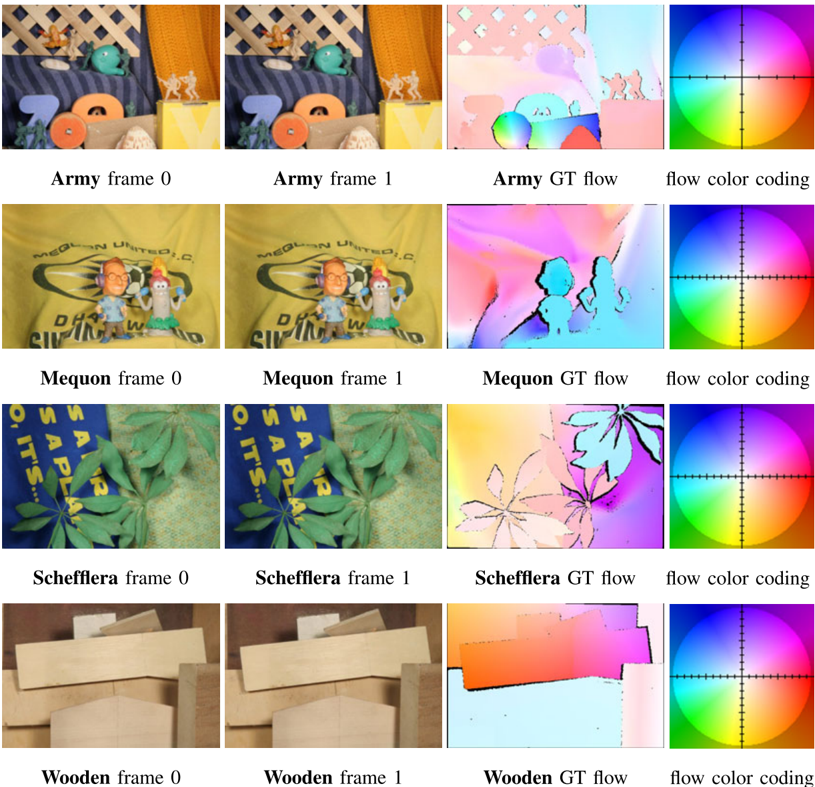
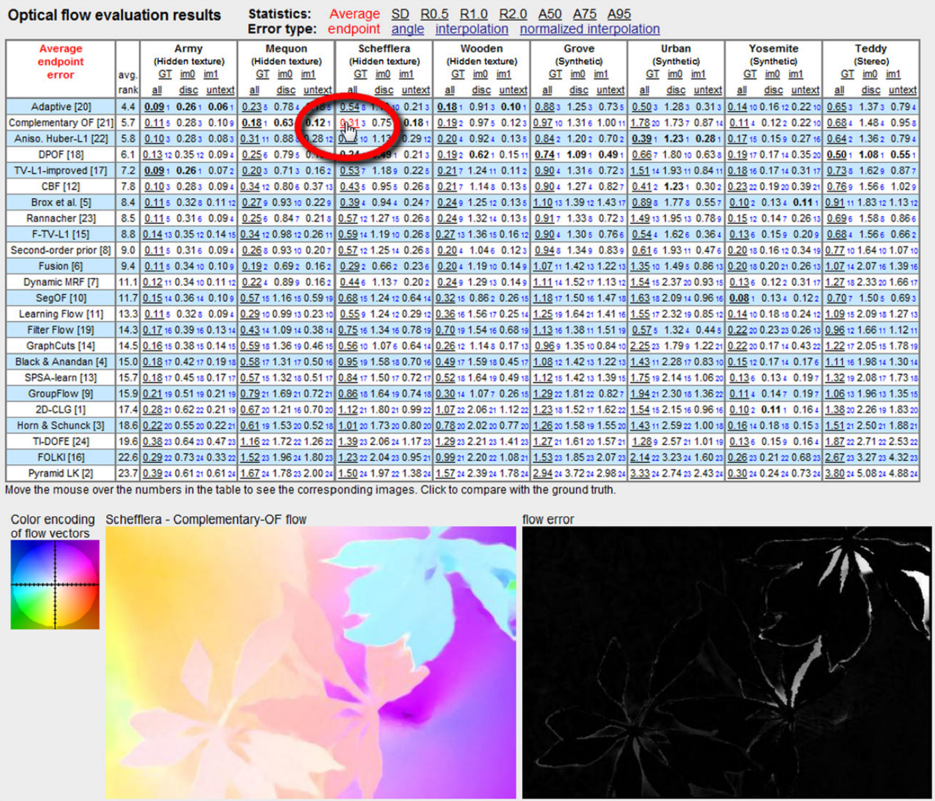
- The benchmark contains 12 training and 12 test sequences; test ground truth is withheld except for Yosemite. As of December 2009 the online evaluation contained results for 24 published methods, all using only 2 input frames and 10 using color.
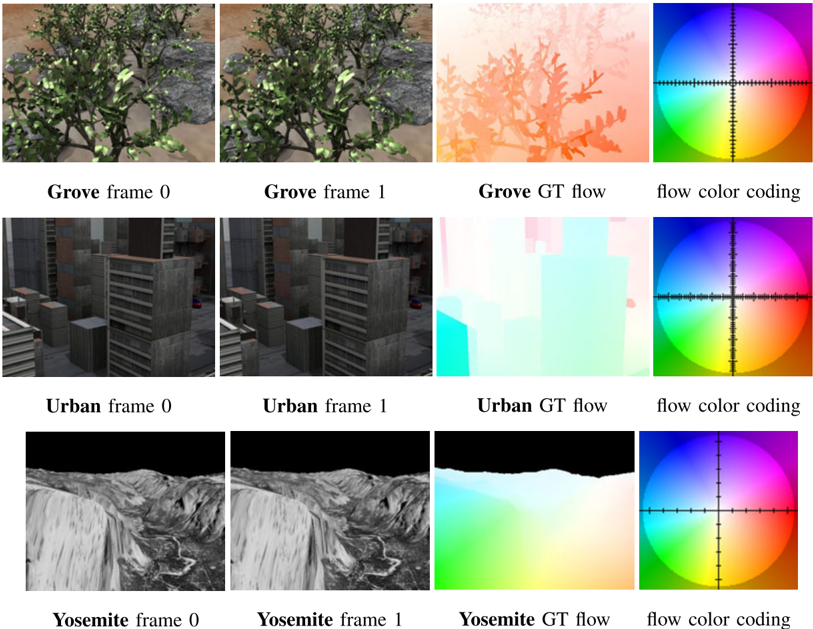
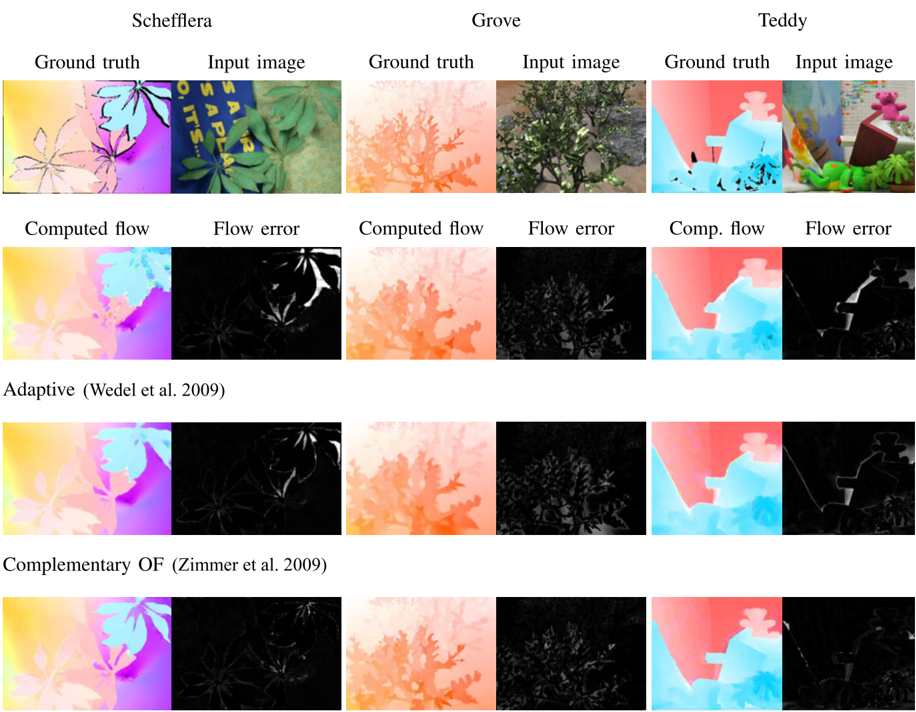
- Best average endpoint error (Avg. EE) improved dramatically over 2D-CLG (Bruhn et al. 2005): Army 0.28→0.09, Mequon 0.67→0.18, Schefflera 1.12→0.24, Wooden 1.07→0.18, Grove 1.23→0.74, Urban 1.54→0.39, Yosemite 0.10→0.08, Teddy 1.38→0.50. Best Avg. EE was below 0.2 pixels on four datasets (Yosemite, Army, Mequon, Wooden).
- Endpoint error (EE) and angular error (AE) rankings were highly correlated (r = 0.989), but the paper argues EE should be preferred: Complementary OF on Urban had Avg. AE 4.64° (rank 6) but Avg. EE 1.78 pixels (rank 20), because AE downweights large motions.
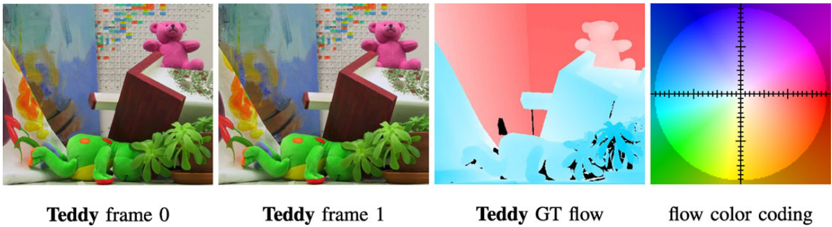
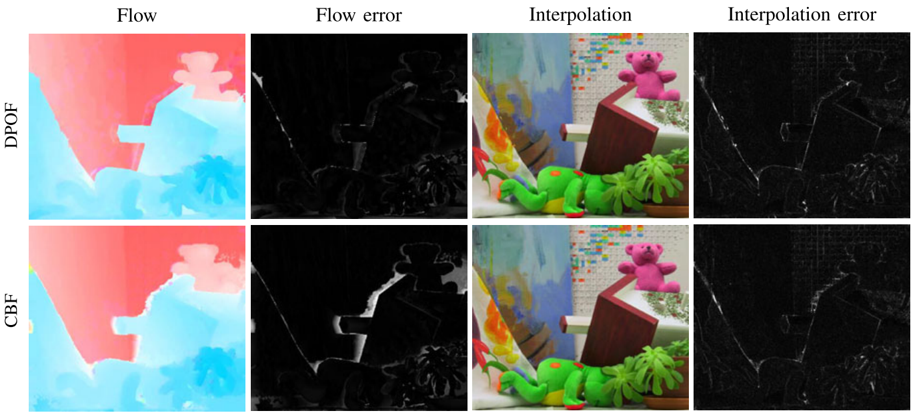
- Motion discontinuity (Disc) regions were the hardest; textureless (Untext) regions were typically easiest. Dataset results were less correlated, with Yosemite poorly or negatively correlated with others. Flow and interpolation errors were only moderately correlated (Avg4 EE vs Avg4 IE r = 0.763). On Teddy, top stereo methods outperformed top flow methods: median lowest-five R1.0 was 9.9 for flow vs 6.5 for stereo in All regions (34% reduction), and 27.6 vs 10.0 in Disc regions (64% reduction).
Methods
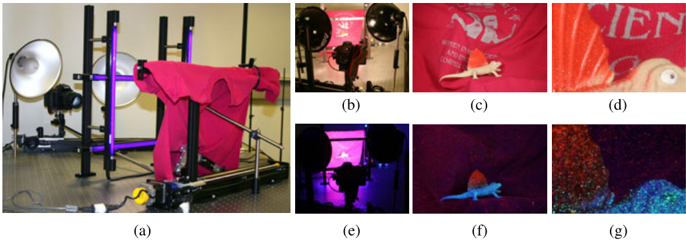
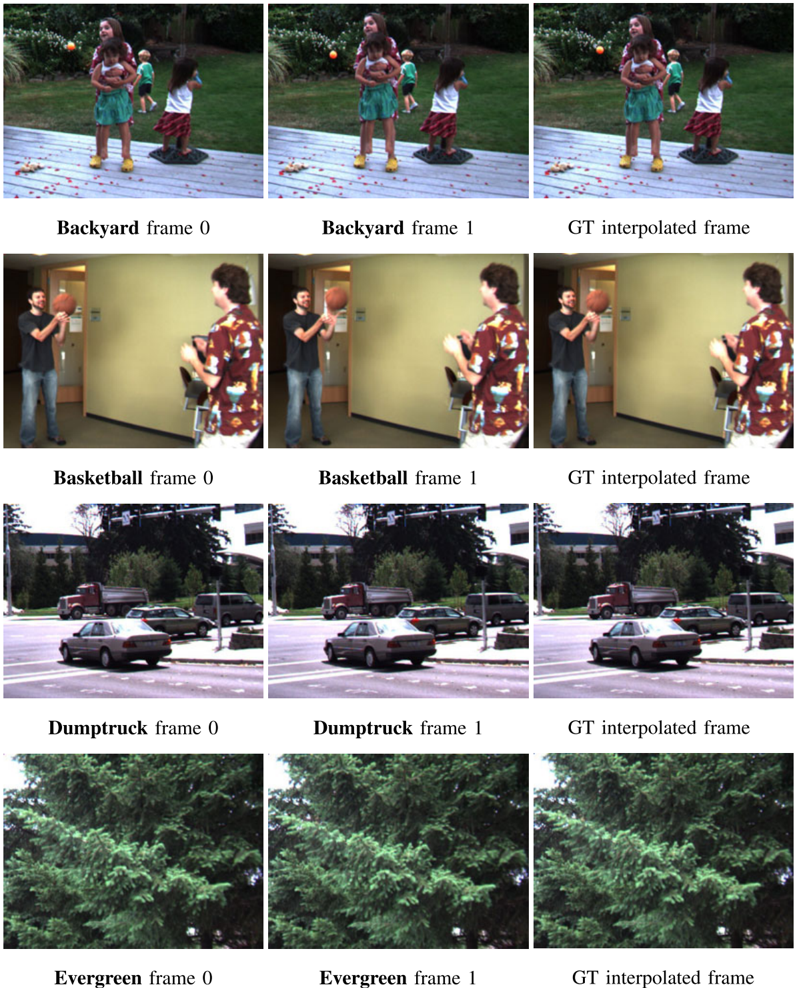
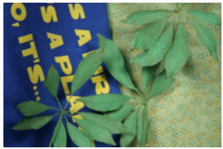
- Four data types were collected: (1) real nonrigid scenes with dense ground truth from hidden fluorescent texture, captured with a Canon EOS 20D at 3504×2336, downsampled every 40th visible-light frame by factor 6 to 584×388, with SSD tracking (15×15 windows), forward/backward crosschecking, and Lucas-Kanade subpixel refinement; (2) realistic synthetic scenes rendered with 3Delight at 640×480, with ground truth from a custom shader and dominant-cluster flow selection; (3) high-speed video for frame interpolation captured with a PointGrey Dragonfly Express at 60 fps, providing every other frame and retaining intermediate frames as ground truth; and (4) modified stereo data (Teddy) from structured light, cropped to make the disparity range roughly symmetric.
- Evaluation metrics include average angular error (AE), absolute flow endpoint error (EE), interpolation error (IE), and gradient-normalized interpolation error (NE). Statistics include averages, robustness measures R_X, and percentile accuracy measures A_X, computed over All, Disc, and Untext region masks.
- Analysis used the online evaluation at http://vision.middlebury.edu/flow/, comparing 24 published methods across metrics, statistics, masks, and datasets, with Pearson correlations between rankings and comparisons to state-of-the-art stereo methods on Teddy.
Limitations
- The paper states that the hidden fluorescent texture scenes are laboratory scenes, not real-world scenes, and have no motion blur due to stop-motion capture; ground truth is unavailable where cross-checking failed, especially occluded regions, and the measured ground truth is not perfect, though significant errors are limited to a small fraction of pixels. Synthetic sequences were generated without motion blur. The modified stereo ground truth is only accurate to 0.25 pixels, and algorithms may exploit the knowledge that motions are horizontal; overfitting to rigid data should be visible across the 12 evaluation images. Interpolation ground truth is an intermediate image, not a flow field, so the flow definition is apparent motion.
- The paper also states that no single method yet achieves strong performance across a wide variety of datatypes, that any dataset has a limited lifespan, and that future studies should include more challenging realistic synthetic data, longer sequences, and more difficult materials, illumination changes, atmospheric effects, and transparency.
- Evident from the text: the online tables do not provide an overall ranking among methods; runtimes are not normalized for programming environment, CPU speed, cores, or hardware acceleration; algorithms are required to produce dense flow and cannot submit confidence maps or sparse/incomplete fields; all 24 published methods used only 2 frames despite 8-frame sequences being available; and the paper cannot definitively answer whether temporal smoothing is less suited to the more challenging sequences.
Model-written summary. Check it against the paper before relying on it.
Integrity signals
Registry
Cites
Statistics
Figures

Verification
Claims the paper makes
2 Valid · 16 Not valid · 58 Not checked · 185 Own results and interpretations
A result the paper states — it cites no source for it, so there is none to check. The quote shows it is in the paper.
In the paper
“Rather than collecting a single type of data (with its inherent limitations) we instead collected four different types of data, each satisfying a different subset of desirable properties.”
plain- Asserted: passes — The authors put it forward as true.
- Checkable: passes — It can be checked against evidence.
- Load-bearing: passes — The paper’s conclusions depend on it.
- Based: passes — The paper gives a reason why it holds.
A result the paper states — it cites no source for it, so there is none to check. The quote shows it is in the paper.
In the paper
“Using the combination of fluorescent paint, downsampling high-resolution images, and sequential tracking of small motions, we are able to obtain dense, subpixel accurate ground truth for a nonrigid scene.”
plainstates a cause- Asserted: passes — The authors put it forward as true.
- Checkable: passes — It can be checked against evidence.
- Load-bearing: passes — The paper’s conclusions depend on it.
- Based: passes — The paper gives a reason why it holds.
A result the paper reports from its own data — it cites no other source for it, so there is none to check. The quote shows it is in the paper.
In the paper
“To allow for measures that predict performance on such tasks, we collected a variety of data suitable for frame interpolation.”
plainstates a cause- Asserted: passes — The authors put it forward as true.
- Checkable: passes — It can be checked against evidence.
- Load-bearing: passes — The paper’s conclusions depend on it.
- Based: passes — The paper gives a reason why it holds.
A result the paper reports from its own data — it cites no other source for it, so there is none to check. The quote shows it is in the paper.
In the paper
“We have developed a technique for capturing imagery of nonrigid scenes with ground-truth optical flow.”
plain- Asserted: passes — The authors put it forward as true.
- Checkable: passes — It can be checked against evidence.
- Load-bearing: passes — The paper’s conclusions depend on it.
- Based: passes — The paper gives a reason why it holds.
A result the paper states — it cites no source for it, so there is none to check. The quote shows it is in the paper.
In the paper
“To go beyond previous synthetic ground truth (e.g., the Yosemite sequence), we generated two types of fairly complex synthetic outdoor scenes.”
plain- Asserted: passes — The authors put it forward as true.
- Checkable: passes — It can be checked against evidence.
- Load-bearing: passes — The paper’s conclusions depend on it.
- Based: passes — The paper gives a reason why it holds.
96 more claims
Create a free account to see all 261 claims and every source verdict.
- Probably not a substantial claim. 114
- It may state two separate claims as one. 76
- The quote only partly states this claim. 6
Claims other papers make about this one
Each is checked against this paper’s own text: does it say what the citing paper says it does?
The source backs part of the claim, not all of it — or backs it for a different population, condition or comparison.
In the citing paper
“Notable works include the Middlebury dataset (Baker et al, 2011) and the KITTI datasets (Geiger et al, 2012; Menze and Geiger, 2015), but due to the difficulty of computing accurate ground truth, these have been restricted to 8 and 2 · 200 pairs of frames, respectively (the latter are also limited by the special driving setting).”
From What Makes Good Synthetic Training Data for Learning Disparity and Optical Flow Estimation? (2018) · cites this paper as Baker et al, 2011
Experimental — accuracy not yet measured
Citations
Cites
The pascal visual object classes (VOC) challenge
Everingham, M., Van Gool, L., Williams, C. K. I., Winn, J., & Zisserman, A. (2010) · International Journal of Computer Vision · doi:10.1007/s11263-009-0275-4 · Cited by 19,599
Proceedings of IEEE Conference on Computer Vision and Pattern Recognition
(1993) · doi:10.1109/cvpr.1993 · Cited by 17,667
Proceedings of IEEE International Conference on Computer Vision
(1995) · Proceedings of IEEE International Conference on Computer Vision · doi:10.1109/iccv.1995.466933 · Cited by 12,860
(1981) · Cited by 11,963
Horn, B. K. P., & Schunck, B. G. (1981) · Artificial Intelligence · doi:10.1016/0004-3702(81)90024-2 · Cited by 10,312
Horn, B. K., & Schunck, B. G. (1981) · SPIE Proceedings · doi:10.1117/12.965761 · Cited by 7,394 · cited 2×
“A baseline approach is to use an L2 norm as in the Horn and Schunck algorithm (Horn and Schunck 1981):”
BackgroundMethodFast approximate energy minimization via graph cuts
Boykov, Y., Veksler, O., & Zabih, R. (2001) · IEEE Transactions on Pattern Analysis and Machine Intelligence · doi:10.1109/34.969114 · Cited by 6,988
A Taxonomy and Evaluation of Dense Two-Frame Stereo Correspondence Algorithms
Scharstein, D., & Szeliski, R. (2002) · International Journal of Computer Vision · doi:10.1023/a:1014573219977 · Cited by 6,740 · cited 10×
“Many areas of computer vision, such as stereo [63], face recognition [28, 55, 68], and object recognition [23, 24], have challenging datasets to track the progress made by leading algorithms and to stimulate new ideas.”
BackgroundMethodResultInfluentialSelf-citationProceedings European Conference on Computer Vision 2002
Heyden, A., Sparr, G., Nielsen, M., & Johansen, P. (2002) · Lund University Publications (Lund University) · Cited by 5,153
From few to many: illumination cone models for face recognition under variable lighting and pose
Georghiades, A. S., Belhumeur, P. N., & Kriegman, D. J. (2001) · IEEE Transactions on Pattern Analysis and Machine Intelligence · doi:10.1109/34.927464 · Cited by 4,912 · cited 1×
“Many areas of computer vision, such as stereo (Scharstein and Szeliski 2002), face recognition (Philips et al. 2005; Sim et al. 2003; Gross et al. 2008; Georghiades et al. 2001), and object recognition (Fei-Fei et al.”
Background
Research works printed but not linked: 4
- Anandan, P., & Weiss, R. (1985). Introducing smoothness constraint in a matching approach for the computation of displacement fields. In Proceedings of the DARPA image understanding workshop (pp. 186-196).
- Bleyer, M., & Chambon, S. (2010). Does color really help in dense stereo matching? In Proceedings of the international symposium 3D data processing, visualization and transmission .
- Lempitsky, V., Roth, S., & Rother, C. (2008). Fusion flow: discretecontinuous optimization for optical flow estimation. In Proceedings of the IEEE conference on computer vision and pattern recognition .
- Rannacher, J. (2009). Realtime 3D motion estimation on graphics hardware . Undergraduate thesis, Heidelberg University.
Cited by
Items 1,401–1,500 of 2,273
Cardiac Motion Estimation in Magnetic Resonance Images Using Optical Flow
Medina, R., Ibarra, E., Morocho, V., & Vanegas, P. (2016) · IEEE Latin America Transactions · doi:10.1109/tla.2016.7555259 · Cited by 5
“El funcionamiento de los algoritmos de estimación de flujo óptico fue estudiado considerando cuatro secuencias extraídas de la base de datos de Middlebury [4].”
BackgroundOptical Flow Templates for Superpixel Labeling in Autonomous Robot Navigation
Roberts, R. B., & Dellaert, F. (2013) · Cited by 4
A photogrammetric technique for generation of an accurate multispectral optical flow dataset
Kniaz, V. V. (2017) · Proceedings of SPIE, the International Society for Optical Engineering/Proceedings of SPIE · doi:10.1117/12.2269956 · Cited by 4
“u(ti) = xp(ti+1)− xp(ti), (7) where xp(ti) – is the projection of point p of the scene in the frame i”
BackgroundAutomatic Detection of Aerial Vehicle in Cloudy Environment by Using Wavelet Enhancement Technique
Pakfiliz, A. G. (2017) · Radioengineering · doi:10.13164/re.2017.1169 · Cited by 4
“The other approach for moving object detection is optical flow, which is defined as a velocity field in the image which transforms one image into the next image in a sequence [7], [8].”
BackgroundMethodA novel deghosting method for exposure fusion
Wang, C., & He, C. (2018) · Multimedia Tools and Applications · doi:10.1007/s11042-018-6261-5 · Cited by 4
“We do lots of experiments on the exposure sequences from the datasets of Orazio Gallo [2], Wei Zhang [28] and Baker [1] that involves a variety of challenging real life scenes for testing different deghosting algorithms.”
MethodOptical flow based waveform for the assessment of the vocal fold vibrations
Ammar, H. (2018) · Australasian Physical & Engineering Sciences in Medicine · doi:10.1007/s13246-018-0717-9 · Cited by 4
Benchmarking The Imbalanced Behavior of Deep Learning Based Optical Flow Estimators
Savian, S., Elahi, M., & Tillo, T. (2019) · International Conference on Signal-Image Technology & Internet-Based Systems (SITIS) · doi:10.1109/sitis.2019.00035 · Cited by 5
Stochastic Models for Local Optical Flow Estimation
Corpetti, T., & Mémin, É. (2012) · Lecture notes in computer science · doi:10.1007/978-3-642-24785-9_59 · Cited by 4
Robust Optical Flow Estimation of Double-Layer Images under Transparency or ReflectionPreprint
Yang, J., Li, H., Dai, Y., et al. (2016) · arXiv (Cornell University) · doi:10.48550/arxiv.1605.01825 · Cited by 4
“Middlebury [2] and Sintel [7] flow datasets, and the reflection dataset in [21]).”
BackgroundOptical Flow Estimation versus Motion Estimation
Sellent, A., Kondermann, D., Simon, S. F., Baker, S., Dedeoǧlu, G., Erdler, O., Parsonage, P., Unger, C., & Niehsen, W. (2012) · heiDOK (Heidelberg University) · doi:10.11588/heidok.00013641 · Cited by 5
“Optical flow estimation is often understood to be identical to dense image based motion estimation [3,5].”
BackgroundSelf-citationOperational tracking of lava lake surface motion at Kīlauea Volcano, Hawai‘i
Patrick, M. R., & Orr, T. R. (2018) · Techniques and methods · doi:10.3133/tm13a3 · Cited by 4
Deep Motion Boundary DetectionPreprint
Yin, X., Dai, X., Wang, X., Zhang, M., Tao, D., & Davis, L. S. (2018) · arXiv (Cornell University) · doi:10.48550/arxiv.1804.04785 · Cited by 5
“As one of the most significant cues in human visual system, optical flow is of great importance for visual learning, structure perception, and self-localization [1,2].”
BackgroundHow, P. R., Hulton, N. R. J., & Buie, L. (2018) · doi:10.5194/gi-2018-28 · Cited by 4
Kernel-Free Image Deblurring with a Pair of Blurred/Noisy Images.Preprint
Gu, C., Lu, X., He, Y., & Zhang, C. (2019) · arXiv (Cornell University) · Cited by 4
Depth-Aware Video Frame InterpolationPreprint
Bao, W., Lai, W.-S., Ma, C., et al. (2019) · arXiv (Cornell University) · doi:10.4230/oasics.ipmvm.2020.19 · Cited by 4
Virtual Rephotography: Novel View Prediction Error for 3D ReconstructionPreprint
Waechter, M., Beljan, M., Fuhrmann, S., et al. (2016) · arXiv (Cornell University) · doi:10.48550/arxiv.1601.06950 · Cited by 5
“Among other metrics this has been implemented in the Middlebury flow benchmark [Baker et al. 2011].”
MethodGolyanik, V., Jonas, A., Stricker, D., & Theobalt, C. (2019) · arXiv (Cornell University) · doi:10.48550/arxiv.1909.02468 · Cited by 6
“The new incoming frames and calculated flow fields visualised with Middlebury colour scheme [6] are given underneath.”
MethodSpace-Time-Aware Multi-Resolution Video EnhancementPreprint
Haris, M., Shakhnarovich, G., & Ukita, N. (2020) · arXiv (Cornell University) · doi:10.48550/arxiv.2003.13170 · Cited by 4
“Middlebury [2] has the original resolution of 640 × 480 pixels.”
BackgroundDriver Intention Anticipation Based on In-Cabin and Driving Scene MonitoringPreprint
Rong, Y., Akata, Z., & Kasneci, E. (2020) · arXiv (Cornell University) · doi:10.48550/arxiv.2006.11557 · Cited by 4
“According to the optical flow color coding [21], the direction changes 90 degree (from bottom side to right side) from the light yellow to blue, and the green is in between.”
BackgroundSpace-Time Video Regularity and Visual Fidelity: Compression, Resolution and Frame Rate AdaptationPreprint
Lee, D. Y., Ko, H., Kim, J.-H., & Bovik, A. C. (2021) · arXiv (Cornell University) · doi:10.48550/arxiv.2103.16771 · Cited by 7
“2 illustrates examples of the computed “most regular” space-time paths of local space-time regions of videos from the Middlebury optical flow database [51], as well as the average ground truth motion vectors for each video patches.”
BackgroundTransFill: Reference-guided Image Inpainting by Merging Multiple Color and Spatial TransformationsPreprint
Zhou, Y., Barnes, C., Shechtman, E., et al. (2021) · arXiv (Cornell University) · doi:10.48550/arxiv.2103.15982 · Cited by 4
AutoFlow: Learning a Better Training Set for Optical FlowPreprint
Sun, D., Vlasic, D., Herrmann, C., Jampani, V., Krainin, M., Chang, H., Ramin Zabih, A., Freeman, W. T., & Liu, C. (2021) · arXiv (Cornell University) · doi:10.48550/arxiv.2104.14544 · Cited by 4
“However, unlike high-level vision tasks, it is only possible to obtain ground truth under controlled lab environments [1] or rigid scenes/objects [12, 23].”
BackgroundBridgeNet: A Joint Learning Network of Depth Map Super-Resolution and Monocular Depth EstimationPreprint
Tang, Q., Cong, R., Sheng, R., et al. (2021) · arXiv (Cornell University) · doi:10.48550/arxiv.2107.12541 · Cited by 4
Asymmetric Bilateral Motion Estimation for Video Frame InterpolationPreprint
Park, J., Lee, C., & Kim, C. (2021) · arXiv (Cornell University) · doi:10.48550/arxiv.2108.06815 · Cited by 4
“Table 1 also lists the actual runtime for interpolating an intermediate frame in the “Urban” sequence in the Middlebury benchmark [1] using an RTX 2080 Ti GPU.”
MethodAn adaptive phase feedback algorithm for displacement tracking from video frames
Luo, J., Yang, Q., Law, S.-S., & Liu, G. (2025) · Mechanical Systems and Signal Processing · doi:10.1016/j.ymssp.2025.113521 · Cited by 5
Block-overlap-based validity metric for hybrid de-interlacing
Santoro, M., AlRegib, G., & Altunbasak, Y. (2012) · Proceedings - International Conference on Image Processing · doi:10.1109/icip.2012.6466991 · Cited by 3
A confidence measure for assessing optical flow accuracy in the absence of ground truth
Márquez-Valle, P., Gil, D., & Hernández-Sabaté, A. (2011) · IEEE International Conference on Computer Vision Workshops · doi:10.1109/iccvw.2011.6130499 · Cited by 3
“In order to measure the accuracy between the groundtruth and the computed OF we have computed the EndPoint Error (EE), defined as follows [4]:”
MethodYang, T., Ren, P., Xie, X., Hua, X.-S., & Zhang, L. (2023) · Lecture notes in computer science · doi:10.1007/978-3-031-25069-9_47 · Cited by 4
Revisiting Event-Based Video Frame Interpolation
Chen, J., Zhu, Y., Lian, D., Yang, J., Wang, Y., Zhang, R., Liu, X., Qian, S., Kneip, L., & Gao, S. (2023) · IEEE/RSJ International Conference on Intelligent Robots and Systems (IROS) · doi:10.1109/iros55552.2023.10341804 · Cited by 5
“…Dataset (b) Real-world Dataset Triplet [34] Septuplet [34] Middlebury [33] HQF [37] HS-ERGB (close) [ [34], Vimeo 90k Setuplet [34] and Middlebury [33]; (b) real datasets: HQF dataset [37], and the close sequences of the HS-ERGB dataset [6] ( × 2 , × 4 , × 6 , × 8 denote skip 1, 3, 5, 7 frames,…”
BackgroundMethodInfluentialSparse optical flow outliers elimination method based on Borda stochastic neighborhood graph
Wang, Y., Li, Y., Wang, J., et al. (2024) · Machine Learning Science and Technology · doi:10.1088/2632-2153/ad1a50 · Cited by 3
“Reproduced from [32], with permission from Springer Nature.”
MethodThe Impact of Metrics in Mechanical Imaging
Chabib, A., Witz, J., Gosselet, P., & Magnier, V. (2024) · Strain · doi:10.1111/str.12494 · Cited by 5
“It analysed the impact of the penalty functions and the effect of other parameters on the displacement field from Middlebury OF benchmark [15], which contains real-life images.”
Parallel Spatio-Temporal Attention Transformer for Video Frame Interpolation
Ning, X., Cai, F., Li, Y., & Ding, Y. (2024) · Electronics · doi:10.3390/electronics13101981 · Cited by 4
“On the Middlebury [9] dataset, we calculate its IE value, where a lower IE represents a better performance.”
MethodInfluentialWang, C., Zhang, J. J., Wilson, M. A., & Etienne‐Cummings, R. (2024) · IEEE Transactions on Pattern Analysis and Machine Intelligence · doi:10.1109/tpami.2024.3410140 · Cited by 5
“Exposure: Learning-based or classic tone-mapping methods can merge time-synchronized low dynamic range (LDR) frames captured at different exposures into a single HDR frame [18], [19], [20], [21], [22], [23], [24], [25], [26], [27], [28], [29].”
BackgroundWong, T. M., Moosmann, J. P., & Zeller‐Plumhoff, B. (2024) · IEEE/CVF Conference on Computer Vision and Pattern Recognition Workshops (CVPRW) · doi:10.1109/cvprw63382.2024.00010 · Cited by 3
“…and deformed structures in µ m ), we evaluate the result based on the average End-Point-Error (EPE), which is defined as the Euclidean distance [1, 14] between the displacement vector f = { f w , f h , f d } and its reference vector f ) This is also because of the difficulty to obtain the ground…”
Wang, R. C., Jorgensen, A. M., Li, D., Sun, T., Yang, Z. X., & Peng, X. (2024) · Space Weather · doi:10.1029/2024sw004040 · Cited by 3
“Motion estimation, in computer vision, focuses on inferring and analyzing the relative motion of the camera and objects (Baker et al., 2011).”
Sokolov, S. V., & Chub, E. G. (2024) · Optoelectronics Instrumentation and Data Processing · doi:10.3103/s8756699024700900 · Cited by 3
GazeMap: Dual-Pathway CNN Approach for Diagnosing Alzheimer’s Disease from Gaze and Head Movements
Jung, H., Ham, S., Kil, H., Shin, J. E., & Kim, E. Y. (2025) · Mathematics · doi:10.3390/math13111867 · Cited by 6
When Pose Estimation Fails: Measuring Occlusion for Reliable Multimodal Interaction
Fan, C., & Chowdhury, T. (2025) · Companion Publication of the International Conference on Multimodal Interaction (ICMI Companion) · doi:10.1145/3747327.3763043 · Cited by 2
“Then, we evaluate the pose estimation model performance us-ing the Average End-Point Error (EPE) metric [3, 23].”
2D amplitude-modulation frequency-modulation - based method for motion estimation
Murray, V., Rodríguez, P., Noriega, M., et al. (2015) · IEEE Latin American Symposium on Circuits and Systems (LASCAS) · doi:10.1109/lascas.2015.7250484 · Cited by 3
“Our motivation for the new perception-based approach comes from the need to maintain compatibility with the majority of optical flow motion methods that are based on a small number of video frames [2], [3] and the fact that there are no perception-based methods that can produce motion estimation estimates at every sin…”
BackgroundMethodOn improving the robustness of differential optical flow
Rashwan, H. A., Puig, D., & García, M. Á. (2011) · IEEE International Conference on Computer Vision Workshops · doi:10.1109/iccvw.2011.6130344 · Cited by 5
“Five families of optical flow methods have been proposed [15], [16]: Differential, region-based, energy-based, phase-based and discrete-optimization methods.”
MethodEvaluation of two-view geometry methods with automatic ground-truth generation
Lakemond, R., Fookes, C., & Sridharan, S. (2013) · Image and Vision Computing · doi:10.1016/j.imavis.2013.09.002 · Cited by 3
“More recently, [26] made use of several methods to establish ground truth for different optical flow tests.”
MethodEstimation of longitudinal muscle motion using a primal-dual algorithm
Li, J., Zhou, Y., Yang, Y.-F., Chen, B., Wang, L., & Zheng, Y. (2012) · Biomedical Engineering International Conference · doi:10.1109/bmeicon.2012.6465425 · Cited by 3
“2 (d) based on a color coded scheme in [31].”
BackgroundLee, J. H., Hwang, Y. N., Park, S. Y., Jeong, J. S., & Kim, S. M. (2014) · IEEE Transactions on Biomedical Engineering · doi:10.1109/tbme.2014.2336672 · Cited by 3
“To better identify regions of abnormal flow patterns, vectorized flow fields were color coded using a reliable color map [30].”
MethodLee, J. H., & Kim, S. M. (2013) · Computers in Biology and Medicine · doi:10.1016/j.compbiomed.2013.09.004 · Cited by 3
Biomedical Imaging: A Computer Vision Perspective
Jiang, X., Dawood, M., Gigengack, F., Risse, B., Schmid, S., Tenbrinck, D., & Schäfers, K. P. (2013) · Lecture notes in computer science · doi:10.1007/978-3-642-40261-6_1 · Cited by 4
“In fact, this assumption combines a number of assumptions about the reflectance properties of the scene, the illumination in the scene, and the image formation process in the camera [2].”
BackgroundLocal Signal Equalization for Correspondence Matching
Bradley, D., & Beeler, T. (2013) · IEEE/CVF International Conference on Computer Vision (ICCV) · doi:10.1109/iccv.2013.236 · Cited by 3
“Correspondence matching is very common in several domains, including stereo reconstruction [20], multi-view reconstruction [21], optical flow [1], and many more.”
BackgroundSensor-based globally asymptotically stable range-only simultaneous localization and mapping
Lourenço, P., Batista, P., Oliveira, P., Silvestre, C., & Chen, C. L. P. (2013) · IEEE Conference on Decision and Control (CDC) · doi:10.1109/cdc.2013.6760786 · Cited by 4
Image Capture and Representation
Krig, S. (2014) · Apress eBooks · doi:10.1007/978-1-4302-5930-5_1 · Cited by 3
Introduction to Dense Optical Flow
Liu, C. (2015) · Springer eBooks · doi:10.1007/978-3-319-23048-1_1 · Cited by 3
Karargyris, A. (2010) · OhioLink ETD Center (Ohio Library and Information Network) · Cited by 4
On the nonlinear analysis of optical flow
Xia, S.-X., & Yin, Y.-M. (2016) · Topological Methods in Nonlinear Analysis · doi:10.12775/tmna.2016.054 · Cited by 4
“In the paper [16], Roth and Black constructed a database of natural scene motions by making use of range images and camera motions (some other databases of optical flow are available in [4], [11]), they studied the spatial statistics of optical flow and gained a rich prior model of optical flow.”
BackgroundDense optical flow computation using textural features
Qu, Z., Liang, L., & Lu, J. (2016) · International Conference on Wireless Communications and Signal Processing (WCSP) · doi:10.1109/wcsp.2016.7752554 · Cited by 3
“[10] introduced brightness gradient as an additional flow constraint term, and the method is also adopted in [3,11].”
BackgroundMethodHorn & Schunck parameter characterization of the gradient based method for Optical Flow computing
Blanco-Silva, G.-E., Ramos-Arreguín, J. M., Toledano‐Ayala, M., & Rodríguez‐Reséndiz, J. (2017) · International Conference on Electronics, Communications, and Computers · doi:10.1109/conielecomp.2017.7891814 · Cited by 3
Towards a Smart Exploitation of GPUs for Low Energy Motion Estimation Using Full HD and 4K Videos
Mahmoudi, S. A., Belarbi, M. A., & Manneback, P. (2018) · Lecture notes in networks and systems · doi:10.1007/978-3-319-97719-5_18 · Cited by 3
Jeong, Y., Moon, S., Jeong, J., et al. (2018) · Applied Sciences · doi:10.3390/app8060890 · Cited by 3
Xiang, X., Zhai, M., Zhang, R., Wangwang, X., & Saddik, A. E. (2018) · IEEE Access · doi:10.1109/access.2018.2841880 · Cited by 3
Nguyen, B., Berger, C., & Benderius, O. (2019) · IEEE/RSJ International Conference on Intelligent Robots and Systems (IROS) · doi:10.1109/iros40897.2019.8968066 · Cited by 3
“hard to make them truly real-time with given conventional definitions and guidelines of real-time system [4].”
Parallel implementation of a robust optical flow technique
Sánchez, J., López, N. M. M., & de la Nuez, A. J. S. (2012) · Acceda (Universidad de Las Palmas de Gran Canaria) · Cited by 4
Orthonormal Diffusion Decompositions of Images for Optical Flow Estimation
Gudivada, S., & Borş, A. G. (2013) · Lecture notes in computer science · doi:10.1007/978-3-642-40246-3_30 · Cited by 3
“Lately, various approaches have employed regularization with constraints [11] or smoothing with diffusion kernels [12].”
BackgroundMethodA Duality Based Approach For Fractional Order Tv-Model In Optical Flow Estimation
Kumar, P. (2020) · International Conference on Computing, Communication and Security (ICCCS) · doi:10.1109/icccs49678.2020.9276840 · Cited by 3
“The performance of the proposed fractional order TV-model is analyzed on Grove, RubberWhale, Urban and Venus datasets (available at [22]).”
MethodRefinement of matching costs for stereo disparities using recurrent neural networks
Emlek, A., & Peker, M. (2021) · EURASIP Journal on Image and Video Processing · doi:10.1186/s13640-021-00551-9 · Cited by 3
“EPE is defined in [39] as given in Eq.”
BackgroundMethodHobloss, N., Zhang, L., & Cagnazzo, M. (2021) · International Conference on Quality of Multimedia Experience (QoMEX) · doi:10.1109/qomex51781.2021.9465458 · Cited by 6
Yang, K., Wu, S., Samuel, O. W., Zhang, H., Ghista, D. N., Yang, D., & Wong, K. K. L. (2021) · Frontiers in Physiology · doi:10.3389/fphys.2021.698405 · Cited by 5
Yang, K., Wu, S., Ghista, D. N., Yang, D., & Wong, K. K. L. (2022) · Computer Methods and Programs in Biomedicine · doi:10.1016/j.cmpb.2022.106678 · Cited by 3
Multi-encoder Network for Parameter Reduction of a Kernel-based Interpolation Architecture
Khalifeh, I., Blanch, M. G., Ebroul Izquierdo, M., & Mrak, M. (2022) · IEEE/CVF Conference on Computer Vision and Pattern Recognition Workshops (CVPRW) · doi:10.1109/cvprw56347.2022.00088 · Cited by 3
“To provide a fair comparison to the base approach, the Middlebury other dataset [1] with publicly available ground truth, selected sequences of UCF-101 [27] and the DAVIS [23] set are used.”
MethodRazavian, M., Oestges, C., & Vanhoenacker‐Janvier, D. (2022) · Radio Science · doi:10.1029/2022rs007553 · Cited by 3
A Fast Hybrid Deep Neural Network Model for pushing behavior detection in human crowds
Alia, A., Maree, M., & Chraibi, M. (2022) · IEEE/ACS International Conference on Computer Systems and Applications (AICCSA) · doi:10.1109/aiccsa56895.2022.10017883 · Cited by 3
“Feature extraction employs three methods to extract the relevant features from the input: pre-trained deep optical flow model [6], wheel color [7], and EfficientNetB1 [8].”
MethodShi, C., He, J., Pundlik, S. J., Zhou, X., Wu, N., & Luo, G. (2023) · Science China Information Sciences · doi:10.1007/s11432-021-3473-1 · Cited by 4
Dorazil, J., Fleury, B. H., & Hlawatsch, F. (2023) · IEEE International Conference on Acoustics Speech and Signal Processing · doi:10.1109/icassp49357.2023.10095694 · Cited by 3
“Optical flow (OF) estimation is an important image processing task with a wide range of applications including video compression, autonomous navigation, and medical diagnosis and intervention [1].”
BackgroundLiu, S., Zhang, H., Li, C., et al. (2023) · BMC Medical Imaging · doi:10.1186/s12880-023-01040-3 · Cited by 3
StarCraftImage: A Dataset For Prototyping Spatial Reasoning Methods For Multi-Agent Environments
Kulinski, S., Waytowich, N. R., Hare, J. Z., & Inouye, D. I. (2023) · IEEE Computer Society Conference on Computer Vision and Pattern Recognition/Proceedings - IEEE Computer Society Conference on Computer Vision and Pattern Recognition/Proceedings · doi:10.1109/cvpr52729.2023.02107 · Cited by 7
“For the encoder, the convolutional layers consist of [3 , 32 , 64 , 128 , 128 , 512] channels, the decoder con-18 volutional layers consist of [512 , 128 , 128 , 64 , 32 , 3] channels, and the fully connected layer takes in the 512 channels and projects this to the 64 dimensional µ and σ latent…”
BackgroundMethodAn Efficient Multi-Scale Attention Feature Fusion Network for 4K Video Frame Interpolation
Ning, X., Li, Y., Feng, Z., Liu, J., & Ding, Y. (2024) · Electronics · doi:10.3390/electronics13061037 · Cited by 4
Evolution of transformer-based optical flow estimation techniques: a survey
Kumar, N., Verma, O. P., & Parihar, A. S. (2024) · Multimedia Tools and Applications · doi:10.1007/s11042-024-20246-3 · Cited by 5
Color Mismatch Compensation Method Based on a Physical Model
Bao, Q., Beghdadi, A., & Luong, M. (2012) · IEEE Transactions on Circuits and Systems for Video Technology · doi:10.1109/tcsvt.2012.2203733 · Cited by 4
“Then some measures of performance of optical flow such as the angular error (AE) and the error in flow (EE) [40] are used.”
MethodKumar, P., Kumar, S., & Raman, B. (2016) · International Conference on Advanced Computational Intelligence (ICACI) · doi:10.1109/icaci.2016.7449814 · Cited by 3
“Middlebury datasets with their brief description are given in [28].”
BackgroundGu, I. Y., Kumar, D. P., & Yun, Y. (2016) · Lecture notes in computer science · doi:10.1007/978-3-319-41501-7_55 · Cited by 3
Flight-Test Evaluation of Navigation Information in Wide-Field Optical Flow
Chao, H., Gu, Y., Gross, J. N., Rhudy, M. B., & Napolitano, M. (2016) · Journal of Aerospace Information Systems · doi:10.2514/1.i010482 · Cited by 3
A torus model for optical flow
Adams, H., Bush, J., Carr, B., Kassab, L., & Mirth, J. (2019) · Pattern Recognition Letters · doi:10.1016/j.patrec.2019.11.029 · Cited by 6
“The Middlebury dataset in [6] ranges from real stereo imagery of rigid scenes to realistic synthetic imagery; the database contains public ground truth optical flow training data along with sequestered ground truth data for the purpose of testing algorithms.”
BackgroundAdaptive Frame Interpolation using an End-to-End Deep Net with High Quality Flow Estimation
Tseng, R.-Y., Liu, Y., Chen, J.-C., & Lin, K. W. (2019) · Conference on Technologies and Applications of Artificial Intelligence (TAAI) · doi:10.1109/taai48200.2019.8959822 · Cited by 4
“Then, use optical flow to warp and blend input frames to synthesis in-between frame [1][2][3][4].”
MethodBWIN: A Bilateral Warping Method for Video Frame Interpolation
Xue, F., Li, J., Liu, J., & Wu, C. (2021) · IEEE International Conference on Multimedia and Expo (ICME) · doi:10.1109/icme51207.2021.9428254 · Cited by 4
“The Middlebury benchmark [18] is widely used in video frame interpolation.”
MethodCamera motion detection for story and multimedia information convergence
Bak, H.-Y., & Park, S.-B. (2021) · Personal and Ubiquitous Computing · doi:10.1007/s00779-021-01585-6 · Cited by 4
Brightness Intensity-Based Transient Motion Prediction
Tekwani, H., & Raj, K. (2021) · Smart innovation, systems and technologies · doi:10.1007/978-981-16-2877-1_27 · Cited by 3
Constrained Visual-Inertial Localization With Application And Benchmark in Laparoscopic Surgery
Hartwig, R., Ostler, D., Rosenthal, J.-C., Feußner, H., Wilhelm, D., & Wollherr, D. (2022) · Proceedings - IEEE International Conference on Robotics and Automation/Proceedings · doi:10.1109/icra46639.2022.9812105 · Cited by 4
Brown, R. J., Hernández, W., Escobar, D., Gutiérrez, E., Crummy, J. M., Cole, R. P., & Tournigand, P. (2022) · Volcanica · doi:10.30909/vol.05.02.271293 · Cited by 3
Zhao, X., Wang, C., Liu, W., et al. (2022) · Measurement Science and Technology · doi:10.1088/1361-6501/aca042 · Cited by 3
“The second is the MPI-Sintel Dataset [30], which Figure 4.”
InfluentialData Driven Optical Flow Prediction for Improving Direct Method Visual SLAM Systems
Wan, B., Chen, W., He, L., & Zhang, H. (2022) · IEEE International Conference on Robotics and Biomimetics (ROBIO) · doi:10.1109/robio55434.2022.10011968 · Cited by 3
“This method is commonly used and is more appropriate in most applications in comparison to other evaluation metrics [1].”
MethodWhen Discrete Meets Differential: Assessing the Stability of Structure from Small Motion
Lin, W.-Y., Tan, G.-C., & Cheong, L. (2009) · International Journal of Computer Vision · doi:10.1007/s11263-009-0260-y · Cited by 3
Improving Optical Flow Using Residual and Sobel Edge Images
Vaudrey, T., Wedel, A., Chen, C., & Klette, R. (2010) · Lecture notes of the Institute for Computer Sciences, Social Informatics and Telecommunications Engineering · doi:10.1007/978-3-642-11577-6_27 · Cited by 5
“Results: To compare the results numerically, we calculated the end-pointerror (EPE) as used in [1], which is basically a 2D-root mean squared error.”
BackgroundMethodResultInfluentialOptical Flow as a Tool for Cardiac Motion Estimation
Ibarra, E., Medina, R., Morocho, V., & Vanegas, P. (2015) · Asia-Pacific Conference on Computer Aided System Engineering (APCASE) · doi:10.1109/apcase.2015.38 · Cited by 3
“The comparison is performed using several image sequences that have been used as part of the Middlebury optical flow benchmark [4].”
MethodFocus of Expansion Localization through Inverse C-Velocity
Bak, A., Bouchafa, S., & Aubert, D. (2011) · Lecture notes in computer science · doi:10.1007/978-3-642-24085-0_50 · Cited by 3
“The former being the prominent one in most real-time capable algorithms, especially on image discontinuities [11], the later being a common pitfall of local optical flow estimation methods.”
BackgroundQuality Assessment of Non-dense Image Correspondences
Sellent, A., & Wingbermühle, J. (2012) · Lecture notes in computer science · doi:10.1007/978-3-642-33868-7_12 · Cited by 4
“1: (a) Input image from scene taken from [1].”
BackgroundInfluentialEnhancement of imagery of objects with highly dynamic brightness and large rotational motion
Kanaev, A. V., Miller, C. W., Seanor, C. J., & Murray-Krezan, J. (2014) · Applied Optics · doi:10.1364/ao.53.000c32 · Cited by 3
Motion estimation using block overlap minimization
Santoro, M., AlRegib, G., & Altunbasak, Y. (2012) · IEEE International Workshop on Multimedia Signal Processing (MMSP) · doi:10.1109/mmsp.2012.6343438 · Cited by 3
“We also demonstrate the effectiveness of overlap minimization using the eight ground truth test sequences from Middlebury University [13].”
MethodA self-organization based optical flow estimator with GPU implementation
Shiralkar, M. P., & Schalkoff, R. J. (2011) · Machine Vision and Applications · doi:10.1007/s00138-011-0352-x · Cited by 5
“While Black and Anandan [3] use a Lorenzian penalty function, recent algorithms typically use the L1 norm [1].”
MethodInfluentialEdge preserving motion estimation with occlusions correction for assisted 2D to 3D conversion
Pohl, P., Sirotenko, M., Tolstaya, E. V., et al. (2014) · Proceedings of SPIE, the International Society for Optical Engineering/Proceedings of SPIE · doi:10.1117/12.2039674 · Cited by 3
“To have some quantification as well as comparison with state-of-the-art we used famous Middlesbury optical flow evaluation database accessible at [7] and described in [6].”
MethodExtracting motion data from video using optical flow with physically-based constraints
Frakes, D. H., Zwart, C. M., & Singhose, W. (2013) · International Journal of Control Automation and Systems · doi:10.1007/s12555-011-0026-5 · Cited by 3
“To demonstrate the suitability of MCGI for the proposed applications, it is compared here to both classical Horn-Schunk optical flow [2] and to the very recently proposed Segment Adaptive Gradient Angle (SAGA) interpolation [31].”
BackgroundMethodInfluentialOptical Flow Estimation using Phase Only-Correlation
Reyes, A., Alba, A., & Arce-Santana, E. (2013) · Procedia Technology · doi:10.1016/j.protcy.2013.04.013 · Cited by 3
“In order to evaluate the results of the proposed method, we apply it to image sequences obtained from the Middlebury database [7].”
MethodYang, Q., & Wen, Y. (2014) · International Joint Conference on Neural Networks (IJCNN) · doi:10.1109/ijcnn.2014.6889439 · Cited by 3
“The comparison of average angle error (AAE) [26] of five descriptors is listed in the Table 1.”
BackgroundMRF-based true motion estimation using H.264 decoding information
Huang, Y.-L., Liu, Y., & Chien, S. (2010) · SiPS ... design and implementation - IEEE Workshop on Signal Processing Systems · doi:10.1109/sips.2010.5624772 · Cited by 3
Fast digital optical flow estimation based on EMD
Quelin, M., Bouzerdoum, A., & Phung, S. L. (2010) · European Workshop on Visual Information Processing · doi:10.1109/euvip.2010.5699108 · Cited by 3
“Recently, new evaluation methods have been proposed to compare and improve the latest computer vision optical flow estimators [1].”
Method
Metadata
- Authors
- Baker, S., Scharstein, D., Lewis, J. P., Roth, S., Black, M. J., & Szeliski, R.
- Affiliations
- Microsoft (United States) (US)
- Middlebury College (US)
- Technische Universität Darmstadt (DE)
- Brown University (US)
- Corresponding author
- Scharstein, Daniel
- Venue
- International Journal of Computer Vision
- Published
- 2010-11-30
- Volume
- 92
- Issue
- 1
- Pages
- 1-31
- ISSN
- 0920-5691 (ISSN-L)
- 1573-1405
- OpenAlex
- W2147253850
- Semantic Scholar
- 804836b8ad86ef8042e3dcbd45442a52f031ee03
- Cited by
- 2,205
- References
- 112
- Citations by year
- 2026: 49 · 2025: 81 · 2024: 82 · 2023: 117 · 2022: 129 · 2021: 152 · 2020: 174 · 2019: 163 · 2018: 144 · 2017: 156 · 2016: 187 · 2015: 180 · 2014: 154 · 2013: 129 · 2012: 118
- FWCI
- 146.62
- Type
- journal article
- Language
- en
- Open access
- hybrid
- doi.org
- Licence
- cc-by-nc
- Locations
- International Journal of Computer Vision (publishedVersion, cc-by-nc)
- Publikationsdatenbank der Fraunhofer-Gesellschaft (Fraunhofer-Gesellschaft) (publishedVersion)
- Max Planck Institute for Plasma Physics (submittedVersion)
- Fraunhofer-Publica (Fraunhofer-Gesellschaft) (submittedVersion)
- Funders
- National Science Foundation (0534858, 0535075, 0413169)
- Intel Corporation
- Topics
- Physical Sciences › Computer Science › Computer Vision and Pattern Recognition › Advanced Vision and Imaging
- Physical Sciences › Computer Science › Computer Vision and Pattern Recognition › Video Surveillance and Tracking Methods
- Physical Sciences › Computer Science › Signal Processing › Video Coding and Compression Technologies
- Keywords
- optical flow, benchmark dataset, evaluation methodology, non-rigid motion, motion discontinuities, textureless regions, sensor noise
About these checks
Registry, retraction, Cites and statistics results are computed, not judged, with one exception: a printed reference that no index lists is read once by a model before it counts as a citation error. Claims are extracted by a model and kept only when their quote appears verbatim in the text; each cited source is then checked, with a model’s help, for whether it says what the claim relies on. Those verdicts can be wrong — read the claim’s quote and the cited source before relying on one.
The claim verdicts this report counts are experimental: their accuracy is not yet measured.
A language model drew the claims from the paper on 2026-10-01, under version 3 of the claim definition (model deepseek-v4.1-flash, prompt extract-v3).
A second model labelled each claim on 2026-10-01 (model jev-1.13-20260917, definition revision gold-guideline-v0.2).
Statistics and arithmetic are recomputed, not judged.
Confidence bands are shown only for fields calibrated on our annotated test set. None is calibrated yet, so no band is shown.
What counts as a claim ›How we measure confidence ›How we check this ›
Are you an author, or do you see a problem with this page? Request a review
Data sources
Bibliographic data: Semantic Scholar, OpenAlex, Crossref.
Contains information from the Semantic Scholar Academic Graph Datasets, made available under the ODC Attribution License (ODC-BY 1.0).
Semantic Scholar’s data is described in: Kinney, R., et al. (2023). The Semantic Scholar Open Data Platform. arXiv:2301.10140.
