

A Database and Evaluation Methodology for Optical Flow
Open accessThe DOI matches its Crossref record; 110 of the 112 references it cites were found in a registry or an index; 2 of the 68 sources its claims cite were checked for support.
Abstract
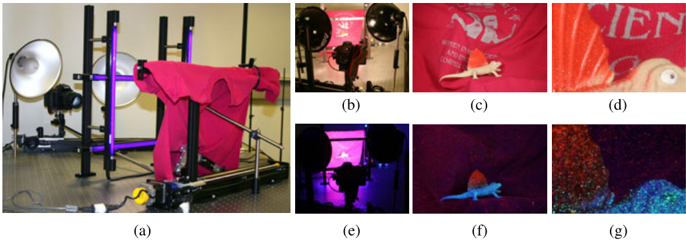
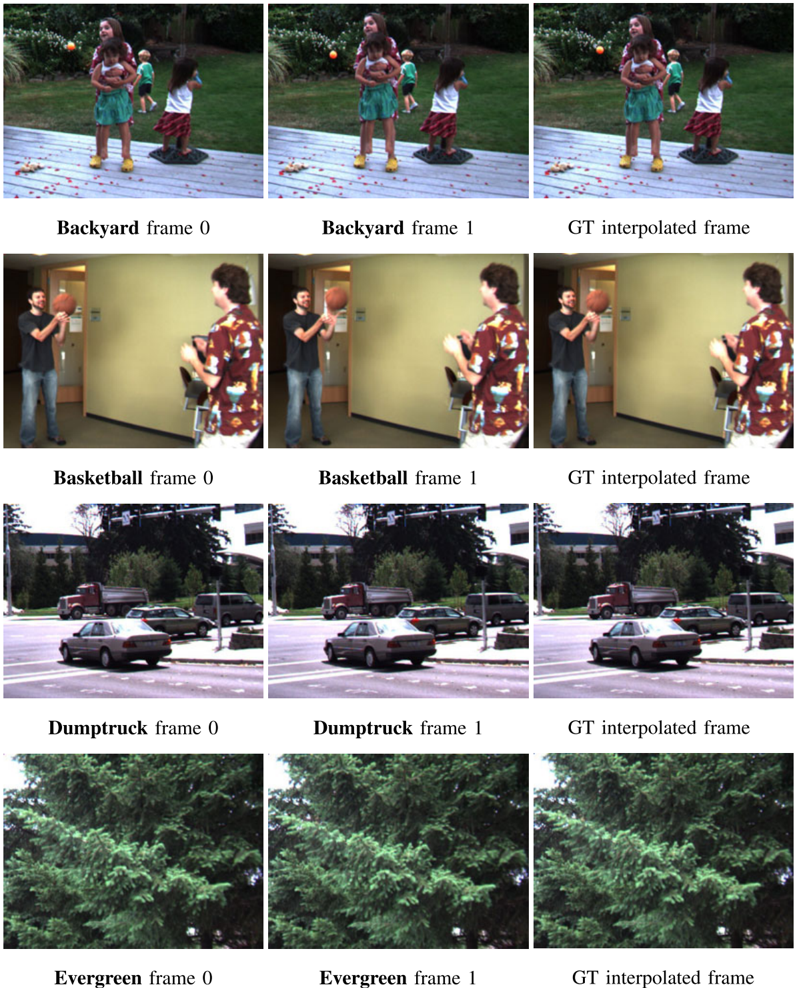
The quantitative evaluation of optical flow algorithms by Barron et al. (1994) led to significant advances in performance. The challenges for optical flow algorithms today go beyond the datasets and evaluation methods proposed in that paper. Instead, they center on problems associated with complex natural scenes, including nonrigid motion, real sensor noise, and motion discontinuities. We propose a new set of benchmarks and evaluation methods for the next generation of optical flow algorithms. To that end, we contribute four types of data to test different aspects of optical flow algorithms: (1) sequences with nonrigid motion where the ground-truth flow is determined by tracking hidden fluorescent texture, (2) realistic synthetic sequences, (3) high frame-rate video used to study interpolation error, and (4) modified stereo sequences of static scenes. In addition to the average angular error used by Barron et al., we compute the absolute flow endpoint error, measures for frame interpolation error, improved statistics, and results at motion discontinuities and in textureless regions.
Overview
CoChat Summary
TL;DR
The paper introduces a new optical flow benchmark of four data types (hidden fluorescent texture, realistic synthetic, high-speed interpolation, and modified stereo) plus an extended evaluation methodology with endpoint error, interpolation error, robustness/accuracy statistics, and region masks. It reports that performance improved substantially over the preliminary 2007 study, but motion discontinuities and diverse datasets remain difficult, and top flow methods still lag top stereo methods on the modified Teddy stereo data.
Key findings
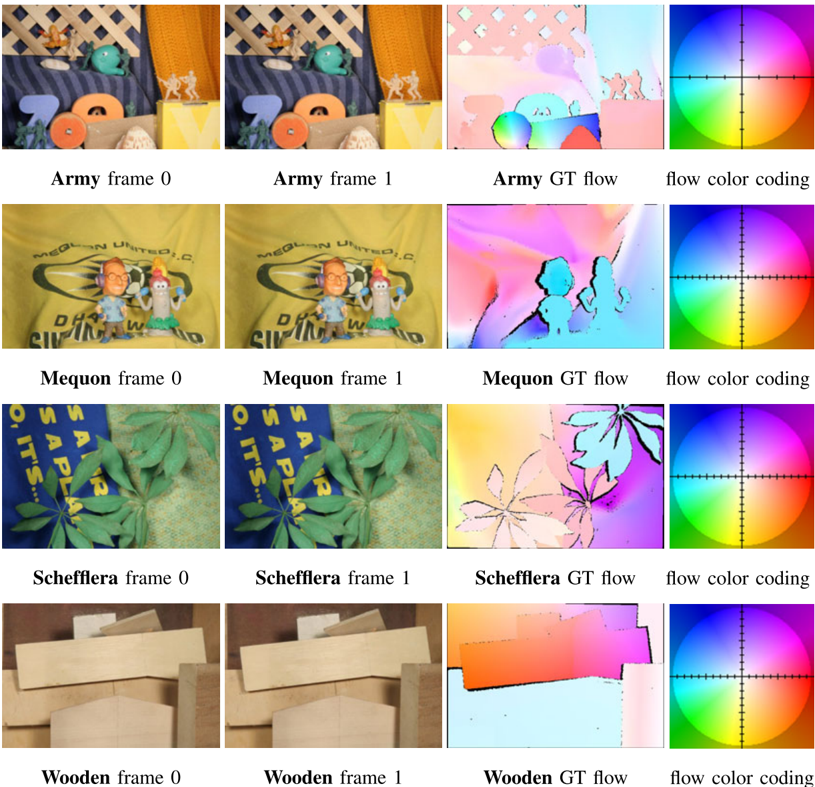
- The benchmark contains 12 training and 12 test sequences; test ground truth is withheld except for Yosemite. As of December 2009 the online evaluation contained results for 24 published methods, all using only 2 input frames and 10 using color.
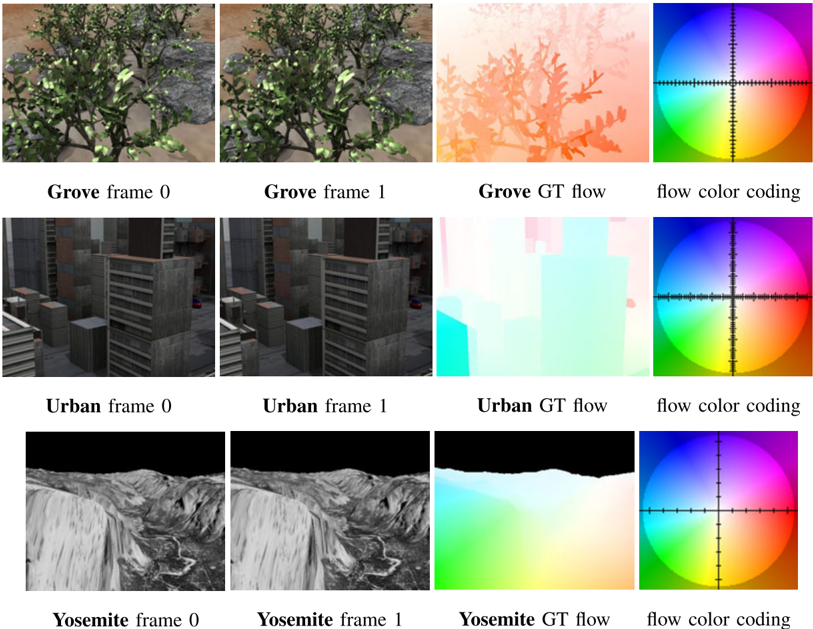
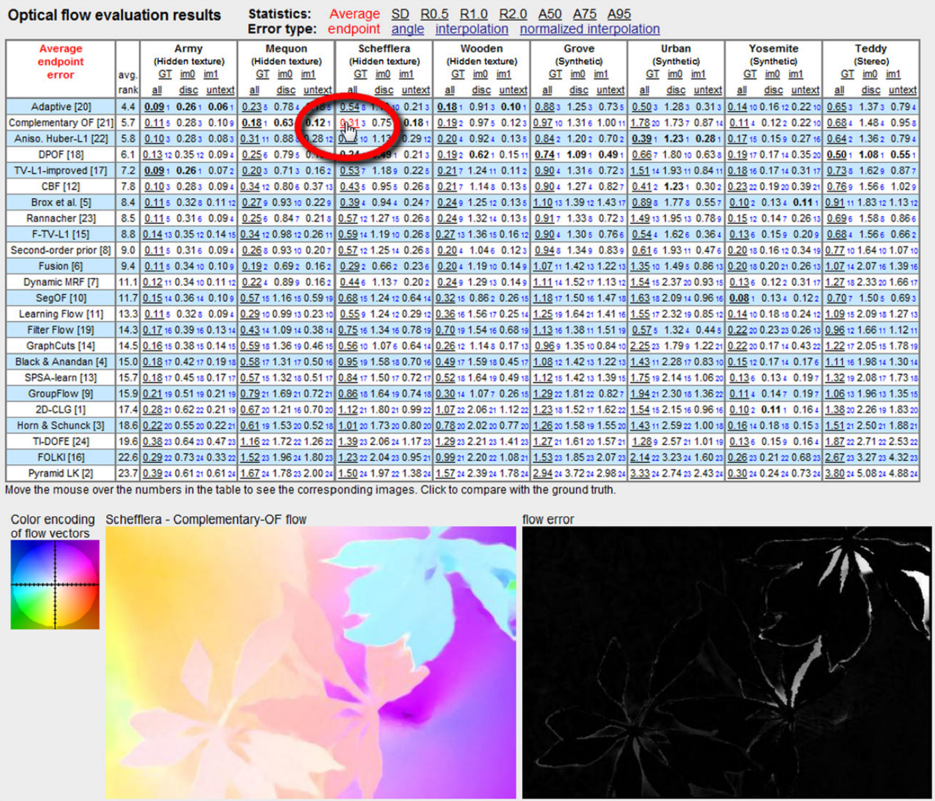
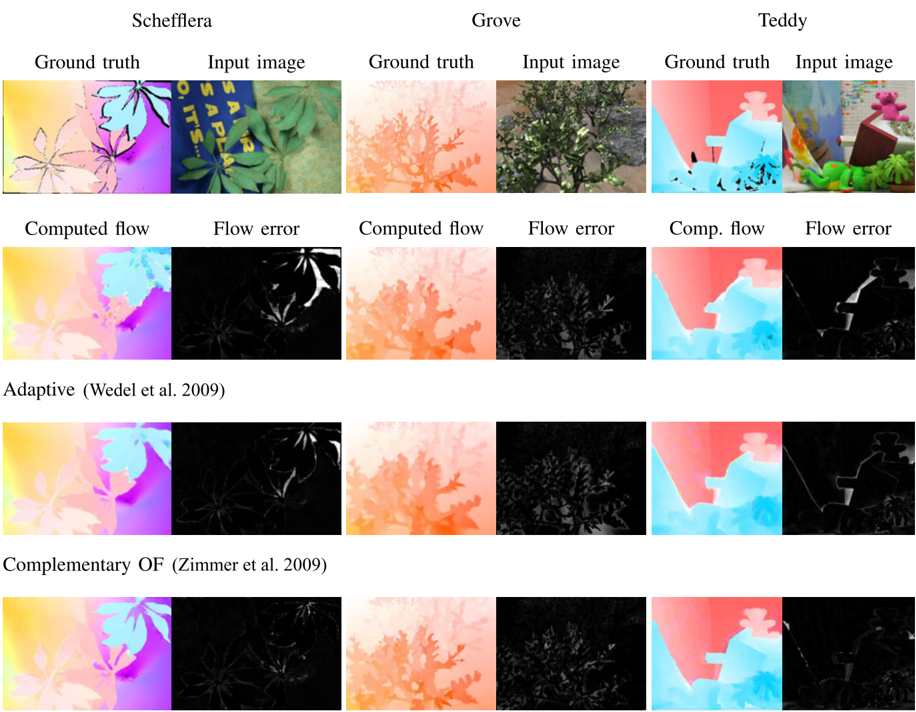
- Best average endpoint error (Avg. EE) improved dramatically over 2D-CLG (Bruhn et al. 2005): Army 0.28→0.09, Mequon 0.67→0.18, Schefflera 1.12→0.24, Wooden 1.07→0.18, Grove 1.23→0.74, Urban 1.54→0.39, Yosemite 0.10→0.08, Teddy 1.38→0.50. Best Avg. EE was below 0.2 pixels on four datasets (Yosemite, Army, Mequon, Wooden).
- Endpoint error (EE) and angular error (AE) rankings were highly correlated (r = 0.989), but the paper argues EE should be preferred: Complementary OF on Urban had Avg. AE 4.64° (rank 6) but Avg. EE 1.78 pixels (rank 20), because AE downweights large motions.
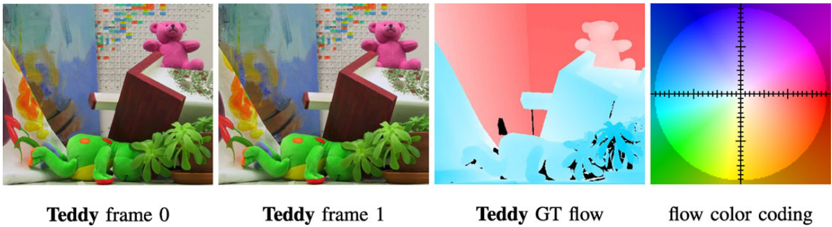
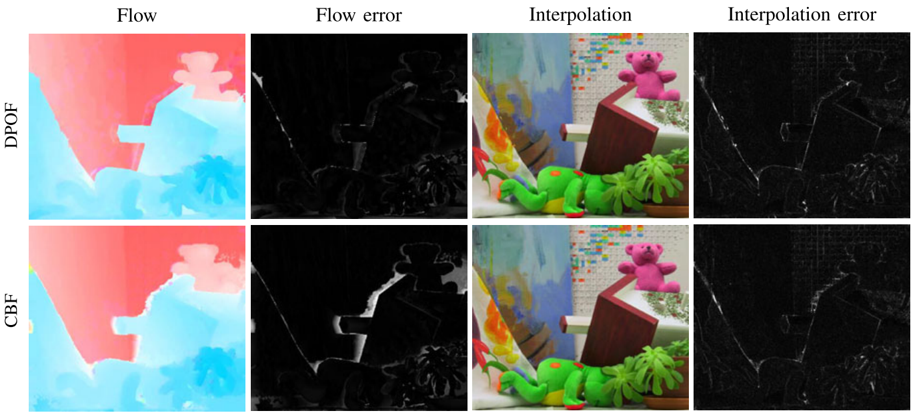
- Motion discontinuity (Disc) regions were the hardest; textureless (Untext) regions were typically easiest. Dataset results were less correlated, with Yosemite poorly or negatively correlated with others. Flow and interpolation errors were only moderately correlated (Avg4 EE vs Avg4 IE r = 0.763). On Teddy, top stereo methods outperformed top flow methods: median lowest-five R1.0 was 9.9 for flow vs 6.5 for stereo in All regions (34% reduction), and 27.6 vs 10.0 in Disc regions (64% reduction).
Methods
- Four data types were collected: (1) real nonrigid scenes with dense ground truth from hidden fluorescent texture, captured with a Canon EOS 20D at 3504×2336, downsampled every 40th visible-light frame by factor 6 to 584×388, with SSD tracking (15×15 windows), forward/backward crosschecking, and Lucas-Kanade subpixel refinement; (2) realistic synthetic scenes rendered with 3Delight at 640×480, with ground truth from a custom shader and dominant-cluster flow selection; (3) high-speed video for frame interpolation captured with a PointGrey Dragonfly Express at 60 fps, providing every other frame and retaining intermediate frames as ground truth; and (4) modified stereo data (Teddy) from structured light, cropped to make the disparity range roughly symmetric.
- Evaluation metrics include average angular error (AE), absolute flow endpoint error (EE), interpolation error (IE), and gradient-normalized interpolation error (NE). Statistics include averages, robustness measures R_X, and percentile accuracy measures A_X, computed over All, Disc, and Untext region masks.
- Analysis used the online evaluation at http://vision.middlebury.edu/flow/, comparing 24 published methods across metrics, statistics, masks, and datasets, with Pearson correlations between rankings and comparisons to state-of-the-art stereo methods on Teddy.
Limitations
- The paper states that the hidden fluorescent texture scenes are laboratory scenes, not real-world scenes, and have no motion blur due to stop-motion capture; ground truth is unavailable where cross-checking failed, especially occluded regions, and the measured ground truth is not perfect, though significant errors are limited to a small fraction of pixels. Synthetic sequences were generated without motion blur. The modified stereo ground truth is only accurate to 0.25 pixels, and algorithms may exploit the knowledge that motions are horizontal; overfitting to rigid data should be visible across the 12 evaluation images. Interpolation ground truth is an intermediate image, not a flow field, so the flow definition is apparent motion.
- The paper also states that no single method yet achieves strong performance across a wide variety of datatypes, that any dataset has a limited lifespan, and that future studies should include more challenging realistic synthetic data, longer sequences, and more difficult materials, illumination changes, atmospheric effects, and transparency.
- Evident from the text: the online tables do not provide an overall ranking among methods; runtimes are not normalized for programming environment, CPU speed, cores, or hardware acceleration; algorithms are required to produce dense flow and cannot submit confidence maps or sparse/incomplete fields; all 24 published methods used only 2 frames despite 8-frame sequences being available; and the paper cannot definitively answer whether temporal smoothing is less suited to the more challenging sequences.
Model-written summary. Check it against the paper before relying on it.
Integrity signals
Registry
Cites
Statistics
Figures

Verification
Claims the paper makes
2 Valid · 16 Not valid · 58 Not checked · 185 Own results and interpretations
A result the paper states — it cites no source for it, so there is none to check. The quote shows it is in the paper.
In the paper
“Rather than collecting a single type of data (with its inherent limitations) we instead collected four different types of data, each satisfying a different subset of desirable properties.”
plain- Asserted: passes — The authors put it forward as true.
- Checkable: passes — It can be checked against evidence.
- Load-bearing: passes — The paper’s conclusions depend on it.
- Based: passes — The paper gives a reason why it holds.
A result the paper states — it cites no source for it, so there is none to check. The quote shows it is in the paper.
In the paper
“Using the combination of fluorescent paint, downsampling high-resolution images, and sequential tracking of small motions, we are able to obtain dense, subpixel accurate ground truth for a nonrigid scene.”
plainstates a cause- Asserted: passes — The authors put it forward as true.
- Checkable: passes — It can be checked against evidence.
- Load-bearing: passes — The paper’s conclusions depend on it.
- Based: passes — The paper gives a reason why it holds.
A result the paper reports from its own data — it cites no other source for it, so there is none to check. The quote shows it is in the paper.
In the paper
“To allow for measures that predict performance on such tasks, we collected a variety of data suitable for frame interpolation.”
plainstates a cause- Asserted: passes — The authors put it forward as true.
- Checkable: passes — It can be checked against evidence.
- Load-bearing: passes — The paper’s conclusions depend on it.
- Based: passes — The paper gives a reason why it holds.
A result the paper reports from its own data — it cites no other source for it, so there is none to check. The quote shows it is in the paper.
In the paper
“We have developed a technique for capturing imagery of nonrigid scenes with ground-truth optical flow.”
plain- Asserted: passes — The authors put it forward as true.
- Checkable: passes — It can be checked against evidence.
- Load-bearing: passes — The paper’s conclusions depend on it.
- Based: passes — The paper gives a reason why it holds.
A result the paper states — it cites no source for it, so there is none to check. The quote shows it is in the paper.
In the paper
“To go beyond previous synthetic ground truth (e.g., the Yosemite sequence), we generated two types of fairly complex synthetic outdoor scenes.”
plain- Asserted: passes — The authors put it forward as true.
- Checkable: passes — It can be checked against evidence.
- Load-bearing: passes — The paper’s conclusions depend on it.
- Based: passes — The paper gives a reason why it holds.
96 more claims
Create a free account to see all 261 claims and every source verdict.
- Probably not a substantial claim. 114
- It may state two separate claims as one. 76
- The quote only partly states this claim. 6
Claims other papers make about this one
Each is checked against this paper’s own text: does it say what the citing paper says it does?
The source backs part of the claim, not all of it — or backs it for a different population, condition or comparison.
In the citing paper
“Notable works include the Middlebury dataset (Baker et al, 2011) and the KITTI datasets (Geiger et al, 2012; Menze and Geiger, 2015), but due to the difficulty of computing accurate ground truth, these have been restricted to 8 and 2 · 200 pairs of frames, respectively (the latter are also limited by the special driving setting).”
From What Makes Good Synthetic Training Data for Learning Disparity and Optical Flow Estimation? (2018) · cites this paper as Baker et al, 2011
Experimental — accuracy not yet measured
Citations
Cites
The pascal visual object classes (VOC) challenge
Everingham, M., Van Gool, L., Williams, C. K. I., Winn, J., & Zisserman, A. (2010) · International Journal of Computer Vision · doi:10.1007/s11263-009-0275-4 · Cited by 19,599
Proceedings of IEEE Conference on Computer Vision and Pattern Recognition
(1993) · doi:10.1109/cvpr.1993 · Cited by 17,667
Proceedings of IEEE International Conference on Computer Vision
(1995) · Proceedings of IEEE International Conference on Computer Vision · doi:10.1109/iccv.1995.466933 · Cited by 12,860
(1981) · Cited by 11,963
Horn, B. K. P., & Schunck, B. G. (1981) · Artificial Intelligence · doi:10.1016/0004-3702(81)90024-2 · Cited by 10,312
Horn, B. K., & Schunck, B. G. (1981) · SPIE Proceedings · doi:10.1117/12.965761 · Cited by 7,394 · cited 2×
“A baseline approach is to use an L2 norm as in the Horn and Schunck algorithm (Horn and Schunck 1981):”
BackgroundMethodFast approximate energy minimization via graph cuts
Boykov, Y., Veksler, O., & Zabih, R. (2001) · IEEE Transactions on Pattern Analysis and Machine Intelligence · doi:10.1109/34.969114 · Cited by 6,988
A Taxonomy and Evaluation of Dense Two-Frame Stereo Correspondence Algorithms
Scharstein, D., & Szeliski, R. (2002) · International Journal of Computer Vision · doi:10.1023/a:1014573219977 · Cited by 6,740 · cited 10×
“Many areas of computer vision, such as stereo [63], face recognition [28, 55, 68], and object recognition [23, 24], have challenging datasets to track the progress made by leading algorithms and to stimulate new ideas.”
BackgroundMethodResultInfluentialSelf-citationProceedings European Conference on Computer Vision 2002
Heyden, A., Sparr, G., Nielsen, M., & Johansen, P. (2002) · Lund University Publications (Lund University) · Cited by 5,153
From few to many: illumination cone models for face recognition under variable lighting and pose
Georghiades, A. S., Belhumeur, P. N., & Kriegman, D. J. (2001) · IEEE Transactions on Pattern Analysis and Machine Intelligence · doi:10.1109/34.927464 · Cited by 4,912 · cited 1×
“Many areas of computer vision, such as stereo (Scharstein and Szeliski 2002), face recognition (Philips et al. 2005; Sim et al. 2003; Gross et al. 2008; Georghiades et al. 2001), and object recognition (Fei-Fei et al.”
Background
Research works printed but not linked: 4
- Anandan, P., & Weiss, R. (1985). Introducing smoothness constraint in a matching approach for the computation of displacement fields. In Proceedings of the DARPA image understanding workshop (pp. 186-196).
- Bleyer, M., & Chambon, S. (2010). Does color really help in dense stereo matching? In Proceedings of the international symposium 3D data processing, visualization and transmission .
- Lempitsky, V., Roth, S., & Rother, C. (2008). Fusion flow: discretecontinuous optimization for optical flow estimation. In Proceedings of the IEEE conference on computer vision and pattern recognition .
- Rannacher, J. (2009). Realtime 3D motion estimation on graphics hardware . Undergraduate thesis, Heidelberg University.
Cited by
Items 1,301–1,400 of 2,273
Image and Video Retargetting by Darting
Brand, M. (2009) · Lecture notes in computer science · doi:10.1007/978-3-642-02611-9_4 · Cited by 8
“At top, the original frames and the forward flow, from the Middlebury flow dataset [9].”
MethodOn Feature Tracking in X-Ray Images
Klüppel, M., Wang, J., Bernecker, D., Fischer, P., & Joachim Hornegger, A. (2014) · Informatik aktuell · doi:10.1007/978-3-642-54111-7_28 · Cited by 5
“present a benchmark of multiple optical flow implementations [10].”
BackgroundGo with the flow: Optical flow-based transport operators for image manifolds
Sankaranarayanan, A. C., Hegde, C., Nagaraj, S., & Baraniuk, R. G. (2011) · Allerton Conference on Communication, Control, and Computing · doi:10.1109/allerton.2011.6120390 · Cited by 7
“Since the pioneering work of Horn and Schunck [8], significant progress has been made on reliable optical flow estimation given a pair of images [13]– [16].”
BackgroundDeformable Reconstruction of Histology Sections Using Structural Probability Maps
Müller, M., Yiğitsoy, M., Heibel, H., & Navab, N. (2014) · Lecture notes in computer science · doi:10.1007/978-3-319-10404-1_16 · Cited by 5
“In order to quantify the results of our method, we calculated the absolute end point error (EE) and the relative angular error (AE) between the resulting deformation fields and the ground truth fields [13].”
MethodAn experimental evaluation of balance strategy based obstacle avoidance
Ruijuan, C., Ding, R., Lin, M., Dechao, M., Wu, Z., & Hang, M. (2016) · International Conference on Control, Automation, Robotics and Vision (ICARCV) · doi:10.1109/icarcv.2016.7838720 · Cited by 5
“Most of the measurements used are angular error [1], [14], [16], [20], endpoint error [1], [15], [16], [20], [21], and density of OF [14], [16].”
BackgroundMethodOptical flow-based video completion in spherical image sequences
Xu, B., Pathak, S., Fujii, H., Yamashita, A., & Asama, H. (2016) · IEEE International Conference on Robotics and Biomimetics (ROBIO) · doi:10.1109/robio.2016.7866353 · Cited by 5
“In this paper we follow the paper [14] to visualize the motion flow field in color, in which the hue and saturation are transformed from the orientation and magnitude of motion, respectively, as is shown in Fig.”
MethodSmart, Sparse Contours to Represent and Edit ImagesPreprint
Dekel, T., Gan, C., Krishnan, D., et al. (2017) · arXiv (Cornell University) · doi:10.48550/arxiv.1712.08232 · Cited by 3
Convolutional Networks in Visual EnvironmentsPreprint
Betti, A., & Gori, M. (2018) · arXiv (Cornell University) · doi:10.48550/arxiv.1801.07110 · Cited by 7
“[2]) suggests to determine the velocity field by enforcing brightness invariance.”
BackgroundCubes3D: Neural Network based Optical Flow in Omnidirectional Image ScenesPreprint
Apitzsch, A., Seidel, R., & Hirtz, G. (2018) · arXiv (Cornell University) · doi:10.48550/arxiv.1804.09004 · Cited by 7
“Averaged over all pixels of an image we get: EPE = 1 N N∑ i=1 √ (ui − ũi)2 + (vi − ṽi)2 (5) Evaluated results on AAE, AEPE and Flow errors are presented in Table I.”
BackgroundMethodInfluentialVideo Frame Interpolation by Plug-and-Play Deep Locally Linear EmbeddingPreprint
Nguyen, D. C., Kim, W., Kim, J., & Lee, S. (2018) · arXiv (Cornell University) · doi:10.48550/arxiv.1807.01462 · Cited by 7
A Fusion Approach for Multi-Frame Optical Flow EstimationPreprint
Ren, Z., Gallo, O., Sun, D., et al. (2018) · arXiv (Cornell University) · doi:10.48550/arxiv.1810.10066 · Cited by 5
“Given the large number of publications in this area, we refer the reader to [41, 2] for a more complete survey focusing on two-frame optical flow methods.”
BackgroundUnsupervised Deep Epipolar Flow for Stationary or Dynamic ScenesPreprint
Zhong, Y., Ji, P., Wang, J., et al. (2019) · arXiv (Cornell University) · doi:10.48550/arxiv.1904.03848 · Cited by 5
“We evaluate our methods on standard optical flow benchmarks, including KITTI [12, 23], MPI-Sintel [6], Flying Chairs [7], and Middlebury [3].”
MethodWu, L., Yang, Z., Wang, Q., et al. (2020) · arXiv (Cornell University) · doi:10.48550/arxiv.2007.06288 · Cited by 5
“For better visualization, We use the color-coding rule in [47] to encode motions where different color represents different motion directions while the saturation represents the motion amplitude.”
MethodMotionSqueeze: Neural Motion Feature Learning for Video UnderstandingPreprint
Kwon, H., Kim, M., Kwak, S., et al. (2020) · arXiv (Cornell University) · doi:10.48550/arxiv.2007.09933 · Cited by 5
All at Once: Temporally Adaptive Multi-Frame Interpolation with Advanced Motion ModelingPreprint
Chi, Z., Nasiri, R. M., Liu, Z., et al. (2020) · arXiv (Cornell University) · doi:10.48550/arxiv.2007.11762 · Cited by 5
“We use PSNR, SSIM and interpolation error (IE) [1] as evaluation metrics.”
MethodEnhanced Quadratic Video InterpolationPreprint
Liu, Y., Xie, L., Li, S., et al. (2020) · arXiv (Cornell University) · doi:10.48550/arxiv.2009.04642 · Cited by 5
“Previous studies [12,11,17,9,15,24,10,7] on video frame interpolation have adopted many video datasets for training and evaluating, such as Middlebury [1], UCF101 [21], Vimeo-90k [25], Adobe 240fps [22] and YouTube 960-fps [24].”
BackgroundKrig, S. (2014) · Apress eBooks · doi:10.1007/978-1-4302-5930-5_3 · Cited by 4
Tracking and Structure from Motion
Weishaupt, A., Bagnato, L., d'Angelo, E., et al. (2010) · Infoscience (Ecole Polytechnique Fédérale de Lausanne) · Cited by 5
Wang, S., Zhao, J., Pu, T., Zhao, L., Guo, X., Cheng, Y., Li, C., Ma, W., Tang, C., Xu, Z., et al. (2026) · Nature Communications · doi:10.1038/s41467-026-68659-y · Cited by 10
“This is consistent with the limitations of conventional optical fl ow methods, which also perform poorly under such conditions 52,53 .”
FLODCAST: Flow and depth forecasting via multimodal recurrent architectures
Ciamarra, A., Becattini, F., Seidenari, L., & Bimbo, A. D. (2024) · Pattern Recognition · doi:10.1016/j.patcog.2024.110337 · Cited by 4
DreamMover: Leveraging the Prior of Diffusion Models for Image Interpolation with Large Motion
Shen, L., Liu, T., Sun, H., Ye, X., Li, B., Zhang, J., & Cao, Z. (2024) · Lecture notes in computer science · doi:10.1007/978-3-031-72633-0_19 · Cited by 22
Controllable Tracking-Based Video Frame Interpolation
Briedis, K. M., Djelouah, A., Ortiz, R., Groß, M. H., & Schroers, C. (2025) · ACM SIGGRAPH Conference (SIGGRAPH) · doi:10.1145/3721238.3730598 · Cited by 7
Feature points tracking adaptive to saturation
Romero, A., Gouiffès, M., & Lacassagne, L. (2011) · IEEE International Conference on Signal and Image Processing Applications (ICSIPA) · doi:10.1109/icsipa.2011.6144104 · Cited by 6
“A qualitative analysis of the experimental results can be done with the help of colormaps as those built for theBasketball sequence and displayed in Fig.4.”
InfluentialJoint Framework for Motion Validity and Estimation Using Block Overlap
Santoro, M., AlRegib, G., & Altunbasak, Y. (2012) · IEEE Transactions on Image Processing · doi:10.1109/tip.2012.2235452 · Cited by 4
“5: Pass converged MVs to next level of hierarchy and return converge.”
BackgroundInfluentialA topological analysis on patches of optical flow
Xia, S.-X. (2016) · The Journal of Nonlinear Sciences and Applications · doi:10.22436/jnsa.009.04.18 · Cited by 4
“A large number of results about this topic have been obtained in recent years [4, 5, 11, 15].”
BackgroundSimple method for generating evaluation data for scene flow algorithms
Jang, I. Y., Lim, H.-Y., & An, S. (2018) · Electronics Letters · doi:10.1049/el.2018.6856 · Cited by 4
Low-dimensional superpixel descriptor and its application in visual correspondence estimation
Ду, С., & Ikenaga, T. (2019) · Multimedia Tools and Applications · doi:10.1007/s11042-019-7248-6 · Cited by 4
“01 to all the 12 sequences provided by the main dataset of the Middlebury optical flow dataset [4], i.”
BackgroundMethodInfluentialSCOTT: Shape-Location Combined Tracking with Optimal Transport
Zheng, X., Ye, J., Wang, J. Z., & Li, J. (2020) · SIAM Journal on Mathematics of Data Science · doi:10.1137/19m1253976 · Cited by 5
Attention-based 3D convolutional networks
Ding, E., Da-wei, X., Zhao, Y., Liu, Z., & Liu, Y. (2022) · Journal of Experimental & Theoretical Artificial Intelligence · doi:10.1080/0952813x.2021.1960625 · Cited by 4
“For the evaluation methodology of optical flow (Baker et al., 2011; Condell et al., 2003; Kajo et al., 2016), several fusion methods (Guo et al., 2010; Ladjailia et al., 2020; Sun et al., 2018) have been developed for better video representation (Piergiovanni and Ryoo, 2019).”
MethodCNN-Based Fluid Motion Estimation Using Correlation Coefficient and Multiscale Cost Volume
Chen, J., Duan, H., Song, Y., Tang, M., & Cai, Z. (2022) · Electronics · doi:10.3390/electronics11244159 · Cited by 4
Prediction of Fire Signatures Based on Fractional Order Optical Flow and Convolution Neural Network
Gupta, S., Khan, M., & Kumar, P. (2023) · Communications in computer and information science · doi:10.1007/978-3-031-31417-9_24 · Cited by 4
A Motion Distillation Framework for Video Frame Interpolation
Zhou, S., Tan, W., & Yan, B. (2023) · IEEE Transactions on Multimedia · doi:10.1109/tmm.2023.3314971 · Cited by 7
“Specifically, Interpolation Error ( IE ) and Normalized Interpolation Error ( NIE ) metrics [68] are used on Middlebury-Benchmark.”
MethodZhou, W., Deng, Y., Peng, B., et al. (2023) · Signal Processing Image Communication · doi:10.1016/j.image.2023.117056 · Cited by 4
Pre-Trained Transformer-Based Parallel Multi-Channel Adaptive Image Sequence Interpolation Network
Liu, H., Chen, G., Liu, M., & Nie, L. (2024) · IEEE Transactions on Circuits and Systems for Video Technology · doi:10.1109/tcsvt.2024.3409395 · Cited by 6
“These include UCF101 [33], Vimeo90k [34], and Middlebury [35].”
BackgroundMovingCables: Moving Cable Segmentation Method and Dataset
Holešovský, O., Škoviera, R., & Hlaváč, V. (2024) · IEEE Robotics and Automation Letters · doi:10.1109/lra.2024.3416800 · Cited by 6
“UV fluorescence provided the ground truth in datasets for optical flow [29] and the semantic segmentation of rigid and deformable objects [30], [31].”
BackgroundHan, C., Seshadri, P., Ding, Y., Posner, N., Koo, B. W., Agrawal, A., Lerch, A., & Guhathakurta, S. (2024) · Urban Informatics · doi:10.1007/s44212-024-00053-9 · Cited by 13
“…of pre-tagged image datasets in the last two decades, detection of people and objects from video or static images has become easier and more efficient (Baker et al., 2011; Bar-ron et al., 1994; Dollar et al., 2009; Fei-Fei et al., 2006; Martin et al., 2004; Scharstein & Szeliski, 2002).”
A Perspective on Deep Vision Performance with Standard Image and Video Codecs
Reich, C., Hahn, O., Cremers, D., Roth, S., & Debnath, B. K. (2024) · IEEE/CVF Conference on Computer Vision and Pattern Recognition Workshops (CVPRW) · doi:10.1109/cvprw63382.2024.00580 · Cited by 5
Self-citationZhang, T., Gu, Y., Zhao, B., Wang, L., Zhu, Z., Lin, Y., Chang, X., Xia, X., Jiang, Z., Shi, H., et al. (2024) · Remote Sensing of Environment · doi:10.1016/j.rse.2024.114457 · Cited by 4
Automated cell profiling in imaging flow cytometry with annotation-efficient learning
Hong, T., Peng, M., Kim, Y., Schellhorn, H. E., & Fang, Q. (2024) · Optics & Laser Technology · doi:10.1016/j.optlastec.2024.111992 · Cited by 8
Satellite based rainfall nowcasting using geospatial techniques
Shukla, B. P., Vyas, J., Chhari, A., Shah, S., Panda, S. K., & Varma, A. K. (2024) · Meteorology and Atmospheric Physics · doi:10.1007/s00703-024-01049-5 · Cited by 8
“This field is useful for applications like object tracking, video stabilization, and motion analysis (Baker et al. 2011).”
On the Evaluation of Scene Flow Estimation
Mordohai, P. (2012) · Lecture notes in computer science · doi:10.1007/978-3-642-33868-7_15 · Cited by 6
“[61] had to paint hidden fluorescent texture on the scene to generate ground truth optical flow for the Middlebury Optical Flow evaluation.”
MethodRobust single image noise estimation from approximate local statistics
Roodt, Y., Robinson, P. E. J., Nel, A., et al. (2012) · Cited by 4
Separating background and foreground optical flow fields by low-rank and sparse regularization
Sakai, T., & Hiroki, K. (2015) · IEEE International Conference on Acoustics Speech and Signal Processing · doi:10.1109/icassp.2015.7178225 · Cited by 4
“See [3, 4, 5] for the review of optical flow computation methods.”
BackgroundRecognition algorithm of landmark for quadrotors aircraft based on image feature of corner points
Luo, K., Miao, H., & Wang, L. (2015) · IEEE International Conference on Information and Automation (ICIA) · doi:10.1109/icinfa.2015.7279512 · Cited by 4
Multiple moving objects tracking for automated visual surveillance
Sun, Y., & Meng, M. Q. ‐. (2015) · IEEE International Conference on Information and Automation (ICIA) · doi:10.1109/icinfa.2015.7279544 · Cited by 4
“Optical flow is a set of algorithms which can detect and track moving objects in video sequences [12].”
BackgroundOptic Flow: Improving Discontinuity Preserving
Monzón, N., Sánchez, J., & de la Nuez, A. S. (2013) · Lecture notes in computer science · doi:10.1007/978-3-642-53862-9_16 · Cited by 4
“Although there are several approximations to calculate the optical flow, the variational methods have proven to be among the most accurate methods in the literature [2].”
MethodSparsity in optical flow and trajectories
Gibson, J., & Marques, O. (2015) · Signal Image and Video Processing · doi:10.1007/s11760-015-0767-3 · Cited by 4
“We evaluate the average endpoint error (Avg EE) [3] of our generated trajectories and compare against other methods.”
BackgroundResultOptical flow estimation using Approximate Nearest Neighbor Field fusion
Jith, O. U. N., Ramakanth, S. A., & Babu, R. V. (2014) · IEEE International Conference on Acoustics Speech and Signal Processing · doi:10.1109/icassp.2014.6854871 · Cited by 5
“Figure (3) shows the flow result for Middlebury training sequence using the proposed algorithm in comparison with the Ground truth.”
InfluentialAre reflectance field renderings appropriate for optical flow evaluation?
Güssefeld, B., Kondermann, D., Schwartz, C., & Klein, R. (2014) · Proceedings - International Conference on Image Processing · doi:10.1109/icip.2014.7025397 · Cited by 4
“It is the best-performing method on the Middlebury website coming with a freely available implementation.”
Analytical Analysis of Motion Separability
Hadian-Jazi, M., Bab‐Hadiashar, A., & Hoseinnezhad, R. (2013) · The Scientific World JOURNAL · doi:10.1155/2013/878417 · Cited by 4
“To demonstrate the application of the proposed separability prediction criterion, the separability of different moving objects in a number of image sequences that are commonly used for motion analysis including four from theMiddlebury [21] (called Urban2, Mequon, Grove2 and RubberWhale) benchmarks was examined.”
MethodMotion estimation within the MPEG video compressed domain for JET plasma diagnostics
Craciunescu, T., Murari, A., Tiseanu, I., & Lang, P. T. (2011) · Nuclear Instruments and Methods in Physics Research Section A Accelerators Spectrometers Detectors and Associated Equipment · doi:10.1016/j.nima.2011.08.011 · Cited by 5
“[10].”
Automatic left-right channel swap detection
Akimov, D., Shestov, A., Voronov, A., & Vatolin, D. S. (2012) · International Conference on D Imaging · doi:10.1109/ic3d.2012.6615126 · Cited by 5
“OF vector field is visualised using Middlebury color benchmark [1].”
MethodLocal texture based optical flow for complex brightness variations
Wang, C., Lu, Z., & Liao, Q. (2014) · Proceedings - International Conference on Image Processing · doi:10.1109/icip.2014.7025395 · Cited by 4
“Experimental result on modified sequence RubberWhale, flow color coded as in [1]”
MethodCompass Rose: A Rotational Robust Signature for Optical Flow Computation
Niu, Y., Dick, A., & Brooks, M. J. (2013) · IEEE Transactions on Circuits and Systems for Video Technology · doi:10.1109/tcsvt.2013.2276854 · Cited by 6
“To compute the variation in the diagonal direction, a seemingly plausible way is to project [E(i + 1, j) − E(i, j), E(i, j + 1) − E(i, j)] to the direction 1 √ 2 [1, 1].”
BackgroundMethodDistortion Compensation for Movement Detection Based on Dense Optical Flow
Maier, J., & Ambrosch, K. (2011) · Lecture notes in computer science · doi:10.1007/978-3-642-24028-7_16 · Cited by 4
Optical flow on evolving sphere-like surfaces
Lang, L. F., & Scherzer, O. (2017) · Inverse Problems and Imaging · doi:10.3934/ipi.2017015 · Cited by 4
“We employ the standard flow colour-coding [6] for the visualisation of the computed vector fields.”
MethodOrtho-diffusion decompositions of graph-based representation of images
Gudivada, S., & Borş, A. G. (2015) · Pattern Recognition · doi:10.1016/j.patcog.2015.03.022 · Cited by 4
“A well known data set for comparing optical flow estimation algorithms is the Middlebury database [46] which contains optical flow ground truth for the given image sequences.”
BackgroundMethodSurrogate-Driven Estimation of Respiratory Motion and Layers in X-Ray Fluoroscopy
Fischer, P., Pohl, T., Maier, A., et al. (2015) · Lecture notes in computer science · doi:10.1007/978-3-319-24553-9_35 · Cited by 4
“The ground truth motion of the respiratory layer is compared to the computed motion using the endpoint error (EE) [2].”
MethodBellamine, I., & Tairi, H. (2015) · International Journal of Computer Applications in Technology · doi:10.1504/ijcat.2016.073609 · Cited by 4
Motion Compensation Based Fast Moving Object Detection in Dynamic Background
Zhang, W., Li, C., Zheng, A., et al. (2015) · Communications in computer and information science · doi:10.1007/978-3-662-48570-5_24 · Cited by 4
A Variational Aggregation Framework for Patch-Based Optical Flow Estimation
Fortun, D., Bouthémy, P., & Kervrann, C. (2016) · Journal of Mathematical Imaging and Vision · doi:10.1007/s10851-016-0664-6 · Cited by 5
“To validate our method for computing motion candidates, we have exploited sequences from MPI Sintel and Middlebury datasets [5,23] provided with ground truth.”
BackgroundMethodRETRACTED ARTICLE: Moving object surveillance using object proposals and background prior prediction
Yao, Y., Li, J., Wu, T., et al. (2017) · Multimedia Tools and Applications · doi:10.1007/s11042-017-4820-9 · Cited by 4
“Recently, background estimation has been widely applied to the video surveillance detection foreground (target), which describes the dynamics of image features such as optical flow technology [2] [20], frame difference, background difference [3], [29] et al.”
MethodRetractedMoving Region Segmentation Using Sparse Motion Cue from a Moving Camera
Kang, J., Kim, S., Oh, T. J., et al. (2012) · Advances in intelligent systems and computing · doi:10.1007/978-3-642-33926-4_24 · Cited by 4
“The dense optical flow [6] provides motion of whole pixels in an image, and has been utilized as a motion cue in [7][8].”
MethodReal-Time Image Registration via Optical Flow Calculation
Popovic, V., Seyid, K., Çoğal, Ö., Akın, A., & Leblebici, Y. (2017) · Springer eBooks · doi:10.1007/978-3-319-59057-8_9 · Cited by 4
Filter Flow Made Practical: Massively Parallel and Lock-Free
Ravi, S. N., Xiong, Y., Mukherjee, L., & Singh, V. (2017) · IEEE Computer Society Conference on Computer Vision and Pattern Recognition/Proceedings - IEEE Computer Society Conference on Computer Vision and Pattern Recognition/Proceedings · doi:10.1109/cvpr.2017.532 · Cited by 4
“1 for MPI Sintel and Middlebury datasets.”
BackgroundMethodInfluentialReal-time non-rigid target tracking for ultrasound-guided clinical interventions
Zachiu, C., Ries, M. G., Ramaekers, P., Guey, J.-L., MOONEN, C. T. W., & de Senneville, B. D. (2017) · Physics in Medicine and Biology · doi:10.1088/1361-6560/aa8c66 · Cited by 4
“…were analyzed in relation to the injected motion pattern both in terms of followed trajectory and the pixel-wise error in flow endpoint (FEP) (Baker et al. 2011): FEP[mm] = √ (ugold − uest)2 + (vgold − vest)2 (6) where (ugold, vgold) and (uest, vest) are the gold standard and the estimated…”
MethodIdentification of superheat of aluminum electrolytic cell based on computer vision and expert rule
Xiaofang, C., Xiaowei, Y., & Keke, H. (2017) · Chinese Automation Congress · doi:10.1109/cac.2017.8243610 · Cited by 4
“The traditional LK optical flow method [8, 9] is mainly based on three assumptions constant brightness, time continuous or small movement and space consistent.”
BackgroundMethodMotion Invariance in Visual Environments
Betti, A., Gori, M., & Melacci, S. (2019) · International Joint Conference on Artificial Intelligence · doi:10.24963/ijcai.2019/278 · Cited by 6
“In deriving equations some conditions arises naturally at t = T (see the Supplementary Material for more details): α̂q̈(T ) + γ̂q̇(T ) = 0, −α̂q((3))(T )− ̇̂ αq̈(T ) + (β̂ + λMM̂ \ − ̇̂ γ)q̇(T ) + λM (N̂ ])′q(T ) = 0 (7) An interesting special case of these equations is that obtained with a null signal C ≡ 0.”
BackgroundInfluentialScalable Multi-Consistency Feature Matching with Non-Cooperative Games
Zhao, C., Yang, J., Xiao, Y., et al. (2018) · Proceedings - International Conference on Image Processing · doi:10.1109/icip.2018.8451012 · Cited by 4
“Correspondence selection is a cornerstone of many computer vision and robotic tasks, such as optical flow [1], structure-from-motion [2], stereo matching [3], simultaneous localization and mapping [4] and image stitching [5].”
BackgroundHahn, S., Absil, J., Debeir, O., et al. (2018) · Magnetic Resonance in Medicine · doi:10.1002/mrm.27596 · Cited by 4
Challenges for Optical Flow Estimates in Elastography
Sherina, E., Krainz, L., Hubmer, S., Drexler, W., & Scherzer, O. (2021) · Lecture notes in computer science · doi:10.1007/978-3-030-75549-2_11 · Cited by 7
DCVNet: Dilated Cost Volume Networks for Fast Optical Flow
Jiang, H., & Miller, E. G. (2023) · IEEE Winter Conference on Applications of Computer Vision · doi:10.1109/wacv56688.2023.00512 · Cited by 7
A review of optical flow models applied for fluid motion estimation
Osman, A. B., Ovinis, M., Osei, H., et al. (2016) · Cited by 4
Kumar, P., & Khan, M. (2022) · Journal of Physics Conference Series · doi:10.1088/1742-6596/2327/1/012031 · Cited by 4
“• Synthetic dataset: Venus, Grove, Yoesmite [20,21].”
Somraj, N., Sancheti, P., & Soundararajan, R. (2022) · Proceedings - International Symposium on Mixed and Augmented Reality, ISMAR · doi:10.1109/ismar55827.2022.00100 · Cited by 5
Hei, Q., Dong, W., & Shi, B. (2023) · Cartography and Geographic Information Science · doi:10.1080/15230406.2022.2154271 · Cited by 5
“Optical flow calculation is a method to obtain the motion information of dynamic geographic scenes by comparing the changes in image pixels with adjacent video frames (Baker et al., 2007; Ogasawara et al., 2017).”
MethodOn Moving Object Segmentation from Monocular Video with Transformers
Homeyer, C., & Schnörr, C. (2023) · IEEE International Conference on Computer Vision Workshops · doi:10.1109/iccvw60793.2023.00095 · Cited by 8
“While there are many diverse datasets for optical flow training [1, 48, 10, 22], there are fewer datasets for scene flow training [41].”
BackgroundGuidance image based method for real-time motion artefact handling on Time-of-Flight cameras
Schockaert, C., Garcia, F., & Mirbach, B. (2015) · IEEE Intelligent Vehicles Symposium · doi:10.1109/ivs.2015.7225853 · Cited by 4
“practical for real-time applications, a situation which is aggravated in the case of textureless phase-shifted images [6].”
BackgroundMotion Detection Using Color Space-Time Interest Points
Bellamine, I., & Tairi, H. (2016) · Lecture notes in electrical engineering · doi:10.1007/978-3-319-30301-7_11 · Cited by 4
Edge-aware temporally consistent SimpleFlow: Optical flow without global optimization
Phan, R., & Androutsos, D. (2013) · doi:10.1109/icdsp.2013.6622827 · Cited by 4
“We show results for the two frame, and multi-frame case using test sets from the Middlebury Optical Flow database.”
MethodInfluentialVideo Extrapolation Method Based on Time-Varying Energy Optimization and CIP
Sakaino, H. (2016) · IEEE Transactions on Image Processing · doi:10.1109/tip.2016.2579307 · Cited by 4
Regularised differentiation for image derivatives
Mathlouthi, Y., Mitiche, A., & Ayed, I. B. (2017) · IET Image Processing · doi:10.1049/iet-ipr.2016.0369 · Cited by 4
Fast motion estimation for field sequential imaging: Survey and benchmark
Steiner, H., Sommerhoff, H., Bulczak, D., Jung, N., Lambers, M., & Kolb, A. (2019) · Image and Vision Computing · doi:10.1016/j.imavis.2019.07.001 · Cited by 4
“Similar as the Middlebury (Baker et al., 2011) and MPI Sintel (Butler 80 et al., 2012) benchmarks, this survey and benchmark paper is open to be extended to any motion estimation technique, e.g. for more accurate (and potentially slower) approaches in the future. The original approaches on the calculation of optical f…”
BackgroundMethodResultInfluentialAdaptive random-based self-organizing background subtraction for moving detection
Lu, S., & Ma, X. (2019) · International Journal of Machine Learning and Cybernetics · doi:10.1007/s13042-019-01037-x · Cited by 4
“Basically, the moving detection methods are regarded as three categories: frame difference [11], optical flow [12, 13] and background sub-traction [14, 15].”
MethodHidden Footprints: Learning Contextual Walkability from 3D Human Trails
Sun, J., Averbuch‐Elor, H., Wang, Q., & Snavely, N. (2020) · Lecture notes in computer science · doi:10.1007/978-3-030-58523-5_12 · Cited by 7
Detection of Railway Tunnel lining Based on Adaptive Background Learning
Liu, Y., Yang, E., & Liu, C. (2020) · International Conference on Signal Processing · doi:10.1109/icsp48669.2020.9320937 · Cited by 4
“The optical flow [7] is another popular way to research moving objects detection, this method is so complicated that it is difficult to apply widely.”
MethodReconfigurable Hybrid Model Convolutional Stage – Infinity Laplacian Applied to Depth Completion
Lazcano, V. A., & Calderero, F. (2021) · Artificial Intelligence and Cloud Computing Conference (AICCC) · doi:10.1145/3508259.3508275 · Cited by 4
“We used the MPI-Sintel Depth Completion Suite, which is publicly available on the web [8].”
MethodGeometric Models for Rolling-shutter and Push-broom Sensors
Ringaby, E. (2014) · Linköping University Electronic Press eBooks · doi:10.3384/diss.diva-110085 · Cited by 5
“Instead of using the distance to calculate the weights, Natural Neighbors interpolation [5] uses an area based measure by using Delaunay triangulation.”
BackgroundMethodVariational Tensor-Based Models for Image Diffusion in Non-Linear Domains
Åström, F. (2015) · Linköping University Electronic Press eBooks · doi:10.3384/diss.diva-114279 · Cited by 4
“5: Mean squared error (MSE) between the first and the second image of sequences from the Middlebury dataset [13].”
BackgroundMethodInfluentialMulti-objective Optimization for Characterization of Optical Flow Methods
Delpiano, J. F., Pizarro, L., Verschae, R., et al. (2014) · International Conference on Computer Vision Theory and Applications · doi:10.5220/0004736305660573 · Cited by 4
“Optical flow algorithms tend to be evaluated (for ranking or for searching of optimal parameters) according to either accuracy (Barron et al., 1994)(Baker et al., 2011) or speed (Changming and Sun, 2002)(Bruhn et al., 2005a).”
BackgroundMethodTemporal consistent depth map upscaling for 3DTV
Schwarz, S., Sjöström, M., & Olsson, R. (2014) · Proceedings of SPIE, the International Society for Optical Engineering/Proceedings of SPIE · doi:10.1117/12.2032697 · Cited by 4
Natural gradients for deformable registration
Zikic, D., Kamen, A., & Navab, N. (2010) · IEEE Computer Society Conference on Computer Vision and Pattern Recognition/Proceedings - IEEE Computer Society Conference on Computer Vision and Pattern Recognition/Proceedings · doi:10.1109/cvpr.2010.5540019 · Cited by 6
“We use the Rubber Whale sequence from the Middlebury Flow data base [6] with known ground truth, and SSD as difference measure.”
MethodDellen, B. K., & Wörgötter, F. (2010) · International Journal of Computer Vision · doi:10.1007/s11263-010-0402-2 · Cited by 4
“As a consequence, many methods for optic flow have been proposed in the past (for reviews see Barron et al. 1994; Galvin et al. 1998; Baker et al. 2007).”
BackgroundModel-based optical flow for large displacements and homogeneous regions
Nie, Q., Bouchafa, S., & Merigot, A. (2013) · Proceedings - International Conference on Image Processing · doi:10.1109/icip.2013.6738796 · Cited by 4
“Index Terms— 3D motion, egomotion, c-velocity, optical flow, block matching”
BackgroundAnisotropic optical flow algorithm based on self-adaptive cellular neural network
Zhang, C., Chen, Z., Li, M., & Sun, K. (2013) · Journal of Electronic Imaging · doi:10.1117/1.jei.22.1.013038 · Cited by 4
“(19), the second-order partial derivatives (uxx, uyx, uxy, uyy, vxx, vyx, vxy, vyy) could be solved with the following formulas, named the semidiscrete method:(25)”
BackgroundEfficient implementation of optical flow algorithm based on directional filters on a GPU using CUDA
Hegner, R., Austvoll, I., Ryen, T., & Schuster, G. M. (2011) · European Signal Processing Conference (EUSIPCO) · Cited by 4
A Dense Pipeline for 3D Reconstruction from Image Sequences
Schneevoigt, T., Schroers, C., & Weickert, J. (2014) · Lecture notes in computer science · doi:10.1007/978-3-319-11752-2_52 · Cited by 4
“[1].”
Obeidy, W. K., Arshad, H., Yee, T. S., et al. (2015) · Lecture notes in computer science · doi:10.1007/978-3-319-25939-0_9 · Cited by 4
Object tracking with adaptive motion modeling of particle filter and support vector machines
Ratnayake, K., & Amer, M. A. (2015) · Proceedings - International Conference on Image Processing · doi:10.1109/icip.2015.7350978 · Cited by 4
“For our experiments, we have used the videos that are challenging for tracking due to factors such as illumination changes, background clutter, pose change, fast motion, occlusion etc, from the standard benchmark datasets PETS [20], VIVID [21], Berkeley segmentation [22], FERET face recognition [23] and optical flow […”
MethodNumerically stable estimation of scene flow independent of brightness and regularizer weights
Kameda, Y., Matsuda, I., & Itoh, S. (2014) · Cited by 4
Metadata
- Authors
- Baker, S., Scharstein, D., Lewis, J. P., Roth, S., Black, M. J., & Szeliski, R.
- Affiliations
- Microsoft (United States) (US)
- Middlebury College (US)
- Technische Universität Darmstadt (DE)
- Brown University (US)
- Corresponding author
- Scharstein, Daniel
- Venue
- International Journal of Computer Vision
- Published
- 2010-11-30
- Volume
- 92
- Issue
- 1
- Pages
- 1-31
- ISSN
- 0920-5691 (ISSN-L)
- 1573-1405
- OpenAlex
- W2147253850
- Semantic Scholar
- 804836b8ad86ef8042e3dcbd45442a52f031ee03
- Cited by
- 2,205
- References
- 112
- Citations by year
- 2026: 49 · 2025: 81 · 2024: 82 · 2023: 117 · 2022: 129 · 2021: 152 · 2020: 174 · 2019: 163 · 2018: 144 · 2017: 156 · 2016: 187 · 2015: 180 · 2014: 154 · 2013: 129 · 2012: 118
- FWCI
- 146.62
- Type
- journal article
- Language
- en
- Open access
- hybrid
- doi.org
- Licence
- cc-by-nc
- Locations
- International Journal of Computer Vision (publishedVersion, cc-by-nc)
- Publikationsdatenbank der Fraunhofer-Gesellschaft (Fraunhofer-Gesellschaft) (publishedVersion)
- Max Planck Institute for Plasma Physics (submittedVersion)
- Fraunhofer-Publica (Fraunhofer-Gesellschaft) (submittedVersion)
- Funders
- National Science Foundation (0534858, 0535075, 0413169)
- Intel Corporation
- Topics
- Physical Sciences › Computer Science › Computer Vision and Pattern Recognition › Advanced Vision and Imaging
- Physical Sciences › Computer Science › Computer Vision and Pattern Recognition › Video Surveillance and Tracking Methods
- Physical Sciences › Computer Science › Signal Processing › Video Coding and Compression Technologies
- Keywords
- optical flow, benchmark dataset, evaluation methodology, non-rigid motion, motion discontinuities, textureless regions, sensor noise
About these checks
Registry, retraction, Cites and statistics results are computed, not judged, with one exception: a printed reference that no index lists is read once by a model before it counts as a citation error. Claims are extracted by a model and kept only when their quote appears verbatim in the text; each cited source is then checked, with a model’s help, for whether it says what the claim relies on. Those verdicts can be wrong — read the claim’s quote and the cited source before relying on one.
The claim verdicts this report counts are experimental: their accuracy is not yet measured.
A language model drew the claims from the paper on 2026-10-01, under version 3 of the claim definition (model deepseek-v4.1-flash, prompt extract-v3).
A second model labelled each claim on 2026-10-01 (model jev-1.13-20260917, definition revision gold-guideline-v0.2).
Statistics and arithmetic are recomputed, not judged.
Confidence bands are shown only for fields calibrated on our annotated test set. None is calibrated yet, so no band is shown.
What counts as a claim ›How we measure confidence ›How we check this ›
Are you an author, or do you see a problem with this page? Request a review
Data sources
Bibliographic data: Semantic Scholar, OpenAlex, Crossref.
Contains information from the Semantic Scholar Academic Graph Datasets, made available under the ODC Attribution License (ODC-BY 1.0).
Semantic Scholar’s data is described in: Kinney, R., et al. (2023). The Semantic Scholar Open Data Platform. arXiv:2301.10140.
