

A Database and Evaluation Methodology for Optical Flow
Open accessThe DOI matches its Crossref record; 110 of the 112 references it cites were found in a registry or an index; 2 of the 68 sources its claims cite were checked for support.
Abstract
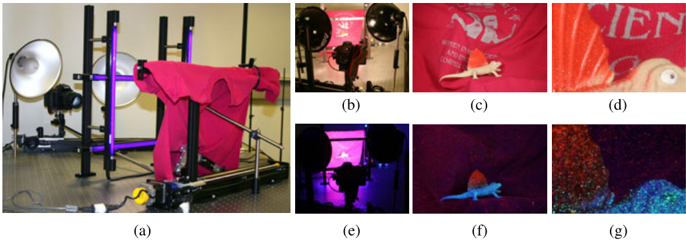
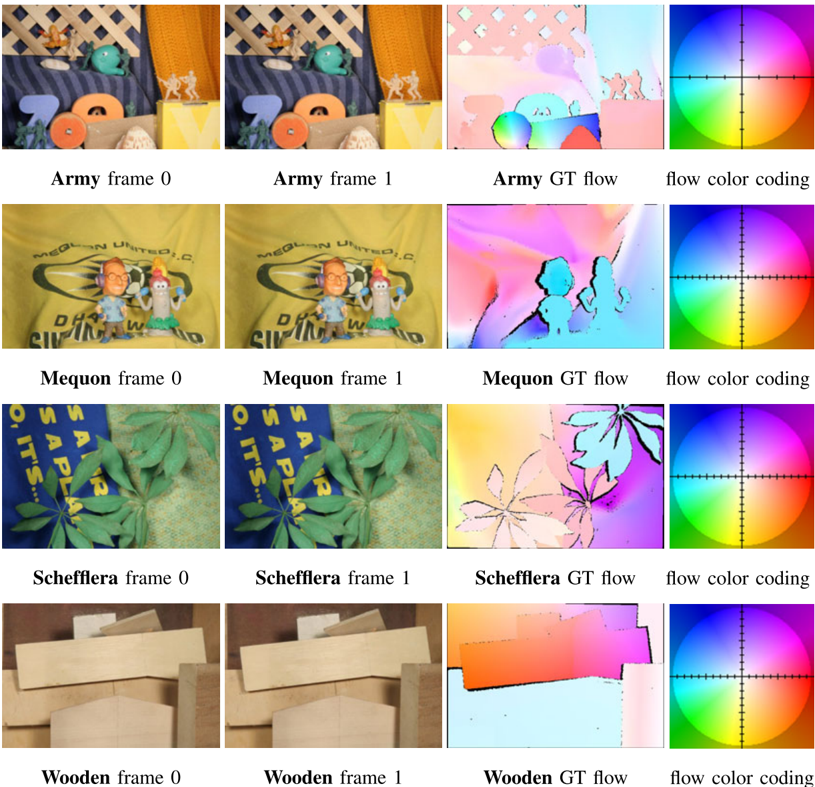
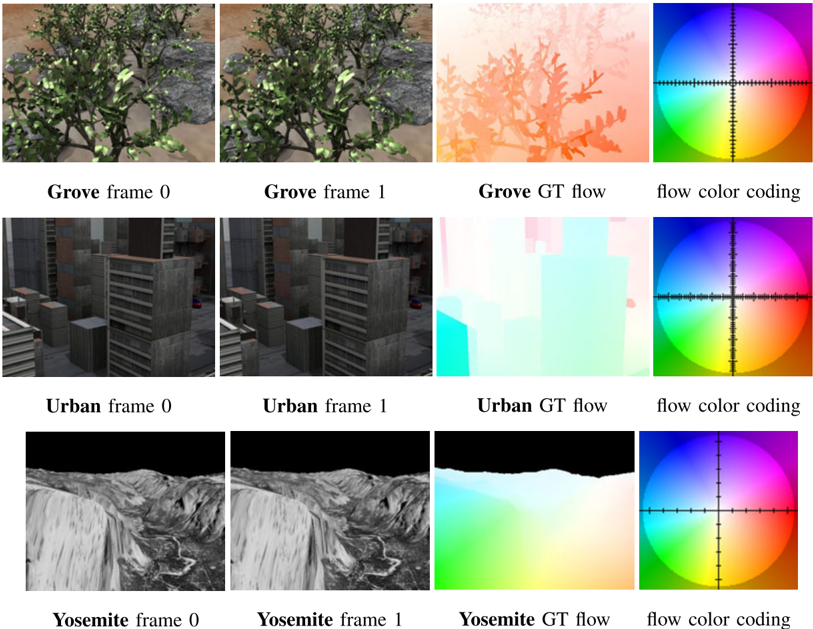
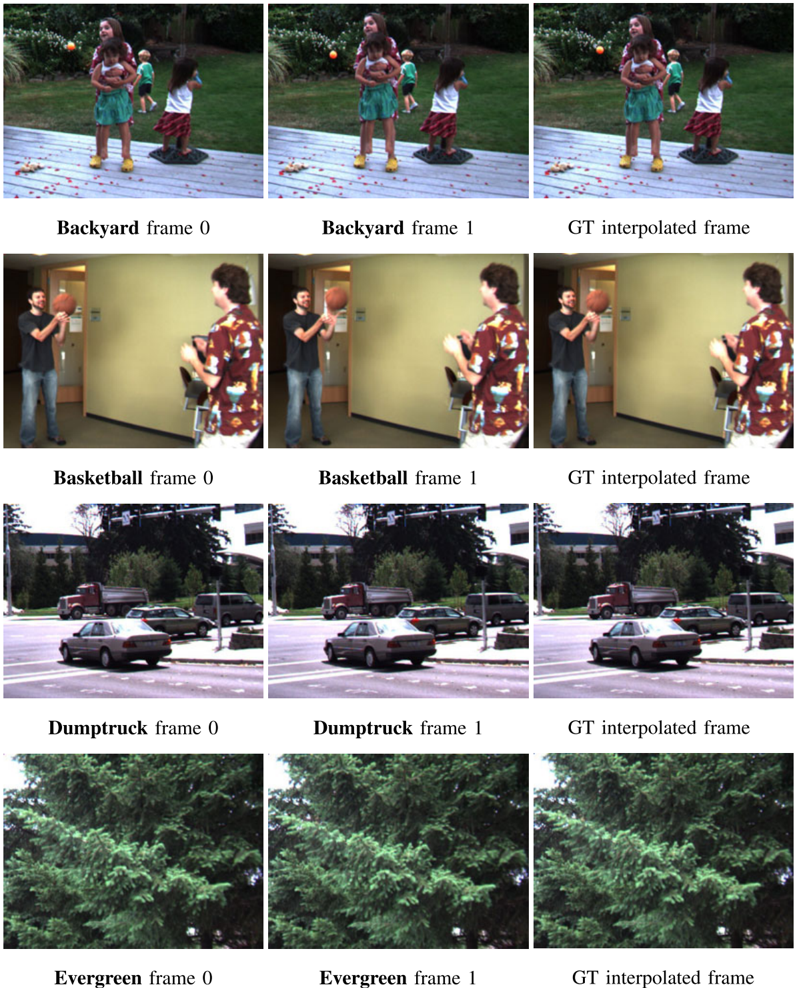
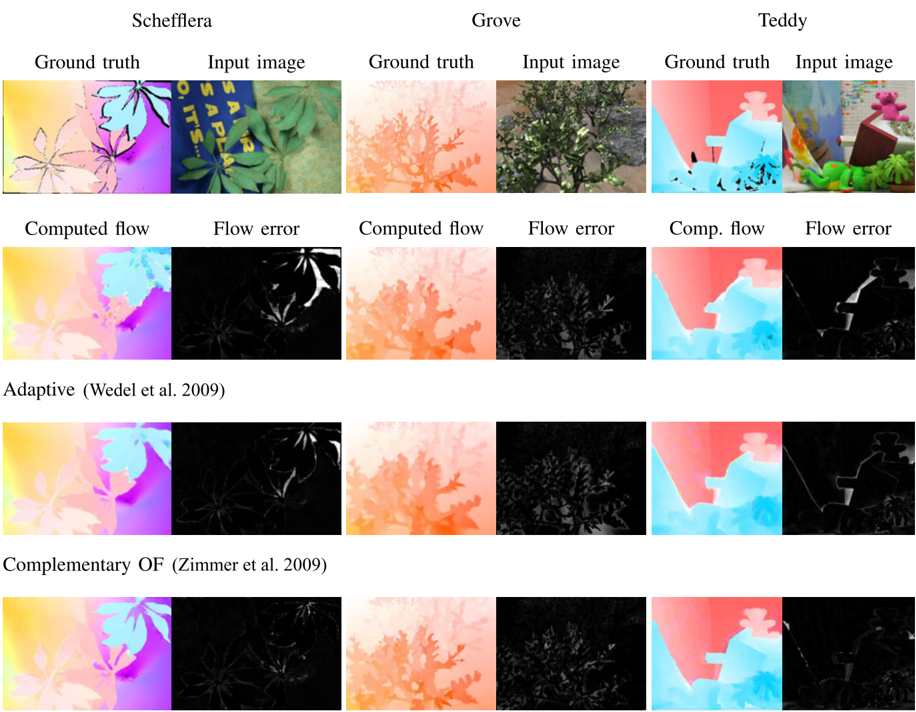
The quantitative evaluation of optical flow algorithms by Barron et al. (1994) led to significant advances in performance. The challenges for optical flow algorithms today go beyond the datasets and evaluation methods proposed in that paper. Instead, they center on problems associated with complex natural scenes, including nonrigid motion, real sensor noise, and motion discontinuities. We propose a new set of benchmarks and evaluation methods for the next generation of optical flow algorithms. To that end, we contribute four types of data to test different aspects of optical flow algorithms: (1) sequences with nonrigid motion where the ground-truth flow is determined by tracking hidden fluorescent texture, (2) realistic synthetic sequences, (3) high frame-rate video used to study interpolation error, and (4) modified stereo sequences of static scenes. In addition to the average angular error used by Barron et al., we compute the absolute flow endpoint error, measures for frame interpolation error, improved statistics, and results at motion discontinuities and in textureless regions.
Overview
CoChat Summary
TL;DR
The paper introduces a new optical flow benchmark of four data types (hidden fluorescent texture, realistic synthetic, high-speed interpolation, and modified stereo) plus an extended evaluation methodology with endpoint error, interpolation error, robustness/accuracy statistics, and region masks. It reports that performance improved substantially over the preliminary 2007 study, but motion discontinuities and diverse datasets remain difficult, and top flow methods still lag top stereo methods on the modified Teddy stereo data.
Key findings
- The benchmark contains 12 training and 12 test sequences; test ground truth is withheld except for Yosemite. As of December 2009 the online evaluation contained results for 24 published methods, all using only 2 input frames and 10 using color.
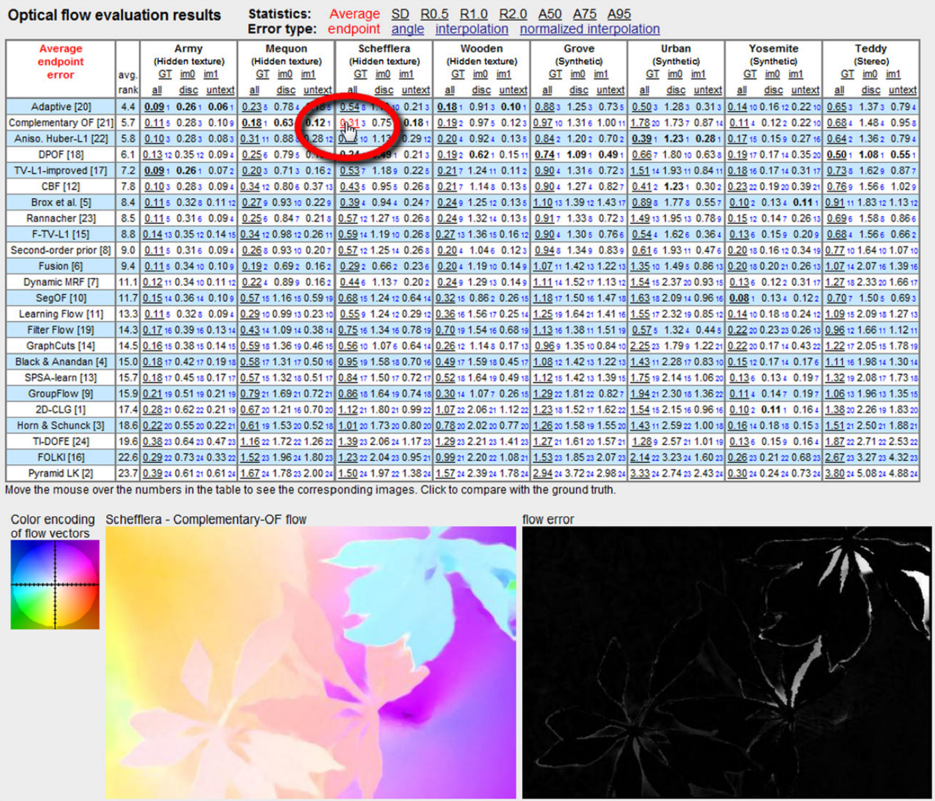
- Best average endpoint error (Avg. EE) improved dramatically over 2D-CLG (Bruhn et al. 2005): Army 0.28→0.09, Mequon 0.67→0.18, Schefflera 1.12→0.24, Wooden 1.07→0.18, Grove 1.23→0.74, Urban 1.54→0.39, Yosemite 0.10→0.08, Teddy 1.38→0.50. Best Avg. EE was below 0.2 pixels on four datasets (Yosemite, Army, Mequon, Wooden).
- Endpoint error (EE) and angular error (AE) rankings were highly correlated (r = 0.989), but the paper argues EE should be preferred: Complementary OF on Urban had Avg. AE 4.64° (rank 6) but Avg. EE 1.78 pixels (rank 20), because AE downweights large motions.
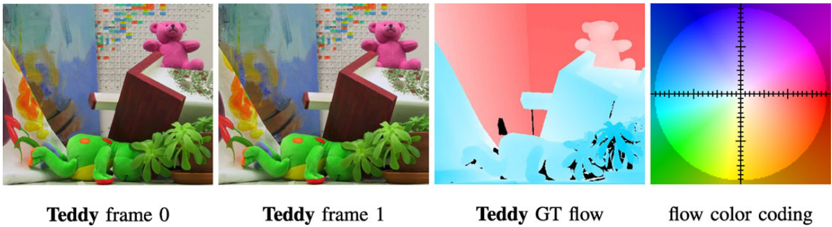
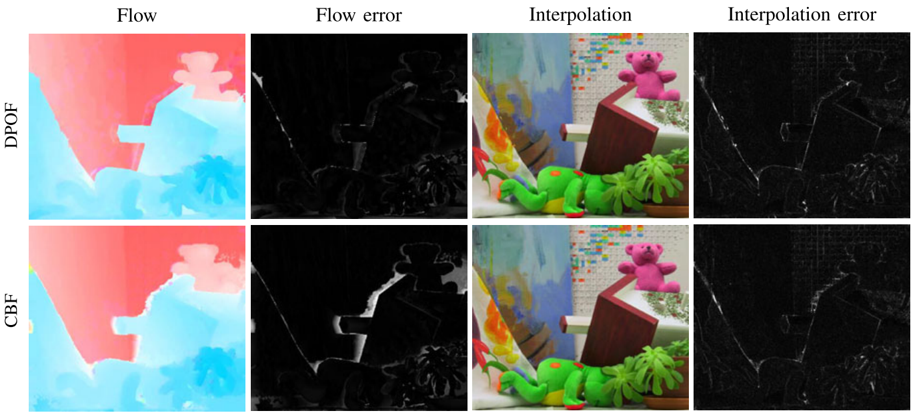
- Motion discontinuity (Disc) regions were the hardest; textureless (Untext) regions were typically easiest. Dataset results were less correlated, with Yosemite poorly or negatively correlated with others. Flow and interpolation errors were only moderately correlated (Avg4 EE vs Avg4 IE r = 0.763). On Teddy, top stereo methods outperformed top flow methods: median lowest-five R1.0 was 9.9 for flow vs 6.5 for stereo in All regions (34% reduction), and 27.6 vs 10.0 in Disc regions (64% reduction).
Methods
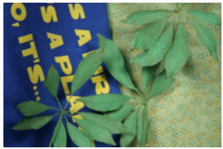
- Four data types were collected: (1) real nonrigid scenes with dense ground truth from hidden fluorescent texture, captured with a Canon EOS 20D at 3504×2336, downsampled every 40th visible-light frame by factor 6 to 584×388, with SSD tracking (15×15 windows), forward/backward crosschecking, and Lucas-Kanade subpixel refinement; (2) realistic synthetic scenes rendered with 3Delight at 640×480, with ground truth from a custom shader and dominant-cluster flow selection; (3) high-speed video for frame interpolation captured with a PointGrey Dragonfly Express at 60 fps, providing every other frame and retaining intermediate frames as ground truth; and (4) modified stereo data (Teddy) from structured light, cropped to make the disparity range roughly symmetric.
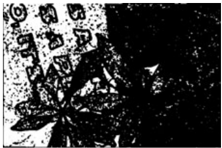
- Evaluation metrics include average angular error (AE), absolute flow endpoint error (EE), interpolation error (IE), and gradient-normalized interpolation error (NE). Statistics include averages, robustness measures R_X, and percentile accuracy measures A_X, computed over All, Disc, and Untext region masks.
- Analysis used the online evaluation at http://vision.middlebury.edu/flow/, comparing 24 published methods across metrics, statistics, masks, and datasets, with Pearson correlations between rankings and comparisons to state-of-the-art stereo methods on Teddy.
Limitations
- The paper states that the hidden fluorescent texture scenes are laboratory scenes, not real-world scenes, and have no motion blur due to stop-motion capture; ground truth is unavailable where cross-checking failed, especially occluded regions, and the measured ground truth is not perfect, though significant errors are limited to a small fraction of pixels. Synthetic sequences were generated without motion blur. The modified stereo ground truth is only accurate to 0.25 pixels, and algorithms may exploit the knowledge that motions are horizontal; overfitting to rigid data should be visible across the 12 evaluation images. Interpolation ground truth is an intermediate image, not a flow field, so the flow definition is apparent motion.
- The paper also states that no single method yet achieves strong performance across a wide variety of datatypes, that any dataset has a limited lifespan, and that future studies should include more challenging realistic synthetic data, longer sequences, and more difficult materials, illumination changes, atmospheric effects, and transparency.
- Evident from the text: the online tables do not provide an overall ranking among methods; runtimes are not normalized for programming environment, CPU speed, cores, or hardware acceleration; algorithms are required to produce dense flow and cannot submit confidence maps or sparse/incomplete fields; all 24 published methods used only 2 frames despite 8-frame sequences being available; and the paper cannot definitively answer whether temporal smoothing is less suited to the more challenging sequences.
Model-written summary. Check it against the paper before relying on it.
Integrity signals
Registry
Cites
Statistics
Figures

Verification
Claims the paper makes
2 Valid · 16 Not valid · 58 Not checked · 185 Own results and interpretations
A result the paper states — it cites no source for it, so there is none to check. The quote shows it is in the paper.
In the paper
“Rather than collecting a single type of data (with its inherent limitations) we instead collected four different types of data, each satisfying a different subset of desirable properties.”
plain- Asserted: passes — The authors put it forward as true.
- Checkable: passes — It can be checked against evidence.
- Load-bearing: passes — The paper’s conclusions depend on it.
- Based: passes — The paper gives a reason why it holds.
A result the paper states — it cites no source for it, so there is none to check. The quote shows it is in the paper.
In the paper
“Using the combination of fluorescent paint, downsampling high-resolution images, and sequential tracking of small motions, we are able to obtain dense, subpixel accurate ground truth for a nonrigid scene.”
plainstates a cause- Asserted: passes — The authors put it forward as true.
- Checkable: passes — It can be checked against evidence.
- Load-bearing: passes — The paper’s conclusions depend on it.
- Based: passes — The paper gives a reason why it holds.
A result the paper reports from its own data — it cites no other source for it, so there is none to check. The quote shows it is in the paper.
In the paper
“To allow for measures that predict performance on such tasks, we collected a variety of data suitable for frame interpolation.”
plainstates a cause- Asserted: passes — The authors put it forward as true.
- Checkable: passes — It can be checked against evidence.
- Load-bearing: passes — The paper’s conclusions depend on it.
- Based: passes — The paper gives a reason why it holds.
A result the paper reports from its own data — it cites no other source for it, so there is none to check. The quote shows it is in the paper.
In the paper
“We have developed a technique for capturing imagery of nonrigid scenes with ground-truth optical flow.”
plain- Asserted: passes — The authors put it forward as true.
- Checkable: passes — It can be checked against evidence.
- Load-bearing: passes — The paper’s conclusions depend on it.
- Based: passes — The paper gives a reason why it holds.
A result the paper states — it cites no source for it, so there is none to check. The quote shows it is in the paper.
In the paper
“To go beyond previous synthetic ground truth (e.g., the Yosemite sequence), we generated two types of fairly complex synthetic outdoor scenes.”
plain- Asserted: passes — The authors put it forward as true.
- Checkable: passes — It can be checked against evidence.
- Load-bearing: passes — The paper’s conclusions depend on it.
- Based: passes — The paper gives a reason why it holds.
96 more claims
Create a free account to see all 261 claims and every source verdict.
- Probably not a substantial claim. 114
- It may state two separate claims as one. 76
- The quote only partly states this claim. 6
Claims other papers make about this one
Each is checked against this paper’s own text: does it say what the citing paper says it does?
The source backs part of the claim, not all of it — or backs it for a different population, condition or comparison.
In the citing paper
“Notable works include the Middlebury dataset (Baker et al, 2011) and the KITTI datasets (Geiger et al, 2012; Menze and Geiger, 2015), but due to the difficulty of computing accurate ground truth, these have been restricted to 8 and 2 · 200 pairs of frames, respectively (the latter are also limited by the special driving setting).”
From What Makes Good Synthetic Training Data for Learning Disparity and Optical Flow Estimation? (2018) · cites this paper as Baker et al, 2011
Experimental — accuracy not yet measured
Citations
Cites
The pascal visual object classes (VOC) challenge
Everingham, M., Van Gool, L., Williams, C. K. I., Winn, J., & Zisserman, A. (2010) · International Journal of Computer Vision · doi:10.1007/s11263-009-0275-4 · Cited by 19,599
Proceedings of IEEE Conference on Computer Vision and Pattern Recognition
(1993) · doi:10.1109/cvpr.1993 · Cited by 17,667
Proceedings of IEEE International Conference on Computer Vision
(1995) · Proceedings of IEEE International Conference on Computer Vision · doi:10.1109/iccv.1995.466933 · Cited by 12,860
(1981) · Cited by 11,963
Horn, B. K. P., & Schunck, B. G. (1981) · Artificial Intelligence · doi:10.1016/0004-3702(81)90024-2 · Cited by 10,312
Horn, B. K., & Schunck, B. G. (1981) · SPIE Proceedings · doi:10.1117/12.965761 · Cited by 7,394 · cited 2×
“A baseline approach is to use an L2 norm as in the Horn and Schunck algorithm (Horn and Schunck 1981):”
BackgroundMethodFast approximate energy minimization via graph cuts
Boykov, Y., Veksler, O., & Zabih, R. (2001) · IEEE Transactions on Pattern Analysis and Machine Intelligence · doi:10.1109/34.969114 · Cited by 6,988
A Taxonomy and Evaluation of Dense Two-Frame Stereo Correspondence Algorithms
Scharstein, D., & Szeliski, R. (2002) · International Journal of Computer Vision · doi:10.1023/a:1014573219977 · Cited by 6,740 · cited 10×
“Many areas of computer vision, such as stereo [63], face recognition [28, 55, 68], and object recognition [23, 24], have challenging datasets to track the progress made by leading algorithms and to stimulate new ideas.”
BackgroundMethodResultInfluentialSelf-citationProceedings European Conference on Computer Vision 2002
Heyden, A., Sparr, G., Nielsen, M., & Johansen, P. (2002) · Lund University Publications (Lund University) · Cited by 5,153
From few to many: illumination cone models for face recognition under variable lighting and pose
Georghiades, A. S., Belhumeur, P. N., & Kriegman, D. J. (2001) · IEEE Transactions on Pattern Analysis and Machine Intelligence · doi:10.1109/34.927464 · Cited by 4,912 · cited 1×
“Many areas of computer vision, such as stereo (Scharstein and Szeliski 2002), face recognition (Philips et al. 2005; Sim et al. 2003; Gross et al. 2008; Georghiades et al. 2001), and object recognition (Fei-Fei et al.”
Background
Research works printed but not linked: 4
- Anandan, P., & Weiss, R. (1985). Introducing smoothness constraint in a matching approach for the computation of displacement fields. In Proceedings of the DARPA image understanding workshop (pp. 186-196).
- Bleyer, M., & Chambon, S. (2010). Does color really help in dense stereo matching? In Proceedings of the international symposium 3D data processing, visualization and transmission .
- Lempitsky, V., Roth, S., & Rother, C. (2008). Fusion flow: discretecontinuous optimization for optical flow estimation. In Proceedings of the IEEE conference on computer vision and pattern recognition .
- Rannacher, J. (2009). Realtime 3D motion estimation on graphics hardware . Undergraduate thesis, Heidelberg University.
Cited by
Microsoft COCO: Common Objects in Context
Lin, T.-Y., Maire, M., Belongie, S., Hays, J., Perona, P., Ramanan, D., Dollár, P., & Zitnick, C. L. (2014) · Lecture Notes in Computer Science · doi:10.1007/978-3-319-10602-1_48 · Cited by 45,460
“Some notable datasets include the Middlebury datasets for stereo vision [20], multi-view stereo [36] and optical flow [21].”
BackgroundThe unreasonable effectiveness of deep features as a perceptual metric
Zhang, R., Isola, P., Efros, A. A., Shechtman, E., & Wang, O. (2018) · arXiv · doi:10.48550/arxiv.1801.03924 · Cited by 24,812
Are we ready for autonomous driving? The KITTI vision benchmark suite
Geiger, A., Lenz, P., & Urtasun, R. (2012) · 2012 IEEE Conference on Computer Vision and Pattern Recognition · doi:10.1109/cvpr.2012.6248074 · Cited by 14,897
“Perhaps not surprisingly, many algorithms that do well on established datasets such as Middlebury [41, 2] struggle on our benchmark.”
InfluentialThe Unreasonable Effectiveness of Deep Features as a Perceptual Metric
Zhang, R., Isola, P., Efros, A. A., Shechtman, E., & Wang, O. (2018) · 2018 IEEE/CVF Conference on Computer Vision and Pattern Recognition · doi:10.1109/cvpr.2018.00068 · Cited by 14,623
Flownet: Learning optical flow with convolutional networks
Dosovitskiy, A., Fischer, P., Ilg, E., Hausser, P., Hazirbas, C., Golkov, V., Smagt, P. V. D., Cremers, D., & Brox, T. (2015) · 2015 IEEE International Conference on Computer Vision (ICCV) · doi:10.1109/iccv.2015.316 · Cited by 4,313
“The Middlebury dataset [2] contains only 8 image pairs for training, with ground truth flows generated using four different techniques.”
MethodA benchmark for the evaluation of RGB-D SLAM systems
Sturm, J., Engelhard, N., Endres, F., Burgard, W., & Cremers, D. (2012) · 2012 IEEE/RSJ International Conference on Intelligent Robots and Systems · doi:10.1109/iros.2012.6385773 · Cited by 3,976
“All sequences and movies are available on our website [1].”
BackgroundWu, Y., Lim, J., & Yang, M.-H. (2015) · IEEE Transactions on Pattern Analysis and Machine Intelligence · doi:10.1109/tpami.2014.2388226 · Cited by 3,371
“In recent years, many benchmark datasets have been developed for various vision problems, such as the Berkeley segmentation [38], FERET face recognition [45] and optical flow dataset [9].”
BackgroundPWC-Net: CNNs for Optical Flow Using Pyramid, Warping, and Cost Volume
Sun, D., Yang, X., Liu, M.-Y., & Kautz, J. (2018) · 2018 IEEE/CVF Conference on Computer Vision and Pattern Recognition · doi:10.1109/cvpr.2018.00931 · Cited by 2,648
“First, traditional optical flow methods often pre-process the raw images to extract features that are invariant to shadows or lighting changes [4, 48].”
BackgroundInfluentialMicrosoft COCO: Common Objects in Context
Lin, T.-Y., Maire, M., Belongie, S., Bourdev, L., Girshick, R., Hays, J., Perona, P., Ramanan, D., Zitnick, C. L., & Dollár, P. (2014) · arXiv · doi:10.48550/arxiv.1405.0312 · Cited by 2,579
“Some notable datasets include the Middlebury datasets for stereo vision [20], multi-view stereo [36] and optical flow [21].”
BackgroundA Naturalistic Open Source Movie for Optical Flow Evaluation
Butler, D. J., Wulff, J., Stanley, G. B., & Black, M. J. (2012) · Lecture Notes in Computer Science · doi:10.1007/978-3-642-33783-3_44 · Cited by 1,842
“Figure 1 shows example images from our data set, together with the corresponding ground truth flow (color coding as in [1]).”
BackgroundMethodInfluentialSelf-citationPlaying for Data: Ground Truth from Computer Games
Richter, S. R., Vineet, V., Roth, S., & Koltun, V. (2016) · Lecture Notes in Computer Science · doi:10.1007/978-3-319-46475-6_7 · Cited by 1,815
“The use of synthetic data has been particularly significant in evaluating optical flow estimation due to the difficulty of obtaining accurate ground-truth flow measurements for real-world scenes [6, 7, 18, 32].”
BackgroundSelf-citationSIFT Flow: Dense Correspondence across Scenes and Its Applications
Liu, C., Yuen, J., & Torralba, A. (2011) · IEEE Transactions on Pattern Analysis and Machine Intelligence · doi:10.1109/tpami.2010.147 · Cited by 1,582
“Inspired by the recent advances in image alignment and scene parsing, we propose SIFT flow to establish the correspondence between images across scenes.”
BackgroundMethodDeformable medical image registration: a survey
Sotiras, A., Davatzikos, C., & Paragios, N. (2013) · IEEE Transactions on Medical Imaging · doi:10.1109/tmi.2013.2265603 · Cited by 1,587
“cations where the interest is to recover the apparent motion of objects between sequences of successive images (optical flow estimation) [12], [13].”
BackgroundOptical Flow Estimation Using a Spatial Pyramid Network
Ranjan, A., & Black, M. J. (2017) · 2017 IEEE Conference on Computer Vision and Pattern Recognition (CVPR) · doi:10.1109/cvpr.2017.291 · Cited by 1,344
“We report similar performance as FlowNet on Flying Chairs and Sintel [11] but are significantly more accurate than FlowNet on Middlebury [4] and KITTI [18] after fine tuning.”
MethodSelf-citationSecrets of optical flow estimation and their principles
Sun, D., Roth, S., & Black, M. J. (2010) · 2010 IEEE Computer Society Conference on Computer Vision and Pattern Recognition · doi:10.1109/cvpr.2010.5539939 · Cited by 1,389
Self-citationVideo Enhancement with Task-Oriented Flow
Xue, T., Chen, B., Wu, J., Wei, D., & Freeman, W. T. (2019) · International Journal of Computer Vision · doi:10.1007/s11263-018-01144-2 · Cited by 1,393
“For example, in temporal frame interpolation, most algorithms first estimate how pixels move between input frames (frame 1 and 3), and then move pixels to the estimated location in the output frame (frame 2) (Baker et al 2011).”
InfluentialPedestrian detection: A benchmark
Dollar, P., Wojek, C., Schiele, B., & Perona, P. (2009) · 2009 IEEE Conference on Computer Vision and Pattern Recognition · doi:10.1109/cvpr.2009.5206631 · Cited by 1,313
MOT16: A Benchmark for Multi-Object Tracking
Milan, A., Leal-Taixe, L., Reid, I., Roth, S., & Schindler, K. (2016) · arXiv · doi:10.48550/arxiv.1603.00831 · Cited by 1,309
“In the recent past, the computer vision community has developed centralized benchmarks for numerous tasks including object detection [14], pedestrian detection [12], 3D reconstruction [39], optical flow [7], [19], visual odometry [19], singleobject short-term tracking [26], and stereo estimation [19], [37].”
BackgroundSelf-citationLarge Displacement Optical Flow: Descriptor Matching in Variational Motion Estimation
Brox, T., & Malik, J. (2011) · IEEE Transactions on Pattern Analysis and Machine Intelligence · doi:10.1109/tpami.2010.143 · Cited by 1,295
Advances in Computer Vision-Based Civil Infrastructure Inspection and Monitoring
Spencer, B. F., Hoskere, V., & Narazaki, Y. (2019) · Engineering · doi:10.1016/j.eng.2018.11.030 · Cited by 1,282
Mayer, N., Ilg, E., Cremers, D., Dosovitskiy, A., & Brox, T. (2016) · Cited by 1,221
Video Enhancement with Task-Oriented FlowPreprint
Xue, T., Chen, B., Wu, J., Wei, D., & Freeman, W. T. (2019) · DSpace@MIT (Massachusetts Institute of Technology) · Cited by 1,188
Sigal, L., Balan, A. O., & Black, M. J. (2010) · International Journal of Computer Vision · doi:10.1007/s11263-009-0273-6 · Cited by 1,164
“…that similar efforts have been made in related areas including the development of datasets for face detection (Phillips et al. 2000, 2002), human gait identification (Gross and Shi 2001; Sarkar et al. 2005), dense stereo vision (Scharstein and Szeliski 2002) and optical flow (Baker et al. 2007).”
BackgroundSelf-citationSuper SloMo: High Quality Estimation of Multiple Intermediate Frames for Video Interpolation
Jiang, H., Sun, D., Jampani, V., Yang, M.-H., Learned-Miller, E., & Kautz, J. (2018) · 2018 IEEE/CVF Conference on Computer Vision and Pattern Recognition · doi:10.1109/cvpr.2018.00938 · Cited by 1,053
“In addition to SepConv, we also compare our model with other three top-performing models on the Middlebury dataset2, where the interpolation algorithm [1] is coupled with different optical flow methods including MDP-Flow2 [37], PMMST [39], and DeepFlow [34].”
BackgroundMethodInfluentialDeepFlow: Large Displacement Optical Flow with Deep Matching
Weinzaepfel, P., Revaud, J., Harchaoui, Z., & Schmid, C. (2013) · 2013 IEEE International Conference on Computer Vision · doi:10.1109/iccv.2013.175 · Cited by 997
“The matching algorithm builds upon a multi-stage architecture with about 6 layers (depending on the image size), inter-leaving convolutions and max-pooling, a construction akin to deep convolutional nets [15].”
LiteFlowNet: A Lightweight Convolutional Neural Network for Optical Flow Estimation
Hui, T.-W., Tang, X., & Loy, C. C. (2018) · 2018 IEEE/CVF Conference on Computer Vision and Pattern Recognition · doi:10.1109/cvpr.2018.00936 · Cited by 817
Video Frame Synthesis Using Deep Voxel Flow
Liu, Z., Yeh, R. A., Tang, X., Liu, Y., & Agarwala, A. (2017) · 2017 IEEE International Conference on Computer Vision (ICCV) · doi:10.1109/iccv.2017.478 · Cited by 743
MOTChallenge 2015: Towards a Benchmark for Multi-Target Tracking
Leal-Taixé, L., Milan, A., Reid, I. D., Roth, S., & Schindler, K. (2015) · arXiv (Cornell University) · doi:10.48550/arxiv.1504.01942 · Cited by 743
“In the recent past, the computer vision community has developed centralized benchmarks for numerous tasks including object detection [19], pedestrian detection [17], 3D reconstruction [45], optical flow [9], [22], visual odometry [22], singleobject short-term tracking [28], and stereo estimation [22], [43].”
BackgroundSelf-citationComparing ICP variants on real-world data sets: Open-source library and experimental protocol
Pomerleau, F., Colas, F., Siegwart, R., & Magnenat, S. (2013) · Autonomous Robots · doi:10.1007/s10514-013-9327-2 · Cited by 760
EpicFlow: Edge-preserving interpolation of correspondences for optical flow
Revaud, J., Weinzaepfel, P., Harchaoui, Z., & Schmid, C. (2015) · 2015 IEEE Conference on Computer Vision and Pattern Recognition (CVPR) · doi:10.1109/cvpr.2015.7298720 · Cited by 697
“On the Middlebury test set, we obtain an AEE below 0 .”
BackgroundMethodInfluentialVideo Frame Interpolation via Adaptive Separable Convolution
Niklaus, S., Mai, L., & Liu, F. (2017) · 2017 IEEE International Conference on Computer Vision (ICCV) · doi:10.1109/iccv.2017.37 · Cited by 725
“Common frame interpolation approaches estimate dense motion, typically optical flow, between two input frames and then interpolate one or more intermediate frames guided by the motion [3, 53, 60].”
BackgroundMethodInfluentialVideo Super-Resolution With Convolutional Neural Networks
Kappeler, A., Yoo, S., Dai, Q., & Katsaggelos, A. K. (2016) · IEEE Transactions on Computational Imaging · doi:10.1109/tci.2016.2532323 · Cited by 647
“We tested a number of optical flow estimation algorithms [28].”
MethodRanjan, A., Jampani, V., Balles, L., Kim, K., Sun, D., Wulff, J., & Black, M. J. (2019) · 2019 IEEE/CVF Conference on Computer Vision and Pattern Recognition (CVPR) · doi:10.1109/cvpr.2019.01252 · Cited by 632
“Furthermore, there are no sensors that provide ground truth optical flow, so all existing datasets with real imagery are limited or approximate [1, 6, 13].”
BackgroundSelf-citationComputer Vision for Autonomous Vehicles: Problems, Datasets and State of the Art
Janai, J., Güney, F., Behl, A., & Geiger, A. (2020) · Foundations and Trends® in Computer Graphics and Vision · doi:10.1561/0600000079 · Cited by 643
“(2012b); Scharstein & Szeliski (2002); Baker et al. (2011); Everingham et al.”
BackgroundMethodInfluentialSun, D., Roth, S., & Black, M. J. (2014) · International Journal of Computer Vision · doi:10.1007/s11263-013-0644-x · Cited by 614
“The field of optical flow estimation is making steady progress as evidenced by the increasing accuracy of current meth-ods on the Middlebury optical flow benchmark (Baker et al. 2007).”
BackgroundSelf-citationPanoptic-DeepLab: A Simple, Strong, and Fast Baseline for Bottom-Up Panoptic Segmentation
Cheng, B., Collins, M. D., Zhu, Y., Liu, T., Huang, T. S., Adam, H., & Chen, L.-C. (2020) · 2020 IEEE/CVF Conference on Computer Vision and Pattern Recognition (CVPR) · doi:10.1109/cvpr42600.2020.01249 · Cited by 635
“We encode 2D offset vectors into RGB values, same as [3].”
MethodThe Visual Object Tracking VOT2014 Challenge Results
Kristan, M., Pflugfelder, R., Leonardis, A., Matas, J., Čehovin, L., Nebehay, G., Vojíř, T., Fernández, G., Lukežič, A., Dimitriev, A., et al. (2015) · Lecture Notes in Computer Science · doi:10.1007/978-3-319-16181-5_14 · Cited by 588
FlowNet: Learning Optical Flow with Convolutional Networks
Fischer, P., Dosovitskiy, A., Ilg, E., Haeusser, P., Hazırbaş, C., Golkov, V., van der Smagt, P., Cremers, D., & Brox, T. (2015) · arXiv (Cornell University) · doi:10.48550/arxiv.1504.06852 · Cited by 562
“The Middlebury dataset [2] contains only 8 image pairs for training, with ground truth flows generated using four different techniques.”
MethodFurukawa, Y., & Hernández, C. (2015) · Foundations and Trends in Computer Graphics and Vision · doi:10.1561/0600000052 · Cited by 598
“In fact, optical flow is another very active field in Computer Vision, tackling the problem of dense correspondence across images [33].”
BackgroundDepth-Aware Video Frame Interpolation
Bao, W., Lai, W.-S., Ma, C., Zhang, X., Gao, Z., & Yang, M.-H. (2019) · 2019 IEEE/CVF Conference on Computer Vision and Pattern Recognition (CVPR) · doi:10.1109/cvpr.2019.00382 · Cited by 554
UnFlow: Unsupervised Learning of Optical Flow With a Bidirectional Census Loss
Meister, S., Hur, J., & Roth, S. (2018) · Proceedings of the AAAI Conference on Artificial Intelligence · doi:10.1609/aaai.v32i1.12276 · Cited by 520
“Similar observations hold, for example, on the Middlebury dataset (Baker et al. 2011).”
ResultSelf-citationThe Generalized PatchMatch Correspondence Algorithm
Barnes, C., Shechtman, E., Goldman, D. B., & Finkelstein, A. (2010) · Lecture Notes in Computer Science · doi:10.1007/978-3-642-15558-1_3 · Cited by 530
“4 shows an example of transferring labels using correspondences without a term penalizing discontinuity, but in other settings a neighborhood term is necessary for accurate optical flow [3, 6].”
BackgroundVideo Frame Interpolation via Adaptive Convolution
Niklaus, S., Mai, L., & Liu, F. (2017) · 2017 IEEE Conference on Computer Vision and Pattern Recognition (CVPR) · doi:10.1109/cvpr.2017.244 · Cited by 499
“Following recent frame interpolation work [36], we use the interpolation method from the Middlebury benchmark [1] to synthesize the interpolated frame using the optical flow results.”
BackgroundMethodInfluentialA Main Directional Mean Optical Flow Feature for Spontaneous Micro-Expression Recognition
Liu, Y.-J., Zhang, J.-K., Yan, W.-J., Wang, S.-J., Zhao, G., & Fu, X. (2016) · IEEE Transactions on Affective Computing · doi:10.1109/taffc.2015.2485205 · Cited by 520
“Optical flow fields in (b), (d) and (f) are visualized using the color coding scheme in [31].”
MethodDepth from Combining Defocus and Correspondence Using Light-Field Cameras
Tao, M. W., Hadap, S., Malik, J., & Ramamoorthi, R. (2013) · 2013 IEEE International Conference on Computer Vision · doi:10.1109/iccv.2013.89 · Cited by 506
“is one of the top performers on the Middlebury’s dataset [2].”
BackgroundBurst photography for high dynamic range and low-light imaging on mobile cameras
Hasinoff, S. W., Sharlet, D., Geiss, R., Adams, A., Barron, J. T., Kainz, F., Chen, J., & Levoy, M. (2016) · ACM Transactions on Graphics · doi:10.1145/2980179.2980254 · Cited by 483
“In the computer vision literature, optical flow techniques are evaluated primarily by quality on established benchmarks [Baker et al. 2011; Menze and Geiger 2015].”
MethodVisual attribute transfer through deep image analogy
Liao, J., Yao, Y., Yuan, L., Hua, G., & Kang, S. B. (2017) · ACM Transactions on Graphics · doi:10.1145/3072959.3073683 · Cited by 487
“Category (I) is tested on the Middlebury optical flow benchmark dataset [Baker et al. 2011], total 23 color image pairs.”
MethodAn Uncertain Future: Forecasting from Static Images Using Variational Autoencoders
Walker, J., Doersch, C., Gupta, A., & Hebert, M. (2016) · Lecture Notes in Computer Science · doi:10.1007/978-3-319-46478-7_51 · Cited by 449
“The directions of the trajectories at each point in time are color-coded according to the square on the right [2].”
BackgroundMotion Detail Preserving Optical Flow Estimation
Xu, L., Jia, J., & Matsushita, Y. (2012) · IEEE Transactions on Pattern Analysis and Machine Intelligence · doi:10.1109/tpami.2011.236 · Cited by 493
Dense Point Trajectories by GPU-Accelerated Large Displacement Optical Flow
Sundaram, N., Brox, T., & Keutzer, K. (2010) · Lecture Notes in Computer Science · doi:10.1007/978-3-642-15549-9_32 · Cited by 422
“The rates of convergence are derived from 8 different matrices from images in the Middlebury dataset [25].”
MethodRichter, S. R., Hayder, Z., & Koltun, V. (2017) · 2017 IEEE International Conference on Computer Vision (ICCV) · doi:10.1109/iccv.2017.243 · Cited by 419
“The Middlebury benchmarks for stereo, multi-view stereo, and optical flow played a pivotal role in the development of low-level vision algorithms [4, 57, 58, 59].”
BackgroundRobust patch-based hdr reconstruction of dynamic scenes
Sen, P., Kalantari, N. K., Yaesoubi, M., Darabi, S., Goldman, D. B., & Shechtman, E. (2012) · ACM Transactions on Graphics · doi:10.1145/2366145.2366222 · Cited by 433
Context-Aware Synthesis for Video Frame Interpolation
Niklaus, S., & Liu, F. (2018) · 2018 IEEE/CVF Conference on Computer Vision and Pattern Recognition · doi:10.1109/cvpr.2018.00183 · Cited by 411
“We perform a quantitative comparison with state of the art frame interpolation algorithms on the interpolation section of the Middlebury benchmark for optical flow [1].”
BackgroundMethodInfluentialOptical flow modeling and computation: A survey
Fortun, D., Bouthemy, P., & Kervrann, C. (2015) · Computer Vision and Image Understanding · doi:10.1016/j.cviu.2015.02.008 · Cited by 431
“The Middlebury benchmark 1 [11,13] is composed of more challenging sequences, partly made of smooth deformations similar to the sequences described in [17], but also involving motion discontinuities and motion details.”
BackgroundRemote Sensing for Landslide Investigations: An Overview of Recent Achievements and Perspectives
Scaioni, M., Longoni, L., Melillo, V., & Papini, M. (2014) · Remote Sensing · doi:10.3390/rs6109600 · Cited by 424
“One technique that has been successfully applied is digital image correlation (DIC) or optical-flow tracking [139], which may provide 2D displacements on the topographic surface on the basis of a single sequence of images.”
MethodAn Improved Algorithm for TV-L 1 Optical Flow
Wedel, A., Pock, T., Zach, C., Bischof, H., & Cremers, D. (2009) · Lecture Notes in Computer Science · doi:10.1007/978-3-642-03061-1_2 · Cited by 423
“Figure 2 shows an example, where the ground truth flow is used to register two images from the Middlebury optical flow benchmark data base [5].”
BackgroundMethodInfluentialSynthetic Data for Deep Learning
Nikolenko, S. I. (2021) · Springer Optimization and Its Applications · doi:10.1007/978-3-030-75178-4 · Cited by 423
“[34]; in addition to ground truth real life measurements taken with specially constructed computer-controlled lighting, they provide realistic synthetic imagery as part of the dataset and include it in the large-scale evaluation of”
BackgroundSemantic Flow for Fast and Accurate Scene Parsing
Li, X., You, A., Zhu, Z., Zhao, H., Yang, M., Yang, K., Tan, S., & Tong, Y. (2020) · Lecture Notes in Computer Science · doi:10.1007/978-3-030-58452-8_45 · Cited by 416
Evaluation of Interest Point Detectors and Feature Descriptors for Visual Tracking
Gauglitz, S., Höllerer, T., & Turk, M. (2011) · International Journal of Computer Vision · doi:10.1007/s11263-011-0431-5 · Cited by 397
“Baker et al. (2007) produced image sequences including moving objects that were designed to evaluate dense optical flow.”
BackgroundSoftmax Splatting for Video Frame Interpolation
Niklaus, S., & Liu, F. (2020) · 2020 IEEE/CVF Conference on Computer Vision and Pattern Recognition (CVPR) · doi:10.1109/cvpr42600.2020.00548 · Cited by 381
“We thus use brightness constancy as a measure of occlusion [2], which can be obtained via backward warping ←− ω as follows.”
MethodInfluentialPROST: Parallel robust online simple tracking
Santner, J., Leistner, C., Saffari, A., Pock, T., & Bischof, H. (2010) · 2010 IEEE Computer Society Conference on Computer Vision and Pattern Recognition · doi:10.1109/cvpr.2010.5540145 · Cited by 377
“With the additional incorporation of a diffusion tensor for anisotropic regularization, their method (Huber - L1) is currently one of the most accurate optical flow algorithms according to the Middlebury evaluation website [4].”
MethodA perceptually motivated online benchmark for image matting
Rhemann, C., Rother, C., Wang, J., Gelautz, M., Kohli, P., & Rott, P. (2009) · 2009 IEEE Conference on Computer Vision and Pattern Recognition · doi:10.1109/cvpr.2009.5206503 · Cited by 367
“It is well known that the introduction of quantitative benchmarks for low-level vision problems, such as stereo [18] or optical-flow [2], has led to a considerable performance boost in the respective fields.”
BackgroundMethodJain, S. D., Xiong, B., & Grauman, K. (2017) · 2017 IEEE Conference on Computer Vision and Pattern Recognition (CVPR) · doi:10.1109/cvpr.2017.228 · Cited by 361
“In particular, we convert the raw optical flow to a 3-channel (RGB) color-coded optical flow image [3].”
MethodMOTChallenge: A Benchmark for Single-Camera Multiple Target Tracking
Dendorfer, P., Os̆ep, A., Milan, A., Schindler, K., Cremers, D., Reid, I., Roth, S., & Leal-Taixé, L. (2021) · International Journal of Computer Vision · doi:10.1007/s11263-020-01393-0 · Cited by 374
Self-citationBao, W., Lai, W.-S., Zhang, X., Gao, Z., & Yang, M.-H. (2021) · IEEE Transactions on Pattern Analysis and Machine Intelligence · doi:10.1109/tpami.2019.2941941 · Cited by 362
“(3) We demonstrate that the proposed method performs favorably against the state-of-the-art frame interpolation algorithms on several benchmark datasets, including the Middlebury [28], UCF101 [29], and Vimeo90K [9] datasets.”
MethodInfluentialOcclusion Aware Unsupervised Learning of Optical Flow
Wang, Y., Yang, Y., Yang, Z., Zhao, L., Wang, P., & Xu, W. (2018) · 2018 IEEE/CVF Conference on Computer Vision and Pattern Recognition · doi:10.1109/cvpr.2018.00513 · Cited by 320
“Starting from then, the accuracy of optical flow estimation has been improving steadily as evidenced by the results on Middlebury [8] and MPI-Sintel [14] benchmark dataset.”
MethodVideo Segmentation via Object Flow
Tsai, Y.-H., Yang, M.-H., & Black, M. J. (2016) · 2016 IEEE Conference on Computer Vision and Pattern Recognition (CVPR) · doi:10.1109/cvpr.2016.423 · Cited by 318
“Optical flow estimation has been extensively studied [2, 6, 30] and it is widely used for video segmentation and (a) frame t− 1 (b) frame t”
MethodSelf-citationPower transmission line inspection robots: A review, trends and challenges for future research
Alhassan, A. B., Zhang, X., Shen, H., & Xu, H. (2020) · International Journal of Electrical Power & Energy Systems · doi:10.1016/j.ijepes.2020.105862 · Cited by 337
Channel Attention Is All You Need for Video Frame Interpolation
Choi, M., Kim, H., Han, B., Xu, N., & Lee, K. M. (2020) · Proceedings of the AAAI Conference on Artificial Intelligence · doi:10.1609/aaai.v34i07.6693 · Cited by 328
“Video frame interpolation approaches are typically based on optical flow estimation to handle time-varying information in videos (Baker et al. 2010; Werlberger et al. 2011; Yu et al. 2013).”
BackgroundMethodHandbook of Mathematical Methods in Imaging
(2011) · Springer eBooks · doi:10.1007/978-0-387-92920-0 · Cited by 334
Phase-based frame interpolation for video
Meyer, S., Wang, O., Zimmer, H., Grosse, M., & Sorkine-Hornung, A. (2015) · 2015 IEEE Conference on Computer Vision and Pattern Recognition (CVPR) · doi:10.1109/cvpr.2015.7298747 · Cited by 294
“Phase-based approaches build on the insight that the motion of certain signals can be represented as phase-shift.”
BackgroundThe Visual Object Tracking VOT2013 Challenge Results
Kristan, M., Pflugfelder, R., Leonardis, A., Matas, J., Porikli, F., Cehovin, L., Nebehay, G., Fernandez, G., Vojir, T., Gatt, A., et al. (2013) · 2013 IEEE International Conference on Computer Vision Workshops · doi:10.1109/iccvw.2013.20 · Cited by 308
“Indeed, much of the advances in several computer vision fields, like object detection, classification and segmentation [12], optical-flow computation [3], can be attributed to a ubiquitous access to standard datasets and evaluation protocols [43].”
BackgroundReal-Time Intermediate Flow Estimation for Video Frame Interpolation
Huang, Z., Zhang, T., Heng, W., Shi, B., & Zhou, S. (2022) · Lecture Notes in Computer Science · doi:10.1007/978-3-031-19781-9_36 · Cited by 326
“[2], Vimeo90K [62] benchmarks, respectively.”
MethodInfluentialFully Automatic Recognition of the Temporal Phases of Facial Actions
Valstar, M. F., & Pantic, M. (2012) · IEEE Transactions on Systems, Man, and Cybernetics, Part B (Cybernetics) · doi:10.1109/tsmcb.2011.2163710 · Cited by 304
Furukawa, Y., & Hernández, C. (2015) · now publishers, Inc. eBooks · doi:10.1561/9781601988379 · Cited by 268
Visualization of Eye Tracking Data: A Taxonomy and Survey
Blascheck, T., Kurzhals, K., Raschke, M., Burch, M., Weiskopf, D., & Ertl, T. (2017) · Computer Graphics Forum · doi:10.1111/cgf.13079 · Cited by 285
DeepMatching: Hierarchical Deformable Dense Matching
Revaud, J., Weinzaepfel, P., Harchaoui, Z., & Schmid, C. (2016) · International Journal of Computer Vision · doi:10.1007/s11263-016-0908-3 · Cited by 267
“A series of improvements were proposed over the years (Black and Anandan 1996; Werlberger et al 2009; Bruhn et al 2005; Papenberg et al 2006; Baker et al 2011; Sun et al 2014b; Vogel et al 2013a).”
AdaCoF: Adaptive Collaboration of Flows for Video Frame Interpolation
Lee, H., Kim, T., Chung, T.-Y., Pak, D., Ban, Y., & Lee, S. (2020) · 2020 IEEE/CVF Conference on Computer Vision and Pattern Recognition (CVPR) · doi:10.1109/cvpr42600.2020.00536 · Cited by 270
“We also upload our result to Middlebury Benchmark [1] and compare it with the other recent state-of-the-art algorithms.”
MethodTracking Revisited Using RGBD Camera: Unified Benchmark and Baselines
Song, S., & Xiao, J. (2013) · 2013 IEEE International Conference on Computer Vision · doi:10.1109/iccv.2013.36 · Cited by 269
“two-view stereo matching [19], multi-view stereo reconstruction [20], optical flow [4], image segmentation [8], and object classification, detection, and segmentation [9], scene classification [27] and our PTB is an addition to the list to provide a benchmark for tracking algorithms using either RGB or RGBD data.”
MethodHierarchical Discrete Distribution Decomposition for Match Density Estimation
Yin, Z., Darrell, T., & Yu, F. (2019) · 2019 IEEE/CVF Conference on Computer Vision and Pattern Recognition (CVPR) · doi:10.1109/cvpr.2019.00620 · Cited by 252
“For a thorough review, we refer to popular benchmarks including Middlebury [4], MPI Sintel [7], and KITTI [32] benchmarks for both the classical methods and the latest advances in these areas.”
MethodA Systematic Evaluation and Benchmark for Person Re-Identification: Features, Metrics, and Datasets
Karanam, S., Gou, M., Wu, Z., Rates-Borras, A., Camps, O., & Radke, R. J. (2019) · IEEE Transactions on Pattern Analysis and Machine Intelligence · doi:10.1109/tpami.2018.2807450 · Cited by 247
“We anticipate that the benchmark will be updated (along the lines of the Middlebury benchmarks [31], [32]) as new techniques are implemented into our evaluation framework.”
MethodBailer, C., Taetz, B., & Stricker, D. (2015) · 2015 IEEE International Conference on Computer Vision (ICCV) · doi:10.1109/iccv.2015.457 · Cited by 233
“We refer to publications like [2, 27, 29] for a detailed overview of optical flow methods and the general principles behind it.”
BackgroundMethodMulti-stream CNN: Learning representations based on human-related regions for action recognition
Tu, Z., Xie, W., Qin, Q., Poppe, R., Veltkamp, R. C., Li, B., & Yuan, J. (2018) · Pattern Recognition · doi:10.1016/j.patcog.2018.01.020 · Cited by 247
DrivingStereo: A Large-Scale Dataset for Stereo Matching in Autonomous Driving Scenarios
Yang, G., Song, X., Huang, C., Deng, Z., Shi, J., & Zhou, B. (2019) · 2019 IEEE/CVF Conference on Computer Vision and Pattern Recognition (CVPR) · doi:10.1109/cvpr.2019.00099 · Cited by 237
“Compared to EPE or D1 error, these metric curves intuitively exhibit the performance of stereo methods on different ranges.”
BackgroundInfluentialComputer Vision for Autonomous Vehicles: Problems, Datasets and State of the Art
Janai, J., Güney, F., Behl, A., & Geiger, A. (2020) · doi:10.1561/9781680836899 · Cited by 232
Spatio-temporal video autoencoder with differentiable memory
Pătrăucean, V., Handa, A., & Cipolla, R. (2015) · arXiv (Cornell University) · doi:10.48550/arxiv.1511.06309 · Cited by 211
“The optical flow throughout this section is displayed using the colour code from Baker et al. (2011), illustrated in Figure 2, top-right corner.”
BackgroundMethodAnderson, R., Gallup, D., Barron, J. T., Kontkanen, J., Snavely, N., Hernández, C., Agarwal, S., & Seitz, S. M. (2016) · ACM Transactions on Graphics · doi:10.1145/2980179.2980257 · Cited by 225
“Visual quality over metric fidelity: Techniques with low endpoint error on standard flow benchmarks [Baker et al. 2011; Menze and Geiger 2015] often produce dramatic artifacts such as temporal flickering or poorly localized edges when used for our task.”
BackgroundEnd-to-End Learning of Motion Representation for Video Understanding
Fan, L., Huang, W., Gan, C., Ermon, S., Gong, B., & Huang, J. (2018) · 2018 IEEE/CVF Conference on Computer Vision and Pattern Recognition · doi:10.1109/cvpr.2018.00630 · Cited by 230
“The MiddleBurry dataset [2] is a widely-used benchmark for evaluating different optical flow extraction methods.”
MethodAccurate Optical Flow via Direct Cost Volume Processing
Xu, J., Ranftl, R., & Koltun, V. (2017) · 2017 IEEE Conference on Computer Vision and Pattern Recognition (CVPR) · doi:10.1109/cvpr.2017.615 · Cited by 213
“In particular, the problem is largely solved when image motion is small [4, 32].”
BackgroundNEAT: Neural Attention Fields for End-to-End Autonomous Driving
Chitta, K., Prakash, A., & Geiger, A. (2021) · 2021 IEEE/CVF International Conference on Computer Vision (ICCV) · doi:10.1109/iccv48922.2021.01550 · Cited by 222
“2 using a standard optical flow color wheel [3].”
MethodMotion estimation with non-local total variation regularization
Werlberger, M., Pock, T., & Bischof, H. (2010) · 2010 IEEE Computer Society Conference on Computer Vision and Pattern Recognition · doi:10.1109/cvpr.2010.5539945 · Cited by 216
“To emphasize the potential of our approach we did some evaluations on the already introduced Middlebury benchmark database [3] and achieve top rankings for a lot of the evaluated metrics (cf . http://vision. middlebury.edu/flow).”
Method3D Scene Flow Estimation with a Piecewise Rigid Scene Model
Vogel, C., Schindler, K., & Roth, S. (2015) · International Journal of Computer Vision · doi:10.1007/s11263-015-0806-0 · Cited by 209
“While it may not be surprising that considering longer sequences may help motionestimation,atleastinclassical2Dopticalflowestima-tion multi-frame extensions have largely not had the desired effect; two-frame methods are still the state of the art (see Baker et al. 2011; Geiger et al. 2012).”
BackgroundSelf-citationMáthé, K., & Buşoniu, L. (2015) · Sensors · doi:10.3390/s150714887 · Cited by 219
A Video Representation Using Temporal Superpixels
Chang, J., Wei, D., & Fisher III, J. W. (2013) · 2013 IEEE Conference on Computer Vision and Pattern Recognition · doi:10.1109/cvpr.2013.267 · Cited by 213
“For the LC, we use the videos from [2] and [12] since ground truth flow is needed.”
MethodGLU-Net: Global-Local Universal Network for Dense Flow and Correspondences
Truong, P., Danelljan, M., & Timofte, R. (2020) · 2020 IEEE/CVF Conference on Computer Vision and Pattern Recognition (CVPR) · doi:10.1109/cvpr42600.2020.00629 · Cited by 206
“On the other hand, optical flow [4, 20] aims to estimate accurate pixel-wise displacements between two consecutive frames of a sequence or video.”
BackgroundKubric: A scalable dataset generator
Greff, K., Belletti, F., Beyer, L., Doersch, C., Du, Y., Duckworth, D., Fleet, D. J., Gnanapragasam, D., Golemo, F., Herrmann, C., et al. (2022) · 2022 IEEE/CVF Conference on Computer Vision and Pattern Recognition (CVPR) · doi:10.1109/cvpr52688.2022.00373 · Cited by 217
BMBC: Bilateral Motion Estimation with Bilateral Cost Volume for Video Interpolation
Park, J., Ko, K., Lee, C., & Kim, C.-S. (2020) · Lecture Notes in Computer Science · doi:10.1007/978-3-030-58568-6_7 · Cited by 208
“Also, after we train the bilateral motion network with the bilateral cost volume, we can use the shared weights to estimate the bilateral motions at an arbitrary t ∈ [0, 1].”
MethodInfluentialLearning Image Matching by Simply Watching Video
Long, G., Kneip, L., Alvarez, J. M., Li, H., Zhang, X., & Yu, Q. (2016) · Lecture Notes in Computer Science · doi:10.1007/978-3-319-46466-4_26 · Cited by 188
“As a numerical evaluation of the generalization ability, we compare the CNN based interpolation results to traditional warp based interpolation method [3] using state-of-the-art optical flow, i.”
BackgroundMethodPhaseNet for Video Frame Interpolation
Meyer, S., Djelouah, A., McWilliams, B., Sorkine-Hornung, A., Gross, M., & Schroers, C. (2018) · 2018 IEEE/CVF Conference on Computer Vision and Pattern Recognition · doi:10.1109/cvpr.2018.00059 · Cited by 184
“Intermediate frames of a video sequence are commonly obtained by interpolating an optical flow field [5] representing a dense correspondence field between images.”
BackgroundMethodOptical Flow Estimation for Flame Detection in Videos
Mueller, M., Karasev, P., Kolesov, I., & Tannenbaum, A. (2013) · IEEE Transactions on Image Processing · doi:10.1109/tip.2013.2258353 · Cited by 201
“A detailed survey on related optical flow work can be found in [26] Classical optical flow models based on brightness constancy, d dt I = 0, are inadequate to model the appearance of fire for two reasons.”
Background
Metadata
- Authors
- Baker, S., Scharstein, D., Lewis, J. P., Roth, S., Black, M. J., & Szeliski, R.
- Affiliations
- Microsoft (United States) (US)
- Middlebury College (US)
- Technische Universität Darmstadt (DE)
- Brown University (US)
- Corresponding author
- Scharstein, Daniel
- Venue
- International Journal of Computer Vision
- Published
- 2010-11-30
- Volume
- 92
- Issue
- 1
- Pages
- 1-31
- ISSN
- 0920-5691 (ISSN-L)
- 1573-1405
- OpenAlex
- W2147253850
- Semantic Scholar
- 804836b8ad86ef8042e3dcbd45442a52f031ee03
- Cited by
- 2,205
- References
- 112
- Citations by year
- 2026: 49 · 2025: 81 · 2024: 82 · 2023: 117 · 2022: 129 · 2021: 152 · 2020: 174 · 2019: 163 · 2018: 144 · 2017: 156 · 2016: 187 · 2015: 180 · 2014: 154 · 2013: 129 · 2012: 118
- FWCI
- 146.62
- Type
- journal article
- Language
- en
- Open access
- hybrid
- doi.org
- Licence
- cc-by-nc
- Locations
- International Journal of Computer Vision (publishedVersion, cc-by-nc)
- Publikationsdatenbank der Fraunhofer-Gesellschaft (Fraunhofer-Gesellschaft) (publishedVersion)
- Max Planck Institute for Plasma Physics (submittedVersion)
- Fraunhofer-Publica (Fraunhofer-Gesellschaft) (submittedVersion)
- Funders
- National Science Foundation (0534858, 0535075, 0413169)
- Intel Corporation
- Topics
- Physical Sciences › Computer Science › Computer Vision and Pattern Recognition › Advanced Vision and Imaging
- Physical Sciences › Computer Science › Computer Vision and Pattern Recognition › Video Surveillance and Tracking Methods
- Physical Sciences › Computer Science › Signal Processing › Video Coding and Compression Technologies
- Keywords
- optical flow, benchmark dataset, evaluation methodology, non-rigid motion, motion discontinuities, textureless regions, sensor noise
About these checks
Registry, retraction, Cites and statistics results are computed, not judged, with one exception: a printed reference that no index lists is read once by a model before it counts as a citation error. Claims are extracted by a model and kept only when their quote appears verbatim in the text; each cited source is then checked, with a model’s help, for whether it says what the claim relies on. Those verdicts can be wrong — read the claim’s quote and the cited source before relying on one.
The claim verdicts this report counts are experimental: their accuracy is not yet measured.
A language model drew the claims from the paper on 2026-10-01, under version 3 of the claim definition (model deepseek-v4.1-flash, prompt extract-v3).
A second model labelled each claim on 2026-10-01 (model jev-1.13-20260917, definition revision gold-guideline-v0.2).
Statistics and arithmetic are recomputed, not judged.
Confidence bands are shown only for fields calibrated on our annotated test set. None is calibrated yet, so no band is shown.
What counts as a claim ›How we measure confidence ›How we check this ›
Are you an author, or do you see a problem with this page? Request a review
Data sources
Bibliographic data: Semantic Scholar, OpenAlex, Crossref.
Contains information from the Semantic Scholar Academic Graph Datasets, made available under the ODC Attribution License (ODC-BY 1.0).
Semantic Scholar’s data is described in: Kinney, R., et al. (2023). The Semantic Scholar Open Data Platform. arXiv:2301.10140.
