

A Database and Evaluation Methodology for Optical Flow
Open accessThe DOI matches its Crossref record; 110 of the 112 references it cites were found in a registry or an index; 2 of the 68 sources its claims cite were checked for support.
Abstract
The quantitative evaluation of optical flow algorithms by Barron et al. (1994) led to significant advances in performance. The challenges for optical flow algorithms today go beyond the datasets and evaluation methods proposed in that paper. Instead, they center on problems associated with complex natural scenes, including nonrigid motion, real sensor noise, and motion discontinuities. We propose a new set of benchmarks and evaluation methods for the next generation of optical flow algorithms. To that end, we contribute four types of data to test different aspects of optical flow algorithms: (1) sequences with nonrigid motion where the ground-truth flow is determined by tracking hidden fluorescent texture, (2) realistic synthetic sequences, (3) high frame-rate video used to study interpolation error, and (4) modified stereo sequences of static scenes. In addition to the average angular error used by Barron et al., we compute the absolute flow endpoint error, measures for frame interpolation error, improved statistics, and results at motion discontinuities and in textureless regions.
Overview
CoChat Summary
TL;DR
The paper introduces a new optical flow benchmark of four data types (hidden fluorescent texture, realistic synthetic, high-speed interpolation, and modified stereo) plus an extended evaluation methodology with endpoint error, interpolation error, robustness/accuracy statistics, and region masks. It reports that performance improved substantially over the preliminary 2007 study, but motion discontinuities and diverse datasets remain difficult, and top flow methods still lag top stereo methods on the modified Teddy stereo data.
Key findings
- The benchmark contains 12 training and 12 test sequences; test ground truth is withheld except for Yosemite. As of December 2009 the online evaluation contained results for 24 published methods, all using only 2 input frames and 10 using color.
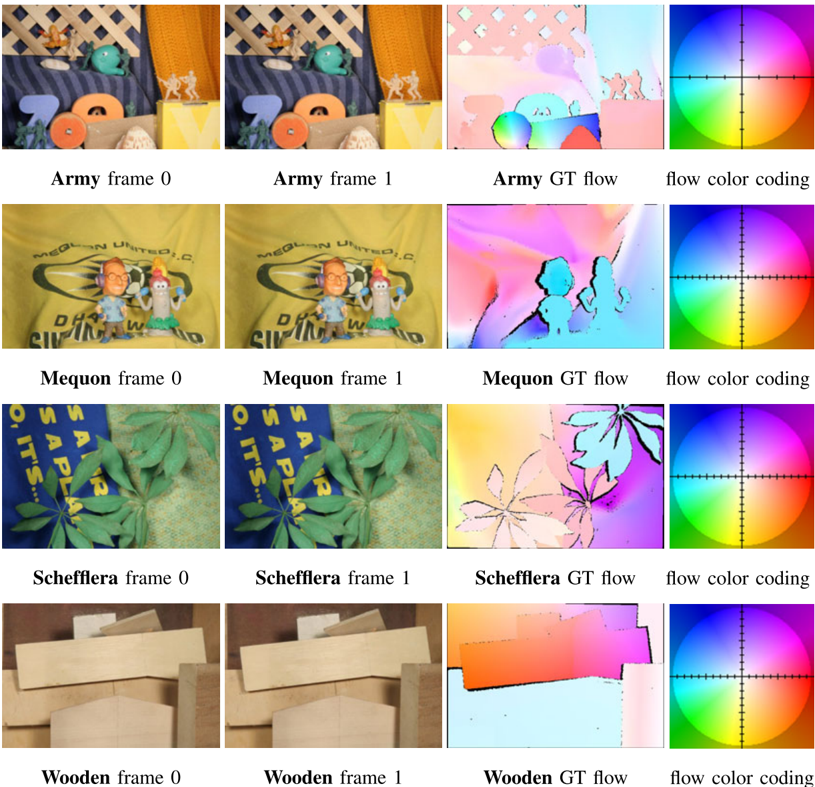
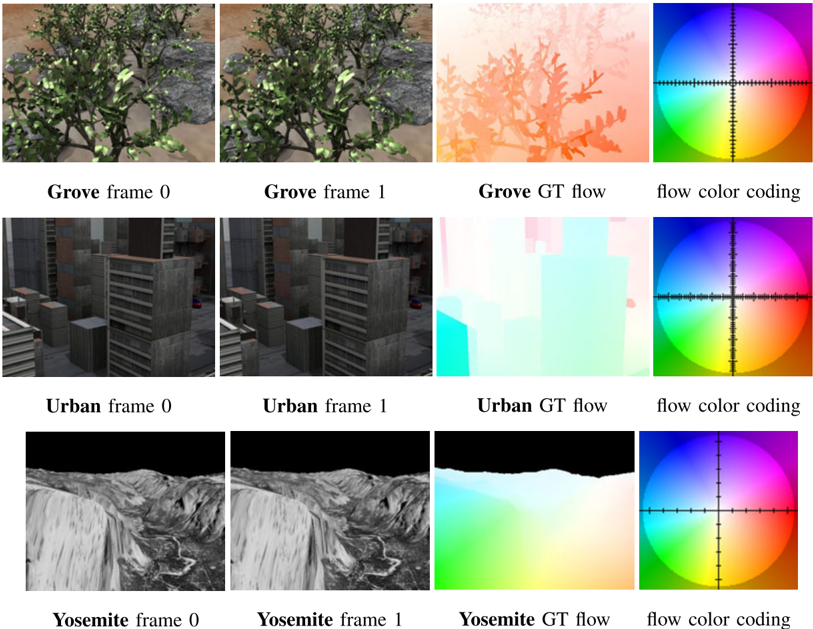
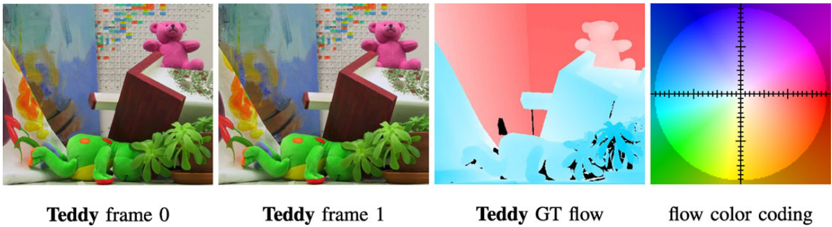
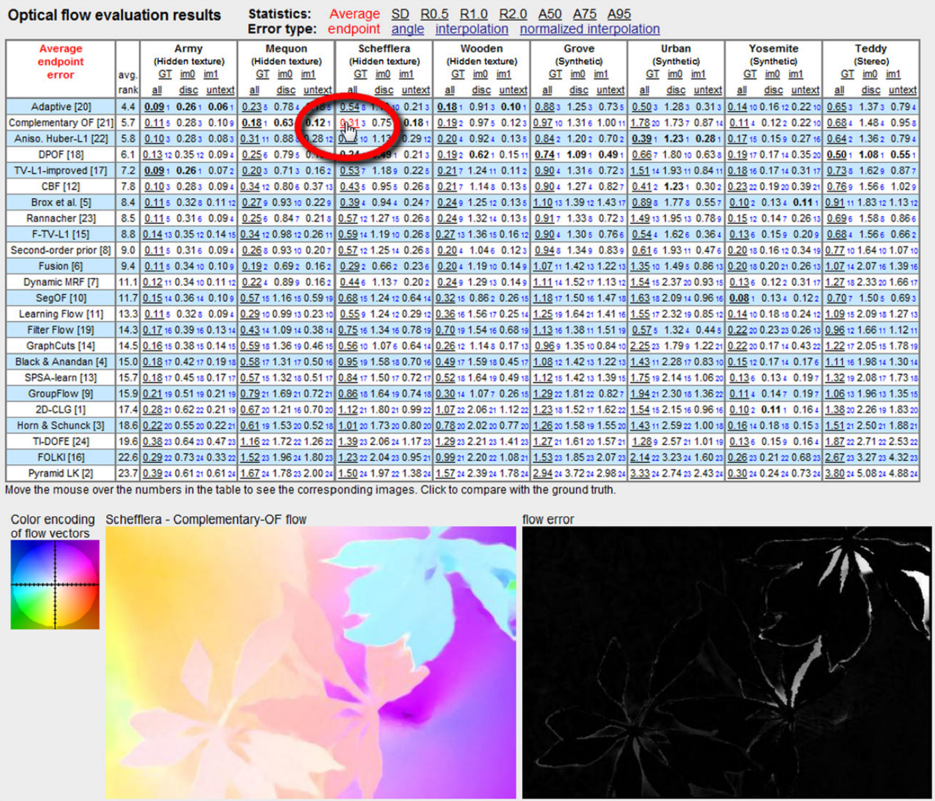
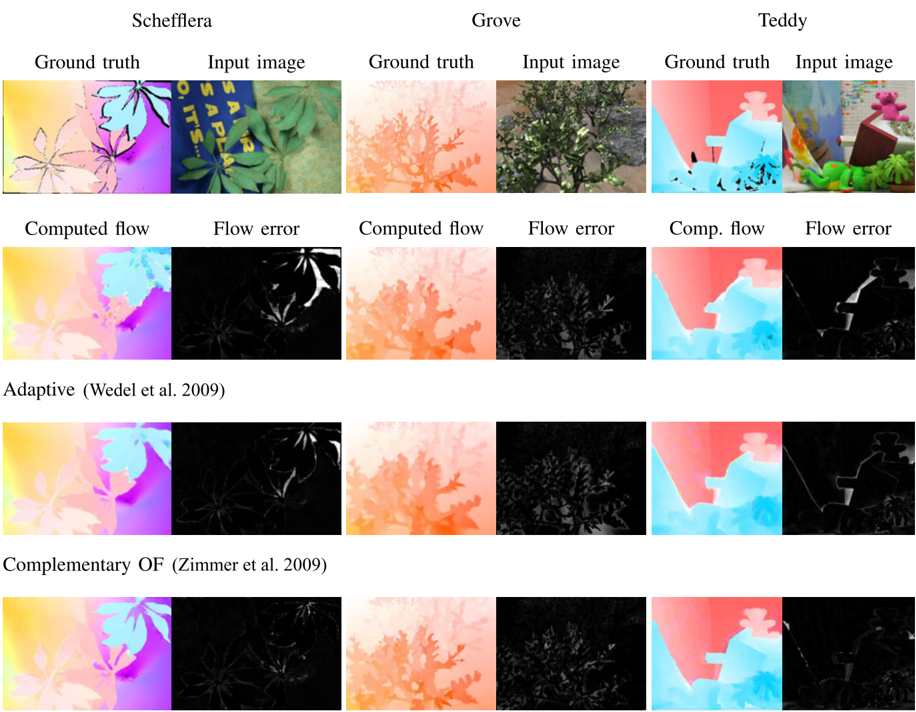
- Best average endpoint error (Avg. EE) improved dramatically over 2D-CLG (Bruhn et al. 2005): Army 0.28→0.09, Mequon 0.67→0.18, Schefflera 1.12→0.24, Wooden 1.07→0.18, Grove 1.23→0.74, Urban 1.54→0.39, Yosemite 0.10→0.08, Teddy 1.38→0.50. Best Avg. EE was below 0.2 pixels on four datasets (Yosemite, Army, Mequon, Wooden).
- Endpoint error (EE) and angular error (AE) rankings were highly correlated (r = 0.989), but the paper argues EE should be preferred: Complementary OF on Urban had Avg. AE 4.64° (rank 6) but Avg. EE 1.78 pixels (rank 20), because AE downweights large motions.
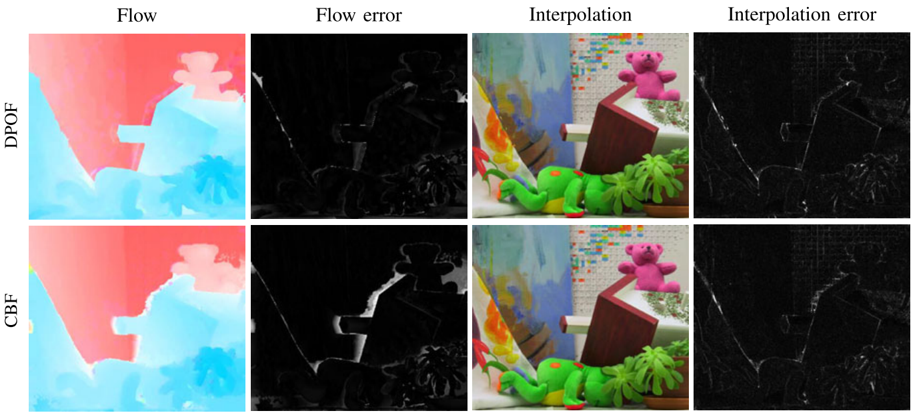
- Motion discontinuity (Disc) regions were the hardest; textureless (Untext) regions were typically easiest. Dataset results were less correlated, with Yosemite poorly or negatively correlated with others. Flow and interpolation errors were only moderately correlated (Avg4 EE vs Avg4 IE r = 0.763). On Teddy, top stereo methods outperformed top flow methods: median lowest-five R1.0 was 9.9 for flow vs 6.5 for stereo in All regions (34% reduction), and 27.6 vs 10.0 in Disc regions (64% reduction).
Methods
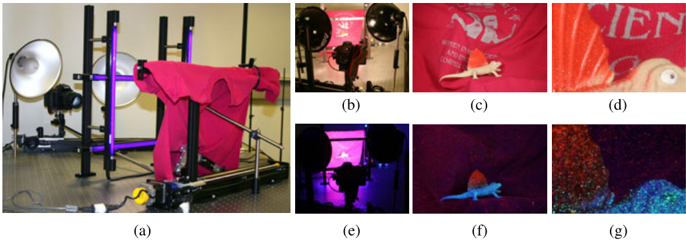
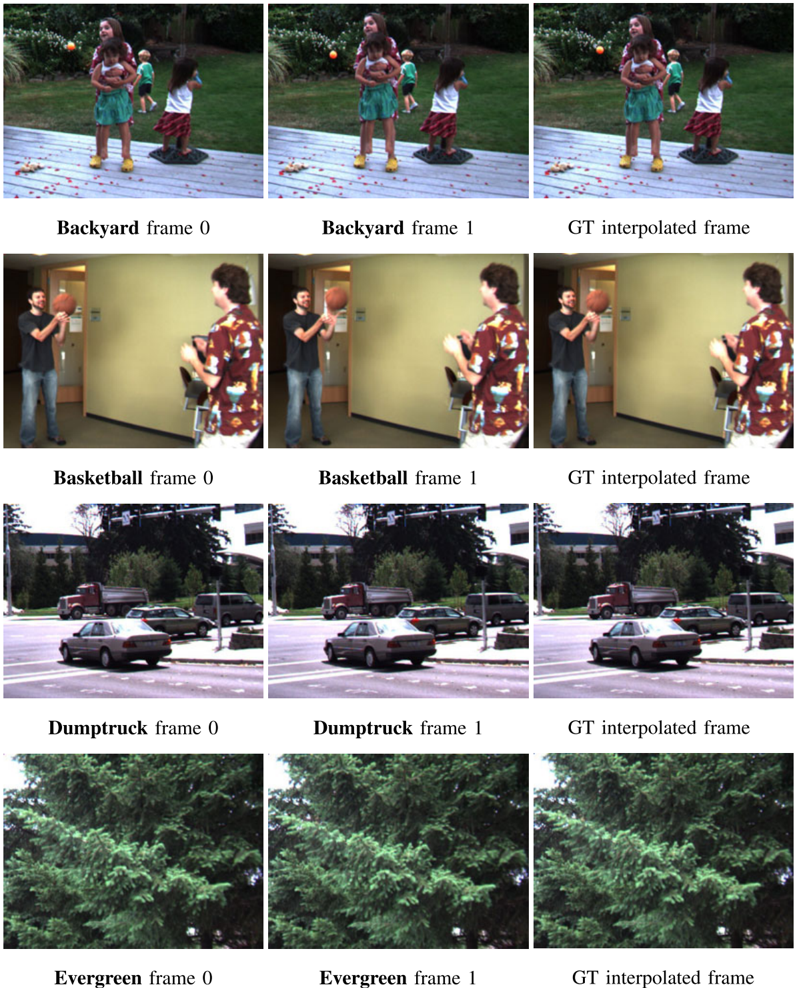
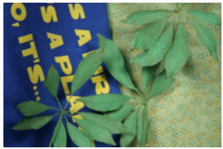
- Four data types were collected: (1) real nonrigid scenes with dense ground truth from hidden fluorescent texture, captured with a Canon EOS 20D at 3504×2336, downsampled every 40th visible-light frame by factor 6 to 584×388, with SSD tracking (15×15 windows), forward/backward crosschecking, and Lucas-Kanade subpixel refinement; (2) realistic synthetic scenes rendered with 3Delight at 640×480, with ground truth from a custom shader and dominant-cluster flow selection; (3) high-speed video for frame interpolation captured with a PointGrey Dragonfly Express at 60 fps, providing every other frame and retaining intermediate frames as ground truth; and (4) modified stereo data (Teddy) from structured light, cropped to make the disparity range roughly symmetric.
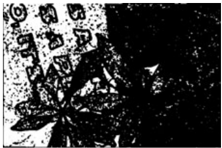
- Evaluation metrics include average angular error (AE), absolute flow endpoint error (EE), interpolation error (IE), and gradient-normalized interpolation error (NE). Statistics include averages, robustness measures R_X, and percentile accuracy measures A_X, computed over All, Disc, and Untext region masks.
- Analysis used the online evaluation at http://vision.middlebury.edu/flow/, comparing 24 published methods across metrics, statistics, masks, and datasets, with Pearson correlations between rankings and comparisons to state-of-the-art stereo methods on Teddy.
Limitations
- The paper states that the hidden fluorescent texture scenes are laboratory scenes, not real-world scenes, and have no motion blur due to stop-motion capture; ground truth is unavailable where cross-checking failed, especially occluded regions, and the measured ground truth is not perfect, though significant errors are limited to a small fraction of pixels. Synthetic sequences were generated without motion blur. The modified stereo ground truth is only accurate to 0.25 pixels, and algorithms may exploit the knowledge that motions are horizontal; overfitting to rigid data should be visible across the 12 evaluation images. Interpolation ground truth is an intermediate image, not a flow field, so the flow definition is apparent motion.
- The paper also states that no single method yet achieves strong performance across a wide variety of datatypes, that any dataset has a limited lifespan, and that future studies should include more challenging realistic synthetic data, longer sequences, and more difficult materials, illumination changes, atmospheric effects, and transparency.
- Evident from the text: the online tables do not provide an overall ranking among methods; runtimes are not normalized for programming environment, CPU speed, cores, or hardware acceleration; algorithms are required to produce dense flow and cannot submit confidence maps or sparse/incomplete fields; all 24 published methods used only 2 frames despite 8-frame sequences being available; and the paper cannot definitively answer whether temporal smoothing is less suited to the more challenging sequences.
Model-written summary. Check it against the paper before relying on it.
Integrity signals
Registry
Cites
Statistics
Figures

Verification
Claims the paper makes
2 Valid · 16 Not valid · 58 Not checked · 185 Own results and interpretations
A result the paper states — it cites no source for it, so there is none to check. The quote shows it is in the paper.
In the paper
“Rather than collecting a single type of data (with its inherent limitations) we instead collected four different types of data, each satisfying a different subset of desirable properties.”
plain- Asserted: passes — The authors put it forward as true.
- Checkable: passes — It can be checked against evidence.
- Load-bearing: passes — The paper’s conclusions depend on it.
- Based: passes — The paper gives a reason why it holds.
A result the paper states — it cites no source for it, so there is none to check. The quote shows it is in the paper.
In the paper
“Using the combination of fluorescent paint, downsampling high-resolution images, and sequential tracking of small motions, we are able to obtain dense, subpixel accurate ground truth for a nonrigid scene.”
plainstates a cause- Asserted: passes — The authors put it forward as true.
- Checkable: passes — It can be checked against evidence.
- Load-bearing: passes — The paper’s conclusions depend on it.
- Based: passes — The paper gives a reason why it holds.
A result the paper reports from its own data — it cites no other source for it, so there is none to check. The quote shows it is in the paper.
In the paper
“To allow for measures that predict performance on such tasks, we collected a variety of data suitable for frame interpolation.”
plainstates a cause- Asserted: passes — The authors put it forward as true.
- Checkable: passes — It can be checked against evidence.
- Load-bearing: passes — The paper’s conclusions depend on it.
- Based: passes — The paper gives a reason why it holds.
A result the paper reports from its own data — it cites no other source for it, so there is none to check. The quote shows it is in the paper.
In the paper
“We have developed a technique for capturing imagery of nonrigid scenes with ground-truth optical flow.”
plain- Asserted: passes — The authors put it forward as true.
- Checkable: passes — It can be checked against evidence.
- Load-bearing: passes — The paper’s conclusions depend on it.
- Based: passes — The paper gives a reason why it holds.
A result the paper states — it cites no source for it, so there is none to check. The quote shows it is in the paper.
In the paper
“To go beyond previous synthetic ground truth (e.g., the Yosemite sequence), we generated two types of fairly complex synthetic outdoor scenes.”
plain- Asserted: passes — The authors put it forward as true.
- Checkable: passes — It can be checked against evidence.
- Load-bearing: passes — The paper’s conclusions depend on it.
- Based: passes — The paper gives a reason why it holds.
96 more claims
Create a free account to see all 261 claims and every source verdict.
- Probably not a substantial claim. 114
- It may state two separate claims as one. 76
- The quote only partly states this claim. 6
Claims other papers make about this one
Each is checked against this paper’s own text: does it say what the citing paper says it does?
The source backs part of the claim, not all of it — or backs it for a different population, condition or comparison.
In the citing paper
“Notable works include the Middlebury dataset (Baker et al, 2011) and the KITTI datasets (Geiger et al, 2012; Menze and Geiger, 2015), but due to the difficulty of computing accurate ground truth, these have been restricted to 8 and 2 · 200 pairs of frames, respectively (the latter are also limited by the special driving setting).”
From What Makes Good Synthetic Training Data for Learning Disparity and Optical Flow Estimation? (2018) · cites this paper as Baker et al, 2011
Experimental — accuracy not yet measured
Citations
Cites
The pascal visual object classes (VOC) challenge
Everingham, M., Van Gool, L., Williams, C. K. I., Winn, J., & Zisserman, A. (2010) · International Journal of Computer Vision · doi:10.1007/s11263-009-0275-4 · Cited by 19,599
Proceedings of IEEE Conference on Computer Vision and Pattern Recognition
(1993) · doi:10.1109/cvpr.1993 · Cited by 17,667
Proceedings of IEEE International Conference on Computer Vision
(1995) · Proceedings of IEEE International Conference on Computer Vision · doi:10.1109/iccv.1995.466933 · Cited by 12,860
(1981) · Cited by 11,963
Horn, B. K. P., & Schunck, B. G. (1981) · Artificial Intelligence · doi:10.1016/0004-3702(81)90024-2 · Cited by 10,312
Horn, B. K., & Schunck, B. G. (1981) · SPIE Proceedings · doi:10.1117/12.965761 · Cited by 7,394 · cited 2×
“A baseline approach is to use an L2 norm as in the Horn and Schunck algorithm (Horn and Schunck 1981):”
BackgroundMethodFast approximate energy minimization via graph cuts
Boykov, Y., Veksler, O., & Zabih, R. (2001) · IEEE Transactions on Pattern Analysis and Machine Intelligence · doi:10.1109/34.969114 · Cited by 6,988
A Taxonomy and Evaluation of Dense Two-Frame Stereo Correspondence Algorithms
Scharstein, D., & Szeliski, R. (2002) · International Journal of Computer Vision · doi:10.1023/a:1014573219977 · Cited by 6,740 · cited 10×
“Many areas of computer vision, such as stereo [63], face recognition [28, 55, 68], and object recognition [23, 24], have challenging datasets to track the progress made by leading algorithms and to stimulate new ideas.”
BackgroundMethodResultInfluentialSelf-citationProceedings European Conference on Computer Vision 2002
Heyden, A., Sparr, G., Nielsen, M., & Johansen, P. (2002) · Lund University Publications (Lund University) · Cited by 5,153
From few to many: illumination cone models for face recognition under variable lighting and pose
Georghiades, A. S., Belhumeur, P. N., & Kriegman, D. J. (2001) · IEEE Transactions on Pattern Analysis and Machine Intelligence · doi:10.1109/34.927464 · Cited by 4,912 · cited 1×
“Many areas of computer vision, such as stereo (Scharstein and Szeliski 2002), face recognition (Philips et al. 2005; Sim et al. 2003; Gross et al. 2008; Georghiades et al. 2001), and object recognition (Fei-Fei et al.”
Background
Research works printed but not linked: 4
- Anandan, P., & Weiss, R. (1985). Introducing smoothness constraint in a matching approach for the computation of displacement fields. In Proceedings of the DARPA image understanding workshop (pp. 186-196).
- Bleyer, M., & Chambon, S. (2010). Does color really help in dense stereo matching? In Proceedings of the international symposium 3D data processing, visualization and transmission .
- Lempitsky, V., Roth, S., & Rother, C. (2008). Fusion flow: discretecontinuous optimization for optical flow estimation. In Proceedings of the IEEE conference on computer vision and pattern recognition .
- Rannacher, J. (2009). Realtime 3D motion estimation on graphics hardware . Undergraduate thesis, Heidelberg University.
Cited by
Items 2,201–2,273 of 2,273
Vision-based moving pedestrian recognition from imprecise and uncertain data
Zhou, D. (2014) · theses.fr (ABES) · doi:10.70675/a1ee97c6zb4e3z41b7z926dzca2cfe84b3e9
“More information of different dense optical flow approaches can be found in [178, 179].”
BackgroundAggregation framework and patch-based representation for optical flow
Fortun, D. (2014) · theses.fr (ABES) · doi:10.70675/7caf49c4z4806z4251zb70aza78d5513f55f
Contributions to active visual estimation and control of robotic systems
Spica, R. (2015) · theses.fr (ABES) · doi:10.70675/f58200cbzd6fdz4f03za579zc0ee87a6aee3 · Cited by 2
Integration of Inertial and Optical Navigation Systems with Spatial Stabilization of a Video Camera
Sokolov, S. V., Погорелов, В. А., & Shvidchenko, S. A. (2025) · Optoelectronics Instrumentation and Data Processing · doi:10.3103/s8756699025700888
Wang, L. (2014) · theses.fr (ABES) · doi:10.70675/7a30d182z2ec1z4f47z8928z5f13400f5c06 · Cited by 1
Video Analysis for Micro- Expression Spotting and Recognition
Lu, H. (2018) · theses.fr (ABES) · doi:10.70675/7ce29cb9z6e23z48cfzbf50z270ecf3e0381 · Cited by 2
Super résolution de texture pour la reconstruction 3D fine
Burns, C. (2018) · theses.fr (ABES) · doi:10.70675/61266807z3f12z4afcza3aczd1ea2b5050df
Analyse de vidéo par décomposition hiérarchique du mouvement appliquée à la post-production vidéo
Rua, J. M. P. (2017) · theses.fr (ABES) · doi:10.70675/254e4bbfze183z4401z8489z09b5d61679aa · Cited by 1
Light field editing and rendering
Hog, M. (2018) · theses.fr (ABES) · doi:10.70675/7facb14dze70az4b6az8c33z358dd46366c6
“Now, in the state of the art optical flow estimation methods [162] Deep Flow [163] stands out for its performance in terms of quality and run-time.”
BackgroundAnalysis of water flows videos for surface velocityestimation
Khalid, M. (2018) · theses.fr (ABES) · doi:10.70675/69d1eb90zfbe5z481czb6f5z15a8e112cb10
Towards an opportunistic artificial vision system for analysing complex scenes from onboard cameras
Mai, T. K. (2018) · theses.fr (ABES) · doi:10.70675/8584c6e0z50cdz400cz904dz9065963e8172
Mennillo, L. (2019) · theses.fr (ABES) · doi:10.70675/d169246ezfdeaz4ea9z81e2z0f0d378bfc45 · Cited by 2
Boukhtache, S. (2020) · theses.fr (ABES) · doi:10.70675/926ba7dczd8d5z472cz9991z5f907cc3f9a2
Veit, M., Lucherini, A., Verstockt, S., et al. (2026) · Fire Safety Journal · doi:10.1016/j.firesaf.2026.104758
3D motion estimation and assessment in fluorescence microscopy volume sequences
Manandhar, S. (2019) · theses.fr (ABES) · doi:10.70675/56199bf3z8b10z478bz8dedzc9dd6c60c9d5
Herrou, G. (2019) · theses.fr (ABES) · doi:10.70675/4c1566b8z42f4z41b4z8f20z7a040d0fce4b
Robust Learning of a depth map for obstacle avoidance with a monocular stabilized flying camera
Pinard, C. (2019) · theses.fr (ABES) · doi:10.70675/14bf1a7dz78a9z4170zbfacz9b660a96e7db · Cited by 2
Scene analysis and view rendering from light fields
David, P. (2020) · theses.fr (ABES) · doi:10.70675/cab6970bz12ccz46caza799z2e14fee9d876
Débruitage vidéo temps réel pour systèmes embarqués
Petreto, A. (2020) · theses.fr (ABES) · doi:10.70675/342db9cfz270cz4532z9c44z2862e471cdd9 · Cited by 2
Learning to generate human videos
Wang, Y. (2021) · theses.fr (ABES) · doi:10.70675/54fdd862z3857z4491z82dczafed8e74ca41 · Cited by 4
From the algorithm to the targets, optimization flow for high performance computing on embedded GPUs
Seznec, M. (2021) · theses.fr (ABES) · doi:10.70675/b4e4b92dz6eacz4629z98eaz7f54eed75a57 · Cited by 1
Variational Data Assimilation with Deep Prior. Application to Geophysical Motion Estimation
Filoche, A. (2022) · theses.fr (ABES) · doi:10.70675/cdc07c59z84ffz4512zab61z9c48c0e1cfbb · Cited by 2
NeuroFusion-SLAM: A Deep Neural Network Framework for Real-Time Multi-Sensor SLAM
Yu, C., Wei, W., Cao, Z., Guo, Z., & Fu, B. (2026) · Sensors · doi:10.3390/s26072267
“As a standard optical flow evaluation metric, EPE has been widely adopted in benchmark evaluations and the related literature [25].”
Flow-Based Visual-Inertial Odometry for Neuromorphic Vision Sensors
Khairallah, M. Z. (2022) · theses.fr (ABES) · doi:10.70675/d8de7f40z6408z4377za2aeza5bd7f7951f0
Zhu, Z., Jiang, X., & Gao, T. (2026) · Displays · doi:10.1016/j.displa.2026.103473
Navigation of a quad-rotor to access the interior of a building
Zhou, S. (2015) · theses.fr (ABES) · doi:10.70675/46265dadz328cz4683z8414z52c6f179b1a4
Evain, E. (2022) · theses.fr (ABES) · doi:10.70675/3030fbe2zd333z4a07za36ezd4d5b2392483 · Cited by 1
Robotic models for the honeybee visual odometer
Bergantin, L. (2023) · theses.fr (ABES) · doi:10.70675/347ba783z123dz48e6z82abz6f206e6d6061 · Cited by 1
Optical flow estimation from event-based data using spiking neural networks
Anibarro, J. C. (2024) · theses.fr (ABES) · doi:10.70675/e3d280d5z9a49z450fz8904zfb375d8d0d67
33910 Motion and Temporal Analysis
Johnson, C. (2025) · De Gruyter eBooks · doi:10.1515/9783111734361-010
Ahmadabadian, A. H. (2026) · ISPRS Journal of Photogrammetry and Remote Sensing · doi:10.1016/j.isprsjprs.2026.03.027
Zhang, X., Prabha, S. P. S. K., pareja, C. C. V., et al. (2026) · SSRN Electronic Journal · doi:10.2139/ssrn.6578539
TransVLM: A Vision-Language Framework and Benchmark for Detecting Any Shot Transitions
Chen, C., Ren, Y., Li, Y., Goriachko, V., Ye, Z., Guo, Z., Hong, Z., & Gong, M. (2026) · Lecture notes in computer science · doi:10.1007/978-3-032-37435-6_6 · Cited by 1
Melt-Pool Dynamics Quantification in LPBF via Move Contrast X-Ray Imaging
Song, Z., Ma, C., Chen, Y., Li, K., Wang, F., & Xiao, T. (2026) · Metals · doi:10.3390/met16050487 · Cited by 1
Syn4D: A Multiview Synthetic 4D Dataset
Jiang, Z., Lan, Y., Luo, Y., Deng, Y., Lai, Z., Sucar, E., Rupprecht, C., Laina, I., Larlus, D., Zheng, C., et al. (2026) · Lecture notes in computer science · doi:10.1007/978-3-032-37010-5_10 · Cited by 9
K, S. R. C., & Mahaboob Basha, S. (2025) · International Conference on Sustainable Computing and Smart Systems (ICSCSS) · doi:10.1109/icscss64956.2025.11500710
“The Lucas-Kanade approach stands as one of the widely used optical flow methods for pixel-level motion tracking although it shows high computational complexity and strong susceptibility to noise [8].”
Xu, B., Xinkai, J. I. A. O., Wang, Q.-C., & Liu, C. X. (2026) · Measurement Science and Technology · doi:10.1088/1361-6501/ae6f38 · Cited by 3
“Considering the rapid movement of vehicles, if real-time vehicle detection issue is not addressed, despite high detection accuracy, these algorithms may still fail to identify vehicles [72].”
Improved Cinematic-Guided Camera Language Transfer in 3D Scene
Wang, Y., Jiang, Z., Deng, B., et al. (2026) · International Conference on 3D Vision (3DV) · doi:10.1109/3dv69130.2026.00183
“4.2.3; the optical flow loss L K opti-flow of depth layer K is: where O K ref and O K S represent the optical flows of the reference and rendered videos at depth layer K , respectively, measured using the endpoint error (EPE) distance [4].”
InfluentialSokolov, S. V., Marshakov, D. V., & Reshetnikova, I. V. (2026) · International Conference on Industrial Engineering, Applications and Manufacturing (ICIEAM) · doi:10.1109/icieam69213.2026.11549657
“One of the most frequently used assumptions is the assumption of smoothness of the optical flow over the entire image (i.e., the absence of a sharp change in the velocity field), effectively used in calculating the optical flow in the Horn-Schunck algorithm [8,16,21].”
Triangular Consistency as a Universal Constraint for Learning Optical Flow
Xiao, Y. H., Coronel, C. R., Zhan, J., Oskouie, H. E., Wong, A., & Lao, D. (2026) · Lecture notes in computer science · doi:10.1007/978-3-032-37261-1_8 · Cited by 1
A second-order regularized optical flow method for computing smooth displacement gradient fieldsPreprint
Lahmani, J., Kesenci, Y., & Olivo‐Marín, J. (2026) · SSRN Electronic Journal · doi:10.2139/ssrn.7005642
MASS: Motion-Aligned Selective Scan for Refinement in Flow-Based Video Frame Interpolation
Yoo, J.-S., & Jung, S. (2026) · Lecture notes in computer science · doi:10.1007/978-3-032-37232-1_8
STA: Spatio-temporal alignment for multimodal test-time adaptation
Yin, X.-L., Wang, X., Zhan, D., et al. (2026) · Knowledge-Based Systems · doi:10.1016/j.knosys.2026.116543
Mahala, N. K., Khan, M., & Kumar, P. (2026) · Applied Mathematical Modelling · doi:10.1016/j.apm.2026.117165
A chemical plant image data enhancement method based on improved SinGAN
Wang, X., Hu, S., Qi, X., et al. (2026) · Royal Society Open Science · doi:10.1098/rsos.251401
Open-Frame-gen: Real-Time Video Frame Interpolation on Constrained Consumer Hardware
Nair, P., Prajwal, R., Madhav, S., et al. (2026) · International Joint Conference on Computer Science and Software Engineering · doi:10.1109/jcsse68839.2026.11597073
“For evaluation, we rank all Vimeo-90K test triplets by average absolute grayscale difference between frames t − 1 and t + 1 , then take the 300 highest-motion sequences and supplement them with Middlebury [12] and UCF101.”
Zhang, X., Prabha, S. P. S. K., pareja, C. C. V., et al. (2026) · Polymer Testing · doi:10.1016/j.polymertesting.2026.109285
On the Real-World Generalisability of Optical Flow Models
Reijalt, P., Gielisse, S., Karlsson, R., & van Gemert, J. C. (2026) · Lecture notes in computer science · doi:10.1007/978-3-032-36839-3_20
Jones, R. J., Liu, L., You, D., et al. (2026) · Physics in Medicine and Biology · doi:10.1088/1361-6560/ae9117
“The end-point error (EPE) (Baker et al 2011) of the predicted DVFs was computed as the Euclidean norm (magnitude) of the residual error vector at each voxel location r : The EPEs quantify the absolute error magnitude of BMPs with respect to the ground truth and are expressed in millimeters.”
Zhou, J., Zhang, X., Wu, X. F., et al. (2026) · Structural Health Monitoring · doi:10.1177/14759217261476581
Customizable motion scenario-based dataset generation for optical flow evaluation
Hooshyaripour, N., Liao, K., Lang, J., Neumann, H., & Petriu, E. M. (2026) · Computer Vision and Image Understanding · doi:10.1016/j.cviu.2026.104928
Liu, Y., Jin, K., Wang, W., et al. (2026) · Natural Hazards · doi:10.1007/s11069-026-08349-6
Learning efficient non-rigid registration in k-space for accelerated Magnetic Resonance Imaging
Ghoul, A., Hammernik, K., Lingg, A., et al. (2026) · Medical Image Analysis · doi:10.1016/j.media.2026.104296
“We further examined how high accelerations impacted the precision and consistency of motion estimation qualitatively by compar-8 ing color-coded [58] motion estimates, quiver plots overlaid on the fully sampled moving image, and the mean square error map between the fully sampled fixed and warped…”
Kriker, O., Bouchahda, N., Abdallah, A. B., Bedoui, M. H., Khaldi, A., Kafi, M. R., & Sahu, A. K. (2026) · Flow Measurement and Instrumentation · doi:10.1016/j.flowmeasinst.2026.103600
ReynoldsFlow: Physics-Inspired Spatiotemporal Flow Representation for Video Understanding
Chen, Y., Ching-Kai, L., Huang, P., & Wu, C.-T. (2026) · Lecture notes in computer science · doi:10.1007/978-3-032-37422-6_31 · Cited by 1
Explainable gait-based scoliosis detection using dense optical flow
Aguilar-Ortega, R., Zhou, Z., Yu, S., et al. (2026) · Expert Systems with Applications · doi:10.1016/j.eswa.2026.134516
Research on multi-scale RAFT framework in particle image velocimetry of complex flow fields
Liu, S., Lu, J., Li, N., & Zhu, H. (2026) · Flow Measurement and Instrumentation · doi:10.1016/j.flowmeasinst.2026.103635
Fisher, D. J. (2014) · UCL Discovery (University College London)
Unified point-edgelet feature tracking
Sundararajan, K. (2011) · TigerPrints (Clemson University)
Enhancing low-level features with mid-level cues
Trulls, E. (2015) · UPCommons institutional repository (Universitat Politècnica de Catalunya) · doi:10.5821/dissertation-2117-95639 · Cited by 1
“9: (a) We follow the color-coding scheme for two-dimensional flow fields of (Baker et al., 2011).”
Taxonomy of Feature Description Attributes
Krig, S. (2016) · Springer eBooks · doi:10.1007/978-3-319-33762-3_5
Motion Estimation Based on Patchwise-Optimized Optical Flow
Wu, H., Song, M., Tu, S., & Wen, Z. (2014) · Advances in intelligent systems and computing · doi:10.1007/978-3-642-54924-3_7
Optical Flow Reliability Model Approximated with RBF
Agís, R., Javier, D., Ortigosa, P. M., et al. (2011) · Lecture notes in computer science · doi:10.1007/978-3-642-21498-1_12
Turbulence power laws and inverse motion modeling in images
Héas, P., Mémin, É., Heitz, D., & Mininni, P. D. (2009) · HAL · Cited by 1
Metadata
- Authors
- Baker, S., Scharstein, D., Lewis, J. P., Roth, S., Black, M. J., & Szeliski, R.
- Affiliations
- Microsoft (United States) (US)
- Middlebury College (US)
- Technische Universität Darmstadt (DE)
- Brown University (US)
- Corresponding author
- Scharstein, Daniel
- Venue
- International Journal of Computer Vision
- Published
- 2010-11-30
- Volume
- 92
- Issue
- 1
- Pages
- 1-31
- ISSN
- 0920-5691 (ISSN-L)
- 1573-1405
- OpenAlex
- W2147253850
- Semantic Scholar
- 804836b8ad86ef8042e3dcbd45442a52f031ee03
- Cited by
- 2,205
- References
- 112
- Citations by year
- 2026: 49 · 2025: 81 · 2024: 82 · 2023: 117 · 2022: 129 · 2021: 152 · 2020: 174 · 2019: 163 · 2018: 144 · 2017: 156 · 2016: 187 · 2015: 180 · 2014: 154 · 2013: 129 · 2012: 118
- FWCI
- 146.62
- Type
- journal article
- Language
- en
- Open access
- hybrid
- doi.org
- Licence
- cc-by-nc
- Locations
- International Journal of Computer Vision (publishedVersion, cc-by-nc)
- Publikationsdatenbank der Fraunhofer-Gesellschaft (Fraunhofer-Gesellschaft) (publishedVersion)
- Max Planck Institute for Plasma Physics (submittedVersion)
- Fraunhofer-Publica (Fraunhofer-Gesellschaft) (submittedVersion)
- Funders
- National Science Foundation (0534858, 0535075, 0413169)
- Intel Corporation
- Topics
- Physical Sciences › Computer Science › Computer Vision and Pattern Recognition › Advanced Vision and Imaging
- Physical Sciences › Computer Science › Computer Vision and Pattern Recognition › Video Surveillance and Tracking Methods
- Physical Sciences › Computer Science › Signal Processing › Video Coding and Compression Technologies
- Keywords
- optical flow, benchmark dataset, evaluation methodology, non-rigid motion, motion discontinuities, textureless regions, sensor noise
About these checks
Registry, retraction, Cites and statistics results are computed, not judged, with one exception: a printed reference that no index lists is read once by a model before it counts as a citation error. Claims are extracted by a model and kept only when their quote appears verbatim in the text; each cited source is then checked, with a model’s help, for whether it says what the claim relies on. Those verdicts can be wrong — read the claim’s quote and the cited source before relying on one.
The claim verdicts this report counts are experimental: their accuracy is not yet measured.
A language model drew the claims from the paper on 2026-10-01, under version 3 of the claim definition (model deepseek-v4.1-flash, prompt extract-v3).
A second model labelled each claim on 2026-10-01 (model jev-1.13-20260917, definition revision gold-guideline-v0.2).
Statistics and arithmetic are recomputed, not judged.
Confidence bands are shown only for fields calibrated on our annotated test set. None is calibrated yet, so no band is shown.
What counts as a claim ›How we measure confidence ›How we check this ›
Are you an author, or do you see a problem with this page? Request a review
Data sources
Bibliographic data: Semantic Scholar, OpenAlex, Crossref.
Contains information from the Semantic Scholar Academic Graph Datasets, made available under the ODC Attribution License (ODC-BY 1.0).
Semantic Scholar’s data is described in: Kinney, R., et al. (2023). The Semantic Scholar Open Data Platform. arXiv:2301.10140.
