

A Database and Evaluation Methodology for Optical Flow
Open accessThe DOI matches its Crossref record; 110 of the 112 references it cites were found in a registry or an index; 2 of the 68 sources its claims cite were checked for support.
Abstract
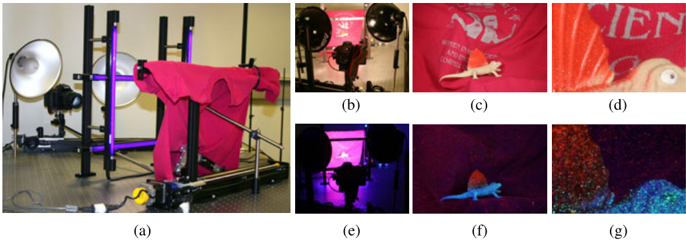
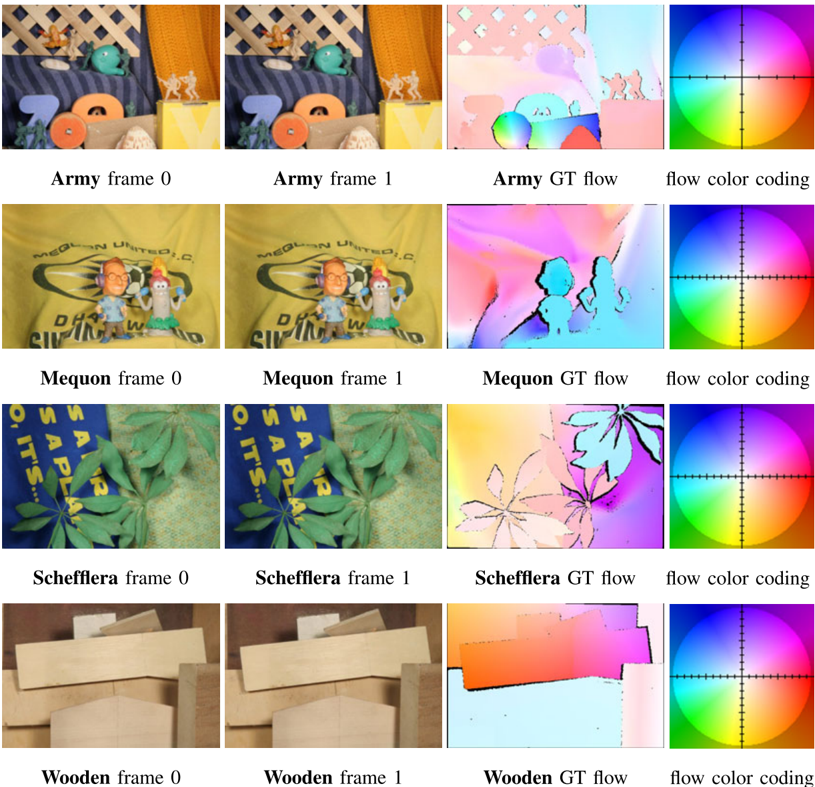
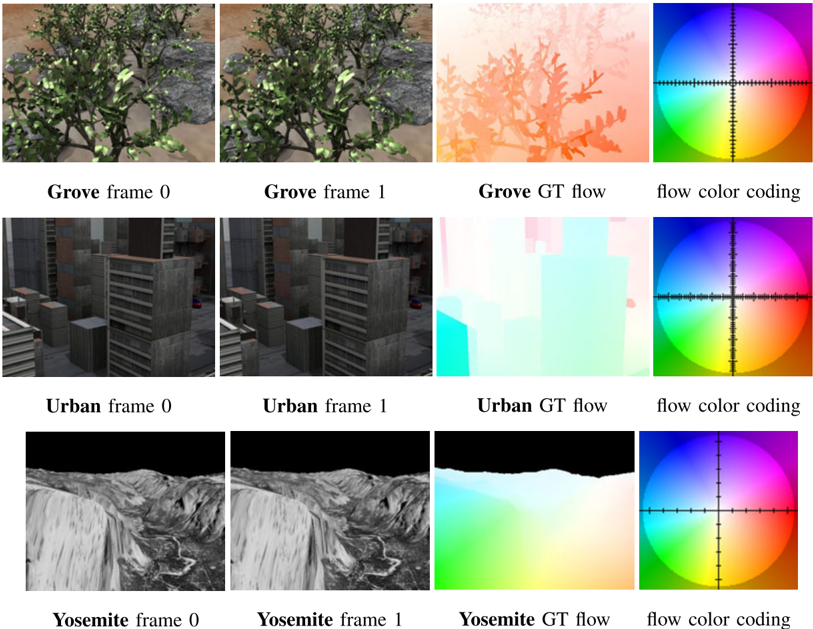
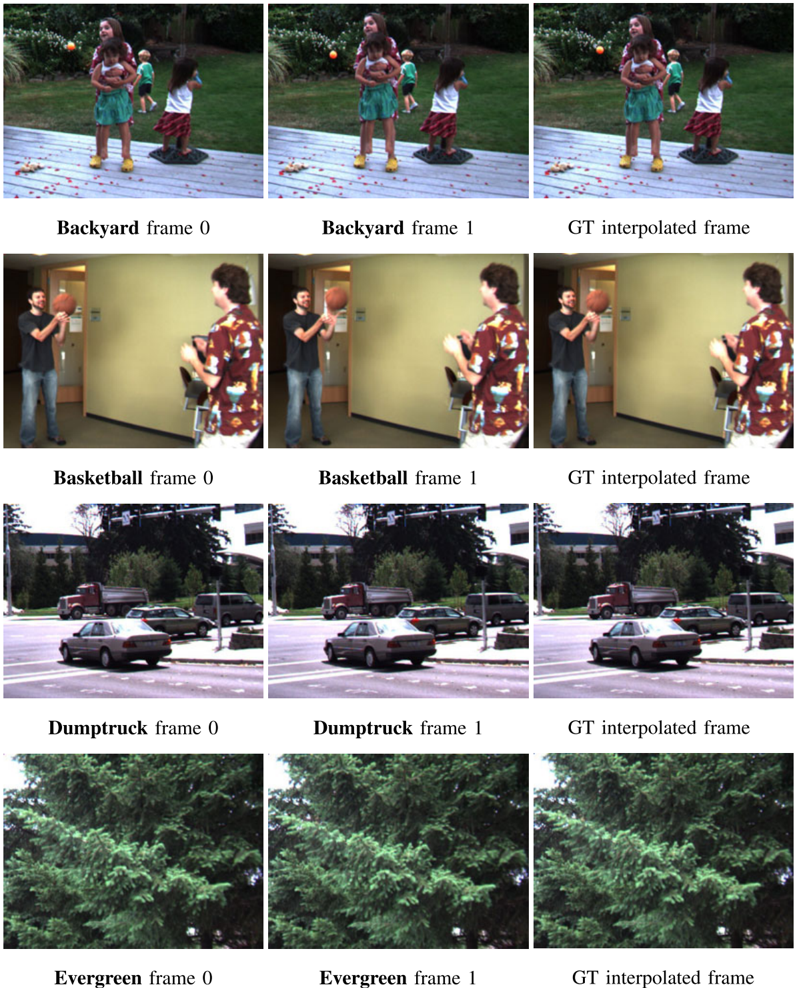
The quantitative evaluation of optical flow algorithms by Barron et al. (1994) led to significant advances in performance. The challenges for optical flow algorithms today go beyond the datasets and evaluation methods proposed in that paper. Instead, they center on problems associated with complex natural scenes, including nonrigid motion, real sensor noise, and motion discontinuities. We propose a new set of benchmarks and evaluation methods for the next generation of optical flow algorithms. To that end, we contribute four types of data to test different aspects of optical flow algorithms: (1) sequences with nonrigid motion where the ground-truth flow is determined by tracking hidden fluorescent texture, (2) realistic synthetic sequences, (3) high frame-rate video used to study interpolation error, and (4) modified stereo sequences of static scenes. In addition to the average angular error used by Barron et al., we compute the absolute flow endpoint error, measures for frame interpolation error, improved statistics, and results at motion discontinuities and in textureless regions.
Overview
CoChat Summary
TL;DR
The paper introduces a new optical flow benchmark of four data types (hidden fluorescent texture, realistic synthetic, high-speed interpolation, and modified stereo) plus an extended evaluation methodology with endpoint error, interpolation error, robustness/accuracy statistics, and region masks. It reports that performance improved substantially over the preliminary 2007 study, but motion discontinuities and diverse datasets remain difficult, and top flow methods still lag top stereo methods on the modified Teddy stereo data.
Key findings
- The benchmark contains 12 training and 12 test sequences; test ground truth is withheld except for Yosemite. As of December 2009 the online evaluation contained results for 24 published methods, all using only 2 input frames and 10 using color.
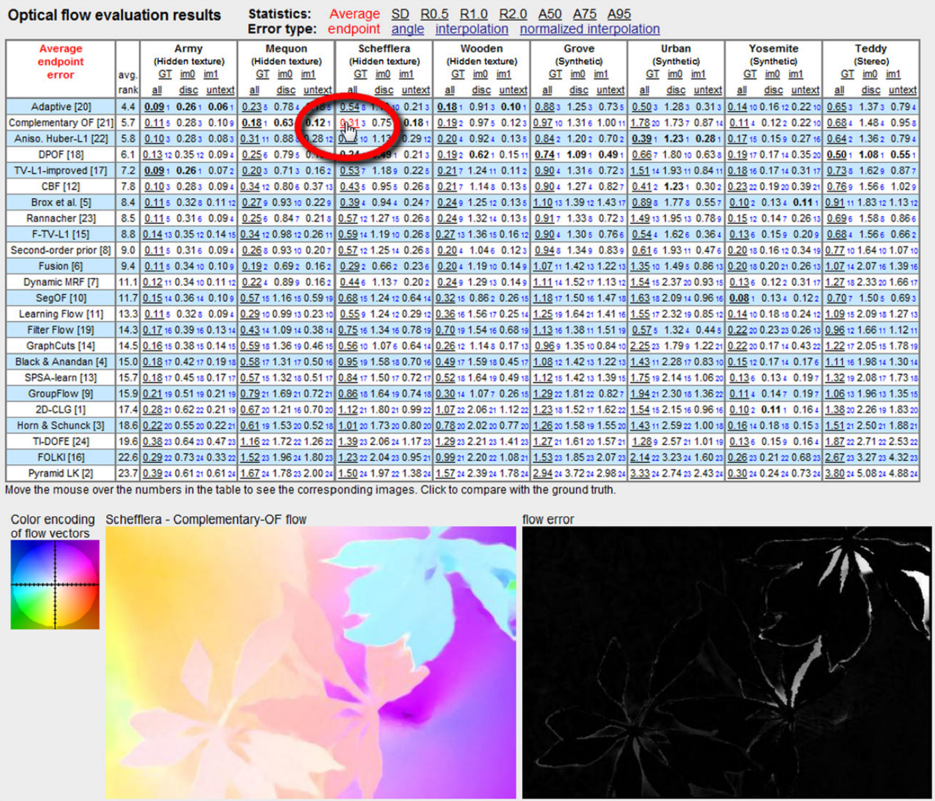
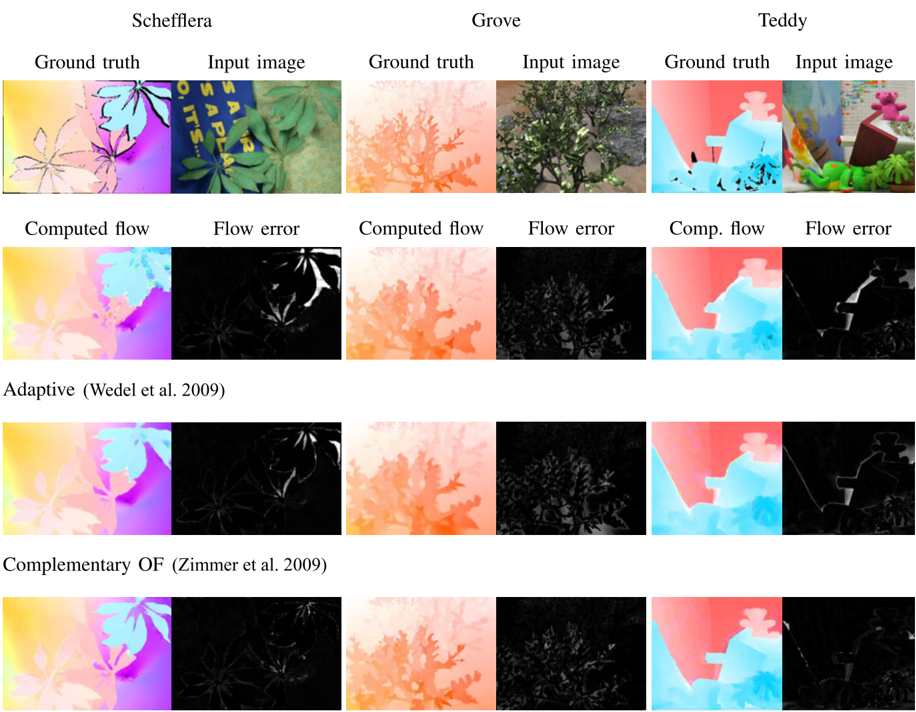
- Best average endpoint error (Avg. EE) improved dramatically over 2D-CLG (Bruhn et al. 2005): Army 0.28→0.09, Mequon 0.67→0.18, Schefflera 1.12→0.24, Wooden 1.07→0.18, Grove 1.23→0.74, Urban 1.54→0.39, Yosemite 0.10→0.08, Teddy 1.38→0.50. Best Avg. EE was below 0.2 pixels on four datasets (Yosemite, Army, Mequon, Wooden).
- Endpoint error (EE) and angular error (AE) rankings were highly correlated (r = 0.989), but the paper argues EE should be preferred: Complementary OF on Urban had Avg. AE 4.64° (rank 6) but Avg. EE 1.78 pixels (rank 20), because AE downweights large motions.
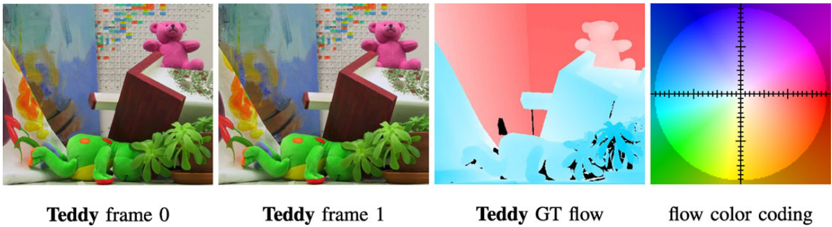
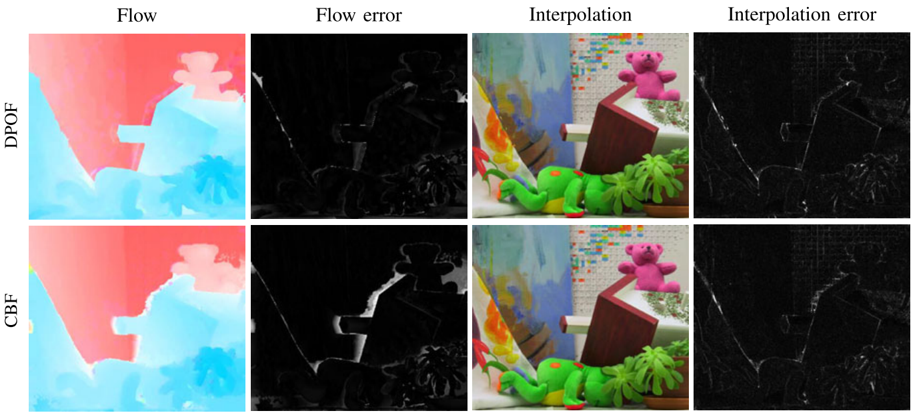
- Motion discontinuity (Disc) regions were the hardest; textureless (Untext) regions were typically easiest. Dataset results were less correlated, with Yosemite poorly or negatively correlated with others. Flow and interpolation errors were only moderately correlated (Avg4 EE vs Avg4 IE r = 0.763). On Teddy, top stereo methods outperformed top flow methods: median lowest-five R1.0 was 9.9 for flow vs 6.5 for stereo in All regions (34% reduction), and 27.6 vs 10.0 in Disc regions (64% reduction).
Methods
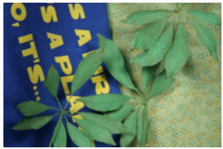
- Four data types were collected: (1) real nonrigid scenes with dense ground truth from hidden fluorescent texture, captured with a Canon EOS 20D at 3504×2336, downsampled every 40th visible-light frame by factor 6 to 584×388, with SSD tracking (15×15 windows), forward/backward crosschecking, and Lucas-Kanade subpixel refinement; (2) realistic synthetic scenes rendered with 3Delight at 640×480, with ground truth from a custom shader and dominant-cluster flow selection; (3) high-speed video for frame interpolation captured with a PointGrey Dragonfly Express at 60 fps, providing every other frame and retaining intermediate frames as ground truth; and (4) modified stereo data (Teddy) from structured light, cropped to make the disparity range roughly symmetric.
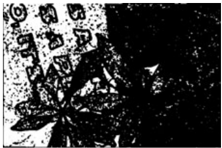
- Evaluation metrics include average angular error (AE), absolute flow endpoint error (EE), interpolation error (IE), and gradient-normalized interpolation error (NE). Statistics include averages, robustness measures R_X, and percentile accuracy measures A_X, computed over All, Disc, and Untext region masks.
- Analysis used the online evaluation at http://vision.middlebury.edu/flow/, comparing 24 published methods across metrics, statistics, masks, and datasets, with Pearson correlations between rankings and comparisons to state-of-the-art stereo methods on Teddy.
Limitations
- The paper states that the hidden fluorescent texture scenes are laboratory scenes, not real-world scenes, and have no motion blur due to stop-motion capture; ground truth is unavailable where cross-checking failed, especially occluded regions, and the measured ground truth is not perfect, though significant errors are limited to a small fraction of pixels. Synthetic sequences were generated without motion blur. The modified stereo ground truth is only accurate to 0.25 pixels, and algorithms may exploit the knowledge that motions are horizontal; overfitting to rigid data should be visible across the 12 evaluation images. Interpolation ground truth is an intermediate image, not a flow field, so the flow definition is apparent motion.
- The paper also states that no single method yet achieves strong performance across a wide variety of datatypes, that any dataset has a limited lifespan, and that future studies should include more challenging realistic synthetic data, longer sequences, and more difficult materials, illumination changes, atmospheric effects, and transparency.
- Evident from the text: the online tables do not provide an overall ranking among methods; runtimes are not normalized for programming environment, CPU speed, cores, or hardware acceleration; algorithms are required to produce dense flow and cannot submit confidence maps or sparse/incomplete fields; all 24 published methods used only 2 frames despite 8-frame sequences being available; and the paper cannot definitively answer whether temporal smoothing is less suited to the more challenging sequences.
Model-written summary. Check it against the paper before relying on it.
Integrity signals
Registry
Cites
Statistics
Figures

Verification
Claims the paper makes
2 Valid · 16 Not valid · 58 Not checked · 185 Own results and interpretations
A result the paper states — it cites no source for it, so there is none to check. The quote shows it is in the paper.
In the paper
“Rather than collecting a single type of data (with its inherent limitations) we instead collected four different types of data, each satisfying a different subset of desirable properties.”
plain- Asserted: passes — The authors put it forward as true.
- Checkable: passes — It can be checked against evidence.
- Load-bearing: passes — The paper’s conclusions depend on it.
- Based: passes — The paper gives a reason why it holds.
A result the paper states — it cites no source for it, so there is none to check. The quote shows it is in the paper.
In the paper
“Using the combination of fluorescent paint, downsampling high-resolution images, and sequential tracking of small motions, we are able to obtain dense, subpixel accurate ground truth for a nonrigid scene.”
plainstates a cause- Asserted: passes — The authors put it forward as true.
- Checkable: passes — It can be checked against evidence.
- Load-bearing: passes — The paper’s conclusions depend on it.
- Based: passes — The paper gives a reason why it holds.
A result the paper reports from its own data — it cites no other source for it, so there is none to check. The quote shows it is in the paper.
In the paper
“To allow for measures that predict performance on such tasks, we collected a variety of data suitable for frame interpolation.”
plainstates a cause- Asserted: passes — The authors put it forward as true.
- Checkable: passes — It can be checked against evidence.
- Load-bearing: passes — The paper’s conclusions depend on it.
- Based: passes — The paper gives a reason why it holds.
A result the paper reports from its own data — it cites no other source for it, so there is none to check. The quote shows it is in the paper.
In the paper
“We have developed a technique for capturing imagery of nonrigid scenes with ground-truth optical flow.”
plain- Asserted: passes — The authors put it forward as true.
- Checkable: passes — It can be checked against evidence.
- Load-bearing: passes — The paper’s conclusions depend on it.
- Based: passes — The paper gives a reason why it holds.
A result the paper states — it cites no source for it, so there is none to check. The quote shows it is in the paper.
In the paper
“To go beyond previous synthetic ground truth (e.g., the Yosemite sequence), we generated two types of fairly complex synthetic outdoor scenes.”
plain- Asserted: passes — The authors put it forward as true.
- Checkable: passes — It can be checked against evidence.
- Load-bearing: passes — The paper’s conclusions depend on it.
- Based: passes — The paper gives a reason why it holds.
96 more claims
Create a free account to see all 261 claims and every source verdict.
- Probably not a substantial claim. 114
- It may state two separate claims as one. 76
- The quote only partly states this claim. 6
Claims other papers make about this one
Each is checked against this paper’s own text: does it say what the citing paper says it does?
The source backs part of the claim, not all of it — or backs it for a different population, condition or comparison.
In the citing paper
“Notable works include the Middlebury dataset (Baker et al, 2011) and the KITTI datasets (Geiger et al, 2012; Menze and Geiger, 2015), but due to the difficulty of computing accurate ground truth, these have been restricted to 8 and 2 · 200 pairs of frames, respectively (the latter are also limited by the special driving setting).”
From What Makes Good Synthetic Training Data for Learning Disparity and Optical Flow Estimation? (2018) · cites this paper as Baker et al, 2011
Experimental — accuracy not yet measured
Citations
Cites
The pascal visual object classes (VOC) challenge
Everingham, M., Van Gool, L., Williams, C. K. I., Winn, J., & Zisserman, A. (2010) · International Journal of Computer Vision · doi:10.1007/s11263-009-0275-4 · Cited by 19,599
Proceedings of IEEE Conference on Computer Vision and Pattern Recognition
(1993) · doi:10.1109/cvpr.1993 · Cited by 17,667
Proceedings of IEEE International Conference on Computer Vision
(1995) · Proceedings of IEEE International Conference on Computer Vision · doi:10.1109/iccv.1995.466933 · Cited by 12,860
(1981) · Cited by 11,963
Horn, B. K. P., & Schunck, B. G. (1981) · Artificial Intelligence · doi:10.1016/0004-3702(81)90024-2 · Cited by 10,312
Horn, B. K., & Schunck, B. G. (1981) · SPIE Proceedings · doi:10.1117/12.965761 · Cited by 7,394 · cited 2×
“A baseline approach is to use an L2 norm as in the Horn and Schunck algorithm (Horn and Schunck 1981):”
BackgroundMethodFast approximate energy minimization via graph cuts
Boykov, Y., Veksler, O., & Zabih, R. (2001) · IEEE Transactions on Pattern Analysis and Machine Intelligence · doi:10.1109/34.969114 · Cited by 6,988
A Taxonomy and Evaluation of Dense Two-Frame Stereo Correspondence Algorithms
Scharstein, D., & Szeliski, R. (2002) · International Journal of Computer Vision · doi:10.1023/a:1014573219977 · Cited by 6,740 · cited 10×
“Many areas of computer vision, such as stereo [63], face recognition [28, 55, 68], and object recognition [23, 24], have challenging datasets to track the progress made by leading algorithms and to stimulate new ideas.”
BackgroundMethodResultInfluentialSelf-citationProceedings European Conference on Computer Vision 2002
Heyden, A., Sparr, G., Nielsen, M., & Johansen, P. (2002) · Lund University Publications (Lund University) · Cited by 5,153
From few to many: illumination cone models for face recognition under variable lighting and pose
Georghiades, A. S., Belhumeur, P. N., & Kriegman, D. J. (2001) · IEEE Transactions on Pattern Analysis and Machine Intelligence · doi:10.1109/34.927464 · Cited by 4,912 · cited 1×
“Many areas of computer vision, such as stereo (Scharstein and Szeliski 2002), face recognition (Philips et al. 2005; Sim et al. 2003; Gross et al. 2008; Georghiades et al. 2001), and object recognition (Fei-Fei et al.”
Background
Research works printed but not linked: 4
- Anandan, P., & Weiss, R. (1985). Introducing smoothness constraint in a matching approach for the computation of displacement fields. In Proceedings of the DARPA image understanding workshop (pp. 186-196).
- Bleyer, M., & Chambon, S. (2010). Does color really help in dense stereo matching? In Proceedings of the international symposium 3D data processing, visualization and transmission .
- Lempitsky, V., Roth, S., & Rother, C. (2008). Fusion flow: discretecontinuous optimization for optical flow estimation. In Proceedings of the IEEE conference on computer vision and pattern recognition .
- Rannacher, J. (2009). Realtime 3D motion estimation on graphics hardware . Undergraduate thesis, Heidelberg University.
Cited by
Items 1,501–1,600 of 2,273
Pereira, D. R., Delpiano, J. F., & Papa, J. P. (2014) · SIBGRAPI Conference on Graphics, Patterns and Images (SIBGRAPI) · doi:10.1109/sibgrapi.2014.22 · Cited by 4
On-Line Video Motion Estimation by Invariant Receptive Inputs
Gori, M., Lippi, M., Maggini, M., et al. (2014) · IEEE Conference on Computer Vision and Pattern Recognition Workshops (CVPRW) · doi:10.1109/cvprw.2014.112 · Cited by 3
“A lot of effort has been and is still spent by the scientific community, in order to improve the prediction quality in different applicative contexts, and particularly in determining the optical flow [8] (for recent contributes, see [1, 12, 18, 21] and references therein).”
BackgroundOptical Flow with Harmonic Constraint and Oriented Smoothness
Zhao, J., Wang, Y.-Q., & Wang, H. (2011) · 2011 Sixth International Conference on Image and Graphics · doi:10.1109/icig.2011.122 · Cited by 3
Co-aligning aerial hyperspectral push-broom strips for change detection
Ringaby, E., Ahlberg, J., Wadströmer, N., et al. (2010) · Proceedings of SPIE, the International Society for Optical Engineering/Proceedings of SPIE · doi:10.1117/12.865034 · Cited by 3
“We use a track and re-track procedure which means that when a point is tracked from the first image patch to the other one, it is tracked back to the first image patch again, and if it returns to the original position the point is regarded as a match, otherwise it is discarded.(10) After this step we have accurate poi…”
MethodHyperbolic Numerics for Variational Approaches to Correspondence Problems
Zimmer, H., Breuß, M., Weickert, J., & Seidel, H. (2009) · Lecture notes in computer science · doi:10.1007/978-3-642-02256-2_53 · Cited by 4
“We use greyscale versions of the stereo image data from the Middlebury University [15]1.”
MethodParallel Implementation of Dense Optical Flow Computation on Many-Core Processor
Chen, W., Yu, J. H., Zhang, W., Jiang, L., Zhang, G., & Chai, Z. (2015) · Lecture notes in computer science · doi:10.1007/978-3-319-27119-4_9 · Cited by 4
7. On optical flow models for variational motion estimation
Burger, M., Dirks, H., & Frerking, L. (2016) · De Gruyter eBooks · doi:10.1515/9783110430394-007 · Cited by 5
Lin, C.-T., Chen, L.-T., & Wang, Y.-F. (2015) · IEEE Vehicular Technology Conference · doi:10.1109/vtcfall.2015.7390937 · Cited by 3
“nontrivial to make such a framework robust and practical [5].”
BackgroundInfluentialOptical Flow Estimation Using Local Features
Mohammed, A. D., & Morris, T. (2015) · Research Explorer (The University of Manchester) · Cited by 3
Estimation of the Degree of Endolymphatic Hydrops Using Optical Coherence Tomography
Karvonen, T., Uranishi, Y., Sakamoto, T., Tona, Y., Okamoto, K., Tamura, H., & Kuroda, T. (2016) · Advanced Biomedical Engineering · doi:10.14326/abe.5.19 · Cited by 3
PERFORMANCE EVALUATION OF FEATURE DETECTION FOR LOCAL OPTICAL FLOW TRACKING
Senst, T., Unger, B., Keller, I., & Sikora, T. (2012) · International Conference on Pattern Recognition Applications and Methods · doi:10.5220/0003731103030309 · Cited by 3
“Baker et al. proposed robust statistics by applying a set of thresholds to the error measurements.”
BackgroundMethodInfluentialOptical Flow and Trajectory Methods in Context
Gibson, J., & Marques, O. (2016) · SpringerBriefs in computer science · doi:10.1007/978-3-319-44941-8_2 · Cited by 3
Movement detection for object tracking applied to the InMoov robot head
Ortiz, N., Londoño, L. F., Jinete, M. A., et al. (2016) · doi:10.1109/stsiva.2016.7743328 · Cited by 3
“[15] database: Hydrangea and Walking sets.”
Dynamic Obstacle Detection Based on Background Compensation in Robot’s Movement Space
Ni, T., Li, Q., Sun, L., et al. (2017) · MATEC Web of Conferences · doi:10.1051/matecconf/20179508013 · Cited by 3
“Moving target detection under complex background mainly includes the following three ways: the background model method [2], inter-frame difference method [3] and the optical flow field method [4].”
MethodInfluentialQuasi-Flat Zones for Angular Data Simplification
Aptoula, E., Pham, M., & Lefèvre, S. (2017) · Lecture notes in computer science · doi:10.1007/978-3-319-57240-6_28 · Cited by 3
“The dataset provided in [14] contains the optical flow ground truth of eight images, out of which we picked three for qualitative comparison purposes.”
BackgroundMethodInfluentialNovel method of extracting motion from natural movies
Suzuki, W., Ichinohe, N., Tani, T., Hayami, T., Miyakawa, N., Watanabe, S., & Takeichi, H. (2017) · Journal of Neuroscience Methods · doi:10.1016/j.jneumeth.2017.08.006 · Cited by 3
“The aim of using algorithms to extract optical flow (Baker et al. 2011; Barron et al. 1994) is to estimate the ground-truth flow of motion in an image sequence.”
Analysing Acceleration for Motion Analysis
Sun, Y., Hare, J. S., & Nixon, M. S. (2017) · International Conference on Signal-Image Technology & Internet-Based Systems (SITIS) · doi:10.1109/sitis.2017.56 · Cited by 3
“The colour map of acceleration flow: (b), (e) are pseudo ground truth [7] and (c), (f) detection by the new approach on the right.”
BackgroundMethodInfluentialdos Santos, J. D. B., Sen, P., & Oliveira, M. M. (2018) · The Visual Computer · doi:10.1007/s00371-018-1521-y · Cited by 3
“[3] proposed another benchmark for optical-flow algorithms that considers aspects not covered by Barron et al.”
BackgroundMethodMatlab programmed method for the optical flow estimation based on the integral image
Molina, A. M., & Lazcano, V. A. (2018) · International Conference on Control, Automation and Robotics (ICCAR) · doi:10.1109/iccar.2018.8384707 · Cited by 3
Low Memory Image Reconstruction Algorithm from RAW Images
Briand, T. (2018) · IEEE Image, Video, and Multidimensional Signal Processing Workshop (IVMSP) · doi:10.1109/ivmspw.2018.8448561 · Cited by 3
“We generated a burst of N im = 200 CFA images from the Rubberwhale image [22], which is a color image of size 584 × 388 .”
MethodDeeper Spatial Pyramid Network with Refined Up-Sampling for Optical Flow Estimation
Sun, Z., & Wang, H. (2018) · Lecture notes in computer science · doi:10.1007/978-3-030-00776-8_45 · Cited by 3
High-Fidelity Depth Upsampling Using the Self-Learning Framework
Shim, I., Oh, T.-H., & Kweon, I. S. (2018) · Sensors · doi:10.3390/s19010081 · Cited by 3
“For the evaluation, we used a robust accuracy measure as a metric of quantitative comparison, “A〈#N〉” as used in [43]; “A〈#N〉” denotes the depth error at the Nth percentile after the errors are sorted from low to high.”
MethodGPU Based Horn-Schunck Method to Estimate Optical Flow and Occlusion
Lazcano, V. A., & Rivera, F. (2019) · Lecture notes in computer science · doi:10.1007/978-3-030-14812-6_26 · Cited by 3
Pavilion: Bridging Photo-Realism and Robotics
Jiang, F., & Hao, Q. (2019) · Proceedings - IEEE International Conference on Robotics and Automation/Proceedings · doi:10.1109/icra.2019.8794235 · Cited by 3
“Previous works of generating optical flow data can be divided into two groups: (1) real-world database-based [6] and (2) computer graphics-based [7], [8], [9].”
Fang, H., Li, H., Song, S., Pang, K., Ai, D., Fan, J., Song, H., Yu, Y., & Yang, J. (2020) · Physics in Medicine and Biology · doi:10.1088/1361-6560/aba087 · Cited by 4
DDCNet-Multires: Effective Receptive Field Guided Multiresolution CNN for Dense Prediction
Salehi, A., & Balasubramanian, M. (2022) · Neural Processing Letters · doi:10.1007/s11063-022-11039-6 · Cited by 3
“It contains only 8 two-frame sequences with small displacements, around 10 pixels [2].”
BackgroundThe Hodgkin–Huxley neuron model for motion detection in image sequences
Yedjour, H., Meftah, B., Yedjour, D., & Lézoray, O. (2021) · Neural Computing and Applications · doi:10.1007/s00521-021-06446-0 · Cited by 4
“The motion boundary detection evaluation is carried on motion boundary datasets generated from the optical flow datasets: Sintel [49], KITTI [50], Middlebury [51] and YMB dataset [35].”
MethodInfluentialCompleted Dense Scene Flow in RGB-D Space
Wang, Y., Zhang, J., Liu, Z., Wu, Q., Chou, P. A., Zhang, Z., & Jia, Y. (2015) · Lecture notes in computer science · doi:10.1007/978-3-319-16628-5_14 · Cited by 3
“These maps are illustrated based on middlebury color coding [12].”
MethodTrustworthy Video Surveillance: An Approach Based on Guaranteeing Data Privacy
Martínez-Ballesté, A., Solanas, A., & Rashwan, H. A. (2014) · Studies in computational intelligence · doi:10.1007/978-3-319-09885-2_15 · Cited by 3
Angularly Consistent Light Field Video Interpolation
David, P., Pendu, M. L., & Guillemot, C. M. (2020) · IEEE International Conference on Multimedia and Expo (ICME) · doi:10.1109/icme46284.2020.9102968 · Cited by 6
“We choose to use a method similar to the one described in [10].”
MethodDirect Video Frame Interpolation With Multiple Latent Encoders
Kwon, Y.-H., Yoon, J. H., & Park, M.-G. (2021) · IEEE Access · doi:10.1109/access.2021.3053695 · Cited by 3
“After excluding Urban and Teddy from the Middlebury dataset, the proposed method shows significantly better performance than the others.”
MethodInfluentialA Study of Fall Detection: Review and Implementation
Mubashir, M. (2011) · UPT. Syiah Kuala University Library (Syiah Kuala University) · Cited by 4
Speeding-up Graphical Model Optimization via a Coarse-to-fine Cascade of Pruning ClassifiersPreprint
Conejo, B., Komodakis, N., Leprince, S., & Avouac, J. (2014) · arXiv (Cornell University) · doi:10.48550/arxiv.1409.4205 · Cited by 3
“Using the dataset of [1], we train the classifier on Army (1116 labels), and test on RubberWhale (625 labels) and Dimetrodon (483 labels).”
MethodJoint Large-Scale Motion Estimation and Image ReconstructionPreprint
Dirks, H. (2016) · arXiv (Cornell University) · doi:10.48550/arxiv.1610.09908 · Cited by 5
“Figure 1: Frame 4 of the Rubber Whale sequence from [2].”
BackgroundMethodInfluentialPyramidal Gradient Matching for Optical Flow EstimationPreprint
Li, Y. (2017) · arXiv (Cornell University) · doi:10.48550/arxiv.1704.03217 · Cited by 5
“The classical framework for optical flow estimation is based on variational formulation and the related global energy optimization [8], [9].”
MethodContinual Occlusions and Optical Flow EstimationPreprint
Neoral, M., Šochman, J., & Matas, J. (2018) · arXiv (Cornell University) · doi:10.48550/arxiv.1811.01602 · Cited by 3
“In the following, we focus on the Robust Vision Challenge [32], where one trained model with the same parameters has to be evaluated on four individual benchmarks [27,6,22,3] instead of fine-tuning for each particular dataset independently.”
MethodZoom-In-to-Check: Boosting Video Interpolation via Instance-level DiscriminationPreprint
Yuan, L., Chen, Y., Liu, H., et al. (2018) · arXiv (Cornell University) · doi:10.48550/arxiv.1812.01210 · Cited by 3
Technical Report on Visual Quality Assessment for Frame InterpolationPreprint
Men, H., Lin, H., Hosu, V., Maurer, D., Bruhn, A., & Saupe, D. (2019) · arXiv (Cornell University) · doi:10.48550/arxiv.1901.05362 · Cited by 4
“tion, currently, there is only one optical flow benchmark that is commonly used and offers an assessment of interpolated frames, which is the Middlebury benchmark [4].”
MethodA Variational Model for Joint Motion Estimation and Image ReconstructionPreprint
Burger, M., Dirks, H., & Schönlieb, C. (2016) · arXiv (Cornell University) · doi:10.17863/cam.25352 · Cited by 6
Xie, J., Gao, R., Zheng, Z., et al. (2019) · arXiv (Cornell University) · doi:10.48550/arxiv.1911.11294 · Cited by 3
“…facial expression, and the other is a woman with surprise facial expression; (b) visualizes the learned trackable motions (optical flows) by color images, by following (Baker et al. 2011), where each color represents a direction (Please see the appendix for the displacement field color coding map.)”
BackgroundMRPB 1.0: A Unified Benchmark for the Evaluation of Mobile Robot Local Planning ApproachesPreprint
Wen, J. G., Zhang, X., Bi, Q., et al. (2020) · arXiv (Cornell University) · doi:10.48550/arxiv.2011.00491 · Cited by 3
“Compared with several successful benchmarks in the area of computer vision [17]– [19], there is relatively little research on motion planning benchmarks in robotics.”
BackgroundPrediction-assistant Frame Super-Resolution for Video StreamingPreprint
Wang, S., Bao, W., Zhai, G., Wang, C. L., Hu, J. W., & Gao, Z. (2021) · arXiv (Cornell University) · doi:10.48550/arxiv.2103.09455 · Cited by 6
“Method Vimeo90K [53] Middlebury [1] Vid4 [31] REDS [39] HD [4] 4 × 8 × 4 × 8 × 4 × 8 × 4 × 8 × 4 × 8 × PSNR SSIM PSNR SSIM PSNR SSIM PSNR SSIM PSNR SSIM PSNR SSIM PSNR SSIM PSNR SSIM PSNR SSIM PSNR SSIM Bicubic 1 LR 29.77 0.903 25.79 0.824 27.71 0.858 23.82 0.763 22.37 0.610 19.82 0.615 26.29 0.801 23.48 0.702 32.98 0…”
MethodInfluential3D Motion Analysis via Energy Minimization
Wedel, A. (2009) · bonndoc (University of Bonn) · Cited by 3
Software for Non-Parametric Image Registration of 2-Photon Imaging DataPreprint
Flotho, P., Nomura, S., Kuhn, B., & Strauss, D. (2021) · bioRxiv · doi:10.1101/2021.07.25.453381 · Cited by 13
“Chen et al. [6] lead (as of July 2021) the Middlebury optical flow benchmark [7] with respect to average endpoint error (AEE) and average angular error (AAE).”
BackgroundWang, H., Fan, R., & Liu, M. (2020) · doi:10.36227/techrxiv.13186688.v1 · Cited by 4
“Additionally, we adopt two standard evaluation metrics, the average end-point error (AEPE) and the percentage of erroneous pixels (F1) [14, 15, 16, 17].”
MethodInfluentialCombinatorial Solutions for Shape Optimization in Computer Vision
Schoenemann, T. (2009) · bonndoc (University of Bonn) · Cited by 3
Video Quality Assessment System Using Deep Optical Flow and Fourier Property
Kang, D., Kim, Y., Kwon, S., Kim, H., Kim, J., & Paik, J. (2023) · IEEE Access · doi:10.1109/access.2023.3335352 · Cited by 2
“To overcome this problem, most datasets [21], [26], [27], [28] synthesize motion fields using virtual tools.”
BackgroundResearch on variational optical flow method for rockfall monitoring
Chen, H., Zhang, L., Zhang, Y., et al. (2024) · Signal Image and Video Processing · doi:10.1007/s11760-024-03187-0 · Cited by 2
Liu, Y., Hao, S., Qi, X., Huang, K., Yang, M., Huang, Z., Li, Y., Chang, L., Zhou, L., Long, Y., et al. (2025) · IEEE Transactions on Circuits and Systems I Regular Papers · doi:10.1109/tcsi.2025.3572918 · Cited by 3
“To evaluate the accuracy of the proposed accelerator, as many existing works [12], [14], [16], the dataset Middlebury [33] is used for testing.”
Representing Flow Fields with Divergence-Free Kernels for Reconstruction
Ni, X., Xing, J., Li, X., Wang, B., & Chen, B. (2025) · Proceedings of the ACM on Computer Graphics and Interactive Techniques · doi:10.1145/3747872 · Cited by 4
Robust Optic-Flow Estimation with Bayesian Inference of Model and Hyper-parameters
Héas, P., Herzet, C., & Mémin, É. (2012) · Lecture notes in computer science · doi:10.1007/978-3-642-24785-9_65 · Cited by 4
“5 shows that this combination performs the best in terms of MEP and MBA errors.”
BackgroundMethodInfluentialCorrelation and variational approaches for motion and diffusion estimation in fluorescence imaging
Fortun, D., Chen, C., Paul‐Gilloteaux, P., et al. (2013) · HAL (Le Centre pour la Communication Scientifique Directe) · Cited by 2
Mixed-Resolution Patch-Matching
Sureka, H., & Narayanan, P. J. (2012) · Lecture notes in computer science · doi:10.1007/978-3-642-33783-3_14 · Cited by 4
“Local matching combined with multi-resolution refinement is used for optical flow [8], but large displacements of small objects are often missed.”
BackgroundOn-chip semidense representation map for dense visual features driven by attention processes
Granados, S., Barranco, F., Mota, S., et al. (2013) · Journal of Real-Time Image Processing · doi:10.1007/s11554-012-0320-3 · Cited by 2
“We used several Middle-bury benchmark sequences whose ground truth is known [2].”
MethodInfluentialUnusual Motion Detection for Vision-Based Driver Assistance
Fu, L., Wu, W., Zhang, Y., et al. (2015) · International Journal of Fuzzy Logic and Intelligent Systems · doi:10.5391/ijfis.2015.15.1.27 · Cited by 2
“The TV-L(1) method is one of the best optical flow methods proposed in recent years [13].”
MethodHafner, D., Demetz, O., Weickert, J., & Reißel, M. (2014) · Journal of Mathematical Imaging and Vision · doi:10.1007/s10851-014-0529-9 · Cited by 2
Hierarchical Properties of Multi-resolution Optical Flow Computation
Kameda, Y., Imiya, A., & Sakai, T. (2012) · Lecture notes in computer science · doi:10.1007/978-3-642-33868-7_57 · Cited by 2
Block matching based real-time optical flow hardware implementation
Seyid, K., Richaud, A., Capoccia, R., & Leblebici, Y. (2016) · IEEE International Symposium on Circuits and Systems proceedings · doi:10.1109/iscas.2016.7539020 · Cited by 3
“In this work, we will present a block matching based algorithm for optical flow implementation, and compare the results with actual ground truth results according to the error metrics also provided by [3].”
BackgroundResultInfluentialBoundary Preserving Variational Image Differentiation
Mathlouthi, Y., Mitiche, A., & Ayed, I. B. (2016) · Lecture notes in computer science · doi:10.1007/978-3-319-45886-1_29 · Cited by 2
“We used two standard error measures to evaluate optical flow [1]: the average angular error (aae) and the endpoint error (epe).”
MethodInfluentialModification of the optical flow horn-schunck estimation incorporating exaustive search
Lazcano, V. A., & Molina, M. (2015) · CHILEAN Conference on Electrical, Electronics Engineering, Information and Communication Technologies · doi:10.1109/chilecon.2015.7404675 · Cited by 2
Gathering Event Detection by Stereo Vision
Wang, Q., Wei, J., & Wang, G. (2016) · Lecture notes in computer science · doi:10.1007/978-3-319-50832-0_42 · Cited by 2
Monomodal Image Registration by Tensor Analysis: Going Beyond the Brightness Constancy Assumption
Morán, M. B. H., Conci, A., González, J. R., et al. (2018) · IEEE/ACS International Conference on Computer Systems and Applications (AICCSA) · doi:10.1109/aiccsa.2018.8612853 · Cited by 2
Dynamic Features Based on Flow-Correlation and HOG for Recognition of Discrete Facial Expressions
Anthwal, S., & Ganotra, D. (2020) · Revue d intelligence artificielle · doi:10.18280/ria.340508 · Cited by 4
“To quantify resemblance between the computed optical flow and the ground truth flow, optical flow performance measures angular error (AE) and endpoint error (EE) values [44] were computed and concatenated with 2D correlation coefficients (Eq.”
MethodOptical Flow Estimation Between Images of Different Resolutions via Variational Method
Zhao, R. Q., Xiong, R., Zhu, S., Zeng, B., Huang, T., & Gao, W. (2020) · IEEE International Conference on Visual Communications and Image Processing (VCIP) · doi:10.1109/vcip49819.2020.9301771 · Cited by 3
“We also compare the performance of proposed method with approaches adjusting images for traditional schemes on Middlebury [11] and MPI-Sintel [12] datasets.”
MethodNonlinear Evolutionary PDE-Based Refinement of Optical Flow
Doshi, H., & Kiran, N. U. (2021) · Machine Graphics and Vision · doi:10.22630/mgv.2021.30.1.3 · Cited by 2
Salehi, A., & Balasubramanian, M. (2023) · Eye · doi:10.1038/s41433-023-02623-8 · Cited by 1
Song, Y., She, M., & Köser, K. (2022) · ISPRS annals of the photogrammetry, remote sensing and spatial information sciences · doi:10.5194/isprs-annals-v-4-2022-353-2022 · Cited by 4
“A famous in-door scene 3D vision benchmark is the Middlebury dataset, which contains Stereo (Scharstein et al., 2014), Multi-View Stereo (MVS) (Seitz et al., 2006), and Optical Flow (Baker et al., 2011) datasets.”
BackgroundMulti-scale Intermediate Flow Estimation for Video Frame Interpolation
Fan, Z., Zhu, F., Li, L., & Tan, X. (2022) · IEEE International Conference on Tools with Artificial Intelligence (ICTAI) · doi:10.1109/ictai56018.2022.00137 · Cited by 3
“The first three rows of images are from the Middlebury dataset [20].”
BackgroundMethodA Primal-Dual Finite Element Method for Scalar and Vectorial Total Variation Minimization
Hilb, S., Langer, A., & Alkämper, M. (2023) · Journal of Scientific Computing · doi:10.1007/s10915-023-02209-2 · Cited by 2
“In Fig.7 we evaluate Algorithm 3 visually against the Middlebury optical flow benchmark [9].”
MethodOptical Flow and Expansion Based Deep Temporal Up-Sampling of LIDAR Point Clouds
Rózsa, Z., & Szirányi, T. (2023) · Remote Sensing · doi:10.3390/rs15102487 · Cited by 4
Traffic Risk Assessment from Driving Scene Images
Wu, W.-J., & Lin, H. (2023) · Conference proceedings/Conference proceedings - IEEE International Conference on Systems, Man, and Cybernetics · doi:10.1109/smc53992.2023.10393985 · Cited by 2
“The dense optical flow vector calculated by the driver attention model is transformed into the optical flow image [1].”
MethodOn the Road to Autonomy: A Comparative Analysis of Multimodal Datasets
Dasgupta, A., Gopi, O., Chowdhury, A. Z. M. K. A., & Behera, S. (2024) · Communications in computer and information science · doi:10.1007/978-3-031-59114-3_2 · Cited by 3
Deng, L., Pei, J., Song, Y., Huo, W., Zhang, Y., & Huang, Y. (2025) · IEEE Internet of Things Journal · doi:10.1109/jiot.2025.3550532 · Cited by 4
“…of the same pixel between two frames, which can be calculated by p 2 ( ˜ q ) = p 2 ( ˜ q ) The displacement of each pixel is expressed by a method similar to Middlebury color coding [68], and the corresponding relationship between the pixel displacement and the color block is shown in Fig.”
Ulrich, K., Scheckenbach, F., Wong, T. M., et al. (2025) · Frontiers in Plant Science · doi:10.3389/fpls.2025.1572745 · Cited by 2
When Is a Confidence Measure Good Enough?
Márquez-Valle, P., Gil, D., Hernández-Sabaté, A., et al. (2013) · Lecture notes in computer science · doi:10.1007/978-3-642-39402-7_35 · Cited by 2
“In optical flow, the accuracy is commonly computed by the end-point error [1].”
BackgroundMethodOptical flow based guidance system design for semi-strapdown image homing guided missiles
Huang, L., Song, J., Zhang, M., et al. (2016) · Chinese Journal of Aeronautics · doi:10.1016/j.cja.2016.08.011 · Cited by 2
“Baker et al.(21) studied several well-known algorithms to obtain optical flow, including PLK and Black Anandan (BA), where the groundtruth flow was determined by tracking hidden fluorescent texture painted on the scene.”
MethodChen, D., & Cohen, L. D. (2019) · Handbook of numerical analysis · doi:10.1016/bs.hna.2019.07.009 · Cited by 2
“3b, we visualize the vector field ξ̃ through the color coding scheme (Baker et al., 2011).”
BackgroundMethodA Lightweight Network Model For Video Frame Interpolation Using Spatial Pyramids
Zhuang, J., Qin, Z., Chen, J., & Wan, T. (2020) · Proceedings - International Conference on Image Processing · doi:10.1109/icip40778.2020.9191039 · Cited by 2
“Video Frame Interpolation, as a basic task in video enhancement, is to synthesize one or more frames between two consecutive frames [1].”
BackgroundSublabel-Accurate Multilabeling Meets Product Label Spaces
Ye, Z., Haefner, B., Quéau, Y., Möllenhoff, T., & Cremers, D. (2021) · Lecture notes in computer science · doi:10.1007/978-3-030-92659-5_1 · Cited by 2
“We compute the optical flow on Grove3 [2] using our method and our baseline for a varying amount of labels.”
MethodSain: Similarity-Aware Video Frame Interpolation
Lv, Y., Yang, W., Zuo, W., Liao, Q., & Zhu, R. (2022) · IEEE International Conference on Acoustics Speech and Signal Processing · doi:10.1109/icassp43922.2022.9747211 · Cited by 2
Real Time Dense Motion Estimation Using FPGA Based Omnidirectional Video Acquisition Device
Kwiatkowski, J., Sobel, D., Ryt, A., Domżał, M., Jędrasiak, K., & Nawrat, A. (2015) · Studies in systems, decision and control · doi:10.1007/978-3-319-21118-3_7 · Cited by 2
“To achieve that, two quality coefficients, which are present in literature, are used [28].”
BackgroundFǎgǎdar-Cosma, M., Creţu, V.-I., & Micea, M. V. (2012) · Lecture notes in computer science · doi:10.1007/978-3-642-31295-3_25 · Cited by 2
Motion Detection Based on Biological Correlation Model
Sun, B., Sang, N., Wang, Y., & Zheng, Q. (2010) · Lecture notes in computer science · doi:10.1007/978-3-642-13318-3_28 · Cited by 2
Quasi-dense optical flow estimation based on dynamical system models
Fukami, T., Enokida, S., Sebe, N., et al. (2011) · Society of Instrument and Control Engineers of Japan · Cited by 2
Optical Flow on Moving Manifolds
Bauer, M., Grasmair, M., & Kirisits, C. (2015) · SIAM Journal on Imaging Sciences · doi:10.1137/140965235 · Cited by 2
“In Figure 3 we use the color coding from [6] to visualize the optical flow.”
Superslicing frame restoration for anisotropic sstem
Laptev, D., Vezhnevets, A. S., & Buhmann, J. M. (2014) · IEEE International Symposium on Biomedical Imaging (ISBI) · doi:10.1109/isbi.2014.6868090 · Cited by 2
“A more advanced technique is based on optical flow estimation and frame warping [3].”
MethodVariational Multi-Valued Velocity Field Estimation for Transparent Sequences
Ramírez-Manzanares, A., Rivera, M., Kornprobst, P., & Lauze, F. (2011) · Journal of Mathematical Imaging and Vision · doi:10.1007/s10851-011-0260-8 · Cited by 2
“[10] around a database of image sequences with ground truth for a systematic evaluation and benchmark of optical flow algorithms.”
BackgroundFuzzy segmentation of video shots using hybrid color spaces and motion information
de Carvalho, B. M., Garduño, E., Santos, T., de Oliveira, L. M., & Neto, J. F. S. (2013) · Pattern Analysis and Applications · doi:10.1007/s10044-013-0359-1 · Cited by 2
“A more recent study [28] provides a ranking of several state-of-theart optical flow methods, and has been kept up-to-date at the Middlebury’s optical flow page (http://vision.”
BackgroundA Novel Space Variant Image Representation
Onkarappa, N., & Sappa, A. D. (2012) · Journal of Mathematical Imaging and Vision · doi:10.1007/s10851-012-0384-5 · Cited by 2
2D instantaneous frequency-based method for motion estimation using total variation
Murray, V., Rodríguez, P., & Pattichis, M. S. (2014) · IEEE Global Conference on Signal and Information Processing · doi:10.1109/globalsip.2014.7032273 · Cited by 2
Consistent optical flow for stereo video
Sellent, A., Linz, C., & Magnor, M. A. (2010) · Proceedings - International Conference on Image Processing · doi:10.1109/icip.2010.5649199 · Cited by 3
“Though state-of-the-art optical flow algorithms perform increasingly well [6, 7, 8], the general two-image approach often fails to yield consistent and coherent correspondences in a stereoscopic setting.”
BackgroundEfficient real-time local optical flow estimation by means of integral projections
Senst, T., Eiselein, V., Pätzold, M., & Sikora, T. (2011) · Proceedings - International Conference on Image Processing · doi:10.1109/icip.2011.6116111 · Cited by 3
“2, with a reduced theoretical complexity ofO(k ·n ·w) compared to theO(k ·n ·w2) by PLK, theAEE of the proposed method is slightly higher than in the original Lucas-Kanade algorithm which is due to the approximation error of using integral projections but obviously has a higher accuracy than the II-LK [9], which compu…”
MethodInfluentialRobust optical flow estimation based on brightness correction fields
Wang, W., Su, Z., Pan, J., Wang, Y., & Sun, R. (2011) · Frontiers of Information Technology & Electronic Engineering · doi:10.1631/jzus.c1100062 · Cited by 3
A true motion estimation method based on binarized cross correlation
Michielin, F., Calvagno, G., Sartor, P., & Erdler, O. (2013) · IEEE International Conference on Consumer Electronics - Berlin (ICCE-Berlin) · doi:10.1109/icce-berlin.2013.6697998 · Cited by 2
“The test was made on the Middlebury database [14] which provides a set of different sequences with an associated VF ground truth.”
MethodInfluentialRakêt, L. L., Søgaard, J., Salmistraro, M., et al. (2012) · Proceedings of SPIE, the International Society for Optical Engineering/Proceedings of SPIE · doi:10.1117/12.929435 · Cited by 2
Semi-local variational optical flow estimation
Fortun, D., & Charles Kervrann, A. (2012) · Proceedings - International Conference on Image Processing · doi:10.1109/icip.2012.6466799 · Cited by 2
Coarse-to-fine optical flow estimation with image structure tensor
Chen, Z., Zhang, C., & Li, M. (2013) · International Congress on Image and Signal Processing (CISP) · doi:10.1109/cisp.2013.6745263 · Cited by 2
“Effect of the local structure tensor constancy assumption In recently years, the Middlebury database has been the accepted benchmark to evaluate various optical flow methods([23]).”
BackgroundHong, B. (2013) · Physics in Medicine and Biology · doi:10.1088/0031-9155/58/21/7757 · Cited by 2
“…proposed algorithm are shown on the middle row, and the deformation fields h(t, x) that account for the undesirable patient motion during the imaging procedure are shown on the bottom row at eight different time phases using the standard color coding scheme for the optical flow (Baker et al 2011).”
MethodConfidence measures of optical flow estimation suitable for multiframe superresolution
Kanaev, A. V. (2012) · Proceedings of SPIE, the International Society for Optical Engineering/Proceedings of SPIE · doi:10.1117/12.918720 · Cited by 2
“The number of papers on optical flow during the last several years easily tops a hundred [1-4] while considerably smaller number of papers has been devoted to optical flow confidence measures [5-9].”
BackgroundMethodInfluentialWang, B., Zhu, Q., Xiong, H., & Luo, C. (2011) · International Conference on Mobile and Ubiquitous Multimedia (MUM) · doi:10.1145/2107596.2107614 · Cited by 2
Metadata
- Authors
- Baker, S., Scharstein, D., Lewis, J. P., Roth, S., Black, M. J., & Szeliski, R.
- Affiliations
- Microsoft (United States) (US)
- Middlebury College (US)
- Technische Universität Darmstadt (DE)
- Brown University (US)
- Corresponding author
- Scharstein, Daniel
- Venue
- International Journal of Computer Vision
- Published
- 2010-11-30
- Volume
- 92
- Issue
- 1
- Pages
- 1-31
- ISSN
- 0920-5691 (ISSN-L)
- 1573-1405
- OpenAlex
- W2147253850
- Semantic Scholar
- 804836b8ad86ef8042e3dcbd45442a52f031ee03
- Cited by
- 2,205
- References
- 112
- Citations by year
- 2026: 49 · 2025: 81 · 2024: 82 · 2023: 117 · 2022: 129 · 2021: 152 · 2020: 174 · 2019: 163 · 2018: 144 · 2017: 156 · 2016: 187 · 2015: 180 · 2014: 154 · 2013: 129 · 2012: 118
- FWCI
- 146.62
- Type
- journal article
- Language
- en
- Open access
- hybrid
- doi.org
- Licence
- cc-by-nc
- Locations
- International Journal of Computer Vision (publishedVersion, cc-by-nc)
- Publikationsdatenbank der Fraunhofer-Gesellschaft (Fraunhofer-Gesellschaft) (publishedVersion)
- Max Planck Institute for Plasma Physics (submittedVersion)
- Fraunhofer-Publica (Fraunhofer-Gesellschaft) (submittedVersion)
- Funders
- National Science Foundation (0534858, 0535075, 0413169)
- Intel Corporation
- Topics
- Physical Sciences › Computer Science › Computer Vision and Pattern Recognition › Advanced Vision and Imaging
- Physical Sciences › Computer Science › Computer Vision and Pattern Recognition › Video Surveillance and Tracking Methods
- Physical Sciences › Computer Science › Signal Processing › Video Coding and Compression Technologies
- Keywords
- optical flow, benchmark dataset, evaluation methodology, non-rigid motion, motion discontinuities, textureless regions, sensor noise
About these checks
Registry, retraction, Cites and statistics results are computed, not judged, with one exception: a printed reference that no index lists is read once by a model before it counts as a citation error. Claims are extracted by a model and kept only when their quote appears verbatim in the text; each cited source is then checked, with a model’s help, for whether it says what the claim relies on. Those verdicts can be wrong — read the claim’s quote and the cited source before relying on one.
The claim verdicts this report counts are experimental: their accuracy is not yet measured.
A language model drew the claims from the paper on 2026-10-01, under version 3 of the claim definition (model deepseek-v4.1-flash, prompt extract-v3).
A second model labelled each claim on 2026-10-01 (model jev-1.13-20260917, definition revision gold-guideline-v0.2).
Statistics and arithmetic are recomputed, not judged.
Confidence bands are shown only for fields calibrated on our annotated test set. None is calibrated yet, so no band is shown.
What counts as a claim ›How we measure confidence ›How we check this ›
Are you an author, or do you see a problem with this page? Request a review
Data sources
Bibliographic data: Semantic Scholar, OpenAlex, Crossref.
Contains information from the Semantic Scholar Academic Graph Datasets, made available under the ODC Attribution License (ODC-BY 1.0).
Semantic Scholar’s data is described in: Kinney, R., et al. (2023). The Semantic Scholar Open Data Platform. arXiv:2301.10140.
