

A Database and Evaluation Methodology for Optical Flow
Open accessThe DOI matches its Crossref record; 110 of the 112 references it cites were found in a registry or an index; 2 of the 68 sources its claims cite were checked for support.
Abstract
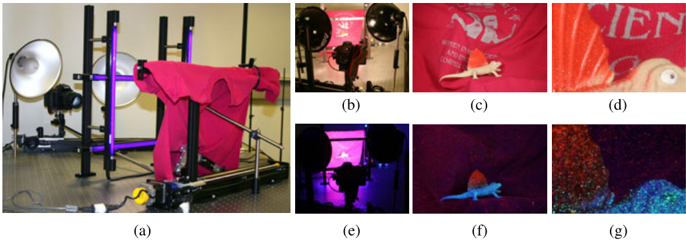
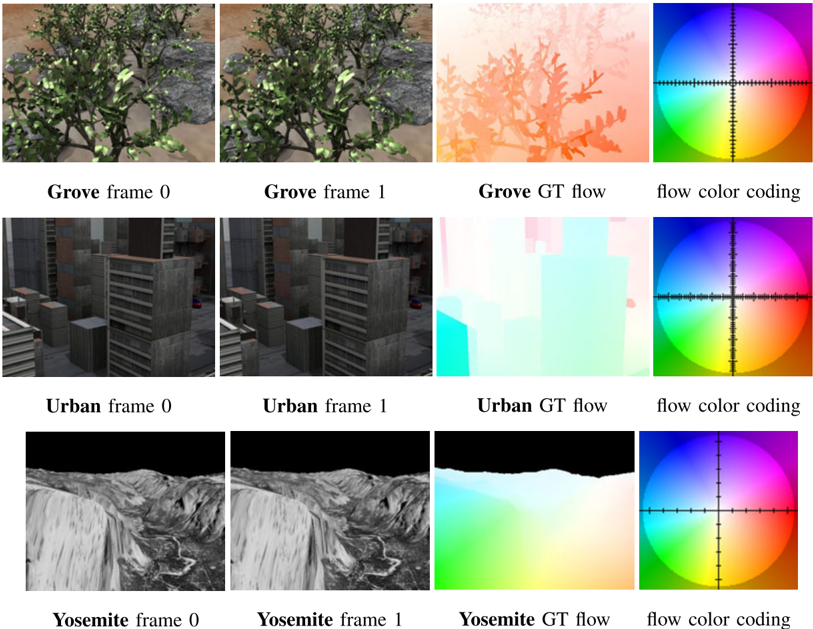
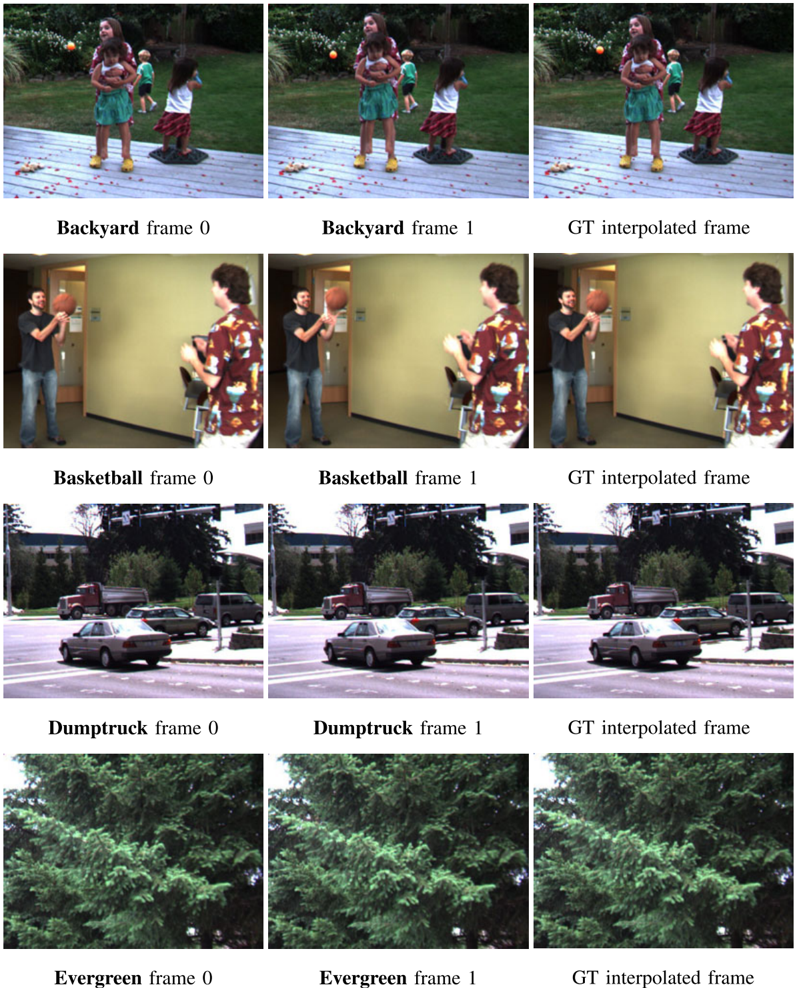
The quantitative evaluation of optical flow algorithms by Barron et al. (1994) led to significant advances in performance. The challenges for optical flow algorithms today go beyond the datasets and evaluation methods proposed in that paper. Instead, they center on problems associated with complex natural scenes, including nonrigid motion, real sensor noise, and motion discontinuities. We propose a new set of benchmarks and evaluation methods for the next generation of optical flow algorithms. To that end, we contribute four types of data to test different aspects of optical flow algorithms: (1) sequences with nonrigid motion where the ground-truth flow is determined by tracking hidden fluorescent texture, (2) realistic synthetic sequences, (3) high frame-rate video used to study interpolation error, and (4) modified stereo sequences of static scenes. In addition to the average angular error used by Barron et al., we compute the absolute flow endpoint error, measures for frame interpolation error, improved statistics, and results at motion discontinuities and in textureless regions.
Overview
CoChat Summary
TL;DR
The paper introduces a new optical flow benchmark of four data types (hidden fluorescent texture, realistic synthetic, high-speed interpolation, and modified stereo) plus an extended evaluation methodology with endpoint error, interpolation error, robustness/accuracy statistics, and region masks. It reports that performance improved substantially over the preliminary 2007 study, but motion discontinuities and diverse datasets remain difficult, and top flow methods still lag top stereo methods on the modified Teddy stereo data.
Key findings
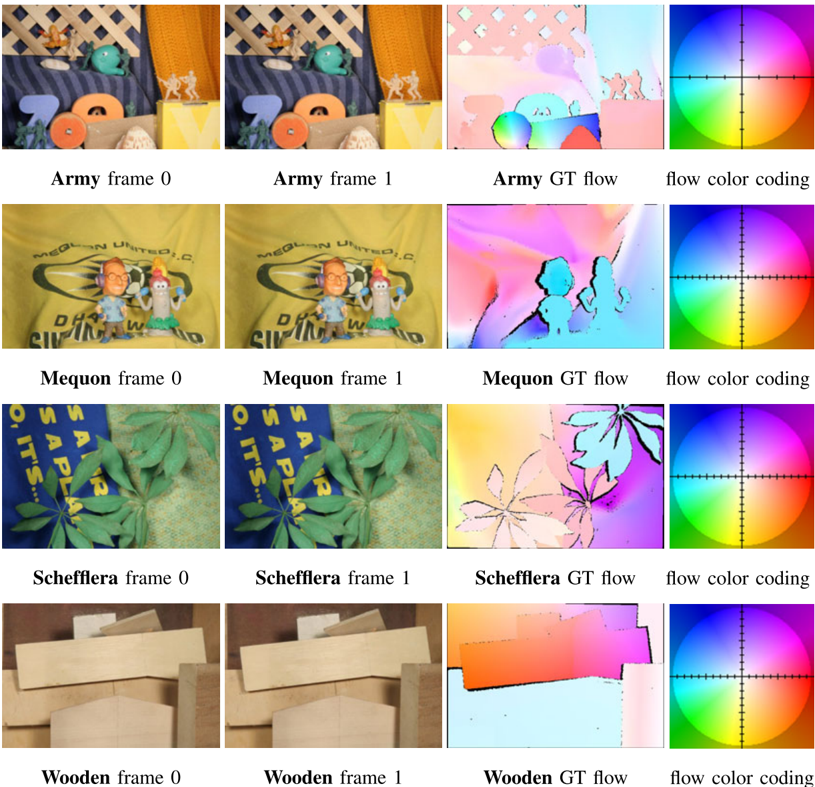
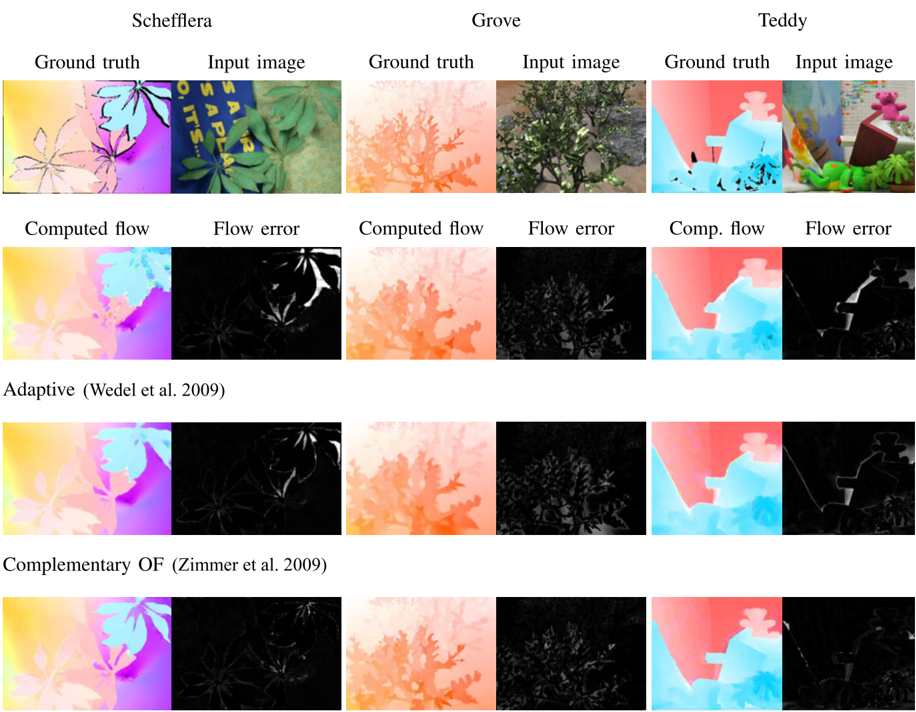
- The benchmark contains 12 training and 12 test sequences; test ground truth is withheld except for Yosemite. As of December 2009 the online evaluation contained results for 24 published methods, all using only 2 input frames and 10 using color.
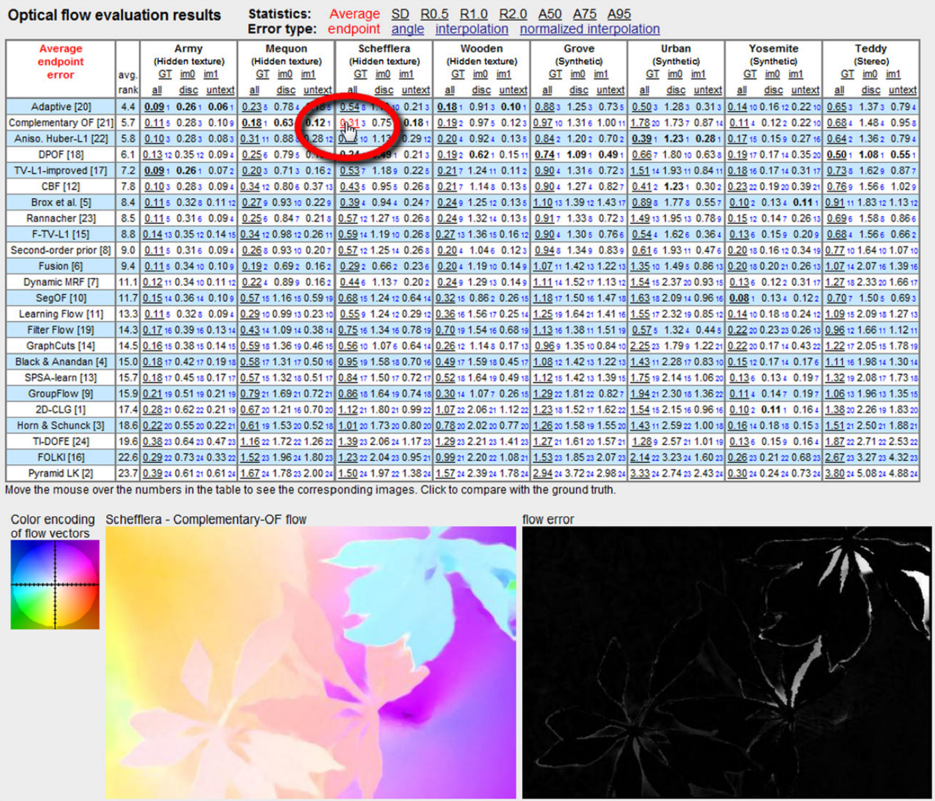
- Best average endpoint error (Avg. EE) improved dramatically over 2D-CLG (Bruhn et al. 2005): Army 0.28→0.09, Mequon 0.67→0.18, Schefflera 1.12→0.24, Wooden 1.07→0.18, Grove 1.23→0.74, Urban 1.54→0.39, Yosemite 0.10→0.08, Teddy 1.38→0.50. Best Avg. EE was below 0.2 pixels on four datasets (Yosemite, Army, Mequon, Wooden).
- Endpoint error (EE) and angular error (AE) rankings were highly correlated (r = 0.989), but the paper argues EE should be preferred: Complementary OF on Urban had Avg. AE 4.64° (rank 6) but Avg. EE 1.78 pixels (rank 20), because AE downweights large motions.
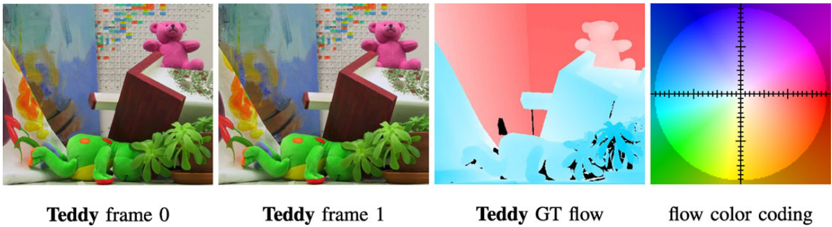
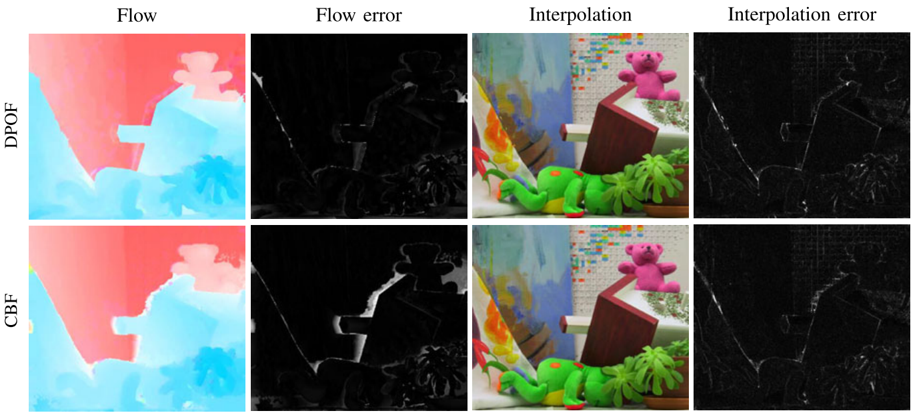
- Motion discontinuity (Disc) regions were the hardest; textureless (Untext) regions were typically easiest. Dataset results were less correlated, with Yosemite poorly or negatively correlated with others. Flow and interpolation errors were only moderately correlated (Avg4 EE vs Avg4 IE r = 0.763). On Teddy, top stereo methods outperformed top flow methods: median lowest-five R1.0 was 9.9 for flow vs 6.5 for stereo in All regions (34% reduction), and 27.6 vs 10.0 in Disc regions (64% reduction).
Methods
- Four data types were collected: (1) real nonrigid scenes with dense ground truth from hidden fluorescent texture, captured with a Canon EOS 20D at 3504×2336, downsampled every 40th visible-light frame by factor 6 to 584×388, with SSD tracking (15×15 windows), forward/backward crosschecking, and Lucas-Kanade subpixel refinement; (2) realistic synthetic scenes rendered with 3Delight at 640×480, with ground truth from a custom shader and dominant-cluster flow selection; (3) high-speed video for frame interpolation captured with a PointGrey Dragonfly Express at 60 fps, providing every other frame and retaining intermediate frames as ground truth; and (4) modified stereo data (Teddy) from structured light, cropped to make the disparity range roughly symmetric.
- Evaluation metrics include average angular error (AE), absolute flow endpoint error (EE), interpolation error (IE), and gradient-normalized interpolation error (NE). Statistics include averages, robustness measures R_X, and percentile accuracy measures A_X, computed over All, Disc, and Untext region masks.
- Analysis used the online evaluation at http://vision.middlebury.edu/flow/, comparing 24 published methods across metrics, statistics, masks, and datasets, with Pearson correlations between rankings and comparisons to state-of-the-art stereo methods on Teddy.
Limitations
- The paper states that the hidden fluorescent texture scenes are laboratory scenes, not real-world scenes, and have no motion blur due to stop-motion capture; ground truth is unavailable where cross-checking failed, especially occluded regions, and the measured ground truth is not perfect, though significant errors are limited to a small fraction of pixels. Synthetic sequences were generated without motion blur. The modified stereo ground truth is only accurate to 0.25 pixels, and algorithms may exploit the knowledge that motions are horizontal; overfitting to rigid data should be visible across the 12 evaluation images. Interpolation ground truth is an intermediate image, not a flow field, so the flow definition is apparent motion.
- The paper also states that no single method yet achieves strong performance across a wide variety of datatypes, that any dataset has a limited lifespan, and that future studies should include more challenging realistic synthetic data, longer sequences, and more difficult materials, illumination changes, atmospheric effects, and transparency.
- Evident from the text: the online tables do not provide an overall ranking among methods; runtimes are not normalized for programming environment, CPU speed, cores, or hardware acceleration; algorithms are required to produce dense flow and cannot submit confidence maps or sparse/incomplete fields; all 24 published methods used only 2 frames despite 8-frame sequences being available; and the paper cannot definitively answer whether temporal smoothing is less suited to the more challenging sequences.
Model-written summary. Check it against the paper before relying on it.
Integrity signals
Registry
Cites
Statistics
Figures

Verification
Claims the paper makes
2 Valid · 16 Not valid · 58 Not checked · 185 Own results and interpretations
A result the paper states — it cites no source for it, so there is none to check. The quote shows it is in the paper.
In the paper
“Rather than collecting a single type of data (with its inherent limitations) we instead collected four different types of data, each satisfying a different subset of desirable properties.”
plain- Asserted: passes — The authors put it forward as true.
- Checkable: passes — It can be checked against evidence.
- Load-bearing: passes — The paper’s conclusions depend on it.
- Based: passes — The paper gives a reason why it holds.
A result the paper states — it cites no source for it, so there is none to check. The quote shows it is in the paper.
In the paper
“Using the combination of fluorescent paint, downsampling high-resolution images, and sequential tracking of small motions, we are able to obtain dense, subpixel accurate ground truth for a nonrigid scene.”
plainstates a cause- Asserted: passes — The authors put it forward as true.
- Checkable: passes — It can be checked against evidence.
- Load-bearing: passes — The paper’s conclusions depend on it.
- Based: passes — The paper gives a reason why it holds.
A result the paper reports from its own data — it cites no other source for it, so there is none to check. The quote shows it is in the paper.
In the paper
“To allow for measures that predict performance on such tasks, we collected a variety of data suitable for frame interpolation.”
plainstates a cause- Asserted: passes — The authors put it forward as true.
- Checkable: passes — It can be checked against evidence.
- Load-bearing: passes — The paper’s conclusions depend on it.
- Based: passes — The paper gives a reason why it holds.
A result the paper reports from its own data — it cites no other source for it, so there is none to check. The quote shows it is in the paper.
In the paper
“We have developed a technique for capturing imagery of nonrigid scenes with ground-truth optical flow.”
plain- Asserted: passes — The authors put it forward as true.
- Checkable: passes — It can be checked against evidence.
- Load-bearing: passes — The paper’s conclusions depend on it.
- Based: passes — The paper gives a reason why it holds.
A result the paper states — it cites no source for it, so there is none to check. The quote shows it is in the paper.
In the paper
“To go beyond previous synthetic ground truth (e.g., the Yosemite sequence), we generated two types of fairly complex synthetic outdoor scenes.”
plain- Asserted: passes — The authors put it forward as true.
- Checkable: passes — It can be checked against evidence.
- Load-bearing: passes — The paper’s conclusions depend on it.
- Based: passes — The paper gives a reason why it holds.
96 more claims
Create a free account to see all 261 claims and to verify the 1 reference still open.
- Probably not a substantial claim. 114
- It may state two separate claims as one. 76
- The quote only partly states this claim. 6
Claims other papers make about this one
Each is checked against this paper’s own text: does it say what the citing paper says it does?
The source backs part of the claim, not all of it — or backs it for a different population, condition or comparison.
In the citing paper
“Notable works include the Middlebury dataset (Baker et al, 2011) and the KITTI datasets (Geiger et al, 2012; Menze and Geiger, 2015), but due to the difficulty of computing accurate ground truth, these have been restricted to 8 and 2 · 200 pairs of frames, respectively (the latter are also limited by the special driving setting).”
From What Makes Good Synthetic Training Data for Learning Disparity and Optical Flow Estimation? (2018) · cites this paper as Baker et al, 2011
Experimental — accuracy not yet measured
Citations
Cites
The pascal visual object classes (VOC) challenge
Everingham, M., Van Gool, L., Williams, C. K. I., Winn, J., & Zisserman, A. (2010) · International Journal of Computer Vision · doi:10.1007/s11263-009-0275-4 · Cited by 19,599
Proceedings of IEEE Conference on Computer Vision and Pattern Recognition
(1993) · doi:10.1109/cvpr.1993 · Cited by 17,667
Proceedings of IEEE International Conference on Computer Vision
(1995) · Proceedings of IEEE International Conference on Computer Vision · doi:10.1109/iccv.1995.466933 · Cited by 12,860
(1981) · Cited by 11,963
Horn, B. K. P., & Schunck, B. G. (1981) · Artificial Intelligence · doi:10.1016/0004-3702(81)90024-2 · Cited by 10,312
Horn, B. K., & Schunck, B. G. (1981) · SPIE Proceedings · doi:10.1117/12.965761 · Cited by 7,394 · cited 2×
“A baseline approach is to use an L2 norm as in the Horn and Schunck algorithm (Horn and Schunck 1981):”
BackgroundMethodFast approximate energy minimization via graph cuts
Boykov, Y., Veksler, O., & Zabih, R. (2001) · IEEE Transactions on Pattern Analysis and Machine Intelligence · doi:10.1109/34.969114 · Cited by 6,988
A Taxonomy and Evaluation of Dense Two-Frame Stereo Correspondence Algorithms
Scharstein, D., & Szeliski, R. (2002) · International Journal of Computer Vision · doi:10.1023/a:1014573219977 · Cited by 6,740 · cited 10×
“Many areas of computer vision, such as stereo [63], face recognition [28, 55, 68], and object recognition [23, 24], have challenging datasets to track the progress made by leading algorithms and to stimulate new ideas.”
BackgroundMethodResultInfluentialSelf-citationProceedings European Conference on Computer Vision 2002
Heyden, A., Sparr, G., Nielsen, M., & Johansen, P. (2002) · Lund University Publications (Lund University) · Cited by 5,153
From few to many: illumination cone models for face recognition under variable lighting and pose
Georghiades, A. S., Belhumeur, P. N., & Kriegman, D. J. (2001) · IEEE Transactions on Pattern Analysis and Machine Intelligence · doi:10.1109/34.927464 · Cited by 4,912 · cited 1×
“Many areas of computer vision, such as stereo (Scharstein and Szeliski 2002), face recognition (Philips et al. 2005; Sim et al. 2003; Gross et al. 2008; Georghiades et al. 2001), and object recognition (Fei-Fei et al.”
Background
Research works printed but not linked: 4
- Anandan, P., & Weiss, R. (1985). Introducing smoothness constraint in a matching approach for the computation of displacement fields. In Proceedings of the DARPA image understanding workshop (pp. 186-196).
- Bleyer, M., & Chambon, S. (2010). Does color really help in dense stereo matching? In Proceedings of the international symposium 3D data processing, visualization and transmission .
- Lempitsky, V., Roth, S., & Rother, C. (2008). Fusion flow: discretecontinuous optimization for optical flow estimation. In Proceedings of the IEEE conference on computer vision and pattern recognition .
- Rannacher, J. (2009). Realtime 3D motion estimation on graphics hardware . Undergraduate thesis, Heidelberg University.
Cited by
Items 2,001–2,100 of 2,273
Estimación de movimiento en secuencias de imágenes RGB y RGB-D
Fernández, G., & Roberto, F. F. (2016)
Multi-way Particle Swarm FusionPreprint
Liu, C., Yan, H., Kohli, P., & Furukawa, Y. (2016) · arXiv (Cornell University) · doi:10.48550/arxiv.1612.01234 · Cited by 1
“We copy their problem setting and use images from the Middlebury optical flow benchmark [25].”
MethodSalient Feature Detection for optical flow computation
Yang, J., Wang, R., & Xu, R. (2016) · doi:10.1109/cgncc.2016.7829181
“RESULT The performance of feature selection is evaluated by calculating Average Angular Error (AAE) and average End-point Error(EPE) [11] of optical flow on the gray-scale images of the Middlebury Optical Flow Training Data[12].”
MethodScale-change aware locally adaptive optical flow
Kim, E., & Lee, K. M. (2016) · Asia-Pacific Signal and Information Processing Association Annual Summit and Conference · doi:10.1109/apsipa.2016.7820725
“The work of TH Kim, HS Lee, and KM Lee [9] outperformed state-of-theart methods and ranked second in Middlebury dataset [10] at the time of its publication.”
MethodHorizontal velocity estimation of lander using images
Gupthan, V. R. V., Asha, S., & Dhanalakshmi, P. P. (2016) · International Conference on Inventive Computation Technologies (ICICT) · doi:10.1109/inventive.2016.7830236
“The reference images with true optical flows were downloaded from the Middlebury dataset [11].”
MethodUnsupervised Methods for Camera Pose Estimation and People Counting in Crowded Scenes
Elasal, N. H. K. (2016) · YorkSpace (York University)
Adaptive Regularization in Convex Composite Optimization for Variational Imaging ProblemsPreprint
Hong, B., Koo, J., Dirks, H., et al. (2016) · arXiv (Cornell University) · doi:10.48550/arxiv.1609.02356
“The Dimetrodon (solid), Grove2 (dotted) and Hydrangea (dashed) datasets from [2] were used to generate these graphs.”
MethodAn User-Friendly Method of Image Warping for Traffic Monitoring System
Yi, C., & Cho, J. (2016) · Journal of Digital Convergence · doi:10.14400/jdc.2016.14.12.231
“가운데 있는 도로 평면 추정 (Road plane estimation) 모듈의 경우 우선 이동하고 있 는 자동차들의 궤적(Trajectory)을 따라서 광류 흐름 (Optical flow)[6, 7]을 따라 데이터를 검출하게 된다.”
Wu, H., Li, L., Liu, J., Zhu, Y., Li, P., & Wen, Z. (2016) · IEEE International Conference on Signal and Image Processing (ICSIP) · doi:10.1109/siprocess.2016.7888268
Optical flow estimation using steered-L1 norm
Zayouna, A. (2016) · Middlesex University Research Repository (Middlesex University Of London)
Features identification and tracking for an autonomous ground vehicle
Nguyen, C. H. (2013) · VTechWorks (Virginia Tech)
Learn to Model Motion from Blurry FootagesPreprint
Li, W., Chen, D., Lv, Z., et al. (2017) · arXiv (Cornell University) · doi:10.48550/arxiv.1704.05817
“Many estimation methods have obtained impressive performance in terms of reliability and accuracy showed on the Middlebury [36] and Sintel [37] benchmark.”
MethodAn edge matching approach for video motion estimation
Barrow, B. O. (2010) · CU Scholar (University of Colorado Boulder)
Compression of Probabilistic Volumetric Models using multi-resolution scene flow
Biris, O., Ulusoy, A. O., & Mundy, J. L. (2017) · Image and Vision Computing · doi:10.1016/j.imavis.2017.06.005
“A motion capture studio with high speed cameras such as the ones used in [40] would provide non-consecutive time instances with spatio-temporal continuity.”
BackgroundMethodInfluentialA modified variational method for large displacement optical flow
Fan, J., Wang, Y., & Guo, L. (2017) · International Conference on Image, Vision and Computing (ICIVC) · doi:10.1109/icivc.2017.7984532
“We statists them on the semi-synthetic sequence Dimetrod, Hydrangea and RubberWhale from Middlebury dataset [1] because these three are more representative than the "fuH" synthetic ones for the real world.”
BackgroundMethodOptical flow on degraded imagery
Harguess, J. D., Barngrover, C., & Reese, M. (2016) · IEEE Applied Imagery Pattern Recognition Workshop · doi:10.1109/aipr.2016.8010577
“The results of each of the four optical flow methods (Farneback, SimpleFlow, TVL1, and DeepFlow) on the original and degraded versions of the “RubberWhale” image sequence from the Middlebury dataset are shown in this section.”
MethodInfluentialAn Improved Evaluation Method for Optical Flow of Angle Error
Zhen, C. H. E. N., Ren-zhi, Q. I. N., ZHANG, C.-X., Ding-ding, K. O. N. G., & SHANG, X. (2017) · International Conference on Computer Networks and Communication Technology (CNCT) · doi:10.2991/cnct-16.2017.43
“[6] Baker S, Scharstein D, Lewis J P, et al. A database and evaluation methodology for optical flow[J].”
MethodInfluentialLocation-Based Sensor Fusion for UAS Urban Navigation.
Rufa, J. R. (2014) · Deep Blue (University of Michigan)
Secrets in Computing Optical Flow by Convolutional NetworksPreprint
Li, J. (2017) · arXiv (Cornell University) · doi:10.48550/arxiv.1710.01462
“As training loss we use the endpoint error (EPE) [2], which is the standard error measure for optical flow estimation.”
BackgroundMethodLearning Motion from Temporal Coincidences
Conrad, C., & Mester, R. (2017) · Lecture notes in computer science · doi:10.1007/978-3-319-70742-6_2
“Since then, the basic idea of brightness constancy and/or locally constant motion have been used and extended many times to design highly optimised algorithms (see [1,16] for an overview).”
BackgroundMethodMotion Localization with Optic Flow for Autonomous Robot Teams and Swarms
Massimino, A. K., & Sofge, D. (2018) · Journal of Computer and Communications · doi:10.4236/jcc.2018.61026
“To solve this issue, called the aperture problem, algorithms impose other constraints such as smoothness of the optic flow vectors [4].”
BackgroundVision-inertia based navigation algorithms for quadrotors
Hao, N., He, F., Yao, Y., Qi, H., Wang, N., & Yi, H. (2017) · Asian Control Conference (ASCC) · doi:10.1109/ascc.2017.8287575
“Among that, SLAM(Simultaneously Localization and Mapping) is the most widely studied topic, which combines the localization and mapping tasks, being able to keep the localization globally consistent[1,2,3,4,6,7,8].”
BackgroundDai, B., Yao, Y., Ye, W., et al. (2018) · Multimedia Tools and Applications · doi:10.1007/s11042-017-5390-6
RetractedHelala, M. A., & Qureshi, F. Z. (2017) · Conference on Computer and Robot Vision (CRV) · doi:10.1109/crv.2017.40
“We evaluate our method on three standard optical flow benchmarks: (1) MPI Sintel benchmark [34]; (2) Middlebury benchmark [35] and 3) KITTI benchmark [36].”
MethodLight field scene flow with occlusion regularization
Chen, J., Ni, Y., Hou, J., et al. (2017) · Asia-Pacific Signal and Information Processing Association Annual Summit and Conference (APSIPA ASC) · doi:10.1109/apsipa.2017.8282200
“Optical flow visualized with the Middlebury color code [10].”
MethodSequential decomposition of 2D apparent motion fields based on low-rank and sparse approximation
Sakai, T., Ogawa, S., & Hiroki, K. (2017) · Asia-Pacific Signal and Information Processing Association Annual Summit and Conference (APSIPA ASC) · doi:10.1109/apsipa.2017.8281998
“See [36], [37], [38], [5] for the review of existing methods for optical flow computation.”
Limited-Memory Belief Propagation via Nested Optimization
Zach, C. (2018) · Lecture notes in computer science · doi:10.1007/978-3-319-78199-0_34
Variational Methods in Image Processing
Gilboa, G. (2018) · Advances in computer vision and pattern recognition · doi:10.1007/978-3-319-75847-3_2
Tlapale, É., Masson, G. S., & Kornprobst, P. (2009)
Yang, Q., Zhang, Y., Zhao, T., et al. (2018) · Chinese Control and Decision Conference (CCDC) · doi:10.1109/ccdc.2018.8407392
“For assessing the performance of the optical flow model we use the most popular databases middlebury [14].”
MethodAgrawal, V., Früh, M., Bringmann, O., & Rosenstiel, W. (2018) · International Conference on Dependable Systems and Networks workshops · doi:10.1109/dsn-w.2018.00071
Analysis of 8 × 8 and 9 × 9 optical flow patches by nudged elastic band
Yin, Q., & Wang, W. (2018) · Journal of Physics Conference Series · doi:10.1088/1742-6596/1053/1/012057
A Combined Local-Global Match for Optical Flow
Zu, Y., Tang, W., Bao, X., et al. (2018) · Communications in computer and information science · doi:10.1007/978-981-13-1702-6_19
Motion Occlusions for Automatic Generation of Relative Depth Maps
Oudni, L., Vázquez, C., & Coulombe, S. (2018) · Proceedings - International Conference on Image Processing · doi:10.1109/icip.2018.8451417
Optical Flow Super-Resolution Based on Image Guidence Using Convolutional Neural NetworkPreprint
Zhang, L., Lu, Z., & Liao, Q. (2018) · arXiv (Cornell University) · doi:10.48550/arxiv.1809.00588 · Cited by 1
“The optical flow field is currently the most common and most effective method for describing two-dimensional motion of images[8, 9, 10].”
MethodOnline video analysis for abnormal event detection and action recognition
Leyva, R. (2026) · Warwick Research Archive Portal (University of Warwick) · doi:10.82444/warw.33759115
Ishii, F. T., Flores, F. C., & Rittner, L. (2018) · IEEE Symposium on Computers and Communications (ISCC) · doi:10.1109/iscc.2018.8538466 · Cited by 1
“In order to deal this, an absolute error measure is introduced as the error in flow endpoint (EE) [16], [17].”
BackgroundMethodInfluentialDynamic Saliency Model Inspired by Middle Temporal Visual Area: A Spatio-Temporal Perspective
Mahmood, H., Islam, S. M. S., Gilani, S. O., et al. (2018) · Digital Image Computing: Techniques and Applications · doi:10.1109/dicta.2018.8615806
“We use optical flow method proposed by Cie Liu [6], central part of this method is grounded on [30] and [31].”
MethodHigh-speed Video from Asynchronous Camera ArrayPreprint
Lu, S. (2019) · arXiv (Cornell University) · doi:10.48550/arxiv.1901.06034
“This work falls into the area of frame interpolation [4] and novel view synthesis [20, 21].”
BackgroundMethodInfluentialStephenson, F., Breckon, T. P., & Katramados, I. (2019) · Proceedings - International Conference on Image Processing · doi:10.1109/icip.2019.8803739
“datasets [11, 12, 10, 13] providing accurate ground truth optical flow for comparison.”
BackgroundAdaptive V1-MT model for motion perception
Li, S., Fan, X., Xu, Y., & Huang, J. (2019) · KSII Transactions on Internet and Information Systems · doi:10.3837/tiis.2019.01.021 · Cited by 1
“In addition, a prominent benchmarking dataset has been developed to evaluate and compare publicly estimation algorithms in natural image sequences [9].”
BackgroundMethodExploring Temporal Information for Improved Video UnderstandingPreprint
Zhu, Y. (2019) · arXiv (Cornell University) · doi:10.48550/arxiv.1905.10654
“To quantitatively evaluate the quality of learned flow, we test the three models on four well received benchmarks, MPI-Sintel [24], KITTI 2012 [53], KITTI 2015 [53] and Middlebury [11].”
MethodInfluentialAn Improved Visual Background Extraction Algorithm Combining Depth Information
Feng, Y., Jin, S., & Ye, W. (2019) · Journal of Physics Conference Series · doi:10.1088/1742-6596/1229/1/012019
“The optical flow method can accurately calculate the speed of the moving target and can handle the rotation of the target, but in most cases it is computationally complex and sensitive to noise, making it difficult to meet real-time requirements [3].”
BackgroundMethodDrift Robust Non-rigid Optical Flow Enhancement for Long SequencesPreprint
Li, W., Cosker, D. P., & Brown, M. (2016) · arXiv (Cornell University) · doi:10.48550/arxiv.1603.02252
“We evaluate APO with a range of 6 popular optical flow estimation methods which are publicly avail- able from the Middlebury Evaluation System [1].”
MethodInfluentialDense Motion Estimation for SmokePreprint
Chen, D., Li, W., & Hall, P. M. (2016) · arXiv (Cornell University) · doi:10.48550/arxiv.1609.02001
“Given a ground truth benchmark [40,12], the motion estimation algorithms are commonly evaluated using quantitative metrics i.”
MethodShape Tracking With Occlusions via Coarse-To-Fine Region-Based Sobolev DescentPreprint
Yang, Y., & Sundaramoorthi, G. (2012) · arXiv (Cornell University) · doi:10.48550/arxiv.1208.4391
“…between two time instances τ i and τ i +1 , that is, d τ i ,τ i +1 ( x ) = φ τ i ◦ φ − 1 τ i +1 ( x ) − x , is is shown in optical flow code [48] (the color indicates direction and darkness indicates magnitude; magnitude should not be compared across images as they are re-scaled in each…”
Joint Optical Flow and Temporally Consistent Semantic SegmentationPreprint
Hur, J., & Roth, S. (2016) · arXiv (Cornell University) · doi:10.48550/arxiv.1607.07716 · Cited by 7
“Several approaches have relied on the epipolar constraint for estimating motion [1].”
MethodSelf-citationContent-Adaptive Non-Stationary Projector Resolution Enhancement
Hu, X. (2019) · UWSpace (University of Waterloo)
Correlation Estimation from Compressed ImagesPreprint
Thirumalai, V., & Frossard, P. (2011) · arXiv (Cornell University) · doi:10.48550/arxiv.1107.4667
“Classically, the accuracy of the motion values is evaluated with the original images [25] and the data cost is typically given as eEdðMÞ 1⁄4XN1 k1⁄41 XN2”
BackgroundHow to improve local optima of optical flow energies using discrete matchesPreprint
Palomares, R. P., Meinhardt-Llopis, E., Ballester, C., & Haro, G. (2016) · arXiv.org · doi:10.48550/arxiv.1602.08960
“In order to assure that the proposed framework is a real alternative to the coarse-to-fine warping strategy and, therefore, also valid for sequences that do not have large displacements of small objects, experiments on the Middlebury optical flow data set [5] have been performed for both approaches.”
MethodAsymmetric Bilateral Phase Correlation for Optical Flow Estimation in the Frequency DomainPreprint
Argyriou, V. (2018) · arXiv (Cornell University) · doi:10.48550/arxiv.1811.00327
“In this study six datasets were utilised, and in more details the video sequences with ground truth provided by Baker in [6], the MPI-SINTEL dataset from Butler in [9] and the UCLgtOFv1.”
BackgroundMethodA Bayesian displacement field approach to accurate registration of SAR images
Ding, M., Wang, H., Sui, L., Zhao, C., & Zhang, Q. (2019) · Geocarto International · doi:10.1080/10106049.2019.1633418
“Color coding as in (Baker et al. 2011).”
MethodMultiframe interpolation for video using phase features
Zhou, L., Chen, Y., Tian, X., & Jiang, R. (2019) · Journal of Electronic Imaging · doi:10.1117/1.jei.28.4.043002
SDC - Stacked Dilated Convolution: A Unified Descriptor Network for Dense Matching TasksPreprint
Schuster, R., Wasenmüller, O., Unger, C., et al. (2019) · arXiv (Cornell University) · doi:10.48550/arxiv.1904.03076
“CPM [19] and FlowFields++ [32] are selected to represent optical flow matching algorithms and are evaluated on KITTI [26], Middlebury [3], HD1K [21], and MPI Sin-tel [6].”
BackgroundMethodResultInfluentialOcclusion Detection of Dense Correspondence Fields Using Motion Statistics and Triangulation
Dong, C., Wang, Z., Xing, C., et al. (2019) · IEEE Access · doi:10.1109/access.2019.2925101
“To facilitate quantitative evaluation of the proposed method, we used the performance measure of optical flow algorithms [45], the average angular error (AAE) and the average endpoint error (AEE),”
MethodDecoupling Spatial Pattern and its Movement Via Complex Factorization Over Orthogonal Filter Pairs
Mu, Y., Dimitrakopoulos, R. G., & Ferrie, F. P. (2019) · Canadian Conference on Computer and Robot Vision · doi:10.1109/crv.2019.00009
“The dataset is the Middlebury dataset [3] which was listed originally in 2002 and still remains one of the most important datasets published in the last decade.”
Zhang, Y., Ma, P., Gulfraz, A. R., et al. (2019) · Lecture notes in computer science · doi:10.1007/978-3-030-25999-0_1
Simulating Proto Planetary Disks with Deep Networks
Shen, H. (2019) · UVic’s Research and Learning Repository (University of Victoria)
Devyatkov, V., & Лычков, И. И. (2019) · IADIS International Conferences Interfaces and Human Computer Interaction; Game and Entertainment Technologies; and Computer Graphics, Visualization, Computer Vision and Image Processing (IHCI/GET/CGVCVIP) · doi:10.33965/cgv2019_201906c062 · Cited by 1
“There are some publicly available video datasets intended for optical flow benchmarking: Middlebury (Baker et al, 2011), Sintel (Butler et al, 2012), Flying Things 3D (Mayer et al, 2016).”
MethodAn Empirical Evaluation Study on the Training of SDC Features for Dense Pixel MatchingPreprint
Schuster, R., Wasenmüller, O., Unger, C., et al. (2019) · arXiv (Cornell University) · doi:10.48550/arxiv.1904.06167
“The original SDC model was trained with a mixture of data from KITTI [20], Sintel [3], HD1K [16], Middlebury (MB) [22, 2], and ETH3D [23].”
BackgroundMethodInfluentialMaking Third Person Techniques Recognize First-Person Actions in Egocentric VideosPreprint
Verma, S., Nagar, P., Gupta, D., et al. (2019) · arXiv (Cornell University) · doi:10.48550/arxiv.1910.07766
“We use [22] to compute optical flow and convert it to RGB flow images [28] after flow compensation.”
MethodIterative Clustering with Game-Theoretic Matching for Robust Multi-consistency CorrespondencePreprint
Zhao, C., Yang, J., Xian, K., et al. (2019) · arXiv (Cornell University) · doi:10.48550/arxiv.1909.01497
“Image feature matching (a.k.a. correspondence selection) is a cornerstone of many computer vision and robotic tasks, such as optical flow [3], structure-from-motion [25], stereo matching [12], simultaneous localization and mapping [4], and image stitching [7].”
The Five Elements of Flow.Preprint
Hofinger, M., Bulò, S. R., Porzi, L., et al. (2019) · arXiv (Cornell University)
Vision-based autonomous landing and nighttime trajectory estimation of quadrotors
Liu, Y. (2019) · Digital Repository Service (Northeastern University) · doi:10.17760/d20328702
“These two motions are not always the same and, in practice, the goal of 2D motion estimation is application dependent[6].”
BackgroundVideo Frame Synthesis via Plug-and-Play Deep Locally Temporal Embedding
Nguyen, A.-D., Kim, W., Kim, J., Lin, W., & Lee, S. (2019) · IEEE Access · doi:10.1109/access.2019.2959019
“Traditionally, this is done by estimating motions in consecutive frames [1], [48].”
BackgroundMethodComputer Vision Based Pantograph Inspection
Li, Y., & Dai, S. (2019) · IEEE International Conference on Power, Intelligent Computing and Systems (ICPICS) · doi:10.1109/icpics47731.2019.8942424
“Take a widely accepted accuracy measure called region overlap[17] for example.”
BackgroundAn Extended Skip Strategy for Inter Prediction
Hao, T., Yu, L., Kuang, Z., et al. (2019) · Picture Coding Symposium · doi:10.1109/pcs48520.2019.8954532
“Traditional video frame interpolation is a twostep process which includes dense motion estimation and pixel synthesis [12]–[14].”
BackgroundOcclusion Aware Unsupervised Learning of Optical Flow From VideoPreprint
Li, J., Zhao, J., Feng, T., et al. (2020) · arXiv (Cornell University) · doi:10.48550/arxiv.2003.01960
“Occlusion: As suggested by many recent studies [32], handling occlusion is a major factor that can improve the unsupervised learning performance apart from adding more constraints.”
BackgroundInvisible Marker: Automatic Annotation of Segmentation Masks for Object ManipulationPreprint
Takahashi, K., & Yonekura, K. (2019) · arXiv (Cornell University) · doi:10.48550/arxiv.1909.12493
Comparison of the Optical Flow Quality for Video Denoising
Monzón, N., & Sánchez, J. (2020) · International Joint Conference on Computer Vision, Imaging and Computer Graphics Theory and Applications (VISIGRAPP) · doi:10.5220/0008767507170724
“Below the images, we show the average angular error (AAE) and the end-point error (EPE), that are standard metrics to measure the optical flow quality (Baker et al., 2007), the parameters used, and the corresponding PSNR, RMSE and density, in each case.”
MethodMultiview Panorama Alignment and Optical Flow Refinement
Mühlhausen, M., & Magnor, M. A. (2020) · Lecture notes in computer science · doi:10.1007/978-3-030-41816-8_4 · Cited by 1
Co-occurrence Background Model with Superpixels for Robust Background InitializationPreprint
Zhou, W., Deng, Y., Peng, B., et al. (2020) · arXiv (Cornell University) · doi:10.48550/arxiv.2003.12931
“As most optical flow techniques assumed [23] that the motion field near motion boundary between foreground and background tend to be over-smoothed and blurred.”
BackgroundDistance Surface for Event-Based Optical FlowPreprint
Almatrafi, M., Baldwin, R. W., Aizawa, K., et al. (2020) · arXiv (Cornell University) · doi:10.48550/arxiv.2003.12680
“While remarkable progress have been made since the original concepts were introduced by HornSchunck [12] and Lucas-Kanade [13], optical flow in the presence of fast motion and occlusions remains a major challenge today [14], [15], [16].”
MethodDeep Space-Time Video Upsampling NetworksPreprint
Kang, J., Jo, Y., Oh, S. W., et al. (2020) · arXiv (Cornell University) · doi:10.48550/arxiv.2004.02432
“For this pretraining, we use 7 frames Y[0,1,2,3,4,5,6] in the training dataset and 128× 128 patches are cropped.”
BackgroundMethodInfluentialMotion Detection Using the Dynamic Color Texture
Bellamine, I., Silkan, H., & Tmiri, A. (2020) · International Conference on Networking, Information Systems & Security (NISS) · doi:10.1145/3386723.3387825
“Experimental results are obtained from very different types of videos: Middlebury real images [27], KTH dataset [28], UTInteraction dataset [29].”
MethodSpatiotemporal Super-Resolution with Cross-Task Consistency and Its Semi-supervised Extension
Lin, H., Hsiu, P.-C., Kuo, T., & Lin, Y. (2020) · International Joint Conference on Artificial Intelligence · doi:10.24963/ijcai.2020/86 · Cited by 1
“Third, evaluated intensively on four benchmark datasets including the Vimeo-90K [Xue et al. , 2019], Middlebury optical flow [Baker et al. , 2007], Vid4 [Liu and Sun, 2011], and DAVIS [Pont-Tuset et al. , 2017] datasets, our method achieves the state-of-the-art performance.”
BackgroundMethodInfluentialMatsunaga, Y., & Nakamura, R. (2020) · International Surgery Journal · doi:10.18203/2349-2902.isj20202547
“The solutions included adapting the self-position estimation method of the endoscope, detection of endoscope motion by the three-dimensional position measuring device, and calculating optical flow using landmarks in the image.(25,26) Therefore, our future work will be focused on guiding surgical robots to the detected…”
MethodAn Analytical Study of CNN-based Video Frame Interpolation Techniques
Pandya, K., Varshney, D., Aggarwal, A., & Parihar, A. S. (2020) · International Conference on Intelligent Computing and Control Systems (ICICCS) · doi:10.1109/iciccs48265.2020.9120989
“We evaluate the methods quantitatively on the UCF101 test set [35], Middlebury optical flow benchmark [31], and Vimeo 90K dataset [8].”
MethodDhote, D., Virmani, C., Krishna, K. G., & Raghav, S. (2020) · International Journal of Computer Applications · doi:10.5120/ijca2020920443
SYNTHETIC VISION SYSTEM CALIBRATION FOR CONFORM PROJECTION ON THE PILOT’S HEAD-UP DISPLAY
Danilov, S. Y., Козырев, М., Grechanichenko, M., Grodzitsky, L., Mizginov, V. A., & Kniaz, V. V. (2020) · The international archives of the photogrammetry, remote sensing and spatial information sciences/International archives of the photogrammetry, remote sensing and spatial information sciences · doi:10.5194/isprs-archives-xliii-b2-2020-575-2020
“In (Baker et al., 2007) a collection of datasets for the evaluation of optical flow algorithms was presented.”
BackgroundHidden Footprints: Learning Contextual Walkability from 3D Human TrailsPreprint
Sun, J. H., Averbuch‐Elor, H., Wang, Q., et al. (2020) · arXiv (Cornell University) · doi:10.48550/arxiv.2008.08701
DiverseNet: When One Right Answer is not EnoughPreprint
Firman, M., Campbell, N. D. F., Agapito, L., & Brostow, G. (2020) · arXiv (Cornell University) · doi:10.48550/arxiv.2008.10634 · Cited by 1
“To evaluate, we use the average endpoint error, as advocated by [2].”
MethodLearned Dual-View Reflection RemovalPreprint
Niklaus, S., Zhang, X. C., Barron, J. T., et al. (2020) · arXiv (Cornell University) · doi:10.48550/arxiv.2010.00702
“However, acquiring ground truth flow is a challenging problem with previous work having exploited hidden fluorescent textures, computer graphics, and high frame-rate videos [2, 5, 14].”
BackgroundMethodBlur Removal via Blurred-Noisy Image PairPreprint
Gu, C., Lu, X., He, Y., et al. (2019) · arXiv (Cornell University) · doi:10.48550/arxiv.1903.10667
“Table 1: Comparisons of average PSNR/SSIM/MSE on test images [1] which are corrupted with different types of synthetic blur.”
BackgroundMethodВикторович, Т. В., & Panin, S. V. (2020) · AIP conference proceedings · doi:10.1063/5.0036680
Convolutional Recurrent Network for Road Boundary ExtractionPreprint
Liang, J., Homayounfar, N., Ma, W.-C., et al. (2020) · arXiv (Cornell University) · doi:10.48550/arxiv.2012.12160
Accelerating Probabilistic Computing with a Stochastic Processing Unit
Zhang, X. (2020) · Cited by 1
Motion Estimation via Scale-Space in Unsupervised Deep Learning
Kim, J., Derbel, B., & Hong, B. (2021) · International Conference on Information Networking · doi:10.1109/icoin50884.2021.9334004
“EXPERIMENT ON DIFFERENT IMAGE SCALE We use middlebury flow dataset [6] to evaluate our unsupervised optical flow estimation.”
MethodStudy of Convolutional Neural Networks applied to Image Stereo Matching
Ponce, J. P. P., & Suyama, R. (2020) · SIBGRAPI Conference on Graphics, Patterns and Images (SIBGRAPI) · doi:10.5753/sibgrapi.est.2020.13005
“the euclidina distance between true point of the pixel and the detected point [15].”
BackgroundWu, J., & Shao, J. (2021) · Research Square · doi:10.21203/rs.3.rs-189166/v1
“It has attracted significant research effort, and made considerable progress in recently years ([18]).”
BackgroundNetwork-based structure flow estimation
Liu, S., Barnes, N. M., Mahony, R. E., & Ye, H. (2020) · International Conference on Digital Image Computing: Techniques and Applications (DICTA) · doi:10.1109/dicta51227.2020.9363398
Generation and Simulation of Yeast Microscopy Imagery with Deep LearningPreprint
Reich, C. (2021) · arXiv (Cornell University) · doi:10.48550/arxiv.2103.11834 · Cited by 1
Learning to See by Looking at NoisePreprint
Baradad, M., Wulff, J., Wang, T., Isola, P., & Torralba, A. B. (2021) · arXiv (Cornell University) · doi:10.48550/arxiv.2106.05963 · Cited by 108
“This approach has been widely used in low-level tasks like depth, stereo, or optical flow estimation [30, 31, 32, 33], where 3D rendering engines can provide densely annotated data to learn from.”
Hartmann, C., & Volk, W. (2021) · The minerals, metals & materials series · doi:10.1007/978-3-030-75381-8_134
Salient Error Detection based Refinement for Wide-baseline Image Interpolation
Chang, Y., Chen, Y., & Wang, G. (2021) · ACM International Conference on Multimedia (ACM MM) · doi:10.1145/3474085.3475696
“Table 3 shows the quantitative evaluation on Middlebury dataset [3] by computing the Peak Signal to Noise Ratio(PSNR) between the interpolated image and the ground truth.”
MethodHomography-guided stereo matching for wide-baseline image interpolation
Chang, Y., Zhang, C., Chen, Y., & Wang, G. (2021) · Computational Visual Media · doi:10.1007/s41095-021-0225-9 · Cited by 1
Metadata
- Authors
- Baker, S., Scharstein, D., Lewis, J. P., Roth, S., Black, M. J., & Szeliski, R.
- Affiliations
- Microsoft (United States) (US)
- Middlebury College (US)
- Technische Universität Darmstadt (DE)
- Brown University (US)
- Corresponding author
- Scharstein, Daniel
- Venue
- International Journal of Computer Vision
- Published
- 2010-11-30
- Volume
- 92
- Issue
- 1
- Pages
- 1-31
- ISSN
- 0920-5691 (ISSN-L)
- 1573-1405
- OpenAlex
- W2147253850
- Semantic Scholar
- 804836b8ad86ef8042e3dcbd45442a52f031ee03
- Cited by
- 2,205
- References
- 112
- Citations by year
- 2026: 49 · 2025: 81 · 2024: 82 · 2023: 117 · 2022: 129 · 2021: 152 · 2020: 174 · 2019: 163 · 2018: 144 · 2017: 156 · 2016: 187 · 2015: 180 · 2014: 154 · 2013: 129 · 2012: 118
- FWCI
- 146.62
- Type
- journal article
- Language
- en
- Open access
- hybrid
- doi.org
- Licence
- cc-by-nc
- Locations
- International Journal of Computer Vision (publishedVersion, cc-by-nc)
- Publikationsdatenbank der Fraunhofer-Gesellschaft (Fraunhofer-Gesellschaft) (publishedVersion)
- Max Planck Institute for Plasma Physics (submittedVersion)
- Fraunhofer-Publica (Fraunhofer-Gesellschaft) (submittedVersion)
- Funders
- National Science Foundation (0534858, 0535075, 0413169)
- Intel Corporation
- Topics
- Physical Sciences › Computer Science › Computer Vision and Pattern Recognition › Advanced Vision and Imaging
- Physical Sciences › Computer Science › Computer Vision and Pattern Recognition › Video Surveillance and Tracking Methods
- Physical Sciences › Computer Science › Signal Processing › Video Coding and Compression Technologies
- Keywords
- optical flow, benchmark dataset, evaluation methodology, non-rigid motion, motion discontinuities, textureless regions, sensor noise
About these checks
Registry, retraction, Cites and statistics results are computed, not judged, with one exception: a printed reference that no index lists is read once by a model before it counts as a citation error. Claims are extracted by a model and kept only when their quote appears verbatim in the text; each cited source is then checked, with a model’s help, for whether it says what the claim relies on. Those verdicts can be wrong — read the claim’s quote and the cited source before relying on one.
The claim verdicts this report counts are experimental: their accuracy is not yet measured.
A language model drew the claims from the paper on 2026-10-01, under version 3 of the claim definition (model deepseek-v4.1-flash, prompt extract-v3).
A second model labelled each claim on 2026-10-01 (model jev-1.13-20260917, definition revision gold-guideline-v0.2).
Statistics and arithmetic are recomputed, not judged.
Confidence bands are shown only for fields calibrated on our annotated test set. None is calibrated yet, so no band is shown.
What counts as a claim ›How we measure confidence ›How we check this ›
Are you an author, or do you see a problem with this page? Request a review
Data sources
Bibliographic data: Semantic Scholar, OpenAlex, Crossref.
Contains information from the Semantic Scholar Academic Graph Datasets, made available under the ODC Attribution License (ODC-BY 1.0).
Semantic Scholar’s data is described in: Kinney, R., et al. (2023). The Semantic Scholar Open Data Platform. arXiv:2301.10140.
