

A Database and Evaluation Methodology for Optical Flow
Open accessThe DOI matches its Crossref record; 110 of the 112 references it cites were found in a registry or an index; 2 of the 68 sources its claims cite were checked for support.
Abstract
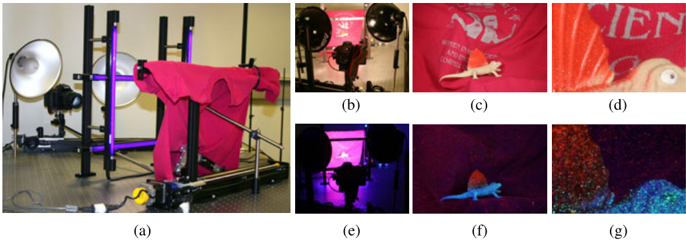
The quantitative evaluation of optical flow algorithms by Barron et al. (1994) led to significant advances in performance. The challenges for optical flow algorithms today go beyond the datasets and evaluation methods proposed in that paper. Instead, they center on problems associated with complex natural scenes, including nonrigid motion, real sensor noise, and motion discontinuities. We propose a new set of benchmarks and evaluation methods for the next generation of optical flow algorithms. To that end, we contribute four types of data to test different aspects of optical flow algorithms: (1) sequences with nonrigid motion where the ground-truth flow is determined by tracking hidden fluorescent texture, (2) realistic synthetic sequences, (3) high frame-rate video used to study interpolation error, and (4) modified stereo sequences of static scenes. In addition to the average angular error used by Barron et al., we compute the absolute flow endpoint error, measures for frame interpolation error, improved statistics, and results at motion discontinuities and in textureless regions.
Overview
CoChat Summary
TL;DR
The paper introduces a new optical flow benchmark of four data types (hidden fluorescent texture, realistic synthetic, high-speed interpolation, and modified stereo) plus an extended evaluation methodology with endpoint error, interpolation error, robustness/accuracy statistics, and region masks. It reports that performance improved substantially over the preliminary 2007 study, but motion discontinuities and diverse datasets remain difficult, and top flow methods still lag top stereo methods on the modified Teddy stereo data.
Key findings
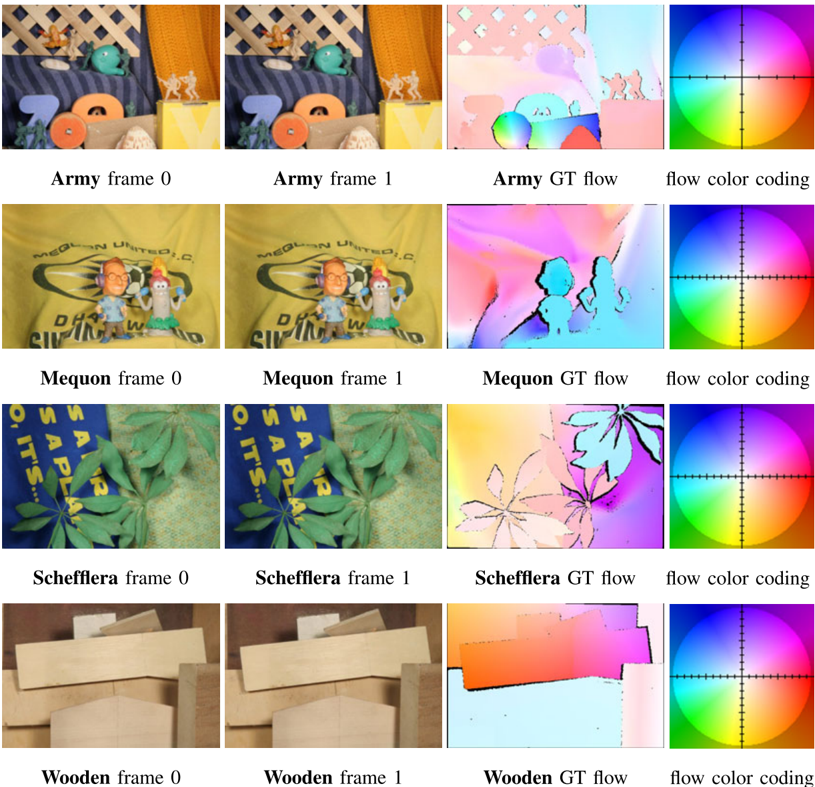
- The benchmark contains 12 training and 12 test sequences; test ground truth is withheld except for Yosemite. As of December 2009 the online evaluation contained results for 24 published methods, all using only 2 input frames and 10 using color.
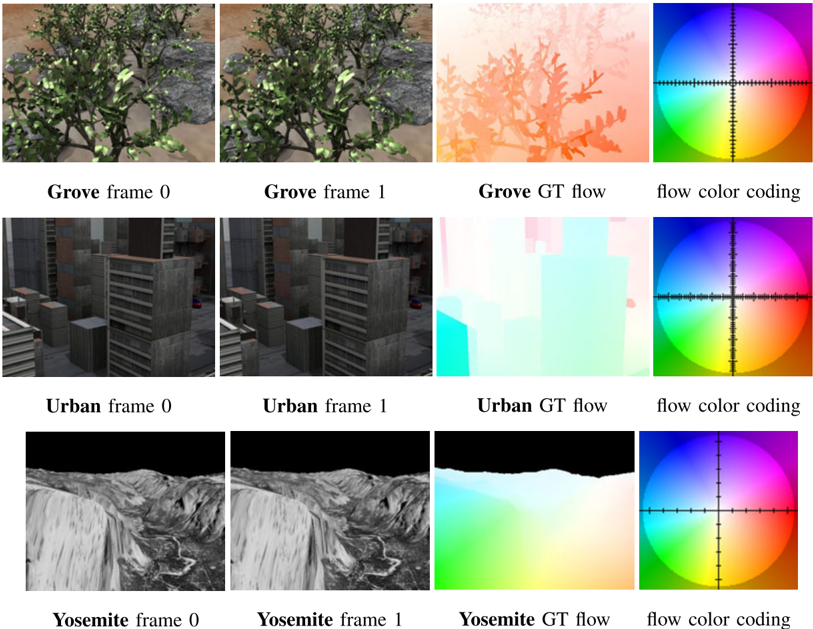
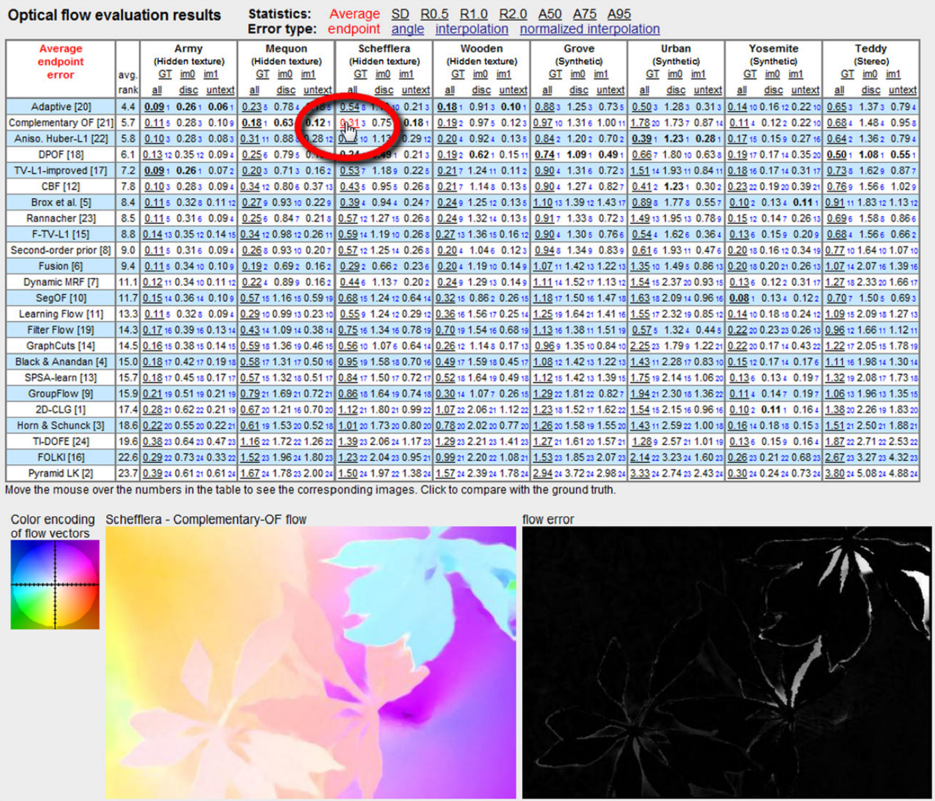
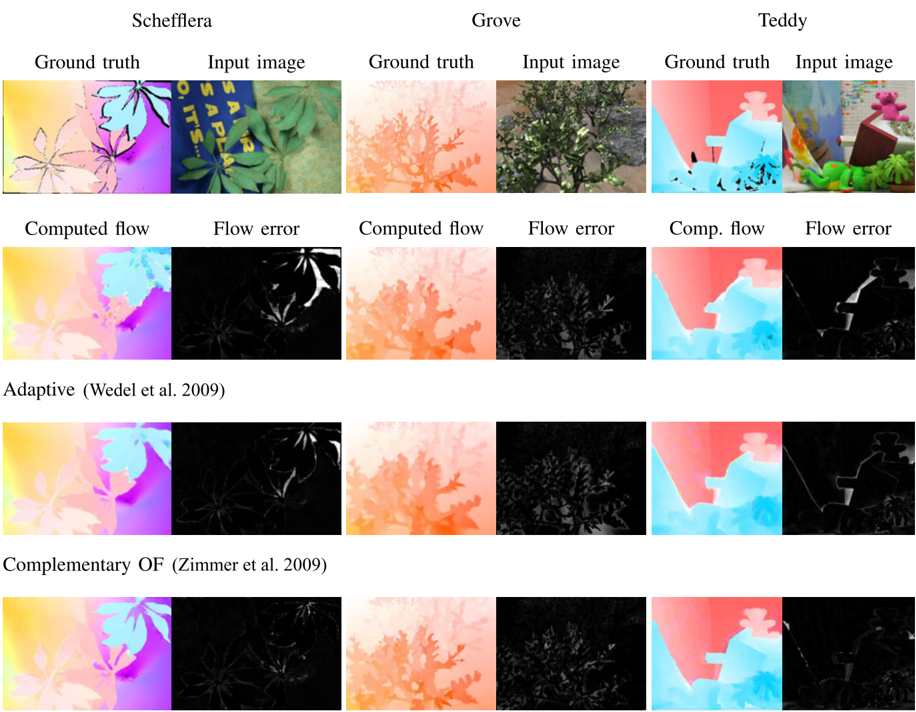
- Best average endpoint error (Avg. EE) improved dramatically over 2D-CLG (Bruhn et al. 2005): Army 0.28→0.09, Mequon 0.67→0.18, Schefflera 1.12→0.24, Wooden 1.07→0.18, Grove 1.23→0.74, Urban 1.54→0.39, Yosemite 0.10→0.08, Teddy 1.38→0.50. Best Avg. EE was below 0.2 pixels on four datasets (Yosemite, Army, Mequon, Wooden).
- Endpoint error (EE) and angular error (AE) rankings were highly correlated (r = 0.989), but the paper argues EE should be preferred: Complementary OF on Urban had Avg. AE 4.64° (rank 6) but Avg. EE 1.78 pixels (rank 20), because AE downweights large motions.
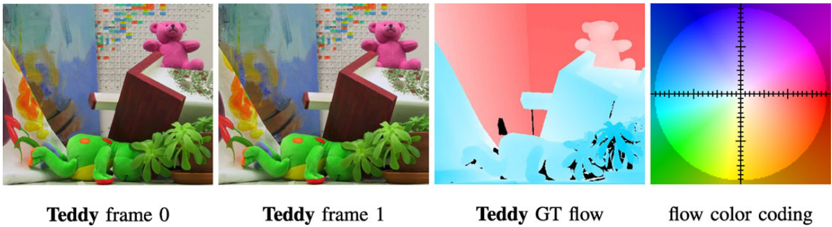
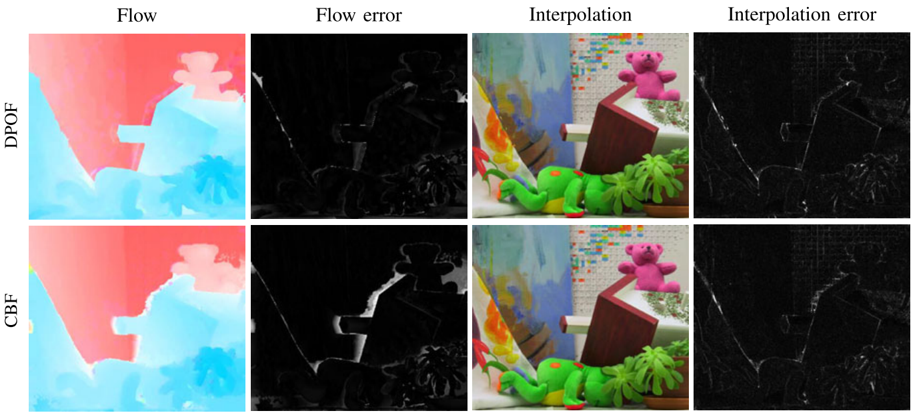
- Motion discontinuity (Disc) regions were the hardest; textureless (Untext) regions were typically easiest. Dataset results were less correlated, with Yosemite poorly or negatively correlated with others. Flow and interpolation errors were only moderately correlated (Avg4 EE vs Avg4 IE r = 0.763). On Teddy, top stereo methods outperformed top flow methods: median lowest-five R1.0 was 9.9 for flow vs 6.5 for stereo in All regions (34% reduction), and 27.6 vs 10.0 in Disc regions (64% reduction).
Methods
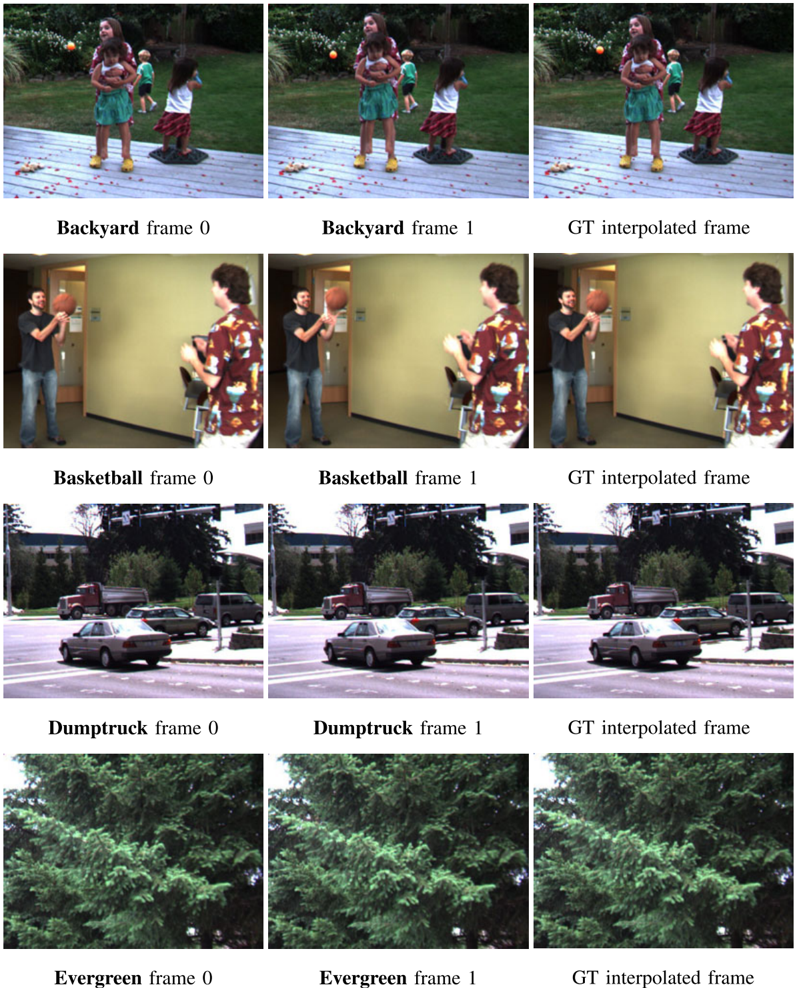
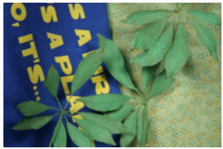
- Four data types were collected: (1) real nonrigid scenes with dense ground truth from hidden fluorescent texture, captured with a Canon EOS 20D at 3504×2336, downsampled every 40th visible-light frame by factor 6 to 584×388, with SSD tracking (15×15 windows), forward/backward crosschecking, and Lucas-Kanade subpixel refinement; (2) realistic synthetic scenes rendered with 3Delight at 640×480, with ground truth from a custom shader and dominant-cluster flow selection; (3) high-speed video for frame interpolation captured with a PointGrey Dragonfly Express at 60 fps, providing every other frame and retaining intermediate frames as ground truth; and (4) modified stereo data (Teddy) from structured light, cropped to make the disparity range roughly symmetric.
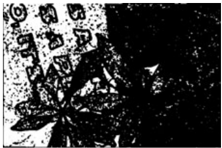
- Evaluation metrics include average angular error (AE), absolute flow endpoint error (EE), interpolation error (IE), and gradient-normalized interpolation error (NE). Statistics include averages, robustness measures R_X, and percentile accuracy measures A_X, computed over All, Disc, and Untext region masks.
- Analysis used the online evaluation at http://vision.middlebury.edu/flow/, comparing 24 published methods across metrics, statistics, masks, and datasets, with Pearson correlations between rankings and comparisons to state-of-the-art stereo methods on Teddy.
Limitations
- The paper states that the hidden fluorescent texture scenes are laboratory scenes, not real-world scenes, and have no motion blur due to stop-motion capture; ground truth is unavailable where cross-checking failed, especially occluded regions, and the measured ground truth is not perfect, though significant errors are limited to a small fraction of pixels. Synthetic sequences were generated without motion blur. The modified stereo ground truth is only accurate to 0.25 pixels, and algorithms may exploit the knowledge that motions are horizontal; overfitting to rigid data should be visible across the 12 evaluation images. Interpolation ground truth is an intermediate image, not a flow field, so the flow definition is apparent motion.
- The paper also states that no single method yet achieves strong performance across a wide variety of datatypes, that any dataset has a limited lifespan, and that future studies should include more challenging realistic synthetic data, longer sequences, and more difficult materials, illumination changes, atmospheric effects, and transparency.
- Evident from the text: the online tables do not provide an overall ranking among methods; runtimes are not normalized for programming environment, CPU speed, cores, or hardware acceleration; algorithms are required to produce dense flow and cannot submit confidence maps or sparse/incomplete fields; all 24 published methods used only 2 frames despite 8-frame sequences being available; and the paper cannot definitively answer whether temporal smoothing is less suited to the more challenging sequences.
Model-written summary. Check it against the paper before relying on it.
Integrity signals
Registry
Cites
Statistics
Figures

Verification
Claims the paper makes
2 Valid · 16 Not valid · 58 Not checked · 185 Own results and interpretations
A result the paper states — it cites no source for it, so there is none to check. The quote shows it is in the paper.
In the paper
“Rather than collecting a single type of data (with its inherent limitations) we instead collected four different types of data, each satisfying a different subset of desirable properties.”
plain- Asserted: passes — The authors put it forward as true.
- Checkable: passes — It can be checked against evidence.
- Load-bearing: passes — The paper’s conclusions depend on it.
- Based: passes — The paper gives a reason why it holds.
A result the paper states — it cites no source for it, so there is none to check. The quote shows it is in the paper.
In the paper
“Using the combination of fluorescent paint, downsampling high-resolution images, and sequential tracking of small motions, we are able to obtain dense, subpixel accurate ground truth for a nonrigid scene.”
plainstates a cause- Asserted: passes — The authors put it forward as true.
- Checkable: passes — It can be checked against evidence.
- Load-bearing: passes — The paper’s conclusions depend on it.
- Based: passes — The paper gives a reason why it holds.
A result the paper reports from its own data — it cites no other source for it, so there is none to check. The quote shows it is in the paper.
In the paper
“To allow for measures that predict performance on such tasks, we collected a variety of data suitable for frame interpolation.”
plainstates a cause- Asserted: passes — The authors put it forward as true.
- Checkable: passes — It can be checked against evidence.
- Load-bearing: passes — The paper’s conclusions depend on it.
- Based: passes — The paper gives a reason why it holds.
A result the paper reports from its own data — it cites no other source for it, so there is none to check. The quote shows it is in the paper.
In the paper
“We have developed a technique for capturing imagery of nonrigid scenes with ground-truth optical flow.”
plain- Asserted: passes — The authors put it forward as true.
- Checkable: passes — It can be checked against evidence.
- Load-bearing: passes — The paper’s conclusions depend on it.
- Based: passes — The paper gives a reason why it holds.
A result the paper states — it cites no source for it, so there is none to check. The quote shows it is in the paper.
In the paper
“To go beyond previous synthetic ground truth (e.g., the Yosemite sequence), we generated two types of fairly complex synthetic outdoor scenes.”
plain- Asserted: passes — The authors put it forward as true.
- Checkable: passes — It can be checked against evidence.
- Load-bearing: passes — The paper’s conclusions depend on it.
- Based: passes — The paper gives a reason why it holds.
96 more claims
Create a free account to see all 261 claims and every source verdict.
- Probably not a substantial claim. 114
- It may state two separate claims as one. 76
- The quote only partly states this claim. 6
Claims other papers make about this one
Each is checked against this paper’s own text: does it say what the citing paper says it does?
The source backs part of the claim, not all of it — or backs it for a different population, condition or comparison.
In the citing paper
“Notable works include the Middlebury dataset (Baker et al, 2011) and the KITTI datasets (Geiger et al, 2012; Menze and Geiger, 2015), but due to the difficulty of computing accurate ground truth, these have been restricted to 8 and 2 · 200 pairs of frames, respectively (the latter are also limited by the special driving setting).”
From What Makes Good Synthetic Training Data for Learning Disparity and Optical Flow Estimation? (2018) · cites this paper as Baker et al, 2011
Experimental — accuracy not yet measured
Citations
Cites
The pascal visual object classes (VOC) challenge
Everingham, M., Van Gool, L., Williams, C. K. I., Winn, J., & Zisserman, A. (2010) · International Journal of Computer Vision · doi:10.1007/s11263-009-0275-4 · Cited by 19,599
Proceedings of IEEE Conference on Computer Vision and Pattern Recognition
(1993) · doi:10.1109/cvpr.1993 · Cited by 17,667
Proceedings of IEEE International Conference on Computer Vision
(1995) · Proceedings of IEEE International Conference on Computer Vision · doi:10.1109/iccv.1995.466933 · Cited by 12,860
(1981) · Cited by 11,963
Horn, B. K. P., & Schunck, B. G. (1981) · Artificial Intelligence · doi:10.1016/0004-3702(81)90024-2 · Cited by 10,312
Horn, B. K., & Schunck, B. G. (1981) · SPIE Proceedings · doi:10.1117/12.965761 · Cited by 7,394 · cited 2×
“A baseline approach is to use an L2 norm as in the Horn and Schunck algorithm (Horn and Schunck 1981):”
BackgroundMethodFast approximate energy minimization via graph cuts
Boykov, Y., Veksler, O., & Zabih, R. (2001) · IEEE Transactions on Pattern Analysis and Machine Intelligence · doi:10.1109/34.969114 · Cited by 6,988
A Taxonomy and Evaluation of Dense Two-Frame Stereo Correspondence Algorithms
Scharstein, D., & Szeliski, R. (2002) · International Journal of Computer Vision · doi:10.1023/a:1014573219977 · Cited by 6,740 · cited 10×
“Many areas of computer vision, such as stereo [63], face recognition [28, 55, 68], and object recognition [23, 24], have challenging datasets to track the progress made by leading algorithms and to stimulate new ideas.”
BackgroundMethodResultInfluentialSelf-citationProceedings European Conference on Computer Vision 2002
Heyden, A., Sparr, G., Nielsen, M., & Johansen, P. (2002) · Lund University Publications (Lund University) · Cited by 5,153
From few to many: illumination cone models for face recognition under variable lighting and pose
Georghiades, A. S., Belhumeur, P. N., & Kriegman, D. J. (2001) · IEEE Transactions on Pattern Analysis and Machine Intelligence · doi:10.1109/34.927464 · Cited by 4,912 · cited 1×
“Many areas of computer vision, such as stereo (Scharstein and Szeliski 2002), face recognition (Philips et al. 2005; Sim et al. 2003; Gross et al. 2008; Georghiades et al. 2001), and object recognition (Fei-Fei et al.”
Background
Research works printed but not linked: 4
- Anandan, P., & Weiss, R. (1985). Introducing smoothness constraint in a matching approach for the computation of displacement fields. In Proceedings of the DARPA image understanding workshop (pp. 186-196).
- Bleyer, M., & Chambon, S. (2010). Does color really help in dense stereo matching? In Proceedings of the international symposium 3D data processing, visualization and transmission .
- Lempitsky, V., Roth, S., & Rother, C. (2008). Fusion flow: discretecontinuous optimization for optical flow estimation. In Proceedings of the IEEE conference on computer vision and pattern recognition .
- Rannacher, J. (2009). Realtime 3D motion estimation on graphics hardware . Undergraduate thesis, Heidelberg University.
Cited by
Items 2,101–2,200 of 2,273
Focal Flow Based Depth Reconstruction from Focal Stack
Deng, X., Chen, H., Liu, C., et al. (2021) · doi:10.1364/3d.2021.3th7e.4
Discontinuity Preserving Optical Flow Based on Anisotropic Operator
Khan, M., & Kumar, P. (2021) · International Conference on Information & Communication Technology and System (ICTS) · doi:10.1109/icts52701.2021.9608188
Spatio-Temporal Multi-Flow Network for Video Frame InterpolationPreprint
Danier, D., Zhang, F., & Bull, D. (2021) · arXiv (Cornell University) · Cited by 2
Deep learning based restoration of lost sections in Micro-CT core plugs
Arsenyev-Obraztsov, S., & Plusch, G. O. (2021) · IOP Conference Series Materials Science and Engineering · doi:10.1088/1757-899x/1201/1/012070
An Adaptive Smoothness Parameter Strategy for Variational Optical Flow Model
Alsharif, H. Z. H., Shu, T., Zhu, B., et al. (2021) · Scientific Programming · doi:10.1155/2021/7594636
Panoptic SwiftNet: Pyramidal Fusion for Real-Time Panoptic Segmentation
Šarić, J., Oršić, M., & Šegvić, S. (2023) · Remote Sensing · doi:10.3390/rs15081968 · Cited by 11
Precipitation Nowcasting using Data-driven Reduced-order ModelPreprint
Vidyadharan, D. S., Xavier, A., Bastian, B. T., Ragh, A., & Chittilapilly, N. (2021) · doi:10.36227/techrxiv.14540343.v1
Detecting Significant Changes in Image Sequences
Mashtalir, S., & Mikhnova, O. (2017) · Advances in computational intelligence and robotics book series · doi:10.4018/978-1-5225-2229-4.ch017
Krig, S. (2014) · Apress eBooks · doi:10.1007/978-1-4302-5930-5_13
3D Szenenfluss – bildbasierte Schätzung dichter Bewegungsfelder
Vogel, C. A., Roth, S., & Schindler, K. (2015) · Springer eBooks · doi:10.1007/978-3-662-46900-2_48-1
Self-citationTwo-stream fusion edge detection network
Almawi, H. W. (2021) · doi:10.32920/ryerson.14663673.v1
Image Capture and Representation
Krig, S. (2016) · Springer eBooks · doi:10.1007/978-3-319-33762-3_1 · Cited by 1
(2016) · Elsevier eBooks · doi:10.1016/b978-0-12-809703-8.09994-9
Precipitation Nowcasting using Data-driven Reduced-order ModelPreprint
Vidyadharan, D. S., Xavier, A., Bastian, B. T., Ragh, A., & Chittilapilly, N. (2021) · doi:10.36227/techrxiv.14540343
Wang, P., Luo, X., & Junwei, L. (2022) · Recent Advances in Electrical & Electronic Engineering (Formerly Recent Patents on Electrical & Electronic Engineering) · doi:10.2174/2352096515666220621100306
Optical flow estimation technique for hazy scenes
Kashif, R., & Rao, S. (2022) · International Conference on Digital Futures and Transformative Technologies (ICoDT2) · doi:10.1109/icodt255437.2022.9805761
Winkler, J. R. (2022) · Research Square · doi:10.21203/rs.3.rs-1804043/v1
Jones, W. K. (2022) · Atmospheric measurement techniques · doi:10.5194/amt-2022-31-ac2
Jones, W. K. (2022) · Atmospheric measurement techniques · doi:10.5194/amt-2022-31-ac1
Hutley, N. R., Beecroft, R., Wagenaar, D., et al. (2022) · doi:10.5194/egusphere-2022-735-rc1
Sequential Frame-Interpolation and DCT-based Video Compression Framework
Jalalpour, Y., Feng, W., & Liu, F. (2022) · ACM International Conference on Multimedia in Asia (MMAsia) · doi:10.1145/3551626.3564959
“Traditional frame synthesis approaches estimate dense motion between two consecutive input frames using optical flow or motion estimation algorithms and then leverage the estimated dense correspondences to temporally synthesize one or more frames between inputs [3, 29].”
Fast Asymmetric Bilateral Motion Estimation for Video Frame Interpolation
Kim, J., Park, J., & Kim, C. (2022) · Asia-Pacific Signal and Information Processing Association Annual Summit and Conference (APSIPA ASC) · doi:10.23919/apsipaasc55919.2022.9980210
Perception in Autonomous Driving
Liu, S., Li, L., Tang, J., Wu, S., & Gaudiot, J. (2018) · Synthesis lectures on computer science · doi:10.1007/978-3-031-01802-2_3 · Cited by 1
Evaluating the Robustness of Depth Image Super-Resolution Models
Wang, D., Yan, J., Liu, X., et al. (2022) · IEEE International Workshop on Multimedia Signal Processing (MMSP) · doi:10.1109/mmsp55362.2022.9949286
“There are many public depth image datasets, such as NYU v2 [3], Middlebury 2001 [4], 2006 [5], 2014 [6] and MPI Sintel [7], and etc .”
BackgroundExperimental Evaluation of Four Intermediate Filters to Improve the Motion Field Estimation
Lazcano, V. A., & Isa-Mohor, C. (2023) · Forum for interdisciplinary mathematics · doi:10.1007/978-981-19-7014-6_3
Towards Equivariant Optical Flow Estimation with Deep Learning
Savian, S., Morerio, P., Bue, A. D., Janes, A., & Tillo, T. (2023) · IEEE Winter Conference on Applications of Computer Vision · doi:10.1109/wacv56688.2023.00506 · Cited by 2
“( a) Inputs F n , F n +1 overlay, (e) groundtruth OF (Middlebury Visualization [3]).”
BackgroundOptical flow estimation based on local-global modeling and visual similarity guidance
Mingyi, S. H. U., Zhang, C., Chen, Z., Ge, L., Hu, W., & Wang, Z. (2023) · Scientia Sinica Informationis · doi:10.1360/ssi-2022-0340
Psychophysical measurement of perceived motion flow of naturalistic scenesPreprint
Yang, Y., Fukiage, T., Sun, Z., & Nishida, S. (2023) · bioRxiv (Cold Spring Harbor Laboratory) · doi:10.1101/2023.02.14.528582
A Survey on Neural Networks in Cancer Research
Reji, J., & Sunder, R. (2023) · Lecture notes in networks and systems · doi:10.1007/978-981-19-6631-6_37
Towards Plenoptic Raumzeit Reconstruction
Eisemann, M., Klose, F., & Magnor, M. A. (2011) · Lecture notes in computer science · doi:10.1007/978-3-642-24870-2_1
An acceleration method of optical flow calculation for automotive ADAS
Chen, W., Sun, R., & Chai, Z. (2022) · IEEE International Symposium on Parallel and Distributed Processing with Applications (ISPA) · doi:10.1109/ispa-bdcloud-socialcom-sustaincom57177.2022.00117 · Cited by 1
“5) Error measurement indicators: AE(Angular Error) and EPE(End Point Error) [17].”
MethodVideo Quality Assessment System using Deep Optical Flow and Fourier PropertyPreprint
Kang, D., Ki, Y., Kwon, S., et al. (2023) · Research Square · doi:10.21203/rs.3.rs-2685872/v1
Artefact Indicator for Flow‐based Temporal Interpolation of Power Doppler Ultrasound
Biberger, S., Mercier, G., Wallinger, C. F., et al. (2023) · PAMM · doi:10.1002/pamm.202200090
Nunnari, F., Ameli, M., & Mishra, S. (2023) · IEEE International Conference on Acoustics, Speech, and Signal Processing Workshops (ICASSPW) · doi:10.1109/icasspw59220.2023.10193528
“The algorithm has been shown to be effective in a variety of computer vision applications, such as object tracking and motion estimation [22].”
MethodLightweight Video Frame Interpolation Based on Bidirectional Attention Module
Li, Y., & Han, Y. (2023) · IEEE Symposium on Computers and Communications (ISCC) · doi:10.1109/iscc58397.2023.10217927
“Especially, as seen in metrics on the Middlebury benchmark, our method achieves the highest performance.”
MethodInfluentialDeep consecutive attention network for video super-resolution
Saleem, T. (2022) · Chula Digiverse · doi:10.58837/chula.the.2022.134
“In contrast to traditional optical flow approaches [38], [43], [48], it offers a more generalized warping framework and redefines the majority of those as special cases of it.”
BackgroundMethodInfluentialA Motion Refinement Network With Local Compensation for Video Frame Interpolation
Wang, K., & Liu, P. (2023) · IEEE Access · doi:10.1109/access.2023.3317515
Linear Time Non-Local Cost Aggregation on Complementary Spatial Tree Structures
Bu, P., Wang, H., Dou, Y., et al. (2023) · Applied Sciences · doi:10.3390/app132111892
Optical Flow with Semantic Guidance and Uncertainty Estimation for Robust Video Perception
Iosif, A., & Negru, M. (2023) · IEEE International Conference on Intelligent Computer Communication and Processing (ICCP) · doi:10.1109/iccp60212.2023.10398605
Motion-based temporal interpolations of power Doppler ultrasound
Biberger, S., Kirisits, C., Wallinger, C. F., Buckton, D. J., & Scherzer, O. (2024) · SPIE Medical Imaging: Ultrasonic Imaging and Tomography · doi:10.1117/12.3006736 · Cited by 1
“18 We restrict ourselves to widely available, well-tested and efficient implementations of pyramidal Lucas-Kanade method (PyrLK), 4,19 Farneb¨ack’s method (Fb) 7 and Robust Local Optical Flow (RLOF) 20 from OpenCV.”
BackgroundMethodPerformance Analysis of Optical Flow Techniques for Airborne SAR Image Registration
Thyagarajan, P. L., Nies, H., Berens, P., et al. (2024) · IEEE Transactions on Geoscience and Remote Sensing · doi:10.1109/tgrs.2024.3369402
“EPE is the widely used performance metric in the Middlebury benchmark [7] for evaluating optical flow estimation methods. c) Average Angular Error: Average angular error (AAE) is defined as the mean angular distance between the estimated flow vector and the ground truth flow.”
BackgroundMethodFATN: Flow-Guided Alignment-Based Transformer Network for High Dynamic Range Imaging
Chen, W., Huang, F., Wang, Q., Sun, Y. X., Cheng, Z., & Yang, M. (2023) · International Academic Exchange Conference on Science and Technology Innovation (IAECST) · doi:10.1109/iaecst60924.2023.10503364
“In the alignment stage, explicit methods such as homography [5], meshflow [6], and optical flow [7] are used, which have limitations in aligning dynamic foreground objects or handling occlusions.”
MethodResearch on Short term Rainfall Prediction Technology Based on Deep LearningPreprint
Ji, C., & Xu, Y. F. (2024) · Research Square · doi:10.21203/rs.3.rs-4347251/v1
Contour Counts: Restricting Deformation for Accurate Animation Interpolation
Li, L., Xu, X., Jiang, K., Liu, W., & Wang, Z. (2024) · IEEE Signal Processing Letters · doi:10.1109/lsp.2024.3404138
Stereoscopic video deblurring transformer
Imani, H., Islam, M. B., Junayed, M. S., et al. (2024) · Scientific Reports · doi:10.1038/s41598-024-63860-9
“Most approaches in this field first compute the motion between successive frames before applying frame transformations 3,4 .”
MethodPlug-and-play illumination correction for illumination variant optical flow estimation
Wu, J., Li, D., & Gao, Z. (2024) · doi:10.1117/12.3036382
“8 Variational optical flow approaches often depend on the gradient constancy assumption (GCA).”
Self-supervised Any-Point Tracking by Contrastive Random Walks
Shrivastava, A., & Owens, A. (2024) · Lecture notes in computer science · doi:10.1007/978-3-031-72630-9_16 · Cited by 3
An Efficient Algorithm for Calculating Optical Flow Parameters in Computer Vision Systems
Sokolov, S. V., Marshakov, D. V., Khatlamadzhiyan, A. E., et al. (2024) · Lecture notes in networks and systems · doi:10.1007/978-3-031-77688-5_33
Skin the sheep not only once: Reusing Various Depth Datasets to Drive the Learning of Optical Flow
Huang, S.-C., & Chiu, W.-C. (2024) · IEEE/RSJ International Conference on Intelligent Robots and Systems (IROS) · doi:10.1109/iros58592.2024.10801757
CutMAA: Motion-Aware Data Augmentation for Light Field Super-Resolution
Yun, S., Ahn, N., & Park, I. K. (2025) · IEEE Access · doi:10.1109/access.2025.3539920
BEOUNet: video frame interpolation via bidirectional encoding and optimized U-Net
Wang, S., Yang, X., Si, T., et al. (2025) · doi:10.1117/12.3057779
Image Stitching based Frame Interpolation Framework for Dynamic Camera Images
Oh, M., Rhee, S., & Kim, K. (2025) · Journal of Broadcast Engineering · doi:10.5909/jbe.2025.30.1.12
RAONet: CNNs with Residuals and Adaptive Occlusion for Optical Flow Estimation
Shi, Y., Zhao, Y., Zhou, W., et al. (2024) · International Conference on Advances in Electrical Engineering and Computer Applications (AEECA) · doi:10.1109/aeeca62331.2024.00087
“…as 1 0.9 To observe the performance of the proposed network and each component, all models are trained on the Flying Chairs training dataset and tested on the Flying Chairs validation dataset, MPI Sintel Clean dataset [21], MPI Sintel Final dataset[22], and KITTI dataset [23], respectively.”
InfluentialLawDNet: Enhanced Audio-Driven Lip Synthesis via Local Affine Warping Deformation
Deng, J., Luo, Y., Yang, X., Li, S., Wang, W., Guo, J., & Ping, S. (2025) · IEEE International Conference on Acoustics Speech and Signal Processing · doi:10.1109/icassp49660.2025.10888666
“The first category uses motion field prediction networks, such as optical flow [11], to generate deformation fields from audio inputs [12]–[15].”
Applications of Photogrammetry Technique in Slope Stability Investigation
Singh, J., Roul, A. R., Aher, S. P., et al. (2025) · Earth systems data and models · doi:10.1007/978-3-031-78896-3_5
Ego Vehicle Speed Estimation Using Optical Flow Analysis
Rathnayake, O., Senadeera, S. V., Perera, S., et al. (2024) · IEEE Global Conference for Advancement in Technology (GCAT) · doi:10.1109/gcat62922.2024.10923928
“…magnitude are assigned to the hue and the value respectively while keeping saturation constant and later converted into a 3-channel RGB image in which the color represents the direction of the flow vector and the intensity of the respective color represents the magnitude of the flow vector [10].”
DLLP: a deep learning-based layer prediction network for three-dimensional fluorescence microscopy
Zhang, R., Li, Y., Gong, Y., et al. (2025) · Optics Express · doi:10.1364/oe.553587
Temporal dynamics of perceived motion flow in naturalistic movie sequences
Yang, Y., Fukiage, T., Sun, Z., & Nishida, S. (2025) · Vision Research · doi:10.1016/j.visres.2025.108629
Energy-Driven Riemannian Block-Matching
Ha, D. N. L., & Huynh, H. X. (2025) · Lecture notes in computer science · doi:10.1007/978-981-96-6389-7_22
UFlow-Net: A Unified Approach for Improved Video Frame Interpolation
Israq, F., Alam, S. B., Khatun, H., et al. (2024) · International Conference on Computer and Information Technology (ICCIT) · doi:10.1109/iccit64611.2024.11021809
“We evaluated the performance of our frame interpolation method using three test datasets: UCF101 [22], Vimeo90K [21], and Middlebury [23].”
A Video Frame Interpolation Framework Based on Channel and Token Mixing
Wang, J., & Gao, Y. (2025) · International Conference on Multimedia Retrieval · doi:10.1145/3731715.3733265
Video Frame Interpolation Based on Visibility Guidance and Texture Consistency ConstraintsPreprint
Xu, J., Gong, C., Wang, Q., & Zhu, D. (2025) · Research Square · doi:10.21203/rs.3.rs-7044661/v1
Kamper, M., Wang, Y., & Naets, F. (2025) · SSRN Electronic Journal · doi:10.2139/ssrn.5362095
VFI-E: Flow-Based Extrapolation for High-Fidelity Unsupervised Video Frame Interpolation
Liu, D., Zhang, F., Liu, Y., & Li, P. (2026) · Tsinghua Science & Technology · doi:10.26599/tst.2025.9010110 · Cited by 1
Enhancing Motion Estimation with BM-EDM Method
Ha, D. N. L. (2025) · Lecture notes of the Institute for Computer Sciences, Social Informatics and Telecommunications Engineering · doi:10.1007/978-3-032-01497-9_7
A primal-dual adaptive finite element method for total variation minimization
Alkämper, M., Hilb, S., & Langer, A. (2025) · Advances in Computational Mathematics · doi:10.1007/s10444-025-10254-8 · Cited by 1
“We use qi_lagrange for projecting onto the finite element space except when n refine = 0, in which case, we use nodal interpolation of the image data.”
InfluentialSF‐Net: Video Frame Interpolation With a 3D Square Funnel Network
Azadegan, H., & Shirazi, A. A. B. (2025) · IET Image Processing · doi:10.1049/ipr2.70193
PS4PRO: Pixel-to-Pixel Supervision for Photorealistic Rendering and Optimization
Shen, Y., Zhai, Q., & Zhu, F. M. (2025) · IEEE/CVF Conference on Computer Vision and Pattern Recognition Workshops (CVPRW) · doi:10.1109/cvprw67362.2025.00232
“The Triplet subset includes sequences with three consecu-Method B.) [1] includes image pairs with a resolution of 640 × 480 .”
Sokolov, S. V., Marshakov, D. V., & Reshetnikova, I. V. (2025) · International Russian Automation Conference (RusAutoCon) · doi:10.1109/rusautocon65989.2025.11177297
“…are gradient constraints from adjacent pixels, resulting from the assumption of their equal velocity in the image plane, accounting for the phase correlation of individual image pixels, various variations of assumptions about the spatio-temporal dynamics of the optical flow intensity, etc. [16–18].”
Andrijauskas, I., Šumanas, M., Dzedzickis, A., et al. (2025) · Sensors · doi:10.3390/s25196051
“A comprehensive database shows that even the best models struggle on low-texture regions and violate physical constraints without explicit regularisation [35].”
Li, X., Li, H., & Hu, Y. (2025) · IEEE International Ultrasonics Symposium · doi:10.1109/ius62464.2025.11201591
“We evaluate the accuracy of motion estimation using the end-point error (EPE) [18], which computes the Euclidean distance between predicted and ground-truth motion vectors.”
Li, X., Hu, Y., Li, H., et al. (2025) · IEEE International Ultrasonics Symposium · doi:10.1109/ius62464.2025.11201851
FGRFlow: Learning Fine-Grained Rigidity Scene Flow from 4D Radar Point Cloud
Zhai, M., Wang, Y., Hu, H., et al. (2025) · ACM International Conference on Multimedia (ACM MM) · doi:10.1145/3746027.3755042
“The visualized tool was taken from [8], which used the motion encoding method [1] better support the local rigidity assumption.”
Enhanced Motion-aware Latent Diffusion Models for Video Frame Interpolation
Huang, Z., Qin, C., Xing, Y., & Yang, W. (2025) · ACM International Conference on Multimedia (ACM MM) · doi:10.1145/3746027.3754776 · Cited by 1
“We also provide benchmark results based on PSNR and SSIM in the Appendix, noting that these are limited in reflecting the perceptual quality of interpolated content [10] and are therefore not the focus of this paper.”
Low-level feature extraction (including edge detection)
Nixon, M. S., & Aguado, A. S. (2025) · Elsevier eBooks · doi:10.1016/b978-0-443-36686-4.00013-4 · Cited by 2
Sun, F., Su, C., Xiong, B., & Wang, Y. (2025) · Intelligent Computing · doi:10.34133/icomputing.0243 · Cited by 2
Zhang, L., Li, Y., Tao, X., Zhao, N. J., Cui, F., & Wang, H. (2025) · Lecture notes in networks and systems · doi:10.1007/978-981-96-5006-4_107
Li, W., Wang, J., Zhang, B., et al. (2025) · Digital Signal Processing · doi:10.1016/j.dsp.2025.105769
Hänsch, R., Arndt, J., Potnis, A. V., et al. (2025) · IEEE International Geoscience and Remote Sensing Symposium (IGARSS) · doi:10.1109/igarss55030.2025.11244021
“Figure 2 illustrates an example of this optical to SAR displacement calculated from the reference tiepoints and visualized using methodology described in [8].”
Wang, K., Chen, A., Yang, Y., & Liao, J. (2025) · International Conference on Computational Intelligence and Robotics (CIR) · doi:10.1109/cir65373.2025.11257364
“For stereo matching, the average absolute error (EPE)[14] and the percentage of mismatched pixels (D1)[13] from KITTI Stereo 2015 are employed, both of which are metrics where lower values indicate better performance.”
Aerial Spectral Parameter Intelligent Retrieval Estimator for Multispectral Imagery
Zhang, W., Dai, X., Hu, Y., et al. (2025) · IEEE International Geoscience and Remote Sensing Symposium (IGARSS) · doi:10.1109/igarss55030.2025.11242959
“Parameter estimation for aerial targets has traditionally relied on optical flow [12] and feature tracking methods [13].”
Structure Aware Diffusion Models for Enhanced Cardiac Motion Estimation in Echocardiography
Li, X., Li, H., Hu, Y., et al. (2025) · doi:10.1109/embc58623.2025.11254656
“We employed the End-Point Error (denoted as EPE ) [21] as the evaluation metric to quantify the discrepancy between the predicted optical flow and the ground truth optical flow.”
Wang, S., & Huang, Y. (2025) · Computational and Applied Mathematics · doi:10.1007/s40314-025-03566-4
“The numerical results for “Dimetrodon” phantoms without the optical flow equation are presented in Table 3 and the corresponding reconstructed images are shown in Figure 5.”
InfluentialA robust patch-based synthesis framework for combining inconsistent images
Darabi, A. (2013) · UNM’s Digital Repository (University of New Mexico)
Causal RGB Video Frame Rate Up-Conversion Method Using Inter-Event Frame Optical Flow Estimation
Kim, Y., Ju, D., Park, J., Park, J., Chung, H., & Sim, D. (2025) · Journal of Broadcast Engineering · doi:10.5909/jbe.2025.30.5.795
On the efficacy of VMamba for speckle image optical flow
Ai, Z., Falco, S., & Eakins, D. (2026) · Optics Express · doi:10.1364/oe.607803
Mane, D., Arora, S., & Shelke, S. (2026) · Frontiers in Artificial Intelligence · doi:10.3389/frai.2025.1669512 · Cited by 1
Self-Supervised Pre-Training for Optical Flow Estimation via Contrastive Learning
An, F., & Tao, W. (2026) · IEEE Access · doi:10.1109/access.2026.3662358
“However, obtaining optical flow labels in real scenes is very difficult, because motion capture systems are needed to track the motion of each pixel [12].”
ReparoV2: QoE-Aware Live Video Streaming Under Low-Bandwidth Networks
Wang, F., Li, Q., Shi, W., Qian, Y., Tyson, G., Jiang, Y., Lv, J., & Yuan, Z. (2026) · IEEE Transactions on Mobile Computing · doi:10.1109/tmc.2026.3665225
“97on twowidely-useddatasetsforvideoframeinterpolationtasks (Middlebury [53] and UCF101 [54]).”
UniPaint: Unified Space-Time Video Inpainting via Mixture-of-Experts
Wan, Z., Qi, C., Liu, Z., Gui, T., & Ma, Y. (2025) · IEEE International Conference on Computer Vision Workshops · doi:10.1109/iccvw69036.2025.00198 · Cited by 16
“While conventional benchmarks [5,8,46,55,69] often assume mostly Model Plug-and-Play Spatial Inpainting Temporal Inpainting Shape-Aware VideoComposer [62] ✓ Comparison of UniPaint with previous video inpainting methods.”
A General Decomposition Method for a Convex Problem Related to Total Variation Minimization
Hilb, S., & Langer, A. (2026) · SMAI Journal of Computational Mathematics · doi:10.5802/smai-jcm.140
A Posteriori Error Control for Nonconvex Problems via Calibration
Berkels, B., Effland, A., Rumpf, M., et al. (2026) · SIAM Journal on Numerical Analysis · doi:10.1137/25m1782959
Fine-grained talking motion consistent network for realistic face generation
Xiao, Z., Guo, J., Liu, X., & He, J. (2026) · Engineering Applications of Artificial Intelligence · doi:10.1016/j.engappai.2026.114364
Design of Optical Flow Model Optimization Methods in the Absence of Ground Truth
Fang, J., Zou, D., & Pan, C. (2026) · Journal of Shanghai Jiaotong University (Science) · doi:10.1007/s12204-026-2907-z
Adaptive control, regularization techniques and their applications in image
Amur, K. B. (2011) · theses.fr (ABES) · doi:10.70675/70711210z306ez4f5ez81b9z78070fd10903
Graph mining for object tracking in videos
Diot, F. (2014) · theses.fr (ABES) · doi:10.70675/77be6784zcba8z4c5dz8f9dz45401362ba40
“The interested reader can nd an overview of the eld in Baker et al. (2011).”
Metadata
- Authors
- Baker, S., Scharstein, D., Lewis, J. P., Roth, S., Black, M. J., & Szeliski, R.
- Affiliations
- Microsoft (United States) (US)
- Middlebury College (US)
- Technische Universität Darmstadt (DE)
- Brown University (US)
- Corresponding author
- Scharstein, Daniel
- Venue
- International Journal of Computer Vision
- Published
- 2010-11-30
- Volume
- 92
- Issue
- 1
- Pages
- 1-31
- ISSN
- 0920-5691 (ISSN-L)
- 1573-1405
- OpenAlex
- W2147253850
- Semantic Scholar
- 804836b8ad86ef8042e3dcbd45442a52f031ee03
- Cited by
- 2,205
- References
- 112
- Citations by year
- 2026: 49 · 2025: 81 · 2024: 82 · 2023: 117 · 2022: 129 · 2021: 152 · 2020: 174 · 2019: 163 · 2018: 144 · 2017: 156 · 2016: 187 · 2015: 180 · 2014: 154 · 2013: 129 · 2012: 118
- FWCI
- 146.62
- Type
- journal article
- Language
- en
- Open access
- hybrid
- doi.org
- Licence
- cc-by-nc
- Locations
- International Journal of Computer Vision (publishedVersion, cc-by-nc)
- Publikationsdatenbank der Fraunhofer-Gesellschaft (Fraunhofer-Gesellschaft) (publishedVersion)
- Max Planck Institute for Plasma Physics (submittedVersion)
- Fraunhofer-Publica (Fraunhofer-Gesellschaft) (submittedVersion)
- Funders
- National Science Foundation (0534858, 0535075, 0413169)
- Intel Corporation
- Topics
- Physical Sciences › Computer Science › Computer Vision and Pattern Recognition › Advanced Vision and Imaging
- Physical Sciences › Computer Science › Computer Vision and Pattern Recognition › Video Surveillance and Tracking Methods
- Physical Sciences › Computer Science › Signal Processing › Video Coding and Compression Technologies
- Keywords
- optical flow, benchmark dataset, evaluation methodology, non-rigid motion, motion discontinuities, textureless regions, sensor noise
About these checks
Registry, retraction, Cites and statistics results are computed, not judged, with one exception: a printed reference that no index lists is read once by a model before it counts as a citation error. Claims are extracted by a model and kept only when their quote appears verbatim in the text; each cited source is then checked, with a model’s help, for whether it says what the claim relies on. Those verdicts can be wrong — read the claim’s quote and the cited source before relying on one.
The claim verdicts this report counts are experimental: their accuracy is not yet measured.
A language model drew the claims from the paper on 2026-10-01, under version 3 of the claim definition (model deepseek-v4.1-flash, prompt extract-v3).
A second model labelled each claim on 2026-10-01 (model jev-1.13-20260917, definition revision gold-guideline-v0.2).
Statistics and arithmetic are recomputed, not judged.
Confidence bands are shown only for fields calibrated on our annotated test set. None is calibrated yet, so no band is shown.
What counts as a claim ›How we measure confidence ›How we check this ›
Are you an author, or do you see a problem with this page? Request a review
Data sources
Bibliographic data: Semantic Scholar, OpenAlex, Crossref.
Contains information from the Semantic Scholar Academic Graph Datasets, made available under the ODC Attribution License (ODC-BY 1.0).
Semantic Scholar’s data is described in: Kinney, R., et al. (2023). The Semantic Scholar Open Data Platform. arXiv:2301.10140.
