

A Database and Evaluation Methodology for Optical Flow
Open accessThe DOI matches its Crossref record; 110 of the 112 references it cites were found in a registry or an index; 2 of the 68 sources its claims cite were checked for support.
Abstract
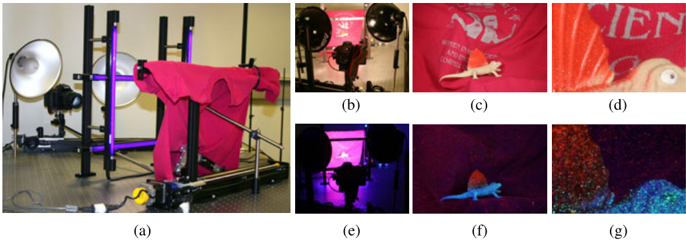
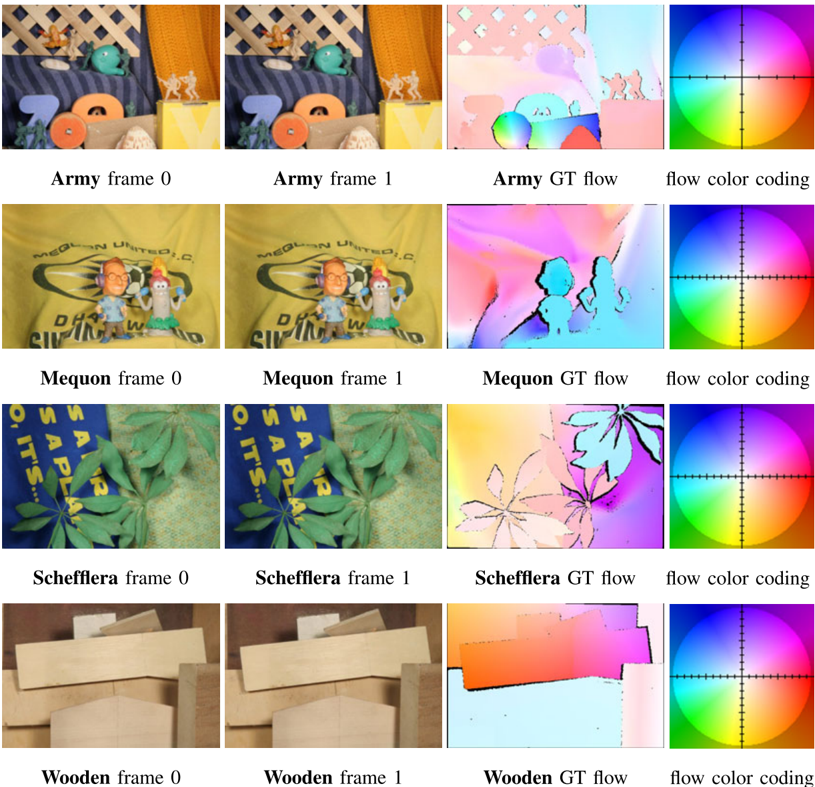
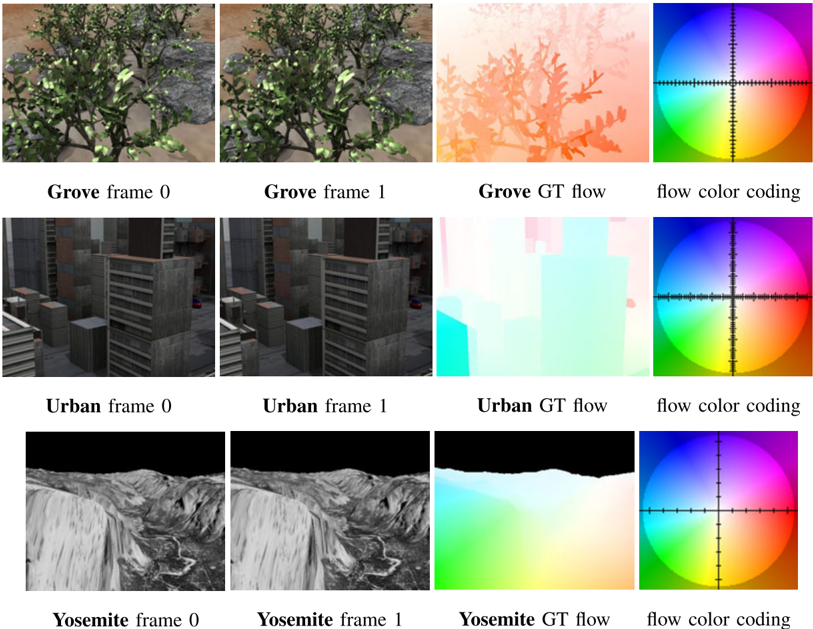
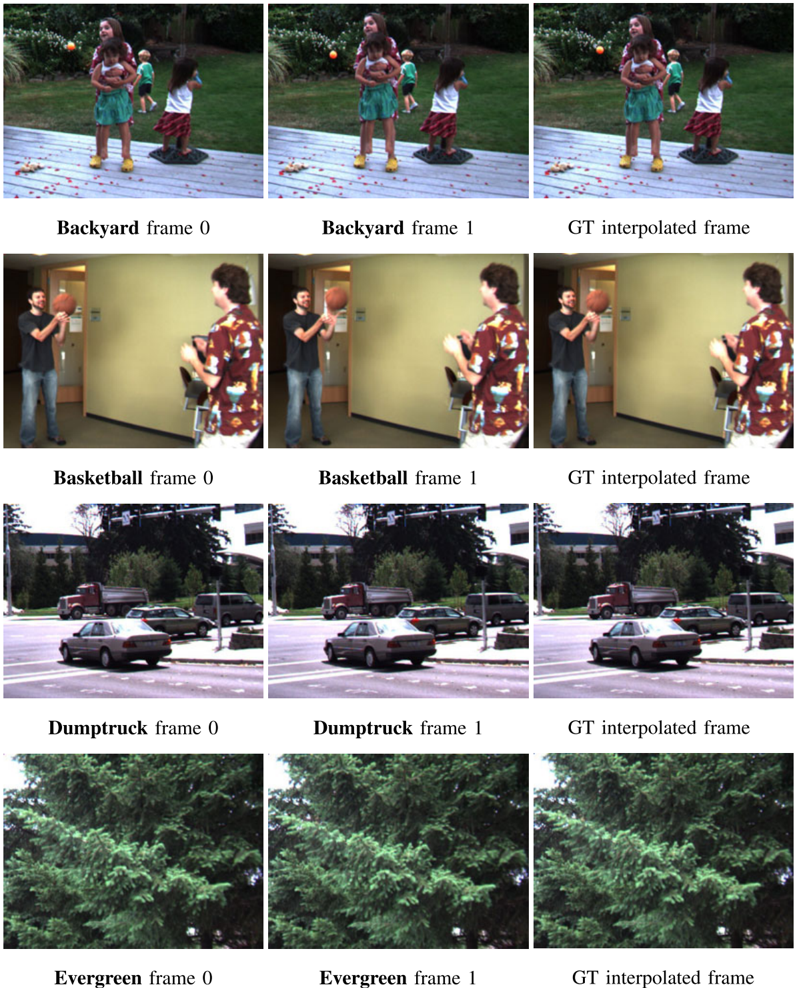
The quantitative evaluation of optical flow algorithms by Barron et al. (1994) led to significant advances in performance. The challenges for optical flow algorithms today go beyond the datasets and evaluation methods proposed in that paper. Instead, they center on problems associated with complex natural scenes, including nonrigid motion, real sensor noise, and motion discontinuities. We propose a new set of benchmarks and evaluation methods for the next generation of optical flow algorithms. To that end, we contribute four types of data to test different aspects of optical flow algorithms: (1) sequences with nonrigid motion where the ground-truth flow is determined by tracking hidden fluorescent texture, (2) realistic synthetic sequences, (3) high frame-rate video used to study interpolation error, and (4) modified stereo sequences of static scenes. In addition to the average angular error used by Barron et al., we compute the absolute flow endpoint error, measures for frame interpolation error, improved statistics, and results at motion discontinuities and in textureless regions.
Overview
CoChat Summary
TL;DR
The paper introduces a new optical flow benchmark of four data types (hidden fluorescent texture, realistic synthetic, high-speed interpolation, and modified stereo) plus an extended evaluation methodology with endpoint error, interpolation error, robustness/accuracy statistics, and region masks. It reports that performance improved substantially over the preliminary 2007 study, but motion discontinuities and diverse datasets remain difficult, and top flow methods still lag top stereo methods on the modified Teddy stereo data.
Key findings
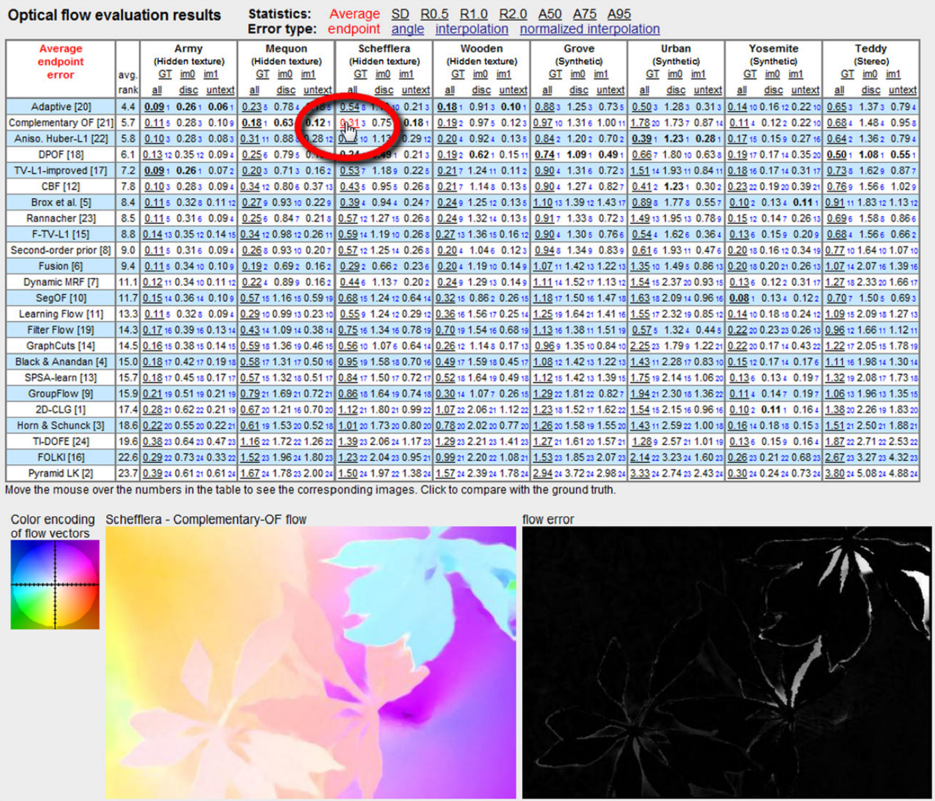
- The benchmark contains 12 training and 12 test sequences; test ground truth is withheld except for Yosemite. As of December 2009 the online evaluation contained results for 24 published methods, all using only 2 input frames and 10 using color.
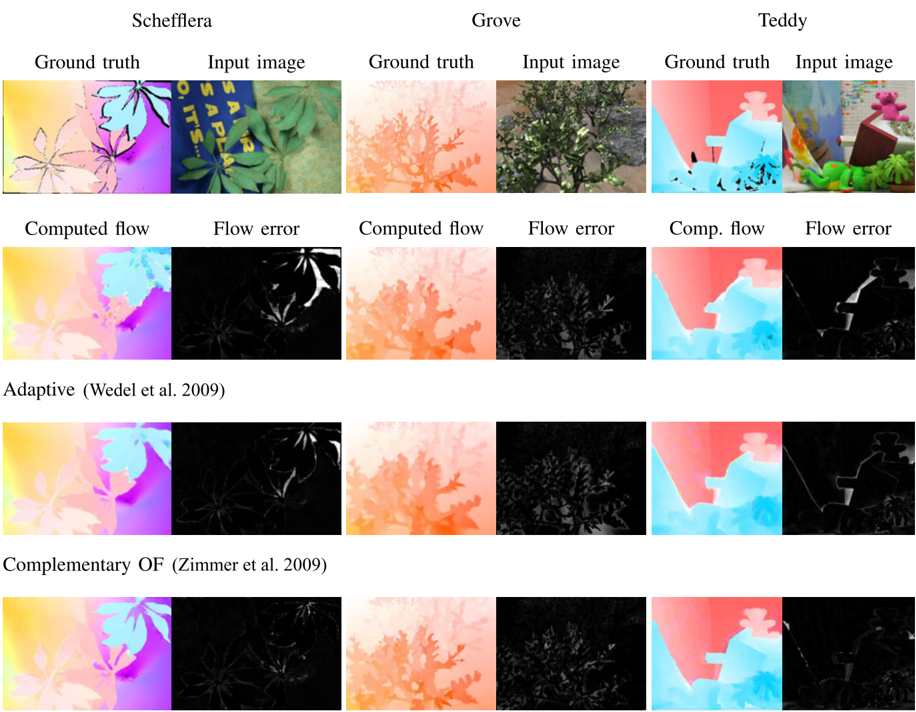
- Best average endpoint error (Avg. EE) improved dramatically over 2D-CLG (Bruhn et al. 2005): Army 0.28→0.09, Mequon 0.67→0.18, Schefflera 1.12→0.24, Wooden 1.07→0.18, Grove 1.23→0.74, Urban 1.54→0.39, Yosemite 0.10→0.08, Teddy 1.38→0.50. Best Avg. EE was below 0.2 pixels on four datasets (Yosemite, Army, Mequon, Wooden).
- Endpoint error (EE) and angular error (AE) rankings were highly correlated (r = 0.989), but the paper argues EE should be preferred: Complementary OF on Urban had Avg. AE 4.64° (rank 6) but Avg. EE 1.78 pixels (rank 20), because AE downweights large motions.
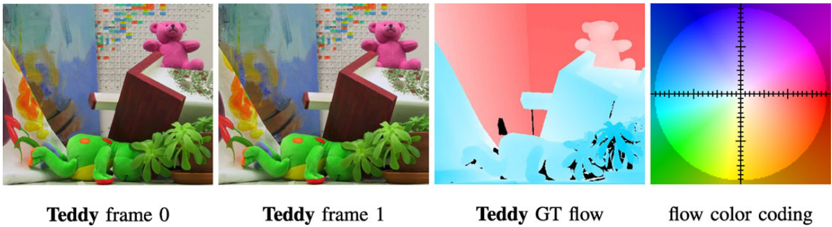
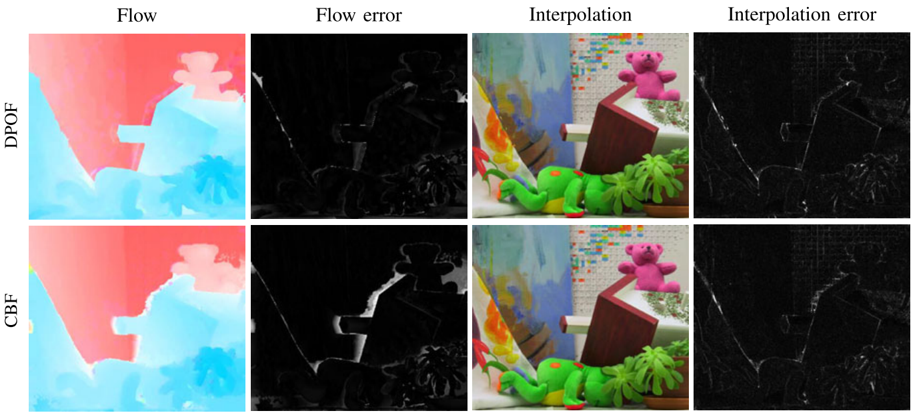
- Motion discontinuity (Disc) regions were the hardest; textureless (Untext) regions were typically easiest. Dataset results were less correlated, with Yosemite poorly or negatively correlated with others. Flow and interpolation errors were only moderately correlated (Avg4 EE vs Avg4 IE r = 0.763). On Teddy, top stereo methods outperformed top flow methods: median lowest-five R1.0 was 9.9 for flow vs 6.5 for stereo in All regions (34% reduction), and 27.6 vs 10.0 in Disc regions (64% reduction).
Methods
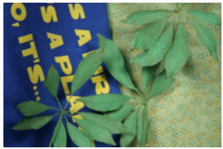
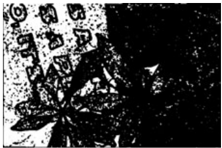
- Four data types were collected: (1) real nonrigid scenes with dense ground truth from hidden fluorescent texture, captured with a Canon EOS 20D at 3504×2336, downsampled every 40th visible-light frame by factor 6 to 584×388, with SSD tracking (15×15 windows), forward/backward crosschecking, and Lucas-Kanade subpixel refinement; (2) realistic synthetic scenes rendered with 3Delight at 640×480, with ground truth from a custom shader and dominant-cluster flow selection; (3) high-speed video for frame interpolation captured with a PointGrey Dragonfly Express at 60 fps, providing every other frame and retaining intermediate frames as ground truth; and (4) modified stereo data (Teddy) from structured light, cropped to make the disparity range roughly symmetric.
- Evaluation metrics include average angular error (AE), absolute flow endpoint error (EE), interpolation error (IE), and gradient-normalized interpolation error (NE). Statistics include averages, robustness measures R_X, and percentile accuracy measures A_X, computed over All, Disc, and Untext region masks.
- Analysis used the online evaluation at http://vision.middlebury.edu/flow/, comparing 24 published methods across metrics, statistics, masks, and datasets, with Pearson correlations between rankings and comparisons to state-of-the-art stereo methods on Teddy.
Limitations
- The paper states that the hidden fluorescent texture scenes are laboratory scenes, not real-world scenes, and have no motion blur due to stop-motion capture; ground truth is unavailable where cross-checking failed, especially occluded regions, and the measured ground truth is not perfect, though significant errors are limited to a small fraction of pixels. Synthetic sequences were generated without motion blur. The modified stereo ground truth is only accurate to 0.25 pixels, and algorithms may exploit the knowledge that motions are horizontal; overfitting to rigid data should be visible across the 12 evaluation images. Interpolation ground truth is an intermediate image, not a flow field, so the flow definition is apparent motion.
- The paper also states that no single method yet achieves strong performance across a wide variety of datatypes, that any dataset has a limited lifespan, and that future studies should include more challenging realistic synthetic data, longer sequences, and more difficult materials, illumination changes, atmospheric effects, and transparency.
- Evident from the text: the online tables do not provide an overall ranking among methods; runtimes are not normalized for programming environment, CPU speed, cores, or hardware acceleration; algorithms are required to produce dense flow and cannot submit confidence maps or sparse/incomplete fields; all 24 published methods used only 2 frames despite 8-frame sequences being available; and the paper cannot definitively answer whether temporal smoothing is less suited to the more challenging sequences.
Model-written summary. Check it against the paper before relying on it.
Integrity signals
Registry
Cites
Statistics
Figures

Verification
Claims the paper makes
2 Valid · 16 Not valid · 58 Not checked · 185 Own results and interpretations
A result the paper states — it cites no source for it, so there is none to check. The quote shows it is in the paper.
In the paper
“Rather than collecting a single type of data (with its inherent limitations) we instead collected four different types of data, each satisfying a different subset of desirable properties.”
plain- Asserted: passes — The authors put it forward as true.
- Checkable: passes — It can be checked against evidence.
- Load-bearing: passes — The paper’s conclusions depend on it.
- Based: passes — The paper gives a reason why it holds.
A result the paper states — it cites no source for it, so there is none to check. The quote shows it is in the paper.
In the paper
“Using the combination of fluorescent paint, downsampling high-resolution images, and sequential tracking of small motions, we are able to obtain dense, subpixel accurate ground truth for a nonrigid scene.”
plainstates a cause- Asserted: passes — The authors put it forward as true.
- Checkable: passes — It can be checked against evidence.
- Load-bearing: passes — The paper’s conclusions depend on it.
- Based: passes — The paper gives a reason why it holds.
A result the paper reports from its own data — it cites no other source for it, so there is none to check. The quote shows it is in the paper.
In the paper
“To allow for measures that predict performance on such tasks, we collected a variety of data suitable for frame interpolation.”
plainstates a cause- Asserted: passes — The authors put it forward as true.
- Checkable: passes — It can be checked against evidence.
- Load-bearing: passes — The paper’s conclusions depend on it.
- Based: passes — The paper gives a reason why it holds.
A result the paper reports from its own data — it cites no other source for it, so there is none to check. The quote shows it is in the paper.
In the paper
“We have developed a technique for capturing imagery of nonrigid scenes with ground-truth optical flow.”
plain- Asserted: passes — The authors put it forward as true.
- Checkable: passes — It can be checked against evidence.
- Load-bearing: passes — The paper’s conclusions depend on it.
- Based: passes — The paper gives a reason why it holds.
A result the paper states — it cites no source for it, so there is none to check. The quote shows it is in the paper.
In the paper
“To go beyond previous synthetic ground truth (e.g., the Yosemite sequence), we generated two types of fairly complex synthetic outdoor scenes.”
plain- Asserted: passes — The authors put it forward as true.
- Checkable: passes — It can be checked against evidence.
- Load-bearing: passes — The paper’s conclusions depend on it.
- Based: passes — The paper gives a reason why it holds.
96 more claims
Create a free account to see all 261 claims and every source verdict.
- Probably not a substantial claim. 114
- It may state two separate claims as one. 76
- The quote only partly states this claim. 6
Claims other papers make about this one
Each is checked against this paper’s own text: does it say what the citing paper says it does?
The source backs part of the claim, not all of it — or backs it for a different population, condition or comparison.
In the citing paper
“Notable works include the Middlebury dataset (Baker et al, 2011) and the KITTI datasets (Geiger et al, 2012; Menze and Geiger, 2015), but due to the difficulty of computing accurate ground truth, these have been restricted to 8 and 2 · 200 pairs of frames, respectively (the latter are also limited by the special driving setting).”
From What Makes Good Synthetic Training Data for Learning Disparity and Optical Flow Estimation? (2018) · cites this paper as Baker et al, 2011
Experimental — accuracy not yet measured
Citations
Cites
The pascal visual object classes (VOC) challenge
Everingham, M., Van Gool, L., Williams, C. K. I., Winn, J., & Zisserman, A. (2010) · International Journal of Computer Vision · doi:10.1007/s11263-009-0275-4 · Cited by 19,599
Proceedings of IEEE Conference on Computer Vision and Pattern Recognition
(1993) · doi:10.1109/cvpr.1993 · Cited by 17,667
Proceedings of IEEE International Conference on Computer Vision
(1995) · Proceedings of IEEE International Conference on Computer Vision · doi:10.1109/iccv.1995.466933 · Cited by 12,860
(1981) · Cited by 11,963
Horn, B. K. P., & Schunck, B. G. (1981) · Artificial Intelligence · doi:10.1016/0004-3702(81)90024-2 · Cited by 10,312
Horn, B. K., & Schunck, B. G. (1981) · SPIE Proceedings · doi:10.1117/12.965761 · Cited by 7,394 · cited 2×
“A baseline approach is to use an L2 norm as in the Horn and Schunck algorithm (Horn and Schunck 1981):”
BackgroundMethodFast approximate energy minimization via graph cuts
Boykov, Y., Veksler, O., & Zabih, R. (2001) · IEEE Transactions on Pattern Analysis and Machine Intelligence · doi:10.1109/34.969114 · Cited by 6,988
A Taxonomy and Evaluation of Dense Two-Frame Stereo Correspondence Algorithms
Scharstein, D., & Szeliski, R. (2002) · International Journal of Computer Vision · doi:10.1023/a:1014573219977 · Cited by 6,740 · cited 10×
“Many areas of computer vision, such as stereo [63], face recognition [28, 55, 68], and object recognition [23, 24], have challenging datasets to track the progress made by leading algorithms and to stimulate new ideas.”
BackgroundMethodResultInfluentialSelf-citationProceedings European Conference on Computer Vision 2002
Heyden, A., Sparr, G., Nielsen, M., & Johansen, P. (2002) · Lund University Publications (Lund University) · Cited by 5,153
From few to many: illumination cone models for face recognition under variable lighting and pose
Georghiades, A. S., Belhumeur, P. N., & Kriegman, D. J. (2001) · IEEE Transactions on Pattern Analysis and Machine Intelligence · doi:10.1109/34.927464 · Cited by 4,912 · cited 1×
“Many areas of computer vision, such as stereo (Scharstein and Szeliski 2002), face recognition (Philips et al. 2005; Sim et al. 2003; Gross et al. 2008; Georghiades et al. 2001), and object recognition (Fei-Fei et al.”
Background
Research works printed but not linked: 4
- Anandan, P., & Weiss, R. (1985). Introducing smoothness constraint in a matching approach for the computation of displacement fields. In Proceedings of the DARPA image understanding workshop (pp. 186-196).
- Bleyer, M., & Chambon, S. (2010). Does color really help in dense stereo matching? In Proceedings of the international symposium 3D data processing, visualization and transmission .
- Lempitsky, V., Roth, S., & Rother, C. (2008). Fusion flow: discretecontinuous optimization for optical flow estimation. In Proceedings of the IEEE conference on computer vision and pattern recognition .
- Rannacher, J. (2009). Realtime 3D motion estimation on graphics hardware . Undergraduate thesis, Heidelberg University.
Cited by
Items 301–400 of 2,273
Revisiting Adaptive Convolutions for Video Frame Interpolation
Niklaus, S., Mai, L., & Wang, O. (2021) · IEEE Winter Conference on Applications of Computer Vision · doi:10.1109/wacv48630.2021.00114 · Cited by 77
“We adopt the test set selection from [36] and conduct our evaluation on Vimeo-90k [63], the Middlebury benchmark samples with publicly known ground truth [1], the Liu et al .”
BackgroundMethodInfluentialImproving Real-Time Hand Gesture Recognition with Semantic Segmentation
Benítez-García, G., Prudente-Tixteco, L., Castro-Madrid, L. C., Toscano-Medina, R., Olivares-Mercado, J., Sánchez-Pérez, G., & Villalba, L. J. G. (2021) · Sensors · doi:10.3390/s21020356 · Cited by 59
“Following common standards, we employ the color wheel described in [41] for color-coding the optical flow values, as shown in Figure 1.”
MethodJoint Optical Flow and Temporally Consistent Semantic Segmentation
Hur, J., & Roth, S. (2016) · Lecture notes in computer science · doi:10.1007/978-3-319-46604-0_12 · Cited by 71
“Several approaches have relied on the epipolar constraint for estimating motion [1].”
MethodSelf-citationViTBAT: Video tracking and behavior annotation tool
Biresaw, T. A., Nawaz, T. H., Ferryman, J. M., & Dell, A. I. (2016) · IEEE International Conference on Advanced Video and Signal Based Surveillance (AVSS) · doi:10.1109/avss.2016.7738055 · Cited by 63
“Ground-truth information is often used to test and evaluate the performance for different computer vision tasks such as optical flow estimation [1], stereo correspondence estimation [23] and video tracking [18], where the term ‘ground truth’ refers to the ideal performance an algorithm is desired to achieve.”
BackgroundEpicFlow: Edge-Preserving Interpolation of Correspondences for Optical FlowPreprint
Revaud, J., Weinzaepfel, P., Harchaoui, Z., et al. (2015) · arXiv (Cornell University) · doi:10.48550/arxiv.1501.02565 · Cited by 59
“On the Middlebury test set, we obtain an AEE below 0 .”
BackgroundMethodInfluentialLearning to detect Motion Boundaries
Weinzaepfel, P., Revaud, J., Harchaoui, Z., & Schmid, C. (2015) · IEEE Computer Society Conference on Computer Vision and Pattern Recognition/Proceedings - IEEE Computer Society Conference on Computer Vision and Pattern Recognition/Proceedings · doi:10.1109/cvpr.2015.7298873 · Cited by 70
“The Middlebury dataset [3] is composed of 8 training se quences of 2 to 8 frames with ground-truth optical flow for a central frame.”
MethodVideo stabilization: A comprehensive survey
Wang, Y., Huang, Q., Jiang, C., Liu, J., Shang, M., & Miao, Z. (2022) · Neurocomputing · doi:10.1016/j.neucom.2022.10.008 · Cited by 75
Joint motion estimation and segmentation of complex scenes with label costs and occlusion modeling
Unger, M., Werlberger, M., Pock, T., & Bischof, H. (2012) · IEEE Computer Society Conference on Computer Vision and Pattern Recognition/Proceedings - IEEE Computer Society Conference on Computer Vision and Pattern Recognition/Proceedings · doi:10.1109/cvpr.2012.6247887 · Cited by 63
Optical flow for incompressible turbulence motion estimation
Chen, X., Zillé, P., Shao, L., & Corpetti, T. (2015) · Experiments in Fluids · doi:10.1007/s00348-014-1874-6 · Cited by 64
“…calculate the Average Angle Error (AAE) and Root Mean Square Error (RMSE) as evaluation criteria, which are commonly used in optical field community (Baker et al 2011): Here, N represents the total number of pixels and u c ( x , t ) and u e ( x , t ) are respectively the exact and the estimated…”
Karargyris, A., & Bourbakis, N. (2010) · IEEE Transactions on Medical Imaging · doi:10.1109/tmi.2010.2098882 · Cited by 62
“Researchers [25]–[30] have added gradient constancy constraints and they have”
BackgroundEfficient Nonlocal Regularization for Optical Flow
Krähenbühl, P., & Koltun, V. (2012) · Lecture notes in computer science · doi:10.1007/978-3-642-33718-5_26 · Cited by 60
“E(u) = Edata(u) + λEreg(u), where Edata(u) is a data term that aims to preserve image features under the motion u, and Ereg(u) is a regularization term that favors smoothness [4, 18].”
BackgroundMethodFramework for Generation of Synthetic Ground Truth Data for Driver Assistance Applications
Haltakov, V., Unger, C., & Ilić, S. (2013) · Lecture notes in computer science · doi:10.1007/978-3-642-40602-7_35 · Cited by 57
“Furthermore, benchmarks like the popular Middlebury dataset [2] or the recently introduced Syntel dataset [7, 26] employ synthetic images for the evaluation of optical flow and [6] use synthetic scenes for the evaluation of background subtraction algorithms.”
BackgroundMethodVideoSnapping: interactive synchronization of multiple videos
Wang, O., Schroers, C., Zimmer, H., Groß, M. H., & Sorkine‐Hornung, A. (2014) · ACM Transactions on Graphics · doi:10.1145/2601097.2601208 · Cited by 63
Wu, D., Yin, X., Jiang, B., Jiang, M., Li, Z., & Song, H. (2020) · Biosystems Engineering · doi:10.1016/j.biosystemseng.2020.01.012 · Cited by 61
Seitz, S. M., & Baker, S. (2009) · IEEE/CVF International Conference on Computer Vision (ICCV) · doi:10.1109/iccv.2009.5459155 · Cited by 68
“on the Middlebury Flow benchmark [1] and show our algorithm to be reasonably competitive with the state of the art in terms of flow accuracy.”
BackgroundMethodResultInfluentialSelf-citationFast and robust optical flow for time-lapse microscopy using super-voxels
Amat, F., Myers, E. W., & Keller, P. (2012) · Bioinformatics · doi:10.1093/bioinformatics/bts706 · Cited by 60
“Automated computational techniques are essential for the quantitative analysis of cellular dynamics using time-lapse light microscopy.”
BackgroundMethodInfluentialFeng, Y. J., Ren, J., & Jiang, J. (2011) · IEEE Transactions on Broadcasting · doi:10.1109/tbc.2011.2131030 · Cited by 55
“As a result, optical flow has been widely applied in many applications including motion detection, object detection and tracking, dominant image plane extraction as well as visual odometry and robot navigation [17], [30], [36].”
MethodProbFlow: Joint Optical Flow and Uncertainty Estimation
Wannenwetsch, A. S., Keuper, M., & Roth, S. (2017) · IEEE/CVF International Conference on Computer Vision (ICCV) · doi:10.1109/iccv.2017.133 · Cited by 68
“We rely on the Middle-bury dataset [2], which has frequently been used to evaluate the performance of optical flow confidence measures.”
MethodResultSelf-citationRichter, F., Shen, S., Liu, F., Huang, J.-B., Funk, E. K., Orosco, R. K., & Yip, M. C. (2021) · IEEE Robotics and Automation Letters · doi:10.1109/lra.2021.3056057 · Cited by 71
“The CNN for optical flow estimation [25] is pre-trained on the Middlebury dataset [27],”
MethodPixelNet: Towards a General Pixel-level Architecture
Bansal, A., Chen, X., Russell, B., Gupta, A. K., & Ramanan, D. (2016) · arXiv (Cornell University) · doi:10.48550/arxiv.1609.06694 · Cited by 51
Motion Estimation by Deep Learning in 2D Echocardiography: Synthetic Dataset and Validation
Evain, E., Sun, Y., Faraz, K., Garcia, D., Saloux, E., Gerber, B. L., Craene, M. D., & Bernard, O. (2022) · IEEE Transactions on Medical Imaging · doi:10.1109/tmi.2022.3151606 · Cited by 73
“The endpoint error is defined as EPE = √ (u− ugt)(2) + (v − vgt)(2) and corresponds to a distance measure between the estimated flow (u, v) and the ground truth (ugt, vgt) [35].”
BackgroundComputing Range Flow from Multi-modal Kinect Data
Gottfried, J.-M., Keuper, J., & Garbe, C. S. (2011) · Lecture notes in computer science · doi:10.1007/978-3-642-24028-7_70 · Cited by 65
“The computation of optical flow [2] from 2D image sequences or range flow [11] from depth image sequences plays an important role in the middle layer of a wide range of computer vision algorithms, such as object tracking, camera motion estimation or gesture recognition.”
BackgroundDense versus Sparse Approaches for Estimating the Fundamental Matrix
Valgaerts, L., Bruhn, A., Mainberger, M., & Weickert, J. (2011) · International Journal of Computer Vision · doi:10.1007/s11263-011-0466-7 · Cited by 63
SDC – Stacked Dilated Convolution: A Unified Descriptor Network for Dense Matching Tasks
Schuster, R., Wasenmüller, O., Unger, C., & Stricker, D. (2019) · IEEE Computer Society Conference on Computer Vision and Pattern Recognition/Proceedings - IEEE Computer Society Conference on Computer Vision and Pattern Recognition/Proceedings · doi:10.1109/cvpr.2019.00266 · Cited by 60
“CPM [19] and FlowFields++ [32] are selected to represent optical flow matching algorithms and are evaluated on KITTI [26], Middlebury [3], HD1K [21], and MPI Sin-tel [6].”
BackgroundMethodResultInfluentialOptimizing Video Prediction via Video Frame Interpolation
Wu, Y., Wen, Q., & Chen, Q. (2022) · IEEE Computer Society Conference on Computer Vision and Pattern Recognition/Proceedings - IEEE Computer Society Conference on Computer Vision and Pattern Recognition/Proceedings · doi:10.1109/cvpr52688.2022.01729 · Cited by 75
“We evaluate our methods on multiple datasets, including DAVIS [34], Middlebury-Other [1], and Vimeo90K [47] datasets.”
Optical flow in the presence of spatially-varying motion blur
Portz, T., Zhang, L., & Jiang, H. (2012) · IEEE Computer Society Conference on Computer Vision and Pattern Recognition/Proceedings - IEEE Computer Society Conference on Computer Vision and Pattern Recognition/Proceedings · doi:10.1109/cvpr.2012.6247871 · Cited by 59
A Survey of Image Synthesis Methods for Visual Machine Learning
Tsirikoglou, A., Eilertsen, G., & Unger, J. (2020) · Computer Graphics Forum · doi:10.1111/cgf.14047 · Cited by 70
Hartmann, C., Wang, J., Opristescu, D., & Volk, W. (2018) · Optics and Lasers in Engineering · doi:10.1016/j.optlaseng.2018.03.021 · Cited by 54
Robust Optical Flow in Rainy Scenes
Li, R., Tan, R. T., & Cheong, L. (2018) · Lecture notes in computer science · doi:10.1007/978-3-030-01267-0_18 · Cited by 57
“[2] obtain ground-truth data of only a couple of real image pairs using a controlled experiment setup, which does not work under outdoor rain.”
MethodGüney, F., & Geiger, A. (2017) · Lecture notes in computer science · doi:10.1007/978-3-319-54190-7_13 · Cited by 62
“Unfortunately, coarse-to-fine schemes often lead to blurred object boundaries on current benchmarks [4,6,28] due to their susceptibility to local minima in the energy function.”
BackgroundLee, R., Venieris, S. I., & Lane, N. D. (2021) · ACM Computing Surveys · doi:10.1145/3469094 · Cited by 74
Realtime Video Classification using Dense HOF/HOG
Uijlings, J., Duta, I. C., Rostamzadeh, N., & Sebe, N. (2014) · International Conference on Multimedia Retrieval · doi:10.1145/2578726.2578744 · Cited by 53
“Whereas accuracy for optical flow is mostly measured on optical flow benchmarks such as [2, 4], in this paper we investigate this trade-off directly on our task of interest: video classification.”
MethodA survey of optical flow techniques for UAV navigation applications
Chao, H., Gu, Y., & Napolitano, M. (2013) · International Conference on Unmanned Aircraft Systems (ICUAS) · doi:10.1109/icuas.2013.6564752 · Cited by 73
“The obtained motion field estimates can serve as a reference for optical flows computed from vision, which is similar to the ground truth in computer vision societies[10].”
BackgroundMethodInfluentialMotion Effects Synthesis for 4D Films
Lee, J., Han, B., & Choi, S. (2015) · IEEE Transactions on Visualization and Computer Graphics · doi:10.1109/tvcg.2015.2507591 · Cited by 52
“To restore a cameramotion, the fundamentalmatrix is converted to the essentialmatrix using the following definition: E ¼ KTFK; K ¼ f 0 w=2 0 f h=2 0 0 1 0 @ 1 A; (4) where K is a camera calibration matrix parameterized by image width and height ðw; hÞ and a predefined focal length f .”
MethodScene-Adaptive Video Frame Interpolation via Meta-Learning
Choi, M., Choi, J., Baik, S., Kim, T. H., & Lee, K. M. (2020) · IEEE Computer Society Conference on Computer Vision and Pattern Recognition/Proceedings - IEEE Computer Society Conference on Computer Vision and Pattern Recognition/Proceedings · doi:10.1109/cvpr42600.2020.00946 · Cited by 55
“To fine-tune the model, a frame triplet consisting For a feasibility test on the effectiveness of test-time adaptation, we fine-tune a pre-trained SepConv [31] model on each sequence from Middlebury [2] dataset.”
MethodRIFE: Real-Time Intermediate Flow Estimation for Video Frame Interpolation.Preprint
Huang, Z., Zhang, T., Heng, W., Shi, B., & Zhou, S. (2020) · arXiv (Cornell University) · Cited by 70
Sparse Flow: Sparse Matching for Small to Large Displacement Optical Flow
Timofte, R., & Gool, L. V. (2015) · IEEE Winter Conference on Applications of Computer Vision · doi:10.1109/wacv.2015.151 · Cited by 66
“The seminal work of Horn and Schunck [15] has been improved repeatedly over the years [25, 6, 10, 24, 34, 28, 4, 32].”
BackgroundVisualizing and Understanding Patch Interactions in Vision Transformer
Ma, J., Bai, Y., Zhong, B., Zhang, W., Yao, T., & Mei, T. (2023) · IEEE Transactions on Neural Networks and Learning Systems · doi:10.1109/tnnls.2023.3270479 · Cited by 80
Optical Flow Estimation for Spiking Camera
Hu, L., Zhao, R. Q., Ding, Z., Ма, Л., Shi, B., Xiong, R., & Huang, T. (2022) · IEEE Computer Society Conference on Computer Vision and Pattern Recognition/Proceedings - IEEE Computer Society Conference on Computer Vision and Pattern Recognition/Proceedings · doi:10.1109/cvpr52688.2022.01732 · Cited by 78
“In the variational age, the datasets to evaluate an optical flow algorithm are mainly Middle-bury [1], Sintel [4] and KITTI [12, 21].”
MethodStructure and motion estimation from rolling shutter video
Hedborg, J., Ringaby, E., Forssén, P.-E., & Felsberg, M. (2011) · IEEE International Conference on Computer Vision Workshops · doi:10.1109/iccvw.2011.6130217 · Cited by 61
“We propose to use a more local approach which is achieved by re-tracking the tracked points back from the current to the previous image, and rejecting correspondences where the deviation in initial and resulting position is larger than a certain threshold [5].”
MethodOptical Flow Estimation in the Deep Learning Age
Hur, J., & Roth, S. (2020) · Springer eBooks · doi:10.1007/978-3-030-46732-6_7 · Cited by 65
“However, collecting such a dataset with real-world images has been challenging due to the difficulty of measuring the true motion for all pixels [4].”
BackgroundSelf-citationChipQA: No-Reference Video Quality Prediction via Space-Time Chips
Ebenezer, J. P., Shang, Z., Wu, Y., Wei, H., Sethuraman, S., & Bovik, A. C. (2021) · IEEE Transactions on Image Processing · doi:10.1109/tip.2021.3112055 · Cited by 60
“• Many popular optical flow databases [45]–[47] only have”
BackgroundConstrained Optical Flow Estimation as a Matching Problem
Mozerov, M. G. (2013) · IEEE Transactions on Image Processing · doi:10.1109/tip.2013.2244221 · Cited by 50
“To illustrate our experimental result we use the HSV color wheel that was proposed in [12].”
MethodHuman Interaction Prediction Using Deep Temporal Features
Ke, Q., Bennamoun, M., An, S., Boussaïd, F., & Sohel, F. A. (2016) · Lecture notes in computer science · doi:10.1007/978-3-319-48881-3_28 · Cited by 53
Neural Dense Non-Rigid Structure from Motion with Latent Space Constraints
Sidhu, V., Tretschk, E., Golyanik, V., Agudo, A., & Theobalt, C. (2020) · Lecture notes in computer science · doi:10.1007/978-3-030-58517-4_13 · Cited by 62
Dense Correspondences across Scenes and Scales
Tau, M., & Hassner, T. (2015) · IEEE Transactions on Pattern Analysis and Machine Intelligence · doi:10.1109/tpami.2015.2474356 · Cited by 51
“The quality of the resulting flow is evaluated by considering the angular and endpoint errors [44].”
BackgroundMethodInfluentialEstimating Human Pose with Flowing Puppets
Zuffi, S., Romero, J., Schmid, C., & Black, M. J. (2013) · IEEE/CVF International Conference on Computer Vision (ICCV) · doi:10.1109/iccv.2013.411 · Cited by 48
“Below each image is the estimated forward flow field color coded as in [2] with the puppet overlaid in black.”
MethodSelf-citationRobust Optical Flow Estimation of Double-Layer Images under Transparency or Reflection
Yang, J., Li, H., Dai, Y., & Tan, R. T. (2016) · IEEE Computer Society Conference on Computer Vision and Pattern Recognition/Proceedings - IEEE Computer Society Conference on Computer Vision and Pattern Recognition/Proceedings · doi:10.1109/cvpr.2016.157 · Cited by 59
“Middlebury [2] and Sintel [7] flow datasets, and the reflection dataset in [21]).”
BackgroundSegFlow: Joint Learning for Video Object Segmentation and Optical FlowPreprint
Cheng, J., Tsai, Y., Wang, S., et al. (2017) · arXiv (Cornell University) · doi:10.48550/arxiv.1709.06750 · Cited by 48
“For instance, when an object moves fast, the optical flow methods [2, 5, 37] are not effective in capturing the movement and hence generate incomplete flow within the object (see Figure 4 for an example).”
BackgroundA General Dense Image Matching Framework Combining Direct and Feature-Based Costs
Braux-Zin, J., Dupont, R., & Bartoli, A. (2013) · IEEE/CVF International Conference on Computer Vision (ICCV) · doi:10.1109/iccv.2013.30 · Cited by 52
“Middlebury benchmark.”
BackgroundMethodInfluentialScalable Scene Flow From Point Clouds in the Real World
Jund, P., Sweeney, C., Abdo, N., Chen, Z., & Shlens, J. (2021) · IEEE Robotics and Automation Letters · doi:10.1109/lra.2021.3139542 · Cited by 70
“Previous datasets for estimating optical flow were small and largely based on synthetic imagery [19], [20], [21], [22].”
BackgroundST-MFNet: A Spatio-Temporal Multi-Flow Network for Frame Interpolation
Danier, D., Zhang, F., & Bull, D. (2022) · IEEE Computer Society Conference on Computer Vision and Pattern Recognition/Proceedings - IEEE Computer Society Conference on Computer Vision and Pattern Recognition/Proceedings · doi:10.1109/cvpr52688.2022.00351 · Cited by 80
“All of these confirm the effectiveness of the up-sampling scale in multi-flow estimation.”
Segmenting video into classes of algorithm-suitability
Aodha, O. M., Brostow, G., & Pollefeys, M. (2010) · IEEE Computer Society Conference on Computer Vision and Pattern Recognition/Proceedings - IEEE Computer Society Conference on Computer Vision and Pattern Recognition/Proceedings · doi:10.1109/cvpr.2010.5540099 · Cited by 53
“We used image pairs with ground truth flow from three sources: the eight Middlebury training sequences [2], two Middlebury-like sequences from [25], and nine of our own challenging synthetic sequences, for a total of 19.”
InfluentialRobust Non-Local TV- $L^{1}$ Optical Flow Estimation With Occlusion Detection
Zhang, C., Chen, Z., Wang, M., Li, M., & Jiang, S. (2017) · IEEE Transactions on Image Processing · doi:10.1109/tip.2017.2712279 · Cited by 54
Fundamental Principles on Learning New Features for Effective Dense Matching
Zhang, F., & Wah, B. W.-S. (2017) · IEEE Transactions on Image Processing · doi:10.1109/tip.2017.2752370 · Cited by 45
“However, they may perform poorly when applied to complicated outdoor scenes (for instance, the KITTI datasets [21]) because the simple color or gradient-based features they employ for calculating matching costs cannot address the nuances in complex scenes.”
BackgroundMethodBridgeNet: A Joint Learning Network of Depth Map Super-Resolution and Monocular Depth Estimation
Tang, Q., Cong, R., Sheng, R., He, L., Zhang, D., Zhao, Y., & Kwong, S. (2021) · ACM International Conference on Multimedia (ACM MM) · doi:10.1145/3474085.3475373 · Cited by 68
Illumination-Robust Dense Optical Flow Using Census Signatures
Müller, T., Rabe, C., Rannacher, J., Franke, U., & Mester, R. (2011) · Lecture notes in computer science · doi:10.1007/978-3-642-23123-0_24 · Cited by 55
“For a variety of optical flow methods, the average endpoint error of the flow field, 1/ |Ω| · Ω |u (x)− uGT (x)| dx, is computed for every γ in the range [1, 4].”
BackgroundMethodInfluentialMotion Compensated Frame Interpolation with a Symmetric Optical Flow Constraint
Rakêt, L. L., Roholm, L., Bruhn, A., & Weickert, J. (2012) · Lecture notes in computer science · doi:10.1007/978-3-642-33179-4_43 · Cited by 49
“[9], [10], [11]), in which one defines a new flow v 1/2 f from I1/2 to I1”
BackgroundMethodInfluentialAn Exploration Framework to Identify and Track Movement of Cloud Systems
Doraiswamy, H., Natarajan, V., & Nanjundiah, R. S. (2013) · IEEE Transactions on Visualization and Computer Graphics · doi:10.1109/tvcg.2013.131 · Cited by 49
Higher-order total variation approaches and generalisations
Bredies, K., & Höller, M. (2020) · Inverse Problems · doi:10.1088/1361-6420/ab8f80 · Cited by 71
Two-Stream Deep Feature-Based Froth Flotation Monitoring Using Visual Attention Clues
Ai, M., Xie, Y., Tang, Z., Zhang, J., & Gui, W. (2020) · IEEE Transactions on Instrumentation and Measurement · doi:10.1109/tim.2020.3026456 · Cited by 48
“Usually, the optical flow calculation is formulated as the optimization of a global energy function, which is the weighted sum of brightness constancy and a prior term [33] E = E BC + λ E Prior .”
MethodAdvancing Learned Video Compression With In-Loop Frame Prediction
Yang, R., Timofte, R., & Gool, L. V. (2022) · IEEE Transactions on Circuits and Systems for Video Technology · doi:10.1109/tcsvt.2022.3222418 · Cited by 54
Klette, R., Krüger, N., Vaudrey, T., Pauwels, K., Hulle, M. M. V., Morales, S., Kandil, F. I., Haeusler, R., Pugeault, N., Rabe, C., et al. (2011) · IEEE Transactions on Vehicular Technology · doi:10.1109/tvt.2011.2148134 · Cited by 51
A Dataset for Visual Navigation with Neuromorphic Methods
Barranco, F., Fermuller, C. M., Aloimonos, Y., & Delbrück, T. (2016) · Frontiers in Neuroscience · doi:10.3389/fnins.2016.00049 · Cited by 52
“Image motion flow fields will be evaluated using the average endpoint error (Otte and Nagel, 1994; Baker et al., 2011), which is defined as the average value of the vector distance between the estimated motion u and the ground-truth ˆ u , and is derived for N motion flow values as: Another…”
BackgroundMethodInfluentialOS-Flow: A Robust Algorithm for Dense Optical and SAR Image Registration
Xiang, Y., Wang, F., Wan, L., Jiao, N., & You, H. (2019) · IEEE Transactions on Geoscience and Remote Sensing · doi:10.1109/tgrs.2019.2905585 · Cited by 46
“(a) Two urban images from Middlebury flow data set [38].”
BackgroundDeep Slow Motion Video Reconstruction With Hybrid Imaging System
Paliwal, A., & Kalantari, N. K. (2020) · IEEE Transactions on Pattern Analysis and Machine Intelligence · doi:10.1109/tpami.2020.2987316 · Cited by 44
“We begin by quantitatively evaluating our results on the Slow Flow [44], Middlebury [21] and (NfS) [45] datasets.”
BackgroundInfluentialOcclusion Detection and Motion Estimation with Convex Optimization
Ayvacı, A., Raptis, M., & Soatto, S. (2010) · Cited by 44
Super SloMo: High Quality Estimation of Multiple Intermediate Frames for Video InterpolationPreprint
Jiang, H., Sun, D., Jampani, V., et al. (2017) · arXiv (Cornell University) · doi:10.48550/arxiv.1712.00080 · Cited by 44
“In addition to SepConv, we also compare our model with other three top-performing models on the Middlebury dataset2, where the interpolation algorithm [1] is coupled with different optical flow methods including MDP-Flow2 [37], PMMST [39], and DeepFlow [34].”
BackgroundMethodInfluentialMultiaperture Visual Velocity Measurement Method Based on Biomimetic Compound-Eye for UAVs
Shen, C., Zhao, X., Wu, X., Cao, H., Wang, C., Tang, J., & Liu, J. (2023) · IEEE Internet of Things Journal · doi:10.1109/jiot.2023.3324966 · Cited by 45
“6 shows the AAE and EPE [29] between the obtained flow field and the ground truth for γ ∈ [0 .”
BackgroundA combined post-filtering method to improve accuracy of variational optical flow estimation
Tu, Z., van der Aa, N., van Gemeren, C., & Veltkamp, R. C. (2013) · Pattern Recognition · doi:10.1016/j.patcog.2013.11.026 · Cited by 44
“Both the proposed algorithm and the other algorithms [2,4,5,34] for comparison (their codes are available on line) were implemented in MATLAB.”
BackgroundMethodInfluentialNowPrecip: localized precipitation nowcasting in the complex terrain of Switzerland
Sideris, I. V., Foresti, L., Nerini, D., & Germann, U. (2020) · Quarterly Journal of the Royal Meteorological Society · doi:10.1002/qj.3766 · Cited by 56
“Standard techniques (Baker et al., 2011) and two well-known measures are employed for verification of NowTrack: (a) the flow endpoint error (EPE), which represents the Cartesian distance between the true and estimated values (Otte and Nagel, 1994; Zhu et al.”
MethodA Flexible Recurrent Residual Pyramid Network for Video Frame Interpolation
Zhang, H., Zhao, Y., & Wang, R. (2020) · Lecture notes in computer science · doi:10.1007/978-3-030-58595-2_29 · Cited by 46
“For optical flow methods, we apply the interpolation algorithm presented in [2].”
BackgroundMethodInfluentialSuper-resolution of compressed videos using convolutional neural networks
Kappeler, A., Yoo, S., Dai, Q., & Katsaggelos, A. K. (2016) · Proceedings - International Conference on Image Processing · doi:10.1109/icip.2016.7532538 · Cited by 40
“We tested a number of optical flow estimation algorithms [25].”
MethodImproving Optical Flow on a Pyramid Level
Hofinger, M., Bulò, S. R., Porzi, L., Knapitsch, A., Pock, T., & Kontschieder, P. (2020) · Lecture notes in computer science · doi:10.1007/978-3-030-58604-1_46 · Cited by 54
“Stopping Cues EPE [1] Fl-all [%] EPE [1] Fl-all [%] EPE [1] Fl-all [%] EPE [1] Fl-all [%] EPE [1] Fl-all [%] EPE [1] Fl-all [%]”
BackgroundMethodHybrid Approach for Facial Expression Recognition Using Convolutional Neural Networks and SVM
Kim, J., Kim, M.-H., Suh, H.-E., Naseem, M. T., & Lee, C.-S. (2022) · Applied Sciences · doi:10.3390/app12115493 · Cited by 51
Occlusion Boundary Detection Using Pseudo-depth
He, X., & Yuille, A. (2010) · Lecture notes in computer science · doi:10.1007/978-3-642-15561-1_39 · Cited by 48
“We perform this estimation using a novel algorithm (submitted elsewhere) but other motion flow algorithms that perform well on the Middlebury dataset [2] would probably be sufficient.”
BackgroundMethodInfluentialMODNet: Moving Object Detection Network with Motion and Appearance for Autonomous DrivingPreprint
Siam, M., Mahgoub, H., Zahran, M., Yogamani, S. K., Jägersand, M., & El-Sallab, A. (2017) · arXiv (Cornell University) · doi:10.48550/arxiv.1709.04821 · Cited by 57
“In case of optical flow, a color wheel representation is used to convert it to RGB flow[1].”
MethodLocality-Aware Inter-and Intra-Video Reconstruction for Self-Supervised Correspondence Learning
Li, L., Zhou, T., Wang, W., Yang, L., Li, J., & Yang, Y. (2022) · IEEE Computer Society Conference on Computer Vision and Pattern Recognition/Proceedings - IEEE Computer Society Conference on Computer Vision and Pattern Recognition/Proceedings · doi:10.1109/cvpr52688.2022.00852 · Cited by 66
“Although synthetic data would serve an alternative in some low-level visual correspondence tasks ( e.g ., optical flow estimation [2]), they limit the generalization to real scenes.”
BackgroundWater Surface Modeling from a Single Viewpoint Video
Li, C. S., Pickup, D., Saunders, T., et al. (2012) · IEEE Transactions on Visualization and Computer Graphics · doi:10.1109/tvcg.2012.302 · Cited by 41
FPGA-Based Hardware Implementation of Real-Time Optical Flow Calculation
Seyid, K., Richaud, A., Capoccia, R., & Leblebici, Y. (2016) · IEEE Transactions on Circuits and Systems for Video Technology · doi:10.1109/tcsvt.2016.2598703 · Cited by 46
“It is a well-established topic and has been benchmarked for a long time [2]–[4].”
BackgroundMethodResultInfluentialAltena, B., & Kääb, A. (2017) · Frontiers in Earth Science · doi:10.3389/feart.2017.00053 · Cited by 46
“Optical Flow There is a rich body of literature on optical flow (Barron et al., 1994; Baker et al., 2011).”
BackgroundPezzementi, Z. A., Tabor, T., Hu, P., Chang, J., Ramanan, D., Wellington, C., Babu, B. P. W., & Herman, H. (2017) · Journal of Field Robotics · doi:10.1002/rob.21760 · Cited by 54
Refraction Wiggles for Measuring Fluid Depth and Velocity from Video
Xue, T., Rubinstein, M., Wadhwa, N., Levin, A., Durand, F., & Freeman, W. T. (2014) · Lecture notes in computer science · doi:10.1007/978-3-319-10578-9_50 · Cited by 55
“Based on this brightness constancy equation, a traditional way to calculate the motion vector v is to minimize the following optical flow equation [7]:”
MethodModelling the dynamics of motion integration with a new luminance-gated diffusion mechanism
Tlapale, É., Masson, G. S., & Kornprobst, P. (2010) · Vision Research · doi:10.1016/j.visres.2010.05.022 · Cited by 43
“Here, we used the Middleburry colour code (Baker et al., 2007) as illustrated in Fig.”
MethodPanoptic-DeepLab: A Simple, Strong, and Fast Baseline for Bottom-Up Panoptic SegmentationPreprint
Cheng, B., Collins, M. D., Zhu, Y., et al. (2019) · arXiv (Cornell University) · doi:10.48550/arxiv.1911.10194 · Cited by 41
Frame Rate Up Conversion Based on Variational Image Fusion
Lee, W. H., Choi, K., & Ra, J. B. (2013) · IEEE Transactions on Image Processing · doi:10.1109/tip.2013.2288139 · Cited by 38
“To examine the objective performance improvement of the refined optical flow estimation, we perform an experiment on the Middlebury benchmark datasets with ground truth [39].”
MethodSparse Representation-Based Multiple Frame Video Super-Resolution
Dai, Q., Yoo, S., Kappeler, A., et al. (2016) · IEEE Transactions on Image Processing · doi:10.1109/tip.2016.2631339 · Cited by 39
“There is a plethora of techniques in the literature for estimating a dense motion field [33], [34].”
CycMuNet+: Cycle-Projected Mutual Learning for Spatial-Temporal Video Super-Resolution
Hu, M., Jiang, K., Wang, Z., Bai, X., & Hu, R. (2023) · IEEE Transactions on Pattern Analysis and Machine Intelligence · doi:10.1109/tpami.2023.3293522 · Cited by 50
“Inspired by the existing studies [30], [77], the commonly used video datasets with different image resolutions, including Vimeo90K [30] , UCF101 [77] and Middlebury [78] datasets are used for training and evaluation, detailed as follows.”
MethodLIBSVX: A Supervoxel Library and Benchmark for Early Video Processing
Xu, C., & Corso, J. J. (2016) · International Journal of Computer Vision · doi:10.1007/s11263-016-0906-5 · Cited by 46
Generalized Analytic Signals in Image Processing: Comparison, Theory and Applications
Bernstein, S., Bouchot, J.-L., Reinhardt, M., et al. (2013) · Springer eBooks · doi:10.1007/978-3-0348-0603-9_11 · Cited by 39
Bio-inspired Motion Estimation with Event-Driven Sensors
Barranco, F., Fermuller, C. M., & Aloimonos, Y. (2015) · Lecture notes in computer science · doi:10.1007/978-3-319-19258-1_27 · Cited by 46
“3 compares the proposed method, our contour-based event method [3] and top frame-based algorithms, among them the method of Sun [22], which ranked the first in 2014 in [2].”
MethodStereo-Based 3D Reconstruction of Dynamic Fluid Surfaces by Global Optimization
Qian, Y., Gong, M., & Yang, Y. (2017) · IEEE Computer Society Conference on Computer Vision and Pattern Recognition/Proceedings - IEEE Computer Society Conference on Computer Vision and Pattern Recognition/Proceedings · doi:10.1109/cvpr.2017.704 · Cited by 43
“EPE(k) = √ (uk − uk)2 + (vk − v′ k), k ∈ Ω1 ∪ Ω2, (7) which is based on the popular endpoint error (EPE) used in evaluating optical flow results [4].”
Continual Occlusion and Optical Flow Estimation
Neoral, M., Šochman, J., & Matas, J. (2019) · Lecture notes in computer science · doi:10.1007/978-3-030-20870-7_10 · Cited by 47
Wu, L., Yang, Z., Wang, Q., Jian, M., Zhao, B., Yan, J., & Chen, C. W. (2020) · Neurocomputing · doi:10.1016/j.neucom.2020.07.003 · Cited by 47
“For better visualization, We use the color-coding rule in [47] to encode motions where different color represents different motion directions while the saturation represents the motion amplitude.”
MethodDriver Intention Anticipation Based on In-Cabin and Driving Scene Monitoring
Rong, Y., Akata, Z., & Kasneci, E. (2020) · IEEE International Conference on Intelligent Transportation Systems (ITSC) · doi:10.1109/itsc45102.2020.9294181 · Cited by 61
“According to the optical flow color coding [21], the direction changes 90 degree (from bottom side to right side) from the light yellow to blue, and the green is in between.”
BackgroundGwosdek, P., Zimmer, H., Grewenig, S., Bruhn, A., & Weickert, J. (2012) · Lecture notes in computer science · doi:10.1007/978-3-642-35740-4_29 · Cited by 44
Bi-directional Frame Interpolation for Unsupervised Video Anomaly Detection
Deng, H., Zhang, Z., Zou, S., & Li, X. (2023) · IEEE Winter Conference on Applications of Computer Vision · doi:10.1109/wacv56688.2023.00266 · Cited by 53
“Video frame interpolation is generally based on time-varying information in the optical flow to produce a continuous motion association [1].”
BackgroundReconstructing 3-D Skin Surface Motion for the DIET Breast Cancer Screening System
Botterill, T., Lotz, T., Kashif, A. S., & Chase, J. G. (2014) · IEEE Transactions on Medical Imaging · doi:10.1109/tmi.2014.2304959 · Cited by 41
“Modern dense optical flow algorithms [31], [32] are generally based on the classic formulation by Horn and Schunck [33].”
MethodSLSDeep: Skin Lesion Segmentation Based on Dilated Residual and Pyramid Pooling Networks
Sarker, M. M. K., Rashwan, H. A., Akram, F., Banu, S. F., Saleh, A., Singh, V. K., Chowdhury, F. U. H., Abdulwahab, S., Romaní, S., Radeva, P. I., et al. (2018) · Lecture notes in computer science · doi:10.1007/978-3-030-00934-2_3 · Cited by 187
“SLSDeep-EPE yields the highest SPE, which is 0.1% and 0.3% more than MResNet-Seg [3] and SLSDeep, respectively.”
MethodInfluentialRainFlow: Optical Flow Under Rain Streaks and Rain Veiling Effect
Li, R., Tan, R. T., Cheong, L. F., Avilés-Rivero, A. I., Fan, Q., & Schönlieb, C. (2019) · IEEE/CVF International Conference on Computer Vision (ICCV) · doi:10.1109/iccv.2019.00740 · Cited by 43
Metadata
- Authors
- Baker, S., Scharstein, D., Lewis, J. P., Roth, S., Black, M. J., & Szeliski, R.
- Affiliations
- Microsoft (United States) (US)
- Middlebury College (US)
- Technische Universität Darmstadt (DE)
- Brown University (US)
- Corresponding author
- Scharstein, Daniel
- Venue
- International Journal of Computer Vision
- Published
- 2010-11-30
- Volume
- 92
- Issue
- 1
- Pages
- 1-31
- ISSN
- 0920-5691 (ISSN-L)
- 1573-1405
- OpenAlex
- W2147253850
- Semantic Scholar
- 804836b8ad86ef8042e3dcbd45442a52f031ee03
- Cited by
- 2,205
- References
- 112
- Citations by year
- 2026: 49 · 2025: 81 · 2024: 82 · 2023: 117 · 2022: 129 · 2021: 152 · 2020: 174 · 2019: 163 · 2018: 144 · 2017: 156 · 2016: 187 · 2015: 180 · 2014: 154 · 2013: 129 · 2012: 118
- FWCI
- 146.62
- Type
- journal article
- Language
- en
- Open access
- hybrid
- doi.org
- Licence
- cc-by-nc
- Locations
- International Journal of Computer Vision (publishedVersion, cc-by-nc)
- Publikationsdatenbank der Fraunhofer-Gesellschaft (Fraunhofer-Gesellschaft) (publishedVersion)
- Max Planck Institute for Plasma Physics (submittedVersion)
- Fraunhofer-Publica (Fraunhofer-Gesellschaft) (submittedVersion)
- Funders
- National Science Foundation (0534858, 0535075, 0413169)
- Intel Corporation
- Topics
- Physical Sciences › Computer Science › Computer Vision and Pattern Recognition › Advanced Vision and Imaging
- Physical Sciences › Computer Science › Computer Vision and Pattern Recognition › Video Surveillance and Tracking Methods
- Physical Sciences › Computer Science › Signal Processing › Video Coding and Compression Technologies
- Keywords
- optical flow, benchmark dataset, evaluation methodology, non-rigid motion, motion discontinuities, textureless regions, sensor noise
About these checks
Registry, retraction, Cites and statistics results are computed, not judged, with one exception: a printed reference that no index lists is read once by a model before it counts as a citation error. Claims are extracted by a model and kept only when their quote appears verbatim in the text; each cited source is then checked, with a model’s help, for whether it says what the claim relies on. Those verdicts can be wrong — read the claim’s quote and the cited source before relying on one.
The claim verdicts this report counts are experimental: their accuracy is not yet measured.
A language model drew the claims from the paper on 2026-10-01, under version 3 of the claim definition (model deepseek-v4.1-flash, prompt extract-v3).
A second model labelled each claim on 2026-10-01 (model jev-1.13-20260917, definition revision gold-guideline-v0.2).
Statistics and arithmetic are recomputed, not judged.
Confidence bands are shown only for fields calibrated on our annotated test set. None is calibrated yet, so no band is shown.
What counts as a claim ›How we measure confidence ›How we check this ›
Are you an author, or do you see a problem with this page? Request a review
Data sources
Bibliographic data: Semantic Scholar, OpenAlex, Crossref.
Contains information from the Semantic Scholar Academic Graph Datasets, made available under the ODC Attribution License (ODC-BY 1.0).
Semantic Scholar’s data is described in: Kinney, R., et al. (2023). The Semantic Scholar Open Data Platform. arXiv:2301.10140.
