

A Database and Evaluation Methodology for Optical Flow
Open accessThe DOI matches its Crossref record; 110 of the 112 references it cites were found in a registry or an index; 2 of the 68 sources its claims cite were checked for support.
Abstract
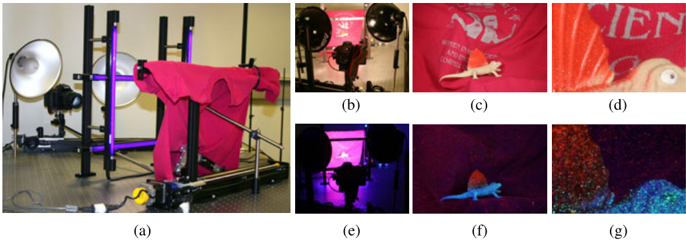
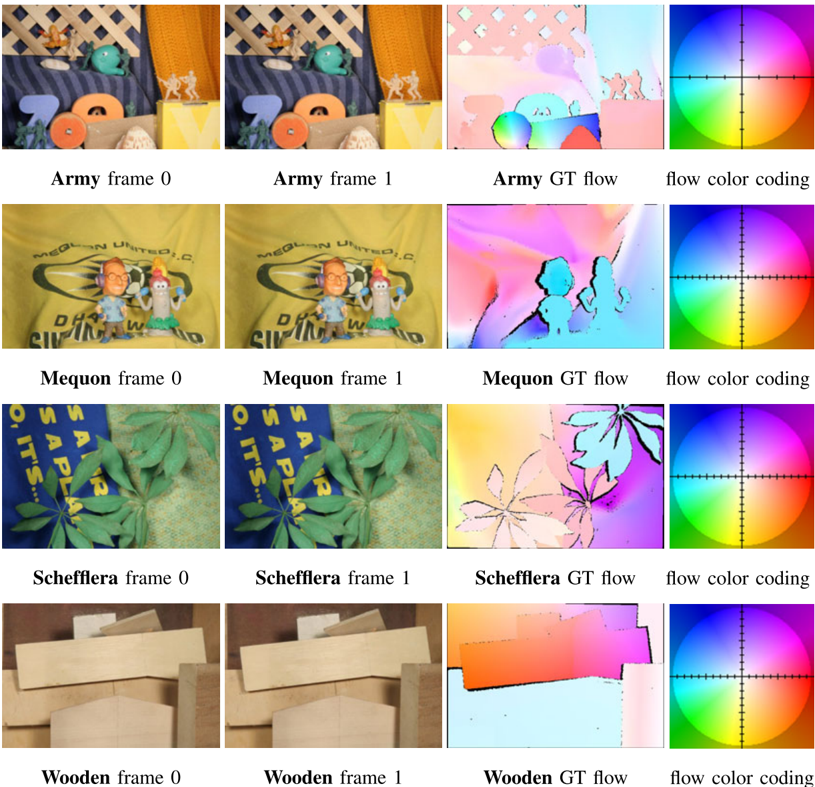
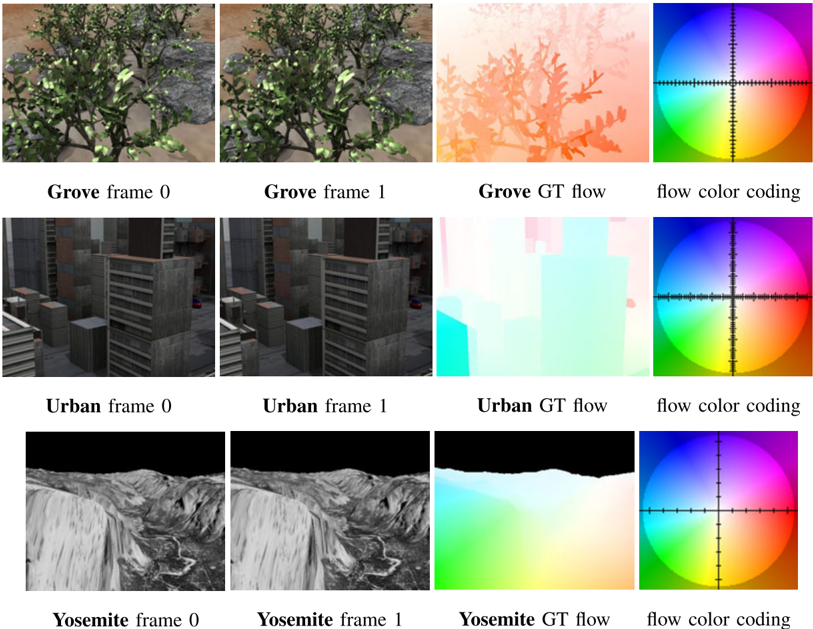
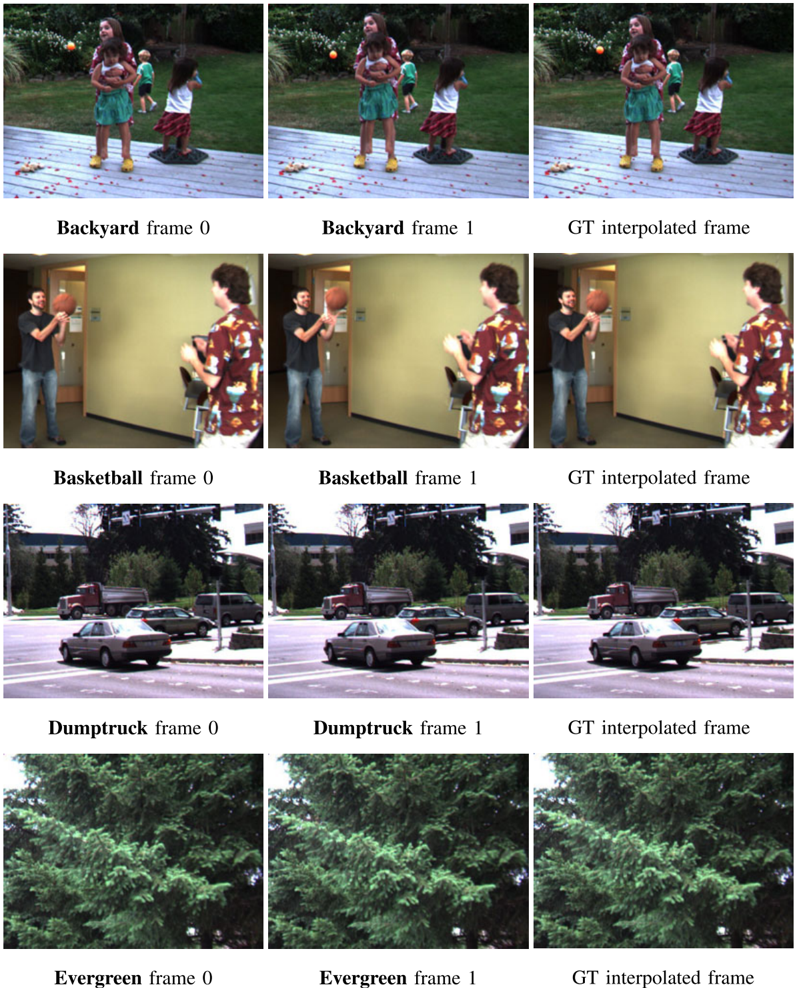
The quantitative evaluation of optical flow algorithms by Barron et al. (1994) led to significant advances in performance. The challenges for optical flow algorithms today go beyond the datasets and evaluation methods proposed in that paper. Instead, they center on problems associated with complex natural scenes, including nonrigid motion, real sensor noise, and motion discontinuities. We propose a new set of benchmarks and evaluation methods for the next generation of optical flow algorithms. To that end, we contribute four types of data to test different aspects of optical flow algorithms: (1) sequences with nonrigid motion where the ground-truth flow is determined by tracking hidden fluorescent texture, (2) realistic synthetic sequences, (3) high frame-rate video used to study interpolation error, and (4) modified stereo sequences of static scenes. In addition to the average angular error used by Barron et al., we compute the absolute flow endpoint error, measures for frame interpolation error, improved statistics, and results at motion discontinuities and in textureless regions.
Overview
CoChat Summary
TL;DR
The paper introduces a new optical flow benchmark of four data types (hidden fluorescent texture, realistic synthetic, high-speed interpolation, and modified stereo) plus an extended evaluation methodology with endpoint error, interpolation error, robustness/accuracy statistics, and region masks. It reports that performance improved substantially over the preliminary 2007 study, but motion discontinuities and diverse datasets remain difficult, and top flow methods still lag top stereo methods on the modified Teddy stereo data.
Key findings
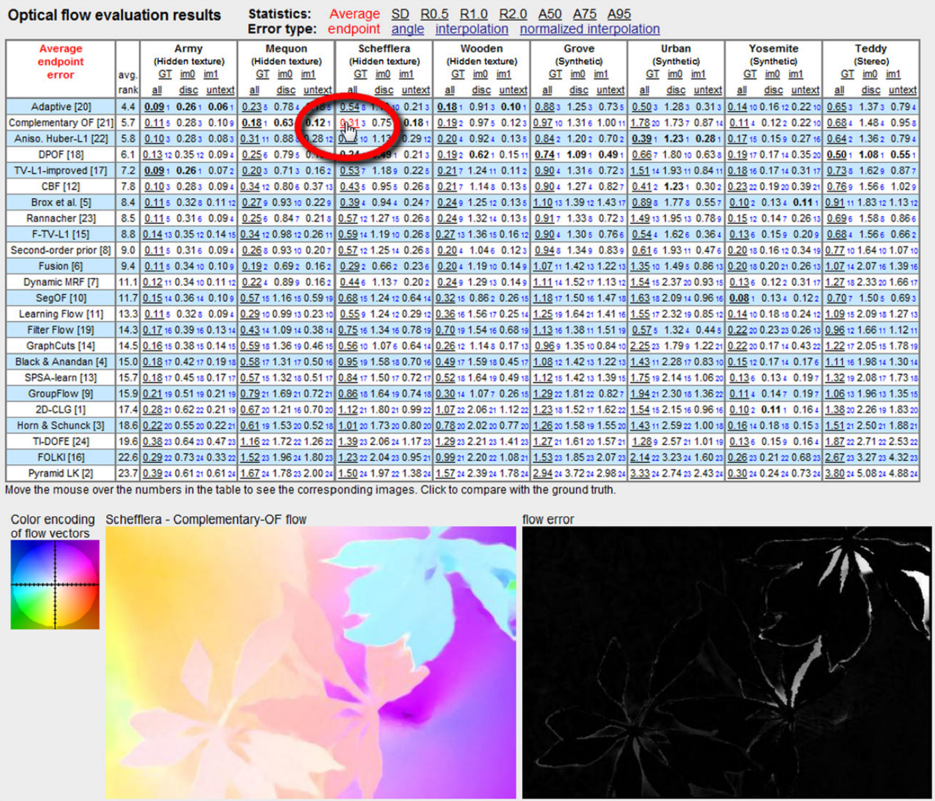
- The benchmark contains 12 training and 12 test sequences; test ground truth is withheld except for Yosemite. As of December 2009 the online evaluation contained results for 24 published methods, all using only 2 input frames and 10 using color.
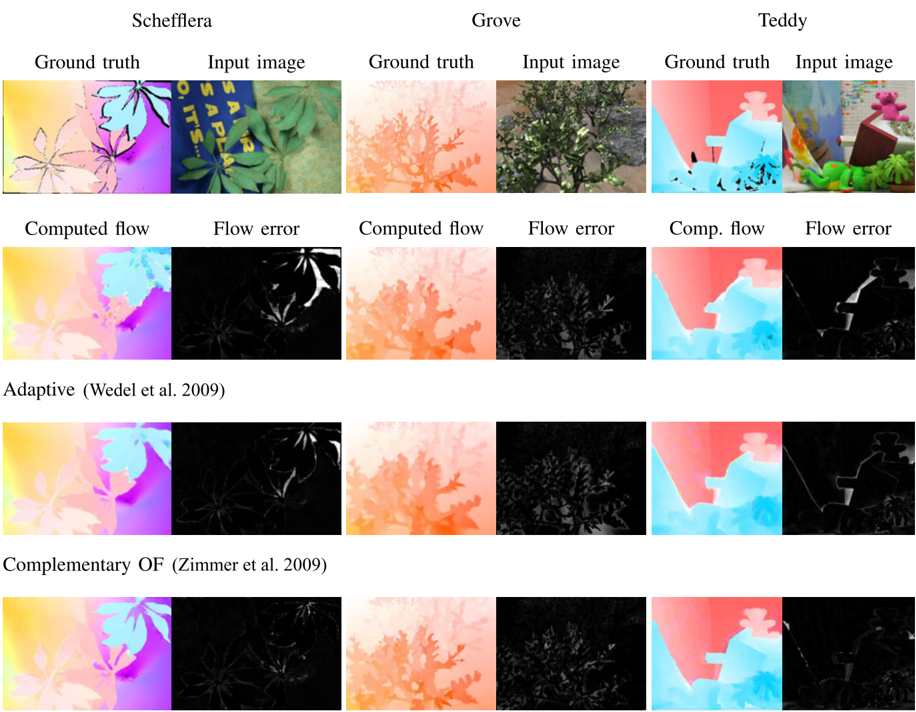
- Best average endpoint error (Avg. EE) improved dramatically over 2D-CLG (Bruhn et al. 2005): Army 0.28→0.09, Mequon 0.67→0.18, Schefflera 1.12→0.24, Wooden 1.07→0.18, Grove 1.23→0.74, Urban 1.54→0.39, Yosemite 0.10→0.08, Teddy 1.38→0.50. Best Avg. EE was below 0.2 pixels on four datasets (Yosemite, Army, Mequon, Wooden).
- Endpoint error (EE) and angular error (AE) rankings were highly correlated (r = 0.989), but the paper argues EE should be preferred: Complementary OF on Urban had Avg. AE 4.64° (rank 6) but Avg. EE 1.78 pixels (rank 20), because AE downweights large motions.
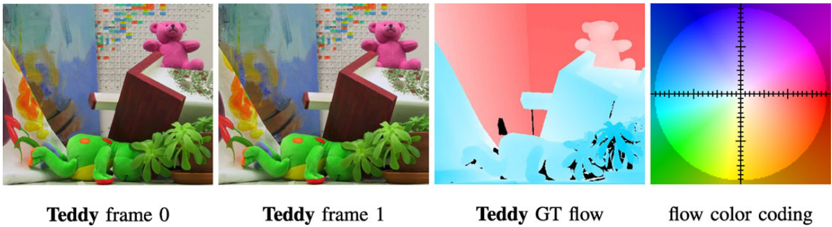
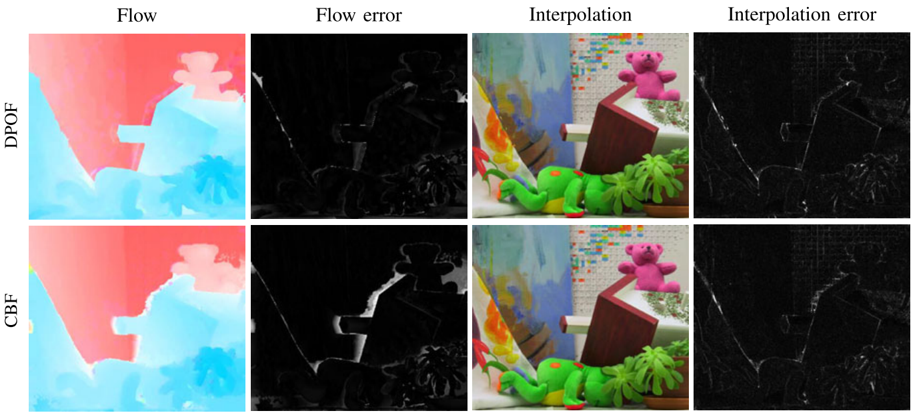
- Motion discontinuity (Disc) regions were the hardest; textureless (Untext) regions were typically easiest. Dataset results were less correlated, with Yosemite poorly or negatively correlated with others. Flow and interpolation errors were only moderately correlated (Avg4 EE vs Avg4 IE r = 0.763). On Teddy, top stereo methods outperformed top flow methods: median lowest-five R1.0 was 9.9 for flow vs 6.5 for stereo in All regions (34% reduction), and 27.6 vs 10.0 in Disc regions (64% reduction).
Methods
- Four data types were collected: (1) real nonrigid scenes with dense ground truth from hidden fluorescent texture, captured with a Canon EOS 20D at 3504×2336, downsampled every 40th visible-light frame by factor 6 to 584×388, with SSD tracking (15×15 windows), forward/backward crosschecking, and Lucas-Kanade subpixel refinement; (2) realistic synthetic scenes rendered with 3Delight at 640×480, with ground truth from a custom shader and dominant-cluster flow selection; (3) high-speed video for frame interpolation captured with a PointGrey Dragonfly Express at 60 fps, providing every other frame and retaining intermediate frames as ground truth; and (4) modified stereo data (Teddy) from structured light, cropped to make the disparity range roughly symmetric.
- Evaluation metrics include average angular error (AE), absolute flow endpoint error (EE), interpolation error (IE), and gradient-normalized interpolation error (NE). Statistics include averages, robustness measures R_X, and percentile accuracy measures A_X, computed over All, Disc, and Untext region masks.
- Analysis used the online evaluation at http://vision.middlebury.edu/flow/, comparing 24 published methods across metrics, statistics, masks, and datasets, with Pearson correlations between rankings and comparisons to state-of-the-art stereo methods on Teddy.
Limitations
- The paper states that the hidden fluorescent texture scenes are laboratory scenes, not real-world scenes, and have no motion blur due to stop-motion capture; ground truth is unavailable where cross-checking failed, especially occluded regions, and the measured ground truth is not perfect, though significant errors are limited to a small fraction of pixels. Synthetic sequences were generated without motion blur. The modified stereo ground truth is only accurate to 0.25 pixels, and algorithms may exploit the knowledge that motions are horizontal; overfitting to rigid data should be visible across the 12 evaluation images. Interpolation ground truth is an intermediate image, not a flow field, so the flow definition is apparent motion.
- The paper also states that no single method yet achieves strong performance across a wide variety of datatypes, that any dataset has a limited lifespan, and that future studies should include more challenging realistic synthetic data, longer sequences, and more difficult materials, illumination changes, atmospheric effects, and transparency.
- Evident from the text: the online tables do not provide an overall ranking among methods; runtimes are not normalized for programming environment, CPU speed, cores, or hardware acceleration; algorithms are required to produce dense flow and cannot submit confidence maps or sparse/incomplete fields; all 24 published methods used only 2 frames despite 8-frame sequences being available; and the paper cannot definitively answer whether temporal smoothing is less suited to the more challenging sequences.
Model-written summary. Check it against the paper before relying on it.
Integrity signals
Registry
Cites
Statistics
Figures

Verification
Claims the paper makes
2 Valid · 16 Not valid · 58 Not checked · 185 Own results and interpretations
A result the paper states — it cites no source for it, so there is none to check. The quote shows it is in the paper.
In the paper
“Rather than collecting a single type of data (with its inherent limitations) we instead collected four different types of data, each satisfying a different subset of desirable properties.”
plain- Asserted: passes — The authors put it forward as true.
- Checkable: passes — It can be checked against evidence.
- Load-bearing: passes — The paper’s conclusions depend on it.
- Based: passes — The paper gives a reason why it holds.
A result the paper states — it cites no source for it, so there is none to check. The quote shows it is in the paper.
In the paper
“Using the combination of fluorescent paint, downsampling high-resolution images, and sequential tracking of small motions, we are able to obtain dense, subpixel accurate ground truth for a nonrigid scene.”
plainstates a cause- Asserted: passes — The authors put it forward as true.
- Checkable: passes — It can be checked against evidence.
- Load-bearing: passes — The paper’s conclusions depend on it.
- Based: passes — The paper gives a reason why it holds.
A result the paper reports from its own data — it cites no other source for it, so there is none to check. The quote shows it is in the paper.
In the paper
“To allow for measures that predict performance on such tasks, we collected a variety of data suitable for frame interpolation.”
plainstates a cause- Asserted: passes — The authors put it forward as true.
- Checkable: passes — It can be checked against evidence.
- Load-bearing: passes — The paper’s conclusions depend on it.
- Based: passes — The paper gives a reason why it holds.
A result the paper reports from its own data — it cites no other source for it, so there is none to check. The quote shows it is in the paper.
In the paper
“We have developed a technique for capturing imagery of nonrigid scenes with ground-truth optical flow.”
plain- Asserted: passes — The authors put it forward as true.
- Checkable: passes — It can be checked against evidence.
- Load-bearing: passes — The paper’s conclusions depend on it.
- Based: passes — The paper gives a reason why it holds.
A result the paper states — it cites no source for it, so there is none to check. The quote shows it is in the paper.
In the paper
“To go beyond previous synthetic ground truth (e.g., the Yosemite sequence), we generated two types of fairly complex synthetic outdoor scenes.”
plain- Asserted: passes — The authors put it forward as true.
- Checkable: passes — It can be checked against evidence.
- Load-bearing: passes — The paper’s conclusions depend on it.
- Based: passes — The paper gives a reason why it holds.
96 more claims
Create a free account to see all 261 claims and every source verdict.
- Probably not a substantial claim. 114
- It may state two separate claims as one. 76
- The quote only partly states this claim. 6
Claims other papers make about this one
Each is checked against this paper’s own text: does it say what the citing paper says it does?
The source backs part of the claim, not all of it — or backs it for a different population, condition or comparison.
In the citing paper
“Notable works include the Middlebury dataset (Baker et al, 2011) and the KITTI datasets (Geiger et al, 2012; Menze and Geiger, 2015), but due to the difficulty of computing accurate ground truth, these have been restricted to 8 and 2 · 200 pairs of frames, respectively (the latter are also limited by the special driving setting).”
From What Makes Good Synthetic Training Data for Learning Disparity and Optical Flow Estimation? (2018) · cites this paper as Baker et al, 2011
Experimental — accuracy not yet measured
Citations
Cites
The pascal visual object classes (VOC) challenge
Everingham, M., Van Gool, L., Williams, C. K. I., Winn, J., & Zisserman, A. (2010) · International Journal of Computer Vision · doi:10.1007/s11263-009-0275-4 · Cited by 19,599
Proceedings of IEEE Conference on Computer Vision and Pattern Recognition
(1993) · doi:10.1109/cvpr.1993 · Cited by 17,667
Proceedings of IEEE International Conference on Computer Vision
(1995) · Proceedings of IEEE International Conference on Computer Vision · doi:10.1109/iccv.1995.466933 · Cited by 12,860
(1981) · Cited by 11,963
Horn, B. K. P., & Schunck, B. G. (1981) · Artificial Intelligence · doi:10.1016/0004-3702(81)90024-2 · Cited by 10,312
Horn, B. K., & Schunck, B. G. (1981) · SPIE Proceedings · doi:10.1117/12.965761 · Cited by 7,394 · cited 2×
“A baseline approach is to use an L2 norm as in the Horn and Schunck algorithm (Horn and Schunck 1981):”
BackgroundMethodFast approximate energy minimization via graph cuts
Boykov, Y., Veksler, O., & Zabih, R. (2001) · IEEE Transactions on Pattern Analysis and Machine Intelligence · doi:10.1109/34.969114 · Cited by 6,988
A Taxonomy and Evaluation of Dense Two-Frame Stereo Correspondence Algorithms
Scharstein, D., & Szeliski, R. (2002) · International Journal of Computer Vision · doi:10.1023/a:1014573219977 · Cited by 6,740 · cited 10×
“Many areas of computer vision, such as stereo [63], face recognition [28, 55, 68], and object recognition [23, 24], have challenging datasets to track the progress made by leading algorithms and to stimulate new ideas.”
BackgroundMethodResultInfluentialSelf-citationProceedings European Conference on Computer Vision 2002
Heyden, A., Sparr, G., Nielsen, M., & Johansen, P. (2002) · Lund University Publications (Lund University) · Cited by 5,153
From few to many: illumination cone models for face recognition under variable lighting and pose
Georghiades, A. S., Belhumeur, P. N., & Kriegman, D. J. (2001) · IEEE Transactions on Pattern Analysis and Machine Intelligence · doi:10.1109/34.927464 · Cited by 4,912 · cited 1×
“Many areas of computer vision, such as stereo (Scharstein and Szeliski 2002), face recognition (Philips et al. 2005; Sim et al. 2003; Gross et al. 2008; Georghiades et al. 2001), and object recognition (Fei-Fei et al.”
Background
Research works printed but not linked: 4
- Anandan, P., & Weiss, R. (1985). Introducing smoothness constraint in a matching approach for the computation of displacement fields. In Proceedings of the DARPA image understanding workshop (pp. 186-196).
- Bleyer, M., & Chambon, S. (2010). Does color really help in dense stereo matching? In Proceedings of the international symposium 3D data processing, visualization and transmission .
- Lempitsky, V., Roth, S., & Rother, C. (2008). Fusion flow: discretecontinuous optimization for optical flow estimation. In Proceedings of the IEEE conference on computer vision and pattern recognition .
- Rannacher, J. (2009). Realtime 3D motion estimation on graphics hardware . Undergraduate thesis, Heidelberg University.
Cited by
Items 201–300 of 2,273
Learning a Confidence Measure for Optical Flow
Aodha, O. M., Humayun, A., Pollefeys, M., & Brostow, G. (2012) · IEEE Transactions on Pattern Analysis and Machine Intelligence · doi:10.1109/tpami.2012.171 · Cited by 115
MODNet: Motion and Appearance based Moving Object Detection Network for Autonomous Driving
Siam, M., Mahgoub, H., Zahran, M., Yogamani, S., Jagersand, M., & El-Sallab, A. (2018) · 2018 21st International Conference on Intelligent Transportation Systems (ITSC) · doi:10.1109/itsc.2018.8569744 · Cited by 95
“In case of optical flow, a color wheel representation is used to convert it to RGB flow[1].”
MethodDense, accurate optical flow estimation with piecewise parametric model
Yang, J., & Li, H. (2015) · IEEE Computer Society Conference on Computer Vision and Pattern Recognition/Proceedings - IEEE Computer Society Conference on Computer Vision and Pattern Recognition/Proceedings · doi:10.1109/cvpr.2015.7298704 · Cited by 109
“At the time of writing, our method achieves the top accuracy on the KITTI benchmark [20], outperforms all published methods on the MPI Sintel (clean) benchmark [13], and yields top-tier results on the Middlebury benchmark [1].”
BackgroundMethodDriving High-Resolution Facial Scans with Video Performance Capture
Fyffe, G., Jones, A., Alexander, O., Ichikari, R., & Debevec, P. E. (2014) · ACM Transactions on Graphics · doi:10.1145/2638549 · Cited by 104
“Finally, as our framework is agnostic to the particular method employed for estimating 2D correspondences, we would like to try more recent optical flow algorithms such as the top performers on the Middlebury benchmark [Baker et al. 2011].”
MethodFree Supervision from Video Games
Krahenbuhl, P. (2018) · 2018 IEEE/CVF Conference on Computer Vision and Pattern Recognition · doi:10.1109/cvpr.2018.00312 · Cited by 82
“In low-level vision, the Middlebury dataset served as the gold standard to judge all optical flow, stereo and multiview stereo algorithms [3].”
MethodSiam, M., Jiang, C., Lu, S., Petrich, L., Gamal, M., Elhoseiny, M., & Jägersand, M. (2019) · Proceedings - IEEE International Conference on Robotics and Automation/Proceedings · doi:10.1109/icra.2019.8794254 · Cited by 103
“The input to the motion stream is the optical flow computed using [16], and converted into RGB representation using the Sintel color wheel representation [1].”
MethodUnsupervised Learning of Edges
Li, Y., Paluri, M., Rehg, J. M., & Dollar, P. (2016) · 2016 IEEE Conference on Computer Vision and Pattern Recognition (CVPR) · doi:10.1109/cvpr.2016.179 · Cited by 89
“The standard colorcoding scheme for optical flow maps 2D flow vectors into a 3D color space by encoding flow orientation via hue and magnitude via saturation [4].”
MethodUijlings, J., Duta, I. C., Sangineto, E., & Sebe, N. (2014) · International Journal of Multimedia Information Retrieval · doi:10.1007/s13735-014-0069-5 · Cited by 100
“Moreover, optical flow methods are generally tested against optical flow benchmarks such as [2,7], but it is not immediately obvious that methods which perform well on these benchmarks would automatically also yield better HOF and MBH descriptors.”
MethodImage Denoising by Exploring External and Internal Correlations
Yue, H., Sun, X., Yang, J., & Wu, F. (2015) · IEEE Transactions on Image Processing · doi:10.1109/tip.2015.2412373 · Cited by 96
“4 (a), the reconstructed image (top) is noisy and its corresponding t i (the second and third row), visualized using the color-coding [33] shown in the left side of Fig.”
MethodPixelNet: Representation of the pixels, by the pixels, and for the pixelsPreprint
Bansal, A., Chen, X., Russell, B. C., Gupta, A. K., & Ramanan, D. (2017) · arXiv (Cornell University) · doi:10.48550/arxiv.1702.06506 · Cited by 126
“These include low-level tasks such as edge detection [21, 64, 94] and optical flow [5, 30, 86], mid-level tasks such as depth/normal recovery [6, 24, 25, 81, 89], and high-level tasks such as keypoint prediction [13, 36, 78, 91], object detection [43], and semantic segmentation [16, 27, 40, 62, 67, 82].”
BackgroundLayered segmentation and optical flow estimation over time
Sun, D., Sudderth, E. B., & Black, M. J. (2012) · IEEE Computer Society Conference on Computer Vision and Pattern Recognition/Proceedings - IEEE Computer Society Conference on Computer Vision and Pattern Recognition/Proceedings · doi:10.1109/cvpr.2012.6247873 · Cited by 90
“This Layers++ method estimates image motion very accurately as measured by the Middlebury optical flow benchmark [1].”
MethodSelf-citationIM-Net for High Resolution Video Frame Interpolation
Peleg, T., Székely, P., Sabo, D., & Sendik, O. (2019) · IEEE Computer Society Conference on Computer Vision and Pattern Recognition/Proceedings - IEEE Computer Society Conference on Computer Vision and Pattern Recognition/Proceedings · doi:10.1109/cvpr.2019.00250 · Cited by 97
“Finally, while the Middlebury challenge [1] is very popular, it is a small (8 images) and limited benchmark with low resolution frames that does not meet our needs.”
BackgroundFast Edge-Preserving PatchMatch for Large Displacement Optical Flow
Bao, L., Yang, Q., & Jin, H. (2014) · IEEE Computer Society Conference on Computer Vision and Pattern Recognition/Proceedings - IEEE Computer Society Conference on Computer Vision and Pattern Recognition/Proceedings · doi:10.1109/cvpr.2014.452 · Cited by 110
“We performed experiments on the Middlebury training datasets [2] to validate this idea.”
BackgroundMethodHassner, T., Mayzels, V., & Zelnik‐Manor, L. (2012) · IEEE Computer Society Conference on Computer Vision and Pattern Recognition/Proceedings - IEEE Computer Society Conference on Computer Vision and Pattern Recognition/Proceedings · doi:10.1109/cvpr.2012.6247842 · Cited by 98
Hu, Y.-T., Chen, H.-S., Hui, K., Huang, J., & Schwing, A. G. (2019) · IEEE Computer Society Conference on Computer Vision and Pattern Recognition/Proceedings - IEEE Computer Society Conference on Computer Vision and Pattern Recognition/Proceedings · doi:10.1109/cvpr.2019.00322 · Cited by 122
“For instance, synthetic data has been used for optical flow [42, 41, 9, 7, 69, 81, 58], robustness estimation of features [51], visual odometry [35, 81], hand tracking [87], shape from shading [82], semantic segmentation [83, 50, 81, 58], amodal segmentation [52, 24], multi-view stereopsis [47] and…”
MethodIm2Flow: Motion Hallucination from Static Images for Action Recognition
Gao, R., Xiong, B., & Grauman, K. L. (2018) · IEEE Computer Society Conference on Computer Vision and Pattern Recognition/Proceedings - IEEE Computer Society Conference on Computer Vision and Pattern Recognition/Proceedings · doi:10.1109/cvpr.2018.00622 · Cited by 105
“Another approach is to encode the flow as an RGB image designed for visualization [1, 33], but this mapping is not reversible to obtain the motion vectors.”
BackgroundEnhanced Quadratic Video Interpolation
Liu, Y., Xie, L., Li, S., Sun, W., Qiao, Y., & Dong, C. (2020) · Lecture notes in computer science · doi:10.1007/978-3-030-66823-5_3 · Cited by 115
“Previous studies [12,11,17,9,15,24,10,7] on video frame interpolation have adopted many video datasets for training and evaluating, such as Middlebury [1], UCF101 [21], Vimeo-90k [25], Adobe 240fps [22] and YouTube 960-fps [24].”
BackgroundComputer Vision Metrics: Survey, Taxonomy, and Analysis
Krig, S. (2014) · Apress eBooks · doi:10.1007/978-1-4302-5930-5 · Cited by 168
Myocardial Motion Estimation From Medical Images Using the Monogenic Signal
Alessandrini, M., Basarab, A., Liebgott, H., & Bernard, O. (2012) · IEEE Transactions on Image Processing · doi:10.1109/tip.2012.2226903 · Cited by 101
“For these reasons, we employ here the less conventional but more appropriate endpoint error (EE) [37], [38]:”
MethodContinuous depth estimation for multi-view stereo
Liu, Y., Cao, X., Dai, Q., & Xu, W. (2009) · IEEE Computer Society Conference on Computer Vision and Pattern Recognition/Proceedings - IEEE Computer Society Conference on Computer Vision and Pattern Recognition/Proceedings · doi:10.1109/cvpr.2009.5206712 · Cited by 97
“Variational approach has made tremendous progress on optical flow problems[4], which is very similar to stereo matching.”
BackgroundSlow Flow: Exploiting High-Speed Cameras for Accurate and Diverse Optical Flow Reference Data
Janai, J., Güney, F., Wulff, J., Black, M. J., & Geiger, A. (2017) · IEEE Computer Society Conference on Computer Vision and Pattern Recognition/Proceedings - IEEE Computer Society Conference on Computer Vision and Pattern Recognition/Proceedings · doi:10.1109/cvpr.2017.154 · Cited by 93
“proposed the influential Middlebury optical flow evaluation [3], for which correspondences have been established by recording images of objects with fluorescent texture under UV light illumination.”
BackgroundMethodInfluentialSelf-citationRanjan, A., Janai, J., Geiger, A., & Black, M. J. (2019) · IEEE/CVF International Conference on Computer Vision (ICCV) · doi:10.1109/iccv.2019.00249 · Cited by 109
“A survey of classical optical flow methods is available in [3, 27].”
BackgroundMethodSelf-citationTraditional and modern strategies for optical flow: an investigation
Shah, S. T. H., & Xiang, X. (2021) · SN Applied Sciences · doi:10.1007/s42452-021-04227-x · Cited by 113
PDC-Net+: Enhanced Probabilistic Dense Correspondence Network
Truong, P., Danelljan, M., Timofte, R., & Gool, L. V. (2023) · IEEE Transactions on Pattern Analysis and Machine Intelligence · doi:10.1109/tpami.2023.3249225 · Cited by 147
“Dense correspondence estimation has most commonly been addressed in the context of optical flow [25], [26], [27], [28], where the image pairs represent consecutive frames in a video.”
BackgroundUpgrading Optical Flow to 3D Scene Flow Through Optical Expansion
Yang, G., & Ramanan, D. (2020) · IEEE Computer Society Conference on Computer Vision and Pattern Recognition/Proceedings - IEEE Computer Society Conference on Computer Vision and Pattern Recognition/Proceedings · doi:10.1109/cvpr42600.2020.00141 · Cited by 105
“In practice, we found optical expansion ground-truth can be reliably computed for training, given the high-quality optical flow datasets available [1, 7, 11, 25, 38, 36].”
MethodWang, Y., Shen, X., Yuan, Y., Du, Y., Li, M., Hu, S. X., Crowley, J. L., & Vaufreydaz, D. (2023) · IEEE Transactions on Pattern Analysis and Machine Intelligence · doi:10.1109/tpami.2023.3305122 · Cited by 193
“However, for videos, similarity includes a score based on both RGB appearance and a RGB representation of optical flow computed between consecutive frames [3].”
MethodUnsupervised Deep Epipolar Flow for Stationary or Dynamic Scenes
Zhong, Y., Ji, P., Wang, J., Dai, Y., & Li, H. (2019) · IEEE Computer Society Conference on Computer Vision and Pattern Recognition/Proceedings - IEEE Computer Society Conference on Computer Vision and Pattern Recognition/Proceedings · doi:10.1109/cvpr.2019.01237 · Cited by 87
“We evaluate our methods on standard optical flow benchmarks, including KITTI [12, 23], MPI-Sintel [6], Flying Chairs [7], and Middlebury [3].”
MethodConvolutional Recurrent Network for Road Boundary Extraction
Liang, J., Homayounfar, N., Ma, W.-C., Wang, S., & Urtasun, R. (2019) · IEEE Computer Society Conference on Computer Vision and Pattern Recognition/Proceedings - IEEE Computer Society Conference on Computer Vision and Pattern Recognition/Proceedings · doi:10.1109/cvpr.2019.00974 · Cited by 96
Facial expression recognition from image sequences using twofold random forest classifier
Pu, X., Fan, K., Chen, X., Ji, L., & Zhou, Z. (2015) · Neurocomputing · doi:10.1016/j.neucom.2015.05.005 · Cited by 92
Semi-Supervised Learning for Optical Flow with Generative Adversarial Networks
Lai, W., Huang, J., & Yang, M. (2017) · neural information processing systems · Cited by 112
Sparse, Smart Contours to Represent and Edit Images
Dekel, T., Gan, C., Krishnan, D., Liu, C., & Freeman, W. T. (2018) · IEEE Computer Society Conference on Computer Vision and Pattern Recognition/Proceedings - IEEE Computer Society Conference on Computer Vision and Pattern Recognition/Proceedings · doi:10.1109/cvpr.2018.00370 · Cited by 84
LiteFlowNet: A Lightweight Convolutional Neural Network for Optical Flow EstimationPreprint
Hui, T.-W., Tang, X., & Loy, C. C. (2018) · arXiv (Cornell University) · doi:10.48550/arxiv.1805.07036 · Cited by 80
A Fusion Approach for Multi-Frame Optical Flow Estimation
Ren, Z., Gallo, O., Sun, D., Yang, M., Sudderth, E. B., & Kautz, J. (2019) · IEEE Winter Conference on Applications of Computer Vision · doi:10.1109/wacv.2019.00225 · Cited by 102
“Given the large number of publications in this area, we refer the reader to [41, 2] for a more complete survey focusing on two-frame optical flow methods.”
BackgroundFeatureFlow: Robust Video Interpolation via Structure-to-Texture Generation
Gui, S., Wang, C., Chen, Q., & Tao, D. (2020) · IEEE Computer Society Conference on Computer Vision and Pattern Recognition/Proceedings - IEEE Computer Society Conference on Computer Vision and Pattern Recognition/Proceedings · doi:10.1109/cvpr42600.2020.01402 · Cited by 88
“The Middlebury benchmark [1] is widely used to evaluate VFI methods.”
MethodVideo Frame Interpolation via Generalized Deformable Convolution
Shi, Z., Liu, X., Shi, K., Dai, L., & Chen, J. (2021) · IEEE Transactions on Multimedia · doi:10.1109/tmm.2021.3052419 · Cited by 105
“UCF101 Test Dataset [53], and Middlebury-Other Dataset [54]) and compare it with the state-of-the-art.”
Is my new tracker really better than yours?
Zajc, L. Č., Kristan, M., & Leonardis, A. (2014) · IEEE Winter Conference on Applications of Computer Vision · doi:10.1109/wacv.2014.6836055 · Cited by 81
“Unlike some other fields of computer vision, like object detection and classification [11], optical-flow computation [4] and automatic segmentation [2], where widely adopted evaluation protocols are used, visual tracking is still largely lacking these features.”
MethodLandslide Displacement Monitoring Using 3D Range Flow on Airborne and Terrestrial LiDAR Data
Ghuffar, S., Székely, B., Roncat, A., & Pfeifer, N. (2013) · Remote Sensing · doi:10.3390/rs5062720 · Cited by 83
“The aperture problem can be solved by using a regularization strategy [5,49], which is an essential part of the state of the art motion estimation algorithms.”
MethodLDMVFI: Video Frame Interpolation with Latent Diffusion Models
Danier, D., Zhang, F., & Bull, D. (2024) · Proceedings of the AAAI Conference on Artificial Intelligence · doi:10.1609/aaai.v38i2.27912 · Cited by 173
“We evaluate models on the most commonly used VFI benchmarks, including Middlebury [1], UCF-101 [66], DAVIS [52], and SNU-FILM [7] datasets.”
MethodInfluentialVideo dehazing with spatial and temporal coherence
Zhang, J., Li, L., Zhang, Y., Guo-qiang, Y., Cao, X., & Sun, J. (2011) · The Visual Computer · doi:10.1007/s00371-011-0569-8 · Cited by 82
“[3] give a modern survey of optical flow estimation.”
BackgroundOptimal Filter Estimation for Lucas-Kanade Optical Flow
Sharmin, N., & Brad, R. (2012) · Sensors · doi:10.3390/s120912694 · Cited by 97
“The Context of Evaluation In the aim of experimental evaluation, we have employed the Middlebury dataset [14] which provides the ground truth.”
MethodPropagating multi-class pixel labels throughout video frames
Chen, A. Y. C., & Corso, J. J. (2010) · IEEE Western New York Image and Signal Processing Workshop (WNYISPW) · doi:10.1109/wnyipw.2010.5649773 · Cited by 84
“2), we use the classical Black and Anandon method [5] due to its efficiency and relative effectiveness [4].”
MethodSEA-RAFT: Simple, Efficient, Accurate RAFT for Optical Flow
Wang, Y., Lipson, L., & Deng, J. (2024) · Lecture notes in computer science · doi:10.1007/978-3-031-72667-5_3 · Cited by 275
EVolution: an edge-based variational method for non-rigid multi-modal image registration
de Senneville, B. D., Zachiu, C., Ries, M. G., & MOONEN, C. T. W. (2016) · Physics in Medicine and Biology · doi:10.1088/0031-9155/61/20/7377 · Cited by 86
“Concerning the data set of bladder MR-scans and the paired head CT/MR-scans, the quality of the estimated motion was assessed using the voxel-wise error in flow endpoint (FEP) computed as follows (Baker et al 2011): ) being the reference OF-motion estimate.”
TagSense: a smartphone-based approach to automatic image tagging
Qin, C., Bao, X., Choudhury, R. R., & Nelakuditi, S. (2011) · International Conference on Mobile Systems, Applications, and Services · doi:10.1145/1999995.1999997 · Cited by 85
“We already use optical flow [13, 36], but there are several other opportunities to use image processing for labeling.”
MethodHand-Held Video Deblurring Via Efficient Fourier Aggregation
Delbracio, M., & Sapiro, G. (2015) · IEEE Transactions on Computational Imaging · doi:10.1109/tci.2015.2501245 · Cited by 79
“There are many existing variants depending on the combination of fitting/regularization terms used [39].”
BackgroundLu, Y., Gao, J.-W., Yu, Q., Li, Y., Lv, Y., & Qiao, H. (2023) · IEEE Transactions on Intelligent Transportation Systems · doi:10.1109/tits.2023.3264573 · Cited by 87
“For example, the frame difference method [34] extracts the target based on the difference between the pixel values of two adjacent image frames, and the optical flow method [35] uses the instantaneous motion speeds of all pixels on the detection surface of the image target object field to obtain…”
MethodSphereFlow: 6 DoF Scene Flow from RGB-D Pairs
Hornáček, M., Fitzgibbon, A. W., & Rother, C. (2014) · IEEE Computer Society Conference on Computer Vision and Pattern Recognition/Proceedings - IEEE Computer Society Conference on Computer Vision and Pattern Recognition/Proceedings · doi:10.1109/cvpr.2014.451 · Cited by 86
Estimating optical flow: A comprehensive review of the state of the art
Alfarano, A., Maiano, L., Papa, L., & Amerini, I. (2024) · Computer Vision and Image Understanding · doi:10.1016/j.cviu.2024.104160 · Cited by 124
Motion-Aware 3D Gaussian Splatting for Efficient Dynamic Scene Reconstruction
Guo, Z., Zhou, W., Li, L., Wang, M., & Li, H. (2024) · IEEE Transactions on Circuits and Systems for Video Technology · doi:10.1109/tcsvt.2024.3502257 · Cited by 178
“The dense optical flow maps under the images are produced by rendering the Gaussian movements (according to the Middlebury color coding [48]).”
Learning Dense Facial Correspondences in Unconstrained Images
Yu, R., Saito, S., Li, H., Ceylan, D., & Li, H. (2017) · IEEE/CVF International Conference on Computer Vision (ICCV) · doi:10.1109/iccv.2017.506 · Cited by 83
“The problem of dense correspondence estimation has been mainly investigated in the form of optical flow estimation for tracking purposes [23, 6, 4, 10].”
BackgroundOptical Flow Guided TV-L1 Video Interpolation and Restoration
Werlberger, M., Pock, T., Unger, M., & Bischof, H. (2011) · Lecture notes in computer science · doi:10.1007/978-3-642-23094-3_20 · Cited by 92
An Evaluation of Data Costs for Optical Flow
Vogel, C., Roth, S., & Schindler, K. (2013) · Lecture notes in computer science · doi:10.1007/978-3-642-40602-7_37 · Cited by 90
“The Middlebury dataset [1] has been the standard optical flow benchmark for several years.”
BackgroundMethodInfluentialSelf-citationHam, B., Cho, M., Schmid, C., & Ponce, J. (2016) · IEEE Computer Society Conference on Computer Vision and Pattern Recognition/Proceedings - IEEE Computer Society Conference on Computer Vision and Pattern Recognition/Proceedings · Cited by 76
Many-to-many Splatting for Efficient Video Frame Interpolation
Hu, P., Niklaus, S., Sclaroff, S., & Saenko, K. (2022) · IEEE Computer Society Conference on Computer Vision and Pattern Recognition/Proceedings - IEEE Computer Society Conference on Computer Vision and Pattern Recognition/Proceedings · doi:10.1109/cvpr52688.2022.00354 · Cited by 108
“Another motion-based solution is to forward warp pixels to the desired time step via optical flow [1].”
BackgroundInfluentialMotion Estimation Using the Correlation Transform
Drulea, M., & Nedevschi, S. (2013) · IEEE Transactions on Image Processing · doi:10.1109/tip.2013.2263149 · Cited by 82
“The combined model is equivalent to using a SSD intensity matching and it was shown to increase the robustness against noise [4], [21].”
MethodAutomating Image Morphing Using Structural Similarity on a Halfway Domain
Liao, J., Lima, R. S., Nehab, D., Hoppe, H., Sander, P. V., & Yu, J. (2014) · ACM Transactions on Graphics · doi:10.1145/2629494 · Cited by 67
Generating sharp panoramas from motion-blurred videos
Li, Y., Kang, S. B., Joshi, N., Seitz, S. M., & Huttenlocher, D. P. (2010) · IEEE Computer Society Conference on Computer Vision and Pattern Recognition/Proceedings - IEEE Computer Society Conference on Computer Vision and Pattern Recognition/Proceedings · doi:10.1109/cvpr.2010.5539938 · Cited by 85
“Motion errors are expressed as average end-point errors [3] of warps between successive frames; restoration errors are in the range between 0 and 255.”
BackgroundInterest Point Detector and Feature Descriptor Survey
Krig, S. (2014) · Apress eBooks · doi:10.1007/978-1-4302-5930-5_6 · Cited by 83
Spring: A High-Resolution High-Detail Dataset and Benchmark for Scene Flow, Optical Flow and Stereo
Mehl, L., Schmalfuß, J., Jahedi, A., Nalivayko, Y., & Bruhn, A. (2023) · IEEE Computer Society Conference on Computer Vision and Pattern Recognition/Proceedings - IEEE Computer Society Conference on Computer Vision and Pattern Recognition/Proceedings · doi:10.1109/cvpr52729.2023.00482 · Cited by 228
“We make the full data of the train split available, but only publish the images for the test split while withholding the ground truth files, which is a standard practise [2, 5, 10, 30, 34, 36].”
InfluentialWhy Is the Census Transform Good for Robust Optic Flow Computation?
Hafner, D., Demetz, O., & Weickert, J. (2013) · Lecture notes in computer science · doi:10.1007/978-3-642-38267-3_18 · Cited by 82
“Once their properties are well-understood, these ideas can easily be embedded in any highly sophisticated optic flow method that ranks favourably in the Middlebury benchmark [7].”
A multiple object geometric deformable model for image segmentation
Bogovic, J., Prince, J. L., & Bazin, P. (2012) · Computer Vision and Image Understanding · doi:10.1016/j.cviu.2012.10.006 · Cited by 83
Robust Interpolation of Correspondences for Large Displacement Optical Flow
Hu, Y., Li, Y., & Song, R. (2017) · IEEE Computer Society Conference on Computer Vision and Pattern Recognition/Proceedings - IEEE Computer Society Conference on Computer Vision and Pattern Recognition/Proceedings · doi:10.1109/cvpr.2017.509 · Cited by 78
“Classic variational minimization framework for optical flow estimation has shown its success in the case of small displacements [18, 4].”
BackgroundSfnet: Faster and Accurate Semantic Segmentation Via Semantic Flow
Li, X., Zhang, J., Yang, Y., Cheng, G., Yang, K., Tong, Y., & Tao, D. (2023) · International Journal of Computer Vision · doi:10.1007/s11263-023-01875-x · Cited by 89
“in [88] to visualize the Semantic Flow field.”
MethodScene Reconstruction and Visualization from Internet Photo Collections: A Survey
Snavely, N. (2011) · IPSJ Transactions on Computer Vision and Applications · doi:10.2197/ipsjtcva.3.44 · Cited by 83
Convolutional Invasion and Expansion Networks for Tumor Growth Prediction
Zhang, L., Lü, L., Summers, R. M., Kebebew, E., & Yao, J. (2017) · IEEE Transactions on Medical Imaging · doi:10.1109/tmi.2017.2774044 · Cited by 75
“This expansion/shrink cue is captured by optical flow computing [28], [38], based on which the expansion network is trained to infer tumor growth.”
BackgroundMethodLocal Layering for Joint Motion Estimation and Occlusion Detection
Sun, D., Liu, C., & Pfister, H. (2014) · IEEE Computer Society Conference on Computer Vision and Pattern Recognition/Proceedings - IEEE Computer Society Conference on Computer Vision and Pattern Recognition/Proceedings · doi:10.1109/cvpr.2014.144 · Cited by 66
“Motion is encoded using the color key from [5].”
MethodCorbetta, A., & Toschi, F. (2022) · Annual Review of Condensed Matter Physics · doi:10.1146/annurev-conmatphys-031620-100450 · Cited by 93
Illumination-Robust Optical Flow Using a Local Directional Pattern
Mohamed, M. A., Rashwan, H. A., Mertsching, B., García, M. Á., & Puig, D. (2014) · IEEE Transactions on Circuits and Systems for Video Technology · doi:10.1109/tcsvt.2014.2308628 · Cited by 77
“We have evaluated the proposed algorithm on three different data sets: 1) KITTI [10]; 2) Middelebury [1]; and 3) MPI [6].”
MethodInfluentialEvaluating Egomotion and Structure-from-Motion Approaches Using the TUM RGB-D Benchmark
Sturm, J., Burgard, W., & Cremers, D. (2012) · Cited by 112
Singh, V. K., Abdel‐Nasser, M., Rashwan, H. A., Akram, F., Pandey, N., Lalande, A., Presles, B., Romaní, S., & Puig, D. (2019) · IEEE Access · doi:10.1109/access.2019.2940418 · Cited by 72
“The EPE loss [39] compares the magnitude and orientation of the edges of the predicted mask with its ground truth for preserving the boundaries of the segmented regions.”
BackgroundAll at Once: Temporally Adaptive Multi-frame Interpolation with Advanced Motion Modeling
Chi, Z., Nasiri, R. M., Liu, Z., Lu, J., Tang, J., & Plataniotis, K. N. (2020) · Lecture notes in computer science · doi:10.1007/978-3-030-58583-9_7 · Cited by 87
“We use PSNR, SSIM and interpolation error (IE) [1] as evaluation metrics.”
MethodMotion-Compensated Frame Rate Up-Conversion—Part I: Fast Multi-Frame Motion Estimation
Wang, D., Zhang, L., & Vincent, A. (2010) · IEEE Transactions on Broadcasting · doi:10.1109/tbc.2010.2043896 · Cited by 74
When Can We Use KinectFusion for Ground Truth Acquisition
Meister, S., Izadi, S., Kohli, P., Hämmerle, M., Rother, C., & Kondermann, D. (2012) · IEEE/RSJ International Conference on Intelligent Robots and Systems (IROS) · Cited by 72
Can We Track Targets From Space? A Hybrid Kernel Correlation Filter Tracker for Satellite Video
Shao, J., Du, B., Wu, C., & Zhang, L. (2019) · IEEE Transactions on Geoscience and Remote Sensing · doi:10.1109/tgrs.2019.2922648 · Cited by 71
“Gibson in the 1940s, indicates apparent motion of objects in a visual scene, which is resulted from the relative motion between a scene and an observer [36].”
BackgroundHu, Z., Yang, D., Zhang, K., & Chen, Z. (2020) · IEEE Journal of Selected Topics in Applied Earth Observations and Remote Sensing · doi:10.1109/jstars.2020.2971657 · Cited by 67
“TheCRAMadoptstheideaprovidedbyBaker et al. [34], in which Hue, Saturation, Value (HSV) color transformation is used.”
MethodDistance Surface for Event-Based Optical Flow
Almatrafi, M., Baldwin, R. W., Aizawa, K., & Hirakawa, K. (2020) · IEEE Transactions on Pattern Analysis and Machine Intelligence · doi:10.1109/tpami.2020.2986748 · Cited by 86
“While remarkable progress have been made since the original concepts were introduced by HornSchunck [12] and Lucas-Kanade [13], optical flow in the presence of fast motion and occlusions remains a major challenge today [14], [15], [16].”
MethodHigh-Resolution Depth Maps Imaging via Attention-Based Hierarchical Multi-Modal Fusion
Zhong, Z., Liu, X., Jiang, J., Zhao, D., Chen, Z., & Ji, X. (2021) · IEEE Transactions on Image Processing · doi:10.1109/tip.2021.3131041 · Cited by 84
“For Middlebury dataset, we follow the same experimental setting as [6]: 58 RGB-D images are collected from MPI Sintel depth dataset [41] and 34 RGBD images from Middlebury dataset 2001 [42], 2006 [1] and 2014 [43], which serve as the training set.”
Silicon Effects on the Root System of Diverse Crop Species Using Root Phenotyping Technology
Tripathi, P., Subedi, S., Khan, A. L., Chung, Y. S., & Kim, Y.-H. (2021) · Plants · doi:10.3390/plants10050885 · Cited by 81
Wang, L.-P., Ochoa-Rodríguez, S., Assel, J. V., Pina, R. D., Pessemier, M., Kröll, S., Willems, P., & Onof, C. (2015) · Journal of Hydrology · doi:10.1016/j.jhydrol.2015.05.049 · Cited by 79
Optical flow for image-based river velocity estimation
Khalid, M., Pénard, L., & Mémin, É. (2018) · Flow Measurement and Instrumentation · doi:10.1016/j.flowmeasinst.2018.11.009 · Cited by 75
Lessons and Insights from Creating a Synthetic Optical Flow Benchmark
Wulff, J., Butler, D. J., Stanley, G. B., & Black, M. J. (2012) · Lecture notes in computer science · doi:10.1007/978-3-642-33868-7_17 · Cited by 80
Self-citationA Variational Model for Joint Motion Estimation and Image Reconstruction
Burger, M., Dirks, H., & Schönlieb, C. (2018) · SIAM Journal on Imaging Sciences · doi:10.1137/16m1084183 · Cited by 72
“First of all we compare our joint TV-TV optical flow model with a TV-L 1 optical flow model on the Dimetrodon sequence from [3] with increasing levels of noise.”
MethodExtracting full-field subpixel structural displacements from videos via deep learning
Luan, L., Zheng, J., Wang, M., Yang, Y., Rizzo, P., & Sun, H. (2021) · Journal of Sound and Vibration · doi:10.1016/j.jsv.2021.116142 · Cited by 65
“Before the appearance of neural networks, the variational approach was dominant in the computation of optical flow [42, 43].”
BackgroundMethodTemporal sparse free-form deformations
Shi, W., Jantsch, M., Aljabar, P., Pizarro, L., Bai, W., Wang, H., O’Regan, D. P., Zhuang, X., & Rueckert, D. (2013) · Medical Image Analysis · doi:10.1016/j.media.2013.04.010 · Cited by 67
Osadchiev, A. A., & Sedakov, R. (2018) · Remote Sensing of Environment · doi:10.1016/j.rse.2018.11.043 · Cited by 63
On the Integration of Optical Flow and Action Recognition
Sevilla-Lara, L., Liao, Y., Güney, F., Jampani, V., Geiger, A., & Black, M. J. (2019) · Lecture notes in computer science · doi:10.1007/978-3-030-12939-2_20 · Cited by 229
Self-citationGrauer, S. J., & Steinberg, A. M. (2020) · Experiments in Fluids · doi:10.1007/s00348-020-2912-1 · Cited by 62
Video Frame Interpolation: A Comprehensive Survey
Dong, J., Ota, K., & Dong, M. (2023) · ACM Transactions on Multimedia Computing Communications and Applications · doi:10.1145/3556544 · Cited by 116
“The Peak Signal-to-Noise Ratio (PSNR), Structual Similarity Index (SSIM) [129], interpolation error (IE) [3], and normalized interpolation error (NIE) [3] are the most often utilized performance measures for VFI algorithms.”
MethodInfluentialDense Continuous-Time Optical Flow From Event Cameras
Gehrig, M., Muglikar, M., & Scaramuzza, D. (2024) · IEEE Transactions on Pattern Analysis and Machine Intelligence · doi:10.1109/tpami.2024.3361671 · Cited by 99
“Instead, only the final displacement prediction is evaluated using end-point-error (EPE) and angular error (AE) metrics [52].”
MethodOptical flow-motion history image (OF-MHI) for action recognition
Tsai, D., Chiu, W., & Lee, M.-H. (2014) · Signal Image and Video Processing · doi:10.1007/s11760-014-0677-9 · Cited by 62
“There are numerous methods available for optical flow computation [41,42].”
MethodPunching holes in light: recent progress in single-shot coded-aperture optical imaging
Liang, J. (2020) · Reports on Progress in Physics · doi:10.1088/1361-6633/abaf43 · Cited by 71
Kervrann, C., Sorzano, C. Ó. S., Acton, S. T., Olivo‐Marín, J., & Unser, M. A. (2015) · IEEE Journal of Selected Topics in Signal Processing · doi:10.1109/jstsp.2015.2505402 · Cited by 63
A comprehensive survey on video frame interpolation techniques
Parihar, A. S., Varshney, D., Pandya, K., & Aggarwal, A. (2021) · The Visual Computer · doi:10.1007/s00371-020-02016-y · Cited by 78
Contour Motion Estimation for Asynchronous Event-Driven Cameras
Barranco, F., Fermuller, C. M., & Aloimonos, Y. (2014) · Proceedings of the IEEE · doi:10.1109/jproc.2014.2347207 · Cited by 73
“To compare the accuracy of the speed estimation, we simulated the outputs of the DVS for the well-known ‘‘dimetrodon’’ and ‘‘rubberwhale’’ sequences from the Middlebury database [49] and the classic ‘‘Yosemite,’’ ‘‘translation tree,’’ and ‘‘diverging tree’’ sequences from [38].”
Optical Flow with Geometric Occlusion Estimation and Fusion of Multiple Frames
Kennedy, R., & Taylor, C. J. (2015) · Lecture notes in computer science · doi:10.1007/978-3-319-14612-6_27 · Cited by 72
“We begin with the Middlebury dataset [4] since it is a standard benchmark for optical flow, although it has only small and simple motions.”
MethodResultEDFLOW: Event Driven Optical Flow Camera With Keypoint Detection and Adaptive Block Matching
Liu, M., & Delbrück, T. (2022) · IEEE Transactions on Circuits and Systems for Video Technology · doi:10.1109/tcsvt.2022.3156653 · Cited by 74
“AEE and AAE are common metrics for OF evaluation [74].”
BackgroundLearning to Learn Task-Adaptive Hyperparameters for Few-Shot Learning
Baik, S., Choi, M., Choi, J., Kim, H., & Lee, K. M. (2023) · IEEE Transactions on Pattern Analysis and Machine Intelligence · doi:10.1109/tpami.2023.3261387 · Cited by 80
“For further evaluation, we use the OTHERS set from Middlebury [84] and the HD dataset [85].”
MethodLayered RGBD scene flow estimation
Sun, D., Sudderth, E. B., & Pfister, H. (2015) · IEEE Computer Society Conference on Computer Vision and Pattern Recognition/Proceedings - IEEE Computer Society Conference on Computer Vision and Pattern Recognition/Proceedings · doi:10.1109/cvpr.2015.7298653 · Cited by 69
“Stimulated by several recent benchmarks [5, 11, 13], the field of optical flow estimation has made rapid progress.”
BackgroundMethodRendering synthetic ground truth images for eye tracker evaluation
Świrski, L., & Dodgson, N. A. (2014) · ACM Symposium on Eye Tracking Research and Applications (ETRA) · doi:10.1145/2578153.2578188 · Cited by 60
Fractional-order variational optical flow model for motion estimation
Chen, D., Sheng, H., Chen, Y., & Xue, D. (2013) · Philosophical Transactions of the Royal Society A Mathematical Physical and Engineering Sciences · doi:10.1098/rsta.2012.0148 · Cited by 67
“Combining AE and EE with the statistics, we can obtain the average of AE (AVAE), standard deviations of AE (SDAE) and average of EE (AVEE), all of which can be used to evaluate the optical flow estimation intuitively [29].”
Method
Metadata
- Authors
- Baker, S., Scharstein, D., Lewis, J. P., Roth, S., Black, M. J., & Szeliski, R.
- Affiliations
- Microsoft (United States) (US)
- Middlebury College (US)
- Technische Universität Darmstadt (DE)
- Brown University (US)
- Corresponding author
- Scharstein, Daniel
- Venue
- International Journal of Computer Vision
- Published
- 2010-11-30
- Volume
- 92
- Issue
- 1
- Pages
- 1-31
- ISSN
- 0920-5691 (ISSN-L)
- 1573-1405
- OpenAlex
- W2147253850
- Semantic Scholar
- 804836b8ad86ef8042e3dcbd45442a52f031ee03
- Cited by
- 2,205
- References
- 112
- Citations by year
- 2026: 49 · 2025: 81 · 2024: 82 · 2023: 117 · 2022: 129 · 2021: 152 · 2020: 174 · 2019: 163 · 2018: 144 · 2017: 156 · 2016: 187 · 2015: 180 · 2014: 154 · 2013: 129 · 2012: 118
- FWCI
- 146.62
- Type
- journal article
- Language
- en
- Open access
- hybrid
- doi.org
- Licence
- cc-by-nc
- Locations
- International Journal of Computer Vision (publishedVersion, cc-by-nc)
- Publikationsdatenbank der Fraunhofer-Gesellschaft (Fraunhofer-Gesellschaft) (publishedVersion)
- Max Planck Institute for Plasma Physics (submittedVersion)
- Fraunhofer-Publica (Fraunhofer-Gesellschaft) (submittedVersion)
- Funders
- National Science Foundation (0534858, 0535075, 0413169)
- Intel Corporation
- Topics
- Physical Sciences › Computer Science › Computer Vision and Pattern Recognition › Advanced Vision and Imaging
- Physical Sciences › Computer Science › Computer Vision and Pattern Recognition › Video Surveillance and Tracking Methods
- Physical Sciences › Computer Science › Signal Processing › Video Coding and Compression Technologies
- Keywords
- optical flow, benchmark dataset, evaluation methodology, non-rigid motion, motion discontinuities, textureless regions, sensor noise
About these checks
Registry, retraction, Cites and statistics results are computed, not judged, with one exception: a printed reference that no index lists is read once by a model before it counts as a citation error. Claims are extracted by a model and kept only when their quote appears verbatim in the text; each cited source is then checked, with a model’s help, for whether it says what the claim relies on. Those verdicts can be wrong — read the claim’s quote and the cited source before relying on one.
The claim verdicts this report counts are experimental: their accuracy is not yet measured.
A language model drew the claims from the paper on 2026-10-01, under version 3 of the claim definition (model deepseek-v4.1-flash, prompt extract-v3).
A second model labelled each claim on 2026-10-01 (model jev-1.13-20260917, definition revision gold-guideline-v0.2).
Statistics and arithmetic are recomputed, not judged.
Confidence bands are shown only for fields calibrated on our annotated test set. None is calibrated yet, so no band is shown.
What counts as a claim ›How we measure confidence ›How we check this ›
Are you an author, or do you see a problem with this page? Request a review
Data sources
Bibliographic data: Semantic Scholar, OpenAlex, Crossref.
Contains information from the Semantic Scholar Academic Graph Datasets, made available under the ODC Attribution License (ODC-BY 1.0).
Semantic Scholar’s data is described in: Kinney, R., et al. (2023). The Semantic Scholar Open Data Platform. arXiv:2301.10140.
