

A Database and Evaluation Methodology for Optical Flow
Open accessThe DOI matches its Crossref record; 110 of the 112 references it cites were found in a registry or an index; 2 of the 68 sources its claims cite were checked for support.
Abstract
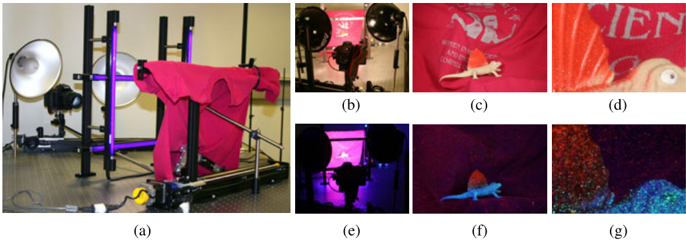
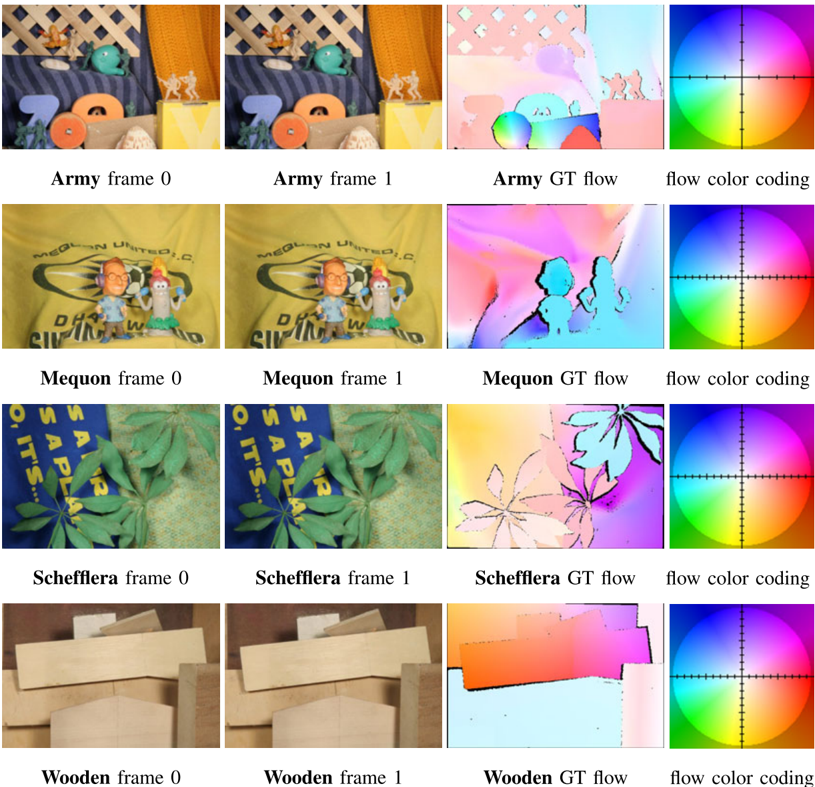
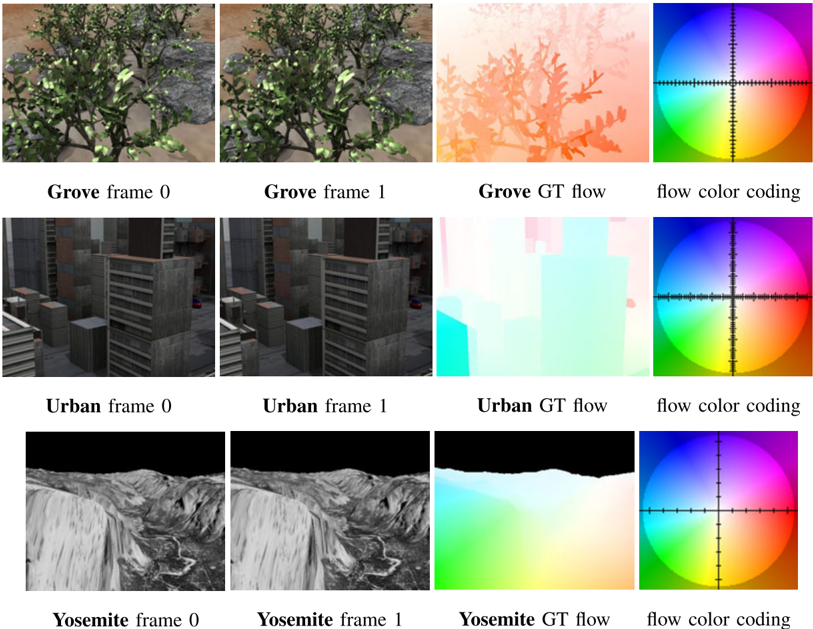
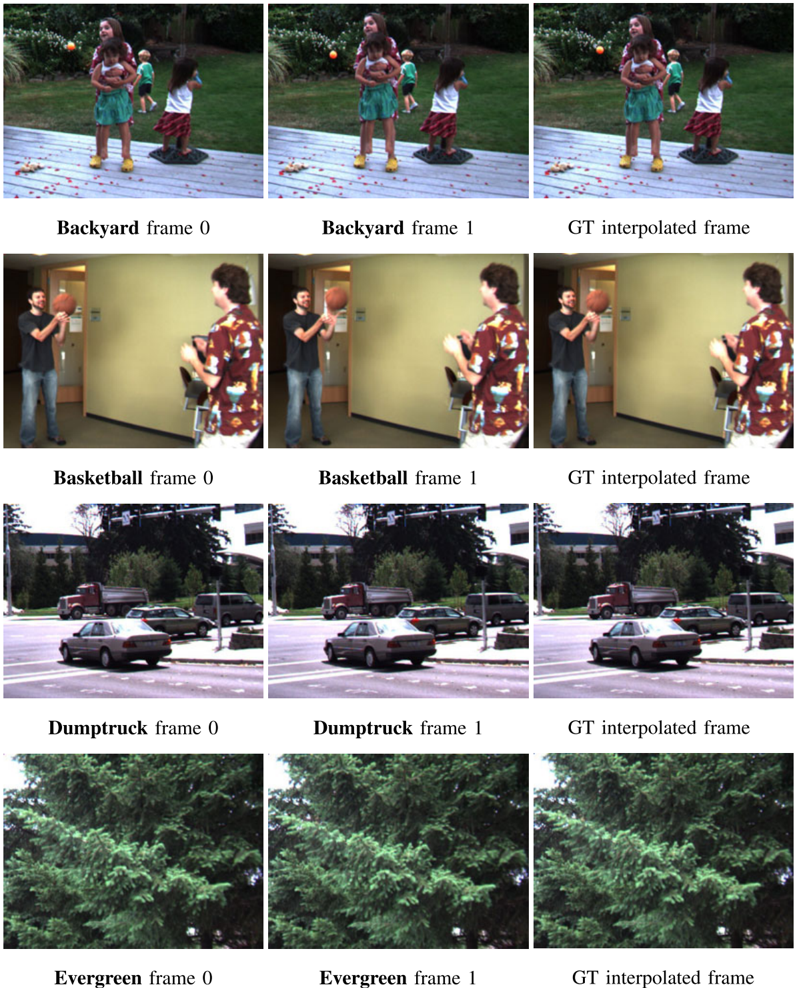
The quantitative evaluation of optical flow algorithms by Barron et al. (1994) led to significant advances in performance. The challenges for optical flow algorithms today go beyond the datasets and evaluation methods proposed in that paper. Instead, they center on problems associated with complex natural scenes, including nonrigid motion, real sensor noise, and motion discontinuities. We propose a new set of benchmarks and evaluation methods for the next generation of optical flow algorithms. To that end, we contribute four types of data to test different aspects of optical flow algorithms: (1) sequences with nonrigid motion where the ground-truth flow is determined by tracking hidden fluorescent texture, (2) realistic synthetic sequences, (3) high frame-rate video used to study interpolation error, and (4) modified stereo sequences of static scenes. In addition to the average angular error used by Barron et al., we compute the absolute flow endpoint error, measures for frame interpolation error, improved statistics, and results at motion discontinuities and in textureless regions.
Overview
CoChat Summary
TL;DR
The paper introduces a new optical flow benchmark of four data types (hidden fluorescent texture, realistic synthetic, high-speed interpolation, and modified stereo) plus an extended evaluation methodology with endpoint error, interpolation error, robustness/accuracy statistics, and region masks. It reports that performance improved substantially over the preliminary 2007 study, but motion discontinuities and diverse datasets remain difficult, and top flow methods still lag top stereo methods on the modified Teddy stereo data.
Key findings
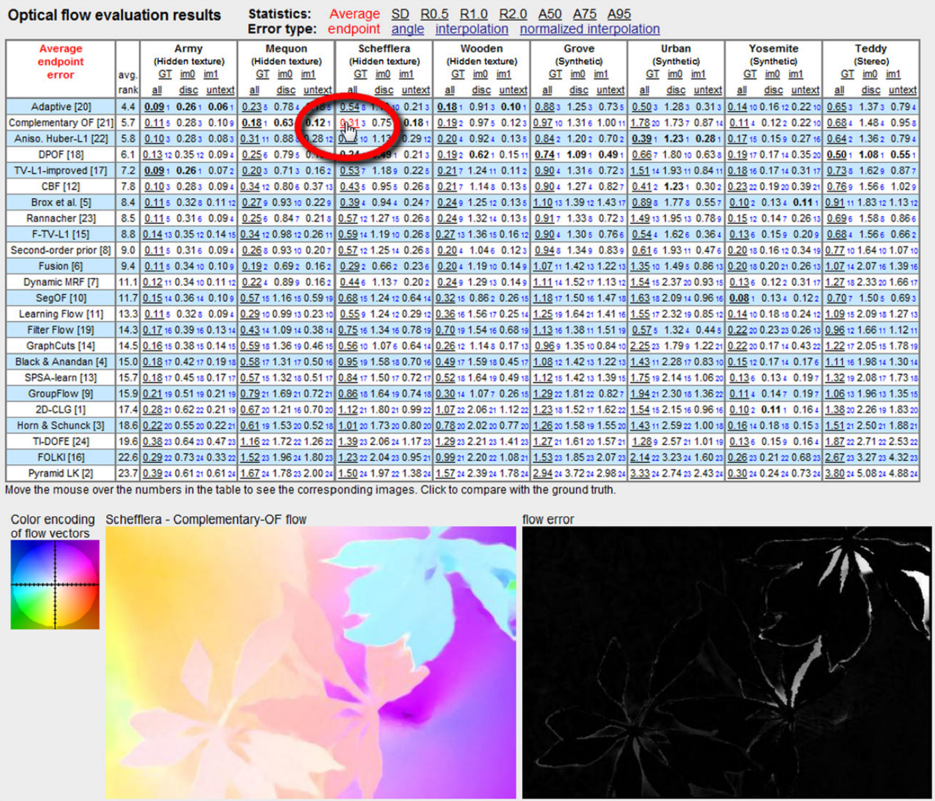
- The benchmark contains 12 training and 12 test sequences; test ground truth is withheld except for Yosemite. As of December 2009 the online evaluation contained results for 24 published methods, all using only 2 input frames and 10 using color.
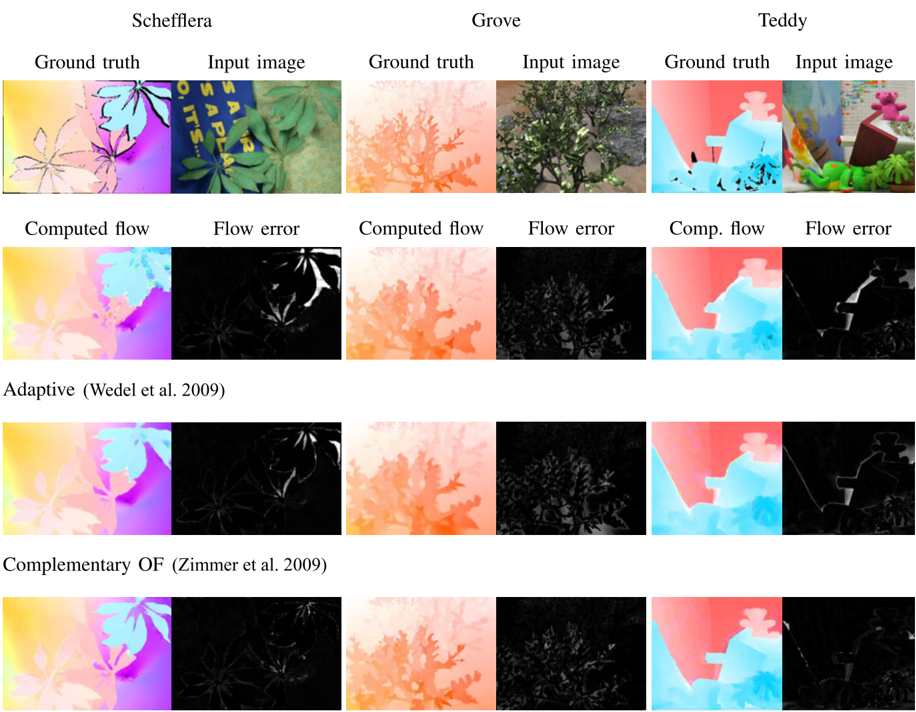
- Best average endpoint error (Avg. EE) improved dramatically over 2D-CLG (Bruhn et al. 2005): Army 0.28→0.09, Mequon 0.67→0.18, Schefflera 1.12→0.24, Wooden 1.07→0.18, Grove 1.23→0.74, Urban 1.54→0.39, Yosemite 0.10→0.08, Teddy 1.38→0.50. Best Avg. EE was below 0.2 pixels on four datasets (Yosemite, Army, Mequon, Wooden).
- Endpoint error (EE) and angular error (AE) rankings were highly correlated (r = 0.989), but the paper argues EE should be preferred: Complementary OF on Urban had Avg. AE 4.64° (rank 6) but Avg. EE 1.78 pixels (rank 20), because AE downweights large motions.
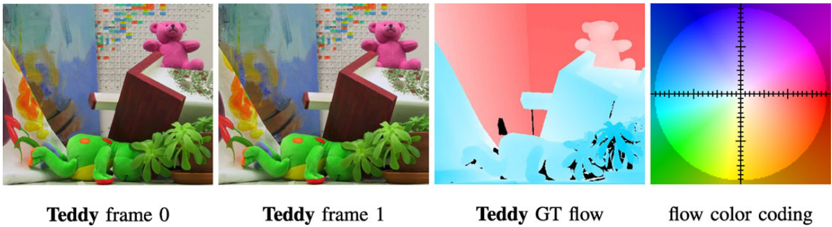
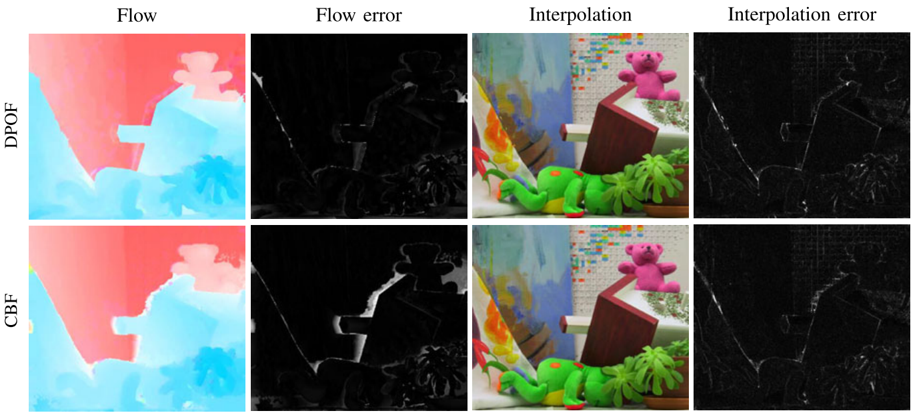
- Motion discontinuity (Disc) regions were the hardest; textureless (Untext) regions were typically easiest. Dataset results were less correlated, with Yosemite poorly or negatively correlated with others. Flow and interpolation errors were only moderately correlated (Avg4 EE vs Avg4 IE r = 0.763). On Teddy, top stereo methods outperformed top flow methods: median lowest-five R1.0 was 9.9 for flow vs 6.5 for stereo in All regions (34% reduction), and 27.6 vs 10.0 in Disc regions (64% reduction).
Methods
- Four data types were collected: (1) real nonrigid scenes with dense ground truth from hidden fluorescent texture, captured with a Canon EOS 20D at 3504×2336, downsampled every 40th visible-light frame by factor 6 to 584×388, with SSD tracking (15×15 windows), forward/backward crosschecking, and Lucas-Kanade subpixel refinement; (2) realistic synthetic scenes rendered with 3Delight at 640×480, with ground truth from a custom shader and dominant-cluster flow selection; (3) high-speed video for frame interpolation captured with a PointGrey Dragonfly Express at 60 fps, providing every other frame and retaining intermediate frames as ground truth; and (4) modified stereo data (Teddy) from structured light, cropped to make the disparity range roughly symmetric.
- Evaluation metrics include average angular error (AE), absolute flow endpoint error (EE), interpolation error (IE), and gradient-normalized interpolation error (NE). Statistics include averages, robustness measures R_X, and percentile accuracy measures A_X, computed over All, Disc, and Untext region masks.
- Analysis used the online evaluation at http://vision.middlebury.edu/flow/, comparing 24 published methods across metrics, statistics, masks, and datasets, with Pearson correlations between rankings and comparisons to state-of-the-art stereo methods on Teddy.
Limitations
- The paper states that the hidden fluorescent texture scenes are laboratory scenes, not real-world scenes, and have no motion blur due to stop-motion capture; ground truth is unavailable where cross-checking failed, especially occluded regions, and the measured ground truth is not perfect, though significant errors are limited to a small fraction of pixels. Synthetic sequences were generated without motion blur. The modified stereo ground truth is only accurate to 0.25 pixels, and algorithms may exploit the knowledge that motions are horizontal; overfitting to rigid data should be visible across the 12 evaluation images. Interpolation ground truth is an intermediate image, not a flow field, so the flow definition is apparent motion.
- The paper also states that no single method yet achieves strong performance across a wide variety of datatypes, that any dataset has a limited lifespan, and that future studies should include more challenging realistic synthetic data, longer sequences, and more difficult materials, illumination changes, atmospheric effects, and transparency.
- Evident from the text: the online tables do not provide an overall ranking among methods; runtimes are not normalized for programming environment, CPU speed, cores, or hardware acceleration; algorithms are required to produce dense flow and cannot submit confidence maps or sparse/incomplete fields; all 24 published methods used only 2 frames despite 8-frame sequences being available; and the paper cannot definitively answer whether temporal smoothing is less suited to the more challenging sequences.
Model-written summary. Check it against the paper before relying on it.
Integrity signals
Registry
Cites
Statistics
Figures

Verification
Claims the paper makes
2 Valid · 16 Not valid · 58 Not checked · 185 Own results and interpretations
A result the paper states — it cites no source for it, so there is none to check. The quote shows it is in the paper.
In the paper
“Rather than collecting a single type of data (with its inherent limitations) we instead collected four different types of data, each satisfying a different subset of desirable properties.”
plain- Asserted: passes — The authors put it forward as true.
- Checkable: passes — It can be checked against evidence.
- Load-bearing: passes — The paper’s conclusions depend on it.
- Based: passes — The paper gives a reason why it holds.
A result the paper states — it cites no source for it, so there is none to check. The quote shows it is in the paper.
In the paper
“Using the combination of fluorescent paint, downsampling high-resolution images, and sequential tracking of small motions, we are able to obtain dense, subpixel accurate ground truth for a nonrigid scene.”
plainstates a cause- Asserted: passes — The authors put it forward as true.
- Checkable: passes — It can be checked against evidence.
- Load-bearing: passes — The paper’s conclusions depend on it.
- Based: passes — The paper gives a reason why it holds.
A result the paper reports from its own data — it cites no other source for it, so there is none to check. The quote shows it is in the paper.
In the paper
“To allow for measures that predict performance on such tasks, we collected a variety of data suitable for frame interpolation.”
plainstates a cause- Asserted: passes — The authors put it forward as true.
- Checkable: passes — It can be checked against evidence.
- Load-bearing: passes — The paper’s conclusions depend on it.
- Based: passes — The paper gives a reason why it holds.
A result the paper reports from its own data — it cites no other source for it, so there is none to check. The quote shows it is in the paper.
In the paper
“We have developed a technique for capturing imagery of nonrigid scenes with ground-truth optical flow.”
plain- Asserted: passes — The authors put it forward as true.
- Checkable: passes — It can be checked against evidence.
- Load-bearing: passes — The paper’s conclusions depend on it.
- Based: passes — The paper gives a reason why it holds.
A result the paper states — it cites no source for it, so there is none to check. The quote shows it is in the paper.
In the paper
“To go beyond previous synthetic ground truth (e.g., the Yosemite sequence), we generated two types of fairly complex synthetic outdoor scenes.”
plain- Asserted: passes — The authors put it forward as true.
- Checkable: passes — It can be checked against evidence.
- Load-bearing: passes — The paper’s conclusions depend on it.
- Based: passes — The paper gives a reason why it holds.
96 more claims
Create a free account to see all 261 claims and every source verdict.
- Probably not a substantial claim. 114
- It may state two separate claims as one. 76
- The quote only partly states this claim. 6
Claims other papers make about this one
Each is checked against this paper’s own text: does it say what the citing paper says it does?
The source backs part of the claim, not all of it — or backs it for a different population, condition or comparison.
In the citing paper
“Notable works include the Middlebury dataset (Baker et al, 2011) and the KITTI datasets (Geiger et al, 2012; Menze and Geiger, 2015), but due to the difficulty of computing accurate ground truth, these have been restricted to 8 and 2 · 200 pairs of frames, respectively (the latter are also limited by the special driving setting).”
From What Makes Good Synthetic Training Data for Learning Disparity and Optical Flow Estimation? (2018) · cites this paper as Baker et al, 2011
Experimental — accuracy not yet measured
Citations
Cites
The pascal visual object classes (VOC) challenge
Everingham, M., Van Gool, L., Williams, C. K. I., Winn, J., & Zisserman, A. (2010) · International Journal of Computer Vision · doi:10.1007/s11263-009-0275-4 · Cited by 19,599
Proceedings of IEEE Conference on Computer Vision and Pattern Recognition
(1993) · doi:10.1109/cvpr.1993 · Cited by 17,667
Proceedings of IEEE International Conference on Computer Vision
(1995) · Proceedings of IEEE International Conference on Computer Vision · doi:10.1109/iccv.1995.466933 · Cited by 12,860
(1981) · Cited by 11,963
Horn, B. K. P., & Schunck, B. G. (1981) · Artificial Intelligence · doi:10.1016/0004-3702(81)90024-2 · Cited by 10,312
Horn, B. K., & Schunck, B. G. (1981) · SPIE Proceedings · doi:10.1117/12.965761 · Cited by 7,394 · cited 2×
“A baseline approach is to use an L2 norm as in the Horn and Schunck algorithm (Horn and Schunck 1981):”
BackgroundMethodFast approximate energy minimization via graph cuts
Boykov, Y., Veksler, O., & Zabih, R. (2001) · IEEE Transactions on Pattern Analysis and Machine Intelligence · doi:10.1109/34.969114 · Cited by 6,988
A Taxonomy and Evaluation of Dense Two-Frame Stereo Correspondence Algorithms
Scharstein, D., & Szeliski, R. (2002) · International Journal of Computer Vision · doi:10.1023/a:1014573219977 · Cited by 6,740 · cited 10×
“Many areas of computer vision, such as stereo [63], face recognition [28, 55, 68], and object recognition [23, 24], have challenging datasets to track the progress made by leading algorithms and to stimulate new ideas.”
BackgroundMethodResultInfluentialSelf-citationProceedings European Conference on Computer Vision 2002
Heyden, A., Sparr, G., Nielsen, M., & Johansen, P. (2002) · Lund University Publications (Lund University) · Cited by 5,153
From few to many: illumination cone models for face recognition under variable lighting and pose
Georghiades, A. S., Belhumeur, P. N., & Kriegman, D. J. (2001) · IEEE Transactions on Pattern Analysis and Machine Intelligence · doi:10.1109/34.927464 · Cited by 4,912 · cited 1×
“Many areas of computer vision, such as stereo (Scharstein and Szeliski 2002), face recognition (Philips et al. 2005; Sim et al. 2003; Gross et al. 2008; Georghiades et al. 2001), and object recognition (Fei-Fei et al.”
Background
Research works printed but not linked: 4
- Anandan, P., & Weiss, R. (1985). Introducing smoothness constraint in a matching approach for the computation of displacement fields. In Proceedings of the DARPA image understanding workshop (pp. 186-196).
- Bleyer, M., & Chambon, S. (2010). Does color really help in dense stereo matching? In Proceedings of the international symposium 3D data processing, visualization and transmission .
- Lempitsky, V., Roth, S., & Rother, C. (2008). Fusion flow: discretecontinuous optimization for optical flow estimation. In Proceedings of the IEEE conference on computer vision and pattern recognition .
- Rannacher, J. (2009). Realtime 3D motion estimation on graphics hardware . Undergraduate thesis, Heidelberg University.
Cited by
Items 101–200 of 2,273
Models Matter, So Does Training: An Empirical Study of CNNs for Optical Flow Estimation
Sun, D., Yang, X., Liu, M.-Y., & Kautz, J. (2020) · IEEE Transactions on Pattern Analysis and Machine Intelligence · doi:10.1109/tpami.2019.2894353 · Cited by 195
“Sun et al. [39] learn a full model for optical flow, but the learning has been limited to a few training sequences [12].”
BackgroundMethodInfluentialFusion Moves for Markov Random Field Optimization
Lempitsky, V., Rother, C., Roth, S., & Blake, A. (2010) · IEEE Transactions on Pattern Analysis and Machine Intelligence · doi:10.1109/tpami.2009.143 · Cited by 196
“On the 8 test datasets [30], our optimization scheme consistently outperforms the two baseline algorithms. for x ∈ X do 5: x cur ← x cur x 6: end for 7: Cluster the set of 2D vectors { x curp }”
MethodInfluentialSelf-citationOptical flow and scene flow estimation: A survey
Zhai, M., Xiang, X., Lv, N., & Kong, X. (2021) · Pattern Recognition · doi:10.1016/j.patcog.2021.107861 · Cited by 196
IFRNet: Intermediate Feature Refine Network for Efficient Frame Interpolation
Kong, L., Jiang, B., Luo, D., Chu, W., Huang, X., Tai, Y., Wang, C., & Yang, J. (2022) · 2022 IEEE/CVF Conference on Computer Vision and Pattern Recognition (CVPR) · doi:10.1109/cvpr52688.2022.00201 · Cited by 196
“Middlebury [2]: The Middlebury benchmark is a widely used dataset to evaluate optical flow and VFI methods.”
Efficient Coarse-to-Fine Patch Match for Large Displacement Optical Flow
Hu, Y., Song, R., & Li, Y. (2016) · 2016 IEEE Conference on Computer Vision and Pattern Recognition (CVPR) · doi:10.1109/cvpr.2016.615 · Cited by 188
“Matching correspondences are shown as small colored patches centered at the matching points (color coded as in [2]).”
BackgroundMethodInfluentialDeformable Medical Image Registration: Setting the State of the Art with Discrete Methods
Glocker, B., Sotiras, A., Komodakis, N., & Paragios, N. (2011) · Annual Review of Biomedical Engineering · doi:10.1146/annurev-bioeng-071910-124649 · Cited by 193
“The use of these errors measurements is common in the literature of optical flow (90).”
BackgroundWhat Makes Good Synthetic Training Data for Learning Disparity and Optical Flow Estimation?
Mayer, N., Ilg, E., Fischer, P., Hazirbas, C., Cremers, D., Dosovitskiy, A., & Brox, T. (2018) · International Journal of Computer Vision · doi:10.1007/s11263-018-1082-6 · Cited by 191
“Notable works include the Middlebury dataset (Baker et al, 2011) and the KITTI datasets (Geiger et al, 2012; Menze and Geiger, 2015), but due to the difficulty of computing accurate ground truth, these have been restricted to 8 and 2 200 pairs of frames, respectively (the latter are also limited by…”
MethodEfficient sparse-to-dense optical flow estimation using a learned basis and layers
Wulff, J., & Black, M. J. (2015) · 2015 IEEE Conference on Computer Vision and Pattern Recognition (CVPR) · doi:10.1109/cvpr.2015.7298607 · Cited by 181
“However, it still has a running time of around 2 seconds on Middlebury image pairs.”
MethodSelf-citationTorontoCity: Seeing the World with a Million Eyes
Wang, S., Bai, M., Mattyus, G., Chu, H., Luo, W., Yang, B., Liang, J., Cheverie, J., Fidler, S., & Urtasun, R. (2017) · 2017 IEEE International Conference on Computer Vision (ICCV) · doi:10.1109/iccv.2017.327 · Cited by 186
“A popular alternative is to use synthetic data to generate large scale benchmarks [4, 6, 27, 30, 32, 14, 7, 29].”
XVFI: eXtreme Video Frame Interpolation
Sim, H., Oh, J., & Kim, M. (2021) · 2021 IEEE/CVF International Conference on Computer Vision (ICCV) · doi:10.1109/iccv48922.2021.01422 · Cited by 181
“tions, zoomings and occlusions, which have never been seen in the previous VFI benchmark datasets [3, 39, 35, 40, 49].”
BackgroundMethodDeep Video Super-Resolution Using HR Optical Flow Estimation
Wang, L., Guo, Y., Liu, L., Lin, Z., Deng, X., & An, W. (2020) · IEEE Transactions on Image Processing · doi:10.1109/tip.2020.2967596 · Cited by 176
“We further compare the super-resolved optical flows and upsampled optical flows to the groundtruth on the Sintel [51], Middlebury [52], KITTI 2012 [53] and KITTI 2015 [54] datasets.”
MethodUnsupervised Multi-Modal Image Registration via Geometry Preserving Image-to-Image Translation
Arar, M., Ginger, Y., Danon, D., Bermano, A. H., & Cohen-Or, D. (2020) · 2020 IEEE/CVF Conference on Computer Vision and Pattern Recognition (CVPR) · doi:10.1109/cvpr42600.2020.01342 · Cited by 175
“This can be seen from the deformation field visualization [2], where little deformation is applied on the banana plant, while most of the deformation is applied on the background.”
BackgroundWhat Matters in Unsupervised Optical Flow
Jonschkowski, R., Stone, A., Barron, J. T., Gordon, A., Konolige, K., & Angelova, A. (2020) · Lecture Notes in Computer Science · doi:10.1007/978-3-030-58536-5_33 · Cited by 174
“Though such data can be generated for rigid objects with known geometry [6,19], recovering this ground truth flow for arbitrary scenes is laborious, and requires approaches as unusual as manually painting scenes with textured fluorescent paint and imaging it under ultraviolet light [1].”
BackgroundA High-Quality Video Denoising Algorithm Based on Reliable Motion Estimation
Liu, C., & Freeman, W. T. (2010) · Lecture Notes in Computer Science · doi:10.1007/978-3-642-15558-1_51 · Cited by 173
“The motion estimation of one frame is shown in Figure 5, where motion vectors are visualized by the color scheme proposed in [26].”
MethodVideo-Based Person Re-Identification With Accumulative Motion Context
Liu, H., Jie, Z., Jayashree, K., Qi, M., Jiang, J., Yan, S., & Feng, J. (2018) · IEEE Transactions on Circuits and Systems for Video Technology · doi:10.1109/tcsvt.2017.2715499 · Cited by 177
“maps are encoded with the flow color coding [43] method which is also used in [37].”
MethodDeep Video Frame Interpolation Using Cyclic Frame Generation
Liu, Y.-L., Liao, Y.-T., Lin, Y.-Y., & Chuang, Y.-Y. (2019) · Proceedings of the AAAI Conference on Artificial Intelligence · doi:10.1609/aaai.v33i01.33018794 · Cited by 161
“Conventional methods (Baker et al. 2011; Werlberger et al. 2011; Yu et al. 2013) for frame interpolation usually estimate dense motion correspondences between consecutive frames via stereo matching or optical flow prediction, and can synthesize intermediate frames based on the estimated…”
MethodInfluentialDense Optical Flow Prediction from a Static Image
Walker, J., Gupta, A., & Hebert, M. (2015) · 2015 IEEE International Conference on Computer Vision (ICCV) · doi:10.1109/iccv.2015.281 · Cited by 163
“1 ar X iv :1 50 5.”
Endoscope image mosaic based on pyramid ORB
Zhang, Z., Wang, L., Zheng, W., Yin, L., Hu, R., & Yang, B. (2022) · Biomedical Signal Processing and Control · doi:10.1016/j.bspc.2021.103261 · Cited by 171
Visual Object Tracking Performance Measures Revisited
Čehovin, L., Leonardis, A., & Kristan, M. (2016) · IEEE Transactions on Image Processing · doi:10.1109/tip.2016.2520370 · Cited by 167
“computation [2] and automatic segmentation [3], where widely adopted evaluation protocols are used, visual tracking is still largely lacking these properties.”
MethodKondermann, D., Nair, R., Honauer, K., Krispin, K., Andrulis, J., Brock, A., Gussefeld, B., Rahimimoghaddam, M., Hofmann, S., Brenner, C., et al. (2016) · 2016 IEEE Conference on Computer Vision and Pattern Recognition Workshops (CVPRW) · doi:10.1109/cvprw.2016.10 · Cited by 160
“The first Middlebury datasets contain general discussions on accuracy [3].”
BackgroundMethodSpatio-Temporal Transformer Network for Video Restoration
Kim, T. H., Sajjadi, M. S. M., Hirsch, M., & Schölkopf, B. (2018) · Lecture Notes in Computer Science · doi:10.1007/978-3-030-01219-9_7 · Cited by 158
“and these approaches perform well on the Middlebury optical flow dataset [21] where motion displacements are relatively small.”
MethodFull Flow: Optical Flow Estimation By Global Optimization over Regular Grids
Chen, Q., & Koltun, V. (2016) · 2016 IEEE Conference on Computer Vision and Pattern Recognition (CVPR) · doi:10.1109/cvpr.2016.509 · Cited by 165
“While this local refinement approach can be accurate when displacements are small [3, 39], it does not optimize the objective globally over the full space of flows and is prone to local minima.”
BackgroundWhen Deep Learning Meets Digital Image Correlation
Boukhtache, S., Abdelouahab, K., Berry, F., Blaysat, B., Grédiac, M., & Sur, F. (2021) · Optics and Lasers in Engineering · doi:10.1016/j.optlaseng.2020.106308 · Cited by 159
“Number of frames Resolution Displacements Middlebury [36] 72 varies Small ( ≤ 10 pixels) KITTI2012 [37] 194 1226 × 370 Large KITTI2015 [32] 800 1242 × 375 Large MPI Sintel [31] 1064 1024 × 436 Small and large FlyingThings3D [38] 21818 960 × 540 Small and large Flying Chairs [12] 22782 384 × 512…”
Global Solutions of Variational Models with Convex Regularization
Pock, T., Cremers, D., Bischof, H., & Chambolle, A. (2010) · SIAM Journal on Imaging Sciences · doi:10.1137/090757617 · Cited by 159
“In our second experiment we apply our convex framework to disparity estimation of a stereo image pair taken from [5].”
MethodApplications of fractional calculus in computer vision: A survey
Arora, S., Mathur, T., Agarwal, S., Tiwari, K., & Gupta, P. (2022) · Neurocomputing · doi:10.1016/j.neucom.2021.10.122 · Cited by 162
Multiple Video Frame Interpolation via Enhanced Deformable Separable Convolution
Cheng, X., & Chen, Z. (2022) · IEEE Transactions on Pattern Analysis and Machine Intelligence · doi:10.1109/tpami.2021.3100714 · Cited by 158
“Interpolation error comparisons among kernel-based methods on the Middlebury Evaluation set [12].”
BackgroundMethodInfluentialDeep Homography Estimation for Dynamic Scenes
Le, H. M., Liu, F., Zhang, S., & Agarwala, A. (2020) · IEEE Computer Society Conference on Computer Vision and Pattern Recognition/Proceedings - IEEE Computer Society Conference on Computer Vision and Pattern Recognition/Proceedings · doi:10.1109/cvpr42600.2020.00767 · Cited by 192
“this end, we test our method on examples from optical flow benchmarks, namely Middlebury [2] and Sintel [6].”
BackgroundMethodA survey of variational and CNN-based optical flow techniques
Tu, Z., Xie, W. C., Zhang, D., Poppe, R. W., Veltkamp, R. C., Li, B., & Yuan, J. (2018) · Signal Processing Image Communication · doi:10.1016/j.image.2018.12.002 · Cited by 162
“Middlebury The Middlebury benchmark dataset [5] provides ground truth for both real and synthetic sequences with complex conditions such as motion discontinuities, non-rigid motion, motion blur, and multiple independent motion.”
BackgroundMethodInfluentialRGB-D flow: Dense 3-D motion estimation using color and depth
Herbst, E. V., Ren, X., & Fox, D. (2013) · Proceedings - IEEE International Conference on Robotics and Automation/Proceedings · doi:10.1109/icra.2013.6630885 · Cited by 178
“The xy-flows are shown in the Middlebury color coding [28].”
MethodJain, S. D., Xiong, B., & Grauman, K. (2017) · arXiv (Cornell University) · doi:10.48550/arxiv.1701.05384 · Cited by 127
“In particular, we convert the raw optical flow to a 3-channel (RGB) color-coded optical flow image [3].”
MethodPlaying for Data: Ground Truth from Computer Games
Richter, S. R., Vineet, V., Roth, S., & Koltun, V. (2016) · arXiv (Cornell University) · doi:10.48550/arxiv.1608.02192 · Cited by 118
“The use of synthetic data has been particularly significant in evaluating optical flow estimation due to the difficulty of obtaining accurate ground-truth flow measurements for real-world scenes [6, 7, 18, 32].”
BackgroundSelf-citationOptical Flow with Semantic Segmentation and Localized Layers
Sevilla-Lara, L., Sun, D., Jampani, V., & Black, M. J. (2016) · IEEE Computer Society Conference on Computer Vision and Pattern Recognition/Proceedings - IEEE Computer Society Conference on Computer Vision and Pattern Recognition/Proceedings · doi:10.1109/cvpr.2016.422 · Cited by 184
“In the Middlebury dataset [5] the semantic segmentation results produce mostly the ‘unknown’ class, or they correspond to classes without a specific motion model (i.”
BackgroundSelf-citationFILM: Frame Interpolation for Large Motion
Reda, F. A., Kontkanen, J., Tabellion, E., Sun, D., Pantofaru, C., & Curless, B. (2022) · Lecture notes in computer science · doi:10.1007/978-3-031-20071-7_15 · Cited by 308
Large Displacement Optical Flow from Nearest Neighbor Fields
Chen, Z., Jin, H., Lin, Z., Cohen, S. D., & Wu, Y. N. (2013) · IEEE Computer Society Conference on Computer Vision and Pattern Recognition/Proceedings - IEEE Computer Society Conference on Computer Vision and Pattern Recognition/Proceedings · doi:10.1109/cvpr.2013.316 · Cited by 175
“(a) The RubberWhale example [4], (b) The ground truth, (c)(d) Th similarity transformations inferred with dominant motion patterns extracted from sparse feature correspondences and the nearest neighbor field, respectively.”
InfluentialVideo Frame Interpolation via Deformable Separable Convolution
Cheng, X., & Chen, Z. (2020) · Proceedings of the AAAI Conference on Artificial Intelligence · doi:10.1609/aaai.v34i07.6634 · Cited by 174
“Traditional methods interpolate one frame with a two-step method which first estimate motion information, typically optical flow, and then perform the pixel synthesis operation guided by motion (Baker et al. 2011).”
MethodAsymmetric Bilateral Motion Estimation for Video Frame Interpolation
Park, J., Lee, C., & Kim, C. (2021) · IEEE/CVF International Conference on Computer Vision (ICCV) · doi:10.1109/iccv48922.2021.01427 · Cited by 210
“Table 1 also lists the actual runtime for interpolating an intermediate frame in the “Urban” sequence in the Middlebury benchmark [1] using an RTX 2080 Ti GPU.”
MethodVideo Frame Interpolation with Transformer
Lu, L., Wu, R., Lin, H., Lu, J., & Jia, J. (2022) · IEEE Computer Society Conference on Computer Vision and Pattern Recognition/Proceedings - IEEE Computer Society Conference on Computer Vision and Pattern Recognition/Proceedings · doi:10.1109/cvpr52688.2022.00352 · Cited by 226
“Visual comparison on a challenging sample from Middlebury dataset [1].”
MethodMotionSqueeze: Neural Motion Feature Learning for Video Understanding
Kwon, H., Kim, M., Kwak, S., & Cho, M. (2020) · Lecture notes in computer science · doi:10.1007/978-3-030-58517-4_21 · Cited by 192
Robust Video Object Cosegmentation
Wang, W., Shen, J., Li, X., & Porikli, F. (2015) · IEEE Transactions on Image Processing · doi:10.1109/tip.2015.2438550 · Cited by 141
“field using [1], numerous over-segmentation methods can”
SimpleFlow: A Non‐iterative, Sublinear Optical Flow Algorithm
Tao, M. W., Bai, J., Kohli, P., & Paris, S. (2012) · Computer Graphics Forum · doi:10.1111/j.1467-8659.2012.03013.x · Cited by 165
“Optical flow describes the motion in a video, i.e. it describes how each point in the scene moves from a frame to the next [BSL∗07].”
BackgroundLarge displacement optical flow computation withoutwarping
Steinbrucker, F., Pock, T., & Cremers, D. (2009) · 2009 IEEE 12th International Conference on Computer Vision · doi:10.1109/iccv.2009.5459364 · Cited by 137
“Figure 1 provides an example of this limitation taken from an image of the Middlebury benchmark [3].”
BackgroundNon-local Total Generalized Variation for Optical Flow Estimation
Ranftl, R., Bredies, K., & Pock, T. (2014) · Lecture notes in computer science · doi:10.1007/978-3-319-10590-1_29 · Cited by 147
“Figure 5 shows the influence of the parameters wp and and wc on the average endpoint error (EPE), evaluated on the Middlebury training set [1].”
MethodPWC-Net: CNNs for Optical Flow Using Pyramid, Warping, and Cost VolumePreprint
Sun, D., Yang, X.-D., Liu, M.-Y., & Kautz, J. (2017) · 2018 IEEE/CVF Conference on Computer Vision and Pattern Recognition · doi:10.48550/arxiv.1709.02371 · Cited by 3,034
“First, traditional optical flow methods often pre-process the raw images to extract features that are invariant to shadows or lighting changes [4, 48].”
BackgroundInfluentialOcclusion boundary detection and figure/ground assignment from optical flow
Sundberg, P., Brox, T., Maire, M., Arbeláez, P., & Malik, J. (2011) · IEEE Computer Society Conference on Computer Vision and Pattern Recognition/Proceedings - IEEE Computer Society Conference on Computer Vision and Pattern Recognition/Proceedings · doi:10.1109/cvpr.2011.5995364 · Cited by 158
Horn-Schunck Optical Flow with a Multi-Scale Strategy
Meinhardt-Llopis, E., Pérez, J. S., & Kondermann, D. (2013) · Image Processing On Line · doi:10.5201/ipol.2013.20 · Cited by 166
Extracting Motion and Appearance via Inter-Frame Attention for Efficient Video Frame Interpolation
Zhang, G., Zhu, Y., Wang, H., Chen, Y., Wu, G., & Wang, L. (2023) · IEEE Computer Society Conference on Computer Vision and Pattern Recognition/Proceedings - IEEE Computer Society Conference on Computer Vision and Pattern Recognition/Proceedings · doi:10.1109/cvpr52729.2023.00550 · Cited by 251
“3) Middlebury [1], we use the OTHER set in Middlebury for testing, which contains images with a resolution around 640 × 480.”
MethodJRDB: A Dataset and Benchmark of Egocentric Robot Visual Perception of Humans in Built Environments
Martín-Martín, R., Patel, M., Rezatofighi, H., Shenoi, A., Gwak, J., Frankel, E., Sadeghian, A., & Savarese, S. (2021) · IEEE Transactions on Pattern Analysis and Machine Intelligence · doi:10.1109/tpami.2021.3070543 · Cited by 257
“…problems such as object detection [1], [2], semantic and instance segmentation [1], [2], [3], 3D reconstruction [4], optical flow computation [5], and stereo estimation [6], and, on the other hand, problems related to understanding, analyzing and predicting human motion and behaviour such as…”
BackgroundPractical temporal consistency for image-based graphics applications
Lang, M., Wang, O., Aydın, T. O., Smolić, A., & Groß, M. H. (2012) · ACM Transactions on Graphics · doi:10.1145/2185520.2185530 · Cited by 136
“One advantage of our approach is that by design our disparities are well aligned to image edges.”
BackgroundMethodInfluentialSpace-Time-Aware Multi-Resolution Video Enhancement
Haris, M., Shakhnarovich, G., & Ukita, N. (2020) · IEEE Computer Society Conference on Computer Vision and Pattern Recognition/Proceedings - IEEE Computer Society Conference on Computer Vision and Pattern Recognition/Proceedings · doi:10.1109/cvpr42600.2020.00293 · Cited by 158
“Middlebury [2] has the original resolution of 640 × 480 pixels.”
BackgroundA Survey of Optical Flow Techniques for Robotics Navigation Applications
Chao, H., Gu, Y., & Napolitano, M. (2013) · Journal of Intelligent & Robotic Systems · doi:10.1007/s10846-013-9923-6 · Cited by 152
“Many optical flow algorithms have been observed to be able to achieve sub-pixel level accuracy compared with the ground truth data [3].”
BackgroundMethodInfluentialPerception, information processing and modeling: Critical stages for autonomous driving applications
Gruyer, D., Magnier, V., Hamdi, K., Claussmann, L., Orfila, O., & Rakotonirainy, A. (2017) · Annual Reviews in Control · doi:10.1016/j.arcontrol.2017.09.012 · Cited by 157
Learning Accurate Dense Correspondences and When to Trust Them
Truong, P., Danelljan, M., Gool, L. V., & Timofte, R. (2021) · IEEE Computer Society Conference on Computer Vision and Pattern Recognition/Proceedings - IEEE Computer Society Conference on Computer Vision and Pattern Recognition/Proceedings · doi:10.1109/cvpr46437.2021.00566 · Cited by 180
“Dense correspondence estimation has most commonly been addressed in the context of optical flow [2, 12, 16, 48], where the image pairs represent consecutive frames in a video.”
BackgroundA 3D Morphable Model of Craniofacial Shape and Texture Variation
Dai, H., Pears, N. E., Smith, W. A. P., & Duncan, C. (2017) · IEEE/CVF International Conference on Computer Vision (ICCV) · doi:10.1109/iccv.2017.335 · Cited by 130
“Optical flow algorithms are based on the assumption that objects in image sequences I(x; y; t) retain their brightnesses as they move across the image at a velocity (vx; vy) [5].”
BackgroundMethodMOTSynth: How Can Synthetic Data Help Pedestrian Detection and Tracking?
Fabbri, M., Brasó, G., Maugeri, G., Cetintas, O., Gasparini, R., Ošep, A., Calderara, S., Leal-Taixé, L., & Cucchiara, R. (2021) · IEEE/CVF International Conference on Computer Vision (ICCV) · doi:10.1109/iccv48922.2021.01067 · Cited by 185
“Such simulated environments have been successfully applied to low-level tasks, such as feature descriptor computation [40], visual odometry [30, 32, 82, 60], optical flow estimation [5, 11, 60, 52, 44, 53] and depth estimation [44, 53].”
MethodLight field video capture using a learning-based hybrid imaging system
Wang, T.-C., Zhu, J.-Y., Kalantari, N. K., Efros, A. A., & Ramamoorthi, R. (2017) · ACM Transactions on Graphics · doi:10.1145/3072959.3073614 · Cited by 136
“Many researchers have tried to upsample the frame rate of 2D videos by interpolating frames in the temporal domain (Baker et al. 2011; Liao et al. 2014; Mahajan et al. 2009; Meyer et al. 2015).”
InfluentialSBGAR: Semantics Based Group Activity Recognition
Li, X., & Chuah, M. C. (2017) · IEEE/CVF International Conference on Computer Vision (ICCV) · doi:10.1109/iccv.2017.313 · Cited by 129
“[20].”
Massively parallel Lucas Kanade optical flow for real-time video processing applications
Plyer, A., Besnerais, G. L., & Champagnat, F. (2014) · Journal of Real-Time Image Processing · doi:10.1007/s11554-014-0423-0 · Cited by 146
“Table 3 Comparative results on Middlebury training database (MiddleTrain): mean angular error (AE) (±standard deviation of AE) Density is 100 % for all methods.”
BackgroundMethodInfluentialA Variational Approach to Video Registration with Subspace Constraints
Garg, R., Roussos, A., & Agapito, L. (2013) · International Journal of Computer Vision · doi:10.1007/s11263-012-0607-7 · Cited by 126
Robust Local Optical Flow for Feature Tracking
Senst, T., Eiselein, V., & Sikora, T. (2012) · IEEE Transactions on Circuits and Systems for Video Technology · doi:10.1109/tcsvt.2012.2202070 · Cited by 140
Tong, X., Ye, Z., Xu, Y., Liu, S., Li, L., Xie, H., & Li, T. (2015) · IEEE Transactions on Geoscience and Remote Sensing · doi:10.1109/tgrs.2015.2391999 · Cited by 123
“This paper concentrates on introducing subpixel image registration for translation estimation, which is fundamental to many applications in the fields of remote sensing and image processing, such as earth surface dynamics monitoring [23], [24], attitude jitter analysis [25], [26], image super-resolution [27], and opti…”
MethodOn rendering synthetic images for training an object detector
Rozantsev, A., Lepetit, V., & Fua, P. (2015) · Computer Vision and Image Understanding · doi:10.1016/j.cviu.2014.12.006 · Cited by 144
“Of course, generic image synthesis techniques have been used in computer vision for many other purposes, such as face detection [7], optimizing camera tracking algorithms [9], evaluation of the algorithms [10, 3, 23, 18, 2, 11], gesture recognition and pose estimation [1, 24], or rendering virtual objects that merge w…”
MethodProposal Flow: Semantic Correspondences from Object Proposals
Ham, B., Cho, M., Schmid, C., & Ponce, J. (2017) · IEEE Transactions on Pattern Analysis and Machine Intelligence · doi:10.1109/tpami.2017.2724510 · Cited by 147
Creating Autonomous Vehicle Systems
Liu, S., Li, L., Tang, J., Wu, S., & Gaudiot, J. (2017) · Synthesis lectures on computer science · doi:10.2200/s00787ed1v01y201707csl009 · Cited by 135
Evaluating fish feeding intensity in aquaculture with convolutional neural networks
Ubina, N. A., Cheng, S., Chang, C.-C., & Chen, H.-Y. (2021) · Aquacultural Engineering · doi:10.1016/j.aquaeng.2021.102178 · Cited by 128
Conditional Image-to-Video Generation with Latent Flow Diffusion Models
Ni, H., Shi, C., Li, K., Huang, X., & Min, M. R. (2023) · IEEE Computer Society Conference on Computer Vision and Pattern Recognition/Proceedings - IEEE Computer Society Conference on Computer Vision and Pattern Recognition/Proceedings · doi:10.1109/cvpr52729.2023.01769 · Cited by 283
“We use the color coding scheme in [4] to visualize flow, where the color indicates the direction and magnitude of the flow.”
MethodSparsity regularization for parameter identification problems
Jin, B., & Maaß, P. (2012) · Inverse Problems · doi:10.1088/0266-5611/28/12/123001 · Cited by 151
“To visualize the flow field, we use polar coordinates (angles, intensities) and utilize the color coding map (see figure 7(c) cf [9]).”
MethodThe State of the Art in HDR Deghosting: A Survey and Evaluation
Tursun, O. T., Akyüz, A. O., Erdem, A., & Erdem, E. (2015) · Computer Graphics Forum · doi:10.1111/cgf.12593 · Cited by 119
Layered image motion with explicit occlusions, temporal consistency, and depth ordering
Sun, D., Sudderth, E. B., & Black, M. J. (2010) · Cited by 116
Self-citationRueckauer, B., & Delbrück, T. (2016) · Frontiers in Neuroscience · doi:10.3389/fnins.2016.00176 · Cited by 129
“…of optical flow estimation techniques is marked by two major stepping stones: The quantitative evaluation of optical flow algorithms by Barron et al. (1994) provided a dataset and error measures that became standard until succeeded by the more challenging Middlebury benchmark (Baker et al., 2010).”
MethodAdaPool: Exponential Adaptive Pooling for Information-Retaining Downsampling
Stergiou, A., & Poppe, R. W. (2022) · IEEE Transactions on Image Processing · doi:10.1109/tip.2022.3227503 · Cited by 175
“In contrast to other datasets used for video super-resolution and interpolation [38], [39], [40], [41], [42], [43], [44], Inter4K provides standardized UHD resolution at 60 fps for all videos.”
MethodResultADNet: Attention-guided Deformable Convolutional Network for High Dynamic Range Imaging
Liu, Z., Lin, W., Li, X., Rao, Q., Jiang, T., Han, M., Fan, H., Sun, J., & Liu, S. (2021) · IEEE/CVF Conference on Computer Vision and Pattern Recognition Workshops (CVPRW) · doi:10.1109/cvprw53098.2021.00057 · Cited by 151
“Existing explicit image alignment methods mainly consists of three categories: global alignment with homography [10], middle-level alignment with meshflow [19], and pixel-level alignment with optical flow [1].”
MethodEfficient preconditioning of laplacian matrices for computer graphics
Krishnan, D., Fattal, R., & Szeliski, R. (2013) · ACM Transactions on Graphics · doi:10.1145/2461912.2461992 · Cited by 112
“Example application of such models is optical flow regularization [Baker et al. 2011].”
MethodSelf-citationGhost-free High Dynamic Range Imaging with Context-Aware Transformer
Liu, Z., Wang, Y., Zeng, B., & Liu, S. (2022) · Lecture notes in computer science · doi:10.1007/978-3-031-19800-7_20 · Cited by 191
Multimedia super-resolution via deep learning: A survey
Hayat, K. (2018) · Digital Signal Processing · doi:10.1016/j.dsp.2018.07.005 · Cited by 123
PMBANet: Progressive Multi-Branch Aggregation Network for Scene Depth Super-Resolution
Ye, X., Sun, B., Wang, Z., Yang, J., Xu, R., Li, H., & Li, B. (2020) · IEEE Transactions on Image Processing · doi:10.1109/tip.2020.3002664 · Cited by 119
“During training, we use 36 RGB-D images (6, 21, 9 images from 2001 [2], 2006 [27] and 2014 [46] datasets, respectively) from Middlebury dataset.”
On a PCA-based lung motion model
Li, R., Lewis, J. H., Jia, X., Zhao, T., Liu, W., Wuenschel, S., Lamb, J., Yang, D., Low, D. A., & Jiang, S. B. (2011) · Physics in Medicine and Biology · doi:10.1088/0031-9155/56/18/015 · Cited by 110
“Studies (Yang and Klette 2010, Baker et al 2011) have shown that TV-L1 based registration methods generally perform over most L2 based methods in term of accuracy. Additional advantages of TV-L1 include the robustness in handling discontinuities in the displacement field and outliers in the data (Heinrich et al 2010).…”
MethodSelf-citationFLAVR: Flow-Agnostic Video Representations for Fast Frame Interpolation
Kalluri, T., Pathak, D., Chandraker, M. K., & Tran, D. (2023) · IEEE Winter Conference on Applications of Computer Vision · doi:10.1109/wacv56688.2023.00211 · Cited by 221
“Results on Middleburry We evaluate FLAVR on the publicly available test images from Middleburry [1, 55] dataset.”
MethodBiologically plausible deep learning — But how far can we go with shallow networks?
Illing, B., Gerstner, W., & Brea, J. (2019) · Neural Networks · doi:10.1016/j.neunet.2019.06.001 · Cited by 130
Light field video stabilization
Smith, B. M., Zhang, L., Jin, H., & Agarwala, A. (2009) · 2009 IEEE 12th International Conference on Computer Vision · doi:10.1109/iccv.2009.5459270 · Cited by 107
“[8] for the optical flow computation, although other state-of-the-art optical flow methods reviewed in [6] may also be used.”
BackgroundZimmer, H., Bruhn, A., Weickert, J., Valgaerts, L., Salgado, A., Rosenhahn, B., & Seidel, H.-P. (2009) · Lecture Notes in Computer Science · doi:10.1007/978-3-642-03641-5_16 · Cited by 107
“1, we show results for the Urban3 sequence from the recent optic flow database [22] of the Middlebury University(1).”
BackgroundPointOdyssey: A Large-Scale Synthetic Dataset for Long-Term Point Tracking
Zheng, Y., Harley, A. W., Shen, B., Wetzstein, G., & Guibas, L. J. (2023) · IEEE/CVF International Conference on Computer Vision (ICCV) · doi:10.1109/iccv51070.2023.01818 · Cited by 329
“For many years, the Middlebury dataset [6] was the primary benchmark for stereo and motion estimation methods.”
BackgroundTracking the Trackers: An Analysis of the State of the Art in Multiple Object Tracking
Leal-Taixé, L., Milan, A., Schindler, K., Cremers, D., Reid, I. D., & Roth, S. (2017) · arXiv (Cornell University) · doi:10.48550/arxiv.1704.02781 · Cited by 100
“Depth estimation and optical flow evaluation were first standardized with the Middlebury dataset and the results of several methods were compared in [4].”
BackgroundMethodSelf-citationBergen, T., & Wittenberg, T. C. (2014) · IEEE Journal of Biomedical and Health Informatics · doi:10.1109/jbhi.2014.2384134 · Cited by 115
“[169] for optical flow evaluation.”
Fast Edge-Preserving PatchMatch for Large Displacement Optical Flow
Bao, L., Yang, Q., & Jin, H. (2014) · IEEE Transactions on Image Processing · doi:10.1109/tip.2014.2359374 · Cited by 116
“We performed experiments on the Middlebury training datasets [2] to validate this idea.”
Ham, B., Cho, M., Schmid, C., & Ponce, J. (2016) · IEEE Computer Society Conference on Computer Vision and Pattern Recognition/Proceedings - IEEE Computer Society Conference on Computer Vision and Pattern Recognition/Proceedings · doi:10.1109/cvpr.2016.378 · Cited by 123
“, Mid bu y [2] a MPI-Sin l [5] d ot f t r wi hi -c ri ti n , d gro ru h f r e r i o is d f ul t ca tu e u t its i in ic lly ma tic natur , a u l n ti in x mely l b r v and s h s bj c v .”
Sparse Occlusion Detection with Optical Flow
Ayvacı, A., Raptis, M., & Soatto, S. (2011) · International Journal of Computer Vision · doi:10.1007/s11263-011-0490-7 · Cited by 126
“" The first column shows the motion estimates, color-coded as in Baker et al. (2007), the second is the residual I (x, t) − I (w(x), t + dt) before re-weighting stage; the third shows |W e 1 | after re-weighting, and the fourth is the sparse error term e 1 correspondingly (16) is the customary…”
BackgroundMethodInfluentialThe ParallelEye Dataset: A Large Collection of Virtual Images for Traffic Vision Research
Li, X., Wang, K., Tian, Y., Yan, L., Deng, F. Y., & Wang, F. (2018) · IEEE Transactions on Intelligent Transportation Systems · doi:10.1109/tits.2018.2857566 · Cited by 126
“For example, in the real world, it is difficult for researchers to obtain precise labeling of optical flow, so virtual data are used to estimate optical flow [18]–[21].”
BackgroundDiscrete Optimization for Optical Flow
Menze, M., Heipke, C., & Geiger, A. (2015) · Lecture notes in computer science · doi:10.1007/978-3-319-24947-6_2 · Cited by 132
“To estimate displacements larger than 1 pixel, as required by modern benchmarks [1,9,17] and for many applications, continuous methods typically rely on image pyramids [7].”
MethodBio-inspired computer vision: Towards a synergistic approach of artificial and biological vision
Medathati, N. V. K., Neumann, H., Masson, G. S., & Kornprobst, P. (2016) · Computer Vision and Image Understanding · doi:10.1016/j.cviu.2016.04.009 · Cited by 124
“Moreover, they can be evaluated against standard computer vision benchmarks ( Baker et al., 2011; Butler et al., 2012 ).”
BackgroundMethodInfluentialUnsupervised Video Interpolation Using Cycle Consistency
Reda, F. A., Sun, D., Dündar, A., Shoeybi, M., Liu, G., Shih, K. J., Tao, A., Kautz, J., & Catanzaro, B. (2019) · IEEE/CVF International Conference on Computer Vision (ICCV) · doi:10.1109/iccv.2019.00098 · Cited by 107
“To quantitatively evaluate interpolations we considered Peak-Signal-To-Noise (PSNR), the Structural-SimilarityImage-Metric (SSIM), and the Interpolation-Error (IE) [1], which is calculated as the root mean-squared-error between generated and ground truth frames.”
MethodCDFI: Compression-Driven Network Design for Frame Interpolation
Ding, T., Liang, L., Zhu, Z., & Zharkov, I. (2021) · IEEE Computer Society Conference on Computer Vision and Pattern Recognition/Proceedings - IEEE Computer Society Conference on Computer Vision and Pattern Recognition/Proceedings · doi:10.1109/cvpr46437.2021.00791 · Cited by 137
“rapid expansion in optical flow [1, 60], many approaches either utilize an off-the-shelf flow model [2, 41, 42, 61] or estimate their own task-specific flow [27, 36, 62, 63, 45] as a guidance of pixel-level motion interpolation.”
MethodInfluentialHigh Quality Shape from a Single RGB-D Image under Uncalibrated Natural Illumination
Han, Y., Lee, J., & Kweon, I. S. (2013) · IEEE/CVF International Conference on Computer Vision (ICCV) · doi:10.1109/iccv.2013.204 · Cited by 96
“”, “RX” and “AX” as used in [2].”
X-ray phase-contrast in vivo microtomography probes new aspects of Xenopus gastrulation
Moosmann, J. P., Ershov, A., Weinhardt, V., Baumbach, T., Prasad, M. S., LaBonne, C., Xiao, X., Kashef, J., & Hofmann, R. (2013) · Nature · doi:10.1038/nature12116 · Cited by 112
Tracking Objects From Satellite Videos: A Velocity Feature Based Correlation Filter
Shao, J., Du, B., Wu, C., & Zhang, L. (2019) · IEEE Transactions on Geoscience and Remote Sensing · doi:10.1109/tgrs.2019.2916953 · Cited by 104
“in a visual scene, which is computed from the relative motion between a scene and an observer [47].”
BackgroundObject Tracking in Satellite Videos Based on a Multiframe Optical Flow Tracker
Du, B., Cai, S., & Wu, C. (2019) · IEEE Journal of Selected Topics in Applied Earth Observations and Remote Sensing · doi:10.1109/jstars.2019.2917703 · Cited by 103
“Optical flow is the apparent motion of the brightness patterns in the image, and the motion field is projected from threedimensional motion into two-dimensional plane [47], [50].”
BackgroundAutoFlow: Learning a Better Training Set for Optical Flow
Sun, D., Vlasic, D., Herrmann, C., Jampani, V., Krainin, M., Chang, H., Zabih, R., Freeman, W. T., & Liu, C. (2021) · IEEE Computer Society Conference on Computer Vision and Pattern Recognition/Proceedings - IEEE Computer Society Conference on Computer Vision and Pattern Recognition/Proceedings · doi:10.1109/cvpr46437.2021.00996 · Cited by 150
“However, unlike high-level vision tasks, it is only possible to obtain ground truth under controlled lab environments [1] or rigid scenes/objects [12, 23].”
BackgroundPaulin, G., & Ivašić-Kos, M. (2023) · Artificial Intelligence Review · doi:10.1007/s10462-022-10358-3 · Cited by 140
“The authors introduced ambient occlusion as a post-processing effect, in contrast to Baker et al. (2011), where it was initially used in rendering.”
BackgroundMethodInfluentialChallenges of Ground Truth Evaluation of Multi-target Tracking
Milan, A., Schindler, K., & Roth, S. (2013) · 2013 IEEE Conference on Computer Vision and Pattern Recognition Workshops · doi:10.1109/cvprw.2013.111 · Cited by 93
“However, previous benchmarks, such as Middlebury [6] or PASCAL [13] for example, show that the raw ranking is not the only criterion for how a specific method is valued in the community.”
MethodSelf-citationModeling temporal coherence for optical flow
Volz, S., Bruhn, A., Valgaerts, L., et al. (2011) · International Conference on Computer Vision · doi:10.1109/iccv.2011.6126359 · Cited by 96
Spiking Optical Flow for Event-Based Sensors Using IBM's TrueNorth Neurosynaptic System
Haessig, G., Cassidy, A. S., Alvarez-Icaza, R., Benosman, R. B., & Orchard, G. (2018) · IEEE Transactions on Biomedical Circuits and Systems · doi:10.1109/tbcas.2018.2834558 · Cited by 112
Metadata
- Authors
- Baker, S., Scharstein, D., Lewis, J. P., Roth, S., Black, M. J., & Szeliski, R.
- Affiliations
- Microsoft (United States) (US)
- Middlebury College (US)
- Technische Universität Darmstadt (DE)
- Brown University (US)
- Corresponding author
- Scharstein, Daniel
- Venue
- International Journal of Computer Vision
- Published
- 2010-11-30
- Volume
- 92
- Issue
- 1
- Pages
- 1-31
- ISSN
- 0920-5691 (ISSN-L)
- 1573-1405
- OpenAlex
- W2147253850
- Semantic Scholar
- 804836b8ad86ef8042e3dcbd45442a52f031ee03
- Cited by
- 2,205
- References
- 112
- Citations by year
- 2026: 49 · 2025: 81 · 2024: 82 · 2023: 117 · 2022: 129 · 2021: 152 · 2020: 174 · 2019: 163 · 2018: 144 · 2017: 156 · 2016: 187 · 2015: 180 · 2014: 154 · 2013: 129 · 2012: 118
- FWCI
- 146.62
- Type
- journal article
- Language
- en
- Open access
- hybrid
- doi.org
- Licence
- cc-by-nc
- Locations
- International Journal of Computer Vision (publishedVersion, cc-by-nc)
- Publikationsdatenbank der Fraunhofer-Gesellschaft (Fraunhofer-Gesellschaft) (publishedVersion)
- Max Planck Institute for Plasma Physics (submittedVersion)
- Fraunhofer-Publica (Fraunhofer-Gesellschaft) (submittedVersion)
- Funders
- National Science Foundation (0534858, 0535075, 0413169)
- Intel Corporation
- Topics
- Physical Sciences › Computer Science › Computer Vision and Pattern Recognition › Advanced Vision and Imaging
- Physical Sciences › Computer Science › Computer Vision and Pattern Recognition › Video Surveillance and Tracking Methods
- Physical Sciences › Computer Science › Signal Processing › Video Coding and Compression Technologies
- Keywords
- optical flow, benchmark dataset, evaluation methodology, non-rigid motion, motion discontinuities, textureless regions, sensor noise
About these checks
Registry, retraction, Cites and statistics results are computed, not judged, with one exception: a printed reference that no index lists is read once by a model before it counts as a citation error. Claims are extracted by a model and kept only when their quote appears verbatim in the text; each cited source is then checked, with a model’s help, for whether it says what the claim relies on. Those verdicts can be wrong — read the claim’s quote and the cited source before relying on one.
The claim verdicts this report counts are experimental: their accuracy is not yet measured.
A language model drew the claims from the paper on 2026-10-01, under version 3 of the claim definition (model deepseek-v4.1-flash, prompt extract-v3).
A second model labelled each claim on 2026-10-01 (model jev-1.13-20260917, definition revision gold-guideline-v0.2).
Statistics and arithmetic are recomputed, not judged.
Confidence bands are shown only for fields calibrated on our annotated test set. None is calibrated yet, so no band is shown.
What counts as a claim ›How we measure confidence ›How we check this ›
Are you an author, or do you see a problem with this page? Request a review
Data sources
Bibliographic data: Semantic Scholar, OpenAlex, Crossref.
Contains information from the Semantic Scholar Academic Graph Datasets, made available under the ODC Attribution License (ODC-BY 1.0).
Semantic Scholar’s data is described in: Kinney, R., et al. (2023). The Semantic Scholar Open Data Platform. arXiv:2301.10140.
