

A Database and Evaluation Methodology for Optical Flow
Open accessThe DOI matches its Crossref record; 110 of the 112 references it cites were found in a registry or an index; 2 of the 68 sources its claims cite were checked for support.
Abstract
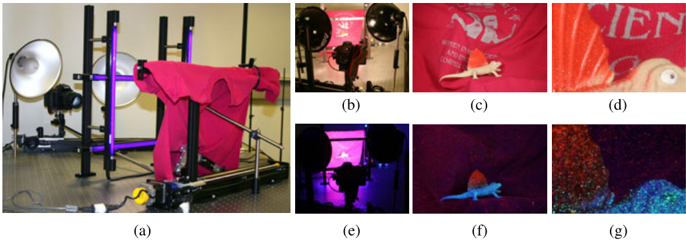
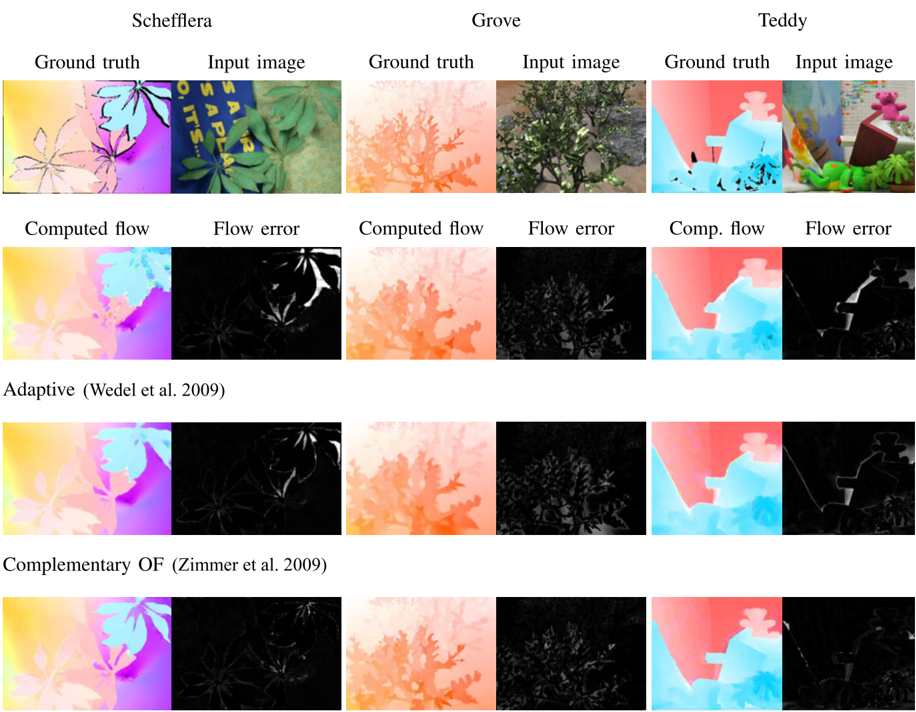
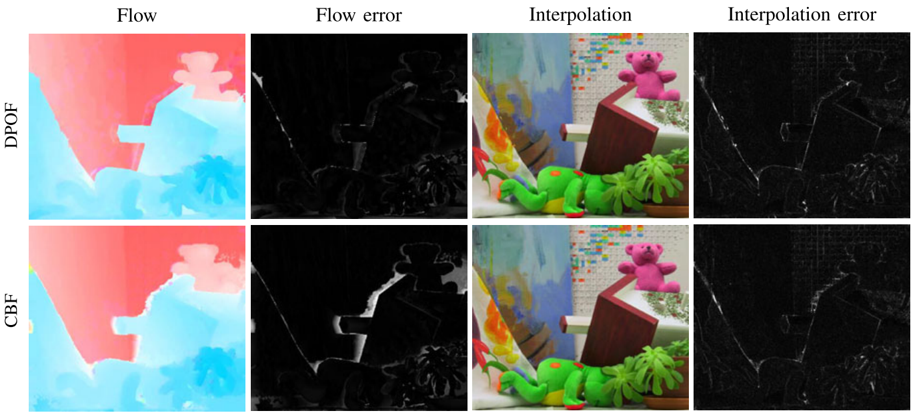
The quantitative evaluation of optical flow algorithms by Barron et al. (1994) led to significant advances in performance. The challenges for optical flow algorithms today go beyond the datasets and evaluation methods proposed in that paper. Instead, they center on problems associated with complex natural scenes, including nonrigid motion, real sensor noise, and motion discontinuities. We propose a new set of benchmarks and evaluation methods for the next generation of optical flow algorithms. To that end, we contribute four types of data to test different aspects of optical flow algorithms: (1) sequences with nonrigid motion where the ground-truth flow is determined by tracking hidden fluorescent texture, (2) realistic synthetic sequences, (3) high frame-rate video used to study interpolation error, and (4) modified stereo sequences of static scenes. In addition to the average angular error used by Barron et al., we compute the absolute flow endpoint error, measures for frame interpolation error, improved statistics, and results at motion discontinuities and in textureless regions.
Overview
CoChat Summary
TL;DR
The paper introduces a new optical flow benchmark of four data types (hidden fluorescent texture, realistic synthetic, high-speed interpolation, and modified stereo) plus an extended evaluation methodology with endpoint error, interpolation error, robustness/accuracy statistics, and region masks. It reports that performance improved substantially over the preliminary 2007 study, but motion discontinuities and diverse datasets remain difficult, and top flow methods still lag top stereo methods on the modified Teddy stereo data.
Key findings
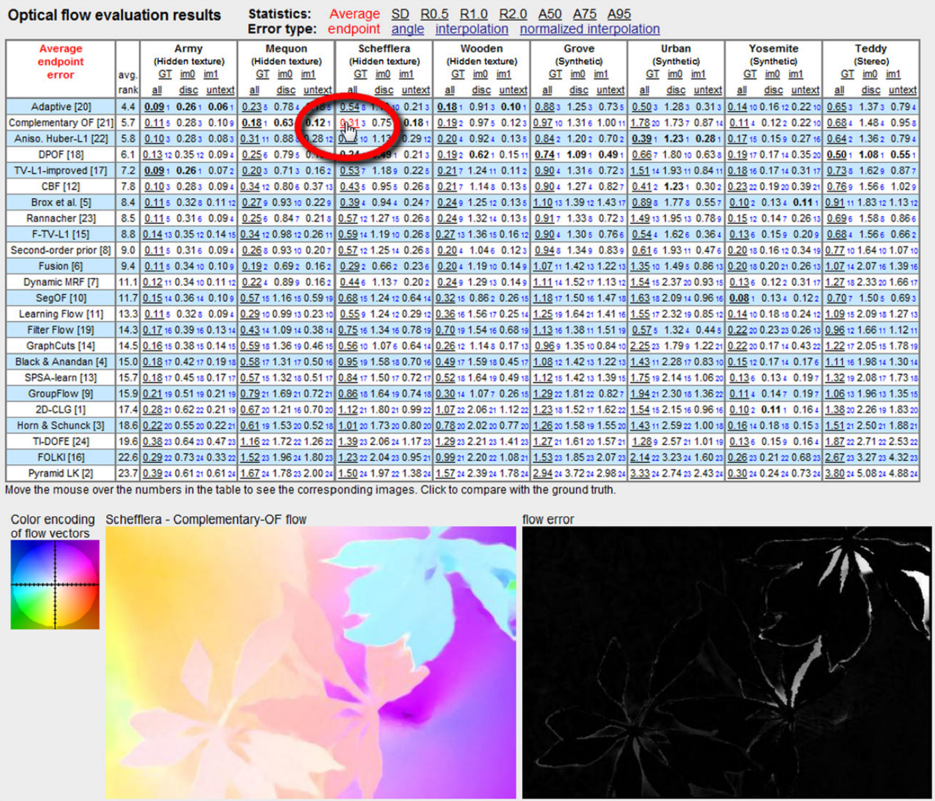
- The benchmark contains 12 training and 12 test sequences; test ground truth is withheld except for Yosemite. As of December 2009 the online evaluation contained results for 24 published methods, all using only 2 input frames and 10 using color.
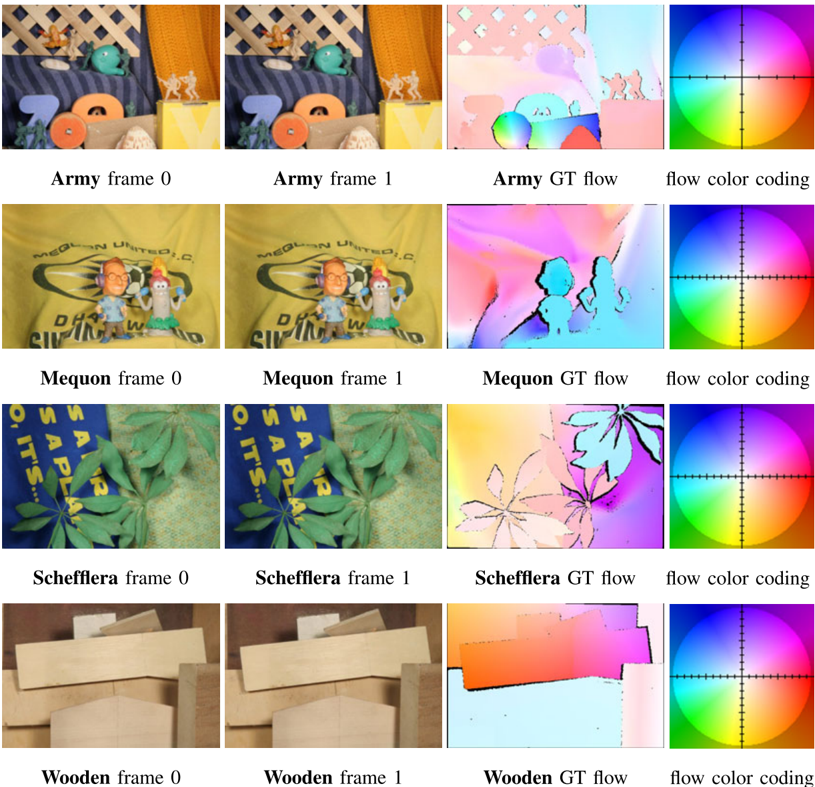
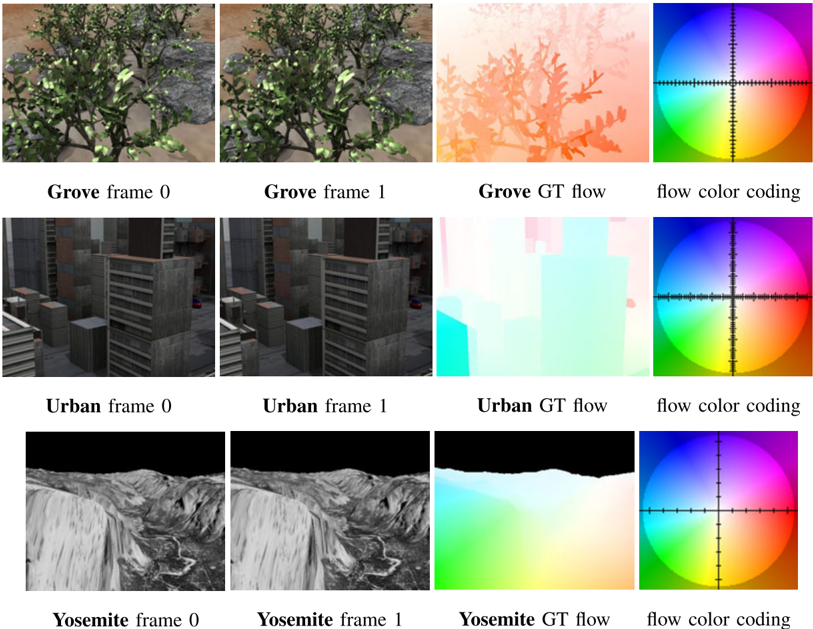
- Best average endpoint error (Avg. EE) improved dramatically over 2D-CLG (Bruhn et al. 2005): Army 0.28→0.09, Mequon 0.67→0.18, Schefflera 1.12→0.24, Wooden 1.07→0.18, Grove 1.23→0.74, Urban 1.54→0.39, Yosemite 0.10→0.08, Teddy 1.38→0.50. Best Avg. EE was below 0.2 pixels on four datasets (Yosemite, Army, Mequon, Wooden).
- Endpoint error (EE) and angular error (AE) rankings were highly correlated (r = 0.989), but the paper argues EE should be preferred: Complementary OF on Urban had Avg. AE 4.64° (rank 6) but Avg. EE 1.78 pixels (rank 20), because AE downweights large motions.
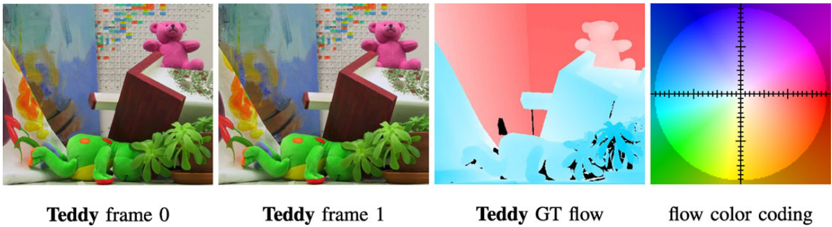
- Motion discontinuity (Disc) regions were the hardest; textureless (Untext) regions were typically easiest. Dataset results were less correlated, with Yosemite poorly or negatively correlated with others. Flow and interpolation errors were only moderately correlated (Avg4 EE vs Avg4 IE r = 0.763). On Teddy, top stereo methods outperformed top flow methods: median lowest-five R1.0 was 9.9 for flow vs 6.5 for stereo in All regions (34% reduction), and 27.6 vs 10.0 in Disc regions (64% reduction).
Methods
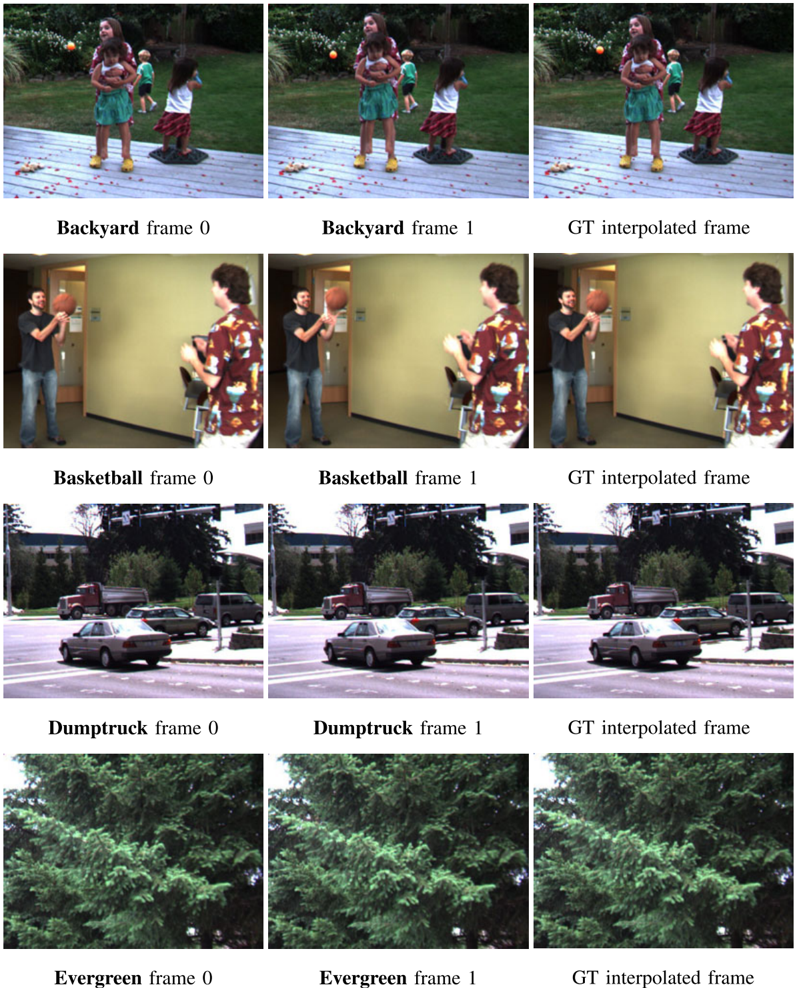
- Four data types were collected: (1) real nonrigid scenes with dense ground truth from hidden fluorescent texture, captured with a Canon EOS 20D at 3504×2336, downsampled every 40th visible-light frame by factor 6 to 584×388, with SSD tracking (15×15 windows), forward/backward crosschecking, and Lucas-Kanade subpixel refinement; (2) realistic synthetic scenes rendered with 3Delight at 640×480, with ground truth from a custom shader and dominant-cluster flow selection; (3) high-speed video for frame interpolation captured with a PointGrey Dragonfly Express at 60 fps, providing every other frame and retaining intermediate frames as ground truth; and (4) modified stereo data (Teddy) from structured light, cropped to make the disparity range roughly symmetric.
- Evaluation metrics include average angular error (AE), absolute flow endpoint error (EE), interpolation error (IE), and gradient-normalized interpolation error (NE). Statistics include averages, robustness measures R_X, and percentile accuracy measures A_X, computed over All, Disc, and Untext region masks.
- Analysis used the online evaluation at http://vision.middlebury.edu/flow/, comparing 24 published methods across metrics, statistics, masks, and datasets, with Pearson correlations between rankings and comparisons to state-of-the-art stereo methods on Teddy.
Limitations
- The paper states that the hidden fluorescent texture scenes are laboratory scenes, not real-world scenes, and have no motion blur due to stop-motion capture; ground truth is unavailable where cross-checking failed, especially occluded regions, and the measured ground truth is not perfect, though significant errors are limited to a small fraction of pixels. Synthetic sequences were generated without motion blur. The modified stereo ground truth is only accurate to 0.25 pixels, and algorithms may exploit the knowledge that motions are horizontal; overfitting to rigid data should be visible across the 12 evaluation images. Interpolation ground truth is an intermediate image, not a flow field, so the flow definition is apparent motion.
- The paper also states that no single method yet achieves strong performance across a wide variety of datatypes, that any dataset has a limited lifespan, and that future studies should include more challenging realistic synthetic data, longer sequences, and more difficult materials, illumination changes, atmospheric effects, and transparency.
- Evident from the text: the online tables do not provide an overall ranking among methods; runtimes are not normalized for programming environment, CPU speed, cores, or hardware acceleration; algorithms are required to produce dense flow and cannot submit confidence maps or sparse/incomplete fields; all 24 published methods used only 2 frames despite 8-frame sequences being available; and the paper cannot definitively answer whether temporal smoothing is less suited to the more challenging sequences.
Model-written summary. Check it against the paper before relying on it.
Integrity signals
Registry
Cites
Statistics
Figures

Verification
Claims the paper makes
2 Valid · 16 Not valid · 58 Not checked · 185 Own results and interpretations
A result the paper states — it cites no source for it, so there is none to check. The quote shows it is in the paper.
In the paper
“Rather than collecting a single type of data (with its inherent limitations) we instead collected four different types of data, each satisfying a different subset of desirable properties.”
plain- Asserted: passes — The authors put it forward as true.
- Checkable: passes — It can be checked against evidence.
- Load-bearing: passes — The paper’s conclusions depend on it.
- Based: passes — The paper gives a reason why it holds.
A result the paper states — it cites no source for it, so there is none to check. The quote shows it is in the paper.
In the paper
“Using the combination of fluorescent paint, downsampling high-resolution images, and sequential tracking of small motions, we are able to obtain dense, subpixel accurate ground truth for a nonrigid scene.”
plainstates a cause- Asserted: passes — The authors put it forward as true.
- Checkable: passes — It can be checked against evidence.
- Load-bearing: passes — The paper’s conclusions depend on it.
- Based: passes — The paper gives a reason why it holds.
A result the paper reports from its own data — it cites no other source for it, so there is none to check. The quote shows it is in the paper.
In the paper
“To allow for measures that predict performance on such tasks, we collected a variety of data suitable for frame interpolation.”
plainstates a cause- Asserted: passes — The authors put it forward as true.
- Checkable: passes — It can be checked against evidence.
- Load-bearing: passes — The paper’s conclusions depend on it.
- Based: passes — The paper gives a reason why it holds.
A result the paper reports from its own data — it cites no other source for it, so there is none to check. The quote shows it is in the paper.
In the paper
“We have developed a technique for capturing imagery of nonrigid scenes with ground-truth optical flow.”
plain- Asserted: passes — The authors put it forward as true.
- Checkable: passes — It can be checked against evidence.
- Load-bearing: passes — The paper’s conclusions depend on it.
- Based: passes — The paper gives a reason why it holds.
A result the paper states — it cites no source for it, so there is none to check. The quote shows it is in the paper.
In the paper
“To go beyond previous synthetic ground truth (e.g., the Yosemite sequence), we generated two types of fairly complex synthetic outdoor scenes.”
plain- Asserted: passes — The authors put it forward as true.
- Checkable: passes — It can be checked against evidence.
- Load-bearing: passes — The paper’s conclusions depend on it.
- Based: passes — The paper gives a reason why it holds.
96 more claims
Create a free account to see all 261 claims and every source verdict.
- Probably not a substantial claim. 114
- It may state two separate claims as one. 76
- The quote only partly states this claim. 6
Claims other papers make about this one
Each is checked against this paper’s own text: does it say what the citing paper says it does?
The source backs part of the claim, not all of it — or backs it for a different population, condition or comparison.
In the citing paper
“Notable works include the Middlebury dataset (Baker et al, 2011) and the KITTI datasets (Geiger et al, 2012; Menze and Geiger, 2015), but due to the difficulty of computing accurate ground truth, these have been restricted to 8 and 2 · 200 pairs of frames, respectively (the latter are also limited by the special driving setting).”
From What Makes Good Synthetic Training Data for Learning Disparity and Optical Flow Estimation? (2018) · cites this paper as Baker et al, 2011
Experimental — accuracy not yet measured
Citations
Cites
The pascal visual object classes (VOC) challenge
Everingham, M., Van Gool, L., Williams, C. K. I., Winn, J., & Zisserman, A. (2010) · International Journal of Computer Vision · doi:10.1007/s11263-009-0275-4 · Cited by 19,599
Proceedings of IEEE Conference on Computer Vision and Pattern Recognition
(1993) · doi:10.1109/cvpr.1993 · Cited by 17,667
Proceedings of IEEE International Conference on Computer Vision
(1995) · Proceedings of IEEE International Conference on Computer Vision · doi:10.1109/iccv.1995.466933 · Cited by 12,860
(1981) · Cited by 11,963
Horn, B. K. P., & Schunck, B. G. (1981) · Artificial Intelligence · doi:10.1016/0004-3702(81)90024-2 · Cited by 10,312
Horn, B. K., & Schunck, B. G. (1981) · SPIE Proceedings · doi:10.1117/12.965761 · Cited by 7,394 · cited 2×
“A baseline approach is to use an L2 norm as in the Horn and Schunck algorithm (Horn and Schunck 1981):”
BackgroundMethodFast approximate energy minimization via graph cuts
Boykov, Y., Veksler, O., & Zabih, R. (2001) · IEEE Transactions on Pattern Analysis and Machine Intelligence · doi:10.1109/34.969114 · Cited by 6,988
A Taxonomy and Evaluation of Dense Two-Frame Stereo Correspondence Algorithms
Scharstein, D., & Szeliski, R. (2002) · International Journal of Computer Vision · doi:10.1023/a:1014573219977 · Cited by 6,740 · cited 10×
“Many areas of computer vision, such as stereo [63], face recognition [28, 55, 68], and object recognition [23, 24], have challenging datasets to track the progress made by leading algorithms and to stimulate new ideas.”
BackgroundMethodResultInfluentialSelf-citationProceedings European Conference on Computer Vision 2002
Heyden, A., Sparr, G., Nielsen, M., & Johansen, P. (2002) · Lund University Publications (Lund University) · Cited by 5,153
From few to many: illumination cone models for face recognition under variable lighting and pose
Georghiades, A. S., Belhumeur, P. N., & Kriegman, D. J. (2001) · IEEE Transactions on Pattern Analysis and Machine Intelligence · doi:10.1109/34.927464 · Cited by 4,912 · cited 1×
“Many areas of computer vision, such as stereo (Scharstein and Szeliski 2002), face recognition (Philips et al. 2005; Sim et al. 2003; Gross et al. 2008; Georghiades et al. 2001), and object recognition (Fei-Fei et al.”
Background
Research works printed but not linked: 4
- Anandan, P., & Weiss, R. (1985). Introducing smoothness constraint in a matching approach for the computation of displacement fields. In Proceedings of the DARPA image understanding workshop (pp. 186-196).
- Bleyer, M., & Chambon, S. (2010). Does color really help in dense stereo matching? In Proceedings of the international symposium 3D data processing, visualization and transmission .
- Lempitsky, V., Roth, S., & Rother, C. (2008). Fusion flow: discretecontinuous optimization for optical flow estimation. In Proceedings of the IEEE conference on computer vision and pattern recognition .
- Rannacher, J. (2009). Realtime 3D motion estimation on graphics hardware . Undergraduate thesis, Heidelberg University.
Cited by
Items 401–500 of 2,273
Robust Video Frame Interpolation With Exceptional Motion Map
Park, M., Kim, H. G., Lee, S., & Ro, Y. M. (2020) · IEEE Transactions on Circuits and Systems for Video Technology · doi:10.1109/tcsvt.2020.2981964 · Cited by 41
“The video frame interpolation is divided into two steps: optical flow estimation and intermediate frame synthesis [5], [6], [11].”
MethodA Plug-and-Play Scheme to Adapt Image Saliency Deep Model for Video Data
Li, Y., Li, S., Chen, C., Hao, A., & Qin, H. (2020) · IEEE Transactions on Circuits and Systems for Video Technology · doi:10.1109/tcsvt.2020.3023080 · Cited by 39
“…between optical flow data (i.e., 2-channel V X, V Y ) and original color image (i.e., 3-channel RGB), we follow the coding scheme mentioned in [55] to convert the 2-channel optical flow data into the 3-channel color-coded version, in which it uses the 55 pre-defined colors with different hue…”
MethodStereo Matching—State-of-the-Art and Research Challenges
Bleyer, M., & Breiteneder, C. J. (2013) · Advances in computer vision and pattern recognition · doi:10.1007/978-1-4471-5520-1_6 · Cited by 50
Contrast-enhanced ultrasound-based AI model for multi-classification of focal liver lesions
Ding, W., Meng, Y., Ma, J., Pang, C., Wu, J., Tian, J., Yu, J., Liang, P., & Wang, K. (2025) · Journal of Hepatology · doi:10.1016/j.jhep.2025.01.011 · Cited by 49
A Third Eye for Performance Evaluation in Stereo Sequence Analysis
Morales, S., & Klette, R. (2009) · Lecture notes in computer science · doi:10.1007/978-3-642-03767-2_131 · Cited by 44
Occlusion Reasoning for Temporal Interpolation using Optical Flow
Herbst, E. V., Seitz, S. M., & Baker, S. (2009) · Cited by 46
Self-citationNeurite elongation is highly correlated with bulk forward translocation of microtubules
Athamneh, A. I. M., He, Y., Lamoureux, P. L., Fix, L., Suter, D. M., & Miller, K. E. (2017) · Scientific Reports · doi:10.1038/s41598-017-07402-6 · Cited by 49
Conditional Prior Networks for Optical Flow
Yang, Y., & Soatto, S. (2018) · Lecture notes in computer science · doi:10.1007/978-3-030-01267-0_17 · Cited by 38
“In classical (variational) OF, the regularizer captures very rudimentary low-order statistics [4,9,29,5,37], for instance the high kurtosis of the gradient distribution.”
BackgroundMotion Estimation by Hybrid Optical Flow Technology for UAV Landing in an Unvisited Area
Cheng, H.-W., Chen, T.-L., & Tien, C.-H. (2019) · Sensors · doi:10.3390/s19061380 · Cited by 38
“Compared with the conventional global featurebased methods, the Gunnar–Farnebäck optical flow [22] with pixel-wise correspondences between two subsequent images has superior performance [19,20,32].”
MethodA Compositional Framework for Grounding Language Inference, Generation, and Acquisition in Video
Yu, H., Siddharth, N., Barbu, A., & Siskind, J. M. (2015) · Journal of Artificial Intelligence Research · doi:10.1613/jair.4556 · Cited by 42
Learning Pixel Trajectories with Multiscale Contrastive Random Walks
Bian, Z., Jabri, A., Efros, A. A., & Owens, A. (2022) · IEEE Computer Society Conference on Computer Vision and Pattern Recognition/Proceedings - IEEE Computer Society Conference on Computer Vision and Pattern Recognition/Proceedings · doi:10.1109/cvpr52688.2022.00640 · Cited by 55
“Cycle consistency has long been used to detect occlusions [3,23,36,66,80], and is used to discount the loss of occluded pixels in unsupervised flow [25,28, 32,”
MethodEnhanced Bi-directional Motion Estimation for Video Frame Interpolation
Jin, X., Wu, L., Shen, G., Chen, Y., Chen, J., Koo, J., & Hahm, C.-H. (2023) · IEEE Winter Conference on Applications of Computer Vision · doi:10.1109/wacv56688.2023.00502 · Cited by 56
“For the running time, we follow the practice of [27], and test all models with a RTX 2080 Ti GPU for interpolating the “Urban” sequence in Middle-bury benchmark [1], which has a resolution of 640× 480.”
MethodSide Information and Noise Learning for Distributed Video Coding Using Optical Flow and Clustering
Luong, H. V., Rakêt, L. L., Huang, X., & Forchhammer, S. O. (2012) · IEEE Transactions on Image Processing · doi:10.1109/tip.2012.2215621 · Cited by 38
Jung, J., Hong, K., Park, G., et al. (2010) · Optics Express · doi:10.1364/oe.18.026373 · Cited by 36
Graph based construction of textured large field of view mosaics for bladder cancer diagnosis
Weibel, T., Daul, C., Wolf, D., Rösch, R., & Guillemin, F. H. (2012) · Pattern Recognition · doi:10.1016/j.patcog.2012.05.023 · Cited by 39
Image Sequence Interpolation Based on Optical Flow, Segmentation, and Optimal Control
Chen, K., & Lorenz, D. A. (2011) · IEEE Transactions on Image Processing · doi:10.1109/tip.2011.2179305 · Cited by 38
“Aside from the aforementioned image sequence interpolation methods, the image warping technique was introduced in [17] to generate the intermediate image based on a priori known optical-flow field, e.g., estimated by the Horn and Schunck method.”
Robust Fingertip Detection in a Complex Environment
Wu, G., & Kang, W. (2016) · IEEE Transactions on Multimedia · doi:10.1109/tmm.2016.2545401 · Cited by 36
Altena, B., & Kääb, A. (2017) · Remote Sensing · doi:10.3390/rs9030300 · Cited by 40
“Optical flow is a method which can estimate the displacement up to individual pixel level [22,23], attempts of exploiting this novel approach have been made over glaciers, but yet without satisfying results [24].”
MethodPulseCam: a camera-based, motion-robust and highly sensitive blood perfusion imaging modality
Kumar, M., Suliburk, J. W., Veeraraghavan, A., & Sabharwal, A. (2020) · Scientific Reports · doi:10.1038/s41598-020-61576-0 · Cited by 40
A critical literature survey and prospects on tampering and anomaly detection in image data
da Costa, K. A. P., Papa, J. P., Júnior, L. A. P., Colombo, D., Ser, J. D., Muhammad, K., & de Albuquerque, V. H. C. (2020) · Applied Soft Computing · doi:10.1016/j.asoc.2020.106727 · Cited by 45
MRPB 1.0: A Unified Benchmark for the Evaluation of Mobile Robot Local Planning Approaches
Wen, J. G., Zhang, X., Bi, Q., Pan, Z., Feng, Y., Yuan, J., & Fang, Y. (2021) · Proceedings - IEEE International Conference on Robotics and Automation/Proceedings · doi:10.1109/icra48506.2021.9561901 · Cited by 51
“Compared with several successful benchmarks in the area of computer vision [17]– [19], there is relatively little research on motion planning benchmarks in robotics.”
BackgroundGround Truth Data, Content, Metrics, and Analysis
Krig, S. (2014) · Apress eBooks · doi:10.1007/978-1-4302-5930-5_7 · Cited by 53
A Protocol for Evaluating Video Trackers Under Real-World Conditions
Nawaz, T. H., & Cavallaro, A. (2012) · IEEE Transactions on Image Processing · doi:10.1109/tip.2012.2228497 · Cited by 35
“I. INTRODUCTION UNLIKE OTHER areas of image processing and computervision such as disparity estimation [1], optical flow computation [2] and video coding [3] that consistently use commonly accepted evaluation procedures, video tracking still lacks a standard way to evaluate and compare algorithmic…”
MethodRegularization Strategies for Discontinuity-Preserving Optical Flow Methods
Monzón, N., Salgado, A., & Sánchez, J. (2016) · IEEE Transactions on Image Processing · doi:10.1109/tip.2016.2526903 · Cited by 36
“sequences from the MPI-Sintel [39] and Middlebury [40] benchmark databases, which allows us to show the results in”
MethodVariational method for joint optical flow estimation and edge-aware image restoration
Tu, Z., Xie, W. C., Cao, J., van Gemeren, C., Poppe, R. W., & Veltkamp, R. C. (2016) · Pattern Recognition · doi:10.1016/j.patcog.2016.10.027 · Cited by 40
“First, we use four representative synthetic sequences with ground- truths are selected from the Middlebury benchmark: Dimetrodon (Hidden Texture), Venus (Stereo), Grove3 and Urban3 (Synthetic).”
BackgroundMethodInfluentialGliß, J., Stebel, K., Kylling, A., & Sudbo, A. S. (2018) · Atmospheric measurement techniques · doi:10.5194/amt-11-781-2018 · Cited by 42
“Optical flow intercomparison benchmarks (e.g. Baker et al., 2011, Menze and Geiger, 2015) can provide useful information with which to assess the performance (e.g. accuracy) and applicability (e.g. computational demands, availability of source code) of different OF algorithms.”
BackgroundMethodInfluentialBlur Removal Via Blurred-Noisy Image Pair
Gu, C., Lu, X., He, Y., & Zhang, C. (2020) · IEEE Transactions on Image Processing · doi:10.1109/tip.2020.3036745 · Cited by 46
“We first assess the performance of some current deblurring methods and our approach on ten image pairs from the publicly available dataset [4].”
MethodInterest Point Detector and Feature Descriptor Survey
Krig, S. (2016) · Springer eBooks · doi:10.1007/978-3-319-33762-3_6 · Cited by 46
TriangleFlow: Optical Flow with Triangulation-Based Higher-Order Likelihoods
Glocker, B., Heibel, H., Navab, N., Kohli, P., & Rother, C. (2010) · Lecture notes in computer science · doi:10.1007/978-3-642-15558-1_20 · Cited by 38
“A rather comprehensive overview and comparison of latest optical flow methods can be found in [5] and on the website of the Middlebury optical flow database(1).”
BackgroundMotion Cooperation: Smooth Piece-wise Rigid Scene Flow from RGB-D Images
Jaimez, M., Souiai, M., Stückler, J., González-Jiménez, J., & Cremers, D. (2015) · International Conference on 3D Vision (3DV) · doi:10.1109/3dv.2015.15 · Cited by 33
Frame Interpolation with Multi-Scale Deep Loss Functions and Generative Adversarial NetworksPreprint
van Amersfoort, J., Shi, W., Acosta, A., Massa, F., Totz, J., Wang, Z., & Caballero, J. (2017) · arXiv (Cornell University) · doi:10.48550/arxiv.1711.06045 · Cited by 58
“A description of this interpolation mechanism can be found in [9].”
BackgroundMethodInfluentialTracklets Predicting Based Adaptive Graph TrackingPreprint
Shan, C., Wei, C., Deng, B., Huang, J., Hua, X., Cheng, X., & Liang, K. (2020) · arXiv (Cornell University) · doi:10.48550/arxiv.2010.09015 · Cited by 66
“Dense optical flow[9, 10, 12] describes the optical flow of each pixel of the image moving to the next frame, using color to indicate the direction of optical flow, and brightness to indicate the size of optical flow[5].”
Prior Expectations in Visual Speed Perception Predict Encoding Characteristics of Neurons in Area MT
Zhang, L.-Q., & Stocker, A. A. (2022) · Journal of Neuroscience · doi:10.1523/jneurosci.1920-21.2022 · Cited by 43
Highly Overparameterized Optical Flow Using PatchMatch Belief Propagation
Hornáček, M., Besse, F., Kautz, J., Fitzgibbon, A. W., & Rother, C. (2014) · Lecture notes in computer science · doi:10.1007/978-3-319-10578-9_15 · Cited by 39
“We tested our method on the UCL optical flow data set [15] and on a subset of the Middlebury optical flow benchmark [1] for which ground truth flow was available.”
MethodFast Median Filtering for Phase or Orientation Data
Storath, M., & Weinmann, A. (2017) · IEEE Transactions on Pattern Analysis and Machine Intelligence · doi:10.1109/tpami.2017.2692779 · Cited by 36
“[48] for these methods and the three mentioned filtering approaches.”
Refined TV-L 1 Optical Flow Estimation Using Joint Filtering
Zhang, C., Ge, L., Chen, Z., Li, M., Liu, W., & Chen, H. (2019) · IEEE Transactions on Multimedia · doi:10.1109/tmm.2019.2929934 · Cited by 41
“We first tested our JOF method on the Middlebury database [59] because it is a standard benchmark for evaluating various optical flow computation methods.”
MethodSuresha, M., Kuppa, S., & Raghukumar, D. S. (2020) · International Journal of Multimedia Information Retrieval · doi:10.1007/s13735-019-00190-x · Cited by 45
“…Sun et al. [106] and Karpathy et al. [37] applied CNN on the temporal domain with stacked video frames over time and improved this work [3–6] by introducing two-stream CNN approaches, which use two CNNs with static images in a spatial net and…”
BackgroundMethodAcross Scales and Across Dimensions: Temporal Super-Resolution Using Deep Internal Learning
Zuckerman, L. P., Naor, E., Pisha, G., Bagon, S., & Irani, M. (2020) · Lecture notes in computer science · doi:10.1007/978-3-030-58571-6_4 · Cited by 37
Kholil, M., Ismanto, I., & Fuad, M. (2021) · IOP Conference Series Materials Science and Engineering · doi:10.1088/1757-899x/1073/1/012066 · Cited by 34
“In fact, optical flow is another area that is very active in Computer Vision, overcoming the problem of correspondence that is dense across images [10].”
BackgroundRegistration Using Sparse Free-Form Deformations
Shi, W., Zhuang, X., Pizarro, L., Bai, W., Wang, H., Tung, K.-P., Edwards, P., & Rueckert, D. (2012) · Lecture notes in computer science · doi:10.1007/978-3-642-33418-4_81 · Cited by 43
“Visual comparison between the classic FFD and the proposed SFFD using the colour scheme from [16].”
MethodReducing redundancy in wireless capsule endoscopy videos
Lee, H.-G., Choi, M.-K., Shin, B., & Lee, S. (2013) · Computers in Biology and Medicine · doi:10.1016/j.compbiomed.2013.02.009 · Cited by 33
Héas, P., Mémin, É., Heitz, D., & Mininni, P. D. (2012) · Tellus A Dynamic Meteorology and Oceanography · doi:10.3402/tellusa.v64i0.10962 · Cited by 34
A Novel Approach for the Short-Term Forecast of the Effective Cloud Albedo
Urbich, I., Bendix, J., & Müller, R. W. (2018) · Remote Sensing · doi:10.3390/rs10060955 · Cited by 37
“There are methods such as block-based methods, discrete optimization methods or differential methods [23].”
Real and implied motion at the center of gaze
Açık, A., Bartel, A., & König, P. (2014) · Journal of Vision · doi:10.1167/14.1.2 · Cited by 36
“…algorithms are developed for optic flow estimations, and it is beyond the scope of the present study to evaluate and compare their performance (see Baker et al., 2011 and the corresponding webpage http://vision.middlebury.edu/flow/ for a comprehensive review and comparison of state-of-theart…”
MethodWhat can we expect from a V1-MT feedforward architecture for optical flow estimation?
Solari, F., Chessa, M., Medathati, N. V. K., & Kornprobst, P. (2015) · Signal Processing Image Communication · doi:10.1016/j.image.2015.04.006 · Cited by 41
Transfusive image manipulation
Yücer, K., Jacobson, A., Hornung, A., & Sorkine‐Hornung, O. (2012) · ACM Transactions on Graphics · doi:10.1145/2366145.2366195 · Cited by 31
“where ∆M is a warp update computed in every iteration [Baker et al. 2011].”
BackgroundMethodInfluentialComparing Optical Flow Algorithms Using 6-DOF Motion of Real-World Rigid Objects
Mammarella, M., Campa, G., Fravolini, M. L., & Napolitano, M. R. (2012) · IEEE Transactions on Systems Man and Cybernetics Part C (Applications and Reviews) · doi:10.1109/tsmcc.2012.2218806 · Cited by 36
“In [12], the ground-truth flow for real images was determined using hidden fluorescent texture painted on a scene, along with a computationally intensive approach to track small windows in a sequence of UV images.”
MethodStructure and motion from scene registration
Basha, T., Avidan, S., Hornung, A., & Matusik, W. (2012) · IEEE Computer Society Conference on Computer Vision and Pattern Recognition/Proceedings - IEEE Computer Society Conference on Computer Vision and Pattern Recognition/Proceedings · doi:10.1109/cvpr.2012.6247830 · Cited by 33
“See [3, 18] for a recent overview and evaluation on optical flow and multi-view reconstruction.”
BackgroundTowards Longer Long-Range Motion Trajectories
Rubinstein, M., & Liu, C. (2012) · British Machine Vision Conference (BMVC) · doi:10.5244/c.26.53 · Cited by 33
“Existing datasets with ground-truth motions are available mostly for short sequences (2-10 frames) [1, 12], while to the best of our knowledge, no dataset or evaluation framework exists for dense long-range motion.”
BackgroundMethodAlmatrafi, M., & Hirakawa, K. (2019) · IEEE Transactions on Computational Imaging · doi:10.1109/tci.2019.2948787 · Cited by 34
“Further advancements were encouraged by benchmarks such as Barron [4] and Middlebury [5] that enabled quantitative assessment of OF performance.”
MethodVelocity refinement of PIV using global optical flow
Seong, J. H., Song, M. S., Núñez, D., et al. (2019) · Experiments in Fluids · doi:10.1007/s00348-019-2820-4 · Cited by 33
Cross-Weather Image Alignment via Latent Generative Model With Intensity Consistency
Zhou, H., Ma, J., Tan, C. C., Zhang, Y., & Ling, H. (2020) · IEEE Transactions on Image Processing · doi:10.1109/tip.2020.2980210 · Cited by 37
“To visualize the flow field, we follow the code in [46], where each pixel indicates a flow vector and the orientation and magnitude are represented by the hue and saturation of the pixel, respectively (see Fig.”
MethodCNN-Based Ultrasound Image Reconstruction for Ultrafast Displacement Tracking
Perdios, D., Vonlanthen, M., Martinez, F., Arditi, M., & Thiran, J. (2020) · IEEE Transactions on Medical Imaging · doi:10.1109/tmi.2020.3046700 · Cited by 40
“To evaluate the accuracy of displacement estimates throughout the experiments, we relied on the relative endpoint error (REPE), a normalized version of the well-known endpoint error (epe), commonly used in flow estimation techniques [39], [40].”
MethodUnsupervised Learning of Particle Image Velocimetry
Zhang, M., & Piggott, M. D. (2020) · Lecture notes in computer science · doi:10.1007/978-3-030-59851-8_7 · Cited by 60
“The flow field colour is coded in HSV [18].”
BackgroundUnsupervised Learning of Optical Flow with Deep Feature Similarity
Im, W., Kim, T., & Yoon, S. (2020) · Lecture notes in computer science · doi:10.1007/978-3-030-58586-0_11 · Cited by 36
Błachut, K., & Kryjak, T. (2022) · Sensors · doi:10.3390/s22135017 · Cited by 41
“Example results for both algorithms implemented, along with selected frames from the Middlebury dataset and their ground truth, are provided in Figure 17.”
MethodInfluentialDense Lagrangian motion estimation with occlusions
Ricco, S., & Tomasi, C. (2012) · IEEE Computer Society Conference on Computer Vision and Pattern Recognition/Proceedings - IEEE Computer Society Conference on Computer Vision and Pattern Recognition/Proceedings · doi:10.1109/cvpr.2012.6247877 · Cited by 32
“Although valuable for two-frame optical flow, the Middlebury benchmark [3] is not well-suited to evaluating longrange motion estimation.”
Globally optimal toon tracking
Zhu, H., Liu, X., Wong, T., & Heng, P. (2016) · ACM Transactions on Graphics · doi:10.1145/2897824.2925872 · Cited by 43
“A comprehensive survey can be found in [Baker et al. 2011].”
BackgroundA fractional order variational model for the robust estimation of optical flow from image sequences
Kumar, P., Kumar, S., & Raman, B. (2016) · Optik · doi:10.1016/j.ijleo.2016.05.118 · Cited by 33
Fast and Accurate Optical Flow based Depth Map Estimation from Light FieldsPreprint
Chen, Y., Alain, M., & Smolić, A. (2020) · arXiv (Cornell University) · doi:10.48550/arxiv.2008.04673 · Cited by 33
“For a comprehensive survey, please refer to the work in [1, 15].”
BackgroundPhysGen: Rigid-Body Physics-Grounded Image-to-Video Generation
Liu, S., Ren, Z., Gupta, S., & Wang, S. (2024) · Lecture notes in computer science · doi:10.1007/978-3-031-73007-8_21 · Cited by 226
“For Motion-FID, we use RAFT [72] to extract and colorize optical flow [5], then compute FID from these rendered images.”
MethodDemetz, O., Hafner, D., & Weickert, J. (2013) · British Machine Vision Conference (BMVC) · doi:10.5244/c.27.50 · Cited by 39
“Next we assess the error rates on the Middlebury training images, cf. Table 3.”
MethodInfluentialNonlocal Sparse and Low-Rank Regularization for Optical Flow Estimation
Dong, W., Shi, G., Hu, X., & Ma, Y. (2014) · IEEE Transactions on Image Processing · doi:10.1109/tip.2014.2352497 · Cited by 38
“To visualize the optical flow, the color-coding scheme of [30] are used.”
MethodIllumination invariant optical flow using neighborhood descriptors
Ali, S., Daul, C., Galbrun, E., & Blondel, W. (2015) · Computer Vision and Image Understanding · doi:10.1016/j.cviu.2015.12.003 · Cited by 38
Fast Weighted Histograms for Bilateral Filtering and Nearest Neighbor Searching
He, S., Yang, Q., Lau, R. W. H., & Yang, M. (2015) · IEEE Transactions on Circuits and Systems for Video Technology · doi:10.1109/tcsvt.2015.2430671 · Cited by 34
“The result (cropped) is tested on the Army data set from Middleburry benchmark [4].”
MethodOptimized Memory Allocation and Power Minimization for FPGA-Based Image Processing
Garcia, P., Bhowmik, D., Stewart, R., et al. (2019) · Journal of Imaging · doi:10.3390/jimaging5010007 · Cited by 32
“We used the publicly available dataset from [41].”
MethodLi, Z., Wang, J., Sylvester, D., Blaauw, D. T., & Kim, H.-S. (2019) · IEEE Journal of Solid-State Circuits · doi:10.1109/jssc.2018.2885559 · Cited by 30
“7% for the Middlebury [28] benchmark).”
Character navigation in dynamic environments based on optical flow
López, A., Chaumette, F., Marchand, É., & Pettré, J. (2019) · Computer Graphics Forum · doi:10.1111/cgf.13629 · Cited by 35
“There are many benchmarks [BSL ∗ 11] to test modern optical flow algorithms although it is still an open field of research.”
BackgroundZoom-In-To-Check: Boosting Video Interpolation via Instance-Level Discrimination
Yuan, L., Chen, Y., Liu, H., Kong, T., & Shi, J. (2019) · IEEE Computer Society Conference on Computer Vision and Pattern Recognition/Proceedings - IEEE Computer Society Conference on Computer Vision and Pattern Recognition/Proceedings · doi:10.1109/cvpr.2019.01246 · Cited by 34
Learning Multi-human Optical Flow
Ranjan, A., Hoffmann, D. T., Tzionas, D., Tang, S., Romero, J., & Black, M. J. (2020) · International Journal of Computer Vision · doi:10.1007/s11263-019-01279-w · Cited by 46
Self-citationA Pilot Study on Convolutional Neural Networks for Motion Estimation From Ultrasound Images
Evain, E., Faraz, K., Grenier, T., et al. (2020) · IEEE Transactions on Ultrasonics Ferroelectrics and Frequency Control · doi:10.1109/tuffc.2020.2976809 · Cited by 32
“EPE is a standard metric used in optical flow and is defined as the L2 norm of the difference between the estimated flow vector and the ground truth [19] (in pixels)”
MethodA Novel Change Detection Method for Natural Disaster Detection and Segmentation from Video Sequence
Qiao, H., Wan, X., Wan, Y., Li, S., & Zhang, W. (2020) · Sensors · doi:10.3390/s20185076 · Cited by 38
“The displacement can be calculated as follow: r(x, y) = √ u(x, y)2 + v(x, y)2 (1) Figure 4 shows an example of displacements’ distribution based on sequence “RubberWhale” [53].”
BackgroundMethodInfluentialDeep Siamese Network With Motion Fitting for Object Tracking in Satellite Videos
Ruan, L., Guo, Y., Yang, D., & Chen, Z. (2022) · IEEE Geoscience and Remote Sensing Letters · doi:10.1109/lgrs.2022.3158652 · Cited by 32
Optimization Strategies for High-Performance Computing of Optical-Flow in General-Purpose Processors
Anguita, M., Díaz, J., Ros, E., & Fernández, F. J. R. (2009) · IEEE Transactions on Circuits and Systems for Video Technology · doi:10.1109/tcsvt.2009.2026821 · Cited by 40
“Table V shows the results for Yosemite with (Y256 × 256, Y252 × 316) and without clouds (Y252 × 316NC), the wellknown diverging and translating tree sequences (DT150 × 160, TT150 × 160), the RubberWhale (RW388 × 592), and Grove2 (G480 × 640) from the Middlebury database described in [16] (these last two sequences do n…”
The Initial Development of Transient Volcanic Plumes as a Function of Source Conditions
Tournigand, P., Taddeucci, J., Gaudin, D., et al. (2017) · Journal of Geophysical Research Solid Earth · doi:10.1002/2017jb014907 · Cited by 32
“Following brightness constancy assumption over the measurement time, this method solves the optical flow equation based on pixel intensity (Baker et al., 2011).”
BackgroundMethodInfluentialReHAR: Robust and Efficient Human Activity Recognition
Li, X., & Chuah, M. C. (2018) · IEEE Winter Conference on Applications of Computer Vision · doi:10.1109/wacv.2018.00046 · Cited by 44
“Then, we use the method described in [31] 1 to visualize the optical flow information into a col-orful image (3 channels), namely optical flow image.”
MethodVirtual Rephotography: Novel View Prediction Error for 3D Reconstruction
Waechter, M., Beljan, M., Fuhrmann, S., Moehrle, N., Kopf, J., & Goesele, M. (2017) · ACM Transactions on Graphics · doi:10.1145/2999533 · Cited by 36
Reconstruction of 3-D Histology Images by Simultaneous Deformable Registration
Marco Feuerstein, A., Heibel, H., Gardiazabal, J., Navab, N., & Groher, M. (2011) · Lecture notes in computer science · doi:10.1007/978-3-642-23629-7_71 · Cited by 32
“In order to quantitatively evaluate our method, we apply the performance measures commonly used for optical flow evaluation by the vision community [1].”
MethodQiu, W., Wang, X., Bai, X., Yuille, A., & Tu, Z. (2014) · IEEE Winter Conference on Applications of Computer Vision · doi:10.1109/wacv.2014.6835734 · Cited by 39
“We denote s1(p, σ(p)) as a SIFT feature computed at scale σ(p) at position p in the first image.”
BackgroundMethodConsistent Binocular Depth and Scene Flow with Chained Temporal Profiles
Hung, C. H., Xu, L., & Jia, J. (2012) · International Journal of Computer Vision · doi:10.1007/s11263-012-0559-y · Cited by 33
“A taxonomy of optical flow methods, along with comparisons, is reported on the Middlebury website (Baker et al. 2011).”
MethodVision-Based Fingertip Tracking Utilizing Curvature Points Clustering and Hash Model Representation
Wu, G., & Kang, W. (2017) · IEEE Transactions on Multimedia · doi:10.1109/tmm.2017.2691538 · Cited by 31
Non-rigid CT/CBCT to CBCT registration for online external beam radiotherapy guidance
Zachiu, C., de Senneville, B. D., Tijssen, R., Kotte, A., Houweling, A., Kerkmeijer, L., Lagendijk, J., Moonen, C., & Ries, M. (2017) · Physics in Medicine and Biology · doi:10.1088/1361-6560/aa990e · Cited by 30
“The voxel-wise error in flow endpoint (FEP) between the motion fields provided by EVolution and the optical flow methods was also evaluated (Baker et al 2011): Phys.”
MethodIllumination-Invariance Optical Flow Estimation Using Weighted Regularization Transform
Mei, L., Lai, J., Xie, X., Zhu, J., & Chen, J. (2019) · IEEE Transactions on Circuits and Systems for Video Technology · doi:10.1109/tcsvt.2019.2890861 · Cited by 33
“These publicly available datasets include 1) the Middlebury flow dataset [41], 2) the KITTI flow 2015 dataset [42], [43], and 3) the MPI Sintel dataset [44], which cover a comprehensive range with complex illumination conditions.”
Bao, W., Lai, W., Zhang, X., et al. (2018) · arXiv (Cornell University) · doi:10.48550/arxiv.1810.08768 · Cited by 31
“(3) We demonstrate that the proposed method performs favorably against the state-of-the-art frame interpolation algorithms on several benchmark datasets, including the Middlebury [28], UCF101 [29], and Vimeo90K [9] datasets.”
MethodInfluentialVideo shot-boundary detection: issues, challenges and solutions
Kar, T., Kanungo, P., Mohanty, S. N., Groppe, S., & Groppe, J. (2024) · Artificial Intelligence Review · doi:10.1007/s10462-024-10742-1 · Cited by 47
“…et al. (2003), Wang et al. (2007) and Hua (2010) proposed a motion-based algorithm for SBD. Inclusion of motion information tends to make the system robust to motion, increases the accuracy at the cost of higher computational load (Baker et al. 2011; Dosovitskiy et al. 2015; Tao et al. 2012).”
Hierarchical belief propagation to reduce search space using CUDA for stereo and motion estimation
Grauer-Gray, S., & Kambhamettu, C. (2009) · IEEE Winter Conference on Applications of Computer Vision · doi:10.1109/wacv.2009.5403097 · Cited by 33
“The results are shown in table 4.”
BackgroundHead Motion Signatures from Egocentric Videos
Poleg, Y., Arora, C., & Peleg, B. (2015) · Lecture notes in computer science · doi:10.1007/978-3-319-16811-1_21 · Cited by 29
“Other methods for optical flow estimation can be used as well [13].”
MethodWu, Q., Wang, H., Lin, Y.-J., Zhuang, Y., & Zhang, Y. (2016) · Journal of Atmospheric and Oceanic Technology · doi:10.1175/jtech-d-16-0013.1 · Cited by 30
Topology-Aware Non-Rigid Point Cloud Registration
Zampogiannis, K., Fermuller, C. M., & Aloimonos, Y. (2019) · IEEE Transactions on Pattern Analysis and Machine Intelligence · doi:10.1109/tpami.2019.2940655 · Cited by 31
An overview of optical flow-based approaches for motion segmentation
Anthwal, S., & Ganotra, D. (2019) · The Imaging Science Journal · doi:10.1080/13682199.2019.1641316 · Cited by 36
“complex but small non-rigid motion between them, taken from Grove2 sequence from Middlebury Optical flow dataset [9] are shown in Figure 2(a,b) and the”
BackgroundMethodInfluentialPixel Objectness: Learning to Segment Generic Objects Automatically in Images and Videos
Xiong, B., Jain, S. D., & Grauman, K. L. (2018) · IEEE Transactions on Pattern Analysis and Machine Intelligence · doi:10.1109/tpami.2018.2865794 · Cited by 31
“In particular, we convert the raw optical flow to a 3-channel (RGB) colorcoded optical flow image [87].”
MethodCapturing Small, Fast-Moving Objects: Frame Interpolation via Recurrent Motion Enhancement
Hu, M., Xiao, J., Liao, L., Wang, Z., Lin, C., Wang, M., & Satoh, S. (2021) · IEEE Transactions on Circuits and Systems for Video Technology · doi:10.1109/tcsvt.2021.3110796 · Cited by 38
Optical flow for video super-resolution: a survey
Tu, Z., Li, H., Xie, W., Liu, Y., Zhang, S., Li, B., & Yuan, J. (2022) · Artificial Intelligence Review · doi:10.1007/s10462-022-10159-8 · Cited by 40
Singh, V. K., Kalafi, E. Y., Wang, S., Benjamin, A., Asideu, M., Kumar, V., & Samir, A. E. (2022) · Expert Systems with Applications · doi:10.1016/j.eswa.2022.118166 · Cited by 44
Optical and SAR Image Dense Registration Using a Robust Deep Optical Flow Framework
Zhang, H., Lei, L., Ni, W., Yang, X., Tang, T., Cheng, K., Xiang, D., & Kuang, G. (2023) · IEEE Journal of Selected Topics in Applied Earth Observations and Remote Sensing · doi:10.1109/jstars.2023.3235535 · Cited by 38
“Optical flow is the pattern of apparent motion of objects in a visual scene caused by the relative motion between the sensor and the scene [39].”
BackgroundRobust Trajectory-Space TV-L1 Optical Flow for Non-rigid Sequences
Garg, R., Roussos, A., & Agapito, L. (2011) · Lecture notes in computer science · doi:10.1007/978-3-642-23094-3_22 · Cited by 31
“In particular, the most popular one [21] (Middlebury) does not incorporate any such sequences.”
BackgroundRestoration of turbulence degraded underwater images
Kanaev, A. V., Smith, L. N., Hou, W. W., et al. (2012) · Optical Engineering · doi:10.1117/1.oe.51.5.057007 · Cited by 30
A comparative study of optical flow and traditional sensors in UAV navigation
Chao, H., Gu, Y., Gross, J. N., Guo, G., Fravolini, M. L., & Napolitano, M. R. (2013) · Proceedings of the ... American Control Conference/Proceedings of the American Control Conference · doi:10.1109/acc.2013.6580428 · Cited by 39
“Many researchers have worked on the quantitative evaluation of different optical flow algorithms using user specific ground truth [16], [17], [18].”
BackgroundRobust Processing of Optical Flow of Fluids
Doshi, A., & Bors, A. G. (2010) · IEEE Transactions on Image Processing · doi:10.1109/tip.2010.2048614 · Cited by 33
“Experimental results and their analysis are provided in Section V, while Section VI concludes the paper.”
BackgroundMethodOn-line 3 D motion estimation using low resolution MRI
Glitzner, M., de Senneville, B. D., Lagendijk, J. J. W., Raaymakers, B. W., & Crijns, S. P. M. (2015) · Physics in Medicine and Biology · doi:10.1088/0031-9155/60/16/n301 · Cited by 30
“For clarity, the analyses are done solely in terms of absolute, component-wise differences (endpoint error (Baker et al. 2011)) ∆DV Fi (x, n) = ‖DVFi (x, n)−DVFref (x, n) ‖2, (3) with n denoting the temporal index of a 3D-dynamic.”
Method
Metadata
- Authors
- Baker, S., Scharstein, D., Lewis, J. P., Roth, S., Black, M. J., & Szeliski, R.
- Affiliations
- Microsoft (United States) (US)
- Middlebury College (US)
- Technische Universität Darmstadt (DE)
- Brown University (US)
- Corresponding author
- Scharstein, Daniel
- Venue
- International Journal of Computer Vision
- Published
- 2010-11-30
- Volume
- 92
- Issue
- 1
- Pages
- 1-31
- ISSN
- 0920-5691 (ISSN-L)
- 1573-1405
- OpenAlex
- W2147253850
- Semantic Scholar
- 804836b8ad86ef8042e3dcbd45442a52f031ee03
- Cited by
- 2,205
- References
- 112
- Citations by year
- 2026: 49 · 2025: 81 · 2024: 82 · 2023: 117 · 2022: 129 · 2021: 152 · 2020: 174 · 2019: 163 · 2018: 144 · 2017: 156 · 2016: 187 · 2015: 180 · 2014: 154 · 2013: 129 · 2012: 118
- FWCI
- 146.62
- Type
- journal article
- Language
- en
- Open access
- hybrid
- doi.org
- Licence
- cc-by-nc
- Locations
- International Journal of Computer Vision (publishedVersion, cc-by-nc)
- Publikationsdatenbank der Fraunhofer-Gesellschaft (Fraunhofer-Gesellschaft) (publishedVersion)
- Max Planck Institute for Plasma Physics (submittedVersion)
- Fraunhofer-Publica (Fraunhofer-Gesellschaft) (submittedVersion)
- Funders
- National Science Foundation (0534858, 0535075, 0413169)
- Intel Corporation
- Topics
- Physical Sciences › Computer Science › Computer Vision and Pattern Recognition › Advanced Vision and Imaging
- Physical Sciences › Computer Science › Computer Vision and Pattern Recognition › Video Surveillance and Tracking Methods
- Physical Sciences › Computer Science › Signal Processing › Video Coding and Compression Technologies
- Keywords
- optical flow, benchmark dataset, evaluation methodology, non-rigid motion, motion discontinuities, textureless regions, sensor noise
About these checks
Registry, retraction, Cites and statistics results are computed, not judged, with one exception: a printed reference that no index lists is read once by a model before it counts as a citation error. Claims are extracted by a model and kept only when their quote appears verbatim in the text; each cited source is then checked, with a model’s help, for whether it says what the claim relies on. Those verdicts can be wrong — read the claim’s quote and the cited source before relying on one.
The claim verdicts this report counts are experimental: their accuracy is not yet measured.
A language model drew the claims from the paper on 2026-10-01, under version 3 of the claim definition (model deepseek-v4.1-flash, prompt extract-v3).
A second model labelled each claim on 2026-10-01 (model jev-1.13-20260917, definition revision gold-guideline-v0.2).
Statistics and arithmetic are recomputed, not judged.
Confidence bands are shown only for fields calibrated on our annotated test set. None is calibrated yet, so no band is shown.
What counts as a claim ›How we measure confidence ›How we check this ›
Are you an author, or do you see a problem with this page? Request a review
Data sources
Bibliographic data: Semantic Scholar, OpenAlex, Crossref.
Contains information from the Semantic Scholar Academic Graph Datasets, made available under the ODC Attribution License (ODC-BY 1.0).
Semantic Scholar’s data is described in: Kinney, R., et al. (2023). The Semantic Scholar Open Data Platform. arXiv:2301.10140.
