

A Database and Evaluation Methodology for Optical Flow
Open accessThe DOI matches its Crossref record; 110 of the 112 references it cites were found in a registry or an index; 2 of the 68 sources its claims cite were checked for support.
Abstract
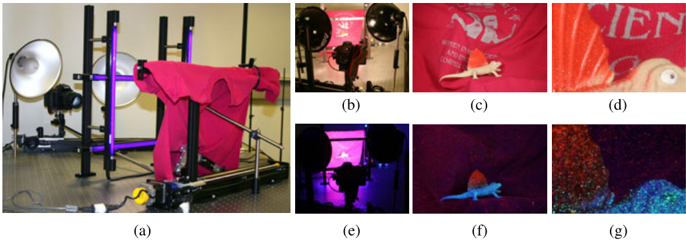
The quantitative evaluation of optical flow algorithms by Barron et al. (1994) led to significant advances in performance. The challenges for optical flow algorithms today go beyond the datasets and evaluation methods proposed in that paper. Instead, they center on problems associated with complex natural scenes, including nonrigid motion, real sensor noise, and motion discontinuities. We propose a new set of benchmarks and evaluation methods for the next generation of optical flow algorithms. To that end, we contribute four types of data to test different aspects of optical flow algorithms: (1) sequences with nonrigid motion where the ground-truth flow is determined by tracking hidden fluorescent texture, (2) realistic synthetic sequences, (3) high frame-rate video used to study interpolation error, and (4) modified stereo sequences of static scenes. In addition to the average angular error used by Barron et al., we compute the absolute flow endpoint error, measures for frame interpolation error, improved statistics, and results at motion discontinuities and in textureless regions.
Overview
CoChat Summary
TL;DR
The paper introduces a new optical flow benchmark of four data types (hidden fluorescent texture, realistic synthetic, high-speed interpolation, and modified stereo) plus an extended evaluation methodology with endpoint error, interpolation error, robustness/accuracy statistics, and region masks. It reports that performance improved substantially over the preliminary 2007 study, but motion discontinuities and diverse datasets remain difficult, and top flow methods still lag top stereo methods on the modified Teddy stereo data.
Key findings
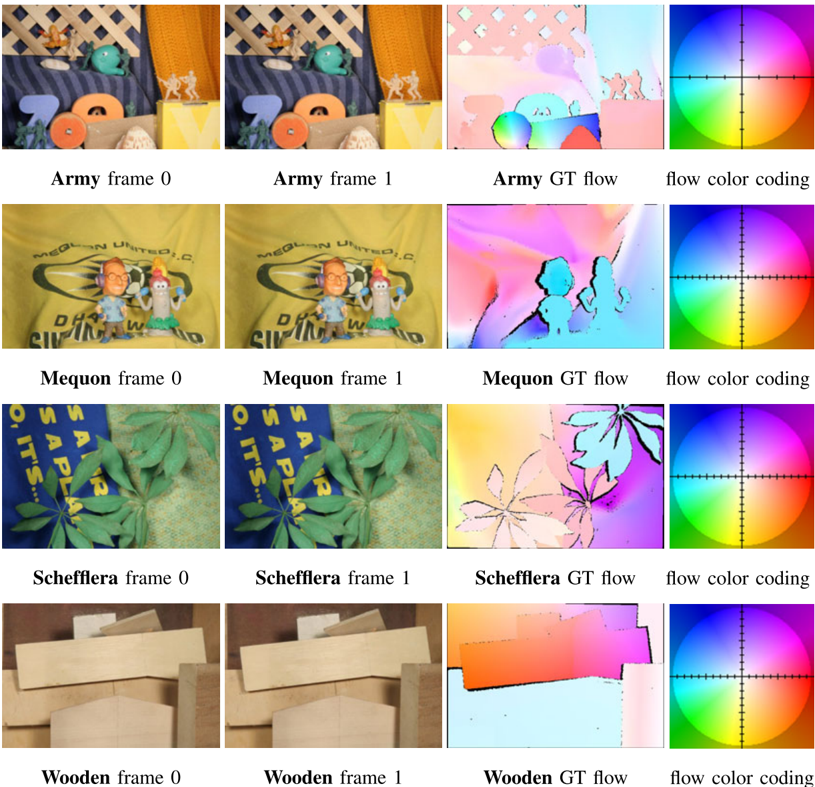
- The benchmark contains 12 training and 12 test sequences; test ground truth is withheld except for Yosemite. As of December 2009 the online evaluation contained results for 24 published methods, all using only 2 input frames and 10 using color.
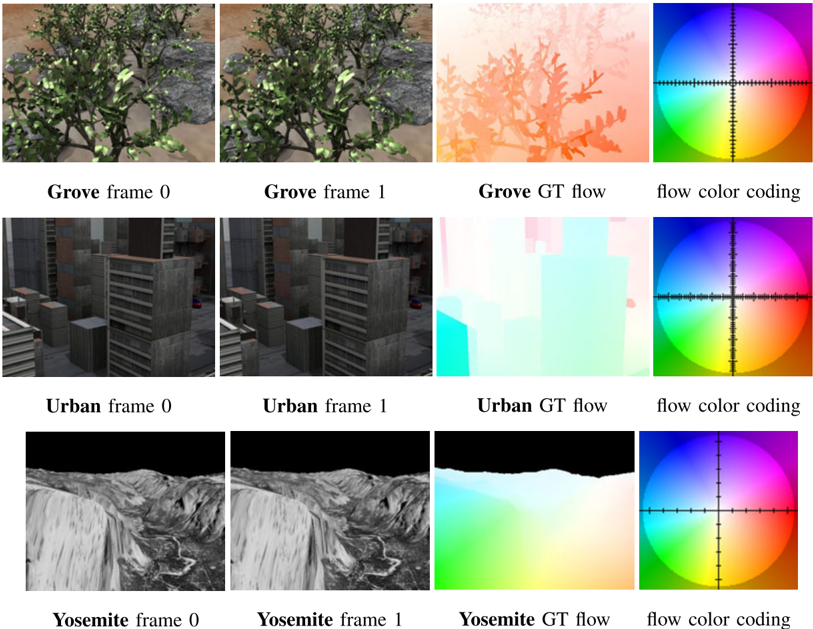
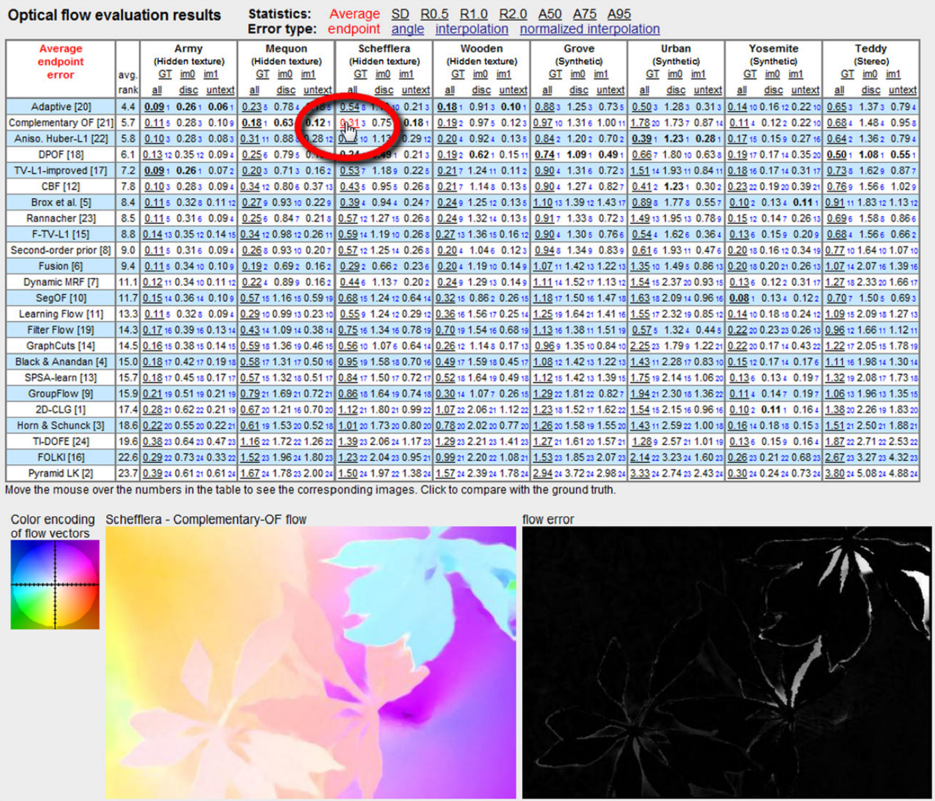
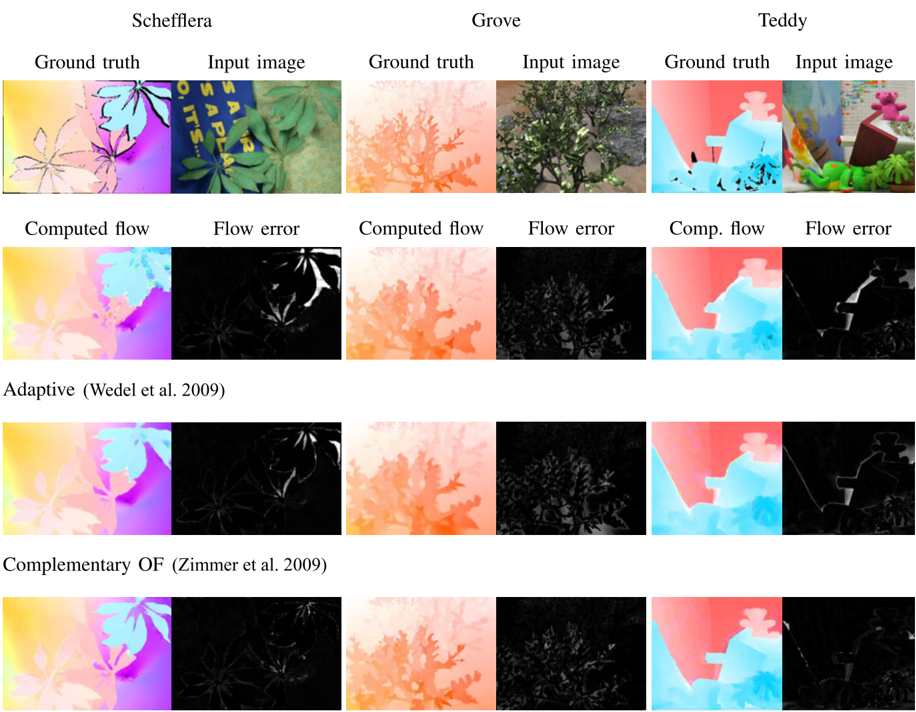
- Best average endpoint error (Avg. EE) improved dramatically over 2D-CLG (Bruhn et al. 2005): Army 0.28→0.09, Mequon 0.67→0.18, Schefflera 1.12→0.24, Wooden 1.07→0.18, Grove 1.23→0.74, Urban 1.54→0.39, Yosemite 0.10→0.08, Teddy 1.38→0.50. Best Avg. EE was below 0.2 pixels on four datasets (Yosemite, Army, Mequon, Wooden).
- Endpoint error (EE) and angular error (AE) rankings were highly correlated (r = 0.989), but the paper argues EE should be preferred: Complementary OF on Urban had Avg. AE 4.64° (rank 6) but Avg. EE 1.78 pixels (rank 20), because AE downweights large motions.
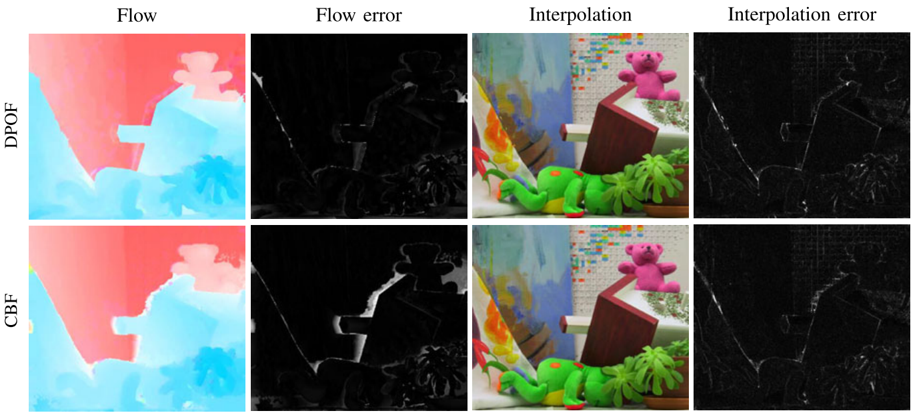
- Motion discontinuity (Disc) regions were the hardest; textureless (Untext) regions were typically easiest. Dataset results were less correlated, with Yosemite poorly or negatively correlated with others. Flow and interpolation errors were only moderately correlated (Avg4 EE vs Avg4 IE r = 0.763). On Teddy, top stereo methods outperformed top flow methods: median lowest-five R1.0 was 9.9 for flow vs 6.5 for stereo in All regions (34% reduction), and 27.6 vs 10.0 in Disc regions (64% reduction).
Methods
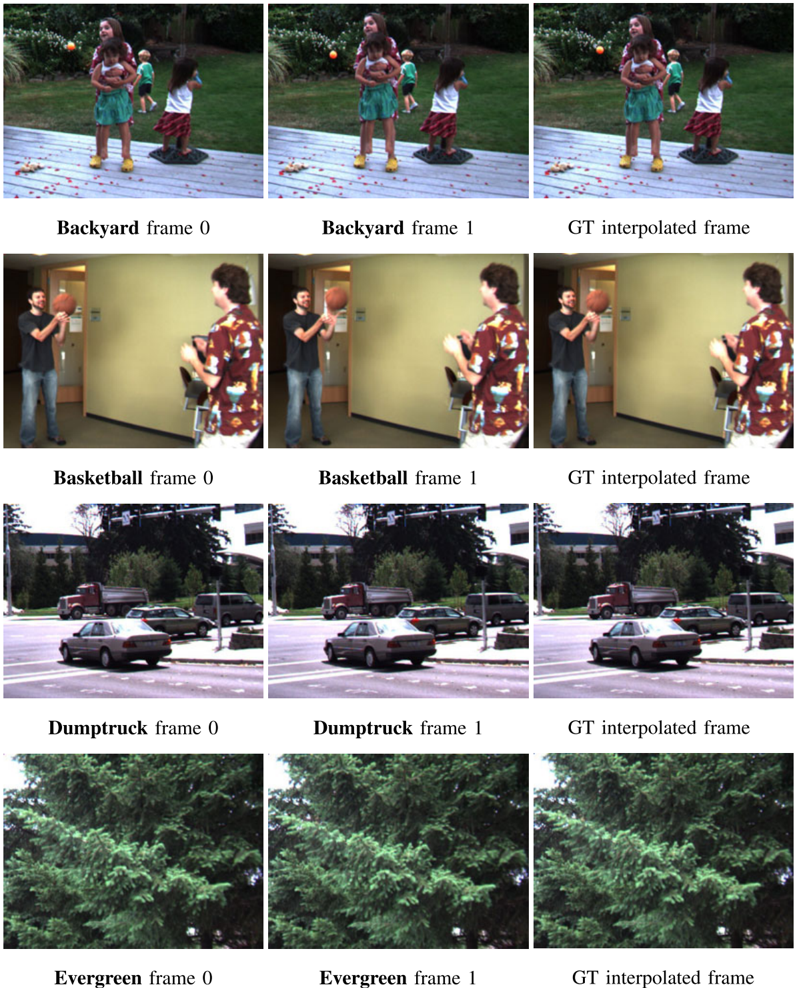
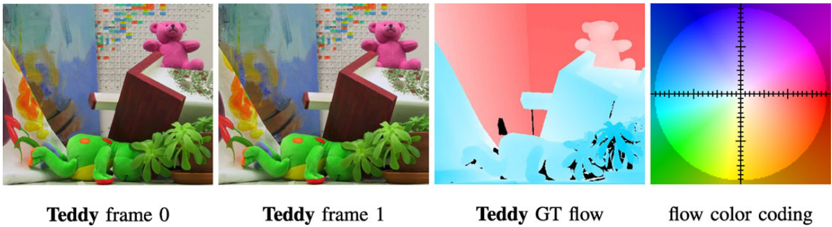
- Four data types were collected: (1) real nonrigid scenes with dense ground truth from hidden fluorescent texture, captured with a Canon EOS 20D at 3504×2336, downsampled every 40th visible-light frame by factor 6 to 584×388, with SSD tracking (15×15 windows), forward/backward crosschecking, and Lucas-Kanade subpixel refinement; (2) realistic synthetic scenes rendered with 3Delight at 640×480, with ground truth from a custom shader and dominant-cluster flow selection; (3) high-speed video for frame interpolation captured with a PointGrey Dragonfly Express at 60 fps, providing every other frame and retaining intermediate frames as ground truth; and (4) modified stereo data (Teddy) from structured light, cropped to make the disparity range roughly symmetric.
- Evaluation metrics include average angular error (AE), absolute flow endpoint error (EE), interpolation error (IE), and gradient-normalized interpolation error (NE). Statistics include averages, robustness measures R_X, and percentile accuracy measures A_X, computed over All, Disc, and Untext region masks.
- Analysis used the online evaluation at http://vision.middlebury.edu/flow/, comparing 24 published methods across metrics, statistics, masks, and datasets, with Pearson correlations between rankings and comparisons to state-of-the-art stereo methods on Teddy.
Limitations
- The paper states that the hidden fluorescent texture scenes are laboratory scenes, not real-world scenes, and have no motion blur due to stop-motion capture; ground truth is unavailable where cross-checking failed, especially occluded regions, and the measured ground truth is not perfect, though significant errors are limited to a small fraction of pixels. Synthetic sequences were generated without motion blur. The modified stereo ground truth is only accurate to 0.25 pixels, and algorithms may exploit the knowledge that motions are horizontal; overfitting to rigid data should be visible across the 12 evaluation images. Interpolation ground truth is an intermediate image, not a flow field, so the flow definition is apparent motion.
- The paper also states that no single method yet achieves strong performance across a wide variety of datatypes, that any dataset has a limited lifespan, and that future studies should include more challenging realistic synthetic data, longer sequences, and more difficult materials, illumination changes, atmospheric effects, and transparency.
- Evident from the text: the online tables do not provide an overall ranking among methods; runtimes are not normalized for programming environment, CPU speed, cores, or hardware acceleration; algorithms are required to produce dense flow and cannot submit confidence maps or sparse/incomplete fields; all 24 published methods used only 2 frames despite 8-frame sequences being available; and the paper cannot definitively answer whether temporal smoothing is less suited to the more challenging sequences.
Model-written summary. Check it against the paper before relying on it.
Integrity signals
Registry
Cites
Statistics
Figures

Verification
Claims the paper makes
2 Valid · 16 Not valid · 58 Not checked · 185 Own results and interpretations
A result the paper states — it cites no source for it, so there is none to check. The quote shows it is in the paper.
In the paper
“Rather than collecting a single type of data (with its inherent limitations) we instead collected four different types of data, each satisfying a different subset of desirable properties.”
plain- Asserted: passes — The authors put it forward as true.
- Checkable: passes — It can be checked against evidence.
- Load-bearing: passes — The paper’s conclusions depend on it.
- Based: passes — The paper gives a reason why it holds.
A result the paper states — it cites no source for it, so there is none to check. The quote shows it is in the paper.
In the paper
“Using the combination of fluorescent paint, downsampling high-resolution images, and sequential tracking of small motions, we are able to obtain dense, subpixel accurate ground truth for a nonrigid scene.”
plainstates a cause- Asserted: passes — The authors put it forward as true.
- Checkable: passes — It can be checked against evidence.
- Load-bearing: passes — The paper’s conclusions depend on it.
- Based: passes — The paper gives a reason why it holds.
A result the paper reports from its own data — it cites no other source for it, so there is none to check. The quote shows it is in the paper.
In the paper
“To allow for measures that predict performance on such tasks, we collected a variety of data suitable for frame interpolation.”
plainstates a cause- Asserted: passes — The authors put it forward as true.
- Checkable: passes — It can be checked against evidence.
- Load-bearing: passes — The paper’s conclusions depend on it.
- Based: passes — The paper gives a reason why it holds.
A result the paper reports from its own data — it cites no other source for it, so there is none to check. The quote shows it is in the paper.
In the paper
“We have developed a technique for capturing imagery of nonrigid scenes with ground-truth optical flow.”
plain- Asserted: passes — The authors put it forward as true.
- Checkable: passes — It can be checked against evidence.
- Load-bearing: passes — The paper’s conclusions depend on it.
- Based: passes — The paper gives a reason why it holds.
A result the paper states — it cites no source for it, so there is none to check. The quote shows it is in the paper.
In the paper
“To go beyond previous synthetic ground truth (e.g., the Yosemite sequence), we generated two types of fairly complex synthetic outdoor scenes.”
plain- Asserted: passes — The authors put it forward as true.
- Checkable: passes — It can be checked against evidence.
- Load-bearing: passes — The paper’s conclusions depend on it.
- Based: passes — The paper gives a reason why it holds.
96 more claims
Create a free account to see all 261 claims and every source verdict.
- Probably not a substantial claim. 114
- It may state two separate claims as one. 76
- The quote only partly states this claim. 6
Claims other papers make about this one
Each is checked against this paper’s own text: does it say what the citing paper says it does?
The source backs part of the claim, not all of it — or backs it for a different population, condition or comparison.
In the citing paper
“Notable works include the Middlebury dataset (Baker et al, 2011) and the KITTI datasets (Geiger et al, 2012; Menze and Geiger, 2015), but due to the difficulty of computing accurate ground truth, these have been restricted to 8 and 2 · 200 pairs of frames, respectively (the latter are also limited by the special driving setting).”
From What Makes Good Synthetic Training Data for Learning Disparity and Optical Flow Estimation? (2018) · cites this paper as Baker et al, 2011
Experimental — accuracy not yet measured
Citations
Cites
The pascal visual object classes (VOC) challenge
Everingham, M., Van Gool, L., Williams, C. K. I., Winn, J., & Zisserman, A. (2010) · International Journal of Computer Vision · doi:10.1007/s11263-009-0275-4 · Cited by 19,599
Proceedings of IEEE Conference on Computer Vision and Pattern Recognition
(1993) · doi:10.1109/cvpr.1993 · Cited by 17,667
Proceedings of IEEE International Conference on Computer Vision
(1995) · Proceedings of IEEE International Conference on Computer Vision · doi:10.1109/iccv.1995.466933 · Cited by 12,860
(1981) · Cited by 11,963
Horn, B. K. P., & Schunck, B. G. (1981) · Artificial Intelligence · doi:10.1016/0004-3702(81)90024-2 · Cited by 10,312
Horn, B. K., & Schunck, B. G. (1981) · SPIE Proceedings · doi:10.1117/12.965761 · Cited by 7,394 · cited 2×
“A baseline approach is to use an L2 norm as in the Horn and Schunck algorithm (Horn and Schunck 1981):”
BackgroundMethodFast approximate energy minimization via graph cuts
Boykov, Y., Veksler, O., & Zabih, R. (2001) · IEEE Transactions on Pattern Analysis and Machine Intelligence · doi:10.1109/34.969114 · Cited by 6,988
A Taxonomy and Evaluation of Dense Two-Frame Stereo Correspondence Algorithms
Scharstein, D., & Szeliski, R. (2002) · International Journal of Computer Vision · doi:10.1023/a:1014573219977 · Cited by 6,740 · cited 10×
“Many areas of computer vision, such as stereo [63], face recognition [28, 55, 68], and object recognition [23, 24], have challenging datasets to track the progress made by leading algorithms and to stimulate new ideas.”
BackgroundMethodResultInfluentialSelf-citationProceedings European Conference on Computer Vision 2002
Heyden, A., Sparr, G., Nielsen, M., & Johansen, P. (2002) · Lund University Publications (Lund University) · Cited by 5,153
From few to many: illumination cone models for face recognition under variable lighting and pose
Georghiades, A. S., Belhumeur, P. N., & Kriegman, D. J. (2001) · IEEE Transactions on Pattern Analysis and Machine Intelligence · doi:10.1109/34.927464 · Cited by 4,912 · cited 1×
“Many areas of computer vision, such as stereo (Scharstein and Szeliski 2002), face recognition (Philips et al. 2005; Sim et al. 2003; Gross et al. 2008; Georghiades et al. 2001), and object recognition (Fei-Fei et al.”
Background
Research works printed but not linked: 4
- Anandan, P., & Weiss, R. (1985). Introducing smoothness constraint in a matching approach for the computation of displacement fields. In Proceedings of the DARPA image understanding workshop (pp. 186-196).
- Bleyer, M., & Chambon, S. (2010). Does color really help in dense stereo matching? In Proceedings of the international symposium 3D data processing, visualization and transmission .
- Lempitsky, V., Roth, S., & Rother, C. (2008). Fusion flow: discretecontinuous optimization for optical flow estimation. In Proceedings of the IEEE conference on computer vision and pattern recognition .
- Rannacher, J. (2009). Realtime 3D motion estimation on graphics hardware . Undergraduate thesis, Heidelberg University.
Cited by
Items 501–600 of 2,273
Krig, S. (2014) · Apress eBooks · doi:10.1007/978-1-4302-5930-5_2 · Cited by 45
Accurate Optical Flow via Direct Cost Volume ProcessingPreprint
Jia, X., Ranftl, R., & Koltun, V. (2017) · arXiv (Cornell University) · doi:10.48550/arxiv.1704.07325 · Cited by 30
“In particular, the problem is largely solved when image motion is small [4, 32].”
BackgroundOptical Flow Estimation with Deep Learning, a Survey on Recent Advances
Savian, S., Elahi, M., & Tillo, T. (2020) · Unsupervised and Semi-Supervised Learning · doi:10.1007/978-3-030-32583-1_12 · Cited by 29
Cascaded Scene Flow Prediction Using Semantic Segmentation
Ren, Z., Sun, D., Kautz, J., & Sudderth, E. B. (2017) · International Conference on 3D Vision (3DV) · doi:10.1109/3dv.2017.00034 · Cited by 37
Contour detection and image segmentation
Malik, J., & Maire, M. (2009) · Cited by 30
Komorkiewicz, M., Kryjak, T., & Gorgoń, M. (2014) · Sensors · doi:10.3390/s140202860 · Cited by 31
“, by creating a synthetic 3D scene with moving objects and rendering 2D images in two time points, more possibilities are described in [9]), they can be compared for each pixel with the results obtained from an optical flow computation algorithm denoted as (u, v).”
BackgroundMethodInfluentialTomasi, M., Vanegas, M., Barranco, F., D�az, J., & Ros, E. (2011) · IEEE Transactions on Circuits and Systems for Video Technology · doi:10.1109/tcsvt.2011.2162260 · Cited by 31
“Evaluation methods are detailed in [41] and [42].”
MethodA Novel Hardware Architecture of the Lucas–Kanade Optical Flow for Reduced Frame Memory Access
Seong, H.-S., Rhee, C. E., & Lee, H.-J. (2015) · IEEE Transactions on Circuits and Systems for Video Technology · doi:10.1109/tcsvt.2015.2437077 · Cited by 31
“In [32], a new benchmark for optical flow is introduced.”
BackgroundZhang, W., Wang, X., Li, H., Zhou, J., Luo, Z., & Meng, G. (2023) · Measurement · doi:10.1016/j.measurement.2023.113812 · Cited by 30
Aggregation of local parametric candidates with exemplar-based occlusion handling for optical flow
Fortun, D., Bouthémy, P., & Kervrann, C. (2015) · Computer Vision and Image Understanding · doi:10.1016/j.cviu.2015.11.020 · Cited by 35
“To validate our method for computing motion candidates, we have processed sequences from MPI Sintel and Middlebury datasets [5, 23] provided with ground truth.”
BackgroundMethodMulti-hypothesis transform domain Wyner-Ziv video coding including optical flow
Huang, X., Rakêt, L. L., Luong, H. V., Nielsen, M., Lauze, F., & Forchhammer, S. O. (2011) · IEEE International Workshop on Multimedia Signal Processing (MMSP) · doi:10.1109/mmsp.2011.6093771 · Cited by 27
“In recent years a large number of techniques have been proposed to determine optical flow, and the accuracy of optical flow algorithms has improved tremendously [14].”
BackgroundYang, M. B., Wang, Y., Cai, C., Liu, Z., Zhu, H., & Zhou, S. (2019) · Optics Express · doi:10.1364/oe.27.015968 · Cited by 27
Joint Learning of Blind Video Denoising and Optical Flow Estimation
Yu, S., Park, B., Park, J., & Jeong, J. (2020) · IEEE/CVF Conference on Computer Vision and Pattern Recognition Workshops (CVPRW) · doi:10.1109/cvprw50498.2020.00258 · Cited by 35
“However, they are generally focused on noise-free sequences such as the KITTI [25] and Middlebury [26] datasets.”
BackgroundPillarFlow: End-to-end Birds-eye-view Flow Estimation for Autonomous Driving
Lee, K.-H., Kliemann, M., Gaidon, A., Li, J., Fang, C., Pillai, S., & Burgard, W. (2020) · IEEE/RSJ International Conference on Intelligent Robots and Systems (IROS) · doi:10.1109/iros45743.2020.9340931 · Cited by 30
“The estimated 2-D BeV flows is visualized by an optical flow representation in [12].”
BackgroundMethodNeural frame interpolation for rendered content
Briedis, K. M., Djelouah, A., Meyer, M., McGonigal, I., Groß, M. H., & Schroers, C. (2021) · ACM Transactions on Graphics · doi:10.1145/3478513.3480553 · Cited by 37
“To rely on estimated motion vectors is the most straightforward approach to frame interpolation [Baker et al. 2011].”
BackgroundMethodWang, Y., Egner, F. S., Willems, T., Kirchner, M., & Desmet, W. (2022) · Mechanical Systems and Signal Processing · doi:10.1016/j.ymssp.2022.108879 · Cited by 31
RealFlow: EM-Based Realistic Optical Flow Dataset Generation from Videos
Han, Y., Luo, K., Luo, A., Liu, J., Fan, H., Luo, G., & Liu, S. (2022) · Lecture notes in computer science · doi:10.1007/978-3-031-19800-7_17 · Cited by 42
A Weighted Optimization Approach to Time-of-Flight Sensor Fusion
Schwarz, S., Sjöström, M., & Olsson, R. (2013) · IEEE Transactions on Image Processing · doi:10.1109/tip.2013.2287613 · Cited by 28
“This weight could, for example, be generated from the optical flow [30] of the texture sequence.”
BackgroundRoujol, S., Anter, E., Josephson, M. E., & Nezafat, R. (2013) · PLoS ONE · doi:10.1371/journal.pone.0078852 · Cited by 33
“point and served as motion estimate accuracy as follows [26]:”
MethodFast Optical Flow Estimation Based on the Split Bregman Method
Chen, J., Cai, Z., Lai, J., & Xie, X. (2016) · IEEE Transactions on Circuits and Systems for Video Technology · doi:10.1109/tcsvt.2016.2615324 · Cited by 29
“Visual comparison of the different support weights for the marked region a in the army image sequence [31].”
BackgroundMethodInfluentialVirtual Rephotography: Novel View Prediction Error for 3D Reconstruction
Waechter, M., Beljan, M., Fuhrmann, S., Moehrle, N., Kopf, J., & Goesele, M. (2017) · ACM Transactions on Graphics · doi:10.1145/3072959.2999533 · Cited by 33
“Among other metrics this has been implemented in the Middlebury flow benchmark [Baker et al. 2011].”
MethodA Novel Benchmark RGBD Dataset for Dormant Apple Trees and Its Application to Automatic Pruning
Akbar, S. A., Chattopadhyay, S., Elfiky, N. M., & Kak, A. C. (2016) · IEEE/CVF Conference on Computer Vision and Pattern Recognition Workshops (CVPRW) · doi:10.1109/cvprw.2016.50 · Cited by 35
“dataset [7], Middlebury datasets [27, 14, 28], the Cityscapes dataset for semantic understanding of urban scenes through visul perception [9], benchmarks for evaluating optical flow algorithms [6], pedestrian detection benchmarks [10] and many more.”
MethodJoshi, N., & Zitnick, C. L. (2014) · Cited by 31
Coarse-to-Fine PatchMatch for Dense Correspondence
Li, Y., Hu, Y., Song, R., Rao, P., & Wang, Y. (2017) · IEEE Transactions on Circuits and Systems for Video Technology · doi:10.1109/tcsvt.2017.2720175 · Cited by 29
“We find that after n = 6, our matching method nearly converges, and it obtains a limited gain in accuracy for even larger n . average endpoint error (AEE) [6] for the MPI-Sintel test set.”
MethodEDEN: Multimodal Synthetic Dataset of Enclosed GarDEN Scenes
Lê, H.-Â., Mensink, T., Das, P., Karaoğlu, S., & Gevers, T. (2021) · IEEE Winter Conference on Applications of Computer Vision · doi:10.1109/wacv48630.2021.00162 · Cited by 54
Liu, S., Wang, X., Li, S., et al. (2021) · Expert Systems with Applications · doi:10.1016/j.eswa.2021.116216 · Cited by 27
Optical Flow Estimation with Channel Constancy
Sevilla-Lara, L., Sun, D., Miller, E. G., & Black, M. J. (2014) · Lecture notes in computer science · doi:10.1007/978-3-319-10590-1_28 · Cited by 31
“Below we use mean endpoint error (MEPE) as a measure of accuracy [1].”
MethodSelf-citationEM-Driven Unsupervised Learning for Efficient Motion Segmentation
Meunier, E., Badoual, A., & Bouthémy, P. (2022) · IEEE Transactions on Pattern Analysis and Machine Intelligence · doi:10.1109/tpami.2022.3198480 · Cited by 53
“Second row: the input flow field displayed with the HSV color code [3] that is depicted in Fig.”
MethodSplatting-based Synthesis for Video Frame Interpolation
Niklaus, S., Hu, P., & Chen, J. (2023) · IEEE Winter Conference on Applications of Computer Vision · doi:10.1109/wacv56688.2023.00078 · Cited by 42
PanoFlow: Learning 360° Optical Flow for Surrounding Temporal Understanding
Shi, H., Zhou, Y., Yang, K., Yin, X., Wang, Z., Ye, Y., Yin, Z., Shi, M., Li, P., & Wang, K. (2023) · IEEE Transactions on Intelligent Transportation Systems · doi:10.1109/tits.2023.3241212 · Cited by 57
“We further explore the photoconsistency [67] by introducing photometric error (PE) and warped photometric error (WPE) to evaluate the ground-truth optical flow quality of the dataset when only forward flow is given:”
BackgroundMethodThe City of Sights: Design, construction, and measurement of an Augmented Reality stage set
Gruber, L., Gauglitz, S., Ventura, J., Zollmann, S., Huber, M., Schlegel, M., Klinker, G., Schmalstieg, D., & Höllerer, T. (2010) · Proceedings - International Symposium on Mixed and Augmented Reality, ISMAR · doi:10.1109/ismar.2010.5643564 · Cited by 36
“, [1, 23, 32]), this has not yet happened for AR, although the need for common datasets and quantitative evaluations has been recognized [10, 21, 33].”
BackgroundMethodLearning to Extract Motion from Videos in Convolutional Neural NetworksPreprint
Teney, D., & Hebert, M. (2016) · arXiv (Cornell University) · doi:10.48550/arxiv.1601.07532 · Cited by 34
Li, H., Yang, Z., Zhang, Y., Tao, D., & Yu, Z. (2024) · IEEE Transactions on Computational Imaging · doi:10.1109/tci.2024.3369396 · Cited by 29
“In explicit alignment meth-ods, the common alignment strategy is image alignment based on optical flow [33].”
Offline and Online Optical Flow Enhancement for Deep Video Compression
Tang, C., Sheng, X., Li, Z., Zhang, H., Li, L., & Liu, D. (2024) · Proceedings of the AAAI Conference on Artificial Intelligence · doi:10.1609/aaai.v38i6.28317 · Cited by 49
Bayesian Inference of Models and Hyperparameters for Robust Optical-Flow Estimation
Héas, P., Herzet, C., & Mémin, É. (2011) · IEEE Transactions on Image Processing · doi:10.1109/tip.2011.2179053 · Cited by 28
“In this database, challenging computer vision scenes are provided for optical-flow estimation evaluation [1].”
BackgroundMethodInfluentialConvex Relaxation of Vectorial Problems with Coupled Regularization
Strekalovskiy, E., Chambolle, A., & Cremers, D. (2014) · SIAM Journal on Imaging Sciences · doi:10.1137/130908348 · Cited by 25
Detecting people carrying objects based on an optical flow motion model
Senst, T., Evangelio, R. H., & Sikora, T. (2011) · Proceedings · doi:10.1109/wacv.2011.5711518 · Cited by 30
“In the recent years, optical flow computation has becaoe more and more accurate [3].”
BackgroundLi, B., Dinesh, K., Duan, Z., et al. (2017) · IEEE International Conference on Acoustics Speech and Signal Processing · doi:10.1109/icassp.2017.7952688 · Cited by 26
“[7] that ranked first on the Middlebury optical flow benchmark [18] at the time of publication.”
BackgroundGIF2Video: Color Dequantization and Temporal Interpolation of GIF Images
Wang, Y., Huang, H., Wang, C., He, T., Wang, J., & Hoai, M. (2019) · IEEE Computer Society Conference on Computer Vision and Pattern Recognition/Proceedings - IEEE Computer Society Conference on Computer Vision and Pattern Recognition/Proceedings · doi:10.1109/cvpr.2019.00151 · Cited by 26
“Classical video interpolation meth-ods rely on cross-frame motion estimation and occlusion reasoning [3, 4, 14, 18].”
BackgroundKey frame extraction based on global motion statistics for team-sport videos
Yuan, Y., Lu, Z., Yang, Z., Jian, M., Wu, L., Li, Z., & Liu, X. (2021) · Multimedia Systems · doi:10.1007/s00530-021-00777-7 · Cited by 28
Exploiting Attention-Consistency Loss For Spatial-Temporal Stream Action Recognition
Xu, H., Jin, X., Wang, Q., Hussain, A., & Huang, K. (2022) · ACM Transactions on Multimedia Computing Communications and Applications · doi:10.1145/3538749 · Cited by 27
“On the other hand, two-stream structures separately process spatial information and temporal information based on different types of inputs such as normally RGB and precomputed optical flow [2] using 2D CNN backbones.”
MethodDelay-Optimized Multi-User VR Streaming via End-Edge Collaborative Neural Frame Interpolation
Yang, S., Yang, P., Chen, J., et al. (2023) · IEEE Transactions on Network Science and Engineering · doi:10.1109/tnse.2023.3296511 · Cited by 25
“AsetofVRvideosareclassifiedusing conventionalopticalflowmethod[33],videoswithhighaverage fieldstrengthareconsideredtocontainhigh-motioncontents, andviceversa.”
Progress in the restoration of image sequences degraded by atmospheric turbulence
Gal, R., Kiryati, N., & Sochen, N. (2014) · Pattern Recognition Letters · doi:10.1016/j.patrec.2014.04.007 · Cited by 26
“A recent overview of optical flow methods can be found in [15].”
BackgroundPixel-level robust digital image correlation
Cofaru, C., Philips, W. R., & Paepegem, W. V. (2013) · Optics Express · doi:10.1364/oe.21.029979 · Cited by 26
UnrealStereo: A Synthetic Dataset for Analyzing Stereo Vision.
Zhang, Y., Qiu, W., Chen, Q., Hu, X., & Yuille, A. (2016) · Cited by 27
On illumination-invariant variational optical flow for weakly textured scenes
Trinh, D. H., & Daul, C. (2018) · Computer Vision and Image Understanding · doi:10.1016/j.cviu.2018.11.004 · Cited by 31
Mask-CDNet: A mask based pixel change detection network
Bu, S., Li, Q., Han, P., Leng, P., & Li, K. (2019) · Neurocomputing · doi:10.1016/j.neucom.2019.10.022 · Cited by 27
Weighted local intensity fusion method for variational optical flow estimation
Tu, Z., Poppe, R. W., & Veltkamp, R. C. (2015) · Pattern Recognition · doi:10.1016/j.patcog.2015.09.002 · Cited by 25
“7 shows the results of the Beanbags [40] sequence produced by three state-of-the-art large displacement handling methods: LDOF [32], Classic þ NLP [45] and NN-fi eld [8].”
Scene flow by tracking in intensity and depth data
Quiroga, J., Devernay, F., & Crowley, J. L. (2012) · 2009 IEEE Computer Society Conference on Computer Vision and Pattern Recognition Workshops · doi:10.1109/cvprw.2012.6239237 · Cited by 30
“In the pyramidal decomposition points with unmeasured depth are propagated in the different levels increasing the effective area of the regions where scene flow can not be computed.”
BackgroundTowards the intrahour forecasting of direct normal irradiance using sky-imaging data
Nou, J., Chauvin, R., Eynard, J., Thil, S., & Grieu, S. (2018) · Heliyon · doi:10.1016/j.heliyon.2018.e00598 · Cited by 29
“This so-called Aperture problem is then regularized with a prior term, generally consisting in a smoothness constraint (Baker et al., 2011).”
MethodOn optical flow techniques applied to breaking surges
Shi, R., Leng, X., & Chanson, H. (2020) · Flow Measurement and Instrumentation · doi:10.1016/j.flowmeasinst.2020.101710 · Cited by 27
Performance Testing of Optical Flow Time Series Analyses Based on a Fast, High-Alpine Landslide
Hermle, D., Gaeta, M., Krautblatter, M., et al. (2022) · Remote Sensing · doi:10.3390/rs14030455 · Cited by 25
“Based on the assumption of a globally smooth motion field [44], or if the dynamic motion field is constant within a certain interrogation window [34], the brightness constancy term is valid, so changes in illumination are resolved in motion [43,45].”
BackgroundMethodKong, N., Gehler, P., & Black, M. J. (2014) · Lecture notes in computer science · doi:10.1007/978-3-319-10605-2_24 · Cited by 30
“We compute EPE (averaged end-point-error) [1] of the estimated flow (using estimated albedo sequences) compared with the ground truth flow and then average this over the three synthetic examples.”
MethodSelf-citationEVA$^{2}$: Event-Assisted Video Frame Interpolation via Cross-Modal Alignment and Aggregation
Xiao, Z., Weng, W., Zhang, Y., & Xiong, Z. (2022) · IEEE Transactions on Computational Imaging · doi:10.1109/tci.2022.3228747 · Cited by 33
“, VIMEO90K-TRIPLET [1], MIDDLEBURY [82], AND GOPRO [83].”
MethodAudio-driven Neural Gesture Reenactment with Video Motion Graphs
Zhou, Y., Yang, J., Li, D., Saito, J., Aneja, D., & Kalogerakis, E. (2022) · IEEE Computer Society Conference on Computer Vision and Pattern Recognition/Proceedings - IEEE Computer Society Conference on Computer Vision and Pattern Recognition/Proceedings · doi:10.1109/cvpr52688.2022.00341 · Cited by 38
“More advanced frame interpolation methods [25,32,43,49] based on optical flow estimation [5, 29, 64] have been proposed to synthesize intermediate frames between two consecutive frames, in particular for slow motion videos.”
MethodDisentangling Architecture and Training for Optical Flow
Sun, D., Herrmann, C., Reda, F. A., Rubinstein, M., Fleet, D. J., & Freeman, W. T. (2022) · Lecture notes in computer science · doi:10.1007/978-3-031-20047-2_10 · Cited by 52
“It is the first deep learning based approach to outperform traditional methods on Middlebury, such as NNF-Local [6] (avg. rank 5.8 and 7.4), which had been the top-performing method since 2013.”
MethodInfluentialHigh Dynamic Range Imaging with Context-aware Transformer
Zhou, F., Fu, Z., & Zhang, D. (2023) · doi:10.1109/ijcnn54540.2023.10191491 · Cited by 25
“However, traditional image alignment methods, such as optical flow methods [8], patch-based optimization methods [10], [11] and mesh flow methods [9], will inevitably produce ghosts because they cannot strictly align when large movements occur.”
MethodZhou, Y. C., Yang, Y., Yi, M., Bai, X., Liu, W., & Latecki, L. J. (2014) · International Journal of Pattern Recognition and Artificial Intelligence · doi:10.1142/s0218001414550015 · Cited by 26
Histogram-Based Optical Flow for Motion Estimation in Ultrasound Imaging
Tenbrinck, D., Schmid, S., Jiang, X., Schäfers, K. P., & Stypmann, J. (2012) · Journal of Mathematical Imaging and Vision · doi:10.1007/s10851-012-0398-z · Cited by 26
“This was done for different levels of noise and for each level the algorithm parameters were optimized with respect to the AEE result.”
BackgroundMethodResultInfluentialMotion estimation of crowd flow using optical flow techniques: A review
Kajo, I., Malik, A. S., & Kamel, N. (2015) · International Conference on Signal Processing and Communication Systems · doi:10.1109/icspcs.2015.7391778 · Cited by 27
An integrated artificial vision framework for assisting visually impaired users
Chessa, M., Noceti, N., Odone, F., Solari, F., Sosa-García, J., & Zini, L. (2016) · Computer Vision and Image Understanding · doi:10.1016/j.cviu.2015.11.007 · Cited by 27
Comparative study of algorithms for cloud motion estimation using sky-imaging data
Zaher, A., Thil, S., Nou, J., et al. (2017) · IFAC-PapersOnLine · doi:10.1016/j.ifacol.2017.08.1488 · Cited by 25
Local All-Pass Geometric Deformations
Gilliam, C., & Blu, T. (2017) · IEEE Transactions on Image Processing · doi:10.1109/tip.2017.2765822 · Cited by 23
“For a review of modern optical flow estimation we refer the reader to [36], [44].”
BackgroundIn Vivo Detection of Chronic Kidney Disease Using Tissue Deformation Fields From Dynamic MR Imaging
Hodneland, E., Keilegavlen, E., Hanson, E., Andersen, E., Monssen, J. A., Rørvik, J. T., Leh, S. M., Marti, H., Lundervold, A., Svarstad, E., et al. (2018) · IEEE Transactions on Biomedical Engineering · doi:10.1109/tbme.2018.2879362 · Cited by 30
MUGGLE: MUlti-Stream Group Gaze Learning and Estimation
Zhuang, N., Ni, B., Xu, Y. X., Yang, X., Zhang, W., Li, Z., & Gao, W. (2019) · IEEE Transactions on Circuits and Systems for Video Technology · doi:10.1109/tcsvt.2019.2940479 · Cited by 26
“In other words, we would like to turn the original image into a map similar to optical flow [3], where every pixel represents a point at a person’s viewing path.”
BackgroundOsadchiev, A. A., Barymova, A., Sedakov, R., Zhiba, R., & Dbar, R. S. (2020) · Remote Sensing · doi:10.3390/rs12183079 · Cited by 25
“In this study we used an optical flow algorithm to reconstruct velocity fields in the sea surface layer from quadcopter video records [76,77].”
MethodModels Matter, So Does Training: An Empirical Study of CNNs for Optical Flow EstimationPreprint
Sun, D., Yang, X., Liu, M.-Y., et al. (2018) · arXiv (Cornell University) · doi:10.48550/arxiv.1809.05571 · Cited by 25
“Sun et al. [39] learn a full model for optical flow, but the learning has been limited to a few training sequences [12].”
BackgroundMethodInfluentialMotion denoising with application to time-lapse photography
Rubinstein, M., Liu, C., Sand, P., Durand, F., & Freeman, W. T. (2011) · IEEE Computer Society Conference on Computer Vision and Pattern Recognition/Proceedings - IEEE Computer Society Conference on Computer Vision and Pattern Recognition/Proceedings · doi:10.1109/cvpr.2011.5995374 · Cited by 27
“(e) The color coding used for visualizing the displacement fields, borrowed from [2].”
MethodCristovao, P., Nakada, H., Tanimura, Y., & Asoh, H. (2020) · IEEE Access · doi:10.1109/access.2020.3016313 · Cited by 31
“To evaluate the error between the actual in-between and predicted image interpolation, we follow some baseline metrics presented in [49], including the peak signal-to-noise ratio (PSRN), structural similarity index FIGURE 9.”
MethodReference-Free DIBR-Synthesized Video Quality Metric in Spatial and Temporal Domains
Wang, G., Wang, Z., Gu, K., Jiang, K., & He, Z. (2021) · IEEE Transactions on Circuits and Systems for Video Technology · doi:10.1109/tcsvt.2021.3074181 · Cited by 28
Phase-Based Displacement Sensor With Improved Spatial Frequency Estimation and Data Fusion Strategy
Zhou, J., Zhang, W., Li, Y., Wang, X., Zhang, L., & Li, H. (2022) · IEEE Sensors Journal · doi:10.1109/jsen.2022.3141110 · Cited by 24
Siogkas, G. K., & Dermatas, E. (2012) · IEEE Transactions on Intelligent Transportation Systems · doi:10.1109/tits.2012.2223686 · Cited by 24
“It has been estimated with several methods [33], each with its strengths and weaknesses.”
Ground truth design principles
Kondermann, D. (2013) · doi:10.1145/2501105.2501114 · Cited by 25
“Its optical flow dataset [1] was created by adding UV paint to the scene in order to generate an invisible texture that can be seen only with UV light being turned on.”
MethodVariational Optical Flow Estimation Based on Stick Tensor Voting
Rashwan, H. A., García, M. Á., & Puig, D. (2013) · IEEE Transactions on Image Processing · doi:10.1109/tip.2013.2253481 · Cited by 26
“Many methods have been proposed for estimating an optical flow field based on differential techniques [17].”
MethodMéhu, M., & van der Maaten, L. J. P. (2014) · Journal of Nonverbal Behavior · doi:10.1007/s10919-014-0192-2 · Cited by 31
“The optical flow estimator outlined above is presently one of the best-performing algorithms on a widely used benchmark data set for evaluation of optical flow algorithms (Werlberger et al. 2010; Baker et al. 2011).”
MethodSmoothness Constraints in Recursive Search Motion Estimation for Picture Rate Conversion
Bartels, C., & de Haan, G. (2010) · IEEE Transactions on Circuits and Systems for Video Technology · doi:10.1109/tcsvt.2010.2058474 · Cited by 26
“Screenshots, taken at the time of writing, of the Middlebury optical flow benchmark [27] with our method highlighted in dark gray.”
InfluentialDictionary-based multiple frame video super-resolution
Dai, Q., Yoo, S., Kappeler, A., & Katsaggelos, A. K. (2015) · Proceedings - International Conference on Image Processing · doi:10.1109/icip.2015.7350764 · Cited by 22
“Only αk is used in Equation (6) to reconstruct the HR patch in the current frame.”
MethodHighly accurate optical flow estimation on superpixel tree
Hu, Y., Song, R., Li, Y., Rao, P., & Wang, Y. (2016) · Image and Vision Computing · doi:10.1016/j.imavis.2016.06.004 · Cited by 28
Ultrasound field characterization using synthetic schlieren tomography
Pulkkinen, A., Leskinen, J. J., & Tiihonen, A. (2017) · The Journal of the Acoustical Society of America · doi:10.1121/1.4986623 · Cited by 24
Li, Z., Dong, Q., Saligane, M., Kempke, B. P., Gong, L., Zhang, Z., Dreslinski, R., Sylvester, D., Blaauw, D. T., & Kim, H.-S. (2017) · IEEE Journal of Solid-State Circuits · doi:10.1109/jssc.2017.2751501 · Cited by 24
“We evaluate this technique with standard Middlebury [36] and KITTI [21] benchmarks.”
MethodDesktop Action Recognition From First-Person Point-of-View
Cai, M., Lu, F., & Gao, Y. (2018) · IEEE Transactions on Cybernetics · doi:10.1109/tcyb.2018.2806381 · Cited by 26
“Optical flow [44]–[46] measures local motion of pixels or keypoints, and previous research has shown that features based on optical flow are effective for action recognition.”
BackgroundA Multi-Scale Position Feature Transform Network for Video Frame Interpolation
Cheng, X., & Chen, Z. (2019) · IEEE Transactions on Circuits and Systems for Video Technology · doi:10.1109/tcsvt.2019.2939143 · Cited by 25
“[6]”
MethodInfluentialXu, D., Fu, H., Wu, L., Jian, M., Wang, D., & Liu, X. (2020) · IEEE Access · doi:10.1109/access.2020.2979742 · Cited by 27
“[17].”
A Dual Camera System for High Spatiotemporal Resolution Video Acquisition
Cheng, M., Ma, Z., Asif, M. S., Xu, Y., Liu, H., Bao, W., & Sun, J. (2020) · IEEE Transactions on Pattern Analysis and Machine Intelligence · doi:10.1109/tpami.2020.2983371 · Cited by 27
“Motion estimation can be performed using classical block-based or dense optical flow-based methods [2]– [5], [25], [37], [47].”
MethodAnimating Still Landscape Photographs Through Cloud Motion Creation
Jhou, W.-C., & Cheng, W.-H. (2015) · IEEE Transactions on Multimedia · doi:10.1109/tmm.2015.2500031 · Cited by 24
“8(f), the color coding system in [40] is used to visualize the resultant flow field.”
MethodBayesian Estimation of Turbulent Motion
Héas, P., Herzet, C., Mémin, É., Heitz, D., & Mininni, P. D. (2012) · IEEE Transactions on Pattern Analysis and Machine Intelligence · doi:10.1109/tpami.2012.232 · Cited by 30
“From top to bottom at time t = 30∆t (left), t = 60∆t (middle) and t = 90∆t (right): simulated velocity fields visualized using the color system of [1], scalar and particle images, motion estimates in the case of scalar and particle images .”
Assessment of multi-exposure HDR image deghosting methods
Karađuzović-Hadžiabdić, K., Telalović, J. H., & Mantiuk, R. (2017) · Computers & Graphics · doi:10.1016/j.cag.2017.01.002 · Cited by 23
A vision-based sense-and-avoid system tested on a ScanEagle UAV
Bratanov, D., Mejías, L., & Ford, J. (2017) · International Conference on Unmanned Aircraft Systems (ICUAS) · doi:10.1109/icuas.2017.7991302 · Cited by 23
“For details on this technique refer to [30] and references within.”
MethodZhang, Y., Ngan, K. N., Ma, L., & Li, H. (2017) · IEEE Transactions on Image Processing · doi:10.1109/tip.2017.2746260 · Cited by 23
“The estimated flow in the top row is visualized by [39].”
A Filtering-Based Framework for Optical Flow Estimation
Chen, J., Cai, Z., Lai, J., & Xie, X. (2018) · IEEE Transactions on Circuits and Systems for Video Technology · doi:10.1109/tcsvt.2018.2805101 · Cited by 27
“These real-world challenges are not present in previous datasets [22], [34].”
BackgroundMethodInfluentialColor vision deficiency datasets & recoloring evaluation using GANs
Li, H., Zhang, L., Zhang, X., Zhang, M., Zhu, G., Shen, P., Li, P., Bennamoun, M., & Shah, S. A. A. (2020) · Multimedia Tools and Applications · doi:10.1007/s11042-020-09299-2 · Cited by 26
Unsupervised Image Registration for Video SAR
Xue-jun, H., Ding, J., & Guo, Q. (2020) · IEEE Journal of Selected Topics in Applied Earth Observations and Remote Sensing · doi:10.1109/jstars.2020.3032464 · Cited by 24
“(e) Estimated displacement fields which are visualized using the standard optical-flow visualization [29].”
MethodSTI-Net: Spatiotemporal integration network for video saliency detection
Zhou, X., Cao, W., Gao, H., Ming, Z., & Zhang, J. (2023) · Information Sciences · doi:10.1016/j.ins.2023.01.106 · Cited by 27
A Filter Formulation for Computing Real Time Optical Flow
Adarve, J. D., & Mahony, R. E. (2016) · IEEE Robotics and Automation Letters · doi:10.1109/lra.2016.2532928 · Cited by 22
“The optical flow filter is configured with two pyramid levels, [4, 2] propagation iterations, [2, 4] smooth iterations and gains γ = [50, 5] at bottom and top levels respectively.”
BackgroundMethodInfluentialA proof-of-concept framework for PDE-based video compression
Andris, S., Peter, P., & Weickert, J. (2016) · Picture Coding Symposium · doi:10.1109/pcs.2016.7906362 · Cited by 23
Perception for UAV: Vision-Based Navigation and Environment Modeling
Sanfourche, M., Delaune, J. H., Besnerais, G. L., de Plinval, H., Israel, J., Cornic, P., Treil, A., Watanabe, Y., & Plyer, A. (2012) · HAL · doi:10.12762/2012.al04-04 · Cited by 37
syris: a flexible and efficient framework for X-ray imaging experiments simulation
Faragó, T., Mikulík, P., Ershov, A., Vogelgesang, M., Hänschke, D., & Baumbach, T. (2017) · Journal of Synchrotron Radiation · doi:10.1107/s1600577517012255 · Cited by 26
“…the future is to create a database of testing data sets with given ground truth data, similar to a number of popular databases for computer vision (Baker et al. , 2011; Martin et al. , 2001) and medical image analysis (van Ginneken et al. , 2010; Arganda-Carreras et al. , 2015; Hogeweg et al. ,…”
MethodSurvey on hardware implementations of visual object trackers
El‐Shafie, A. A., & Habib, S. E. D. (2019) · IET Image Processing · doi:10.1049/iet-ipr.2018.5952 · Cited by 24
BTBUFood-60: Dataset for Object Detection in Food Field
Cai, Q., Li, J., Li, H., & Weng, Y. (2019) · IEEE International Conference on Big Data and Smart Computing (BigComp) · doi:10.1109/bigcomp.2019.8678916 · Cited by 24
“For instance, the creation of ground truth stereo and optical flow datasets [6], [7] helped draw”
BackgroundNoorshams, N., & Wainwright, M. J. (2012) · arXiv (Cornell University) · doi:10.48550/arxiv.1212.3850 · Cited by 35
“Moving beyond simulated problems, we conclude by showing the SOSMP algorithm in application to a larger scale problem that arises in computer vision—namely, that of optical flow estimation [4].”
Method
Metadata
- Authors
- Baker, S., Scharstein, D., Lewis, J. P., Roth, S., Black, M. J., & Szeliski, R.
- Affiliations
- Microsoft (United States) (US)
- Middlebury College (US)
- Technische Universität Darmstadt (DE)
- Brown University (US)
- Corresponding author
- Scharstein, Daniel
- Venue
- International Journal of Computer Vision
- Published
- 2010-11-30
- Volume
- 92
- Issue
- 1
- Pages
- 1-31
- ISSN
- 0920-5691 (ISSN-L)
- 1573-1405
- OpenAlex
- W2147253850
- Semantic Scholar
- 804836b8ad86ef8042e3dcbd45442a52f031ee03
- Cited by
- 2,205
- References
- 112
- Citations by year
- 2026: 49 · 2025: 81 · 2024: 82 · 2023: 117 · 2022: 129 · 2021: 152 · 2020: 174 · 2019: 163 · 2018: 144 · 2017: 156 · 2016: 187 · 2015: 180 · 2014: 154 · 2013: 129 · 2012: 118
- FWCI
- 146.62
- Type
- journal article
- Language
- en
- Open access
- hybrid
- doi.org
- Licence
- cc-by-nc
- Locations
- International Journal of Computer Vision (publishedVersion, cc-by-nc)
- Publikationsdatenbank der Fraunhofer-Gesellschaft (Fraunhofer-Gesellschaft) (publishedVersion)
- Max Planck Institute for Plasma Physics (submittedVersion)
- Fraunhofer-Publica (Fraunhofer-Gesellschaft) (submittedVersion)
- Funders
- National Science Foundation (0534858, 0535075, 0413169)
- Intel Corporation
- Topics
- Physical Sciences › Computer Science › Computer Vision and Pattern Recognition › Advanced Vision and Imaging
- Physical Sciences › Computer Science › Computer Vision and Pattern Recognition › Video Surveillance and Tracking Methods
- Physical Sciences › Computer Science › Signal Processing › Video Coding and Compression Technologies
- Keywords
- optical flow, benchmark dataset, evaluation methodology, non-rigid motion, motion discontinuities, textureless regions, sensor noise
About these checks
Registry, retraction, Cites and statistics results are computed, not judged, with one exception: a printed reference that no index lists is read once by a model before it counts as a citation error. Claims are extracted by a model and kept only when their quote appears verbatim in the text; each cited source is then checked, with a model’s help, for whether it says what the claim relies on. Those verdicts can be wrong — read the claim’s quote and the cited source before relying on one.
The claim verdicts this report counts are experimental: their accuracy is not yet measured.
A language model drew the claims from the paper on 2026-10-01, under version 3 of the claim definition (model deepseek-v4.1-flash, prompt extract-v3).
A second model labelled each claim on 2026-10-01 (model jev-1.13-20260917, definition revision gold-guideline-v0.2).
Statistics and arithmetic are recomputed, not judged.
Confidence bands are shown only for fields calibrated on our annotated test set. None is calibrated yet, so no band is shown.
What counts as a claim ›How we measure confidence ›How we check this ›
Are you an author, or do you see a problem with this page? Request a review
Data sources
Bibliographic data: Semantic Scholar, OpenAlex, Crossref.
Contains information from the Semantic Scholar Academic Graph Datasets, made available under the ODC Attribution License (ODC-BY 1.0).
Semantic Scholar’s data is described in: Kinney, R., et al. (2023). The Semantic Scholar Open Data Platform. arXiv:2301.10140.
