

A Database and Evaluation Methodology for Optical Flow
Open accessThe DOI matches its Crossref record; 110 of the 112 references it cites were found in a registry or an index; 2 of the 68 sources its claims cite were checked for support.
Abstract
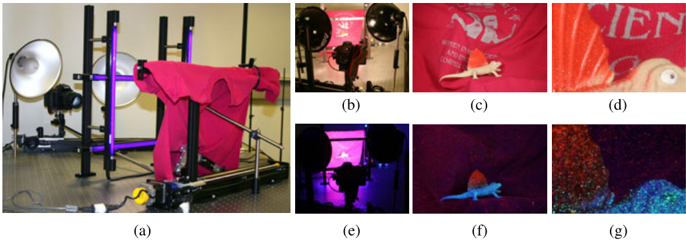
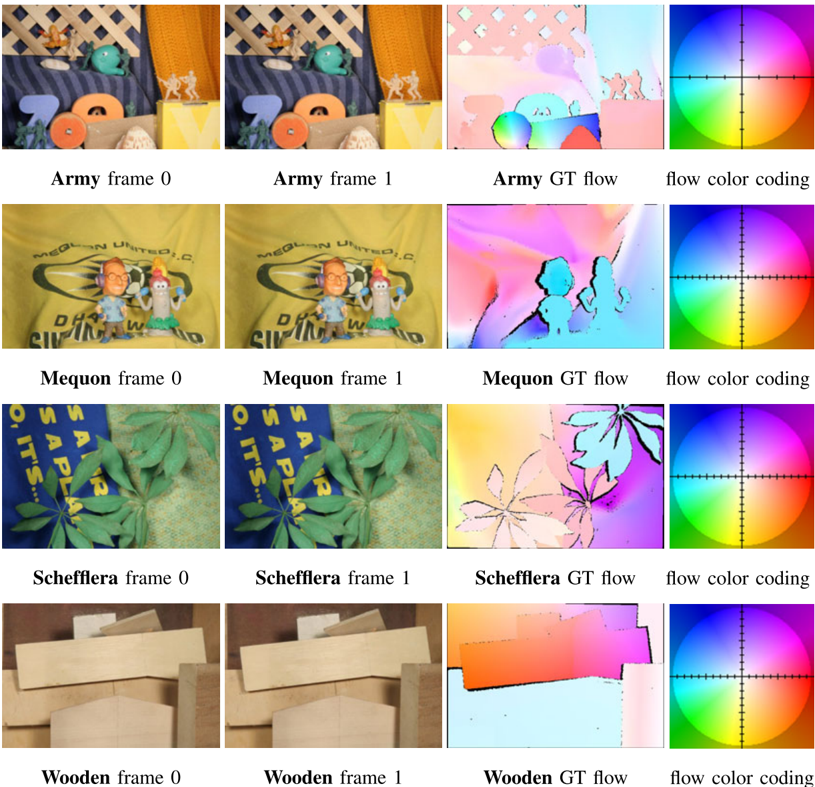
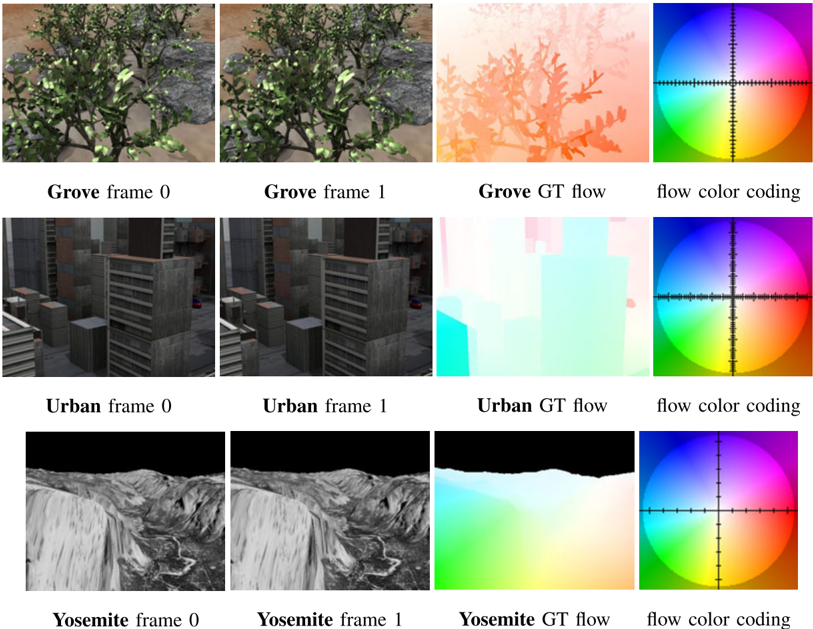
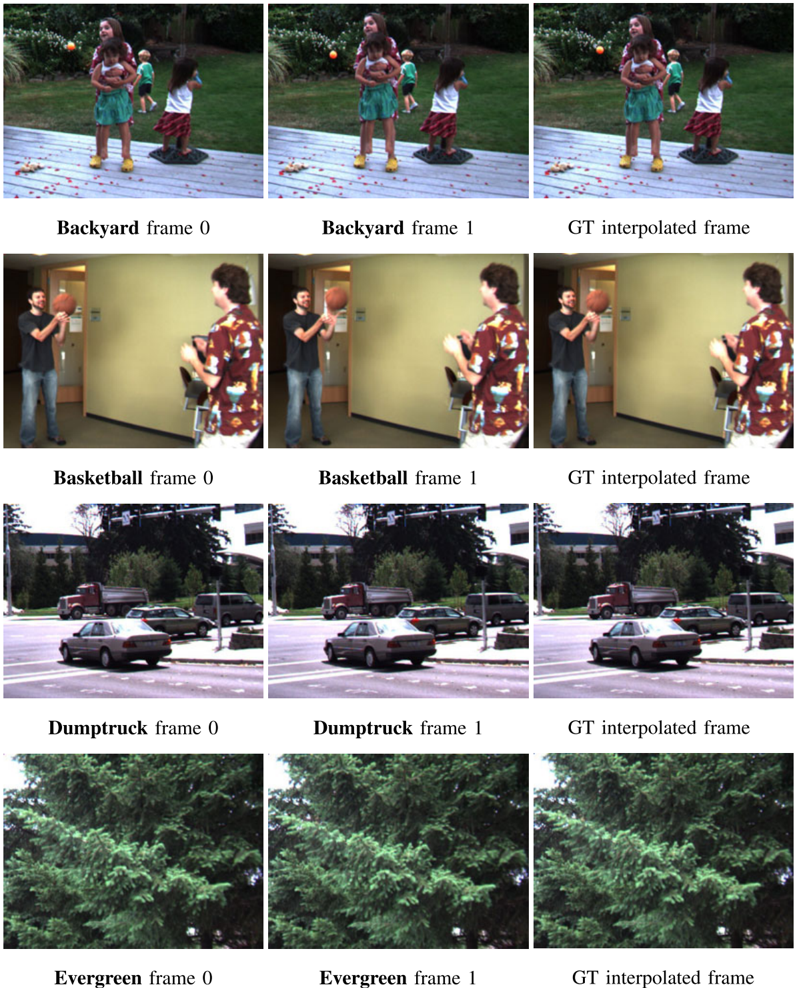
The quantitative evaluation of optical flow algorithms by Barron et al. (1994) led to significant advances in performance. The challenges for optical flow algorithms today go beyond the datasets and evaluation methods proposed in that paper. Instead, they center on problems associated with complex natural scenes, including nonrigid motion, real sensor noise, and motion discontinuities. We propose a new set of benchmarks and evaluation methods for the next generation of optical flow algorithms. To that end, we contribute four types of data to test different aspects of optical flow algorithms: (1) sequences with nonrigid motion where the ground-truth flow is determined by tracking hidden fluorescent texture, (2) realistic synthetic sequences, (3) high frame-rate video used to study interpolation error, and (4) modified stereo sequences of static scenes. In addition to the average angular error used by Barron et al., we compute the absolute flow endpoint error, measures for frame interpolation error, improved statistics, and results at motion discontinuities and in textureless regions.
Overview
CoChat Summary
TL;DR
The paper introduces a new optical flow benchmark of four data types (hidden fluorescent texture, realistic synthetic, high-speed interpolation, and modified stereo) plus an extended evaluation methodology with endpoint error, interpolation error, robustness/accuracy statistics, and region masks. It reports that performance improved substantially over the preliminary 2007 study, but motion discontinuities and diverse datasets remain difficult, and top flow methods still lag top stereo methods on the modified Teddy stereo data.
Key findings
- The benchmark contains 12 training and 12 test sequences; test ground truth is withheld except for Yosemite. As of December 2009 the online evaluation contained results for 24 published methods, all using only 2 input frames and 10 using color.
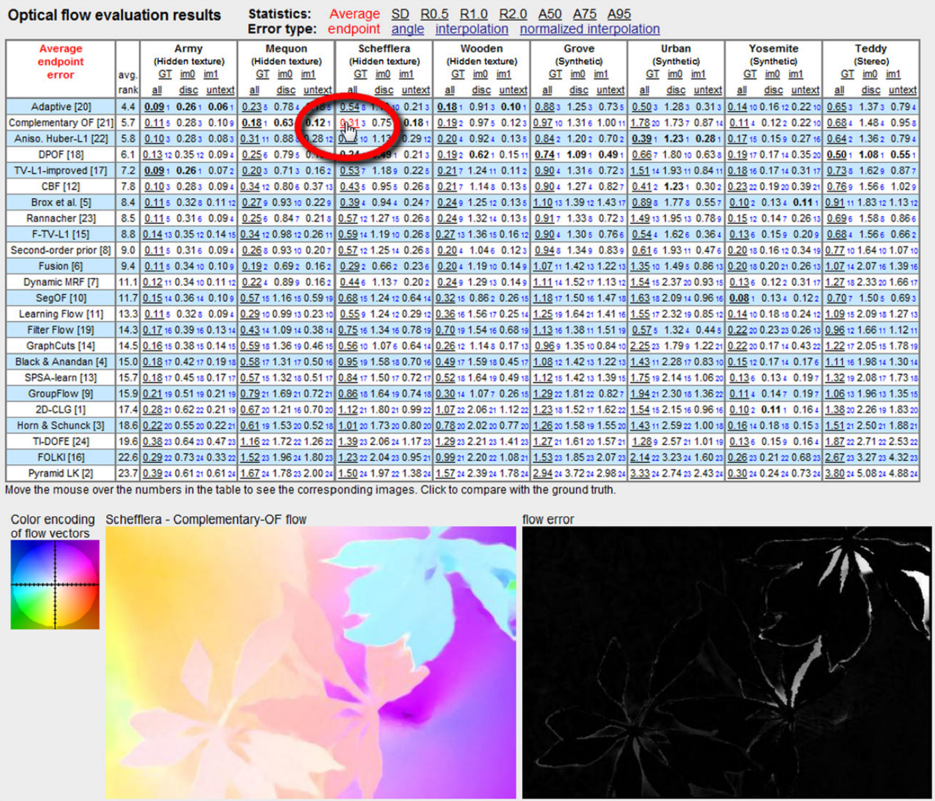
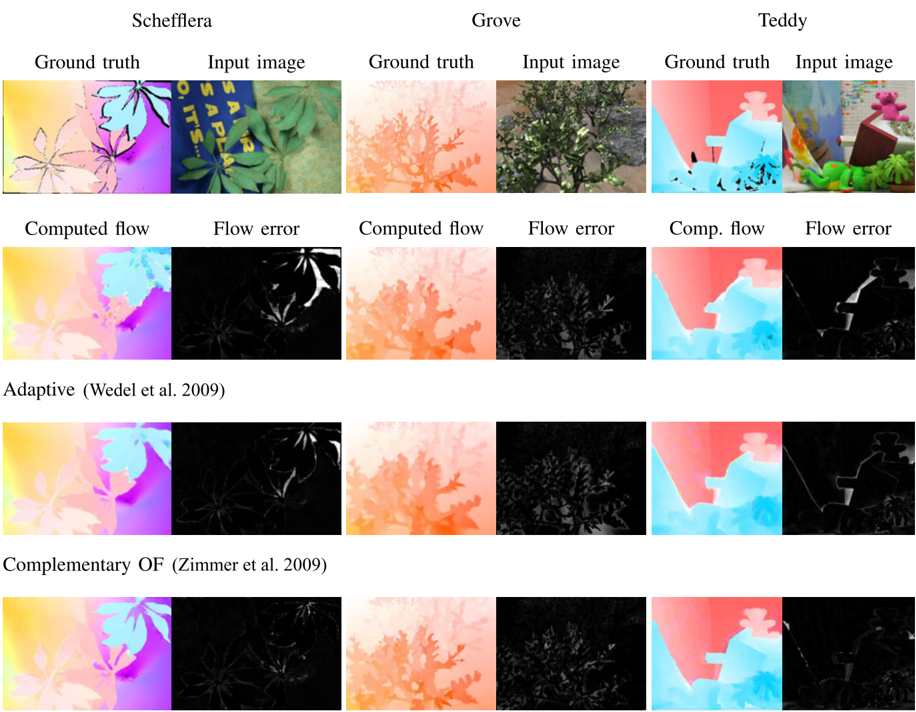
- Best average endpoint error (Avg. EE) improved dramatically over 2D-CLG (Bruhn et al. 2005): Army 0.28→0.09, Mequon 0.67→0.18, Schefflera 1.12→0.24, Wooden 1.07→0.18, Grove 1.23→0.74, Urban 1.54→0.39, Yosemite 0.10→0.08, Teddy 1.38→0.50. Best Avg. EE was below 0.2 pixels on four datasets (Yosemite, Army, Mequon, Wooden).
- Endpoint error (EE) and angular error (AE) rankings were highly correlated (r = 0.989), but the paper argues EE should be preferred: Complementary OF on Urban had Avg. AE 4.64° (rank 6) but Avg. EE 1.78 pixels (rank 20), because AE downweights large motions.
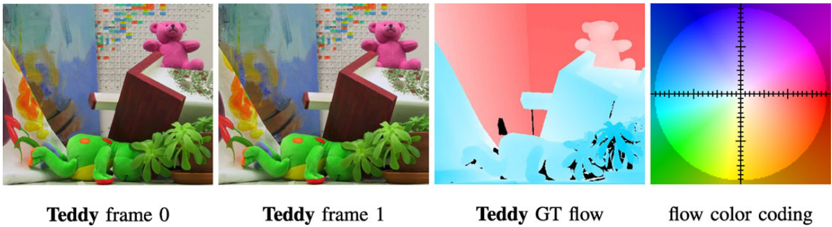
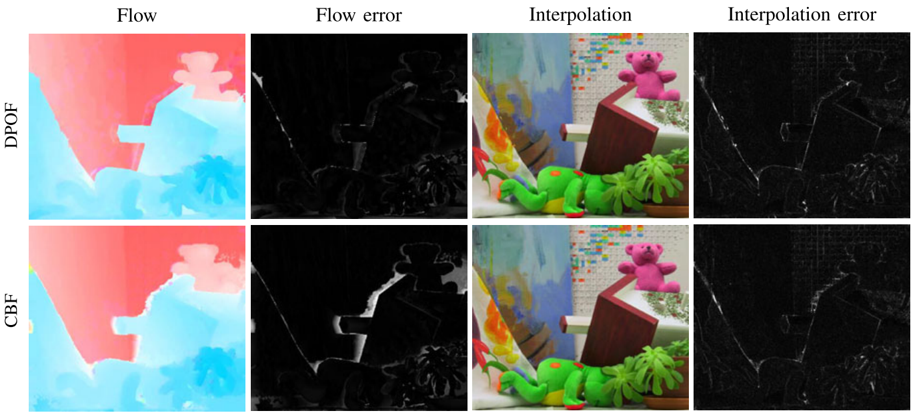
- Motion discontinuity (Disc) regions were the hardest; textureless (Untext) regions were typically easiest. Dataset results were less correlated, with Yosemite poorly or negatively correlated with others. Flow and interpolation errors were only moderately correlated (Avg4 EE vs Avg4 IE r = 0.763). On Teddy, top stereo methods outperformed top flow methods: median lowest-five R1.0 was 9.9 for flow vs 6.5 for stereo in All regions (34% reduction), and 27.6 vs 10.0 in Disc regions (64% reduction).
Methods
- Four data types were collected: (1) real nonrigid scenes with dense ground truth from hidden fluorescent texture, captured with a Canon EOS 20D at 3504×2336, downsampled every 40th visible-light frame by factor 6 to 584×388, with SSD tracking (15×15 windows), forward/backward crosschecking, and Lucas-Kanade subpixel refinement; (2) realistic synthetic scenes rendered with 3Delight at 640×480, with ground truth from a custom shader and dominant-cluster flow selection; (3) high-speed video for frame interpolation captured with a PointGrey Dragonfly Express at 60 fps, providing every other frame and retaining intermediate frames as ground truth; and (4) modified stereo data (Teddy) from structured light, cropped to make the disparity range roughly symmetric.
- Evaluation metrics include average angular error (AE), absolute flow endpoint error (EE), interpolation error (IE), and gradient-normalized interpolation error (NE). Statistics include averages, robustness measures R_X, and percentile accuracy measures A_X, computed over All, Disc, and Untext region masks.
- Analysis used the online evaluation at http://vision.middlebury.edu/flow/, comparing 24 published methods across metrics, statistics, masks, and datasets, with Pearson correlations between rankings and comparisons to state-of-the-art stereo methods on Teddy.
Limitations
- The paper states that the hidden fluorescent texture scenes are laboratory scenes, not real-world scenes, and have no motion blur due to stop-motion capture; ground truth is unavailable where cross-checking failed, especially occluded regions, and the measured ground truth is not perfect, though significant errors are limited to a small fraction of pixels. Synthetic sequences were generated without motion blur. The modified stereo ground truth is only accurate to 0.25 pixels, and algorithms may exploit the knowledge that motions are horizontal; overfitting to rigid data should be visible across the 12 evaluation images. Interpolation ground truth is an intermediate image, not a flow field, so the flow definition is apparent motion.
- The paper also states that no single method yet achieves strong performance across a wide variety of datatypes, that any dataset has a limited lifespan, and that future studies should include more challenging realistic synthetic data, longer sequences, and more difficult materials, illumination changes, atmospheric effects, and transparency.
- Evident from the text: the online tables do not provide an overall ranking among methods; runtimes are not normalized for programming environment, CPU speed, cores, or hardware acceleration; algorithms are required to produce dense flow and cannot submit confidence maps or sparse/incomplete fields; all 24 published methods used only 2 frames despite 8-frame sequences being available; and the paper cannot definitively answer whether temporal smoothing is less suited to the more challenging sequences.
Model-written summary. Check it against the paper before relying on it.
Integrity signals
Registry
Cites
Statistics
Figures

Verification
Claims the paper makes
2 Valid · 16 Not valid · 58 Not checked · 185 Own results and interpretations
A result the paper states — it cites no source for it, so there is none to check. The quote shows it is in the paper.
In the paper
“Rather than collecting a single type of data (with its inherent limitations) we instead collected four different types of data, each satisfying a different subset of desirable properties.”
plain- Asserted: passes — The authors put it forward as true.
- Checkable: passes — It can be checked against evidence.
- Load-bearing: passes — The paper’s conclusions depend on it.
- Based: passes — The paper gives a reason why it holds.
A result the paper states — it cites no source for it, so there is none to check. The quote shows it is in the paper.
In the paper
“Using the combination of fluorescent paint, downsampling high-resolution images, and sequential tracking of small motions, we are able to obtain dense, subpixel accurate ground truth for a nonrigid scene.”
plainstates a cause- Asserted: passes — The authors put it forward as true.
- Checkable: passes — It can be checked against evidence.
- Load-bearing: passes — The paper’s conclusions depend on it.
- Based: passes — The paper gives a reason why it holds.
A result the paper reports from its own data — it cites no other source for it, so there is none to check. The quote shows it is in the paper.
In the paper
“To allow for measures that predict performance on such tasks, we collected a variety of data suitable for frame interpolation.”
plainstates a cause- Asserted: passes — The authors put it forward as true.
- Checkable: passes — It can be checked against evidence.
- Load-bearing: passes — The paper’s conclusions depend on it.
- Based: passes — The paper gives a reason why it holds.
A result the paper reports from its own data — it cites no other source for it, so there is none to check. The quote shows it is in the paper.
In the paper
“We have developed a technique for capturing imagery of nonrigid scenes with ground-truth optical flow.”
plain- Asserted: passes — The authors put it forward as true.
- Checkable: passes — It can be checked against evidence.
- Load-bearing: passes — The paper’s conclusions depend on it.
- Based: passes — The paper gives a reason why it holds.
A result the paper states — it cites no source for it, so there is none to check. The quote shows it is in the paper.
In the paper
“To go beyond previous synthetic ground truth (e.g., the Yosemite sequence), we generated two types of fairly complex synthetic outdoor scenes.”
plain- Asserted: passes — The authors put it forward as true.
- Checkable: passes — It can be checked against evidence.
- Load-bearing: passes — The paper’s conclusions depend on it.
- Based: passes — The paper gives a reason why it holds.
96 more claims
Create a free account to see all 261 claims and every source verdict.
- Probably not a substantial claim. 114
- It may state two separate claims as one. 76
- The quote only partly states this claim. 6
Claims other papers make about this one
Each is checked against this paper’s own text: does it say what the citing paper says it does?
The source backs part of the claim, not all of it — or backs it for a different population, condition or comparison.
In the citing paper
“Notable works include the Middlebury dataset (Baker et al, 2011) and the KITTI datasets (Geiger et al, 2012; Menze and Geiger, 2015), but due to the difficulty of computing accurate ground truth, these have been restricted to 8 and 2 · 200 pairs of frames, respectively (the latter are also limited by the special driving setting).”
From What Makes Good Synthetic Training Data for Learning Disparity and Optical Flow Estimation? (2018) · cites this paper as Baker et al, 2011
Experimental — accuracy not yet measured
Citations
Cites
The pascal visual object classes (VOC) challenge
Everingham, M., Van Gool, L., Williams, C. K. I., Winn, J., & Zisserman, A. (2010) · International Journal of Computer Vision · doi:10.1007/s11263-009-0275-4 · Cited by 19,599
Proceedings of IEEE Conference on Computer Vision and Pattern Recognition
(1993) · doi:10.1109/cvpr.1993 · Cited by 17,667
Proceedings of IEEE International Conference on Computer Vision
(1995) · Proceedings of IEEE International Conference on Computer Vision · doi:10.1109/iccv.1995.466933 · Cited by 12,860
(1981) · Cited by 11,963
Horn, B. K. P., & Schunck, B. G. (1981) · Artificial Intelligence · doi:10.1016/0004-3702(81)90024-2 · Cited by 10,312
Horn, B. K., & Schunck, B. G. (1981) · SPIE Proceedings · doi:10.1117/12.965761 · Cited by 7,394 · cited 2×
“A baseline approach is to use an L2 norm as in the Horn and Schunck algorithm (Horn and Schunck 1981):”
BackgroundMethodFast approximate energy minimization via graph cuts
Boykov, Y., Veksler, O., & Zabih, R. (2001) · IEEE Transactions on Pattern Analysis and Machine Intelligence · doi:10.1109/34.969114 · Cited by 6,988
A Taxonomy and Evaluation of Dense Two-Frame Stereo Correspondence Algorithms
Scharstein, D., & Szeliski, R. (2002) · International Journal of Computer Vision · doi:10.1023/a:1014573219977 · Cited by 6,740 · cited 10×
“Many areas of computer vision, such as stereo [63], face recognition [28, 55, 68], and object recognition [23, 24], have challenging datasets to track the progress made by leading algorithms and to stimulate new ideas.”
BackgroundMethodResultInfluentialSelf-citationProceedings European Conference on Computer Vision 2002
Heyden, A., Sparr, G., Nielsen, M., & Johansen, P. (2002) · Lund University Publications (Lund University) · Cited by 5,153
From few to many: illumination cone models for face recognition under variable lighting and pose
Georghiades, A. S., Belhumeur, P. N., & Kriegman, D. J. (2001) · IEEE Transactions on Pattern Analysis and Machine Intelligence · doi:10.1109/34.927464 · Cited by 4,912 · cited 1×
“Many areas of computer vision, such as stereo (Scharstein and Szeliski 2002), face recognition (Philips et al. 2005; Sim et al. 2003; Gross et al. 2008; Georghiades et al. 2001), and object recognition (Fei-Fei et al.”
Background
Research works printed but not linked: 4
- Anandan, P., & Weiss, R. (1985). Introducing smoothness constraint in a matching approach for the computation of displacement fields. In Proceedings of the DARPA image understanding workshop (pp. 186-196).
- Bleyer, M., & Chambon, S. (2010). Does color really help in dense stereo matching? In Proceedings of the international symposium 3D data processing, visualization and transmission .
- Lempitsky, V., Roth, S., & Rother, C. (2008). Fusion flow: discretecontinuous optimization for optical flow estimation. In Proceedings of the IEEE conference on computer vision and pattern recognition .
- Rannacher, J. (2009). Realtime 3D motion estimation on graphics hardware . Undergraduate thesis, Heidelberg University.
Cited by
Items 701–800 of 2,273
Bosma, L., Zachiu, C., Ries, M., de Senneville, B. D., & Raaymakers, B. (2021) · Physics in Medicine and Biology · doi:10.1088/1361-6560/abe02a · Cited by 17
“…the quality of an estimatedDVF, it is comparedwith the gold standardDVF in terms of absolute, component-wise differences, or the endpoint error (Baker et al 2011): D = -DVF t t tx DVF x DVF x, , , , 4gs est 2( ) ( ) ( ) ( ) i.e. the Euclidean distance between the 3Ddeformation vectors of the…”
BackgroundTV-L1 Optical Flow Estimation with Image Details Recovering Based on Modified Census Transform
Mohamed, M. A., & Mertsching, B. (2012) · Lecture notes in computer science · doi:10.1007/978-3-642-33179-4_46 · Cited by 21
“In this section, the optical flow results of the Middlebury data sets [18] are represented in figure 1.”
BackgroundDiscrete-Continuous Optimization for Optical Flow Estimation
Roth, S., Lempitsky, V., & Rother, C. (2009) · Lecture notes in computer science · doi:10.1007/978-3-642-03061-1_1 · Cited by 25
Self-citationStochastic Uncertainty Models for the Luminance Consistency Assumption
Corpetti, T., & Mémin, É. (2011) · IEEE Transactions on Image Processing · doi:10.1109/tip.2011.2162742 · Cited by 23
“Comparative performance evaluations of some of these techniques can be found in [2], [3], [12], and [14].”
BackgroundMethodZhao, X., Ding, W., Liu, C., et al. (2017) · IET Image Processing · doi:10.1049/iet-ipr.2017.0060 · Cited by 18
Sign Language Recognition Based on CBAM-ResNet
Chao, H. G., Fenhua, W., & Zhang, R. (2019) · International Conference on Artificial Intelligence and Advanced Manufacture (AIAM) · doi:10.1145/3358331.3358379 · Cited by 23
“Many researchers used convolutional neural network [11] with multi-stream input to obtain more information, like optical flow [12], depth information, post information [13], etc.”
BackgroundOcclusion Aware Unsupervised Learning of Optical FlowPreprint
Wang, Y., Yang, Y. P., Yang, Z., et al. (2017) · arXiv (Cornell University) · doi:10.48550/arxiv.1711.05890 · Cited by 18
“Starting from then, the accuracy of optical flow estimation has been improving steadily as evidenced by the results on Middlebury [8] and MPI-Sintel [14] benchmark dataset.”
MethodLearning Human Optical FlowPreprint
Ranjan, A., Romero, J., & Black, M. J. (2018) · arXiv (Cornell University) · doi:10.48550/arxiv.1806.05666 · Cited by 25
“Middlebury is limited to small motions [2], KITTI is focused on rigid scenes and automotive motions [17], while Sintel has a limited number of synthetic scenes [5].”
BackgroundSelf-citationTu, Z., Zheng, A., Yang, E., et al. (2015) · Cognitive Computation · doi:10.1007/s12559-015-9318-z · Cited by 17
“The Middlebury optical flow benchmark is a new benchmark and evaluation method for optical flow algorithms [9].”
MethodOptical Flow Estimation Based on the Frequency-Domain Regularization
Chen, J., Lai, J., Cai, Z., Xie, X., & Pan, Z. (2020) · IEEE Transactions on Circuits and Systems for Video Technology · doi:10.1109/tcsvt.2020.2974490 · Cited by 17
“…we perform our method on three public optical flow datasets, such as the MPI-Sintel dataset [23], Kitti dataset [24], [25], and Middlebury dataset [22], which P ; • Obtain the weighted Laplacian feature maps with the flow gradient maps selected by the flow gradient weight maps; • Obtain the wavelet…”
BackgroundMethodTest-Time Adaptation for Video Frame Interpolation via Meta-Learning
Choi, M., Choi, J., Baik, S., Kim, T. H., & Lee, K. M. (2021) · IEEE Transactions on Pattern Analysis and Machine Intelligence · doi:10.1109/tpami.2021.3129819 · Cited by 21
“In practice, we fine-tune a pre-trained SepConv [6] model on each sequence from Middlebury-OTHERS [53] dataset.”
MethodEfficient Burst Raw Denoising with Variance Stabilization and Multi-frequency Denoising Network
Li, D., Zhang, Y., Law, K. L., Wang, X., Qin, H., & Li, H. (2022) · International Journal of Computer Vision · doi:10.1007/s11263-022-01627-3 · Cited by 25
“The most long-standing method for multi-frame alignment is based on optical flow [6, 22, 28, 35, 50].”
MethodFacial optical flow estimation via neural non-rigid registration
Zhuang, P., Jiang, B., Xu, H., Feng, W., & Zhang, J. (2022) · Computational Visual Media · doi:10.1007/s41095-021-0267-z · Cited by 19
“Some representative learningbased methods: FlowNet [12], SpyNet [27], and FlowNet2 [28], have gradually improved the flow accuracy on various public benchmark datasets, like Middlebury [29], MPI Sintel [30], FlyingChairs [12], FlyingThings3D [31], and KITTI [32, 33]; these approaches have started to outperform classic…”
MethodNeural Image Representations for Multi-image Fusion and Layer Separation
Nam, S., Brubaker, M. A., & Brown, M. S. (2022) · Lecture notes in computer science · doi:10.1007/978-3-031-20071-7_13 · Cited by 31
“Images from [4,14,8,23] are used here for visualization.”
MethodSynthetic River Flow Videos for Evaluating Image‐Based Velocimetry Methods
Bodart, G., Coz, J. L., Jodeau, M., & Hauet, A. (2022) · Water Resources Research · doi:10.1029/2022wr032251 · Cited by 22
Jyoti, J. S., Medeiros, H. P., Sebo, S., & McDonald, W. (2023) · Flow Measurement and Instrumentation · doi:10.1016/j.flowmeasinst.2023.102341 · Cited by 23
MS-RAFT+: High Resolution Multi-Scale RAFT
Jahedi, A., Luz, M., Rivinius, M., Mehl, L., & Bruhn, A. (2023) · International Journal of Computer Vision · doi:10.1007/s11263-023-01930-7 · Cited by 32
A Proof of Convergence of the Horn--Schunck Optical Flow Algorithm in Arbitrary Dimension
Tarnec, L. L., Destrempes, F., Cloutier, G. M., et al. (2014) · SIAM Journal on Imaging Sciences · doi:10.1137/130904727 · Cited by 17
“Other complex and very proficient estimators for optical flow, however, now exist in the context of natural scenes [2, 3] to take into account discontinuities at object edges.”
BackgroundSpeed and Texture: An Empirical Study on Optical-Flow Accuracy in ADAS Scenarios
Onkarappa, N., & Sappa, A. D. (2014) · IEEE Transactions on Intelligent Transportation Systems · doi:10.1109/tits.2013.2274760 · Cited by 18
“[12], different synthetic and real data sets for general motion scenarios with the ground truth are presented, whereas in [29], many synthetic sequences with the ground truth for ADAS”
BackgroundMethodDisparity and optical flow partitioning using extended Potts priors
Cai, X., Fitschen, J. H., Nikolova, M., Steidl, G., & Storath, M. (2014) · Information and Inference A Journal of the IMA · doi:10.1093/imaiai/iau010 · Cited by 18
“Last accessed December 12, 2014 [6]).”
BackgroundRecovering fluid-type motions using Navier-Stokes potential flow
Li, F., Xu, L., Guyenne, P., & Yu, J. (2010) · IEEE Computer Society Conference on Computer Vision and Pattern Recognition/Proceedings - IEEE Computer Society Conference on Computer Vision and Pattern Recognition/Proceedings · doi:10.1109/cvpr.2010.5539942 · Cited by 18
“We refer the readers to the optical flow evaluation database by Baker et al [3] for a complete review.”
A Universal Optical Flow Based Real-Time Low-Latency Omnidirectional Stereo Video System
Tang, M., Wen, J., Zhang, Y., Gu, J., Junker, P., Guo, B., Jhao, G., Zhu, Z., & Han, Y. (2018) · IEEE Transactions on Multimedia · doi:10.1109/tmm.2018.2867266 · Cited by 15
“Nearest neighbor fields (NNF) algorithm [14] is one of the most accurate optical flow calculation method in the Middlebury evaluation [15].”
MethodAn Improved Optical Flow Algorithm Based on Mask-R-CNN and K-Means for Velocity Calculation
Peng, Y., Liu, X., Shen, C., Huang, H., Zhao, D., Cao, H., & Guo, X. (2019) · Applied Sciences · doi:10.3390/app9142808 · Cited by 19
“Nowadays, the mainstream optical flow calculation techniques include the frame differential method [21], pyramid Lucas Kanade (LK) algorithm and convolution network-based optical flow algorithms [22].”
MethodMüller, S., Farag, I., Weickert, J., Braun, Y., Lollert, A., Dobberstein, J., Hötker, A. M., & Graf, N. M. (2019) · Journal of medical imaging · doi:10.1117/1.jmi.6.3.034001 · Cited by 23
“In computer vision, benchmarking and performance evaluation have established themselves as important triggers for scientific progress in key areas ranging from motion analysis [4, 3, 17] over optimisation algorithms [24] to segmentation methods [33].”
BackgroundCreating Autonomous Vehicle Systems, Second Edition
Liu, S., Li, L., Tang, J., Wu, S., & Gaudiot, J. (2020) · Synthesis lectures on computer science · doi:10.2200/s01036ed1v01y202007csl012 · Cited by 28
A polar representation of motion and implications for optical flow
Adato, Y., Zickler, T. E., & Ben‐Shahar, O. (2011) · IEEE Computer Society Conference on Computer Vision and Pattern Recognition/Proceedings - IEEE Computer Society Conference on Computer Vision and Pattern Recognition/Proceedings · doi:10.1109/cvpr.2011.5995419 · Cited by 21
“, the same orientation error in the estimated flow is played down in the AE measure as the magnitude of the flow increases [3, 4].”
BackgroundMethodInfluential3D motion flow estimation using local all-pass filters
Gilliam, C., Küstner, T., & Blu, T. (2016) · IEEE International Symposium on Biomedical Imaging (ISBI) · doi:10.1109/isbi.2016.7493264 · Cited by 16
Optical flow sensor integrated navigation system for quadrotor in GPS-denied environment
Tsai, S.-E., & Zhuang, S.-H. (2016) · International Conference on Robotics and Automation Engineering (ICRAE) · doi:10.1109/icrae.2016.7738795 · Cited by 17
“Optical flow is a family of techniques that focuses on determining motion from images, which can provide reliable velocity and position information when applied for robot localization or navigation.”
BackgroundEnergy and Execution Time Comparison of Optical Flow Algorithms on SIMD and GPU Architectures
Petreto, A., Hennequin, A. M., Kœhler, T., Romera, T., Fargeix, Y., Gaillard, B., Bouyer, M., Meunier, Q. L., & Lacassagne, L. (2018) · Conference on Design and Architectures for Signal and Image Processing · doi:10.1109/dasip.2018.8597004 · Cited by 19
“An extensive qualitative analysis [2] of existing algorithms is available on the Middlebury’s website [3], which also provides links to some of the codes.”
MethodCFA Video Denoising and Demosaicking Chain via Spatio-Temporal Patch-Based Filtering
Buades, A., & Duran, J. (2019) · IEEE Transactions on Circuits and Systems for Video Technology · doi:10.1109/tcsvt.2019.2956691 · Cited by 21
“We evaluate the performance of the proposed chain on several sequences from the Middlebury datasets1 [60], [61].”
MethodLearning Dense Facial Correspondences in Unconstrained ImagesPreprint
Yu, R., Saito, S., Li, H., et al. (2017) · arXiv (Cornell University) · doi:10.48550/arxiv.1709.00536 · Cited by 17
“The problem of dense correspondence estimation has been mainly investigated in the form of optical flow estimation for tracking purposes [23, 6, 4, 10].”
BackgroundDense Optical Flow Prediction from a Static ImagePreprint
Walker, J., Gupta, A., & Hebert, M. (2015) · arXiv (Cornell University) · doi:10.48550/arxiv.1505.00295 · Cited by 26
“1 ar X iv :1 50 5.”
JRDB: A Dataset and Benchmark for Visual Perception for Navigation in Human Environments.Preprint
Martín-Martín, R., Rezatofighi, H., Shenoi, A., Patel, M. R., Gwak, J., Dass, N., Federman, A. N., Goebel, P., & Savarese, S. (2019) · arXiv (Cornell University) · Cited by 17
InMoDeGAN: Interpretable Motion Decomposition Generative Adversarial Network for Video GenerationPreprint
Wang, Y., Brémond, F., & Dantcheva, A. (2021) · arXiv (Cornell University) · doi:10.48550/arxiv.2101.03049 · Cited by 31
“Firstly, we represent the optical flow according to the Middlebury evaluation [2].”
MethodFerrante, E., Fécamp, V., & Nikos Paragios, A. (2015) · International Journal of Computer Assisted Radiology and Surgery · doi:10.1007/s11548-015-1205-2 · Cited by 16
“The problem of deformable image registration has been a pillar of computer vision (optical flow) and medical imaging (imagefusion),andtherefore,onecancitenumerousmethods to perform 2D–2D and 3D–3D registration [1,11].”
BackgroundMotion‐based frame interpolation for film and television effects
Kokaram, A. C., Singh, D., Robinson, S., Kelly, D., Collis, B., & Libreri, K. (2020) · IET Computer Vision · doi:10.1049/iet-cvi.2019.0814 · Cited by 19
Self-Supervised Approach for Facial Movement Based Optical Flow
Alkaddour, M., Tariq, U., & Dhall, A. (2022) · IEEE Transactions on Affective Computing · doi:10.1109/taffc.2022.3197622 · Cited by 17
“cal flow algorithms [50] is the average angular error (AAE).”
Video Interpolation by Event-Driven Anisotropic Adjustment of Optical Flow
Wu, S., You, K., He, W., Yang, C., Tian, Y., Wang, Y., Zhang, Z., & Liao, J. (2022) · Lecture notes in computer science · doi:10.1007/978-3-031-20071-7_16 · Cited by 32
Is Appearance Free Action Recognition Possible?
Ilic, F., Pock, T., & Wildes, R. P. (2022) · Lecture notes in computer science · doi:10.1007/978-3-031-19772-7_10 · Cited by 32
Lagrangian motion magnification with double sparse optical flow decomposition
Flotho, P., Heiß, C., Steidl, G., & Strauß, D. J. (2023) · Frontiers in Applied Mathematics and Statistics · doi:10.3389/fams.2023.1164491 · Cited by 23
“The widely available dense inverse search (DIS) OF method [32] initializes the OF field with patch correspondences and uses a variational method similar to Sun et al. and Brox et al. [11] for high resolution refinement.”
MethodFPGA–DSP co-processing for feature tracking in smart video sensors
Tomasi, M., Pundlik, S. J., & Luo, G. (2014) · Journal of Real-Time Image Processing · doi:10.1007/s11554-014-0413-2 · Cited by 17
“In order to first validate our approach, we assess the accuracy of the optical flow estimation using a well-known benchmarking dataset [16].”
BackgroundMethodInfluentialPatch-based spatio-temporal super-resolution for video with non-rigid motion
Salvador, J., Kochale, A., & Schweidler, S. (2013) · Signal Processing Image Communication · doi:10.1016/j.image.2013.02.002 · Cited by 16
Revisiting Example Dependent Cost-Sensitive Learning with Decision Trees
Aodha, O. M., & Brostow, G. (2013) · IEEE/CVF International Conference on Computer Vision (ICCV) · doi:10.1109/iccv.2013.31 · Cited by 17
“Table 3 presents results for leave one out optical flow experiments on 22 different sequences from [18] and 8 from [3].”
BackgroundSIFTpack: A Compact Representation for Efficient SIFT Matching
Gilinsky, A., & Zelnik‐Manor, L. (2013) · IEEE/CVF International Conference on Computer Vision (ICCV) · doi:10.1109/iccv.2013.101 · Cited by 18
“We used SIFT-flow [15] to compute the flow-field between the pairs of images of the Middlebury data-set [4] and on the “light” data-set of “Mikolajczyk” [18].”
MethodEstimating accurate optical flow in the presence of motion blur
Tu, Z., Poppe, R. W., & Veltkamp, R. C. (2015) · Journal of Electronic Imaging · doi:10.1117/1.jei.24.5.053018 · Cited by 16
“Journal of Electronic Imaging 053018-5 Sep∕Oct 2015 • Vol. 24(5) the common average endpoint error (AEE) of Baker et al.30 is applied to compare the computed dense flow fields of each method.”
MethodMonocular scene flow estimation via variational method
Xiao, D., Yang, Q., Yang, B., & Wei, W. (2015) · Multimedia Tools and Applications · doi:10.1007/s11042-015-3091-6 · Cited by 16
“In addition, since the dataset 2 provides a complete ground truth optical flow motion information, the scene flow accuracy can be evaluated by calculating the RMSE on 2D projected image [3].”
MethodAdaptive guided image filter for warping in variational optical flow computation
Tu, Z., Poppe, R. W., & Veltkamp, R. C. (2016) · Signal Processing · doi:10.1016/j.sigpro.2016.02.018 · Cited by 20
“In addition, although we hope Iwarp should be as similar to I1 as possible – less interpolation error implies a more accurate estimated flow field [29], Iwarp must not be equal to I1.”
BackgroundMethodInfluentialAbnormal crowd motion detection using double sparse representation
Liu, P., Tao, Y., Zhao, W., & Tang, X. (2017) · Neurocomputing · doi:10.1016/j.neucom.2016.09.138 · Cited by 16
Guided Filtering: Toward Edge-Preserving for Optical Flow
Zhang, C., Ge, L., Chen, Z., Ren-zhi, Q. I. N., Li, M., & Liu, W. (2018) · IEEE Access · doi:10.1109/access.2018.2831920 · Cited by 19
“In this section, we began testing guided filtering using Middlebury data since the Middlebury database is a standard benchmark [53] for optical flow.”
MethodKalmanFlow 2.0: Efficient Video Optical Flow Estimation via Context-Aware Kalman Filtering
Bao, W., Zhang, X., Chen, L., & Gao, Z. (2019) · IEEE Transactions on Image Processing · doi:10.1109/tip.2019.2903656 · Cited by 19
“On the Middlebury benchmark [14], MDPFlow2 [12] and NNF-Local [15] are among the best methods for their near error-free performance.”
BackgroundMethodInfluentialAccelerated Gravitational Point Set Alignment With Altered Physical Laws
Golyanik, V., Theobalt, C., & Stricker, D. (2019) · IEEE/CVF International Conference on Computer Vision (ICCV) · doi:10.1109/iccv.2019.00217 · Cited by 15
“In the bottom row, we show recovered reprojected displacements for frames 7 and 29 following [22] and the used Middlebury optical flow encoding [4].”
MethodXie, J., Gao, R., Zheng, Z., Zhu, S. C., & Wu, Y. N. (2020) · Proceedings of the AAAI Conference on Artificial Intelligence · doi:10.1609/aaai.v34i07.6931 · Cited by 19
“…facial expression, and the other is a woman with surprise facial expression; (b) visualizes the learned trackable motions (optical flows) by color images, by following (Baker et al. 2011), where each color represents a direction (Please see the appendix for the displacement field color coding map.)”
BackgroundIbrahim, M. R., Haworth, J., Christie, N., Cheng, T., & Hailes, S. M. V. (2020) · Transport Reviews · doi:10.1080/01441647.2020.1840456 · Cited by 18
“…of images, or so-called optical fl ow (Alvarez, Deriche, Papadopoulo, & Sánchez, 2007; Andrade, Blunsden, & Fisher, 2006; Ayvaci, Raptis, & Soatto, 2012; Baker et al., 2011; Butler, Wul ff , Stanley, & Black, 2012; Enkelmann, n.d.; Mallot, Bültho ff , Little, & Bohrer, 1991; Sun, Roth, & Black, 2010).”
PDWN: Pyramid Deformable Warping Network for Video Interpolation
Chen, Z., Wang, R., Liu, H., & Wang, Y. (2021) · IEEE Open Journal of Signal Processing · doi:10.1109/ojsp.2021.3075879 · Cited by 19
“1) Evaluation Datasets Our model is trained on a single dataset (Vimeo-90K training set) but validated on multiple datasets including Vimeo90K[28] test dataset (448 × 256), UCF [16, 23] dataset (25 FPS, 256 × 256), and the Middlebury dataset [2] (typically 640 × 480).”
Enhanced Correlation Matching based Video Frame Interpolation
Lee, S.-H., Choi, N., & Choi, W. I. (2022) · IEEE Winter Conference on Applications of Computer Vision · doi:10.1109/wacv51458.2022.00318 · Cited by 23
“Figure 2: Backward and forward warping examples [1].”
BackgroundRodríguez, Á., Fernandez-Lozano, C., Dorado, J., & Rabuñal, J. R. (2014) · Analytical Biochemistry · doi:10.1016/j.ab.2014.02.027 · Cited by 19
Benchmarking template-based tracking algorithms
Lieberknecht, S., Benhimane, S., Meier, P. G., & Navab, N. (2010) · Virtual Reality · doi:10.1007/s10055-010-0185-3 · Cited by 17
“Similar to the Middlebury datasets (Baker et al. 2007), we are not planning to publish the ground truth for every frame.”
BackgroundResultRoujol, S., Benois‐Pineau, J., de Senneville, B. D., et al. (2012) · IEEE Transactions on Information Technology in Biomedicine · doi:10.1109/titb.2012.2190366 · Cited by 16
“Quality assessment of the motion estimation: Since the real motion (Dgt = (uGT , vGT )) and the estimated motion (D = (u, v)) are available for each pixel in such synthetic dataset experiment, the measures commonly reported in the optical flow community such as the endpoint error (EE) and the angular error (AE) of the…”
Automated measurement of fast mitochondrial transport in neurons
Miller, K. E., Liu, X.-A., & Puthanveettil, S. V. (2015) · Frontiers in Cellular Neuroscience · doi:10.3389/fncel.2015.00435 · Cited by 16
“In brief, optical flow is defined as the apparent motion of the brightness patterns in the image (Baker et al., 2011).”
BackgroundInfluentialHassner, T., Filosof, S., Mayzels, V., & Zelnik‐Manor, L. (2016) · IEEE Transactions on Pattern Analysis and Machine Intelligence · doi:10.1109/tpami.2016.2592916 · Cited by 17
In-depth analysis of high-speed, cold neutron imaging of air-water two-phase flows
Zboray, R., & Trtik, P. (2019) · Flow Measurement and Instrumentation · doi:10.1016/j.flowmeasinst.2019.03.005 · Cited by 16
The promises and perils of automated facial action coding in studying children’s emotions.
Martínez, A. M. (2019) · Developmental Psychology · doi:10.1037/dev0000728 · Cited by 17
“This is called optical flow and is defined as the apparent motion of the brightness pattern of a set of images (Baker et al., 2011).”
Active Gaze Control Improves Optic Flow-Based Segmentation and Steering
Raudies, F., Mingolla, E., & Neumann, H. (2012) · PLoS ONE · doi:10.1371/journal.pone.0038446 · Cited by 19
“The object motion sequence ‘Dumptruck’ [24] shows a typical traffic scenario of moving cars at an intersection (see insets in Figure 8a and 8b).”
BackgroundHierarchical Discrete Distribution Decomposition for Match Density EstimationPreprint
Yin, Z., Darrell, T. J., & Yu, F. (2018) · arXiv (Cornell University) · doi:10.48550/arxiv.1812.06264 · Cited by 16
“For a thorough review, we refer to popular benchmarks including Middlebury [4], MPI Sintel [7], and KITTI [32] benchmarks for both the classical methods and the latest advances in these areas.”
MethodSemantic Flow for Fast and Accurate Scene ParsingPreprint
Li, X., You, A., Zhu, Z., et al. (2020) · arXiv (Cornell University) · doi:10.48550/arxiv.2002.10120 · Cited by 16
Multiple Video Frame Interpolation via Enhanced Deformable Separable ConvolutionPreprint
Cheng, X., & Chen, Z. (2020) · arXiv (Cornell University) · doi:10.48550/arxiv.2006.08070 · Cited by 16
“Interpolation error comparisons among kernel-based methods on the Middlebury Evaluation set [12].”
BackgroundMethodInfluentialWang, H., Fan, R., & Liu, M. (2020) · doi:10.36227/techrxiv.13186688.v2 · Cited by 17
Efficient Image Registration Network for Non-Rigid Cardiac Motion Estimation
Pan, J., Rueckert, D., Küstner, T., & Hammernik, K. (2021) · Lecture notes in computer science · doi:10.1007/978-3-030-88552-6_2 · Cited by 24
Software for non‐parametric image registration of 2‐photon imaging data
Flotho, P., Nomura, S., Kühn, B., & Strauß, D. J. (2022) · Journal of Biophotonics · doi:10.1002/jbio.202100330 · Cited by 18
Unsupervised Learning of Optical Flow With Non-Occlusion From Geometry
Wang, G., Ren, S., & Wang, H. (2022) · IEEE Transactions on Intelligent Transportation Systems · doi:10.1109/tits.2022.3182858 · Cited by 17
“However these data are expensive to obtain [23], [31], and sometimes special methods are even needed to get them [32], which limits the application of these supervised methods.”
MethodHu, Q., Wei, Y. J., Li, X., Wang, C., Li, J., & Wang, Y. (2022) · Computers in Biology and Medicine · doi:10.1016/j.compbiomed.2022.106139 · Cited by 15
Apke, J. M., Noh, Y., & Bedka, K. M. (2022) · Journal of Atmospheric and Oceanic Technology · doi:10.1175/jtech-d-22-0057.1 · Cited by 18
“While extensive research exists in OF retrieval validation and benchmarking (e.g., Baker et al. 2011; Butler et al. 2012; Geiger et al. 2012), little work has been done to compare the inherent accuracy of AMVs derived from various OF retrieval methods.”
MethodUnsupervised Optical Flow Estimation for Differently Exposed Images in LDR Domain
Liu, Z., Li, Z. G., Chen, W., Wu, X., & Liu, Z. (2023) · IEEE Transactions on Circuits and Systems for Video Technology · doi:10.1109/tcsvt.2023.3252007 · Cited by 17
“The optical flows are color-coded by [55].”
Traffic Camera Anomaly Detection
Wang, Y.-K., Fan, C.-T., & Chen, J.-F. (2014) · Proceedings - International Conference on Pattern Recognition/Proceedings/International Conference on Pattern Recognition · doi:10.1109/icpr.2014.794 · Cited by 16
“For abstracting to motion feature, we (cid:2)rst estimate optical fl ow (cid:2)elds [12,13 ] on each pair of consecutive images of the sequence, including both forward and backward directions of the optical flow.”
A Flow-based Motion Perception Technique for an Autonomous Robot System
Pinto, A. M., Moreira, A. P., Correia, M. V., & Costa, P. (2013) · Journal of Intelligent & Robotic Systems · doi:10.1007/s10846-013-9999-z · Cited by 23
“Dimetrodon, Grove2, Grove3, RubberWhale and Urban3 [2].”
BackgroundMethodInfluentialStereo-based motion detection and tracking from a moving platform
Romero-Cano, V., & Nieto, J. I. (2013) · IEEE Intelligent Vehicles Symposium · doi:10.1109/ivs.2013.6629517 · Cited by 17
“Since then, a large amount of research has been accomplished in order to provide efficient and accurate forms to calculate the motion of multiple moving objects from visual cues [13], [14], [15].”
BackgroundA Fast Simple Optical Flow Computation Approach Based on the 3-D Gradient
Li, Y., Zhu, E., Zhao, J., Yin, J., & Zhao, X. (2013) · IEEE Transactions on Circuits and Systems for Video Technology · doi:10.1109/tcsvt.2013.2283648 · Cited by 16
“Eight sequences are tested: six sequences (Urban2, Urban3, Grove2, Grove3, RubberWhale, and Hydrangea) from Middlebury Benchmark [5], and diverging/translating tree (DTree and TTree) used in [26].”
BackgroundMethodResultInfluentialMethods for depth-map filtering in view-plus-depth 3D video representation
Smirnov, S., Gotchev, A. P., & Egiazarian, K. (2012) · EURASIP Journal on Advances in Signal Processing · doi:10.1186/1687-6180-2012-25 · Cited by 17
“As suggested in [13], the performance of optical flow estimation algorithms can be evaluated using gradientSmirnov et al.”
MethodTowards a Bayesian Video Denoising Method
Arias, P., & Morel, J. (2015) · Lecture notes in computer science · doi:10.1007/978-3-319-25903-1_10 · Cited by 18
Using Isometry to Classify Correct/Incorrect 3D-2D Correspondences
Collins, T., & Bartoli, A. (2014) · Lecture notes in computer science · doi:10.1007/978-3-319-10593-2_22 · Cited by 14
“Computing dense ground truth correspondences for deforming surfaces is notoriously difficult and tedious [28].”
BackgroundFALDOI: A New Minimization Strategy for Large Displacement Variational Optical Flow
Palomares, R. P., Meinhardt-Llopis, E., Ballester, C., & Haro, G. (2016) · Journal of Mathematical Imaging and Vision · doi:10.1007/s10851-016-0688-y · Cited by 17
“The proposed method has been tested on several publicly available databases: Middlebury [5], MPI-Sintel [12], KITTI 2012 [21], and KITTI 2015 [34], as well as on proof of concept examples, chosen in order to obtain a better understanding of the fundamental parts of the proposed strategy.”
MethodInfluentialDense Batch Non-Rigid Structure from Motion in a Second
Golyanik, V., & Stricker, D. (2017) · IEEE Winter Conference on Applications of Computer Vision · doi:10.1109/wacv.2017.35 · Cited by 16
“[37], together with the colour key [6] on the right; (c) corresponding reconstructions recovered by AMP.”
BackgroundA multi-aperture optical flow estimation method for an artificial compound eye
Wu, S., Zhang, G., Neri, F., Zhu, M. Q., Jiang, T., & Kuhnert, K.-D. (2018) · Integrated Computer-Aided Engineering · doi:10.3233/ica-180593 · Cited by 15
“2(b), and the color coding in [20] for the visualization of optical flow is shown in Fig.”
Real-Time Segmentation with Appearance, Motion and Geometry
Siam, M., Eikerdawy, S., Gamal, M., Abdel-Razek, M., Jägersand, M., & Zhang, H. (2018) · IEEE/RSJ International Conference on Intelligent Robots and Systems (IROS) · doi:10.1109/iros.2018.8594088 · Cited by 16
“The optical flow is computed using the method from [25] and is converted to color wheel representation as in [26].”
MethodDynamic turbulence mitigation for long-range imaging in the presence of large moving objects
Nieuwenhuizen, R. P. J., Dijk, J., & Klamer Schutte, B. (2019) · EURASIP Journal on Image and Video Processing · doi:10.1186/s13640-018-0380-9 · Cited by 15
Apke, J. M., Hilburn, K., Miller, S. D., & Peterson, D. A. (2020) · Atmospheric measurement techniques · doi:10.5194/amt-13-1593-2020 · Cited by 20
“While dense optical flow validation for satellite meteorological application research like OFB identification is taking place, the reader is referred to the Middlebury (Baker et al., 2011), the MPI Sintel (Butler et al., 2012), and the KITTI (Geiger et al., 2012) benchmarks for extensive validation statistics of the m…”
MethodDrechsler, M., Lang, L. F., Al-Khatib, L., Dirks, H., Burger, M., Schönlieb, C., & Palacios, I. M. (2020) · Molecular Biology of the Cell · doi:10.1091/mbc.e19-08-0440 · Cited by 17
All-Pass Parametric Image Registration
Zhang, X., Gilliam, C., & Blu, T. (2020) · IEEE Transactions on Image Processing · doi:10.1109/tip.2020.2984897 · Cited by 16
“However, when these images are related only through a geometric transformation, without any change of light intensity the images are related by the brightness constancy equation [7], [8]: where T ( x , y ) → ( x + u x ( x , y ), y + u y ( x , y )) is a geometric transformation.”
BackgroundFrom Video to Hyperspectral: Hyperspectral Image-Level Feature Extraction with Transfer Learning
Sun, Y., Liu, B., Yu, X., Yu, A., Gao, K., & Ding, L. (2022) · Remote Sensing · doi:10.3390/rs14205118 · Cited by 18
Residual Images Remove Illumination Artifacts!
Vaudrey, T., & Klette, R. (2009) · Lecture notes in computer science · doi:10.1007/978-3-642-03798-6_48 · Cited by 16
“The image is from [3], and has ground truth available (warping from t to t + 1).”
BackgroundMethodXu, J., Denman, S., Sridharan, S., et al. (2014) · IEEE Transactions on Circuits and Systems for Video Technology · doi:10.1109/tcsvt.2014.2367352 · Cited by 15
“A recent survey [14] reports the run times of 24 different optical flow methods evaluated on a data set with a resolution of 640×480 pixels.”
MethodVariational-Bayes Optical Flow
Chantas, G., Gkamas, T., & Nikou, C. (2014) · Journal of Mathematical Imaging and Vision · doi:10.1007/s10851-014-0494-3 · Cited by 18
“3(c)) obtained from the Middlebury database [2] and other reliable resources, in cases where the Middlebury database does not provide the data we need.”
BackgroundMethodInfluentialDistributed Representation of Geometrically Correlated Images With Compressed Linear Measurements
Thirumalai, V., & Frossard, P. (2012) · IEEE Transactions on Image Processing · doi:10.1109/tip.2012.2188035 · Cited by 15
“RELATED WORK We present in this section a brief overview of the related works in distributed image coding, where we mostly focus on simple sensing solutions based on linear measurements.”
BackgroundYang, Y., Dorn, C. J., Mancini, T., Talken, Z., Kenyon, G. T., Farrar, C. R., & Mascareñas, D. (2018) · Structural Control and Health Monitoring · doi:10.1002/stc.2193 · Cited by 15
Vision-based Human Action Recognition on Pre-trained AlexNet
Zamri, N. M., Ling, G. F., Han, P. Y., et al. (2019) · IEEE International Conference on Control System, Computing and Engineering · doi:10.1109/iccsce47578.2019.9068586 · Cited by 15
“There are many algorithms for computing the optical flow [18][19].”
MethodEfficient Space-time Video Super Resolution using Low-Resolution Flow and Mask Upsampling
Dutta, S., Shah, N. A., & Mittal, A. (2021) · IEEE/CVF Conference on Computer Vision and Pattern Recognition Workshops (CVPRW) · doi:10.1109/cvprw53098.2021.00041 · Cited by 20
“Early works in Video Frame Interpolation are often based on Optical Flow estimation, and interpolation accuracy is used to compute the quality of optical flow [1, 4].”
MethodOptical Flow with Semantic Segmentation and Localized LayersPreprint
Sevilla-Lara, L., Sun, D., Jampani, V., & Black, M. J. (2016) · arXiv (Cornell University) · doi:10.48550/arxiv.1603.03911 · Cited by 22
“In the Middlebury dataset [5] the semantic segmentation results produce mostly the ‘unknown’ class, or they correspond to classes without a specific motion model (i.”
BackgroundSelf-citationDATS_2022: A Versatile Indian Dataset for Object Detection in Unstructured Traffic Conditions
Paranjape, B. A., & Naik, A. A. (2022) · Data in Brief · doi:10.1016/j.dib.2022.108470 · Cited by 15
Dong, Y., Zhao, S., Wang, Y., Cai, K., Pang, H., & Liu, Y. (2024) · PLoS ONE · doi:10.1371/journal.pone.0310356 · Cited by 16
Bosma, L. S., Zachiu, C., de Senneville, B. D., Raaymakers, B. W., & Ries, M. G. (2023) · Medical Physics · doi:10.1002/mp.16367 · Cited by 18
Metadata
- Authors
- Baker, S., Scharstein, D., Lewis, J. P., Roth, S., Black, M. J., & Szeliski, R.
- Affiliations
- Microsoft (United States) (US)
- Middlebury College (US)
- Technische Universität Darmstadt (DE)
- Brown University (US)
- Corresponding author
- Scharstein, Daniel
- Venue
- International Journal of Computer Vision
- Published
- 2010-11-30
- Volume
- 92
- Issue
- 1
- Pages
- 1-31
- ISSN
- 0920-5691 (ISSN-L)
- 1573-1405
- OpenAlex
- W2147253850
- Semantic Scholar
- 804836b8ad86ef8042e3dcbd45442a52f031ee03
- Cited by
- 2,205
- References
- 112
- Citations by year
- 2026: 49 · 2025: 81 · 2024: 82 · 2023: 117 · 2022: 129 · 2021: 152 · 2020: 174 · 2019: 163 · 2018: 144 · 2017: 156 · 2016: 187 · 2015: 180 · 2014: 154 · 2013: 129 · 2012: 118
- FWCI
- 146.62
- Type
- journal article
- Language
- en
- Open access
- hybrid
- doi.org
- Licence
- cc-by-nc
- Locations
- International Journal of Computer Vision (publishedVersion, cc-by-nc)
- Publikationsdatenbank der Fraunhofer-Gesellschaft (Fraunhofer-Gesellschaft) (publishedVersion)
- Max Planck Institute for Plasma Physics (submittedVersion)
- Fraunhofer-Publica (Fraunhofer-Gesellschaft) (submittedVersion)
- Funders
- National Science Foundation (0534858, 0535075, 0413169)
- Intel Corporation
- Topics
- Physical Sciences › Computer Science › Computer Vision and Pattern Recognition › Advanced Vision and Imaging
- Physical Sciences › Computer Science › Computer Vision and Pattern Recognition › Video Surveillance and Tracking Methods
- Physical Sciences › Computer Science › Signal Processing › Video Coding and Compression Technologies
- Keywords
- optical flow, benchmark dataset, evaluation methodology, non-rigid motion, motion discontinuities, textureless regions, sensor noise
About these checks
Registry, retraction, Cites and statistics results are computed, not judged, with one exception: a printed reference that no index lists is read once by a model before it counts as a citation error. Claims are extracted by a model and kept only when their quote appears verbatim in the text; each cited source is then checked, with a model’s help, for whether it says what the claim relies on. Those verdicts can be wrong — read the claim’s quote and the cited source before relying on one.
The claim verdicts this report counts are experimental: their accuracy is not yet measured.
A language model drew the claims from the paper on 2026-10-01, under version 3 of the claim definition (model deepseek-v4.1-flash, prompt extract-v3).
A second model labelled each claim on 2026-10-01 (model jev-1.13-20260917, definition revision gold-guideline-v0.2).
Statistics and arithmetic are recomputed, not judged.
Confidence bands are shown only for fields calibrated on our annotated test set. None is calibrated yet, so no band is shown.
What counts as a claim ›How we measure confidence ›How we check this ›
Are you an author, or do you see a problem with this page? Request a review
Data sources
Bibliographic data: Semantic Scholar, OpenAlex, Crossref.
Contains information from the Semantic Scholar Academic Graph Datasets, made available under the ODC Attribution License (ODC-BY 1.0).
Semantic Scholar’s data is described in: Kinney, R., et al. (2023). The Semantic Scholar Open Data Platform. arXiv:2301.10140.
