

ReCiPe2016: a harmonised life cycle impact assessment method at midpoint and endpoint level
Open accessThe DOI matches its Crossref record; 53 of the 54 references it cites were found in a registry or an index.
Abstract
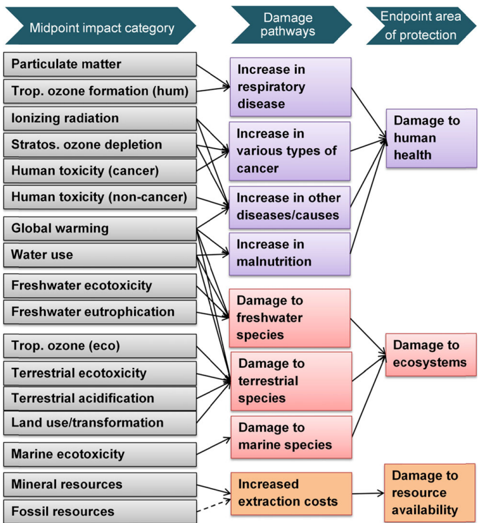
Life cycle impact assessment (LCIA) translates emissions and resource extractions into a limited number of environmental impact scores by means of so-called characterisation factors. There are two mainstream ways to derive characterisation factors, i.e. at midpoint level and at endpoint level. To further progress LCIA method development, we updated the ReCiPe2008 method to its version of 2016. This paper provides an overview of the key elements of the ReCiPe2016 method. We implemented human health, ecosystem quality and resource scarcity as three areas of protection. Endpoint characterisation factors, directly related to the areas of protection, were derived from midpoint characterisation factors with a constant mid-to-endpoint factor per impact category. We included 17 midpoint impact categories. The update of ReCiPe provides characterisation factors that are representative for the global scale instead of the European scale, while maintaining the possibility for a number of impact categories to implement characterisation factors at a country and continental scale. We also expanded the number of environmental interventions and added impacts of water use on human health, impacts of water use and climate change on freshwater ecosystems and impacts of water use and tropospheric ozone formation on terrestrial ecosystems as novel damage pathways. Although significant effort has been put into the update of ReCiPe, there is still major improvement potential in the way impact pathways are modelled. Further improvements relate to a regionalisation of more impact categories, moving from local to global species extinction and adding more impact pathways. Life cycle impact assessment is a fast evolving field of research. ReCiPe2016 provides a state-of-the-art method to convert life cycle inventories to a limited number of life cycle impact scores on midpoint and endpoint level.
Overview
The claims and statistics of this paper haven’t been checked yet.
Free: it reads the open-access text and checks the first 5 claims that cite a source we can check. Create a free account to check every claim.
Integrity signals
Registry
Cites
Statistics
Figures
Verification
Claims the paper makes
The claims and statistics of this paper haven’t been checked yet.
Free: it reads the open-access text and checks the first 5 claims that cite a source we can check. Create a free account to check every claim.
Self-check
Percentages, sums and reported differences re-computed from the paper’s own numbers.
The self-check needs the paper’s full text.
Citations
Cites
(2013) · Cited by 6,752
Accelerating extinction risk from climate change
Urban, M. C. (2015) · Science · doi:10.1126/science.aaa4984 · Cited by 2,436 · cited 2×
“For terrestrial ecosystems, the increase in potentially disappeared fraction of species (PDF) due to an increase in global temperature was derived from the review by Urban (2015).”
BackgroundThe water footprint of humanity
Hoekstra, A. Y., & Mekonnen, M. M. (2012) · Proceedings of the National Academy of Sciences · doi:10.1073/pnas.1109936109 · Cited by 2,260 · cited 2×
“…et al. 2013; Curran et al. 2014 Water use Increase of water consumed Water consumption potential (WCP) m3 water-eq consumed Döll and Siebert 2002; Hoekstra and Mekonnen 2012 Mineral resource scarcity Increase of ore extracted Surplus ore potential (SOP) kg Cu-eq Vieira et al. 2016a Fossil…”
BackgroundMethodAssessing the Environmental Impacts of Freshwater Consumption in LCA
Pfister, S., Koehler, A., & Hellweg, S. (2009) · Environmental Science & Technology · doi:10.1021/es802423e · Cited by 1,321 · cited 2×
“…shortage Pfister et al. 2009 Ecosystems (terrestrial) Decrease in Net Primary Productivity because of water shortage as proxy for total species loss Pfister et al. 2009 Ecosystems (aquatic) Fish species loss due to decreased river discharge Hanafiah et al. 2011 Land use Ecosystems (terrestrial)…”
BackgroundAmbient Air Pollution Exposure Estimation for the Global Burden of Disease 2013
Brauer, M., Freedman, G., Frostad, J., van Donkelaar, A., Martin, R. V., Dentener, F., Dingenen, R. V., Estep, K., Amini, H., Apte, J. S., et al. (2016) · Environmental Science & Technology · doi:10.1021/acs.est.5b03709 · Cited by 1,215
Addressing Global Mortality from Ambient PM2.5
Apte, J. S., Marshall, J. D., Cohen, A. J., & Brauer, M. (2015) · Environmental Science & Technology · doi:10.1021/acs.est.5b01236 · Cited by 995
Joos, F., Roth, R., Fuglestvedt, J. S., Peters, G. P., Enting, I. G., von Bloh, W., Brovkin, V., Burke, E. J., Eby, M., Edwards, N. R., et al. (2013) · Atmospheric Chemistry and Physics · doi:10.5194/acp-13-2793-2013 · Cited by 839
Implementation of life cycle impact assessment methods
Jungbluth, N., Margni, M. D., & Hischier, R. (2010) · Cited by 816
Global modeling of irrigation water requirements
Döll, P., & Siebert, S. (2002) · Water Resources Research · doi:10.1029/2001wr000355 · Cited by 816 · cited 2×
“For agriculture, the consumptive part of the withdrawal was estimated with water requirement ratios based on Döll and Siebert (2002).”
BackgroundMethod
Research works printed but not linked: 2
- 20. Goedkoop M, Heijungs R, Huijbregts MAJ, De Schryver A, Struijs J, van Zelm R (2009) ReCiPe 2008: a life cycle impact assessment method which comprises harmonised category indicators at the midpoint and endpoint levels. First edition. Report i: characterization. The Netherlands: Ruimte en Milieu, Ministerie van Volkshuisvesting, Ruimtelijke Ordening en Milieubeheer
- Vieira MDM, Ponsioen T, Goedkoop M, Huijbregts MAJ (2016c) Fossil resource scarcity. In: Huijbregts MAJ, Steinmann ZJN, Elshout PMF, Stam G, Verones F, Vieira MDM, Van Zelm R (eds) ReCiPe2016. A harmonized life cycle impact assessment method at midpoint and endpoint level. Report I: characterization. RIVM Report 2016-0104. National Institute for Human Health and the Environment, Bilthoven. Chapter 13
Cited by
Items 101–200 of 1,013
Woo, S.-H., Jang, H., Lee, S., & Lee, S. (2022) · The Science of The Total Environment · doi:10.1016/j.scitotenv.2022.156961 · Cited by 136
Life cycle assessment of lithium-based batteries: Review of sustainability dimensions
Paul, D., Pechancová, V., Saha, N., Pavelková, D., Saha, N., Motiei, M., Jamatia, T., Chaudhuri, M., Ivanichenko, A., Venher, M., et al. (2024) · Renewable and Sustainable Energy Reviews · doi:10.1016/j.rser.2024.114860 · Cited by 143
“By converting emissions and resource extraction into scores for the environmental impact, life cycle impact assessment (LCIA) aids in the interpretation of LCA studies [55].”
Environmental impacts of biodegradable microplastics
Piao, Z., Boakye, A. A. A., & Yao, Y. (2024) · Nature Chemical Engineering · doi:10.1038/s44286-024-00127-0 · Cited by 134
“Our LCIA method does not include species in the sediment, similar to other LCIA methods (for example, ReCiPe, TRACI and USEtox) 30,31,63 , due to a richer species presence in water and a lack of ecotoxicological data for sediment species.”
Environmental life cycle assessment of cemented carbide (WC-Co) production
Furberg, A., Arvidsson, R., & Molander, S. (2018) · Journal of Cleaner Production · doi:10.1016/j.jclepro.2018.10.272 · Cited by 126
“This version, and not the latest method suite ReCiPe (version 2016) (Huijbregts et al., 2017), was applied in order to maintain compatibility with the Ecoinvent database (2017) that was used for the background system LCIA data (Section 2.”
MethodComparison of Different Monetization Methods in LCA: A Review
Arendt, R., Bachmann, T. M., Motoshita, M., Bach, V., & Finkbeiner, M. (2020) · Sustainability · doi:10.3390/su122410493 · Cited by 135
“1 in the ReCiPe report) and the Environmental Prices Handbook (figure 5 and table 25 in the Environmental Prices Handbook) [26,29], we determine which AoPs are included in which impact category of those methods that have the damage cost perspective.”
BackgroundMethodInfluentialLuo, H., Cheng, F., Huelsenbeck, L. D., & Smith, N. (2021) · Journal of environmental chemical engineering · doi:10.1016/j.jece.2021.105159 · Cited by 128
Jia, C., Pang, M., Lu, Y., Liu, Y., Zhuang, M., Liu, B., Lu, J., Wei, T., Wang, L., Bian, T., et al. (2022) · One Earth · doi:10.1016/j.oneear.2022.11.006 · Cited by 125
Life cycle assessment of polyphenols extraction processes from waste biomass
Barjoveanu, G., Pătrăuțanu, O.-A., Teodosiu, C., & Volf, I. (2020) · Scientific Reports · doi:10.1038/s41598-020-70587-w · Cited by 114
Life cycle assessment of electrolytic manganese metal production
Zhang, R., Ma, X., Shen, X., Zhai, Y., Zhang, T., Ji, C., & Hong, J. (2020) · Journal of Cleaner Production · doi:10.1016/j.jclepro.2019.119951 · Cited by 120
Life Cycle Assessment of vegetable oil based polyols for polyurethane production
Fridrihsone, A., Romagnoli, F., Kirsanovs, V., & Cābulis, U. (2020) · Journal of Cleaner Production · doi:10.1016/j.jclepro.2020.121403 · Cited by 122
Lee, B., Cho, H., Kim, H., Lim, D., Cho, W. C., Kim, C., & Lim, H. (2021) · Journal of environmental chemical engineering · doi:10.1016/j.jece.2021.106349 · Cited by 128
Saber, Z., van Zelm, R., Pirdashti, H., Schipper, A. M., Esmaeili, M., Motevali, A., Nabavi‐Pelesaraei, A., & Huijbregts, M. A. J. (2021) · Sustainable Production and Consumption · doi:10.1016/j.spc.2021.02.033 · Cited by 126
Self-citationEnvironmental impacts and resource use of urban agriculture: a systematic review and meta-analysis
Dorr, E., Goldstein, B. P., Horvath, A., Aubry, C., & Gabrielle, B. (2021) · Environmental Research Letters · doi:10.1088/1748-9326/ac1a39 · Cited by 126
Huysveld, S., Ragaert, K., Demets, R., Nhu, T. T., Civancik-Uslu, D., Kusenberg, M., Geem, K. M. V., Meester, S. D., & Dewulf, J. (2022) · Waste Management · doi:10.1016/j.wasman.2022.08.006 · Cited by 130
Wakjira, T. G., KUTTY, A. A. K. A., & Alam, M. S. (2024) · Construction and Building Materials · doi:10.1016/j.conbuildmat.2024.135114 · Cited by 126
Florio, C., Fiorentino, G., Corcelli, F., Ulgiati, S., Dumontet, S., Güsewell, J., & Eltrop, L. (2019) · Energies · doi:10.3390/en12040718 · Cited by 112
Planetary Boundaries Analysis of Low-Carbon Ammonia Production Routes
D’Angelo, S. C., Cobo, S., Tulus, V., Nabera, A., Martín, A. J., Pérez‐Ramírez, J., & Guillén‐Gosálbez, G. (2021) · ACS Sustainable Chemistry & Engineering · doi:10.1021/acssuschemeng.1c01915 · Cited by 124
Peña, L. V. D. L., Taelman, S. E., Préat, N., Boone, L., der Biest, K. V., Custódio, M., Lucas, S. H., Everaert, G., & Dewulf, J. P. (2021) · The Science of The Total Environment · doi:10.1016/j.scitotenv.2021.152125 · Cited by 131
Trade and the role of non-food commodities for global eutrophication
Hamilton, H. A., Ivanova, D., Stadler, K., Merciai, S., Schmidt, J. H., van Zelm, R., Moran, D. D., & Wood, R. A. (2018) · Nature Sustainability · doi:10.1038/s41893-018-0079-z · Cited by 120
Liu, M., Ogunmoroti, A., Liu, W., Li, M., Bi, M., Liu, W., & Cui, Z. (2021) · The Science of The Total Environment · doi:10.1016/j.scitotenv.2021.150751 · Cited by 117
Environmental impacts in the civil aviation sector: Current state and guidance
Rupcic, L., Pierrat, É., Saavedra-Rubio, K., Thonemann, N., Ogugua, C. J., & Laurent, A. (2023) · Transportation Research Part D Transport and Environment · doi:10.1016/j.trd.2023.103717 · Cited by 130
Wang, Y., & Lü, Y. (2020) · Journal of Cleaner Production · doi:10.1016/j.jclepro.2020.121635 · Cited by 118
An assessment study on various clean hydrogen production methods
Aydin, M., & Dincer, I. (2022) · Energy · doi:10.1016/j.energy.2021.123090 · Cited by 95
Kravchenko, E., Minkina, T., Манджиева, С. С., Bauer, T. V., Latsynnik, E., Wong, M. H., & Nazarenko, O. (2024) · Journal of Hazardous Materials · doi:10.1016/j.jhazmat.2024.136751 · Cited by 122
Chordia, M., Wickerts, S., Nordelöf, A., & Arvidsson, R. (2022) · Resources, Conservation and Recycling · doi:10.1016/j.resconrec.2022.106634 · Cited by 114
Promoting a circular economy in the solar photovoltaic industry using life cycle symbiosis
Mathur, N., Singh, S., & Sutherland, J. W. (2020) · Resources, Conservation and Recycling · doi:10.1016/j.resconrec.2019.104649 · Cited by 110
Cardeal, G., Höse, K., Ribeiro, I., & Götze, U. (2020) · Sustainability · doi:10.3390/su12219130 · Cited by 128
“The environmental value should focus on the added value to the planet, regarding the main environmental categories reflected in Life Cycle Assessment (LCA)—human health, resources, and ecosystems quality [22].”
BackgroundSchulte, M., Lewandowski, I. M., Pude, R., & Wagner, M. (2021) · GCB Bioenergy · doi:10.1111/gcbb.12825 · Cited by 123
“…(LCIA) was conducted using the indicator approach ReCiPe, from which all 18 midpoint- impact categories were included, and a hierarchical perspective was applied (Huijbregts et al., 2016): Fine particulate matter formation (FPM), that is, air pollution from fine particles, is expressed in kg PM2.”
MethodDiez-Cañamero, B., & Mendoza, J. M. F. (2023) · Waste Management · doi:10.1016/j.wasman.2023.03.041 · Cited by 119
A Review of Life Cycle Assessment Studies of Electric Vehicles with a Focus on Resource Use
Dolganova, I., Rödl, A., Bach, V., Kaltschmitt, M., & Finkbeiner, M. (2020) · Resources · doi:10.3390/resources9030032 · Cited by 115
Bărăgău, I.-A., Power, N. P., Morgan, D. J., Lobo, R., Roberts, C. S., Titirici, M., Middelkoop, V., Diaz, A., Dunn, S., & Kellici, S. (2021) · ACS Sustainable Chemistry & Engineering · doi:10.1021/acssuschemeng.0c08594 · Cited by 112
Crustacean waste biorefinery as a sustainable cost-effective business model
Vicente, F. A., Ventura, S. P. M., Passos, H., Dias, A. C., Torres‐Acosta, M. A., Novak, U., & Likozar, B. (2022) · Chemical Engineering Journal · doi:10.1016/j.cej.2022.135937 · Cited by 115
Huysveld, S., Hubo, S., Ragaert, K., & Dewulf, J. P. (2018) · Journal of Cleaner Production · doi:10.1016/j.jclepro.2018.11.110 · Cited by 114
Environmental and social life cycle assessment of urban water systems: The case of Mexico City
García-Sánchez, M., & Güereca, L. P. (2019) · The Science of The Total Environment · doi:10.1016/j.scitotenv.2019.07.270 · Cited by 114
van der Hulst, M. K., Huijbregts, M. A. J., van Loon, N., Theelen, M., Kootstra, L., Bergesen, J. D., & Hauck, M. (2020) · Journal of Industrial Ecology · doi:10.1111/jiec.13027 · Cited by 116
Self-citationRajendran, N., Kang, D., Han, J., & Baskar, G. (2022) · Journal of Cleaner Production · doi:10.1016/j.jclepro.2022.132712 · Cited by 111
Ma, X., Ye, L., Qi, C., Yang, D., Shen, X., & Hong, J. (2018) · Journal of Environmental Management · doi:10.1016/j.jenvman.2018.07.027 · Cited by 113
Energy and water footprints of cereal production in China
Zhai, Y., Zhang, T., Bai, Y., Ji, C., Ma, X., Shen, X., & Hong, J. (2020) · Resources Conservation and Recycling · doi:10.1016/j.resconrec.2020.105150 · Cited by 111
Järviö, N., Parviainen, T., Maljanen, N.-L., Kobayashi, Y., Kujanpää, L., Ercili-Cura, D., Landowski, C. P., Ryynänen, T., Nordlund, E., & Tuomisto, H. L. (2021) · Nature Food · doi:10.1038/s43016-021-00418-2 · Cited by 118
Kar, S., Singh, R., Gurian, P. L., Hendricks, A., Kohl, P. A., McKelvey, S., & Spatari, S. (2022) · The Science of The Total Environment · doi:10.1016/j.scitotenv.2022.159499 · Cited by 109
Singh, G. V. P. B., & Prasad, V. D. (2024) · Journal of Cleaner Production · doi:10.1016/j.jclepro.2024.141729 · Cited by 109
Environmental hotspots of lactic acid production systems
Ögmundarson, Ó., Sukumara, S., Laurent, A., & Fantke, P. (2019) · GCB Bioenergy · doi:10.1111/gcbb.12652 · Cited by 109
McLaren, S. J., Berardy, A., Henderson, A. D., Holden, N. M., Huppertz, T., Jolliet, O., De Camillis, C., Renouf, M. A., Rugani, B., Saarinen, M., et al. (2021) · FAO eBooks · doi:10.4060/cb8054en · Cited by 198
Hamidinasab, B., Javadikia, H., Hosseini-Fashami, F., Kouchaki‐Penchah, H., & Nabavi‐Pelesaraei, A. (2023) · Solar Energy · doi:10.1016/j.solener.2023.111830 · Cited by 113
Bjørn, A., Richardson, K., & Hauschild, M. Z. (2018) · Journal of Industrial Ecology · doi:10.1111/jiec.12820 · Cited by 110
“To facilitate this, options for handling choices may be classified according to “perspective archetypes,” which is a common approach to handling value judgment in life cycle impact assessment (Hofstetter 1998; Huijbregts et al. 2017).”
BackgroundSendão, R. M. S., de Yuso, M. D. V. M., Algarra, M., da Silva, J. C. G. E., & da Silva, L. P. (2020) · Journal of Cleaner Production · doi:10.1016/j.jclepro.2020.120080 · Cited by 107
Jayawardana, J., Sandanayake, M. S., Jayasinghe, J. A. S. C., Kulatunga, A. K., & Zhang, G. (2023) · Journal of Building Engineering · doi:10.1016/j.jobe.2023.106550 · Cited by 127
Life Cycle Assessment of Coastal Enhanced Weathering for Carbon Dioxide Removal from Air
Foteinis, S., Campbell, J. S., & Renforth, P. (2023) · Environmental Science & Technology · doi:10.1021/acs.est.2c08633 · Cited by 95
Zhang, Q., Jiao, Y., He, C., Ruan, R. R., Hu, J., Ren, J., Toniolo, S., Jiang, D., Lu, C., Li, Y., et al. (2024) · Nature Communications · doi:10.1038/s41467-024-48790-4 · Cited by 126
“AccordingtoISO 14040andISO 14044 45 , LCAfor hydrogen production systems is made by using SimaPro 8.5based on ReCiPe2016 Midpoint method 46 .”
Rock-to-Metal Ratio: A Foundational Metric for Understanding Mine Wastes
Nassar, N. T., Lederer, G. W., Brainard, J., Padilla, A. J., & Lessard, J. D. (2022) · Environmental Science & Technology · doi:10.1021/acs.est.1c07875 · Cited by 112
Sustainability analysis of hydrogen production processes
Mio, A., Barbera, E., Pavan, A. M., Bertucco, A., & Fermeglia, M. (2023) · International Journal of Hydrogen Energy · doi:10.1016/j.ijhydene.2023.06.122 · Cited by 116
Assessing the sustainability of acid mine drainage (AMD) treatment in South Africa
Masindi, V., Chatzisymeon, E., Kortidis, I., & Foteinis, S. (2018) · The Science of The Total Environment · doi:10.1016/j.scitotenv.2018.04.108 · Cited by 104
Pipitone, E., Caltabellotta, S., & Occhipinti, L. (2021) · Sustainability · doi:10.3390/su131910992 · Cited by 122
“, NOX, NH3, and SO2) introduced in the atmosphere in terms of the equivalent mass of SO2 [14,15].”
BackgroundMethodInfluentialKeller, F., Lee, R. P., & Meyer, B. E. (2019) · Journal of Cleaner Production · doi:10.1016/j.jclepro.2019.119484 · Cited by 107
Felipe-Falgas, P., Madrid‐López, C., & Marquet, O. (2022) · Sustainability · doi:10.3390/su14074139 · Cited by 103
Global impacts of nitrogen and phosphorus fertiliser use for major crops on aquatic biodiversity
Jwaideh, M. A. A., Sutanudjaja, E. H., & Dalin, C. (2022) · The International Journal of Life Cycle Assessment · doi:10.1007/s11367-022-02078-1 · Cited by 115
Comparative life cycle assessment of alternative systems for wine packaging in Italy
Ferrara, C., & Feo, G. D. (2020) · Journal of Cleaner Production · doi:10.1016/j.jclepro.2020.120888 · Cited by 107
Zhu, X., Ho, C.-H., & Wang, X. (2020) · ACS Sustainable Chemistry & Engineering · doi:10.1021/acssuschemeng.0c02211 · Cited by 106
Ecosystem services and life cycle assessment: A bibliometric review
VanderWilde, C. P., & Newell, J. P. (2021) · Resources Conservation and Recycling · doi:10.1016/j.resconrec.2021.105461 · Cited by 110
Xayachak, T., Haque, N., Lau, D., Parthasarathy, R., & Pramanik, B. K. (2023) · Process Safety and Environmental Protection · doi:10.1016/j.psep.2023.03.061 · Cited by 109
Segura-Salazar, J., Lima, F. M., & Tavares, L. M. (2019) · Journal of Cleaner Production · doi:10.1016/j.jclepro.2019.05.318 · Cited by 88
Herrando, M., Elduque, D., Javierre, C., & Fueyo, N. (2022) · Energy Conversion and Management · doi:10.1016/j.enconman.2022.115402 · Cited by 101
Low-carbon diets can reduce global ecological and health costs
Lucas, E., Guo, M., & Guillén‐Gosálbez, G. (2023) · Nature Food · doi:10.1038/s43016-023-00749-2 · Cited by 111
Wagner, M., Mangold, A., Lask, J., Petig, E., Kiesel, A., & Lewandowski, I. (2019) · GCB Bioenergy · doi:10.1111/gcbb.12567 · Cited by 96
“The environmental performance of miscanthus cultivation was assessed by conducting a LCA according to the ISO standards 14040 and 14040 (ISO, 2006a,b), using the lifecycle impact assessment methodology ReCiPe (Huijbregts et al., 2017).”
MethodBuilding Material Use and Associated Environmental Impacts in China 2000–2015
Huang, B., Zhao, F. J., Fishman, T., Chen, W., Heeren, N., & Hertwich, E. G. (2018) · Environmental Science & Technology · doi:10.1021/acs.est.8b04104 · Cited by 102
Cui, L., Liu, M., Yuan, X., Wang, Q., Ma, Q., Wang, P., Hong, J., & Liu, H. (2021) · Journal of Cleaner Production · doi:10.1016/j.jclepro.2021.127703 · Cited by 100
Fiber-Reinforced concrete and its life cycle assessment: A systematic review
Manso‐Morato, J., Hurtado‐Alonso, N., Revilla‐Cuesta, V., Skaf, M., & Ortega‐López, V. (2024) · Journal of Building Engineering · doi:10.1016/j.jobe.2024.110062 · Cited by 124
Life-cycle sustainability assessment of key electricity generation systems in Portugal
Kabayo, J., Marques, P., Garcia, R., & Freire, F. M. C. S. (2019) · Energy · doi:10.1016/j.energy.2019.03.166 · Cited by 106
“In contrast, the more recent ReCiPe method which was used for the current study [50], disaggregates metal- and fossil fuel depletion.”
BackgroundMethodInfluentialChauvy, R., Verdonck, D., Dubois, L., Thomas, D., & Weireld, G. D. (2021) · Journal of CO2 Utilization · doi:10.1016/j.jcou.2021.101488 · Cited by 99
Chandrakumar, C., & McLaren, S. J. (2018) · Ecological Indicators · doi:10.1016/j.ecolind.2018.03.063 · Cited by 101
Huang, J., Wang, S., Chen, J., Chen, C., & Lizundia, E. (2025) · Advanced Materials · doi:10.1002/adma.202416733 · Cited by 131
Jungbluth, N., & Meili, C. (2018) · The International Journal of Life Cycle Assessment · doi:10.1007/s11367-018-1556-3 · Cited by 96
Review of methods to assess sustainability of industrial water use
Willet, J., Wetser, K., Vreeburg, J. H. G., & Rijnaarts, H. H. M. (2019) · Water Resources and Industry · doi:10.1016/j.wri.2019.100110 · Cited by 103
Zhao, G., & Baker, J. (2022) · Energy Strategy Reviews · doi:10.1016/j.esr.2022.100819 · Cited by 103
Environmental and health outcomes of single-use versus reusable duodenoscopes
Le, N. N. T., Hernandez, L. V., Vakil, N. B., Guda, N. M., Patnode, C., & Jolliet, O. (2022) · Gastrointestinal Endoscopy · doi:10.1016/j.gie.2022.06.014 · Cited by 100
Life cycle assessment of ocean liming for carbon dioxide removal from the atmosphere
Foteinis, S., Andresen, J., Campo, F., Caserini, S., & Renforth, P. (2022) · Journal of Cleaner Production · doi:10.1016/j.jclepro.2022.133309 · Cited by 78
Zhang, J., Tian, H., Wang, X., & Tong, Y. W. (2020) · Chemical Engineering Journal · doi:10.1016/j.cej.2020.125757 · Cited by 97
Life cycle assessment of fish oil substitute produced by microalgae using food waste
Bartek, L., Strid, I., Henryson, K., Junne, S., Rasi, S., & Eriksson, M. (2021) · Sustainable Production and Consumption · doi:10.1016/j.spc.2021.04.033 · Cited by 78
Pavlović, A., Donchev, T., Petkova, D., & Staletović, N. (2022) · Construction and Building Materials · doi:10.1016/j.conbuildmat.2022.127424 · Cited by 105
Harun, S. N., Hanafiah, M. M., & Aziz, N. I. H. A. (2020) · Environmental Management · doi:10.1007/s00267-020-01365-7 · Cited by 94
“categories at the endpoint level using the ReCiPe 2016 method developed by (Huijbregts et al. 2017).”
MethodLife cycle assessment of prospective sewage sludge treatment paths in Germany
Mayer, F., Bhandari, R., & Gäth, S. A. (2021) · Journal of Environmental Management · doi:10.1016/j.jenvman.2021.112557 · Cited by 97
The environmental impacts of clothing: Evidence from United States and three European countries
Sohn, J. L., Nielsen, K. S., Birkved, M., Joanes, T., & Gwozdz, W. (2021) · Sustainable Production and Consumption · doi:10.1016/j.spc.2021.05.013 · Cited by 105
Kaswan, M. S., Rathi, R., Garza‐Reyes, J. A., & Antony, J. (2022) · International Journal of Lean Six Sigma · doi:10.1108/ijlss-12-2020-0212 · Cited by 99
Life cycle assessment of alkali-activated materials: a systematic literature review
Nikravan, M., Firdous, R., & Stephan, D. (2023) · Low-carbon Materials and Green Construction · doi:10.1007/s44242-023-00014-6 · Cited by 93
Kumar, R., Sharma, H. D., Saran, C., Tripathy, T. S., Sangwan, K. S., & Herrmann, C. A. (2022) · Procedia CIRP · doi:10.1016/j.procir.2022.04.003 · Cited by 93
Environmental Impacts of Global Offshore Wind Energy Development until 2040
Li, C., Mogollón, J. M., Tukker, A., & Steubing, B. R. P. (2022) · Environmental Science & Technology · doi:10.1021/acs.est.2c02183 · Cited by 100
Matthews, N. E., Stamford, L., & Shapira, P. (2019) · Sustainable Production and Consumption · doi:10.1016/j.spc.2019.05.002 · Cited by 115
“This process can be aided by the three different archetypes (hierarchist, individualist, egalitarian) used in the ReCiPe impact assessment methodology (Hofstetter et al., 2000; Huijbregts et al., 2017).”
MethodMilousi, M., Souliotis, M., Arampatzis, G., & Papaefthimiou, S. (2019) · Sustainability · doi:10.3390/su11092539 · Cited by 104
Shades of green: life cycle assessment of renewable energy projects financed through green bonds
Gibon, T., Popescu, I., Hitaj, C., Petucco, C., & Benetto, E. (2020) · Environmental Research Letters · doi:10.1088/1748-9326/abaa0c · Cited by 91
Ismail, H., & Hanafiah, M. M. (2021) · Journal of Cleaner Production · doi:10.1016/j.jclepro.2021.127358 · Cited by 99
Environmental assessment of four waste cooking oil valorization pathways
Landi, F. F. D. A., Fabiani, C., Castellani, B., Cotana, F., & Pisello, A. L. (2021) · Waste Management · doi:10.1016/j.wasman.2021.11.037 · Cited by 98
Marine shell-based biorefinery: A sustainable solution for aquaculture waste valorization
Kiehbadroudinezhad, M., Hosseinzadeh-Bandbafha, H., Varjani, S., Wang, Y., Peng, W., Pan, J., Aghbashlo, M., & Tabatabaei, M. (2023) · Renewable Energy · doi:10.1016/j.renene.2023.02.057 · Cited by 91
Chairat, S., & Gheewala, S. H. (2023) · Environmental Research · doi:10.1016/j.envres.2023.116788 · Cited by 98
Basosi, R., Bonciani, R., Frosali, D., Manfrida, G., Parisi, M. L., & Sansone, F. (2020) · Sustainability · doi:10.3390/su12072786 · Cited by 84
Environmental assessment of future electricity mix – Linking an hourly economic model with LCA
Kiss, B., Kácsor, E., & Szalay, Z. (2020) · Journal of Cleaner Production · doi:10.1016/j.jclepro.2020.121536 · Cited by 90
Khounani, Z., Hosseinzadeh-Bandbafha, H., Moustakas, K., Talebi, A. F., Goli, S. A. H., Rajaeifar, M. A., Khoshnevisan, B., Salehi Jouzani, G., Peng, W., Kim, K.-H., et al. (2021) · Journal of Cleaner Production · doi:10.1016/j.jclepro.2020.123916 · Cited by 84
Life cycle assessment of mycelium-based composite materials
Volk, R., Schröter, M., Saeidi, N., Steffl, S., Javadian, A., Hebel, D. E., & Schultmann, F. (2024) · Resources Conservation and Recycling · doi:10.1016/j.resconrec.2024.107579 · Cited by 90
“(Huijbregts et al., 2017).”
Mayer, F., Bhandari, R., & Gäth, S. A. (2021) · Waste Management · doi:10.1016/j.wasman.2021.05.019 · Cited by 89
Flow battery production: Materials selection and environmental impact
He, H., Tian, S., Tarroja, B., Ogunseitan, O. A., Samuelsen, S. G., & Schoenung, J. M. (2020) · Journal of Cleaner Production · doi:10.1016/j.jclepro.2020.121740 · Cited by 89
“Global warming potential (GWP), ozone depletion potential (ODP), fine particulate matter (PM), acidification potential (AP) and freshwater eutrophication potential (EP) are calculated using the ReCiPe midpoint 2016 (ReCiPe) method (Huijbregts et al., 2017).”
MethodPeng, T., Wang, Y., Zhu, Y., Yang, Y., Yang, Y., & Tang, R. (2020) · Additive manufacturing · doi:10.1016/j.addma.2020.101530 · Cited by 89
Metadata
- Authors
- Huijbregts, M. A. J., Steinmann, Z. J. N., Elshout, P. M. F., Stam, G., Verones, F., Vieira, M., Zijp, M., Hollander, A., & van Zelm, R.
- Affiliations
- Netherlands Environmental Assessment Agency (NL)
- Radboud University Nijmegen (NL)
- Norwegian University of Science and Technology (NO)
- National Institute for Public Health and the Environment (NL)
- Corresponding author
- Huijbregts, Mark A. J.
- ORCID
- Venue
- The International Journal of Life Cycle Assessment
- Published
- 2016-12-12
- Volume
- 22
- Issue
- 2
- Pages
- 138-147
- ISSN
- 0948-3349 (ISSN-L)
- 1614-7502
- OpenAlex
- W2564630286
- Semantic Scholar
- 318510507a790e4b13a4320ec9a6a8756ed96ecd
- Cited by
- 4,485
- References
- 54
- Citations by year
- 2026: 945 · 2025: 906 · 2024: 682 · 2023: 578 · 2022: 520 · 2021: 391 · 2020: 232 · 2019: 131 · 2018: 78 · 2017: 18 · 2016: 3
- FWCI
- 48.09
- Type
- journal article
- Language
- en
- Update notices
- correction (2020-07-02)
- Open access
- hybrid
- doi.org
- Licence
- cc-by
- creativecommons.org/licenses/by/4.0 (tdm)
- creativecommons.org/licenses/by/4.0 (vor)
- Locations
- The International Journal of Life Cycle Assessment (publishedVersion, cc-by)
- Radboud Repository (Radboud University) (submittedVersion)
- Rivm Repository (Netherlands National Institute for Public Health and the Environment) (submittedVersion)
- Radboud Repository (Radboud University) (submittedVersion, other-oa)
- Funders
- Rijksinstituut voor Volksgezondheid en Milieu (S/607020)
- Topics
- Physical Sciences › Environmental Science › Environmental Engineering › Environmental Impact and Sustainability
- Physical Sciences › Environmental Science › Ecology › Agriculture Sustainability and Environmental Impact
- Physical Sciences › Environmental Science › Environmental Engineering › Sustainability and Ecological Systems Analysis
- Keywords
- life cycle impact assessment, characterization factors, human health effects, ecosystem quality, resource constraints, water use impacts, freshwater ecosystems, tropospheric ozone formation, terrestrial ecosystems, species extinction, environmental interventions, global scale
About these checks
Registry, retraction, Cites and statistics results are computed, not judged, with one exception: a printed reference that no index lists is read once by a model before it counts as a citation error. Claims are extracted by a model and kept only when their quote appears verbatim in the text; each cited source is then checked, with a model’s help, for whether it says what the claim relies on. Those verdicts can be wrong — read the claim’s quote and the cited source before relying on one.
Statistics and arithmetic are recomputed, not judged.
Confidence bands are shown only for fields calibrated on our annotated test set. None is calibrated yet, so no band is shown.
What counts as a claim ›How we measure confidence ›How we check this ›
Are you an author, or do you see a problem with this page? Request a review
Data sources
Bibliographic data: Semantic Scholar, OpenAlex, Crossref.
Contains information from the Semantic Scholar Academic Graph Datasets, made available under the ODC Attribution License (ODC-BY 1.0).
Semantic Scholar’s data is described in: Kinney, R., et al. (2023). The Semantic Scholar Open Data Platform. arXiv:2301.10140.
