

ReCiPe2016: a harmonised life cycle impact assessment method at midpoint and endpoint level
Open accessThe DOI matches its Crossref record; 53 of the 54 references it cites were found in a registry or an index.
Abstract
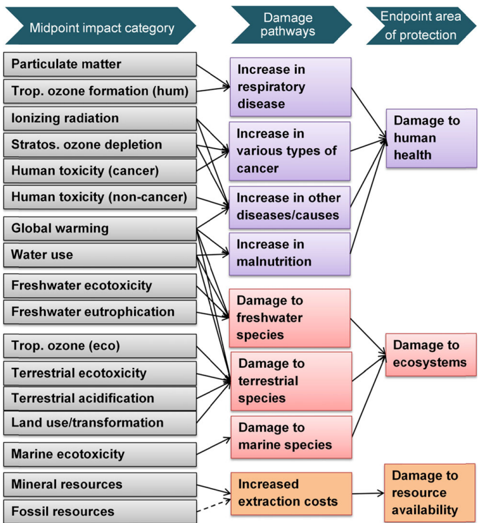
Life cycle impact assessment (LCIA) translates emissions and resource extractions into a limited number of environmental impact scores by means of so-called characterisation factors. There are two mainstream ways to derive characterisation factors, i.e. at midpoint level and at endpoint level. To further progress LCIA method development, we updated the ReCiPe2008 method to its version of 2016. This paper provides an overview of the key elements of the ReCiPe2016 method. We implemented human health, ecosystem quality and resource scarcity as three areas of protection. Endpoint characterisation factors, directly related to the areas of protection, were derived from midpoint characterisation factors with a constant mid-to-endpoint factor per impact category. We included 17 midpoint impact categories. The update of ReCiPe provides characterisation factors that are representative for the global scale instead of the European scale, while maintaining the possibility for a number of impact categories to implement characterisation factors at a country and continental scale. We also expanded the number of environmental interventions and added impacts of water use on human health, impacts of water use and climate change on freshwater ecosystems and impacts of water use and tropospheric ozone formation on terrestrial ecosystems as novel damage pathways. Although significant effort has been put into the update of ReCiPe, there is still major improvement potential in the way impact pathways are modelled. Further improvements relate to a regionalisation of more impact categories, moving from local to global species extinction and adding more impact pathways. Life cycle impact assessment is a fast evolving field of research. ReCiPe2016 provides a state-of-the-art method to convert life cycle inventories to a limited number of life cycle impact scores on midpoint and endpoint level.
Overview
The claims and statistics of this paper haven’t been checked yet.
Free: it reads the open-access text and checks the first 5 claims that cite a source we can check. Create a free account to check every claim.
Integrity signals
Registry
Cites
Statistics
Figures
Verification
Claims the paper makes
The claims and statistics of this paper haven’t been checked yet.
Free: it reads the open-access text and checks the first 5 claims that cite a source we can check. Create a free account to check every claim.
Self-check
Percentages, sums and reported differences re-computed from the paper’s own numbers.
The self-check needs the paper’s full text.
Citations
Cites
(2013) · Cited by 6,752
Accelerating extinction risk from climate change
Urban, M. C. (2015) · Science · doi:10.1126/science.aaa4984 · Cited by 2,436 · cited 2×
“For terrestrial ecosystems, the increase in potentially disappeared fraction of species (PDF) due to an increase in global temperature was derived from the review by Urban (2015).”
BackgroundThe water footprint of humanity
Hoekstra, A. Y., & Mekonnen, M. M. (2012) · Proceedings of the National Academy of Sciences · doi:10.1073/pnas.1109936109 · Cited by 2,260 · cited 2×
“…et al. 2013; Curran et al. 2014 Water use Increase of water consumed Water consumption potential (WCP) m3 water-eq consumed Döll and Siebert 2002; Hoekstra and Mekonnen 2012 Mineral resource scarcity Increase of ore extracted Surplus ore potential (SOP) kg Cu-eq Vieira et al. 2016a Fossil…”
BackgroundMethodAssessing the Environmental Impacts of Freshwater Consumption in LCA
Pfister, S., Koehler, A., & Hellweg, S. (2009) · Environmental Science & Technology · doi:10.1021/es802423e · Cited by 1,321 · cited 2×
“…shortage Pfister et al. 2009 Ecosystems (terrestrial) Decrease in Net Primary Productivity because of water shortage as proxy for total species loss Pfister et al. 2009 Ecosystems (aquatic) Fish species loss due to decreased river discharge Hanafiah et al. 2011 Land use Ecosystems (terrestrial)…”
BackgroundAmbient Air Pollution Exposure Estimation for the Global Burden of Disease 2013
Brauer, M., Freedman, G., Frostad, J., van Donkelaar, A., Martin, R. V., Dentener, F., Dingenen, R. V., Estep, K., Amini, H., Apte, J. S., et al. (2016) · Environmental Science & Technology · doi:10.1021/acs.est.5b03709 · Cited by 1,215
Addressing Global Mortality from Ambient PM2.5
Apte, J. S., Marshall, J. D., Cohen, A. J., & Brauer, M. (2015) · Environmental Science & Technology · doi:10.1021/acs.est.5b01236 · Cited by 995
Joos, F., Roth, R., Fuglestvedt, J. S., Peters, G. P., Enting, I. G., von Bloh, W., Brovkin, V., Burke, E. J., Eby, M., Edwards, N. R., et al. (2013) · Atmospheric Chemistry and Physics · doi:10.5194/acp-13-2793-2013 · Cited by 839
Implementation of life cycle impact assessment methods
Jungbluth, N., Margni, M. D., & Hischier, R. (2010) · Cited by 816
Global modeling of irrigation water requirements
Döll, P., & Siebert, S. (2002) · Water Resources Research · doi:10.1029/2001wr000355 · Cited by 816 · cited 2×
“For agriculture, the consumptive part of the withdrawal was estimated with water requirement ratios based on Döll and Siebert (2002).”
BackgroundMethod
Research works printed but not linked: 2
- 20. Goedkoop M, Heijungs R, Huijbregts MAJ, De Schryver A, Struijs J, van Zelm R (2009) ReCiPe 2008: a life cycle impact assessment method which comprises harmonised category indicators at the midpoint and endpoint levels. First edition. Report i: characterization. The Netherlands: Ruimte en Milieu, Ministerie van Volkshuisvesting, Ruimtelijke Ordening en Milieubeheer
- Vieira MDM, Ponsioen T, Goedkoop M, Huijbregts MAJ (2016c) Fossil resource scarcity. In: Huijbregts MAJ, Steinmann ZJN, Elshout PMF, Stam G, Verones F, Vieira MDM, Van Zelm R (eds) ReCiPe2016. A harmonized life cycle impact assessment method at midpoint and endpoint level. Report I: characterization. RIVM Report 2016-0104. National Institute for Human Health and the Environment, Bilthoven. Chapter 13
Cited by
Items 201–300 of 1,013
Tian, X., Richardson, R. E., Tester, J. W., Lozano, J. L., & You, F. (2020) · ACS Sustainable Chemistry & Engineering · doi:10.1021/acssuschemeng.0c05189 · Cited by 96
Guo, W., Feng, T., Li, W., Hua, L., Meng, Z., & Li, K. (2023) · Journal of Energy Storage · doi:10.1016/j.est.2023.108589 · Cited by 94
Goren, A. Y., Dinçer, İ., & Khalvati, A. (2023) · Journal of environmental chemical engineering · doi:10.1016/j.jece.2023.111187 · Cited by 101
Ahmed, M. M., Das, B. K., Das, P., Hossain, M. S., & Kibria, M. G. (2023) · Energy Conversion and Management · doi:10.1016/j.enconman.2023.117865 · Cited by 89
Sills, D. L., Van Doren, L. G., Beal, C., & Raynor, E. (2020) · Algal Research · doi:10.1016/j.algal.2019.101770 · Cited by 83
Paris, J. M. G., Falkenberg, T., Nöthlings, U., Heinzel, C., Borgemeister, C., & Escobar, N. (2021) · The Science of The Total Environment · doi:10.1016/j.scitotenv.2021.151437 · Cited by 97
Life Cycle Assessment of Biomass Pyrolysis
Gahane, D., Biswal, D., & Mandavgane, S. A. (2022) · BioEnergy Research · doi:10.1007/s12155-022-10390-9 · Cited by 94
Xing, J., Song, J., Liu, C., Yang, W., Duan, H., Yabar, H., & Ren, J. (2022) · Nature Food · doi:10.1038/s43016-022-00649-x · Cited by 90
Gonçalves, A., Ferreira, B., Leite, M., & Ribeiro, I. (2023) · Sustainable Production and Consumption · doi:10.1016/j.spc.2023.10.004 · Cited by 96
Wang, Z., Lv, J., Гу, Ф., Yang, J., & Guo, J. (2019) · The Science of The Total Environment · doi:10.1016/j.scitotenv.2019.136096 · Cited by 91
Li, S., Wu, J., Wang, X., & Ma, L. (2020) · Journal of Cleaner Production · doi:10.1016/j.jclepro.2020.122683 · Cited by 91
Life Cycle Assessment of Disposed and Recycled End-of-Life Photovoltaic Panels in Australia
Singh, J., Molinari, G., Bui, J. T., Soltani, B., Rajarathnam, G. P., & Abbas, A. (2021) · Sustainability · doi:10.3390/su131911025 · Cited by 87
“Examples of indicators for LCIAs relating to lifecycle CO2 emissions include IMPACT 2002+ and IPCC 2013 GWP100a [35].”
BackgroundMethodInfluentialTrue cost accounting of organic and conventional food production
Michalke, A., Köhler, S., Meßmann, L., Thorenz, A., Tuma, A., & Gaugler, T. (2023) · Journal of Cleaner Production · doi:10.1016/j.jclepro.2023.137134 · Cited by 98
Environmental Impact and Environmental Cost Assessment of Methanol Production from wood biomass
Yadav, P., Athanassiadis, D., Yacout, D. M. M., Tysklind, M., & Upadhyayula, V. K. K. (2020) · Environmental Pollution · doi:10.1016/j.envpol.2020.114990 · Cited by 92
Briones-Hidrovo, A., Rey, J. R. C., Tarelho, L. A. C., Gonçalves, C. V. M., da Costa, T. P., & Dias, A. C. (2021) · Journal of Cleaner Production · doi:10.1016/j.jclepro.2020.125680 · Cited by 91
Mainardis, M., Buttazzoni, M., Gievers, F., Vance, C., Magnolo, F., Murphy, F., & Goi, D. (2021) · Journal of Cleaner Production · doi:10.1016/j.jclepro.2021.129056 · Cited by 87
Liu, Z., Wang, X., Li, S., Bai, Z., & Ma, L. (2021) · Bioresource Technology · doi:10.1016/j.biortech.2021.126576 · Cited by 88
Chin, M. Y., Phuang, Z. X., Woon, K. S., Hanafiah, M. M., Zhang, Z., & Liu, X. (2022) · Journal of Environmental Management · doi:10.1016/j.jenvman.2022.115778 · Cited by 91
A life cycle impact analysis of various hydrogen production methods for public transportation sector
Aydın, M. İ., & Dinçer, İ. (2022) · International Journal of Hydrogen Energy · doi:10.1016/j.ijhydene.2022.09.125 · Cited by 88
Elomari, Y., Mateu, C., Marín-Genescà, M., & Boer, D. T. (2024) · Applied Energy · doi:10.1016/j.apenergy.2024.122619 · Cited by 86
Wentker, M., Greenwood, M., Asaba, M. C., & Leker, J. (2019) · Journal of Energy Storage · doi:10.1016/j.est.2019.101022 · Cited by 91
Beemsterboer, S., Baumann, H., & Wallbaum, H. (2020) · The International Journal of Life Cycle Assessment · doi:10.1007/s11367-020-01821-w · Cited by 96
Dastjerdi, B., Strezov, V., Kumar, R., He, J., & Behnia, M. (2020) · The Science of The Total Environment · doi:10.1016/j.scitotenv.2020.144355 · Cited by 89
Wrålsen, B., & O’Born, R. (2023) · The International Journal of Life Cycle Assessment · doi:10.1007/s11367-023-02154-0 · Cited by 89
Life Cycle Assessment of PLA Products: A Systematic Literature Review
Fonseca, A. C., Ramalho, E., Gouveia, A., Figueiredo, F., & Nunes, J. (2023) · Sustainability · doi:10.3390/su151612470 · Cited by 92
“With it being updated in 2016, it is now a state-of-the-art method that incorporates 3 endpoint impact categories (human health, ecosystem quality, and resource scarcity) and 17 midpoint categories [44].”
MethodTowards practical applications of radiative cooling
Yang, K., Wu, X., Zhou, L., Wu, P. P., Gereige, I., & Gan, Q. (2025) · Nature Reviews Clean Technology · doi:10.1038/s44359-025-00041-5 · Cited by 96
“The cradle-to-gate life cycle assessment 117,185 estimates a potential 60% reduction in carbon-equivalent emissions associated with the construction and operation of buildings utilizing RC roofs compared with those using conventional concrete tiles.”
Risse, M., Weber-Blaschke, G., & Richter, K. (2019) · Science of The Total Environment · doi:10.1016/j.scitotenv.2019.01.117 · Cited by 84
Eco-design and Eco-materials: An interactive and collaborative approach
Cicconi, P. (2019) · Sustainable materials and technologies · doi:10.1016/j.susmat.2019.e00135 · Cited by 84
Bello, S., Galán‐Martín, Á., Feijóo, G., Moreira, M. T., & Guillén‐Gosálbez, G. (2020) · Applied Energy · doi:10.1016/j.apenergy.2020.115884 · Cited by 87
Life cycle comparison of marine fuels for IMO 2020 Sulphur Cap
Bilgili, L. (2021) · The Science of The Total Environment · doi:10.1016/j.scitotenv.2021.145719 · Cited by 84
Life Cycle Assessment of Fungal-Based Composite Bricks
Stelzer, L., Hoberg, F., Bach, V., Schmidt, B., Pfeiffer, S., Meyer, V., & Finkbeiner, M. (2021) · Sustainability · doi:10.3390/su132111573 · Cited by 91
“For the categories of land use, water scarcity, and smog, the recommendations of the Product Environmental Footprint [26] were followed, applying the LANCA method [27–29] as an aggregated single-score indicator for land use, the AWARE (Available Water Remaining) method [30] for water scarcity, and ReCiPe [31,32] for s…”
BackgroundMethodSun, S., & Ertz, M. (2022) · Sustainable Cities and Society · doi:10.1016/j.scs.2022.104045 · Cited by 84
“0 to calculate the environmental impact indicator score, and the impact category “Global warming” was selected to quantitatively estimate the EF and GHG emissions reduction benefits of shared micromobility (Huijbregts et al., 2017; Sun & Ertz, 2021b).”
BackgroundHackenhaar, I., Moraga, G., Thomassen, G., Taelman, S. E., Dewulf, J. P., & Bachmann, T. M. (2024) · Sustainable Production and Consumption · doi:10.1016/j.spc.2024.01.018 · Cited by 105
Feo, G. D., Ferrara, C., & Minichini, F. (2021) · Journal of Cleaner Production · doi:10.1016/j.jclepro.2021.130158 · Cited by 92
Mazac, R., Järviö, N., & Tuomisto, H. L. (2023) · The Science of The Total Environment · doi:10.1016/j.scitotenv.2023.162796 · Cited by 92
Arrigoni, A., Beckett, C., Ciancio, D., Pelosato, R., Dotelli, G., & Grillet, A. (2018) · Resources Conservation and Recycling · doi:10.1016/j.resconrec.2018.05.025 · Cited by 91
Life cycle impact assessment of microplastics as one component of marine plastic debris
Saling, P. R., Gyuzeleva, L., Wittstock, K., Wessolowski, V., & Grießhammer, R. (2020) · The International Journal of Life Cycle Assessment · doi:10.1007/s11367-020-01802-z · Cited by 86
“Still only a handful of LCA impact categories are related to the marine environment (Huijbregts et al. 2016) and there is a general lack of focus on plastics and its interactions with marine environments (Woods et al. 2016).”
BackgroundOreto, C., Russo, F., Veropalumbo, R., Viscione, N., Biancardo, S. A., & Dell’Acqua, G. (2021) · Materials · doi:10.3390/ma14143867 · Cited by 82
“The overall results in terms of midpoint indicators of the comparative LCIA conducted on the twenty asphalt pavement configurations are presented in Table S2 in the Supplementary Material along with the percentage variations compared to the baseline pavement configuration involving a traditional HMA in the wearing cours…”
MethodInfluentialMarvuglia, A., Bayram, A., Baustert, P., Gutiérrez, T. N., & Igos, E. (2021) · Journal of Cleaner Production · doi:10.1016/j.jclepro.2021.129847 · Cited by 98
Ateşcan, Y., Mills, A., Ayre, D., Koziol, K. K., & Salonitis, K. (2024) · The International Journal of Advanced Manufacturing Technology · doi:10.1007/s00170-024-13241-3 · Cited by 82
“For the life cycle impact assessment (LCIA) process, ReCiPe 2016 mid-point (H) was the chosen method to calculate the environmental impact of the inventory data [37].”
MethodA crustal scarcity indicator for long-term global elemental resource assessment in LCA
Arvidsson, R., Söderman, M. L., Sandén, B. A., Nordelöf, A., André, H., & Tillman, A. (2020) · The International Journal of Life Cycle Assessment · doi:10.1007/s11367-020-01781-1 · Cited by 88
“By including price-based allocation of byproduct elements (Huijbregts et al. 2016), the SOPs become time- sensitive since market prices of metals are highly fluctuating over time (Drielsma et al. 2016).”
BackgroundMethodInfluentialZeller, V., Lavigne, C., D’Ans, P., Towa, E., & Achten, W. (2020) · The Science of The Total Environment · doi:10.1016/j.scitotenv.2020.140690 · Cited by 84
Eufrasio, R. M., Kantzas, E. P., Edwards, N. R., Holden, P. B., Pollitt, H., Mercure, J.-F., Koh, S. C. L., & Beerling, D. J. (2022) · Communications Earth & Environment · doi:10.1038/s43247-022-00436-3 · Cited by 92
Global Metrics for Terrestrial Biodiversity
Burgess, N. D., Ali, N., Bedford, J., Bhola, N., Brooks, S. E., Cierna, A., Correa, R. J., Harris, M., Hargey, A., Hughes, J., et al. (2024) · Annual Review of Environment and Resources · doi:10.1146/annurev-environ-121522-045106 · Cited by 96
Thomassen, G., Van Dael, M., & Van Passel, S. (2018) · Bioresource Technology · doi:10.1016/j.biortech.2018.07.037 · Cited by 77
Critical review and methodological issues in integrated life-cycle analysis on road networks
Hasan, U., Whyte, A., & Jassmi, H. A. (2018) · Journal of Cleaner Production · doi:10.1016/j.jclepro.2018.09.148 · Cited by 80
Life cycle assessment of ultra-low treatment for steel industry sintering flue gas emissions
Cui, L., Ba, K., Li, F., Wang, Q., Ma, Q., Yuan, X., Mu, R., Hong, J., & Zuo, J. (2020) · The Science of The Total Environment · doi:10.1016/j.scitotenv.2020.138292 · Cited by 80
Planetary metrics for the absolute environmental sustainability assessment of chemicals
Tulus, V., Pérez‐Ramírez, J., & Guillén‐Gosálbez, G. (2021) · Green Chemistry · doi:10.1039/d1gc02623b · Cited by 86
Correa-Cano, M. E., Salmoral, G., Rey, D., Knox, J. W., Graves, A. R., Melo, Ó., Foster, W., Naranjo, L., Zegarra, E., Johnson, C. E., et al. (2022) · Renewable and Sustainable Energy Reviews · doi:10.1016/j.rser.2022.112182 · Cited by 80
Li, X., Wang, R., Shao, C., Li, D., Bai, S., Hou, N., & Zhao, X. (2022) · ACS Sustainable Chemistry & Engineering · doi:10.1021/acssuschemeng.1c08074 · Cited by 84
Analysis: the biodiversity footprint of the University of Oxford
Bull, J. W., Taylor, I., Biggs, E., Grub, H. M. J., Yearley, T., Waters, H., & Milner‐Gulland, E. J. (2022) · Nature · doi:10.1038/d41586-022-01034-1 · Cited by 93
Tang, H., Li, S., Zhang, Y., Na, Y., Sun, C., Zhao, D., Liu, J., & Zhou, Z. (2022) · Journal of Cleaner Production · doi:10.1016/j.jclepro.2022.135035 · Cited by 85
Bisht, M., Martins, M., Dias, A. C., Ventura, S. P. M., & Coutinho, J. A. P. (2021) · Green Chemistry · doi:10.1039/d1gc01432c · Cited by 79
Recognizing the long-term impacts of plastic particles for preventing distortion in decision-making
Gontard, N., David, G., Guilbert, A., & Sohn, J. L. (2022) · Nature Sustainability · doi:10.1038/s41893-022-00863-2 · Cited by 83
A climate-optimal supply chain for CO2 capture, utilization, and storage by mineralization
Ostovari, H., Müller, L. J., Mayer, F., & Bardow, A. (2022) · Journal of Cleaner Production · doi:10.1016/j.jclepro.2022.131750 · Cited by 83
Technoeconomic and Life-Cycle Assessment for Electrocatalytic Production of Furandicarboxylic Acid
Patel, P., Schwartz, D., Wang, X., Lin, R., Ajao, O., & Seifitokaldani, A. (2022) · ACS Sustainable Chemistry & Engineering · doi:10.1021/acssuschemeng.1c08602 · Cited by 80
Nabavi‐Pelesaraei, A., Mobtaker, H. G., Salehi, M., Rafiee, S., Chau, K., & Ebrahimi, R. (2023) · Agronomy · doi:10.3390/agronomy13030737 · Cited by 82
Pedersen, A., Pandya, J., Leonzio, G., Serov, A., Bernardi, A., Stephens, I. E. L., Titirici, M., Petit, C., & Chachuat, B. (2023) · Green Chemistry · doi:10.1039/d3gc03206j · Cited by 82
Tagne, R. F. T., Tchuifon, D. R. T., Santagata, R., Kouteu, P. A. N., Anagho, S. G., Ionel, I., & Ulgiati, S. (2020) · Journal of Cleaner Production · doi:10.1016/j.jclepro.2020.125464 · Cited by 80
Adrianto, L. R., Ciacci, L., Pfister, S., & Hellweg, S. (2023) · The Science of The Total Environment · doi:10.1016/j.scitotenv.2023.162038 · Cited by 83
Development of chemical admixtures for green and environmentally friendly concrete: A review
Lai, G., Liu, X., Li, S., Xu, Y., Zheng, Y., Guan, J., Gao, R., Wei, Z., Wang, Z., & Cui, S. (2023) · Journal of Cleaner Production · doi:10.1016/j.jclepro.2023.136116 · Cited by 84
Khakmardan, S., Rolinck, M., Cerdas, F., Herrmann, C., Giurco, D., Crawford, R., & Li, W. (2023) · Procedia CIRP · doi:10.1016/j.procir.2023.02.102 · Cited by 77
A Scoping Review of Indicators for Sustainable Healthy Diets
Harrison, M. R., Palma, G., Buendia, T., Bueno-Tarodo, M., Quell, D., & Hachem, F. (2022) · Frontiers in Sustainable Food Systems · doi:10.3389/fsufs.2021.822263 · Cited by 83
“Other common indicators include those that combined multiple environmental concepts such as the ReCiPe score (Huijbregts et al., 2017) which can include up to 18 environmental indicators.”
BackgroundPera, A. L., Sellaro, M., & Bencivenni, E. (2022) · Journal of Cleaner Production · doi:10.1016/j.jclepro.2022.131552 · Cited by 86
Jolaoso, L. A., Duan, C., & Kazempoor, P. (2023) · International Journal of Hydrogen Energy · doi:10.1016/j.ijhydene.2023.07.129 · Cited by 77
Horrillo, A., Gaspar, P., & Escribano, M. (2020) · Animals · doi:10.3390/ani10010162 · Cited by 80
Uncertainty in LCA: An estimation of practitioner-related effects
Scrucca, F., Baldassarri, C., Baldinelli, G., Bonamente, E., Rinaldi, S., Rotili, A., & Barbanera, M. (2020) · Journal of Cleaner Production · doi:10.1016/j.jclepro.2020.122304 · Cited by 76
Yao, Z., Zhang, W., Wang, X., Zhang, L., Zhang, W., Liu, D., & Chen, X. (2021) · Journal of Cleaner Production · doi:10.1016/j.jclepro.2021.127611 · Cited by 91
Aleisa, E., Alsulaili, A. D., & Almuzaini, Y. (2021) · Waste Management · doi:10.1016/j.wasman.2021.08.035 · Cited by 79
Koide, R., Murakami, S., & Nansai, K. (2021) · Renewable and Sustainable Energy Reviews · doi:10.1016/j.rser.2021.111858 · Cited by 84
Environmental Impact Analysis of Portland Cement (CEM1) Using the Midpoint Method
Ige, O. E., Olanrewaju, O. A., Duffy, K. J., & Collins, O. C. (2022) · Energies · doi:10.3390/en15072708 · Cited by 89
“Ozone depletion (OD) happens when the rate of ozone destruction is accelerated by recalcitrant chemicals from anthropogenic emissions containing chlorine or bromine atoms [88,106].”
BackgroundMoosavi-Nezhad, M., Salehi, R., Aliniaeifard, S., Winans, K. S., & Nabavi‐Pelesaraei, A. (2022) · Journal of Cleaner Production · doi:10.1016/j.jclepro.2022.132069 · Cited by 81
Fayyaz, S., Masjedi, S. K., Kazemi, A., Khaki, E., Moeinaddini, M., & Olsen, S. I. (2022) · Journal of Cleaner Production · doi:10.1016/j.jclepro.2022.135299 · Cited by 84
Feng, H., Zhao, J., Hollberg, A., & Habert, G. (2023) · Journal of Cleaner Production · doi:10.1016/j.jclepro.2023.136936 · Cited by 76
Keiser, D., Schnoor, L. H., Pupkes, B., & Freitag, M. (2023) · Journal of Air Transport Management · doi:10.1016/j.jairtraman.2023.102418 · Cited by 82
Raza, M. H., Khan, M., & Zhong, R. Y. (2023) · The Science of The Total Environment · doi:10.1016/j.scitotenv.2023.167839 · Cited by 76
Product Environmental Footprint (PEF) Pilot Phase—Comparability over Flexibility?
Bach, V., Lehmann, A., Görmer, M., & Finkbeiner, M. (2018) · Sustainability · doi:10.3390/su10082898 · Cited by 71
Schade, S., & Meier, T. (2019) · Algal Research · doi:10.1016/j.algal.2019.101485 · Cited by 71
Choice of materials for takeaway beverage cups towards a circular economy
Changwichan, K., & Gheewala, S. H. (2020) · Sustainable Production and Consumption · doi:10.1016/j.spc.2020.02.004 · Cited by 75
An (Eco)Toxicity Life Cycle Impact Assessment Framework for Per- And Polyfluoroalkyl Substances
Holmquist, H., Fantke, P., Cousins, I. T., Owsianiak, M., Liagkouridis, I., & Peters, G. M. (2020) · Environmental Science & Technology · doi:10.1021/acs.est.9b07774 · Cited by 68
Bai, Y., Zhai, Y., Ji, C., Zhang, T., Chen, W., Shen, X., & Hong, J. (2021) · Resources Conservation and Recycling · doi:10.1016/j.resconrec.2021.105606 · Cited by 79
Najid, N., Fellaou, S., Kouzbour, S., Gourich, B., & Ruiz-García, A. (2021) · Process Safety and Environmental Protection · doi:10.1016/j.psep.2021.10.014 · Cited by 80
Eštoková, A., Fabianová, M., & Ondová, M. (2022) · International Journal of Civil Engineering · doi:10.1007/s40999-022-00701-8 · Cited by 79
Kayad, A. G., Sozzi, M., Paraforos, D. S., Rodrigues, F. A., Cohen, Y., Fountas, S., Medel-Jiménez, F., Pezzuolo, A., Grigolato, S., & Marinello, F. (2022) · Computers and Electronics in Agriculture · doi:10.1016/j.compag.2022.107080 · Cited by 80
E-scooter micromobility systems: Review of attributes and impacts
Mitropoulos, L. K., Stavropoulou, E., Tzouras, P. G., Karolemeas, C., & Kepaptsoglou, K. L. (2023) · Transportation Research Interdisciplinary Perspectives · doi:10.1016/j.trip.2023.100888 · Cited by 75
Fulham, G. J., Mendoza-Moreno, P. V., & Marek, E. (2024) · Energy & Environmental Science · doi:10.1039/d4ee00933a · Cited by 82
Wu, Z., & Kong, D. (2018) · Clean Technologies and Environmental Policy · doi:10.1007/s10098-018-1548-9 · Cited by 78
Gasa, G., López-Román, A., Prieto, C., & Cabeza, L. F. (2021) · Sustainability · doi:10.3390/su13073672 · Cited by 88
“The ReCiPe2016 version includes three categories of endpoints (human health, ecosystem quality, and resource scarcity) and 17 categories of intermediate points, as shown in Figure 5, with the aim of providing the link between the environmental mechanisms (midpoint impact categories) and the three areas of protection (…”
BackgroundLife cycle assessment of digestate post-treatment and utilization
Angouria-Tsorochidou, E., Seghetta, M., Trémier, A., & Thomsen, M. (2022) · The Science of The Total Environment · doi:10.1016/j.scitotenv.2021.152764 · Cited by 80
A Comparative Analysis of Plant-Based Milk Alternatives Part 2: Environmental Impacts
Geburt, K., Albrecht, E. H., Pointke, M., Pawelzik, E., Gerken, M., & Traulsen, I. (2022) · Sustainability · doi:10.3390/su14148424 · Cited by 83
Recent Progress and Perspective in Pure Water‐Fed Anion Exchange Membrane Water Electrolyzers
Shaik, S., Kundu, J., Yuan, Y., Chung, W., Han, D., Lee, U., Huang, H., & Choi, S. (2024) · Advanced Energy Materials · doi:10.1002/aenm.202401956 · Cited by 99
Liang, L., Wang, Y., Ridoutt, B. G., Lal, R., Wang, D., Wu, W., Wang, L., & Zhao, G. (2018) · Ecological Indicators · doi:10.1016/j.ecolind.2018.09.017 · Cited by 79
Vargas-Gonzalez, M., Witte, F., Martz, P., Gilbert, L., Humbert, S., Jolliet, O., van Zelm, R., & L'Haridon, J. (2019) · Ecological Indicators · doi:10.1016/j.ecolind.2019.105498 · Cited by 64
Planetary boundaries for water – A review
Bunsen, J., Berger, M., & Finkbeiner, M. (2021) · Ecological Indicators · doi:10.1016/j.ecolind.2020.107022 · Cited by 61
Dong, Y., Hossain, M. U., Li, H., & Liu, P. (2021) · Sustainability · doi:10.3390/su13169016 · Cited by 73
“com (accessed on 2 April 2021) [5] [44] [6] [7]”
BackgroundGreenhouse Gas Emissions and Blue Water Use of Dutch Diets and Its Association with Health
Vellinga, R. E., van de Kamp, M. E., Toxopeus, I. B., van Rossum, C. T. M., de Valk, E., Biesbroek, S., Hollander, A., & Temme, E. H. M. (2019) · Sustainability · doi:10.3390/su11216027 · Cited by 73
Self-citationChristé, S., da Silva, J. C. G. E., & da Silva, L. P. (2020) · Materials · doi:10.3390/ma13030504 · Cited by 73
“03 endpoint method, Hierarchist version [46].”
Onn, C. C., Mo, K. H., Radwan, M. K. H., Liew, W. H., Ng, C. G., & Yusoff, S. B. (2019) · Sustainability · doi:10.3390/su11247194 · Cited by 76
“The LCIA translates material flows, energy flows, and emissions into a limited number of indicator scores that represent relative severity on environmental impact categories distinguished by different stages in the cause-effect chain of environmental impact, referring to midpoint and endpoint modelling [22].”
BackgroundMethodVega, G. C., Sohn, J. L., Voogt, J., Birkved, M., Olsen, S. I., & Nilsson, A. E. (2021) · Resources Conservation and Recycling · doi:10.1016/j.resconrec.2020.105318 · Cited by 77
“The LCA includes all 18 impact categories in ReCiPe 2016 Midpoint (H) methodology (Huijbregts et al., 2017).”
MethodLife cycle assessment on PERC solar modules
Jia, X., Zhou, C., Tang, Y., & Wang, W. (2021) · Solar Energy Materials and Solar Cells · doi:10.1016/j.solmat.2021.111112 · Cited by 72
Metadata
- Authors
- Huijbregts, M. A. J., Steinmann, Z. J. N., Elshout, P. M. F., Stam, G., Verones, F., Vieira, M., Zijp, M., Hollander, A., & van Zelm, R.
- Affiliations
- Netherlands Environmental Assessment Agency (NL)
- Radboud University Nijmegen (NL)
- Norwegian University of Science and Technology (NO)
- National Institute for Public Health and the Environment (NL)
- Corresponding author
- Huijbregts, Mark A. J.
- ORCID
- Venue
- The International Journal of Life Cycle Assessment
- Published
- 2016-12-12
- Volume
- 22
- Issue
- 2
- Pages
- 138-147
- ISSN
- 0948-3349 (ISSN-L)
- 1614-7502
- OpenAlex
- W2564630286
- Semantic Scholar
- 318510507a790e4b13a4320ec9a6a8756ed96ecd
- Cited by
- 4,485
- References
- 54
- Citations by year
- 2026: 945 · 2025: 906 · 2024: 682 · 2023: 578 · 2022: 520 · 2021: 391 · 2020: 232 · 2019: 131 · 2018: 78 · 2017: 18 · 2016: 3
- FWCI
- 48.09
- Type
- journal article
- Language
- en
- Update notices
- correction (2020-07-02)
- Open access
- hybrid
- doi.org
- Licence
- cc-by
- creativecommons.org/licenses/by/4.0 (tdm)
- creativecommons.org/licenses/by/4.0 (vor)
- Locations
- The International Journal of Life Cycle Assessment (publishedVersion, cc-by)
- Radboud Repository (Radboud University) (submittedVersion)
- Rivm Repository (Netherlands National Institute for Public Health and the Environment) (submittedVersion)
- Radboud Repository (Radboud University) (submittedVersion, other-oa)
- Funders
- Rijksinstituut voor Volksgezondheid en Milieu (S/607020)
- Topics
- Physical Sciences › Environmental Science › Environmental Engineering › Environmental Impact and Sustainability
- Physical Sciences › Environmental Science › Ecology › Agriculture Sustainability and Environmental Impact
- Physical Sciences › Environmental Science › Environmental Engineering › Sustainability and Ecological Systems Analysis
- Keywords
- life cycle impact assessment, characterization factors, human health effects, ecosystem quality, resource constraints, water use impacts, freshwater ecosystems, tropospheric ozone formation, terrestrial ecosystems, species extinction, environmental interventions, global scale
About these checks
Registry, retraction, Cites and statistics results are computed, not judged, with one exception: a printed reference that no index lists is read once by a model before it counts as a citation error. Claims are extracted by a model and kept only when their quote appears verbatim in the text; each cited source is then checked, with a model’s help, for whether it says what the claim relies on. Those verdicts can be wrong — read the claim’s quote and the cited source before relying on one.
Statistics and arithmetic are recomputed, not judged.
Confidence bands are shown only for fields calibrated on our annotated test set. None is calibrated yet, so no band is shown.
What counts as a claim ›How we measure confidence ›How we check this ›
Are you an author, or do you see a problem with this page? Request a review
Data sources
Bibliographic data: Semantic Scholar, OpenAlex, Crossref.
Contains information from the Semantic Scholar Academic Graph Datasets, made available under the ODC Attribution License (ODC-BY 1.0).
Semantic Scholar’s data is described in: Kinney, R., et al. (2023). The Semantic Scholar Open Data Platform. arXiv:2301.10140.
