

ReCiPe2016: a harmonised life cycle impact assessment method at midpoint and endpoint level
Open accessThe DOI matches its Crossref record; 53 of the 54 references it cites were found in a registry or an index.
Abstract
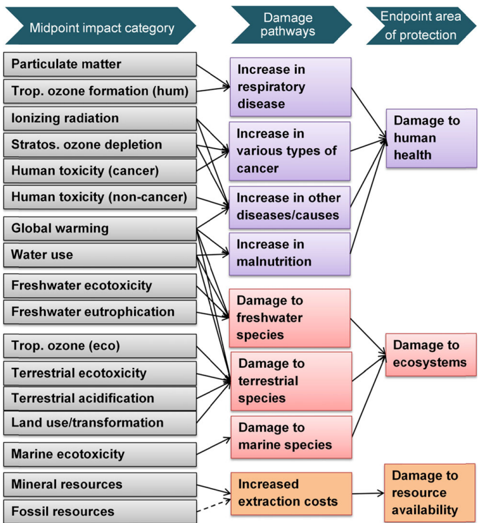
Life cycle impact assessment (LCIA) translates emissions and resource extractions into a limited number of environmental impact scores by means of so-called characterisation factors. There are two mainstream ways to derive characterisation factors, i.e. at midpoint level and at endpoint level. To further progress LCIA method development, we updated the ReCiPe2008 method to its version of 2016. This paper provides an overview of the key elements of the ReCiPe2016 method. We implemented human health, ecosystem quality and resource scarcity as three areas of protection. Endpoint characterisation factors, directly related to the areas of protection, were derived from midpoint characterisation factors with a constant mid-to-endpoint factor per impact category. We included 17 midpoint impact categories. The update of ReCiPe provides characterisation factors that are representative for the global scale instead of the European scale, while maintaining the possibility for a number of impact categories to implement characterisation factors at a country and continental scale. We also expanded the number of environmental interventions and added impacts of water use on human health, impacts of water use and climate change on freshwater ecosystems and impacts of water use and tropospheric ozone formation on terrestrial ecosystems as novel damage pathways. Although significant effort has been put into the update of ReCiPe, there is still major improvement potential in the way impact pathways are modelled. Further improvements relate to a regionalisation of more impact categories, moving from local to global species extinction and adding more impact pathways. Life cycle impact assessment is a fast evolving field of research. ReCiPe2016 provides a state-of-the-art method to convert life cycle inventories to a limited number of life cycle impact scores on midpoint and endpoint level.
Overview
The claims and statistics of this paper haven’t been checked yet.
Free: it reads the open-access text and checks the first 5 claims that cite a source we can check. Create a free account to check every claim.
Integrity signals
Registry
Cites
Statistics
Figures
Verification
Claims the paper makes
The claims and statistics of this paper haven’t been checked yet.
Free: it reads the open-access text and checks the first 5 claims that cite a source we can check. Create a free account to check every claim.
Self-check
Percentages, sums and reported differences re-computed from the paper’s own numbers.
The self-check needs the paper’s full text.
Citations
Cites
(2013) · Cited by 6,752
Accelerating extinction risk from climate change
Urban, M. C. (2015) · Science · doi:10.1126/science.aaa4984 · Cited by 2,436 · cited 2×
“For terrestrial ecosystems, the increase in potentially disappeared fraction of species (PDF) due to an increase in global temperature was derived from the review by Urban (2015).”
BackgroundThe water footprint of humanity
Hoekstra, A. Y., & Mekonnen, M. M. (2012) · Proceedings of the National Academy of Sciences · doi:10.1073/pnas.1109936109 · Cited by 2,260 · cited 2×
“…et al. 2013; Curran et al. 2014 Water use Increase of water consumed Water consumption potential (WCP) m3 water-eq consumed Döll and Siebert 2002; Hoekstra and Mekonnen 2012 Mineral resource scarcity Increase of ore extracted Surplus ore potential (SOP) kg Cu-eq Vieira et al. 2016a Fossil…”
BackgroundMethodAssessing the Environmental Impacts of Freshwater Consumption in LCA
Pfister, S., Koehler, A., & Hellweg, S. (2009) · Environmental Science & Technology · doi:10.1021/es802423e · Cited by 1,321 · cited 2×
“…shortage Pfister et al. 2009 Ecosystems (terrestrial) Decrease in Net Primary Productivity because of water shortage as proxy for total species loss Pfister et al. 2009 Ecosystems (aquatic) Fish species loss due to decreased river discharge Hanafiah et al. 2011 Land use Ecosystems (terrestrial)…”
BackgroundAmbient Air Pollution Exposure Estimation for the Global Burden of Disease 2013
Brauer, M., Freedman, G., Frostad, J., van Donkelaar, A., Martin, R. V., Dentener, F., Dingenen, R. V., Estep, K., Amini, H., Apte, J. S., et al. (2016) · Environmental Science & Technology · doi:10.1021/acs.est.5b03709 · Cited by 1,215
Addressing Global Mortality from Ambient PM2.5
Apte, J. S., Marshall, J. D., Cohen, A. J., & Brauer, M. (2015) · Environmental Science & Technology · doi:10.1021/acs.est.5b01236 · Cited by 995
Joos, F., Roth, R., Fuglestvedt, J. S., Peters, G. P., Enting, I. G., von Bloh, W., Brovkin, V., Burke, E. J., Eby, M., Edwards, N. R., et al. (2013) · Atmospheric Chemistry and Physics · doi:10.5194/acp-13-2793-2013 · Cited by 839
Implementation of life cycle impact assessment methods
Jungbluth, N., Margni, M. D., & Hischier, R. (2010) · Cited by 816
Global modeling of irrigation water requirements
Döll, P., & Siebert, S. (2002) · Water Resources Research · doi:10.1029/2001wr000355 · Cited by 816 · cited 2×
“For agriculture, the consumptive part of the withdrawal was estimated with water requirement ratios based on Döll and Siebert (2002).”
BackgroundMethod
Research works printed but not linked: 2
- 20. Goedkoop M, Heijungs R, Huijbregts MAJ, De Schryver A, Struijs J, van Zelm R (2009) ReCiPe 2008: a life cycle impact assessment method which comprises harmonised category indicators at the midpoint and endpoint levels. First edition. Report i: characterization. The Netherlands: Ruimte en Milieu, Ministerie van Volkshuisvesting, Ruimtelijke Ordening en Milieubeheer
- Vieira MDM, Ponsioen T, Goedkoop M, Huijbregts MAJ (2016c) Fossil resource scarcity. In: Huijbregts MAJ, Steinmann ZJN, Elshout PMF, Stam G, Verones F, Vieira MDM, Van Zelm R (eds) ReCiPe2016. A harmonized life cycle impact assessment method at midpoint and endpoint level. Report I: characterization. RIVM Report 2016-0104. National Institute for Human Health and the Environment, Bilthoven. Chapter 13
Cited by
Items 401–500 of 1,013
Kathiravel, R., Zhu, S., & Feng, H. (2024) · Energy and Buildings · doi:10.1016/j.enbuild.2024.113905 · Cited by 60
Veltman, K., Rotz, C. A., Chase, L. E., Cooper, J. S., Ingraham, P., Izaurralde, R. C., Jones, C. D., Gaillard, R., Larson, R. A., Ruark, M. D., et al. (2018) · Agricultural Systems · doi:10.1016/j.agsy.2018.07.005 · Cited by 65
Spatial-temporal analysis of selected industrial aquatic heavy metal pollution in China
Huang, Y., Zhou, B., Li, N., Li, Y., Han, R., Qi, J., Lü, X., Li, S., Feng, C., & Liang, S. (2019) · Journal of Cleaner Production · doi:10.1016/j.jclepro.2019.117944 · Cited by 60
Aziz, N. I. H. A., Hanafiah, M. M., Gheewala, S. H., & Ismail, H. (2020) · Sustainability · doi:10.3390/su12083213 · Cited by 66
Anaerobic membrane bioreactors (AnMBR) treating urban wastewater in mild climates
Robles, Á., Durán, F., Giménez, J. B., Jiménez, E., Ribes, J., Serralta, J., Seco, A., Ferrer, J., & Rogalla, F. (2020) · Bioresource Technology · doi:10.1016/j.biortech.2020.123763 · Cited by 60
Optimizing irrigation in urban agriculture for tomato crops in rooftop greenhouses
Parada, F., Gabarrell, X., Rufí-Salís, M., Arcas‐Pilz, V., Muñoz, P., & Villalba, G. (2021) · The Science of The Total Environment · doi:10.1016/j.scitotenv.2021.148689 · Cited by 64
Vandervaeren, C., Galle, W., Stephan, A., & Temmerman, N. D. (2021) · Resources Conservation and Recycling · doi:10.1016/j.resconrec.2021.106001 · Cited by 62
Life cycle assessment of reusable plastic food packaging
Yadav, P., Silvenius, F., Katajajuuri, J.-M., & Leinonen, I. (2024) · Journal of Cleaner Production · doi:10.1016/j.jclepro.2024.141529 · Cited by 59
Basavalingaiah, K., Paramesh, V., Parajuli, R., Girisha, H. C., Shivaprasad, M. K., Vidyashree, G. V., Thoma, G. J., Hanumanthappa, M., Yogesh, G. S., Dhar, S., et al. (2021) · Environmental Impact Assessment Review · doi:10.1016/j.eiar.2021.106687 · Cited by 59
Mottaghi, M., Bairamzadeh, S., & Pishvaee, M. S. (2022) · Industrial Crops and Products · doi:10.1016/j.indcrop.2022.114747 · Cited by 62
Koch, D., Friedl, A., & Mihalyi, B. (2022) · Environment Development and Sustainability · doi:10.1007/s10668-022-02302-w · Cited by 64
Bergez, J.-É., Béthinger, A., Bockstaller, C., Cederberg, C., Ceschia, É., Guilpart, N., Lange, S., Müller, F., Reidsma, P., RIVIÈRE, C., et al. (2022) · Ecological Indicators · doi:10.1016/j.ecolind.2022.109107 · Cited by 67
Tanthanawiwat, K., Gheewala, S. H., Nilsalab, P., Schoch, M., & Silalertruksa, T. (2024) · Journal of Cleaner Production · doi:10.1016/j.jclepro.2024.140652 · Cited by 62
Ungureanu, A., Francini, A., Neri, P., Girimonte, A., Giovanardi, R., Ferrari, A. M., & Rosa, R. (2024) · ACS Sustainable Chemistry & Engineering · doi:10.1021/acssuschemeng.3c08491 · Cited by 59
Mancuso, G., Habchi, S., Maraldi, M., Valenti, F., & Bari, H. E. (2024) · Bioresource Technology · doi:10.1016/j.biortech.2024.131252 · Cited by 59
Zhang, L., Zhang, W., Cui, Z., Hu, Y., Schmidhalter, U., & Chen, X. (2021) · Journal of Cleaner Production · doi:10.1016/j.jclepro.2021.127620 · Cited by 59
Zero-carbon balance: The case of HouseZero
Grinham, J., Fjeldheim, H., Yan, B., Dokka, T. H., Edwards, K., Hegli, T., & Malkawi, A. M. (2021) · Building and Environment · doi:10.1016/j.buildenv.2021.108511 · Cited by 59
Tushar, Q., Bhuiyan, M. A., Zhang, G., Maqsood, T., & Tasmin, T. (2021) · Construction and Building Materials · doi:10.1016/j.conbuildmat.2021.125850 · Cited by 59
Shekhar, A. R., Parekh, M. H., & Pol, V. G. (2022) · Journal of Power Sources · doi:10.1016/j.jpowsour.2022.231015 · Cited by 59
Foteinis, S., Savvakis, N., & Tsoutsos, T. D. (2022) · Energy · doi:10.1016/j.energy.2022.126355 · Cited by 67
Life cycle assessment of wood pellets and wood split logs for residential heating
Quinteiro, P. S. G. N., Tarelho, L. A. C., Marques, P., Martín-Gamboa, M., Freire, F. M. C. S., Arroja, L., & Dias, A. C. (2019) · The Science of The Total Environment · doi:10.1016/j.scitotenv.2019.06.420 · Cited by 58
de Souza, H. R. A., Dantas, T. E. T., Zanghelini, G. M., Cherubini, E., & Soares, S. R. (2020) · The Science of The Total Environment · doi:10.1016/j.scitotenv.2020.138111 · Cited by 60
Environmental assessment of industrial production of microalgal biodiesel in central-south Chile
Branco-Vieira, M., Costa, D. M. B., Mata, T. M., Martins, A. A., Freitas, M. A. V., & Caetano, N. S. (2020) · Journal of Cleaner Production · doi:10.1016/j.jclepro.2020.121756 · Cited by 56
Environmental impact assessment of local decoupled multi-loop aquaponics in an urban context
Körner, O., Bisbis, M., Baganz, G. F. M., Baganz, D., Staaks, G. B. O., Monsees, H., Goddek, S., & Keesman, K. J. (2021) · Journal of Cleaner Production · doi:10.1016/j.jclepro.2021.127735 · Cited by 64
Herrera, A., D’Imporzano, G., Zilio, M., Pigoli, A., Rizzi, B., Meers, E., Schouman, O., Schepis, M., Barone, F., Giordano, A., et al. (2022) · ACS Sustainable Chemistry & Engineering · doi:10.1021/acssuschemeng.1c07028 · Cited by 57
Human and planetary health implications of negative emissions technologies
Cobo, S., Galán‐Martín, Á., Tulus, V., Huijbregts, M. A. J., & Guillén‐Gosálbez, G. (2022) · Nature Communications · doi:10.1038/s41467-022-30136-7 · Cited by 57
Self-citationCavalett, O., Watanabe, M. D. B., Fleiger, K., Hoenig, V., & Cherubini, F. (2022) · Scientific Reports · doi:10.1038/s41598-022-13064-w · Cited by 62
The True Cost of Food: A Preliminary Assessment
Hendriks, S. L., Ruiz, A. D. G., Acosta, M. H., Baumers, H., Galgani, P., Mason-D’Croz, D., Godde, C., Waha, K., Kanidou, D., von Braun, J., et al. (2023) · Springer eBooks · doi:10.1007/978-3-031-15703-5_32 · Cited by 74
Environmental impacts of road pavement rehabilitation
Elliot, T. R., Carter, A., Ghattuwar, S., & Levasseur, A. (2023) · Transportation Research Part D Transport and Environment · doi:10.1016/j.trd.2023.103720 · Cited by 57
de Souza, N. R. D., Matt, L., Sedrik, R., Vares, L., & Cherubini, F. (2023) · Sustainable Production and Consumption · doi:10.1016/j.spc.2023.11.002 · Cited by 69
Life Cycle Assessment of China’s agroecosystems
Liang, L., Lal, R., Ridoutt, B. G., Du, Z., Wang, D., Wang, L., Wu, W., & Zhao, G. (2018) · Ecological Indicators · doi:10.1016/j.ecolind.2018.01.053 · Cited by 58
Comparative life cycle assessment for conventional and organic coffee cultivation in Vietnam
Trinh, L. T. K., Hu, A. H., Lan, Y. C., & Chen, Z. (2019) · International Journal of Environmental Science and Technology · doi:10.1007/s13762-019-02539-5 · Cited by 63
“ReCiPe is the most current and consistent indicator available in LCIA which was used to assess the midpoint and endpoint impact (Huijbregts et al. 2017).”
MethodWang, Z., Zhou, S., Wang, M., & Zhang, D. (2020) · Journal of Environmental Management · doi:10.1016/j.jenvman.2020.110483 · Cited by 58
Ehrenstein, M., Galán‐Martín, Á., Tulus, V., & Guillén‐Gosálbez, G. (2020) · Applied Energy · doi:10.1016/j.apenergy.2020.115486 · Cited by 62
Monsiváis-Alonso, R., Mansouri, S. S., & Román‐Martínez, A. (2020) · Chemical Engineering and Processing - Process Intensification · doi:10.1016/j.cep.2020.108171 · Cited by 57
Famiglietti, J., Toppi, T., Pistocchini, L., Scoccia, R., & Motta, M. (2020) · The Science of The Total Environment · doi:10.1016/j.scitotenv.2020.144392 · Cited by 58
“The results obtained with EF method 3.0 normalization and weighting set selected for this paper – impact assessment method of Environmental Footprint initiative (Fazio et al., 2018) were compared with the results obtained with ReCiPe 2016 (Hierarchist -”
MethodResultInfluentialAlipanah, M., Saha, A. K., Vahidi, E., & Jin, H. (2021) · Clean Technologies and Recycling · doi:10.3934/ctr.2021008 · Cited by 60
Gouveia, J. R., Pinto, S. M., Campos, S., Matos, J. R., Sobral, J., Esteves, S., & Oliveira, L. M. (2022) · Sustainability · doi:10.3390/su14042105 · Cited by 56
Life cycle and circularity metrics to measure the sustainability of closed-loop agri-food pathways
Falcone, G., Stıllıtano, T., Iofrıda, N., Spada, E., Bernardi, B., Gulısano, G., & Luca, A. I. D. (2022) · Frontiers in Sustainable Food Systems · doi:10.3389/fsufs.2022.1014228 · Cited by 56
“Pe 2016 Midpoint Impact Assessment method (Huijbregts et al., 2017) through 18 impact categories.”
MethodLife cycle assessment of aluminum-silicon alloy production from secondary aluminum in China
Zhang, Y., Cai, Y., Liu, S., Su, Z., & Jiang, T. (2023) · Journal of Cleaner Production · doi:10.1016/j.jclepro.2023.136214 · Cited by 56
Dong, Y., Ng, S. T., & Liu, P. (2023) · Sustainable Cities and Society · doi:10.1016/j.scs.2023.104604 · Cited by 56
Environmental impact assessment of green ammonia coupled with urea and ammonium nitrate production
Galusnyak, Ş. C., Petrescu, L., Sandu, V.-C., & Cormoş, C.-C. (2023) · Journal of Environmental Management · doi:10.1016/j.jenvman.2023.118215 · Cited by 56
Environmental assessment of diets: overview and guidance on indicator choice
Ran, Y., Cederberg, C., Jonell, M., Bergman, K., de Boer, I. J. M., Einarsson, R., Karlsson, J. O., Karlsson, H., Martin, M. A., Metson, G. S., et al. (2024) · The Lancet Planetary Health · doi:10.1016/s2542-5196(24)00006-8 · Cited by 61
Self-citationBach, V., Finogenova, N., Berger, M., Winter, L., & Finkbeiner, M. (2017) · Resources Policy · doi:10.1016/j.resourpol.2017.07.003 · Cited by 57
“The impacts of greenhouse gas emissions are determined by applying the ReCiPe methodology (Huijbregts et al., 2017) to determine impacts to human health (CCHH) and the environment (CCE).”
MethodKosai, S., & Yamasue, E. (2018) · The Science of The Total Environment · doi:10.1016/j.scitotenv.2018.10.085 · Cited by 60
Global relative species loss due to first‐generation biofuel production for the transport sector
Elshout, P. M. F., van Zelm, R., van der Velde, M., Steinmann, Z. J. N., & Huijbregts, M. A. J. (2019) · GCB Bioenergy · doi:10.1111/gcbb.12597 · Cited by 62
“LC‐IMPACT distinguishes itself from other life cycle impact assessment methods including the ReCiPe method (Huijbregts et al., 2016), which typically quantified potential species losses at the local scale.”
BackgroundMethodSelf-citationGuida, S., Conzelmann, L., Remy, C., Vale, P., Jefferson, B., & Soares, A. (2021) · The Science of The Total Environment · doi:10.1016/j.scitotenv.2021.146834 · Cited by 57
Hiloidhari, M., Vijay, V., Banerjee, R., Baruah, D. C., & Rao, A. B. (2021) · Renewable and Sustainable Energy Reviews · doi:10.1016/j.rser.2021.111583 · Cited by 63
Zhang, T., Bai, Y., Shen, X., Zhai, Y., Ji, C., Ma, X., & Hong, J. (2021) · The International Journal of Life Cycle Assessment · doi:10.1007/s11367-021-01925-x · Cited by 55
“The assessment of this study uses a mixed model that integrates the IMPACT World + model and ReCiPe 2016 model (Huijbregts et al. 2017; Bulle et al. 2019), as shown in previously reported research by our group (Zhang et al.”
MethodPacheco-López, A., Lechtenberg, F., Somoza-Tornos, A., Graells, M., & Espuña, A. (2021) · Frontiers in Energy Research · doi:10.3389/fenrg.2021.676233 · Cited by 55
Kiehbadroudinezhad, M., Merabet, A., Rajabipour, A., Čada, M., Kiehbadroudinezhad, S., Khanali, M., & Hosseinzadeh-Bandbafha, H. (2021) · Energy Conversion and Management · doi:10.1016/j.enconman.2021.115064 · Cited by 55
Stıllıtano, T., Falcone, G., Iofrıda, N., Spada, E., Gulısano, G., & Luca, A. I. D. (2022) · The Science of The Total Environment · doi:10.1016/j.scitotenv.2022.157229 · Cited by 57
Xia, W., Lau, S. K., & Yong, W. F. (2022) · Journal of Cleaner Production · doi:10.1016/j.jclepro.2022.133354 · Cited by 55
Chen, Q., Hou, Y., Lai, X., Shen, K., Gu, H., Wang, Y., Guo, Y., Lu, L., Han, X., & Zheng, Y. (2023) · Separation and Purification Technology · doi:10.1016/j.seppur.2023.123277 · Cited by 57
Wang, Z., Ma, X., Pan, H., Yang, X., Zhang, X., Lyu, Y., Liao, W., Shui, W., Wu, J., Xu, M., et al. (2023) · Journal of Cleaner Production · doi:10.1016/j.jclepro.2023.137248 · Cited by 55
Jayawardana, J., Sandanayake, M. S., Kulatunga, A. K., Jayasinghe, J. A. S. C., Zhang, G., & Osadith, S. A. U. (2023) · Sustainability · doi:10.3390/su152316336 · Cited by 66
Harm from Residential Indoor Air Contaminants
Morantes, G., Jones, B., Molina, C., & Sherman, M. H. (2023) · Environmental Science & Technology · doi:10.1021/acs.est.3c07374 · Cited by 63
A review of radioactive waste processing and disposal from a life cycle environmental perspective
Clayton, R., Kirk, J., Banford, A., & Stamford, L. (2024) · Clean Technologies and Environmental Policy · doi:10.1007/s10098-024-02998-6 · Cited by 55
Javed, M. H., Ahmad, A., Rehan, M., Musharavati, F., Nizami, A., & Khan, M. I. (2025) · Sustainability · doi:10.3390/su17031277 · Cited by 56
Henryson, K., Hansson, P., & Sundberg, C. (2017) · The International Journal of Life Cycle Assessment · doi:10.1007/s11367-017-1298-7 · Cited by 55
Martins, M., Mesquita, L. M. D. S., Vaz, B. M. C., Dias, A. C., Torres‐Acosta, M. A., Quéguineur, B., Coutinho, J. A. P., & Ventura, S. P. M. (2021) · ACS Sustainable Chemistry & Engineering · doi:10.1021/acssuschemeng.0c09110 · Cited by 57
Erison, A. E., Tan, Y. H., Mubarak, N. M., Kansedo, J., Khalid, M., Abdullah, M. O., & Ghasemi, M. (2022) · Environmental Research · doi:10.1016/j.envres.2022.114149 · Cited by 57
Innovative Materials in Italy for Eco-Friendly and Sustainable Buildings
Colangelo, F., Farina, I., Travaglioni, M., Salzano, C., Cioffi, R., & Petrillo, A. (2021) · Materials · doi:10.3390/ma14082048 · Cited by 54
Recycled WEEE plastics in China: Generation trend and environmental impacts
Liu, X., Lu, X., Feng, Y., Zhang, L., & Yuan, Z. (2021) · Resources Conservation and Recycling · doi:10.1016/j.resconrec.2021.105978 · Cited by 56
Ivanica, R., Risse, M., Weber‐Blaschke, G., & Richter, K. (2022) · Journal of Cleaner Production · doi:10.1016/j.jclepro.2022.130631 · Cited by 57
Kokemohr, L., Escobar, N., Mertens, A., Mosnier, C., Pirlo, G., Veysset, P. P., & Kuhn, T. (2022) · Journal of Cleaner Production · doi:10.1016/j.jclepro.2022.134552 · Cited by 56
Schreiber, A., Rosen, M., Waetzig, K., Nikolowski, K., Schiffmann, N., Wiggers, H., Küpers, M., Fattakhova‐Rohlfing, D., Kuckshinrichs, W., Guillon, O., et al. (2023) · Green Chemistry · doi:10.1039/d2gc03368b · Cited by 55
Lamers, P., Ghosh, T., Upasani, S., Sacchi, R., & Daioglou, V. (2023) · Environmental Science & Technology · doi:10.1021/acs.est.2c04246 · Cited by 51
Prospective Life Cycle Assessment of Lithium-Sulfur Batteries for Stationary Energy Storage
Wickerts, S., Arvidsson, R., Nordelöf, A., Svanström, M., & Johansson, P. (2023) · ACS Sustainable Chemistry & Engineering · doi:10.1021/acssuschemeng.3c00141 · Cited by 56
Izaola, B., Akizu‐Gardoki, O., & Oregi, X. (2023) · Sustainable Production and Consumption · doi:10.1016/j.spc.2023.07.001 · Cited by 64
Life cycle environmental impact assessment of titanium dioxide production in China
Dai, Y., Dong, H., Sun, L.-X., Li, J., Zhang, T., Geng, Y., & Liu, Z. (2023) · Environmental Impact Assessment Review · doi:10.1016/j.eiar.2023.107412 · Cited by 54
Life cycle assessment of wood-based panels: A review
Costa, D., Serra, J., Quinteiro, P. S. G. N., & Dias, A. C. (2024) · Journal of Cleaner Production · doi:10.1016/j.jclepro.2024.140955 · Cited by 57
Life cycle assessment of recycling copper slags as cement replacement material in mine backfill
Zhou, H., Başarır, H., Poulet, T., Li, W., Kleiv, R. A., & Karrech, A. (2024) · Resources Conservation and Recycling · doi:10.1016/j.resconrec.2024.107591 · Cited by 54
Luo, C., Zhou, Y., Chen, Z., Bian, X., Chen, N., Li, J., Wu, Y., & Yang, Z. (2024) · The Science of The Total Environment · doi:10.1016/j.scitotenv.2024.176421 · Cited by 54
Yang, Y., Xu, H., Yang, X., Zhang, Y., & Liu, T. (2024) · Resources Conservation and Recycling · doi:10.1016/j.resconrec.2024.107973 · Cited by 55
Deng, B., Wu, Z., Feng, E., Ma, L., Wang, Z., Chen, J., Eddy, L., Lathem, A., Wang, T., Chen, W., et al. (2025) · Journal of the American Chemical Society · doi:10.1021/jacs.5c00071 · Cited by 56
Boldoczki, S., Thorenz, A., & Tuma, A. (2021) · Journal of Industrial Ecology · doi:10.1111/jiec.13104 · Cited by 58
“1 (Huijbregts et al., 2017).”
Ramagiri, K. K., Chintha, R., Bandlamudi, R. K., Maeijer, P. K. D., & Kar, A. (2021) · Infrastructures · doi:10.3390/infrastructures6070104 · Cited by 57
Vega, G. C., Gross, A., & Birkved, M. (2021) · Sustainable Production and Consumption · doi:10.1016/j.spc.2021.07.008 · Cited by 62
“Two characterization meth- ds were used for the life cycle impact assessment: ReCiPe Hierrchist midpoint and endpoints ( Huijbregts et al., 2017 ) and ILCD 011 Midpoint + ( European Commission - Joint Research Centre - nstitute for Environment and Sustainability, 2012 ).”
MethodLv, L., Song, G., Zhao, X., & Chen, J. (2021) · The Science of The Total Environment · doi:10.1016/j.scitotenv.2021.149451 · Cited by 56
Favi, C., Marconi, M., Mandolini, M., & Germani, M. (2022) · Applied Energy · doi:10.1016/j.apenergy.2022.118671 · Cited by 54
Zeug, W., Bezama, A., & Thrän, D. (2021) · The International Journal of Life Cycle Assessment · doi:10.1007/s11367-021-01983-1 · Cited by 53
Pagone, E., Salonitis, K., & JOLLY, M. R. (2020) · Journal of Cleaner Production · doi:10.1016/j.jclepro.2020.120272 · Cited by 56
“The technique was further developed in the subsequent decades (Hwang et al., 1993; Yoon and Hwang, 1995).”
MethodMoheb-Alizadeh, H., Handfield, R., & Warsing, D. P. (2021) · Journal of Cleaner Production · doi:10.1016/j.jclepro.2021.127323 · Cited by 58
Integration of raw materials indicators of energy technologies into energy system models
Peiró, L. T., Martin, N., Villalba, G., & Madrid‐López, C. (2021) · Applied Energy · doi:10.1016/j.apenergy.2021.118150 · Cited by 57
Carvalho, L. S., Willers, C. D., Soares, B. B., Nogueira, A. R., Neto, J. A. D. A., & Rodrigues, L. B. (2021) · Environmental Science and Pollution Research · doi:10.1007/s11356-021-17317-5 · Cited by 53
Evaluating the sustainability of soil improvement techniques in foundation substructures
Sánchez-Garrido, A. J., Navarro, I. J., & Yepes, V. (2022) · Journal of Cleaner Production · doi:10.1016/j.jclepro.2022.131463 · Cited by 59
Qian, H., Song, G., Lv, L., Cheng, Y., Zhang, L., & Chen, J. (2022) · Journal of Cleaner Production · doi:10.1016/j.jclepro.2022.131764 · Cited by 53
Silva, N., & Molina‐Besch, K. (2023) · Resources Conservation and Recycling · doi:10.1016/j.resconrec.2023.106871 · Cited by 61
Saharudin, D. M., Jeswani, H. K., & Azapagic, A. (2023) · Applied Energy · doi:10.1016/j.apenergy.2023.121506 · Cited by 60
Process innovations to enable viable enzymatic poly(ethylene terephthalate) recycling
Murphy, N. P., Dempsey, S. H., DesVeaux, J. S., Uekert, T., Chang, A. C., Mailaram, S., Alherech, M., Alt, H. M., Ramirez, K. J., Norton‐Baker, B., et al. (2025) · Nature Chemical Engineering · doi:10.1038/s44286-025-00212-y · Cited by 53
“03 midpoint hierarchy method 64 .”
Comparative life cycle assessment of manufactured and remanufactured loading machines in China
Xiao, L., Liu, W., Guo, Q., Gao, L., Zhang, G., & Chen, X. (2018) · Resources Conservation and Recycling · doi:10.1016/j.resconrec.2017.12.021 · Cited by 56
Todorović, M., Mehmeti, A., & Cantore, V. (2018) · Journal of Cleaner Production · doi:10.1016/j.jclepro.2018.02.200 · Cited by 57
“ReCiPe 2016 (Huijbregts et al., 2017) the most recent harmonized life cycle impact model including seventeen midpoint and three endpoint impact categories was employed to highlight the importance of all of the potential environmental impacts.”
MethodXu, J., Guo, C. S., Chen, X., Zhang, Z., Yang, L., Wang, M., & Yang, K. (2018) · Journal of Cleaner Production · doi:10.1016/j.jclepro.2018.10.224 · Cited by 53
Hybridization of Fossil‐ and CO2‐Based Routes for Ethylene Production using Renewable Energy
Ioannou, I., D’Angelo, S. C., Martín, A. J., Pérez‐Ramírez, J., & Guillén‐Gosálbez, G. (2020) · ChemSusChem · doi:10.1002/cssc.202001312 · Cited by 56
Ma, Z., Ryberg, M. W., Wang, P., Tang, L., & Chen, W. (2020) · ACS Sustainable Chemistry & Engineering · doi:10.1021/acssuschemeng.0c05926 · Cited by 55
Monetizing environmental impact of integrated aquaponic farming compared to separate systems
Greenfeld, A., Becker, N., Bornman, J. F., Spatari, S., & Angel, D. L. (2021) · The Science of The Total Environment · doi:10.1016/j.scitotenv.2021.148459 · Cited by 53
Cradle-to-grave life cycle assessment of production and consumption of pulses in the United States
Bandekar, P., Putman, B., Thoma, G. J., & Matlock, M. D. (2021) · Journal of Environmental Management · doi:10.1016/j.jenvman.2021.114062 · Cited by 53
Regionalized Life Cycle Inventories of Global Sulfidic Copper Tailings
Adrianto, L. R., Pfister, S., & Hellweg, S. (2022) · Environmental Science & Technology · doi:10.1021/acs.est.1c01786 · Cited by 52
Carbon and water footprint of battery-grade lithium from brine and spodumene: A simulation-based LCA
Mas-Fons, A., Horta Arduin, R., Loubet, P., Pereira, T., Parvez, A. M., & Sonnemann, G. (2024) · Journal of Cleaner Production · doi:10.1016/j.jclepro.2024.142108 · Cited by 52
Metadata
- Authors
- Huijbregts, M. A. J., Steinmann, Z. J. N., Elshout, P. M. F., Stam, G., Verones, F., Vieira, M., Zijp, M., Hollander, A., & van Zelm, R.
- Affiliations
- Netherlands Environmental Assessment Agency (NL)
- Radboud University Nijmegen (NL)
- Norwegian University of Science and Technology (NO)
- National Institute for Public Health and the Environment (NL)
- Corresponding author
- Huijbregts, Mark A. J.
- ORCID
- Venue
- The International Journal of Life Cycle Assessment
- Published
- 2016-12-12
- Volume
- 22
- Issue
- 2
- Pages
- 138-147
- ISSN
- 0948-3349 (ISSN-L)
- 1614-7502
- OpenAlex
- W2564630286
- Cited by
- 4,485
- References
- 54
- Citations by year
- 2026: 945 · 2025: 906 · 2024: 682 · 2023: 578 · 2022: 520 · 2021: 391 · 2020: 232 · 2019: 131 · 2018: 78 · 2017: 18 · 2016: 3
- FWCI
- 48.09
- Type
- journal article
- Language
- en
- Update notices
- correction (2020-07-02)
- Open access
- hybrid
- doi.org
- Licence
- cc-by
- creativecommons.org/licenses/by/4.0 (tdm)
- creativecommons.org/licenses/by/4.0 (vor)
- Locations
- The International Journal of Life Cycle Assessment (publishedVersion, cc-by)
- Radboud Repository (Radboud University) (submittedVersion)
- Rivm Repository (Netherlands National Institute for Public Health and the Environment) (submittedVersion)
- Radboud Repository (Radboud University) (submittedVersion, other-oa)
- Funders
- Rijksinstituut voor Volksgezondheid en Milieu (S/607020)
- Topics
- Physical Sciences › Environmental Science › Environmental Engineering › Environmental Impact and Sustainability
- Physical Sciences › Environmental Science › Ecology › Agriculture Sustainability and Environmental Impact
- Physical Sciences › Environmental Science › Environmental Engineering › Sustainability and Ecological Systems Analysis
- Keywords
- life cycle impact assessment, characterization factors, human health effects, ecosystem quality, resource constraints, water use impacts, freshwater ecosystems, tropospheric ozone formation, terrestrial ecosystems, species extinction, environmental interventions, global scale
About these checks
Registry, retraction, Cites and statistics results are computed, not judged, with one exception: a printed reference that no index lists is read once by a model before it counts as a citation error. Claims are extracted by a model and kept only when their quote appears verbatim in the text; each cited source is then checked, with a model’s help, for whether it says what the claim relies on. Those verdicts can be wrong — read the claim’s quote and the cited source before relying on one.
Statistics and arithmetic are recomputed, not judged.
Confidence bands are shown only for fields calibrated on our annotated test set. None is calibrated yet, so no band is shown.
What counts as a claim ›How we measure confidence ›How we check this ›
Are you an author, or do you see a problem with this page? Request a review
Data sources
Bibliographic data: Semantic Scholar, OpenAlex, Crossref.
Contains information from the Semantic Scholar Academic Graph Datasets, made available under the ODC Attribution License (ODC-BY 1.0).
Semantic Scholar’s data is described in: Kinney, R., et al. (2023). The Semantic Scholar Open Data Platform. arXiv:2301.10140.
