

ReCiPe2016: a harmonised life cycle impact assessment method at midpoint and endpoint level
Open accessThe DOI matches its Crossref record; 53 of the 54 references it cites were found in a registry or an index.
Abstract
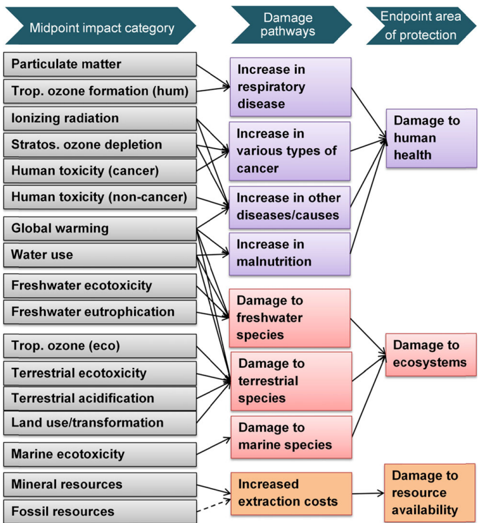
Life cycle impact assessment (LCIA) translates emissions and resource extractions into a limited number of environmental impact scores by means of so-called characterisation factors. There are two mainstream ways to derive characterisation factors, i.e. at midpoint level and at endpoint level. To further progress LCIA method development, we updated the ReCiPe2008 method to its version of 2016. This paper provides an overview of the key elements of the ReCiPe2016 method. We implemented human health, ecosystem quality and resource scarcity as three areas of protection. Endpoint characterisation factors, directly related to the areas of protection, were derived from midpoint characterisation factors with a constant mid-to-endpoint factor per impact category. We included 17 midpoint impact categories. The update of ReCiPe provides characterisation factors that are representative for the global scale instead of the European scale, while maintaining the possibility for a number of impact categories to implement characterisation factors at a country and continental scale. We also expanded the number of environmental interventions and added impacts of water use on human health, impacts of water use and climate change on freshwater ecosystems and impacts of water use and tropospheric ozone formation on terrestrial ecosystems as novel damage pathways. Although significant effort has been put into the update of ReCiPe, there is still major improvement potential in the way impact pathways are modelled. Further improvements relate to a regionalisation of more impact categories, moving from local to global species extinction and adding more impact pathways. Life cycle impact assessment is a fast evolving field of research. ReCiPe2016 provides a state-of-the-art method to convert life cycle inventories to a limited number of life cycle impact scores on midpoint and endpoint level.
Overview
The claims and statistics of this paper haven’t been checked yet.
Free: it reads the open-access text and checks the first 5 claims that cite a source we can check. Create a free account to check every claim.
Integrity signals
Registry
Cites
Statistics
Figures
Verification
Claims the paper makes
The claims and statistics of this paper haven’t been checked yet.
Free: it reads the open-access text and checks the first 5 claims that cite a source we can check. Create a free account to check every claim.
Self-check
Percentages, sums and reported differences re-computed from the paper’s own numbers.
The self-check needs the paper’s full text.
Citations
Cites
(2013) · Cited by 6,752
Accelerating extinction risk from climate change
Urban, M. C. (2015) · Science · doi:10.1126/science.aaa4984 · Cited by 2,436 · cited 2×
“For terrestrial ecosystems, the increase in potentially disappeared fraction of species (PDF) due to an increase in global temperature was derived from the review by Urban (2015).”
BackgroundThe water footprint of humanity
Hoekstra, A. Y., & Mekonnen, M. M. (2012) · Proceedings of the National Academy of Sciences · doi:10.1073/pnas.1109936109 · Cited by 2,260 · cited 2×
“…et al. 2013; Curran et al. 2014 Water use Increase of water consumed Water consumption potential (WCP) m3 water-eq consumed Döll and Siebert 2002; Hoekstra and Mekonnen 2012 Mineral resource scarcity Increase of ore extracted Surplus ore potential (SOP) kg Cu-eq Vieira et al. 2016a Fossil…”
BackgroundMethodAssessing the Environmental Impacts of Freshwater Consumption in LCA
Pfister, S., Koehler, A., & Hellweg, S. (2009) · Environmental Science & Technology · doi:10.1021/es802423e · Cited by 1,321 · cited 2×
“…shortage Pfister et al. 2009 Ecosystems (terrestrial) Decrease in Net Primary Productivity because of water shortage as proxy for total species loss Pfister et al. 2009 Ecosystems (aquatic) Fish species loss due to decreased river discharge Hanafiah et al. 2011 Land use Ecosystems (terrestrial)…”
BackgroundAmbient Air Pollution Exposure Estimation for the Global Burden of Disease 2013
Brauer, M., Freedman, G., Frostad, J., van Donkelaar, A., Martin, R. V., Dentener, F., Dingenen, R. V., Estep, K., Amini, H., Apte, J. S., et al. (2016) · Environmental Science & Technology · doi:10.1021/acs.est.5b03709 · Cited by 1,215
Addressing Global Mortality from Ambient PM2.5
Apte, J. S., Marshall, J. D., Cohen, A. J., & Brauer, M. (2015) · Environmental Science & Technology · doi:10.1021/acs.est.5b01236 · Cited by 995
Joos, F., Roth, R., Fuglestvedt, J. S., Peters, G. P., Enting, I. G., von Bloh, W., Brovkin, V., Burke, E. J., Eby, M., Edwards, N. R., et al. (2013) · Atmospheric Chemistry and Physics · doi:10.5194/acp-13-2793-2013 · Cited by 839
Implementation of life cycle impact assessment methods
Jungbluth, N., Margni, M. D., & Hischier, R. (2010) · Cited by 816
Global modeling of irrigation water requirements
Döll, P., & Siebert, S. (2002) · Water Resources Research · doi:10.1029/2001wr000355 · Cited by 816 · cited 2×
“For agriculture, the consumptive part of the withdrawal was estimated with water requirement ratios based on Döll and Siebert (2002).”
BackgroundMethod
Research works printed but not linked: 2
- 20. Goedkoop M, Heijungs R, Huijbregts MAJ, De Schryver A, Struijs J, van Zelm R (2009) ReCiPe 2008: a life cycle impact assessment method which comprises harmonised category indicators at the midpoint and endpoint levels. First edition. Report i: characterization. The Netherlands: Ruimte en Milieu, Ministerie van Volkshuisvesting, Ruimtelijke Ordening en Milieubeheer
- Vieira MDM, Ponsioen T, Goedkoop M, Huijbregts MAJ (2016c) Fossil resource scarcity. In: Huijbregts MAJ, Steinmann ZJN, Elshout PMF, Stam G, Verones F, Vieira MDM, Van Zelm R (eds) ReCiPe2016. A harmonized life cycle impact assessment method at midpoint and endpoint level. Report I: characterization. RIVM Report 2016-0104. National Institute for Human Health and the Environment, Bilthoven. Chapter 13
Cited by
Items 501–600 of 1,013
Life-cycle environmental and cost-effective energy retrofitting solutions for office stock
Gangolells, M., Gaspar, K., Casals, M., Ferré-Bigorra, J., Forcada, N., & Macarulla, M. (2020) · Sustainable Cities and Society · doi:10.1016/j.scs.2020.102319 · Cited by 52
Comparative life cycle assessment of high-yield synthesis routes for carbon dots
Fernandes, S., da Silva, J. C. G. E., & da Silva, L. P. (2021) · NanoImpact · doi:10.1016/j.impact.2021.100332 · Cited by 52
Zhou, Y., Xiao, C., Yang, S. Y., Yin, H., Yang, Z., & Chi, R. (2021) · Sustainable Production and Consumption · doi:10.1016/j.spc.2021.09.003 · Cited by 56
Life Cycle Assessment of Autonomous Electric Field Tractors in Swedish Agriculture
Lagnelöv, O., Larsson, G., Larsolle, A., & Hansson, P. (2021) · Sustainability · doi:10.3390/su132011285 · Cited by 66
“The damage assessment results, calculated as per ReCiPe 2016 [60,61], can be seen in Figure 7.”
MethodStelzer, P., Cakmak, U. D., Eisner, L., Doppelbauer, L. K., Kallaí, I., Schweizer, G., Prammer, H. K., & Major, Z. (2022) · Composites Part B Engineering · doi:10.1016/j.compositesb.2022.109638 · Cited by 52
Rahmah, D. M., Putra, A. S., Ishizaki, R., Noguchi, R., & Ahamed, T. (2022) · Sustainability · doi:10.3390/su14073912 · Cited by 52
Critical analysis of life cycle inventory datasets for organic crop production systems
Montemayor, E., Andrade, E. P., Blasi, A. B., & Antón, A. (2022) · The International Journal of Life Cycle Assessment · doi:10.1007/s11367-022-02044-x · Cited by 56
“0 (used in this study) and even another commonly used method ReCiPe 2016 (Huijbregts et al. 2017) do not have toxicity CFs for these compounds or they are not properly accounted for in SimaPro.”
MethodYu, M., Liu, X., Liu, Z., & Yang, S. Y. (2022) · Journal of Cleaner Production · doi:10.1016/j.jclepro.2022.132353 · Cited by 52
Balasbaneh, A. T., & Sher, W. (2022) · Environment Development and Sustainability · doi:10.1007/s10668-022-02707-7 · Cited by 56
Rice Production Chain: Environmental and Social Impact Assessment—A Review
Vinci, G., Ruggieri, R., Ruggeri, M., & Prencipe, S. A. (2023) · Agriculture · doi:10.3390/agriculture13020340 · Cited by 52
Environmental impact of animal milk vs plant-based milk: Critical review
Khanpit, V. V., Viswanathan, S., & Hinrichsen, O. (2024) · Journal of Cleaner Production · doi:10.1016/j.jclepro.2024.141703 · Cited by 56
Environmental impacts of food packaging: Is it all a matter of raw materials?
Arfelli, F., Roguszewska, M., Torta, G., Iurlo, M., Cespi, D., Ciacci, L., & Passarini, F. (2024) · Sustainable Production and Consumption · doi:10.1016/j.spc.2024.06.032 · Cited by 60
“Results are reported according to the ReCiPe 2016 Life Cycle Impact Assessment (LCIA) method v. 1.08, perspective (H) (Huijbregts et al., 2017).”
InfluentialLife cycle assessment of an ambitious renovation of a Norwegian apartment building to nZEB standard
Wrålsen, B., O’Born, R., & Skaar, C. (2018) · Energy and Buildings · doi:10.1016/j.enbuild.2018.07.036 · Cited by 52
Saedpanah, E., Asrami, R. F., Sohani, A., & Sayyaadi, H. (2019) · Journal of Cleaner Production · doi:10.1016/j.jclepro.2019.118440 · Cited by 52
Life Cycle Assessment of Geotechnical Works in Building Construction: A Review and Recommendations
Song, X., Carlsson, C., Kiilsgaard, R., Bendz, D., & Kennedy, H. (2020) · Sustainability · doi:10.3390/su12208442 · Cited by 55
Buchmayr, A., Verhofstadt, E., OOTEGEM, L. V., Sanjuan-Delmás, D., Thomassen, G., & Dewulf, J. P. (2020) · Renewable and Sustainable Energy Reviews · doi:10.1016/j.rser.2020.110666 · Cited by 54
Alejandrino, C., Mercante, I. T., & Bovea, M. D. (2022) · Journal of Cleaner Production · doi:10.1016/j.jclepro.2022.130365 · Cited by 55
Li, J., Zhang, Y., Yang, Y., Zhang, X., Wang, N., Yonghong, Z., Tian, Y., & Xie, K. (2022) · Applied Energy · doi:10.1016/j.apenergy.2022.118791 · Cited by 52
Pradel, M., de Fays, M., & Seguineau, C. (2022) · SSRN Electronic Journal · doi:10.2139/ssrn.4068293 · Cited by 56
Quantifying the life-cycle health impacts of a cobalt-containing lithium-ion battery
Arvidsson, R., Chordia, M., & Nordelöf, A. (2022) · The International Journal of Life Cycle Assessment · doi:10.1007/s11367-022-02084-3 · Cited by 51
“For example, a limited number of exposure routes (drinking water and air) is considered in ReCiPe’s individualist perspective (Huijbregts et al.”
BackgroundMethodInfluentialPayen, S., Cosme, N. M. D., & Elliott, A. H. (2021) · The International Journal of Life Cycle Assessment · doi:10.1007/s11367-020-01847-0 · Cited by 52
Fotia, K., Mehmeti, A., Tsirogiannis, I. L., Nanos, G. D., Mamolos, A. P., Malamos, N. A., BAROUCHAS, P. E., & Todorović, M. (2021) · Water · doi:10.3390/w13141954 · Cited by 51
“Sensitivity Analysis of Life Cycle Assessment Method Besides the Impact World+ method, the potential environmental impacts were further computed with ReCiPe 2016 [42] and Environmental Footprint [43] to validate the credibility of the above results.”
MethodInfluentialNabavi‐Pelesaraei, A., Saber, Z., Mostashari-Rad, F., Mobtaker, H. G., & Chau, K. (2021) · Elsevier eBooks · doi:10.1016/b978-0-12-823987-2.00012-x · Cited by 72
D’Angelo, S. C., Martín, A. J., Cobo, S., Ordóñez, D. F., Guillén‐Gosálbez, G., & Pérez‐Ramírez, J. (2023) · Energy & Environmental Science · doi:10.1039/d2ee02683j · Cited by 52
Vassalle, L., Ferrer, I., Passos, F. L. D. R., Mota, C. R., & Garfí, M. (2023) · The Science of The Total Environment · doi:10.1016/j.scitotenv.2023.163291 · Cited by 58
Chen, S., Zhu, L., Sun, L., Huang, Q., Zhang, Y., Li, X., Ye, X., Li, Y., & Wang, L. (2023) · The Science of The Total Environment · doi:10.1016/j.scitotenv.2023.163659 · Cited by 51
RetractedIncineration economy: Waste management policy failing the circular economy transition in Norway
Mattson, K. R., Pettersen, J. B., & Brattebø, H. (2024) · Resources Conservation and Recycling · doi:10.1016/j.resconrec.2024.107838 · Cited by 56
Blanco, C. F., Marques, A., & van Bodegom, P. M. (2017) · Ecosystem Services · doi:10.1016/j.ecoser.2017.11.011 · Cited by 51
“Therefore some methodologies consider more aggregated endpoint impact categories like human health or ecosystem quality (Huijbregts et al., 2017; Goedkoop and Spriensma, 1999; Itsubo and Inaba, 2003).”
MethodComparative life cycle assessment of cooking appliances in Italian kitchens
Favi, C., Germani, M., Landi, D., Mengarelli, M., & Rossi, M. (2018) · Journal of Cleaner Production · doi:10.1016/j.jclepro.2018.03.140 · Cited by 51
Energy and carbon coupled water footprint analysis for Kraft wood pulp paper production
Ma, X., Shen, X., Qi, C., Ye, L., Yang, D., & Hong, J. (2018) · Renewable and Sustainable Energy Reviews · doi:10.1016/j.rser.2018.07.054 · Cited by 53
Poujol, B., Prieur‐Vernat, A., Dubranna, J., Besseau, R., Blanc, I., & Pérez‐López, P. (2020) · Journal of Industrial Ecology · doi:10.1111/jiec.12989 · Cited by 58
Pineda, I. T., Lee, Y. D., Kim, Y. S., Lee, S. M., & Park, K. S. (2020) · Journal of Cleaner Production · doi:10.1016/j.jclepro.2020.124395 · Cited by 59
Cradle to grave environmental impact evaluation of the consumption of potato and tomato products
Parajuli, R., Matlock, M. D., & Thoma, G. J. (2020) · The Science of The Total Environment · doi:10.1016/j.scitotenv.2020.143662 · Cited by 54
Soleimani, T., & Gilbert, H. (2021) · The International Journal of Life Cycle Assessment · doi:10.1007/s11367-020-01860-3 · Cited by 51
González‐García, S., Almeida, F., Moreira, M. T., & Brandão, M. (2021) · The Science of The Total Environment · doi:10.1016/j.scitotenv.2021.145270 · Cited by 50
Tsalidis, G. A. (2022) · Sustainability · doi:10.3390/su14020846 · Cited by 55
Pardo, G. O., del Prado, A., Álvarez, J. F., Yáñez-Ruíz, D. R., & Belanche, A. (2022) · Journal of Cleaner Production · doi:10.1016/j.jclepro.2022.131518 · Cited by 50
Life Cycle Assessment and Preliminary Cost Evaluation of a Smart Packaging System
Stramarkou, M., Boukouvalas, C. J., Koskinakis, S. E., Serifi, O., Bekiris, V., Tsamis, C., & Krokida, M. K. (2022) · Sustainability · doi:10.3390/su14127080 · Cited by 51
“Finally, the protection of consumers by the integrated chemical sensor that can detect a possible microbial spoilage and inform them about the quality of the food product is first priority.”
BackgroundSustainability of photovoltaic technologies in future net‐zero emissions scenarios
Urbina, A. (2022) · Progress in Photovoltaics Research and Applications · doi:10.1002/pip.3642 · Cited by 56
“38 For the commercial technologies mentioned above, the literature review that has been carried out delivered slightly different results (it may depend on variations on the LCI, inventory or the LCIA, impact assessment method, that has been used), the compilation of these data have been included in…”
BackgroundLife cycle assessment of a concrete 3D printing process
Roux, C., Kuzmenko, K., Roussel, N., Mesnil, R., & Féraille, A. (2022) · The International Journal of Life Cycle Assessment · doi:10.1007/s11367-022-02111-3 · Cited by 51
Natarajan, S., Mae, T., Teah, H. Y., Sakurai, H., & Noda, S. (2025) · Journal of Materials Chemistry A · doi:10.1039/d4ta07618d · Cited by 52
Jimmy, A. N., Khan, N. A., Hossain, M. N., & Sujauddin, M. (2017) · Modeling Earth Systems and Environment · doi:10.1007/s40808-017-0368-y · Cited by 53
“6 and ReCiPe’s midpoint methodology (Huijbregts et al. 2017).”
MethodLife cycle considerations of nano-enabled agrochemicals: are today's tools up to the task?
Pourzahedi, L., Pandorf, M., Ravikumar, D., Zimmerman, J. B., Seager, T. P., Theis, T. L., Westerhoff, P. K., Gilbertson, L. M., & Lowry, G. V. (2018) · Environmental Science Nano · doi:10.1039/c7en01166k · Cited by 58
Mehmeti, A., Pérez‐Trujillo, J. P., Elizalde‐Blancas, F., Angelis-Dimakis, A., & McPhail, S. J. (2018) · Energy Conversion and Management · doi:10.1016/j.enconman.2018.04.095 · Cited by 50
“contributes to a better understanding of the environmental impacts using recent models and 161 scientific knowledge [34].”
MethodD’Imporzano, G., Pilu, R., Corno, L., & Adani, F. (2018) · Bioresource Technology · doi:10.1016/j.biortech.2018.07.053 · Cited by 51
Applying and advancing the economic resource scarcity potential (ESP) method for rare earth elements
Pell, R. S., Wall, F., Yan, X., & Bailey, G. (2018) · Resources Policy · doi:10.1016/j.resourpol.2018.10.003 · Cited by 50
Giraldi-Díaz, M. R., Medina-Salas, L. D., Castillo-González, E., & León-Lira, R. (2018) · Sustainability · doi:10.3390/su10124598 · Cited by 50
“01, hierarchist version, and only the characterization level was used to determine the environmental impact) midpoint calculation methodology [26], an integrated version within the specialized software, SimaPro©.”
MethodRichter, J. L., Tähkämö, L., & Dalhammar, C. J. (2019) · Journal of Cleaner Production · doi:10.1016/j.jclepro.2019.03.331 · Cited by 55
“Also, as the description of the material in the original inventory is plastic host, we believe this was an error in the original inventory. impact assessment (LCIA) method ReCiPe (see Huijbregts et al., 2016).”
MethodEvaluating environmental impacts of selection for residual feed intake in pigs
Soleimani, T., & Gilbert, H. (2020) · animal · doi:10.1017/s175173112000138x · Cited by 50
“13 (Huijbregts et al., 2016), one of the most recently updated life cycle impact assessment methods, with the Ecoalim (Wilfart et al., 2016) and Ecoinvent (Wernet et al., 2016) inventory databases, were used.”
MethodLife Cycle Assessment of Wood Pellet Production in Thailand
Saosee, P., Sajjakulnukit, B., & Gheewala, S. H. (2020) · Sustainability · doi:10.3390/su12176996 · Cited by 50
“02) is used for the impact assessment [30].”
MethodComparative life cycle assessment of four buildings in Greenland
Ryberg, M. W., Ohms, P. K., Møller, E. B., & Lading, T. (2021) · Building and Environment · doi:10.1016/j.buildenv.2021.108130 · Cited by 50
Environmental and social life cycle assessments of an industrial LED lighting product
Wang, S., Su, D., & Wu, Y. (2022) · Environmental Impact Assessment Review · doi:10.1016/j.eiar.2022.106804 · Cited by 52
Life cycle optimization of BECCS supply chains in the European Union
Negri, V., Galán‐Martín, Á., Pozo, C., Fajardy, M., Reiner, D. M., Dowell, N. M., & Guillén‐Gosálbez, G. (2021) · Applied Energy · doi:10.1016/j.apenergy.2021.117252 · Cited by 49
Meng, X., Yang, J., Ding, N., & Lü, B. (2023) · Resources Conservation and Recycling · doi:10.1016/j.resconrec.2023.106938 · Cited by 49
Aslani, A., Hachem-Vermette, C., & Zahedi, R. (2023) · Construction and Building Materials · doi:10.1016/j.conbuildmat.2023.131197 · Cited by 49
Liew, C. S., Mong, G. R., Lim, J. W., Raksasat, R., Rawindran, H., Leong, W. H., Manogaran, M. D., Chai, Y. H., Ho, Y., Rahmah, A. U., et al. (2023) · Waste Management · doi:10.1016/j.wasman.2023.04.013 · Cited by 51
Cordella, M., Horn, R., Hong, S. H., Bianchi, M., Isasa, M., Harmens, R., Sonderegger, T., & Pihkola, H. (2023) · Journal of Cleaner Production · doi:10.1016/j.jclepro.2023.137719 · Cited by 52
Naser, A., Defersha, F. M., Xu, X. W., & Yang, S. L. (2023) · Journal of Manufacturing Systems · doi:10.1016/j.jmsy.2023.10.009 · Cited by 54
Das, J., Kleiman, A., Rehman, A. U., Verma, R., & Young, M. H. (2024) · Sustainability · doi:10.3390/su16051910 · Cited by 53
“The ReCiPe 2016 midpoint H (hierarchist) LCIA method [61], used in this study is based on a scientific consensus of the time frame and likelihood of impact mechanisms.”
MethodElectrically Heated Fluidized Beds─A Review
Ahmed, I., Duchesne, M., Tan, Y., & Lu, D. Y. (2024) · Industrial & Engineering Chemistry Research · doi:10.1021/acs.iecr.3c04232 · Cited by 50
Briones-Hidrovo, A., Uche, J., & Martínez-Gracia, A. (2019) · The Science of The Total Environment · doi:10.1016/j.scitotenv.2019.136369 · Cited by 49
Al-Qahtani, A., González-Garay, A., Bernardi, A., Galán-Martín, Á., Pozo, C., Dowell, N. M., Chachuat, B., & Guillén-Gosálbez, G. (2020) · Applied Energy · doi:10.1016/j.apenergy.2020.114718 · Cited by 43
Wietschel, L., Meßmann, L., Thorenz, A., & Tuma, A. (2020) · Journal of Industrial Ecology · doi:10.1111/jiec.13083 · Cited by 49
Koroma, M. S., Brown, N. W. O., Cardellini, G., & Messagie, M. (2020) · Energies · doi:10.3390/en13236236 · Cited by 57
“Environmental impacts in this study were quantified using the midpoint hierarchical version of the ReCiPe 2016 impact assessment methodology [37].”
BackgroundMethodEnvironmental burdens of small-scale intensive pig production in China
Liu, X., Cai, Z., & Yuan, Z. (2021) · The Science of The Total Environment · doi:10.1016/j.scitotenv.2020.144720 · Cited by 49
Jato‐Espino, D., Toro-Huertas, E. I., & Güereca, L. P. (2022) · The Science of The Total Environment · doi:10.1016/j.scitotenv.2022.152959 · Cited by 51
A life cycle assessment comparison of materials for a tidal stream turbine blade
Walker, S., & Thies, P. R. (2022) · Applied Energy · doi:10.1016/j.apenergy.2021.118353 · Cited by 49
“04) was used [13], which gives impact results for the categories required by the Product Environmental Footprint (PEF) methodology [14], as well as in four additional categories.”
MethodEnvironmental assessment coupled with machine learning for circular economy
Prioux, N., Ouaret, R., Hétreux, G., & Belaud, J. (2022) · Clean Technologies and Environmental Policy · doi:10.1007/s10098-022-02275-4 · Cited by 67
Kim, H., Haider, J., Qyyum, M. A., & Lim, H. (2022) · Journal of Cleaner Production · doi:10.1016/j.jclepro.2022.132947 · Cited by 48
Li, Y., Zhang, X., Morgan, V., Lohman, H. A. C., Rowles, L. S., Mittal, S., Kogler, A., Cusick, R. D., Tarpeh, W. A., & Guest, J. S. (2022) · Environmental Science Water Research & Technology · doi:10.1039/d2ew00455k · Cited by 59
Cao, Y., Li, L., Zhang, Y., Liu, Z., Wang, L., Wu, F., & You, J. (2022) · Resources Conservation and Recycling · doi:10.1016/j.resconrec.2022.106689 · Cited by 52
Ambitious EV policy expedites the e-waste and socio-environmental impacts in India
Asokan, V. A., Teah, H. Y., Kawazu, E. C., & Hotta, Y. (2022) · Resources Conservation and Recycling · doi:10.1016/j.resconrec.2022.106829 · Cited by 51
Akl, D. F., Giannakakis, G., Ruiz‐Ferrando, A., Agrachev, M., Medrano‐García, J. D., Guillén‐Gosálbez, G., Jeschke, G., Clark, A. H., Safonova, О. V., Mitchell, S. J., et al. (2023) · Advanced Materials · doi:10.1002/adma.202211464 · Cited by 48
Energy Efficiency is Not Enough!
Huber, J., Imperiali, L., Menzi, D., Musil, F. P., & Kolar, J. W. (2024) · IEEE Power Electronics Magazine · doi:10.1109/mpel.2024.3354013 · Cited by 54
“Again using the ReCiPe 2016 method [55], [56], we characterize these additional environmental impact dimensions in the following for exem-plary 2L and 3L PEBBs.”
MethodKhan, M. H. A., Sitaraman, T., Haque, N., Leslie, G. L., Saydam, S., Daiyan, R., Amal, R., & Kara, S. (2024) · International Journal of Hydrogen Energy · doi:10.1016/j.ijhydene.2024.01.081 · Cited by 53
Daniela-Abigail, H.-L., Lille, M. V. D., Sacramento‐Rivero, J. C., Ponce‐Caballero, C., Mekaoui, A. E., & Navarro-Pineda, F. S. (2024) · Renewable energy focus · doi:10.1016/j.ref.2024.100649 · Cited by 48
Heidari, M. D., Mathis, D., Blanchet, P., & Amor, B. (2019) · Forests · doi:10.3390/f10020160 · Cited by 48
Comparisons of environmental impacts between wood and plastic transport pallets
Kočí, V. (2019) · The Science of The Total Environment · doi:10.1016/j.scitotenv.2019.05.472 · Cited by 56
Quantifying Europe's biodiversity footprints and the role of urbanization and income
Koslowski, M., Moran, D. D., Tisserant, A., Verones, F., & Wood, R. A. (2020) · Global Sustainability · doi:10.1017/sus.2019.23 · Cited by 50
“To arrive at this absolute metric, based on previously calculated local, relative species losses, global species densities per ecosystem type are used (Huijbregts et al ., 2017).”
MethodSelf-citationGrasso, A. C., Olthof, M. R., van Dooren, C., Broekema, R., Visser, M., & Brouwer, I. A. (2020) · Journal of Nutrition · doi:10.1093/jn/nxaa322 · Cited by 50
Sustainability Health Initiative for NetPositive Enterprise handprint methodological framework
Norris, G. A., Burek, J., Moore, E. A., Kirchain, R., & Gregory, J. R. (2021) · The International Journal of Life Cycle Assessment · doi:10.1007/s11367-021-01874-5 · Cited by 48
A framework for sustainable evaluation of thermal energy storage in circular economy
Abokersh, M. H., Norouzi, M., Boer, D. T., Cabeza, L. F., Casa, G., Prieto, C., Jiménez, L., & Vallès, M. (2021) · Renewable Energy · doi:10.1016/j.renene.2021.04.136 · Cited by 48
Vilaça, M., Santos, G. G. D., Oliveira, M. S. A., Coelho, M. C., & Correia, G. H. D. A. (2022) · Applied Energy · doi:10.1016/j.apenergy.2022.118589 · Cited by 51
Onyelowe, K. C., Ebid, A. M., Riofrio, A., Baykara, H., Soleymani, A., Mahdi, H. A., Jahangir, H., & Ibe, K. (2022) · Sustainability · doi:10.3390/su14159573 · Cited by 50
Matuštík, J., Pohořelý, M., & Kočí, V. (2022) · Science of The Total Environment · doi:10.1016/j.scitotenv.2021.151058 · Cited by 47
Global warming potential analysis of bio-jet fuel based on life cycle assessment
Zhu, X., Xiao, J., Wang, C., Zhu, L., & Wang, S. (2022) · Carbon Neutrality · doi:10.1007/s43979-022-00026-4 · Cited by 51
“ReCiPe Midpoint method is used in the LCA calculation of this study [10] to evaluate the environmental impact of three bio-jet fuel conversion paths.”
MethodA comparative assessment of value chain criticality of lithium-ion battery cells
Manjong, N. B., Bach, V., Usai, L., Marinova, S., Burheim, O. S., Finkbeiner, M., & Strømman, A. H. (2023) · Sustainable materials and technologies · doi:10.1016/j.susmat.2023.e00614 · Cited by 62
Gonzales‐Calienes, G., Kannangara, M., & Bensebaa, F. (2023) · Batteries · doi:10.3390/batteries9070375 · Cited by 50
“The impact category 2e the hierarchic version [61].”
BackgroundMethodPausta, C. M., Kalbar, P. P., & Saroj, D. P. (2024) · Scientific Reports · doi:10.1038/s41598-024-54060-6 · Cited by 49
Green Hydrogen and Its Supply Chain. A Critical Assessment of the Environmental Impacts
Sola, A., Rosa, R., & Ferrari, A. M. (2024) · Advanced Sustainable Systems · doi:10.1002/adsu.202400708 · Cited by 51
Romeiko, X. X. (2019) · Sustainability · doi:10.3390/su11102743 · Cited by 51
Santagata, R., Zucaro, A., Fiorentino, G., Lucagnano, E., & Ulgiati, S. (2020) · Ecological Indicators · doi:10.1016/j.ecolind.2020.106676 · Cited by 52
Deng, L., Chen, L., Zhao, J., & Wang, R. (2021) · PLoS ONE · doi:10.1371/journal.pone.0245981 · Cited by 55
Sustainable ternary cement blends with high-volume ground granulated blast furnace slag–fly ash
Radwan, M. K. H., Onn, C. C., Mo, K. H., Yap, S. P., Chin, R. J., & Lai, S. H. (2021) · Environment Development and Sustainability · doi:10.1007/s10668-021-01633-4 · Cited by 47
Zhu, X., Wang, S., & Wang, L. (2022) · Energy Science & Engineering · doi:10.1002/ese3.1100 · Cited by 47
Jovet, Y., Lefèvre, F., Laurent, A., & Clausse, M. (2022) · Applied Energy · doi:10.1016/j.apenergy.2022.118854 · Cited by 47
“2017 [37]), which contains the GWP from the IPCC for assessing climate change impacts, combined with emission intensities from the ecoinvent database (v.”
Maeseele, C., & Roux, P. (2021) · Journal of Cleaner Production · doi:10.1016/j.jclepro.2021.128151 · Cited by 46
Finogenova, N., Dettmer, T., Plaga, B., Gernuks, M., & Finkbeiner, M. (2022) · Sustainability · doi:10.3390/su14148837 · Cited by 49
New Techniques for Assessing Critical Raw Material Aspects in Energy and Other Technologies
Martin, N., Madrid‐López, C., Villalba, G., & Peiró, L. T. (2022) · Environmental Science & Technology · doi:10.1021/acs.est.2c05308 · Cited by 46
Life Cycle Assessment of Raw and Fe-Modified Biochars: Contributing to Circular Economy
Gallego-Ramírez, C., Chica, E., & Rubio-Clemente, A. (2023) · Materials · doi:10.3390/ma16176059 · Cited by 46
“Furthermore, ReCiPe 2016 allows the selection of a global method [44].”
Method
Metadata
- Authors
- Huijbregts, M. A. J., Steinmann, Z. J. N., Elshout, P. M. F., Stam, G., Verones, F., Vieira, M., Zijp, M., Hollander, A., & van Zelm, R.
- Affiliations
- Netherlands Environmental Assessment Agency (NL)
- Radboud University Nijmegen (NL)
- Norwegian University of Science and Technology (NO)
- National Institute for Public Health and the Environment (NL)
- Corresponding author
- Huijbregts, Mark A. J.
- ORCID
- Venue
- The International Journal of Life Cycle Assessment
- Published
- 2016-12-12
- Volume
- 22
- Issue
- 2
- Pages
- 138-147
- ISSN
- 0948-3349 (ISSN-L)
- 1614-7502
- OpenAlex
- W2564630286
- Cited by
- 4,485
- References
- 54
- Citations by year
- 2026: 945 · 2025: 906 · 2024: 682 · 2023: 578 · 2022: 520 · 2021: 391 · 2020: 232 · 2019: 131 · 2018: 78 · 2017: 18 · 2016: 3
- FWCI
- 48.09
- Type
- journal article
- Language
- en
- Update notices
- correction (2020-07-02)
- Open access
- hybrid
- doi.org
- Licence
- cc-by
- creativecommons.org/licenses/by/4.0 (tdm)
- creativecommons.org/licenses/by/4.0 (vor)
- Locations
- The International Journal of Life Cycle Assessment (publishedVersion, cc-by)
- Radboud Repository (Radboud University) (submittedVersion)
- Rivm Repository (Netherlands National Institute for Public Health and the Environment) (submittedVersion)
- Radboud Repository (Radboud University) (submittedVersion, other-oa)
- Funders
- Rijksinstituut voor Volksgezondheid en Milieu (S/607020)
- Topics
- Physical Sciences › Environmental Science › Environmental Engineering › Environmental Impact and Sustainability
- Physical Sciences › Environmental Science › Ecology › Agriculture Sustainability and Environmental Impact
- Physical Sciences › Environmental Science › Environmental Engineering › Sustainability and Ecological Systems Analysis
- Keywords
- life cycle impact assessment, characterization factors, human health effects, ecosystem quality, resource constraints, water use impacts, freshwater ecosystems, tropospheric ozone formation, terrestrial ecosystems, species extinction, environmental interventions, global scale
About these checks
Registry, retraction, Cites and statistics results are computed, not judged, with one exception: a printed reference that no index lists is read once by a model before it counts as a citation error. Claims are extracted by a model and kept only when their quote appears verbatim in the text; each cited source is then checked, with a model’s help, for whether it says what the claim relies on. Those verdicts can be wrong — read the claim’s quote and the cited source before relying on one.
Statistics and arithmetic are recomputed, not judged.
Confidence bands are shown only for fields calibrated on our annotated test set. None is calibrated yet, so no band is shown.
What counts as a claim ›How we measure confidence ›How we check this ›
Are you an author, or do you see a problem with this page? Request a review
Data sources
Bibliographic data: Semantic Scholar, OpenAlex, Crossref.
Contains information from the Semantic Scholar Academic Graph Datasets, made available under the ODC Attribution License (ODC-BY 1.0).
Semantic Scholar’s data is described in: Kinney, R., et al. (2023). The Semantic Scholar Open Data Platform. arXiv:2301.10140.
