

ReCiPe2016: a harmonised life cycle impact assessment method at midpoint and endpoint level
Open accessThe DOI matches its Crossref record; 53 of the 54 references it cites were found in a registry or an index.
Abstract
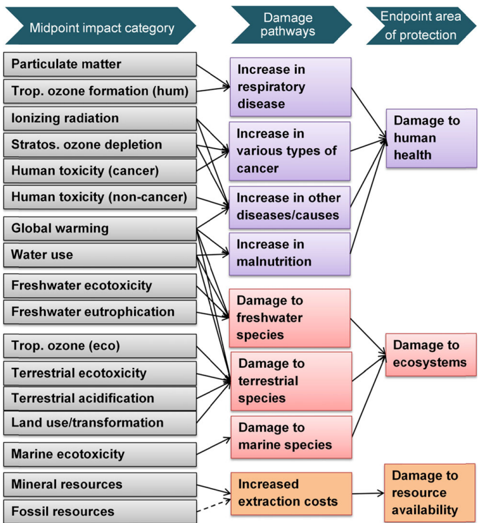
Life cycle impact assessment (LCIA) translates emissions and resource extractions into a limited number of environmental impact scores by means of so-called characterisation factors. There are two mainstream ways to derive characterisation factors, i.e. at midpoint level and at endpoint level. To further progress LCIA method development, we updated the ReCiPe2008 method to its version of 2016. This paper provides an overview of the key elements of the ReCiPe2016 method. We implemented human health, ecosystem quality and resource scarcity as three areas of protection. Endpoint characterisation factors, directly related to the areas of protection, were derived from midpoint characterisation factors with a constant mid-to-endpoint factor per impact category. We included 17 midpoint impact categories. The update of ReCiPe provides characterisation factors that are representative for the global scale instead of the European scale, while maintaining the possibility for a number of impact categories to implement characterisation factors at a country and continental scale. We also expanded the number of environmental interventions and added impacts of water use on human health, impacts of water use and climate change on freshwater ecosystems and impacts of water use and tropospheric ozone formation on terrestrial ecosystems as novel damage pathways. Although significant effort has been put into the update of ReCiPe, there is still major improvement potential in the way impact pathways are modelled. Further improvements relate to a regionalisation of more impact categories, moving from local to global species extinction and adding more impact pathways. Life cycle impact assessment is a fast evolving field of research. ReCiPe2016 provides a state-of-the-art method to convert life cycle inventories to a limited number of life cycle impact scores on midpoint and endpoint level.
Overview
The claims and statistics of this paper haven’t been checked yet.
Free: it reads the open-access text and checks the first 5 claims that cite a source we can check. Create a free account to check every claim.
Integrity signals
Registry
Cites
Statistics
Figures
Verification
Claims the paper makes
The claims and statistics of this paper haven’t been checked yet.
Free: it reads the open-access text and checks the first 5 claims that cite a source we can check. Create a free account to check every claim.
Self-check
Percentages, sums and reported differences re-computed from the paper’s own numbers.
The self-check needs the paper’s full text.
Citations
Cites
(2013) · Cited by 6,752
Accelerating extinction risk from climate change
Urban, M. C. (2015) · Science · doi:10.1126/science.aaa4984 · Cited by 2,436 · cited 2×
“For terrestrial ecosystems, the increase in potentially disappeared fraction of species (PDF) due to an increase in global temperature was derived from the review by Urban (2015).”
BackgroundThe water footprint of humanity
Hoekstra, A. Y., & Mekonnen, M. M. (2012) · Proceedings of the National Academy of Sciences · doi:10.1073/pnas.1109936109 · Cited by 2,260 · cited 2×
“…et al. 2013; Curran et al. 2014 Water use Increase of water consumed Water consumption potential (WCP) m3 water-eq consumed Döll and Siebert 2002; Hoekstra and Mekonnen 2012 Mineral resource scarcity Increase of ore extracted Surplus ore potential (SOP) kg Cu-eq Vieira et al. 2016a Fossil…”
BackgroundMethodAssessing the Environmental Impacts of Freshwater Consumption in LCA
Pfister, S., Koehler, A., & Hellweg, S. (2009) · Environmental Science & Technology · doi:10.1021/es802423e · Cited by 1,321 · cited 2×
“…shortage Pfister et al. 2009 Ecosystems (terrestrial) Decrease in Net Primary Productivity because of water shortage as proxy for total species loss Pfister et al. 2009 Ecosystems (aquatic) Fish species loss due to decreased river discharge Hanafiah et al. 2011 Land use Ecosystems (terrestrial)…”
BackgroundAmbient Air Pollution Exposure Estimation for the Global Burden of Disease 2013
Brauer, M., Freedman, G., Frostad, J., van Donkelaar, A., Martin, R. V., Dentener, F., Dingenen, R. V., Estep, K., Amini, H., Apte, J. S., et al. (2016) · Environmental Science & Technology · doi:10.1021/acs.est.5b03709 · Cited by 1,215
Addressing Global Mortality from Ambient PM2.5
Apte, J. S., Marshall, J. D., Cohen, A. J., & Brauer, M. (2015) · Environmental Science & Technology · doi:10.1021/acs.est.5b01236 · Cited by 995
Joos, F., Roth, R., Fuglestvedt, J. S., Peters, G. P., Enting, I. G., von Bloh, W., Brovkin, V., Burke, E. J., Eby, M., Edwards, N. R., et al. (2013) · Atmospheric Chemistry and Physics · doi:10.5194/acp-13-2793-2013 · Cited by 839
Implementation of life cycle impact assessment methods
Jungbluth, N., Margni, M. D., & Hischier, R. (2010) · Cited by 816
Global modeling of irrigation water requirements
Döll, P., & Siebert, S. (2002) · Water Resources Research · doi:10.1029/2001wr000355 · Cited by 816 · cited 2×
“For agriculture, the consumptive part of the withdrawal was estimated with water requirement ratios based on Döll and Siebert (2002).”
BackgroundMethod
Research works printed but not linked: 2
- 20. Goedkoop M, Heijungs R, Huijbregts MAJ, De Schryver A, Struijs J, van Zelm R (2009) ReCiPe 2008: a life cycle impact assessment method which comprises harmonised category indicators at the midpoint and endpoint levels. First edition. Report i: characterization. The Netherlands: Ruimte en Milieu, Ministerie van Volkshuisvesting, Ruimtelijke Ordening en Milieubeheer
- Vieira MDM, Ponsioen T, Goedkoop M, Huijbregts MAJ (2016c) Fossil resource scarcity. In: Huijbregts MAJ, Steinmann ZJN, Elshout PMF, Stam G, Verones F, Vieira MDM, Van Zelm R (eds) ReCiPe2016. A harmonized life cycle impact assessment method at midpoint and endpoint level. Report I: characterization. RIVM Report 2016-0104. National Institute for Human Health and the Environment, Bilthoven. Chapter 13
Cited by
Items 701–800 of 1,013
Musharavati, F., Ahmad, A., Javed, M. H., Sajid, K., & Naqvi, M. (2024) · Environmental Research · doi:10.1016/j.envres.2024.118121 · Cited by 42
Bacterial cellulose and composites for the treatment of water pollution: a review
Tran, G. T., Nguyen, T. T. T., Nguyen, D. T. C., & Tran, T. V. (2025) · Environmental Chemistry Letters · doi:10.1007/s10311-025-01818-7 · Cited by 46
“Moreover, the wastewater produced in this process, containing residual quantities of certain chemicals such as sodium dihydrogen phosphate, poses potential threats to human health and the environment [52, 53].”
Navigating uncertainty in life cycle assessment‐based approaches to biodiversity footprinting
Bromwich, T., White, T., Bouchez, A., Hawkins, I., zu Ermgassen, S., Bull, J. W., Bartlett, H., Bennun, L., Biggs, E., Booth, H. L., et al. (2025) · Methods in Ecology and Evolution · doi:10.1111/2041-210x.70001 · Cited by 48
“There are, there - (terrestrial, freshwater and marine ecosystems) to calculate ‘spe - cies.year’, an estimate of the species loss that may occur as a con - sequence of an organisation's activities (Huijbregts et al., 2017 ).”
Representativeness of environmental impact assessment methods regarding Life Cycle Inventories
Esnouf, A., Latrille, É., Steyer, J., & Hélias, A. (2017) · The Science of The Total Environment · doi:10.1016/j.scitotenv.2017.10.102 · Cited by 45
Environmental and Social Impact Assessment of Optimized Post-Tensioned Concrete Road Bridges
Penadés-Plà, V., Martínez-Muñoz, D., García-Segura, T., Navarro, I. J., & Yepes, V. (2020) · Sustainability · doi:10.3390/su12104265 · Cited by 41
Analyzing the environmental impact of copper-based mixed waste recycling-a LCA case study in China
Zhang, W., Li, Z., Dong, S., Qian, P., Ye, S., Hu, S., Xia, B., & Wang, C. (2020) · Journal of Cleaner Production · doi:10.1016/j.jclepro.2020.125256 · Cited by 41
A bottom-up approach to model the environmental impact of the last-mile in an urban food-system
Stelwagen, R. E., Slegers, P. M., de Schutter, L., & Leeuwen, E. S. V. (2020) · Sustainable Production and Consumption · doi:10.1016/j.spc.2020.12.039 · Cited by 44
LCA and economic study on the local oxygen supply in Central Europe during the COVID-19 pandemic
Bałys, M., Brodawka, E., Korzeniewska, A., Szczurowski, J., & Zarębska, K. (2021) · The Science of The Total Environment · doi:10.1016/j.scitotenv.2021.147401 · Cited by 42
Li, Y., Wu, W., Yang, J., Cheng, K., Smith, P., Sun, J., Xu, X., Qian, Y., & Pan, G. (2022) · The Science of The Total Environment · doi:10.1016/j.scitotenv.2022.153898 · Cited by 41
A comparison of different waste collection methods: Environmental impacts and occupational risks
Rossi, M., Papetti, A., & Germani, M. (2022) · Journal of Cleaner Production · doi:10.1016/j.jclepro.2022.133145 · Cited by 41
Leveraging Infrastructure BIM for Life-Cycle-Based Sustainable Road Pavement Management
Oreto, C., Biancardo, S. A., Abbondati, F., & Veropalumbo, R. (2023) · Materials · doi:10.3390/ma16031047 · Cited by 41
“Among the impact assessment models available in the literature, the Egalitarian ReCiPe [41] impact assessment method was selected both for its diffusion in the construction sector and for the number of environmental problems quantified by its impact category indicators, namely, 18 midpoint indicators and 3 endpoint in…”
MethodEnvironmental life cycle assessment of spent coffee ground pellet
Hamedani, S. R., Colantoni, A., Bianchini, L., Carnevale, M., Paris, E., Villarini, M., & Gallucci, F. (2022) · Energy Reports · doi:10.1016/j.egyr.2022.05.031 · Cited by 45
Tan, D., Wu, Y., Zhang, Z., Jiao, Y., Zeng, L., & Meng, Y. (2023) · Sustainability · doi:10.3390/su151511724 · Cited by 45
Association between ambient air particulate matter and human health impacts in northern Thailand
Supasri, T., Gheewala, S. H., Macatangay, R. C., Chakpor, A., & Sedpho, S. (2023) · Scientific Reports · doi:10.1038/s41598-023-39930-9 · Cited by 40
Choe, C., Cheon, S., Kim, H., & Lim, H. (2023) · Renewable and Sustainable Energy Reviews · doi:10.1016/j.rser.2023.113628 · Cited by 40
Value-transforming financial, carbon and biodiversity footprint accounting
Geneidy, S. E., Peura, M., Aumanen, V.-M., Baumeister, S., Helimo, U. T., Vainio, V., & Kotiaho, J. S. (2026) · Journal of Industrial Ecology · doi:10.1007/s44498-026-00151-8 · Cited by 41
“…Assess the biodiversity impact caused by the drivers of biodiversity loss By further integrating LCA and EEIOA with LCIA meth-ods, such as LC-IMPACT (Verones et al., 2020) or ReC-iPe (Huijbregts et al., 2017), the quantity of the drivers of biodiversity loss can be converted to biodiversity loss.”
InfluentialMiyan, N., Omur, T., Amed, B., Özkan, H., Aydın, R., & Kabay, N. (2024) · Construction and Building Materials · doi:10.1016/j.conbuildmat.2024.135233 · Cited by 42
Pérez, R., Argüelles, F., Laca, A., & Laca, A. (2024) · Environmental Science and Pollution Research · doi:10.1007/s11356-024-32540-6 · Cited by 44
“…terrestrial ecotoxicity (TEC), freshwater ecotoxicity (FEC), marine ecotoxicity (MEC), human carcinogenic toxicity (HCT), human non-carcinogenic toxicity (HNCT), land use (LUC), mineral resource scarcity (MRS), fossil resource scarcity (FRS) and water consumption (WC) (Huijbregts et al. 2016).”
BackgroundKarka, P., Johannsen, I., & Papadokonstantakis, S. (2024) · Sustainable Energy & Fuels · doi:10.1039/d3se01211e · Cited by 41
Life Cycle Sustainability Assessment of municipal solid waste management systems: a review
Ceraso, A., & Cesaro, A. (2024) · Journal of Environmental Management · doi:10.1016/j.jenvman.2024.122143 · Cited by 44
Life-Cycle Assessment of an Innovative Ground-Source Heat Pump System with Upstream Thermal Storage
Bonamente, E., & Aquino, A. (2017) · Energies · doi:10.3390/en10111854 · Cited by 40
Life-cycle greenhouse-gas emissions assessment: An Australian commercial building perspective
Le, K. N., Tran, C. N. N., & Tam, V. W. Y. (2018) · Journal of Cleaner Production · doi:10.1016/j.jclepro.2018.07.172 · Cited by 41
Joyce, P. J., & Björklund, A. (2019) · Journal of Sustainable Metallurgy · doi:10.1007/s40831-019-00209-x · Cited by 40
Cost-combined life cycle assessment of ferronickel production
Ma, X., Yang, D., Zhai, Y., Shen, X., Zhang, R., & Hong, J. (2019) · The International Journal of Life Cycle Assessment · doi:10.1007/s11367-019-01600-2 · Cited by 43
“LCIA analysis was conducted using an updated integrated model (Zhang et al. 2016; Li et al. 2016; Chen et al. 2016), including USEtox™ model (Huijbregts et al. 2010), IPCC report (IPCC 2014), IMPACTWorld+ model (Plouffe et al. 2012), and ReCiPe method (Huijbregts et al. 2017).”
MethodRiazi, B., Zhang, J., Yee, W., Ngo, H. L., & Spatari, S. (2019) · ACS Sustainable Chemistry & Engineering · doi:10.1021/acssuschemeng.9b02238 · Cited by 40
Hermoso-Orzáez, M. J., Lozano-Miralles, J. A., García, R. L., & Brito, P. (2019) · Sustainability · doi:10.3390/su11215982 · Cited by 40
“12 method [61] considers only three categories of damage-oriented impact: human health, ecosystem quality and resources.”
MethodJourdaine, M., Loubet, P., Trébucq, S., & Sonnemann, G. (2019) · Journal of Cleaner Production · doi:10.1016/j.jclepro.2019.119472 · Cited by 41
Environmental impact assessment of beef cattle production in semi-intensive systems in Paraguay
Costantini, M., Vázquez‐Rowe, I., Manzardo, A., & Bacenetti, J. (2020) · Sustainable Production and Consumption · doi:10.1016/j.spc.2020.11.003 · Cited by 44
Wang, D., Cheow, W. S., Amalina, N., Faiezin, M., & Hadinoto, K. (2021) · Journal of Cleaner Production · doi:10.1016/j.jclepro.2021.126074 · Cited by 40
Russo, V., Strever, A. E., & Ponstein, H. J. (2021) · The International Journal of Life Cycle Assessment · doi:10.1007/s11367-021-01911-3 · Cited by 42
Wyndorps, J., Ostovari, H., & von der Assen, N. V. (2021) · Sustainable Energy & Fuels · doi:10.1039/d1se00975c · Cited by 45
Hofmann, A., Wang, Z., Bautista, S. P., Weil, M., Müller, F. J., Lowe, R. P., Schneider, L., Mohsin, I. U., & Hanemann, T. (2021) · Electrochimica Acta · doi:10.1016/j.electacta.2021.139670 · Cited by 40
Pérez, R., Laca, A., Laca, A., & Díaz, M. (2022) · Journal of Cleaner Production · doi:10.1016/j.jclepro.2022.130594 · Cited by 46
Raccary, B., Loubet, P., Pérès, C., & Sonnemann, G. (2022) · TrAC Trends in Analytical Chemistry · doi:10.1016/j.trac.2022.116525 · Cited by 40
Extended use and optimization of struvite in hydroponic cultivation systems
Arcas‐Pilz, V., Parada, F., Rufí-Salís, M., Stringari, G., Gonzalez, R., Villalba, G., & Gabarrell, X. (2022) · Resources Conservation and Recycling · doi:10.1016/j.resconrec.2021.106130 · Cited by 42
Wiprächtiger, M., Rapp, M., Hellweg, S., Shinde, R., & Haupt, M. (2022) · Journal of Industrial Ecology · doi:10.1111/jiec.13275 · Cited by 46
Kovács, E., Hoaghia, M.-A., Senila, L. R., Scurtu, D. A., Varaticeanu, C., Roman, C., & Dumitraş, D. E. (2022) · Agronomy · doi:10.3390/agronomy12061320 · Cited by 40
Global water consumption impacts on riverine fish species richness in Life Cycle Assessment
Pierrat, É., Barbarossa, V., Núñez, M., Scherer, L., Link, A., Damiani, M., Verones, F., & Dorber, M. (2022) · The Science of The Total Environment · doi:10.1016/j.scitotenv.2022.158702 · Cited by 43
Self-citationPiotrowska, K., Piasecka, I., Kłos, Z., Marczuk, A., & Kasner, R. (2022) · Materials · doi:10.3390/ma15217778 · Cited by 42
“Midpoint indicators focus on a single environmental problem, while endpoint indicators show the environmental impact on three higher aggregation levels (Figure 5) [41,42].”
BackgroundKim, H., Choe, C., Lee, A., & Lim, H. (2023) · International Journal of Hydrogen Energy · doi:10.1016/j.ijhydene.2023.01.062 · Cited by 40
Coupling big data and life cycle assessment: A review, recommendations, and prospects
Li, J., Tian, Y., & Xie, K. (2023) · Ecological Indicators · doi:10.1016/j.ecolind.2023.110455 · Cited by 41
Rodríguez, N. B., Formentini, G., Favi, C., & Marconi, M. (2021) · Procedia CIRP · doi:10.1016/j.procir.2021.01.108 · Cited by 41
Grasso, A. C., Besselink, J. J. F., Tyszler, M., & Bruins, M. J. (2023) · Nutrients · doi:10.3390/nu15112473 · Cited by 42
“The environmental impact of each food item was assessed using three environmental impact indicators, namely GHGE (kg CO 2 eq), land occupation (m 2 *y), and blue water use (m 3 ), and were calculated by applying the ReCiPe Midpoint 2016 method [52].”
MethodGreenhouse gas emissions from bio-based growing media: A life-cycle assessment
Hashemi, F., Mogensen, L., Smith, A. M., Larsen, S. U., & Knudsen, M. T. (2023) · The Science of The Total Environment · doi:10.1016/j.scitotenv.2023.167977 · Cited by 44
Prospective life cycle inventory datasets for conventional and hybrid-electric aircraft technologies
Thonemann, N., Saavedra-Rubio, K., Pierrat, É., Dudka, K. M., Bangoura, M., Baumann, N., Bentheimer, C., Caliandro, P., Breuker, R. D., de Ruiter, C., et al. (2023) · Journal of Cleaner Production · doi:10.1016/j.jclepro.2023.140314 · Cited by 40
Brglez, K., Čuček, L., Krajnc, D., & Lukman, R. K. (2024) · Journal of Cleaner Production · doi:10.1016/j.jclepro.2024.141761 · Cited by 39
Sinisterra-Solís, N. K., Sanjuán, N., Ribal, J., Estruch, V., Clemente, G., & Rozakis, S. (2024) · Ecological Indicators · doi:10.1016/j.ecolind.2024.111934 · Cited by 41
Cao, X., Chen, S., & Xiang, W. (2024) · The Science of The Total Environment · doi:10.1016/j.scitotenv.2024.172047 · Cited by 39
Zhu, Y., Prescott, G. W., Chu, P., & Carrasco, L. R. (2024) · Journal of Cleaner Production · doi:10.1016/j.jclepro.2024.142079 · Cited by 45
Chicaiza-Ortiz, C., Peñafiel-Arcos, P., Herrera-Feijoo, R. J., Ma, W., Logroño, W., Tian, H., & Wang, Y. (2024) · Journal of Cleaner Production · doi:10.1016/j.jclepro.2024.143993 · Cited by 44
Comparing environmental and personal health impacts of individual food choices
Walker, C., Gibney, E. R., Mathers, J. C., & Hellweg, S. (2019) · The Science of The Total Environment · doi:10.1016/j.scitotenv.2019.05.404 · Cited by 46
Life-cycle assessment of p-type multi-Si back surface field (BSF) solar module in China of 2019
Jia, X., Lv, F., Li, P., & Wang, W. (2019) · Solar Energy · doi:10.1016/j.solener.2019.12.018 · Cited by 39
Baral, N. R., Asher, Z. D., Trinko, D. A., Sproul, E. G., Quiroz‐Arita, C., Quinn, J. C., & Bradley, T. H. (2020) · Journal of Cleaner Production · doi:10.1016/j.jclepro.2020.123593 · Cited by 39
“These additional impacts include ecotoxicity, eutrophication, carcinogenic and non-carcinogenic to human health, stratospheric ozone and fossil fuel resources depletions, acidification and photochemical ozone formation potentials, and respiratory effects all based on the ReCiPe methods (Huijbregts et al., 2017).”
MethodKuo, C.-H., Hu, A. H., Hung, L. H., Yang, K.-T., & Wu, C.-H. (2020) · Journal of Cleaner Production · doi:10.1016/j.jclepro.2020.124301 · Cited by 39
Rama, M., Entrena-Barbero, E., Dias, A. C., Moreira, M. T., Feijóo, G., & González‐García, S. (2020) · The Science of The Total Environment · doi:10.1016/j.scitotenv.2020.143133 · Cited by 39
Rapa, M., Gobbi, L., & Ruggieri, R. (2020) · Energies · doi:10.3390/en13236292 · Cited by 41
“The first method reported is the ReCiPe 2016 midpoint that involves six impact categories dealing with air, five categories for the water, five categories for the land, and two categories dealing with human health [45,46].”
MethodHenderson, A. D., Niblick, B., Golden, H. E., & Bare, J. (2021) · The International Journal of Life Cycle Assessment · doi:10.1007/s11367-021-01956-4 · Cited by 39
“• freshwater eutrophication due to emissions to soil are calculated based on a 10% factor soil-applied nutrients similar to the ReCiPe approach (Huijbregts et al. 2017).”
MethodEnhanced real-time scheduling algorithm for energy management in a renewable-integrated microgrid
Shotorbani, A. M., Zeinal‐Kheiri, S., Chhipi‐Shrestha, G., Mohammadi‐Ivatloo, B., Sadiq, R., & Hewage, K. (2021) · Applied Energy · doi:10.1016/j.apenergy.2021.117658 · Cited by 44
Abokersh, M. H., Gangwar, S., Spiekman, M., Vallès, M., Jiménez, L., & Boer, D. T. (2021) · Renewable Energy · doi:10.1016/j.renene.2021.08.091 · Cited by 41
Mussagy, C. U., Kurnia, K. A., Dias, A. C., Raghavan, V., Santos‐Ebinuma, V. C., & Pessoa, A. (2021) · Bioresource Technology · doi:10.1016/j.biortech.2021.126555 · Cited by 39
Ecosystem service deficits of European cities
Elliot, T. R., Goldstein, B. P., Gómez‐Baggethun, E., Proença, V. M., & Rugani, B. (2022) · The Science of The Total Environment · doi:10.1016/j.scitotenv.2022.155875 · Cited by 42
Arendt, R., Bach, V., & Finkbeiner, M. (2022) · Journal of Cleaner Production · doi:10.1016/j.jclepro.2022.132232 · Cited by 42
Nexus analysis and life cycle assessment of regional water supply systems: A case study from Italy
Arfelli, F., Ciacci, L., Vassura, I., & Passarini, F. (2022) · Resources Conservation and Recycling · doi:10.1016/j.resconrec.2022.106446 · Cited by 39
Poncelet, A. C., Loubet, P., Helbig, C., Beylot, A., Muller, S. M., Villeneuve, J., Laratte, B., Thorenz, A., Tuma, A., & Sonnemann, G. (2022) · The International Journal of Life Cycle Assessment · doi:10.1007/s11367-022-02093-2 · Cited by 42
“2019, 2002) and the midpoint and endpoint CFs for the “mineral resource scarcity” category in the ReCiPe 2016 method (Huijbregts et al. 2017).”
BackgroundMethodDas, S., & De, S. K. (2023) · Energy Conversion and Management · doi:10.1016/j.enconman.2022.116631 · Cited by 39
The role of aeroponic container farms in sustainable food systems – The environmental credentials
Schmidt Rivera, X., Rodgers, B., Odanye, T., Jalil-Vega, F., & Farmer, J. (2023) · Science of The Total Environment · doi:10.1016/j.scitotenv.2022.160420 · Cited by 38
Prospective sustainability assessment: The case of wood in automotive applications
Mair-Bauernfeind, C., Zimek, M., Asada, R., Bauernfeind, D., Baumgartner, R. J., & Stern, T. (2020) · The International Journal of Life Cycle Assessment · doi:10.1007/s11367-020-01803-y · Cited by 38
Cortés, A., Esteve-Llorens, X., González-García, S., Moreira, M. T., & Feijoo, G. (2021) · Science of The Total Environment · doi:10.1016/j.scitotenv.2021.148249 · Cited by 38
Life cycle assessment of tomato production for different production strategies in Norway
Naseer, M., Persson, T., Hjelkrem, A.-G. R., Ruoff, P., & Verheul, M. (2022) · Journal of Cleaner Production · doi:10.1016/j.jclepro.2022.133659 · Cited by 38
Taelman, S. E., Peña, L. V. D. L., Préat, N., Bachmann, T. M., der Biest, K. V., Maes, J., & Dewulf, J. P. (2023) · The International Journal of Life Cycle Assessment · doi:10.1007/s11367-023-02216-3 · Cited by 38
Silva, M. B. D. O., de Oliveira, S. A., & Rosa, D. D. S. (2024) · Journal of Cleaner Production · doi:10.1016/j.jclepro.2024.140726 · Cited by 38
Fernández-López, L., González-García, P., Fernández‐Ríos, A., García, R. A., Laso, J., Martínez-Ibáñez, E., Gutiérrez-Fernández, D., Martínez, M. P., Marchisio, V., Figueroa, M., et al. (2024) · Cleaner and Circular Bioeconomy · doi:10.1016/j.clcb.2024.100079 · Cited by 46
Lau, I., Alex Burdorf, A., Hesseling, S. A. W., Wijk, L., Tauber, M., & Hunfeld, N. (2024) · Frontiers in Public Health · doi:10.3389/fpubh.2024.1380400 · Cited by 42
Djettene, R., Dubois, L., Duprez, M., Weireld, G. D., & Thomas, D. (2024) · Journal of CO2 Utilization · doi:10.1016/j.jcou.2024.102879 · Cited by 43
Contribution of double-cropped maize ethanol in Brazil to sustainable development
Gurgel, A., Seabra, J. E. A., Arantes, S. M., Moreira, M. M. R., Lynd, L. R., & Galindo, R. (2024) · Nature Sustainability · doi:10.1038/s41893-024-01424-5 · Cited by 38
Castagnoli, A., Salem, A. M., Desideri, U., & Pecorini, I. (2024) · Journal of Cleaner Production · doi:10.1016/j.jclepro.2024.144174 · Cited by 38
Learning-by-doing: experience from 20 years of teaching LCA to future engineers
Cosme, N. M. D., Hauschild, M. Z., Molin, C., Rosenbaum, R. K., & Laurent, A. (2018) · The International Journal of Life Cycle Assessment · doi:10.1007/s11367-018-1457-5 · Cited by 45
“2009; Huijbregts et al. 2016, 2017) and ILCD (EC-JRC 2011; Hauschild et al. 2013) LCIA 382 methodologies (see Figure 3).”
Sarkkinen, M., Kujala, K., & Gehör, S. (2019) · Journal of Cleaner Production · doi:10.1016/j.jclepro.2019.07.058 · Cited by 39
Life beyond the grid: A Life-Cycle Sustainability Assessment of household energy needs
Gwerder, Y. V., Marques, P., Dias, L. C., & Freire, F. M. C. S. (2019) · Applied Energy · doi:10.1016/j.apenergy.2019.113881 · Cited by 38
“/kWh or MJ [47] Economic Financial Burden Investment Costs €/Lifetime N.”
BackgroundMethodInfluentialCriticality assessment of abiotic resource use for Europe– application of the SCARCE method
Arendt, R., Muhl, M., Bach, V., & Finkbeiner, M. (2020) · Resources Policy · doi:10.1016/j.resourpol.2020.101650 · Cited by 40
Barcelos, S. M. B. D., Salvador, R., Guedes, M. D. G., & de Francisco, A. C. (2020) · Sustainability · doi:10.3390/su12083214 · Cited by 38
Lask, J., Rukavina, S., Zorić, I., Kam, J., Kiesel, A., Lewandowski, I. M., & Wagner, M. (2020) · GCB Bioenergy · doi:10.1111/gcbb.12781 · Cited by 38
“As the miscanthus cultivation takes place in a specific region, location-specific characterization factors (CF) for land use are considered as suggested in the ReCiPe2016 methodology (Huijbregts et al., 2017).”
MethodOrdóñez, D. F., Shah, N., & Guillén‐Gosálbez, G. (2021) · Applied Energy · doi:10.1016/j.apenergy.2021.116488 · Cited by 38
Guillén-Lambea, S., Carvalho, M., Delgado, M., & Lázaro, A. (2020) · Clean Technologies and Environmental Policy · doi:10.1007/s10098-020-01941-9 · Cited by 38
Jaxa-Rozen, M., Pratiwi, A. S., & Trutnevyte, E. (2021) · The International Journal of Life Cycle Assessment · doi:10.1007/s11367-021-01921-1 · Cited by 40
Lassio, J. G., Magrini, A., & Branco, D. A. C. (2021) · Journal of Cleaner Production · doi:10.1016/j.jclepro.2021.127568 · Cited by 40
Life cycle analysis of electronic products for a product-service system
Nunes, I. C., Kohlbeck, E., Beuren, F. H., Fagundes, A. B., & Pereira, D. (2021) · Journal of Cleaner Production · doi:10.1016/j.jclepro.2021.127926 · Cited by 40
Life-cycle environmental impact assessment and plastic pollution prevention measures of wet wipes
Yuting, Z., Wen, Z., Lin, W., Hu, Y., Kosajan, V., & Zhang, T. (2021) · Resources Conservation and Recycling · doi:10.1016/j.resconrec.2021.105803 · Cited by 44
Santillán‐Saldivar, J., Gemechu, E. D., Muller, S. M., Villeneuve, J., Young, S. B., & Sonnemann, G. (2022) · The International Journal of Life Cycle Assessment · doi:10.1007/s11367-022-02027-y · Cited by 39
Ai, L., Ng, S., & Ong, W. (2022) · ChemSusChem · doi:10.1002/cssc.202200857 · Cited by 44
Hollas, C. E., Rodrigues, H. C., Bolsan, A. C., Venturin, B., Bortoli, M., Antes, F. G., Steinmetz, R. L. R., & Kunz, A. (2022) · The Science of The Total Environment · doi:10.1016/j.scitotenv.2022.159494 · Cited by 38
Li, Y., Trimmer, J. T., Hand, S. M., Zhang, X., Chambers, K. G., Lohman, H. A. C., Shi, R., Byrne, D. M., Cook, S. M., & Guest, J. S. (2022) · Environmental Science Water Research & Technology · doi:10.1039/d2ew00431c · Cited by 45
Baars, J., Cerdas, F., & Heidrich, O. (2023) · Environmental Science & Technology · doi:10.1021/acs.est.2c04080 · Cited by 38
Xicotencatl, B. M., Kleijn, R., van Nielen, S. S., Donati, F., Sprecher, B., & Tukker, A. (2023) · Journal of Industrial Ecology · doi:10.1111/jiec.13410 · Cited by 41
Trinidad, K. R., Ashizawa, R., Nikkhah, A., Semper, C., Casolaro, C., Kaplan, D. L., Savchenko, A. V., & Blackstone, N. T. (2023) · Journal of Cleaner Production · doi:10.1016/j.jclepro.2023.138153 · Cited by 37
Lao, W.-L., & Chang, L. (2023) · Industrial Crops and Products · doi:10.1016/j.indcrop.2023.117443 · Cited by 38
Pesqueira, J. F. J. R., Pereira, M. F. R., & Silva, A. M. T. (2024) · Journal of Cleaner Production · doi:10.1016/j.jclepro.2024.140845 · Cited by 37
Aleisa, E. (2024) · Desalination · doi:10.1016/j.desal.2024.117827 · Cited by 37
Calculating the true costs of protein sources by integrating environmental costs and market prices
Azarkamand, S., Fernández‐Ríos, A., Batlle-Bayer, L., Bala, A., Sazdovski, I., Roca, M., Margallo, M., García, R. A., Laso, J., Puig, R., et al. (2024) · Sustainable Production and Consumption · doi:10.1016/j.spc.2024.06.006 · Cited by 37
Luanwuthi, S., Iamprasertkun, P., Akkharaamnuay, T., Kunyawut, C., Phukhrongthung, A., & Puchongkawarin, C. (2024) · ACS Sustainable Chemistry & Engineering · doi:10.1021/acssuschemeng.4c04783 · Cited by 40
Metadata
- Authors
- Huijbregts, M. A. J., Steinmann, Z. J. N., Elshout, P. M. F., Stam, G., Verones, F., Vieira, M., Zijp, M., Hollander, A., & van Zelm, R.
- Affiliations
- Netherlands Environmental Assessment Agency (NL)
- Radboud University Nijmegen (NL)
- Norwegian University of Science and Technology (NO)
- National Institute for Public Health and the Environment (NL)
- Corresponding author
- Huijbregts, Mark A. J.
- ORCID
- Venue
- The International Journal of Life Cycle Assessment
- Published
- 2016-12-12
- Volume
- 22
- Issue
- 2
- Pages
- 138-147
- ISSN
- 0948-3349 (ISSN-L)
- 1614-7502
- OpenAlex
- W2564630286
- Semantic Scholar
- 318510507a790e4b13a4320ec9a6a8756ed96ecd
- Cited by
- 4,485
- References
- 54
- Citations by year
- 2026: 945 · 2025: 906 · 2024: 682 · 2023: 578 · 2022: 520 · 2021: 391 · 2020: 232 · 2019: 131 · 2018: 78 · 2017: 18 · 2016: 3
- FWCI
- 48.09
- Type
- journal article
- Language
- en
- Update notices
- correction (2020-07-02)
- Open access
- hybrid
- doi.org
- Licence
- cc-by
- creativecommons.org/licenses/by/4.0 (tdm)
- creativecommons.org/licenses/by/4.0 (vor)
- Locations
- The International Journal of Life Cycle Assessment (publishedVersion, cc-by)
- Radboud Repository (Radboud University) (submittedVersion)
- Rivm Repository (Netherlands National Institute for Public Health and the Environment) (submittedVersion)
- Radboud Repository (Radboud University) (submittedVersion, other-oa)
- Funders
- Rijksinstituut voor Volksgezondheid en Milieu (S/607020)
- Topics
- Physical Sciences › Environmental Science › Environmental Engineering › Environmental Impact and Sustainability
- Physical Sciences › Environmental Science › Ecology › Agriculture Sustainability and Environmental Impact
- Physical Sciences › Environmental Science › Environmental Engineering › Sustainability and Ecological Systems Analysis
- Keywords
- life cycle impact assessment, characterization factors, human health effects, ecosystem quality, resource constraints, water use impacts, freshwater ecosystems, tropospheric ozone formation, terrestrial ecosystems, species extinction, environmental interventions, global scale
About these checks
Registry, retraction, Cites and statistics results are computed, not judged, with one exception: a printed reference that no index lists is read once by a model before it counts as a citation error. Claims are extracted by a model and kept only when their quote appears verbatim in the text; each cited source is then checked, with a model’s help, for whether it says what the claim relies on. Those verdicts can be wrong — read the claim’s quote and the cited source before relying on one.
Statistics and arithmetic are recomputed, not judged.
Confidence bands are shown only for fields calibrated on our annotated test set. None is calibrated yet, so no band is shown.
What counts as a claim ›How we measure confidence ›How we check this ›
Are you an author, or do you see a problem with this page? Request a review
Data sources
Bibliographic data: Semantic Scholar, OpenAlex, Crossref.
Contains information from the Semantic Scholar Academic Graph Datasets, made available under the ODC Attribution License (ODC-BY 1.0).
Semantic Scholar’s data is described in: Kinney, R., et al. (2023). The Semantic Scholar Open Data Platform. arXiv:2301.10140.
