

ReCiPe2016: a harmonised life cycle impact assessment method at midpoint and endpoint level
Open accessThe DOI matches its Crossref record; 53 of the 54 references it cites were found in a registry or an index.
Abstract
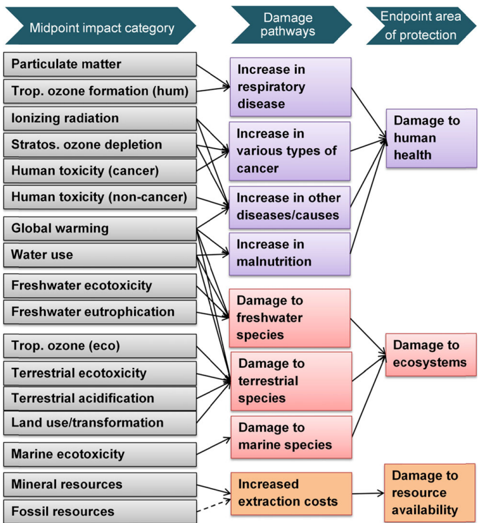
Life cycle impact assessment (LCIA) translates emissions and resource extractions into a limited number of environmental impact scores by means of so-called characterisation factors. There are two mainstream ways to derive characterisation factors, i.e. at midpoint level and at endpoint level. To further progress LCIA method development, we updated the ReCiPe2008 method to its version of 2016. This paper provides an overview of the key elements of the ReCiPe2016 method. We implemented human health, ecosystem quality and resource scarcity as three areas of protection. Endpoint characterisation factors, directly related to the areas of protection, were derived from midpoint characterisation factors with a constant mid-to-endpoint factor per impact category. We included 17 midpoint impact categories. The update of ReCiPe provides characterisation factors that are representative for the global scale instead of the European scale, while maintaining the possibility for a number of impact categories to implement characterisation factors at a country and continental scale. We also expanded the number of environmental interventions and added impacts of water use on human health, impacts of water use and climate change on freshwater ecosystems and impacts of water use and tropospheric ozone formation on terrestrial ecosystems as novel damage pathways. Although significant effort has been put into the update of ReCiPe, there is still major improvement potential in the way impact pathways are modelled. Further improvements relate to a regionalisation of more impact categories, moving from local to global species extinction and adding more impact pathways. Life cycle impact assessment is a fast evolving field of research. ReCiPe2016 provides a state-of-the-art method to convert life cycle inventories to a limited number of life cycle impact scores on midpoint and endpoint level.
Overview
The claims and statistics of this paper haven’t been checked yet.
Free: it reads the open-access text and checks the first 5 claims that cite a source we can check. Create a free account to check every claim.
Integrity signals
Registry
Cites
Statistics
Figures
Verification
Claims the paper makes
The claims and statistics of this paper haven’t been checked yet.
Free: it reads the open-access text and checks the first 5 claims that cite a source we can check. Create a free account to check every claim.
Self-check
Percentages, sums and reported differences re-computed from the paper’s own numbers.
The self-check needs the paper’s full text.
Citations
Cites
(2013) · Cited by 6,752
Accelerating extinction risk from climate change
Urban, M. C. (2015) · Science · doi:10.1126/science.aaa4984 · Cited by 2,436 · cited 2×
“For terrestrial ecosystems, the increase in potentially disappeared fraction of species (PDF) due to an increase in global temperature was derived from the review by Urban (2015).”
BackgroundThe water footprint of humanity
Hoekstra, A. Y., & Mekonnen, M. M. (2012) · Proceedings of the National Academy of Sciences · doi:10.1073/pnas.1109936109 · Cited by 2,260 · cited 2×
“…et al. 2013; Curran et al. 2014 Water use Increase of water consumed Water consumption potential (WCP) m3 water-eq consumed Döll and Siebert 2002; Hoekstra and Mekonnen 2012 Mineral resource scarcity Increase of ore extracted Surplus ore potential (SOP) kg Cu-eq Vieira et al. 2016a Fossil…”
BackgroundMethodAssessing the Environmental Impacts of Freshwater Consumption in LCA
Pfister, S., Koehler, A., & Hellweg, S. (2009) · Environmental Science & Technology · doi:10.1021/es802423e · Cited by 1,321 · cited 2×
“…shortage Pfister et al. 2009 Ecosystems (terrestrial) Decrease in Net Primary Productivity because of water shortage as proxy for total species loss Pfister et al. 2009 Ecosystems (aquatic) Fish species loss due to decreased river discharge Hanafiah et al. 2011 Land use Ecosystems (terrestrial)…”
BackgroundAmbient Air Pollution Exposure Estimation for the Global Burden of Disease 2013
Brauer, M., Freedman, G., Frostad, J., van Donkelaar, A., Martin, R. V., Dentener, F., Dingenen, R. V., Estep, K., Amini, H., Apte, J. S., et al. (2016) · Environmental Science & Technology · doi:10.1021/acs.est.5b03709 · Cited by 1,215
Addressing Global Mortality from Ambient PM2.5
Apte, J. S., Marshall, J. D., Cohen, A. J., & Brauer, M. (2015) · Environmental Science & Technology · doi:10.1021/acs.est.5b01236 · Cited by 995
Joos, F., Roth, R., Fuglestvedt, J. S., Peters, G. P., Enting, I. G., von Bloh, W., Brovkin, V., Burke, E. J., Eby, M., Edwards, N. R., et al. (2013) · Atmospheric Chemistry and Physics · doi:10.5194/acp-13-2793-2013 · Cited by 839
Implementation of life cycle impact assessment methods
Jungbluth, N., Margni, M. D., & Hischier, R. (2010) · Cited by 816
Global modeling of irrigation water requirements
Döll, P., & Siebert, S. (2002) · Water Resources Research · doi:10.1029/2001wr000355 · Cited by 816 · cited 2×
“For agriculture, the consumptive part of the withdrawal was estimated with water requirement ratios based on Döll and Siebert (2002).”
BackgroundMethod
Research works printed but not linked: 2
- 20. Goedkoop M, Heijungs R, Huijbregts MAJ, De Schryver A, Struijs J, van Zelm R (2009) ReCiPe 2008: a life cycle impact assessment method which comprises harmonised category indicators at the midpoint and endpoint levels. First edition. Report i: characterization. The Netherlands: Ruimte en Milieu, Ministerie van Volkshuisvesting, Ruimtelijke Ordening en Milieubeheer
- Vieira MDM, Ponsioen T, Goedkoop M, Huijbregts MAJ (2016c) Fossil resource scarcity. In: Huijbregts MAJ, Steinmann ZJN, Elshout PMF, Stam G, Verones F, Vieira MDM, Van Zelm R (eds) ReCiPe2016. A harmonized life cycle impact assessment method at midpoint and endpoint level. Report I: characterization. RIVM Report 2016-0104. National Institute for Human Health and the Environment, Bilthoven. Chapter 13
Cited by
Items 901–1,000 of 1,013
Kerdlap, P., Purnama, A. R., Low, J. S. C., Tan, D. Z. L., Barlow, C. Y., & Ramakrishna, S. (2021) · Journal of Industrial Ecology · doi:10.1111/jiec.13151 · Cited by 33
Coppola, G., Costantini, M., Fusi, A., Ruiz-García, L., & Bacenetti, J. (2022) · The Science of The Total Environment · doi:10.1016/j.scitotenv.2022.154107 · Cited by 33
Environmental footprints of soybean production in China
Zhang, Q., Hong, J., Zhang, T., Tian, X., Geng, Y., Chen, W., Zhai, Y., Liu, W., Shen, X., & Bai, Y. (2022) · Environment Development and Sustainability · doi:10.1007/s10668-022-02424-1 · Cited by 33
Urban greenhouse covering materials: Assessing environmental impacts and crop yields effects
Muñoz‐Liesa, J., Cuerva, E., Parada, F., Volk, D., Gassó, S., Josa, A., & Nemecek, T. (2022) · Resources Conservation and Recycling · doi:10.1016/j.resconrec.2022.106527 · Cited by 36
“13 method at Midpoint level with a Hierarchical perspective (Huijbregts et al., 2017),”
Silva, T. A., Ferreira, J., Castro, J. D. S., Braga, M. Q., & Calijuri, M. L. (2022) · Resources Conservation and Recycling · doi:10.1016/j.resconrec.2022.106575 · Cited by 35
Metals for low-carbon technologies: Environmental impacts and relation to planetary boundaries
Schenker, V., Kulionis, V., Oberschelp, C., & Pfister, S. (2022) · Journal of Cleaner Production · doi:10.1016/j.jclepro.2022.133620 · Cited by 35
Li, Y., Liu, M., Tang, Y., Jia, Y., Wang, Q., Ma, Q., Hong, J., Zuo, J., & Yuan, X. (2022) · Energy Conversion and Management · doi:10.1016/j.enconman.2022.116156 · Cited by 34
Stafford, W., Russo, V., & Nahman, A. (2022) · The International Journal of Life Cycle Assessment · doi:10.1007/s11367-022-02085-2 · Cited by 39
Cuezzo, A. M., Araujo, P. Z., Wheeler, J., & Mele, F. D. (2022) · Journal of CO2 Utilization · doi:10.1016/j.jcou.2022.102301 · Cited by 34
Environmental Impact Assessment for Animal Waste, Organic and Synthetic Fertilizers
Litskas, V. D. (2023) · Nitrogen · doi:10.3390/nitrogen4010002 · Cited by 39
Economic and Environmental Performance of an Integrated CO2 Refinery
Ioannou, I., Javaloyes-Antón, J., Caballero, J. A., & Guillén‐Gosálbez, G. (2023) · ACS Sustainable Chemistry & Engineering · doi:10.1021/acssuschemeng.2c06724 · Cited by 34
Snigdha, Hiloidhari, M., & Bandyopadhyay, S. (2023) · Journal of Cleaner Production · doi:10.1016/j.jclepro.2023.136166 · Cited by 38
“This produces a huge amount of emissions and GHGs into the Note: PLife1 is disposable PPE Product Life, PLife2 is reusable PPE Product Life, I1 is Incineration of disposable PPE, I2 is Incineration of reusable PPE, L1 is Landfill of disposable PPE, L2 is Landfill of reusable PPE.”
BackgroundInfluentialHélias, A., Stanford-Clark, C., & Bach, V. (2023) · The International Journal of Life Cycle Assessment · doi:10.1007/s11367-023-02136-2 · Cited by 33
Ostovari, H., Kuhrmann, L., Mayer, F., Minten, H., & Bardow, A. (2023) · Journal of CO2 Utilization · doi:10.1016/j.jcou.2023.102496 · Cited by 37
Zhou, K., Liu, Q., Juan, F., Chang, T., & Liu, J. (2023) · Waste Management · doi:10.1016/j.wasman.2023.10.018 · Cited by 37
Comparative Human Toxicity Impact of Electricity Produced from Shale Gas and Coal
Chen, L., Miller, S. A., & Ellis, B. R. (2017) · Environmental Science & Technology · doi:10.1021/acs.est.7b03546 · Cited by 33
Tang, J., Tang, Y., Liu, Y., Sun, Z., Deng, J., Chen, W., Qin, Z., & Ma, X. (2023) · Energy Conversion and Management · doi:10.1016/j.enconman.2023.117375 · Cited by 33
Thomas, J.-B., Ahlgren, E., Hornborg, S., & Ziegler, F. (2024) · Journal of Cleaner Production · doi:10.1016/j.jclepro.2024.141987 · Cited by 36
Herrmann, M., Mehner, E., Egger, L., Portmann, R., Hammer, L., & Nemecek, T. (2024) · Frontiers in Sustainable Food Systems · doi:10.3389/fsufs.2024.1413802 · Cited by 33
Life cycle assessment of power-to-methane and renewable methane production technologies
Cho, H. H., Strezov, V., & Evans, T. (2024) · Renewable and Sustainable Energy Reviews · doi:10.1016/j.rser.2024.114856 · Cited by 36
dos Muchangos, L. S., Mejía, C., Gupta, R., SadreGhazi, S., & Kajikawa, Y. (2024) · Environmental Impact Assessment Review · doi:10.1016/j.eiar.2024.107740 · Cited by 38
Dem, P., Hayashi, K., Fujii, M., & Mohmmed, E. E. E. (2025) · Environmental Impact Assessment Review · doi:10.1016/j.eiar.2025.107971 · Cited by 34
Hollander, A., de Jonge, R., Biesbroek, S., Hoekstra, J., & Zijp, M. C. (2018) · Sustainability Science · doi:10.1007/s11625-018-0607-9 · Cited by 33
Self-citationDorber, M., Kuipers, K., & Verones, F. (2019) · The Science of The Total Environment · doi:10.1016/j.scitotenv.2019.134582 · Cited by 34
Self-citationCurrent options in the life cycle assessment of additive manufacturing products
Výtisk, J., Kočí, V., Honus, S., & Vrtek, M. (2019) · Open Engineering · doi:10.1515/eng-2019-0073 · Cited by 37
“At present, to evaluate the environmental impacts of additive technologies, recommended may be the current version of LCAmethodologyReCiPe [42].”
BackgroundMethodInfluentialStoppato, A., & Benato, A. (2020) · Energies · doi:10.3390/en13071835 · Cited by 32
Zhao, X., Huang, S., Wang, J., Kaiser, S., & Han, X. (2020) · Ecological Indicators · doi:10.1016/j.ecolind.2020.106759 · Cited by 32
“Some methods (such as ReCiPe (Huijbregts et al., 2017)) show at the same time the mid-point and end-point approaches.”
Global life-cycle impacts of onshore wind-power plants on bird richness
May, R. F., Middel, H., Stokke, B. G., Jackson, C. R., & Verones, F. (2020) · Environmental and Sustainability Indicators · doi:10.1016/j.indic.2020.100080 · Cited by 32
Self-citationSegura-Salazar, J., & Tavares, L. M. (2021) · Minerals Engineering · doi:10.1016/j.mineng.2021.107149 · Cited by 33
Wang, Z., Jochem, P. E. P., Yilmaz, H. Ü., & Xu, L. J. (2021) · Journal of Industrial Ecology · doi:10.1111/jiec.13200 · Cited by 32
Ayub, Y., Mehmood, A., Ren, J., & Lee, C. K. M. (2022) · Journal of Cleaner Production · doi:10.1016/j.jclepro.2022.132029 · Cited by 35
Pedreschi, R., Ponce, E., Hernández, I., Fuentealba, C., Urbina, A., González-Fernández, J. J., Hormaza, J. I., Campos, D., Chirinos, R., & Aguayo, E. (2022) · Foods · doi:10.3390/foods11121807 · Cited by 32
“12 methodology [24], the corresponding impacts at two midpoint categories, GHG emissions (measured in CO2eq) and resources depletion (measured in kg Oileq), are shown in Figure 1.”
BackgroundLCA as decision support tool in the food and feed sector: evidence from R&D case studies
Ott, D., Goyal, S., Reuss, R., Gutzeit, H. O., Liebscher, J., Dautz, J., Degieter, M., Steur, H. D., & Zannini, E. (2022) · Environment Systems & Decisions · doi:10.1007/s10669-022-09874-y · Cited by 36
Ferrara, C., Migliaro, V., Ventura, F., & Feo, G. D. (2022) · The Science of The Total Environment · doi:10.1016/j.scitotenv.2022.159323 · Cited by 34
García-Velásquez, C., & van der Meer, Y. (2022) · Waste Management · doi:10.1016/j.wasman.2022.10.038 · Cited by 32
Conde, J. J., Abelleira, S., Estévez, S., González-Rodríguez, J., Feijóo, G., & Moreira, M. T. (2023) · Journal of Environmental Management · doi:10.1016/j.jenvman.2023.117308 · Cited by 32
“1 Midpoint (H/H) and Endpoint (H/H) methods, using SimaPro 9.3 software (Huijbregts et al., 2017).”
InfluentialEstévez, S., Rebolledo-Leiva, R., Hernández, D., González‐García, S., Feijóo, G., & Moreira, M. T. (2023) · Energy · doi:10.1016/j.energy.2023.127319 · Cited by 32
Kouloumpis, V., Konstantzos, G. E., Chroni, C., Abeliotis, K., & Lasaridi, K. (2023) · Sustainable Production and Consumption · doi:10.1016/j.spc.2023.08.008 · Cited by 35
Shen, Y., Huang, G.-T., Chang-Chien, C.-L., Huang, L. H., Kuo, C.-H., & Hu, A. H. (2023) · Energy Policy · doi:10.1016/j.enpol.2023.113838 · Cited by 34
Feng, C., Wang, J., Cui, B., Ye, Z., Guo, H., Zhang, W., & Zhu, J. (2024) · Construction and Building Materials · doi:10.1016/j.conbuildmat.2024.135641 · Cited by 32
Energy and carbon coupled water footprint analysis for straw pulp paper production
Ma, X., Zhai, Y., Zhang, R., Shen, X., Zhang, T., Ji, C., Yuan, X., & Hong, J. (2019) · Journal of Cleaner Production · doi:10.1016/j.jclepro.2019.06.069 · Cited by 33
González‐García, S., & Dias, A. C. (2019) · Journal of Industrial Ecology · doi:10.1111/jiec.12844 · Cited by 32
Parascanu, M. M., Puig-Gamero, M., Soreanu, G., Valverde, J. L., & Sánchez-Silva, L. (2019) · Energy · doi:10.1016/j.energy.2019.116095 · Cited by 32
Martín-Gamboa, M., Dias, L. C., Quinteiro, P. S. G. N., Freire, F. M. C. S., Arroja, L., & Dias, A. C. (2019) · Energies · doi:10.3390/en12224391 · Cited by 34
Soleimani, T., Hermesch, S., & Gilbert, H. (2021) · Journal of Animal Science · doi:10.1093/jas/skab051 · Cited by 32
Sun, X., Giljum, S., Maus, V., Schomberg, A., Zhang, S., & You, F. (2025) · Environmental Science & Technology · doi:10.1021/acs.est.4c12749 · Cited by 31
Lin, C., Xiao, X., Li, Y., & Liu, J. (2023) · Renewable and Sustainable Energy Reviews · doi:10.1016/j.rser.2023.113800 · Cited by 31
Technological capabilities and sustainability aspects of metal additive manufacturing
Ferreira, B., de Campos, A. A., Casati, R., Gonçalves, A., Leite, M., & Ribeiro, I. (2023) · Progress in Additive Manufacturing · doi:10.1007/s40964-023-00534-4 · Cited by 32
Aich, W., Hammoodi, K. A., Mostafa, L., Saraswat, M., Shawabkeh, A., Jasim, D. J., Said, L. B., El-Shafay, A. S., & Mahdavi, A. (2024) · Process Safety and Environmental Protection · doi:10.1016/j.psep.2024.02.055 · Cited by 31
Arosemena, J. D., Chavero, S. T., Adhikari, B., & Villalba, G. (2024) · Waste Management · doi:10.1016/j.wasman.2024.05.009 · Cited by 31
Yu, H., Hasanuzzaman, M., & Rahim, N. A. (2024) · Resources Conservation and Recycling · doi:10.1016/j.resconrec.2024.107774 · Cited by 31
Meta-analysis of life cycle assessments for Li-ion batteries production emissions
Clemente, M., Maharjan, P., Salazar, M., & Hofman, T. (2025) · The International Journal of Life Cycle Assessment · doi:10.1007/s11367-025-02541-9 · Cited by 51
The ABC‐LCA method for the integration of activity‐based costing and life cycle assessment
Jourdaine, M., Loubet, P., Sonnemann, G., & Trébucq, S. (2021) · Business Strategy and the Environment · doi:10.1002/bse.2712 · Cited by 31
Szulc-Kłosińska, P., Kasprzak, J., Dymaczewski, Z., & Kurczewski, P. (2021) · Energies · doi:10.3390/en14020356 · Cited by 31
“It has been defined with a detailed breakdown into the impact categories at work [37], and its last methodological modifications are described in the paper [38].”
BackgroundTeow, Y. H., Chong, M. T., Ho, K. C., & Mohammad, A. W. (2021) · Sustainable Environment Research · doi:10.1186/s42834-021-00089-5 · Cited by 33
“Thus, consistency in the development of midpoint and endpoint models in ReCiPe method was enhanced by working with the same time horizon per cultural perspective across the various impact categories, in order to ensure characterization factors are up-todate and representative for the global scale, while maintaining th…”
MethodVázquez‐Rowe, I., Córdova-Arias, C., Brioso, X., & Santa‐Cruz, S. (2021) · Sustainability · doi:10.3390/su13158139 · Cited by 38
“Finally, given the holistic nature of this study, an endpoint impact category, human health damage, was applied using the ReCiPe method aforementioned [70].”
MethodShi, Y., Yuan, X., Tang, Y., Li, Y., Wang, Q., Ma, Q., Zuo, J., & Liu, H. (2021) · Sustainable Production and Consumption · doi:10.1016/j.spc.2021.09.019 · Cited by 31
Giraldi-Díaz, M. R., Castillo-González, E., Medina-Salas, L. D., la Cruz, R. V.-D., & Huerta-Silva, H. D. (2021) · Sustainability · doi:10.3390/su132011248 · Cited by 32
Life cycle assessment and society willingness to pay indexes of food waste-to-energy strategies
Huang, Y., Zhao, C., Gao, B., Ma, S., Zhong, Q., Wang, L., & Cui, S. (2021) · Journal of Environmental Management · doi:10.1016/j.jenvman.2021.114364 · Cited by 33
Viana, L. R., Dessureault, P.-L., Marty, C., Loubet, P., Levasseur, A., Boucher, J., & Paré, M. C. (2022) · Journal of Cleaner Production · doi:10.1016/j.jclepro.2022.131344 · Cited by 33
Glover, C. J., Phillips, J. A., Marchand, E. A., & Hiibel, S. R. (2022) · Separations · doi:10.3390/separations9060151 · Cited by 31
Marton, A. M. S., Monticeli, F. M., Zanini, N. C., Barbosa, R. F. S., Medeiros, S. F., Rosa, D. D. S., & Mulinari, D. R. (2022) · Journal of Cleaner Production · doi:10.1016/j.jclepro.2022.132808 · Cited by 31
Sun, Q., Khoshnevisan, B., Zhu, J., Wang, W., Liu, Y., Pan, J., Fan, X., Zhang, D., Wu, M., & Liu, H. (2022) · Journal of Cleaner Production · doi:10.1016/j.jclepro.2022.134247 · Cited by 31
Two Decades of Life Cycle Sustainability Assessment of Solid Oxide Fuel Cells (SOFCs): A Review
Salim, K. M. A., Maelah, R., Hishamuddin, H., Amir, A. M., & Rahman, M. N. A. (2022) · Sustainability · doi:10.3390/su141912380 · Cited by 31
Hybrid System of Photovoltaic and Solar Thermal Technologies for Industrial Process Heat
Rosales-Pérez, J. F., Villarruel-Jaramillo, A., Romero-Ramos, J. A., García, M. P., Cardemil, J. M., & Escobar, R. A. (2023) · Energies · doi:10.3390/en16052220 · Cited by 40
Wang, S., Sadhukhan, J., Xuan, J., Yanjuan, Y., Mao, X., Wang, M., Chen, X., Zhou, X., Xing, L., & Wang, X. (2023) · ACS Sustainable Chemistry & Engineering · doi:10.1021/acssuschemeng.3c00505 · Cited by 31
Ma, X., Zhai, Y., Zhang, T., Yao, X., & Hong, J. (2023) · Energy Conversion and Management · doi:10.1016/j.enconman.2023.117162 · Cited by 33
Parkes, M. G., Azevedo, D. L., Cavallo, A. C., Domingos, T., & Teixeira, R. F. M. (2023) · Scientific Reports · doi:10.1038/s41598-023-38325-0 · Cited by 36
D’Imporzano, G., & Adani, F. (2023) · The Science of The Total Environment · doi:10.1016/j.scitotenv.2023.167025 · Cited by 33
Life Cycle Assessment Tool for Food Supply Chain Environmental Evaluation
da Costa, T. P., Gillespie, J. B., Pelc, K., Adefisan, A., Adefisan, M., Ramanathan, R., & Murphy, F. (2022) · Sustainability · doi:10.3390/su15010718 · Cited by 32
Luca, A. I. D., Iofrıda, N., de Molina, M. G., Spada, E., Domouso, P., Falcone, G., Gulısano, G., & García‐Ruiz, R. (2023) · Frontiers in Sustainable Food Systems · doi:10.3389/fsufs.2023.1207972 · Cited by 30
Life cycle assessment of a two-seater all-electric aircraft
Arvidsson, R., Nordelöf, A., & Brynolf, S. (2023) · The International Journal of Life Cycle Assessment · doi:10.1007/s11367-023-02244-z · Cited by 33
“All of these were operationalised using indicators from ReCiPe 2016 which, for the last three, specifically considers fine particulate matter formation, terrestrial acidification and ozone formation relating to impacts on both human health and terrestrial ecosystems (Huijbregts et al. 2016).”
Zhang, Q., Wang, S., Sun, H., Arhin, S. G., Yang, Z., Liu, G., Tong, Y. W., Tian, H., & Wang, W. (2023) · Energy · doi:10.1016/j.energy.2023.129856 · Cited by 31
Zhou, J., Mogollón, J. M., van Bodegom, P. M., Beusen, A. H. W., & Scherer, L. (2023) · The Science of The Total Environment · doi:10.1016/j.scitotenv.2023.169108 · Cited by 33
“Based on the species richness-nutrient relationships, several LCA studies (e.g., LC-IMPACT (Azevedo et al., 2020), ReCiPe2016 (Huij-bregts et al., 2017), and Jwaideh et al. (2022)) have conceptualized and calculated CFs from fate to effect without considering exposure.”
A comparative life cycle assessment of ETICS and ventilated façade systems with timber cladding
Baptista, J. F., Kokare, S., Francisco, A. V., Godina, R., & Aelenei, D. (2023) · Energy and Buildings · doi:10.1016/j.enbuild.2023.113842 · Cited by 32
Taslakyan, L., Baker, M. C., Strawn, D. G., & Möller, G. (2023) · Water Environment Research · doi:10.1002/wer.10962 · Cited by 31
“PhD version software (Goedkoop et al., 2009; Huijbregts et al., 2017) and selected the impact categories that are most relevant to the goal and scope of this study.”
BackgroundVallejo-Olivares, A., Pastor-Vallés, E., Pettersen, J. B., & Tranell, G. M. (2024) · Waste Management · doi:10.1016/j.wasman.2024.04.023 · Cited by 30
The green ICU: how to interpret green? A multiple perspective approach
Smale, E. M., Baid, H., Balan, M., McGain, F., McAlistar, S., Waele, J. J. D., Diehl, J. C., van Raaij, E. M., van Genderen, M. E., Tibboel, D., et al. (2025) · Critical Care · doi:10.1186/s13054-025-05316-8 · Cited by 30
“This method quantifies environmental impacts from raw material extraction, manufacturing, use, and disposal across multiple environmental indicators, such as climate change, particulate matter, and human-and eco-toxicity [17], and expresses these per functional units, for example, over one year.”
Ruggeri, M., Vinci, G., Ruggieri, R., & Savastano, M. (2025) · Corporate Social Responsibility and Environmental Management · doi:10.1002/csr.3178 · Cited by 43
A systematic review on life cycle assessment (LCA) of metal-organic frameworks (MOFs) and MXenes
Ungureanu, A., Sola, A., Ferrari, A. M., & Rosa, R. (2026) · Discover Chemistry. · doi:10.1007/s44371-026-00495-x · Cited by 30
“ReCiPe [57] was the most frequently applied method, used in 17 out of 26 studies (65%).”
A method to estimate the environmental impacts from genetic change in pig production systems
Ottosen, M., Mackenzie, S. G., Wallace, M., & Kyriazakis, I. (2019) · The International Journal of Life Cycle Assessment · doi:10.1007/s11367-019-01686-8 · Cited by 30
“All EI categories from the ReCiPe 2016 midpoint method (Huijbregts et al. 2016) were considered in this study.”
MethodStrezov, V., & Cho, H. H. (2020) · Journal of Cleaner Production · doi:10.1016/j.jclepro.2020.122515 · Cited by 30
Sustainable product development and service approach for application in industrial lighting products
Wang, S., Su, D., Ma, M., & Kuang, W. (2021) · Sustainable Production and Consumption · doi:10.1016/j.spc.2021.04.003 · Cited by 30
“The comparative LCA was performed ased on the ReCiPe hierarchist perspective ( Goedkoop et al., 009 ) as it is the most recent and harmonized LCIA approach Huijbregts et al., 2016 ).”
MethodGhavam, S., Taylor, C. M., & Styring, P. (2021) · Journal of Cleaner Production · doi:10.1016/j.jclepro.2021.128776 · Cited by 32
Bernal, D. C., Muñoz, E., Manente, G., Sciacovelli, A., Ameli, H., & Gallego‐Schmid, A. (2021) · Sustainability · doi:10.3390/su132011265 · Cited by 30
“1 software has been used to model the system and the impact categories have been calculated according to the “Recipe 2016 midpoint (H)” methodology [46].”
MethodLife cycle assessment of plant cell cultures
Kobayashi, Y., Kärkkäinen, E., Häkkinen, S. T., Nohynek, L. J., Ritala, A., Rischer, H., & Tuomisto, H. L. (2021) · The Science of The Total Environment · doi:10.1016/j.scitotenv.2021.151990 · Cited by 31
Integration of life cycle assessment and life cycle costing for the eco-design of rubber products
Dong, Y., Zhao, Y., Wang, H., Liu, P., He, Y., & Lin, G. (2022) · Scientific Reports · doi:10.1038/s41598-021-04633-6 · Cited by 32
Dericiler, K., Koçanalı, A., Buldu-Aktürk, M., Erdem, E., & Okan, B. S. (2022) · Biomass Conversion and Biorefinery · doi:10.1007/s13399-022-02447-8 · Cited by 30
Boldrin, M. T. N., Formiga, K. T. M., & Pacca, S. A. (2022) · The Science of The Total Environment · doi:10.1016/j.scitotenv.2022.155213 · Cited by 30
Botejara-Antúnez, M., González‐Domínguez, J., & García‐Sanz‐Calcedo, J. (2022) · Case Studies in Construction Materials · doi:10.1016/j.cscm.2022.e01212 · Cited by 30
An Adaptive ANP & ELECTRE IS-Based MCDM Model Using Quantitative Variables
Sánchez-Garrido, A. J., Navarro, I. J., García, J., & Yepes, V. (2022) · Mathematics · doi:10.3390/math10122009 · Cited by 36
“It is available to consider three different perspectives: individualistic, hierarchical, and egalitarian [41].”
BackgroundYe, Z., HAN, X. J., Hu, G., & Zhao, L. Y. (2022) · Fuel · doi:10.1016/j.fuel.2022.126359 · Cited by 31
Pappas, V. M., Samanidis, I., Stavropoulos, G., Athanasiadis, V., Chatzimitakos, T. G., Bozinou, E., Makris, D. P., & Lalas, S. I. (2023) · Sustainability · doi:10.3390/su15032328 · Cited by 33
Sustainability of lettuce production: A comparison of local and centralized food production
Maynard, R. S., Burkhardt, J., & Quinn, J. C. (2023) · Journal of Cleaner Production · doi:10.1016/j.jclepro.2023.139224 · Cited by 33
Systematic assessment of wastewater resource circularity and sustainable value creation
Renfrew, D., Vasilaki, V., Nika, E., Tsalidis, G. A., Marin, E., & Katsou, E. (2024) · Water Research · doi:10.1016/j.watres.2024.121141 · Cited by 31
Mahmud, M. A. P., Huda, N., Farjana, S. H., & Lang, C. I. (2019) · IEEE Access · doi:10.1109/access.2019.2927653 · Cited by 30
“The ReCiPe 2016 approach [41] combines the scientific rigor of the”
MethodVega, G. C., Sohn, J. L., Bruun, S., Olsen, S. I., & Birkved, M. (2019) · Sustainability · doi:10.3390/su11143836 · Cited by 32
“The ReCiPe 2016 Hierarchist method was used for impact assessment [37].”
MethodQuinteiro, P. S. G. N., Greco, F., Tarelho, L. A. C., Righi, S., Arroja, L., & Dias, A. C. (2020) · The Science of The Total Environment · doi:10.1016/j.scitotenv.2020.139162 · Cited by 30
Microalgal cultivation in open and closed systems under a tropical climate: a life cycle comparison
Prado, L. D. O., Bolzani, H. R., Souza, H. H. D. S., Ruas, G., & da Silva, G. H. R. (2023) · Journal of Cleaner Production · doi:10.1016/j.jclepro.2023.138631 · Cited by 29
Soleimani, T., Sordes, F., Techer, I., Junqua, G., Hayek, M., Salgues, M., & Souche, J.-C. (2023) · Science of The Total Environment · doi:10.1016/j.scitotenv.2023.166160 · Cited by 28
Metadata
- Authors
- Huijbregts, M. A. J., Steinmann, Z. J. N., Elshout, P. M. F., Stam, G., Verones, F., Vieira, M., Zijp, M., Hollander, A., & van Zelm, R.
- Affiliations
- Netherlands Environmental Assessment Agency (NL)
- Radboud University Nijmegen (NL)
- Norwegian University of Science and Technology (NO)
- National Institute for Public Health and the Environment (NL)
- Corresponding author
- Huijbregts, Mark A. J.
- ORCID
- Venue
- The International Journal of Life Cycle Assessment
- Published
- 2016-12-12
- Volume
- 22
- Issue
- 2
- Pages
- 138-147
- ISSN
- 0948-3349 (ISSN-L)
- 1614-7502
- OpenAlex
- W2564630286
- Semantic Scholar
- 318510507a790e4b13a4320ec9a6a8756ed96ecd
- Cited by
- 4,485
- References
- 54
- Citations by year
- 2026: 945 · 2025: 906 · 2024: 682 · 2023: 578 · 2022: 520 · 2021: 391 · 2020: 232 · 2019: 131 · 2018: 78 · 2017: 18 · 2016: 3
- FWCI
- 48.09
- Type
- journal article
- Language
- en
- Update notices
- correction (2020-07-02)
- Open access
- hybrid
- doi.org
- Licence
- cc-by
- creativecommons.org/licenses/by/4.0 (tdm)
- creativecommons.org/licenses/by/4.0 (vor)
- Locations
- The International Journal of Life Cycle Assessment (publishedVersion, cc-by)
- Radboud Repository (Radboud University) (submittedVersion)
- Rivm Repository (Netherlands National Institute for Public Health and the Environment) (submittedVersion)
- Radboud Repository (Radboud University) (submittedVersion, other-oa)
- Funders
- Rijksinstituut voor Volksgezondheid en Milieu (S/607020)
- Topics
- Physical Sciences › Environmental Science › Environmental Engineering › Environmental Impact and Sustainability
- Physical Sciences › Environmental Science › Ecology › Agriculture Sustainability and Environmental Impact
- Physical Sciences › Environmental Science › Environmental Engineering › Sustainability and Ecological Systems Analysis
- Keywords
- life cycle impact assessment, characterization factors, human health effects, ecosystem quality, resource constraints, water use impacts, freshwater ecosystems, tropospheric ozone formation, terrestrial ecosystems, species extinction, environmental interventions, global scale
About these checks
Registry, retraction, Cites and statistics results are computed, not judged, with one exception: a printed reference that no index lists is read once by a model before it counts as a citation error. Claims are extracted by a model and kept only when their quote appears verbatim in the text; each cited source is then checked, with a model’s help, for whether it says what the claim relies on. Those verdicts can be wrong — read the claim’s quote and the cited source before relying on one.
Statistics and arithmetic are recomputed, not judged.
Confidence bands are shown only for fields calibrated on our annotated test set. None is calibrated yet, so no band is shown.
What counts as a claim ›How we measure confidence ›How we check this ›
Are you an author, or do you see a problem with this page? Request a review
Data sources
Bibliographic data: Semantic Scholar, OpenAlex, Crossref.
Contains information from the Semantic Scholar Academic Graph Datasets, made available under the ODC Attribution License (ODC-BY 1.0).
Semantic Scholar’s data is described in: Kinney, R., et al. (2023). The Semantic Scholar Open Data Platform. arXiv:2301.10140.
