

ReCiPe2016: a harmonised life cycle impact assessment method at midpoint and endpoint level
Open accessThe DOI matches its Crossref record; 53 of the 54 references it cites were found in a registry or an index.
Abstract
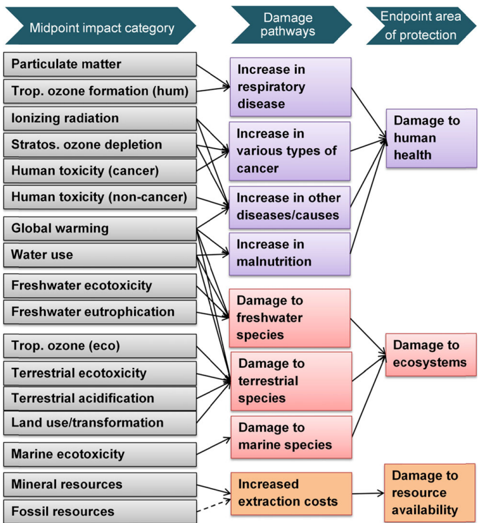
Life cycle impact assessment (LCIA) translates emissions and resource extractions into a limited number of environmental impact scores by means of so-called characterisation factors. There are two mainstream ways to derive characterisation factors, i.e. at midpoint level and at endpoint level. To further progress LCIA method development, we updated the ReCiPe2008 method to its version of 2016. This paper provides an overview of the key elements of the ReCiPe2016 method. We implemented human health, ecosystem quality and resource scarcity as three areas of protection. Endpoint characterisation factors, directly related to the areas of protection, were derived from midpoint characterisation factors with a constant mid-to-endpoint factor per impact category. We included 17 midpoint impact categories. The update of ReCiPe provides characterisation factors that are representative for the global scale instead of the European scale, while maintaining the possibility for a number of impact categories to implement characterisation factors at a country and continental scale. We also expanded the number of environmental interventions and added impacts of water use on human health, impacts of water use and climate change on freshwater ecosystems and impacts of water use and tropospheric ozone formation on terrestrial ecosystems as novel damage pathways. Although significant effort has been put into the update of ReCiPe, there is still major improvement potential in the way impact pathways are modelled. Further improvements relate to a regionalisation of more impact categories, moving from local to global species extinction and adding more impact pathways. Life cycle impact assessment is a fast evolving field of research. ReCiPe2016 provides a state-of-the-art method to convert life cycle inventories to a limited number of life cycle impact scores on midpoint and endpoint level.
Overview
The claims and statistics of this paper haven’t been checked yet.
Free: it reads the open-access text and checks the first 5 claims that cite a source we can check. Create a free account to check every claim.
Integrity signals
Registry
Cites
Statistics
Figures
Verification
Claims the paper makes
The claims and statistics of this paper haven’t been checked yet.
Free: it reads the open-access text and checks the first 5 claims that cite a source we can check. Create a free account to check every claim.
Self-check
Percentages, sums and reported differences re-computed from the paper’s own numbers.
The self-check needs the paper’s full text.
Citations
Cites
(2013) · Cited by 6,752
Accelerating extinction risk from climate change
Urban, M. C. (2015) · Science · doi:10.1126/science.aaa4984 · Cited by 2,436 · cited 2×
“For terrestrial ecosystems, the increase in potentially disappeared fraction of species (PDF) due to an increase in global temperature was derived from the review by Urban (2015).”
BackgroundThe water footprint of humanity
Hoekstra, A. Y., & Mekonnen, M. M. (2012) · Proceedings of the National Academy of Sciences · doi:10.1073/pnas.1109936109 · Cited by 2,260 · cited 2×
“…et al. 2013; Curran et al. 2014 Water use Increase of water consumed Water consumption potential (WCP) m3 water-eq consumed Döll and Siebert 2002; Hoekstra and Mekonnen 2012 Mineral resource scarcity Increase of ore extracted Surplus ore potential (SOP) kg Cu-eq Vieira et al. 2016a Fossil…”
BackgroundMethodAssessing the Environmental Impacts of Freshwater Consumption in LCA
Pfister, S., Koehler, A., & Hellweg, S. (2009) · Environmental Science & Technology · doi:10.1021/es802423e · Cited by 1,321 · cited 2×
“…shortage Pfister et al. 2009 Ecosystems (terrestrial) Decrease in Net Primary Productivity because of water shortage as proxy for total species loss Pfister et al. 2009 Ecosystems (aquatic) Fish species loss due to decreased river discharge Hanafiah et al. 2011 Land use Ecosystems (terrestrial)…”
BackgroundAmbient Air Pollution Exposure Estimation for the Global Burden of Disease 2013
Brauer, M., Freedman, G., Frostad, J., van Donkelaar, A., Martin, R. V., Dentener, F., Dingenen, R. V., Estep, K., Amini, H., Apte, J. S., et al. (2016) · Environmental Science & Technology · doi:10.1021/acs.est.5b03709 · Cited by 1,215
Addressing Global Mortality from Ambient PM2.5
Apte, J. S., Marshall, J. D., Cohen, A. J., & Brauer, M. (2015) · Environmental Science & Technology · doi:10.1021/acs.est.5b01236 · Cited by 995
Joos, F., Roth, R., Fuglestvedt, J. S., Peters, G. P., Enting, I. G., von Bloh, W., Brovkin, V., Burke, E. J., Eby, M., Edwards, N. R., et al. (2013) · Atmospheric Chemistry and Physics · doi:10.5194/acp-13-2793-2013 · Cited by 839
Implementation of life cycle impact assessment methods
Jungbluth, N., Margni, M. D., & Hischier, R. (2010) · Cited by 816
Global modeling of irrigation water requirements
Döll, P., & Siebert, S. (2002) · Water Resources Research · doi:10.1029/2001wr000355 · Cited by 816 · cited 2×
“For agriculture, the consumptive part of the withdrawal was estimated with water requirement ratios based on Döll and Siebert (2002).”
BackgroundMethod
Research works printed but not linked: 2
- 20. Goedkoop M, Heijungs R, Huijbregts MAJ, De Schryver A, Struijs J, van Zelm R (2009) ReCiPe 2008: a life cycle impact assessment method which comprises harmonised category indicators at the midpoint and endpoint levels. First edition. Report i: characterization. The Netherlands: Ruimte en Milieu, Ministerie van Volkshuisvesting, Ruimtelijke Ordening en Milieubeheer
- Vieira MDM, Ponsioen T, Goedkoop M, Huijbregts MAJ (2016c) Fossil resource scarcity. In: Huijbregts MAJ, Steinmann ZJN, Elshout PMF, Stam G, Verones F, Vieira MDM, Van Zelm R (eds) ReCiPe2016. A harmonized life cycle impact assessment method at midpoint and endpoint level. Report I: characterization. RIVM Report 2016-0104. National Institute for Human Health and the Environment, Bilthoven. Chapter 13
Cited by
Items 601–700 of 1,013
Lee, S., Choi, W. C., Kim, J. H., Park, S., Hwang, Y. J., & Na, J. (2023) · Green Chemistry · doi:10.1039/d3gc02329j · Cited by 47
Olabi, A. G., Abdelkareem, M. A., Mahmoud, M., Mahmoud, M. S., Elsaid, K., Obaideen, K., Rezk, H., Eisa, T., Chae, K., & Sayed, E. T. (2023) · International Journal of Hydrogen Energy · doi:10.1016/j.ijhydene.2023.10.293 · Cited by 46
Comparative Life Cycle Assessment of Battery and Fuel Cell Electric Cars, Trucks, and Buses
Syré, A. M., Shyposha, P., Freisem, L., Pollak, A., & Göhlich, D. (2024) · World Electric Vehicle Journal · doi:10.3390/wevj15030114 · Cited by 56
“The impact assessment of this LCA is based on the ReCiPe 2016, the state-of-the-art impact assessment method [35].”
Life cycle and techno-economic assessment of bioresource production from wastewater
Clack, K., Rajagopal, D., & Hoek, E. M. V. (2024) · npj Clean Water · doi:10.1038/s41545-024-00314-9 · Cited by 49
Life cycle assessment of bacterial cellulose and comparison to other cellulosic sources
Silva, F. A. G. S., Branco, S., Dourado, F. O. Q., Neto, B., & Gama, M. (2025) · Journal of Cleaner Production · doi:10.1016/j.jclepro.2025.144876 · Cited by 53
Nguyen, D., Fernandes, R. J., Turner, J. W. G., & Emberson, D. R. (2025) · International Journal of Hydrogen Energy · doi:10.1016/j.ijhydene.2025.02.331 · Cited by 50
Behera, U. S., Purohit, B. K., & Byun, H. (2025) · International Journal of Hydrogen Energy · doi:10.1016/j.ijhydene.2025.05.300 · Cited by 47
Supramolecular chemical recycling of dynamic polymers
Deng, Y., Liu, L., Luo, H., Tian, H., Qu, D., Feringa, B. L., & Zhang, Q. (2025) · Nature Nanotechnology · doi:10.1038/s41565-025-02041-9 · Cited by 50
Eco-thermodynamics of hydrogen production by high-temperature electrolysis using solid oxide cells
Mehmeti, A., Angelis-Dimakis, A., Muñoz, C. B., Graziadio, M., & McPhail, S. J. (2018) · Journal of Cleaner Production · doi:10.1016/j.jclepro.2018.07.166 · Cited by 47
“The LCA-ReCiPe 2016 (Huijbregts et al., 2017) is a Life Cycle Impact Assessment”
BackgroundMethodInfluentialA strategic impact assessment of hydropower plants in alpine and non-alpine areas of Europe
Mahmud, M. A. P., Huda, N., Farjana, S. H., & Lang, C. I. (2019) · Applied Energy · doi:10.1016/j.apenergy.2019.05.007 · Cited by 46
Thomassen, G., Dael, M. V., You, F., & Passel, S. V. (2019) · Green Chemistry · doi:10.1039/c9gc03071a · Cited by 49
Analysis of Major Environmental Impact Categories of Road Construction Materials
Park, W.-J., Kim, R., Roh, S., & Ban, H. (2020) · Sustainability · doi:10.3390/su12176951 · Cited by 49
Life cycle impact assessment methods for estimating the impacts of dissipative flows of metals
Poncelet, A. C., Helbig, C., Loubet, P., Beylot, A., Muller, S. M., Villeneuve, J., Laratte, B., Thorenz, A., Tuma, A., & Sonnemann, G. (2021) · Journal of Industrial Ecology · doi:10.1111/jiec.13136 · Cited by 48
Masilela, P., & Pradhan, A. (2021) · Journal of Cleaner Production · doi:10.1016/j.jclepro.2021.129567 · Cited by 48
Technology-based comparative life cycle assessment for palm oil industry: the case of Nigeria
Anyaoha, K. E., & Zhang, L. (2022) · Environment Development and Sustainability · doi:10.1007/s10668-022-02215-8 · Cited by 46
“The reaction can be aided by the presence of carbon monoxide (CO), sulphur dioxide (SO2), nitrogen oxide (NO), ammonium and non-methane volatile organic compounds (Acero et al., 2017; Frischknecht et al., 2007; Huijbregts et al., 2017).”
BackgroundHollas, C. E., do Amaral, K. G. C., Lange, M. V., Higarashi, M. M., Steinmetz, R. L. R., Barros, E. C., Mariani, L. F., Nakano, V., Kunz, A., Sanches-Pereira, A., et al. (2022) · Journal of Cleaner Production · doi:10.1016/j.jclepro.2022.131654 · Cited by 45
Translating advances in microbial bioproduction to sustainable biotechnology
Carruthers, D. N., & Lee, T. S. (2022) · Frontiers in Bioengineering and Biotechnology · doi:10.3389/fbioe.2022.968437 · Cited by 53
“Common impact databases include Tool for Reduction and Assessment of Chemical and other environmental Impacts (TRACI) by the US EPA (Bare, 2011) and ReCiPe 2016 (Huijbregts et al., 2017) among others.”
BackgroundAmirahmadi, E., Moudrý, J., Konvalina, P., Hörtenhuber, S. J., Ghorbani, M., Neugschwandtner, R. W., Jiang, Z., Krexner, T., & Kopecký, M. (2022) · Sustainability · doi:10.3390/su142315870 · Cited by 47
Meramo, S., Fantke, P., & Sukumara, S. (2022) · Biotechnology for Biofuels and Bioproducts · doi:10.1186/s13068-022-02239-2 · Cited by 48
“ReCiPe End-Point 2016 methodology is used for impact characterization [137].”
MethodBaaqel, H., Bernardi, A., Hallett, J. P., Guillén‐Gosálbez, G., & Chachuat, B. (2023) · ACS Sustainable Chemistry & Engineering · doi:10.1021/acssuschemeng.3c00547 · Cited by 45
Comparative Life Cycle Assessment of Pyrolysis – Recycling Germany's Sorted Mixed Plastic Waste
Hermanns, R., Kraft, A., Hartmann, P., & Meys, R. (2023) · Chemie Ingenieur Technik · doi:10.1002/cite.202300041 · Cited by 48
Environmental and human health impact of recycle concrete powder: an emergy-based LCA approach
Manan, A., Zhang, P., Sabri, M. M. S., Alattyih, W., Ahmad, J. E., & Alzlfawi, A. (2025) · Frontiers in Environmental Science · doi:10.3389/fenvs.2024.1505312 · Cited by 45
Grisales, C. M., Salazar, L. M., & Prato-García, D. (2018) · Environmental Science and Pollution Research · doi:10.1007/s11356-018-2757-9 · Cited by 45
“These substances contribute to the generation of acid rain, eutrophication of water bodies, and alteration of the soil’s pH (Althaus et al. 2007; Ashar and Golwalkar 2013; Huijbregts et al. 2016).”
BackgroundEnvironmental performance analysis of a dual-source heat pump system
Marinelli, S., Lolli, F., Butturi, M. A., Rimini, B., & Gamberini, R. (2020) · Energy and Buildings · doi:10.1016/j.enbuild.2020.110180 · Cited by 47
Manhongo, T. T., Chimphango, A. F. A., Thornley, P., & Röder, M. (2021) · Renewable and Sustainable Energy Reviews · doi:10.1016/j.rser.2021.111216 · Cited by 45
Angouria-Tsorochidou, E., Teigiserova, D. A., & Thomsen, M. (2021) · Resources Conservation and Recycling · doi:10.1016/j.resconrec.2021.105898 · Cited by 47
Li, P., Luo, Y., & Yuan, X. (2021) · Bioresource Technology · doi:10.1016/j.biortech.2021.126230 · Cited by 48
Canaj, K., Parente, A., D’Imperio, M., Boari, F., Buono, V., Toriello, M., Mehmeti, A., & Montesano, F. F. (2021) · Water · doi:10.3390/w14010006 · Cited by 45
“3 [30] and the ReCiPe 2016 (H) methodology [31].”
BackgroundLiang, Y., Xu, J., Luo, X., Chen, J., Yang, Z., & Chen, Y. (2022) · Energy Conversion and Management · doi:10.1016/j.enconman.2022.115740 · Cited by 45
Comparative study of the environmental impacts of used cooking oil valorization options in Thailand
Thushari, I., & Babel, S. (2022) · Journal of Environmental Management · doi:10.1016/j.jenvman.2022.114810 · Cited by 52
Silalertruksa, T., Wirodcharuskul, C., & Gheewala, S. H. (2022) · Energies · doi:10.3390/en15249515 · Cited by 44
Principato, L., Marchetti, S., Barbanera, M., Ruini, L. F., Capoccia, L., Comis, C., & Secondi, L. (2023) · Journal of Industrial Ecology · doi:10.1111/jiec.13391 · Cited by 46
Energy crisis in Europe enhances the sustainability of green chemicals
Nabera, A., Istrate, I.-R., Martín, A. J., Pérez‐Ramírez, J., & Guillén‐Gosálbez, G. (2023) · Green Chemistry · doi:10.1039/d3gc01053h · Cited by 46
Strong economic incentives of ship scrubbers promoting pollution
Hermansson, A. L., Hassellöv, I., Grönholm, T., Jalkanen, J.-P., Fridell, E., Parsmo, R., Hassellöv, J., & Ytreberg, E. (2024) · Nature Sustainability · doi:10.1038/s41893-024-01347-1 · Cited by 45
“ReCiPe offers a harmonized indicator approach where characterization factors for organic substances and metals for different environmental compartments, including marine waters, have been produced 47 .”
InfluentialUnderstanding Denim Recycling: A Quantitative Study with Lifecycle Assessment Methodology
Akı, S. U., Candan, C., Nergis, B. U., & Önder, N. S. (2020) · IntechOpen eBooks · doi:10.5772/intechopen.92793 · Cited by 44
Wang, Y., Liu, Y., Cui, S., Sun, B., Gong, X., Gao, F., & Wang, Z. (2020) · Journal of Cleaner Production · doi:10.1016/j.jclepro.2020.122846 · Cited by 45
Ang, P., Mothe, S. R., Chennamaneni, L. R., Aidil, F., Hsien Hui, K. H. O. O., & Thoniyot, P. (2020) · ACS Sustainable Chemistry & Engineering · doi:10.1021/acssuschemeng.0c06247 · Cited by 46
Gálvez‐Martos, J., Greses, S., Magdalena, J. A., Iribarren, D., Tomás‐Pejó, E., & González‐Fernández, C. (2020) · Bioresource Technology · doi:10.1016/j.biortech.2020.124528 · Cited by 44
Life cycle impact assessment of metal production industries in Australia
Strezov, V., Zhou, X., & Evans, T. (2021) · Scientific Reports · doi:10.1038/s41598-021-89567-9 · Cited by 46
Ordikhani, H., Parashkoohi, M. G., Zamani, D. M., & Ghahderijani, M. (2021) · Energy Reports · doi:10.1016/j.egyr.2021.05.022 · Cited by 46
Yan, L., Zhang, X., Pan, H., Wu, J., Lin, L., Zhang, Y., Xu, C., Xu, M., & Luo, H. (2021) · Ecological Indicators · doi:10.1016/j.ecolind.2021.108112 · Cited by 44
Zhang, X., Boderskov, T., Bruhn, A., & Thomsen, M. (2022) · Algal Research · doi:10.1016/j.algal.2022.102686 · Cited by 47
Aldhafeeri, Z. M., & Alhazmi, H. (2022) · Sustainability · doi:10.3390/su14095093 · Cited by 43
“04/World (2010) H, which considers different perspectives of the impact that the management of MSW in Riyadh can potentially cause [42].”
BackgroundErrington, E., Guo, M., & Heng, J. Y. Y. (2023) · Green Chemistry · doi:10.1039/d2gc01433e · Cited by 46
Monje, V., Owsianiak, M., Junicke, H., Kjellberg, K., Gernaey, K. V., & Flores‐Alsina, X. (2022) · Water Research · doi:10.1016/j.watres.2022.118997 · Cited by 46
“1), were considered for the calculation of final damage scores (Huijbregts et al., 2017).”
Soleimani, T., Hayek, M., Junqua, G., Salgues, M., & Souche, J. (2022) · The Science of The Total Environment · doi:10.1016/j.scitotenv.2022.159980 · Cited by 43
“The Recipe midpoint (H), a state-of-the-art and harmonized life cycle impact assessmentmethod at themidpoint and endpoint level (Huijbregts et al., 2017;Mehmeti et al., 2018)was applied in this study to assess environmental impacts in 18 categories yet 8 conventional local and global environmental impact categories in…”
Ghisellini, P., Ncube, A., Rótolo, G. C., Vassillo, C., Kaiser, S., Passaro, R., & Ulgiati, S. (2023) · Energies · doi:10.3390/en16041671 · Cited by 44
Lago-Olveira, S., Rebolledo-Leiva, R., Garofalo, P., Moreira, M. T., & González‐García, S. (2023) · The Science of The Total Environment · doi:10.1016/j.scitotenv.2023.165124 · Cited by 46
Zhao, Z., Qi, S., Wang, R., Li, H., Song, G., Li, H., & Yin, Q. (2023) · International Journal of Hydrogen Energy · doi:10.1016/j.ijhydene.2023.08.203 · Cited by 47
Comparative environmental sustainability assessment of biohydrogen production methods
Goren, A. Y., Dinçer, İ., & Khalvati, A. (2023) · The Science of The Total Environment · doi:10.1016/j.scitotenv.2023.166613 · Cited by 45
Chen, J., Guo, F., Wu, F., & Bryan, B. A. (2023) · Resources Conservation and Recycling · doi:10.1016/j.resconrec.2023.107248 · Cited by 46
Liu, A., Liu, W., Yao, J. H., Jia, T., Zhao, Y., & Dai, Y. (2023) · Journal of Cleaner Production · doi:10.1016/j.jclepro.2023.139730 · Cited by 43
Microplastic aquatic impacts included in Life Cycle Assessment
Schwarz, A., Herlaar, S., Cohen, Q. M., Quik, J. T. K., Golkaram, M., Urbanus, J. H., van Emmerik, T. H. M., & Huijbregts, M. A. J. (2024) · Resources Conservation and Recycling · doi:10.1016/j.resconrec.2024.107787 · Cited by 47
Self-citationMohamed, A. O., Mohamed, D., Fayad, A., & Nahyan, M. T. A. (2024) · Sustainability · doi:10.3390/su16167156 · Cited by 52
Flash separation of metals by electrothermal chlorination
Deng, B., Xu, S., Eddy, L., Shin, J., Cheng, Y., Kittrell, C., JeBailey, K. M., Sharp, J., Qian, L., Chen, S., et al. (2024) · Nature Chemical Engineering · doi:10.1038/s44286-024-00125-2 · Cited by 48
“The LCI entries were converted into environmental impacts using the ReCiPe 2016 methodology 43 .”
Prospective life-cycle assessment of sustainable alternatives for road freight transport
Cabrera-Jiménez, R., Mateo‐Sanz, J. M., Jiménez, L., & Pozo, C. (2024) · Renewable and Sustainable Energy Reviews · doi:10.1016/j.rser.2024.115243 · Cited by 49
Coassembly of hybrid microscale biomatter for robust, water-processable, and sustainable bioplastics
Qiu, Y., Zhang, D., Long, M., Zhou, Z., Gao, C., Ma, S., Qin, J., Chen, K., Chen, C., Zhao, Z., et al. (2025) · Science Advances · doi:10.1126/sciadv.adr1596 · Cited by 45
Dorber, M., Mattson, K. R., Sandlund, O. T., May, R. F., & Verones, F. (2019) · Environmental Impact Assessment Review · doi:10.1016/j.eiar.2018.12.002 · Cited by 48
Self-citationXu, J., Guo, C. S., & Yu, L. (2019) · Journal of Cleaner Production · doi:10.1016/j.jclepro.2019.04.260 · Cited by 43
Lask, J., Guajardo, A. M., Weik, J., von Cossel, M., Lewandowski, I. M., & Wagner, M. (2020) · GCB Bioenergy · doi:10.1111/gcbb.12715 · Cited by 44
“1 was chosen due to its European focus and its up-to-date nature (Huijbregts et al., 2017).”
BackgroundBałdowska-Witos, P., Piotrowska, K., Kruszelnicka, W., Błaszczak, M., Tomporowski, A., Opielak, M., Kasner, R., & Flizikowski, J. (2020) · Polymers · doi:10.3390/polym12061320 · Cited by 44
“The analysis covered 17 midpoint impact categories and three endpoint damage categories: human health, ecosystem quality and resource availability, which strictly correspond with three areas of protection: human health, ecosystem quality and resource scarcity [69,70].”
BackgroundMethodEnvironmental Sustainability of Mixed Cation Perovskite Materials in Photovoltaics Manufacturing
Khalifa, S. A., Spatari, S., Fafarman, A. T., & Baxter, J. B. (2020) · ACS Sustainable Chemistry & Engineering · doi:10.1021/acssuschemeng.0c05619 · Cited by 43
Peppas, A., Kollias, K., Politis, A., Karalis, L., Taxiarchou, M., & Paspaliaris, I. (2020) · International Journal of Hydrogen Energy · doi:10.1016/j.ijhydene.2020.11.173 · Cited by 43
Saedpanah, E., & Pasdarshahri, H. (2021) · Energy · doi:10.1016/j.energy.2021.121151 · Cited by 43
Cavalaglio, G., Gelosia, M., Giannoni, T., Temporim, R. B. L., Nicolini, A., Cotana, F., & Bertini, A. (2021) · Biochemical Engineering Journal · doi:10.1016/j.bej.2021.108121 · Cited by 46
Life cycle sustainability assessment of synthetic fuels from date palm waste
Hnich, K. B., Martín-Gamboa, M., Khila, Z., Hajjaji, N., Dufour, J., & Iribarren, D. (2021) · The Science of The Total Environment · doi:10.1016/j.scitotenv.2021.148961 · Cited by 45
McCallum, C. S., Narendran, K., Curry, R., McBride, K., & Doran, J. (2021) · Applied Energy · doi:10.1016/j.apenergy.2021.117325 · Cited by 42
O’Brien, M., & Bringezu, S. (2021) · Sustainability · doi:10.3390/su13158536 · Cited by 44
Gievers, F., Loewen, A., & Nelles, M. (2021) · Detritus · doi:10.31025/2611-4135/2021.15111 · Cited by 43
Life Cycle Assessment of Leachate Treatment Strategies
Zhang, L., Bai, H., Zhang, Y., Wang, Y., & Yue, D. (2021) · Environmental Science & Technology · doi:10.1021/acs.est.1c02165 · Cited by 61
Bhonsle, A. K., Singh, J., Trivedi, J., & Atray, N. (2022) · Bioresource Technology Reports · doi:10.1016/j.biteb.2022.101072 · Cited by 43
Zhang, J., Tian, X., Chen, W., Geng, Y., & Wilson, J. (2022) · Environmental Impact Assessment Review · doi:10.1016/j.eiar.2022.106855 · Cited by 45
Application of sugar cane bagasse ash as filler in ultra-high performance concrete
Huang, P., Huang, B., Li, J., Neng-sen, W., & Xu, Q. (2022) · Journal of Building Engineering · doi:10.1016/j.jobe.2023.106447 · Cited by 52
Life cycle assessment of the inclusion of phase change materials in lightweight buildings
Vega, M., Llantoy, N., Chàfer, M., Ushak, S., & Cabeza, L. F. (2022) · Journal of Energy Storage · doi:10.1016/j.est.2022.105903 · Cited by 42
Choe, C., Haider, J., & Lim, H. (2022) · Applied Energy · doi:10.1016/j.apenergy.2022.120545 · Cited by 42
Assessing the environmental impact of resource recovery from dairy manure
Glover, C. J., McDonnell, A., Rollins, K., Hiibel, S. R., & Cornejo, P. K. (2023) · Journal of Environmental Management · doi:10.1016/j.jenvman.2022.117150 · Cited by 45
Mondière, A., Corson, M. S., Auberger, J., Durant, D., Foray, S., Glinec, J.-F., Green, P., Novak, S. M., Signoret, F., & van der Werf, H. M. G. (2023) · Agricultural Systems · doi:10.1016/j.agsy.2023.103798 · Cited by 48
Potential of air-source heat pumps to reduce environmental impacts in 18 European countries
Masternak, C., Meunier, S., Reinbold, V., Saelens, D., Marchand, C., & Leroy, Y. (2024) · Energy · doi:10.1016/j.energy.2024.130487 · Cited by 44
Zuiderveen, E. A. R., Caldeira, C., Vries, T. J. D., Schenk, N. J., Huijbregts, M. A. J., Sala, S., Hanssen, S. V., & van Zelm, R. (2024) · ACS Sustainable Chemistry & Engineering · doi:10.1021/acssuschemeng.3c06996 · Cited by 44
Self-citationSchneider, D., Woerle, M., Kagermeier, J., Zaeh, M. F., & Reinhart, G. (2024) · Sustainable Production and Consumption · doi:10.1016/j.spc.2024.04.030 · Cited by 42
Environmental impact of single-use versus reusable gastroscopes
Pioche, M., Pohl, H., Neves, J. A. C., Laporte, A., Mochet, M., Rivory, J., Grau, R., Jacques, J., Grinberg, D., Boube, M., et al. (2024) · Gut · doi:10.1136/gutjnl-2024-332293 · Cited by 47
Li, K., Wang, X., Wang, X., Tu, S., Song, Y., Shi, T., Wang, L., & Zhou, H. (2025) · Construction and Building Materials · doi:10.1016/j.conbuildmat.2025.142196 · Cited by 42
Biodiversity impact assessment of building's roofs based on Life Cycle Assessment methods
Brachet, A., Schiopu, N., & Clergeau, P. (2019) · Building and Environment · doi:10.1016/j.buildenv.2019.04.014 · Cited by 45
Fernandes, S., da Silva, J. C. G. E., & da Silva, L. P. (2020) · Materials · doi:10.3390/ma13071487 · Cited by 42
“03 endpoint method, Hierarchist version, [30], which evaluates three categories of potential impacts (Human Health, Ecosystems, and Resources).”
MethodFernández-Braña, Á., Feijóo, G., & Dias‐Ferreira, C. (2020) · The Science of The Total Environment · doi:10.1016/j.scitotenv.2020.138843 · Cited by 43
Herron, J., Curran, T. P., MOLONEY, A. P., McGee, M., O’Riordan, E. G., & O’Brien, D. (2021) · animal · doi:10.1016/j.animal.2021.100247 · Cited by 47
Zhang, X., Border, A., Goosen, N. J., & Thomsen, M. (2021) · Algal Research · doi:10.1016/j.algal.2021.102348 · Cited by 43
Mainardis, M., Magnolo, F., Ferrara, C., Vance, C., Misson, G., Feo, G. D., Speelman, S., Murphy, F., & Goi, D. (2021) · The Science of The Total Environment · doi:10.1016/j.scitotenv.2021.149283 · Cited by 42
Sustainable Production of Rare Earth Elements from Mine Waste and Geoethics
Jouini, M., Royer-Lavallée, A., Pabst, T., Chung, E., Kim, R., Cheong, Y., & Neculita, C. M. (2022) · Minerals · doi:10.3390/min12070809 · Cited by 45
“and material welfare, and contributes to higher global average temperatures [49,51,52,54,55].”
BackgroundGlobally regionalized monthly life cycle impact assessment of particulate matter
Oberschelp, C., Pfister, S., & Hellweg, S. (2020) · Environmental Science & Technology · doi:10.1021/acs.est.0c05691 · Cited by 41
Settier-Ramírez, L., López‐Carballo, G., Hernández‐Muñoz, P., Tinitana-Bayas, R., Gavara, R., & Sanjuán, N. (2021) · Journal of Cleaner Production · doi:10.1016/j.jclepro.2021.130159 · Cited by 43
Life cycle assessment of struvite recovery and wastewater sludge end-use: A Flemish illustration
Ravi, R., Beyers, M., Bruun, S., & Meers, E. (2022) · Resources Conservation and Recycling · doi:10.1016/j.resconrec.2022.106325 · Cited by 47
Mesquita, L. M. D. S., Sosa, F. H. B., Contieri, L. S., Marques, P. R., Viganó, J., Coutinho, J. A. P., Dias, A. C., Ventura, S. P. M., & Rostagno, M. A. (2022) · Food Chemistry · doi:10.1016/j.foodchem.2022.135093 · Cited by 42
“The impact assessment was based on the ReCiPe 2016 method (Huijbregts et al., 2017) for the following impact categories: global warming, ozone formation - human health, terrestrial acidification, mineral resource scarcity, and fossil resource scarcity.”
MethodMcElroy, C. R., Kopanitsa, L., Helmes, R., Fan, J., Attard, T. M., Simister, R., van den Burg, S. W. K., Ladds, G., Bailey, D. S., & Gomez, L. D. (2023) · Environmental Technology & Innovation · doi:10.1016/j.eti.2023.103014 · Cited by 41
Navaratnam, S., Tushar, Q., Jahan, I., & Zhang, G. (2023) · Sustainability · doi:10.3390/su15031873 · Cited by 41
“1 initiated from ReCiPe 2008 [97].”
Environmental assessment of the Ecuadorian cocoa value chain with statistics-based LCA
Avadí, Á. (2023) · The International Journal of Life Cycle Assessment · doi:10.1007/s11367-023-02142-4 · Cited by 43
“ReCiPe was chosen because it presents endpoint indicators in all three areas of protection, based on many relevant impact categories (Huijbregts et al. 2016).”
MethodLi, X., Jing, B., Chen, M., Zheng, X., & Wu, W. (2023) · Journal of Cleaner Production · doi:10.1016/j.jclepro.2023.136979 · Cited by 44
Chen, W., Zhang, Q., Hu, L., Geng, Y., & Liu, C. (2023) · Ecotoxicology and Environmental Safety · doi:10.1016/j.ecoenv.2023.115007 · Cited by 41
Prospective Life Cycle Assessment of Two Supercapacitor Architectures
Kamali, A. K., Glogic, E., Keppetipola, N. M., Sonnemann, G., Toupance, T., & Cojocaru, L. (2023) · ACS Sustainable Chemistry & Engineering · doi:10.1021/acssuschemeng.3c04007 · Cited by 43
Labianca, C., Zhu, X., Ferrara, C., Zhang, Y., Feo, G. D., Hsu, S., & Tsang, D. C. W. (2023) · Environmental Research · doi:10.1016/j.envres.2023.118026 · Cited by 46
Metadata
- Authors
- Huijbregts, M. A. J., Steinmann, Z. J. N., Elshout, P. M. F., Stam, G., Verones, F., Vieira, M., Zijp, M., Hollander, A., & van Zelm, R.
- Affiliations
- Netherlands Environmental Assessment Agency (NL)
- Radboud University Nijmegen (NL)
- Norwegian University of Science and Technology (NO)
- National Institute for Public Health and the Environment (NL)
- Corresponding author
- Huijbregts, Mark A. J.
- ORCID
- Venue
- The International Journal of Life Cycle Assessment
- Published
- 2016-12-12
- Volume
- 22
- Issue
- 2
- Pages
- 138-147
- ISSN
- 0948-3349 (ISSN-L)
- 1614-7502
- OpenAlex
- W2564630286
- Cited by
- 4,485
- References
- 54
- Citations by year
- 2026: 945 · 2025: 906 · 2024: 682 · 2023: 578 · 2022: 520 · 2021: 391 · 2020: 232 · 2019: 131 · 2018: 78 · 2017: 18 · 2016: 3
- FWCI
- 48.09
- Type
- journal article
- Language
- en
- Update notices
- correction (2020-07-02)
- Open access
- hybrid
- doi.org
- Licence
- cc-by
- creativecommons.org/licenses/by/4.0 (tdm)
- creativecommons.org/licenses/by/4.0 (vor)
- Locations
- The International Journal of Life Cycle Assessment (publishedVersion, cc-by)
- Radboud Repository (Radboud University) (submittedVersion)
- Rivm Repository (Netherlands National Institute for Public Health and the Environment) (submittedVersion)
- Radboud Repository (Radboud University) (submittedVersion, other-oa)
- Funders
- Rijksinstituut voor Volksgezondheid en Milieu (S/607020)
- Topics
- Physical Sciences › Environmental Science › Environmental Engineering › Environmental Impact and Sustainability
- Physical Sciences › Environmental Science › Ecology › Agriculture Sustainability and Environmental Impact
- Physical Sciences › Environmental Science › Environmental Engineering › Sustainability and Ecological Systems Analysis
- Keywords
- life cycle impact assessment, characterization factors, human health effects, ecosystem quality, resource constraints, water use impacts, freshwater ecosystems, tropospheric ozone formation, terrestrial ecosystems, species extinction, environmental interventions, global scale
About these checks
Registry, retraction, Cites and statistics results are computed, not judged, with one exception: a printed reference that no index lists is read once by a model before it counts as a citation error. Claims are extracted by a model and kept only when their quote appears verbatim in the text; each cited source is then checked, with a model’s help, for whether it says what the claim relies on. Those verdicts can be wrong — read the claim’s quote and the cited source before relying on one.
Statistics and arithmetic are recomputed, not judged.
Confidence bands are shown only for fields calibrated on our annotated test set. None is calibrated yet, so no band is shown.
What counts as a claim ›How we measure confidence ›How we check this ›
Are you an author, or do you see a problem with this page? Request a review
Data sources
Bibliographic data: Semantic Scholar, OpenAlex, Crossref.
Contains information from the Semantic Scholar Academic Graph Datasets, made available under the ODC Attribution License (ODC-BY 1.0).
Semantic Scholar’s data is described in: Kinney, R., et al. (2023). The Semantic Scholar Open Data Platform. arXiv:2301.10140.
