

ReCiPe2016: a harmonised life cycle impact assessment method at midpoint and endpoint level
Open accessThe DOI matches its Crossref record; 53 of the 54 references it cites were found in a registry or an index.
Abstract
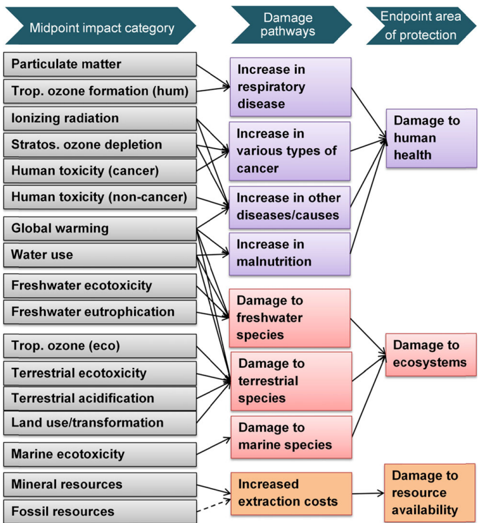
Life cycle impact assessment (LCIA) translates emissions and resource extractions into a limited number of environmental impact scores by means of so-called characterisation factors. There are two mainstream ways to derive characterisation factors, i.e. at midpoint level and at endpoint level. To further progress LCIA method development, we updated the ReCiPe2008 method to its version of 2016. This paper provides an overview of the key elements of the ReCiPe2016 method. We implemented human health, ecosystem quality and resource scarcity as three areas of protection. Endpoint characterisation factors, directly related to the areas of protection, were derived from midpoint characterisation factors with a constant mid-to-endpoint factor per impact category. We included 17 midpoint impact categories. The update of ReCiPe provides characterisation factors that are representative for the global scale instead of the European scale, while maintaining the possibility for a number of impact categories to implement characterisation factors at a country and continental scale. We also expanded the number of environmental interventions and added impacts of water use on human health, impacts of water use and climate change on freshwater ecosystems and impacts of water use and tropospheric ozone formation on terrestrial ecosystems as novel damage pathways. Although significant effort has been put into the update of ReCiPe, there is still major improvement potential in the way impact pathways are modelled. Further improvements relate to a regionalisation of more impact categories, moving from local to global species extinction and adding more impact pathways. Life cycle impact assessment is a fast evolving field of research. ReCiPe2016 provides a state-of-the-art method to convert life cycle inventories to a limited number of life cycle impact scores on midpoint and endpoint level.
Overview
The claims and statistics of this paper haven’t been checked yet.
Free: it reads the open-access text and checks the first 5 claims that cite a source we can check. Create a free account to check every claim.
Integrity signals
Registry
Cites
Statistics
Figures
Verification
Claims the paper makes
The claims and statistics of this paper haven’t been checked yet.
Free: it reads the open-access text and checks the first 5 claims that cite a source we can check. Create a free account to check every claim.
Self-check
Percentages, sums and reported differences re-computed from the paper’s own numbers.
The self-check needs the paper’s full text.
Citations
Cites
(2013) · Cited by 6,752
Accelerating extinction risk from climate change
Urban, M. C. (2015) · Science · doi:10.1126/science.aaa4984 · Cited by 2,436 · cited 2×
“For terrestrial ecosystems, the increase in potentially disappeared fraction of species (PDF) due to an increase in global temperature was derived from the review by Urban (2015).”
BackgroundThe water footprint of humanity
Hoekstra, A. Y., & Mekonnen, M. M. (2012) · Proceedings of the National Academy of Sciences · doi:10.1073/pnas.1109936109 · Cited by 2,260 · cited 2×
“…et al. 2013; Curran et al. 2014 Water use Increase of water consumed Water consumption potential (WCP) m3 water-eq consumed Döll and Siebert 2002; Hoekstra and Mekonnen 2012 Mineral resource scarcity Increase of ore extracted Surplus ore potential (SOP) kg Cu-eq Vieira et al. 2016a Fossil…”
BackgroundMethodAssessing the Environmental Impacts of Freshwater Consumption in LCA
Pfister, S., Koehler, A., & Hellweg, S. (2009) · Environmental Science & Technology · doi:10.1021/es802423e · Cited by 1,321 · cited 2×
“…shortage Pfister et al. 2009 Ecosystems (terrestrial) Decrease in Net Primary Productivity because of water shortage as proxy for total species loss Pfister et al. 2009 Ecosystems (aquatic) Fish species loss due to decreased river discharge Hanafiah et al. 2011 Land use Ecosystems (terrestrial)…”
BackgroundAmbient Air Pollution Exposure Estimation for the Global Burden of Disease 2013
Brauer, M., Freedman, G., Frostad, J., van Donkelaar, A., Martin, R. V., Dentener, F., Dingenen, R. V., Estep, K., Amini, H., Apte, J. S., et al. (2016) · Environmental Science & Technology · doi:10.1021/acs.est.5b03709 · Cited by 1,215
Addressing Global Mortality from Ambient PM2.5
Apte, J. S., Marshall, J. D., Cohen, A. J., & Brauer, M. (2015) · Environmental Science & Technology · doi:10.1021/acs.est.5b01236 · Cited by 995
Joos, F., Roth, R., Fuglestvedt, J. S., Peters, G. P., Enting, I. G., von Bloh, W., Brovkin, V., Burke, E. J., Eby, M., Edwards, N. R., et al. (2013) · Atmospheric Chemistry and Physics · doi:10.5194/acp-13-2793-2013 · Cited by 839
Implementation of life cycle impact assessment methods
Jungbluth, N., Margni, M. D., & Hischier, R. (2010) · Cited by 816
Global modeling of irrigation water requirements
Döll, P., & Siebert, S. (2002) · Water Resources Research · doi:10.1029/2001wr000355 · Cited by 816 · cited 2×
“For agriculture, the consumptive part of the withdrawal was estimated with water requirement ratios based on Döll and Siebert (2002).”
BackgroundMethod
Research works printed but not linked: 2
- 20. Goedkoop M, Heijungs R, Huijbregts MAJ, De Schryver A, Struijs J, van Zelm R (2009) ReCiPe 2008: a life cycle impact assessment method which comprises harmonised category indicators at the midpoint and endpoint levels. First edition. Report i: characterization. The Netherlands: Ruimte en Milieu, Ministerie van Volkshuisvesting, Ruimtelijke Ordening en Milieubeheer
- Vieira MDM, Ponsioen T, Goedkoop M, Huijbregts MAJ (2016c) Fossil resource scarcity. In: Huijbregts MAJ, Steinmann ZJN, Elshout PMF, Stam G, Verones F, Vieira MDM, Van Zelm R (eds) ReCiPe2016. A harmonized life cycle impact assessment method at midpoint and endpoint level. Report I: characterization. RIVM Report 2016-0104. National Institute for Human Health and the Environment, Bilthoven. Chapter 13
Cited by
Items 801–900 of 1,013
Collaborating constructively for sustainable biotechnology
Matthews, N. E., Cizauskas, C. A., Layton, D. S., Stamford, L., & Shapira, P. (2019) · Scientific Reports · doi:10.1038/s41598-019-54331-7 · Cited by 40
Pellet Production from Miscanthus: Energy and Environmental Assessment
Fusi, A., Bacenetti, J., Proto, A. R., Tedesco, D., Pessina, D., & Facchinetti, D. (2020) · Energies · doi:10.3390/en14010073 · Cited by 39
Grael, P. F. F., Oliveira, L. S. B. L., Oliveira, D. S. B. L., & Bezerra, B. S. (2021) · The International Journal of Life Cycle Assessment · doi:10.1007/s11367-020-01842-5 · Cited by 42
Carbon, energy and water footprints analysis of rapeseed oil production: A case study in China
Ji, C., Zhai, Y., Zhang, T., Shen, X., Bai, Y., & Hong, J. (2021) · Journal of Environmental Management · doi:10.1016/j.jenvman.2021.112359 · Cited by 38
Espadas-Aldana, G., Guaygua-Amaguaña, P., Vialle, C., Belaud, J., Evon, P., & Sablayrolles, C. (2021) · Coatings · doi:10.3390/coatings11050525 · Cited by 41
“The ReCiPe 2016 methodology includes 18 midpoint impact categories, and three areas of protection or endpoints [77].”
MethodLiu, X., Lai, G., Guan, J., Qian, S., Wang, Z., Cui, S., Gao, F., Jiao, Y., & Tao, R. (2021) · Chemosphere · doi:10.1016/j.chemosphere.2021.130955 · Cited by 37
Golberg, A., Polikovsky, M., Epstein, M., Slegers, P. M., Drábik, D., & Kribus, A. (2021) · Energy Conversion and Management · doi:10.1016/j.enconman.2021.114679 · Cited by 37
Pioquinto-García, S., Rosas, J. M., Loredo‐Cancino, M., Giraudet, S., Regalado, E. S., Rivas‐García, P., & Dávila-Guzmán, N. E. (2021) · Journal of environmental chemical engineering · doi:10.1016/j.jece.2021.106601 · Cited by 37
Does it pay to develop a ground source heat pump system? Evidence from China
Zhang, T., Zhai, Y., Feng, S., Tan, X., Zhang, M., Duan, L., Shi, Q., Meng, J., & Hong, J. (2021) · Journal of Environmental Management · doi:10.1016/j.jenvman.2021.114378 · Cited by 37
Singh, R., & Sharma, V. (2022) · Journal of Manufacturing Processes · doi:10.1016/j.jmapro.2022.01.003 · Cited by 37
Climate variability and food waste treatment: Analysis for bioenergy sustainability
Han, J., Byun, J., Kwon, O., & Lee, J. (2022) · Renewable and Sustainable Energy Reviews · doi:10.1016/j.rser.2022.112336 · Cited by 39
Sanyé‐Mengual, E., Valente, A., Biganzoli, F., Dorber, M., Verones, F., Marques, A., Rodriguez, J. O., Laurentiis, V. D., Fazio, S., & Sala, S. (2022) · The International Journal of Life Cycle Assessment · doi:10.1007/s11367-022-02049-6 · Cited by 39
Self-citationRosa, R., Pini, M., Cappucci, G. M., & Ferrari, A. M. (2022) · Current Opinion in Green and Sustainable Chemistry · doi:10.1016/j.cogsc.2022.100654 · Cited by 40
Cheng, J., Wang, Q., Li, D., & Yu, J. (2022) · Agriculture · doi:10.3390/agriculture12081281 · Cited by 40
Sanchez‐Matos, J., Regueiro, L., González‐García, S., & Vázquez‐Rowe, I. (2022) · The Science of The Total Environment · doi:10.1016/j.scitotenv.2022.159049 · Cited by 38
Medel-Jiménez, F., Piringer, G., Gronauer, A., Barta, N., Neugschwandtner, R. W., Krexner, T., & Kral, I. (2022) · Journal of Cleaner Production · doi:10.1016/j.jclepro.2022.134841 · Cited by 39
Barati, K., Salkuyeh, Y. K., Ashrafi, O., & Navarri, P. (2023) · Energy Conversion and Management · doi:10.1016/j.enconman.2023.117096 · Cited by 37
Tiwari, B. R., Bhar, R., Dubey, B., Maity, S. K., Brar, S. K., Kumar, G., & Kumar, V. (2023) · ACS Sustainable Chemistry & Engineering · doi:10.1021/acssuschemeng.3c00616 · Cited by 37
Orozco, C. R., Tangtermsirikul, S., Sugiyama, T., & Babel, S. (2023) · Environmental Research · doi:10.1016/j.envres.2023.116579 · Cited by 37
Quantifying the global eco-footprint of wearable healthcare electronics
Yang, C., Wang, B., Wan, J., Kamath, A., You, F., & Tian, B. (2026) · Nature · doi:10.1038/s41586-025-09819-w · Cited by 36
“For the assessment of the environmental impacts 25,61 , the following equation was applied: where EI i represents the environmental impact metrics of process i , CA j is the input/output amount of flow j (materials, energy, waste and so on) within the system boundary, and EF j is the environmental…”
Alshehri, K., Harbottle, M., Sapsford, D., Beames, A., & Cleall, P. (2023) · Journal of Cleaner Production · doi:10.1016/j.jclepro.2023.137352 · Cited by 36
“The results of the traditional LCIA are presented in Fig B.5, and the extensive list of ReCiPe2016 midpoint indicators is available in Table C.6.”
MethodInfluentialMicroalgae organomineral fertilizer production: A life cycle approach
Pereira, A. S. A. D. P., Magalhães, I. B., Ferreira, J., Castro, J. D. S., & Calijuri, M. L. (2023) · Algal Research · doi:10.1016/j.algal.2023.103035 · Cited by 36
Environmental benefits of macroalgae products: A case study of agar based on life cycle assessment
Zhang, R., Wang, Q., Shen, H., Yang, Y., Liu, P., & Dong, Y. (2024) · Algal Research · doi:10.1016/j.algal.2023.103384 · Cited by 36
Life Cycle Assessment of Plant-Based vs. Beef Burgers: A Case Study in the UK
Tang, M., Miri, T., Soltani, F., Onyeaka, H. N., & Al-Sharify, Z. T. (2024) · Sustainability · doi:10.3390/su16114417 · Cited by 40
van der Hulst, M. K., Magoss, D., Massop, Y., Veenstra, S. C., van Loon, N., Doğan, İ., Coletti, G., Theelen, M., Hoeks, S., Huijbregts, M. A. J., et al. (2024) · ACS Sustainable Chemistry & Engineering · doi:10.1021/acssuschemeng.4c01952 · Cited by 36
Self-citationEnvironmental assessment of digitalisation in agriculture: A systematic review
Huck, C., Gobrecht, A., Salou, T., Bellon-Maurel, V., & Loiseau, E. (2024) · Journal of Cleaner Production · doi:10.1016/j.jclepro.2024.143369 · Cited by 39
Li, R., Lu, M., Guo, R., Duan, H., Ni, B., & Fu, S. (2024) · Water Research · doi:10.1016/j.watres.2024.122529 · Cited by 36
Environmental Impact of Wind Farms
Bošnjaković, M., Hrkać, F., Stoić, M., & Hradovi, I. (2024) · Environments · doi:10.3390/environments11110257 · Cited by 44
“The first approach is to present the results using the mean value and/or the mean value factor or the final value approach and/or the final value indicator [12].”
Jaman, A., Mahmud, R. A., Das, B. K., & Tushar, M. S. H. K. (2024) · International Journal of Hydrogen Energy · doi:10.1016/j.ijhydene.2024.11.454 · Cited by 37
Chapa, J., Farkas, B. E., Bailey, R. L., & Huang, J. (2020) · The Science of The Total Environment · doi:10.1016/j.scitotenv.2020.137672 · Cited by 36
Evaluation of an environment-friendly turning process of Inconel 601 in dry conditions
Vukelić, D., Šimunović, K., Šimunović, G., Šarić, T., Kanović, Ž., Budak, I., & Agarski, B. (2020) · Journal of Cleaner Production · doi:10.1016/j.jclepro.2020.121919 · Cited by 36
Kerdlap, P., Low, J. S. C., Tan, D. Z. L., Yeo, Z., & Ramakrishna, S. (2020) · Resources Conservation and Recycling · doi:10.1016/j.resconrec.2020.104963 · Cited by 38
To Rent or Not to Rent: A Question of Circular Prams from a Life Cycle Perspective
Kerdlap, P., Gheewala, S. H., & Ramakrishna, S. (2020) · Sustainable Production and Consumption · doi:10.1016/j.spc.2020.10.008 · Cited by 39
Mora, M. A. M., Pijpers, J. J. H., Antonio, A. C., de la Cruz, J., & Calderón, A. M. A. (2021) · Journal of Energy Storage · doi:10.1016/j.est.2021.102339 · Cited by 38
Global environmental mapping of the aeronautics manufacturing sector
Pierrat, É., Rupcic, L., Hauschild, M. Z., & Laurent, A. (2021) · Journal of Cleaner Production · doi:10.1016/j.jclepro.2021.126603 · Cited by 38
Modelling incineration for more accurate comparisons to recycling in PEF and LCA
Ekvall, T., Gottfridsson, M., Nellström, M., Nilsson, J., Rydberg, M., & Rydberg, T. (2021) · Waste Management · doi:10.1016/j.wasman.2021.09.036 · Cited by 38
Raoufi, K., Haapala, K. R., Etheridge, T., Manoharan, S., & Paul, B. K. (2021) · Journal of Manufacturing Systems · doi:10.1016/j.jmsy.2021.11.017 · Cited by 36
Nexus Between Life Cycle Assessment, Circularity, and Sustainability Indicators—Part I: a Review
Saidani, M., & Kim, H. (2022) · Circular Economy and Sustainability · doi:10.1007/s43615-022-00159-9 · Cited by 39
“For instance, the ReCiPe LCIA methodology is a robust impact calculation method that provides characterization factors and normalization methods for calculating impact [18].”
MethodAlguacil-Duarte, F., González‐Gómez, F., & Romero-Gámez, M. (2022) · Journal of Cleaner Production · doi:10.1016/j.jclepro.2022.133059 · Cited by 36
Romeo, D., Hischier, R., Nowack, B., Jolliet, O., Fantke, P., & Wick, P. (2022) · Environmental Science Nano · doi:10.1039/d1en01014j · Cited by 42
García-Orozco, V. M., Linares‐Hernández, I., Natividad, R., Balderas‐Hernández, P., Alanis, C., Barrera-Díaz, C., & Roa‐Morales, G. (2022) · Journal of environmental chemical engineering · doi:10.1016/j.jece.2022.107969 · Cited by 40
Onyelowe, K. C., Ebid, A. M., Mahdi, H. A., Riofrio, A., Eidgahee, D. R., Baykara, H., Soleymani, A., Kontoni, D. N., Shakeri, J., & Jahangir, H. (2022) · Civil Engineering Journal · doi:10.28991/cej-2022-08-11-03 · Cited by 36
“In addition, the OPC is the major contributor (~56%) in almost every category of the 18-impact indicators analysed with the ReCiPe Midpoint H [63] method.”
MethodMainardis, M., Ferrara, C., Cantoni, B., Marcantonio, C. D., Feo, G. D., & Goi, D. (2023) · The Science of The Total Environment · doi:10.1016/j.scitotenv.2023.167598 · Cited by 36
“…on WW treatment (Anastaso-poulou et al., 2018; Arzate et al., 2019; Carr ´ e et al., 2017), the environmental impacts of all scenarios were assessed using the ReCiPe 2016 evaluation method with hierarchist perspective (H), adopting both midpoint and endpoint levels (Huijbregts et al., 2017).”
McKuin, B. L., Kapuscinski, A. R. D., Sarker, P. K., Cheek, N., Lim, J., & Sabarsky, M. (2023) · Elementa Science of the Anthropocene · doi:10.1525/elementa.2022.00083 · Cited by 46
Environmental sustainability in obstetrics and gynaecology: A systematic review
Cohen, E. S., Kouwenberg, L. H. J. A., Moody, K. S., Weiland, N. H. S., Kringos, D. S., Timmermans, A., & Hehenkamp, W. J. K. (2023) · BJOG An International Journal of Obstetrics & Gynaecology · doi:10.1111/1471-0528.17637 · Cited by 37
“28 The measurements within each impact category vary depending on the specific category being considered.”
BackgroundRebec, K. M., Turk, J., & Kunaver, M. (2023) · Sustainable Production and Consumption · doi:10.1016/j.spc.2023.12.026 · Cited by 39
“ReCiPe provides harmonized characterization factors at the midpoint and endpoint levels (Huijbregts et al., 2017).”
Salazar-Sogamoso, L. M., García, M. Á. G., & Dobrosz‐Gómez, I. (2024) · Journal of Solid State Electrochemistry · doi:10.1007/s10008-024-05976-6 · Cited by 39
“They are related to the emission of chemical substances that can generate persistent effects in organisms, the bioaccumulation of different type of substances in the human food chain, and even the toxic effect [78].”
InfluentialDeng, J., Tang, Y., Tang, J., Liu, H., Chen, W., Sun, Z., Peng, S., & Ma, X. (2024) · Energy Conversion and Management · doi:10.1016/j.enconman.2024.119221 · Cited by 36
Smerigan, A., & Shi, R. (2025) · Environmental Science & Technology · doi:10.1021/acs.est.5c04952 · Cited by 35
Raymond, A. J., Tipton, J. R., Kendall, A. M., & DeJong, J. T. (2019) · Journal of Industrial Ecology · doi:10.1111/jiec.12946 · Cited by 35
Medeiros, D. L., Queiroz, L. M., Cohim, E., Neto, J. A. D. A., & Kiperstok, A. (2019) · The Science of The Total Environment · doi:10.1016/j.scitotenv.2019.136145 · Cited by 35
A framework for good practices to assess abiotic mineral resource depletion in Life Cycle Assessment
Pradel, M., Garcia, J., & Vaija, M. S. (2020) · Journal of Cleaner Production · doi:10.1016/j.jclepro.2020.123296 · Cited by 35
Colucci, V., Manfrida, G., Mendecka, B. M., Talluri, L., & Zuffi, C. (2021) · Sustainability · doi:10.3390/su13041935 · Cited by 35
“The ReCiPe method [30] includes provision for the further step of Damage Assessment (EndPoint LCIA): all the Midpoint impact categories are reduced to three major damage macro-categories: Human health (DALY), Ecosystem quality (species × yr), and Resource depletion (USD2013).”
MethodLife cycle assessment and life cycle costing of an innovative component for refrigeration units
Gasia, J., Fabiani, C., Chàfer, M., Pisello, A. L., Manni, A., Ascani, M., & Cabeza, L. F. (2021) · Journal of Cleaner Production · doi:10.1016/j.jclepro.2021.126442 · Cited by 36
Life cycle analysis of a photovoltaic driven reversible heat pump
Riva, C., Roumpedakis, T. C., Kallis, G., Rocco, M. V., & Karellas, S. (2021) · Energy and Buildings · doi:10.1016/j.enbuild.2021.110894 · Cited by 35
Sánchez-Garrido, A. J., Navarro, I. J., & Yepes, V. (2021) · Environmental Impact Assessment Review · doi:10.1016/j.eiar.2021.106572 · Cited by 35
Additives in the food supply chain: Environmental assessment and circular economy implications
Bimpizas-Pinis, M., Santagata, R., Kaiser, S., Liu, Y., & Lyu, Y. (2022) · Environmental and Sustainability Indicators · doi:10.1016/j.indic.2022.100172 · Cited by 42
Occhicone, A., Vukčević, M., Bošković, I., Mingione, S., & Ferone, C. (2022) · Materials · doi:10.3390/ma15041617 · Cited by 35
Wortmann, C., Syré, A. M., Grahle, A., & Göhlich, D. (2021) · World Electric Vehicle Journal · doi:10.3390/wevj12030096 · Cited by 36
Hannouf, M., Padilla‐Rivera, A., Assefa, G., & Gates, I. D. (2022) · Journal of Industrial Ecology · doi:10.1111/jiec.13283 · Cited by 35
Zhang, C., Zheng, Y. C., Jing, J., Liu, Y., & Huang, H. (2022) · Journal of Cleaner Production · doi:10.1016/j.jclepro.2022.134044 · Cited by 37
de Oliveira, R., Santagata, R., Kaiser, S., Liu, Y., Vassillo, C., Ghisellini, P., Liu, G., & Ulgiati, S. (2022) · Land · doi:10.3390/land11122106 · Cited by 39
An energy future beyond climate neutrality: Comprehensive evaluations of transition pathways
Martin, N., Peiró, L. T., Villalba, G., Nebot-Medina, R., & Madrid‐López, C. (2022) · Applied Energy · doi:10.1016/j.apenergy.2022.120366 · Cited by 36
Das, S., & De, S. K. (2023) · Journal of Cleaner Production · doi:10.1016/j.jclepro.2022.135717 · Cited by 35
Bayram, A., Marvuglia, A., Gutiérrez, T. N., Weis, J.-P., Conter, G., & Zimmer, S. (2022) · Journal of Cleaner Production · doi:10.1016/j.jclepro.2022.135759 · Cited by 37
Cleaner production of metal-organic framework MIL-101(Cr) for toluene adsorption
Rico-Barragán, A. A., Álvarez, J. R., Pioquinto-García, S., Rodríguez-Hernández, J., Rivas‐García, P., & Dávila-Guzmán, N. E. (2023) · Sustainable Production and Consumption · doi:10.1016/j.spc.2023.06.011 · Cited by 35
Li, C., Wang, N., Zhang, H., Liu, Q., Chai, Y., Shen, X., Yang, Z., & Yang, Y. (2019) · Energies · doi:10.3390/en12214214 · Cited by 36
“Moreover, the proposed model was just employed combined with ReCiPe2016.”
BackgroundMethodInfluentialde Souza, R., Bressanin, J. M., Fernandes, D. S., Guimarães, H. R., Chagas, M. F., Bonomi, A., Fregolente, L. V., & Watanabe, M. D. B. (2023) · Energies · doi:10.3390/en16062723 · Cited by 42
Xu, J., Liang, Y., Luo, X., Chen, J., Yang, Z., & Chen, Y. (2023) · Applied Energy · doi:10.1016/j.apenergy.2023.121640 · Cited by 34
Goglio, P., Ponsioen, T. C., Carrasco, J., Milenkovi, I., Kiwala, L., Mierlo, K. V., Helmes, R., Tei, F., Oosterkamp, E. B., & Pérez-Clavijo, M. (2024) · European Journal of Agronomy · doi:10.1016/j.eja.2024.127108 · Cited by 38
“For freshwater and marine eutrophication, and for acidification, we applied the ReCiPe 2016 method (Huijbregts et al., 2016).”
MethodWang, X., Wei, Y., Fan, Z., Chen, Y., & Cui, Z. (2024) · The Science of The Total Environment · doi:10.1016/j.scitotenv.2024.171319 · Cited by 34
Life cycle assessment of culture media with alternative compositions for cultured meat production
Wali, M. E., Karinen, H., Rønning, S. B., Skrivergaard, S., Dorca-Preda, T., Rasmussen, M. K., Young, J. F., Therkildsen, M., Mogensen, L., Ryynänen, T., et al. (2024) · The International Journal of Life Cycle Assessment · doi:10.1007/s11367-024-02350-6 · Cited by 34
Nia, S. A. G., Shahbeik, H., Shafizadeh, A., Rafiee, S., Hosseinzadeh-Bandbafha, H., Kiehbadroudinezhad, M., Tajuddin, S. A. F. S. A., Tabatabaei, M., & Aghbashlo, M. (2024) · Energy Conversion and Management · doi:10.1016/j.enconman.2024.119373 · Cited by 37
Zu, D., Liu, J., Wei, H., Yang, K., Tian, H., Ma, J., & Yang, Z. (2025) · Water Research · doi:10.1016/j.watres.2025.123489 · Cited by 34
Segovia‐Guerrero, L., Baladés, N., Gallardo-Galán, J. J., Mena, A. J. G., & Sales, D. L. (2025) · Journal of Manufacturing and Materials Processing · doi:10.3390/jmmp9040138 · Cited by 34
“1 methodology [42].”
Hosseinzadeh, F., Hashemi, H., & Sarpoolaky, H. (2025) · Desalination · doi:10.1016/j.desal.2025.119231 · Cited by 36
Miguel, G. S., & Cerrato, M. (2020) · Energies · doi:10.3390/en13081896 · Cited by 37
“Thus, the boundaries considered for the environmental dimension included the whole life cycle of the system, as included in the ecoinvent datasets employed [18].”
BackgroundEco-mechanical performance of binary and ternary cement blends containing fly ash and slag
Radwan, M. K. H., Onn, C. C., Mo, K. H., Yap, S. P., Ng, C. G., & Yusoff, S. B. (2020) · Proceedings of the Institution of Civil Engineers - Engineering Sustainability · doi:10.1680/jensu.20.00009 · Cited by 34
Emission reduction pathways for a sustainable cement industry in Myanmar
Tun, T. Z., Bonnet, S., & Gheewala, S. H. (2021) · Sustainable Production and Consumption · doi:10.1016/j.spc.2021.01.016 · Cited by 34
Olindo, R., Schmitt, N., & Vogtlander, J. G. (2021) · Sustainability · doi:10.3390/su13095250 · Cited by 36
“1 [44], the nuclear damage risk is not modeled: the score for uranium is determined by its resource scarcity in the group of minerals, which results in a (relative) very low score per MJ of electricity.”
BackgroundBrancoli, P., Gmoser, R., Taherzadeh, M., & Bolton, K. (2021) · Fermentation · doi:10.3390/fermentation7030173 · Cited by 26
A toolset for complex decision-making in analyze phase of Lean Six Sigma project: a case validation
Singh, M., Rathi, R., Antony, J., & Garza‐Reyes, J. A. (2022) · International Journal of Lean Six Sigma · doi:10.1108/ijlss-11-2020-0200 · Cited by 34
Piao, Z., Heutschi, K., Pieren, R., Mikhailenko, P., Poulikakos, L. D., & Hellweg, S. (2022) · The Science of The Total Environment · doi:10.1016/j.scitotenv.2022.156846 · Cited by 34
Helmes, R., Goglio, P., Salomoni, S., van Es, D. S., Gürsel, I. V., & Aramyan, L. H. (2022) · Sustainability · doi:10.3390/su141811550 · Cited by 35
Keikha, M., Darzi‐Naftchali, A., Motevali, A., & Valipour, M. (2022) · Agricultural Water Management · doi:10.1016/j.agwat.2022.108060 · Cited by 35
Case study of Life Cycle Assessment and sustainable business model for sea urchin waste
Zilia, F., Orsi, L., Costantini, M., Tedesco, D., & Sugni, M. (2023) · Cleaner Environmental Systems · doi:10.1016/j.cesys.2023.100108 · Cited by 35
“The Recipe LCIA method (Huijbregts et al., 2017) was applied to characterize the following environmental impact categories: Global warming, Stratospheric ozone depletion, Ozone formation, Human health, Fine particulate matter formation, Ozone formation, Terrestrial ecosystems, Terrestrial…”
Filippin, D., Sarni, A. R., Rizzo, G., & Baroni, L. (2023) · International Journal of Environmental Research and Public Health · doi:10.3390/ijerph20053797 · Cited by 36
Anastasiades, K., Blom, J., & Audenaert, A. (2023) · Recycling · doi:10.3390/recycling8020029 · Cited by 37
Comparative Life Cycle Assessment of Different Portland Cement Types in South Africa
Ige, O. E., & Olanrewaju, O. A. (2023) · Clean Technologies · doi:10.3390/cleantechnol5030045 · Cited by 38
Life Cycle Assessment of Concrete Production within a Circular Economy Perspective
Cerchione, R., Colangelo, F., Farina, I., Ghisellini, P., Passaro, R., & Ulgiati, S. (2023) · Sustainability · doi:10.3390/su151411469 · Cited by 36
“The CED impact assessment method [23] as well as the analysis of the environmental impacts have been integrated by adopting the ReCiPe MidPoint impact assessment method [24], further expanded showing the midpoint impact indicators.”
BackgroundMethodInfluentialSustainability of corrosion protection for offshore wind turbine towers
Juhl, M., Hauschild, M. Z., & Dam‐Johansen, K. (2023) · Progress in Organic Coatings · doi:10.1016/j.porgcoat.2023.107998 · Cited by 34
Jadlovec, M., Výtisk, J., Honus, S., Pospíšilík, V., & Nesser, B. I. (2023) · Environmental Technology & Innovation · doi:10.1016/j.eti.2023.103400 · Cited by 34
“The LCIA method chosen for the evaluation of environmental impacts in the individually selected categories was the ReCiPe 2016v 1.1 (H) with midpoint characterization factors commonly used in Europe (Huijbregts et al., 2017).”
InfluentialFreire Ordóñez, D., Halfdanarson, T., Ganzer, C., Shah, N., Dowell, N. M., & Guillén-Gosálbez, G. (2022) · Sustainable Energy & Fuels · doi:10.1039/d2se00757f · Cited by 33
Qian, H., Zhao, Y., Qin, F., & Song, G. (2023) · Environmental Impact Assessment Review · doi:10.1016/j.eiar.2023.107152 · Cited by 36
Meng, T., Wang, Y., Fu, L., Wang, Y., Zhang, N., Wang, Z., & Yang, Q. (2023) · Journal of Cleaner Production · doi:10.1016/j.jclepro.2023.139756 · Cited by 33
Temporally dynamic environmental impact assessment of a building stock: Coupling MFA and LCA
Ohms, P. K., Horup, L. H., Gummidi, S. R. B., Ryberg, M. W., Laurent, A., & Liu, G. (2024) · Resources Conservation and Recycling · doi:10.1016/j.resconrec.2023.107340 · Cited by 36
Kernaghan, S. M., Coady, T. M., Kinsella, M., & Lennon, C. M. (2024) · RSC Sustainability · doi:10.1039/d3su00324h · Cited by 38
Comparative Life Cycle Assessment of Sustainable Aviation Fuel Production from Different Biomasses
D’Ascenzo, F., Vinci, G., Savastano, M., Amici, A., & Ruggeri, M. (2024) · Sustainability · doi:10.3390/su16166875 · Cited by 41
Ang, P., Goh, W., Bu, J., & Cheng, S. (2024) · Journal of Cleaner Production · doi:10.1016/j.jclepro.2024.143553 · Cited by 34
Determination of the Least Impactful Municipal Solid Waste Management Option in Harare, Zimbabwe
Trust Nhubu, & Muzenda, E. (2019) · Processes · doi:10.3390/pr7110785 · Cited by 33
“ReCiPe 2016 method is a new version of ReCiPe 2008 that was created by RIVM, Radboud University, Norwegian University of Science and Technology and PRé Consultants [107,108].”
BackgroundMethod
Metadata
- Authors
- Huijbregts, M. A. J., Steinmann, Z. J. N., Elshout, P. M. F., Stam, G., Verones, F., Vieira, M., Zijp, M., Hollander, A., & van Zelm, R.
- Affiliations
- Netherlands Environmental Assessment Agency (NL)
- Radboud University Nijmegen (NL)
- Norwegian University of Science and Technology (NO)
- National Institute for Public Health and the Environment (NL)
- Corresponding author
- Huijbregts, Mark A. J.
- ORCID
- Venue
- The International Journal of Life Cycle Assessment
- Published
- 2016-12-12
- Volume
- 22
- Issue
- 2
- Pages
- 138-147
- ISSN
- 0948-3349 (ISSN-L)
- 1614-7502
- OpenAlex
- W2564630286
- Semantic Scholar
- 318510507a790e4b13a4320ec9a6a8756ed96ecd
- Cited by
- 4,485
- References
- 54
- Citations by year
- 2026: 945 · 2025: 906 · 2024: 682 · 2023: 578 · 2022: 520 · 2021: 391 · 2020: 232 · 2019: 131 · 2018: 78 · 2017: 18 · 2016: 3
- FWCI
- 48.09
- Type
- journal article
- Language
- en
- Update notices
- correction (2020-07-02)
- Open access
- hybrid
- doi.org
- Licence
- cc-by
- creativecommons.org/licenses/by/4.0 (tdm)
- creativecommons.org/licenses/by/4.0 (vor)
- Locations
- The International Journal of Life Cycle Assessment (publishedVersion, cc-by)
- Radboud Repository (Radboud University) (submittedVersion)
- Rivm Repository (Netherlands National Institute for Public Health and the Environment) (submittedVersion)
- Radboud Repository (Radboud University) (submittedVersion, other-oa)
- Funders
- Rijksinstituut voor Volksgezondheid en Milieu (S/607020)
- Topics
- Physical Sciences › Environmental Science › Environmental Engineering › Environmental Impact and Sustainability
- Physical Sciences › Environmental Science › Ecology › Agriculture Sustainability and Environmental Impact
- Physical Sciences › Environmental Science › Environmental Engineering › Sustainability and Ecological Systems Analysis
- Keywords
- life cycle impact assessment, characterization factors, human health effects, ecosystem quality, resource constraints, water use impacts, freshwater ecosystems, tropospheric ozone formation, terrestrial ecosystems, species extinction, environmental interventions, global scale
About these checks
Registry, retraction, Cites and statistics results are computed, not judged, with one exception: a printed reference that no index lists is read once by a model before it counts as a citation error. Claims are extracted by a model and kept only when their quote appears verbatim in the text; each cited source is then checked, with a model’s help, for whether it says what the claim relies on. Those verdicts can be wrong — read the claim’s quote and the cited source before relying on one.
Statistics and arithmetic are recomputed, not judged.
Confidence bands are shown only for fields calibrated on our annotated test set. None is calibrated yet, so no band is shown.
What counts as a claim ›How we measure confidence ›How we check this ›
Are you an author, or do you see a problem with this page? Request a review
Data sources
Bibliographic data: Semantic Scholar, OpenAlex, Crossref.
Contains information from the Semantic Scholar Academic Graph Datasets, made available under the ODC Attribution License (ODC-BY 1.0).
Semantic Scholar’s data is described in: Kinney, R., et al. (2023). The Semantic Scholar Open Data Platform. arXiv:2301.10140.
