

ReCiPe2016: a harmonised life cycle impact assessment method at midpoint and endpoint level
Open accessThe DOI matches its Crossref record; 53 of the 54 references it cites were found in a registry or an index.
Abstract
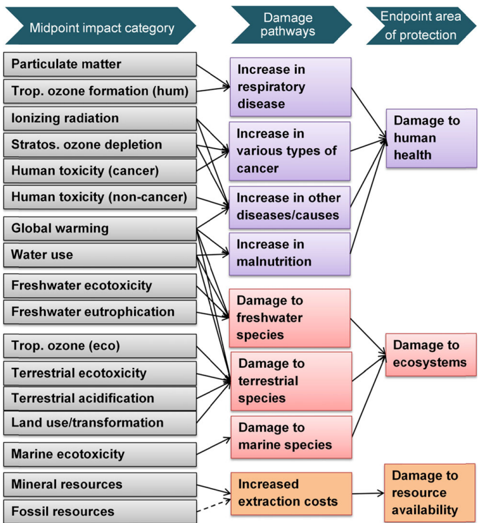
Life cycle impact assessment (LCIA) translates emissions and resource extractions into a limited number of environmental impact scores by means of so-called characterisation factors. There are two mainstream ways to derive characterisation factors, i.e. at midpoint level and at endpoint level. To further progress LCIA method development, we updated the ReCiPe2008 method to its version of 2016. This paper provides an overview of the key elements of the ReCiPe2016 method. We implemented human health, ecosystem quality and resource scarcity as three areas of protection. Endpoint characterisation factors, directly related to the areas of protection, were derived from midpoint characterisation factors with a constant mid-to-endpoint factor per impact category. We included 17 midpoint impact categories. The update of ReCiPe provides characterisation factors that are representative for the global scale instead of the European scale, while maintaining the possibility for a number of impact categories to implement characterisation factors at a country and continental scale. We also expanded the number of environmental interventions and added impacts of water use on human health, impacts of water use and climate change on freshwater ecosystems and impacts of water use and tropospheric ozone formation on terrestrial ecosystems as novel damage pathways. Although significant effort has been put into the update of ReCiPe, there is still major improvement potential in the way impact pathways are modelled. Further improvements relate to a regionalisation of more impact categories, moving from local to global species extinction and adding more impact pathways. Life cycle impact assessment is a fast evolving field of research. ReCiPe2016 provides a state-of-the-art method to convert life cycle inventories to a limited number of life cycle impact scores on midpoint and endpoint level.
Overview
The claims and statistics of this paper haven’t been checked yet.
Free: it reads the open-access text and checks the first 5 claims that cite a source we can check. Create a free account to check every claim.
Integrity signals
Registry
Cites
Statistics
Figures
Verification
Claims the paper makes
The claims and statistics of this paper haven’t been checked yet.
Free: it reads the open-access text and checks the first 5 claims that cite a source we can check. Create a free account to check every claim.
Self-check
Percentages, sums and reported differences re-computed from the paper’s own numbers.
The self-check needs the paper’s full text.
Citations
Cites
(2013) · Cited by 6,752
Accelerating extinction risk from climate change
Urban, M. C. (2015) · Science · doi:10.1126/science.aaa4984 · Cited by 2,436 · cited 2×
“For terrestrial ecosystems, the increase in potentially disappeared fraction of species (PDF) due to an increase in global temperature was derived from the review by Urban (2015).”
BackgroundThe water footprint of humanity
Hoekstra, A. Y., & Mekonnen, M. M. (2012) · Proceedings of the National Academy of Sciences · doi:10.1073/pnas.1109936109 · Cited by 2,260 · cited 2×
“…et al. 2013; Curran et al. 2014 Water use Increase of water consumed Water consumption potential (WCP) m3 water-eq consumed Döll and Siebert 2002; Hoekstra and Mekonnen 2012 Mineral resource scarcity Increase of ore extracted Surplus ore potential (SOP) kg Cu-eq Vieira et al. 2016a Fossil…”
BackgroundMethodAssessing the Environmental Impacts of Freshwater Consumption in LCA
Pfister, S., Koehler, A., & Hellweg, S. (2009) · Environmental Science & Technology · doi:10.1021/es802423e · Cited by 1,321 · cited 2×
“…shortage Pfister et al. 2009 Ecosystems (terrestrial) Decrease in Net Primary Productivity because of water shortage as proxy for total species loss Pfister et al. 2009 Ecosystems (aquatic) Fish species loss due to decreased river discharge Hanafiah et al. 2011 Land use Ecosystems (terrestrial)…”
BackgroundAmbient Air Pollution Exposure Estimation for the Global Burden of Disease 2013
Brauer, M., Freedman, G., Frostad, J., van Donkelaar, A., Martin, R. V., Dentener, F., Dingenen, R. V., Estep, K., Amini, H., Apte, J. S., et al. (2016) · Environmental Science & Technology · doi:10.1021/acs.est.5b03709 · Cited by 1,215
Addressing Global Mortality from Ambient PM2.5
Apte, J. S., Marshall, J. D., Cohen, A. J., & Brauer, M. (2015) · Environmental Science & Technology · doi:10.1021/acs.est.5b01236 · Cited by 995
Joos, F., Roth, R., Fuglestvedt, J. S., Peters, G. P., Enting, I. G., von Bloh, W., Brovkin, V., Burke, E. J., Eby, M., Edwards, N. R., et al. (2013) · Atmospheric Chemistry and Physics · doi:10.5194/acp-13-2793-2013 · Cited by 839
Implementation of life cycle impact assessment methods
Jungbluth, N., Margni, M. D., & Hischier, R. (2010) · Cited by 816
Global modeling of irrigation water requirements
Döll, P., & Siebert, S. (2002) · Water Resources Research · doi:10.1029/2001wr000355 · Cited by 816 · cited 2×
“For agriculture, the consumptive part of the withdrawal was estimated with water requirement ratios based on Döll and Siebert (2002).”
BackgroundMethod
Research works printed but not linked: 2
- 20. Goedkoop M, Heijungs R, Huijbregts MAJ, De Schryver A, Struijs J, van Zelm R (2009) ReCiPe 2008: a life cycle impact assessment method which comprises harmonised category indicators at the midpoint and endpoint levels. First edition. Report i: characterization. The Netherlands: Ruimte en Milieu, Ministerie van Volkshuisvesting, Ruimtelijke Ordening en Milieubeheer
- Vieira MDM, Ponsioen T, Goedkoop M, Huijbregts MAJ (2016c) Fossil resource scarcity. In: Huijbregts MAJ, Steinmann ZJN, Elshout PMF, Stam G, Verones F, Vieira MDM, Van Zelm R (eds) ReCiPe2016. A harmonized life cycle impact assessment method at midpoint and endpoint level. Report I: characterization. RIVM Report 2016-0104. National Institute for Human Health and the Environment, Bilthoven. Chapter 13
Cited by
Items 301–400 of 1,013
Choe, C., Cheon, S., Gu, J., & Lim, H. (2022) · Renewable and Sustainable Energy Reviews · doi:10.1016/j.rser.2022.112398 · Cited by 73
Padilla‐Rivera, A., Hannouf, M., Assefa, G., & Gates, I. D. (2024) · Sustainable Development · doi:10.1002/sd.3265 · Cited by 84
Toward Sustainable Chemical Engineering: The Role of Process Systems Engineering
Bakshi, B. R. (2019) · Annual Review of Chemical and Biomolecular Engineering · doi:10.1146/annurev-chembioeng-060718-030332 · Cited by 77
Life-cycle environmental implications of China’s ban on post-consumer plastics import
Ren, Y., Shi, L., Bardow, A., Geyer, R., & Suh, S. (2020) · Resources Conservation and Recycling · doi:10.1016/j.resconrec.2020.104699 · Cited by 76
Li, J., Tian, Y., Zhang, Y., & Xie, K. (2021) · Journal of Cleaner Production · doi:10.1016/j.jclepro.2021.129113 · Cited by 77
Gasa, G., Prieto, C., López-Román, A., & Cabeza, L. F. (2022) · Journal of Energy Storage · doi:10.1016/j.est.2022.105219 · Cited by 79
“In addition, there are three damage indicators that allow analysis of environmental impacts at the Endpoint level: effects on human health, effects on the quality of ecosystems, and reduction of resources [17].”
Gadaleta, G., Ferrara, C., Gisi, S. D., Notarnicola, M., & Feo, G. D. (2023) · The Science of The Total Environment · doi:10.1016/j.scitotenv.2023.161958 · Cited by 72
Beet red food colourant can be produced more sustainably with engineered Yarrowia lipolytica
Thomsen, P. T., Meramo, S., Ninivaggi, L., Pasutto, E., Babaei, M., Neto, P. M. Á., Pastor, M. C., Sabri, P., Rago, D., Parekh, T. U., et al. (2023) · Nature Microbiology · doi:10.1038/s41564-023-01517-5 · Cited by 71
“The evaluation covered all impact categories included in the ReCiPe 2016 methodology, using H. Evaluated midpoint impact categories included climate change, ozone depletion, ionizing radiation, fine matter, eutrophication, human toxicity, land use and water consumption, among others 35 .”
MethodInce, M. C., Benyahia, B., & Vilé, G. (2025) · ACS Sustainable Chemistry & Engineering · doi:10.1021/acssuschemeng.4c09289 · Cited by 71
Methodology for Carbon Footprint Calculation Towards Sustainable Innovation in Intangible Assets
Loyarte, E., Barral, M., & Morla, J. C. (2020) · Sustainability · doi:10.3390/su12041629 · Cited by 74
“ll t t i i t i t i i t f t i t t f t t l t t l ff t lt , t , res rce availability [34].”
BackgroundBohnes, F. A., & Laurent, A. (2020) · Aquaculture · doi:10.1016/j.aquaculture.2020.736001 · Cited by 72
Life cycle assessment of bacterial cellulose production
Forte, A., Dourado, F. O. Q., Mota, A., Neto, B., Gama, M., & Ferreira, E. C. (2021) · The International Journal of Life Cycle Assessment · doi:10.1007/s11367-021-01904-2 · Cited by 74
“These production processes generate pesticides, heavy metals, and other emissions to soil, water, and air and may cause damage to the ecosystem, and/or accumulate in the food chain, eventually affecting humans (Huijbregts et al. 2017).”
BackgroundMethodComparative Evaluation of Sisal and Polypropylene Fiber Reinforced Concrete Properties
Acosta-Calderon, S., Gordillo-Silva, P., García-Troncoso, N., Bompa, D. V., & Flores-Rada, J. (2022) · Fibers · doi:10.3390/fib10040031 · Cited by 70
“The method ReCiPe Midpoint H [68] was used to change the parameters in the inventory to environmental impact scores.”
MethodRachid, S., Taha, Y., & Benzaazoua, M. (2023) · Minerals Engineering · doi:10.1016/j.mineng.2023.108076 · Cited by 73
Electrolyzer and Fuel Cell Recycling for a Circular Hydrogen Economy
Uekert, T., Wikoff, H. M., & Badgett, A. (2023) · Advanced Sustainable Systems · doi:10.1002/adsu.202300449 · Cited by 73
Saharudin, D. M., Jeswani, H. K., & Azapagic, A. (2024) · The Science of The Total Environment · doi:10.1016/j.scitotenv.2024.170266 · Cited by 77
Huang, C., Yu, H., Gao, Y., Chen, Y., Abdalkarim, S. Y. H., & Tam, K. C. (2025) · Advanced Functional Materials · doi:10.1002/adfm.202424591 · Cited by 90
Turning Spent Coffee Grounds into Sustainable Precursors for the Fabrication of Carbon Dots
Crista, D. M. A., Mragui, A. E., Algarra, M., da Silva, J. C. G. E., Luque, R., & da Silva, L. P. (2020) · Nanomaterials · doi:10.3390/nano10061209 · Cited by 70
Nitkiewicz, T., Wojnarowska, M., Sołtysik, M., Kaczmarski, A., Witko, T., Ingrao, C., & Guzik, M. W. (2020) · The Science of The Total Environment · doi:10.1016/j.scitotenv.2020.141279 · Cited by 70
Mostashari-Rad, F., Mobtaker, H. G., Taki, M., Ghahderijani, M., Saber, Z., Chau, K., & Nabavi‐Pelesaraei, A. (2020) · Data in Brief · doi:10.1016/j.dib.2020.106490 · Cited by 70
Pérez-Camacho, M. N., Curry, R., & Cromie, T. (2019) · Waste Management · doi:10.1016/j.wasman.2019.05.045 · Cited by 74
“The ReCiPe midpoint method and impact areas were chosen to allow the analysis to spotlight single impact categories which might be of interest to policy makers and other researchers (Huijbregts et al., 2017).”
MethodValuing Economic Impact Reductions of Nutrient Pollution from Livestock Waste
Sampat, A. M., Hicks, A., Ruiz‐Mercado, G. J., & Zavala, V. M. (2020) · Resources Conservation and Recycling · doi:10.1016/j.resconrec.2020.105199 · Cited by 69
Economic and Environmental Potential of Wire-Arc Additive Manufacturing
Dias, M., Pragana, J. P. M., Ferreira, B., Ribeiro, I., & Silva, C. M. A. (2022) · Sustainability · doi:10.3390/su14095197 · Cited by 69
Li, L., Shao, X., & Ling, T. (2023) · Journal of Cleaner Production · doi:10.1016/j.jclepro.2023.137674 · Cited by 69
Castro, J. S., Ferreira, J., Magalhães, I. B., de Jesus, M. M., Marangon, B. B., Pereira, A. S. A. D. P., Lorentz, J. F., da Gama, R. C. N., Rodrigues, F. Á., & Calijuri, M. L. (2023) · Renewable and Sustainable Energy Reviews · doi:10.1016/j.rser.2023.113781 · Cited by 71
Karkour, S., Ichisugi, Y., Abeynayaka, A., & Itsubo, N. (2020) · Sustainability · doi:10.3390/su12052002 · Cited by 68
“For the choice of the global LCIA method, recently several studies provided regionalized-impact factors: Recipe2016 [47], ImpactWorld+ [48], and LIME3.”
MethodStatus of Life Cycle Assessment (LCA) in Africa
Karkour, S., Rachid, S., Maaoui, M., Lin, C.-C., & Itsubo, N. (2021) · Environments · doi:10.3390/environments8020010 · Cited by 74
“2018 South Africa [159] Sandstone 1 t of sandstone Primary data/Existing literature IMPACT 2002+ 2018 South Africa [160] Acid mine drainage (AMD)treatment 1 m3 of effluent generated by an AMD reactor Primary data/Existing literature/Ecoinvent v3 ReCiPe2016 2018 South Africa [161] Sanitation system The provision of a s…”
BackgroundResultInfluentialSevindik, S., Spataru, C., Doménech, T., & Bleischwitz, R. (2021) · Energies · doi:10.3390/en14113027 · Cited by 68
“3 [33] has been used to model the products and the ReCiPe Midpoint (H) method [34] has been used to calculate environmental loads.”
MethodCircular economy in the agro-industry: Integrated environmental assessment of dairy products
de Oliveira, R., Cocozza, A., Zucaro, A., Santagata, R., & Ulgiati, S. (2021) · Renewable and Sustainable Energy Reviews · doi:10.1016/j.rser.2021.111314 · Cited by 69
Environmental and social life cycle assessment of growing media for urban rooftop farming
Chavero, S. T., Madrid‐López, C., Villalba, G., Gabarrell, X., Hückstädt, A. B., Finkbeiner, M., & Lehmann, A. (2021) · The International Journal of Life Cycle Assessment · doi:10.1007/s11367-021-01971-5 · Cited by 72
A sustainable chemical process to recycle end-of-life silicon solar cells
Deng, R. D., Dias, P., Lunardi, M. M., & Ji, J. (2021) · Green Chemistry · doi:10.1039/d1gc02263f · Cited by 68
Bassi, S. A., Tonini, D., Saveyn, H. G. M., & Astrup, T. F. (2021) · Environmental Science & Technology · doi:10.1021/acs.est.1c00761 · Cited by 75
Lee, H., Choe, B., Lee, B., Gu, J., Cho, H., Won, W., & Lim, H. (2022) · Journal of Cleaner Production · doi:10.1016/j.jclepro.2022.134210 · Cited by 69
Kim, C.-S., Lee, Y., Kim, K., & Lee, U. (2022) · Catalysts · doi:10.3390/catal12101113 · Cited by 72
Shan, C., Pandyaswargo, A. H., & Onoda, H. (2023) · Energies · doi:10.3390/en16052199 · Cited by 68
Comparative life cycle assessment of battery-electric and diesel underground mining trucks
Balboa-Espinoza, V., Segura-Salazar, J., Hunt, C., Aitken, D., & Campos, L. (2023) · Journal of Cleaner Production · doi:10.1016/j.jclepro.2023.139056 · Cited by 74
Performing life cycle impact assessment with the midpoint and endpoint method ReCiPe
van Zelm, R., Hennequin, T., & Huijbregts, M. A. J. (2025) · Nature Protocols · doi:10.1038/s41596-025-01207-y · Cited by 68
“Widely used endpoint methods are EPS 26,27 ReCiPe is a comprehensive LCIA methodology, which applies a har-monized implementation of cause–effect pathways to calculate both midpoint and endpoint CFs 31 .”
InfluentialSelf-citationAdopting an objective approach to criticality assessment: Learning from the past
Hatayama, H., & Tahara, K. (2017) · Resources Policy · doi:10.1016/j.resourpol.2017.11.002 · Cited by 68
“Furthermore, the degree of each impact is quantified by the analyses using statistics or observed data, as well as scientific models (Huijbregts et al., 2017; Itsubo and Inaba, 2010).”
MethodLozano-Miralles, J. A., Hermoso-Orzáez, M. J., García, C. M., & Rojas‐Sola, J. I. (2018) · Sustainability · doi:10.3390/su10082917 · Cited by 68
Zhang, T., Zhai, Y., Ma, X., Shen, X., Bai, Y., Zhang, R., Ji, C., & Hong, J. (2021) · Journal of Cleaner Production · doi:10.1016/j.jclepro.2021.127925 · Cited by 67
Techno-economic and environmental evaluation of integrated mango waste biorefineries.
Manhongo, T., Chimphango, A., Thornley, P., & Röder, M. (2021) · Journal of Cleaner Production · doi:10.1016/j.jclepro.2021.129335 · Cited by 57
Friedericy, H. J., van Egmond, C. W., Vogtlander, J. G., van der Eijk, A. C., & Jansen, F. W. (2021) · Sustainability · doi:10.3390/su14010430 · Cited by 74
“The ReCipe system, version 2016, has the advantage that toxicities and materials’ depletion are incorporated [27].”
BackgroundUgwu, S. N., Harding, K., & Enweremadu, C. C. (2022) · Journal of Cleaner Production · doi:10.1016/j.jclepro.2022.131178 · Cited by 71
Onyelowe, K. C., Ebid, A. M., Riofrio, A., Soleymani, A., Baykara, H., Kontoni, D. N., Mahdi, H. A., & Jahangir, H. (2022) · Frontiers in Built Environment · doi:10.3389/fbuil.2022.992552 · Cited by 67
“For this study, ReCiPe Midpoint H (Huijbregts et al., 2017) was used to assess the impacts of the different concrete mixes from the 330 data points.”
MethodSanyé‐Mengual, E., Biganzoli, F., Valente, A., Pfister, S., & Sala, S. (2023) · The International Journal of Life Cycle Assessment · doi:10.1007/s11367-023-02169-7 · Cited by 70
Ramadugu, S., Ledella, S. R. K., Gaduturi, J. N. J., Pinninti, R. R., Venkatesh, S., & Saxena, K. K. (2023) · International Journal on Interactive Design and Manufacturing (IJIDeM) · doi:10.1007/s12008-023-01532-0 · Cited by 67
“Characterization factors (CF) are used to calculate the impacts in both midpoint and endpoint levels [33].”
Rufí-Salís, M., Brunnhofer, N., Petit‐Boix, A., Gabarrell, X., Guisasola, A., & Villalba, G. (2020) · The Science of The Total Environment · doi:10.1016/j.scitotenv.2020.139783 · Cited by 70
Threats to human health and ecosystem: Looking for air-pollution related damage since 1990
Ma, X., Zhang, T., Ji, C., Zhai, Y., Shen, X., & Hong, J. (2021) · Renewable and Sustainable Energy Reviews · doi:10.1016/j.rser.2021.111146 · Cited by 75
Environmental impact assessment of alkali-activated mortar with waste precursors and activators
Ramagiri, K. K., & Kar, A. (2021) · Journal of Building Engineering · doi:10.1016/j.jobe.2021.103391 · Cited by 76
Voss, R., Lee, R. P., & Fröhling, M. (2022) · Circular Economy and Sustainability · doi:10.1007/s43615-021-00145-7 · Cited by 68
Bai, Y., Zhang, T., Zhai, Y., Jia, Y., Ren, K., & Hong, J. (2022) · Journal of Environmental Management · doi:10.1016/j.jenvman.2022.114949 · Cited by 70
Vadoudi, K., Deckers, P., Demuytere, C., Askanian, H., & Verney, V. (2022) · Sustainable Production and Consumption · doi:10.1016/j.spc.2022.08.004 · Cited by 81
Life cycle assessment of three typical recycled products from construction and demolition waste
Qiao, L., Tang, Y., Li, Y., Liu, M., Yuan, X., Wang, Q., & Ma, Q. (2022) · Journal of Cleaner Production · doi:10.1016/j.jclepro.2022.134139 · Cited by 70
Labianca, C., Ferrara, C., Zhang, Y., Zhu, X., Feo, G. D., Hsu, S., You, S., Huang, L., & Tsang, D. C. W. (2022) · Journal of Cleaner Production · doi:10.1016/j.jclepro.2022.134963 · Cited by 66
Hatim, M., Majidian, M., Tahmasebi, M., & Nabavi‐Pelesaraei, A. (2023) · Soil and Tillage Research · doi:10.1016/j.still.2023.105795 · Cited by 66
Ecosystem quality in LCIA: status quo, harmonization, and suggestions for the way forward
Woods, J. S., Damiani, M., Fantke, P., Henderson, A. D., Johnston, J. M., Bare, J., Sala, S., de Souza, D. M., Pfister, S., Posthuma, L., et al. (2017) · The International Journal of Life Cycle Assessment · doi:10.1007/s11367-017-1422-8 · Cited by 71
Self-citationBehrooznia, L., Sharifi, M., & Hosseinzadeh-Bandbafha, H. (2020) · Journal of Cleaner Production · doi:10.1016/j.jclepro.2020.122217 · Cited by 69
Satoła, D., Kristiansen, A. B., Wiberg, A. H., Gustavsen, A., Ma, T., & Wang, R. Z. (2020) · Building and Environment · doi:10.1016/j.buildenv.2020.107358 · Cited by 66
Walk, J., Kühl, N., Saidani, M., & Schatte, J. (2023) · Journal of Cleaner Production · doi:10.1016/j.jclepro.2023.136748 · Cited by 81
“ReCiPe is a scientifically sound and acknowledged impact calculation method that provides characterization factors and normalization methods for calculating the impact (Huijbregts et al., 2017).”
Jeswani, H. K., Whiting, A., Martin, A. D., & Azapagic, A. (2019) · Waste Management · doi:10.1016/j.wasman.2019.05.053 · Cited by 68
Bottani, E., Vignali, G., Mosna, D., & Montanari, R. (2019) · Sustainable Production and Consumption · doi:10.1016/j.spc.2019.07.007 · Cited by 68
Taelman, S. E., Sanjuan-Delmás, D., Tonini, D., & Dewulf, J. P. (2020) · Resources Conservation and Recycling · doi:10.1016/j.resconrec.2020.104964 · Cited by 67
Critical minerals in Australia: a review of opportunities and research needs
Mudd, G. M., Werner, T. T., Weng, Z., Yellishetty, M., Yuan, Y., McAlpine, S. R. B., Skirrow, R. G., & Czarnota, K. (2018) · doi:10.11636/record.2018.051 · Cited by 69
“The environmental implication dimension assesses the cradle-to-gate risks to human health and ecosystems of a mineral using the ReCiPe endpoint method (Goedkoop et al., 2009; Huijbregts et al., 2017) and inventory data from the EcoInvent database (Frischknecht et al., 2005).”
MethodSuer, J., Ahrenhold, F., & Traverso, M. (2022) · Journal of Sustainable Metallurgy · doi:10.1007/s40831-022-00585-x · Cited by 64
“extreme weather events, are called endpoint categories [28] and are analysed e.”
BackgroundKleinekorte, J., Kleppich, J., Fleitmann, L., Beckert, V., Blodau, L., & Bardow, A. (2023) · ACS Sustainable Chemistry & Engineering · doi:10.1021/acssuschemeng.2c07682 · Cited by 66
Urea production: An absolute environmental sustainability assessment
Masjedi, S. K., Kazemi, A., Moeinnadini, M., Khaki, E., & Olsen, S. I. (2023) · The Science of The Total Environment · doi:10.1016/j.scitotenv.2023.168225 · Cited by 64
Hiloidhari, M., Banerjee, R., & Rao, A. B. (2020) · Journal of Cleaner Production · doi:10.1016/j.jclepro.2020.125170 · Cited by 68
Ita-Nagy, D., Vázquez-Rowe, I., Kahhat, R., Chinga-Carrasco, G., & Quispe, I. (2020) · The International Journal of Life Cycle Assessment · doi:10.1007/s11367-020-01829-2 · Cited by 63
Oreto, C., Veropalumbo, R., Viscione, N., Biancardo, S. A., & Russo, F. (2021) · Environmental Research · doi:10.1016/j.envres.2021.111277 · Cited by 63
Guzik, M. W., Nitkiewicz, T., Wojnarowska, M., Sołtysik, M., Kenny, S. T., Babu, R. P., Best, M., & O’Connor, K. E. (2021) · Waste Management · doi:10.1016/j.wasman.2021.08.030 · Cited by 65
Junaid, M. F., Rehman, Z. U., Ijaz, N., Čekon, M., Čurpek, J., & Elhag, A. B. (2022) · Energy and Buildings · doi:10.1016/j.enbuild.2022.112280 · Cited by 68
García-Guaita, F., González‐García, S., Villanueva-Rey, P., Moreira, M. T., & Feijóo, G. (2018) · Sustainable Cities and Society · doi:10.1016/j.scs.2018.04.027 · Cited by 71
Wang, R., Lam, C.-M., Hsu, S., & Chen, J. (2019) · Applied Energy · doi:10.1016/j.apenergy.2019.04.183 · Cited by 66
Chàfer, M., Pérez, G., Coma, J., & Cabeza, L. F. (2021) · Energy and Buildings · doi:10.1016/j.enbuild.2021.111236 · Cited by 69
Liu, K., Fang, L., Li, F., Hou, D., Liu, C., Song, Y., Ran, Q., Pang, Y., Du, Y., Yuan, Y., et al. (2021) · The Science of The Total Environment · doi:10.1016/j.scitotenv.2021.152022 · Cited by 63
Mancini, E., Dickson, R., Fabbri, S., Udugama, I. A., Ullah, H. I., Vishwanath, S., Gernaey, K. V., Luo, J., Pinelo, M., & Mansouri, S. S. (2022) · Process Safety and Environmental Protection · doi:10.1016/j.cherd.2022.01.040 · Cited by 65
Toward a national life cycle assessment tool: Generative design for early decision support
Hassan, S. R., Megahed, N. A., Eleinen, O. A., & Hassan, A. M. (2022) · Energy and Buildings · doi:10.1016/j.enbuild.2022.112144 · Cited by 62
Mio, A., Barbera, E., Pavan, A. M., Danielis, R., Bertucco, A., & Fermeglia, M. (2023) · Applied Energy · doi:10.1016/j.apenergy.2023.121431 · Cited by 71
Life cycle environmental and cost assessment of prefabricated components manufacture
Cheng, Z., Zhang, T., Zhou, X., Li, Z., Jia, Y., Ren, K., Xu, T., Li, C., & Hong, J. (2023) · Journal of Cleaner Production · doi:10.1016/j.jclepro.2023.137888 · Cited by 64
Iturrondobeitia, M., Alonso, L., & Lizundia, E. (2023) · Resources Conservation and Recycling · doi:10.1016/j.resconrec.2023.107182 · Cited by 62
Sun, Y., Li, Z., Wang, Q., Zhang, J., & Kong, H. (2023) · Energy Conversion and Management · doi:10.1016/j.enconman.2023.117648 · Cited by 62
Medel-Jiménez, F., Krexner, T., Gronauer, A., & Kral, I. (2023) · Journal of Cleaner Production · doi:10.1016/j.jclepro.2023.140198 · Cited by 63
Yokoi, R., Kataoka, R., Masese, T. N., Bach, V., Finkbeiner, M., Weil, M., Baumann, M., & Motoshita, M. (2024) · Resources Conservation and Recycling · doi:10.1016/j.resconrec.2024.107526 · Cited by 65
Vijerathne, D. T., Wahala, W. M. P. S. B., & Illankoon, I. M. C. S. (2024) · Buildings · doi:10.3390/buildings14092770 · Cited by 70
“ReCiPe offers an advanced technique to convert LCI data into a limited range of life cycle impact scores at midpoint and endpoint levels [38].”
Environmental payback periods of reusable alternatives to single-use plastic kitchenware products
Fetner, H., & Miller, S. A. (2021) · The International Journal of Life Cycle Assessment · doi:10.1007/s11367-021-01946-6 · Cited by 64
Uddin, S. Z. (2022) · ASRC Procedia: Global Perspectives in Science and Scholarship · doi:10.63125/hh8nv249 · Cited by 65
LCA of Glass Versus PET Mineral Water Bottles: An Italian Case Study
Ferrara, C., De Feo, G., & Picone, V. (2021) · Recycling · doi:10.3390/recycling6030050 · Cited by 61
“The midpoint approach consists of 18 impact categories: Global Warming Potential (GWP); Stratospheric Ozone Depletion (SOD); Ionizing Radiation (IR); Ozone Formation, Human Health (OF-HH); Fine Particulate Matter Formation (FPMF); Ozone Formation Terrestrial Ecosystems (OF-TE); Terrestrial Acidification (TA); Freshwat…”
BackgroundMethodSmith, M., Bevacqua, A., Tembe, S., & Lal, P. (2021) · Sustainable Energy Technologies and Assessments · doi:10.1016/j.seta.2021.101364 · Cited by 80
Chen, W., Zhang, Q., Wang, C., Li, Z., Geng, Y., Hong, J., & Cheng, Y. (2022) · Ecological Indicators · doi:10.1016/j.ecolind.2022.108660 · Cited by 61
Feliciano, R. J., Guzmán-Luna, P., Boué, G., Mauricio‐Iglesias, M., Hospido, A., & Membré, J. (2022) · Trends in Food Science & Technology · doi:10.1016/j.tifs.2022.02.027 · Cited by 61
Roy, D., Hassan, R., & Das, B. K. (2022) · Journal of Cleaner Production · doi:10.1016/j.jclepro.2022.133761 · Cited by 62
Song, J., Liu, C., Xing, J., Yang, W., & Ren, J. (2022) · Energy Conversion and Management · doi:10.1016/j.enconman.2022.116568 · Cited by 62
Life-cycle assessment of yeast-based single-cell protein production with oat processing side-stream
Kobayashi, Y., Wali, M. E., Guðmundsson, H., Guðmundsdóttir, E. E., Friðjónsson, Ó. H., Karlsson, E. N., Roitto, M., & Tuomisto, H. L. (2023) · The Science of The Total Environment · doi:10.1016/j.scitotenv.2023.162318 · Cited by 63
Egas, D., Azarkamand, S., Miralles, C. C., Ponsa, S. P., Llenas, L., & Colón, J. (2023) · The International Journal of Life Cycle Assessment · doi:10.1007/s11367-023-02168-8 · Cited by 68
“Other LCIA methods that are used are the ReCiPe (v2008 and v2016) endpoint and midpoint and the TRACI method (v2 and v2.”
MethodResultInfluentialHashemi, F., Mogensen, L., van der Werf, H. M. G., Cederberg, C., & Knudsen, M. T. (2024) · Communications Earth & Environment · doi:10.1038/s43247-024-01415-6 · Cited by 66
Towards sustainable perovskite light-emitting diodes
Zhang, M., Ma, X., Esguerra, J. L., Yu, H., Hjelm, O., Li, J., & Gao, F. (2025) · Nature Sustainability · doi:10.1038/s41893-024-01503-7 · Cited by 61
“Fossil fuel potential is quantified by surplus cost potentials arising from resource extraction, with CFs calculated through a log-linear cumulative cost– tonnage relationship 12 .”
Florio, G. D., Macchi, E. G., Mongibello, L., Baratto, M. C., Basosi, R., Busi, E., Caliano, M., Cigolotti, V., Testi, M., & Trini, M. (2021) · Applied Energy · doi:10.1016/j.apenergy.2020.116378 · Cited by 63
Life cycle assessment of bioenergy product systems: A critical review
Hosseinzadeh-Bandbafha, H., Aghbashlo, M., & Tabatabaei, M. (2021) · e-Prime - Advances in Electrical Engineering Electronics and Energy · doi:10.1016/j.prime.2021.100015 · Cited by 69
Application of environmental life cycle assessment (LCA) within the space sector: A state of the art
Maury, T., Loubet, P., Serrano, S. M., Gallice, A., & Sonnemann, G. (2020) · Acta Astronautica · doi:10.1016/j.actaastro.2020.01.035 · Cited by 60
Junsittiwate, R., Srinophakun, T. R., & Sukpancharoen, S. (2021) · Energy Sustainable Development/Energy for sustainable development · doi:10.1016/j.esd.2021.12.001 · Cited by 61
Metadata
- Authors
- Huijbregts, M. A. J., Steinmann, Z. J. N., Elshout, P. M. F., Stam, G., Verones, F., Vieira, M., Zijp, M., Hollander, A., & van Zelm, R.
- Affiliations
- Netherlands Environmental Assessment Agency (NL)
- Radboud University Nijmegen (NL)
- Norwegian University of Science and Technology (NO)
- National Institute for Public Health and the Environment (NL)
- Corresponding author
- Huijbregts, Mark A. J.
- ORCID
- Venue
- The International Journal of Life Cycle Assessment
- Published
- 2016-12-12
- Volume
- 22
- Issue
- 2
- Pages
- 138-147
- ISSN
- 0948-3349 (ISSN-L)
- 1614-7502
- OpenAlex
- W2564630286
- Semantic Scholar
- 318510507a790e4b13a4320ec9a6a8756ed96ecd
- Cited by
- 4,485
- References
- 54
- Citations by year
- 2026: 945 · 2025: 906 · 2024: 682 · 2023: 578 · 2022: 520 · 2021: 391 · 2020: 232 · 2019: 131 · 2018: 78 · 2017: 18 · 2016: 3
- FWCI
- 48.09
- Type
- journal article
- Language
- en
- Update notices
- correction (2020-07-02)
- Open access
- hybrid
- doi.org
- Licence
- cc-by
- creativecommons.org/licenses/by/4.0 (tdm)
- creativecommons.org/licenses/by/4.0 (vor)
- Locations
- The International Journal of Life Cycle Assessment (publishedVersion, cc-by)
- Radboud Repository (Radboud University) (submittedVersion)
- Rivm Repository (Netherlands National Institute for Public Health and the Environment) (submittedVersion)
- Radboud Repository (Radboud University) (submittedVersion, other-oa)
- Funders
- Rijksinstituut voor Volksgezondheid en Milieu (S/607020)
- Topics
- Physical Sciences › Environmental Science › Environmental Engineering › Environmental Impact and Sustainability
- Physical Sciences › Environmental Science › Ecology › Agriculture Sustainability and Environmental Impact
- Physical Sciences › Environmental Science › Environmental Engineering › Sustainability and Ecological Systems Analysis
- Keywords
- life cycle impact assessment, characterization factors, human health effects, ecosystem quality, resource constraints, water use impacts, freshwater ecosystems, tropospheric ozone formation, terrestrial ecosystems, species extinction, environmental interventions, global scale
About these checks
Registry, retraction, Cites and statistics results are computed, not judged, with one exception: a printed reference that no index lists is read once by a model before it counts as a citation error. Claims are extracted by a model and kept only when their quote appears verbatim in the text; each cited source is then checked, with a model’s help, for whether it says what the claim relies on. Those verdicts can be wrong — read the claim’s quote and the cited source before relying on one.
Statistics and arithmetic are recomputed, not judged.
Confidence bands are shown only for fields calibrated on our annotated test set. None is calibrated yet, so no band is shown.
What counts as a claim ›How we measure confidence ›How we check this ›
Are you an author, or do you see a problem with this page? Request a review
Data sources
Bibliographic data: Semantic Scholar, OpenAlex, Crossref.
Contains information from the Semantic Scholar Academic Graph Datasets, made available under the ODC Attribution License (ODC-BY 1.0).
Semantic Scholar’s data is described in: Kinney, R., et al. (2023). The Semantic Scholar Open Data Platform. arXiv:2301.10140.
