

Online University Teaching During and After the Covid-19 Crisis: Refocusing Teacher Presence and Learning Activity
Open accessThe DOI matches its Crossref record; 71 of the 75 references it cites were found in a registry or an index; 6 of the 42 sources its claims cite were checked for support.
Abstract
The Covid-19 pandemic has raised significant challenges for the higher education community worldwide. A particular challenge has been the urgent and unexpected request for previously face-to-face university courses to be taught online. Online teaching and learning imply a certain pedagogical content knowledge (PCK), mainly related to designing and organising for better learning experiences and creating distinctive learning environments, with the help of digital technologies.
Overview
CoChat Summary
TL;DR
This article is an expert-interview piece offering pedagogical guidance for university teachers suddenly moving online during Covid-19. Its central message is that effective online teaching depends less on tools or materials alone and more on careful learning design, multiple forms of teacher presence, and continuous assessment.
Key findings
- The four experts argue that online learning should be built around carefully designed learning activities, with a mix of synchronous, asynchronous, online, and offline tasks that are clear, appropriately difficult, authentic, and accessible to students.
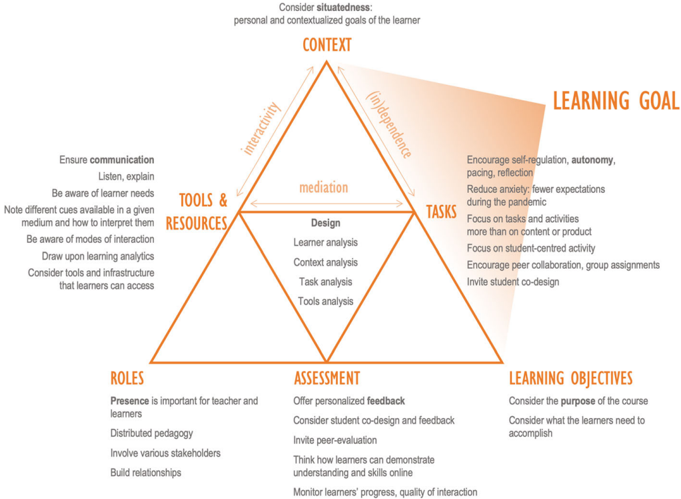
- They propose a tripartite teaching presence for online courses: cognitive presence, social presence, and facilitatory presence.
- Successful online learning requires students not to feel alone, and it benefits from timely feedback, peer collaboration, and student co-design/co-configuration of activities.
- The paper states that continuous assessment is needed in online learning, and suggests self-reflections, portfolios, self-paced asynchronous activities, and use of learning analytics as part of evaluation.
Methods
- Exploratory qualitative study using expert interviews administered by e-mail.
- Sample: 4 online pedagogy experts/co-authors, selected for research expertise, more than a decade of online teaching experience, and experience across different national education systems; they worked in Switzerland, Australia, Spain, and Canada.
- Main analysis: the first author organized the responses into a panel-like article, then the authors jointly revised and synthesized the material; the discussion summarizes themes under learning design, teacher presence, and assessment.
Limitations
- The paper states that all four experts came from “rich parts of the world” (Switzerland, Canada, Australia, and North of Spain), which limits the lens to a “monofocal” view of educational reality.
- The paper itself says the study used a heuristic method based on expert viewpoints and “by no means can replace rigorous, systematic research” following the scientific method.
- Evident from the text: the sample is very small (4 experts) and highly selected, so the findings are expert-opinion guidance rather than generalizable empirical results.
Model-written summary. Check it against the paper before relying on it.
Integrity signals
Registry
Cites
Statistics
Figures
Verification
Claims the paper makes
5 Valid · 0 Not valid · 32 Not checked · 24 Own results and interpretations
The sources with a verdict support this claim; the rest weren’t checked yet, have no full text we could read, or their verdicts aren’t rated yet.
In the paper
“On top of that, a significant challenge for university teachers has been their lack of the pedagogical content knowledge (PCK) (Shulman 1987) needed for teaching online (Angeli and Valanides 2005; Kali, Goodyear and Markauskaite 2011; Ching, Hsu and Baldwin 2018).”
§ Springer Nature Switzerland AG 2020 Published online: 7 July 2020 > Introduction
What the sources say
- Supportedcites Shulman 1987 matched to “Knowledge and teaching: Foundations of the new reform” (1987) source
The parenthetical (Shulman 1987) is attached to the term 'pedagogical content knowledge (PCK)' — an identification citation — while the online-teaching studies are credited to Angeli & Valanides, Kali et al. and Ching et al. Our copy (the Portuguese edition of Shulman's 1987 Harvard Educational Review article) establishes exactly that concept: the 'Categorias da base de conhecimento' section lists 'conhecimento pedagógico do conteúdo' as one of the categories of the knowledge base for teaching, 'esse amálgama especial de conteúdo e pedagogia que é o terreno exclusivo dos professores', and the 'Novas compreensões' section calls it 'a categoria que melhor distingue a compreensão de um especialista em conteúdo daquela de um pedagogo'. The paper itself says nothing about online teaching or about university teachers lacking PCK, but that part of the sentence is not attributed to this source. (LLM, conf=0.85)
- Not checked — no full text of the sourcecites Angeli and Valanides 2005 matched to “Preservice elementary teachers as information and communication technology designers: an instructional systems design model based on an expanded view of pedagogical content knowledge” (2005) source
- Could not verifycites Ching, Hsu and Baldwin 2018 matched to “Online Course Design and Development among College and University Instructors: An Analysis using Grounded Theory” (2018) sourceExperimental — accuracy not yet measured
Our copy of Baldwin, Ching & Friesen (2018) never mentions pedagogical content knowledge, PCK, Shulman, or TPACK; searches for 'pedagogical content knowledge PCK online teaching', 'TPACK technological pedagogical content knowledge', 'Shulman pedagogical content knowledge Angeli Valanides' and 'challenge lack of knowledge training online instructors pedagogy' returned only the References list and design-process passages. The paper's content is a grounded-theory account of how 14 four-year-institution instructors design online courses (Abstract; Results themes; Discussion mapping to ADDIE), and its nearest statements — that instructors 'must develop new curriculum with instructional strategies effective for online learning' (Discussion) and 'rarely use formal instructional design models' (Results) — concern design practice, not a PCK deficiency framed as a significant challenge. Nothing in our copy either states or contradicts the attributed claim. (LLM, conf=0.72)
plain- Asserted: passes — The authors put it forward as true.
- Checkable: passes — It can be checked against evidence.
- Load-bearing: passes — The paper’s conclusions depend on it.
- Based: passes — The paper gives a reason why it holds.
- Supported
The cited sources support only part of this claim — read each source’s verdict below.
In the paper
“Assessment can possibly be considered the most challenging part of the transition to distance learning for an institution used to face-to-face oral or written exam, as the control shift towards the students makes it hardly possible to ensure that students are not cheating (Munoz and Mackay 2019).”
§ Springer Nature Switzerland AG 2020 Published online: 7 July 2020 > Assessment
What the sources say
- Partly supportedcites Munoz and Mackay 2019 matched to “An online testing design choice typology towards cheating threat minimisation” (2019) sourceExperimental — accuracy not yet measured
Split into 2 atoms — 0 confirmed, 2 partially supported, 0 disputed, 0 misattributed, 0 unverifiable. Expand the claim to see per-atom verdicts.
hedgedstates a possible cause- Asserted: passes — The authors put it forward as true.
- Checkable: passes — It can be checked against evidence.
- Load-bearing: unclear — It is unclear whether the paper’s conclusions depend on it.
- Based: passes — The paper gives a reason why it holds.
- Partly supported
A result the paper reports from its own data — it cites no other source for it, so there is none to check. The quote shows it is in the paper.
In the paper
“Our findings point at the design of learning activities with certain characteristics, the combination of three types of presence (social, cognitive and facilitatory) and the need for adapting assessment to the new learning requirements.”
§ Springer Nature Switzerland AG 2020 Published online: 7 July 2020 > Abstract
plainstates an association- Asserted: passes — The authors put it forward as true.
- Checkable: passes — It can be checked against evidence.
- Load-bearing: passes — The paper’s conclusions depend on it.
- Based: passes — The paper gives a reason why it holds.
None of the sources cited for this claim have been checked yet.
In the paper
“What all four experts focus on as a prime ' piece ' of pedagogical knowledge (Kali et al. 2011) is the careful design of activities.”
§ Springer Nature Switzerland AG 2020 Published online: 7 July 2020 > Learning Design
plain- Asserted: passes — The authors put it forward as true.
- Checkable: passes — It can be checked against evidence.
- Load-bearing: unclear — It is unclear whether the paper’s conclusions depend on it.
- Based: passes — The paper gives a reason why it holds.
A result the paper reports from its own data — it cites no other source for it, so there is none to check. The quote shows it is in the paper.
In the paper
“Inspired by Anderson et al. ' s (2001) understanding of teaching presence and how it can be re-conceived in the current Covid-19 situation in which educators are the designers, the tutors and the evaluators of the learning experience, a tripartite framework emerges from the interviews, with three main sub-presences of the teaching presence, namely:”
§ Springer Nature Switzerland AG 2020 Published online: 7 July 2020 > Teacher Presence
plain- Asserted: passes — The authors put it forward as true.
- Checkable: passes — It can be checked against evidence.
- Load-bearing: passes — The paper’s conclusions depend on it.
- Based: passes — The paper gives a reason why it holds.
5 more claims
Create a free account to see all 61 claims and to verify the 9 references still open.
- Probably not a substantial claim. 50
- It may state two separate claims as one. 18
Claims other papers make about this one
Each is checked against this paper’s own text: does it say what the citing paper says it does?
The source backs part of the claim, not all of it — or backs it for a different population, condition or comparison.
In the citing paper
“while it is known that for learning success, input formats usually depend on both attention and interest from the students (Rapanta et al., 2020).”
From Impact of Synchronous and Asynchronous Settings of Online Teaching and Learning in Higher Education on Students' Learning Experience During COVID-19 (2021) · cites this paper as Rapanta et al., 2020
Experimental — accuracy not yet measuredIn the citing paper
“Evaluating AI applications could be beneficial for enhancing their motivation and interest in teaching with AI [40].”
From Developing AI Literacy for Primary and Middle School Teachers in China: Based on a Structural Equation Modeling Analysis (2022) · cites this paper as [40]
Citations
Cites
The Reflective Practitioner: How Professionals Think in Action
Checkoway, B., & Schon, D. A. (1985) · Journal of Policy Analysis and Management · doi:10.2307/3324262 · Cited by 21,268
The reflective practitioner: How professionals think in action
Stewart, C. J. (1984) · Patient Education and Counseling · doi:10.1016/0738-3991(84)90022-3 · Cited by 19,752
Knowledge and teaching: Foundations of the new reform
Shulman, L. (1987) · Harvard Educational Review · doi:10.17763/haer.57.1.j463w79r56455411 · Cited by 16,787
Phenomenological research methods
Moustakas, C. (1994) · doi:10.4135/9781412995658 · Cited by 13,919 · cited 1×
“’ This study ’ s participants, i.e. the four online pedagogy experts, also functioned as co-researchers, following Moustakas ’ (1994) idea (l).”
BackgroundDetermining Validity in Qualitative Inquiry
Creswell, J. W., & Miller, D. L. (2000) · Theory Into Practice · doi:10.1207/s15430421tip3903_2 · Cited by 9,184
Speech Genres and Other Late Essays
Bakhtin, M. M. (1986) · University of Texas Press eBooks · doi:10.7560/720466 · Cited by 8,470
The Difference between Emergency Remote Teaching and Online Learning
Hodges, C. B., Moore, S., Lockee, B. B., Trust, T., & Bond, M. A. (2024) · Handbook of Research in Online Learning · doi:10.1163/9789004702813_021 · Cited by 6,253
Blended learning: Uncovering its transformative potential in higher education
Garrison, D. R., & Kanuka, H. (2004) · The Internet and Higher Education · doi:10.1016/j.iheduc.2004.02.001 · Cited by 4,849
Speech Genres and Other Late Essays
Melaver, M., Bakhtin, M. M., McGee, V. W., Emerson, C., & Holquist, M. (1987) · Poetics Today · doi:10.2307/1772598 · Cited by 3,185
ASSESSING TEACHING PRESENCE IN A COMPUTER CONFERENCING CONTEXT
Anderson, T., Rourke, L., Garrison, R., & Archer, W. (2001) · Online Learning · doi:10.24059/olj.v5i2.1875 · Cited by 1,885
Research works printed but not linked: 2
- Bates, A. W. (2019). Teaching in a digital age. 2nd Edition. Vancouver: Tony Bates Associates. https://pressbooks.bccampus.ca/teachinginadigitalagev2/. Accessed 15 June 2020.
- Shor, I., & Freire, P. (1987). A pedagogy for deliberation: dialogues on transforming education . Westport: Bergin & Garvey Publishers.
Cited by
Items 1,001–1,100 of 2,106
Estimating disease transmission in a closed population under repeated testing
Wascher, M., Schnell, P., KhudaBukhsh, W. R., et al. (2024) · Journal of the Royal Statistical Society Series C (Applied Statistics) · doi:10.1093/jrsssc/qlae021 · Cited by 3
BEYOND REACTIONARY: SAGE PRACTICES FOR INTENTIONAL REFLEXIVITY IN ONLINE QUALITATIVE DATA COLLECTION
Summers, E., Armstrong, S. L., Fard, S. M., et al. (2024) · New Trends in Qualitative Research · doi:10.36367/ntqr.20.1.2024.e976 · Cited by 3
“Some guidance regarding online climates of care and responsiveness applied to both teaching and research, yet needed differentiation in application (Archambault et al., 2022; Banerjee, 2022; Karakaya, 2021; Kaufmann & Kallade, 2022; Mulyono et al., 2021; Rapanta et al., 2020; Robinson et al., 2020).”
BackgroundZin, N. F. M., & Mahmud, M. S. (2024) · International Journal of Learning Teaching and Educational Research · doi:10.26803/ijlter.23.5.9 · Cited by 3
“It promotes knowledge development and student empowerment, and provides a platform for community members to express their perspectives and interests (Rapanta et al., 2020).”
BackgroundUsing hands-on learning video assignments in online and in-person contexts: A longitudinal study
Ji, Q., Zhang, R., Duan, X., Tripp, J. N., Liu, X., & Cheng, C. (2024) · Eurasia Journal of Mathematics Science and Technology Education · doi:10.29333/ejmste/14706 · Cited by 4
“…that, given the right support and strategies, teachers can be successful at engaging students in meaningful online science learning experiences (Rapanta et al., 2020), such as the broadcasting of educational programs through traditional media such as radio or television in Latin America and…”
BackgroundAçık ve uzaktan öğrenmede etkileşim üzerine bir bibliyometrik analiz çalışması
Çınar, E., Orhan, G., & Sezgin, S. (2024) · Açıköğretim Uygulamaları ve Araştırmaları Dergisi · doi:10.51948/auad.1509279 · Cited by 3
Chiramba, O., & Agbaje, O. (2024) · Journal of Educational Studies · doi:10.59915/jes.2024.si2.1 · Cited by 3
Hu, B. (2024) · The Interpreter and Translator Trainer · doi:10.1080/1750399x.2024.2424704 · Cited by 5
“Since ‘teaching presence’ can significantly influence student satisfaction and engagement in online teaching during the (post-)Covid-19 period (Rapanta et al. 2020), we organised individual consultation sessions, akin to mini-mentorship, with the teacher serving as a ‘guide on the side’ rather than…”
Mathew, P. V., Pappachan, J., & Kushwaha, S. (2024) · Discover Education · doi:10.1007/s44217-024-00344-y · Cited by 7
El rol de la educación a distancia en la educación superior, revisión de la literatura
Rodriguez-Ayala, A. E., & Ayala-Tigmasi, R. A. (2023) · Horizon Nexus Journal. · doi:10.70881/hnj/v1/n3/23 · Cited by 4
“El uso adecuado de las plataformas y la integración de recursos multimedia requiere formación especializada, algo que no siempre está disponible (Rapanta et al., 2020).”
WhatsApp integration by business studies teachers to promote collaboration among learners
Gcabashe, N. B. (2024) · South African Journal of Education · doi:10.15700/saje.v44n4a2470 · Cited by 7
“The second type of teacher presence in internet-based instruction is their social presence (Rapanta et al., 2020) which includes communication between the teacher and the learners.”
InfluentialDoes Instructors' and Students' On‐Camera Presence Enhance Learning?
Jiang, X., Li, Y., Kuang, Z., & Jiajun, Y. (2025) · Journal of Computer Assisted Learning · doi:10.1111/jcal.13122 · Cited by 6
Four models of the coworking concept to facilitate remote higher education
Bennis, W. M., & Orel, M. (2025) · Facilities · doi:10.1108/f-02-2024-0031 · Cited by 4
The Covid-19 World: Learning or Downfall
Suoranta, J. (2020) · Postdigital Science and Education · doi:10.1007/s42438-020-00189-2 · Cited by 6
“The entity called SARS-CoV-2 also ‘changes its meaning accordingly when perceived as one or the other, apostpanied by modifications of the entirety of both its material and formal properties’ (Sebeok 1986: 4).”
BackgroundStudent Experience and Expectation with E-Learning Modality in Times of Pandemic
Lavor, O. P., & Ramos, M. S. F. (2020) · WSEAS TRANSACTIONS ON ADVANCES in ENGINEERING EDUCATION · doi:10.37394/232010.2020.17.14 · Cited by 3
“The pandemic has raised significant challenges for the education community worldwide and one of these challenges has been the urgent and unexpected request for courses taught in person previously, to be offered online [7].”
BackgroundInnovation in teaching and learning invertebrate zoology in remote and online classrooms
Davis‐Berg, E. C., & Kocot, K. M. (2021) · Invertebrate Biology · doi:10.1111/ivb.12329 · Cited by 3
“Assessment and grading concerns can be different in the remote or online environment and the face- to-face classroom, and the movement of most assessments online during the pandemic added additional concerns for both students and instructors (Elsalem et al., 2020; Reyneke et al., 2021).”
BackgroundLearning Alone – a kapcsolati beágyazódás vizsgálata a távolléti oktatás alatt
Pusztai, G., & Győri, K. (2021) · Educatio · doi:10.1556/2063.30.2021.1.9 · Cited by 6
Chacko, S., & Jones, S. (2021) · Journal of Teaching and Learning with Technology · doi:10.14434/jotlt.v9i2.31401 · Cited by 4
Hardianti, R. D., Wusqo, I. U., Savitri, E. N., Pamelasari, S. D., Yanitama, A., Suanto, A., & Widyatama, A. (2021) · Journal of Physics Conference Series · doi:10.1088/1742-6596/1918/5/052089 · Cited by 4
Subekti, A. S. (2021) · IJEE (Indonesian Journal of English Education) · doi:10.15408/ijee.v1i1.20681 · Cited by 5
Kamuya Açılan Sınıf: Mesleki Mahremiyet ve Uzaktan Eğitimde Gözetlenme
Atmaca, T., Yildirim, E., & Öntaş, T. (2021) · Opus uluslararası toplum araştırmaları dergisi · doi:10.26466/opus.896351 · Cited by 3
Daly, N., & Forbes, D. (2021) · Journal of Literary Education · doi:10.7203/jle.4.21020 · Cited by 2
Manea, M. M., Safta-Zecheria, L., Neumann, E., Bodrug‐Lungu, V., Milenkova, V. G., & Lendzhova, V. (2021) · Journal of Educational Sciences · doi:10.35923/jes.2021.1.07 · Cited by 6
“…raised questions concerning teachers’ digital competence and content pedagogical knowledge (Schulmann, 1987) needed for teaching online (Rapanta et al, 2020; Ching, Su and Baldwin, 2018), either addressing implications for initial teacher education (Scull et al, 2020; Dyment and…”
BackgroundXue, Y., Hassan, S., Bahader, S., & Habib, S. (2021) · Frontiers in Psychology · doi:10.3389/fpsyg.2021.721304 · Cited by 8
“, 2020), such as social distancing measures, stay-at-home policies, online classes, and the closure of public educational institutions (Rapanta et al., 2020).”
BackgroundPapaja, K. L. (2021) · Lublin Studies in Modern Languages and Literature · doi:10.17951/lsmll.2021.45.3.3-17 · Cited by 5
Face-to-Face, Emergency Remote Teaching and ELearning: A Study of Students’ Performance
Ahmed, T. O. (2021) · International Conference on Computer Science & Education (ICCSE) · doi:10.1109/iccse51940.2021.9569297 · Cited by 3
DaF-Unterricht im virtuellen Raum – Zur Einführung in das Themenheft
Biebighäuser, K., Falk, S., Feick, D., & Schart, M. (2021) · Informationen Deutsch als Fremdsprache · doi:10.1515/infodaf-2021-0068 · Cited by 7
Engajamento docente na Pandemia da COVID-19: a influência do suporte organizacional
Junges, V. D. C., Schuch, C. D. O. S., Becker, R. G., Klein, L. L., Vieira, K. M., & de Campos, S. A. P. (2021) · Research Society and Development · doi:10.33448/rsd-v10i15.21791 · Cited by 6
Physical Activity Among African Academics in a Post-COVID-19 Era: The Terrain for Action
Asiamah, N. (2022) · Springer eBooks · doi:10.1007/978-3-030-88234-1_10 · Cited by 3
Mudau, T. S., Tshivhase, L., & Randa, M. B. (2022) · Journal of Culture and Values in Education · doi:10.46303/jcve.2022.14 · Cited by 3
“Managing online teaching entails designing and organizing for better learning experiences and creating distinctive learning environments using digital technology (Rapanta et al., 2020).”
BackgroundPERSEPSI MAHASISWA TENTANG PEMBELAJARAN ONLINE DI MASA PANDEMI COVID-19
Hapsari, F. M. Z., Ulfah, M., & Barella, Y. (2022) · Jurnal Pendidikan Sosiologi dan Humaniora · doi:10.26418/j-psh.v13i1.52986 · Cited by 3
Naiker, M., Wakeling, L., Johnson, J. B., & Brown, S. (2021) · Journal of University Teaching and Learning Practice · doi:10.53761/1.18.4.15 · Cited by 5
“In light of the recent COVID-19 pandemic and the concurrent shift towards online-only teaching (Crawford et al., 2020; Johnson et al., 2021; Rapanta et al., 2020), it is also important that educators are able to leverage online learning platforms to provide the best experiences for students (Muir et al.”
Nature of Feedback and Interaction in Online Courses during COVID-19
Farrah, M., Abdalnabi, R., & Sider, A. (2022) · Randwick International of Education and Linguistics Science Journal · doi:10.47175/rielsj.v3i2.472 · Cited by 5
Examining Pre-Service Teachers’ Perceptions About Virtual Classrooms in Online Learning
Debbağ, M., & Fidan, M. (2022) · The International Review of Research in Open and Distributed Learning · doi:10.19173/irrodl.v23i3.5925 · Cited by 8
“During VCs, collaborative learning can be used as well as methods such as project-based learning (Cortazar et al., 2021) and peer collaboration (Rapanta et al., 2020).”
MethodATIŞ, D., & DOĞANER, E. Ş. (2022) · ODÜ Sosyal Bilimler Araştırmaları Dergisi (ODÜSOBİAD) · doi:10.48146/odusobiad.1100772 · Cited by 4
Simulated field experiences and culturally responsive pedagogy among teacher candidates
Ghazarian, P. G., Kormos, E., & Wisdom, K. (2022) · Intercultural Education · doi:10.1080/14675986.2022.2144073 · Cited by 8
“COVID-19 has thrust nearly all of higher education into the world of online instruction (Bao 2020; Rapanta et al., 2020).”
BackgroundExemplification process in online education: a longitudinal study of mathematics teachers
Sevimli, E. (2022) · Learning Environments Research · doi:10.1007/s10984-022-09440-y · Cited by 3
“After the outbreak of the pandemic, more emphasis has been put on how online learning environments can be used more effectively in the transition process between textbook, teacher and student knowledge (Demir et al., 2021; Rapanta et al., 2020; Sevimli et al., 2022).”
BackgroundStanojević, M., & Pavlović, N. (2023) · Meta Journal des traducteurs · doi:10.7202/1096255ar · Cited by 2
Web-Conference Lecturing: In Dialogue with Student Experiences During a Pandemic
Westbrook, F., Tibb, A., Blackall, L., & Zabde, H. (2021) · Video Journal of Education and Pedagogy · doi:10.1163/23644583-00501009 · Cited by 5
“…journal of education and pedagogy 5 (2020) 1-17 of capitalist and technocratic ideology (Postman 1992), the pandemic response expects lecturers and coordinators to suspend these concerns and quickly find ways to establish visual forms of connectivity and community (Rapanta et al., 2020).”
BackgroundInfluentialFikriyah, A., Sandika, B., & Wijaya, E. Y. (2020) · Jurnal Inovasi Pendidikan IPA · doi:10.21831/jipi.v6i2.35033 · Cited by 10
Huber, E., McEwen, C., Bryant, P., Taylor, M., Arthars, N., & Boateng, H. (2020) · Annual Conference of the Australasian Society for Computers in Learning in Tertiary Education (ASCILITE) · doi:10.14742/ascilite2020.0142 · Cited by 5
Essa, H. A. E.-G. E., Elkazeh, E. E., Zewiel, M. A. A., & Hassan, L. A. A. (2021) · Tanta Scientific Nursing Journal · doi:10.21608/tsnj.2021.170822 · Cited by 3
“teaching and their other modes of operation (2,6,10) .”
BackgroundMethodInfluentialA Creativity Education Model for Coastal Communities Amid the Covid-19 Pandemic
Wasehudin, W., Anshori, I., Rahman, M. T., Syafe’i, I., & Kesuma, G. C. (2021) · Journal of Environmental Management and Tourism · doi:10.14505//jemt.12.3(51).12 · Cited by 8
University Students’ Learning Disruption and Affordance in a Contested Learning Environment
Nuraini, S. (2021) · Research in Social Sciences and Technology · doi:10.46303/ressat.2021.23 · Cited by 4
“In the history of education, face to face meeting with the teachers has been thought of as the critical factor in the success of education as it offered numerous social contexts where both students and teachers could interact without barriers (Daumiller et al., 2020; Li & Lalani, 2020; Rapanta et al., 2020).”
BackgroundBrahm, T., & Pumptow, M. (2021) · MedienPädagogik Zeitschrift für Theorie und Praxis der Medienbildung · doi:10.21240/mpaed/44/2021.11.13.x · Cited by 5
Impact of Formative E-Assessment on Attendance
Orsi, M., & Juliano, L. (2021) · Journal of Higher Education Theory and Practice · doi:10.33423/jhetp.v21i15.4904 · Cited by 4
Development of Authentic Assessment Models in Research Methods Courses
Wahyuni, S., Ikashaum, F., Wulantina, E., Mustika, J., & Putri, L. R. (2022) · Advances in Social Science, Education and Humanities Research/Advances in social science, education and humanities research · doi:10.2991/assehr.k.211229.016 · Cited by 3
Ayang, A., & Richard, N. (2022) · Malaysian Journal of Social Sciences and Humanities (MJSSH) · doi:10.47405/mjssh.v7i4.1409 · Cited by 3
“This has been confirmed that the accessibility towards internet, software and devices were the important factors for establishing an effective online learning (Rapanta et al., 2020).”
BackgroundVodcasting (Video Podcast) as a Tool for Enhancing Modular Students’ Performance in Science
Vergara, S. D. (2022) · International Journal of Research Publications · doi:10.47119/ijrp1001031620223395 · Cited by 6
Veeramuthu, S. P., Ganapathy, M. N. G., Rahman, M. L. A., Harun, J., & Ramganesh, E. (2022) · Journal of Nusantara Studies (JONUS) · doi:10.24200/jonus.vol7iss2pp44-60 · Cited by 4
ICT-Based Learning in New Normal Era: Viewed from Practice and Impact in ELT Classroom
Hidayah, J., & Prihantoro, P. (2022) · ENGLISH FRANCA Academic Journal of English Language and Education · doi:10.29240/ef.v6i1.4116 · Cited by 3
“ICT allowed the lecturers to deliver materials and to transfer knowledge to students who could not meet physically, as has also been postulated by Rapanta et al. (2020).”
BackgroundMethodMaués, L. M. F., Moreira, F. D. S., Cordeiro, L. D. N. P., Saraiva, R. L. D. P., dos Santos, P. C., & Pinheiro, O. M. P. (2022) · Sustainability · doi:10.3390/su14169891 · Cited by 3
Fitria, T. N., Lita, W., Limei, S., & Bevoor, B. (2023) · Journal International of Lingua and Technology · doi:10.55849/jiltech.v2i1.383 · Cited by 7
Feedback to align teacher and student in a Digital Learning Ecosystem
Pentucci, M., Sarra, A., & Laici, C. (2023) · EDUCATION SCIENCES AND SOCIETY · doi:10.3280/ess1-2023oa15761 · Cited by 5
“This enables to rethink about the importance of the “presence” of the professor in those online environments and his declination in cognitive, social and facilitating presence (Rapanta, Botturi, Goodyear, 2020).”
BackgroundLecturer Attitudes and Behavioural Intentions to Use Learning Management Systems in Vietnam
Thach, P. N., & Lai, P. H. (2022) · Journal of Open Flexible and Distance Learning · doi:10.61468/jofdl.v25i2.465 · Cited by 5
“…COVID-19 crisis, technical problems (such as poor internet connectivity, teachers’ lack of pedagogical knowledge and skills in course design and online learning control, etc.), meant that the need for institutional support became even more pressing (Moralista & Oducado, 2020; Rapanta et al., 2020).”
Active learning in the time of the pandemic: Report from the eye of the storm
Czaplinski, I., Devine, C., Sillence, M. N., Fielding, A. L., Gaede, O., & Schrank, C. E. (2020) · Annual Conference of the Australasian Society for Computers in Learning in Tertiary Education (ASCILITE) · doi:10.14742/ascilite2020.0107 · Cited by 7
“This finding also indicates an important need for teaching staff to be aware of task design principles (Czaplinski, 2020; Rapanta et al., 2020) allowing powerful learning strategies to be used by their students.”
BackgroundStudent Preparedness for Emergency Remote Learning
Sande, B. A., Kemp, C., Burnett, C. S., & Moore, J. (2021) · Theory & Practice in Rural Education · doi:10.3776/tpre.2020.v10n1p2-24 · Cited by 3
“Greater communication from instructors is crucial to student success, as Rapanta et al. (2020) supported.”
BackgroundKnoster, K. C. (2021) · The Research Repository @ WVU (West Virginia University) · doi:10.33915/etd.8322 · Cited by 7
Rotar, O., & Peller-Semmens, C. (2021) · SSRN Electronic Journal · doi:10.2139/ssrn.3974606 · Cited by 4
“, 2020; Arora & Srinivasan, 2020; Marek, Chew, & Wu, 2021; Ogbonnaya, Awoniyi, & Matabane, 2020; Wang, Bajwa, Tong, & Kelly, 2020; Delgado, Bhark, & Donahue, 2021), university faculty and administration (Cutri, Mena, & Whiting, 2020; Izumi, Sukhwani, Surjan, & Shaw, 2020; Code, Ralph, & Forde, 2020; Rannastu-Avalos &…”
InfluentialLufungulo, E. S., Mwila, K., & Mambwe, E. (2022) · SSRN Electronic Journal · doi:10.2139/ssrn.4293326 · Cited by 4
Miao, S. (2023) · Springer eBooks · doi:10.1007/978-3-031-36632-1_10 · Cited by 2
Digital Pedagogy: Challenges and Readiness for Learning in Digital Environment
Efremova, N. (2023) · Innovative science psychology pedagogy defectology · doi:10.23947/2658-7165-2023-6-5-81-93 · Cited by 13
Sang, S. (2024) · Journal of Education and Educational Research · doi:10.54097/e22jqf32 · Cited by 4
“For example, feedback from teachers is one of the most important motivational factors for students to continue their studies (Rapanta et al. 2020; Zilka et al., 2018).”
BackgroundWorking From Home in Higher Education: A Systematic Review
Al-Naabi, I., & Shukaili, N. A. S. A. (2024) · Journal of University Teaching and Learning Practice · doi:10.53761/vn71sq54 · Cited by 5
“This may involve implementing flexible work arrangements that balance in-person and remote work, establishing guidelines for effective virtual instruction (Agyei & Voogt, 2020), and promoting a culture of continuous professional development for teachers (Al-Naabi, 2020; Rapanta et al., 2020).”
BackgroundInfluentialCvetković, K., & Kostić, J. O. (2024) · Nastava i vaspitanje · doi:10.5937/nasvas2401075c · Cited by 6
Wang, J., & Ling, S. (2024) · International Conference on Big Data Engineering and Education (BDEE) · doi:10.1109/bdee63226.2024.00019 · Cited by 2
Çimşir, E., Çapar, M., Folostina, R. M., Iacob, C. I., Tuszyńska-Bogucka, W., Mirowska, L., & Bozkurt, A. (2024) · Discover Education · doi:10.1007/s44217-024-00336-y · Cited by 3
Development of Supervised Learning Models to Predict School Dropout at the University Level
Benítez, M. A. M., Ortega, O. L., Mora‐Vargas, J., Montaño-Arango, Ó., Armenta, J. R. C., & Rivera-Gómez, H. (2025) · IGI Global eBooks · doi:10.4018/979-8-3693-7793-2.ch011 · Cited by 2
Who are learning designers in post-pandemic Australasian universities?
Altena, S., Ng, L. E., & Hinze, M. (2025) · Higher Education Research & Development · doi:10.1080/07294360.2025.2482797 · Cited by 6
“…can best leverage this expertise (Bennett, 2023), particularly within universities where academic sta ff are discipline experts and researchers, often untrained in teaching, and lacking the pedagogical and learning technology expertise expected in the contemporary university (Rapanta et al., 2020).”
Gamifying Coding Education for Beginners: Empowering Learners with HTML, CSS and JavaScript
Chandrasekara, S. K. K. L. S., Hewavitharana, D., Weerasinghe, M., Gayasri, B., Wijendra, D., & Silva, D. I. D. (2025) · International Research Conference on Smart Computing and Systems Engineering (SCSE) · doi:10.1109/scse65633.2025.11030977 · Cited by 4
“Recent studies further emphasize that these traditional approaches fail to address the evolving needs of modern learners, particularly in technical fields [3].”
Warnes, M., Pratt-Adams, S., & Pike, C. V. S. (2025) · SAGE Open · doi:10.1177/21582440251357373 · Cited by 2
“While most universities trained Faculty staff to teach online using virtual classrooms (Rapanta et al., 2020), Neuwirth et al. (2021) suggested that universities should have also considered training students to adapt to, and engage with, the changes in curriculum delivery.”
Watson, D., Webb, R., & Cook, S. (2025) · Professional Development in Education · doi:10.1080/19415257.2025.2536264 · Cited by 5
Li, X., & Ye, Y. (2025) · Scientific Reports · doi:10.1038/s41598-025-15947-0 · Cited by 12
“Online teaching can be tailored to specific content and can use digital technology to design and organize better learning experiences than offline teaching 41 .”
Pike, R. K., Buck, L. A., Tsoukkas, E., & Bell, E. F. (2025) · Assessment & Evaluation in Higher Education · doi:10.1080/02602938.2025.2539291 · Cited by 8
“…some studies suggest that a shift to online assessment post-pandemic has increased outsourcing opportunities (Hill, Mason, and Dunn 2021), others posit that a move to online assessment could reduce outsourcing rates due to legitimising the use of notes and online resources (Rapanta et al. 2020).”
The Effect of Social Conditioning on the Personal Networks of University Students: The Italian Case
Panebianco, D., Monteduro, G., & Nanetti, S. (2025) · European Journal of Education · doi:10.1111/ejed.70243 · Cited by 2
Pérez, N., Martínez, L., Álvarez, N., Otero, L., Veiga, N., & Torres, J. (2026) · Chemistry Education Research and Practice · doi:10.1039/d5rp00296f · Cited by 3
Boustani, N. M., Mourtajji, L., & Chiss, N. (2026) · Frontiers in Education · doi:10.3389/feduc.2025.1686368 · Cited by 7
Reclaiming pedagogy in virtual learning environments: educator and student perspectives
MCGUIRE, M. (2026) · Teaching in Higher Education · doi:10.1080/13562517.2026.2614964 · Cited by 6
“Platform logics, design inertia, and gaps in digital-pedagogical expertise further seperate practice from aspiration, reproducing linear, content-heavy VLE use (Hodges et al. 2020; Rapanta et al. 2020).”
InfluentialDigital Literacy Research for Teaching Excellence in Higher Education: A Bibliometric Perspective
Ángel, A. X. B. D., Jiménez-Ferretiz, L.-E., Silva-Lavín, H., Sánchez-Garza, M. N., Almaguer, K. P. J., & Reyna-Castillo, M. Á. (2026) · Education Sciences · doi:10.3390/educsci16020229 · Cited by 10
AlMuharraqi, M., Toworfe, G. K., -, -, & - (2021) · Journal of Teaching and Teacher Education · doi:10.12785/itte/090205 · Cited by 2
“This conclusion corroborates with the assertion made in recent studies (Rapanta et al., 2020; Coman et al., 2020; Ali, 2020).”
ResultIsmail, M. A., Nazeri, A. F., Zailan, N. A. I., & Ilias, N. F. (2021) · ACPES Journal of Physical Education Sport and Health (AJPESH) · doi:10.15294/ajpesh.v1i1.46296 · Cited by 2
“Moreover, academic staff may face several challenges due to lack of pedagogical knowledge about teaching online (Rapanta et al., 2020).”
BackgroundNarayan, H. L., & Shailashri, V. T. (2021) · International Journal of Applied Engineering and Management Letters · doi:10.47992/ijaeml.2581.7000.0115 · Cited by 3
Current Situation of International Education for International Students in China
Yan, B., Aminu, U. F., & Jimoh, J. (2021) · Journal of Educational Theory and Management · doi:10.26549/jetm.v5i2.7813 · Cited by 2
“et al [17] developed a tripartite frame-work considering the educators as designers, the tutors and the evaluators of the learning experience which consist of three sub-presences of the teaching presence, namely: cognitive, social and facilitatory presence.”
BackgroundAnalysis of the Use of E-Learning as a Historical Learning Medium during the Covid-19 Pandemic
SMP Negeri 46 Kerinci, & Ningsih, T. Z. (2022) · International Journal of Current Science Research and Review · doi:10.47191/ijcsrr/v5-i1-08 · Cited by 2
“Readiness to learn online also refers to how teachers and students manage their time, as well as how they control and regulate themselves in order to stay engaged in the learning process (Rapanta et al., 2020).”
BackgroundDouglas, K., Cardell, K., Deller, M., & Hill, E. (2022) · Life Writing · doi:10.1080/14484528.2022.2030979 · Cited by 5
Expandindo as paredes da sala de aula
de Melo-Minardi, R. C., & Bastos, L. L. (2021) · Revista da Universidade Federal de Minas Gerais · doi:10.35699/2316-770x.2021.29089 · Cited by 2
Morris, S., & Cranney, J. (2022) · Psychology Learning & Teaching · doi:10.1177/14757257221098024 · Cited by 3
“…stressors in students’ lives, and (b) the purposeful increased relevance of teacher ‘presence’, that is, student-instructor relatedness (Stone, 2017; Rapanta et al., 2020; this was indicated by many survey comments, e.g., “…helpful that Sue made herself available for a Live question and answer…”
Hudson, J. (2022) · GiLE Journal of Skills Development · doi:10.52398/gjsd.2022.v2.i1.pp79-89 · Cited by 3
A Pedagogical Framework for Advanced Learners during COVID-19 for Engineering Students
Shukla, H., Ahuja, N. J., Choudhury, T., et al. (2022) · Education Research International · doi:10.1155/2022/2907089 · Cited by 2
A Journey toward Online Teaching: Lessons Learnt
Sarfaraz, S., Ali, S. K., Khurshid, Z., et al. (2022) · European Journal of General Dentistry · doi:10.1055/s-0042-1742643 · Cited by 2
Kartsoni, E., Bakalis, N., Patelarou, E., Markakis, G., Lahana, E., & Patelarou, A. E. (2022) · Population Medicine · doi:10.18332/popmed/151522 · Cited by 2
Yusuf, S., & Alao, M. I. (2022) · Jurnal Educatio FKIP UNMA · doi:10.31949/educatio.v8i3.2439 · Cited by 3
“While effective learning can take place in the absence of effective teaching, optimum results will occur when there is a good match of the two” (Rapanta, Botturi, Goodyear, Guàrdia & Koole, 2020).”
BackgroundPerspective of dental medicine students learning in remote biochemistry laboratories during COVID-19
Golli‐Bennour, E. E., Kassab, A., & Dabbou, S. (2022) · Education and Information Technologies · doi:10.1007/s10639-022-11449-y · Cited by 3
“This adaptation to online platforms is time and effort-consuming, making it difficult for the teachers to finish online courses (Rapanta et al., 2020; Sunasee, 2020).”
BackgroundIamsen, S., Pinchinda, P., Jitsupa, J., & Keesookpun, B. (2022) · International Education Studies · doi:10.5539/ies.v15n6p39 · Cited by 2
“…(2012), Kongwijit (2013), Kittisuksathit et al. (2013), Patpon (2014), Tayapingka (2016), Sappaweerawong et al. (2016), Parnpai (2018), Seeharach (2018), UNESCO (2017), Anukoonwech (2020), Di Pietro et al. (2020), Widodo, Wibowo, and Wagiran (2020), Rapanta et al. (2020) and Elumalai et al. (2020).”
Comic assisted by augmented reality: Its use to empower students’ critical thinking skill
Damopolii, I., Paiki, F. F., & Nunaki, J. H. (2022) · AIP conference proceedings · doi:10.1063/5.0104082 · Cited by 4
Students’ Motivation in Distance Learning: How it would be affected and why it matters?
Zhou, M. (2022) · Advances in Social Science, Education and Humanities Research/Advances in social science, education and humanities research · doi:10.2991/978-2-494069-89-3_119 · Cited by 3
Scherbakova, T., Misirov, D. N., Akopyan, M. A., et al. (2023) · E3S Web of Conferences · doi:10.1051/e3sconf/202337101071 · Cited by 2
Re-embracing MSL approaches in realities of emergent conditions
Kohen-Vacs, D., & Amzalag, M. (2023) · Research and Practice in Technology Enhanced Learning · doi:10.58459/rptel.2023.18037 · Cited by 4
Rengkuan, M., Leasa, M., & Sumampouw, H. M. (2023) · Cypriot Journal of Educational Sciences · doi:10.18844/cjes.v18i2.7299 · Cited by 4
Designing Synchronous and Asynchronous Activities for Interactive Learning
Handoko, H., & Ayumi, A. (2022) · JURNAL ARBITRER · doi:10.25077/ar.9.2.164-177.2022 · Cited by 10
“In addition, students’ focus when participating in synchronous learning can be disrupted by various other activities and teachers cannot control the activities of lecturers personally (Rapanta et al., 2020).”
An innovative tailored instructional design for computer programming courses in engineering
Adorno, D. P., Uğraş, T., Quaicoe, J. S., Jecheva, V. G., Ogunyemi, A. A., Bauters, M., Toshkov, A., Ortakcı, Y., Özacar, K., Atasoy, F., et al. (2023) · U Porto Journal of Engineering · doi:10.24840/2183-6493_009-003_001898 · Cited by 3
Metadata
- Authors
- Rapanta, C., Botturi, L., Goodyear, P., Guàrdia, L., & Koole, M.
- Affiliations
- Universidade Nova de Lisboa (PT)
- University of Applied Sciences and Arts of Southern Switzerland (CH)
- The University of Sydney (AU)
- University of Saskatchewan (CA)
- Corresponding author
- Rapanta, Chrysi
- ORCID
- Rapanta, Chrysi
- Venue
- Postdigital Science and Education
- Published
- 2020-07-07
- Volume
- 2
- Issue
- 3
- Pages
- 923-945
- ISSN
- 2524-485X (ISSN-L)
- 2524-4868
- PMC
- PMC7339092
- OpenAlex
- W3042009104
- Semantic Scholar
- fed495af71b417de8d60cf16b6da44926faf24a0
- Cited by
- 2,130
- References
- 75
- Citations by year
- 2026: 134 · 2025: 158 · 2024: 261 · 2023: 426 · 2022: 556 · 2021: 509 · 2020: 73
- FWCI
- 454.18
- Type
- journal article
- Language
- en
- Open access
- hybrid
- doi.org
- Licence
- other-oa
- www.springer.com/tdm (tdm)
- www.springer.com/tdm (vor)
- Locations
- Postdigital Science and Education (publishedVersion, other-oa)
- PubMed (publishedVersion)
- PubMed Central (submittedVersion)
- The Sydney eScholarship Repository (The University of Sydney) (submittedVersion)
- Funders
- Fundação para a Ciência e a Tecnologia (DL 57/2016/CP1453/CT0066)
- Australian Research Council (DP150104163)
- Topics
- Social Sciences › Education › Digital Education and Society
- Social Sciences › Education › Higher Education Practises and Engagement
- Social Sciences › Education › Educational Innovations and Technology
- Keywords
- online learning, COVID-19 pandemic, higher education, teacher presence, pedagogical content knowledge, learning activities, social presence, cognitive presence
About these checks
Registry, retraction, Cites and statistics results are computed, not judged, with one exception: a printed reference that no index lists is read once by a model before it counts as a citation error. Claims are extracted by a model and kept only when their quote appears verbatim in the text; each cited source is then checked, with a model’s help, for whether it says what the claim relies on. Those verdicts can be wrong — read the claim’s quote and the cited source before relying on one.
The claim verdicts this report counts are experimental: their accuracy is not yet measured.
A language model drew the claims from the paper on 2026-10-10, under version 3 of the claim definition (model deepseek-v4.1-flash, prompt extract-v3).
A second model labelled each claim on 2026-10-10 (model jev-1.13-20260917, definition revision gold-guideline-v0.2).
Cited sources are checked with a language model’s help (qwen3.8-omni-flash).
Statistics and arithmetic are recomputed, not judged.
Confidence bands are shown only for fields calibrated on our annotated test set. None is calibrated yet, so no band is shown.
What counts as a claim ›How we measure confidence ›How we check this ›
Are you an author, or do you see a problem with this page? Request a review
Data sources
Bibliographic data: Semantic Scholar, OpenAlex, Crossref.
Contains information from the Semantic Scholar Academic Graph Datasets, made available under the ODC Attribution License (ODC-BY 1.0).
Semantic Scholar’s data is described in: Kinney, R., et al. (2023). The Semantic Scholar Open Data Platform. arXiv:2301.10140.
