

Online University Teaching During and After the Covid-19 Crisis: Refocusing Teacher Presence and Learning Activity
Open accessThe DOI matches its Crossref record; 71 of the 75 references it cites were found in a registry or an index; 6 of the 42 sources its claims cite were checked for support.
Abstract
The Covid-19 pandemic has raised significant challenges for the higher education community worldwide. A particular challenge has been the urgent and unexpected request for previously face-to-face university courses to be taught online. Online teaching and learning imply a certain pedagogical content knowledge (PCK), mainly related to designing and organising for better learning experiences and creating distinctive learning environments, with the help of digital technologies.
Overview
CoChat Summary
TL;DR
This article is an expert-interview piece offering pedagogical guidance for university teachers suddenly moving online during Covid-19. Its central message is that effective online teaching depends less on tools or materials alone and more on careful learning design, multiple forms of teacher presence, and continuous assessment.
Key findings
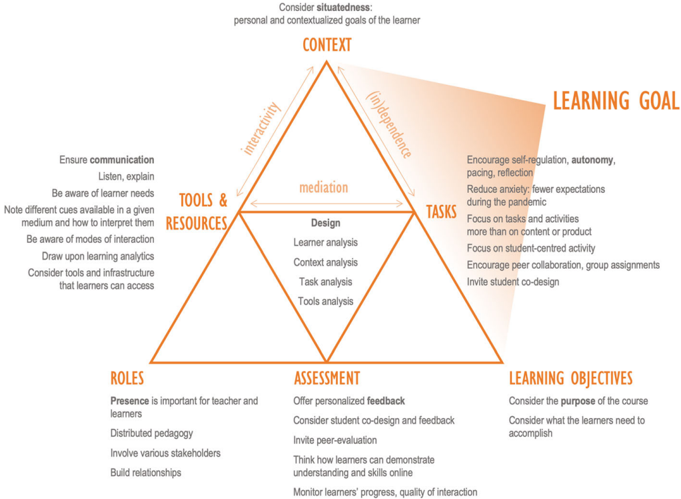
- The four experts argue that online learning should be built around carefully designed learning activities, with a mix of synchronous, asynchronous, online, and offline tasks that are clear, appropriately difficult, authentic, and accessible to students.
- They propose a tripartite teaching presence for online courses: cognitive presence, social presence, and facilitatory presence.
- Successful online learning requires students not to feel alone, and it benefits from timely feedback, peer collaboration, and student co-design/co-configuration of activities.
- The paper states that continuous assessment is needed in online learning, and suggests self-reflections, portfolios, self-paced asynchronous activities, and use of learning analytics as part of evaluation.
Methods
- Exploratory qualitative study using expert interviews administered by e-mail.
- Sample: 4 online pedagogy experts/co-authors, selected for research expertise, more than a decade of online teaching experience, and experience across different national education systems; they worked in Switzerland, Australia, Spain, and Canada.
- Main analysis: the first author organized the responses into a panel-like article, then the authors jointly revised and synthesized the material; the discussion summarizes themes under learning design, teacher presence, and assessment.
Limitations
- The paper states that all four experts came from “rich parts of the world” (Switzerland, Canada, Australia, and North of Spain), which limits the lens to a “monofocal” view of educational reality.
- The paper itself says the study used a heuristic method based on expert viewpoints and “by no means can replace rigorous, systematic research” following the scientific method.
- Evident from the text: the sample is very small (4 experts) and highly selected, so the findings are expert-opinion guidance rather than generalizable empirical results.
Model-written summary. Check it against the paper before relying on it.
Integrity signals
Registry
Cites
Statistics
Figures
Verification
Claims the paper makes
5 Valid · 0 Not valid · 32 Not checked · 24 Own results and interpretations
The sources with a verdict support this claim; the rest weren’t checked yet, have no full text we could read, or their verdicts aren’t rated yet.
In the paper
“On top of that, a significant challenge for university teachers has been their lack of the pedagogical content knowledge (PCK) (Shulman 1987) needed for teaching online (Angeli and Valanides 2005; Kali, Goodyear and Markauskaite 2011; Ching, Hsu and Baldwin 2018).”
§ Springer Nature Switzerland AG 2020 Published online: 7 July 2020 > Introduction
What the sources say
- Supportedcites Shulman 1987 matched to “Knowledge and teaching: Foundations of the new reform” (1987) source
The parenthetical (Shulman 1987) is attached to the term 'pedagogical content knowledge (PCK)' — an identification citation — while the online-teaching studies are credited to Angeli & Valanides, Kali et al. and Ching et al. Our copy (the Portuguese edition of Shulman's 1987 Harvard Educational Review article) establishes exactly that concept: the 'Categorias da base de conhecimento' section lists 'conhecimento pedagógico do conteúdo' as one of the categories of the knowledge base for teaching, 'esse amálgama especial de conteúdo e pedagogia que é o terreno exclusivo dos professores', and the 'Novas compreensões' section calls it 'a categoria que melhor distingue a compreensão de um especialista em conteúdo daquela de um pedagogo'. The paper itself says nothing about online teaching or about university teachers lacking PCK, but that part of the sentence is not attributed to this source. (LLM, conf=0.85)
- Not checked — no full text of the sourcecites Angeli and Valanides 2005 matched to “Preservice elementary teachers as information and communication technology designers: an instructional systems design model based on an expanded view of pedagogical content knowledge” (2005) source
- Could not verifycites Ching, Hsu and Baldwin 2018 matched to “Online Course Design and Development among College and University Instructors: An Analysis using Grounded Theory” (2018) sourceExperimental — accuracy not yet measured
Our copy of Baldwin, Ching & Friesen (2018) never mentions pedagogical content knowledge, PCK, Shulman, or TPACK; searches for 'pedagogical content knowledge PCK online teaching', 'TPACK technological pedagogical content knowledge', 'Shulman pedagogical content knowledge Angeli Valanides' and 'challenge lack of knowledge training online instructors pedagogy' returned only the References list and design-process passages. The paper's content is a grounded-theory account of how 14 four-year-institution instructors design online courses (Abstract; Results themes; Discussion mapping to ADDIE), and its nearest statements — that instructors 'must develop new curriculum with instructional strategies effective for online learning' (Discussion) and 'rarely use formal instructional design models' (Results) — concern design practice, not a PCK deficiency framed as a significant challenge. Nothing in our copy either states or contradicts the attributed claim. (LLM, conf=0.72)
plain- Asserted: passes — The authors put it forward as true.
- Checkable: passes — It can be checked against evidence.
- Load-bearing: passes — The paper’s conclusions depend on it.
- Based: passes — The paper gives a reason why it holds.
- Supported
The cited sources support only part of this claim — read each source’s verdict below.
In the paper
“Assessment can possibly be considered the most challenging part of the transition to distance learning for an institution used to face-to-face oral or written exam, as the control shift towards the students makes it hardly possible to ensure that students are not cheating (Munoz and Mackay 2019).”
§ Springer Nature Switzerland AG 2020 Published online: 7 July 2020 > Assessment
What the sources say
- Partly supportedcites Munoz and Mackay 2019 matched to “An online testing design choice typology towards cheating threat minimisation” (2019) sourceExperimental — accuracy not yet measured
Split into 2 atoms — 0 confirmed, 2 partially supported, 0 disputed, 0 misattributed, 0 unverifiable. Expand the claim to see per-atom verdicts.
hedgedstates a possible cause- Asserted: passes — The authors put it forward as true.
- Checkable: passes — It can be checked against evidence.
- Load-bearing: unclear — It is unclear whether the paper’s conclusions depend on it.
- Based: passes — The paper gives a reason why it holds.
- Partly supported
A result the paper reports from its own data — it cites no other source for it, so there is none to check. The quote shows it is in the paper.
In the paper
“Our findings point at the design of learning activities with certain characteristics, the combination of three types of presence (social, cognitive and facilitatory) and the need for adapting assessment to the new learning requirements.”
§ Springer Nature Switzerland AG 2020 Published online: 7 July 2020 > Abstract
plainstates an association- Asserted: passes — The authors put it forward as true.
- Checkable: passes — It can be checked against evidence.
- Load-bearing: passes — The paper’s conclusions depend on it.
- Based: passes — The paper gives a reason why it holds.
None of the sources cited for this claim have been checked yet.
In the paper
“What all four experts focus on as a prime ' piece ' of pedagogical knowledge (Kali et al. 2011) is the careful design of activities.”
§ Springer Nature Switzerland AG 2020 Published online: 7 July 2020 > Learning Design
plain- Asserted: passes — The authors put it forward as true.
- Checkable: passes — It can be checked against evidence.
- Load-bearing: unclear — It is unclear whether the paper’s conclusions depend on it.
- Based: passes — The paper gives a reason why it holds.
A result the paper reports from its own data — it cites no other source for it, so there is none to check. The quote shows it is in the paper.
In the paper
“Inspired by Anderson et al. ' s (2001) understanding of teaching presence and how it can be re-conceived in the current Covid-19 situation in which educators are the designers, the tutors and the evaluators of the learning experience, a tripartite framework emerges from the interviews, with three main sub-presences of the teaching presence, namely:”
§ Springer Nature Switzerland AG 2020 Published online: 7 July 2020 > Teacher Presence
plain- Asserted: passes — The authors put it forward as true.
- Checkable: passes — It can be checked against evidence.
- Load-bearing: passes — The paper’s conclusions depend on it.
- Based: passes — The paper gives a reason why it holds.
5 more claims
Create a free account to see all 61 claims and to verify the 9 references still open.
- Probably not a substantial claim. 50
- It may state two separate claims as one. 18
Claims other papers make about this one
Each is checked against this paper’s own text: does it say what the citing paper says it does?
The source backs part of the claim, not all of it — or backs it for a different population, condition or comparison.
In the citing paper
“while it is known that for learning success, input formats usually depend on both attention and interest from the students (Rapanta et al., 2020).”
From Impact of Synchronous and Asynchronous Settings of Online Teaching and Learning in Higher Education on Students' Learning Experience During COVID-19 (2021) · cites this paper as Rapanta et al., 2020
Experimental — accuracy not yet measuredIn the citing paper
“Evaluating AI applications could be beneficial for enhancing their motivation and interest in teaching with AI [40].”
From Developing AI Literacy for Primary and Middle School Teachers in China: Based on a Structural Equation Modeling Analysis (2022) · cites this paper as [40]
Citations
Cites
The Reflective Practitioner: How Professionals Think in Action
Checkoway, B., & Schon, D. A. (1985) · Journal of Policy Analysis and Management · doi:10.2307/3324262 · Cited by 21,268
The reflective practitioner: How professionals think in action
Stewart, C. J. (1984) · Patient Education and Counseling · doi:10.1016/0738-3991(84)90022-3 · Cited by 19,752
Knowledge and teaching: Foundations of the new reform
Shulman, L. (1987) · Harvard Educational Review · doi:10.17763/haer.57.1.j463w79r56455411 · Cited by 16,787
Phenomenological research methods
Moustakas, C. (1994) · doi:10.4135/9781412995658 · Cited by 13,919 · cited 1×
“’ This study ’ s participants, i.e. the four online pedagogy experts, also functioned as co-researchers, following Moustakas ’ (1994) idea (l).”
BackgroundDetermining Validity in Qualitative Inquiry
Creswell, J. W., & Miller, D. L. (2000) · Theory Into Practice · doi:10.1207/s15430421tip3903_2 · Cited by 9,184
Speech Genres and Other Late Essays
Bakhtin, M. M. (1986) · University of Texas Press eBooks · doi:10.7560/720466 · Cited by 8,470
The Difference between Emergency Remote Teaching and Online Learning
Hodges, C. B., Moore, S., Lockee, B. B., Trust, T., & Bond, M. A. (2024) · Handbook of Research in Online Learning · doi:10.1163/9789004702813_021 · Cited by 6,253
Blended learning: Uncovering its transformative potential in higher education
Garrison, D. R., & Kanuka, H. (2004) · The Internet and Higher Education · doi:10.1016/j.iheduc.2004.02.001 · Cited by 4,849
Speech Genres and Other Late Essays
Melaver, M., Bakhtin, M. M., McGee, V. W., Emerson, C., & Holquist, M. (1987) · Poetics Today · doi:10.2307/1772598 · Cited by 3,185
ASSESSING TEACHING PRESENCE IN A COMPUTER CONFERENCING CONTEXT
Anderson, T., Rourke, L., Garrison, R., & Archer, W. (2001) · Online Learning · doi:10.24059/olj.v5i2.1875 · Cited by 1,885
Research works printed but not linked: 2
- Bates, A. W. (2019). Teaching in a digital age. 2nd Edition. Vancouver: Tony Bates Associates. https://pressbooks.bccampus.ca/teachinginadigitalagev2/. Accessed 15 June 2020.
- Shor, I., & Freire, P. (1987). A pedagogy for deliberation: dialogues on transforming education . Westport: Bergin & Garvey Publishers.
Cited by
Items 1,101–1,200 of 2,106
Park, K. H., Li, H., & Liu, C. (2023) · Journal of Applied Research in Higher Education · doi:10.1108/jarhe-09-2022-0292 · Cited by 2
Kangkha, P., Gomez, T., Choopun, J., & Boonto, S. (2023) · Asia Social Issues · doi:10.48048/asi.2023.258992 · Cited by 2
Development of Authentic Assessment in Islamic Religious Education in Elementary School
Baroroh, U., & Hamani, T. (2022) · Nazhruna Jurnal Pendidikan Islam · doi:10.31538/nzh.v5i3.2380 · Cited by 3
Synchronous computer-mediated communication in pronunciation teaching: A survey study
Vázquez, L. Q. (2022) · Revista de Estilos de Aprendizaje · doi:10.55777/rea.v15iespecial.4431 · Cited by 2
Different domiciles in online learning during the COVID-19 pandemic
Ahadin, Safiah, I., Yunus, M., Suartama, I. K., Solehudin, M., & Hastuti, W. D. (2023) · Journal of Education and e-Learning Research · doi:10.20448/jeelr.v10i3.4725 · Cited by 7
Brunel, B., Martin, J. G., & Fang, W. (2023) · Lingeduca Journal of Language and Education Studies · doi:10.55849/lingeduca.v1i2.47 · Cited by 4
“…is learning that is carried out with the help of the internet both simultaneously and asynchronously which provides opportunities for student interaction with learning resources, both educators/environment and peers without any space and time limitations and is more flexible (Rapanta, 2020).”
BackgroundInfluentialYu, B., & Zadorozhnyy, A. (2023) · Technology Knowledge and Learning · doi:10.1007/s10758-023-09668-4 · Cited by 3
“Although “online learning” may have diverse definitions, it generally involves “learning that is mediated by the Inter-net” unlike traditional learning in classrooms (Rapanta et al., 2020, p. 2).”
FEATURES OF PERSONALITY-CENTERED LEARNING TECHNOLOGIES
Lysenko, T., Demianenko, O., Tsyna, V., Tsina, A., & Tsurkan, М. (2023) · Conhecimento & Diversidade · doi:10.18316/rcd.v15i37.10969 · Cited by 7
A Review on Effective Open-Source Web-Based Tools to Teach Signals and Systems Course in Online Mode
Aswath, S., Anandan, P., Valarmathi, R. S., et al. (2023) · International Conference on Inventive Research in Computing Applications (ICIRCA) · doi:10.1109/icirca57980.2023.10220708 · Cited by 2
“Teaching style was forced to change during covid and it will remain as it is in post covid times too [5].”
BackgroundZhao, X. (2023) · International Journal of Emerging Technologies in Learning (iJET) · doi:10.3991/ijet.v18i16.42321 · Cited by 5
“Wait, I can’t do that anymore!”: pandemic teacher immediacy in college communication classes
Chatham‐Carpenter, A., & Malone, M. (2023) · Frontiers in Education · doi:10.3389/feduc.2023.1271078 · Cited by 4
Ravindran, L., Lee, K.-F., & Amini, M. (2023) · Springer eBooks · doi:10.1007/978-3-031-38129-4_6 · Cited by 3
Digital Transformation and Academicians’ Well-being: A Cross-National Study
Sharma, S., López-Fernández, A. M., & Sharma, M. (2023) · Global Business Review · doi:10.1177/09721509231195988 · Cited by 4
Penggunaan Media Pembelajaran Yang Efektif Secara Daring pada Mata Pelajaran Rangkaian Listrik
Saseno, S. M., Ridwan, M. M., Alfarizi, M. R., Maulana, M. I., & Zulfikar, L. (2023) · JURNAL EDUNITRO Jurnal Pendidikan Teknik Elektro · doi:10.53682/edunitro.v3i2.6724 · Cited by 3
Changes in Assessment Modality in Saudi Higher Education: Lessons Learnt Post-COVID-19
Mohamed, W., & Almuqayteeb, T. A. (2023) · International Journal of Learning Teaching and Educational Research · doi:10.26803/ijlter.22.9.24 · Cited by 2
Ecopedagogy: Biology Learning Profile Of High School In Pulau Timor
Lestari, N., Paidi, P., & Suyanto, S. (2023) · Journal of Education Culture and Society · doi:10.15503/jecs2023.2.494.511 · Cited by 13
“To accomplish the expected competencies, the curriculum is constructed according to the potential and characteristics of an area as well as the characteristics of students, and the orientation is to provide a valuable learning experience for students (Alismail & McGuire, 2015; Rapanta et al., 2020).”
From face-to-face tuition to online classes: ‘Re-styling’ a course of English for academic purposes
Scott-Monkhouse, A. R. (2023) · Language Learning in Higher Education · doi:10.1515/cercles-2023-2026 · Cited by 3
Susarno, L. H., & Setiawan, B. I. (2023) · World Journal on Educational Technology Current Issues · doi:10.18844/wjet.v15i4.7967 · Cited by 2
Nkambule, B. B., Ngubane, S. A., & Mncube, S. (2023) · Journal of Education Society & Multiculturalism · doi:10.2478/jesm-2023-0018 · Cited by 6
The Features of Students Paying and Not Paying Attention in Online Classes
Hafez, O. F., Nosseir, A., McKee, G. T., & El-Seoud, S. A. (2023) · International Conference on Computer and Applications (ICCA) · doi:10.1109/icca59364.2023.10401506 · Cited by 3
Pratama, F. P., & Raharjo, R. J. H. (2024) · International Journal of Scientific Research and Management (IJSRM) · doi:10.18535/ijsrm/v12i01.em08 · Cited by 3
“Lecturers and students can utilize information and communication technology to support distance learning and research (Al-Mawee et al., 2021; Rapanta et al., 2020).”
BackgroundSofi, S. M., & Selamat, A. (2023) · Malaysian Journal of Information and Communication Technology (MyJICT) · doi:10.53840/myjict8-2-102 · Cited by 9
Mncube, S., Nkambule, B. I., & Ngubane, S. A. (2024) · Mousaion South African Journal of Information Studies · doi:10.25159/2663-659x/15200 · Cited by 4
Limonthy, S., & Madyatmadja, E. D. (2024) · Journal of Computer Science · doi:10.3844/jcssp.2024.276.290 · Cited by 5
IEEE Summer School on Nanotechnology [Column]
Thirmal, C., Kumar, N. V. S., Suresh, G., Chakravarthula, K., Sai, Y. P., & Sivasubramani, S. (2024) · IEEE Nanotechnology Magazine · doi:10.1109/mnano.2023.3340318 · Cited by 2
Bruna, C., Villarroel, V., Sánchez, A., Cortes, J., Castro-Carrasco, P. J., & Conejeros-Solar, M. L. (2024) · Higher Learning Research Communications · doi:10.18870/hlrc.v14i1.1436 · Cited by 3
“It is important to reduce class duration, focus on student learning, and select resources and asynchronous activities that promote self-inquiry, temporal flexibility, and interactive feedback (Gewin, 2020; Rapanta et al., 2020).”
BackgroundChen, K. T.-C. (2024) · Contemporary Educational Technology · doi:10.30935/cedtech/14389 · Cited by 6
Development of a Mouse for Individuals Without Upper Limbs Using Arduino Technology
Gunsha-Morales, A., Chuquimarca, L. E., Pardo, P., et al. (2024) · International Conference on Emerging Trends in Information Technology and Engineering (ICETITE) · doi:10.1109/ic-etite58242.2024.10493246 · Cited by 2
“The right foot is used to press the R pedal for right-click, and the left foot is used to press the L pedal for left-click, as needed [19][20].”
MethodSteyn, R., Antonites, A. J., van der Merwe, A., Merino, A. R., Callaghan, C. W., Boikanyo, D. H., Marques, G., van der Merwe, H., Surujlal, J., Plant, K., et al. (2024) · doi:10.4102/aosis.2024.bk454 · Cited by 4
Gyamerah, K., Asamoah, D., Baidoo-Anu, D., Quainoo, E. A., Amoateng, E. Y., & Sasu, E. O. (2024) · Discover Global Society · doi:10.1007/s44282-024-00053-9 · Cited by 2
Badawi, H. (2024) · At-tadzkir Islamic Education Journal · doi:10.59373/attadzkir.v3i2.56 · Cited by 2
Nasution, S. M., Septiawan, R. R., & Ruriawan, M. F. (2024) · Jurnal Pengembangan dan Pengabdian Masyarakat Multikultural · doi:10.57152/batik.v2i1.1205 · Cited by 2
Mosleh, S. M., Kasasbeh, M. A. M., Alrimawi, I., Sawalha, M., Elshatarat, R. A., Saifan, A. R., Azizeh, S., Yacoub, M. I., Eltayeb, M. M., & Mohamed, N. A. (2024) · Journal of Education and Health Promotion · doi:10.4103/jehp.jehp_49_24 · Cited by 3
“[2,25] To delve deeper into the cultural and contextual factors influencing online teaching readiness, future research should extend beyond the UAE.”
BackgroundManamela, L. E., Sumbane, G. O., Mutshatshi, T. E., Ngoatle, C., & Rasweswe, M. M. (2024) · African Journal of Health Professions Education · doi:10.7196/ajhpe.2024.v16i3.1299 · Cited by 3
“[22,23] This is supported by another study’s findings, which indicate that the use of various online teaching platforms by lecturers, especially unapproved ones, negatively impacted the students.”
ResultUnveiling Students’ Views on Librarians as Teachers in Virtual Library Instruction Sessions
Anna, N. E. V., Harisanty, D., Cahyani, I. R., Harumiaty, N., & Kaur, K. (2024) · Internet Reference Services Quarterly · doi:10.1080/10875301.2024.2391844 · Cited by 2
“In contrast, virtual instruction offers flexibility and accessibility, allowing for a broader reach but can suffer from technical challenges and a lack of physical presence, which can impact engagement and interaction (Rapanta et al., 2020).”
Iaaly, A., Daou, P., Nakad, M., & Abboud, R. (2024) · Education and Information Technologies · doi:10.1007/s10639-024-13078-z · Cited by 3
“The pandemic imposed the use of e-assessment across the world (Fitriyah & Jannah, 2021; Pokhrel & Chhetri, 2021; Rapanta et al., 2020).”
Zhu, J., Yang, Z., Yin, Y., & Fang, W. (2024) · Biochemistry and Molecular Biology Education · doi:10.1002/bmb.21867 · Cited by 7
“6,7 8 – 10 In the context of food biotechnology education, multimedia resources have shown promise in enhancing student understanding of complex concepts.”
Gamble, J. H., Li, H.-M., Liao, X.-L., Cao, C.-H., Chen, X.-M., & Chen, I. (2024) · Scientific Reports · doi:10.1038/s41598-024-79418-8 · Cited by 2
Sánchez-Martínez, C., Carrera, S. M., Carrera, I. M., & Fernandez, A. (2025) · Social Sciences · doi:10.3390/socsci14020078 · Cited by 4
Chopra, K. (2025) · Cogent Education · doi:10.1080/2331186x.2025.2458698 · Cited by 3
“It is argued that this has an impact on student participation in the learning process and, consequently, their attainment of learning outcomes (Rapanta et al., 2020).”
Mohebi, L. (2025) · Lecture notes in educational technology · doi:10.1007/978-981-96-4952-5_8 · Cited by 6
Immersive Educational Pedagogy Development: Cloud-Based Adaptive System for Higher Education
Waliu, A. O., Matthew, U. O., Oseni, V. E., Oyekunle, D. O. T., Oladipupo, M. A., Adekunle, T. S., Chukwuebuka, E. S., & Esseme, A. C. B. (2025) · Advances in computational intelligence and robotics book series · doi:10.4018/979-8-3693-5623-4.ch008 · Cited by 3
Sağıroğlu, N., Uzunboylu, H., Akçamete, G., & Demirok, M. S. (2025) · Applied Sciences · doi:10.3390/app15105326 · Cited by 14
Teaching in the Digital Era: Teachers’ Adaptation in an Entirely Online World
Sanasintani, S. (2025) · Edutech Journal. · doi:10.62872/3gra3v08 · Cited by 4
Morán-Mirabal, L. F., Güemes-Frese, L. E., Favarony-Avila, M., et al. (2025) · Data · doi:10.3390/data10070103 · Cited by 2
The Effectiveness of AI at Rumor Correction During Crisis: Digital Media Perspective
Habes, M., & alasal, N. A. (2025) · Studies in computational intelligence · doi:10.1007/978-3-031-89175-5_32 · Cited by 3
Artificial Intelligence (AI) Literacy as a Pathway for School Teachers' Professional Development
Sagheem, M., Jan, N., Hassan, S., & Tariq, M. N. (2025) · BTTN Journal · doi:10.61732/bj.v4i1.180 · Cited by 6
Students’ Perspectives on Social Sustainability: Developing an Integrated Higher Education Framework
Gheorghe, I.-R., Drakou, A., Ioachim, M. F., & Gheorghe, C.-M. (2025) · Education Sciences · doi:10.3390/educsci15101332 · Cited by 4
Marinelli, A., Bonetti, S., & Orecchia, D. (2021) · EDULEARN proceedings · doi:10.21125/edulearn.2021.0738 · Cited by 2
Perception of Students in Online Test in Engineering: Case of NMIMS University
Sharma, A., Konar, K., Sanghvi, K. A., Churi, P. P., & Rao, N. T. (2021) · International Conference on Communication Information and Computing Technology (ICCICT) · doi:10.1109/iccict50803.2021.9510072 · Cited by 3
Thielsch, A. (2021) · MedienPädagogik Zeitschrift für Theorie und Praxis der Medienbildung · doi:10.21240/mpaed/40/2021.11.14.x · Cited by 2
COVID-19: the Shift to E-learning - Student’s Perception and Outlooks
MARGHESCU, C. I., Drumea, A., Pantazicӑ, M., et al. (2021) · IEEE International Symposium for Design and Technology in Electronic Packaging (SIITME) · doi:10.1109/siitme53254.2021.9663659 · Cited by 2
“7: Answer distribution to the statement “The online labs were effective and helped me learn better” where (1) Strongly disagree, (2) Disagree, (3) Neither agree nor disagree, (4) Agree, (5) Strongly agree”
BackgroundMethodInfluentialReginaldo, A., & CHING, D. A. (2021) · International Journal of Educational Management and Development Studies · doi:10.53378/352076 · Cited by 2
Students’ Concept Construction Errors In Online Learning
Sihite, J., Wyrasti, A. F., & Irnandi, I. (2022) · JTAM (Jurnal Teori dan Aplikasi Matematika) · doi:10.31764/jtam.v6i1.5337 · Cited by 3
“This learning activity can be done by combining various methods, both synchronous and asynchronous with various combinations of active and cooperative learning methods ( Rapanta et al., 2020; Lin et al., 2017).”
MethodCALL Pedagogical Training: An Analysis of Online Language Teacher Education
Pham, D. H. (2022) · Advances in educational technologies and instructional design book series · doi:10.4018/978-1-6684-4446-7.ch018 · Cited by 2
Student Perspectives on On-site versus Online Teaching throughout the Covid-19 Pandemic
Jónsson, B. Þ., Pischetola, M., Inie, N., Daniels, M., & Brabrand, C. (2022) · IEEE Frontiers in Education Conference (FIE) · doi:10.1109/fie56618.2022.9962707 · Cited by 3
“Rapanta et al. [23] studied online/on-site teaching in the Covid-19 situation with teacher interviews and qualitative data analysis.”
BackgroundHimmah, E. F., & Kaestria, R. (2022) · NUMERICAL Jurnal Matematika dan Pendidikan Matematika · doi:10.25217/numerical.v6i1.1625 · Cited by 7
How E-Working Is Effective in Education: Observable Determinants and Challenges
Sinha, M., Yadav, R., & Kishore, M. (2023) · Advances in human resources management and organizational development book series · doi:10.4018/978-1-6684-6745-9.ch013 · Cited by 2
Teacher Resilience During the Pandemic
Fathayatih, S., ., S., & Yamtinah, S. (2023) · KnE Social Sciences · doi:10.18502/kss.v8i2.12750 · Cited by 5
Deta, U. A., Laeliyah, I., Lestari, N. A., Yantidewi, M., Jauhariyah, M. N. R., & Prahanı, B. K. (2023) · AIP conference proceedings · doi:10.1063/5.0141367 · Cited by 2
Dikilitaş, K., & Rambla, X. (2022) · University of Stavanger eBooks · doi:10.31265/usps.257 · Cited by 7
Pembelajaran Selama Pandemi Covid-19: Kesiapan Belajar Daring dan Stress Akademik pada Mahasiswa
Najib, K. H., Alvianto, A., Hidayatullah, A. S., & Ardhian, T. (2022) · Jurnal Imiah Pendidikan dan Pembelajaran · doi:10.23887/jipp.v6i2.42959 · Cited by 8
Egbue, O., Al-Hammoud, R., & Khan, A. A. (2024) · ASEE Annual Conference & Exposition · doi:10.18260/1-2--41131 · Cited by 4
Using Padlet to Improve Students' Personal Letter-Writing Skills
Ferawati, N., Baa, S., & Asma, N. (2022) · ETDC Indonesian Journal of Research and Educational Review · doi:10.51574/ijrer.v1i4.353 · Cited by 2
“Another difficulty in changing in the new normal era from conventional learning to online learning is that even though the teacher has given a tutorial, sometimes the participants understand the practice more directly face-to-face (Dhawan, 2020; Rapanta et al., 2020).”
BackgroundEvaluation of emergency remote teaching during covid-19 lockdown in a Spanish university
Gómez-Calderon, K. C., Blanco, C., Gutiérrez, Í., Serrano, N. A., Santos, J., & Sanchez, G. (2022) · Journal of University Teaching and Learning Practice · doi:10.53761/1.19.5.6 · Cited by 5
Sandarenu, K. (2021) · International Journal of Research Publications · doi:10.47119/ijrp100711220211753 · Cited by 2
Intentional Teaching: Building Resiliency and Trauma-Sensitive Cultures in Schools
Williams, C. (2021) · IntechOpen eBooks · doi:10.5772/intechopen.96571 · Cited by 3
Communicating Compassion in Pedagogy: Lessons From COVID-19
Meluch, A. L., & Hannah, M. (2021) · Advances in educational technologies and instructional design book series · doi:10.4018/978-1-7998-7000-5.ch001 · Cited by 4
Peters, M. A., & Jandrić, P. (2021) · Educational Philosophy and Theory · doi:10.1080/00131857.2021.1929170 · Cited by 2
“This brings about a rise in optimism about human nature (Green, 2020), as well as the importance of formal education (Rapanta et al., 2020), public pedagogy (including the fight against fake news) (Rose, 2020), and many other public functions.”
BackgroundThe Role of Mobile Applications in Learning Arabic-Indonesian Translation
Yusuf, K. (2021) · Journal of Physics Conference Series · doi:10.1088/1742-6596/1933/1/012024 · Cited by 4
“Teaching and learning translation also applied in face-to-face lecturing in class [3], [4].”
BackgroundOnline Teachers: Stepping out of the Comfort Zone Is a Must
Abdelhadi, A. (2021) · Scientific Journal of King Faisal University Humanities and Management Sciences · doi:10.37575/h/lng/210034 · Cited by 4
Westermann, F., Doll, L., Duprés, M., Späth, S., & Schweizer-Ries, P. (2021) · Journal of Work-Applied Management · doi:10.1108/jwam-03-2021-0023 · Cited by 6
Assessing Grammar in Online Environment: A Comparison between High and Low-Stakes Test Performance
Prodanović, M., & Gavranović, V. (2021) · Društvene i humanističke studije · doi:10.51558/2490-3647.2021.6.3.265 · Cited by 2
Teaching English Pronunciation Online during the COVID-19 Crisis Outbreak
Vázquez, L. Q. (2021) · International Conference on Higher Education Advances (HEAd) · doi:10.4995/head21.2021.12906 · Cited by 3
A Systematic Review of Online Learning during COVID-19 Crisis: An Indian Experience
Bhat, R. A., Kumar, S., Najar, A. A., & Deshpande, A. (2021) · Scholedge International Journal of Multidisciplinary & Allied Studies · doi:10.19085/sijmas080301 · Cited by 2
“On the other side in a study Rapanta et al. (2020) have concluded that in the Covid-19 emergency situation, teachers have, almost overnight, been asked to become both designers and tutors, using tools that few have fluently mastered.”
BackgroundAdhiono, B., & Purnomo, E. (2021) · International Conference on Sports, Health, and Physical Education (ISMINA) · doi:10.4108/eai.28-4-2021.2312242 · Cited by 2
“For instance, before the inception of the pandemic in the year 2020 and previously, in physical education, learning allowed for direct and face-to-face communication/interaction and also facilitate the freedom to learn individually or in groups [2].”
BackgroundFaculty Member Employment of Online Platforms: Challenges in Light of the COVID-19 Pandemic
Abedmoneim, R. A. (2021) · International Journal of Smart Education and Urban Society · doi:10.4018/ijseus.291709 · Cited by 2
Bader, S. A. (2021) · International Education Studies · doi:10.5539/ies.v14n12p152 · Cited by 3
“The results also show IN2 received a low score in the teaching and support category, which Rapanta et al. (2020) believed to be the essence of effective online teaching.”
BackgroundResultInfluentialExploring the Online EFL Classroom Ecology of Middle Schools During the COVID-19 Lockdown
Zhao, S., Zhang, L., & Chen, Y. (2022) · Theory and Practice in Language Studies · doi:10.17507/tpls.1201.08 · Cited by 2
“Online learning is based on the use of electronic equipment or network-based training facilities (Rapanta et al., 2020; Sangrà et al., 2012; Sharma & Kitchens, 2004).”
BackgroundMobilidade internacional em tempos de pandemia
Cunha, J. D. N. F., de Mello, I. C., & Akkari, A. (2022) · Revista Prática Docente · doi:10.23926/rpd.2022.v7.n1.e006.id1376 · Cited by 2
Mitchell, M., Gill, C., & Brodmerkel, S. (2022) · Student Success · doi:10.5204/ssj.2146 · Cited by 3
Lu, H. (2022) · Cambridge Journal of Education · doi:10.1080/0305764x.2022.2044759 · Cited by 4
Quro, Q., & Choiriyah, C. (2022) · Journal of Early Childhood Education (JECE) · doi:10.15408/jece.v3i2.22202 · Cited by 2
Bureš, M., Ripka, V., Buresova, K., Frajták, K., Maha, J., & Činátl, K. (2022) · Sustainability · doi:10.3390/su14063631 · Cited by 12
Evaluating the Online Learning Experience at Higher Education Institutions
Abdel‐Salam, A. G., Hazaa, K. A., & Abu-Shanab, E. A. (2022) · International Journal of Cyber Behavior Psychology and Learning · doi:10.4018/ijcbpl.298692 · Cited by 7
Fathoni, A. B., Zulfa, N., & Hidayat, I. N. (2022) · Journal An-Nafs Kajian Penelitian Psikologi · doi:10.33367/psi.v7i1.2049 · Cited by 7
“Besides, the online lecture experience can add to student readiness to face the changes in the lecture system (Rapanta et al., 2020).”
BackgroundTownsend, D., Wilson, K. F., & Harvey, M. (2022) · Journal of Higher Education Policy and Management · doi:10.1080/1360080x.2022.2089802 · Cited by 2
Is the Emergency Distance Teaching Experience Different in Postgraduate Programs? Students' Voices
Alharbi, A. A. (2022) · International Journal of Online Pedagogy and Course Design · doi:10.4018/ijopcd.302084 · Cited by 3
Online teaching in Serbia and the Republic of Srpska at the COVID-19 outbreak: Teachers' experiences
Škobo, M. (2022) · Bastina · doi:10.5937/bastina32-35936 · Cited by 4
Sp, E. F. J., Sholeh, M., & Hermanto, F. Y. (2021) · Dinamika Pendidikan · doi:10.15294/dp.v16i2.30165 · Cited by 2
“In addition, this will spur distance learning to be even better after the pandemic period ends (Berry, 2020; Chaeruman, 2020; Mseleku, 2020; Rapanta et al., 2020; Wilatikta, 2020).”
BackgroundGiovani, S., Jameelah, M., Puteri, N. E., et al. (2022) · JURNAL Al-AZHAR INDONESIA SERI HUMANIORA · doi:10.36722/sh.v7i2.997 · Cited by 2
“'' Online University Teaching During and After the Covid-19 Crisis: Refocusing Teacher Presence and Learning Activity". pp. 2(3), 923- 945, 2020,. [6] [Online]. https://survey.spadadikti.id/ [7] R. T. A. N., Indrayati, A., Sanjoto, T.”
BackgroundInfluentialReadiness for Online Learning During Covid-19 Pandemic in the Vocational Education
Fakultas Pendidikan Teknologi dan Kejuruan, U. P. I., Muktiarni, M., Ana, A., Fakultas Pendidikan Teknologi dan Kejuruan, U. P. I., Barliana, M. S., Fakultas Pendidikan Teknologi dan Kejuruan, U. P. I., Saleh, I., Fakultas Pendidikan Teknologi dan Kejuruan, U. P. I., Mulyadi, Y., Fakultas Pendidikan Teknologi dan Kejuruan, U. P. I., et al. (2022) · Journal of Engineering Education Transformations · doi:10.16920/jeet/2022/v35is2/22118 · Cited by 4
Effectiveness of blended learning technologies in higher educational institutions
Volodavchyk, V., Вакал, А. О., Bielova, V., Vakal, A. O., Bielova, V., Netreba, M. M., & MONKE, O. (2022) · Journal for Educators Teachers and Trainers · doi:10.47750/jett.2022.13.03.018 · Cited by 7
Online Learning: Problems Experienced by Students in Educational Supervision Courses
Peliza, R., & Pohan, M. M. (2022) · AL-ISHLAH Jurnal Pendidikan · doi:10.35445/alishlah.v14i3.1945 · Cited by 2
“The term "online learning" refers to learning over the internet (Rapanta et al., 2020).”
BackgroundRazak, A. A., Latif, S. F. A., Rusdi, F. A., Mubarak, M. Z., Daud, B. C., Mohamed, A. A. R., Kurniawan, Y., Lukman, Z. M., Ijon, R., Yusuff, N. A., et al. (2022) · International Journal of Learning Teaching and Educational Research · doi:10.26803/ijlter.21.9.19 · Cited by 7
“It is also important to identify related components that should be highlighted in the assessment process such as the social, cognitive, and facilitatory elements (Rapanta et al., 2020).”
BackgroundImproving Measurement of Effectiveness of Blended Learning in Iraqi Education Using SVM
Hussein, R. R. A., & Najeeb, H. D. (2022) · Iraqi Journal of Science · doi:10.24996/ijs.2022.63.9.34 · Cited by 2
“The internet has generated new habits and routines of life as a result of the social separation and isolation required to prevent the epidemic from spreading [4][5].”
BackgroundHazel, L. L., & Lyndon, A. Q. (2022) · American Journal of Multidisciplinary Research and Innovation · doi:10.54536/ajmri.v1i4.722 · Cited by 7
“Wild, wild west” or program administration? Traversing politics as writing administrators
Miner, R. (2022) · Computers & composition/Computers and composition · doi:10.1016/j.compcom.2022.102737 · Cited by 2
Remote Online Education in Undergraduate Mathematics: Students’ Perspectives
Tatira, B. (2022) · E-Journal of Humanities Arts and Social Sciences · doi:10.38159/ehass.2022sp3116 · Cited by 2
Metadata
- Authors
- Rapanta, C., Botturi, L., Goodyear, P., Guàrdia, L., & Koole, M.
- Affiliations
- Universidade Nova de Lisboa (PT)
- University of Applied Sciences and Arts of Southern Switzerland (CH)
- The University of Sydney (AU)
- University of Saskatchewan (CA)
- Corresponding author
- Rapanta, Chrysi
- ORCID
- Rapanta, Chrysi
- Venue
- Postdigital Science and Education
- Published
- 2020-07-07
- Volume
- 2
- Issue
- 3
- Pages
- 923-945
- ISSN
- 2524-485X (ISSN-L)
- 2524-4868
- PMC
- PMC7339092
- OpenAlex
- W3042009104
- Semantic Scholar
- fed495af71b417de8d60cf16b6da44926faf24a0
- Cited by
- 2,130
- References
- 75
- Citations by year
- 2026: 134 · 2025: 158 · 2024: 261 · 2023: 426 · 2022: 556 · 2021: 509 · 2020: 73
- FWCI
- 454.18
- Type
- journal article
- Language
- en
- Open access
- hybrid
- doi.org
- Licence
- other-oa
- www.springer.com/tdm (tdm)
- www.springer.com/tdm (vor)
- Locations
- Postdigital Science and Education (publishedVersion, other-oa)
- PubMed (publishedVersion)
- PubMed Central (submittedVersion)
- The Sydney eScholarship Repository (The University of Sydney) (submittedVersion)
- Funders
- Fundação para a Ciência e a Tecnologia (DL 57/2016/CP1453/CT0066)
- Australian Research Council (DP150104163)
- Topics
- Social Sciences › Education › Digital Education and Society
- Social Sciences › Education › Higher Education Practises and Engagement
- Social Sciences › Education › Educational Innovations and Technology
- Keywords
- online learning, COVID-19 pandemic, higher education, teacher presence, pedagogical content knowledge, learning activities, social presence, cognitive presence
About these checks
Registry, retraction, Cites and statistics results are computed, not judged, with one exception: a printed reference that no index lists is read once by a model before it counts as a citation error. Claims are extracted by a model and kept only when their quote appears verbatim in the text; each cited source is then checked, with a model’s help, for whether it says what the claim relies on. Those verdicts can be wrong — read the claim’s quote and the cited source before relying on one.
The claim verdicts this report counts are experimental: their accuracy is not yet measured.
A language model drew the claims from the paper on 2026-10-10, under version 3 of the claim definition (model deepseek-v4.1-flash, prompt extract-v3).
A second model labelled each claim on 2026-10-10 (model jev-1.13-20260917, definition revision gold-guideline-v0.2).
Cited sources are checked with a language model’s help (qwen3.8-omni-flash).
Statistics and arithmetic are recomputed, not judged.
Confidence bands are shown only for fields calibrated on our annotated test set. None is calibrated yet, so no band is shown.
What counts as a claim ›How we measure confidence ›How we check this ›
Are you an author, or do you see a problem with this page? Request a review
Data sources
Bibliographic data: Semantic Scholar, OpenAlex, Crossref.
Contains information from the Semantic Scholar Academic Graph Datasets, made available under the ODC Attribution License (ODC-BY 1.0).
Semantic Scholar’s data is described in: Kinney, R., et al. (2023). The Semantic Scholar Open Data Platform. arXiv:2301.10140.
