

Discreteness of area and volume in quantum gravity
Open accessThe DOI matches its Crossref record; 60 of the 63 references it cites were found in a registry or an index; 6 of the 14 sources its claims cite were checked for support.
Abstract
We study the operator that corresponds to the measurement of volume, in non-perturbative quantum gravity, and we compute its spectrum. The operator is constructed in the loop representation, via a regularization procedure; it is finite, background independent, and diffeomorphism-invariant, and therefore well defined on the space of diffeomorphism invariant states (knot states). We find that the spectrum of the volume of any physical region is discrete. A family of eigenstates are in one to one correspondence with the spin networks, which were introduced by Penrose in a different context. We compute the corresponding component of the spectrum, and exhibit the eigenvalues explicitly. The other eigenstates are related to a generalization of the spin networks, and their eigenvalues can be computed by diagonalizing finite dimensional matrices. Furthermore, we show that the eigenstates of the volume diagonalize also the area operator. We argue that the spectra of volume and area determined here can be considered as predictions of the loop-representation formulation of quantum gravity on the outcomes of (hypothetical) Planck-scale sensitive measurements of the geometry of space.
Overview
CoChat Summary
TL;DR
Rovelli and Smolin construct a regularized volume operator in loop-representation quantum gravity and compute its spectrum, finding it discrete. They show spin-network states diagonalize both the volume and area operators, yielding explicit discrete area and volume eigenvalues.
Key findings
- The volume spectrum is discrete. For trivalent spin networks, the eigenvalue for a region \(R\) is \(V = \frac{1}{4} l_P^3 \sum_i \sqrt{a_i b_i c_i + a_i b_i + a_i c_i + b_i c_i}\), where the sum runs over nodes \(i\) contained in \(R\).
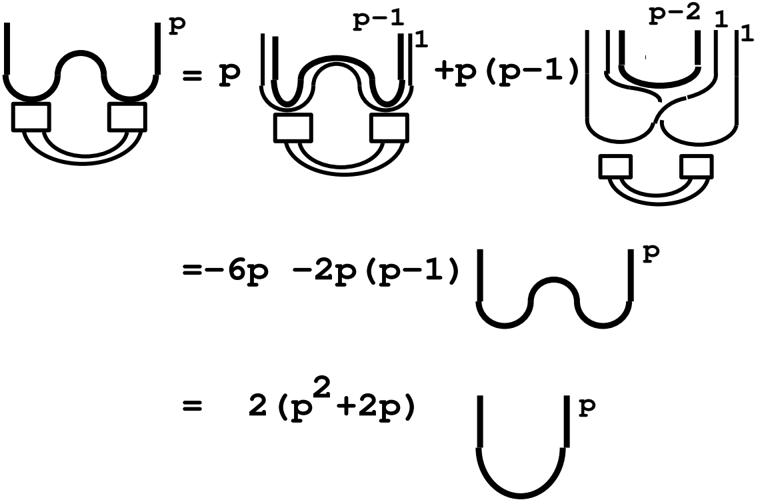
- The full area spectrum is \(A = \frac{1}{2} l_P^2 \sum_l \sqrt{p_l^2 + 2p_l}\), where \(l\) labels spin-network links crossing the surface.
- Spin-network states are eigenstates of the volume operator and also diagonalize the area operator; the two operators commute. Other volume eigenstates are related to a generalization of spin networks, with eigenvalues computable by diagonalizing finite-dimensional matrices.
- The authors argue that, under assumptions about physical fields defining regions and surfaces, Planck-scale measurements of volume or area would yield results in these discrete spectra.
Methods
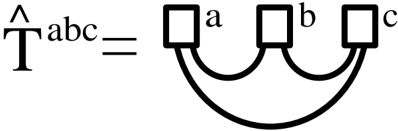
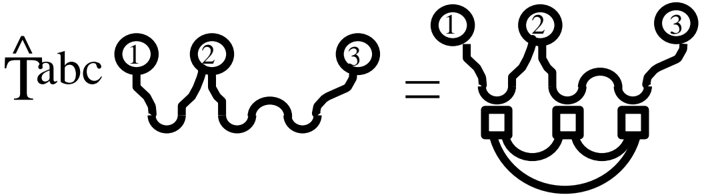
- Theoretical, non-perturbative quantum gravity in the loop representation. The volume operator is constructed via a diffeomorphism-invariant regularization using the three-hand loop observable \(T^{abc}\), partitioning a region into cubic boxes with an arbitrary unphysical flat metric \(g_0\), and taking a weak-operator limit \(L \to 0\).
- The action of the volume operator is computed on the spin-network basis, where spin networks are trivalent graphs with positive integer link colors; the area operator is similarly diagonalized.
- No empirical data are used; the analysis is operator construction and spectral diagonalization.
Limitations
- The paper states that the local operator \(\sqrt{\det g}\) is ill-defined, that the regularization introduces an unphysical background metric \(g_0\) (though the operator is claimed independent of it in the limit), that the topology of the limit is delicate, and that diffeomorphism-invariant states lie in \(D_{\max}\) but not in the domain \(D\). It also notes that consistency of the theory is not proven and that quantization may have more than one solution.
- Evident from the provided text: the excerpt is truncated after the proportionality coefficient, so later sections and full derivation details are not available here. The physical interpretation also relies on assumptions about dynamical matter fields defining spatial regions and surfaces.
Model-written summary of a shortened version of the paper’s full text (it is longer than we read). Check it against the paper before relying on it.
Integrity signals
Registry
Cites
Statistics
Figures

Verification
Claims the paper makes
1 Valid · 4 Not valid · 5 Not checked · 18 Own results and interpretations
The sources with a verdict support this claim; the rest weren’t checked yet, have no full text we could read, or their verdicts aren’t rated yet.
In the paper
“Local quantities tend to be divergent or ill-defined in non-trivial generally covariant quantum field theories [3, 4, 11], a fact likely to be related to the non-renormalizability of the perturbative series.”
What the sources say
- Not checked — no full text of the sourcecites [3] matched to “Loop space representation of quantum general relativity” (1990) source
- Supportedcites [4] matched to “Weaving a classical metric with quantum threads” (1992) source
The Abstract says local operators such as the metric at a point may not be well-defined. The discussion of the local metric operator explains that its renormalization obstructs meaningful local geometric operators and says this appears to be a general feature of diffeomorphism-invariant theories. The claim’s separate suggestion about perturbative non-renormalizability is not the part attributed to this citation. (LLM, conf=0.90)
- Could not verifycites [11] matched to “Link Invariants, Holonomy Algebras and Functional Integration” (1993) sourceExperimental — accuracy not yet measured
The Introduction (pp. 1–2) discusses difficulties defining field-theoretic measures, and p. 4 describes regularized Wilson loops. Neither passage says that local quantities tend to diverge or be ill-defined in non-trivial generally covariant quantum field theories. Searches for local observables, divergences, and renormalization found no passage addressing that claim. (LLM, conf=0.73)
hedgedstates an association- Asserted: passes — The authors put it forward as true.
- Checkable: passes — It can be checked against evidence.
- Load-bearing: passes — The paper’s conclusions depend on it.
- Based: passes — The paper gives a reason why it holds.
The cited sources that could be checked couldn’t confirm or dispute this claim.
In the paper
“note for instance that there are other relevant topologies in state space, as the norm topologies defined by the kinematical or diffeomorphism-invariant Hilbert structures [6, 7], which are inequivalent to the one in which the limit (13) is taken.”
What the sources say
- Could not verifycites [6] matched to “Fermions in quantum gravity” (1994) sourceExperimental — accuracy not yet measured
Section 6.2 (pp. 33–34) uses pointwise topology in a model example about limits on knot states, but says a complete scalar product for the loop representation is not yet available. Neither those passages nor the passages found by searching for Hilbert norm topologies establish kinematical or diffeomorphism-invariant norm topologies, or their inequivalence to the topology used for the cited limit. (LLM, conf=0.72)
- Could not verifycites [7] matched to “Spatial infinity as a boundary of spacetime” (1992) sourceExperimental — accuracy not yet measured
The passages in §4, “Asymptotic symmetries” (page not supplied), discuss equivalence of spacetime completions, not topologies on a state space. Searches for Hilbert norm topologies and inequivalent state-space limits found no passage addressing the attributed claim. (LLM, conf=0.76)
plain- Asserted: passes — The authors put it forward as true.
- Checkable: passes — It can be checked against evidence.
- Load-bearing: unclear — It is unclear whether the paper’s conclusions depend on it.
- Based: passes — The paper gives a reason why it holds.
- Could not verify
A result the paper reports from its own data — it cites no other source for it, so there is none to check. The quote shows it is in the paper.
In the paper
“We find that the spectrum of the volume of any physical region is discrete.”
plain- Asserted: passes — The authors put it forward as true.
- Checkable: passes — It can be checked against evidence.
- Load-bearing: passes — The paper’s conclusions depend on it.
- Based: passes — The paper gives a reason why it holds.
A result the paper states — it cites no source for it, so there is none to check. The quote shows it is in the paper.
In the paper
“An unphysical background metric is introduced for the sake of the regularization, but the operator turns out to be independent of this background, in the limit in which the cut-off is removed.”
plain- Asserted: passes — The authors put it forward as true.
- Checkable: passes — It can be checked against evidence.
- Load-bearing: passes — The paper’s conclusions depend on it.
- Based: passes — The paper gives a reason why it holds.
In the paper
“Furthermore, we show here that the spin network states also diagonalize the operator Â[S], introduced in [3], which measures the area of the surface S.”
What the sources say
- Not checked — no full text of the sourcecites [3] matched to “Loop space representation of quantum general relativity” (1990) source
boostedstates an association- Asserted: passes — The authors put it forward as true.
- Checkable: passes — It can be checked against evidence.
- Load-bearing: passes — The paper’s conclusions depend on it.
- Based: passes — The paper gives a reason why it holds.
12 more claims
Create a free account to see all 28 claims and every source verdict.
- It may state two separate claims as one. 5
- Probably not a substantial claim. 5
- The quote only partly states this claim. 1
Claims other papers make about this one
Each is checked against this paper’s own text: does it say what the citing paper says it does?
The source backs part of the claim, not all of it — or backs it for a different population, condition or comparison.
In the citing paper
“In fact, that is why only volume and area operators could be constructed so far [10, 11].”
From A length operator for canonical quantum gravity (1998) · cites this paper as [10]
Experimental — accuracy not yet measuredThe source backs part of the claim, not all of it — or backs it for a different population, condition or comparison.
In the citing paper
“While the kinematics of loop quantum gravity (LQG) [1] is rather well understood [2, 3], its dynamics is not understood as cleanly.”
From Flipped spinfoam vertex and loop gravity (2008) · cites this paper as [4]
Experimental — accuracy not yet measuredThe source backs part of the claim, not all of it — or backs it for a different population, condition or comparison.
In the citing paper
“This problem arises due to the results obtained for the spectra of the geometrical operators and the black hole entropy being proportional to an unphysical parameter, which is called 'Immirzi parameter' [7] and appears as a parameter of a canonical transformation in classical gravity [8,9].”
From SO (4, C )-covariant Ashtekar-Barbero gravity and the Immirzi parameter (2000) · cites this paper as [9]
Experimental — accuracy not yet measuredThe cited source says what the claim attributes to it.
In the citing paper
“The results reported in this letter are obtained in the framework of quantum geometry [4] which does predict a discrete geometry because, e.g., the spectra of geometric operators as area and volume are discrete [5-7].”
From Absence of a Singularity in Loop Quantum Cosmology (2001) · cites this paper as [5]
The cited source says what the claim attributes to it.
In the citing paper
“Basic geometric quantities have been quantized [10][11][12][13][14] and found to have discrete spectra.”
From Loop quantum cosmology: I. Kinematics (2000) · cites this paper as [10]
17 more claims about this paper
Create a free account to see every claim other papers make about this one.
Citations
Cites
New Variables for Classical and Quantum Gravity
Ashtekar, A. (1986) · Physical Review Letters · doi:10.1103/physrevlett.57.2244 · Cited by 1,663
QUANTUM GRAVITY AND MINIMUM LENGTH
GARAY, L. J. (1995) · International Journal of Modern Physics A · doi:10.1142/s0217751x95000085 · Cited by 1,371
String theory beyond the Planck scale
Gross, D. J., & Mende, P. F. (1988) · Nuclear Physics B · doi:10.1016/0550-3213(88)90390-2 · Cited by 1,249
New Hamiltonian formulation of general relativity
Ashtekar, A. (1987) · Physical Review D · doi:10.1103/physrevd.36.1587 · Cited by 1,119
Quantum gravity and minimum length
Garay, L. J. (1994) · LA Referencia (Red Federada de Repositorios Institucionales de Publicaciones Científicas) · Cited by 881
Loop space representation of quantum general relativity
Rovelli, C., & Smolin, L. (1990) · Nuclear Physics B · doi:10.1016/0550-3213(90)90019-a · Cited by 806
Self-citationThe Hagedorn transition and the number of degrees of freedom of string theory
Atick, J. J., & Witten, E. (1988) · Nuclear Physics B · doi:10.1016/0550-3213(88)90151-4 · Cited by 800
The high-energy behavior of string scattering amplitudes
Gross, D. J., & Mende, P. F. (1987) · Physics Letters B · doi:10.1016/0370-2693(87)90355-8 · Cited by 778
Minimum physical length and the generalized uncertainty principle in string theory
Konishi, K., Paffuti, G., & Provero, P. (1990) · Physics Letters B · doi:10.1016/0370-2693(90)91927-4 · Cited by 753
On the nature of quantum geometrodynamics
Wheeler, J. A. (1957) · Annals of Physics · doi:10.1016/0003-4916(57)90050-7 · Cited by 693
Research works printed but not linked: 1
- Ashtekar, 1994, Quantum geometrodynamics and Coherent state transform on the space of connections, Penn. State University preprints
Cited by
Items 901–1,000 of 1,374
Han, M., Liu, H., & Qu, D. (2025) · Physical review. D/Physical review. D. · doi:10.1103/physrevd.111.024021 · Cited by 9
Quantum Geometry and Black HolesPreprint
Ashtekar, A., & Krasnov, K. V. (1998) · arXiv (Cornell University) · doi:10.48550/arxiv.gr-qc/9804039 · Cited by 39
A spin network generalization of the Jones polynomial and Vassiliev invariants
Gambini, R., Griego, J., & Pullin, J. (1998) · Physics Letters B · doi:10.1016/s0370-2693(98)00182-8 · Cited by 9
Dynamics in canonical models of loop quantum gravityPreprint
Mäkinen, I. (2019) · arXiv (Cornell University) · doi:10.48550/arxiv.1910.00469 · Cited by 9
“The other well-known construction of the volume operator was introduced by Rovelli and Smolin [109] and studied further by De Pietri and Rovelli [65].”
BackgroundMethodInfluentialQuantum Computing SpacetimePreprint
Zizzi, P. (2002) · arXiv (Cornell University) · doi:10.48550/arxiv.gr-qc/0204007 · Cited by 6
“In loop quantum gravity, spin networks are eigenstates of the area and volume-operators [6].”
BackgroundMethodGeneralized uncertainty principle and neutrino phenomenology
Gialamas, I. D., Kärkkäinen, T. J., & Marzola, L. (2024) · Physics Letters B · doi:10.1016/j.physletb.2024.138880 · Cited by 5
Early universe thermostatistics in curved momentum spaces
Gorji, M. A., Hosseinzadeh, V., Nozari, K., & Vakili, B. (2016) · Physical review. D/Physical review. D. · doi:10.1103/physrevd.93.064029 · Cited by 5
Quantum circuit dynamics via path integrals: Is there a classical action for discrete-time paths?
Penney, M. D., Koh, D. E., & Spekkens, R. W. (2017) · New Journal of Physics · doi:10.1088/1367-2630/aa61ba · Cited by 18
“In the quantum context, the fact that it is in principle impossible to resolve spatial distances and times arbitrarily finely [22, 23] and the idea that lengths and times, like other observables in quantum theory, ought to take values in a discrete spectrum [24, 25] also motivate researchers to pursue formulations of…”
BackgroundCosmological dynamics from covariant loop quantum gravity with scalar matter
Han, M., Liu, H., Qu, D., Vidotto, F., & Zhang, C. (2025) · Physical review. D/Physical review. D. · doi:10.1103/physrevd.111.086012 · Cited by 15
“In the large-j regime, the quantum area of a spacelike triangle f is given by Ar f ≃ γj f [30, 31], and Ar f = j f for timelike triangles, assuming the unit is set such that 8 πG ℏ = 1 .”
BackgroundQuantum simulations with nuclear magnetic resonance system*
Qiu, C.-D., Nie, X., & Lu, D. (2021) · Chinese Physics B · doi:10.1088/1674-1056/abe299 · Cited by 5
Towards a background independent approach to M theory
Smolin, L. (1999) · Chaos Solitons & Fractals · doi:10.1016/s0960-0779(98)00206-9 · Cited by 20
“Related to the characterization of the gauge invariant states has been the development of techniques to construct large classes of gauge invariant operators[15, 17].”
BackgroundMethodResultInfluentialSelf-citationA Noncommutative Model of Cosmology with Two Metrics
Falomir, H., Gamboa, J., & Méndez, F. (2020) · Symmetry · doi:10.3390/sym12030435 · Cited by 5
Nozari, K., Saghafi, S., Hajebrahimi, M., & Jusufi, K. (2025) · Physics of the Dark Universe · doi:10.1016/j.dark.2025.102027 · Cited by 21
“Among the different meth-ods approaches to QG proposal, loop quantum gravity (LQG) has shown considerable promise, with major progress achieved (see, for example, [8–15] and the references therein).”
The fermionic contribution to the spectrum of the area operator in nonperturbative quantum gravity
Montesinos, M., & Carlo Rovelli, C. (1998) · CERN Document Server (European Organization for Nuclear Research) · Cited by 5
Self-citationCalculating local and global PDEs by analogic diffusion and wave algorithms
Rekeczky, C., & Roska, T. (2001) · SZTAKI Publication Repository (Hungarian Academy of Sciences) · Cited by 5
Petri, M. (2003) · arXiv (Cornell University) · doi:10.48550/arxiv.gr-qc/0306063 · Cited by 15
“The discovery of area-quantization in loop quantum gravity [26] can be viewed as one of the most important achievements in this field.”
BackgroundOn the Dual Ontological Structure and Mixed Dynamics of the UniversePreprint
Kahan, D. (2024) · Preprints.org · doi:10.20944/preprints202401.0714.v1 · Cited by 9
On the Support of Physical Measures in Gauge TheoriesPreprint
Fleischhack, C. (2001) · arXiv (Cornell University) · doi:10.48550/arxiv.math-ph/0109030 · Cited by 5
“Unfortunately, within the Ashtekar approach we have only two theories at our disposal that are investigated in detail: the quantum gravity (in particular, the canonical quantization [3, 12] and the quantum geometry [17, 59, 60, 8, 9, 10, 48, 4, 74, 77]) and the two-dimensional Yang-Mills theory [73, 13, 35, 36, 75].”
MethodFate of Galilean relativity in minimal-length theories
Bosso, P., Fabiano, G., Frattulillo, D., & Wagner, F. (2024) · Physical review. D/Physical review. D. · doi:10.1103/physrevd.109.046016 · Cited by 7
Degenerate Solutions of General Relativity from Topological Field Theory
Baez, J. C. (1998) · CERN Document Server (European Organization for Nuclear Research) · Cited by 6
SPACE-TIME AT THE PLANCK SCALE: THE QUANTUM COMPUTER VIEW
Zizzi, P. (2006) · Conference on the Foundations of Quantum Mechanics: Historical Analysis and Open Questions · doi:10.1142/9789812773258_0030 · Cited by 6
“In loop quantum gravity, spin networks are eigenstates of the area and volume-operators [17].”
BackgroundCanonical “Loop” Quantum Gravity and Spin Foam Models
Pietri, R. D. (2000) · Springer eBooks · doi:10.1007/978-88-470-2113-6_6 · Cited by 5
“Unfortunately, with the introduction of the volume operator [ RS95a ], it was realized that all the spin network states based on graph γ with all vertices of valence less that 3 are in the kernel of the volume operator.”
BackgroundFrom loop quantum gravity to cosmology: The two-vertex model
Cendal, Á., Garay, I., & Garay, L. J. (2024) · Physical review. D/Physical review. D. · doi:10.1103/physrevd.109.126011 · Cited by 7
“These spin networks are eigenstates of the area and volume operators, which have discrete spectra [3, 4].”
BackgroundOn incomplete statistics and the loop quantum gravity Immirzi parameter
Abreu, É. M. C., Neto, J. A., Barboza, E. M., & Soares, B. B. (2019) · Europhysics Letters (EPL) · doi:10.1209/0295-5075/127/10006 · Cited by 5
Effective Potential in Noncommutative BTZ Black Hole
Sadeghi, J., & Shajiee, V. R. (2015) · International Journal of Theoretical Physics · doi:10.1007/s10773-015-2732-x · Cited by 5
Generalized Uncertainty Principle and Quantum Gravity PhenomenologyPreprint
Bosso, P. (2017) · arXiv (Cornell University) · doi:10.48550/arxiv.1709.04947 · Cited by 33
“In particular, these quantities are integer multiples of elementary Planck area and volume, `Pl and `Pl, respectively [61].”
BackgroundLinear–quadratic GUP and thermodynamic dimensional reduction
Ramezani, H., & Nozari, K. (2024) · Annals of Physics · doi:10.1016/j.aop.2024.169752 · Cited by 5
Gauge symmetries in Ashtekar's formulation of general relativity
Salisbury, D., Pons, J. M., & Shepley, L. C. (2000) · Nuclear Physics B - Proceedings Supplements · doi:10.1016/s0920-5632(00)00792-1 · Cited by 4
Gradenigo, G. (2021) · Foundations of Physics · doi:10.1007/s10701-021-00468-3 · Cited by 5
Profumo, S. (2025) · Physical review. D/Physical review. D. · doi:10.1103/physrevd.111.095010 · Cited by 8
Generating Functionals for Spin Foam AmplitudesPreprint
Hnybida, J. (2014) · arXiv (Cornell University) · doi:10.48550/arxiv.1411.2049 · Cited by 4
“The canonical quantization of Loop Quantum Gravity has had success in constructing a kinematical Hilbert space and deriving the spectra of geometrical operators [86].”
Background‘Third’ Quantization of Vacuum Einstein Gravity and Free Yang–Mills Theories
Raptis, I. (2007) · International Journal of Theoretical Physics · doi:10.1007/s10773-006-9263-4 · Cited by 8
“…the technical symbols, terms, their definitions and associated construction details, direct comparison between (1) and the FYM equation δF(D) = 0 or ∆F(D) = 010 (3) as well as between the Einstein-Hilbert action functional EH and the Y-M one YM on the corresponding affine spaces AA(E) of…”
BackgroundImmirzi ambiguity, boosts and conformal frames for black holes
Garay, L. J., & Marugán, G. A. M. (2003) · Classical and Quantum Gravity · doi:10.1088/0264-9381/20/8/103 · Cited by 6
Bouncing scalar field cosmology in the polymeric minisuperspace picture
Vakili, B., Nozari, K., Hosseinzadeh, V., & Gorji, M. A. (2014) · Modern Physics Letters A · doi:10.1142/s0217732314501697 · Cited by 7
Linking edge modes and geometrical clocks in linearized gravity
Giesel, K., Kabel, V., & Wieland, W. (2025) · Physical review. D/Physical review. D. · doi:10.1103/yrc1-gmql · Cited by 16
“In Subsection IV B, we introduced a specific choice of Lorentz frames to connect the perturbations of the Ashtekar-Barbero variables with the perturbations of the spin connection δω µν := φ ∗ Σ δ ∆ µν .”
Sahlmann, H. (2012) · Cambridge University Press eBooks · doi:10.1017/cbo9780511920998.010 · Cited by 5
Quantization of Measure in Gravitation
Джумакадырович, Д. В., & Folomeev, V. (2023) · Gravitation and Cosmology · doi:10.1134/s0202289323040072 · Cited by 3
“One of the fruitful approaches in quantum gravity is LQG [3, 4], where the spectra of such geometric quantities like the area [5] and volume [6] are calculated.”
BackgroundFive-dimensional mechanics as the starting point for the Magueijo–Smolin doubly special relativity
Rizzuti, B. F., & Deriglazov, A. A. (2011) · Physics Letters B · doi:10.1016/j.physletb.2011.06.078 · Cited by 4
Mathur, S. D. (2010) · International Journal of Modern Physics D · doi:10.1142/s0218271810018530 · Cited by 4
Conformal cores of quantum black holes in quadratic gravity
Liu, R., Quintin, J., & Afshordi, N. (2025) · Physical review. D/Physical review. D. · doi:10.1103/physrevd.111.044031 · Cited by 6
Spin network coherent states for planar gravitational waves. IPreprint
Neville, D. E. (2008) · arXiv (Cornell University) · doi:10.48550/arxiv.0807.1026 · Cited by 3
“ulations which confirm the internal consistency of the formulation, or confirm consistency with established principles. For example, area and volume operators for the theory possess a discrete spectrum [12], in qualitative agreement with the conclusions from thought experiments that lengths smaller than a Planck length…”
ResultLorentz-Covariant Loop Quantum Gravity
Alexandrov, S. Y. (2004) · Theoretical and Mathematical Physics · doi:10.1023/b:tamp.0000029699.54716.0e · Cited by 3
Quasinormal modes and horizon area quantisation in Loop Quantum Gravity
Carneiro, S., & Pigozzo, C. (2022) · General Relativity and Gravitation · doi:10.1007/s10714-022-02905-8 · Cited by 7
Divergences in spinfoam quantum gravityPreprint
Smerlak, M. (2012) · arXiv (Cornell University) · doi:10.48550/arxiv.1201.4874 · Cited by 5
Path Integral Quantization of Volume
Lim, A. P. C. (2020) · Annales Henri Poincaré · doi:10.1007/s00023-019-00882-4 · Cited by 5
“In the quantization of area given in [5], the term √ ξρ+ appeared in the eigenvalues of the area operator.”
BackgroundMethodInfluentialQuantum geometry of the null cone
Wieland, W. (2025) · Physical review. D/Physical review. D. · doi:10.1103/k5vj-61my · Cited by 14
Planck scale effects on the thermodynamics of photon gases
Faruk, M. M., & Rahman, M. M. (2016) · Physical review. D/Physical review. D. · doi:10.1103/physrevd.94.105018 · Cited by 5
Solving the area-length systems in discrete gravity using homotopy continuation
Asante, S. K., & Brysiewicz, T. (2024) · Classical and Quantum Gravity · doi:10.1088/1361-6382/ad6dcc · Cited by 9
Thermodynamics of quantum isolated horizons with model Hamiltonians
Majhi, A. (2013) · Physical review. D. Particles, fields, gravitation, and cosmology/Physical review. D. Particles and fields · doi:10.1103/physrevd.88.024010 · Cited by 4
A review on Loop Quantum GravityPreprint
Casares, P. A. M. (2018) · arXiv (Cornell University) · doi:10.48550/arxiv.1808.01252 · Cited by 17
“However, in the literature, another expression was proposed by Rovelli and Smolin (RS) [25]”
BackgroundSmall-Scale Structure of Spacetime: Bounds and Conjectures
Klinkhamer, F. R., Macías, A., Lämmerzahl, C., & Camacho, A. (2008) · AIP conference proceedings · doi:10.1063/1.2902784 · Cited by 7
“[46] for a calculation in the context of loop quantum gravity and Refs.”
BackgroundAlternative k=−1 loop quantum cosmology
Yang, J., Zhang, C., & Zhang, X. (2023) · Physical review. D/Physical review. D. · doi:10.1103/physrevd.107.046012 · Cited by 8
Loop Quantum Gravity and the Planck Regime of Cosmology
Ashtekar, A. (2014) · Springer eBooks · doi:10.1007/978-3-319-06349-2_16 · Cited by 18
Phenomenological implications of an alternative Hamiltonian constraint for quantum cosmology
Kagan, M. A. (2005) · Physical review. D. Particles, fields, gravitation, and cosmology/Physical review. D. Particles and fields · doi:10.1103/physrevd.72.104004 · Cited by 4
Classical and quantum polyhedra
Schliemann, J. (2014) · Physical review. D. Particles, fields, gravitation, and cosmology/Physical review. D. Particles and fields · doi:10.1103/physrevd.90.124080 · Cited by 3
Basis states for gravitons in non-perturbative loop representation spacePreprint
Iwasaki, J. (1998) · arXiv (Cornell University) · doi:10.48550/arxiv.gr-qc/9807013 · Cited by 6
“This is a physical picture emerging from the non-perturbative loop representation space in addition to other physical aspects [21, 22, 23, 24, 25, 26].”
BackgroundQuantized Curvature in Loop Quantum Gravity
Lim, A. P. C. (2018) · Reports on Mathematical Physics · doi:10.1016/s0034-4877(19)30007-2 · Cited by 5
“1 Quantization of curvature In the quantization of area and volume as done in [17], they used canonical quantization on the dynamical Ashtekar variables to derive area and volume operators.”
MethodThe time evolution of quantum universes in the quantum potential picture
Błaut, A., & Kowalski-Glikman, J. (1998) · Physics Letters A · doi:10.1016/s0375-9601(98)00410-1 · Cited by 4
Lawson, L. M. (2022) · Scientific Reports · doi:10.1038/s41598-022-21098-3 · Cited by 4
“It is well known that the existence of minimal uncertainties in quantum mechanics induces among other consequences [14, 15, 16, 17, 18] a non Hermicity of some operators that generate the corresponding Hilbert space [6, 19, 20, 21].”
BackgroundRandom SU(2) invariant tensors
Li, Y., Han, M., Ruan, D., & Zeng, B. (2018) · Journal of Physics A Mathematical and Theoretical · doi:10.1088/1751-8121/aab5de · Cited by 9
Thiemann, T. (2024) · General Relativity and Gravitation · doi:10.1007/s10714-024-03313-w · Cited by 9
Duque, E. I. (2024) · Physical review. D/Physical review. D. · doi:10.1103/physrevd.110.125006 · Cited by 5
Loop quantum cosmology from an alternative Hamiltonian. II. Including the Lorentzian term
Yang, J., Zhang, C., & Ma, Y. (2020) · Physical review. D/Physical review. D. · doi:10.1103/physrevd.102.084018 · Cited by 4
“All the geometric operators corresponding to the classical length, area and volume have the discrete spectra [8–13].”
BackgroundGeneral covariance and dynamics with a Gauss law
Husain, V., & Mehmood, H. (2024) · Physical review. D/Physical review. D. · doi:10.1103/physrevd.109.064016 · Cited by 4
A Note on Penrose’s Spin-Geometry Theorem and the Geometry of ‘Empirical Quantum Angles’
Szabados, L. B. (2022) · Foundations of Physics · doi:10.1007/s10701-022-00616-3 · Cited by 3
“In particular, in the latter, the area and volume [12] and also the angle [13], represented by appropriately regularized quantum operators, have been shown to be discrete; and, remarkably enough, the spin networks emerged as a basis of the states in this theory [14].”
BackgroundWeinstein, S. (2001) · Cambridge University Press eBooks · doi:10.1017/cbo9780511612909.004 · Cited by 5
“(22)Rovelli and Smolin [13] claim that the area and volume operators in loop quantum gravity are observables, but this relies on a somewhat contentious procedure in which”
BackgroundSilva, C. A. S., & Landim, R. R. (2012) · Europhysics Letters (EPL) · doi:10.1209/0295-5075/100/10002 · Cited by 3
Planck-scale models of the UniversePreprint
Markopoulou, F. (2002) · arXiv (Cornell University) · doi:10.48550/arxiv.gr-qc/0210086 · Cited by 3
“esults from other approaches to quantum gravity, such as Lorentzian ∗fotini@perimeterinstitute.ca 1Reisenberger, 1994, 1997; Reisenberger and Rovelli, 1997; Markopoulou and Smolin, 1997; Baez, 1998. 2Rovelli and Smolin, 1995. For a recent detailed review of loop quantum gravity see Thiemann, 2001, and for a non-techni…”
MethodNew approach to calculating the spectrum of a quantum space–time
Starodubtsev, A. N. (2017) · Theoretical and Mathematical Physics · doi:10.1134/s0040577917030138 · Cited by 4
Quantum entanglement dynamics of spacetime and matter
Chen, Z. (2023) · Fundamental Research · doi:10.1016/j.fmre.2023.10.004 · Cited by 8
“These states are diffeomorphism-invariant, form a discrete orthonormal basis, and support discrete spacetime geometry [1,3–9] .”
Off-Shell Noether Currents and Potentials for First-Order General Relativity
Montesinos, M., González, D., Romero, R., & Celada, M. (2021) · Symmetry · doi:10.3390/sym13020348 · Cited by 4
“In fact, this parameter affects the way in which fermions couple to gravity [22–25] and manifests itself in the spectra of geometric quantum operators [17,26,27] and in the black hole entropy [28–32] derived within the loop framework.”
BackgroundNEW OPERATORS FOR SPIN NET GRAVITY: DEFINITIONS AND CONSEQUENCES
Major, S. (2002) · The Ninth Marcel Grossmann Meeting · doi:10.1142/9789812777386_0287 · Cited by 4
“For instance, when an edge e of a spin network passes through a surface, it contributes area `(2) √ ne(ne + 2) to the area of that surface [2].”
BackgroundThe asymptotic quasinormal modes of dilatonic black holes
Nomura, H., & Tamaki, T. (2005) · Journal of Physics Conference Series · doi:10.1088/1742-6596/24/1/014 · Cited by 4
Embedded graph invariants in Chern-Simons theoryPreprint
Major, S., & Wien, U. (1998) · Cited by 2
Area spectrum of horizon and black hole entropy
Tanaka, T., & Tamaki, T. (2013) · The European Physical Journal C · doi:10.1140/epjc/s10052-013-2314-0 · Cited by 3
Discrete Hamiltonian evolution and quantum gravity
Husain, V, & Winkler, O. (2003) · CERN Document Server (European Organization for Nuclear Research) · Cited by 3
Rovelli, C. (2014) · Springer handbooks · doi:10.1007/978-3-642-41992-8_36 · Cited by 4
Self-citationSemiclassical propagator for coherent state on twisted geometry
Long, G., Liu, H., & Zhang, C. (2025) · Physical review. D/Physical review. D. · doi:10.1103/physrevd.111.046021 · Cited by 3
Master constraint approach to quantum-reduced loop gravity
Mäkinen, I. (2024) · Classical and Quantum Gravity · doi:10.1088/1361-6382/ad4506 · Cited by 6
“The volume operator [33, 34] is a quantization of the classical functional ´ d 3 x | det E | .”
BackgroundInvariants in Quantum Geometry
Lim, A. P. C. (2021) · Reports on Mathematical Physics · doi:10.1016/s0034-4877(21)00013-6 · Cited by 5
“As seen in [11] , [14] and [18], the surface plays an important role in the quantization of area and curvature.”
BackgroundTHE COMPLEX TIMELESS EMERGENCE OF TIME IN QUANTUM GRAVITY
Oriti, D. (2023) · WORLD SCIENTIFIC (EUROPE) eBooks · doi:10.1142/9781800613775_0006 · Cited by 13
Note on quantum entanglement and quantum geometry
Ling, Y., Xiao, Y., & Wu, M.-H. (2019) · Physics Letters B · doi:10.1016/j.physletb.2019.135023 · Cited by 3
SELF-ORGANIZED CRITICAL BEHAVIOR: THE EVOLUTION OF FROZEN SPIN NETWORKS MODEL IN QUANTUM GRAVITY
Chen, J.-Z., & Zhu, J.-Y. (2008) · International Journal of Modern Physics A · doi:10.1142/s0217751x0804041x · Cited by 4
Computing the Graph-Changing Dynamics of Loop Quantum Gravity
Guedes, T. L. M., Marugán, G. A. M., Vidotto, F., & Müller, M. (2025) · Universe · doi:10.3390/universe11120387 · Cited by 9
“Loop quantum gravity (LQG) is a tentative quantum theory of gravity with the distinct feature of geometric observables having discrete spectra [1].”
Does loop quantum gravity imply Λ=0?
Gambini, R., & Pullin, J. A. (1998) · Physics Letters B · doi:10.1016/s0370-2693(98)00915-0 · Cited by 4
On the Hamiltonian formalism of the tetrad-connection gravity
Lagraa, M. H., Lagraa, M., & Touhami, N. (2017) · Classical and Quantum Gravity · doi:10.1088/1361-6382/aa6ca7 · Cited by 4
Classical Gauge Principle - From Field Theories to Classical Mechanics
Rizzuti, B. F., & Vasconcelos, G. F. (2022) · Brazilian Journal of Physics · doi:10.1007/s13538-022-01070-2 · Cited by 3
Small-scale metric structure and horizons: Probing the nature of gravity
Pesci, A. (2025) · Journal of Physics Conference Series · doi:10.1088/1742-6596/3017/1/012024 · Cited by 3
Loop Quantum Gravity: A New Threat to Humeanism? Part I: The Problem of Spacetime
Matarese, V. (2019) · Foundations of Physics · doi:10.1007/s10701-019-00242-6 · Cited by 5
Position in Models of Quantum Mechanics with a Minimal Length
Bosso, P. (2021) · Electronic Conference on Universe (ECU) · doi:10.3390/ecu2021-09275 · Cited by 3
Embedded graph invariants in Chern-Simons theory
Major, S. A. (1999) · Nuclear Physics B · doi:10.1016/s0550-3213(99)00164-9 · Cited by 3
Anything Beyond Special Relativity?
Amelino-Camelia, G. (2006) · Springer eBooks · doi:10.1007/3-540-34523-x_9 · Cited by 3
Topological methods in quantum gravity
Starodubtsev, A. N. (2005) · UWSpace (University of Waterloo) · Cited by 5
Gravity in the presence of fermions as an SU(2) gauge theory
Cianfrani, F., & Montani, G. (2010) · Physical review. D. Particles, fields, gravitation, and cosmology/Physical review. D. Particles and fields · doi:10.1103/physrevd.81.044015 · Cited by 3
Cosmological states in loop quantum gravity on homogeneous graphs
Baytaş, B., & Yokomizo, N. (2023) · Physical review. D/Physical review. D. · doi:10.1103/physrevd.107.066009 · Cited by 4
“Volume operators can also be defined for nodes of arbitrary valency [43, 62, 63].”
BackgroundRadiative properties of a nonsingular black hole: Hawking radiation and gray-body factor
Alonso-Bardaji, A., Brizuela, D., & Schneider, M. (2025) · Journal of High Energy Physics · doi:10.1007/jhep07(2025)189 · Cited by 12
“Among its predictions is the discrete spectrum of geometric quantities, such as area and volume [8, 9], which has been used, for example, in calculations of black-hole entropy [10–14], and in resolving the Big-Bang singularity in cosmological models [15, 16].”
An Overview of Canonical Quantum Gravity
Pullin, J. A. (1999) · International Journal of Theoretical Physics · doi:10.1023/a:1026646111144 · Cited by 3
Local and Non-Local Aspects of Quantum Gravity
von Borzeszkowski, H. ‐., Datta, B., de Sabbata, V., et al. (2002) · Foundations of Physics · doi:10.1023/a:1021498622495 · Cited by 3
Photon gas thermodynamics in dS and AdS momentum spaces
Gorji, M. A., Hosseinzadeh, V., Nozari, K., & Vakili, B. (2016) · Journal of Statistical Mechanics Theory and Experiment · doi:10.1088/1742-5468/2016/07/073107 · Cited by 3
Ling, Y. (2002) · Journal of Mathematical Physics · doi:10.1063/1.1421423 · Cited by 9
“In the case of SU(2), these two problems are solved successfully mainly by virtue of the Haar measure and Peter-Weyl theorem in group theory respectively [4, 5, 6].”
BackgroundMethodInfluential
Metadata
- Authors
- Rovelli, C., & Smolin, L.
- Affiliations
- Pennsylvania State University (US)
- Corresponding author
- Smolin, Lee
- ORCID
- Smolin, Lee
- Venue
- Nuclear Physics B
- Publisher
- Elsevier BV
- Published
- 1995-05
- Volume
- 442
- Issue
- 3
- Pages
- 593-619
- ISSN
- 0550-3213 (ISSN-L)
- OpenAlex
- W2104041846
- Semantic Scholar
- 3b85eebc659d3ae5d857e1d141fd5126db507eba
- Cited by
- 1,365
- References
- 63
- Citations by year
- 2026: 40 · 2025: 79 · 2024: 70 · 2023: 38 · 2022: 35 · 2021: 55 · 2020: 31 · 2019: 42 · 2018: 44 · 2017: 40 · 2016: 48 · 2015: 36 · 2014: 43 · 2013: 47 · 2012: 49
- FWCI
- 38.09
- Type
- journal article
- Language
- en
- Open access
- green
- arxiv.org
- Licence
- www.elsevier.com/tdm/userlicense/1.0/ (tdm)
- www.elsevier.com/legal/tdmrep-license (tdm)
- Locations
- Nuclear Physics B (publishedVersion)
- arXiv (Cornell University) (submittedVersion)
- CERN Document Server (European Organization for Nuclear Research) (submittedVersion)
- arXiv (Cornell University)
- Topics
- Physical Sciences › Physics and Astronomy › Nuclear and High Energy Physics › Noncommutative and Quantum Gravity Theories
- Physical Sciences › Physics and Astronomy › Astronomy and Astrophysics › Relativity and Gravitational Theory
- Physical Sciences › Physics and Astronomy › Nuclear and High Energy Physics › Black Holes and Theoretical Physics
- Keywords
- quantum gravity, loop representation, spin networks, volume operator, area operator, diffeomorphism invariance, background independence, Planck-scale geometry, non-perturbative quantum gravity
About these checks
Registry, retraction, Cites and statistics results are computed, not judged, with one exception: a printed reference that no index lists is read once by a model before it counts as a citation error. Claims are extracted by a model and kept only when their quote appears verbatim in the text; each cited source is then checked, with a model’s help, for whether it says what the claim relies on. Those verdicts can be wrong — read the claim’s quote and the cited source before relying on one.
The claim verdicts this report counts are experimental: their accuracy is not yet measured.
A language model drew the claims from the paper on 2026-10-07, under version 3 of the claim definition (model deepseek-v4.1-flash, prompt extract-v3).
A second model labelled each claim on 2026-10-07 (model jev-1.13-20260917, definition revision gold-guideline-v0.2).
Cited sources are checked with a language model’s help (gpt-6-sol).
Statistics and arithmetic are recomputed, not judged.
Confidence bands are shown only for fields calibrated on our annotated test set. None is calibrated yet, so no band is shown.
What counts as a claim ›How we measure confidence ›How we check this ›
Are you an author, or do you see a problem with this page? Request a review
Data sources
Bibliographic data: Semantic Scholar, OpenAlex, Crossref.
Contains information from the Semantic Scholar Academic Graph Datasets, made available under the ODC Attribution License (ODC-BY 1.0).
Semantic Scholar’s data is described in: Kinney, R., et al. (2023). The Semantic Scholar Open Data Platform. arXiv:2301.10140.
