

Discreteness of area and volume in quantum gravity
Open accessThe DOI matches its Crossref record; 60 of the 63 references it cites were found in a registry or an index; 6 of the 14 sources its claims cite were checked for support.
Abstract
We study the operator that corresponds to the measurement of volume, in non-perturbative quantum gravity, and we compute its spectrum. The operator is constructed in the loop representation, via a regularization procedure; it is finite, background independent, and diffeomorphism-invariant, and therefore well defined on the space of diffeomorphism invariant states (knot states). We find that the spectrum of the volume of any physical region is discrete. A family of eigenstates are in one to one correspondence with the spin networks, which were introduced by Penrose in a different context. We compute the corresponding component of the spectrum, and exhibit the eigenvalues explicitly. The other eigenstates are related to a generalization of the spin networks, and their eigenvalues can be computed by diagonalizing finite dimensional matrices. Furthermore, we show that the eigenstates of the volume diagonalize also the area operator. We argue that the spectra of volume and area determined here can be considered as predictions of the loop-representation formulation of quantum gravity on the outcomes of (hypothetical) Planck-scale sensitive measurements of the geometry of space.
Overview
CoChat Summary
TL;DR
Rovelli and Smolin construct a regularized volume operator in loop-representation quantum gravity and compute its spectrum, finding it discrete. They show spin-network states diagonalize both the volume and area operators, yielding explicit discrete area and volume eigenvalues.
Key findings
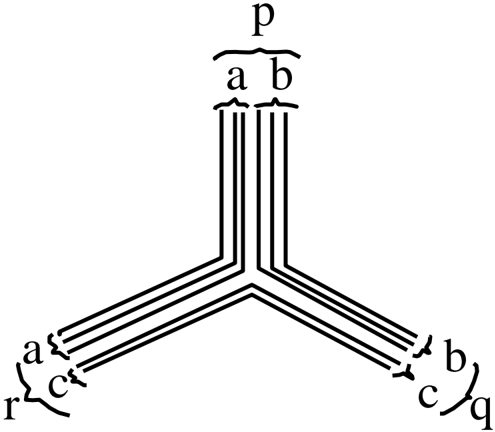
- The volume spectrum is discrete. For trivalent spin networks, the eigenvalue for a region \(R\) is \(V = \frac{1}{4} l_P^3 \sum_i \sqrt{a_i b_i c_i + a_i b_i + a_i c_i + b_i c_i}\), where the sum runs over nodes \(i\) contained in \(R\).
- The full area spectrum is \(A = \frac{1}{2} l_P^2 \sum_l \sqrt{p_l^2 + 2p_l}\), where \(l\) labels spin-network links crossing the surface.
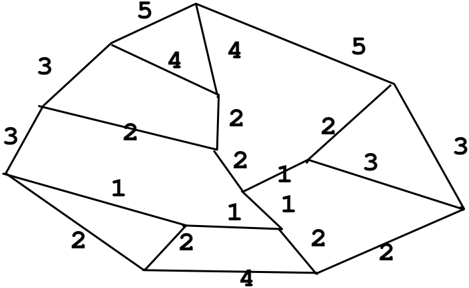
- Spin-network states are eigenstates of the volume operator and also diagonalize the area operator; the two operators commute. Other volume eigenstates are related to a generalization of spin networks, with eigenvalues computable by diagonalizing finite-dimensional matrices.
- The authors argue that, under assumptions about physical fields defining regions and surfaces, Planck-scale measurements of volume or area would yield results in these discrete spectra.
Methods
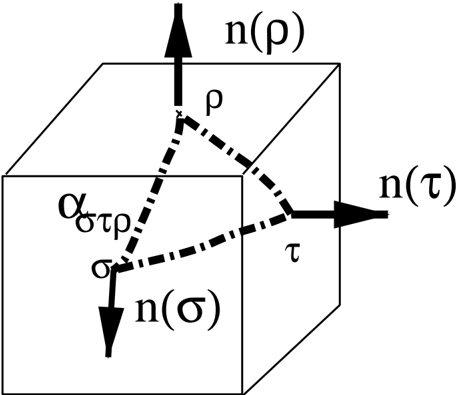
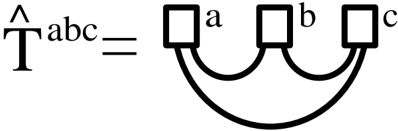
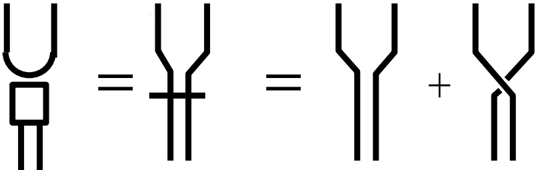
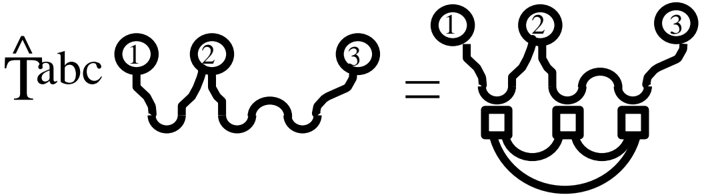
- Theoretical, non-perturbative quantum gravity in the loop representation. The volume operator is constructed via a diffeomorphism-invariant regularization using the three-hand loop observable \(T^{abc}\), partitioning a region into cubic boxes with an arbitrary unphysical flat metric \(g_0\), and taking a weak-operator limit \(L \to 0\).
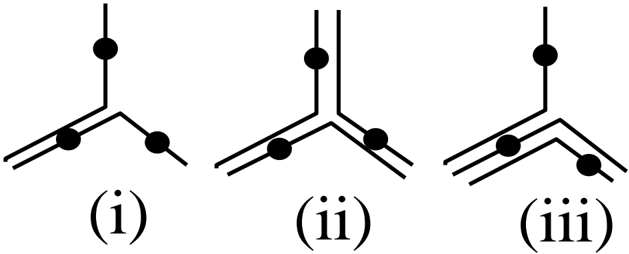
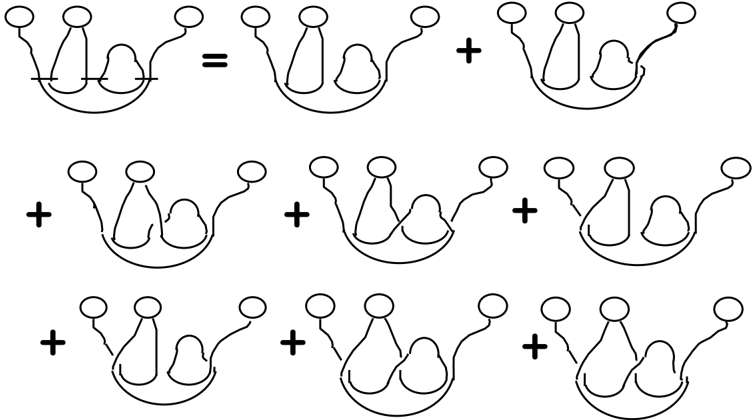
- The action of the volume operator is computed on the spin-network basis, where spin networks are trivalent graphs with positive integer link colors; the area operator is similarly diagonalized.
- No empirical data are used; the analysis is operator construction and spectral diagonalization.
Limitations
- The paper states that the local operator \(\sqrt{\det g}\) is ill-defined, that the regularization introduces an unphysical background metric \(g_0\) (though the operator is claimed independent of it in the limit), that the topology of the limit is delicate, and that diffeomorphism-invariant states lie in \(D_{\max}\) but not in the domain \(D\). It also notes that consistency of the theory is not proven and that quantization may have more than one solution.
- Evident from the provided text: the excerpt is truncated after the proportionality coefficient, so later sections and full derivation details are not available here. The physical interpretation also relies on assumptions about dynamical matter fields defining spatial regions and surfaces.
Model-written summary of a shortened version of the paper’s full text (it is longer than we read). Check it against the paper before relying on it.
Integrity signals
Registry
Cites
Statistics
Figures

Verification
Claims the paper makes
1 Valid · 4 Not valid · 5 Not checked · 18 Own results and interpretations
The sources with a verdict support this claim; the rest weren’t checked yet, have no full text we could read, or their verdicts aren’t rated yet.
In the paper
“Local quantities tend to be divergent or ill-defined in non-trivial generally covariant quantum field theories [3, 4, 11], a fact likely to be related to the non-renormalizability of the perturbative series.”
What the sources say
- Not checked — no full text of the sourcecites [3] matched to “Loop space representation of quantum general relativity” (1990) source
- Supportedcites [4] matched to “Weaving a classical metric with quantum threads” (1992) source
The Abstract says local operators such as the metric at a point may not be well-defined. The discussion of the local metric operator explains that its renormalization obstructs meaningful local geometric operators and says this appears to be a general feature of diffeomorphism-invariant theories. The claim’s separate suggestion about perturbative non-renormalizability is not the part attributed to this citation. (LLM, conf=0.90)
- Could not verifycites [11] matched to “Link Invariants, Holonomy Algebras and Functional Integration” (1993) sourceExperimental — accuracy not yet measured
The Introduction (pp. 1–2) discusses difficulties defining field-theoretic measures, and p. 4 describes regularized Wilson loops. Neither passage says that local quantities tend to diverge or be ill-defined in non-trivial generally covariant quantum field theories. Searches for local observables, divergences, and renormalization found no passage addressing that claim. (LLM, conf=0.73)
hedgedstates an association- Asserted: passes — The authors put it forward as true.
- Checkable: passes — It can be checked against evidence.
- Load-bearing: passes — The paper’s conclusions depend on it.
- Based: passes — The paper gives a reason why it holds.
The cited sources that could be checked couldn’t confirm or dispute this claim.
In the paper
“note for instance that there are other relevant topologies in state space, as the norm topologies defined by the kinematical or diffeomorphism-invariant Hilbert structures [6, 7], which are inequivalent to the one in which the limit (13) is taken.”
What the sources say
- Could not verifycites [6] matched to “Fermions in quantum gravity” (1994) sourceExperimental — accuracy not yet measured
Section 6.2 (pp. 33–34) uses pointwise topology in a model example about limits on knot states, but says a complete scalar product for the loop representation is not yet available. Neither those passages nor the passages found by searching for Hilbert norm topologies establish kinematical or diffeomorphism-invariant norm topologies, or their inequivalence to the topology used for the cited limit. (LLM, conf=0.72)
- Could not verifycites [7] matched to “Spatial infinity as a boundary of spacetime” (1992) sourceExperimental — accuracy not yet measured
The passages in §4, “Asymptotic symmetries” (page not supplied), discuss equivalence of spacetime completions, not topologies on a state space. Searches for Hilbert norm topologies and inequivalent state-space limits found no passage addressing the attributed claim. (LLM, conf=0.76)
plain- Asserted: passes — The authors put it forward as true.
- Checkable: passes — It can be checked against evidence.
- Load-bearing: unclear — It is unclear whether the paper’s conclusions depend on it.
- Based: passes — The paper gives a reason why it holds.
- Could not verify
A result the paper reports from its own data — it cites no other source for it, so there is none to check. The quote shows it is in the paper.
In the paper
“We find that the spectrum of the volume of any physical region is discrete.”
plain- Asserted: passes — The authors put it forward as true.
- Checkable: passes — It can be checked against evidence.
- Load-bearing: passes — The paper’s conclusions depend on it.
- Based: passes — The paper gives a reason why it holds.
A result the paper states — it cites no source for it, so there is none to check. The quote shows it is in the paper.
In the paper
“An unphysical background metric is introduced for the sake of the regularization, but the operator turns out to be independent of this background, in the limit in which the cut-off is removed.”
plain- Asserted: passes — The authors put it forward as true.
- Checkable: passes — It can be checked against evidence.
- Load-bearing: passes — The paper’s conclusions depend on it.
- Based: passes — The paper gives a reason why it holds.
In the paper
“Furthermore, we show here that the spin network states also diagonalize the operator Â[S], introduced in [3], which measures the area of the surface S.”
What the sources say
- Not checked — no full text of the sourcecites [3] matched to “Loop space representation of quantum general relativity” (1990) source
boostedstates an association- Asserted: passes — The authors put it forward as true.
- Checkable: passes — It can be checked against evidence.
- Load-bearing: passes — The paper’s conclusions depend on it.
- Based: passes — The paper gives a reason why it holds.
12 more claims
Create a free account to see all 28 claims and every source verdict.
- It may state two separate claims as one. 5
- Probably not a substantial claim. 5
- The quote only partly states this claim. 1
Claims other papers make about this one
Each is checked against this paper’s own text: does it say what the citing paper says it does?
The source backs part of the claim, not all of it — or backs it for a different population, condition or comparison.
In the citing paper
“In fact, that is why only volume and area operators could be constructed so far [10, 11].”
From A length operator for canonical quantum gravity (1998) · cites this paper as [10]
Experimental — accuracy not yet measuredThe source backs part of the claim, not all of it — or backs it for a different population, condition or comparison.
In the citing paper
“While the kinematics of loop quantum gravity (LQG) [1] is rather well understood [2, 3], its dynamics is not understood as cleanly.”
From Flipped spinfoam vertex and loop gravity (2008) · cites this paper as [4]
Experimental — accuracy not yet measuredThe source backs part of the claim, not all of it — or backs it for a different population, condition or comparison.
In the citing paper
“This problem arises due to the results obtained for the spectra of the geometrical operators and the black hole entropy being proportional to an unphysical parameter, which is called 'Immirzi parameter' [7] and appears as a parameter of a canonical transformation in classical gravity [8,9].”
From SO (4, C )-covariant Ashtekar-Barbero gravity and the Immirzi parameter (2000) · cites this paper as [9]
Experimental — accuracy not yet measuredThe cited source says what the claim attributes to it.
In the citing paper
“The results reported in this letter are obtained in the framework of quantum geometry [4] which does predict a discrete geometry because, e.g., the spectra of geometric operators as area and volume are discrete [5-7].”
From Absence of a Singularity in Loop Quantum Cosmology (2001) · cites this paper as [5]
The cited source says what the claim attributes to it.
In the citing paper
“Basic geometric quantities have been quantized [10][11][12][13][14] and found to have discrete spectra.”
From Loop quantum cosmology: I. Kinematics (2000) · cites this paper as [10]
17 more claims about this paper
Create a free account to see every claim other papers make about this one.
Citations
Cites
New Variables for Classical and Quantum Gravity
Ashtekar, A. (1986) · Physical Review Letters · doi:10.1103/physrevlett.57.2244 · Cited by 1,663
QUANTUM GRAVITY AND MINIMUM LENGTH
GARAY, L. J. (1995) · International Journal of Modern Physics A · doi:10.1142/s0217751x95000085 · Cited by 1,371
String theory beyond the Planck scale
Gross, D. J., & Mende, P. F. (1988) · Nuclear Physics B · doi:10.1016/0550-3213(88)90390-2 · Cited by 1,249
New Hamiltonian formulation of general relativity
Ashtekar, A. (1987) · Physical Review D · doi:10.1103/physrevd.36.1587 · Cited by 1,119
Quantum gravity and minimum length
Garay, L. J. (1994) · LA Referencia (Red Federada de Repositorios Institucionales de Publicaciones Científicas) · Cited by 881
Loop space representation of quantum general relativity
Rovelli, C., & Smolin, L. (1990) · Nuclear Physics B · doi:10.1016/0550-3213(90)90019-a · Cited by 806
Self-citationThe Hagedorn transition and the number of degrees of freedom of string theory
Atick, J. J., & Witten, E. (1988) · Nuclear Physics B · doi:10.1016/0550-3213(88)90151-4 · Cited by 800
The high-energy behavior of string scattering amplitudes
Gross, D. J., & Mende, P. F. (1987) · Physics Letters B · doi:10.1016/0370-2693(87)90355-8 · Cited by 778
Minimum physical length and the generalized uncertainty principle in string theory
Konishi, K., Paffuti, G., & Provero, P. (1990) · Physics Letters B · doi:10.1016/0370-2693(90)91927-4 · Cited by 753
On the nature of quantum geometrodynamics
Wheeler, J. A. (1957) · Annals of Physics · doi:10.1016/0003-4916(57)90050-7 · Cited by 693
Research works printed but not linked: 1
- Ashtekar, 1994, Quantum geometrodynamics and Coherent state transform on the space of connections, Penn. State University preprints
Cited by
Items 701–800 of 1,374
Extension of Loop Quantum Gravity to Metric Theories beyond General Relativity
Ma, Y. (2012) · Journal of Physics Conference Series · doi:10.1088/1742-6596/360/1/012006 · Cited by 15
Minimal length, nuclear matter, and neutron stars
Prasetyo, I., Belfaqih, I. H., Wahidin, A. B., Suroso, A., & Sulaksono, A. (2022) · The European Physical Journal C · doi:10.1140/epjc/s10052-022-10849-1 · Cited by 13
An example of Feynman–Jackson integrals
Díaz, R., & Pariguán, E. (2007) · Journal of Physics A Mathematical and Theoretical · doi:10.1088/1751-8113/40/6/005 · Cited by 12
“In particular, it has been argued, see [13, 14], that in the quantization of gravity discrete structures will emerge naturally.”
BackgroundChern-Simons theory in 11 dimensions as a non-perturbative phase of M theoryPreprint
Smolin, L. (1997) · arXiv (Cornell University) · doi:10.48550/arxiv.hep-th/9703174 · Cited by 19
“combinatorial nature of the spin networks correspond to the discreteness of quantum geometry at the non-perturbative level[16, 18]1.”
BackgroundSelf-citationTowards a Unitary, Renormalizable, and Ultraviolet-Complete Quantum Theory of Gravity
Steinwachs, C. F. (2020) · Frontiers in Physics · doi:10.3389/fphy.2020.00185 · Cited by 19
“[5] Carlo Rovelli and Lee Smolin, “Discreteness of area and volume in quantum gravity,” Nucl.”
BackgroundComparison of area spectra in loop quantum gravity
Gour, G., & Suneeta, V. (2004) · Classical and Quantum Gravity · doi:10.1088/0264-9381/21/14/006 · Cited by 16
Vassiliev invariants: A new framework for quantum gravity
Gambini, R., Griego, J., & Pullin, J. A. (1998) · Nuclear Physics B · doi:10.1016/s0550-3213(98)80012-6 · Cited by 11
Bernardini, A. E., & da Rocha, R. (2007) · Physical review. D. Particles, fields, gravitation, and cosmology/Physical review. D. Particles and fields · doi:10.1103/physrevd.75.065014 · Cited by 16
Canonical formalism of N = 1 supergravity with the real Ashtekar variables
Sawaguchi, M. (2001) · Classical and Quantum Gravity · doi:10.1088/0264-9381/18/7/303 · Cited by 13
Mathur, S. D. (2010) · General Relativity and Gravitation · doi:10.1007/s10714-010-1022-4 · Cited by 13
Znojil, M. (2022) · Universe · doi:10.3390/universe8070385 · Cited by 12
“, via an amendment of the inner product, Hermitizable) candidate for a toy-model observable representing, in the context of quantum cosmology, say, a potentially measurable discrete spatial grid [26, 27, 28, 29, 30].”
Towards a background independent approach to M theoryPreprint
Smolin, L. (1998) · Cited by 13
Self-citationPolymer quantization versus the Snyder noncommutative space
Gorji, M. A., Nozari, K., & Vakili, B. (2015) · Classical and Quantum Gravity · doi:10.1088/0264-9381/32/15/155007 · Cited by 14
4-dimensional BF gravity on the lattice
Kawamoto, N., Sato, N., & Uchida, Y. (2000) · Nuclear Physics B · doi:10.1016/s0550-3213(00)00017-1 · Cited by 12
Scalar Field in the Bianchi I: Noncommutative Classical and Quantum Cosmology
Socorro, J., Pimentel, L. O., Ortiz, C., & Granados, M. A. A. (2009) · International Journal of Theoretical Physics · doi:10.1007/s10773-009-0164-1 · Cited by 13
Discrete quantum spectrum of black holes
Lochan, K., & Chakraborty, S. (2016) · Physics Letters B · doi:10.1016/j.physletb.2016.01.060 · Cited by 15
“It was argued [43] in the framework of Loop Quantum Gravity (henceforth referred to as LQG), that the area spectrum remains no more equidistant and gets quantized like an angular momentum operator.”
MethodNon-Gaussian features from the inverse volume corrections in loop quantum cosmology
Li, L.-F., Cai, R.-G., Guo, Z., & Hu, B. (2012) · Physical review. D. Particles, fields, gravitation, and cosmology/Physical review. D. Particles and fields · doi:10.1103/physrevd.86.044020 · Cited by 11
Imposing detE > 0 in discrete quantum gravity
Loll, R. (1997) · Physics Letters B · doi:10.1016/s0370-2693(97)00303-1 · Cited by 11
On the horizon area of effective loop quantum black holes
Sobrinho, F. C., Borges, H. A., Baranov, I. P. R., & Carneiro, S. (2023) · Classical and Quantum Gravity · doi:10.1088/1361-6382/acdbff · Cited by 16
Topspin networks in loop quantum gravityPreprint
Duston, C. L. (2016) · Cited by 13
Thiemann, T. (2023) · Classical and Quantum Gravity · doi:10.1088/1361-6382/ad085d · Cited by 18
Quantum Computation Toward Quantum Gravity
Zizzi, P. A. (2001) · General Relativity and Gravitation · doi:10.1023/a:1012053424024 · Cited by 35
“In loop quantum gravity, spin networks are eigenstates of the area and volume-operators [ 9 ].”
BackgroundOn the counting of black hole states in loop quantum gravityPreprint
Alexandrov, S. Y. (2004) · arXiv (Cornell University) · doi:10.48550/arxiv.gr-qc/0408033 · Cited by 21
“The puncture contributes the amount given by the eigenvalue of the area operator [9, 10]”
BackgroundTime uncertainty in quantum gravitational systems
G., J. F. B., Marugán, G. A. M., & Villaseñor, E. J. S. (2004) · Physical review. D. Particles, fields, gravitation, and cosmology/Physical review. D. Particles and fields · doi:10.1103/physrevd.69.044017 · Cited by 10
Could planck star remnants be dark matter?
Trivedi, O., & Loeb, A. (2025) · Physics of the Dark Universe · doi:10.1016/j.dark.2025.102003 · Cited by 23
“Loop Quantum Gravity (LQG) [18–23], and in particular its application to cosmology in the form of Loop Quantum Cosmology (LQC) [24–31], has provided an explicit manifestation of this expectation, replacing singularities with non-singular bounces for both cosmological and black hole contexts.”
A novel mechanism for probing the Planck scale
Das, S., & Modak, S. K. (2021) · Classical and Quantum Gravity · doi:10.1088/1361-6382/ac38d3 · Cited by 10
Out of Nowhere: The Emergence of Spacetime in Theories of Quantum Gravity
Wüthrich, C., & Huggett, N. (2025) · doi:10.1093/oso/9780198758501.001.0001 · Cited by 57
Modified graviton dynamics from spin foams: the area Regge action
Dittrich, B. (2024) · The European Physical Journal Plus · doi:10.1140/epjp/s13360-024-05432-4 · Cited by 36
On the value of the Immirzi parameter and the horizon entropy
Pigozzo, C., Bacelar, F. S., & Carneiro, S. (2020) · Classical and Quantum Gravity · doi:10.1088/1361-6382/abce6a · Cited by 18
Consistency check on the fundamental and alternative flux operators in loop quantum gravity *
Yang, J., & Ma, Y. (2019) · Chinese Physics C · doi:10.1088/1674-1137/43/10/103106 · Cited by 13
“In the canonical formulation, the kinematical representation of the holonomy-flux algebra is shown to be unique to certain sense [7], and the geometric operators corresponding to length, area, and volume functions are constructed and all have discrete spectrum [8–12].”
BackgroundPachoł, A. (2024) · Nuclear Physics B · doi:10.1016/j.nuclphysb.2024.116771 · Cited by 11
From Euclidean to Lorentzian loop quantum gravity via a positive complexifier
Varadarajan, M. (2018) · Classical and Quantum Gravity · doi:10.1088/1361-6382/aaf2cd · Cited by 11
Equivalence of Models in Loop Quantum Cosmology and Group Field Theory
Baytaş, B., Bojowald, M., & Crowe, S. (2019) · Universe · doi:10.3390/universe5020041 · Cited by 11
“For an isotropic model, the four areas should be identical, and their minimal non-zero value is determined by a quantum number j = 1/2, modeling the discrete nature through a spin system following the loop paradigm [25].”
BackgroundBlack hole entropy for the general area spectrum
Tanaka, T., & Tamaki, T. (2010) · Journal of Physics Conference Series · doi:10.1088/1742-6596/229/1/012080 · Cited by 14
Rotating black hole in 4D Einstein–Gauss–Bonnet massive gravity: Shadow and center of mass energy
Zubair, M., & Raza, M. A. (2023) · Physics of the Dark Universe · doi:10.1016/j.dark.2023.101200 · Cited by 11
On pairs of difference operators satisfying [D, X]=Id
Górski, A. Z., & Szmigielski, J. (1998) · Journal of Mathematical Physics · doi:10.1063/1.532322 · Cited by 15
One vertex spin-foams with the dipole cosmology boundary
Kisielowski, M., Lewandowski, J., & Puchta, J. (2012) · Classical and Quantum Gravity · doi:10.1088/0264-9381/30/2/025007 · Cited by 12
Modified entropies as the origin of generalized uncertainty principles
Bizet, N. C., Obregón, O., & Yupanqui, W. (2022) · Physics Letters B · doi:10.1016/j.physletb.2022.137636 · Cited by 15
“In fact, such a minimal length arises in different contexts, for example in string theory [6, 10], loop quantum gravity [11, 12], and thought experiments of black hole physics [7, 8].”
BackgroundSpectrum of a quantized black hole, correspondence principle, and holographic bound
Khriplovich, I. B. (2004) · Journal of Experimental and Theoretical Physics · doi:10.1134/1.1809672 · Cited by 23
The closure constraint for the hyperbolic tetrahedron as a Bianchi identity
Charles, C., & Livine, E. R. (2017) · General Relativity and Gravitation · doi:10.1007/s10714-017-2255-2 · Cited by 17
“The spins carried by the edges corresponding to quanta of surfaces [9].”
BackgroundGrailQuest: hunting for atoms of space and time hidden in the wrinkle of Space-Time
Burderi, L., Sanna, A., Salvo, T. D., Amati, L., Amelino-Camelia, G., Branchesi, M., Capozzıello, S., Coccia, E., Colpi, M., Costa, E., et al. (2021) · Experimental Astronomy · doi:10.1007/s10686-021-09745-5 · Cited by 11
Self-citationTwisted geometries are area-metric geometries
Dittrich, B., & Padua-Argüelles, J. (2024) · Physical review. D/Physical review. D. · doi:10.1103/physrevd.109.026002 · Cited by 24
Mezzasalma, S. A. (2002) · Journal of Colloid and Interface Science · doi:10.1006/jcis.2002.8485 · Cited by 10
Quantum Big Bounce of the Isotropic Universe Using Relational Time
Giovannetti, E., Maione, F., & Montani, G. (2023) · Universe · doi:10.3390/universe9080373 · Cited by 13
“In this respect, understanding that in Loop Quantum Gravity (LQG) [2, 7–10] the volume operator has a discrete spectrum [11] and then showing the emergence of the Big Bounce semiclassical dynamics in the so-called Loop Quantum Cosmology (LQC) theory [12–19] was the most relevant success.”
BackgroundReduced phase space approach to the U (1) 3 model for Euclidean quantum gravity
Bakhoda, S., & Thiemann, T. (2021) · Classical and Quantum Gravity · doi:10.1088/1361-6382/ac2721 · Cited by 13
“Since the quantum cosmological constant term is essentially the volume operator3 [3] which in loop quantum gravity (LQG) [4] is under complete control, the quantisation of Lorentzian vacuum gravity is reduced essentially to the quantisation of the Euclidean Hamiltonian constraint which has been intensively studied [5].”
Extended uncertainty principle: A deeper insight into the Hubble tension?
Nozari, K., Saghafi, S., & Hajebrahimi, M. (2024) · Physics of the Dark Universe · doi:10.1016/j.dark.2024.101571 · Cited by 17
Coherent 3j -symbol representation for the loop quantum gravity intertwiner space
Alesci, E., Lewandowski, J., & Mäkinen, I. H. (2016) · Physical review. D/Physical review. D. · doi:10.1103/physrevd.94.084028 · Cited by 12
Canonical loop quantization of the lowest-order projectable Horava gravity
Zhang, X., Yang, J., & Ma, Y. (2020) · Physical review. D/Physical review. D. · doi:10.1103/physrevd.102.124060 · Cited by 10
“[40] C.”
BackgroundCorrections to Flat-Space Particle Dynamics Arising from Space Granularity
Urrutia, L. F. (2006) · Springer eBooks · doi:10.1007/3-540-34523-x_11 · Cited by 11
Duality principle of the zero-point length of spacetime and Generalized Uncertainty Principle
Mondal, V. (2020) · Europhysics Letters (EPL) · doi:10.1209/0295-5075/132/10005 · Cited by 11
A correction to the Immirzi parameter of SU(2) spin networks
Sadiq, M. (2015) · Physics Letters B · doi:10.1016/j.physletb.2015.01.004 · Cited by 12
Immirzi parameter and θ ambiguity in de Sitter MacDowell-Mansouri supergravity
Obregón, O., Ortega-Cruz, M., & Sabido, M. (2012) · Physical review. D. Particles, fields, gravitation, and cosmology/Physical review. D. Particles and fields · doi:10.1103/physrevd.85.124061 · Cited by 11
Microcanonical entropy of a black hole
Bhaduri, R. K., Tran, M. N., & Das, S. (2004) · Physical review. D. Particles, fields, gravitation, and cosmology/Physical review. D. Particles and fields · doi:10.1103/physrevd.69.104018 · Cited by 10
Position-dependent mass in strong quantum gravitational background fields
Lawson, L. M. (2021) · Journal of Physics A Mathematical and Theoretical · doi:10.1088/1751-8121/ac3787 · Cited by 10
“All quantum gravity theories, such as string theory [2] and loop quantum gravity [3] particularly accounts for the existence of a minimal measurable length Δ x which is proportional to the Planck length l p .”
4-dimensional BF Gravity on the Lattice
Kawamoto, N., Sato, N., & Uchida, Y. (1999) · CERN Document Server (European Organization for Nuclear Research) · Cited by 11
Singularity-Free Gravitational Collapse: From Regular Black Holes to Horizonless Objects
Carballo-Rubio, R., Filippo, F. D., Liberati, S., & Visser, M. (2023) · Springer Series in Astrophysics and Cosmology · doi:10.1007/978-981-99-1596-5_9 · Cited by 42
Loop quantum modified gravity and its cosmological application
Zhang, X., & Ma, Y. (2013) · Frontiers of Physics · doi:10.1007/s11467-013-0277-0 · Cited by 12
Quantum clock: A critical discussion on spacetime
Burderi, L., Salvo, T. D., & Iaria, R. (2016) · Physical review. D/Physical review. D. · doi:10.1103/physrevd.93.064017 · Cited by 13
Covariant origin of the U(1)3 model for Euclidean quantum gravity
Bakhoda, S., & Thiemann, T. (2021) · Classical and Quantum Gravity · doi:10.1088/1361-6382/ac37a4 · Cited by 12
“ects that the two approaches enrich each other by providing complementary insight. In particular, the programme of [3] is designed to reduce quantisation ambiguities of the physical Lorentzian theory [4, 5, 6, 7] in the framework of Loop Quantum Gravity (LQG) [8] using the simpler U(1)3 model as a test laboratory and…”
A MINIMAL MODEL FOR QUANTUM GRAVITY
ZIZZI, P. A. (2005) · Modern Physics Letters A · doi:10.1142/s021773230501683x · Cited by 38
“Where: 2 0 2 ln 4 P l A (10) In Loop Quantum Gravity, the discrete area spectrum [16] is: i i i P j j l A ) 1 ( 8 2 (11)”
BackgroundConsequences of Gödel’s Theorems on Quantum Gravity
Faizal, M., Shabir, A., & Khan, A. K. (2024) · International Journal of Theoretical Physics · doi:10.1007/s10773-024-05818-1 · Cited by 10
“In the loop quantum gravity picture, Spin networks encode the fundamental information from which space-time geometry emerges [41, 44].”
Quantized black holes, their spectrum and radiation
Khriplovich, I. B. (2008) · Physics of Atomic Nuclei · doi:10.1134/s1063778808040078 · Cited by 17
Borissova, J. N., Dittrich, B., & Krasnov, K. V. (2024) · Physical review. D/Physical review. D. · doi:10.1103/physrevd.109.124035 · Cited by 23
Thermodynamic properties and topological charge of a static black hole in loop quantum gravity
Dong, S.-H., Hosseinifar, F., Studnička, F., Chung, W. S., & HASSANABADI, H. (2025) · Physics of the Dark Universe · doi:10.1016/j.dark.2025.101962 · Cited by 16
Quantum corrections to Hawking radiation spectrumPreprint
Yoon, Y. (2016) · Cited by 10
Perturbative calculation of quasi-normal modes of arbitrary spin in Schwarzschild spacetime
Musiri, S., & Siopsis, G. (2007) · Physics Letters B · doi:10.1016/j.physletb.2007.04.068 · Cited by 11
Towards anisotropic cosmology in group field theory
Calcinari, A., & Gielen, S. (2023) · Classical and Quantum Gravity · doi:10.1088/1361-6382/acc1db · Cited by 15
“Finally, the volume operator introduced for a tetrahedron in LQG reads [56, 57]”
A brane world model with intersecting branes
Pavšič, M. (2001) · Physics Letters A · doi:10.1016/s0375-9601(01)00189-x · Cited by 15
Quaternionic quantization principle in general relativity and supergravity
Kober, M. (2016) · International Journal of Modern Physics A · doi:10.1142/s0217751x16500044 · Cited by 10
In Search of Quantum de Sitter Space: Generalizing the Kodama StatePreprint
Randono, A. (2007) · arXiv (Cornell University) · doi:10.48550/arxiv.0709.2905 · Cited by 9
Corrections to flat-space particle dynamics arising from space granularity
Urrutia, L. F. (2005) · CERN Document Server (European Organization for Nuclear Research) · Cited by 8
Piecewise linear loop quantum gravity
Engle, J. (2010) · Classical and Quantum Gravity · doi:10.1088/0264-9381/27/3/035003 · Cited by 14
Quantum cosmology with effects of a preferred reference frame
Ghaffarnejad, H. (2009) · Classical and Quantum Gravity · doi:10.1088/0264-9381/27/1/015008 · Cited by 9
Tachyon field in loop quantum cosmology: An example of traversable singularity
Li, L.-F., & Zhu, J.-Y. (2009) · Physical review. D. Particles, fields, gravitation, and cosmology/Physical review. D. Particles and fields · doi:10.1103/physrevd.79.124011 · Cited by 9
On loop states in loop-quantum gravity
Dass, N. D. H., & Mathur, M. (2007) · Classical and Quantum Gravity · doi:10.1088/0264-9381/24/9/002 · Cited by 11
Combinatorial dynamics in quantum gravityPreprint
Kauffman, S. A., & Smolin, L. (1998) · arXiv (Cornell University) · doi:10.48550/arxiv.hep-th/9809161 · Cited by 27
“Originally invented by Penrose[1], more recently they have been shown to represent faithfully a basis of exact non-perturbative states of the quantum gravitational field[3, 4].”
BackgroundInfluentialSelf-citationMinimal length and the flow of entropy from black holes
Alonso-Serrano, A., Da̧browski, M., & Gohar, H. (2018) · International Journal of Modern Physics D · doi:10.1142/s0218271818470284 · Cited by 6
Knot theory and a physical state of quantum gravity
Liko, T., & Kauffman, L. H. (2006) · Classical and Quantum Gravity · doi:10.1088/0264-9381/23/4/r01 · Cited by 11
Shape in an atom of space: exploring quantum geometry phenomenology
Major, S. (2010) · Classical and Quantum Gravity · doi:10.1088/0264-9381/27/22/225012 · Cited by 15
Late time cosmic acceleration from natural infrared cutoff
Gorji, M. A. (2016) · Physics Letters B · doi:10.1016/j.physletb.2016.07.064 · Cited by 9
How many quanta are there in a quantum spacetime?
Ariwahjoedi, S., Kosasih, J. S., Rovelli, C., & Zen, F. P. (2015) · Classical and Quantum Gravity · doi:10.1088/0264-9381/32/16/165019 · Cited by 16
“Similarly, quantum theory is likely to imply a granularity of the gravitational field, and therefore a granularity of space [1, 2].”
Self-citationThe large cosmological constant approximation to classical and quantum gravity: model examples
Gambini, R., & Pullin, J. A. (2000) · Classical and Quantum Gravity · doi:10.1088/0264-9381/17/21/311 · Cited by 15
Holographic entanglement in spin network states: A focused review
Colafranceschi, E., & Adesso, G. (2022) · AVS Quantum Science · doi:10.1116/5.0087122 · Cited by 13
Canonical noncommutativity algebra for the tetrad field in general relativity
Kober, M. (2011) · Classical and Quantum Gravity · doi:10.1088/0264-9381/28/22/225021 · Cited by 12
Path integral for the loop representation of lattice gauge theories
Aroca, J. M., Fort, H., & Gambini, R. (1996) · Physical review. D. Particles, fields, gravitation, and cosmology/Physical review. D. Particles and fields · doi:10.1103/physrevd.54.7751 · Cited by 11
Asymptotic quasinormal modes of scalar field in a gravity's rainbow
Liu, C., & Jian-Yang, Z. (2009) · Chinese Physics B · doi:10.1088/1674-1056/18/10/015 · Cited by 12
The status of Quantum Geometry in the dynamical sector of Loop Quantum CosmologyPreprint
Kamiński, W., & Lew, J. (2012) · Cited by 10
Thermodynamics of quantum spacetime histories
Smolin, L. (2017) · Physical review. D/Physical review. D. · doi:10.1103/physrevd.96.104042 · Cited by 10
Self-citationReal Sector of the Nonminimally Coupled Scalar Field to Self-Dual Gravity
Montesinos, M., Morales-Tecotl, H. A., Urrutia, L. F., et al. (1999) · CERN Document Server (European Organization for Nuclear Research) · Cited by 9
The relation between the maximum entropy of a quantized surface and its area
Korkin, R. V., & Khriplovich, I. B. (2002) · Journal of Experimental and Theoretical Physics · doi:10.1134/1.1499895 · Cited by 28
Strings as perturbations of evolving spin networks
Smolin, L. (2000) · Nuclear Physics B - Proceedings Supplements · doi:10.1016/s0920-5632(00)00758-1 · Cited by 31
“In the SU(2) case, area[15, 8] and volume[15, 8, 16] operators may then be used to assign areas to the faces and volume operators to each space of intertwiners in each tetrahedron 3.”
BackgroundMethodInfluentialSelf-citationFundamental physics in space: a quantum-gravity perspectivePreprint
Giovanni Amelino-camelia, A. (2013) · Cited by 8
Matter in loop quantum gravity without time gauge: A nonminimally coupled scalar field
Cianfrani, F., & Montani, G. (2009) · Physical review. D. Particles, fields, gravitation, and cosmology/Physical review. D. Particles and fields · doi:10.1103/physrevd.80.084045 · Cited by 10
Fundamental Physics in Space: A Quantum-Gravity Perspective
Amelino-Camelia, G. (2004) · General Relativity and Gravitation · doi:10.1023/b:gerg.0000010729.17654.48 · Cited by 13
Appearing Out of Nowhere: The Emergence of Spacetime in Quantum GravityPreprint
Crowther, K. (2014) · arXiv (Cornell University) · doi:10.48550/arxiv.1410.0345 · Cited by 16
Philosophical Foundations of Loop Quantum Gravity
Rovelli, C., & Vidotto, F. (2023) · Springer eBooks · doi:10.1007/978-981-19-3079-9_109-1 · Cited by 28
Self-citationMassive motion in area metric spacetimes
Punzi, R., Schuller, F. P., & Wohlfarth, M. N. R. (2009) · Physical review. D. Particles, fields, gravitation, and cosmology/Physical review. D. Particles and fields · doi:10.1103/physrevd.79.124025 · Cited by 8
Area propagator and boosted spin networks in loop quantum gravity
Livine, E. R. (2019) · Classical and Quantum Gravity · doi:10.1088/1361-6382/ab32d4 · Cited by 10
“Upon quantization, the link acquires an extra-label, a half-integer spin, which defines the wave mode of the SU(2) holonomy and more importantly is understood as the quanta of area 1 carried by the link [1, 24].”
BackgroundCoherent state operators in loop quantum gravity
Alesci, E., Dapor, A., Lewandowski, J., Mäkinen, I. H., & Sikorski, J. (2015) · Physical review. D. Particles, fields, gravitation, and cosmology/Physical review. D. Particles and fields · doi:10.1103/physrevd.92.104023 · Cited by 14
Universe scenarios from loop quantum cosmology
Bojowald, M. (2006) · Annalen der Physik · doi:10.1002/andp.200510191 · Cited by 9
Metadata
- Authors
- Rovelli, C., & Smolin, L.
- Affiliations
- Pennsylvania State University (US)
- Corresponding author
- Smolin, Lee
- ORCID
- Smolin, Lee
- Venue
- Nuclear Physics B
- Publisher
- Elsevier BV
- Published
- 1995-05
- Volume
- 442
- Issue
- 3
- Pages
- 593-619
- ISSN
- 0550-3213 (ISSN-L)
- OpenAlex
- W2104041846
- Semantic Scholar
- 3b85eebc659d3ae5d857e1d141fd5126db507eba
- Cited by
- 1,365
- References
- 63
- Citations by year
- 2026: 40 · 2025: 79 · 2024: 70 · 2023: 38 · 2022: 35 · 2021: 55 · 2020: 31 · 2019: 42 · 2018: 44 · 2017: 40 · 2016: 48 · 2015: 36 · 2014: 43 · 2013: 47 · 2012: 49
- FWCI
- 38.09
- Type
- journal article
- Language
- en
- Open access
- green
- arxiv.org
- Licence
- www.elsevier.com/tdm/userlicense/1.0/ (tdm)
- www.elsevier.com/legal/tdmrep-license (tdm)
- Locations
- Nuclear Physics B (publishedVersion)
- arXiv (Cornell University) (submittedVersion)
- CERN Document Server (European Organization for Nuclear Research) (submittedVersion)
- arXiv (Cornell University)
- Topics
- Physical Sciences › Physics and Astronomy › Nuclear and High Energy Physics › Noncommutative and Quantum Gravity Theories
- Physical Sciences › Physics and Astronomy › Astronomy and Astrophysics › Relativity and Gravitational Theory
- Physical Sciences › Physics and Astronomy › Nuclear and High Energy Physics › Black Holes and Theoretical Physics
- Keywords
- quantum gravity, loop representation, spin networks, volume operator, area operator, diffeomorphism invariance, background independence, Planck-scale geometry, non-perturbative quantum gravity
About these checks
Registry, retraction, Cites and statistics results are computed, not judged, with one exception: a printed reference that no index lists is read once by a model before it counts as a citation error. Claims are extracted by a model and kept only when their quote appears verbatim in the text; each cited source is then checked, with a model’s help, for whether it says what the claim relies on. Those verdicts can be wrong — read the claim’s quote and the cited source before relying on one.
The claim verdicts this report counts are experimental: their accuracy is not yet measured.
A language model drew the claims from the paper on 2026-10-07, under version 3 of the claim definition (model deepseek-v4.1-flash, prompt extract-v3).
A second model labelled each claim on 2026-10-07 (model jev-1.13-20260917, definition revision gold-guideline-v0.2).
Cited sources are checked with a language model’s help (gpt-6-sol).
Statistics and arithmetic are recomputed, not judged.
Confidence bands are shown only for fields calibrated on our annotated test set. None is calibrated yet, so no band is shown.
What counts as a claim ›How we measure confidence ›How we check this ›
Are you an author, or do you see a problem with this page? Request a review
Data sources
Bibliographic data: Semantic Scholar, OpenAlex, Crossref.
Contains information from the Semantic Scholar Academic Graph Datasets, made available under the ODC Attribution License (ODC-BY 1.0).
Semantic Scholar’s data is described in: Kinney, R., et al. (2023). The Semantic Scholar Open Data Platform. arXiv:2301.10140.
