

Discreteness of area and volume in quantum gravity
Open accessThe DOI matches its Crossref record; 60 of the 63 references it cites were found in a registry or an index; 6 of the 14 sources its claims cite were checked for support.
Abstract
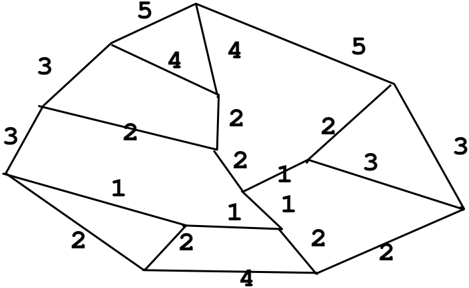
We study the operator that corresponds to the measurement of volume, in non-perturbative quantum gravity, and we compute its spectrum. The operator is constructed in the loop representation, via a regularization procedure; it is finite, background independent, and diffeomorphism-invariant, and therefore well defined on the space of diffeomorphism invariant states (knot states). We find that the spectrum of the volume of any physical region is discrete. A family of eigenstates are in one to one correspondence with the spin networks, which were introduced by Penrose in a different context. We compute the corresponding component of the spectrum, and exhibit the eigenvalues explicitly. The other eigenstates are related to a generalization of the spin networks, and their eigenvalues can be computed by diagonalizing finite dimensional matrices. Furthermore, we show that the eigenstates of the volume diagonalize also the area operator. We argue that the spectra of volume and area determined here can be considered as predictions of the loop-representation formulation of quantum gravity on the outcomes of (hypothetical) Planck-scale sensitive measurements of the geometry of space.
Overview
CoChat Summary
TL;DR
Rovelli and Smolin construct a regularized volume operator in loop-representation quantum gravity and compute its spectrum, finding it discrete. They show spin-network states diagonalize both the volume and area operators, yielding explicit discrete area and volume eigenvalues.
Key findings
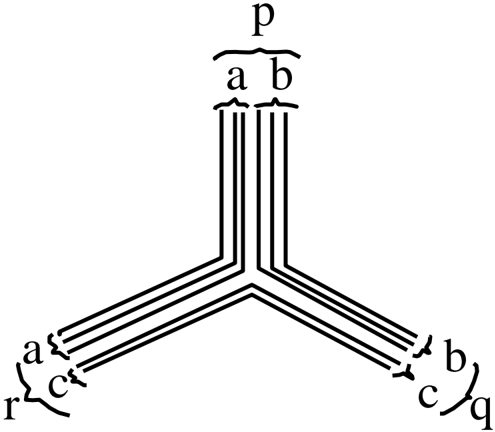
- The volume spectrum is discrete. For trivalent spin networks, the eigenvalue for a region \(R\) is \(V = \frac{1}{4} l_P^3 \sum_i \sqrt{a_i b_i c_i + a_i b_i + a_i c_i + b_i c_i}\), where the sum runs over nodes \(i\) contained in \(R\).
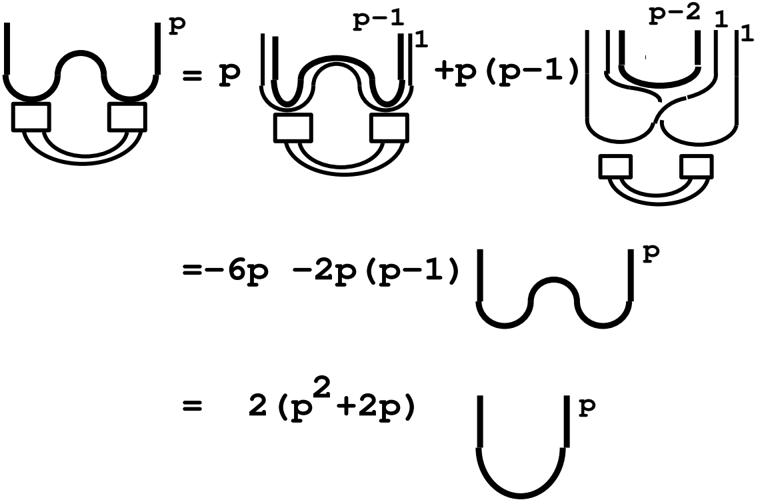
- The full area spectrum is \(A = \frac{1}{2} l_P^2 \sum_l \sqrt{p_l^2 + 2p_l}\), where \(l\) labels spin-network links crossing the surface.
- Spin-network states are eigenstates of the volume operator and also diagonalize the area operator; the two operators commute. Other volume eigenstates are related to a generalization of spin networks, with eigenvalues computable by diagonalizing finite-dimensional matrices.
- The authors argue that, under assumptions about physical fields defining regions and surfaces, Planck-scale measurements of volume or area would yield results in these discrete spectra.
Methods
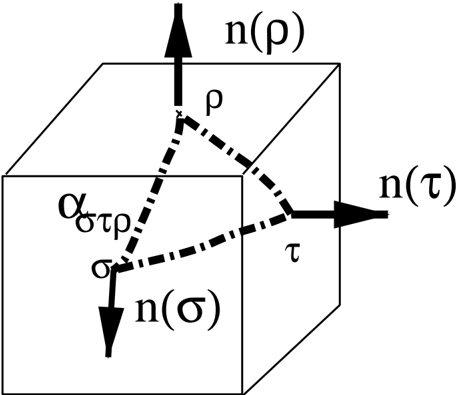
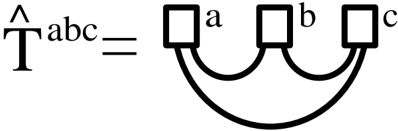
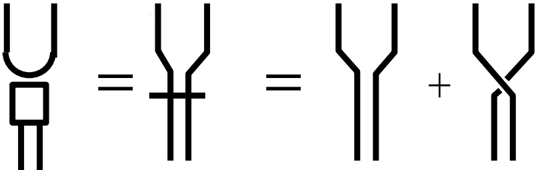
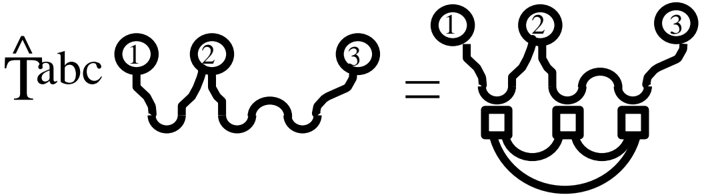
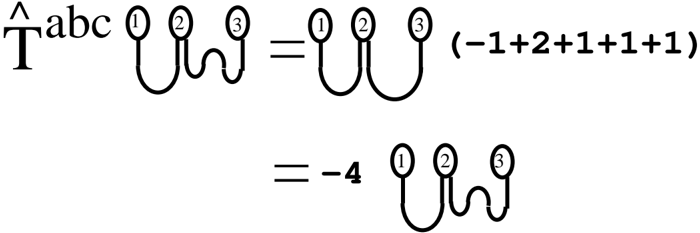
- Theoretical, non-perturbative quantum gravity in the loop representation. The volume operator is constructed via a diffeomorphism-invariant regularization using the three-hand loop observable \(T^{abc}\), partitioning a region into cubic boxes with an arbitrary unphysical flat metric \(g_0\), and taking a weak-operator limit \(L \to 0\).
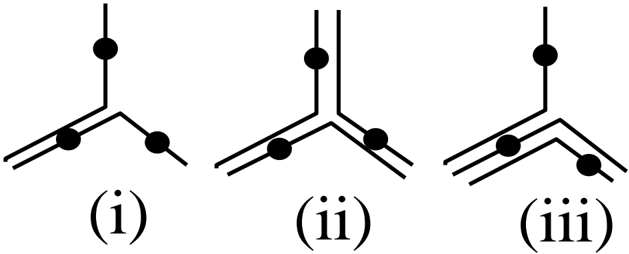
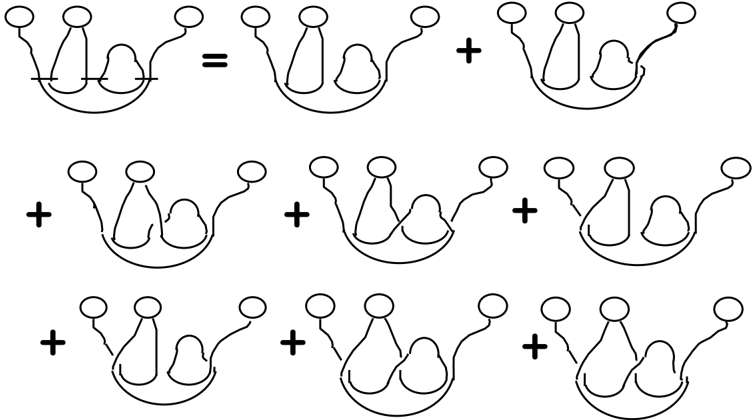
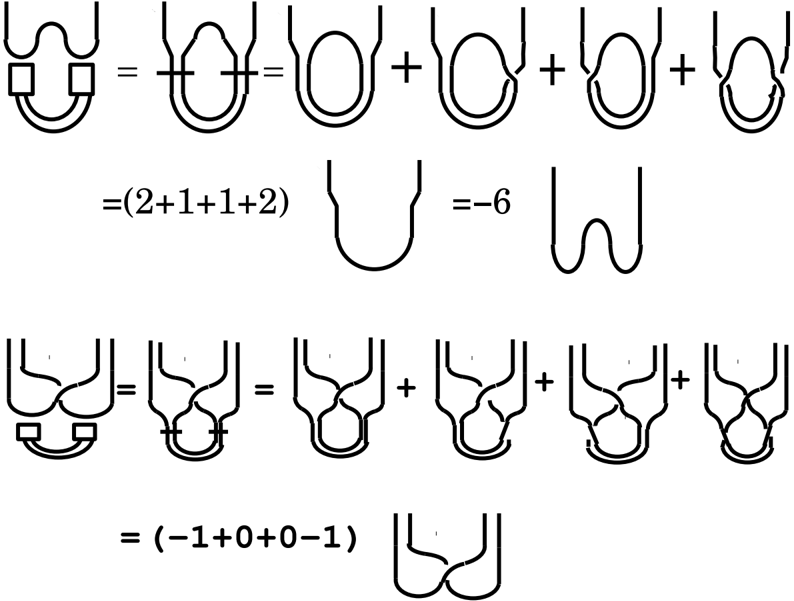
- The action of the volume operator is computed on the spin-network basis, where spin networks are trivalent graphs with positive integer link colors; the area operator is similarly diagonalized.
- No empirical data are used; the analysis is operator construction and spectral diagonalization.
Limitations
- The paper states that the local operator \(\sqrt{\det g}\) is ill-defined, that the regularization introduces an unphysical background metric \(g_0\) (though the operator is claimed independent of it in the limit), that the topology of the limit is delicate, and that diffeomorphism-invariant states lie in \(D_{\max}\) but not in the domain \(D\). It also notes that consistency of the theory is not proven and that quantization may have more than one solution.
- Evident from the provided text: the excerpt is truncated after the proportionality coefficient, so later sections and full derivation details are not available here. The physical interpretation also relies on assumptions about dynamical matter fields defining spatial regions and surfaces.
Model-written summary of a shortened version of the paper’s full text (it is longer than we read). Check it against the paper before relying on it.
Integrity signals
Registry
Cites
Statistics
Figures

Verification
Claims the paper makes
1 Valid · 4 Not valid · 5 Not checked · 18 Own results and interpretations
The sources with a verdict support this claim; the rest weren’t checked yet, have no full text we could read, or their verdicts aren’t rated yet.
In the paper
“Local quantities tend to be divergent or ill-defined in non-trivial generally covariant quantum field theories [3, 4, 11], a fact likely to be related to the non-renormalizability of the perturbative series.”
What the sources say
- Not checked — no full text of the sourcecites [3] matched to “Loop space representation of quantum general relativity” (1990) source
- Supportedcites [4] matched to “Weaving a classical metric with quantum threads” (1992) source
The Abstract says local operators such as the metric at a point may not be well-defined. The discussion of the local metric operator explains that its renormalization obstructs meaningful local geometric operators and says this appears to be a general feature of diffeomorphism-invariant theories. The claim’s separate suggestion about perturbative non-renormalizability is not the part attributed to this citation. (LLM, conf=0.90)
- Could not verifycites [11] matched to “Link Invariants, Holonomy Algebras and Functional Integration” (1993) sourceExperimental — accuracy not yet measured
The Introduction (pp. 1–2) discusses difficulties defining field-theoretic measures, and p. 4 describes regularized Wilson loops. Neither passage says that local quantities tend to diverge or be ill-defined in non-trivial generally covariant quantum field theories. Searches for local observables, divergences, and renormalization found no passage addressing that claim. (LLM, conf=0.73)
hedgedstates an association- Asserted: passes — The authors put it forward as true.
- Checkable: passes — It can be checked against evidence.
- Load-bearing: passes — The paper’s conclusions depend on it.
- Based: passes — The paper gives a reason why it holds.
The cited sources that could be checked couldn’t confirm or dispute this claim.
In the paper
“note for instance that there are other relevant topologies in state space, as the norm topologies defined by the kinematical or diffeomorphism-invariant Hilbert structures [6, 7], which are inequivalent to the one in which the limit (13) is taken.”
What the sources say
- Could not verifycites [6] matched to “Fermions in quantum gravity” (1994) sourceExperimental — accuracy not yet measured
Section 6.2 (pp. 33–34) uses pointwise topology in a model example about limits on knot states, but says a complete scalar product for the loop representation is not yet available. Neither those passages nor the passages found by searching for Hilbert norm topologies establish kinematical or diffeomorphism-invariant norm topologies, or their inequivalence to the topology used for the cited limit. (LLM, conf=0.72)
- Could not verifycites [7] matched to “Spatial infinity as a boundary of spacetime” (1992) sourceExperimental — accuracy not yet measured
The passages in §4, “Asymptotic symmetries” (page not supplied), discuss equivalence of spacetime completions, not topologies on a state space. Searches for Hilbert norm topologies and inequivalent state-space limits found no passage addressing the attributed claim. (LLM, conf=0.76)
plain- Asserted: passes — The authors put it forward as true.
- Checkable: passes — It can be checked against evidence.
- Load-bearing: unclear — It is unclear whether the paper’s conclusions depend on it.
- Based: passes — The paper gives a reason why it holds.
- Could not verify
A result the paper reports from its own data — it cites no other source for it, so there is none to check. The quote shows it is in the paper.
In the paper
“We find that the spectrum of the volume of any physical region is discrete.”
plain- Asserted: passes — The authors put it forward as true.
- Checkable: passes — It can be checked against evidence.
- Load-bearing: passes — The paper’s conclusions depend on it.
- Based: passes — The paper gives a reason why it holds.
A result the paper states — it cites no source for it, so there is none to check. The quote shows it is in the paper.
In the paper
“An unphysical background metric is introduced for the sake of the regularization, but the operator turns out to be independent of this background, in the limit in which the cut-off is removed.”
plain- Asserted: passes — The authors put it forward as true.
- Checkable: passes — It can be checked against evidence.
- Load-bearing: passes — The paper’s conclusions depend on it.
- Based: passes — The paper gives a reason why it holds.
In the paper
“Furthermore, we show here that the spin network states also diagonalize the operator Â[S], introduced in [3], which measures the area of the surface S.”
What the sources say
- Not checked — no full text of the sourcecites [3] matched to “Loop space representation of quantum general relativity” (1990) source
boostedstates an association- Asserted: passes — The authors put it forward as true.
- Checkable: passes — It can be checked against evidence.
- Load-bearing: passes — The paper’s conclusions depend on it.
- Based: passes — The paper gives a reason why it holds.
12 more claims
Create a free account to see all 28 claims and every source verdict.
- It may state two separate claims as one. 5
- Probably not a substantial claim. 5
- The quote only partly states this claim. 1
Claims other papers make about this one
Each is checked against this paper’s own text: does it say what the citing paper says it does?
The source backs part of the claim, not all of it — or backs it for a different population, condition or comparison.
In the citing paper
“In fact, that is why only volume and area operators could be constructed so far [10, 11].”
From A length operator for canonical quantum gravity (1998) · cites this paper as [10]
Experimental — accuracy not yet measuredThe source backs part of the claim, not all of it — or backs it for a different population, condition or comparison.
In the citing paper
“While the kinematics of loop quantum gravity (LQG) [1] is rather well understood [2, 3], its dynamics is not understood as cleanly.”
From Flipped spinfoam vertex and loop gravity (2008) · cites this paper as [4]
Experimental — accuracy not yet measuredThe source backs part of the claim, not all of it — or backs it for a different population, condition or comparison.
In the citing paper
“This problem arises due to the results obtained for the spectra of the geometrical operators and the black hole entropy being proportional to an unphysical parameter, which is called 'Immirzi parameter' [7] and appears as a parameter of a canonical transformation in classical gravity [8,9].”
From SO (4, C )-covariant Ashtekar-Barbero gravity and the Immirzi parameter (2000) · cites this paper as [9]
Experimental — accuracy not yet measuredThe cited source says what the claim attributes to it.
In the citing paper
“The results reported in this letter are obtained in the framework of quantum geometry [4] which does predict a discrete geometry because, e.g., the spectra of geometric operators as area and volume are discrete [5-7].”
From Absence of a Singularity in Loop Quantum Cosmology (2001) · cites this paper as [5]
The cited source says what the claim attributes to it.
In the citing paper
“Basic geometric quantities have been quantized [10][11][12][13][14] and found to have discrete spectra.”
From Loop quantum cosmology: I. Kinematics (2000) · cites this paper as [10]
17 more claims about this paper
Create a free account to see every claim other papers make about this one.
Citations
Cites
New Variables for Classical and Quantum Gravity
Ashtekar, A. (1986) · Physical Review Letters · doi:10.1103/physrevlett.57.2244 · Cited by 1,663
QUANTUM GRAVITY AND MINIMUM LENGTH
GARAY, L. J. (1995) · International Journal of Modern Physics A · doi:10.1142/s0217751x95000085 · Cited by 1,371
String theory beyond the Planck scale
Gross, D. J., & Mende, P. F. (1988) · Nuclear Physics B · doi:10.1016/0550-3213(88)90390-2 · Cited by 1,249
New Hamiltonian formulation of general relativity
Ashtekar, A. (1987) · Physical Review D · doi:10.1103/physrevd.36.1587 · Cited by 1,119
Quantum gravity and minimum length
Garay, L. J. (1994) · LA Referencia (Red Federada de Repositorios Institucionales de Publicaciones Científicas) · Cited by 881
Loop space representation of quantum general relativity
Rovelli, C., & Smolin, L. (1990) · Nuclear Physics B · doi:10.1016/0550-3213(90)90019-a · Cited by 806
Self-citationThe Hagedorn transition and the number of degrees of freedom of string theory
Atick, J. J., & Witten, E. (1988) · Nuclear Physics B · doi:10.1016/0550-3213(88)90151-4 · Cited by 800
The high-energy behavior of string scattering amplitudes
Gross, D. J., & Mende, P. F. (1987) · Physics Letters B · doi:10.1016/0370-2693(87)90355-8 · Cited by 778
Minimum physical length and the generalized uncertainty principle in string theory
Konishi, K., Paffuti, G., & Provero, P. (1990) · Physics Letters B · doi:10.1016/0370-2693(90)91927-4 · Cited by 753
On the nature of quantum geometrodynamics
Wheeler, J. A. (1957) · Annals of Physics · doi:10.1016/0003-4916(57)90050-7 · Cited by 693
Research works printed but not linked: 1
- Ashtekar, 1994, Quantum geometrodynamics and Coherent state transform on the space of connections, Penn. State University preprints
Cited by
Items 1,101–1,200 of 1,374
The road to loop quantum gravity
Huggett, N., & Wüthrich, C. (2025) · Oxford University Press eBooks · doi:10.1093/oso/9780198758501.003.0005 · Cited by 1
Third’ Quantization of Vacuum Einstein Gravity and Free Yang-Mills Theories
Raptis, I. (2006) · CERN Document Server (European Organization for Nuclear Research) · Cited by 2
Effective geometry of Bell-network states on a dipole graph
Baytaş, B., & Yokomizo, N. (2024) · Classical and Quantum Gravity · doi:10.1088/1361-6382/ad997b · Cited by 2
“For an V-valent node, the Rovelli-Smolin volume operator [16, 17] reads: where the constant κ 0 is a quantization ambiguity arising in the regularization of the classical formula for the volume density.”
BackgroundEntanglement in simple spin networks with a boundary
Ling, Y., Wu, M.-H., & Xiao, Y. (2019) · Chinese Physics C · doi:10.1088/1674-1137/43/1/013106 · Cited by 2
Lorentzian spinfoam gravity path integral and geometrical area-law entanglement entropy
Han, M. (2026) · Physical review. D/Physical review. D. · doi:10.1103/kbw3-m49g · Cited by 2
Discrete Hamiltonian evolution and quantum gravity
Husain, V., & Winkler, O. (2004) · Classical and Quantum Gravity · doi:10.1088/0264-9381/21/4/014 · Cited by 4
“In canonical methods, such as loop quantum gravity, discreteness of space arises as a rather natural consequence of Dirac quantization [2, 3, 4, 5], and it is possible that a form of discrete time evolution may emerge from a regulated action of the Hamiltonian constraint.”
BackgroundQuantum Holography from Fermion Fields
Zizzi, P. (2021) · Quantum Reports · doi:10.3390/quantum3030037 · Cited by 2
On black hole radiation spectrum in loop quantum gravity
Mejrhit, K., Laamara, R. A., & Ennadifi, S. E. (2017) · Gravitation and Cosmology · doi:10.1134/s0202289317010108 · Cited by 1
MODELING M-THEORY VACUA VIA GAUGED S-DUALITY
KONISHI, E. (2011) · International Journal of Modern Physics A · doi:10.1142/s0217751x11054693 · Cited by 4
Frampton, P. H., MELCHIORRI, A., Bonora, L., Bračić, A. B., Borštnik, N. M., NIELSEN, H. B., Froggatt, C. D., Shafi, Q., Álvarez, E. A., & Lizzi, F. (2004) · arXiv (Cornell University) · doi:10.48550/arxiv.hep-ph/0401043 · Cited by 28
Entanglement entropy in loop quantum gravity and geometrical area law
Han, M. (2026) · Physical review. D/Physical review. D. · doi:10.1103/8l48-qhks · Cited by 3
A note on the Hamiltonian constraint in canonical GR
Szabados, L. B. (2008) · Classical and Quantum Gravity · doi:10.1088/0264-9381/25/9/095005 · Cited by 2
Chen, Y., Liu, M., & Ulbricht, J. (2024) · Advances in High Energy Physics · doi:10.1155/2024/9755683 · Cited by 3
A Frobenius‐Type Theory for Discrete Systems
Nozaleda, D. R., Rodrı́guez, M. A., & Tempesta, P. (2025) · Studies in Applied Mathematics · doi:10.1111/sapm.70037 · Cited by 1
“Discrete formulations of quantum theories have been proposed, for instance, in several contexts of quantum gravity (see, e.g., [5–7]).”
Deparametrization and quantization of scalar-tensor gravity and its cosmological model
Yuan, F., Li, H., Li, S., & Ma, Y. (2026) · Physical review. D/Physical review. D. · doi:10.1103/by7d-4w9n · Cited by 1
“The fundamental operators of geometry part act on any cylindrical function ψ ( A ) as The geometric operators constructed in LQG, such as the area operator[39], the volume operator[40] and the length operator[41, 42], are still valid in H .”
The Substructure of Elementary Particles Demonstrated by the I-Theory
Isa, H. H. S., & Dumas, C. (2024) · Journal of High Energy Physics Gravitation and Cosmology · doi:10.4236/jhepgc.2024.102031 · Cited by 1
Li, H., Han, M., Liu, H., Song, S., & Qu, D. (2025) · Physical review. D/Physical review. D. · doi:10.1103/physrevd.111.086017 · Cited by 3
Cosmological Sectors in Loop Quantum Gravity
Würzburg, J.-M.-U. (2008) · Cited by 1
Singularity Resolution in Anisotropic and Black Hole Spacetimes in Loop Quantum Cosmology
Saini, S. (2018) · Louisiana State University · doi:10.31390/gradschool_dissertations.4775 · Cited by 3
“It is possible to define various operators representing geometrical quantities such as length, area and volume of curves, surfaces and regions of the spatial hypersurfaces on the kinematical Hilbert space which turn out to possess Planck scale discreteness in their spectra [93, 92, 94].”
BackgroundConformal Cyclic Evolution of the Universe: a Loop Quantum Gravity Perspective
Shriethar, N., & Rathinam, C. (2020) · International Journal of Theoretical Physics · doi:10.1007/s10773-020-04651-6 · Cited by 3
“The theory exhibits the discreteness in area and volume parameters [27].”
BackgroundLoop Representation of Quantum Gravity
Lim, A. P. C. (2023) · Annales Henri Poincaré · doi:10.1007/s00023-023-01337-7 · Cited by 2
“In [29], the authors used canonical quantization on Ashtekar variables to quantize area and volume, for 3-dimensional quantum gravity.”
Corrections to the Bekenstein-Hawking entropy and the Hawking radiation spectrum
Kong, B., & Yoon, Y. (2009) · arXiv (Cornell University) · Cited by 2
Sousa, M. D., Barrau, A., & Martineau, K. (2025) · Physical review. D/Physical review. D. · doi:10.1103/physrevd.111.066006 · Cited by 2
“The quantization “`a la Dirac” of the resulting holonomies and fluxes leads to discrete spectra for geometrical operators, such as the area [47, 48] or the volume [48, 49].”
Gorard, J. (2024) · Preprints.org · doi:10.20944/preprints202402.0280.v1 · Cited by 3
Radiation of a quantized black hole
Khriplovich, I. B. (2005) · Journal of Experimental and Theoretical Physics · doi:10.1134/1.1995791 · Cited by 2
Minimal and maximal lengths from non-Hermitian position-dependent noncommutativityPreprint
Lawson, L. M. (2021) · arXiv (Cornell University) · Cited by 1
Condensation of area quanta ensembles with quantum statistics in Schwarzschild spacetimes
McGovern, R., Major, S., Scheuing, T., & Takis, T. (2026) · Physical review. D/Physical review. D. · doi:10.1103/tkl8-lfmf · Cited by 1
Quantum General Invariance and Loop Gravity
Salisbury, D. (2001) · Foundations of Physics · doi:10.1023/a:1017530508201 · Cited by 1
On Generalised Statistical Equilibrium and Discrete Quantum Gravity
Kotecha, I. (2022) · Springer theses · doi:10.1007/978-3-030-90969-7 · Cited by 5
“We recall that in loop quantum gravity there exist different proposals for a volume operator (see [109,153–155] and references therein), but in each its spectral values are attached to the nodes of the labelled graphs.”
BackgroundNEW HINTS FROM GENERAL RELATIVITY
Dreyer, O. (2003) · International Journal of Modern Physics D · doi:10.1142/s0218271803004055 · Cited by 1
Sahoo, S., & Kumar, M. (2022) · Journal of Physics & Optics Sciences · doi:10.47363/jpsos/2022(4)163
Combinatorial Spacetime from Loop Quantum Gravity
Altaĭsky, M. V. (2026) · Physics of Particles and Nuclei Letters · doi:10.1134/s154747712570195x · Cited by 1
“…SO (3) group, the contraction of Roman indices I, J in (19) gives the squared angular momentum operator ˆ J 2 = 3 I =1 ( T I ) 2 , from where it follows that area operator ˆ A Σ takes a discrete set of eigenvalues: Similar, but more involved consideration is valid for the volume operator [17, 18].”
Emergence of Riemannian Quantum Geometry
Haggard, H. M., Lewandowski, J., & Sahlmann, H. (2024) · Springer eBooks · doi:10.1007/978-981-99-7681-2_96 · Cited by 1
Radiation of Quantized Black Hole
Khriplovich, I. B. (2004) · CERN Document Server (European Organization for Nuclear Research) · Cited by 2
Making quantum gravity calculablePreprint
Loll, R. (1995) · arXiv (Cornell University) · doi:10.48550/arxiv.gr-qc/9511080 · Cited by 1
“It however becomes an observable if the region R is defined intrinsically in some way by the presence of matter fields [15].”
BackgroundMethodInfluentialOntological Enigmas: What is the True Nature of Reality?
Glattfelder, J. B. (2019) · The frontiers collection · doi:10.1007/978-3-030-03633-1_10 · Cited by 3
“24 years later, this idea surprisingly re-emerged, as spin networks were found to represent the states of loop quantum gravity (Rovelli and Smolin 1995b; Baez 1995).”
BackgroundHamiltonian formulation of general relativity
Kiefer, C. (2025) · Oxford University Press eBooks · doi:10.1093/oso/9780198842132.003.0004 · Cited by 1
Ali, A. F. (2012) · Open ULeth Scholarship (OPUS) (University of Lethbridge) · Cited by 1
Phonons mimicking doubly special relativity kinematics
Marino, F. (2025) · Physics Letters B · doi:10.1016/j.physletb.2025.139529 · Cited by 1
“Different candidate theories of quantum gravity, such as loop quantum gravity [1], string theory [2, 3], as well as quantum gravity phenomenological approaches [4], suggest the existence of a minimal length, usually identified with the Planck length L p .”
Hamiltonian gravity in tetrad-connection variables
Duque, E. I. (2025) · Physical review. D/Physical review. D. · doi:10.1103/3r98-k11x · Cited by 3
Black Hole Statistical Physics: EntropyPreprint
Soloviev, V. O. (2005) · arXiv (Cornell University) · doi:10.48550/arxiv.gr-qc/0507124 · Cited by 5
“Non-perturbative techniques of the Ashtekar approach have led to a quantum theory of geometry in which operators corresponding to lengths, areas and volumes have discrete spectra [32].”
BackgroundMethodQUANTUM GEOMETRY AND THE BIG BANG
Singh, P. (2006) · International Journal of Modern Physics D · doi:10.1142/s0218271806009054 · Cited by 1
Quantum Cosmology: The Integration of Special Relativity and Quantum Mechanics Part IPreprint
Kahan, D. (2024) · Preprints.org · doi:10.20944/preprints202405.2028.v2
TGFT condensate cosmology as an example of spacetime emergence in quantum gravity
Oriti, D. (2022) · Routledge eBooks · doi:10.4324/9781003219019-13 · Cited by 2
Classical and Quantum Properties of Black Holes
Khriplovich, I. B. (2003) · Surveys In High Energy Physics · doi:10.1080/0142241032000156568 · Cited by 1
Quasinormal modes and quantization of area/entropy for noncommutative BTZ black hole
Huang, L., Chen, J., & Wang, Y. (2018) · The European Physical Journal C · doi:10.1140/epjc/s10052-018-5779-z · Cited by 1
Solution of the Dirac equation with exponential-type potential under the GUP
Deng, L.-F., Zhang, H., & Long, C. (2021) · International Journal of Modern Physics A · doi:10.1142/s0217751x21500056 · Cited by 1
Approximation of the naive black hole degeneracy
Yoon, Y. (2012) · General Relativity and Gravitation · doi:10.1007/s10714-012-1475-8 · Cited by 1
“this paper, we will consider the connection between the black hole entropy and the area spectrum suggested by Rovelli in 1996 [5] as loop quantum gravity predicts that the area spectrum is quantized [6, 7, 8]. To apply this connection, we will consider the formula proposed by Domagala, Lewandowski and Meissner which c…”
Quantum Hairy Black Hole Formation and Horizon Quantum Mechanics
Cavalcanti, R. T., & da Silva, J. M. H. (2022) · Universe · doi:10.3390/universe9010023 · Cited by 1
Exotic Smoothness and Quantum Gravity II: exotic R^4, singularities and cosmologyPreprint
Aßelmeyer-Maluga, T., & Król, J. (2011) · arXiv (Cornell University) · doi:10.48550/arxiv.1112.4882 · Cited by 2
Zhang, C., Song, S., & Han, M. (2021) · arXiv (Cornell University) · Cited by 3
An informationally-complete unification of quantum spacetime and matterPreprint
Chen, Z. (2014) · arXiv (Cornell University) · Cited by 1
Kisielowski, M. (2021) · Classical and Quantum Gravity · doi:10.1088/1361-6382/ac1e70 · Cited by 1
“There are two proposals for the volume operator: we will call them Rovelli– Smolin–DePietri volume operator [21, 22] and Ashtekar–Lewandowski volume operator [23].”
MethodGravity, Geometry, and the Quantum
Sahlmann, H. (2014) · Springer handbooks · doi:10.1007/978-3-642-41992-8_37 · Cited by 1
Smolin, L. (1996) · arXiv (Cornell University) · doi:10.48550/arxiv.gr-qc/9609031 · Cited by 3
“perator by keeping this order and regulating each piece separately Cˆ′ δǫL(N)|Γ >≡ Z d3xN′(x)Cˆδǫ(x)ˆq(x)L|Γ > (38) where Cˆδǫ(x) is defined in 34 and the regulated density q(x)L is defined as in [19, 37]. We take a cube of linear size L in the background metric centered at x and define qˆL ≡ 1 273!L6 Wˆ x,L (39) 2…”
Self-citationHomothetic expansion of polyhedra in the two-vertex model: emergence of FLRW
Garay, I., Rodríguez-González, S., & Vera, R. (2026) · Classical and Quantum Gravity · doi:10.1088/1361-6382/ae36dd · Cited by 1
“Therefore, they represent quanta of area and volume associated to the links and nodes respectively [3, 4].”
A novel mechanism for probing the Planck scale with wave packets following general distributions
Das, S., & Modak, S. K. (2023) · The European Physical Journal Plus · doi:10.1140/epjp/s13360-023-03990-7 · Cited by 1
A Nonrelativistic Tour of String Theory
Şimşek, C. (2022) · University of Groningen research database (University of Groningen / Centre for Information Technology) · doi:10.33612/diss.219254671 · Cited by 3
Two Thoughts on ``A Tale of Two Parts''
Spencer, J. (2014) · Res Philosophica · doi:10.11612/resphil.2014.91.3.5 · Cited by 1
Quantum Gravity and the Big BangPreprint
Bojowald, M. (2003) · arXiv (Cornell University) · doi:10.48550/arxiv.astro-ph/0309478 · Cited by 9
Thiemann, T., & Giesel, K. (2024) · Springer eBooks · doi:10.1007/978-981-99-7681-2_97 · Cited by 1
Vaid, D., & de Sousa, L. T. (2025) · Annals of Physics · doi:10.1016/j.aop.2025.170240 · Cited by 1
“LQG has concrete predictions such as discreteness of physical areas [5, 6], and also has rigorous mathematical results which reproduce the black hole entropy formulae for Einstein gravity [7].”
On Boundedness of Entropy of Photon Gas in Noncommutative Spacetime
Alam, K., & Faruk, M. M. (2017) · Advances in High Energy Physics · doi:10.1155/2017/7289625 · Cited by 2
Energy Spectrum of equilibrium Black HolesPreprint
Majhi, A. (2013) · arXiv (Cornell University) · Cited by 1
Новый подход к вычислению спектра квантового пространства-времени
Starodubtsev, A. N. (2017) · Теоретическая и математическая физика · doi:10.4213/tmf9128 · Cited by 1
Славутский, Г. (2026) · doi:10.24108/preprints-3114909 · Cited by 1
More on Schwarzschild Black Hole with Ultra-Violet Cutoff
Hannawi, M., & Nozari, K. (2024) · International Journal of Theoretical Physics · doi:10.1007/s10773-023-05514-6 · Cited by 1
On the initial state of the universe in the theory of inflation
Gorobey, N. N., Lukyanenko, A. S., & Svintsov, M. V. (2017) · St Petersburg Polytechnical University Journal Physics and Mathematics · doi:10.1016/j.spjpm.2017.05.008 · Cited by 1
Natural discrete differential calculus in physicsPreprint
Carlo Rovelli, C., & Zatloukal, V. (2019) · PhilSci-Archive (University of Pittsburgh) · doi:10.48550/arxiv.1902.03026 · Cited by 1
Self-citationEsposito, V., Fabiano, G., Frattulillo, D., & Mercati, F. (2025) · Quantum · doi:10.22331/q-2025-04-24-1721 · Cited by 8
Quantization of Black Holes in the Shielded Strong Gravity Scenario (I. Neutral Scalar States)Preprint
Coyne, D. G., & Da, C. (2006) · arXiv (Cornell University) · doi:10.48550/arxiv.hep-th/0609097 · Cited by 2
“In loop quantum gravity, quantization of area is a fundamental outcome of the theory [5,6].”
BackgroundBell nonlocality in maximal-length quantum mechanics
Bosso, P., Illuminati, F., Petruzziello, L., & Wagner, F. (2023) · Physics Letters B · doi:10.1016/j.physletb.2023.138131 · Cited by 1
“Nevertheless, the existence of a minimal length has found further support in achievements obtained in loop quantum gravity [19] and asymptotic safety [20], as well as in heuristic arguments and other physical frameworks (for a”
BackgroundLoop quantum gravity - a short reviewPreprint
Sahlmann, H. (2010) · arXiv (Cornell University) · doi:10.48550/arxiv.1001.4188 · Cited by 65
“In fact, there are two slightly different versions of the volume operator [35, 37], differing in the way the tangent space structure of a vertex is taken into account.”
BackgroundA geometric procedure for the reduced-state-space quantisation of constrained systemsPreprint
Anastopoulos, C. (2004) · arXiv (Cornell University) · doi:10.48550/arxiv.gr-qc/0411130 · Cited by 1
“Furthermore, there exist quantities of potential interest quantum mechanically that do not commute with the constraints–such as the area and volume operators in loop quantum gravity [3].”
BackgroundBunao, J. R. R. (2016) · Classical and Quantum Gravity · doi:10.1088/1361-6382/aa51fb · Cited by 2
Scaling-based quantization of spacetime microstructure
Ma, W., & Ma, Y.-G. (2025) · Nuclear Physics B · doi:10.1016/j.nuclphysb.2025.117282 · Cited by 1
“In the study of spacetime quantization, it is crucial to define fundamental observable operators that characterize the quantum nature of geometry itself [70].”
Quantum Hall Eect and Black Hole Entropy in Loop Quantum Gravity
Vaid, D. (2013) · Cited by 1
Cosmological implications of the hydrodynamical phase of group field theory
Gabbanelli, L., & Bianchi, S. D. (2021) · General Relativity and Gravitation · doi:10.1007/s10714-021-02833-z · Cited by 10
Some Numerical and Phenomenological Studies in Loop Quantum Cosmology
Gupt, B. (2014) · Louisiana State University · doi:10.31390/gradschool_dissertations.1075
“LQG endows the spacetime with a discrete quantum geometry by predicting Planck scale discreteness in the eigenvalues of the geometric operators such as area and volume [29, 30, 31, 32].”
MethodRelativistic Kinematics of Two-Parametric Riemann Surface in Genus TwoPreprint
Nazarenko, A. V., & Kulinich, Y. A. (2016) · arXiv (Cornell University) · doi:10.48550/arxiv.1608.05340
“In this way, we touch the problem of WP-area quantization, which is similar to the one of the loop quantum gravity/cosmology [12].”
MethodInfluentialLength versus time-interval discreteness in 2+1 Lorentzian canonical quantum gravityPreprint
Livine, R. E., & Carlo Rovelli, C. (2001) · arXiv (Cornell University) · doi:10.48550/arxiv.gr-qc/0101088 · Cited by 1
“The situation is then puzzling in 4d, where there is an apparent sign discrepancy between spin foam [5] [7] and loop [1] [2] results .”
BackgroundSelf-citationEmergent Metric Fluctuations from Quantum Field Correlators in Darwinian Quantum GravityPreprint
Lori, N. F. (2026) · SSRN Electronic Journal · doi:10.2139/ssrn.6643038
MacKay, N. M. (2024) · SSRN Electronic Journal · doi:10.2139/ssrn.4944410 · Cited by 2
Deriving Spin within a Discrete-Time Theory
Recami, E., & Salesi, G. (2007) · Foundations of Physics · doi:10.1007/s10701-006-9101-9 · Cited by 2
The Comprehensive Architecture of Quantum Gravity: A Unified Mathematical and Conceptual Synthesis
Kalimuthu, S. (2026) · Annals of Mathematics and Physics · doi:10.17352/amp.000196
Thermodynamic Properties and Topological Charge of a Static Black Hole in Loop Quantum GravityPreprint
Dong, S., Hosseinifar, F., Studnička, F., et al. (2025) · SSRN Electronic Journal · doi:10.2139/ssrn.5202701
Canonical Quantum Gravity with New Variables and Loops: A Report
Pullin, J. A. (1997) · Astrophysics and space science library · doi:10.1007/978-94-011-5812-1_14 · Cited by 1
Canonical Quantum Gravity and Effective Theory
Bojowald, M. (2009) · Birkhäuser Basel eBooks · doi:10.1007/978-3-7643-8736-5_13
“Since those operators have discrete spectra, spatial geometry reconstructed from flux operators is discrete [ 11 , 12, 13].”
BackgroundComplete loop quantum gravity graviton propagator
Alesci, E. (2015)
Spin Foams, Refinement Limit, and Renormalization
Asante, S. K., Dittrich, B., & Steinhaus, S. (2024) · Springer eBooks · doi:10.1007/978-981-99-7681-2_106 · Cited by 1
Borsevici, V., Ganguly, S., & Manna, G. (2025) · SSRN Electronic Journal · doi:10.2139/ssrn.5556791 · Cited by 3
Polymer quantization effects on gauge-flation
Mardaani, M., & Nozari, K. (2018) · International Journal of Geometric Methods in Modern Physics · doi:10.1142/s0219887818501694
Parametrized and relational systems
Kiefer, C. (2025) · Oxford University Press eBooks · doi:10.1093/oso/9780198842132.003.0003
Gimenez, J. G. G., Hadjimichef, D., & Vasconcellos, C. A. Z. (2025) · Astronomische Nachrichten · doi:10.1002/asna.70008
Khodadi, M., Jafari, N., & Mamedov, S. (2026) · The European Physical Journal C · doi:10.1140/epjc/s10052-026-16186-x
Coyne, D. G., & Da, C. (2009) · arXiv (Cornell University) · doi:10.48550/arxiv.0905.1667
“A wide range of theoretical speculation has expanded on such ideas [38,39,40], and there is even a lively”
BackgroundNew Quantum Spin Perspective and Space-Time of Mind-Stuff
Vyas, R. P., & Joshi, M. (2023) · Journal of Applied Consciousness Studies · doi:10.4103/jacs.jacs_34_22 · Cited by 1
Sahlmann, H. (2024) · Elsevier eBooks · doi:10.1016/b978-0-323-95703-8.00252-4
Metadata
- Authors
- Rovelli, C., & Smolin, L.
- Affiliations
- Pennsylvania State University (US)
- Corresponding author
- Smolin, Lee
- ORCID
- Smolin, Lee
- Venue
- Nuclear Physics B
- Publisher
- Elsevier BV
- Published
- 1995-05
- Volume
- 442
- Issue
- 3
- Pages
- 593-619
- ISSN
- 0550-3213 (ISSN-L)
- OpenAlex
- W2104041846
- Semantic Scholar
- 3b85eebc659d3ae5d857e1d141fd5126db507eba
- Cited by
- 1,365
- References
- 63
- Citations by year
- 2026: 40 · 2025: 79 · 2024: 70 · 2023: 38 · 2022: 35 · 2021: 55 · 2020: 31 · 2019: 42 · 2018: 44 · 2017: 40 · 2016: 48 · 2015: 36 · 2014: 43 · 2013: 47 · 2012: 49
- FWCI
- 38.09
- Type
- journal article
- Language
- en
- Open access
- green
- arxiv.org
- Licence
- www.elsevier.com/tdm/userlicense/1.0/ (tdm)
- www.elsevier.com/legal/tdmrep-license (tdm)
- Locations
- Nuclear Physics B (publishedVersion)
- arXiv (Cornell University) (submittedVersion)
- CERN Document Server (European Organization for Nuclear Research) (submittedVersion)
- arXiv (Cornell University)
- Topics
- Physical Sciences › Physics and Astronomy › Nuclear and High Energy Physics › Noncommutative and Quantum Gravity Theories
- Physical Sciences › Physics and Astronomy › Astronomy and Astrophysics › Relativity and Gravitational Theory
- Physical Sciences › Physics and Astronomy › Nuclear and High Energy Physics › Black Holes and Theoretical Physics
- Keywords
- quantum gravity, loop representation, spin networks, volume operator, area operator, diffeomorphism invariance, background independence, Planck-scale geometry, non-perturbative quantum gravity
About these checks
Registry, retraction, Cites and statistics results are computed, not judged, with one exception: a printed reference that no index lists is read once by a model before it counts as a citation error. Claims are extracted by a model and kept only when their quote appears verbatim in the text; each cited source is then checked, with a model’s help, for whether it says what the claim relies on. Those verdicts can be wrong — read the claim’s quote and the cited source before relying on one.
The claim verdicts this report counts are experimental: their accuracy is not yet measured.
A language model drew the claims from the paper on 2026-10-07, under version 3 of the claim definition (model deepseek-v4.1-flash, prompt extract-v3).
A second model labelled each claim on 2026-10-07 (model jev-1.13-20260917, definition revision gold-guideline-v0.2).
Cited sources are checked with a language model’s help (gpt-6-sol).
Statistics and arithmetic are recomputed, not judged.
Confidence bands are shown only for fields calibrated on our annotated test set. None is calibrated yet, so no band is shown.
What counts as a claim ›How we measure confidence ›How we check this ›
Are you an author, or do you see a problem with this page? Request a review
Data sources
Bibliographic data: Semantic Scholar, OpenAlex, Crossref.
Contains information from the Semantic Scholar Academic Graph Datasets, made available under the ODC Attribution License (ODC-BY 1.0).
Semantic Scholar’s data is described in: Kinney, R., et al. (2023). The Semantic Scholar Open Data Platform. arXiv:2301.10140.
