

Discreteness of area and volume in quantum gravity
Open accessThe DOI matches its Crossref record; 60 of the 63 references it cites were found in a registry or an index; 6 of the 14 sources its claims cite were checked for support.
Abstract
We study the operator that corresponds to the measurement of volume, in non-perturbative quantum gravity, and we compute its spectrum. The operator is constructed in the loop representation, via a regularization procedure; it is finite, background independent, and diffeomorphism-invariant, and therefore well defined on the space of diffeomorphism invariant states (knot states). We find that the spectrum of the volume of any physical region is discrete. A family of eigenstates are in one to one correspondence with the spin networks, which were introduced by Penrose in a different context. We compute the corresponding component of the spectrum, and exhibit the eigenvalues explicitly. The other eigenstates are related to a generalization of the spin networks, and their eigenvalues can be computed by diagonalizing finite dimensional matrices. Furthermore, we show that the eigenstates of the volume diagonalize also the area operator. We argue that the spectra of volume and area determined here can be considered as predictions of the loop-representation formulation of quantum gravity on the outcomes of (hypothetical) Planck-scale sensitive measurements of the geometry of space.
Overview
CoChat Summary
TL;DR
Rovelli and Smolin construct a regularized volume operator in loop-representation quantum gravity and compute its spectrum, finding it discrete. They show spin-network states diagonalize both the volume and area operators, yielding explicit discrete area and volume eigenvalues.
Key findings
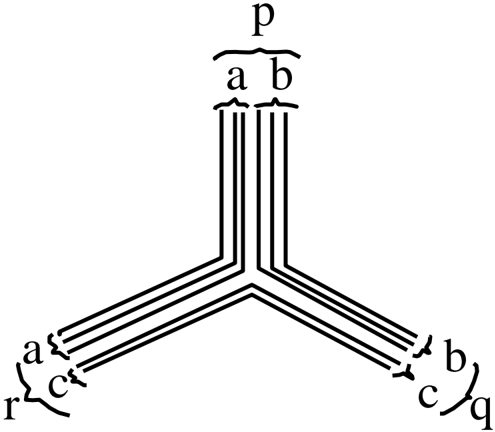
- The volume spectrum is discrete. For trivalent spin networks, the eigenvalue for a region \(R\) is \(V = \frac{1}{4} l_P^3 \sum_i \sqrt{a_i b_i c_i + a_i b_i + a_i c_i + b_i c_i}\), where the sum runs over nodes \(i\) contained in \(R\).
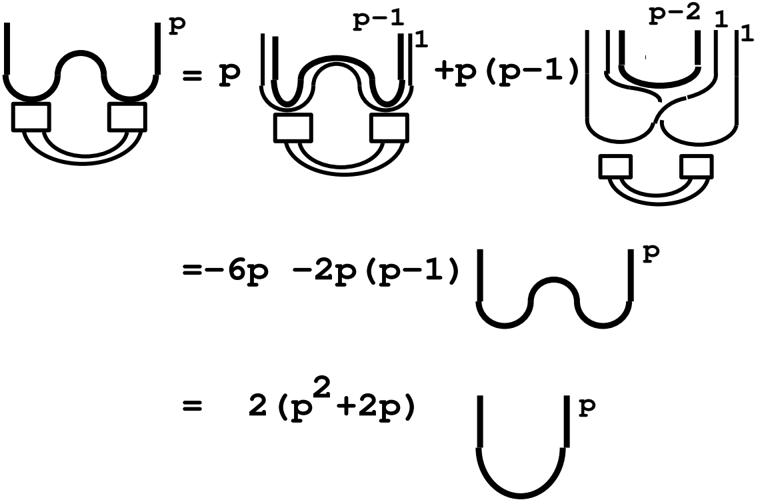
- The full area spectrum is \(A = \frac{1}{2} l_P^2 \sum_l \sqrt{p_l^2 + 2p_l}\), where \(l\) labels spin-network links crossing the surface.
- Spin-network states are eigenstates of the volume operator and also diagonalize the area operator; the two operators commute. Other volume eigenstates are related to a generalization of spin networks, with eigenvalues computable by diagonalizing finite-dimensional matrices.
- The authors argue that, under assumptions about physical fields defining regions and surfaces, Planck-scale measurements of volume or area would yield results in these discrete spectra.
Methods
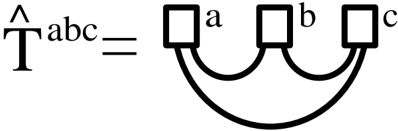
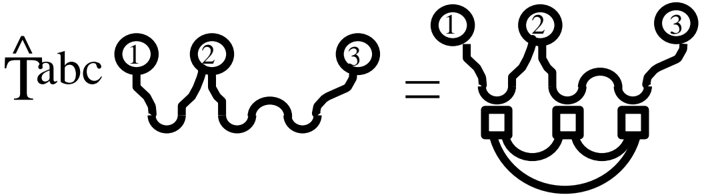
- Theoretical, non-perturbative quantum gravity in the loop representation. The volume operator is constructed via a diffeomorphism-invariant regularization using the three-hand loop observable \(T^{abc}\), partitioning a region into cubic boxes with an arbitrary unphysical flat metric \(g_0\), and taking a weak-operator limit \(L \to 0\).
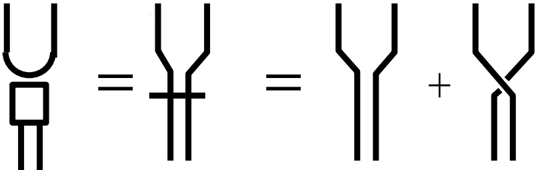
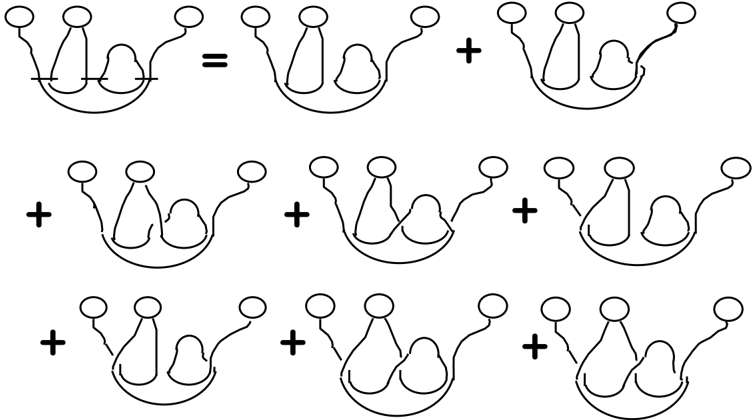
- The action of the volume operator is computed on the spin-network basis, where spin networks are trivalent graphs with positive integer link colors; the area operator is similarly diagonalized.
- No empirical data are used; the analysis is operator construction and spectral diagonalization.
Limitations
- The paper states that the local operator \(\sqrt{\det g}\) is ill-defined, that the regularization introduces an unphysical background metric \(g_0\) (though the operator is claimed independent of it in the limit), that the topology of the limit is delicate, and that diffeomorphism-invariant states lie in \(D_{\max}\) but not in the domain \(D\). It also notes that consistency of the theory is not proven and that quantization may have more than one solution.
- Evident from the provided text: the excerpt is truncated after the proportionality coefficient, so later sections and full derivation details are not available here. The physical interpretation also relies on assumptions about dynamical matter fields defining spatial regions and surfaces.
Model-written summary of a shortened version of the paper’s full text (it is longer than we read). Check it against the paper before relying on it.
Integrity signals
Registry
Cites
Statistics
Figures

Verification
Claims the paper makes
1 Valid · 4 Not valid · 5 Not checked · 18 Own results and interpretations
The sources with a verdict support this claim; the rest weren’t checked yet, have no full text we could read, or their verdicts aren’t rated yet.
In the paper
“Local quantities tend to be divergent or ill-defined in non-trivial generally covariant quantum field theories [3, 4, 11], a fact likely to be related to the non-renormalizability of the perturbative series.”
What the sources say
- Not checked — no full text of the sourcecites [3] matched to “Loop space representation of quantum general relativity” (1990) source
- Supportedcites [4] matched to “Weaving a classical metric with quantum threads” (1992) source
The Abstract says local operators such as the metric at a point may not be well-defined. The discussion of the local metric operator explains that its renormalization obstructs meaningful local geometric operators and says this appears to be a general feature of diffeomorphism-invariant theories. The claim’s separate suggestion about perturbative non-renormalizability is not the part attributed to this citation. (LLM, conf=0.90)
- Could not verifycites [11] matched to “Link Invariants, Holonomy Algebras and Functional Integration” (1993) sourceExperimental — accuracy not yet measured
The Introduction (pp. 1–2) discusses difficulties defining field-theoretic measures, and p. 4 describes regularized Wilson loops. Neither passage says that local quantities tend to diverge or be ill-defined in non-trivial generally covariant quantum field theories. Searches for local observables, divergences, and renormalization found no passage addressing that claim. (LLM, conf=0.73)
hedgedstates an association- Asserted: passes — The authors put it forward as true.
- Checkable: passes — It can be checked against evidence.
- Load-bearing: passes — The paper’s conclusions depend on it.
- Based: passes — The paper gives a reason why it holds.
The cited sources that could be checked couldn’t confirm or dispute this claim.
In the paper
“note for instance that there are other relevant topologies in state space, as the norm topologies defined by the kinematical or diffeomorphism-invariant Hilbert structures [6, 7], which are inequivalent to the one in which the limit (13) is taken.”
What the sources say
- Could not verifycites [6] matched to “Fermions in quantum gravity” (1994) sourceExperimental — accuracy not yet measured
Section 6.2 (pp. 33–34) uses pointwise topology in a model example about limits on knot states, but says a complete scalar product for the loop representation is not yet available. Neither those passages nor the passages found by searching for Hilbert norm topologies establish kinematical or diffeomorphism-invariant norm topologies, or their inequivalence to the topology used for the cited limit. (LLM, conf=0.72)
- Could not verifycites [7] matched to “Spatial infinity as a boundary of spacetime” (1992) sourceExperimental — accuracy not yet measured
The passages in §4, “Asymptotic symmetries” (page not supplied), discuss equivalence of spacetime completions, not topologies on a state space. Searches for Hilbert norm topologies and inequivalent state-space limits found no passage addressing the attributed claim. (LLM, conf=0.76)
plain- Asserted: passes — The authors put it forward as true.
- Checkable: passes — It can be checked against evidence.
- Load-bearing: unclear — It is unclear whether the paper’s conclusions depend on it.
- Based: passes — The paper gives a reason why it holds.
- Could not verify
A result the paper reports from its own data — it cites no other source for it, so there is none to check. The quote shows it is in the paper.
In the paper
“We find that the spectrum of the volume of any physical region is discrete.”
plain- Asserted: passes — The authors put it forward as true.
- Checkable: passes — It can be checked against evidence.
- Load-bearing: passes — The paper’s conclusions depend on it.
- Based: passes — The paper gives a reason why it holds.
A result the paper states — it cites no source for it, so there is none to check. The quote shows it is in the paper.
In the paper
“An unphysical background metric is introduced for the sake of the regularization, but the operator turns out to be independent of this background, in the limit in which the cut-off is removed.”
plain- Asserted: passes — The authors put it forward as true.
- Checkable: passes — It can be checked against evidence.
- Load-bearing: passes — The paper’s conclusions depend on it.
- Based: passes — The paper gives a reason why it holds.
In the paper
“Furthermore, we show here that the spin network states also diagonalize the operator Â[S], introduced in [3], which measures the area of the surface S.”
What the sources say
- Not checked — no full text of the sourcecites [3] matched to “Loop space representation of quantum general relativity” (1990) source
boostedstates an association- Asserted: passes — The authors put it forward as true.
- Checkable: passes — It can be checked against evidence.
- Load-bearing: passes — The paper’s conclusions depend on it.
- Based: passes — The paper gives a reason why it holds.
12 more claims
Create a free account to see all 28 claims and every source verdict.
- It may state two separate claims as one. 5
- Probably not a substantial claim. 5
- The quote only partly states this claim. 1
Claims other papers make about this one
Each is checked against this paper’s own text: does it say what the citing paper says it does?
The source backs part of the claim, not all of it — or backs it for a different population, condition or comparison.
In the citing paper
“In fact, that is why only volume and area operators could be constructed so far [10, 11].”
From A length operator for canonical quantum gravity (1998) · cites this paper as [10]
Experimental — accuracy not yet measuredThe source backs part of the claim, not all of it — or backs it for a different population, condition or comparison.
In the citing paper
“While the kinematics of loop quantum gravity (LQG) [1] is rather well understood [2, 3], its dynamics is not understood as cleanly.”
From Flipped spinfoam vertex and loop gravity (2008) · cites this paper as [4]
Experimental — accuracy not yet measuredThe source backs part of the claim, not all of it — or backs it for a different population, condition or comparison.
In the citing paper
“This problem arises due to the results obtained for the spectra of the geometrical operators and the black hole entropy being proportional to an unphysical parameter, which is called 'Immirzi parameter' [7] and appears as a parameter of a canonical transformation in classical gravity [8,9].”
From SO (4, C )-covariant Ashtekar-Barbero gravity and the Immirzi parameter (2000) · cites this paper as [9]
Experimental — accuracy not yet measuredThe cited source says what the claim attributes to it.
In the citing paper
“The results reported in this letter are obtained in the framework of quantum geometry [4] which does predict a discrete geometry because, e.g., the spectra of geometric operators as area and volume are discrete [5-7].”
From Absence of a Singularity in Loop Quantum Cosmology (2001) · cites this paper as [5]
The cited source says what the claim attributes to it.
In the citing paper
“Basic geometric quantities have been quantized [10][11][12][13][14] and found to have discrete spectra.”
From Loop quantum cosmology: I. Kinematics (2000) · cites this paper as [10]
17 more claims about this paper
Create a free account to see every claim other papers make about this one.
Citations
Cites
New Variables for Classical and Quantum Gravity
Ashtekar, A. (1986) · Physical Review Letters · doi:10.1103/physrevlett.57.2244 · Cited by 1,663
QUANTUM GRAVITY AND MINIMUM LENGTH
GARAY, L. J. (1995) · International Journal of Modern Physics A · doi:10.1142/s0217751x95000085 · Cited by 1,371
String theory beyond the Planck scale
Gross, D. J., & Mende, P. F. (1988) · Nuclear Physics B · doi:10.1016/0550-3213(88)90390-2 · Cited by 1,249
New Hamiltonian formulation of general relativity
Ashtekar, A. (1987) · Physical Review D · doi:10.1103/physrevd.36.1587 · Cited by 1,119
Quantum gravity and minimum length
Garay, L. J. (1994) · LA Referencia (Red Federada de Repositorios Institucionales de Publicaciones Científicas) · Cited by 881
Loop space representation of quantum general relativity
Rovelli, C., & Smolin, L. (1990) · Nuclear Physics B · doi:10.1016/0550-3213(90)90019-a · Cited by 806
Self-citationThe Hagedorn transition and the number of degrees of freedom of string theory
Atick, J. J., & Witten, E. (1988) · Nuclear Physics B · doi:10.1016/0550-3213(88)90151-4 · Cited by 800
The high-energy behavior of string scattering amplitudes
Gross, D. J., & Mende, P. F. (1987) · Physics Letters B · doi:10.1016/0370-2693(87)90355-8 · Cited by 778
Minimum physical length and the generalized uncertainty principle in string theory
Konishi, K., Paffuti, G., & Provero, P. (1990) · Physics Letters B · doi:10.1016/0370-2693(90)91927-4 · Cited by 753
On the nature of quantum geometrodynamics
Wheeler, J. A. (1957) · Annals of Physics · doi:10.1016/0003-4916(57)90050-7 · Cited by 693
Research works printed but not linked: 1
- Ashtekar, 1994, Quantum geometrodynamics and Coherent state transform on the space of connections, Penn. State University preprints
Cited by
Items 401–500 of 1,374
Relational evolution of effectively interacting group field theory quantum gravity condensates
Pithis, A. G. A., & Sakellariadou, M. (2017) · Physical review. D/Physical review. D. · doi:10.1103/physrevd.95.064004 · Cited by 41
The classical limit and the form of the hamiltonian constraint in nonperturbative quantum gravity
Smolin, L. (1996) · arXiv · doi:10.48550/arxiv.gr-qc/9609034 · Cited by 33
“Several authors have studied the hypothesis that the area of any surface, and thus that of an event horizon is a discrete quantity[36, 16, 24].”
BackgroundMethodInfluentialSelf-citationReduced loop quantization with four Klein–Gordon scalar fields as reference matter
Giesel, K., & Vetter, A. (2019) · Classical and Quantum Gravity · doi:10.1088/1361-6382/ab26f4 · Cited by 42
“the square root of the physical Hamiltonian density in (3.20) can all be quantized on Hphys using loop quantum gravity techniques. The √ Q that occurs can be quantized by means of the volume operator [25, 26]. The observable associated to the geometric part of the Hamiltonian constraint Cgeo can be quantized using the…”
MethodInfluentialHow information crosses Schwarzschild’s central singularity
D’Ambrosio, F., & Rovelli, C. (2018) · Classical and Quantum Gravity · doi:10.1088/1361-6382/aae499 · Cited by 50
Self-citationEmergence of gravity from spinfoams
Magliaro, E., & Perini, C. (2011) · Europhysics Letters (EPL) · doi:10.1209/0295-5075/95/30007 · Cited by 43
The minimum length problem of loop quantum cosmologyPreprint
Dzierżak, P., Jezierski, J., Małkiewicz, P., & Piechocki, W. (2008) · arXiv (Cornell University) · doi:10.48550/arxiv.0810.3172 · Cited by 52
“On the other hand, the spectrum of kinematical Âr of LQG is discrete [15, 16].”
BackgroundNon-minimal couplings, quantum geometry and black hole entropy
Ashtekar, A., & Corichi, A. (2003) · CERN Document Server (European Organization for Nuclear Research) · Cited by 32
Model for the motion of a particle in a quantum background
Noui, K. (2008) · Physical review. D. Particles, fields, gravitation, and cosmology/Physical review. D. Particles and fields · doi:10.1103/physrevd.78.105008 · Cited by 33
“Indeed, LQG provides a background independent quantization of general relativity where standard geometrical notions, like length, area or volume, become well-defined operators acting on a suitable Hilbert space [2].”
BackgroundA combinatorial approach to diffeomorphism invariant quantum gauge theories
Zapata, J. A. (1997) · Journal of Mathematical Physics · doi:10.1063/1.532159 · Cited by 32
Dynamical Quantum Geometry (DQG Programme)
Koslowski, T. (2007) · arXiv (Cornell University) · doi:10.48550/arxiv.0709.3465 · Cited by 32
“The observation that makes the restriction to a subalgebra possible is that one can find a quantization of the volume of a region constructed from area operators, which is different from [5, 6], where an expression of the form ∫”
BackgroundDegenerate configurations, singularities and the non-Abelian nature of loop quantum gravity
Bojowald, M. (2006) · Classical and Quantum Gravity · doi:10.1088/0264-9381/23/3/023 · Cited by 34
“In this case, it is clear that the volume operator should be considered more basic since it can be quantized directly using only fluxes [14, 15], and as such it is indeed essentially unique [34].”
BackgroundElements of Loop Quantum CosmologyPreprint
Bojowald, M. (2005) · arXiv (Cornell University) · doi:10.48550/arxiv.gr-qc/0505057 · Cited by 60
“This then allows us to reconsider the singularity and other problems from the point of view of the full theory, making sure that also in a simpler cosmological context only those steps are undertaken that have an analog in the full theory.”
BackgroundLoop Quantum Gravity à la Aharonov–Bohm
Bianchi, E. (2014) · General Relativity and Gravitation · doi:10.1007/s10714-014-1668-4 · Cited by 35
Can Hawking temperatures be negative?
Park, M.-I. (2008) · Physics Letters B · doi:10.1016/j.physletb.2008.04.009 · Cited by 35
Loop states in lattice gauge theory
Mathur, M. (2006) · Physics Letters B · doi:10.1016/j.physletb.2006.08.022 · Cited by 36
Statistical equilibrium in quantum gravity: Gibbs states in group field theory
Kotecha, I., & Oriti, D. (2018) · New Journal of Physics · doi:10.1088/1367-2630/aacbbd · Cited by 34
Combinatorial Space from Loop Quantum Gravity
Zapata, J. A. (1998) · General Relativity and Gravitation · doi:10.1023/a:1026699012787 · Cited by 31
The inverse loop transformPreprint
Thiemann, T., & Cgpg, P. (1998) · Cited by 32
Gravitational Collapse in Loop Quantum Gravity
Modesto, L. (2007) · International Journal of Theoretical Physics · doi:10.1007/s10773-007-9458-3 · Cited by 39
An elementary introduction to loop quantum gravityPreprint
Bodendorfer, N. (2016) · arXiv (Cornell University) · doi:10.48550/arxiv.1607.05129 · Cited by 73
“2 Volume operator The volume operator V̂ (R) of a region R [138, 140, 141] is constructed in a similar way than the area operator by regularising the classical expression”
BackgroundLoop quantum gravity on non-compact spaces
Arnsdorf, M., & Gupta, S. (2000) · Nuclear Physics B · doi:10.1016/s0550-3213(00)00196-6 · Cited by 33
“Their construction is made possible by the existence of operators on Haux which measure the area of a surface and the volume of a region [20,12,4,8].”
BackgroundA note on the Holst action, the time gauge, and the Barbero–Immirzi parameter
Geiller, M., & Noui, K. (2013) · General Relativity and Gravitation · doi:10.1007/s10714-013-1552-7 · Cited by 49
The volume operator in covariant Quantum GravityPreprint
Ding, Y., & Rovelli, C. (2010) · Cited by 32
Self-citationQuantum properties of topological black holes
Klemm, D. S., & Vanzo, L. (1998) · Physical review. D. Particles, fields, gravitation, and cosmology/Physical review. D. Particles and fields · doi:10.1103/physrevd.58.104025 · Cited by 30
Quantum Geometry and Gravity: Recent Advances
Ashtekar, A. (2001) · CERN Document Server (European Organization for Nuclear Research) · Cited by 42
Discreteness of area in noncommutative space
Amelino-Camelia, G., Gubitosi, G., & Mercati, F. (2009) · Physics Letters B · doi:10.1016/j.physletb.2009.04.045 · Cited by 28
Quantum Geometry and Black Holes
Ashtekar, A., & Krasnov, K. V. (1999) · Springer eBooks · doi:10.1007/978-94-017-0934-7_10 · Cited by 31
Quantum field theory with the generalized uncertainty principle I: Scalar electrodynamics
Bosso, P., Das, S., & Todorinov, V. (2020) · Annals of Physics · doi:10.1016/j.aop.2020.168319 · Cited by 41
The cubic matrix model and a duality between strings and loopsPreprint
Smolin, L. (2000) · arXiv (Cornell University) · doi:10.48550/arxiv.hep-th/0006137 · Cited by 52
Self-citationBackground-independent condensed matter models for quantum gravity
Hamma, A., & Markopoulou, F. (2011) · New Journal of Physics · doi:10.1088/1367-2630/13/9/095006 · Cited by 30
“4 Graphs are used in many different approaches to quantum gravity, from spin networks in quantum gravity [21, 22] and Loop Quantum Gravity [20], Spin Foams [23] and Group Field Theory [24], to the partial orders in Causal Sets [25] and Quantum Causal Histories [26].”
MethodNear-Horizon Thermodynamics of Hairy Black Holes from Gravitational Decoupling
Cavalcanti, R. T., Alves, K. D. S., & da Silva, J. M. H. (2022) · Universe · doi:10.3390/universe8070363 · Cited by 36
“GUP and Generalized Dirac Equation Minimum lengths are predicted from different approaches to quantum gravity, such as as string theory [28,29], loop quantum gravity [30], quantum black holes [31], among others [32–34].”
BackgroundPhysical properties of quantum field theory measures
Mourão, J. M., Thiemann, T., & Velhinho, J. M. (1999) · Journal of Mathematical Physics · doi:10.1063/1.532868 · Cited by 38
Perturbative calculation of quasi-normal modes of Schwarzschild black holes
Musiri, S., & Siopsis, G. (2003) · CERN Document Server (European Organization for Nuclear Research) · Cited by 29
Multiple-event probability in general-relativistic quantum mechanics
Hellmann, F., Mondragón, M., Pérez, A., & Rovelli, C. (2007) · Physical review. D. Particles, fields, gravitation, and cosmology/Physical review. D. Particles and fields · doi:10.1103/physrevd.75.084033 · Cited by 30
Self-citationLoop Quantum Gravity Phenomenology: Linking Loops to Observational Physics
Girelli, F. (2012) · Symmetry Integrability and Geometry Methods and Applications · doi:10.3842/sigma.2012.098 · Cited by 40
“described by specific discrete spectra of geometric operators, area [228], volume [162, 169, 228], length [50,171,253] and angle [187] operators.”
BackgroundInfluentialTimelike surfaces in Lorentz covariant loop gravity and spin foam models
Alexandrov, S. Y., & Kádár, Z. (2005) · Classical and Quantum Gravity · doi:10.1088/0264-9381/22/17/010 · Cited by 35
“It refers to the main result of SLQG, which is the spectrum of the area operator of two-dimensional spacelike surfaces [15, 16].”
BackgroundHolography in a quantum spacetimePreprint
Markopoulou, F., & Smolin, L. (1999) · arXiv (Cornell University) · doi:10.48550/arxiv.hep-th/9910146 · Cited by 48
Self-citationThe degrees of freedom of area Regge calculus: dynamics, non-metricity, and broken diffeomorphisms
Asante, S. K., Dittrich, B., & Haggard, H. M. (2018) · Classical and Quantum Gravity · doi:10.1088/1361-6382/aac588 · Cited by 36
“The natural conjugated variables are electric (or triad) fields, which in the (3 + 1)dimensional case are integrated over two-dimensional surfaces—from these variables one constructs the areas of these surfaces [21, 22].”
BackgroundFundamental length scale of quantum spacetime foam
Klinkhamer, F. R. (2007) · Journal of Experimental and Theoretical Physics Letters · doi:10.1134/s0021364007140019 · Cited by 31
“First, observe that loop-quantum-gravity calculations [14, 15], with lPlanck replaced by l, give for a subset of the eigenvalue spectrum of the area operator the values 8πγ l(2) ∑n i=1 √ ji (ji + 1), with positive half-integers ji, positive integers n, and a real parameter γ > 0.”
BackgroundDiffeomorphism invariant quantum field theories of connections in terms of webs
Lewandowski, J., & Thiemann, T. (1999) · Max Planck Institute for Plasma Physics · Cited by 28
Rovelli, C. (2006) · AIP conference proceedings · doi:10.1063/1.2399564 · Cited by 28
Self-citationPerturbative calculation of quasi-normal modes of Schwarzschild black holes
Musiri, S., & Siopsis, G. (2003) · Classical and Quantum Gravity · doi:10.1088/0264-9381/20/24/l02 · Cited by 49
Diffeomorphism-invariant quantum field theories of connections in terms of webs
Lewandowski, J., & Thiemann, T. (1999) · Classical and Quantum Gravity · doi:10.1088/0264-9381/16/7/311 · Cited by 29
Eleven-dimensional supergravity as a constrained topological field theory
Ling, Y., & Smolin, L. (2001) · Nuclear Physics B · doi:10.1016/s0550-3213(01)00063-3 · Cited by 29
“beautiful and robust structure was found that could not have been seen in perturbation theory, which leads to definite physical predictions such as the discrete spectra of the area and volume operators[9, 6, 7]. The eigenstates of these operators provide a basis of states for background independent quantum theories of…”
BackgroundSelf-citationSpinning geometry = Twisted geometry
Freidel, L., & Ziprick, J. (2014) · Classical and Quantum Gravity · doi:10.1088/0264-9381/31/4/045007 · Cited by 46
“In the quantum theory, length [23], area [24] and volume [25] operators are constructed from flux operators.”
BackgroundMatrix elements of Lorentzian Hamiltonian constraint in loop quantum gravity
Alesci, E., Liegener, K., & Zipfel, A. (2013) · Physical review. D. Particles, fields, gravitation, and cosmology/Physical review. D. Particles and fields · doi:10.1103/physrevd.88.084043 · Cited by 32
“[5] C.Rovelli, “Quantum Gravity", (Cambridge University Press, Cambridge 2004).”
BackgroundInfluentialAMBIGUITIES IN LOOP QUANTIZATION: AREA VS. ELECTRIC CHARGE
CORICHI, A., & KRASNOV, K. V. (1998) · Modern Physics Letters A · doi:10.1142/s0217732398001406 · Cited by 28
Loop expansion and the bosonic representation of loop quantum gravity
Bianchi, E., Guglielmon, J., Hackl, L., & Yokomizo, N. (2016) · Physical review. D/Physical review. D. · doi:10.1103/physrevd.94.086009 · Cited by 31
“[25] Carlo Rovelli and Lee Smolin, “Discreteness of area and volume in quantum gravity,” Nucl.”
BackgroundGraphical evolution of spin network states
Borissov, R. (1997) · Physical Review D · doi:10.1103/physrevd.55.6099 · Cited by 27
Achour, J. B., Geiller, M., Noui, K., & Yu, C. (2015) · Physical review. D. Particles, fields, gravitation, and cosmology/Physical review. D. Particles and fields · doi:10.1103/physrevd.91.104016 · Cited by 38
Black hole entropy from spin one punctures
Kaul, R. K., & Rama, S. K. (2003) · Physical review. D. Particles, fields, gravitation, and cosmology/Physical review. D. Particles and fields · doi:10.1103/physrevd.68.024001 · Cited by 34
Thermodynamics of ideal gas in doubly special relativity
Chandra, N., & Chatterjee, S. (2012) · Physical review. D. Particles, fields, gravitation, and cosmology/Physical review. D. Particles and fields · doi:10.1103/physrevd.85.045012 · Cited by 26
Tachyon matter in loop quantum cosmology
Sen, A. A. (2006) · Physical review. D. Particles, fields, gravitation, and cosmology/Physical review. D. Particles and fields · doi:10.1103/physrevd.74.043501 · Cited by 31
Natural cutoffs via compact symplectic manifolds
Nozari, K., Gorji, M. A., Hosseinzadeh, V., & Vakili, B. (2015) · Classical and Quantum Gravity · doi:10.1088/0264-9381/33/2/025009 · Cited by 38
Note on gravity, entropy, and BF topological field theory
Kowalski-Glikman, J. (2010) · Physical review. D. Particles, fields, gravitation, and cosmology/Physical review. D. Particles and fields · doi:10.1103/physrevd.81.084038 · Cited by 35
“The holographic principle says that the number of bits N on the screen S is proportional to its area1 N = A G , (1.4) which is essentially the statement that the screen S is made of pixels of Planck size (this is the point where, as pointed out in [10], Loop Quantum Gravity with its quantization of area operator [11]…”
BackgroundInfluentialDegenerate Configurations, Singularities and the Non-Abelian Nature of Loop Quantum Gravity
Bojowald, M. (2005) · CERN Document Server (European Organization for Nuclear Research) · Cited by 25
On loop quantum gravity kinematics with a non-degenerate spatial background
Sahlmann, H. (2010) · Classical and Quantum Gravity · doi:10.1088/0264-9381/27/22/225007 · Cited by 31
“It should be stressed, however, that this split is a result of the application of the standard quantization procedure [6, 7, 8] to the new representations, not an assumption.”
BackgroundRelativistic thermodynamics with an invariant energy scale
Das, S., Ghosh, S., & Roychowdhury, D. (2009) · Physical review. D. Particles, fields, gravitation, and cosmology/Physical review. D. Particles and fields · doi:10.1103/physrevd.80.125036 · Cited by 27
Simplifying the spectral analysis of the volume operator
Loll, R. (1997) · Nuclear Physics B · doi:10.1016/s0550-3213(97)00334-9 · Cited by 27
“This is also sensible from a physical point of view, since the condition should be independent of the regularization (for example, the version of the area operator corresponding to a pure Laplacian [10,20] obviously fulfills (4.1), but coincides with other discretized forms of the area to lowest order in the lattice s…”
BackgroundInfluentialDoes String Theory Posit Extended SimplesPreprint
Baker, D. J. (2016) · PhilSci-Archive (University of Pittsburgh) · Cited by 27
Ghosh, S. (2007) · Physics Letters B · doi:10.1016/j.physletb.2007.03.016 · Cited by 26
Self-assembly of geometric space from random graphs
Kelly, C., Trugenberger, C. A., & Biancalana, F. (2019) · Classical and Quantum Gravity · doi:10.1088/1361-6382/ab1c7d · Cited by 37
“[3] Carlo Rovelli and Lee Smolin.”
BackgroundChern-Simons states in spin-network quantum gravity
Gambini, R., Griego, J., & Pullin, J. A. (1997) · Physics Letters B · doi:10.1016/s0370-2693(97)01048-4 · Cited by 29
Deformed algebra and the effective dynamics of the interior of black holes
Bosso, P., Obregón, O., Rastgoo, S., & Yupanqui, W. (2021) · Classical and Quantum Gravity · doi:10.1088/1361-6382/ac025f · Cited by 36
“In fact, many theories of quantum gravity and gedankenexperimente in black hole physics predict a deviation from the Heisengerg uncertainty principles at high energies/momenta [59–65].”
Bouncing evolution in a model of loop quantum gravity
Zhang, C., Lewandowski, J., Li, H., & Ma, Y. (2019) · Physical review. D/Physical review. D. · doi:10.1103/physrevd.99.124012 · Cited by 29
“2-surface area, 3-region volume, length of a curvature and integral of certain metric components) are regularized without need to subtract infinities and their spectra turn out to be discrete [8, 12–18].”
BackgroundTVC 79. Gravitation : Théorie et Expérience
Donà, P., & Speziale, S. (2013) · Hermann eBooks · doi:10.3917/herm.makhl.2013.01.0089 · Cited by 109
Reformulation of the symmetries of first-order general relativity
Montesinos, M., González, D., Celada, M., & Díaz, B. (2017) · Classical and Quantum Gravity · doi:10.1088/1361-6382/aa89f3 · Cited by 35
Diffuse ultra-high energy neutrino fluxes and physics beyond the Standard Model
Bhattacharya, A., Choubey, S., Gandhi, R., & Watanabe, A. (2010) · Physics Letters B · doi:10.1016/j.physletb.2010.04.078 · Cited by 32
“Additionally, if quantum gravity demands a fundamental length scale, leading to a breakdown of special relativity, or loop quantum gravity [44–49] leads to discrete space-time , one expects tiny LV effects to percolate to lower energies.”
BackgroundCosmology as a problem in critical phenomena
Smolin, L. (2008) · Springer eBooks · doi:10.1007/bfb0103573 · Cited by 30
Self-citationTopological parameters in gravity
Kaul, R. K., & Sengupta, S. (2012) · Physical review. D. Particles, fields, gravitation, and cosmology/Physical review. D. Particles and fields · doi:10.1103/physrevd.85.024026 · Cited by 31
On the spinfoam expansion in cosmology
Rovelli, C., & Vidotto, F. (2010) · Classical and Quantum Gravity · doi:10.1088/0264-9381/27/14/145005 · Cited by 44
Self-citationA Minimal Model for Quantum Gravity
Zizzi, P. A. (2004) · CERN Document Server (European Organization for Nuclear Research) · Cited by 26
Against the Excesses of Quantum Gravity: A Plea for Modesty
Curiel, E. (2001) · Philosophy of Science · doi:10.1086/392926 · Cited by 36
Single particle in quantum gravity and Braunstein-Ghosh-Severini entropy of a spin network
Rovelli, C., & Vidotto, F. (2010) · Physical review. D. Particles, fields, gravitation, and cosmology/Physical review. D. Particles and fields · doi:10.1103/physrevd.81.044038 · Cited by 27
“Finally, in quantum gravity these quantities will have discrete eigenvalues [16, 17], giving directly (30).”
BackgroundSelf-citationEffective four-dimensional loop quantum black hole with a cosmological constant
Lin, J., & Zhang, X. (2024) · Physical review. D/Physical review. D. · doi:10.1103/physrevd.110.026002 · Cited by 32
“This includes natural predictions for discrete geometrical spectrum [5–10] and successful generalizations to metric f ( R ) theories, higher-dimensional gravity and so on [11–13].”
BackgroundJercher, A. F., Oriti, D., & Pithis, A. G. A. (2022) · Journal of Cosmology and Astroparticle Physics · doi:10.1088/1475-7516/2022/01/050 · Cited by 37
Minimum Length Effects in Black Hole Physics
Casadio, R., Micu, O., & Nicolini, P. (2014) · Fundamental theories of physics · doi:10.1007/978-3-319-10852-0_10 · Cited by 43
Polymer parametrized field theory
Laddha, A., & Varadarajan, M. (2008) · Physical review. D. Particles, fields, gravitation, and cosmology/Physical review. D. Particles and fields · doi:10.1103/physrevd.78.044008 · Cited by 30
Limits on Efficient Computation in the Physical WorldPreprint
Aaronson, S. (2004) · arXiv (Cornell University) · doi:10.48550/arxiv.quant-ph/0412143 · Cited by 38
“But in my view, there are strong reasons to hold that belief, which include black hole entropy bounds; the existence of a natural minimum length scale (10−33 cm); results on area quantization in quantum gravity [205]; the fact that many physical quantities once thought to be continuous have turned out to be discrete;…”
BackgroundTopological lattice gravity using self-dual variables
Zapata, J. A. (1996) · Classical and Quantum Gravity · doi:10.1088/0264-9381/13/10/003 · Cited by 25
Quantum spacetime on a quantum simulator
Li, K., Li, Y., Han, M., Lu, S., Zhou, J., Ruan, D., Long, G., Wan, Y., Lu, D., Zeng, B., et al. (2019) · Communications Physics · doi:10.1038/s42005-019-0218-5 · Cited by 57
Area metric gravity and accelerating cosmology
Punzi, R., Schuller, F. P., & Wohlfarth, M. N. R. (2006) · CERN Document Server (European Organization for Nuclear Research) · Cited by 25
Implications of the gauge-fixing loop quantum cosmology
Cianfrani, F., & Montani, G. (2012) · Physical review. D. Particles, fields, gravitation, and cosmology/Physical review. D. Particles and fields · doi:10.1103/physrevd.85.024027 · Cited by 28
Testing the imposition of the spin foam simplicity constraints
Geiller, M., & Noui, K. (2012) · Classical and Quantum Gravity · doi:10.1088/0264-9381/29/13/135008 · Cited by 28
“However, in the quantum theory, it appears explicitly in the spectra of the geometric operators [54, 55] such as area and volume, and in the formula for the entropy of black holes [56–60].”
BackgroundSemiclassical regime of Regge calculus and spin foams
Bianchi, E., & Satz, A. (2009) · Nuclear Physics B · doi:10.1016/j.nuclphysb.2008.09.005 · Cited by 25
“Newton’s constant enters in the argument of the cosine through the identification of the spins jf with the areas of the triangles by the LQG formula Aa = ~κγ jf for the large spin asymptotics of the spectrum of the area [18, 19].”
BackgroundBianchi, E., Donà, P., & Vilensky, I. (2019) · Physical review. D/Physical review. D. · doi:10.1103/physrevd.99.086013 · Cited by 32
“, each operator measures a geometric property of a single quantum polyhedron such as its volume or the dihedral angle between two faces [1, 6–15].”
BackgroundGravitational statistical mechanics: a model
Major, S., & Setter, K. (2001) · Classical and Quantum Gravity · doi:10.1088/0264-9381/18/23/309 · Cited by 30
“ar X iv :g rqc /0 10 10 31 v2 1 9 Fe b 20 01”
A Lorentz-Covariant Connection for Canonical Gravity
Geiller, M. (2011) · Symmetry Integrability and Geometry Methods and Applications · doi:10.3842/sigma.2011.083 · Cited by 34
“theory: it shows up in the spectra of geometric operators [5, 6] and in the black hole entropy formula [7, 8, 10, 9].”
BackgroundSpin-foam models and the physical scalar product
Alesci, E., Noui, K., & Sardelli, F. (2008) · Physical Review D · doi:10.1103/physrevd.78.104009 · Cited by 24
Dynamics of anisotropies close to a cosmological bounce in quantum gravity
de Cesare, M., Oriti, D., Pithis, A. G. A., & Sakellariadou, M. (2017) · Classical and Quantum Gravity · doi:10.1088/1361-6382/aa986a · Cited by 34
“[35] Carlo Rovelli and Lee Smolin, “Discreteness of area and volume in quantum gravity,” Nucl.”
Background(3 + 1)-dimensional topological phases and self-dual quantum geometries encoded on Heegaard surfaces
Dittrich, B. (2017) · Journal of High Energy Physics · doi:10.1007/jhep05(2017)123 · Cited by 33
“In the loop quantum gravity interpretation [51, 52] this gives the square of the area of the triangle enclosed by the Wilson loop.”
BackgroundInfluentialOn quasi-normal modes of Kerr black holes
Musiri, S., & Siopsis, G. (2003) · Physics Letters B · doi:10.1016/j.physletb.2003.10.109 · Cited by 24
DAS, S., RAMADEVI, P., & YAJNIK, U. A. (2002) · Modern Physics Letters A · doi:10.1142/s0217732302007582 · Cited by 33
Thiemann, T. (1998) · Journal of Mathematical Physics · doi:10.1063/1.532344 · Cited by 36
“In this appendix we show how the developments of this paper can be written in terms of edges which are more convenient to deal with if a) one wants to write down a complete orthonormal basis [18, 19] of L2(A/G, d� 0) without having to make use of the recipe mentioned in lemma 3.1,ii) and b) if one is interested in app…”
MethodInfluentialImprint of black hole area quantization and Hawking radiation on inspiraling binary
Datta, S., & Phukon, K. S. (2021) · Physical review. D/Physical review. D. · doi:10.1103/physrevd.104.124062 · Cited by 32
Polymeric quantization and black hole thermodynamics
Gorji, M. A., Nozari, K., & Vakili, B. (2014) · Physics Letters B · doi:10.1016/j.physletb.2014.06.005 · Cited by 32
Big-bounce cosmology in the presence of Immirzi field
Bombacigno, F., Cianfrani, F., & Montani, G. (2016) · Physical review. D/Physical review. D. · doi:10.1103/physrevd.94.064021 · Cited by 26
Black holes in full quantum gravity
Krasnov, K. V., & Rovelli, C. (2009) · Classical and Quantum Gravity · doi:10.1088/0264-9381/26/24/245009 · Cited by 44
“Is it possible, instead, to describe black holes entirely within the non perturbative quantum theory of spacetime [5, 6, 7]?”
BackgroundSelf-citationQuantum geometry in action: Big bang and black holes
Ashtekar, A. (2005) · Proceedings of symposia in pure mathematics · doi:10.1090/pspum/073/2131021 · Cited by 46
Numerical indications on the semiclassical limit of the flipped vertex
Magliaro, E., Perini, C., & Rovelli, C. (2008) · Classical and Quantum Gravity · doi:10.1088/0264-9381/25/9/095009 · Cited by 24
Self-citation
Metadata
- Authors
- Rovelli, C., & Smolin, L.
- Affiliations
- Pennsylvania State University (US)
- Corresponding author
- Smolin, Lee
- ORCID
- Smolin, Lee
- Venue
- Nuclear Physics B
- Publisher
- Elsevier BV
- Published
- 1995-05
- Volume
- 442
- Issue
- 3
- Pages
- 593-619
- ISSN
- 0550-3213 (ISSN-L)
- OpenAlex
- W2104041846
- Semantic Scholar
- 3b85eebc659d3ae5d857e1d141fd5126db507eba
- Cited by
- 1,365
- References
- 63
- Citations by year
- 2026: 40 · 2025: 79 · 2024: 70 · 2023: 38 · 2022: 35 · 2021: 55 · 2020: 31 · 2019: 42 · 2018: 44 · 2017: 40 · 2016: 48 · 2015: 36 · 2014: 43 · 2013: 47 · 2012: 49
- FWCI
- 38.09
- Type
- journal article
- Language
- en
- Open access
- green
- arxiv.org
- Licence
- www.elsevier.com/tdm/userlicense/1.0/ (tdm)
- www.elsevier.com/legal/tdmrep-license (tdm)
- Locations
- Nuclear Physics B (publishedVersion)
- arXiv (Cornell University) (submittedVersion)
- CERN Document Server (European Organization for Nuclear Research) (submittedVersion)
- arXiv (Cornell University)
- Topics
- Physical Sciences › Physics and Astronomy › Nuclear and High Energy Physics › Noncommutative and Quantum Gravity Theories
- Physical Sciences › Physics and Astronomy › Astronomy and Astrophysics › Relativity and Gravitational Theory
- Physical Sciences › Physics and Astronomy › Nuclear and High Energy Physics › Black Holes and Theoretical Physics
- Keywords
- quantum gravity, loop representation, spin networks, volume operator, area operator, diffeomorphism invariance, background independence, Planck-scale geometry, non-perturbative quantum gravity
About these checks
Registry, retraction, Cites and statistics results are computed, not judged, with one exception: a printed reference that no index lists is read once by a model before it counts as a citation error. Claims are extracted by a model and kept only when their quote appears verbatim in the text; each cited source is then checked, with a model’s help, for whether it says what the claim relies on. Those verdicts can be wrong — read the claim’s quote and the cited source before relying on one.
The claim verdicts this report counts are experimental: their accuracy is not yet measured.
A language model drew the claims from the paper on 2026-10-07, under version 3 of the claim definition (model deepseek-v4.1-flash, prompt extract-v3).
A second model labelled each claim on 2026-10-07 (model jev-1.13-20260917, definition revision gold-guideline-v0.2).
Cited sources are checked with a language model’s help (gpt-6-sol).
Statistics and arithmetic are recomputed, not judged.
Confidence bands are shown only for fields calibrated on our annotated test set. None is calibrated yet, so no band is shown.
What counts as a claim ›How we measure confidence ›How we check this ›
Are you an author, or do you see a problem with this page? Request a review
Data sources
Bibliographic data: Semantic Scholar, OpenAlex, Crossref.
Contains information from the Semantic Scholar Academic Graph Datasets, made available under the ODC Attribution License (ODC-BY 1.0).
Semantic Scholar’s data is described in: Kinney, R., et al. (2023). The Semantic Scholar Open Data Platform. arXiv:2301.10140.
