

Discreteness of area and volume in quantum gravity
Open accessThe DOI matches its Crossref record; 60 of the 63 references it cites were found in a registry or an index; 6 of the 14 sources its claims cite were checked for support.
Abstract
We study the operator that corresponds to the measurement of volume, in non-perturbative quantum gravity, and we compute its spectrum. The operator is constructed in the loop representation, via a regularization procedure; it is finite, background independent, and diffeomorphism-invariant, and therefore well defined on the space of diffeomorphism invariant states (knot states). We find that the spectrum of the volume of any physical region is discrete. A family of eigenstates are in one to one correspondence with the spin networks, which were introduced by Penrose in a different context. We compute the corresponding component of the spectrum, and exhibit the eigenvalues explicitly. The other eigenstates are related to a generalization of the spin networks, and their eigenvalues can be computed by diagonalizing finite dimensional matrices. Furthermore, we show that the eigenstates of the volume diagonalize also the area operator. We argue that the spectra of volume and area determined here can be considered as predictions of the loop-representation formulation of quantum gravity on the outcomes of (hypothetical) Planck-scale sensitive measurements of the geometry of space.
Overview
CoChat Summary
TL;DR
Rovelli and Smolin construct a regularized volume operator in loop-representation quantum gravity and compute its spectrum, finding it discrete. They show spin-network states diagonalize both the volume and area operators, yielding explicit discrete area and volume eigenvalues.
Key findings
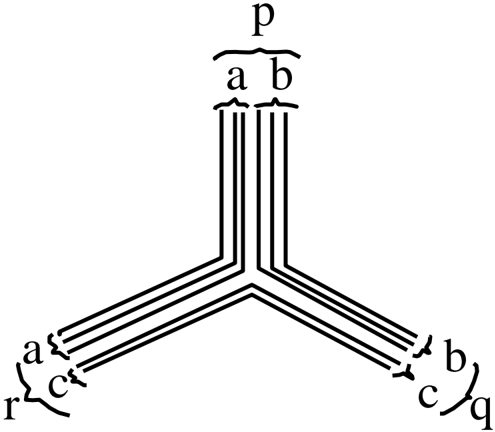
- The volume spectrum is discrete. For trivalent spin networks, the eigenvalue for a region \(R\) is \(V = \frac{1}{4} l_P^3 \sum_i \sqrt{a_i b_i c_i + a_i b_i + a_i c_i + b_i c_i}\), where the sum runs over nodes \(i\) contained in \(R\).
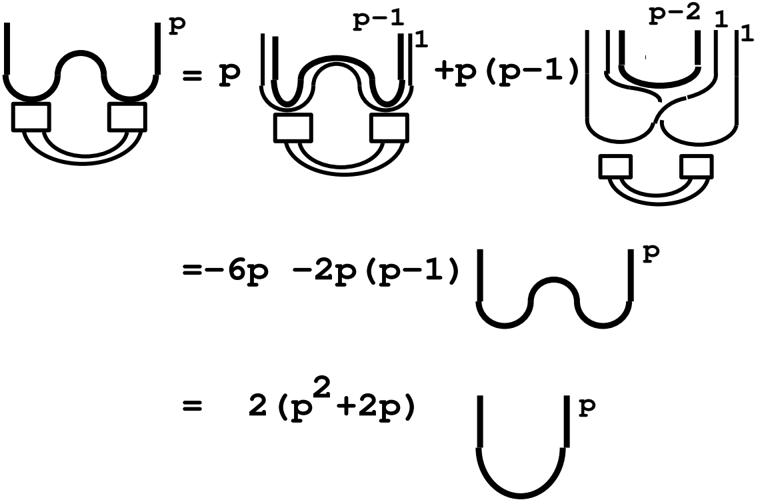
- The full area spectrum is \(A = \frac{1}{2} l_P^2 \sum_l \sqrt{p_l^2 + 2p_l}\), where \(l\) labels spin-network links crossing the surface.
- Spin-network states are eigenstates of the volume operator and also diagonalize the area operator; the two operators commute. Other volume eigenstates are related to a generalization of spin networks, with eigenvalues computable by diagonalizing finite-dimensional matrices.
- The authors argue that, under assumptions about physical fields defining regions and surfaces, Planck-scale measurements of volume or area would yield results in these discrete spectra.
Methods
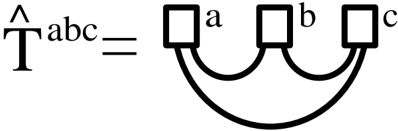
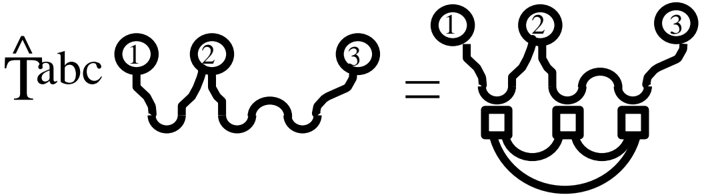
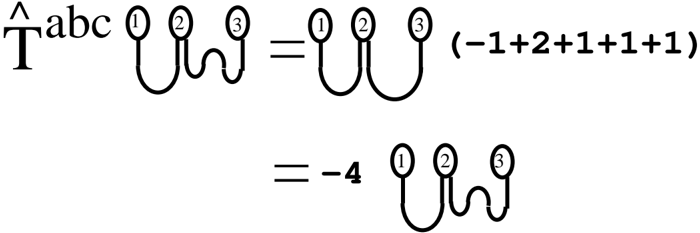
- Theoretical, non-perturbative quantum gravity in the loop representation. The volume operator is constructed via a diffeomorphism-invariant regularization using the three-hand loop observable \(T^{abc}\), partitioning a region into cubic boxes with an arbitrary unphysical flat metric \(g_0\), and taking a weak-operator limit \(L \to 0\).
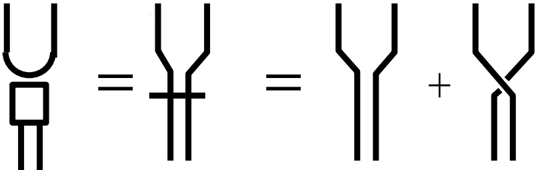
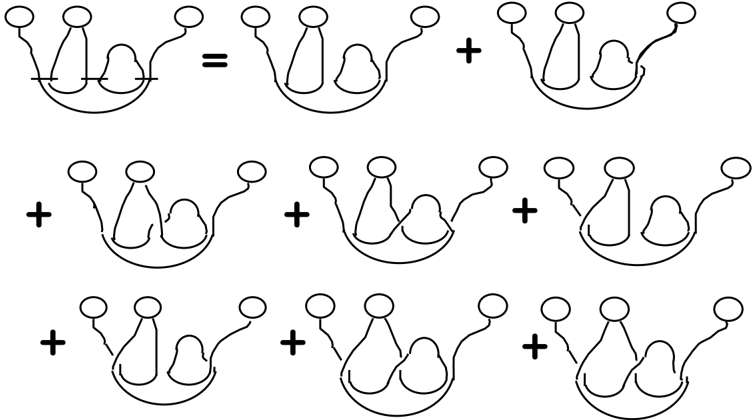
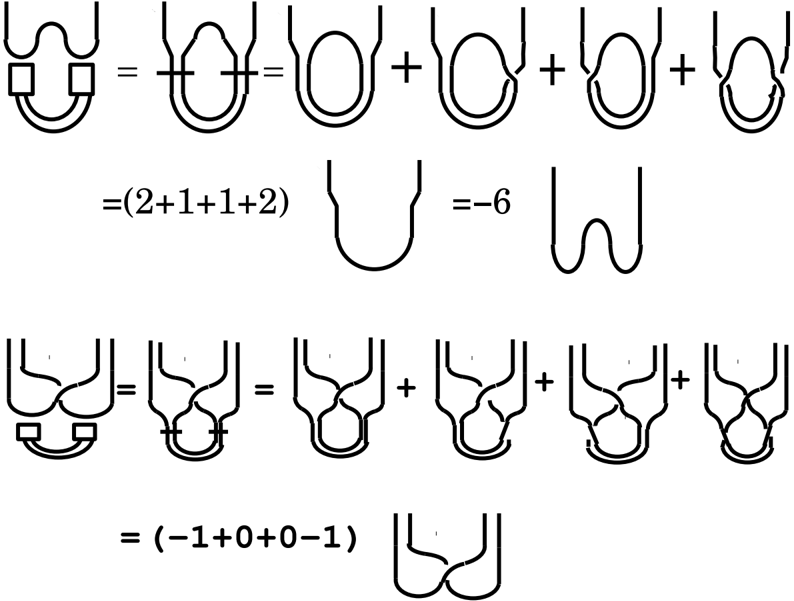
- The action of the volume operator is computed on the spin-network basis, where spin networks are trivalent graphs with positive integer link colors; the area operator is similarly diagonalized.
- No empirical data are used; the analysis is operator construction and spectral diagonalization.
Limitations
- The paper states that the local operator \(\sqrt{\det g}\) is ill-defined, that the regularization introduces an unphysical background metric \(g_0\) (though the operator is claimed independent of it in the limit), that the topology of the limit is delicate, and that diffeomorphism-invariant states lie in \(D_{\max}\) but not in the domain \(D\). It also notes that consistency of the theory is not proven and that quantization may have more than one solution.
- Evident from the provided text: the excerpt is truncated after the proportionality coefficient, so later sections and full derivation details are not available here. The physical interpretation also relies on assumptions about dynamical matter fields defining spatial regions and surfaces.
Model-written summary of a shortened version of the paper’s full text (it is longer than we read). Check it against the paper before relying on it.
Integrity signals
Registry
Cites
Statistics
Figures

Verification
Claims the paper makes
1 Valid · 4 Not valid · 5 Not checked · 18 Own results and interpretations
The sources with a verdict support this claim; the rest weren’t checked yet, have no full text we could read, or their verdicts aren’t rated yet.
In the paper
“Local quantities tend to be divergent or ill-defined in non-trivial generally covariant quantum field theories [3, 4, 11], a fact likely to be related to the non-renormalizability of the perturbative series.”
What the sources say
- Not checked — no full text of the sourcecites [3] matched to “Loop space representation of quantum general relativity” (1990) source
- Supportedcites [4] matched to “Weaving a classical metric with quantum threads” (1992) source
The Abstract says local operators such as the metric at a point may not be well-defined. The discussion of the local metric operator explains that its renormalization obstructs meaningful local geometric operators and says this appears to be a general feature of diffeomorphism-invariant theories. The claim’s separate suggestion about perturbative non-renormalizability is not the part attributed to this citation. (LLM, conf=0.90)
- Could not verifycites [11] matched to “Link Invariants, Holonomy Algebras and Functional Integration” (1993) sourceExperimental — accuracy not yet measured
The Introduction (pp. 1–2) discusses difficulties defining field-theoretic measures, and p. 4 describes regularized Wilson loops. Neither passage says that local quantities tend to diverge or be ill-defined in non-trivial generally covariant quantum field theories. Searches for local observables, divergences, and renormalization found no passage addressing that claim. (LLM, conf=0.73)
hedgedstates an association- Asserted: passes — The authors put it forward as true.
- Checkable: passes — It can be checked against evidence.
- Load-bearing: passes — The paper’s conclusions depend on it.
- Based: passes — The paper gives a reason why it holds.
The cited sources that could be checked couldn’t confirm or dispute this claim.
In the paper
“note for instance that there are other relevant topologies in state space, as the norm topologies defined by the kinematical or diffeomorphism-invariant Hilbert structures [6, 7], which are inequivalent to the one in which the limit (13) is taken.”
What the sources say
- Could not verifycites [6] matched to “Fermions in quantum gravity” (1994) sourceExperimental — accuracy not yet measured
Section 6.2 (pp. 33–34) uses pointwise topology in a model example about limits on knot states, but says a complete scalar product for the loop representation is not yet available. Neither those passages nor the passages found by searching for Hilbert norm topologies establish kinematical or diffeomorphism-invariant norm topologies, or their inequivalence to the topology used for the cited limit. (LLM, conf=0.72)
- Could not verifycites [7] matched to “Spatial infinity as a boundary of spacetime” (1992) sourceExperimental — accuracy not yet measured
The passages in §4, “Asymptotic symmetries” (page not supplied), discuss equivalence of spacetime completions, not topologies on a state space. Searches for Hilbert norm topologies and inequivalent state-space limits found no passage addressing the attributed claim. (LLM, conf=0.76)
plain- Asserted: passes — The authors put it forward as true.
- Checkable: passes — It can be checked against evidence.
- Load-bearing: unclear — It is unclear whether the paper’s conclusions depend on it.
- Based: passes — The paper gives a reason why it holds.
- Could not verify
A result the paper reports from its own data — it cites no other source for it, so there is none to check. The quote shows it is in the paper.
In the paper
“We find that the spectrum of the volume of any physical region is discrete.”
plain- Asserted: passes — The authors put it forward as true.
- Checkable: passes — It can be checked against evidence.
- Load-bearing: passes — The paper’s conclusions depend on it.
- Based: passes — The paper gives a reason why it holds.
A result the paper states — it cites no source for it, so there is none to check. The quote shows it is in the paper.
In the paper
“An unphysical background metric is introduced for the sake of the regularization, but the operator turns out to be independent of this background, in the limit in which the cut-off is removed.”
plain- Asserted: passes — The authors put it forward as true.
- Checkable: passes — It can be checked against evidence.
- Load-bearing: passes — The paper’s conclusions depend on it.
- Based: passes — The paper gives a reason why it holds.
In the paper
“Furthermore, we show here that the spin network states also diagonalize the operator Â[S], introduced in [3], which measures the area of the surface S.”
What the sources say
- Not checked — no full text of the sourcecites [3] matched to “Loop space representation of quantum general relativity” (1990) source
boostedstates an association- Asserted: passes — The authors put it forward as true.
- Checkable: passes — It can be checked against evidence.
- Load-bearing: passes — The paper’s conclusions depend on it.
- Based: passes — The paper gives a reason why it holds.
12 more claims
Create a free account to see all 28 claims and every source verdict.
- It may state two separate claims as one. 5
- Probably not a substantial claim. 5
- The quote only partly states this claim. 1
Claims other papers make about this one
Each is checked against this paper’s own text: does it say what the citing paper says it does?
The source backs part of the claim, not all of it — or backs it for a different population, condition or comparison.
In the citing paper
“In fact, that is why only volume and area operators could be constructed so far [10, 11].”
From A length operator for canonical quantum gravity (1998) · cites this paper as [10]
Experimental — accuracy not yet measuredThe source backs part of the claim, not all of it — or backs it for a different population, condition or comparison.
In the citing paper
“While the kinematics of loop quantum gravity (LQG) [1] is rather well understood [2, 3], its dynamics is not understood as cleanly.”
From Flipped spinfoam vertex and loop gravity (2008) · cites this paper as [4]
Experimental — accuracy not yet measuredThe source backs part of the claim, not all of it — or backs it for a different population, condition or comparison.
In the citing paper
“This problem arises due to the results obtained for the spectra of the geometrical operators and the black hole entropy being proportional to an unphysical parameter, which is called 'Immirzi parameter' [7] and appears as a parameter of a canonical transformation in classical gravity [8,9].”
From SO (4, C )-covariant Ashtekar-Barbero gravity and the Immirzi parameter (2000) · cites this paper as [9]
Experimental — accuracy not yet measuredThe cited source says what the claim attributes to it.
In the citing paper
“The results reported in this letter are obtained in the framework of quantum geometry [4] which does predict a discrete geometry because, e.g., the spectra of geometric operators as area and volume are discrete [5-7].”
From Absence of a Singularity in Loop Quantum Cosmology (2001) · cites this paper as [5]
The cited source says what the claim attributes to it.
In the citing paper
“Basic geometric quantities have been quantized [10][11][12][13][14] and found to have discrete spectra.”
From Loop quantum cosmology: I. Kinematics (2000) · cites this paper as [10]
17 more claims about this paper
Create a free account to see every claim other papers make about this one.
Citations
Cites
New Variables for Classical and Quantum Gravity
Ashtekar, A. (1986) · Physical Review Letters · doi:10.1103/physrevlett.57.2244 · Cited by 1,663
QUANTUM GRAVITY AND MINIMUM LENGTH
GARAY, L. J. (1995) · International Journal of Modern Physics A · doi:10.1142/s0217751x95000085 · Cited by 1,371
String theory beyond the Planck scale
Gross, D. J., & Mende, P. F. (1988) · Nuclear Physics B · doi:10.1016/0550-3213(88)90390-2 · Cited by 1,249
New Hamiltonian formulation of general relativity
Ashtekar, A. (1987) · Physical Review D · doi:10.1103/physrevd.36.1587 · Cited by 1,119
Quantum gravity and minimum length
Garay, L. J. (1994) · LA Referencia (Red Federada de Repositorios Institucionales de Publicaciones Científicas) · Cited by 881
Loop space representation of quantum general relativity
Rovelli, C., & Smolin, L. (1990) · Nuclear Physics B · doi:10.1016/0550-3213(90)90019-a · Cited by 806
Self-citationThe Hagedorn transition and the number of degrees of freedom of string theory
Atick, J. J., & Witten, E. (1988) · Nuclear Physics B · doi:10.1016/0550-3213(88)90151-4 · Cited by 800
The high-energy behavior of string scattering amplitudes
Gross, D. J., & Mende, P. F. (1987) · Physics Letters B · doi:10.1016/0370-2693(87)90355-8 · Cited by 778
Minimum physical length and the generalized uncertainty principle in string theory
Konishi, K., Paffuti, G., & Provero, P. (1990) · Physics Letters B · doi:10.1016/0370-2693(90)91927-4 · Cited by 753
On the nature of quantum geometrodynamics
Wheeler, J. A. (1957) · Annals of Physics · doi:10.1016/0003-4916(57)90050-7 · Cited by 693
Research works printed but not linked: 1
- Ashtekar, 1994, Quantum geometrodynamics and Coherent state transform on the space of connections, Penn. State University preprints
Cited by
Items 501–600 of 1,374
Holography, Quantum Geometry, and Quantum Information Theory
Zizzi, P. A. (2000) · Entropy · doi:10.3390/e2010039 · Cited by 46
“In loop quantum gravity, spin networks are eigenstates of the area and volume-operators [7].”
BackgroundSemiclassical and quantum analysis of the isotropic Universe in the polymer paradigm
Montani, G., Mantero, C., Bombacigno, F., Cianfrani, F., & Barca, G. (2019) · Physical review. D/Physical review. D. · doi:10.1103/physrevd.99.063534 · Cited by 28
Note on the geometrical interpretation of quantum groups and noncommutative spaces in gravity
Eugenio Bianchi, A., & Carlo Rovelli, C. (2011) · Physical review. D. Particles, fields, gravitation, and cosmology/Physical review. D. Particles and fields · doi:10.1103/physrevd.84.027502 · Cited by 27
“The quantization of physical space is a direct quantum-gravitational effect, which has probably no direct relation with quantum groups, and is governed by ~ and the Newton constant [11].”
BackgroundSelf-citationA Discrete History of the Lorentzian Path Integral
Loll, R. (2003) · Lecture notes in physics · doi:10.1007/978-3-540-45230-0_4 · Cited by 30
“16 In particular, there is nothing in the construction suggesting the presence of any kind of “fundamental discreteness”, as has been found in canonical models of four-dimensional quantum gravity [41, 42, 43].”
BackgroundQuantum gravity: A brief history of ideas and some prospects
Carlip, S., Chiou, D.-W., Ni, W.-T., & Woodard, R. (2015) · eScholarship (California Digital Library) · Cited by 23
Universal area spectrum in single-horizon black holes
Tamaki, T., & Nomura, H. (2004) · Physical review. D. Particles, fields, gravitation, and cosmology/Physical review. D. Particles and fields · doi:10.1103/physrevd.70.044041 · Cited by 24
Planck-scale models of the universe
Markopoulou, F. (2004) · Cambridge University Press eBooks · doi:10.1017/cbo9780511814990.027 · Cited by 38
“esults from other approaches to quantum gravity, such as Lorentzian ∗fotini@perimeterinstitute.ca 1Reisenberger, 1994, 1997; Reisenberger and Rovelli, 1997; Markopoulou and Smolin, 1997; Baez, 1998. 2Rovelli and Smolin, 1995. For a recent detailed review of loop quantum gravity see Thiemann, 2001, and for a non-techni…”
MethodA note on B-observables in Ponzano–Regge 3D quantum gravity
Livine, E. R., & Ryan, J. P. (2009) · Classical and Quantum Gravity · doi:10.1088/0264-9381/26/3/035013 · Cited by 27
“In loop quantum gravity [3], the geometric observables lie mostly in the domain of the kinematical Hilbert space where the volume and area operators are defined and are diagonal on the space of states [4].”
BackgroundTowards effective actions for the continuum limit of spin foams
Borissova, J. N., & Dittrich, B. (2023) · Classical and Quantum Gravity · doi:10.1088/1361-6382/accbfb · Cited by 41
“A central result of loop quantum gravity [29], which underlies spin foams, is that (a) the areas are independent variables and (b) that the spectra of area operators are discrete [30], and that the spectra are asymptotically equi-distant.”
SPIN FOAMS AS FEYNMAN DIAGRAMS
REISENBERGER, M., & ROVELLI, C. (2003) · 2001: A Relativistic Spacetime Odyssey · doi:10.1142/9789812791368_0023 · Cited by 50
“[22] C Rovelli and L Smolin, “Discreteness of Area and Volume in Quantum Gravity”, Nucl Phys B442 (1995) 593, gr-qc/9411005; Erratum: Nucl Phys B456 (1995) 734.”
BackgroundSelf-citationQuantum null geometry and gravity
Ciambelli, L., Freidel, L., & Leigh, R. G. (2024) · Journal of High Energy Physics · doi:10.1007/jhep12(2024)028 · Cited by 38
Emergent four-dimensional linearized gravity from a spin foam model
Han, M., Huang, Z., & Zipfel, A. (2019) · Physical review. D/Physical review. D. · doi:10.1103/physrevd.100.024060 · Cited by 22
α -attractor inflation modified by GUP in light of ACT observations
Heidarian, H., Solbi, M., Heydari, S., & Karami, K. (2025) · Physics Letters B · doi:10.1016/j.physletb.2025.139833 · Cited by 39
Reality conditions for Ashtekar gravity from Lorentz-covariant formulation
Alexandrov, S. Y. (2006) · Classical and Quantum Gravity · doi:10.1088/0264-9381/23/6/002 · Cited by 26
“ar X iv :g rqc /0 51 00 50 v1 1 0 O ct 2 00 5”
Some astrophysical aspects of a Schwarzschild geometry equipped with a minimal measurable length
Khodadi, M., Nozari, K., & Hajizadeh, A. (2017) · Physics Letters B · doi:10.1016/j.physletb.2017.05.016 · Cited by 23
Baez, J. C. (2003) · Nature · doi:10.1038/421702a · Cited by 33
Nonperturbative dynamics for abstract (p,q) string networks
Markopoulou, F., & Smolin, L. (1998) · Physical review. D. Particles, fields, gravitation, and cosmology/Physical review. D. Particles and fields · doi:10.1103/physrevd.58.084033 · Cited by 32
“In a very interesting paper [1], Sen introduces the notion of a network of (p, q) strings and hypothesizes that they might play a role in a non-perturbative formulation of string theory analogous to the role SU(2) spin networks play in non-perturbative quantum general relativity[2, 3].”
BackgroundSelf-citationThe volume operator in covariant quantum gravity
Ding, Y., & Rovelli, C. (2010) · Classical and Quantum Gravity · doi:10.1088/0264-9381/27/16/165003 · Cited by 23
“The kinematics of canonical loop quantum gravity, indeed, is rather well understood; in particular, the properties of the geometrical operators, including the area and the volume operators[21–23] are well established.”
BackgroundLorentz and Galilei invariance on lattices
Levi, D., Tempesta, P., & Winternitz, P. (2004) · Physical review. D. Particles, fields, gravitation, and cosmology/Physical review. D. Particles and fields · doi:10.1103/physrevd.69.105011 · Cited by 26
Appearance of a Minimal Length in e+e- Annihilation
Dymnikova, I., Sakharov, A., & Ulbricht, J. (2014) · Advances in High Energy Physics · doi:10.1155/2014/707812 · Cited by 23
Aquilanti, V., Marinelli, D., & Marzuoli, A. (2013) · Journal of Physics A Mathematical and Theoretical · doi:10.1088/1751-8113/46/17/175303 · Cited by 23
“Matrix elements of K were computed in [12] to provide a Hermitian representation, whose features have been studied by many [13–15] (see also [16] for an approach based on Bohr–Sommerfeld quantization).”
MethodTowards background independent quantum gravity with tensor models
Eichhorn, A., Lumma, J., Koslowski, T., & Pereira, A. D. (2019) · Classical and Quantum Gravity · doi:10.1088/1361-6382/ab2545 · Cited by 39
Strings as perturbations of evolving spin-networks
Smolin, L. (2000) · CERN Document Server (European Organization for Nuclear Research) · Cited by 23
Self-citationDoubly special relativity from quantum cellular automata
Bibeau-Delisle, A., Bisio, A., D’Ariano, G. M., Perinotti, P., & Tosini, A. (2015) · Europhysics Letters (EPL) · doi:10.1209/0295-5075/109/50003 · Cited by 44
Fractal Dimension in 3d Spin-FoamsPreprint
Caravelli, F., & Modesto, L. (2009) · arXiv (Cornell University) · doi:10.48550/arxiv.0905.2170 · Cited by 39
Phase transitions in group field theory: The Landau perspective
Pithis, A. G. A., & Thürigen, J. (2018) · Physical review. D/Physical review. D. · doi:10.1103/physrevd.98.126006 · Cited by 23
“From the physical perspective of the discrete geometries, another possibility is that such a phase transition should be characterized by arbitrary large fluctuations in GFT momentum space given by group representations since these are the eigenmodes of length, area or volume operators of such geometries [32].”
BackgroundZhang, C., Song, S., & Han, M. (2022) · Physical review. D/Physical review. D. · doi:10.1103/physrevd.105.064008 · Cited by 29
“Taking advantage of the basic operators, one can define operators representing geometric observables such as areas and volumes [52–54].”
Background2D manifold-independent spinfoam theory
Livine, E. R., Perez, A., & Rovelli, C. (2003) · Classical and Quantum Gravity · doi:10.1088/0264-9381/20/20/308 · Cited by 22
“The T operator is then analogous to the quantum gravity loop operator, and the operator L is analogous to the area operator, which is also given in terms of the Casimir of SU(2), and which is diagonalized by the spin network basis [19].”
BackgroundSelf-citationGeneric degeneracy and entropy in loop quantum gravity
Ansari, M. H. (2008) · Nuclear Physics B · doi:10.1016/j.nuclphysb.2007.11.038 · Cited by 27
“A subset of surface states which has no node residing on the surface was originally considered by Smolin and Rovelli where they derived their eigenvalues in [8].”
BackgroundSpin networks and recoupling in loop quantum gravity
Pietri, R. D. (1997) · Nuclear Physics B - Proceedings Supplements · doi:10.1016/s0920-5632(97)00397-6 · Cited by 28
Loop quantum cosmology with self-dual variables
Wilson-Ewing, E. (2015) · Physical review. D. Particles, fields, gravitation, and cosmology/Physical review. D. Particles and fields · doi:10.1103/physrevd.92.123536 · Cited by 26
“As explained above, since linear combinations of êµc encode the non-trivial information about a generalized holonomy of length µ̊ℓo (with respect to the fiducial metric q̊ab) along an edge parallel to any one of the e̊ak, and p̂ is proportional to the equatorial area of the 3-sphere, these operators are indeed the LQ…”
BackgroundMethodInfluentialReduced phase space quantization of black holes: Path integrals and effective dynamics
Zhang, C. (2021) · Physical review. D/Physical review. D. · doi:10.1103/physrevd.104.126003 · Cited by 26
Gravity as a constrained BF theory: Noether charges and Immirzi parameter
Durka, R., & Kowalski-Glikman, J. (2011) · Physical review. D. Particles, fields, gravitation, and cosmology/Physical review. D. Particles and fields · doi:10.1103/physrevd.83.124011 · Cited by 24
Loop Quantum Brans-Dicke Theory
Zhang, X., & Ma, Y. (2012) · Journal of Physics Conference Series · doi:10.1088/1742-6596/360/1/012055 · Cited by 25
Das, S., Ramadevi, P., & Yajnik, U. A. (2002) · CERN Document Server (European Organization for Nuclear Research) · Cited by 21
Sachs’ free data in real connection variables
Paoli, E. D., & Simone Speziale, D. (2017) · Journal of High Energy Physics · doi:10.1007/jhep11(2017)205 · Cited by 26
“There exists a canonical quantisation scheme that leads to the well-known prediction of quantum discreteness of space [20].”
BackgroundGeometry for the accelerating universe
Punzi, R., Schuller, F. P., & Wohlfarth, M. N. R. (2007) · Physical review. D. Particles, fields, gravitation, and cosmology/Physical review. D. Particles and fields · doi:10.1103/physrevd.76.101501 · Cited by 29
Gravitational collapse in loop quantum gravity
Modesto, L. (2006) · CERN Document Server (European Organization for Nuclear Research) · Cited by 21
Space-like singularities of general relativity: A phantom menace?
Ashtekar, A., del Río, A., & Schneider, M. (2022) · General Relativity and Gravitation · doi:10.1007/s10714-022-02932-5 · Cited by 27
Skara, F., & Perivolaropoulos, L. (2019) · Physical review. D/Physical review. D. · doi:10.1103/physrevd.100.123527 · Cited by 26
“In particular interest in a minimum measurable length or equivalently in a ultraviolet cutoff has been motivated by studies of string theory [28–34], loop quantum gravity [35–41], quantum geometry [42], doubly special relativity (DSR)[43–48] and by black hole physics [10, 49–51] or even Gedanken experiments [52] and t…”
BackgroundA Model of Wavefunction Collapse in Discrete Space-Time
Shan, G. (2006) · International Journal of Theoretical Physics · doi:10.1007/s10773-006-9163-7 · Cited by 23
“…of quantum theory and general relativity may inevitably result in the discreteness of space-time (Einstein, 1936; Snyder, 1947; Heisenberg, 1957; Salecker and Wigner, 1958; Garay, 1995; Rovelli and Smolin, 1995; Polchinski, 1998; Adler and Santiago, 1999; Amelino-Camelia, 2000; Smolin, 2001).”
BackgroundQ̂ operator for canonical quantum gravity
Ma, Y., & Ling, Y. (2000) · Physical review. D. Particles, fields, gravitation, and cosmology/Physical review. D. Particles and fields · doi:10.1103/physrevd.62.104021 · Cited by 24
Role of a "local" cosmological constant in Euclidean quantum gravity
Modanese, G. (1996) · Physical review. D. Particles, fields, gravitation, and cosmology/Physical review. D. Particles and fields · doi:10.1103/physrevd.54.5002 · Cited by 23
Bartolo, C. D., Gambini, R., Griego, J., & Pullin, J. (2000) · Classical and Quantum Gravity · doi:10.1088/0264-9381/17/16/310 · Cited by 21
Effective GUP-modified Raychaudhuri equation and black hole singularity: four models
Blanchette, K., Das, S., & Rastgoo, S. (2021) · Journal of High Energy Physics · doi:10.1007/jhep09(2021)062 · Cited by 25
Okołów, A. (2009) · Communications in Mathematical Physics · doi:10.1007/s00220-009-0755-y · Cited by 21
“LQG partially supports this belief: quantum operators corresponding to basic geometric quantities like area and volume have discrete spectra [27, 17, 28], but still these operators are associated with regular subsets of the space-like manifold Σ like e.”
BackgroundA new action for simplicial gravity in four dimensions
Wieland, W. (2014) · Classical and Quantum Gravity · doi:10.1088/0264-9381/32/1/015016 · Cited by 32
“The three-volume is itself a functional of the spinors, implicitly given by the cross-product [45, 47, 48]:”
BackgroundWeave States in Loop Quantum Gravity
Grot, N., & Rovelli, C. (1997) · General Relativity and Gravitation · doi:10.1023/a:1018876726684 · Cited by 23
Self-citationStatistical description of an ideal gas in maximum length quantum mechanics
Bensalem, S., & Bouaziz, D. (2019) · Physica A Statistical Mechanics and its Applications · doi:10.1016/j.physa.2019.02.033 · Cited by 22
Entropy of black holes with arbitrary shapes in loop quantum gravity
Song, S., Li, H., Ma, Y., & Zhang, C. (2021) · Science China Physics Mechanics and Astronomy · doi:10.1007/s11433-021-1770-3 · Cited by 24
On the constant that fixes the area spectrum in canonical quantum gravity
Krasnov, K. (1998) · Classical and Quantum Gravity · doi:10.1088/0264-9381/15/1/001 · Cited by 26
A Gaussian Weave for Kinematical Loop Quantum Gravity
Corichi, A., & Reyes, J. M. (2000) · CERN Document Server (European Organization for Nuclear Research) · Cited by 20
Quantum field theory with the generalized uncertainty principle II: Quantum Electrodynamics
Bosso, P., Das, S., & Todorinov, V. (2020) · Annals of Physics · doi:10.1016/j.aop.2020.168350 · Cited by 32
Lattice Chern-Simons gravity via the Ponzano-Regge model
Kawamoto, N., Nielsen, H. B., & Sato, N. (1999) · Nuclear Physics B · doi:10.1016/s0550-3213(99)00331-4 · Cited by 20
A proposal for analysing the classical limit of kinematic loop gravity
Varadarajan, M., & Zapata, J. A. (2000) · Classical and Quantum Gravity · doi:10.1088/0264-9381/17/19/309 · Cited by 20
“It is reasonable to require that the structure of this set of loops be such that we can use them to approximate, in some way, any given loop.”
BackgroundQuasinormal modes of a black hole localized on a codimension-two brane of finite tension
al-Binni, U. A., & Siopsis, G. (2007) · Physical review. D. Particles, fields, gravitation, and cosmology/Physical review. D. Particles and fields · doi:10.1103/physrevd.76.104031 · Cited by 24
Dynamics of a scalar field in a polymer-like representation
Han, M., & Ma, Y. (2006) · Classical and Quantum Gravity · doi:10.1088/0264-9381/23/7/031 · Cited by 20
“Ds”
New loop quantum cosmology modifications from gauge-covariant fluxes
Liegener, K., & Singh, P. (2019) · Physical review. D/Physical review. D. · doi:10.1103/physrevd.100.124048 · Cited by 20
“Of course, this is exactly what has been done in standard LQG in order to build geometrical operators [48–52].”
BackgroundThe area spectrum in quantum gravity
Krasnov, K. V. (1998) · Classical and Quantum Gravity · doi:10.1088/0264-9381/15/6/001 · Cited by 25
“In this theory the spectrum of the operator measuring the area of a surface S is given by [2]”
BackgroundInfluentialA note on the Holst action, the time gauge, and the Barbero-Immirzi parameterPreprint
Geiller, M., & Noui, K. (2012) · HAL · Cited by 30
Discreteness of space from GUP in strong gravitational fields
Das, A., Das, S., & Vagenas, E. C. (2020) · Physics Letters B · doi:10.1016/j.physletb.2020.135772 · Cited by 25
Achour, J. B., Geiller, M., Noui, K., & Yu, C. (2014) · Physical review. D. Particles, fields, gravitation, and cosmology/Physical review. D. Particles and fields · doi:10.1103/physrevd.89.064064 · Cited by 28
On the Constant that Fixes the Area Spectrum in Canonical Quantum Gravity
Krasnov, K. (1997) · arXiv · doi:10.48550/arxiv.gr-qc/9709058 · Cited by 20
Polymer representation of the Bianchi IX cosmology in the Misner variables
Giovannetti, E., & Montani, G. (2019) · Physical review. D/Physical review. D. · doi:10.1103/physrevd.100.104058 · Cited by 24
“Loop Quantum Gravity theory [8, 9, 10, 6] had more success.”
BackgroundShortcomings of the big bounce derivation in loop quantum cosmology
Cianfrani, F., & Montani, G. (2010) · Physical review. D. Particles, fields, gravitation, and cosmology/Physical review. D. Particles and fields · doi:10.1103/physrevd.82.021501 · Cited by 21
Real alternative to quantum gravity in loop space
Loll, R. (1996) · Physical Review D · doi:10.1103/physrevd.54.5381 · Cited by 19
“The Hamiltonian constraint function in terms of (A,E) reads ǫijkEai E b jF k ab − ( 2 β2 + 2)E [a i E b] j (A i a − Γia)(Ajb − Γ j b).”
Gravity's rainbow: A bridge between LQC and DSR
Gorji, M. A., Nozari, K., & Vakili, B. (2016) · Physics Letters B · doi:10.1016/j.physletb.2016.12.023 · Cited by 22
Area Quantization in Quasi-Extreme Black Holes
Abdalla, E., Castello-Branco, K. H. C., & Lima-Santos, A. (2003) · Modern Physics Letters A · doi:10.1142/s0217732303011435 · Cited by 30
Twisted geometries coherent states for loop quantum gravity
Calcinari, A., Freidel, L., Livine, E. R., & Speziale, S. (2020) · Classical and Quantum Gravity · doi:10.1088/1361-6382/abc273 · Cited by 23
Immirzi, G. (1995) · CERN Document Server (European Organization for Nuclear Research) · Cited by 19
Coherent states for black holes
Dasgupta, A. (2003) · Journal of Cosmology and Astroparticle Physics · doi:10.1088/1475-7516/2003/08/004 · Cited by 23
Feynman diagrammatic approach to spinfoams
Kisielowski, M., Lewandowski, J., & Puchta, J. (2011) · Classical and Quantum Gravity · doi:10.1088/0264-9381/29/1/015009 · Cited by 21
Spectrum of quantum black holes and quasinormal modes
Oppenheim, J. (2004) · Physical review. D. Particles, fields, gravitation, and cosmology/Physical review. D. Particles and fields · doi:10.1103/physrevd.69.044012 · Cited by 23
General geometric operators in all dimensional loop quantum gravity
Long, G., & Ma, Y. (2020) · Physical review. D/Physical review. D. · doi:10.1103/physrevd.101.084032 · Cited by 24
“An important prediction of this theory is the quantum discreteness of spatial geometry at Planck scale, since the spectrums of the geometric operators, such as volume and area, are discrete [5] [6] [7].”
BackgroundContinuous area spectrum of a regular black hole
Nomura, H., & Tamaki, T. (2005) · Physical review. D. Particles, fields, gravitation, and cosmology/Physical review. D. Particles and fields · doi:10.1103/physrevd.71.124033 · Cited by 24
FURTHER RESULTS ON GEOMETRIC OPERATORS IN QUANTUM GRAVITY
Loll, R. (1996) · MPG.PuRe (Max Planck Society) · Cited by 19
Han, M., Liu, H., & Qu, D. (2023) · Physical review. D/Physical review. D. · doi:10.1103/physrevd.108.026010 · Cited by 26
“The LQG area spectrum indicates that the quantum area of triangle f is given by af = 8πγG~ √ jf (jf + 1) [32, 33].”
BackgroundTowards the self-adjointness of a Hamiltonian operator in loop quantum gravity
Zhang, C., Lewandowski, J., & Ma, Y. (2018) · Physical review. D/Physical review. D. · doi:10.1103/physrevd.98.086014 · Cited by 17
“A family of operators representing geometric observables (2-surface area, 3-region volume, inverse metric tensor) were regularized without need to subtract infinities and their spectra turned out to be discrete [11–16].”
BackgroundSimple Derivation of Minimum Length, Minimum Dipole Moment and Lack of Space–Time Continuity
Schiller, C. (2006) · International Journal of Theoretical Physics · doi:10.1007/s10773-005-9018-7 · Cited by 19
Generalized Lagrangian-Path Representation of Non-Relativistic Quantum Mechanics
Tessarotto, M., & Cremaschini, C. (2016) · Foundations of Physics · doi:10.1007/s10701-016-9989-7 · Cited by 20
Some surprising implications of background independence in canonical quantum gravity
Ashtekar, A. (2009) · General Relativity and Gravitation · doi:10.1007/s10714-009-0802-1 · Cited by 26
“[10] R.”
BackgroundQuantum mechanical spectra of charged black holes
Das, S., Ramadevi, P., Yajnik, U. A., & Sule, A. (2003) · Physics Letters B · doi:10.1016/s0370-2693(03)00673-7 · Cited by 16
Quantum gravity as a “sum over surfaces”
Rovelli, C. (1997) · Nuclear Physics B - Proceedings Supplements · doi:10.1016/s0920-5632(97)00351-4 · Cited by 18
Self-citationExotic smoothness and quantum gravityPreprint
Aßelmeyer-Maluga, T. (2016) · Cited by 23
Toward loop quantization of plane gravitational waves
Hinterleitner, F., & Major, S. (2012) · Classical and Quantum Gravity · doi:10.1088/0264-9381/29/6/065019 · Cited by 17
Modelling space with an atom of quantum geometry
Major, S. A., & Seifert, M. (2002) · Classical and Quantum Gravity · doi:10.1088/0264-9381/19/8/311 · Cited by 23
“Within the context of loop quantum gravity, operators for area [1, 2, 3], volume [1, 4, 5], and possibly even angle [6] have discrete spectra.”
BackgroundApparent horizons, black hole entropy, and loop quantum gravity
Husain, V. (1999) · Physical review. D. Particles, fields, gravitation, and cosmology/Physical review. D. Particles and fields · doi:10.1103/physrevd.59.084019 · Cited by 22
On the metric operator for quantum cylindrical waves
Varadarajan, M. (2000) · Classical and Quantum Gravity · doi:10.1088/0264-9381/17/1/313 · Cited by 18
Spencer, J. (2008) · Philosophical Studies · doi:10.1007/s11098-008-9291-4 · Cited by 21
Further results on geometric operators in quantum gravity
Loll, R. (1997) · Classical and Quantum Gravity · doi:10.1088/0264-9381/14/7/010 · Cited by 18
“onstraints. Because of their obvious geometric interpretation, and relatively simple form in the quantum theory, they have been applied in a variety of contexts. A volume operator was first studied in [4], and part of its spectrum analyzed in [5,6,7]. It has been used in the construction of the quantum Hamiltonian in t…”
MethodPhenomenology of quantum reduced loop gravity in the isotropic cosmological sector
Alesci, E., Barrau, A., Botta, G., Martineau, K., & Stagno, G. V. (2018) · Physical review. D/Physical review. D. · doi:10.1103/physrevd.98.106022 · Cited by 23
Minimal length in quantum gravity and the fate of Lorentz invariance
Hagar, A. (2009) · Studies in History and Philosophy of Science Part B Studies in History and Philosophy of Modern Physics · doi:10.1016/j.shpsb.2009.06.002 · Cited by 19
About Dark Energy and Dark Matter in a Three-Dimensional Quantum Vacuum Model
Fiscaletti, D. (2016) · Foundations of Physics · doi:10.1007/s10701-016-0021-z · Cited by 22
Albuquerque, S., Lobo, I. P., & Bezerra, V. B. (2023) · Classical and Quantum Gravity · doi:10.1088/1361-6382/ace7a8 · Cited by 24
“[7] Carlo Rovelli and Lee Smolin, “Discreteness of area and volume in quantum gravity,” Nuclear Physics B 442 no.”
BackgroundCoarse graining in spin foam modelsPreprint
Markopoulou, F. (2002) · arXiv (Cornell University) · doi:10.48550/arxiv.gr-qc/0203036 · Cited by 17
“Much of the motivation for considering spin foam models comes from the surprising result of loop quantum gravity: the quantized spatial area and volume are discrete [6].”
BackgroundMethodON QUANTUM NATURE OF BLACK-HOLE SPACETIME: A POSSIBLE NEW SOURCE OF INTENSE RADIATION
Ahluwalia, D. V. (1999) · International Journal of Modern Physics D · doi:10.1142/s0218271899000456 · Cited by 18
Manifestly Lorentz-covariant variables for the phase space of general relativity
Montesinos, M., Romero, J., & Celada, M. (2018) · Physical review. D/Physical review. D. · doi:10.1103/physrevd.97.024014 · Cited by 18
ASYMPTOTICS OF CLASSICAL SPIN NETWORKS
Garoufalidis, S., van der Veen, R., & Veen, V. D. (2009) · Cited by 16
Mejrhit, K., & Hajji, R. (2020) · The European Physical Journal C · doi:10.1140/epjc/s10052-020-08632-1 · Cited by 18
Spectroscopy of a canonically quantized horizon
Ansari, M. H. (2007) · Nuclear Physics B · doi:10.1016/j.nuclphysb.2007.01.009 · Cited by 26
“SU(2) area and positive definite quadratic forms 17 V. Conclusion 18”
Background
Metadata
- Authors
- Rovelli, C., & Smolin, L.
- Affiliations
- Pennsylvania State University (US)
- Corresponding author
- Smolin, Lee
- ORCID
- Smolin, Lee
- Venue
- Nuclear Physics B
- Publisher
- Elsevier BV
- Published
- 1995-05
- Volume
- 442
- Issue
- 3
- Pages
- 593-619
- ISSN
- 0550-3213 (ISSN-L)
- OpenAlex
- W2104041846
- Semantic Scholar
- 3b85eebc659d3ae5d857e1d141fd5126db507eba
- Cited by
- 1,365
- References
- 63
- Citations by year
- 2026: 40 · 2025: 79 · 2024: 70 · 2023: 38 · 2022: 35 · 2021: 55 · 2020: 31 · 2019: 42 · 2018: 44 · 2017: 40 · 2016: 48 · 2015: 36 · 2014: 43 · 2013: 47 · 2012: 49
- FWCI
- 38.09
- Type
- journal article
- Language
- en
- Open access
- green
- arxiv.org
- Licence
- www.elsevier.com/tdm/userlicense/1.0/ (tdm)
- www.elsevier.com/legal/tdmrep-license (tdm)
- Locations
- Nuclear Physics B (publishedVersion)
- arXiv (Cornell University) (submittedVersion)
- CERN Document Server (European Organization for Nuclear Research) (submittedVersion)
- arXiv (Cornell University)
- Topics
- Physical Sciences › Physics and Astronomy › Nuclear and High Energy Physics › Noncommutative and Quantum Gravity Theories
- Physical Sciences › Physics and Astronomy › Astronomy and Astrophysics › Relativity and Gravitational Theory
- Physical Sciences › Physics and Astronomy › Nuclear and High Energy Physics › Black Holes and Theoretical Physics
- Keywords
- quantum gravity, loop representation, spin networks, volume operator, area operator, diffeomorphism invariance, background independence, Planck-scale geometry, non-perturbative quantum gravity
About these checks
Registry, retraction, Cites and statistics results are computed, not judged, with one exception: a printed reference that no index lists is read once by a model before it counts as a citation error. Claims are extracted by a model and kept only when their quote appears verbatim in the text; each cited source is then checked, with a model’s help, for whether it says what the claim relies on. Those verdicts can be wrong — read the claim’s quote and the cited source before relying on one.
The claim verdicts this report counts are experimental: their accuracy is not yet measured.
A language model drew the claims from the paper on 2026-10-07, under version 3 of the claim definition (model deepseek-v4.1-flash, prompt extract-v3).
A second model labelled each claim on 2026-10-07 (model jev-1.13-20260917, definition revision gold-guideline-v0.2).
Cited sources are checked with a language model’s help (gpt-6-sol).
Statistics and arithmetic are recomputed, not judged.
Confidence bands are shown only for fields calibrated on our annotated test set. None is calibrated yet, so no band is shown.
What counts as a claim ›How we measure confidence ›How we check this ›
Are you an author, or do you see a problem with this page? Request a review
Data sources
Bibliographic data: Semantic Scholar, OpenAlex, Crossref.
Contains information from the Semantic Scholar Academic Graph Datasets, made available under the ODC Attribution License (ODC-BY 1.0).
Semantic Scholar’s data is described in: Kinney, R., et al. (2023). The Semantic Scholar Open Data Platform. arXiv:2301.10140.
