

Discreteness of area and volume in quantum gravity
Open accessThe DOI matches its Crossref record; 60 of the 63 references it cites were found in a registry or an index; 6 of the 14 sources its claims cite were checked for support.
Abstract
We study the operator that corresponds to the measurement of volume, in non-perturbative quantum gravity, and we compute its spectrum. The operator is constructed in the loop representation, via a regularization procedure; it is finite, background independent, and diffeomorphism-invariant, and therefore well defined on the space of diffeomorphism invariant states (knot states). We find that the spectrum of the volume of any physical region is discrete. A family of eigenstates are in one to one correspondence with the spin networks, which were introduced by Penrose in a different context. We compute the corresponding component of the spectrum, and exhibit the eigenvalues explicitly. The other eigenstates are related to a generalization of the spin networks, and their eigenvalues can be computed by diagonalizing finite dimensional matrices. Furthermore, we show that the eigenstates of the volume diagonalize also the area operator. We argue that the spectra of volume and area determined here can be considered as predictions of the loop-representation formulation of quantum gravity on the outcomes of (hypothetical) Planck-scale sensitive measurements of the geometry of space.
Overview
CoChat Summary
TL;DR
Rovelli and Smolin construct a regularized volume operator in loop-representation quantum gravity and compute its spectrum, finding it discrete. They show spin-network states diagonalize both the volume and area operators, yielding explicit discrete area and volume eigenvalues.
Key findings
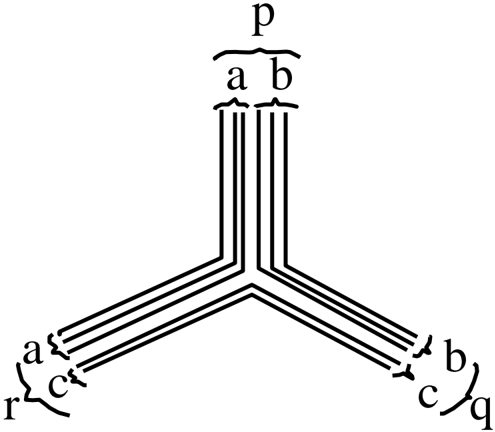
- The volume spectrum is discrete. For trivalent spin networks, the eigenvalue for a region \(R\) is \(V = \frac{1}{4} l_P^3 \sum_i \sqrt{a_i b_i c_i + a_i b_i + a_i c_i + b_i c_i}\), where the sum runs over nodes \(i\) contained in \(R\).
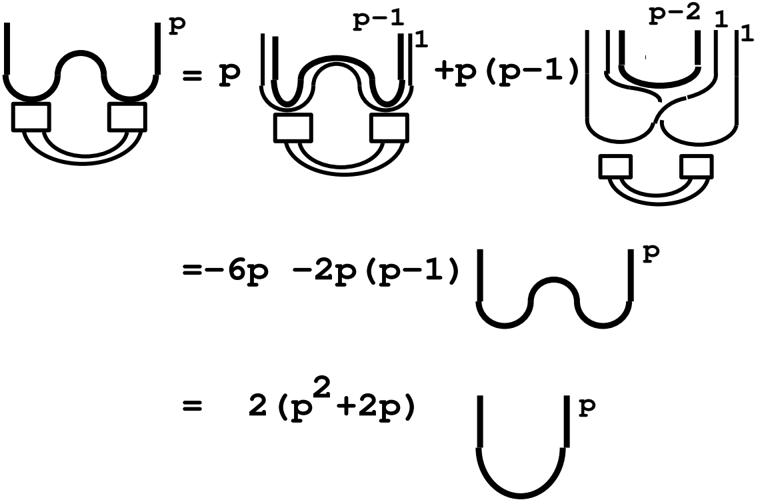
- The full area spectrum is \(A = \frac{1}{2} l_P^2 \sum_l \sqrt{p_l^2 + 2p_l}\), where \(l\) labels spin-network links crossing the surface.
- Spin-network states are eigenstates of the volume operator and also diagonalize the area operator; the two operators commute. Other volume eigenstates are related to a generalization of spin networks, with eigenvalues computable by diagonalizing finite-dimensional matrices.
- The authors argue that, under assumptions about physical fields defining regions and surfaces, Planck-scale measurements of volume or area would yield results in these discrete spectra.
Methods
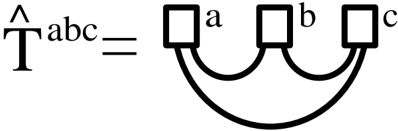
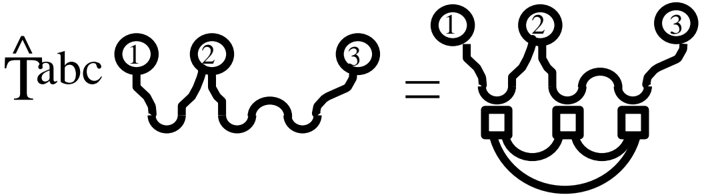
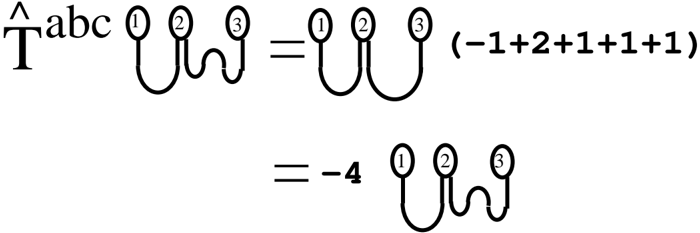
- Theoretical, non-perturbative quantum gravity in the loop representation. The volume operator is constructed via a diffeomorphism-invariant regularization using the three-hand loop observable \(T^{abc}\), partitioning a region into cubic boxes with an arbitrary unphysical flat metric \(g_0\), and taking a weak-operator limit \(L \to 0\).
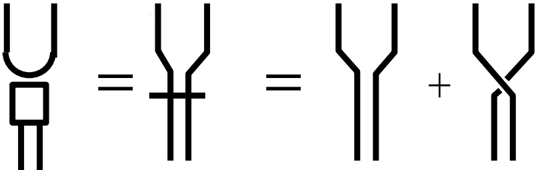
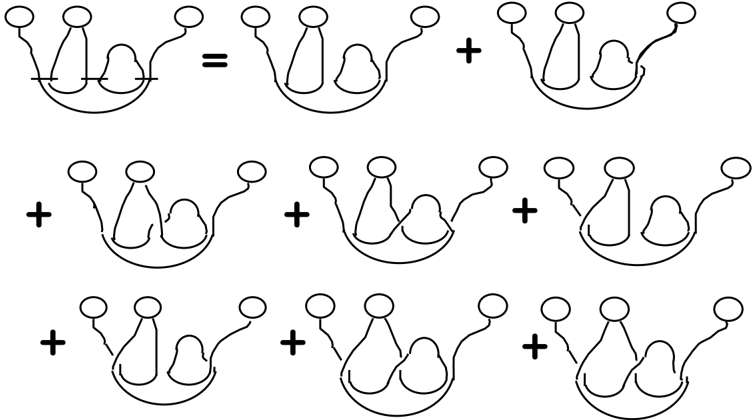
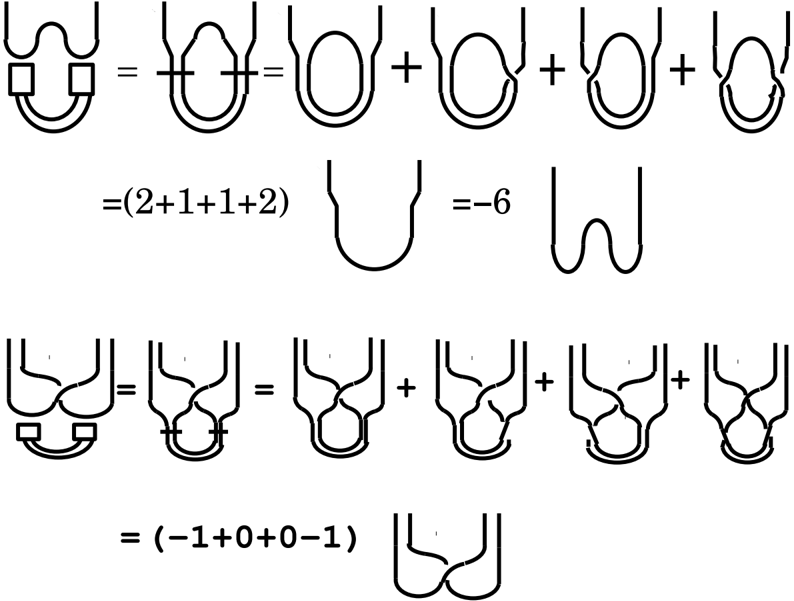
- The action of the volume operator is computed on the spin-network basis, where spin networks are trivalent graphs with positive integer link colors; the area operator is similarly diagonalized.
- No empirical data are used; the analysis is operator construction and spectral diagonalization.
Limitations
- The paper states that the local operator \(\sqrt{\det g}\) is ill-defined, that the regularization introduces an unphysical background metric \(g_0\) (though the operator is claimed independent of it in the limit), that the topology of the limit is delicate, and that diffeomorphism-invariant states lie in \(D_{\max}\) but not in the domain \(D\). It also notes that consistency of the theory is not proven and that quantization may have more than one solution.
- Evident from the provided text: the excerpt is truncated after the proportionality coefficient, so later sections and full derivation details are not available here. The physical interpretation also relies on assumptions about dynamical matter fields defining spatial regions and surfaces.
Model-written summary of a shortened version of the paper’s full text (it is longer than we read). Check it against the paper before relying on it.
Integrity signals
Registry
Cites
Statistics
Figures

Verification
Claims the paper makes
1 Valid · 4 Not valid · 5 Not checked · 18 Own results and interpretations
The sources with a verdict support this claim; the rest weren’t checked yet, have no full text we could read, or their verdicts aren’t rated yet.
In the paper
“Local quantities tend to be divergent or ill-defined in non-trivial generally covariant quantum field theories [3, 4, 11], a fact likely to be related to the non-renormalizability of the perturbative series.”
What the sources say
- Not checked — no full text of the sourcecites [3] matched to “Loop space representation of quantum general relativity” (1990) source
- Supportedcites [4] matched to “Weaving a classical metric with quantum threads” (1992) source
The Abstract says local operators such as the metric at a point may not be well-defined. The discussion of the local metric operator explains that its renormalization obstructs meaningful local geometric operators and says this appears to be a general feature of diffeomorphism-invariant theories. The claim’s separate suggestion about perturbative non-renormalizability is not the part attributed to this citation. (LLM, conf=0.90)
- Could not verifycites [11] matched to “Link Invariants, Holonomy Algebras and Functional Integration” (1993) sourceExperimental — accuracy not yet measured
The Introduction (pp. 1–2) discusses difficulties defining field-theoretic measures, and p. 4 describes regularized Wilson loops. Neither passage says that local quantities tend to diverge or be ill-defined in non-trivial generally covariant quantum field theories. Searches for local observables, divergences, and renormalization found no passage addressing that claim. (LLM, conf=0.73)
hedgedstates an association- Asserted: passes — The authors put it forward as true.
- Checkable: passes — It can be checked against evidence.
- Load-bearing: passes — The paper’s conclusions depend on it.
- Based: passes — The paper gives a reason why it holds.
The cited sources that could be checked couldn’t confirm or dispute this claim.
In the paper
“note for instance that there are other relevant topologies in state space, as the norm topologies defined by the kinematical or diffeomorphism-invariant Hilbert structures [6, 7], which are inequivalent to the one in which the limit (13) is taken.”
What the sources say
- Could not verifycites [6] matched to “Fermions in quantum gravity” (1994) sourceExperimental — accuracy not yet measured
Section 6.2 (pp. 33–34) uses pointwise topology in a model example about limits on knot states, but says a complete scalar product for the loop representation is not yet available. Neither those passages nor the passages found by searching for Hilbert norm topologies establish kinematical or diffeomorphism-invariant norm topologies, or their inequivalence to the topology used for the cited limit. (LLM, conf=0.72)
- Could not verifycites [7] matched to “Spatial infinity as a boundary of spacetime” (1992) sourceExperimental — accuracy not yet measured
The passages in §4, “Asymptotic symmetries” (page not supplied), discuss equivalence of spacetime completions, not topologies on a state space. Searches for Hilbert norm topologies and inequivalent state-space limits found no passage addressing the attributed claim. (LLM, conf=0.76)
plain- Asserted: passes — The authors put it forward as true.
- Checkable: passes — It can be checked against evidence.
- Load-bearing: unclear — It is unclear whether the paper’s conclusions depend on it.
- Based: passes — The paper gives a reason why it holds.
- Could not verify
A result the paper reports from its own data — it cites no other source for it, so there is none to check. The quote shows it is in the paper.
In the paper
“We find that the spectrum of the volume of any physical region is discrete.”
plain- Asserted: passes — The authors put it forward as true.
- Checkable: passes — It can be checked against evidence.
- Load-bearing: passes — The paper’s conclusions depend on it.
- Based: passes — The paper gives a reason why it holds.
A result the paper states — it cites no source for it, so there is none to check. The quote shows it is in the paper.
In the paper
“An unphysical background metric is introduced for the sake of the regularization, but the operator turns out to be independent of this background, in the limit in which the cut-off is removed.”
plain- Asserted: passes — The authors put it forward as true.
- Checkable: passes — It can be checked against evidence.
- Load-bearing: passes — The paper’s conclusions depend on it.
- Based: passes — The paper gives a reason why it holds.
In the paper
“Furthermore, we show here that the spin network states also diagonalize the operator Â[S], introduced in [3], which measures the area of the surface S.”
What the sources say
- Not checked — no full text of the sourcecites [3] matched to “Loop space representation of quantum general relativity” (1990) source
boostedstates an association- Asserted: passes — The authors put it forward as true.
- Checkable: passes — It can be checked against evidence.
- Load-bearing: passes — The paper’s conclusions depend on it.
- Based: passes — The paper gives a reason why it holds.
12 more claims
Create a free account to see all 28 claims and every source verdict.
- It may state two separate claims as one. 5
- Probably not a substantial claim. 5
- The quote only partly states this claim. 1
Claims other papers make about this one
Each is checked against this paper’s own text: does it say what the citing paper says it does?
The source backs part of the claim, not all of it — or backs it for a different population, condition or comparison.
In the citing paper
“In fact, that is why only volume and area operators could be constructed so far [10, 11].”
From A length operator for canonical quantum gravity (1998) · cites this paper as [10]
Experimental — accuracy not yet measuredThe source backs part of the claim, not all of it — or backs it for a different population, condition or comparison.
In the citing paper
“While the kinematics of loop quantum gravity (LQG) [1] is rather well understood [2, 3], its dynamics is not understood as cleanly.”
From Flipped spinfoam vertex and loop gravity (2008) · cites this paper as [4]
Experimental — accuracy not yet measuredThe source backs part of the claim, not all of it — or backs it for a different population, condition or comparison.
In the citing paper
“This problem arises due to the results obtained for the spectra of the geometrical operators and the black hole entropy being proportional to an unphysical parameter, which is called 'Immirzi parameter' [7] and appears as a parameter of a canonical transformation in classical gravity [8,9].”
From SO (4, C )-covariant Ashtekar-Barbero gravity and the Immirzi parameter (2000) · cites this paper as [9]
Experimental — accuracy not yet measuredThe cited source says what the claim attributes to it.
In the citing paper
“The results reported in this letter are obtained in the framework of quantum geometry [4] which does predict a discrete geometry because, e.g., the spectra of geometric operators as area and volume are discrete [5-7].”
From Absence of a Singularity in Loop Quantum Cosmology (2001) · cites this paper as [5]
The cited source says what the claim attributes to it.
In the citing paper
“Basic geometric quantities have been quantized [10][11][12][13][14] and found to have discrete spectra.”
From Loop quantum cosmology: I. Kinematics (2000) · cites this paper as [10]
17 more claims about this paper
Create a free account to see every claim other papers make about this one.
Citations
Cites
New Variables for Classical and Quantum Gravity
Ashtekar, A. (1986) · Physical Review Letters · doi:10.1103/physrevlett.57.2244 · Cited by 1,663
QUANTUM GRAVITY AND MINIMUM LENGTH
GARAY, L. J. (1995) · International Journal of Modern Physics A · doi:10.1142/s0217751x95000085 · Cited by 1,371
String theory beyond the Planck scale
Gross, D. J., & Mende, P. F. (1988) · Nuclear Physics B · doi:10.1016/0550-3213(88)90390-2 · Cited by 1,249
New Hamiltonian formulation of general relativity
Ashtekar, A. (1987) · Physical Review D · doi:10.1103/physrevd.36.1587 · Cited by 1,119
Quantum gravity and minimum length
Garay, L. J. (1994) · LA Referencia (Red Federada de Repositorios Institucionales de Publicaciones Científicas) · Cited by 881
Loop space representation of quantum general relativity
Rovelli, C., & Smolin, L. (1990) · Nuclear Physics B · doi:10.1016/0550-3213(90)90019-a · Cited by 806
Self-citationThe Hagedorn transition and the number of degrees of freedom of string theory
Atick, J. J., & Witten, E. (1988) · Nuclear Physics B · doi:10.1016/0550-3213(88)90151-4 · Cited by 800
The high-energy behavior of string scattering amplitudes
Gross, D. J., & Mende, P. F. (1987) · Physics Letters B · doi:10.1016/0370-2693(87)90355-8 · Cited by 778
Minimum physical length and the generalized uncertainty principle in string theory
Konishi, K., Paffuti, G., & Provero, P. (1990) · Physics Letters B · doi:10.1016/0370-2693(90)91927-4 · Cited by 753
On the nature of quantum geometrodynamics
Wheeler, J. A. (1957) · Annals of Physics · doi:10.1016/0003-4916(57)90050-7 · Cited by 693
Research works printed but not linked: 1
- Ashtekar, 1994, Quantum geometrodynamics and Coherent state transform on the space of connections, Penn. State University preprints
Cited by
Items 1,201–1,300 of 1,374
Quantum Hall Effect and Black Hole Entropy in Loop Quantum GravityPreprint
Vaid, D. (2012) · arXiv (Cornell University) · doi:10.48550/arxiv.1208.3335 · Cited by 9
“Volumes are given by expectation values of intertwiners operators corresponding to the vertices contained within the prescribed region [25, 26].”
BackgroundGraphical Calculus of Spin Networks
Alesci, E., Mäkinen, I., & Yang, J. (2024) · Springer eBooks · doi:10.1007/978-981-99-7681-2_101
Quantum volume and length fluctuations in a midi-superspace model of Minkowski space
Adelman, J., Hinterleitner, F., & Major, S. (2015) · Classical and Quantum Gravity · doi:10.1088/0264-9381/32/5/055009 · Cited by 2
On the Hamiltonian formalism of the tetrad-gravity with fermions
Lagraa, M., & Lagraa, M. (2018) · General Relativity and Gravitation · doi:10.1007/s10714-018-2386-0
Examination of the nature of the Bianchi type cosmological singularitiesPreprint
Dzierżak, P. (2011) · arXiv (Cornell University) · doi:10.48550/arxiv.1104.5486
“On the other hand, the spectrum of kinematical Âr of LQG is discrete [32, 33].”
BackgroundQuantization of length in spaces with position-dependent noncommutativity
Aryampilly, J., Muthukumar, B., & Rashid, A. (2024) · International Journal of Geometric Methods in Modern Physics · doi:10.1142/s021988782450244x
Quantum time uncertainty in Schwarzschild–anti-de Sitter black holes
Galán, P., Garay, L. J., & Marugán, G. A. M. (2007) · Physical review. D. Particles, fields, gravitation, and cosmology/Physical review. D. Particles and fields · doi:10.1103/physrevd.76.044014
Revisiting Quantum Volume OperatorPreprint
Perlov, L. (2018) · arXiv (Cornell University) · doi:10.48550/arxiv.1806.09262
Gaussian Planck relics are ruled-out as dark matter by LIGO
Trivedi, O., & Loeb, A. (2025) · Physics of the Dark Universe · doi:10.1016/j.dark.2025.102174 · Cited by 7
“Among the various candidate frameworks for quantum gravity, Loop Quantum Gravity (LQG) [18–23] has provided a concrete setting in which curvature singularities can be replaced by non-singular ”quantum bounces”.”
An Alternative Cosmology to the Big Bang–Dispersive Extinction Theory of Red Shift
Wang, L. J. (2013) · Applied Physics Research · doi:10.5539/apr.v5n2p47 · Cited by 2
Ultra-High Energy Neutrino Fluxes and Physics Beyond the Standard Model
Bhattacharya, A., Choubey, S., Gandhi, R., & Watanabe, A. (2013)
Phenomenology of quantum bounce in the Klein-Gordon, Wheeler-DeWitt, and Dirac formalisms
Giovannetti, E. (2025) · Physical review. D/Physical review. D. · doi:10.1103/tlv7-fcvk · Cited by 2
“Loop Quantum Gravity [3, 4] represents one of the most reliable Quantum Theories of Gravity, whose main result is the emergence of a discrete spectrum for the area and volume geometrical operators [5].”
Introduction: the emergence of spacetime
Huggett, N., & Wüthrich, C. (2025) · Oxford University Press eBooks · doi:10.1093/oso/9780198758501.003.0001 · Cited by 20
Anonymous, & Liu, H. (2026) · Physical review. D/Physical review. D. · doi:10.1103/r28j-zwhh
“This is not a matter of convenience but a structural feature of theory: for example, the volume operator [33–35] is defined through fractional powers of polynomial flux combinations.”
Bilson-Thompson, S. (2024) · Springer eBooks · doi:10.1007/978-3-031-43452-5_6
Calculation of Physical Processes at the LHC
al-Binni, U. A. (2011)
Quantum Gravity for DummiesPreprint
Vaid, D. (2014) · arXiv (Cornell University) · doi:10.48550/arxiv.1402.2757 · Cited by 1
“l field opened up after the introduction of the “new variables” by Abhay Ashtekar in 1987-88. It was only over the course of the next several years, work by Carlo Rovelli and Lee Smolin (among others) [13, 14, 15] showed that following through with the quantization procedure in the new framework necessarily implied the…”
BackgroundThe emergence of spacetime from causal sets
Huggett, N., & Wüthrich, C. (2025) · Oxford University Press eBooks · doi:10.1093/oso/9780198758501.003.0004
Graphical Calculus of Spin Networks
Alesci, E., Mäkinen, I. H., & Yang, J. (2023) · Springer eBooks · doi:10.1007/978-981-19-3079-9_101-1
The emergence of spacetime in string theory
Huggett, N., & Wüthrich, C. (2025) · Oxford University Press eBooks · doi:10.1093/oso/9780198758501.003.0010
Kiefer, C. (2025) · Oxford University Press eBooks · doi:10.1093/oso/9780198842132.003.0009
The Legendre transform of the Holst action
Gao, C. (2012)
Chakraborty, S. (2017) · Springer theses · doi:10.1007/978-3-319-63733-4_1
Rekeczky, C., & Roska, T. (1999) · Wiley eBooks · doi:10.1002/047134608x.w2217
Reduced Phase Space Quantization of Black Hole, Path Integral, and Effective DynamicsPreprint
Zhang, C. (2021) · arXiv (Cornell University)
Categorical quantum volume operator
Hahn, A., Murk, S., Singh, S., & Brennen, G. K. (2024) · Physical review. D/Physical review. D. · doi:10.1103/physrevd.110.086013 · Cited by 1
“Arguably the most salient property of background-independent theories is the prediction of a granular structure of space in which lengths, areas, and volumes are fundamentally discrete [6–12].”
BackgroundSpectral Analysis of Volume Operators in Loop Quantum Gravity for Kinematical Case
Sebastian, I., Belfaqih, I. H., Ariwahjoedi, S., & Zen, F. P. (2019) · Journal of Physics Conference Series · doi:10.1088/1742-6596/1245/1/012086
Michael, F. (2025) · SSRN Electronic Journal · doi:10.2139/ssrn.5325224
Bojowald, M. (2011) · Lecture notes in physics · doi:10.1007/978-1-4419-8276-6_3
Counting the Microstates at the Black Hole Horizon and the Immirzi Parameter of Loop Quantum Gravity
Sadiq, M. (2020) · Journal of Applied Mathematics and Physics · doi:10.4236/jamp.2020.810153
“The area of a given region of space is quantized in such a way that if a surface is punctured by an edge of the spin network carrying a label j the surface acquires an element of Planck size area [1] [2] [3]”
BackgroundThe Adequate Universe Presented in Four ComputationsPreprint
Zhu, W.-J. (2024) · OSF Preprints (OSF Preprints) · doi:10.31219/osf.io/fq3yp
Rohim, A., & Sulaksono, A. (2026) · The European Physical Journal C · doi:10.1140/epjc/s10052-026-15660-w
Tensorial methods and renormalization in Group Field Theories
Carrozza, S. (2013) · theses.fr (ABES) · doi:10.70675/452fbf63z2e27z4890z920ez05f51c70b608 · Cited by 16
Лоренц-ковариантная петлевая квантовая гравитация
Alexandrov, S. Y. (2004) · Теоретическая и математическая физика · doi:10.4213/tmf62
Cosmología Cuántica de Lazos: Anisotropías e Inhomogeneidades
Físicas, F. D. C. (2011)
A rotating GUP black hole: Metric, shadow, and bounds on quantum parameters
Fragomeno, F., Hergott, S., Rastgoo, S., et al. (2026) · Journal of Cosmology and Astroparticle Physics · doi:10.1088/1475-7516/2026/06/081
“Related minimum-length features also emerge in loop quantum gravity through the discrete spectra of geometric operators like area and volume [17].”
The Statistical Fingerprints of Quantum Gravity
Ansari, M. H. (2008) · UWSpace (University of Waterloo) · Cited by 3
Toward Canonical General Relativity in the Loop Gravity Phase Space
Ziprick, J. (2014) · UWSpace (University of Waterloo)
Huggett, N., & Wüthrich, C. (2025) · Oxford University Press eBooks · doi:10.1093/oso/9780198758501.002.0004
Kober, M. (2018) · arXiv (Cornell University) · doi:10.48550/arxiv.1809.02469
“In der Schleifenquantengravitation etwa, die immerhin die Eigenschaft der Hintergrundunabhängigkeit aufweist, also keine starre metrische Struktur voraussetzt, tritt an die Stelle der gewöhnlichen Raum-Zeit ein sogenanntes Spinnetzwerk, also ein System von Knotenpunkten, die durch Holonomien verbunden sind, welche qua…”
Background“2 Spin networks and black hole entropy Spin network were applied [10] to LQG, where they are eigenstates of the area and volume-operators [29] [30].”
MethodHuggett, N., & Wüthrich, C. (2025) · Oxford University Press eBooks · doi:10.1093/oso/9780198758501.003.0002
A note on the fuzzy sphere area spectrum, black-hole luminosity and the quantum nature of spacetime
Santos, V., Silva, C. A. S., & Almeida, C. A. S. (2015) · Europhysics Letters (EPL) · doi:10.1209/0295-5075/110/30003
“In this way, several approaches in order to investigate the correct spectrum of the fuzzy sphere geometrical quantities have been proposed [23, 24, 25, 26, 27].”
MethodHuggett, N., & Wüthrich, C. (2025) · Oxford University Press eBooks · doi:10.1093/oso/9780198758501.003.0011
Chapter 7 Quantum Space-Times Beyond the Continuum of Minkowski and Einstein
Ashtekar, A. (2010)
Baytaş, B. (2026) · Journal of Physics Conference Series · doi:10.1088/1742-6596/3177/1/012130
Quantum Gravity Theory: Complete Review with Historical, Theoretical, and Problem-Based PerspectivesPreprint
Alzerkany, A. (2025) · SSRN Electronic Journal · doi:10.2139/ssrn.5346400
Generalized Uncertainty Principle and Delta-Function Potential
Paramanik, S., Nag, A., & Sahoo, S. (2022) · Ukrainian Journal of Physics · doi:10.15407/ujpe67.8.568
Combinatorial solutions to the Hamiltonian constraint in (2+ 1)-dimensional Ashtekar gravity
Ezawa, K. (1996) · Nuclear Physics B · doi:10.1016/0550-3213(95)00557-9 · Cited by 4
On the invariance of the speed of lightPreprint
Gao, S. (2012) · PhilSci-Archive (University of Pittsburgh)
Hidden Symmetries in Gravity : Black holes and other minisuperspaces
Sartini, F. (2022) · theses.fr (ABES) · doi:10.70675/8aef293bz7e4ez4caez9e8dzd39c73f4ab0c · Cited by 6
Toroidal quantum gravity: I. Foundations
Ascarate, A. (2026) · Classical and Quantum Gravity · doi:10.1088/1361-6382/ae85a6
Bounds on large extra dimensions from the Generalized Uncertainty Principle
Cavaglià, M., Harms, B., & Hou, S. (2017) · International Journal of Modern Physics A · doi:10.1142/s0217751x17500828
“Many quantum gravity candidates, such as, string theory [4, 5, 6, 7], noncommutative geometry [8, 9] and loop quantum gravity [10], seem to suggest a modification of the Heisenberg uncertainty principle at or around the Planck scale.”
BackgroundRadiative Corrections in Spinfoam Quantum Gravity
Riello, A. (2014) · theses.fr (ABES) · doi:10.70675/e80506e4z56a4z47e8z84e1z90643916a827 · Cited by 3
Effective dynamics of Janis-Newman-Winicour spacetime
Yuan, F., Li, S., Li, Z., & Ma, Y. (2026) · Physical review. D/Physical review. D. · doi:10.1103/141f-9df5 · Cited by 2
“The geometric operators in LQG, such as the area operator, the volume operator and the length operator, generally have discrete spectra[8– 11].”
From the Hamiltonian formalism to the Spin-Foams: The final step in LQG?
Marin, D. (2010) · Unitn-eprints PhD (University of Trento) · doi:10.15168/11572_368076
The Self Assembly of the Universe and the Elements of the Periodic Table
Sillerud, L. O. (2024) · Springer eBooks · doi:10.1007/978-3-031-56687-5_6
Quantum networks: topology and spectral characterization
Berec, V. (2018) · EPJ Web of Conferences · doi:10.1051/epjconf/201818202014
No-Time General Relativity: A Motion-Based Reformulation of PhysicsPreprint
Sigursson, J. Ó. (2025) · OSF Preprints (OSF Preprints) · doi:10.31219/osf.io/zstfm_v4
Ahissar, E., & Fried, M. (2019) · Preprints.org · doi:10.20944/preprints201910.0044.v1
Connections and Loops Within SQC
Moniz, P. V. (2010) · Lecture notes in physics · doi:10.1007/978-3-642-11570-7_6
Kiefer, C. (2025) · Oxford University Press eBooks · doi:10.1093/oso/9780198842132.003.0005
Huggett, N., & Wüthrich, C. (2025) · Oxford University Press eBooks · doi:10.1093/oso/9780198758501.003.0007
Loop Quantum Gravity and Effective Theory
Bojowald, M. (2008) · From Quantum to Emergent Gravity: Theory and Phenomenology (QG-Ph) · doi:10.22323/1.043.0010
“(The volume operator [ 23 , 24] is complicated and its spectrum is not known explicitly in the full theory, but it is convenient for the conceptual argumen t.) Since each action of the Hamiltonian constraint changes spins and the graph, and thus the volume, its basic action can be seen to provide elementary moves of a…”
BackgroundNoui, K. (2009) · Springer eBooks · doi:10.1007/978-90-481-3015-3_19 · Cited by 1
“However, Loop Quantum Gravity provides very fascinating intermediate results that may give a glimpse of space-time at the Planck scale [16], a resolution of the initial singularity for the Big Bang model [17] and also a microscopic explanation of Black-Holes thermodynamics [18].”
BackgroundThermal Time and Kepler's Second LawPreprint
Vaid, D. (2016) · arXiv (Cornell University) · doi:10.48550/arxiv.1607.00955
“Loop Quantum Gravity (LQG) [1]. A fundamental result of this approach towards reconciling geometry and quantum mechanics, is the quantization of geometric degrees of freedom such as areas and volumes [2,3]. LQG predicts that the area of any surface is quantized in units of the Planck length squared l2 p . Despite its…”
BackgroundOperator calculations in loop quantum gravity
Borissov, R. (1997) · Nuclear Physics B - Proceedings Supplements · doi:10.1016/s0920-5632(97)00388-5
The effect of loop quantum gravitational rainbow functions on the formation of naked singularities
Akram, M. V., Bhat, I. A., Aziz, A., & Faizal, M. (2022) · International Journal of Modern Physics A · doi:10.1142/s0217751x22501792
The string theoretic account of general relativity
Huggett, N., & Wüthrich, C. (2025) · Oxford University Press eBooks · doi:10.1093/oso/9780198758501.003.0009
Kiefer, C. (2025) · Oxford University Press eBooks · doi:10.1093/oso/9780198842132.002.0004
New insights in quantum geometry
Sahlmann, H. (2012) · Journal of Physics Conference Series · doi:10.1088/1742-6596/360/1/012007 · Cited by 1
Towards vertex renormalization in 4d Spin Foams
Banburski, A. (2017) · UWSpace (University of Waterloo)
Carrozza, S. (2014) · Springer theses · doi:10.1007/978-3-319-05867-2_1
Quantum gravity with connections and loops
Kiefer, C. (2025) · Oxford University Press eBooks · doi:10.1093/oso/9780198842132.003.0006
MICRO BLACK HOLES IN THE LABORATORY AND OTHER EXPERIMENTAL SIGNATURES OF QUANTUM GRAVITY
Bleicher, M., & Sprenger, M. (2011) · International Journal of Modern Physics E · doi:10.1142/s0218301311040116
Loop Quantum Gravity and Discrete Geometry
Zhang, M. (2014) · theses.fr (ABES) · doi:10.70675/026f7da8z9bd6z462bz92f1z74b088afa84d
The holostar - a self-consistent model for a compact self-gravitating objectPreprint
Petri, M. (2003) · arXiv (Cornell University) · doi:10.48550/arxiv.gr-qc/0306066 · Cited by 2
“Therefore the smallest physically meaningful space-time region will be bounded by a surface of roughly Planckarea.”
BackgroundReview on hermiticity of the volume operators in Loop Quantum Gravity
Ariwahjoedi, S., Belfaqih, I. H., Sebastian, I., & Zen, F. P. (2019) · General Relativity and Gravitation · doi:10.1007/s10714-019-2541-2
“As a consequence arising from the quantization, the measurements of spatial quantities are discrete, this is reflected by the discrete spectrum of area and volume operator [3,4].”
BackgroundMethodInfluentialA conceptual essay on the nature of spacetime
Ferreira, R. B., & Ferreira, J. B. (2020) · Physics Essays · doi:10.4006/0836-1398-33.4.400 · Cited by 1
Einstein-Hilbert Path Integrals in $\mathbb{R}^4$Preprint
Lim, A. P. C. (2017) · arXiv (Cornell University) · doi:10.48550/arxiv.1705.00396 · Cited by 1
The Hyper-Torus Universe Model—A New Paradigm for Understanding RealityPreprint
McCammon, C. R. (2024) · Preprints.org · doi:10.20944/preprints202406.0674.v4
Mit Schleifen zur Quantengravitation:Königs- oder Holzweg?
Knecht, V. (2024) · Springer eBooks · doi:10.1007/978-3-662-69355-1_12
Kiefer, C. (2025) · Oxford University Press eBooks · doi:10.1093/oso/9780198842132.002.0005
Matter Spin Networks and Gauge Invariance at Planck Scales
Altaĭsky, M. V. (2026) · International Journal of Theoretical Physics · doi:10.1007/s10773-026-06304-6
Laurent sequences, extended Rota algebras and categorical discretization of dynamical systems
Rodrı́guez, M. A., & Tempesta, P. (2026) · Journal of Differential Equations · doi:10.1016/j.jde.2026.114537
Finitary-Algebraic `Resolution' of the Inner Schwarzschild SingularityPreprint
Raptis, I. (2004) · arXiv (Cornell University) · doi:10.48550/arxiv.gr-qc/0408045
“’s loop QG scenario for canonical QGR [110, 134, 135, 116] and its offshoot quantum (Riemannian) geometry referred to above, in which the basic structures involved (ie, the spin-Lorentzian gravitational connections [3]) still vitally depend on a background continuum, while spacetime discreteness ‘emerges’ from, that i…”
Internal structure of Hayward black holes
Shao, C., Guo, J.-Q., Yu, T., & Zhang, H. (2026) · Physical review. D/Physical review. D. · doi:10.1103/qyyr-df8v · Cited by 6
“Although several promising candidates for a theory of quantum gravity have been proposed, including string theory and loop quantum gravity, these approaches are still under active development and have yet to gain consensus within the scientific community [4].”
Quantum cosmology in loop quantum gravity : 2-vertex spinfoam amplitudes and effective hamiltonians
Stagno, G. V. (2018) · theses.fr (ABES) · doi:10.70675/fe020c0czebdez43c2za92bz8181267db58f
Hawking Radiation of a Single-Partition Black Hole
Yoon, Y. (2018) · Advances in High Energy Physics · doi:10.1155/2018/3601489 · Cited by 4
Still on the way to quantizing gravityPreprint
Loll, R. (1997) · arXiv (Cornell University)
Katsekpor, T., Lawson, L. M., Osei, P. K., & Nonkané, I. (2025) · Reviews in Mathematical Physics · doi:10.1142/s0129055x25500254
“Note that similar quantization of length was shown in the context of loop quantum gravity in [63–66], albeit following a much more involved analysis, and perhaps under a stronger set of starting assumptions.”
Hidden Symmetries in Gravity : Black holes and other minisuperspacesPreprint
Sartini, F. (2022) · arXiv (Cornell University) · doi:10.48550/arxiv.2211.04909
Loop Quantum Cosmology, Space-Time Structure, and Falsifiability
Bojowald, M. (2012) · Lecture notes in physics · doi:10.1007/978-3-642-33036-0_7
Loop special relativity: Kaluza-Klein area metric as a line element for stringy events
Davidson, A., & Barkai, N. (2024) · Physical review. D/Physical review. D. · doi:10.1103/physrevd.110.026011 · Cited by 1
Topics on D-branes and Holography
Smedbäck, M. (2004) · Uppsala University Publications (Uppsala University)
New Results in Quantum ThermodynamicsPreprint
Koutandos, S. (2021) · Preprints.org · doi:10.20944/preprints202105.0586.v1
Generalized uncertainty principle from deformed angular momentum algebra
Abutaleb, A. A. (2026) · International Journal of Modern Physics D · doi:10.1142/s0218271826500136
Solving the dark energy problem via symmetry constraints
Arraut, I. (2025) · The European Physical Journal C · doi:10.1140/epjc/s10052-025-14213-x · Cited by 1
“The existence of the Planck length means that for energies at which this extremely short scaleisreached,thenanaturalrepulsiveeffectemergeswhich avoids the possibility of reaching shorter scales [27,32–38].”
On Planck Areal SpeedPreprint
Rivero, A. (2024) · Qeios · doi:10.32388/q7sktz
Metadata
- Authors
- Rovelli, C., & Smolin, L.
- Affiliations
- Pennsylvania State University (US)
- Corresponding author
- Smolin, Lee
- ORCID
- Smolin, Lee
- Venue
- Nuclear Physics B
- Publisher
- Elsevier BV
- Published
- 1995-05
- Volume
- 442
- Issue
- 3
- Pages
- 593-619
- ISSN
- 0550-3213 (ISSN-L)
- OpenAlex
- W2104041846
- Semantic Scholar
- 3b85eebc659d3ae5d857e1d141fd5126db507eba
- Cited by
- 1,365
- References
- 63
- Citations by year
- 2026: 40 · 2025: 79 · 2024: 70 · 2023: 38 · 2022: 35 · 2021: 55 · 2020: 31 · 2019: 42 · 2018: 44 · 2017: 40 · 2016: 48 · 2015: 36 · 2014: 43 · 2013: 47 · 2012: 49
- FWCI
- 38.09
- Type
- journal article
- Language
- en
- Open access
- green
- arxiv.org
- Licence
- www.elsevier.com/tdm/userlicense/1.0/ (tdm)
- www.elsevier.com/legal/tdmrep-license (tdm)
- Locations
- Nuclear Physics B (publishedVersion)
- arXiv (Cornell University) (submittedVersion)
- CERN Document Server (European Organization for Nuclear Research) (submittedVersion)
- arXiv (Cornell University)
- Topics
- Physical Sciences › Physics and Astronomy › Nuclear and High Energy Physics › Noncommutative and Quantum Gravity Theories
- Physical Sciences › Physics and Astronomy › Astronomy and Astrophysics › Relativity and Gravitational Theory
- Physical Sciences › Physics and Astronomy › Nuclear and High Energy Physics › Black Holes and Theoretical Physics
- Keywords
- quantum gravity, loop representation, spin networks, volume operator, area operator, diffeomorphism invariance, background independence, Planck-scale geometry, non-perturbative quantum gravity
About these checks
Registry, retraction, Cites and statistics results are computed, not judged, with one exception: a printed reference that no index lists is read once by a model before it counts as a citation error. Claims are extracted by a model and kept only when their quote appears verbatim in the text; each cited source is then checked, with a model’s help, for whether it says what the claim relies on. Those verdicts can be wrong — read the claim’s quote and the cited source before relying on one.
The claim verdicts this report counts are experimental: their accuracy is not yet measured.
A language model drew the claims from the paper on 2026-10-07, under version 3 of the claim definition (model deepseek-v4.1-flash, prompt extract-v3).
A second model labelled each claim on 2026-10-07 (model jev-1.13-20260917, definition revision gold-guideline-v0.2).
Cited sources are checked with a language model’s help (gpt-6-sol).
Statistics and arithmetic are recomputed, not judged.
Confidence bands are shown only for fields calibrated on our annotated test set. None is calibrated yet, so no band is shown.
What counts as a claim ›How we measure confidence ›How we check this ›
Are you an author, or do you see a problem with this page? Request a review
Data sources
Bibliographic data: Semantic Scholar, OpenAlex, Crossref.
Contains information from the Semantic Scholar Academic Graph Datasets, made available under the ODC Attribution License (ODC-BY 1.0).
Semantic Scholar’s data is described in: Kinney, R., et al. (2023). The Semantic Scholar Open Data Platform. arXiv:2301.10140.
