

Discreteness of area and volume in quantum gravity
Open accessThe DOI matches its Crossref record; 60 of the 63 references it cites were found in a registry or an index; 6 of the 14 sources its claims cite were checked for support.
Abstract
We study the operator that corresponds to the measurement of volume, in non-perturbative quantum gravity, and we compute its spectrum. The operator is constructed in the loop representation, via a regularization procedure; it is finite, background independent, and diffeomorphism-invariant, and therefore well defined on the space of diffeomorphism invariant states (knot states). We find that the spectrum of the volume of any physical region is discrete. A family of eigenstates are in one to one correspondence with the spin networks, which were introduced by Penrose in a different context. We compute the corresponding component of the spectrum, and exhibit the eigenvalues explicitly. The other eigenstates are related to a generalization of the spin networks, and their eigenvalues can be computed by diagonalizing finite dimensional matrices. Furthermore, we show that the eigenstates of the volume diagonalize also the area operator. We argue that the spectra of volume and area determined here can be considered as predictions of the loop-representation formulation of quantum gravity on the outcomes of (hypothetical) Planck-scale sensitive measurements of the geometry of space.
Overview
CoChat Summary
TL;DR
Rovelli and Smolin construct a regularized volume operator in loop-representation quantum gravity and compute its spectrum, finding it discrete. They show spin-network states diagonalize both the volume and area operators, yielding explicit discrete area and volume eigenvalues.
Key findings
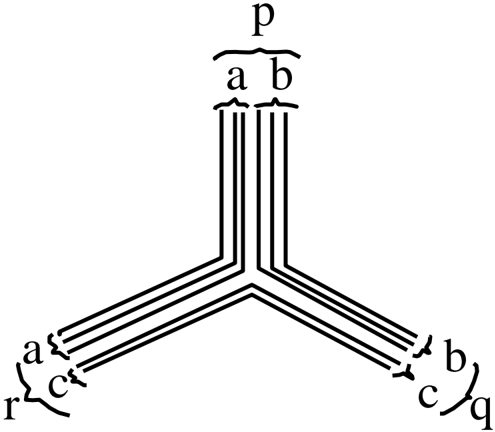
- The volume spectrum is discrete. For trivalent spin networks, the eigenvalue for a region \(R\) is \(V = \frac{1}{4} l_P^3 \sum_i \sqrt{a_i b_i c_i + a_i b_i + a_i c_i + b_i c_i}\), where the sum runs over nodes \(i\) contained in \(R\).
- The full area spectrum is \(A = \frac{1}{2} l_P^2 \sum_l \sqrt{p_l^2 + 2p_l}\), where \(l\) labels spin-network links crossing the surface.
- Spin-network states are eigenstates of the volume operator and also diagonalize the area operator; the two operators commute. Other volume eigenstates are related to a generalization of spin networks, with eigenvalues computable by diagonalizing finite-dimensional matrices.
- The authors argue that, under assumptions about physical fields defining regions and surfaces, Planck-scale measurements of volume or area would yield results in these discrete spectra.
Methods
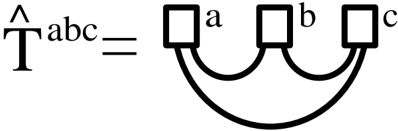
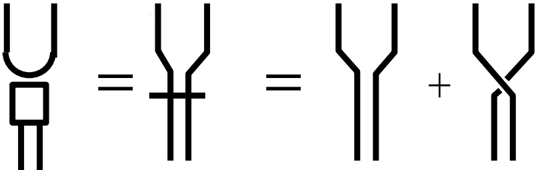
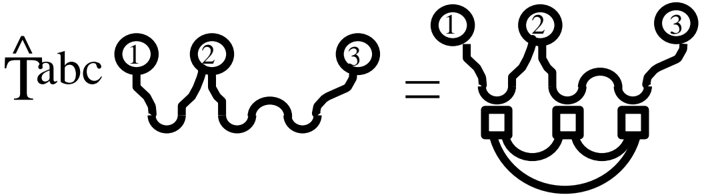
- Theoretical, non-perturbative quantum gravity in the loop representation. The volume operator is constructed via a diffeomorphism-invariant regularization using the three-hand loop observable \(T^{abc}\), partitioning a region into cubic boxes with an arbitrary unphysical flat metric \(g_0\), and taking a weak-operator limit \(L \to 0\).
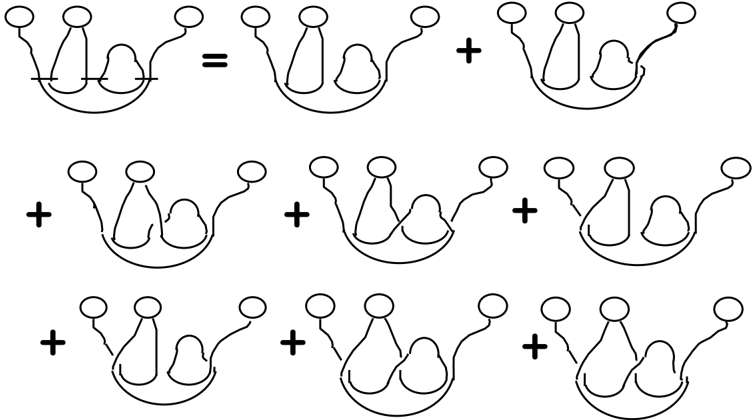
- The action of the volume operator is computed on the spin-network basis, where spin networks are trivalent graphs with positive integer link colors; the area operator is similarly diagonalized.
- No empirical data are used; the analysis is operator construction and spectral diagonalization.
Limitations
- The paper states that the local operator \(\sqrt{\det g}\) is ill-defined, that the regularization introduces an unphysical background metric \(g_0\) (though the operator is claimed independent of it in the limit), that the topology of the limit is delicate, and that diffeomorphism-invariant states lie in \(D_{\max}\) but not in the domain \(D\). It also notes that consistency of the theory is not proven and that quantization may have more than one solution.
- Evident from the provided text: the excerpt is truncated after the proportionality coefficient, so later sections and full derivation details are not available here. The physical interpretation also relies on assumptions about dynamical matter fields defining spatial regions and surfaces.
Model-written summary of a shortened version of the paper’s full text (it is longer than we read). Check it against the paper before relying on it.
Integrity signals
Registry
Cites
Statistics
Figures

Verification
Claims the paper makes
1 Valid · 4 Not valid · 5 Not checked · 18 Own results and interpretations
The sources with a verdict support this claim; the rest weren’t checked yet, have no full text we could read, or their verdicts aren’t rated yet.
In the paper
“Local quantities tend to be divergent or ill-defined in non-trivial generally covariant quantum field theories [3, 4, 11], a fact likely to be related to the non-renormalizability of the perturbative series.”
What the sources say
- Not checked — no full text of the sourcecites [3] matched to “Loop space representation of quantum general relativity” (1990) source
- Supportedcites [4] matched to “Weaving a classical metric with quantum threads” (1992) source
The Abstract says local operators such as the metric at a point may not be well-defined. The discussion of the local metric operator explains that its renormalization obstructs meaningful local geometric operators and says this appears to be a general feature of diffeomorphism-invariant theories. The claim’s separate suggestion about perturbative non-renormalizability is not the part attributed to this citation. (LLM, conf=0.90)
- Could not verifycites [11] matched to “Link Invariants, Holonomy Algebras and Functional Integration” (1993) sourceExperimental — accuracy not yet measured
The Introduction (pp. 1–2) discusses difficulties defining field-theoretic measures, and p. 4 describes regularized Wilson loops. Neither passage says that local quantities tend to diverge or be ill-defined in non-trivial generally covariant quantum field theories. Searches for local observables, divergences, and renormalization found no passage addressing that claim. (LLM, conf=0.73)
hedgedstates an association- Asserted: passes — The authors put it forward as true.
- Checkable: passes — It can be checked against evidence.
- Load-bearing: passes — The paper’s conclusions depend on it.
- Based: passes — The paper gives a reason why it holds.
The cited sources that could be checked couldn’t confirm or dispute this claim.
In the paper
“note for instance that there are other relevant topologies in state space, as the norm topologies defined by the kinematical or diffeomorphism-invariant Hilbert structures [6, 7], which are inequivalent to the one in which the limit (13) is taken.”
What the sources say
- Could not verifycites [6] matched to “Fermions in quantum gravity” (1994) sourceExperimental — accuracy not yet measured
Section 6.2 (pp. 33–34) uses pointwise topology in a model example about limits on knot states, but says a complete scalar product for the loop representation is not yet available. Neither those passages nor the passages found by searching for Hilbert norm topologies establish kinematical or diffeomorphism-invariant norm topologies, or their inequivalence to the topology used for the cited limit. (LLM, conf=0.72)
- Could not verifycites [7] matched to “Spatial infinity as a boundary of spacetime” (1992) sourceExperimental — accuracy not yet measured
The passages in §4, “Asymptotic symmetries” (page not supplied), discuss equivalence of spacetime completions, not topologies on a state space. Searches for Hilbert norm topologies and inequivalent state-space limits found no passage addressing the attributed claim. (LLM, conf=0.76)
plain- Asserted: passes — The authors put it forward as true.
- Checkable: passes — It can be checked against evidence.
- Load-bearing: unclear — It is unclear whether the paper’s conclusions depend on it.
- Based: passes — The paper gives a reason why it holds.
- Could not verify
A result the paper reports from its own data — it cites no other source for it, so there is none to check. The quote shows it is in the paper.
In the paper
“We find that the spectrum of the volume of any physical region is discrete.”
plain- Asserted: passes — The authors put it forward as true.
- Checkable: passes — It can be checked against evidence.
- Load-bearing: passes — The paper’s conclusions depend on it.
- Based: passes — The paper gives a reason why it holds.
A result the paper states — it cites no source for it, so there is none to check. The quote shows it is in the paper.
In the paper
“An unphysical background metric is introduced for the sake of the regularization, but the operator turns out to be independent of this background, in the limit in which the cut-off is removed.”
plain- Asserted: passes — The authors put it forward as true.
- Checkable: passes — It can be checked against evidence.
- Load-bearing: passes — The paper’s conclusions depend on it.
- Based: passes — The paper gives a reason why it holds.
In the paper
“Furthermore, we show here that the spin network states also diagonalize the operator Â[S], introduced in [3], which measures the area of the surface S.”
What the sources say
- Not checked — no full text of the sourcecites [3] matched to “Loop space representation of quantum general relativity” (1990) source
boostedstates an association- Asserted: passes — The authors put it forward as true.
- Checkable: passes — It can be checked against evidence.
- Load-bearing: passes — The paper’s conclusions depend on it.
- Based: passes — The paper gives a reason why it holds.
12 more claims
Create a free account to see all 28 claims and every source verdict.
- It may state two separate claims as one. 5
- Probably not a substantial claim. 5
- The quote only partly states this claim. 1
Claims other papers make about this one
Each is checked against this paper’s own text: does it say what the citing paper says it does?
The source backs part of the claim, not all of it — or backs it for a different population, condition or comparison.
In the citing paper
“In fact, that is why only volume and area operators could be constructed so far [10, 11].”
From A length operator for canonical quantum gravity (1998) · cites this paper as [10]
Experimental — accuracy not yet measuredThe source backs part of the claim, not all of it — or backs it for a different population, condition or comparison.
In the citing paper
“While the kinematics of loop quantum gravity (LQG) [1] is rather well understood [2, 3], its dynamics is not understood as cleanly.”
From Flipped spinfoam vertex and loop gravity (2008) · cites this paper as [4]
Experimental — accuracy not yet measuredThe source backs part of the claim, not all of it — or backs it for a different population, condition or comparison.
In the citing paper
“This problem arises due to the results obtained for the spectra of the geometrical operators and the black hole entropy being proportional to an unphysical parameter, which is called 'Immirzi parameter' [7] and appears as a parameter of a canonical transformation in classical gravity [8,9].”
From SO (4, C )-covariant Ashtekar-Barbero gravity and the Immirzi parameter (2000) · cites this paper as [9]
Experimental — accuracy not yet measuredThe cited source says what the claim attributes to it.
In the citing paper
“The results reported in this letter are obtained in the framework of quantum geometry [4] which does predict a discrete geometry because, e.g., the spectra of geometric operators as area and volume are discrete [5-7].”
From Absence of a Singularity in Loop Quantum Cosmology (2001) · cites this paper as [5]
The cited source says what the claim attributes to it.
In the citing paper
“Basic geometric quantities have been quantized [10][11][12][13][14] and found to have discrete spectra.”
From Loop quantum cosmology: I. Kinematics (2000) · cites this paper as [10]
17 more claims about this paper
Create a free account to see every claim other papers make about this one.
Citations
Cites
New Variables for Classical and Quantum Gravity
Ashtekar, A. (1986) · Physical Review Letters · doi:10.1103/physrevlett.57.2244 · Cited by 1,663
QUANTUM GRAVITY AND MINIMUM LENGTH
GARAY, L. J. (1995) · International Journal of Modern Physics A · doi:10.1142/s0217751x95000085 · Cited by 1,371
String theory beyond the Planck scale
Gross, D. J., & Mende, P. F. (1988) · Nuclear Physics B · doi:10.1016/0550-3213(88)90390-2 · Cited by 1,249
New Hamiltonian formulation of general relativity
Ashtekar, A. (1987) · Physical Review D · doi:10.1103/physrevd.36.1587 · Cited by 1,119
Quantum gravity and minimum length
Garay, L. J. (1994) · LA Referencia (Red Federada de Repositorios Institucionales de Publicaciones Científicas) · Cited by 881
Loop space representation of quantum general relativity
Rovelli, C., & Smolin, L. (1990) · Nuclear Physics B · doi:10.1016/0550-3213(90)90019-a · Cited by 806
Self-citationThe Hagedorn transition and the number of degrees of freedom of string theory
Atick, J. J., & Witten, E. (1988) · Nuclear Physics B · doi:10.1016/0550-3213(88)90151-4 · Cited by 800
The high-energy behavior of string scattering amplitudes
Gross, D. J., & Mende, P. F. (1987) · Physics Letters B · doi:10.1016/0370-2693(87)90355-8 · Cited by 778
Minimum physical length and the generalized uncertainty principle in string theory
Konishi, K., Paffuti, G., & Provero, P. (1990) · Physics Letters B · doi:10.1016/0370-2693(90)91927-4 · Cited by 753
On the nature of quantum geometrodynamics
Wheeler, J. A. (1957) · Annals of Physics · doi:10.1016/0003-4916(57)90050-7 · Cited by 693
Research works printed but not linked: 1
- Ashtekar, 1994, Quantum geometrodynamics and Coherent state transform on the space of connections, Penn. State University preprints
Cited by
Items 801–900 of 1,374
Black holes quasinormal modes, Loop Quantum Gravity Immirzi parameter and nonextensive statistics
Abreu, É. M. C., Neto, J. A., Barboza, E. M., & Soares, B. B. (2019) · Physics Letters B · doi:10.1016/j.physletb.2019.135011 · Cited by 8
A note on black hole entropy in loop quantum gravity
Carlip, S. (2015) · Classical and Quantum Gravity · doi:10.1088/0264-9381/32/15/155009 · Cited by 24
“) This is almost precisely the standard formula for area in loop quantum gravity [67, 68].”
BackgroundCanonical quantum gravity on noncommutative space–time
Kober, M. (2015) · International Journal of Modern Physics A · doi:10.1142/s0217751x15500852 · Cited by 9
Quantum Geometry of Isolated Horizons and Black Hole EntropyPreprint
Ashtekar, A., Baez, J. C., & Krasnov, K. V. (2000) · arXiv (Cornell University) · doi:10.48550/arxiv.gr-qc/0005126 · Cited by 8
“The resulting length [22], area [19,20] and volume [19,21] operators are again covariant with respect to spatial diffeomorphisms.”
BackgroundMethodOpen-flux solutions to the quantum constraints for plane gravity waves
Neville, D. E. (1997) · Physical review. D. Particles, fields, gravitation, and cosmology/Physical review. D. Particles and fields · doi:10.1103/physrevd.55.766 · Cited by 9
Canonical ``Loop'' Quantum Gravity and Spin Foam ModelsPreprint
Pietri, R. D. (1999) · arXiv (Cornell University) · doi:10.48550/arxiv.gr-qc/9903076 · Cited by 17
“Unfortunately, with the introduction of the volume operator [ RS95a ], it was realized that all the spin network states based on graph γ with all vertices of valence less that 3 are in the kernel of the volume operator.”
BackgroundZizzi, P. (2018) · Modern Physics Letters A · doi:10.1142/s0217732318501687 · Cited by 12
Scalar curvature operator for models of loop quantum gravity on a cubical graph
Lewandowski, J., & Mäkinen, I. (2022) · Physical review. D/Physical review. D. · doi:10.1103/physrevd.106.046013 · Cited by 12
Relative entropy as a measure of inhomogeneity in general relativity
Akerblom, N., & Cornelissen, G. (2012) · Journal of Mathematical Physics · doi:10.1063/1.3675440 · Cited by 9
“As an example of this, in loop quantum gravity, volume is a (trace class) operator V (compare [20, 21, 22]), so it makes sense to consider its von Neumann entropy −Tr(V logV) (as a regularized value).”
BackgroundA Proposal for a Bohmian Ontology of Quantum Gravity
Vassallo, A., & Esfeld, M. (2014) · Foundations of Physics · doi:10.1007/s10701-013-9745-1 · Cited by 18
“The most common interpretation of spin networks is the geometric one which exploits the fact that the labeling of nodes and edges in a graph represents contributions to eigenvalues, respectively, of volume and area operators defined on the Hilbert space of gravitational states (see [30], and [29], pp.”
BackgroundAn experiment to test the discreteness of time
Martin-Dussaud, P., Biagio, A. D., & Christodoulou, M. (2022) · Quantum · doi:10.22331/q-2022-10-06-826 · Cited by 17
“In Loop Quantum Gravity (LQG) the spectrum of the length, area and volume operators are famously discrete [42].”
BackgroundClassical geometry from a physical state in canonical quantum gravity
Ma, Y., & Ling, Y. (2000) · Physical review. D. Particles, fields, gravitation, and cosmology/Physical review. D. Particles and fields · doi:10.1103/physrevd.62.064030 · Cited by 9
Scalar cosmological perturbations from quantum entanglement within Lorentzian quantum gravity
Jercher, A. F., Marchetti, L., & Pithis, A. G. A. (2024) · Physical review. D/Physical review. D. · doi:10.1103/physrevd.109.066021 · Cited by 15
Entropy and area of black holes in loop quantum gravity
Khriplovich, I. B. (2002) · Physics Letters B · doi:10.1016/s0370-2693(02)01914-7 · Cited by 20
Universal Properties of the Evolution of the Universe in Modified Loop Quantum Cosmology
Saeed, J., Pan, R., Brown, C., Cleaver, G., & Wang, A. (2024) · Universe · doi:10.3390/universe10100397 · Cited by 14
“√ The parameter λ is defined as Pl , where ∆ denotes the minimal area gap of the area operator in LQG [7,12,69,70].”
Fermion spins in loop quantum gravity
Mansuroglu, R., & Sahlmann, H. (2021) · Physical review. D/Physical review. D. · doi:10.1103/physrevd.103.066016 · Cited by 12
“[23] C.”
BackgroundInfluentialSU(1,1) Barbero-like variables derived from Holst action
Montesinos, M., Romero, J., Escobedo, R., & Celada, M. (2018) · Physical review. D/Physical review. D. · doi:10.1103/physrevd.98.124002 · Cited by 10
Noncommutative spaces and covariant formulation of statistical mechanics
Hosseinzadeh, V., Gorji, M. A., Nozari, K., & Vakili, B. (2015) · Physical review. D. Particles, fields, gravitation, and cosmology/Physical review. D. Particles and fields · doi:10.1103/physrevd.92.025008 · Cited by 8
Loop Quantum Gravity: A Demystified View
Vyas, R. P., & Joshi, M. (2022) · Gravitation and Cosmology · doi:10.1134/s0202289322030094 · Cited by 9
Elementary Charge and Neutrino’s Mass from Planck Length
Carneiro, S. (2020) · Foundations of Physics · doi:10.1007/s10701-020-00383-z · Cited by 8
Quasilocal energy for spin-net gravity
Major, S. A. (2000) · Classical and Quantum Gravity · doi:10.1088/0264-9381/17/6/311 · Cited by 14
“This comes about through an interplay between the operator and the gauge invariant Hilbert space which allows the operator to be defined on the induced Hilbert space.”
BackgroundThe cosmological implications of a fundamental length: a DSR-inspired de Sitter spacetime
Khosravi, N., & Sepangi, H. R. (2008) · Journal of Cosmology and Astroparticle Physics · doi:10.1088/1475-7516/2008/04/011 · Cited by 12
“ys a crucial role [3]. Also, the fundamental length appears in loop quantum gravity [4] as a promising alternative to quantum gravity, in the form of discrete spectra of the area and volume operators [5]. This fundamental length is introduced by hand in some effective theories [6, 7, 8] where it is shown that it can be…”
BackgroundThe Area Operator in the Spherically Symmetric Sector of Loop Quantum Gravity
Bojowald, M., & Kastrup, H. A. (1999) · CERN Document Server (European Organization for Nuclear Research) · doi:10.48550/arxiv.hep-th/9907043 · Cited by 7
“!) the relationship between the more complicated spectrum of the general (non-symmetric) area operator in loop quantum gravity and the old Bekenstein proposal that An ∝ n. ∗e-mail address: bojowald@physik.rwth-aachen.de †e-mail address: kastrup@physik.rwth-aachen.de”
BackgroundThe Damped Harmonic Oscillator at the Classical Limit of the Snyder-de Sitter Space
Lawson, L. M., Nonkané, I., & Sodoga, K. (2021) · Journal of Mathematics Research · doi:10.5539/jmr.v13n2p1 · Cited by 7
“Among all the candidate theories [2, 3, 4] to address this problem, the non-commutative geometry seems to be the promising approach to quantum gravity.”
BackgroundQuantum corrections to the Hawking radiation spectrum
Yoon, Y. (2016) · Journal of the Korean Physical Society · doi:10.3938/jkps.68.730 · Cited by 13
“a photon is emitted from a single area quantum in the black hole, rather than from extended regions), which leads to the selection rule for quantum black hole, we argue that the Hawking radiation spectrum is still discrete contrary to what Barreira, Carfora and Rovelli argued [3] and Krasnov argued [4], even in the ca…”
ResultAsymptotic black hole quasinormal frequenciesPreprint
Motl, L., & Neitzke, A. (2003) · arXiv (Cornell University) · doi:10.48550/arxiv.hep-th/0301173 · Cited by 7
Second-order amplitudes in loop quantum gravity
Mamone, D., & Rovelli, C. (2009) · Classical and Quantum Gravity · doi:10.1088/0264-9381/26/24/245013 · Cited by 15
Self-citationThe Information-Complete Quantum Theory
Chen, Z. (2022) · Quantum Engineering · doi:10.1155/2022/9203196 · Cited by 8
Exotic fermionic fields and minimal length
da Silva, J. M. H., Beghetto, D., Cavalcanti, R. T., et al. (2020) · The European Physical Journal C · doi:10.1140/epjc/s10052-020-8313-z · Cited by 7
“[7] C.”
BackgroundQuantization of static space-times
Ma, Y. (2002) · Physical review. D. Particles, fields, gravitation, and cosmology/Physical review. D. Particles and fields · doi:10.1103/physrevd.65.064012 · Cited by 6
Canonical quantum gravity and consistent discretizations
Gambini, R., & Pullin, J. A. (2004) · Pramana · doi:10.1007/bf02705197 · Cited by 8
A new realization of quantum geometry
Bähr, B., Dittrich, B., & Geiller, M. (2021) · Classical and Quantum Gravity · doi:10.1088/1361-6382/abfed1 · Cited by 68
“The usual area operator [70, 71] involves a sum over the Casimir operators for each spin network edge piercing the surface.”
BackgroundA Brane World Model with Intersecting Branes
Pavsic, M. (2001) · CERN Document Server (European Organization for Nuclear Research) · Cited by 7
Energy and directional signatures for plane quantized gravity waves
Neville, D. E. (1998) · Physical review. D. Particles, fields, gravitation, and cosmology/Physical review. D. Particles and fields · doi:10.1103/physrevd.57.986 · Cited by 8
On the distribution of the eigenvalues of the area operator in loop quantum gravity
G, J. F. B., Margalef-Bentabol, J., & Villaseñor, E. J. S. (2018) · Classical and Quantum Gravity · doi:10.1088/1361-6382/aaabf9 · Cited by 8
The status of quantum geometry in the dynamical sector of loop quantum cosmology
Kamiński, W., Lewandowski, J., & Szulc, Ł. (2008) · Classical and Quantum Gravity · doi:10.1088/0264-9381/25/5/055003 · Cited by 12
“In loop quantum gravity [1], the operators representing the intrinsic 3-geometry of a given Cauchy surface as well as the extrinsic curvature are known [2].”
BackgroundRevisiting the solution of the second-class constraints of the Holst action
Montesinos, M., Romero, J., & Celada, M. (2019) · Physical review. D/Physical review. D. · doi:10.1103/physrevd.99.064029 · Cited by 8
Black hole evaporation within a momentum-dependent metric
Salesi, G., & Grezia, E. D. (2009) · Physical review. D. Particles, fields, gravitation, and cosmology/Physical review. D. Particles and fields · doi:10.1103/physrevd.79.104009 · Cited by 8
Entropy and Area of Black Holes in Loop Quantum GravityPreprint
Khriplovich, I. B. (2001) · Cited by 7
A note on the Poisson bracket of 2d smeared fluxes in loop quantum gravity
Cattaneo, A. S., & Pérez, A. (2017) · Classical and Quantum Gravity · doi:10.1088/1361-6382/aa69b4 · Cited by 31
“We hope this clarifies the geometric origin for the non-commutativity of fluxes in loop quantum gravity which is especially important as can be shown to be the root from which discreteness of quantum geometry stems [5, 6, 8].”
BackgroundZhang, C., Song, S., & Han, M. (2020) · arXiv (Cornell University) · Cited by 8
Bianchi type I, Schutz perfect fluid and evolutionary quantum cosmology
Tavakoli, F., & Vakili, B. (2019) · General Relativity and Gravitation · doi:10.1007/s10714-019-2602-6 · Cited by 11
Holographic relations in loop quantum gravityPreprint
Smolin, L. (2016) · arXiv (Cornell University) · doi:10.48550/arxiv.1608.02932 · Cited by 11
Self-citationLoop quantum cosmology from an alternative Hamiltonian
Yang, J., Zhang, C., & Ma, Y. (2019) · Physical review. D/Physical review. D. · doi:10.1103/physrevd.100.064026 · Cited by 7
“[7] C.”
BackgroundIntroduction to SU(2) recoupling theory and graphical methods for loop quantum gravityPreprint
Mäkinen, I. (2019) · arXiv (Cornell University) · doi:10.48550/arxiv.1910.06821 · Cited by 24
“We will consider the volume operator [66,69], the Euclidean part of the so-called Warsaw Hamiltonian [64, 67], and the curvature operator [63].”
BackgroundMethodTensorial methods and renormalization
Orsay, L. (2013) · Cited by 6
Quantum Entropy of the Schwarzschild Black Hole due to Gravitational Perturbations
Chen, S., & Ji-Liang, J. (2004) · Chinese Physics Letters · doi:10.1088/0256-307x/21/6/007 · Cited by 7
Neutrino primordial Planckian black holes
Carneiro, S., de Holanda, P. C., & Saa, A. (2021) · Physics Letters B · doi:10.1016/j.physletb.2021.136670 · Cited by 7
Noncommutative geometry induced by spin effects
Colatto, L. P., Penna, A. L. A., & dos Santos, W. C. (2006) · Physical review. D. Particles, fields, gravitation, and cosmology/Physical review. D. Particles and fields · doi:10.1103/physrevd.73.105007 · Cited by 7
Area Operator in Loop Quantum Gravity
Lim, A. P. C. (2017) · Annales Henri Poincaré · doi:10.1007/s00023-017-0600-3 · Cited by 8
“It was remarked in [12] that the eigenvalues for the area operator come from matter in the ambient space.”
BackgroundMethodOn Loop States in Loop Quantum Gravity
Dass, N. D. H., & Mathur, M. (2006) · CERN Document Server (European Organization for Nuclear Research) · Cited by 9
An analytical computation of asymptotic Schwarzschild quasinormal frequenciesPreprint
Motl, L. (2002) · arXiv (Cornell University) · doi:10.48550/arxiv.gr-qc/0212096 · Cited by 7
“The most interesting result of this approach to quantization of gravity is the following area quantization law [22, 23] that results directly from (10) and (11): A = 8πGNγ ∑”
BackgroundThe Koslowski–Sahlmann representation: gauge and diffeomorphism invariance
Campiglia, M., & Varadarajan, M. (2014) · Classical and Quantum Gravity · doi:10.1088/0264-9381/31/7/075002 · Cited by 15
Analogic cellular PDE machines
Rekeczky, C., Szatmari, I., Földesy, P., et al. (2003) · doi:10.1109/ijcnn.2002.1007452 · Cited by 7
“The major obstacle in building the ideal PDE MACHINE - continuous in both space and time - stems from the fact that the “spectrum of the volume of any physical region is discrete” [20].”
BackgroundReal sector of the nonminimally coupled scalar field to self-dual gravity
Montesinos, M., Morales-Técotl, H. A., Urrutia, L. F., & Vergara, J. D. (1999) · Journal of Mathematical Physics · doi:10.1063/1.532818 · Cited by 12
Holostar thermodynamicsPreprint
Petri, M. (2003) · arXiv (Cornell University) · doi:10.48550/arxiv.gr-qc/0306067 · Cited by 8
Is the diagonal case a general picture for loop quantum cosmology?
Bruno, M., & Montani, G. (2023) · Physical review. D/Physical review. D. · doi:10.1103/physrevd.108.046003 · Cited by 9
“This claim is based on the idea that such a proposal, starting from a classical formulation of General Relativity, which is (on shell) equivalent to the Einstein-Hilbert formulation [4–8], arrives, via the introduction of the SU(2) symmetry, to describe geometrical operators, like areas and volumes of space, as associ…”
Quantum Deep Learning Triuniverse
McCoss, A. M. (2016) · Journal of Quantum Information Science · doi:10.4236/jqis.2016.64015 · Cited by 6
“The papers which most strongly correlate with this one are those by Smolin on Cosmological Natural Selection [44]-[46], Zurek and co-workers on Quantum Darwinism [58]-[60] [75] [102], Wiebe, Kapoor and Svore on Quantum Deep Learning [3] and Watson and Szathmáry on an ability for biological evolution to learn and hence…”
BackgroundEntropy bound for the photon gas in noncommutative spacetime
Nozari, K., Gorji, M. A., Kamali, A. D., & Vakili, B. (2016) · Astroparticle Physics · doi:10.1016/j.astropartphys.2016.05.007 · Cited by 9
Burderi, L., Sanna, A., Salvo, T. D., Amati, L., Amelino-Camelia, G., Branchesi, M., Capozzıello, S., Coccia, E., Colpi, M., Costa, E., et al. (2019) · arXiv (Cornell University) · doi:10.48550/arxiv.1911.02154 · Cited by 11
Self-citationThermodynamics of spacetime from minimal area
Alonso-Serrano, A., & Liška, M. (2021) · Physical review. D/Physical review. D. · doi:10.1103/physrevd.104.084043 · Cited by 11
Coherent states of position-dependent mass in strong quantum gravitational background fieldsPreprint
Lawson, L. M. (2020) · arXiv (Cornell University) · Cited by 6
Bunao, J. R. R., & Galapon, E. A. (2014) · Annals of Physics · doi:10.1016/j.aop.2014.11.003 · Cited by 6
Quantum computing in microtubules—an intra-neural correlate of consciousness?
Hameroff, S. R. (1997) · 認知科学 = Cognitive studies : bulletin of the Japanese Cognitive Science Society · doi:10.11225/jcss.4.3_67 · Cited by 7
Beetle, C., & Corichi, A. (1997) · arXiv (Cornell University) · doi:10.48550/arxiv.gr-qc/9703044 · Cited by 6
κ-Minkowski and Snyder algebra from reparametrisation symmetry
Chatterjee, C., & Gangopadhyay, S. (2008) · Europhysics Letters (EPL) · doi:10.1209/0295-5075/83/21002 · Cited by 6
Considering boundary conditions for black hole entropy in loop quantum gravity
Tamaki, T. (2007) · Classical and Quantum Gravity · doi:10.1088/0264-9381/24/15/005 · Cited by 7
Position and length operators in a theory with minimal length
Slawny, J. (2007) · Journal of Mathematical Physics · doi:10.1063/1.2423220 · Cited by 6
Sahlmann, H., & Sherif, W. (2024) · Classical and Quantum Gravity · doi:10.1088/1361-6382/ad7c14 · Cited by 11
“One also has within LQG well defined notions of quantum geometric observables such as volume [16–19] and area [16, 20].”
Coupling matter to loop quantum gravity
Sahlmann, H. (2005) · publish.UP (University of Potsdam) · Cited by 6
Yang, J., & Ma, Y. (2015) · arXiv (Cornell University) · doi:10.48550/arxiv.1505.00223 · Cited by 17
“Thus we have( T norm γ,~j,~i ,T norm γ′,~j′,~i′ ) Hkin = δγ,γ′ ∏ e∈E(γ) δ je, j′e ∏ v∈V(γ) ∑ m1,··· ,mn ( i J;~aj1··· jn ) m1···mn M( i J ′;~a′ j1··· jn ) m1···mn M′ , (A.74) where n is the number of the edges incident at v, and the complex conjugation of intertwiner related to the corresponding intertwiner (A.30) sat…”
BackgroundMethodInfluentialFlori, C. (2011) · edoc Publication server (Humboldt University of Berlin) · doi:10.18452/16344 · Cited by 7
Barbero’s formulation from a BF -type action with the Immirzi parameter
Celada, M., Montesinos, M., & Romero, J. (2016) · Classical and Quantum Gravity · doi:10.1088/0264-9381/33/11/115014 · Cited by 10
“This action, however, contains a free parameter (the Immirzi parameter [10]) which has no importance at the classical level, but whose meaning at the quantum level still remains unclear since the spectra of geometric operators [11, 12] as well as the entropy of black holes [13–17] explicitly depend on it.”
BackgroundQuantum Space-Times: Beyond the Continuum of Minkowski and Einstein
Ashtekar, A. (2009) · Springer eBooks · doi:10.1007/978-90-481-3475-5_7 · Cited by 6
Integrable maps from Galois differential algebras, Borel transforms and number sequences
Tempesta, P. (2013) · Journal of Differential Equations · doi:10.1016/j.jde.2013.04.008 · Cited by 6
“The problem of physically consistent discretizations has been considered in the context of field theories and Hamiltonian gravity, for instance in [13], [15], [36].”
BackgroundGeometry and entanglement entropy of surfaces in loop quantum gravity
Grüber, D., Sahlmann, H., & Zilker, T. (2018) · Physical review. D/Physical review. D. · doi:10.1103/physrevd.98.066009 · Cited by 7
“[3] C. Rovelli and L. Smolin, “Discreteness of area and volume in quantum gravity,” Nucl.”
BackgroundMethodInfluentialQuantum gravity: Physics from supergeometries
Cirilo-Lombardo, D. J., & Prudêncio, T. (2014) · International Journal of Geometric Methods in Modern Physics · doi:10.1142/s0219887814500674 · Cited by 6
“As is well known from the comments of the (LQG) loop quantum gravity community [12,14,16,17], the spectral lines can be very dense in macroscopic regimes leading physically no contradiction with Hawking’s prediction of a continuous thermal spectrum.”
BackgroundThree possible implications of spacetime discretenessPreprint
Gao, S. (2013) · PhilSci-Archive (University of Pittsburgh) · Cited by 6
Relating spin-foam to canonical loop quantum gravity by graphical calculus
Yang, J., Zhang, C., & Ma, Y. (2021) · Physical review. D/Physical review. D. · doi:10.1103/physrevd.104.044025 · Cited by 9
The holographic solution - Why general relativity must be understood in terms of stringsPreprint
Petri, M. (2004) · arXiv (Cornell University) · doi:10.48550/arxiv.gr-qc/0405007 · Cited by 10
“The minimum (quantized) area in loop quantum gravity is non-zero and roughly equal to the Planck area [4] [46].”
Formation and stability of area quantized black holes
Chakravarti, K., Ghosh, R., & Sarkar, S. (2024) · Physical review. D/Physical review. D. · doi:10.1103/physrevd.109.046001 · Cited by 9
Loop quantum gravity effects on electromagnetic properties of charged leptons
Melo, J. P. S., Neves, M. J., Paixão, J. M. A., & Helayël-Neto, J. A. (2024) · The European Physical Journal C · doi:10.1140/epjc/s10052-024-13257-9 · Cited by 9
Quantum gravity in the triangular gauge
Thiemann, T. (2024) · Physical review. D/Physical review. D. · doi:10.1103/physrevd.110.124021 · Cited by 8
Three-geometry and reformulation of the Wheeler–DeWitt equation
Soo, C. (2007) · Classical and Quantum Gravity · doi:10.1088/0264-9381/24/6/011 · Cited by 11
Thiemann, T., & Giesel, K. (2023) · Springer eBooks · doi:10.1007/978-981-19-3079-9_97-1 · Cited by 10
The large-volume limit of a quantum tetrahedron is a quantum harmonic oscillator
Schliemann, J. (2013) · Classical and Quantum Gravity · doi:10.1088/0264-9381/30/23/235018 · Cited by 5
Asymptotics of classical spin networks
Garoufalidis, S., & van der Veen, R. (2013) · Geometry & Topology · doi:10.2140/gt.2013.17.1 · Cited by 29
“[RS] C. Rovelli and L. Smolin, Discreteness of area and volume in quantum gravity, Nuclear Phys.”
MethodIntertwiner entanglement excitation and holonomy operator
Chen, Q., & Livine, E. R. (2022) · Classical and Quantum Gravity · doi:10.1088/1361-6382/ac90aa · Cited by 10
“On the other hand, geometric observables are raised to quantum operators acting on the Hilbert space spanned by spin networks, leading to the celebrated result of discrete spectra for areas (living along edges) and volumes (living at vertices) [5–7].”
The fermionic contribution to the spectrum of the area operator in nonperturbative quantum gravity
Montesinos, M., & Rovelli, C. (1998) · Classical and Quantum Gravity · doi:10.1088/0264-9381/15/12/009 · Cited by 6
“The area operator ÂS associated to a two–dimensional surface S is well understood [7,8].”
BackgroundSelf-citationQuantum geometry with a nondegenerate vacuum: A toy model
Sengupta, S. (2013) · Physical review. D. Particles, fields, gravitation, and cosmology/Physical review. D. Particles and fields · doi:10.1103/physrevd.88.064016 · Cited by 6
Decoding infrared imprints of quantum origins of black holes
Chakraborty, S., & Lochan, K. (2018) · Physics Letters B · doi:10.1016/j.physletb.2018.12.028 · Cited by 7
“There are many candidate theories with different geometric operators getting quantized as well as with different spectrum of quantization [56–58].”
BackgroundA discrete, unitary, causal theory of quantum gravity
Wall, A. C. (2013) · Classical and Quantum Gravity · doi:10.1088/0264-9381/30/11/115002 · Cited by 12
A “Helium atom” of space: Dynamical instability of the isochoric pentahedron
Coleman-Smith, C. E., & Müller, B. (2013) · Physical review. D. Particles, fields, gravitation, and cosmology/Physical review. D. Particles and fields · doi:10.1103/physrevd.87.044047 · Cited by 5
Fermion coupling to loop quantum gravity: Canonical formulation
Lewandowski, J., & Zhang, C. (2022) · Physical review. D/Physical review. D. · doi:10.1103/physrevd.105.124025 · Cited by 10
How fuzzballs resolve the information paradox
Mathur, S. D. (2013) · Journal of Physics Conference Series · doi:10.1088/1742-6596/462/1/012034 · Cited by 6
Angle and Volume Studies in Quantized SpacePreprint
Seifert, M. (2001) · arXiv (Cornell University) · doi:10.48550/arxiv.gr-qc/0108047 · Cited by 11
“The reader wanting further details as to the construction of these operators is referred to the derivations in [10] (for angular momentum), [13, 14] (for area), [15] (for angle), and [12] (for volume).”
BackgroundN=1 Supergravity with loop quantum gravity methods and quantization of the SUSY constraint
Eder, K., & Sahlmann, H. (2021) · Physical review. D/Physical review. D. · doi:10.1103/physrevd.103.046010 · Cited by 8
“Therefore, let us choose instead the RovelliSmolin variant of the volume operator [19, 20, 21].”
BackgroundA spin network generalization of the Jones polynomial and Vassiliev invariants
Gambini, R., Griego, J., & Pullin, J. A. (1998) · Civil War Book Review · Cited by 5
Probing the shape of quantum surfaces: the quadrupole moment operator
Goeller, C., & Livine, E. R. (2018) · Classical and Quantum Gravity · doi:10.1088/1361-6382/aae327 · Cited by 5
Crowther, K. (2016) · Springer eBooks · doi:10.1007/978-3-319-39508-1_7 · Cited by 5
Metadata
- Authors
- Rovelli, C., & Smolin, L.
- Affiliations
- Pennsylvania State University (US)
- Corresponding author
- Smolin, Lee
- ORCID
- Smolin, Lee
- Venue
- Nuclear Physics B
- Publisher
- Elsevier BV
- Published
- 1995-05
- Volume
- 442
- Issue
- 3
- Pages
- 593-619
- ISSN
- 0550-3213 (ISSN-L)
- OpenAlex
- W2104041846
- Semantic Scholar
- 3b85eebc659d3ae5d857e1d141fd5126db507eba
- Cited by
- 1,365
- References
- 63
- Citations by year
- 2026: 40 · 2025: 79 · 2024: 70 · 2023: 38 · 2022: 35 · 2021: 55 · 2020: 31 · 2019: 42 · 2018: 44 · 2017: 40 · 2016: 48 · 2015: 36 · 2014: 43 · 2013: 47 · 2012: 49
- FWCI
- 38.09
- Type
- journal article
- Language
- en
- Open access
- green
- arxiv.org
- Licence
- www.elsevier.com/tdm/userlicense/1.0/ (tdm)
- www.elsevier.com/legal/tdmrep-license (tdm)
- Locations
- Nuclear Physics B (publishedVersion)
- arXiv (Cornell University) (submittedVersion)
- CERN Document Server (European Organization for Nuclear Research) (submittedVersion)
- arXiv (Cornell University)
- Topics
- Physical Sciences › Physics and Astronomy › Nuclear and High Energy Physics › Noncommutative and Quantum Gravity Theories
- Physical Sciences › Physics and Astronomy › Astronomy and Astrophysics › Relativity and Gravitational Theory
- Physical Sciences › Physics and Astronomy › Nuclear and High Energy Physics › Black Holes and Theoretical Physics
- Keywords
- quantum gravity, loop representation, spin networks, volume operator, area operator, diffeomorphism invariance, background independence, Planck-scale geometry, non-perturbative quantum gravity
About these checks
Registry, retraction, Cites and statistics results are computed, not judged, with one exception: a printed reference that no index lists is read once by a model before it counts as a citation error. Claims are extracted by a model and kept only when their quote appears verbatim in the text; each cited source is then checked, with a model’s help, for whether it says what the claim relies on. Those verdicts can be wrong — read the claim’s quote and the cited source before relying on one.
The claim verdicts this report counts are experimental: their accuracy is not yet measured.
A language model drew the claims from the paper on 2026-10-07, under version 3 of the claim definition (model deepseek-v4.1-flash, prompt extract-v3).
A second model labelled each claim on 2026-10-07 (model jev-1.13-20260917, definition revision gold-guideline-v0.2).
Cited sources are checked with a language model’s help (gpt-6-sol).
Statistics and arithmetic are recomputed, not judged.
Confidence bands are shown only for fields calibrated on our annotated test set. None is calibrated yet, so no band is shown.
What counts as a claim ›How we measure confidence ›How we check this ›
Are you an author, or do you see a problem with this page? Request a review
Data sources
Bibliographic data: Semantic Scholar, OpenAlex, Crossref.
Contains information from the Semantic Scholar Academic Graph Datasets, made available under the ODC Attribution License (ODC-BY 1.0).
Semantic Scholar’s data is described in: Kinney, R., et al. (2023). The Semantic Scholar Open Data Platform. arXiv:2301.10140.
