

Discreteness of area and volume in quantum gravity
Open accessThe DOI matches its Crossref record; 60 of the 63 references it cites were found in a registry or an index; 6 of the 14 sources its claims cite were checked for support.
Abstract
We study the operator that corresponds to the measurement of volume, in non-perturbative quantum gravity, and we compute its spectrum. The operator is constructed in the loop representation, via a regularization procedure; it is finite, background independent, and diffeomorphism-invariant, and therefore well defined on the space of diffeomorphism invariant states (knot states). We find that the spectrum of the volume of any physical region is discrete. A family of eigenstates are in one to one correspondence with the spin networks, which were introduced by Penrose in a different context. We compute the corresponding component of the spectrum, and exhibit the eigenvalues explicitly. The other eigenstates are related to a generalization of the spin networks, and their eigenvalues can be computed by diagonalizing finite dimensional matrices. Furthermore, we show that the eigenstates of the volume diagonalize also the area operator. We argue that the spectra of volume and area determined here can be considered as predictions of the loop-representation formulation of quantum gravity on the outcomes of (hypothetical) Planck-scale sensitive measurements of the geometry of space.
Overview
CoChat Summary
TL;DR
Rovelli and Smolin construct a regularized volume operator in loop-representation quantum gravity and compute its spectrum, finding it discrete. They show spin-network states diagonalize both the volume and area operators, yielding explicit discrete area and volume eigenvalues.
Key findings
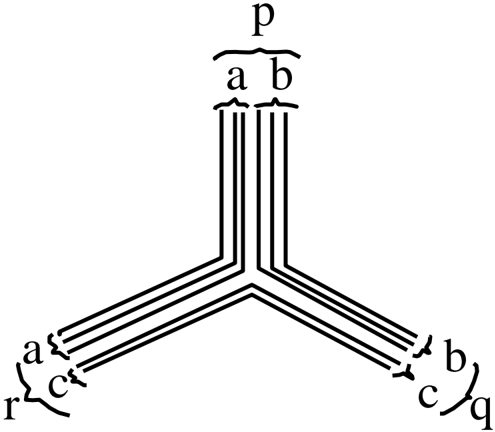
- The volume spectrum is discrete. For trivalent spin networks, the eigenvalue for a region \(R\) is \(V = \frac{1}{4} l_P^3 \sum_i \sqrt{a_i b_i c_i + a_i b_i + a_i c_i + b_i c_i}\), where the sum runs over nodes \(i\) contained in \(R\).
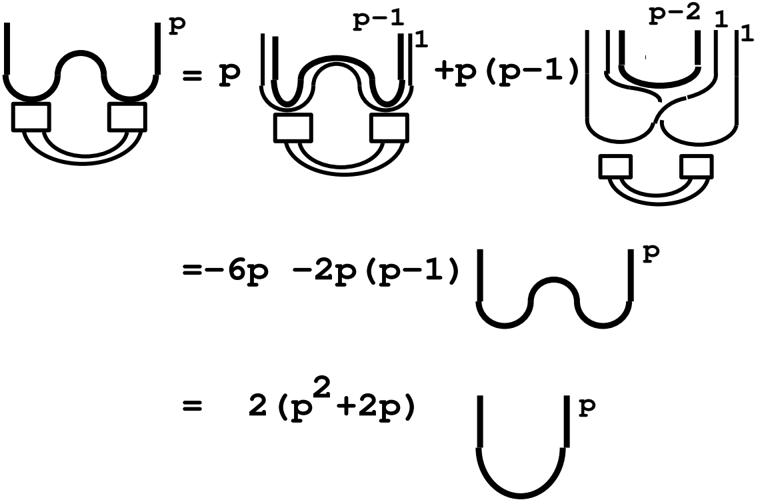
- The full area spectrum is \(A = \frac{1}{2} l_P^2 \sum_l \sqrt{p_l^2 + 2p_l}\), where \(l\) labels spin-network links crossing the surface.
- Spin-network states are eigenstates of the volume operator and also diagonalize the area operator; the two operators commute. Other volume eigenstates are related to a generalization of spin networks, with eigenvalues computable by diagonalizing finite-dimensional matrices.
- The authors argue that, under assumptions about physical fields defining regions and surfaces, Planck-scale measurements of volume or area would yield results in these discrete spectra.
Methods
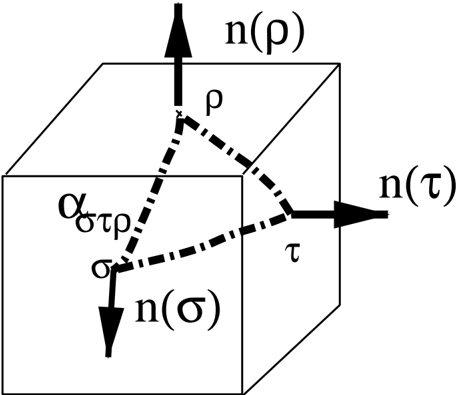
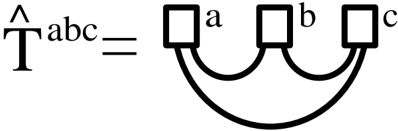
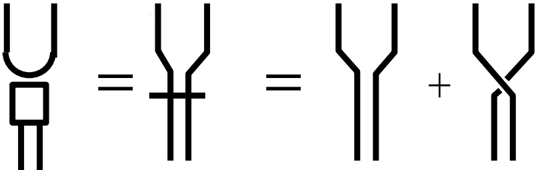
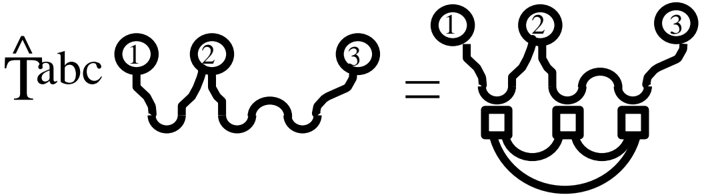
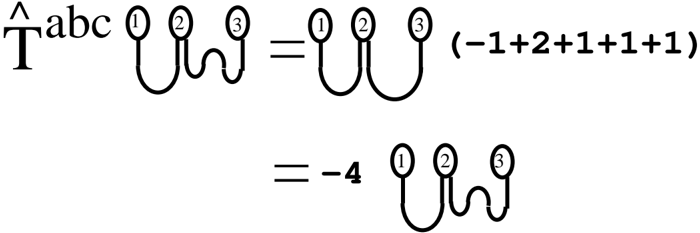
- Theoretical, non-perturbative quantum gravity in the loop representation. The volume operator is constructed via a diffeomorphism-invariant regularization using the three-hand loop observable \(T^{abc}\), partitioning a region into cubic boxes with an arbitrary unphysical flat metric \(g_0\), and taking a weak-operator limit \(L \to 0\).
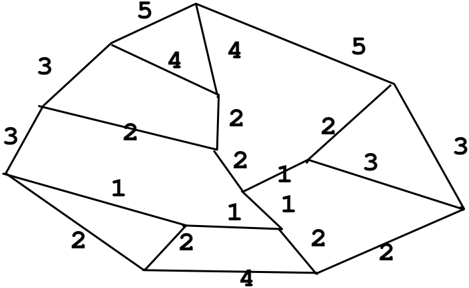
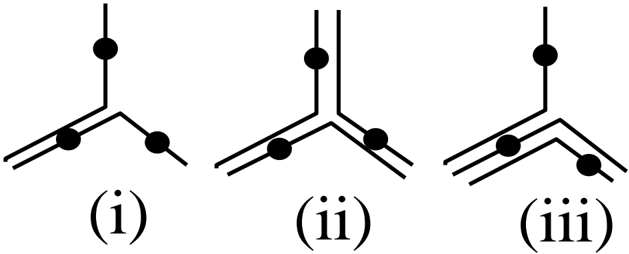
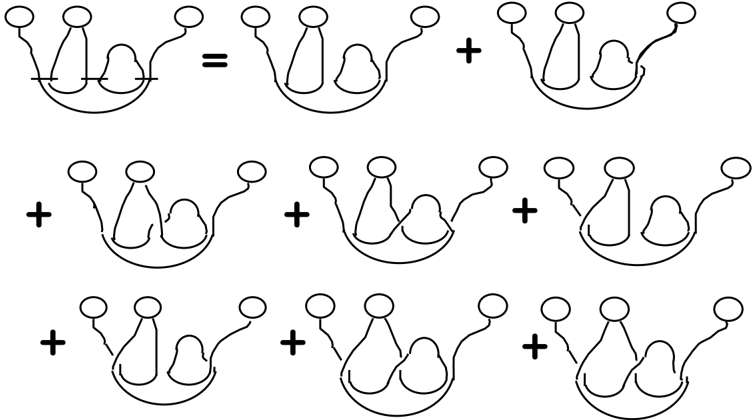
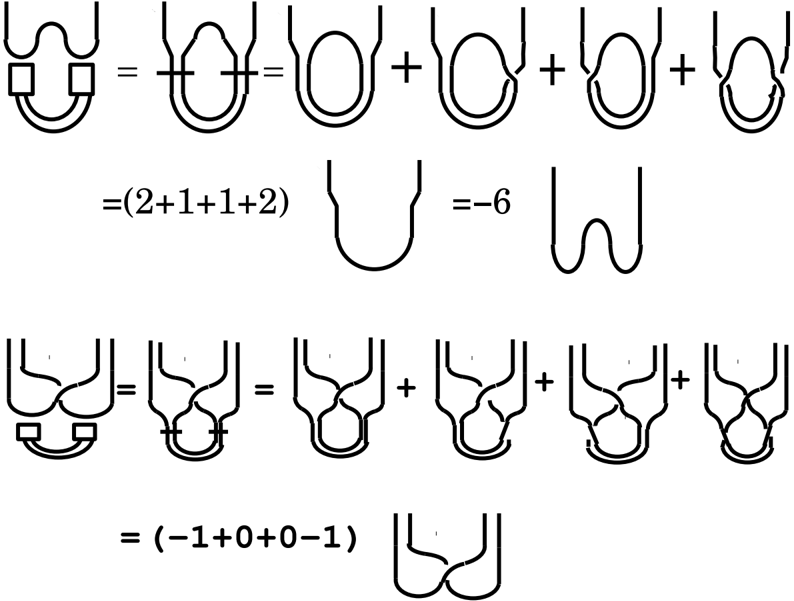
- The action of the volume operator is computed on the spin-network basis, where spin networks are trivalent graphs with positive integer link colors; the area operator is similarly diagonalized.
- No empirical data are used; the analysis is operator construction and spectral diagonalization.
Limitations
- The paper states that the local operator \(\sqrt{\det g}\) is ill-defined, that the regularization introduces an unphysical background metric \(g_0\) (though the operator is claimed independent of it in the limit), that the topology of the limit is delicate, and that diffeomorphism-invariant states lie in \(D_{\max}\) but not in the domain \(D\). It also notes that consistency of the theory is not proven and that quantization may have more than one solution.
- Evident from the provided text: the excerpt is truncated after the proportionality coefficient, so later sections and full derivation details are not available here. The physical interpretation also relies on assumptions about dynamical matter fields defining spatial regions and surfaces.
Model-written summary of a shortened version of the paper’s full text (it is longer than we read). Check it against the paper before relying on it.
Integrity signals
Registry
Cites
Statistics
Figures

Verification
Claims the paper makes
1 Valid · 4 Not valid · 5 Not checked · 18 Own results and interpretations
The sources with a verdict support this claim; the rest weren’t checked yet, have no full text we could read, or their verdicts aren’t rated yet.
In the paper
“Local quantities tend to be divergent or ill-defined in non-trivial generally covariant quantum field theories [3, 4, 11], a fact likely to be related to the non-renormalizability of the perturbative series.”
What the sources say
- Not checked — no full text of the sourcecites [3] matched to “Loop space representation of quantum general relativity” (1990) source
- Supportedcites [4] matched to “Weaving a classical metric with quantum threads” (1992) source
The Abstract says local operators such as the metric at a point may not be well-defined. The discussion of the local metric operator explains that its renormalization obstructs meaningful local geometric operators and says this appears to be a general feature of diffeomorphism-invariant theories. The claim’s separate suggestion about perturbative non-renormalizability is not the part attributed to this citation. (LLM, conf=0.90)
- Could not verifycites [11] matched to “Link Invariants, Holonomy Algebras and Functional Integration” (1993) sourceExperimental — accuracy not yet measured
The Introduction (pp. 1–2) discusses difficulties defining field-theoretic measures, and p. 4 describes regularized Wilson loops. Neither passage says that local quantities tend to diverge or be ill-defined in non-trivial generally covariant quantum field theories. Searches for local observables, divergences, and renormalization found no passage addressing that claim. (LLM, conf=0.73)
hedgedstates an association- Asserted: passes — The authors put it forward as true.
- Checkable: passes — It can be checked against evidence.
- Load-bearing: passes — The paper’s conclusions depend on it.
- Based: passes — The paper gives a reason why it holds.
The cited sources that could be checked couldn’t confirm or dispute this claim.
In the paper
“note for instance that there are other relevant topologies in state space, as the norm topologies defined by the kinematical or diffeomorphism-invariant Hilbert structures [6, 7], which are inequivalent to the one in which the limit (13) is taken.”
What the sources say
- Could not verifycites [6] matched to “Fermions in quantum gravity” (1994) sourceExperimental — accuracy not yet measured
Section 6.2 (pp. 33–34) uses pointwise topology in a model example about limits on knot states, but says a complete scalar product for the loop representation is not yet available. Neither those passages nor the passages found by searching for Hilbert norm topologies establish kinematical or diffeomorphism-invariant norm topologies, or their inequivalence to the topology used for the cited limit. (LLM, conf=0.72)
- Could not verifycites [7] matched to “Spatial infinity as a boundary of spacetime” (1992) sourceExperimental — accuracy not yet measured
The passages in §4, “Asymptotic symmetries” (page not supplied), discuss equivalence of spacetime completions, not topologies on a state space. Searches for Hilbert norm topologies and inequivalent state-space limits found no passage addressing the attributed claim. (LLM, conf=0.76)
plain- Asserted: passes — The authors put it forward as true.
- Checkable: passes — It can be checked against evidence.
- Load-bearing: unclear — It is unclear whether the paper’s conclusions depend on it.
- Based: passes — The paper gives a reason why it holds.
- Could not verify
A result the paper reports from its own data — it cites no other source for it, so there is none to check. The quote shows it is in the paper.
In the paper
“We find that the spectrum of the volume of any physical region is discrete.”
plain- Asserted: passes — The authors put it forward as true.
- Checkable: passes — It can be checked against evidence.
- Load-bearing: passes — The paper’s conclusions depend on it.
- Based: passes — The paper gives a reason why it holds.
A result the paper states — it cites no source for it, so there is none to check. The quote shows it is in the paper.
In the paper
“An unphysical background metric is introduced for the sake of the regularization, but the operator turns out to be independent of this background, in the limit in which the cut-off is removed.”
plain- Asserted: passes — The authors put it forward as true.
- Checkable: passes — It can be checked against evidence.
- Load-bearing: passes — The paper’s conclusions depend on it.
- Based: passes — The paper gives a reason why it holds.
In the paper
“Furthermore, we show here that the spin network states also diagonalize the operator Â[S], introduced in [3], which measures the area of the surface S.”
What the sources say
- Not checked — no full text of the sourcecites [3] matched to “Loop space representation of quantum general relativity” (1990) source
boostedstates an association- Asserted: passes — The authors put it forward as true.
- Checkable: passes — It can be checked against evidence.
- Load-bearing: passes — The paper’s conclusions depend on it.
- Based: passes — The paper gives a reason why it holds.
12 more claims
Create a free account to see all 28 claims and every source verdict.
- It may state two separate claims as one. 5
- Probably not a substantial claim. 5
- The quote only partly states this claim. 1
Claims other papers make about this one
Each is checked against this paper’s own text: does it say what the citing paper says it does?
The source backs part of the claim, not all of it — or backs it for a different population, condition or comparison.
In the citing paper
“In fact, that is why only volume and area operators could be constructed so far [10, 11].”
From A length operator for canonical quantum gravity (1998) · cites this paper as [10]
Experimental — accuracy not yet measuredThe source backs part of the claim, not all of it — or backs it for a different population, condition or comparison.
In the citing paper
“While the kinematics of loop quantum gravity (LQG) [1] is rather well understood [2, 3], its dynamics is not understood as cleanly.”
From Flipped spinfoam vertex and loop gravity (2008) · cites this paper as [4]
Experimental — accuracy not yet measuredThe source backs part of the claim, not all of it — or backs it for a different population, condition or comparison.
In the citing paper
“This problem arises due to the results obtained for the spectra of the geometrical operators and the black hole entropy being proportional to an unphysical parameter, which is called 'Immirzi parameter' [7] and appears as a parameter of a canonical transformation in classical gravity [8,9].”
From SO (4, C )-covariant Ashtekar-Barbero gravity and the Immirzi parameter (2000) · cites this paper as [9]
Experimental — accuracy not yet measuredThe cited source says what the claim attributes to it.
In the citing paper
“The results reported in this letter are obtained in the framework of quantum geometry [4] which does predict a discrete geometry because, e.g., the spectra of geometric operators as area and volume are discrete [5-7].”
From Absence of a Singularity in Loop Quantum Cosmology (2001) · cites this paper as [5]
The cited source says what the claim attributes to it.
In the citing paper
“Basic geometric quantities have been quantized [10][11][12][13][14] and found to have discrete spectra.”
From Loop quantum cosmology: I. Kinematics (2000) · cites this paper as [10]
17 more claims about this paper
Create a free account to see every claim other papers make about this one.
Citations
Cites
New Variables for Classical and Quantum Gravity
Ashtekar, A. (1986) · Physical Review Letters · doi:10.1103/physrevlett.57.2244 · Cited by 1,663
QUANTUM GRAVITY AND MINIMUM LENGTH
GARAY, L. J. (1995) · International Journal of Modern Physics A · doi:10.1142/s0217751x95000085 · Cited by 1,371
String theory beyond the Planck scale
Gross, D. J., & Mende, P. F. (1988) · Nuclear Physics B · doi:10.1016/0550-3213(88)90390-2 · Cited by 1,249
New Hamiltonian formulation of general relativity
Ashtekar, A. (1987) · Physical Review D · doi:10.1103/physrevd.36.1587 · Cited by 1,119
Quantum gravity and minimum length
Garay, L. J. (1994) · LA Referencia (Red Federada de Repositorios Institucionales de Publicaciones Científicas) · Cited by 881
Loop space representation of quantum general relativity
Rovelli, C., & Smolin, L. (1990) · Nuclear Physics B · doi:10.1016/0550-3213(90)90019-a · Cited by 806
Self-citationThe Hagedorn transition and the number of degrees of freedom of string theory
Atick, J. J., & Witten, E. (1988) · Nuclear Physics B · doi:10.1016/0550-3213(88)90151-4 · Cited by 800
The high-energy behavior of string scattering amplitudes
Gross, D. J., & Mende, P. F. (1987) · Physics Letters B · doi:10.1016/0370-2693(87)90355-8 · Cited by 778
Minimum physical length and the generalized uncertainty principle in string theory
Konishi, K., Paffuti, G., & Provero, P. (1990) · Physics Letters B · doi:10.1016/0370-2693(90)91927-4 · Cited by 753
On the nature of quantum geometrodynamics
Wheeler, J. A. (1957) · Annals of Physics · doi:10.1016/0003-4916(57)90050-7 · Cited by 693
Research works printed but not linked: 1
- Ashtekar, 1994, Quantum geometrodynamics and Coherent state transform on the space of connections, Penn. State University preprints
Cited by
Items 1,301–1,374 of 1,374
Relational Approach to Spin NetworksPreprint
Smilga, W. (2008) · arXiv (Cornell University) · doi:10.48550/arxiv.0807.3144
“Spin networks were re-discovered by Rovelli and Smolin as a basis for studies on quantum gravity [11, 12].”
BackgroundRaum, Zeit und Wechselwirkung in der Quantentheorie der Ur-AlternativenPreprint
Kober, M. (2017) · arXiv (Cornell University) · doi:10.48550/arxiv.1707.08640
“Die Idee des Raum-Relationalismus im Sinne der Einsteinschen allgemeinen Relativitätstheorie ist auch in der sehr vielversprechenden und mathematisch auf sehr hohem Niveau formulierten Schleifenquantengravitation bereits verwirklicht, die seitens Carlo Rovelli und Lee Smolin entwickelt wurde [25],[61],[62],[63].”
BackgroundNormalization of Quantized Area Using Torsion and Spin
Ross, D. K. (2001) · General Relativity and Gravitation · doi:10.1023/a:1002019817974
Theoretical and phenomenological implications of discreteness
Amadei, L. (2021) · theses.fr (ABES) · doi:10.70675/1d8992a6zc9b0z44adz971azc23915f50a5c
Spinfoams, γ -duality, and parity violation in primordial gravitational waves
Bianchi, E., & Rincon-Ramirez, M. T. (2026) · Physical review. D/Physical review. D. · doi:10.1103/qz89-26hk · Cited by 4
Ivetić, B., & Luciano, G. G. (2026) · Physics Letters B · doi:10.1016/j.physletb.2026.140627
Kiefer, C. (2025) · Oxford University Press eBooks · doi:10.1093/oso/9780198842132.003.0001 · Cited by 1
Kanai, T. (2026) · Physical review. D/Physical review. D. · doi:10.1103/5x3m-ntqh
Non singular M theory universe in loop quantum cosmology—inspired models
Rama, S. K. (2019) · General Relativity and Gravitation · doi:10.1007/s10714-019-2556-8 · Cited by 5
Deformed Heisenberg Algebra with a minimal length: Application to some molecular potentials
Bouaziz, D. (2016) · Journal of Physics Conference Series · doi:10.1088/1742-6596/670/1/012014
Waldrop, M. M. (2022) · Springer eBooks · doi:10.1007/978-3-030-98214-0_4
Hamiltonian Theory: Generalizations to Higher Dimensions, Supersymmetry, and Modified Gravity
Bodendorfer, N., Eder, K., & Zhang, X. (2023) · Springer eBooks · doi:10.1007/978-981-19-3079-9_98-1 · Cited by 1
Triangular inequality for 3d Euclidean simplicial complex in loop quantum gravity
Belfaqih, I. H., Sebastian, I., Ariwahjoedi, S., & Zen, F. P. (2019) · Journal of Physics Conference Series · doi:10.1088/1742-6596/1245/1/012091
“In this theory the geometrical quantity of space is quantized [1, 2, 3].”
BackgroundCovariant approaches to quantum gravity
Kiefer, C. (2025) · Oxford University Press eBooks · doi:10.1093/oso/9780198842132.003.0002
Dimensional phenomenology in polymeric quantization framework
Nozari, K., & Ramezani, H. (2025) · Annals of Physics · doi:10.1016/j.aop.2025.170297
Kiefer, C. (2025) · Oxford University Press eBooks · doi:10.1093/oso/9780198842132.003.0008
Manoukian, E. B. (2016) · Graduate texts in physics · doi:10.1007/978-3-319-30939-2_1
Finite-resolution limits on quantum uniqueness
Ariwahjoedi, S., Mir, S. A., & Faizal, M. (2026) · Physics Letters B · doi:10.1016/j.physletb.2026.140853
Kiefer, C. (2025) · Oxford University Press eBooks · doi:10.1093/oso/9780198842132.003.0007
Spin foam models of quantum gravity : advances through new techniques and numerical codes
Gozzini, F. (2021) · theses.fr (ABES) · doi:10.70675/4c1ae607zab75z4e83zaf87z9d963a508ea0 · Cited by 1
Black Hole Entropy and Planckian Discreteness
Pérez, A. (2024) · Elsevier eBooks · doi:10.1016/b978-0-323-95703-8.00255-x · Cited by 3
Recent advances in loop quantum cosmology
Ma, Y. (2011) · Zhongguo kexue. Wulixue Lixue Tianwenxue · doi:10.1360/132011-975
Shibah, S. R. M. (2026) · SSRN Electronic Journal · doi:10.2139/ssrn.6184879
Canonical Quantum Gravity on the Space of Vassiliev Invariants
Gambini, R. (1999) · International Journal of Theoretical Physics · doi:10.1023/a:1026698127982
López, J. L., Obregón, O., & Ortega-Cruz, M. (2019) · Advances in Applied Clifford Algebras · doi:10.1007/s00006-019-0940-9
Incertidumbre mínima y escalas invariantes en gravedad cuántica
Sánchez, P. G. (2007) · LA Referencia (Red Federada de Repositorios Institucionales de Publicaciones Científicas)
Quantized Horizons and Bright Black Holes: A Proposed Route to Resolving the Information Paradox
Haug, E. G. (2026) · Journal of Applied Mathematics and Physics · doi:10.4236/jamp.2026.149182
Phenomenology, decoherence and the arrow of time
Kiefer, C. (2025) · Oxford University Press eBooks · doi:10.1093/oso/9780198842132.003.0010
The Volume Operator in Loop Quantum Gravity
Brunnemann, J. (2011)
Quantum geometry from area fluctuations
Kowalski-Glikman, J., & Varrin, L. (2026) · Journal of High Energy Physics · doi:10.1007/jhep08(2026)007 · Cited by 3
“In loop quantum gravity, area and volume operators have discrete spectra, and quantum geometry is carried by spin-network states [1–5].”
An experiment to test the discreteness of timePreprint
Martin-Dussaud, P., Biagio, A. D., & Christodoulou, M. (2020) · Research Square · doi:10.21203/rs.3.rs-112792/v1
Huggett, N., & Wüthrich, C. (2025) · Oxford University Press eBooks · doi:10.1093/oso/9780198758501.002.0005
Odd-parity gravity waves from the Regge–Wheeler gauge perspective in the f(R, T) theory
Saltı, M., & Oktay Aydogdu, A. (2024) · The European Physical Journal Plus · doi:10.1140/epjp/s13360-024-04892-y
Kiefer, C. (2025) · Oxford University Press eBooks · doi:10.1093/oso/9780198842132.005.0001
Semiclassical analysis of loop quantum gravity
Conrady, F. (2006) · edoc Publication server (Humboldt University of Berlin) · doi:10.18452/15549
Possible Extensions on Quantum Field Theory, Loop Quantum Gravity and Statistics
Chang, Y.-F. (2025) · European Journal of Theoretical and Applied Sciences · doi:10.59324/ejtas.2025.3(6).05 · Cited by 2
Gravitational quantum states as finite representations of the Lorentz group
Cianfrani, F. (2021) · Classical and Quantum Gravity · doi:10.1088/1361-6382/ac33bd · Cited by 1
Quantum Cosmology: The Integration of Special Relativity and Quantum Mechanics - Part 1Preprint
Kahan, D. (2024) · OSF Preprints (OSF Preprints) · doi:10.31219/osf.io/buf6c
Quantum Holography from Fermion FieldsPreprint
Zizzi, P. (2021) · arXiv (Cornell University) · doi:10.13140/rg.2.2.25301.55528
No-Time General Relativity: A Motion-Based Reformulation of PhysicsPreprint
Sigursson, J. Ó. (2025) · OSF Preprints (OSF Preprints) · doi:10.31219/osf.io/zstfm_v5
Polymer Quantization of the Isotropic Universe: Comparison with the Bounce of Loop Quantum Cosmology
Barca, G., Giovannetti, E., Mandini, F., & Montani, G. (2023) · The Ninth Marcel Grossmann Meeting · doi:10.1142/9789811269776_0217 · Cited by 3
Proof of Bekenstein–Mukhanov ansatz in loop quantum gravity
Majhi, A. (2016) · Modern Physics Letters A · doi:10.1142/s0217732316501716 · Cited by 1
A note on cutting spin networks and the area spectrum in loop quantum gravity
Asato, Y. (2016) · Classical and Quantum Gravity · doi:10.1088/0264-9381/33/11/117001
Koch, B., Riahinia, A., & Rincón, Á. (2025) · Physical review. D/Physical review. D. · doi:10.1103/w1sd-v69d · Cited by 4
Gravity, Geometry, and the Quantum
Sahlmann, H. (2014) · Springer eBooks · doi:10.1007/978-3-662-46035-1_37
Aspectos da Torção nas Teorias Quânticas da Gravidade
Nardi, R. (2014)
Simplicial Topological Coding and Homology of Spin Networks
Berec, V. (2017) · Springer proceedings in mathematics & statistics · doi:10.1007/978-3-319-56932-1_2
Structures Associated with the Borromean Rings’ Complement in the Poincaré Ball
Nazarenko, A. A., & Nazarenko, A. V. (2024) · Ukrainian Journal of Physics · doi:10.15407/ujpe69.7.498
“…problem concerns the quantization of the relation: where the right-hand side reduces to the form in term of the self-action W : We leave the search for a solution and exploration to future work that needs to show possible connection with low-dimensional loop quantum gravity and spin foam [11, 36].”
BackgroundClosure of Constraints for Plane Gravity WavesPreprint
Neville, D. E. (1995) · arXiv (Cornell University) · doi:10.48550/arxiv.gr-qc/9508022
“On the other hand, there has been great progress in constructing diffeomorphism- invariant volume and area operators; these operators turn out to be essentially counting operators for numbers of loops and loop intersections [ 4 ].”
BackgroundQuantised Spacetime and the Case against Actual Infinities
Retief, A. (2026) · Sophia · doi:10.1007/s11841-026-01176-z
Holographic bound in covariant loop quantum gravity
Tamaki, T. (2016) · Physical review. D/Physical review. D. · doi:10.1103/physrevd.94.024045
TIME AND A TEMPORALLY STATISTICAL QUANTUM GEOMETRODYNAMICS
KONISHI, E. (2013) · International Journal of Modern Physics A · doi:10.1142/s0217751x13300159
Planck–Scale Grain Ensembles, EE–LQG–String Correspondence, and the Emergence of GUT / SM FieldsPreprint
Michael, F. (2025) · SSRN Electronic Journal · doi:10.2139/ssrn.5356027
Huggett, N., & Wüthrich, C. (2025) · Oxford University Press eBooks · doi:10.1093/oso/9780198758501.002.0003
The Age of Precision Cosmology
Waldrop, M. M. (2022) · Springer eBooks · doi:10.1007/978-3-030-98214-0_6
Sahlmann, H., & Sherif, W. (2026) · Classical and Quantum Gravity · doi:10.1088/1361-6382/aea5cb · Cited by 2
Quantum dynamics of loop quantum gravity
Han, M. (2007) · Louisiana State University · doi:10.31390/gradschool_theses.3521
Bellini, M. (2025) · SSRN Electronic Journal · doi:10.2139/ssrn.5743142
Divergences in spinfoam models: powercounting and resummation in the flat model
Smerlak, M. (2011) · HAL
Beyond the Standard Model: Will it be the Theory of Everything?
Ne’eman, Y. (2008) · Springer eBooks · doi:10.1007/978-1-4020-4360-4_9
Spectral Regularization and its Applications in Quantum Field Theory
Kurkov, M. A. (2014)
Hamiltonian Theory: Generalizations to Higher Dimensions, Supersymmetry, and Modified Gravity
Bodendorfer, N., Eder, K., & Zhang, X. (2024) · Springer eBooks · doi:10.1007/978-981-99-7681-2_98
Brunemann, J. (2013) · doi:10.22323/1.140.0016
Shyanbhag, V. R. (2018) · International Journal of Indian Psychology · doi:10.25215/0604.118
Quantum Dyanmics of Loop Quantum GravityPreprint
Han, M. (2007) · arXiv (Cornell University) · doi:10.48550/arxiv.0706.2623
Kiefer, C. (2025) · Oxford University Press eBooks · doi:10.1093/oso/9780198842132.002.0003
Huggett, N., & Wüthrich, C. (2025) · Oxford University Press eBooks · doi:10.1093/oso/9780198758501.003.0008
Probing Planck scale effects on absolute mass limit in neutrino flavor evolution
Joshi, K. D., Dey, S., & Jena, S. (2025) · Nuclear Physics B · doi:10.1016/j.nuclphysb.2025.117118
“The solution of (2.4) is given by [2] ψ with k 21 = 3 4 β ℏ 2 ( α − 1) and k 22 = 3 4 β ℏ 2 ( α + 1), where α = 1 + βmE .”
InfluentialRenormalization group flows in area-metric gravity
Borissova, J. N., Dittrich, B., Eichhorn, A., & Schiffer, M. (2026) · Journal of High Energy Physics · doi:10.1007/jhep09(2026)130 · Cited by 10
Statistical geometry : a study on classical and quantum cases
Wahyoedi, S. A. (2016) · theses.fr (ABES) · doi:10.70675/cb993581z69fcz413bz9009ze7c9fa4e4d92
Renormalization and Coarse-graining of Loop Quantum Gravity
Charles, C. (2016) · theses.fr (ABES) · doi:10.70675/ee84ff51za0a6z4403zb645z5fa878c281ba · Cited by 1
Anonymous, & Liu, H. (2026) · Physical review. D/Physical review. D. · doi:10.1103/734y-rysv · Cited by 1
“In this work, we employ the volume operator proposed by Ashtekar and Lewandowski (AL) [24], and the numerical methodologies developed here for our numerical package [25] are equally applicable to the Rovelli-Smolin proposal [26].”
Metadata
- Authors
- Rovelli, C., & Smolin, L.
- Affiliations
- Pennsylvania State University (US)
- Corresponding author
- Smolin, Lee
- ORCID
- Smolin, Lee
- Venue
- Nuclear Physics B
- Publisher
- Elsevier BV
- Published
- 1995-05
- Volume
- 442
- Issue
- 3
- Pages
- 593-619
- ISSN
- 0550-3213 (ISSN-L)
- OpenAlex
- W2104041846
- Semantic Scholar
- 3b85eebc659d3ae5d857e1d141fd5126db507eba
- Cited by
- 1,365
- References
- 63
- Citations by year
- 2026: 40 · 2025: 79 · 2024: 70 · 2023: 38 · 2022: 35 · 2021: 55 · 2020: 31 · 2019: 42 · 2018: 44 · 2017: 40 · 2016: 48 · 2015: 36 · 2014: 43 · 2013: 47 · 2012: 49
- FWCI
- 38.09
- Type
- journal article
- Language
- en
- Open access
- green
- arxiv.org
- Licence
- www.elsevier.com/tdm/userlicense/1.0/ (tdm)
- www.elsevier.com/legal/tdmrep-license (tdm)
- Locations
- Nuclear Physics B (publishedVersion)
- arXiv (Cornell University) (submittedVersion)
- CERN Document Server (European Organization for Nuclear Research) (submittedVersion)
- arXiv (Cornell University)
- Topics
- Physical Sciences › Physics and Astronomy › Nuclear and High Energy Physics › Noncommutative and Quantum Gravity Theories
- Physical Sciences › Physics and Astronomy › Astronomy and Astrophysics › Relativity and Gravitational Theory
- Physical Sciences › Physics and Astronomy › Nuclear and High Energy Physics › Black Holes and Theoretical Physics
- Keywords
- quantum gravity, loop representation, spin networks, volume operator, area operator, diffeomorphism invariance, background independence, Planck-scale geometry, non-perturbative quantum gravity
About these checks
Registry, retraction, Cites and statistics results are computed, not judged, with one exception: a printed reference that no index lists is read once by a model before it counts as a citation error. Claims are extracted by a model and kept only when their quote appears verbatim in the text; each cited source is then checked, with a model’s help, for whether it says what the claim relies on. Those verdicts can be wrong — read the claim’s quote and the cited source before relying on one.
The claim verdicts this report counts are experimental: their accuracy is not yet measured.
A language model drew the claims from the paper on 2026-10-07, under version 3 of the claim definition (model deepseek-v4.1-flash, prompt extract-v3).
A second model labelled each claim on 2026-10-07 (model jev-1.13-20260917, definition revision gold-guideline-v0.2).
Cited sources are checked with a language model’s help (gpt-6-sol).
Statistics and arithmetic are recomputed, not judged.
Confidence bands are shown only for fields calibrated on our annotated test set. None is calibrated yet, so no band is shown.
What counts as a claim ›How we measure confidence ›How we check this ›
Are you an author, or do you see a problem with this page? Request a review
Data sources
Bibliographic data: Semantic Scholar, OpenAlex, Crossref.
Contains information from the Semantic Scholar Academic Graph Datasets, made available under the ODC Attribution License (ODC-BY 1.0).
Semantic Scholar’s data is described in: Kinney, R., et al. (2023). The Semantic Scholar Open Data Platform. arXiv:2301.10140.
