

Discreteness of area and volume in quantum gravity
Open accessThe DOI matches its Crossref record; 60 of the 63 references it cites were found in a registry or an index; 6 of the 14 sources its claims cite were checked for support.
Abstract
We study the operator that corresponds to the measurement of volume, in non-perturbative quantum gravity, and we compute its spectrum. The operator is constructed in the loop representation, via a regularization procedure; it is finite, background independent, and diffeomorphism-invariant, and therefore well defined on the space of diffeomorphism invariant states (knot states). We find that the spectrum of the volume of any physical region is discrete. A family of eigenstates are in one to one correspondence with the spin networks, which were introduced by Penrose in a different context. We compute the corresponding component of the spectrum, and exhibit the eigenvalues explicitly. The other eigenstates are related to a generalization of the spin networks, and their eigenvalues can be computed by diagonalizing finite dimensional matrices. Furthermore, we show that the eigenstates of the volume diagonalize also the area operator. We argue that the spectra of volume and area determined here can be considered as predictions of the loop-representation formulation of quantum gravity on the outcomes of (hypothetical) Planck-scale sensitive measurements of the geometry of space.
Overview
CoChat Summary
TL;DR
Rovelli and Smolin construct a regularized volume operator in loop-representation quantum gravity and compute its spectrum, finding it discrete. They show spin-network states diagonalize both the volume and area operators, yielding explicit discrete area and volume eigenvalues.
Key findings
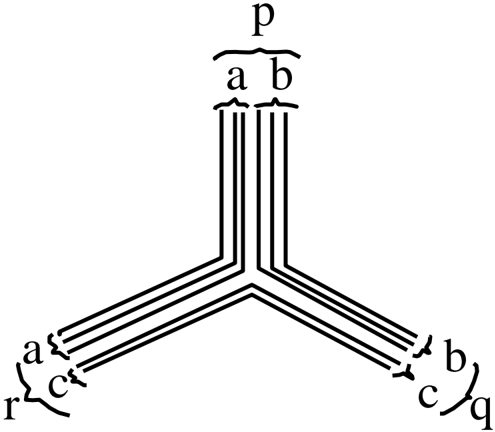
- The volume spectrum is discrete. For trivalent spin networks, the eigenvalue for a region \(R\) is \(V = \frac{1}{4} l_P^3 \sum_i \sqrt{a_i b_i c_i + a_i b_i + a_i c_i + b_i c_i}\), where the sum runs over nodes \(i\) contained in \(R\).
- The full area spectrum is \(A = \frac{1}{2} l_P^2 \sum_l \sqrt{p_l^2 + 2p_l}\), where \(l\) labels spin-network links crossing the surface.
- Spin-network states are eigenstates of the volume operator and also diagonalize the area operator; the two operators commute. Other volume eigenstates are related to a generalization of spin networks, with eigenvalues computable by diagonalizing finite-dimensional matrices.
- The authors argue that, under assumptions about physical fields defining regions and surfaces, Planck-scale measurements of volume or area would yield results in these discrete spectra.
Methods
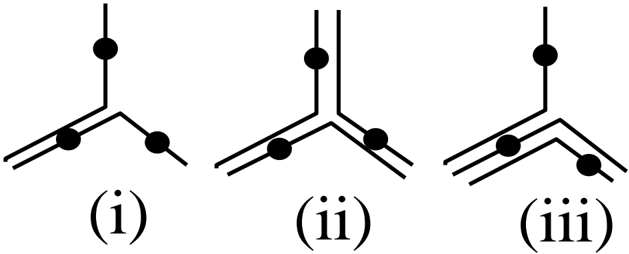
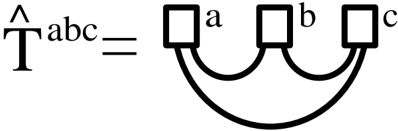
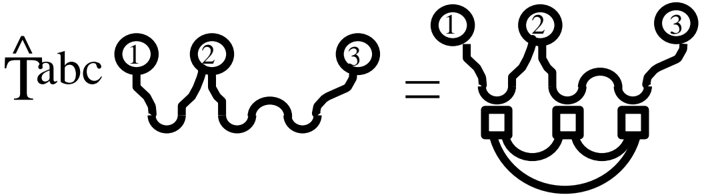
- Theoretical, non-perturbative quantum gravity in the loop representation. The volume operator is constructed via a diffeomorphism-invariant regularization using the three-hand loop observable \(T^{abc}\), partitioning a region into cubic boxes with an arbitrary unphysical flat metric \(g_0\), and taking a weak-operator limit \(L \to 0\).
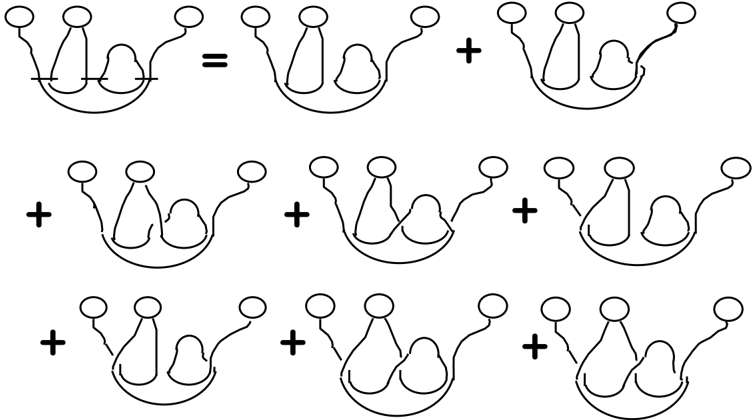
- The action of the volume operator is computed on the spin-network basis, where spin networks are trivalent graphs with positive integer link colors; the area operator is similarly diagonalized.
- No empirical data are used; the analysis is operator construction and spectral diagonalization.
Limitations
- The paper states that the local operator \(\sqrt{\det g}\) is ill-defined, that the regularization introduces an unphysical background metric \(g_0\) (though the operator is claimed independent of it in the limit), that the topology of the limit is delicate, and that diffeomorphism-invariant states lie in \(D_{\max}\) but not in the domain \(D\). It also notes that consistency of the theory is not proven and that quantization may have more than one solution.
- Evident from the provided text: the excerpt is truncated after the proportionality coefficient, so later sections and full derivation details are not available here. The physical interpretation also relies on assumptions about dynamical matter fields defining spatial regions and surfaces.
Model-written summary of a shortened version of the paper’s full text (it is longer than we read). Check it against the paper before relying on it.
Integrity signals
Registry
Cites
Statistics
Figures

Verification
Claims the paper makes
1 Valid · 4 Not valid · 5 Not checked · 18 Own results and interpretations
The sources with a verdict support this claim; the rest weren’t checked yet, have no full text we could read, or their verdicts aren’t rated yet.
In the paper
“Local quantities tend to be divergent or ill-defined in non-trivial generally covariant quantum field theories [3, 4, 11], a fact likely to be related to the non-renormalizability of the perturbative series.”
What the sources say
- Not checked — no full text of the sourcecites [3] matched to “Loop space representation of quantum general relativity” (1990) source
- Supportedcites [4] matched to “Weaving a classical metric with quantum threads” (1992) source
The Abstract says local operators such as the metric at a point may not be well-defined. The discussion of the local metric operator explains that its renormalization obstructs meaningful local geometric operators and says this appears to be a general feature of diffeomorphism-invariant theories. The claim’s separate suggestion about perturbative non-renormalizability is not the part attributed to this citation. (LLM, conf=0.90)
- Could not verifycites [11] matched to “Link Invariants, Holonomy Algebras and Functional Integration” (1993) sourceExperimental — accuracy not yet measured
The Introduction (pp. 1–2) discusses difficulties defining field-theoretic measures, and p. 4 describes regularized Wilson loops. Neither passage says that local quantities tend to diverge or be ill-defined in non-trivial generally covariant quantum field theories. Searches for local observables, divergences, and renormalization found no passage addressing that claim. (LLM, conf=0.73)
hedgedstates an association- Asserted: passes — The authors put it forward as true.
- Checkable: passes — It can be checked against evidence.
- Load-bearing: passes — The paper’s conclusions depend on it.
- Based: passes — The paper gives a reason why it holds.
The cited sources that could be checked couldn’t confirm or dispute this claim.
In the paper
“note for instance that there are other relevant topologies in state space, as the norm topologies defined by the kinematical or diffeomorphism-invariant Hilbert structures [6, 7], which are inequivalent to the one in which the limit (13) is taken.”
What the sources say
- Could not verifycites [6] matched to “Fermions in quantum gravity” (1994) sourceExperimental — accuracy not yet measured
Section 6.2 (pp. 33–34) uses pointwise topology in a model example about limits on knot states, but says a complete scalar product for the loop representation is not yet available. Neither those passages nor the passages found by searching for Hilbert norm topologies establish kinematical or diffeomorphism-invariant norm topologies, or their inequivalence to the topology used for the cited limit. (LLM, conf=0.72)
- Could not verifycites [7] matched to “Spatial infinity as a boundary of spacetime” (1992) sourceExperimental — accuracy not yet measured
The passages in §4, “Asymptotic symmetries” (page not supplied), discuss equivalence of spacetime completions, not topologies on a state space. Searches for Hilbert norm topologies and inequivalent state-space limits found no passage addressing the attributed claim. (LLM, conf=0.76)
plain- Asserted: passes — The authors put it forward as true.
- Checkable: passes — It can be checked against evidence.
- Load-bearing: unclear — It is unclear whether the paper’s conclusions depend on it.
- Based: passes — The paper gives a reason why it holds.
- Could not verify
A result the paper reports from its own data — it cites no other source for it, so there is none to check. The quote shows it is in the paper.
In the paper
“We find that the spectrum of the volume of any physical region is discrete.”
plain- Asserted: passes — The authors put it forward as true.
- Checkable: passes — It can be checked against evidence.
- Load-bearing: passes — The paper’s conclusions depend on it.
- Based: passes — The paper gives a reason why it holds.
A result the paper states — it cites no source for it, so there is none to check. The quote shows it is in the paper.
In the paper
“An unphysical background metric is introduced for the sake of the regularization, but the operator turns out to be independent of this background, in the limit in which the cut-off is removed.”
plain- Asserted: passes — The authors put it forward as true.
- Checkable: passes — It can be checked against evidence.
- Load-bearing: passes — The paper’s conclusions depend on it.
- Based: passes — The paper gives a reason why it holds.
In the paper
“Furthermore, we show here that the spin network states also diagonalize the operator Â[S], introduced in [3], which measures the area of the surface S.”
What the sources say
- Not checked — no full text of the sourcecites [3] matched to “Loop space representation of quantum general relativity” (1990) source
boostedstates an association- Asserted: passes — The authors put it forward as true.
- Checkable: passes — It can be checked against evidence.
- Load-bearing: passes — The paper’s conclusions depend on it.
- Based: passes — The paper gives a reason why it holds.
12 more claims
Create a free account to see all 28 claims and every source verdict.
- It may state two separate claims as one. 5
- Probably not a substantial claim. 5
- The quote only partly states this claim. 1
Claims other papers make about this one
Each is checked against this paper’s own text: does it say what the citing paper says it does?
The source backs part of the claim, not all of it — or backs it for a different population, condition or comparison.
In the citing paper
“In fact, that is why only volume and area operators could be constructed so far [10, 11].”
From A length operator for canonical quantum gravity (1998) · cites this paper as [10]
Experimental — accuracy not yet measuredThe source backs part of the claim, not all of it — or backs it for a different population, condition or comparison.
In the citing paper
“While the kinematics of loop quantum gravity (LQG) [1] is rather well understood [2, 3], its dynamics is not understood as cleanly.”
From Flipped spinfoam vertex and loop gravity (2008) · cites this paper as [4]
Experimental — accuracy not yet measuredThe source backs part of the claim, not all of it — or backs it for a different population, condition or comparison.
In the citing paper
“This problem arises due to the results obtained for the spectra of the geometrical operators and the black hole entropy being proportional to an unphysical parameter, which is called 'Immirzi parameter' [7] and appears as a parameter of a canonical transformation in classical gravity [8,9].”
From SO (4, C )-covariant Ashtekar-Barbero gravity and the Immirzi parameter (2000) · cites this paper as [9]
Experimental — accuracy not yet measuredThe cited source says what the claim attributes to it.
In the citing paper
“The results reported in this letter are obtained in the framework of quantum geometry [4] which does predict a discrete geometry because, e.g., the spectra of geometric operators as area and volume are discrete [5-7].”
From Absence of a Singularity in Loop Quantum Cosmology (2001) · cites this paper as [5]
The cited source says what the claim attributes to it.
In the citing paper
“Basic geometric quantities have been quantized [10][11][12][13][14] and found to have discrete spectra.”
From Loop quantum cosmology: I. Kinematics (2000) · cites this paper as [10]
17 more claims about this paper
Create a free account to see every claim other papers make about this one.
Citations
Cites
New Variables for Classical and Quantum Gravity
Ashtekar, A. (1986) · Physical Review Letters · doi:10.1103/physrevlett.57.2244 · Cited by 1,663
QUANTUM GRAVITY AND MINIMUM LENGTH
GARAY, L. J. (1995) · International Journal of Modern Physics A · doi:10.1142/s0217751x95000085 · Cited by 1,371
String theory beyond the Planck scale
Gross, D. J., & Mende, P. F. (1988) · Nuclear Physics B · doi:10.1016/0550-3213(88)90390-2 · Cited by 1,249
New Hamiltonian formulation of general relativity
Ashtekar, A. (1987) · Physical Review D · doi:10.1103/physrevd.36.1587 · Cited by 1,119
Quantum gravity and minimum length
Garay, L. J. (1994) · LA Referencia (Red Federada de Repositorios Institucionales de Publicaciones Científicas) · Cited by 881
Loop space representation of quantum general relativity
Rovelli, C., & Smolin, L. (1990) · Nuclear Physics B · doi:10.1016/0550-3213(90)90019-a · Cited by 806
Self-citationThe Hagedorn transition and the number of degrees of freedom of string theory
Atick, J. J., & Witten, E. (1988) · Nuclear Physics B · doi:10.1016/0550-3213(88)90151-4 · Cited by 800
The high-energy behavior of string scattering amplitudes
Gross, D. J., & Mende, P. F. (1987) · Physics Letters B · doi:10.1016/0370-2693(87)90355-8 · Cited by 778
Minimum physical length and the generalized uncertainty principle in string theory
Konishi, K., Paffuti, G., & Provero, P. (1990) · Physics Letters B · doi:10.1016/0370-2693(90)91927-4 · Cited by 753
On the nature of quantum geometrodynamics
Wheeler, J. A. (1957) · Annals of Physics · doi:10.1016/0003-4916(57)90050-7 · Cited by 693
Research works printed but not linked: 1
- Ashtekar, 1994, Quantum geometrodynamics and Coherent state transform on the space of connections, Penn. State University preprints
Cited by
Items 1,001–1,100 of 1,374
Superradiant instability of area-quantized Kerr black hole with discrete reflectivity
Luo, Z.-H., & Zhang, Y. (2025) · The European Physical Journal C · doi:10.1140/epjc/s10052-025-14204-y · Cited by 6
“Although the proposals are highly intriguing, it remains crucial to identify “magnifying lenses” that could bring the Planck-scale discretization of the horizon into the observable macroscopic realm.”
Fermion mass gap in the loop representation of quantum gravity
Montesinos, M., Morales-Técotl, H. A., & Matos, T. (1997) · Classical and Quantum Gravity · doi:10.1088/0264-9381/14/7/002 · Cited by 5
Quantum gravity effects on the tachyon inflation from thermodynamic perspective
Bitaj, M., Rashidi, N., Nozari, K., & Roushan, M. (2024) · Physics of the Dark Universe · doi:10.1016/j.dark.2024.101552 · Cited by 3
Emergence of Riemannian Quantum Geometry
Haggard, H. M., Lewandowski, J., & Sahlmann, H. (2023) · Springer eBooks · doi:10.1007/978-981-19-3079-9_96-1 · Cited by 9
Relativistic Generalized Uncertainty Principle and Its ImplicationsPreprint
Todorinov, V. (2021) · arXiv (Cornell University) · doi:10.48550/arxiv.2108.04322 · Cited by 14
Spin foam models: the dynamics of quantum geometry
Freidel, L., & Ryan, J. P. (2008) · Classical and Quantum Gravity · doi:10.1088/0264-9381/25/11/114004 · Cited by 5
“Furthermore, these operators have discrete spectra implying that our spatial geometry is quantized in a discrete manner [5].”
BackgroundInfluentialCoherent States for Fractional Powers of the Harmonic Oscillator Hamiltonian
Giesel, K., & Vetter, A. (2021) · Universe · doi:10.3390/universe7110442 · Cited by 3
Coumbe, D. (2018) · International Journal of Modern Physics D · doi:10.1142/s0218271819500081 · Cited by 5
“quantum gravity [16, 17, 18], string theory [19, 20] and other approaches to quantum gravity [16] also support this picture.”
BackgroundThe kinematical Setup of Quantum Geometry: A Brief ReviewPreprint
Giesel, K. (2017) · arXiv (Cornell University) · doi:10.48550/arxiv.1707.03059 · Cited by 4
“The area operator was first introduced by Smolin [26] and then further analyzed by Rovelli and Smolin in the loop representation [27], which is a representation based on loops instead of graphs and that was used in the earlier days of loop quantum gravity.”
MethodGAUGE FIXING AND OBSERVABLES IN GENERAL RELATIVITY
Salisbury, D. (2003) · Modern Physics Letters A · doi:10.1142/s0217732303012714 · Cited by 3
Universe scenarios from loop quantum cosmology
Bojowald, M. (2006) · Annalen der Physik · doi:10.1002/andp.200651804-508 · Cited by 3
Quantum fate of timelike naked singularity with scalar hair
Svítek, O., Tahamtan, T., & Zampeli, A. (2020) · Annals of Physics · doi:10.1016/j.aop.2020.168195 · Cited by 4
Does matter differ from vacuum?Preprint
Schiller, C. (1996) · arXiv (Cornell University) · doi:10.48550/arxiv.gr-qc/9610066 · Cited by 11
“[22] For this reason all approaches which try to unify quantum mechanics and gravity must yield this relation; indeed it appears in canonical quantum gravity [28], in superstring theory [29], and in the quantum group approach [30], sometimes with an additional term proportional to (∆x)(2) on the right hand side of equ…”
BackgroundPrimordial gravity waves in a rainbow background
Saltı, M., & Oktay Aydogdu, A. (2023) · General Relativity and Gravitation · doi:10.1007/s10714-023-03076-w · Cited by 3
Quantum Space-times: Beyond the Continuum of Minkowski and EinsteinPreprint
Ashtekar, A. (2008) · arXiv (Cornell University) · doi:10.48550/arxiv.0810.0514 · Cited by 11
“One is thus led to build quantum gravity using quantum Riemannian geometry [5, 6, 7, 8].”
BackgroundAspects of quantum gravityPreprint
Pithis, A. G. A. (2019) · arXiv (Cornell University) · doi:10.48550/arxiv.1903.07735 · Cited by 9
“From the physical perspective of the discrete geometries, another possibility is that such a phase transition should be characterised by arbitrary large fluctuations in GFT momentum space given by group representations since these are the eigenmodes of length, area or volume operators of such geometries [512].”
BackgroundEvidence for Planck luminosity bound in quantum gravity
Wieland, W. (2025) · Classical and Quantum Gravity · doi:10.1088/1361-6382/adb536 · Cited by 5
“As explained in e.g. [15, 16], this effect is responsible for the discrete spectra of geometric observables in loop quantum gravity [67–71].”
Asymptotic flatness and quantum geometry
Sengupta, S. (2014) · Classical and Quantum Gravity · doi:10.1088/0264-9381/31/8/085005 · Cited by 4
Mathematical structure of loop quantum cosmologyPreprint
Ashtekar, A., Martin Bojowald, A., & Lewandowski, J. (2003) · arXiv (Cornell University) · doi:10.48550/arxiv.gr-qc/0304074 · Cited by 3
“In quantum geometry, on the other hand, the area operator (of an open surface) has a lowest eigenvalue ao = ( √ 3γ)/4 l(2)Pl [17,30] suggesting that it is physically inappropriate to try to localize Fab on arbitrarily small surfaces.”
BackgroundWoven Geometries: Black HolesPreprint
Iwasaki, J. (1995) · arXiv (Cornell University) · doi:10.48550/arxiv.gr-qc/9506028 · Cited by 2
“It has been shown by rigorously regularized calculations [6, 9] that the value is proportional to the number of times the flat weave ∆ intersects the surface S.”
BackgroundSpectroscopy of an AdS Reissner-Nordstrøm black holePreprint
Raschi, S. (2005) · Cited by 2
Can Effects of a Generalized Uncertainty Principle Appear in Compact Stars?
Gimenez, J. G. G., Hadjimichef, D., Bechstedt, P. O. H., et al. (2024) · Universe · doi:10.3390/universe11010005 · Cited by 2
“The known approaches to quantum gravity such as string theory [1–4], loop quantum gravity [5–7] and quantum geometry [8] indicate, theoretically, the existence of such a minimal measurable length.”
Quantum Automata in Cytoskeletal Microtubules: A Nanoscale Substrate for Cognition
Hameroff, S. R. (1997) · Springer eBooks · doi:10.1007/978-3-642-60570-3_5 · Cited by 2
Connecting Loop Quantum Gravity and String Theory via Quantum Geometry
Vaid, D. (2021) · Springer proceedings in physics · doi:10.1007/978-981-33-4408-2_55 · Cited by 3
Cai, R.-G., Wang, S., Yang, R.-Q., & Zhang, Y. (2018) · Chinese Science Bulletin (Chinese Version) · doi:10.1360/n972018-00035 · Cited by 3
A new discretization of the Euler equation via the finite operator theory
Rodrı́guez, M. A., & Tempesta, P. (2024) · Open Communications in Nonlinear Mathematical Physics · doi:10.46298/ocnmp.12298 · Cited by 2
“This also paves the way for possible applications of the theory to discrete formulations of quantum gravity [6, 19].”
Topology and volume effects in quantum gravity: Wheeler–DeWitt theory
Brannlund, J., DeBenedictis, A., & Lauman, A. (2014) · Classical and Quantum Gravity · doi:10.1088/0264-9381/31/9/095011 · Cited by 3
Regarding the Formalism of Quantum Mechanics
Koutandos, S. (2021) · Physical Science & Biophysics Journal · doi:10.23880/psbj-16000175 · Cited by 2
Perturbative polymer quantum field theory and high energy scalar propagator
Flores-González, E., & Morales-Técotl, H. A. (2019) · Classical and Quantum Gravity · doi:10.1088/1361-6382/ab4dfd · Cited by 2
Barceló, C., Liberati, S., & Visser, M. (2026) · Living Reviews in Relativity · doi:10.1007/s41114-026-00064-9 · Cited by 15
“∙ The discussion of, and argument for, a possible reassessment of fundamental features of quantum physics and general relativity [11, 259, 342, 377, 400, 488, 535, 544].”
A discrete curvature on a planar graphPreprint
Lorente, M. (2004) · arXiv (Cornell University) · doi:10.48550/arxiv.gr-qc/0412094 · Cited by 4
“sponding quantities become analog, like the genus of some 3nj-symbols graph [6], or the curvature in a triangulated manifold [7] or the area and volume eigenvalues for the gravitational field operator [8]. According to Bombelli one can scatter points in a Lorentzian manifold with uniform density, and then keep the stat…”
BackgroundIsometric embeddings of the reduced horizon of a Kerr-Newman black hole into Euclidean 3-space
Stryla, J. (1998) · Classical and Quantum Gravity · doi:10.1088/0264-9381/15/8/013 · Cited by 3
Degeneracy pressure in the presence of maximum length for non-interacting electrons
Parsamehr, S., & Fatahi, N. (2024) · Modern Physics Letters A · doi:10.1142/s0217732324500391 · Cited by 2
Jalalzadeh, S., & Moradpour, H. (2026) · Physics Letters B · doi:10.1016/j.physletb.2026.140427 · Cited by 2
“A similar finiteness arises in LQG, in which geometric operators such as area and volume exhibit discrete spectra [28, 29].”
Álvarez, E. A. (2005) · Springer eBooks · doi:10.1007/11377306_2 · Cited by 7
“The result is expressed in terms of the Barbero-Immirzi parameter ([57]).”
MethodEffective quantum gravitational collapse in a polymer framework
Boldorini, L., & Montani, G. (2024) · Journal of Cosmology and Astroparticle Physics · doi:10.1088/1475-7516/2024/10/090 · Cited by 7
“This choice is inspired by the literature on loop quantum gravity[27][28].”
BackgroundReconstructing the metric in group field theory
Gielen, S., & Mickel, L. (2024) · Classical and Quantum Gravity · doi:10.1088/1361-6382/ad5bb6 · Cited by 4
“…in GFT are defined in analogy with simple geometric operators in loop quantum gravity; in particular one can define a GFT volume operator (based on [20, 21]), and from this a relational volume observable representing the total spatial volume at a given instant of relational time, here again given…”
Quantum geometry of the light cone: Fock representation and spectrum of radiated power
Wieland, W. (2025) · Classical and Quantum Gravity · doi:10.1088/1361-6382/ae0235 · Cited by 10
Combinatorial solutions to the hamiltonian constraint in (2+1)-dimensional Ashtekar gravity
Ezawa, K. (1995) · CERN Document Server (European Organization for Nuclear Research) · Cited by 2
GUP and its Application to Angular Momentum Algebra
Khorram-Hosseini, S. A., Panahi, H., & Zarrinkamar, S. (2020) · International Journal of Theoretical Physics · doi:10.1007/s10773-020-04531-z · Cited by 2
TOPOLOGY AND VOLUME EFFECTS IN QUANTUM GRAVITY WHEELER-DEWITT THEORYPreprint
Brännlund, J., DeBenedictis, A., & Lauman, A. (2016) · Cited by 2
Purely geometric path integral for spin-foams
Shirazi, A. C., & Engle, J. (2014) · Classical and Quantum Gravity · doi:10.1088/0264-9381/31/7/075010 · Cited by 5
“these states could be spin networks [20], generalized spin networks [21], or Livine-Speziale coherent states [22].”
BackgroundLoop Quantum Cosmology: Effective Theory and Related Applications
Li, L.-F., Xiao, K., & Zhu, J.-Y. (2011) · InTech eBooks · doi:10.5772/23643 · Cited by 1
Much ado about nothing: a treatise on empty and not-so-empty spacetimesPreprint
Martin, D. (2006) · arXiv (Cornell University) · doi:10.48550/arxiv.gr-qc/0607022 · Cited by 5
“s, and the fundamental excitations of the geometry is analogous to electric field lines, or quantum vortices. In the classical limit the geometries approach the standard area (see [5] for a review, or [66, 67, 68] for calculations of the area spectrum and the relationship of these “vortices” to spin network states). Ea…”
BackgroundGiesel, K., & Winnekens, D. (2023) · Classical and Quantum Gravity · doi:10.1088/1361-6382/acc0c7 · Cited by 4
Summation and triangulation independence of Lorentzian spinfoam amplitudes for all LQG
Han, M. (2026) · Physical review. D/Physical review. D. · doi:10.1103/n76f-31gf · Cited by 2
Spacetime from causality: causal set theory
Huggett, N., & Wüthrich, C. (2025) · Oxford University Press eBooks · doi:10.1093/oso/9780198758501.003.0003 · Cited by 2
Remarks on the black hole entropy and Hawking spectrum in loop quantum gravity
Alekseev, A., Polychronakos, A. P., & Smedbäck, M. (2005) · Physical review. D. Particles, fields, gravitation, and cosmology/Physical review. D. Particles and fields · doi:10.1103/physrevd.71.067501 · Cited by 2
“The standard result in loop quantum gravity is that the area quantum of a spin-j link is proportional to the square root of its Casimir [1]: Aj = γ √ j(j + 1) (1) In the previous paper [2], we have argued that a different regularization of the area operator produces an additive quantum correction of 1/4 to the Casimir…”
BackgroundOn the fundamental length of quantum geometry and the black hole entropyPreprint
Rainer, M. (1999) · arXiv (Cornell University) · doi:10.48550/arxiv.gr-qc/9903091 · Cited by 5
“The classical limit of quantum geometry could be characterized by discrete spectra of the geometric operators like area, volume [4,5] and length [6] becoming dense on a sufficiently large state space.”
BackgroundLOOP QUANTUM COSMOLOGY AND BOUNDARY PROPOSALS
Bojowald, M., & Vandersloot, K. (2006) · The Ninth Marcel Grossmann Meeting · doi:10.1142/9789812704030_0067 · Cited by 11
Semiclassical states in quantum gravity: curvature associated to a Voronoi graph
Díaz-Polo, J., & Garay, I. (2014) · Classical and Quantum Gravity · doi:10.1088/0264-9381/31/8/085018 · Cited by 2
“The theory provides quantum operators with a direct geometric interpretation (areas and volumes), which happen to have discrete eigenvalues, reinforcing the idea of a discrete geometry [3–6].”
BackgroundHigher dimensional and supersymmetric extensions of loop quantum gravity
Thurn, A. (2015) · OPUS FAU (Kooperativer Bibliotheksverbund Berlin-Brandenburg (KOBV), on behalf of the Universitätsbibliothek Erlangen-Nürnberg) · Cited by 3
SPECTROSCOPY OF AN AdS REISSNER–NORDSTRØM BLACK HOLE
DAPPIAGGI, C., & RASCHI, S. (2006) · International Journal of Modern Physics D · doi:10.1142/s0218271806007948 · Cited by 3
“On a broader setting, as briefly stated in the introduction, the results from this paper should be compared with different methods of area quantization the most notables arising from loop quantum gravity [11] and from the interpretation of the discreteness of the spectrum as an absorption of quasi normal mode excitati…”
ResultPolymer Geometry at Planck Scale and Quantum Einstein Equations
Ashtekar, A. (1996) · Springer eBooks · doi:10.1007/978-94-009-0237-4_12 · Cited by 17
Quantum Big-Bounce as a phenomenology of RQM in the Mini-superspace
Franco, S. L., & Montani, G. (2024) · Physics Letters B · doi:10.1016/j.physletb.2024.138983 · Cited by 5
“One of the most important successes of the Loop Quantum Gravity [1, 2] has been the proof that the geometrical area and volume operators kinematically possess a discrete spectrum [3].”
BackgroundDoes Quantum Gravity Happen at the Planck Scale?
Jacobs, C. (2025) · Philosophy of Physics · doi:10.31389/pop.159 · Cited by 10
Fiber bundle structure in Ashtekar-Barbero-Immirzi formulation of General Relativity
Bruno, M. (2025) · Journal of Geometry and Physics · doi:10.1016/j.geomphys.2025.105537 · Cited by 3
“Furthermore, it addresses one of the most significant aspects of quantum gravity: the quantization of geometry, manifested in the discrete spectra of geometrical operators such as area and volume [13].”
Cremaschini, C., & Tessarotto, M. (2024) · Symmetry · doi:10.3390/sym16081042 · Cited by 3
Semiclassical states in loop quantum gravity: an introduction
Ma, Y. (2006) · 物理学前沿:英文版 · doi:10.1007/s11467-006-0009-9 · Cited by 3
“Certain geometrical operators corresponding to the measure of length [9], area [10, 11], volume [12] and the integrated norm of any smooth 1-form [13] are shown to have discrete spectra in the kinematical Hilbert space.”
The disappearance and emergence of spacetime in loop quantum gravity
Huggett, N., & Wüthrich, C. (2025) · Oxford University Press eBooks · doi:10.1093/oso/9780198758501.003.0006 · Cited by 2
Thermodynamics of Ideal Gas at Planck Scale with Strong Quantum Gravity MeasurementPreprint
Lawson, L. M. (2021) · Research Square · doi:10.21203/rs.3.rs-493283/v1 · Cited by 2
“All the active candidates to the search of these minimal uncertainties such as string theory [8], black hole theory [9], loop quantum gravity [10] and quantum geometry [11] are mostly restricted to the case where there is a nonzero minimal uncertainty in the position.”
BackgroundLoop Quantum Gravity Phenomenology: Linking Loops to PhysicsPreprint
Girelli, F., Hinterleitner, F., & Major, S. (2012) · arXiv (Cornell University) · Cited by 4
Position in Minimal Length Quantum Mechanics
Bosso, P. (2021) · Universe · doi:10.3390/universe8010017 · Cited by 2
A curvature operator for a regular tetrahedron shape in LQG
Mebarki, N., & Nemoul, O. (2019) · International Journal of Geometric Methods in Modern Physics · doi:10.1142/s0219887819500956 · Cited by 4
Quantum gravity, space-time structure, and cosmology
Bojowald, M. (2012) · Journal of Physics Conference Series · doi:10.1088/1742-6596/405/1/012001 · Cited by 2
Moulla, H., Bouaziz, D., Aissaoui, H., et al. (2024) · Nuclear Physics B · doi:10.1016/j.nuclphysb.2024.116626 · Cited by 2
Deriving Spin within a discrete-time theory
Recami, E., & Salesi, G. (2005) · CERN Document Server (European Organization for Nuclear Research) · Cited by 1
Loop quantum gravity and cosmology
Bojowald, M. (2012) · Cambridge University Press eBooks · doi:10.1017/cbo9780511920998.011 · Cited by 4
Deformations of the Canonical Commutation Relations and Metric Structures
D’Andrea, F. (2014) · Symmetry Integrability and Geometry Methods and Applications · doi:10.3842/sigma.2014.062 · Cited by 2
“are encoded by operators with discrete spectra [32], and are in this sense “quantized”.”
BackgroundQuantum Black Hole Thermodynamics
Majumdar, P. (2006) · Springer eBooks · doi:10.1007/3-540-31757-0_8 · Cited by 2
Domi, A., Eberl, T., Hellmann, D., Krieg, S., & Päs, H. (2025) · Journal of Cosmology and Astroparticle Physics · doi:10.1088/1475-7516/2025/01/063 · Cited by 4
Cosmology in loop quantum gravity: symmetry reduction preserving gauge degrees of freedom
Bruno, M. (2025) · Classical and Quantum Gravity · doi:10.1088/1361-6382/ae0088 · Cited by 6
“The main result of this approach is a discretization of geometry, where geometrical operators such as area and volume provide a discrete spectrum [8].”
Quantum cosmology as a lattice in a box
Saeed, M., & Husain, V. (2024) · Physical review. D/Physical review. D. · doi:10.1103/physrevd.110.103504 · Cited by 2
On the role of Barrow's fractal entropy in the loop quantum gravity Barbero-Immirzi parameter
Abreu, É. M. C., & Neto, J. A. (2022) · Europhysics Letters (EPL) · doi:10.1209/0295-5075/ac3291 · Cited by 2
The spacetime singularity resolution of Schwarichild-de Sitter black hole in loop quantum gravity
Liu, C., Guo-Xiang, Y., Zhi-Kun, X., & 312000, (. 3. 2. (. (2010) · Acta Physica Sinica · doi:10.7498/aps.59.1487 · Cited by 4
A possible solution to the problem of time in quantum cosmologyPreprint
Kauffman, S. A., & Smolin, L. (1997) · arXiv (Cornell University) · doi:10.48550/arxiv.gr-qc/9703026 · Cited by 16
“This is because it has been shown that the space of spatially diffeomorphism invariant states of the quantum gravitational field has a basis which is in one to one correspondence with the diffeomorphism classes of a certain set of embedded, labeled graphs Γ, in a given three manifold Σ [14, 15].”
BackgroundSelf-citationPiecewise Flat Curvature and Ricci Flow in Three DimensionsPreprint
Conboye, R., & Miller, W. A. (2016) · arXiv (Cornell University) · doi:10.48550/arxiv.1603.03113 · Cited by 2
“This is becoming quite topical in physics, with many quantum gravity models suggesting that space and time may be discrete in nature [18, 19, 20], and many of these already formulated in terms of piecewise flat manifolds [21, 22].”
BackgroundQuantum gravity in the very early universe
Bojowald, M. (2011) · Nuclear Physics A · doi:10.1016/j.nuclphysa.2011.05.026 · Cited by 3
The d-Dimensional Cosmological Constant and the Holographic Horizons
Yurov, A. V., & Yurov, V. A. (2021) · Symmetry · doi:10.3390/sym13020237 · Cited by 2
“Indeed, the loopback approach does demonstrate a discreteness of the area and the volume [14], but their formulas are expressed in terms of the “colors” of the links adjacent to the corresponding nodes of the spin network and they differ from the Formula (18) (see, however, [15]).”
BackgroundQuantum representation of reduced twisted geometry in loop quantum gravity
Long, G., Zhang, C., & Liu, H. (2025) · Physical review. D/Physical review. D. · doi:10.1103/99fq-xz2w · Cited by 2
Asymptotics of quantum spin networks
van der Veen, R. I. (2010) · UvA-DARE (University of Amsterdam) · Cited by 3
Loops versus stringsPreprint
Álvarez, E. A. (2003) · arXiv (Cornell University) · doi:10.48550/arxiv.gr-qc/0307090 · Cited by 5
“The result is expressed in terms of the Barbero-Immirzi parameter ([38]).”
MethodKong, B., & Yoon, Y. (2016) · Journal of the Korean Physical Society · doi:10.3938/jkps.68.735 · Cited by 7
Topological classification of a 4 D ads black hole with non-minimal maxwell coupling
Rahmani, F., & Sadeghi, M. (2026) · Classical and Quantum Gravity · doi:10.1088/1361-6382/ae64a3 · Cited by 5
“Formulated in terms of Ashtekar connection variables, LQG predicts a discrete spectrum for geometric observables such as area and volume [22, 23], replacing the classical spacetime continuum with a Planck-scale spin-network structure.”
Maxwell–Boltzmann type Hawking radiation
Yoon, Y. (2017) · Modern Physics Letters A · doi:10.1142/s0217732317500717 · Cited by 3
“1 Background According to loop quantum gravity [1, 2, 3], the eigenvalues of the area operator are quantized, and the black hole area, as much as any area, is the sum of these eigenvalues.”
BackgroundRizzuti, B. F., & Vasconcelos, G. F. (2021) · Physics Letters B · doi:10.1016/j.physletb.2021.136334 · Cited by 2
“More recently, quantum gravity (QG) calculations seem to reinforce the existence of a fundamental scale, implying discreteness of areas and volumes [2].”
BackgroundExact solutions of the (3+1)-dimensional DKP oscillator in doubly special relativity
Seffai, D., Hamil, B., & Merad, M. (2024) · International Journal of Modern Physics A · doi:10.1142/s0217751x24501343 · Cited by 2
A dynamical evolution model on the black-hole horizon
Zhu, J.-Y. (2005) · Classical and Quantum Gravity · doi:10.1088/0264-9381/22/13/010 · Cited by 2
Bouncing Universe in loop quantum gravity: full theory calculation
Kisielowski, M. (2023) · Classical and Quantum Gravity · doi:10.1088/1361-6382/acf271 · Cited by 3
Ghegal, L. (2025) · Modern Physics Letters A · doi:10.1142/s0217732325501901 · Cited by 2
Hyperinvariant spin network states — an AdS/CFT model from first principles
Otto, F., Mansuroglu, R., Schuch, N., Gühne, O., & Sahlmann, H. (2026) · Journal of High Energy Physics · doi:10.1007/jhep06(2026)145 · Cited by 1
“(III.12)), we can calculate the loop quantum gravitational version of the angle between two tangent vectors ⃗X ( e 1 ) , ⃗X ( e 2 ) via the formula Since the tensor is rotation invariant, the three sites as well as the three angles need to be equal.”
Zimmermann, R. E. (2003) · arXiv (Cornell University) · doi:10.48550/arxiv.physics/0304053 · Cited by 1
Abreu, É. M. C., Neto, J. A., & Thibes, R. S. (2025) · The European Physical Journal C · doi:10.1140/epjc/s10052-025-14783-w · Cited by 2
QUANTUM COMPUTING IN MICROTUBULES: THE PENROSE-HAMEROFF "ORCH OR" MODEL
Hameroff, S. R. (1999) · WORLD SCIENTIFIC eBooks · doi:10.1142/9789814313254_0047 · Cited by 1
Zhu, W.-J. (2024) · SSRN Electronic Journal · doi:10.33774/coe-2024-0lfc2
The Hyper-Torus Universe Model—A New Paradigm for Understanding RealityPreprint
McCammon, C. R. (2024) · Preprints.org · doi:10.20944/preprints202406.0674.v3 · Cited by 1
Bendjoudi, A., & Mebarki, N. (2016) · Chinese Physics Letters · doi:10.1088/0256-307x/33/11/110401 · Cited by 1
The loop representation of quantum gravity
Gambini, R., Pullin, J. A., & Ashtekar, A. (2022) · Cambridge University Press eBooks · doi:10.1017/9781009290203.010 · Cited by 1
Natural Discrete Differential Calculus in Physics
Carlo Rovelli, C., & Zatloukal, V. (2019) · Foundations of Physics · doi:10.1007/s10701-019-00271-1 · Cited by 4
“A number of current approaches to quantum gravity either assume (for instance [2]) or derive (for instance [3]) this discreteness.”
BackgroundSelf-citationMinimum Spacetime Length and the Thermodynamics of Spacetime
Rossi, V., Cacciatori, S. L., & Pesci, A. (2026) · Entropy · doi:10.3390/e28010097 · Cited by 2
“Given a physical surface, as can be identified by a matter field, its area operator is diagonalized in the spin network basis and shows a discrete spectrum, which implies a minimum area [24] A = 4 where γ is the Barbero-Immirzi constant, a dimensionless free parameter of the theory.”
Metadata
- Authors
- Rovelli, C., & Smolin, L.
- Affiliations
- Pennsylvania State University (US)
- Corresponding author
- Smolin, Lee
- ORCID
- Smolin, Lee
- Venue
- Nuclear Physics B
- Publisher
- Elsevier BV
- Published
- 1995-05
- Volume
- 442
- Issue
- 3
- Pages
- 593-619
- ISSN
- 0550-3213 (ISSN-L)
- OpenAlex
- W2104041846
- Semantic Scholar
- 3b85eebc659d3ae5d857e1d141fd5126db507eba
- Cited by
- 1,365
- References
- 63
- Citations by year
- 2026: 40 · 2025: 79 · 2024: 70 · 2023: 38 · 2022: 35 · 2021: 55 · 2020: 31 · 2019: 42 · 2018: 44 · 2017: 40 · 2016: 48 · 2015: 36 · 2014: 43 · 2013: 47 · 2012: 49
- FWCI
- 38.09
- Type
- journal article
- Language
- en
- Open access
- green
- arxiv.org
- Licence
- www.elsevier.com/tdm/userlicense/1.0/ (tdm)
- www.elsevier.com/legal/tdmrep-license (tdm)
- Locations
- Nuclear Physics B (publishedVersion)
- arXiv (Cornell University) (submittedVersion)
- CERN Document Server (European Organization for Nuclear Research) (submittedVersion)
- arXiv (Cornell University)
- Topics
- Physical Sciences › Physics and Astronomy › Nuclear and High Energy Physics › Noncommutative and Quantum Gravity Theories
- Physical Sciences › Physics and Astronomy › Astronomy and Astrophysics › Relativity and Gravitational Theory
- Physical Sciences › Physics and Astronomy › Nuclear and High Energy Physics › Black Holes and Theoretical Physics
- Keywords
- quantum gravity, loop representation, spin networks, volume operator, area operator, diffeomorphism invariance, background independence, Planck-scale geometry, non-perturbative quantum gravity
About these checks
Registry, retraction, Cites and statistics results are computed, not judged, with one exception: a printed reference that no index lists is read once by a model before it counts as a citation error. Claims are extracted by a model and kept only when their quote appears verbatim in the text; each cited source is then checked, with a model’s help, for whether it says what the claim relies on. Those verdicts can be wrong — read the claim’s quote and the cited source before relying on one.
The claim verdicts this report counts are experimental: their accuracy is not yet measured.
A language model drew the claims from the paper on 2026-10-07, under version 3 of the claim definition (model deepseek-v4.1-flash, prompt extract-v3).
A second model labelled each claim on 2026-10-07 (model jev-1.13-20260917, definition revision gold-guideline-v0.2).
Cited sources are checked with a language model’s help (gpt-6-sol).
Statistics and arithmetic are recomputed, not judged.
Confidence bands are shown only for fields calibrated on our annotated test set. None is calibrated yet, so no band is shown.
What counts as a claim ›How we measure confidence ›How we check this ›
Are you an author, or do you see a problem with this page? Request a review
Data sources
Bibliographic data: Semantic Scholar, OpenAlex, Crossref.
Contains information from the Semantic Scholar Academic Graph Datasets, made available under the ODC Attribution License (ODC-BY 1.0).
Semantic Scholar’s data is described in: Kinney, R., et al. (2023). The Semantic Scholar Open Data Platform. arXiv:2301.10140.
