

The DOI matches its Crossref record; 37 of the 37 references it cites were found in a registry or an index.
Subliminal Instrumental Conditioning Demonstrated in the Human Brain
Open accessAbstract
How the brain uses success and failure to optimize future decisions is a long-standing question in neuroscience. One computational solution involves updating the values of context-action associations in proportion to a reward prediction error. Previous evidence suggests that such computations are expressed in the striatum and, as they are cognitively impenetrable, represent an unconscious learning mechanism. Here, we formally test this by studying instrumental conditioning in a situation where we masked contextual cues, such that they were not consciously perceived. Behavioral data showed that subjects nonetheless developed a significant propensity to choose cues associated with monetary rewards relative to punishments. Functional neuroimaging revealed that during conditioning cue values and prediction errors, generated from a computational model, both correlated with activity in ventral striatum. We conclude that, even without conscious processing of contextual cues, our brain can learn their reward value and use them to provide a bias on decision making.
Overview
The claims and statistics of this paper haven’t been checked yet.
Run the check — free, no account needed. It reads the open-access text and checks the sources it cites.
Integrity signals
Registry
Cites
Statistics
Figures
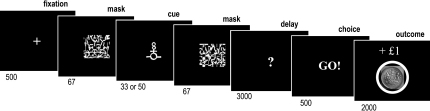
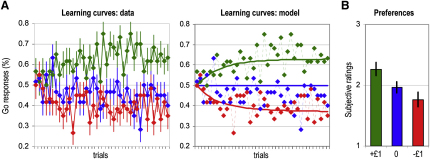
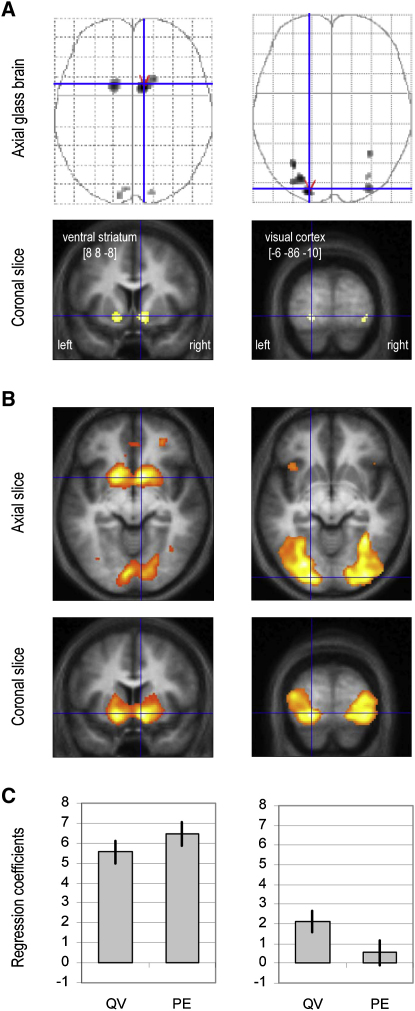
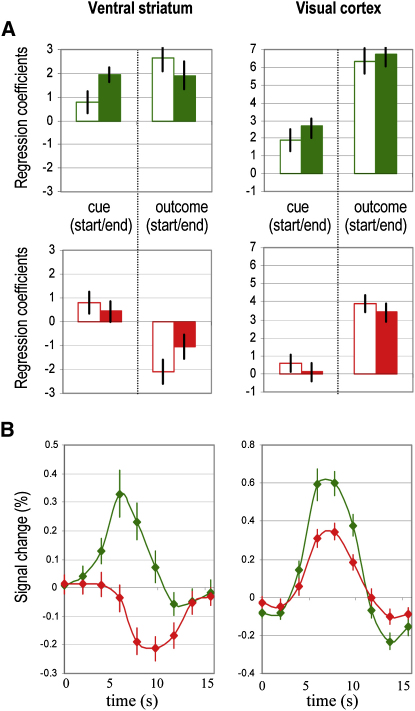
Verification
Claims the paper makes
The claims and statistics of this paper haven’t been checked yet.
Run the check — free, no account needed. It reads the open-access text and checks the sources it cites.
Claims other papers make about this one
Each is checked against this paper’s own text: does it say what the citing paper says it does?
The source backs part of the claim, not all of it — or backs it for a different population, condition or comparison.
In the citing paper
“Remarkably, in humans, such learning appears to proceed even when the cues, reward, or motivation signals are presented below the consciousness threshold ( 17 , 18 ).”
From What is consciousness, and could machines have it? (2017) · cites this paper as [17]
Experimental — accuracy not yet measured
Self-check
Percentages, sums and reported differences re-computed from the paper’s own numbers.
The self-check needs the paper’s full text.
Citations
Cites
Memory and the hippocampus: A synthesis from findings with rats, monkeys, and humans.
Squire, L. R. (1992) · Psychological Review · doi:10.1037/0033-295x.99.2.195 · Cited by 5,376
Barto, A. (1998) · IFAC Proceedings Volumes · doi:10.1016/s1474-6670(17)38315-5 · Cited by 2,172
Dissociable Roles of Ventral and Dorsal Striatum in Instrumental Conditioning
O'Doherty, J., Dayan, P., Schultz, J., Deichmann, R., Friston, K., & Dolan, R. J. (2004) · Science · doi:10.1126/science.1094285 · Cited by 2,088
Self-citationZhang, B., Li, C., & Lin, N. (2020) · De Gruyter eBooks · doi:10.1515/9783110595567-011 · Cited by 1,948
Learning and Memory Functions of the Basal Ganglia
Packard, M. G., & Knowlton, B. J. (2002) · Annual Review of Neuroscience · doi:10.1146/annurev.neuro.25.112701.142937 · Cited by 1,717
Conscious and unconscious emotional learning in the human amygdala
Morris, J. S., Öhman, A., & Dolan, R. J. (1998) · Nature · doi:10.1038/30976 · Cited by 1,665 · cited 1×
“However, subliminal conditioning studies in humans have so far been restricted to Pavlovian paradigms such as fear conditioning (Clark and Squire, 1998; Knight et al., 2003; Morris et al., 1998; Olsson and Phelps, 2004), where subliminal stimuli (like unseen faces) are paired with unpleasant events (like white noise)…”
BackgroundSelf-citationDopamine-dependent prediction errors underpin reward-seeking behaviour in humans
Pessiglione, M., Seymour, B., Flandin, G., Dolan, R. J., & Frith, C. D. (2006) · Nature · doi:10.1038/nature05051 · Cited by 1,584
Self-citationCognitive Neuroscience and the Study of Memory
Milner, B. A., Squire, L. R., & Kandel, E. R. (1998) · Neuron · doi:10.1016/s0896-6273(00)80987-3 · Cited by 1,335
Classical conditioning and brain systems: the role of awareness
Clark, R. E., & Squire, L. R. (1998) · Science · doi:10.1126/science.280.5360.77 · Cited by 1,138
Animal intelligence; experimental studies
Thorndike, E. L. (1911) · doi:10.5962/bhl.title.55072 · Cited by 1,100
Cited by
Sorted by citations
Closed-loop brain training: the science of neurofeedback
Sitaram, R., Ros, T., Stoeckel, L., Haller, S., Scharnowski, F., Lewis-Peacock, J., Weiskopf, N., Blefari, M. L., Rana, M., Oblak, E., et al. (2017) · Nature Reviews Neuroscience · doi:10.1038/nrn.2016.164 · Cited by 1,306
Liu, X., Hairston, J., Schrier, M., & Fan, J. (2011) · Neuroscience & Biobehavioral Reviews · doi:10.1016/j.neubiorev.2010.12.012 · Cited by 916
Empirical support for higher-order theories of conscious awareness
Lau, H., & Rosenthal, D. (2011) · Trends in Cognitive Sciences · doi:10.1016/j.tics.2011.05.009 · Cited by 869
What is consciousness, and could machines have it?
Dehaene, S., Lau, H., & Kouider, S. (2017) · Science · doi:10.1126/science.aan8871 · Cited by 855
The propositional nature of human associative learning
Mitchell, C. J., Houwer, J. D., & Lovibond, P. F. (2009) · Behavioral and Brain Sciences · doi:10.1017/s0140525x09000855 · Cited by 789
Branding the brain: A critical review and outlook
Plaßmann, H., Ramsøy, T. Z., & Milosavljevic, M. (2012) · Journal of Consumer Psychology · doi:10.1016/j.jcps.2011.11.010 · Cited by 687
Trial-by-trial data analysis using computational models
Daw, N. D. (2011) · Oxford University Press eBooks · doi:10.1093/acprof:oso/9780199600434.003.0001 · Cited by 475
Toward a computational theory of conscious processing
Dehaene, S., Charles, L., King, J.-R., & Marti, S. (2014) · Current Opinion in Neurobiology · doi:10.1016/j.conb.2013.12.005 · Cited by 404
Confidence as Bayesian probability: From neural origins to behavior
Meyniel, F., Sigman, M., & Mainen, Z. F. (2015) · Neuron · doi:10.1016/j.neuron.2015.09.039 · Cited by 349
Social and monetary reward learning engage overlapping neural substrates
Lin, A., Adolphs, R., & Rangel, A. (2012) · Social Cognitive and Affective Neuroscience · doi:10.1093/scan/nsr006 · Cited by 351
Rewards teach visual selective attention
Chelazzi, L., Perlato, A., Santandrea, E., & Della Libera, C. (2013) · Vision Research · doi:10.1016/j.visres.2012.12.005 · Cited by 354
Rewards evoke learning of unconsciously processed visual stimuli in adult humans
Seitz, A. R., Kim, D., & Watanabe, T. (2009) · Neuron · doi:10.1016/j.neuron.2009.01.016 · Cited by 337
Nonconscious activation of placebo and nocebo pain responses
Jensen, K. B., Kaptchuk, T. J., Kirsch, I., Raicek, J., Lindstrom, K. M., Berna, C., Gollub, R. L., Ingvar, M., & Kong, J. (2012) · Proceedings of the National Academy of Sciences · doi:10.1073/pnas.1202056109 · Cited by 305
Contextual modulation of value signals in reward and punishment learning
Palminteri, S., Khamassi, M., Joffily, M., & Coricelli, G. (2015) · Nature Communications · doi:10.1038/ncomms9096 · Cited by 273
Self-citationInformation integration without awareness
Mudrik, L., Faivre, N., & Koch, C. (2014) · Trends in Cognitive Sciences · doi:10.1016/j.tics.2014.04.009 · Cited by 277
Unconscious Activation of the Prefrontal No-Go Network
van Gaal, S., Ridderinkhof, K. R., Scholte, H. S., & Lamme, V. A. F. (2010) · Journal of Neuroscience · doi:10.1523/jneurosci.2992-09.2010 · Cited by 291
Underpowered samples, false negatives, and unconscious learning
Vadillo, M. A., Konstantinidis, E., & Shanks, D. R. (2016) · Psychonomic Bulletin & Review · doi:10.3758/s13423-015-0892-6 · Cited by 255
Critical Roles for Anterior Insula and Dorsal Striatum in Punishment-Based Avoidance Learning
Palminteri, S., Justo, D., Jauffret, C., Pavlicek, B., Dauta, A., Delmaire, C., Czernecki, V., Karachi, C., Capelle, L., Dürr, A., et al. (2012) · Neuron · doi:10.1016/j.neuron.2012.10.017 · Cited by 237
Self-citationDeeply Felt Affect: The Emergence of Valence in Deep Active Inference
Hesp, C., Smith, R., Parr, T., Allen, M., Friston, K. J., & Ramstead, M. J. D. (2021) · Neural Computation · doi:10.1162/neco_a_01341 · Cited by 246
Thomsen, K. R., Whybrow, P. C., & Kringelbach, M. L. (2015) · Frontiers in Behavioral Neuroscience · doi:10.3389/fnbeh.2015.00049 · Cited by 256
Savings upon Re-Aiming in Visuomotor Adaptation
Morehead, J. R., Qasim, S. E., Crossley, M. J., & Ivry, R. B. (2015) · Journal of Neuroscience · doi:10.1523/jneurosci.1046-15.2015 · Cited by 215
Brooks, S. J., Savov, V., Allzén, E., Benedict, C., Fredriksson, R., & Schiöth, H. B. (2011) · NeuroImage · doi:10.1016/j.neuroimage.2011.09.077 · Cited by 222
Do Decisions Shape Preference?
Sharot, T., Velasquez, C. M., & Dolan, R. J. (2010) · Psychological Science · doi:10.1177/0956797610379235 · Cited by 206
Self-citationFouragnan, E., Retzler, C., & Philiastides, M. G. (2018) · Human Brain Mapping · doi:10.1002/hbm.24047 · Cited by 176
A dual‐systems perspective on addiction: contributions from neuroimaging and cognitive training
McClure, S. M., & Bickel, W. K. (2014) · Annals of the New York Academy of Sciences · doi:10.1111/nyas.12561 · Cited by 209
Venkatraman, V., Clithero, J. A., Fitzsimons, G. J., & Huettel, S. A. (2011) · Journal of Consumer Psychology · doi:10.1016/j.jcps.2011.11.008 · Cited by 208
The role of consciousness in cognitive control and decision making
van Gaal, S., de Lange, F. P., & Cohen, M. X. (2012) · Frontiers in Human Neuroscience · doi:10.3389/fnhum.2012.00121 · Cited by 200
The Human Basal Ganglia Modulate Frontal-Posterior Connectivity during Attention Shifting
van Schouwenburg, M. R., den Ouden, H. E. M., & Cools, R. (2010) · Journal of Neuroscience · doi:10.1523/jneurosci.1111-10.2010 · Cited by 186
Neural Components Underlying Behavioral Flexibility in Human Reversal Learning
Ghahremani, D. G., Monterosso, J., Jentsch, J. D., Bilder, R. M., & Poldrack, R. A. (2010) · Cerebral Cortex · doi:10.1093/cercor/bhp247 · Cited by 180
A critical review of habit learning and the basal ganglia
Seger, C. A., & Spiering, B. J. (2011) · Frontiers in Systems Neuroscience · doi:10.3389/fnsys.2011.00066 · Cited by 170
Panksepp, J., Lane, R. D., Solms, M., & Smith, R. S. (2016) · Neuroscience & Biobehavioral Reviews · doi:10.1016/j.neubiorev.2016.09.010 · Cited by 182
Towards a comparative science of emotion: Affect and consciousness in humans and animals
Paul, E. S., Sher, S., Tamietto, M., Winkielman, P., & Mendl, M. (2019) · Neuroscience & Biobehavioral Reviews · doi:10.1016/j.neubiorev.2019.11.014 · Cited by 180
Assessing inter individual differences with task related functional neuroimaging
Lebreton, M., Bavard, S., Daunizeau, J., & Palminteri, S. (2019) · Nature Human Behaviour · doi:10.1038/s41562-019-0681-8 · Cited by 160
Self-citationMeasuring anhedonia: impaired ability to pursue, experience, and learn about reward
Thomsen, K. R. (2015) · Frontiers in Psychology · doi:10.3389/fpsyg.2015.01409 · Cited by 166
van Gaal, S., & Lamme, V. A. F. (2012) · The Neuroscientist · doi:10.1177/1073858411404079 · Cited by 181
Pharmacological modulation of subliminal learning in Parkinson's and Tourette's syndromes
Palminteri, S., Lebreton, M. P., Worbe, Y., Grabli, D., Hartmann, A., & Pessiglione, M. (2009) · Proceedings of the National Academy of Sciences · doi:10.1073/pnas.0904035106 · Cited by 147
Self-citationA Neural Mechanism for Nonconscious Activation of Conditioned Placebo and Nocebo Responses
Jensen, K. B., Kaptchuk, T. J., Chen, X., Kirsch, I., Ingvar, M., Gollub, R. L., & Kong, J. (2014) · Cerebral Cortex · doi:10.1093/cercor/bhu275 · Cited by 152
Ethical Issues in Neuromarketing: “I Consume, Therefore I am!”
Ülman, Y. I., Çakar, T. E., & Yildiz, G. (2014) · Science and Engineering Ethics · doi:10.1007/s11948-014-9581-5 · Cited by 168
Dissociable Brain Mechanisms Underlying the Conscious and Unconscious Control of Behavior
van Gaal, S., Lamme, V. A. F., Fahrenfort, J. J., & Ridderinkhof, K. R. (2011) · Journal of Cognitive Neuroscience · doi:10.1162/jocn.2010.21431 · Cited by 127
MacDonald, P. A., & Monchi, O. (2011) · Parkinson s Disease · doi:10.4061/2011/572743 · Cited by 134
Dopaminergic Reward Signals Selectively Decrease fMRI Activity in Primate Visual Cortex
Arsenault, J. T., Nelissen, K., Jarraya, B., & Vanduffel, W. (2013) · Neuron · doi:10.1016/j.neuron.2013.01.008 · Cited by 122
Investigating the impact of sex and cortisol on implicit fear conditioning with fMRI
Merz, C. J., Tabbert, K., Schweckendiek, J., Klucken, T., Vaitl, D., Stark, R. M., & Wolf, O. T. (2009) · Psychoneuroendocrinology · doi:10.1016/j.psyneuen.2009.07.009 · Cited by 117
Collins, A. G. E., Albrecht, M. A., Waltz, J. A., Gold, J. M., & Frank, M. J. (2017) · Biological Psychiatry · doi:10.1016/j.biopsych.2017.05.017 · Cited by 111
Learning and motivation in the human striatum
Shohamy, D. (2011) · Current Opinion in Neurobiology · doi:10.1016/j.conb.2011.05.009 · Cited by 100
Siman-Tov, T., Granot, R., Shany, O., Singer, N., Hendler, T., & Gordon, C. R. (2019) · Neuroscience & Biobehavioral Reviews · doi:10.1016/j.neubiorev.2019.08.012 · Cited by 103
Klucken, T., Schweckendiek, J., Merz, C. J., Tabbert, K., Walter, B., Kagerer, S., Vaitl, D., & Stark, R. M. (2009) · The Journal of Sexual Medicine · doi:10.1111/j.1743-6109.2009.01405.x · Cited by 100
Brain Hemispheres Selectively Track the Expected Value of Contralateral Options
Palminteri, S., Boraud, T., Lafargue, G., Dubois, B., & Pessiglione, M. (2009) · Journal of Neuroscience · doi:10.1523/jneurosci.1500-09.2009 · Cited by 99
Self-citationSharot, T., Rollwage, M., Sunstein, C. R., & Fleming, S. M. (2022) · Perspectives on Psychological Science · doi:10.1177/17456916221082967 · Cited by 99
Vinckier, F., Gaillard, R., Palminteri, S., Rigoux, L., Salvador, A., Fornito, A., Adapa, R., Krebs, M. O., Pessiglione, M., & Fletcher, P. C. (2016) · Molecular Psychiatry · doi:10.1038/mp.2015.73 · Cited by 87
Self-citationUnconscious or underpowered? Probabilistic cuing of visual attention.
Vadillo, M. A., Linssen, D., Orgaz, C. J., Parsons, S., & Shanks, D. R. (2019) · Journal of Experimental Psychology General · doi:10.1037/xge0000632 · Cited by 95
Evidence that instrumental conditioning requires conscious awareness in humans
Skora, L. I., Yeomans, M. R., Crombag, H. S., & Scott, R. B. Y. (2020) · Cognition · doi:10.1016/j.cognition.2020.104546 · Cited by 89
Mind matters: placebo enhances reward learning in Parkinson's disease
Schmidt, L., Braun, E. K., Wager, T. D., & Shohamy, D. (2014) · Nature Neuroscience · doi:10.1038/nn.3842 · Cited by 84
Jocham, G., Klein, T. A., & Ullsperger, M. (2014) · Journal of Neuroscience · doi:10.1523/jneurosci.0757-14.2014 · Cited by 70
Murty, V. P., LaBar, K. S., Hamilton, D. A., & Adcock, R. A. (2011) · Learning & Memory · doi:10.1101/lm.023549.111 · Cited by 77
Effects of loss aversion on post-decision wagering: Implications for measures of awareness
Fleming, S. M., & Dolan, R. J. (2009) · Consciousness and Cognition · doi:10.1016/j.concog.2009.11.002 · Cited by 86
Self-citationBijleveld, E., Custers, R., & Aarts, H. (2012) · Journal of Experimental Psychology General · doi:10.1037/a0027615 · Cited by 88
What Is Consciousness, and Could Machines Have It?
Dehaene, S., Lau, H. C., & Kouider, S. (2021) · Springer eBooks · doi:10.1007/978-3-030-54173-6_4 · Cited by 80
Learning rapidly about the relevance of visual cues requires conscious awareness
Travers, E., Frith, C., & Shea, N. J. (2018) · Quarterly Journal of Experimental Psychology · doi:10.1080/17470218.2017.1373834 · Cited by 75
Self-citationWhat Is It Like to Be a Bass? Red Herrings, Fish Pain and the Study of Animal Sentience
Mason, G. J., & Lavery, J. M. (2022) · Frontiers in Veterinary Science · doi:10.3389/fvets.2022.788289 · Cited by 80
Building a Foundation for Neuromarketing And Consumer Neuroscience Research
Ramsøy, T. Z. (2019) · Journal of Advertising Research · doi:10.2501/jar-2019-034 · Cited by 68
Palminteri, S., Clair, A.-H., Mallet, L., & Pessiglione, M. (2012) · Biological Psychiatry · doi:10.1016/j.biopsych.2011.12.028 · Cited by 60
Self-citationLibera, C. D., Perlato, A., & Chelazzi, L. (2011) · PLoS ONE · doi:10.1371/journal.pone.0019460 · Cited by 64
Bode, S., Murawski, C., Soon, C. S., Bode, P., Stähl, J., & Smith, P. L. (2014) · Neuroscience & Biobehavioral Reviews · doi:10.1016/j.neubiorev.2014.10.017 · Cited by 69
Dynamic Interactions between Top–Down Expectations and Conscious Awareness
Meijs, E. L., Slagter, H. A., de Lange, F. P., & van Gaal, S. (2018) · Journal of Neuroscience · doi:10.1523/jneurosci.1952-17.2017 · Cited by 70
Reward-Priming of Location in Visual Search
Hickey, C., Chelazzi, L., & Theeuwes, J. (2014) · PLoS ONE · doi:10.1371/journal.pone.0103372 · Cited by 64
Dual-process theories and consciousness: the case for ‘Type Zero’ cognition: Table 1.
Shea, N. J., & Frith, C. (2016) · Neuroscience of Consciousness · doi:10.1093/nc/niw005 · Cited by 68
Self-citationOpponent Brain Systems for Reward and Punishment Learning
Palminteri, S., & Pessiglione, M. (2016) · Elsevier eBooks · doi:10.1016/b978-0-12-805308-9.00023-3 · Cited by 71
Self-citationMaterialism and the Moral Status of Animals
Birch, J. (2021) · The Philosophical Quarterly · doi:10.1093/pq/pqab072 · Cited by 66
Scott, R. B. Y., Samaha, J., Chrisley, R., & Dienes, Z. P. (2018) · Cognition · doi:10.1016/j.cognition.2018.02.008 · Cited by 59
Categorization=decision making+generalization
Seger, C. A., & Peterson, E. J. (2013) · Neuroscience & Biobehavioral Reviews · doi:10.1016/j.neubiorev.2013.03.015 · Cited by 65
Monetary, Food, and Social Rewards Induce Similar Pavlovian-to-Instrumental Transfer Effects
Lehner, R., Balsters, J. H., Herger, A., Hare, T. A., & Wenderoth, N. (2017) · Frontiers in Behavioral Neuroscience · doi:10.3389/fnbeh.2016.00247 · Cited by 63
A neuro-cognitive process model of emotional intelligence
Smith, R. S., Killgore, W. D. S., Alkozei, A., & Lane, R. D. (2018) · Biological Psychology · doi:10.1016/j.biopsycho.2018.10.012 · Cited by 73
Nonconscious Learning From Crowded Sequences
Atas, A., Faivre, N., Timmermans, B., Cleeremans, A., & Kouider, S. (2013) · Psychological Science · doi:10.1177/0956797613499591 · Cited by 52
Unconscious reinforcement learning of hidden brain states supported by confidence
Cortese, A., Lau, H. C., & Kawato, M. (2020) · Nature Communications · doi:10.1038/s41467-020-17828-8 · Cited by 54
Lane, R. D., Anderson, F. S., & Smith, R. S. (2018) · Psychosomatic Medicine · doi:10.1097/psy.0000000000000640 · Cited by 51
Conscious and unconscious performance monitoring: Evidence from patients with schizophrenia
Charles, L., Gaillard, R., Amado, I., Krebs, M., Bendjemaa, N., & Dehaene, S. (2016) · NeuroImage · doi:10.1016/j.neuroimage.2016.09.056 · Cited by 49
Reinforcement Learning and Tourette Syndrome
Palminteri, S., & Pessiglione, M. (2013) · International review of neurobiology · doi:10.1016/b978-0-12-411546-0.00005-6 · Cited by 47
Self-citationDecoded fMRI neurofeedback can induce bidirectional confidence changes within single participants
Cortese, A., Amano, K., Koizumi, A., Lau, H. C., & Kawato, M. (2017) · NeuroImage · doi:10.1016/j.neuroimage.2017.01.069 · Cited by 45
Hedonics Act in Unison with the Homeostatic System to Unconsciously Control Body Weight
Münzberg, H., Qualls‐Creekmore, E., Yu, S., Morrison, C. D., & Berthoud, H. (2016) · Frontiers in Nutrition · doi:10.3389/fnut.2016.00006 · Cited by 43
Shared mechanisms may support mnemonic benefits from self-referencing and emotion
Gutchess, A., & Kensinger, E. (2018) · Trends in Cognitive Sciences · doi:10.1016/j.tics.2018.05.001 · Cited by 34
The effects of expected reward on creative problem solving
Cristofori, I., Salvi, C., Beeman, M. J., & Grafman, J. H. (2018) · Cognitive Affective & Behavioral Neuroscience · doi:10.3758/s13415-018-0613-5 · Cited by 48
Xu, Z., Zhang, M., Zhang, P., Luo, J., Tu, M., & Lai, Y. (2023) · Journal of Retailing and Consumer Services · doi:10.1016/j.jretconser.2023.103296 · Cited by 42
Skora, L. I., Livermore, J. J. A., Nisini, F., & Scott, R. B. Y. (2022) · Psychophysiology · doi:10.1111/psyp.14047 · Cited by 43
The Flexible Nature of Unconscious Cognition
Wokke, M. E., van Gaal, S., Scholte, H. S., Ridderinkhof, K. R., & Lamme, V. A. F. (2011) · PLoS ONE · doi:10.1371/journal.pone.0025729 · Cited by 40
Reuß, H., Desender, K., Kiesel, A., & Kunde, W. (2014) · Journal of Experimental Psychology General · doi:10.1037/a0036437 · Cited by 41
Predictive value of body posture and pupil dilation in assessing consumer preference and choice.
Ramsøy, T. Z., Jacobsen, C., Friis-Olivarius, M., Bagdziunaite, D., & Skov, M. (2017) · Journal of Neuroscience Psychology and Economics · doi:10.1037/npe0000073 · Cited by 41
Testosterone and unconscious positive priming increase human motivation separately
Aarts, H., & van Honk, J. (2009) · Neuroreport · doi:10.1097/wnr.0b013e3283308cdd · Cited by 40
Making eye contact without awareness
Rothkirch, M., Madipakkam, A. R., Rehn, E. M., & Sterzer, P. (2015) · Cognition · doi:10.1016/j.cognition.2015.06.012 · Cited by 39
Anticipatory Cortical Activation Precedes Auditory Events in Sleeping Infants
Nakano, T., Homae, F., Watanabe, H., & Taga, G. (2008) · PLoS ONE · doi:10.1371/journal.pone.0003912 · Cited by 39
Neural Evidence for Adaptive Strategy Selection in Value-Based Decision-Making
Gluth, S., Rieskamp, J., & Büchel, C. (2013) · Cerebral Cortex · doi:10.1093/cercor/bht049 · Cited by 41
von Braun, J., Archer, M. S., Reichberg, G. M., & Sorondo, M. S. (2021) · Springer eBooks · doi:10.1007/978-3-030-54173-6 · Cited by 44
Derosière, G., Zénon, A., Alamia, A., & Duqué, J. (2016) · NeuroImage · doi:10.1016/j.neuroimage.2016.10.010 · Cited by 40
Punishment insensitivity in humans is due to failures in instrumental contingency learning
Jean-Richard-dit-Bressel, P., Lee, J. C., Liew, S. X., Weidemann, G., Lovibond, P. F., & McNally, G. P. (2021) · eLife · doi:10.7554/elife.69594 · Cited by 40
Gain and Loss Learning Differentially Contribute to Life Financial Outcomes
Knutson, B. D., Samanez-Larkin, G. R., & Kuhnen, C. M. (2011) · PLoS ONE · doi:10.1371/journal.pone.0024390 · Cited by 37
Attentional modulation of reward processing in the human brain
Rothkirch, M., Schmack, K., Deserno, L., Darmohray, D. M., & Sterzer, P. (2013) · Human Brain Mapping · doi:10.1002/hbm.22383 · Cited by 43
Subliminal Cues While Teaching: HCI Technique for Enhanced Learning
Chalfoun, P., & Frasson, C. (2010) · Advances in Human-Computer Interaction · doi:10.1155/2011/968753 · Cited by 35
FitzGerald, T. H. B., Schwartenbeck, P., & Dolan, R. J. (2014) · Journal of Neuroscience · doi:10.1523/jneurosci.4389-13.2014 · Cited by 36
Self-citationTsikandilakis, M., Bali, P., Derrfuß, J., & Chapman, P. (2019) · Consciousness and Cognition · doi:10.1016/j.concog.2019.102771 · Cited by 36
I Choose, Therefore I Like: Preference for Faces Induced by Arbitrary Choice
Nakamura, K., & Kawabata, H. (2013) · PLoS ONE · doi:10.1371/journal.pone.0072071 · Cited by 33
Metadata
- Authors
- Pessiglione, M., Petrovic, P., Daunizeau, J., Palminteri, S., Dolan, R. J., & Frith, C. D.
- Affiliations
- Inserm (FR)
- Wellcome Centre for Human Neuroimaging (GB)
- Corresponding author
- Pessiglione, Mathias
- Venue
- Neuron
- Publisher
- Elsevier BV
- Published
- 2008-08
- Volume
- 59
- Issue
- 4
- Pages
- 561-567
- ISSN
- 0896-6273 (ISSN-L)
- PMC
- PMC2572733
- OpenAlex
- W2123851461
- Cited by
- 308
- References
- 37
- Citations by year
- 2026: 11 · 2025: 9 · 2024: 5 · 2023: 12 · 2022: 15 · 2021: 11 · 2020: 38 · 2019: 15 · 2018: 24 · 2017: 19 · 2016: 16 · 2015: 19 · 2014: 29 · 2013: 13 · 2012: 19
- FWCI
- 8.96
- Type
- journal article
- Language
- en
- Open access
- hybrid
- doi.org
- Licence
- Locations
- Neuron (publishedVersion, cc-by)
- PubMed Central (publishedVersion, cc-by)
- PubMed (publishedVersion)
- UCL Discovery (University College London) (submittedVersion)
- Max Planck Digital Library (submittedVersion, other-oa)
- MPG.PuRe (Max Planck Society) (submittedVersion, other-oa)
- Funders
- Wellcome Trust
- Topics
- Life Sciences › Neuroscience › Cognitive Neuroscience › Neural and Behavioral Psychology Studies
- Life Sciences › Neuroscience › Cellular and Molecular Neuroscience › Neurotransmitter Receptor Influence on Behavior
- Life Sciences › Neuroscience › Cognitive Neuroscience › Memory and Neural Mechanisms
- Keywords
- subliminal learning, operant conditioning, reward prediction error, ventral striatum, unconscious learning, decision-making, punishment, computational model
- MeSH terms
- Adult, Association Learning, Attention, Awareness, Brain Mapping, Choice Behavior, Conditioning, Operant, Consciousness, Decision Making, Discrimination, Psychological, Female, Humans, Magnetic Resonance Imaging, Male, Perceptual Masking, Reference Values, Subliminal Stimulation, Visual Cortex, Neostriatum, Intuition
About these checks
Registry, retraction, Cites and statistics results are computed, not judged, with one exception: a printed reference that no index lists is read once by a model before it counts as a citation error. Claims are extracted by a model and kept only when their quote appears verbatim in the text; each cited source is then checked, with a model’s help, for whether it says what the claim relies on. Those verdicts can be wrong — read the claim’s quote and the cited source before relying on one.
Statistics and arithmetic are recomputed, not judged.
Confidence bands are shown only for fields calibrated on our annotated test set. None is calibrated yet, so no band is shown.
What counts as a claim ›How we measure confidence ›How we check this ›
Are you an author, or do you see a problem with this page? Request a review
