

Estimates and 25-year trends of the global burden of disease attributable to ambient air pollution: an analysis of data from the Global Burden of Diseases Study 2015.
Open accessThe DOI matches its Crossref record; 31 of the 31 references it cites were found in a registry or an index.
Abstract
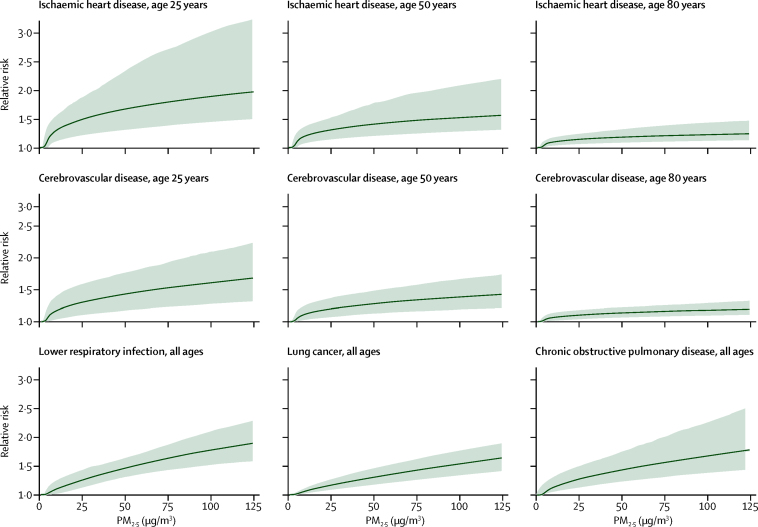
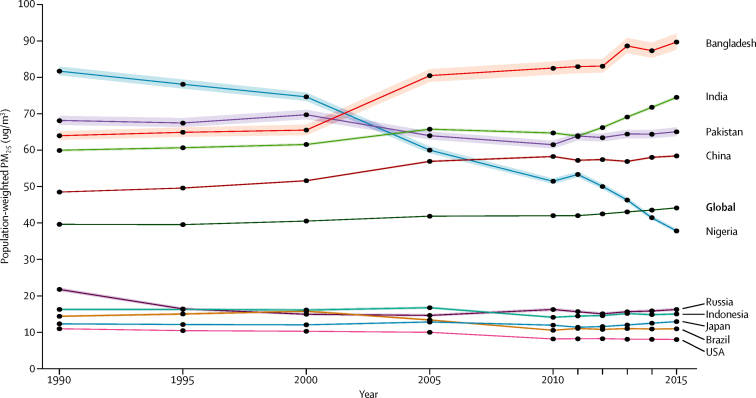
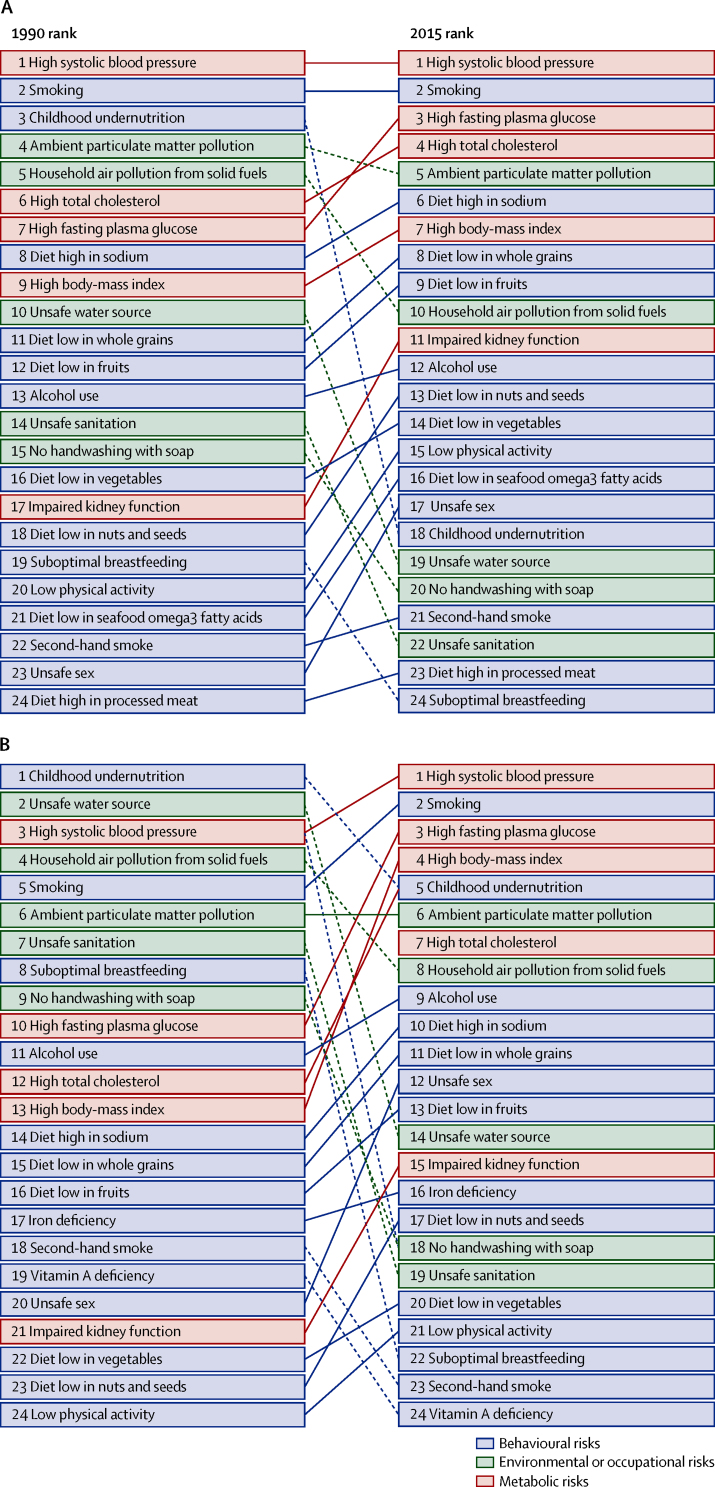
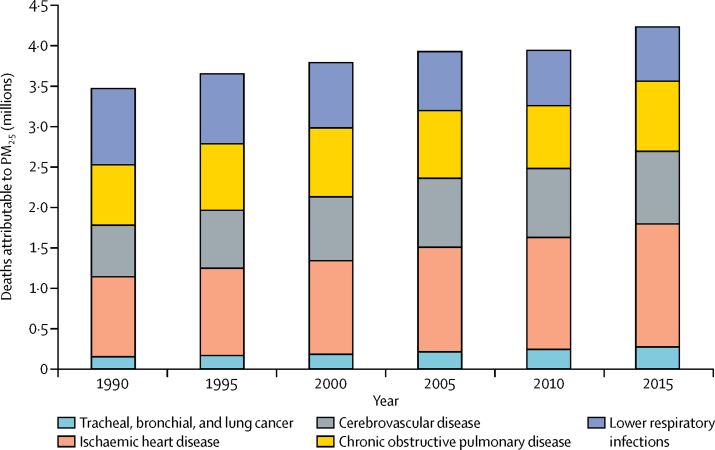
Background Exposure to ambient air pollution increases morbidity and mortality, and is a leading contributor to global disease burden. We explored spatial and temporal trends in mortality and burden of disease attributable to ambient air pollution from 1990 to 2015 at global, regional, and country levels. Methods We estimated global population-weighted mean concentrations of particle mass with aerodynamic diameter less than 2·5 μm (PM 2·5 ) and ozone at an approximate 11 km × 11 km resolution with satellite-based estimates, chemical transport models, and ground-level measurements. Using integrated exposure–response functions for each cause of death, we estimated the relative risk of mortality from ischaemic heart disease, cerebrovascular disease, chronic obstructive pulmonary disease, lung cancer, and lower respiratory infections from epidemiological studies using non-linear exposure–response functions spanning the global range of exposure. Findings Ambient PM 2·5 was the fifth-ranking mortality risk factor in 2015. Exposure to PM 2·5 caused 4·2 million (95% uncertainty interval [UI] 3·7 million to 4·8 million) deaths and 103·1 million (90·8 million 115·1 million) disability-adjusted life-years (DALYs) in 2015, representing 7·6% of total global deaths and 4·2% of global DALYs, 59% of these in east and south Asia. Deaths attributable to ambient PM 2·5 increased from 3·5 million (95% UI 3·0 million to 4·0 million) in 1990 to 4·2 million (3·7 million to 4·8 million) in 2015. Exposure to ozone caused an additional 254 000 (95% UI 97 000–422 000) deaths and a loss of 4·1 million (1·6 million to 6·8 million) DALYs from chronic obstructive pulmonary disease in 2015. Interpretation Ambient air pollution contributed substantially to the global burden of disease in 2015, which increased over the past 25 years, due to population ageing, changes in non-communicable disease rates, and increasing air pollution in low-income and middle-income countries. Modest reductions in burden will occur in the most polluted countries unless PM 2·5 values are decreased substantially, but there is potential for substantial health benefits from exposure reduction. Funding Bill & Melinda Gates Foundation and Health Effects Institute.
Overview
The claims and statistics of this paper haven’t been checked yet.
Free: it reads the open-access text and checks the first 5 claims that cite a source we can check. Create a free account to check every claim.
Integrity signals
Registry
Cites
Statistics
Figures
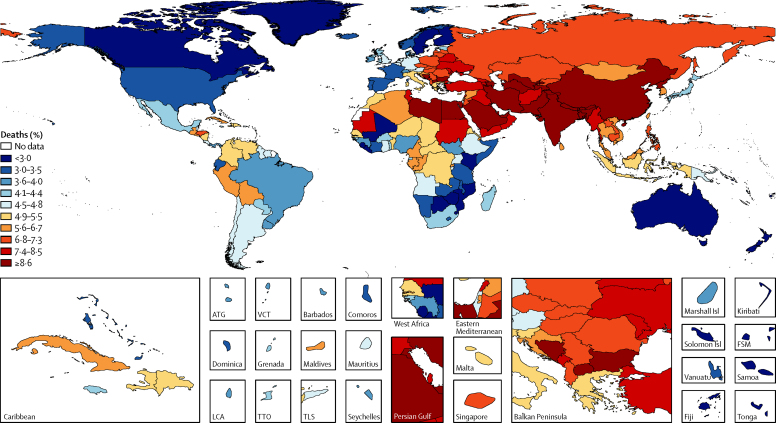
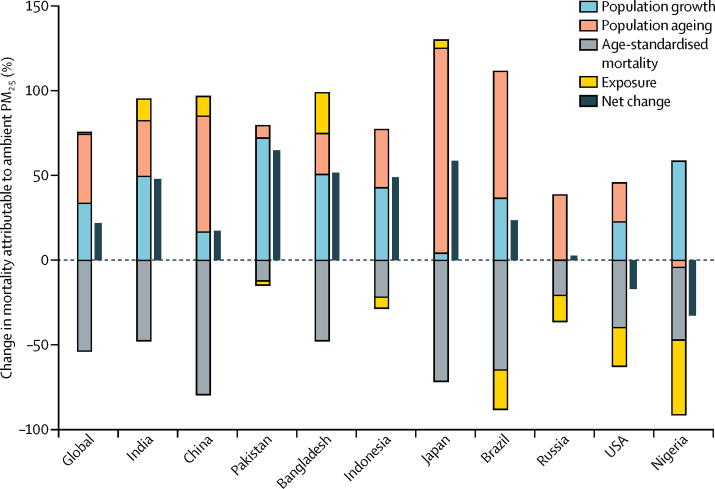
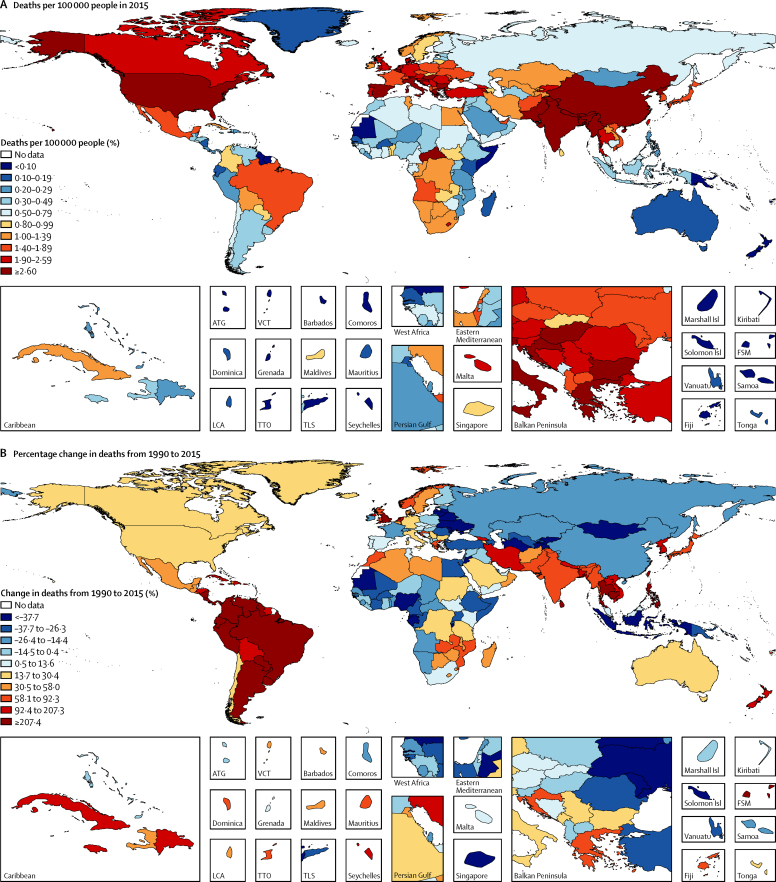
Verification
Claims the paper makes
The claims and statistics of this paper haven’t been checked yet.
Free: it reads the open-access text and checks the first 5 claims that cite a source we can check. Create a free account to check every claim.
Claims other papers make about this one
Each is checked against this paper’s own text: does it say what the citing paper says it does?
The cited source doesn’t support the claim as written.
In the citing paper
“In the western Arctic countries, premature mortality increased by a factor of 6 from 1990 to 2015, mostly due to population aging; while in Russia and Finland premature deaths decreased by up to 26.6% (Cohen et al., 2017).”
From Local Arctic Air Pollution: A Neglected but Serious Problem (2018) · cites this paper as Cohen et al., 2017
Checked by a reasoning model — may be wrong.
Experimental — accuracy not yet measuredThe cited source says what the claim attributes to it.
In the citing paper
“To overcome this limitation in availability of epidemiological concentration-response relationships in other parts of the world, the Global Burden of Disease study developed Integrated Exposure Response (IER) curves, which draw information from epidemiological studies globally on exposure to ambient air pollution, household air pollution, and smoking (Burnett et al., 2014; Cohen et al., 2017).”
From Local Arctic Air Pollution: A Neglected but Serious Problem (2018) · cites this paper as Cohen et al., 2017
The cited source says what the claim attributes to it.
In the citing paper
“Recent estimates of the global premature mortality due to ambient ozone range widely, from ca 140,000 [70] to 1,330,000 [71] per year, with the Global Burden of Disease estimate being 254,000 [72].”
In the citing paper
“and 4.1 (95% CI: 1·6–6·8) million years from COPD alone in 2015 (73).”
From Ozone pollution: A Major health hazard worldwide (2019) · cites this paper as [73]
In the citing paper
“In another study, exposure to ozone was responsible for 254,000 deaths from COPD alone in 2015 (73).”
From Ozone pollution: A Major health hazard worldwide (2019) · cites this paper as [73]
Self-check
Percentages, sums and reported differences re-computed from the paper’s own numbers.
The self-check needs the paper’s full text.
Citations
Cites
Lim, S. S., Vos, T., Flaxman, A. D., Danaei, G., Shibuya, K., Adair-Rohani, H., AlMazroa, M. A., Amann, M., Anderson, H. R., Andrews, K. G., et al. (2012) · The Lancet · doi:10.1016/s0140-6736(12)61766-8 · Cited by 11,805
Self-citationForouzanfar, M. H., Afshin, A., Alexander, L. T., Anderson, H. R., Bhutta, Z. A., Biryukov, S., Brauer, M., Burnett, R., Cercy, K., Charlson, F. J., et al. (2016) · The Lancet · doi:10.1016/s0140-6736(16)31679-8 · Cited by 7,698 · cited 4×
“3,14 Evidence linking these diseases with exposure to ambient air pollution was judged to be consistent with a causal relationship on the basis of criteria specified for GBD risk factors.”
InfluentialSelf-citationWang, H., Naghavi, M., Allen, C., Barber, R. M., Bhutta, Z. A., Carter, A., Casey, D. C., Charlson, F. J., Chen, A. Z., Coates, M. M., et al. (2016) · The Lancet · doi:10.1016/s0140-6736(16)31012-1 · Cited by 6,596
Self-citationThe contribution of outdoor air pollution sources to premature mortality on a global scale
Lelieveld, J., Evans, J. S., Fnais, M., Giannadaki, D., & Pozzer, A. (2015) · Nature · doi:10.1038/nature15371 · Cited by 5,977 · cited 1×
“Lelieveld and colleagues 25 analysed source sector contributions to air pollution and the resulting disease burden in 2010 and estimated the burden in 2050.”
Mortality in relation to smoking: 40 years' observations on male British doctors
Doll, R., Peto, R., Wheatley, K., Gray, R., & Sutherland, I. (1994) · BMJ · doi:10.1136/bmj.309.6959.901 · Cited by 5,932 · cited 3×
“Observed relative risks were related to the IER within a Bayesian framework using the STAN fitting algorithm, as described in the appendix (pp 15–17).”
Forouzanfar, M. H., Alexander, L., Anderson, H. R., Bachman, V. F., Biryukov, S., Brauer, M., Burnett, R., Casey, D., Coates, M. M., Cohen, A., et al. (2015) · The Lancet · doi:10.1016/s0140-6736(15)00128-2 · Cited by 2,701
Self-citationKassebaum, N. J., Arora, M., Barber, R. M., Bhutta, Z. A., Brown, J., Carter, A., Casey, D. C., Charlson, F. J., Coates, M. M., Coggeshall, M., et al. (2016) · The Lancet · doi:10.1016/s0140-6736(16)31460-x · Cited by 2,163
Self-citationBurnett, R. T., Pope, C. A., Ezzati, M., Olives, C., Lim, S. S., Mehta, S., Shin, H. H., Singh, G., Hubbell, B., Brauer, M., et al. (2014) · Environmental Health Perspectives · doi:10.1289/ehp.1307049 · Cited by 1,901 · cited 4×
“12,14 IERs assign concentrations of PM 2·5 to each type of exposure on an equivalent µg/m³ basis assuming that risk is determined by the 24-h PM 2·5 inhaled dose regardless of the exposure source, consistent with previous findings.”
InfluentialSelf-citationLong-term air pollution exposure and cardio- respiratory mortality: a review
Hoek, G., Krishnan, R. M., Beelen, R., Peters, A., Ostro, B., Brunekreef, B., & Kaufman, J. D. (2013) · Environmental Health · doi:10.1186/1476-069x-12-43 · Cited by 1,841 · cited 1×
“…for each cause of death to estimate the relative risk of mortality over the entire global range of ambient annual mean PM 2·5 concentrations using risk estimates from studies of ambient air pollution, household air pollution, and second-hand smoke exposure and active smoking (appendix pp 8–14).”
Self-citationLong-term ozone exposure and mortality
Jerrett, M., Burnett, R. T., Pope, C. A., Ito, K., Thurston, G., Krewski, D., Shi, Y., Calle, E., & Thun, M. (2009) · New England Journal of Medicine · doi:10.1056/nejmoa0803894 · Cited by 1,602
Self-citation
Research works printed but not linked: 1
- United States Environmental Protection Agency 2009 final report: integrated science assessment for particulate matter http://cfpub.epa.gov/ncea/risk/recordisplay.cfm?deid=216546 2009 (accessed Dec 22, 2015). 36630543
Cited by
Items 101–200 of 1,018
Ambient air pollution and diabetes: A systematic review and meta-analysis
Yang, B.-Y., Fan, S., Thiering, E., Seissler, J., Nowak, D., Dong, G.-H., & Heinrich, J. (2020) · Environmental Research · doi:10.1016/j.envres.2019.108817 · Cited by 353
Environmental risk factors and cardiovascular diseases: a comprehensive expert review
Münzel, T., Hahad, O., Sørensen, M., Lelieveld, J., Duerr, G. D., Nieuwenhuijsen, M., & Daiber, A. (2022) · Cardiovascular Research · doi:10.1093/cvr/cvab316 · Cited by 351
Rajagopalan, S., & Landrigan, P. J. (2021) · New England Journal of Medicine · doi:10.1056/nejmra2030281 · Cited by 350
Yun, X., Shen, G., Shen, H., Meng, W., Chen, Y., Xu, H., Ren, Y., Zhong, Q., Du, W., Ma, J., et al. (2020) · Science Advances · doi:10.1126/sciadv.aba7621 · Cited by 333
Eckelman, M. J., Sherman, J. D., & MacNeill, A. J. (2018) · PLOS Medicine · doi:10.1371/journal.pmed.1002623 · Cited by 346
The Impact of PM2.5 on the Host Defense of Respiratory System
Yang, L., Li, C., & Tang, X. (2020) · Frontiers in Cell and Developmental Biology · doi:10.3389/fcell.2020.00091 · Cited by 315
“5 as the fifth leading risk factor for death, which caused 4.2 million deaths and 103.1 million disability-adjusted life-years (DALYs) loss, representing 7.6% of total global deaths and 4.2% of global DALYs.”
BackgroundInfluentialAnenberg, S. C., Henze, D. K., Tinney, V., Kinney, P. L., Raich, W., Fann, N., Malley, C. S., Roman, H., Lamsal, L., Duncan, B., et al. (2018) · Environmental Health Perspectives · doi:10.1289/ehp3766 · Cited by 337
“2 million premature deaths and 103 million Disability Adjusted Life Years (DALYs, YLDs plus Years of Life Lost) in 2015 (Cohen et al. 2017).”
BackgroundMethodInfluentialSelf-citationDefining the relationship between COPD and CVD: what are the implications for clinical practice?
Morgan, A. D., Zakeri, R., & Quint, J. K. (2018) · Therapeutic Advances in Respiratory Disease · doi:10.1177/1753465817750524 · Cited by 337
“…ozone, has been linked to deleterious effects in both the lung and heart as well as increased mortality due to cardiovascular and respiratory causes 73 and may well exacerbate pre-existing heart and lung disease, little is known about how air pollutants may mediate CVD risks in COPD and vice versa.”
Air quality benefits of achieving carbon neutrality in China
Shi, X., Zheng, Y., Lei, Y., Xue, W., Yan, G., Liu, X., Cai, B., Tong, D., & Wang, J. (2021) · Science of The Total Environment · doi:10.1016/j.scitotenv.2021.148784 · Cited by 332
Han, H., Liu, J., Shu, L., Wang, T., & Yuan, H. (2020) · Atmospheric Chemistry and Physics · doi:10.5194/acp-20-203-2020 · Cited by 331
Review of Vehicle Engine Efficiency and Emissions
Johnson, T., & Joshi, A. (2018) · SAE International Journal of Engines · doi:10.4271/2018-01-0329 · Cited by 329
The green print: Advancement of environmental sustainability in healthcare
Sherman, J. D., Thiel, C., MacNeill, A., Eckelman, M. J., Dubrow, R., Hopf, H., Lagasse, R., Bialowitz, J., Costello, A., Forbes, M., et al. (2020) · Resources, Conservation and Recycling · doi:10.1016/j.resconrec.2020.104882 · Cited by 327
Environmental pollution, a hidden culprit for health issues
Xu, H., Jia, Y., Sun, Z., Su, J., Liu, Q. S., Zhou, Q., & Jiang, G. (2022) · Eco-Environment & Health · doi:10.1016/j.eehl.2022.04.003 · Cited by 327
“Airborne fi ne PMs have become one of the globally leading health threats [223], and more than 90% of the population worldwide is suffering from polluted air, with PM 2.5 levels exceeding the WHO standard of 10 μ g/m 3 [224].”
BackgroundInfluentialAir pollution: a global problem needs local fixes
Li, X., Jin, L., & Kan, H. (2019) · Nature · doi:10.1038/d41586-019-01960-7 · Cited by 327
Self-citationA chronology of global air quality
Fowler, D., Brimblecombe, P., Burrows, J., Heal, M. R., Grennfelt, P., Stevenson, D. S., Jowett, A., Nemitz, E., Coyle, M., Liu, X., et al. (2020) · Philosophical Transactions of the Royal Society A Mathematical Physical and Engineering Sciences · doi:10.1098/rsta.2019.0314 · Cited by 323
“Current estimates are that outdoor concentrations of PM 2.5 alone are responsible for annual burdens of 4.2 million premature deaths and 100 million disability-adjusted life-years lost globally [102].”
BackgroundInfluentialDaiber, A., Xia, N., Steven, S., Oelze, M., Hanf, A., Kröller-Schön, S., Münzel, T., & Li, H. (2019) · International Journal of Molecular Sciences · doi:10.3390/ijms20010187 · Cited by 297
“According to the 2015 update of the Global Burden of Disease Study, these “classical” health risk factors increase the global mortality head-to-head with environmental risk factors, such as ambient particulate matter pollution and household air pollution from solid fuels, which ranked on the fifth and tenth position a…”
BackgroundWang, M., Zhou, T., Song, Y., Li, X., Ma, H., Hu, Y., Heianza, Y., & Qi, L. (2021) · European Heart Journal · doi:10.1093/eurheartj/ehaa1031 · Cited by 321
“Long-term ambient air pollution exposure remains a major public health threat worldwide.(1) Numerous studies have associated air pollution with increased risks of cardiovascular diseases and related mortality.”
BackgroundHistorical and future changes in air pollutants from CMIP6 models
Turnock, S. T., Allen, R. J., Andrews, M., Bauer, S. E., Deushi, M., Emmons, L., Good, P., Horowitz, L., John, J. G., Michou, M., et al. (2020) · Atmospheric Chemistry and Physics · doi:10.5194/acp-20-14547-2020 · Cited by 320
Long-Term Exposure to Fine Particulate Matter and Cardiovascular Disease in China
Liang, F., Liu, F., Huang, K., Yang, X., Li, J., Xiao, Q., Chen, J., Liu, X., Cao, J., Shen, C., et al. (2020) · Journal of the American College of Cardiology · doi:10.1016/j.jacc.2019.12.031 · Cited by 320
“5 is currently ranked fifth among all risk factors contributing to global deaths in 2015 (3).”
BackgroundSelf-citationDeng, Y., Lu, T., Cui, J., Keshari Samal, S., Xiong, R., & Huang, C. (2021) · Separation and Purification Technology · doi:10.1016/j.seppur.2021.119623 · Cited by 320
Interactions of climate change, air pollution, and human health.
Kinney, P. L. (2018) · Current Environmental Health Reports · doi:10.1007/s40572-018-0188-x · Cited by 317
Urban population exposure to air pollution in Europe over the last decades
Sicard, P., Agathokleous, E., De Marco, A., Paoletti, E., & Calatayud, V. (2021) · Environmental Sciences Europe · doi:10.1186/s12302-020-00450-2 · Cited by 317
Greenspace and human health: An umbrella review
Yang, B.-Y., Zhao, T., Hu, L.-X., Browning, M. H. E. M., Heinrich, J., Dharmage, S. C., Jalaludin, B., Knibbs, L. D., Liu, X.-X., Luo, Y.-N., et al. (2021) · The Innovation · doi:10.1016/j.xinn.2021.100164 · Cited by 313
Self-citationAir quality and health co-benefits of China’s carbon dioxide emissions peaking before 2030
Tang, R., Zhao, J., Liu, Y., Huang, X., Zhang, Y., Zhou, D., Ding, A., Nielsen, C. P., & Wang, H. (2022) · Nature Communications · doi:10.1038/s41467-022-28672-3 · Cited by 312
Self-citationXue, T., Zheng, Y., Tong, D., Zheng, B., Li, X., Zhu, T., & Zhang, Q. (2019) · Environment International · doi:10.1016/j.envint.2018.11.075 · Cited by 311
“5, defined as the particles with a diameter 2.5 μm) has been identified as one of the leading causes of harm to public health (Cohen et al., 2017).”
BackgroundInfluentialAnenberg, S. C., Mohegh, A., Goldberg, D. L., Kerr, G. H., Brauer, M., Burkart, K., Hystad, P., Larkin, A., Wozniak, S., & Lamsal, L. (2022) · The Lancet Planetary Health · doi:10.1016/s2542-5196(21)00255-2 · Cited by 278
Self-citationAlexeeff, S. E., Liao, N. S., Liu, X., Van Den Eeden, S. K., & Sidney, S. (2021) · Journal of the American Heart Association · doi:10.1161/jaha.120.016890 · Cited by 309
Malley, C. S., Henze, D. K., Kuylenstierna, J. C. I., Vallack, H. W., Davila, Y., Anenberg, S. C., Turner, M. C., & Ashmore, M. R. (2017) · Environmental Health Perspectives · doi:10.1289/ehp1390 · Cited by 305
Vandyck, T., Keramidas, K., Kitous, A., Spadaro, J. V., Van Dingenen, R., Holland, M., & Saveyn, B. (2018) · Nature Communications · doi:10.1038/s41467-018-06885-9 · Cited by 278
Are noise and air pollution related to the incidence of dementia? A cohort study in London, England
Carey, I. M., Anderson, H. R., Atkinson, R. W., Beevers, S. D., Cook, D. G., Strachan, D. P., Dajnak, D., Gulliver, J., & Kelly, F. J. (2018) · BMJ Open · doi:10.1136/bmjopen-2018-022404 · Cited by 302
“6 While air pollution is a well-established risk factor for cardiovascular and respiratory disease, 7 its role in relation to dementia is less well considered and understood.”
Self-citationLi, T., Zhang, Y., Wang, J., Xu, D., Yin, Z., Chen, H., Lv, Y., Luo, J., Zeng, Y., Liu, Y., et al. (2018) · The Lancet Public Health · doi:10.1016/s2468-2667(18)30144-0 · Cited by 301
Self-citationPM2.5-related health and economic loss assessment for 338 Chinese cities
Maji, K. J., Ye, W.-F., Arora, M., & Shiva Nagendra, S. M. (2018) · Environment International · doi:10.1016/j.envint.2018.09.024 · Cited by 301
Source influence on emission pathways and ambient PM 2.5 pollution over India (2015–2050)
Venkataraman, C., Brauer, M., Tibrewal, K., Sadavarte, P., Ma, Q., Cohen, A., Chaliyakunnel, S., Frostad, J., Klimont, Z., Martin, R. V., et al. (2018) · Atmospheric Chemistry and Physics · doi:10.5194/acp-18-8017-2018 · Cited by 278
Self-citationVodonos, A., Awad, Y. A., & Schwartz, J. (2018) · Environmental Research · doi:10.1016/j.envres.2018.06.021 · Cited by 300
Air pollution and climate change as grand challenges to sustainability
Afifa, Arshad, K., Hussain, N., Ashraf, M. H., & Saleem, M. Z. (2024) · Science of The Total Environment · doi:10.1016/j.scitotenv.2024.172370 · Cited by 299
A Review of The Methanol Economy: The Fuel Cell Route
Simon Araya, S., Liso, V., Cui, X., Li, N., Zhu, J., Sahlin, S. L., Jensen, S. H., Nielsen, M. P., & Kær, S. K. (2020) · Energies · doi:10.3390/en13030596 · Cited by 298
Air-pollution prediction in smart city, deep learning approach
Bekkar, A., Hssina, B., Douzi, S., & Douzi, K. (2021) · Journal of Big Data · doi:10.1186/s40537-021-00548-1 · Cited by 296
“1 million disability-adjusted life years (DALYs) globally in 2015 [7] with an increase in 2017 (4.”
BackgroundAir quality improvements and health benefits from China’s clean air action since 2013
Zheng, Y., Xue, T., Zhang, Q., Geng, G., Tong, D., Li, X., & He, K. (2017) · Environmental Research Letters · doi:10.1088/1748-9326/aa8a32 · Cited by 296
Air pollutants and early origins of respiratory diseases
Kim, D., Chen, Z., Zhou, L., & Huang, S. (2018) · Chronic Diseases and Translational Medicine · doi:10.1016/j.cdtm.2018.03.003 · Cited by 295
“plowing, burning fields, lint, pollens, and spores.(11,12) Detailed chemical components of these air pollutants have been summarized in multiple reviews and we will focus on the health impact of these air pollutants with different chemical and physical natures.”
BackgroundCOVID-19: air pollution remains low as people stay at home
Gautam, S. (2020) · Air Quality, Atmosphere & Health · doi:10.1007/s11869-020-00842-6 · Cited by 295
“Faustini et al. (2014) stated that the mortality rate can be increased due to the short- and long-term exposure to NO2.”
BackgroundComparative Analysis of Machine Learning Techniques for Predicting Air Quality in Smart Cities
Ameer, S., Shah, M. A., Khan, A., Song, H., Maple, C., Islam, S. U., & Asghar, M. N. (2019) · IEEE Access · doi:10.1109/access.2019.2925082 · Cited by 293
“From 1990 to 2015, the number of deaths due to air pollution have increased, especially in China and India [10].”
BackgroundBu, X., Xie, Z., Liu, J., Wei, L., Wang, X., Chen, M., & Ren, H. (2021) · Environmental Research · doi:10.1016/j.envres.2021.111123 · Cited by 293
Air Pollution, Stress, and Allostatic Load: Linking Systemic and Central Nervous System Impacts
Thomson, E. M. (2019) · Journal of Alzheimer’s Disease · doi:10.3233/jad-190015 · Cited by 290
“1 million disability-adjusted life-years attributed to ozone [2].”
BackgroundYang, T., Wang, J., Huang, J., Kelly, F. J., & Li, G. (2023) · JAMA Psychiatry · doi:10.1001/jamapsychiatry.2022.4812 · Cited by 289
Chen, W., Xia, C., Zheng, R., Zhou, M., Lin, C., Zeng, H., Zhang, S., Wang, L., Yang, Z., Sun, K., et al. (2019) · The Lancet Global Health · doi:10.1016/s2214-109x(18)30488-1 · Cited by 288
Li, H., Cheng, J., Zhang, Q., Zheng, B., Zhang, Y., Zheng, G., & He, K. (2019) · Atmospheric Chemistry and Physics · doi:10.5194/acp-19-11485-2019 · Cited by 278
Lung cancer in patients who have never smoked — an emerging disease
LoPiccolo, J., Gusev, A., Christiani, D. C., & Jänne, P. A. (2024) · Nature Reviews Clinical Oncology · doi:10.1038/s41571-023-00844-0 · Cited by 286
“Unsurprisingly, risk is proportional to the extent of exposure 270 and is greater than additive when combined with cigarette smoking (risk of lung cancer mortality 2.2 times greater than additive for joint exposure) 271 , although evidence indicates an increased risk even after accounting for…”
InfluentialSang, S., Chu, C., Zhang, T., Chen, H., & Yang, X. (2022) · Ecotoxicology and Environmental Safety · doi:10.1016/j.ecoenv.2022.113588 · Cited by 285
Strak, M., Weinmayr, G., Rodopoulou, S., Chen, J., de Hoogh, K., Andersen, Z. J., Atkinson, R., Bauwelinck, M., Bekkevold, T., Bellander, T., et al. (2021) · BMJ · doi:10.1136/bmj.n1904 · Cited by 284
Self-citationSoil and water pollution and human health: what should cardiologists worry about?
Münzel, T., Hahad, O., Daiber, A., & Landrigan, P. J. (2023) · Cardiovascular Research · doi:10.1093/cvr/cvac082 · Cited by 243
Grande, G., Ljungman, P. L. S., Eneroth, K., Bellander, T., & Rizzuto, D. (2020) · JAMA Neurology · doi:10.1001/jamaneurol.2019.4914 · Cited by 282
Air pollution and cardiovascular disease: car sick
Miller, M. R., & Newby, D. E. (2019) · Cardiovascular Research · doi:10.1093/cvr/cvz228 · Cited by 281
Kong, L., Tang, X., Zhu, J., Wang, Z., Li, J., Wu, H., Wu, Q., Chen, H., Zhu, L., Wang, W., et al. (2021) · Earth System Science Data · doi:10.5194/essd-13-529-2021 · Cited by 261
Mortality Risk and Fine Particulate Air Pollution in a Large, Representative Cohort of U.S. Adults
Pope, C. A., Lefler, J. S., Ezzati, M., Higbee, J. D., Marshall, J. D., Kim, S.-Y., Bechle, M., Gilliat, K. S., Vernon, S. E., Robinson, A. L., et al. (2019) · Environmental Health Perspectives · doi:10.1289/ehp4438 · Cited by 250
Self-citationMachine Learning Approaches for Outdoor Air Quality Modelling: A Systematic Review
Rybarczyk, Y., & Zalakeviciute, R. (2018) · Applied Sciences · doi:10.3390/app8122570 · Cited by 270
Zhang, H., Xu, H., Ashby, C. R., Assaraf, Y. G., Chen, Z., & Liu, H. (2021) · Medicinal Research Reviews · doi:10.1002/med.21739 · Cited by 270
Che, H., Gui, K., Xia, X., Wang, Y., Holben, B. N., Goloub, P., Cuevas-Agulló, E., Wang, H., Zheng, Y., Zhao, H., et al. (2019) · Atmospheric Chemistry and Physics · doi:10.5194/acp-19-10497-2019 · Cited by 270
“…et al., 2017; Liu et al., 2017), atmospheric visibility (Che et al., 2007, 2014; Wang et al., 2009; Gui et al., 2016) and even human health (such as through their roles in lung cancer, respiratory infection and cardiovascular disease; Silva et al., 2013; Lelieveld et al., 2015; Cohen et al., 2017).”
BackgroundAir pollution exposure and depression: A comprehensive updated systematic review and meta-analysis
Borroni, E., Pesatori, A. C., Bollati, V., Buoli, M., & Carugno, M. (2022) · Environmental Pollution · doi:10.1016/j.envpol.2021.118245 · Cited by 269
Rajagopalan, S., Brauer, M., Bhatnagar, A., Bhatt, D. L., Brook, J. R., Huang, W., Münzel, T., Newby, D., Siegel, J., Brook, R. D., et al. (2020) · Circulation · doi:10.1161/cir.0000000000000931 · Cited by 251
Self-citationSaenen, N. D., Martens, D. S., Neven, K. Y., Alfano, R., Bové, H., Janssen, B. G., Roels, H. A., Plusquin, M., Vrijens, K., & Nawrot, T. S. (2019) · Clinical Epigenetics · doi:10.1186/s13148-019-0688-z · Cited by 267
Ding, D., Xing, J., Wang, S., Liu, K., & Hao, J. (2019) · Environmental Health Perspectives · doi:10.1289/ehp4157 · Cited by 267
“The analysis of the GBD study in 2015 shows 1.108 million deaths attributable to PM 2 : 5 pollution (Cohen et al. 2017).”
InfluentialOxidative stress and the cardiovascular effects of air pollution
Miller, M. R. (2020) · Free Radical Biology and Medicine · doi:10.1016/j.freeradbiomed.2020.01.004 · Cited by 265
Performance evaluation of twelve low-cost PM2.5 sensors at an ambient air monitoring site
Feenstra, B., Papapostolou, V., Hasheminassab, S., Zhang, H., Boghossian, B. D., Cocker, D., & Polidori, A. (2019) · Atmospheric Environment · doi:10.1016/j.atmosenv.2019.116946 · Cited by 265
Bulot, F. M. J., Johnston, S. J., Basford, P. J., Easton, N. H. C., Apetroaie-Cristea, M., Foster, G. L., Morris, A. K. R., Cox, S. J., & Loxham, M. (2019) · Scientific Reports · doi:10.1038/s41598-019-43716-3 · Cited by 241
Shukla, K., Kumar, P., Mann, G. S., & Khare, M. (2020) · Sustainable Cities and Society · doi:10.1016/j.scs.2019.101997 · Cited by 252
Defining pathways to healthy sustainable urban development
Tonne, C., Adair, L., Adlakha, D., Anguelovski, I., Belesova, K., Berger, M., Brelsford, C., Dadvand, P., Dimitrova, A., Giles-Corti, B., et al. (2021) · Environment International · doi:10.1016/j.envint.2020.106236 · Cited by 245
The economic cost of air pollution: Evidence from Europe
(2019) · OECD Economics Department Working Papers · doi:10.1787/56119490-en · Cited by 242
Gani, S., Bhandari, S., Seraj, S., Wang, D. S., Patel, K., Soni, P., Arub, Z., Habib, G., Hildebrandt Ruiz, L., & Apte, J. S. (2019) · Atmospheric Chemistry and Physics · doi:10.5194/acp-19-6843-2019 · Cited by 249
“5 observed across the upwind states of Haryana and Punjab (Dey et al., 2012; van Donkelaar et al., 2015), this finding points to the likely conclusion that the high pollution observed in Delhi is not merely5 a local problem, but one with a widespread regional source as well.”
BackgroundShen, G., Ru, M., Du, W., Zhu, X., Zhong, Q., Chen, Y., Shen, H., Yun, X., Meng, W., Liu, J., et al. (2019) · Nature Communications · doi:10.1038/s41467-019-11453-w · Cited by 254
Shaddick, G., Thomas, M. L., Amini, H., Broday, D., Cohen, A., Frostad, J., Green, A., Gumy, S., Liu, Y., Martin, R. V., et al. (2018) · Environmental Science & Technology · doi:10.1021/acs.est.8b02864 · Cited by 241
Self-citationDai, Q., Liu, B., Bi, X., Wu, J., Liang, D., Zhang, Y., Feng, Y., & Hopke, P. K. (2020) · Environmental Science & Technology · doi:10.1021/acs.est.0c02776 · Cited by 254
Wettstein, Z. S., Hoshiko, S., Fahimi, J., Harrison, R. J., Cascio, W. E., & Rappold, A. G. (2018) · Journal of the American Heart Association · doi:10.1161/jaha.117.007492 · Cited by 249
Air quality impacts of crop residue burning in India and mitigation alternatives
Lan, R., Eastham, S. D., Liu, T., Norford, L. K., & Barrett, S. R. H. (2022) · Nature Communications · doi:10.1038/s41467-022-34093-z · Cited by 220
Global Land Use Regression Model for Nitrogen Dioxide Air Pollution
Larkin, A., Geddes, J. A., Martin, R. V., Xiao, Q., Liu, Y., Marshall, J. D., Brauer, M., & Hystad, P. (2017) · Environmental Science & Technology · doi:10.1021/acs.est.7b01148 · Cited by 241
Self-citationChen, K., Wolf, K., Breitner, S., Gasparrini, A., Stafoggia, M., Samoli, E., Andersen, Z. J., Bero-Bedada, G., Bellander, T., Hennig, F., et al. (2018) · Environment International · doi:10.1016/j.envint.2018.04.021 · Cited by 252
“Exposure to ambient air pollution has been identified as a leading contributor to the global disease burden which caused 4.5 million deaths in 2015 (Cohen et al., 2017).”
BackgroundInfluentialKelly, F. J., & Fussell, J. C. (2019) · Atmospheric Environment · doi:10.1016/j.atmosenv.2018.11.058 · Cited by 246
Effectiveness of ammonia reduction on control of fine particle nitrate
Guo, H., Otjes, R., Schlag, P., Kiendler-Scharr, A., Nenes, A., & Weber, R. J. (2018) · Atmospheric Chemistry and Physics · doi:10.5194/acp-18-12241-2018 · Cited by 240
Quantified, localized health benefits of accelerated carbon dioxide emissions reductions
Shindell, D., Faluvegi, G., Seltzer, K., & Shindell, C. (2018) · Nature Climate Change · doi:10.1038/s41558-018-0108-y · Cited by 219
“Population aging, which is estimated to affect IHD and stroke modestly [28], was also excluded as this appears to roughly offset changes in baseline mortality in another study [33].”
Zheng, X.-Y., Orellano, P., Lin, H.-L., Jiang, M., & Guan, W.-J. (2021) · Environment International · doi:10.1016/j.envint.2021.106435 · Cited by 229
Chowdhury, S., Pozzer, A., Haines, A., Klingmüller, K., Münzel, T., Paasonen, P., Sharma, A., Venkataraman, C., & Lelieveld, J. (2022) · Environment International · doi:10.1016/j.envint.2021.107020 · Cited by 230
Persistent fossil fuel growth threatens the Paris Agreement and planetary health
Jackson, R. B., Friedlingstein, P., Andrew, R. M., Canadell, J. G., Le Quéré, C., & Peters, G. P. (2019) · Environmental Research Letters · doi:10.1088/1748-9326/ab57b3 · Cited by 250
Bi, J., Wildani, A., Chang, H. H., & Liu, Y. (2020) · Environmental Science & Technology · doi:10.1021/acs.est.9b06046 · Cited by 227
Self-citationRapid improvement of PM2.5 pollution and associated health benefits in China during 2013–2017
Xue, T., Liu, J., Zhang, Q., Geng, G., Zheng, Y., Tong, D., Liu, Z., Guan, D., Bo, Y., Zhu, T., et al. (2019) · Science China Earth Sciences · doi:10.1007/s11430-018-9348-2 · Cited by 236
Health Benefits of Air Pollution Reduction
Schraufnagel, D. E., Balmes, J. R., De Matteis, S., Hoffman, B., Kim, W. J., Perez-Padilla, R., Rice, M., Sood, A., Vanker, A., & Wuebbles, D. J. (2019) · Annals of the American Thoracic Society · doi:10.1513/annalsats.201907-538cme · Cited by 216
Huang, K., Liang, F., Yang, X., Liu, F., Li, J., Xiao, Q., Chen, J., Liu, X., Cao, J., Shen, C., et al. (2019) · BMJ · doi:10.1136/bmj.l6720 · Cited by 235
Self-citationLong-term trends and health impact of PM2.5 and O3 in Tehran, Iran, 2006–2015
Faridi, S., Shamsipour, M., Krzyzanowski, M., Künzli, N., Amini, H., Azimi, F., Malkawi, M., Momeniha, F., Gholampour, A., Hassanvand, M. S., et al. (2018) · Environment International · doi:10.1016/j.envint.2018.02.026 · Cited by 240
Giani, P., Castruccio, S., Anav, A., Howard, D., Hu, W., & Crippa, P. (2020) · The Lancet Planetary Health · doi:10.1016/s2542-5196(20)30224-2 · Cited by 237
Zhao, Y., Zhang, K., Xu, X., Shen, H., Zhu, X., Zhang, Y., Hu, Y., & Shen, G. (2020) · Environmental Science & Technology Letters · doi:10.1021/acs.estlett.0c00304 · Cited by 239
Dang, R., Liao, H., & Fu, Y. (2021) · Science of The Total Environment · doi:10.1016/j.scitotenv.2020.142394 · Cited by 237
Shi, L., Steenland, K., Li, H., Liu, P., Zhang, Y., Lyles, R. H., Requia, W. J., Ilango, S. D., Chang, H. H., Wingo, T., et al. (2021) · Nature Communications · doi:10.1038/s41467-021-27049-2 · Cited by 239
An evaluation of global organic aerosol schemes using airborne observations
Pai, S. J., Heald, C. L., Pierce, J. R., Farina, S. C., Marais, E. A., Jimenez, J. L., Campuzano-Jost, P., Nault, B. A., Middlebrook, A. M., Coe, H., et al. (2020) · Atmospheric Chemistry and Physics · doi:10.5194/acp-20-2637-2020 · Cited by 212
Does subway expansion improve air quality?
Li, S., Liu, Y., Purevjav, A.-O., & Yang, L. (2019) · Journal of Environmental Economics and Management · doi:10.1016/j.jeem.2019.05.005 · Cited by 238
Self-citationSecondary organic aerosol association with cardiorespiratory disease mortality in the United States
Pye, H. O. T., Ward-Caviness, C. K., Murphy, B. N., Appel, K. W., & Seltzer, K. M. (2021) · Nature Communications · doi:10.1038/s41467-021-27484-1 · Cited by 237
Long-Term Exposure to Ozone and Cause-Specific Mortality Risk in the United States
Lim, C. C., Hayes, R. B., Ahn, J., Shao, Y., Silverman, D. T., Jones, R. R., Garcia, C., Bell, M. L., & Thurston, G. D. (2019) · American Journal of Respiratory and Critical Care Medicine · doi:10.1164/rccm.201806-1161oc · Cited by 237
“” Recent estimates of the global burden of disease of ozone did not include cardiovascular diseases in their analyses (13, 14).”
BackgroundGui, K., Che, H., Wang, Y., Wang, H., Zhang, L., Zhao, H., Zheng, Y., Sun, T., & Zhang, X. (2019) · Environmental Pollution · doi:10.1016/j.envpol.2019.01.056 · Cited by 232
Basith, S., Manavalan, B., Shin, T. H., Park, C. B., Lee, W.-S., Kim, J., & Lee, G. (2022) · Nanomaterials · doi:10.3390/nano12152656 · Cited by 202
“5) is considered the most lethal fraction of air pollution, and it was the fifth leading risk factor for mortality in 2015 [6].”
BackgroundConibear, L., Butt, E. W., Knote, C., Arnold, S. R., & Spracklen, D. V. (2018) · Nature Communications · doi:10.1038/s41467-018-02986-7 · Cited by 214
Huang, K., Xiao, Q., Meng, X., Geng, G., Wang, Y., Lyapustin, A., Gu, D., & Liu, Y. (2018) · Environmental Pollution · doi:10.1016/j.envpol.2018.07.016 · Cited by 227
Self-citationGoldberg, D. L., Anenberg, S. C., Kerr, G. H., Mohegh, A., Lu, Z., & Streets, D. G. (2021) · Earth's Future · doi:10.1029/2020ef001665 · Cited by 196
Outlook for clean air in the context of sustainable development goals
Rafaj, P., Kiesewetter, G., Gül, T., Schöpp, W., Cofala, J., Klimont, Z., Purohit, P., Heyes, C., Amann, M., Borken-Kleefeld, J., et al. (2018) · Global Environmental Change · doi:10.1016/j.gloenvcha.2018.08.008 · Cited by 217
Metadata
- Authors
- Cohen, A. J., Brauer, M., Burnett, R., Anderson, H. R., Frostad, J., Estep, K., Balakrishnan, K., Brunekreef, B., Dandona, L., Dandona, R., Feigin, V., Freedman, G., Hubbell, B., Jobling, A., Kan, H., Knibbs, L., Liu, Y., Martin, R., Morawska, L., Pope, C. A., Shin, H., Straif, K., Shaddick, G., Thomas, M., van Dingenen, R., van Donkelaar, A., Vos, T., Murray, C. J. L., & Forouzanfar, M. H.
- Affiliations
- Health Effects Institute (US)
- University of British Columbia (CA)
- Health Canada (CA)
- St George's, University of London (GB)
- Institute for Health Metrics and Evaluation (US)
- Sri Ramachandra Institute of Higher Education and Research (IN)
- Utrecht University (NL)
- Public Health Foundation of India (IN)
- Auckland University of Technology (NZ)
- Environmental Protection Agency (US)
- University of Bath (GB)
- Fudan University (CN)
- The University of Queensland (AU)
- Emory University (US)
- Dalhousie University (CA)
- Brigham Young University (US)
- Centre international de recherche sur le cancer (FR)
- Corresponding author
- Cohen, Aaron J
- ORCID
- Venue
- The Lancet
- Publisher
- Elsevier BV
- Published
- 2017-05
- Volume
- 389
- Issue
- 10082
- Pages
- 1907-1918
- ISSN
- 0099-5355 (ISSN-L)
- 0140-6736
- PMC
- PMC5439030
- OpenAlex
- W2607350314
- Semantic Scholar
- 3d1530e016e349526e6830af922e001578873166
- Cited by
- 6,583
- References
- 29
- Citations by year
- 2026: 551 · 2025: 641 · 2024: 730 · 2023: 869 · 2022: 919 · 2021: 940 · 2020: 866 · 2019: 562 · 2018: 415 · 2017: 84
- FWCI
- 284.22
- Type
- journal article
- Language
- en
- Update notices
- erratum (2018-04-21)
- Open access
- hybrid
- doi.org
- Licence
- cc-by
- www.elsevier.com/tdm/userlicense/1.0/ (tdm)
- creativecommons.org/licenses/by/4.0/ (vor)
- Locations
- The Lancet (publishedVersion, cc-by)
- Europe PMC (PubMed Central) (publishedVersion, other-oa)
- PubMed Central (publishedVersion, cc-by)
- PubMed (publishedVersion)
- St George's Online Research Archive (St George's University of London) (acceptedVersion)
- QUT ePrints (Queensland University of Technology) (submittedVersion, cc-by)
- Tuwhera (Auckland University of Technology) (submittedVersion, cc-by)
- Utrecht University Repository (Utrecht University) (submittedVersion, other-oa)
- ORCA Online Research @Cardiff (Cardiff University) (submittedVersion)
- Joint Research Centre (European Commission) (submittedVersion)
- Research Explorer (The University of Manchester) (submittedVersion)
- Utrecht University Repository (Utrecht University) (submittedVersion, cc-by)
- The Lancet Global Health
- Funders
- Bill and Melinda Gates Foundation
- World Health Organization
- Engineering and Physical Sciences Research Council (1499934)
- Topics
- Physical Sciences › Environmental Science › Health, Toxicology and Mutagenesis › Air Quality and Health Impacts
- Physical Sciences › Earth and Planetary Sciences › Atmospheric Science › Atmospheric chemistry and aerosols
- Physical Sciences › Environmental Science › Pollution › Energy and Environment Impacts
- Keywords
- ambient air pollution, PM2.5, ozone, attributable mortality, disability-adjusted life years, global burden of disease, exposure-response functions, ischemic heart disease, cerebrovascular disease, chronic obstructive pulmonary disease, lung cancer, lower respiratory tract infection, chemical transport model, non-communicable diseases
- MeSH terms
- Global Burden of Disease, Adolescent, Adult, Aged, Aged, 80 and over, Air Pollution, Cerebrovascular Disorders, Child, Child, Preschool, Environmental Exposure, Female, Heart Diseases, Humans, Infant, Infant, Newborn, Male, Middle Aged, Respiratory Tract Diseases, Quality-Adjusted Life Years, Young Adult
About these checks
Registry, retraction, Cites and statistics results are computed, not judged, with one exception: a printed reference that no index lists is read once by a model before it counts as a citation error. Claims are extracted by a model and kept only when their quote appears verbatim in the text; each cited source is then checked, with a model’s help, for whether it says what the claim relies on. Those verdicts can be wrong — read the claim’s quote and the cited source before relying on one.
Statistics and arithmetic are recomputed, not judged.
Confidence bands are shown only for fields calibrated on our annotated test set. None is calibrated yet, so no band is shown.
What counts as a claim ›How we measure confidence ›How we check this ›
Are you an author, or do you see a problem with this page? Request a review
Data sources
Bibliographic data: Semantic Scholar, OpenAlex, Crossref.
Contains information from the Semantic Scholar Academic Graph Datasets, made available under the ODC Attribution License (ODC-BY 1.0).
Semantic Scholar’s data is described in: Kinney, R., et al. (2023). The Semantic Scholar Open Data Platform. arXiv:2301.10140.
