

The DOI matches its Crossref record; 69 of the 72 references it cites were found in a registry or an index; 32 of the 49 sources its claims cite were checked for support.
Worldwide trends in diabetes prevalence and treatment from 1990 to 2022: a pooled analysis of 1108 population-representative studies with 141 million participants
Open accessAbstract
BACKGROUND: Diabetes can be detected at the primary health-care level, and effective treatments lower the risk of complications. There are insufficient data on the coverage of treatment for diabetes and how it has changed. We estimated trends from 1990 to 2022 in diabetes prevalence and treatment for 200 countries and territories. METHODS: of 6·5% or higher, or taking medication for diabetes. We defined diabetes treatment as the proportion of people with diabetes who were taking medication for diabetes. We analysed the data in a Bayesian hierarchical meta-regression model to estimate diabetes prevalence and treatment. FINDINGS: In 2022, an estimated 828 million (95% credible interval [CrI] 757-908) adults (those aged 18 years and older) had diabetes, an increase of 630 million (554-713) from 1990. From 1990 to 2022, the age-standardised prevalence of diabetes increased in 131 countries for women and in 155 countries for men with a posterior probability of more than 0·80. The largest increases were in low-income and middle-income countries in southeast Asia (eg, Malaysia), south Asia (eg, Pakistan), the Middle East and north Africa (eg, Egypt), and Latin America and the Caribbean (eg, Jamaica, Trinidad and Tobago, and Costa Rica). Age-standardised prevalence neither increased nor decreased with a posterior probability of more than 0·80 in some countries in western and central Europe, sub-Saharan Africa, east Asia and the Pacific, Canada, and some Pacific island nations where prevalence was already high in 1990; it decreased with a posterior probability of more than 0·80 in women in Japan, Spain, and France, and in men in Nauru. The lowest prevalence in the world in 2022 was in western Europe and east Africa for both sexes, and in Japan and Canada for women, and the highest prevalence in the world in 2022 was in countries in Polynesia and Micronesia, some countries in the Caribbean and the Middle East and north Africa, as well as Pakistan and Malaysia. In 2022, 445 million (95% CrI 401-496) adults aged 30 years or older with diabetes did not receive treatment (59% of adults aged 30 years or older with diabetes), 3·5 times the number in 1990. From 1990 to 2022, diabetes treatment coverage increased in 118 countries for women and 98 countries for men with a posterior probability of more than 0·80. The largest improvement in treatment coverage was in some countries from central and western Europe and Latin America (Mexico, Colombia, Chile, and Costa Rica), Canada, South Korea, Russia, Seychelles, and Jordan. There was no increase in treatment coverage in most countries in sub-Saharan Africa; the Caribbean; Pacific island nations; and south, southeast, and central Asia. In 2022, age-standardised treatment coverage was lowest in countries in sub-Saharan Africa and south Asia, and treatment coverage was less than 10% in some African countries. Treatment coverage was 55% or higher in South Korea, many high-income western countries, and some countries in central and eastern Europe (eg, Poland, Czechia, and Russia), Latin America (eg, Costa Rica, Chile, and Mexico), and the Middle East and north Africa (eg, Jordan, Qatar, and Kuwait). INTERPRETATION: In most countries, especially in low-income and middle-income countries, diabetes treatment has not increased at all or has not increased sufficiently in comparison with the rise in prevalence. The burden of diabetes and untreated diabetes is increasingly borne by low-income and middle-income countries. The expansion of health insurance and primary health care should be accompanied with diabetes programmes that realign and resource health services to enhance the early detection and effective treatment of diabetes. FUNDING: UK Medical Research Council, UK Research and Innovation (Research England), and US Centers for Disease Control and Prevention.
Overview
AI snapshot
Written from the paper’s full text.
TL;DR
This pooled analysis of 1108 population-representative studies estimates that in 2022, 828 million adults had diabetes and 445 million adults aged 30 years or older with diabetes were untreated. Although diabetes prevalence rose in many low-income and middle-income countries, treatment coverage increased mainly in high-income and some middle-income countries, widening global inequities.
Key findings
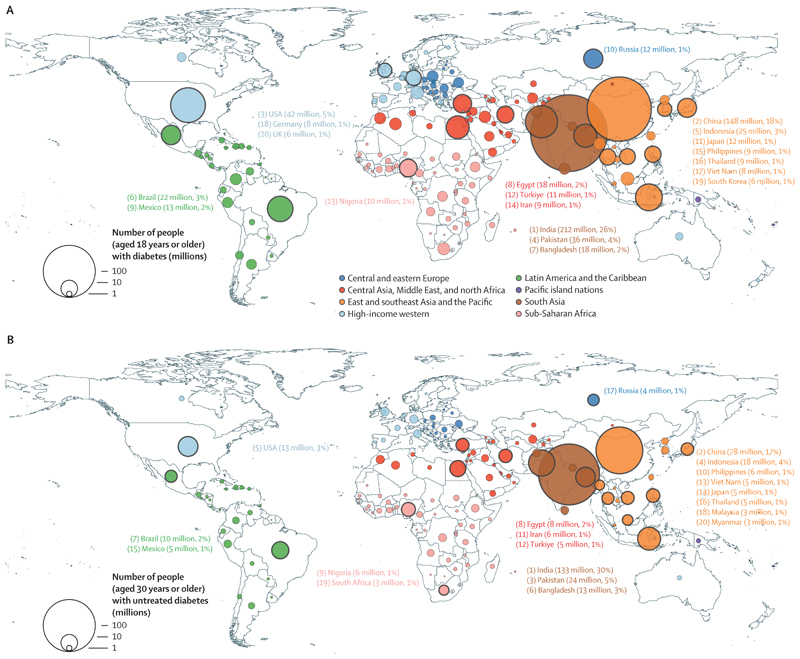
- In 2022, an estimated 828 million (95% CrI 757–908) adults aged 18 years or older had diabetes, an increase of 630 million (554–713) from 1990; 420 million (372–473) were women and 408 million (356–467) were men. India (212 million, 175–250) and China (148 million, 103–202) had the largest numbers.
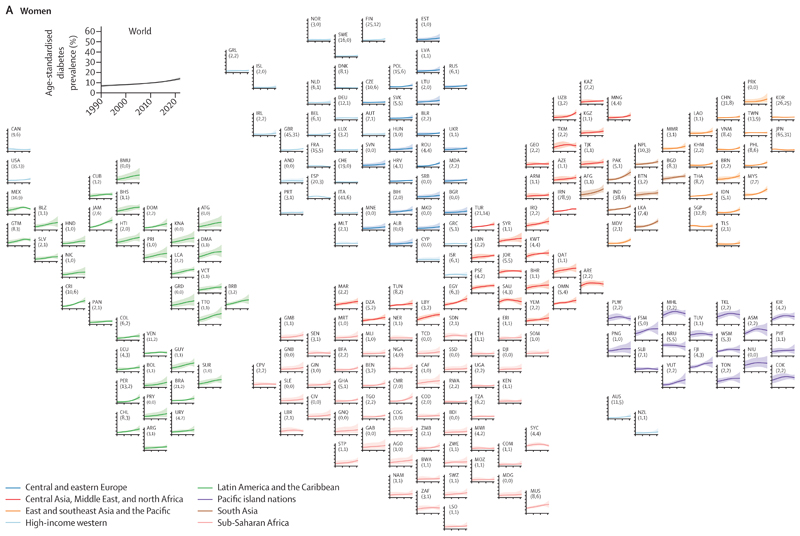
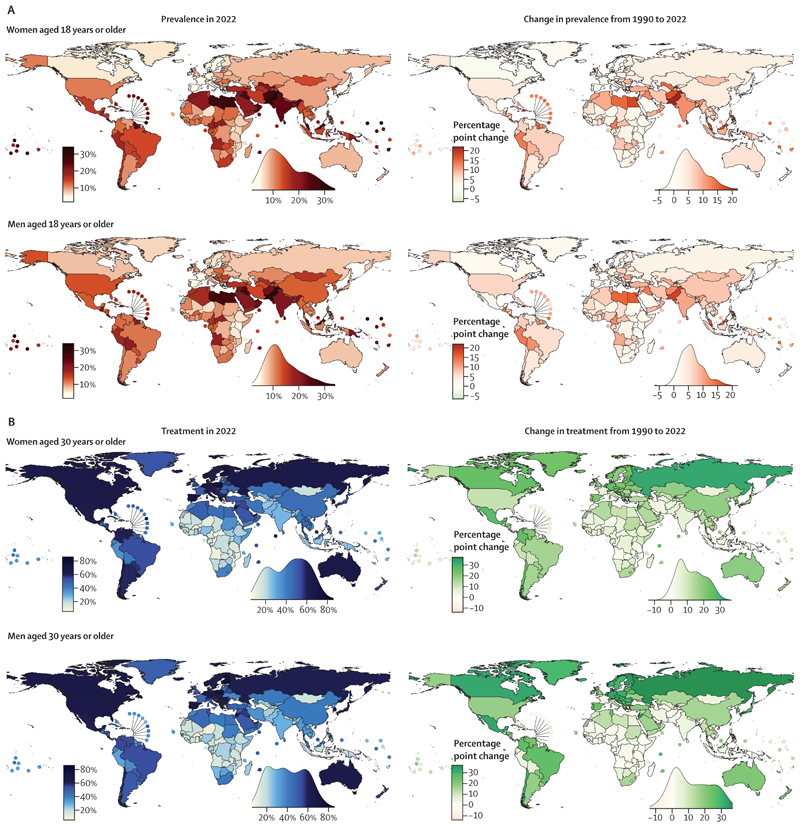
- Age-standardised diabetes prevalence increased from 1990 to 2022 in 131 countries for women and 155 countries for men with posterior probability >0·80; the largest increases were 15–22 percentage points in countries from southeast Asia, south Asia, the Middle East and north Africa, and Latin America and the Caribbean. Prevalence decreased with posterior probability >0·80 in women in Japan, Spain, and France, and in men in Nauru by 7 percentage points.
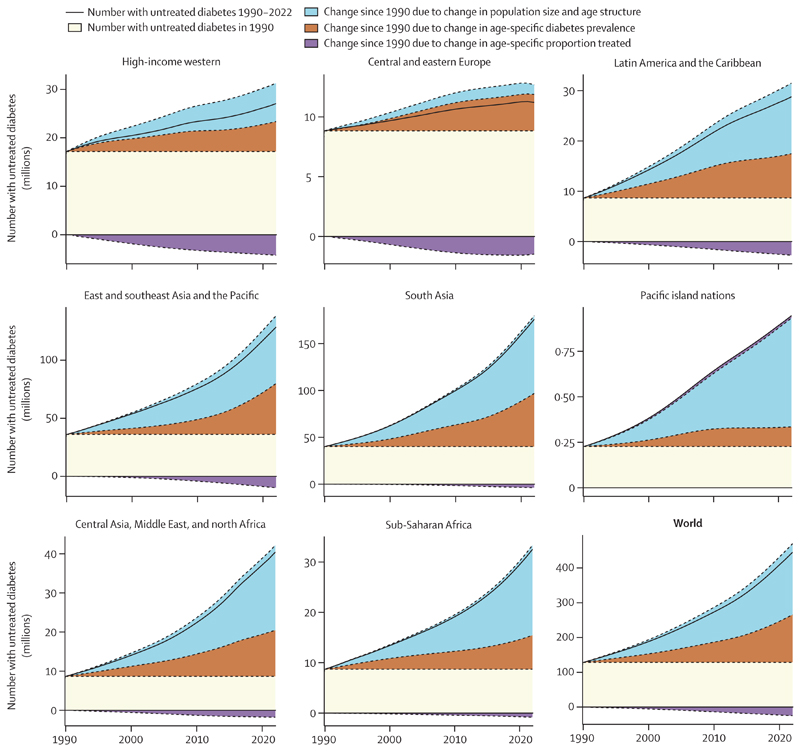
- In 2022, 445 million (95% CrI 401–496) adults aged 30 years or older with diabetes did not receive treatment (59% of adults aged 30 years or older with diabetes), 3·5 times the number in 1990 (129 million, 112–147). 30% of untreated diabetes cases (133 million, 109–160) were in India, followed by China (78 million, 51–112).
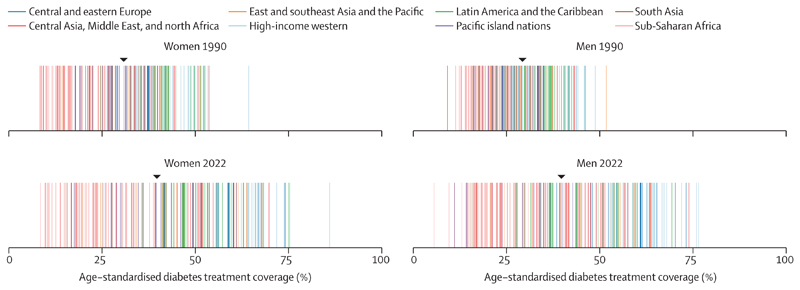
- Treatment coverage increased from 1990 to 2022 in 118 countries for women and 98 countries for men with posterior probability >0·80; largest improvements were 25–37 percentage points in countries including Mexico, Colombia, Chile, Costa Rica, Brazil, the Netherlands, Finland, Croatia, Canada, South Korea, Russia, Seychelles, and Jordan. In 2022, treatment coverage was 5–10% in a few sub-Saharan African countries and 55% or higher in South Korea, many high-income western countries, and some countries in central and eastern Europe, Latin America, and the Middle East and north Africa; the highest was 86% (74–95) for women and 77% (60–89) for men in Belgium.
Methods
- Pooled analysis of 1108 population-representative studies with 141 million participants aged 18 years or older, conducted from 1980 to 2022, with measurements of fasting glucose and/or HbA1c and information on diabetes treatment; 833 (75%) studies had treatment data.
- Diabetes was defined as fasting plasma glucose ≥7·0 mmol/L, HbA1c ≥6·5%, or taking medication for diabetes; treatment was defined as the proportion of people with diabetes taking oral hypoglycaemic drugs or insulin. Prevalence was estimated for women and men aged 18 years or older, and treatment for those aged 30 years or older.
- A Bayesian hierarchical meta-regression model estimated trends by sex, age, country, and year for 200 countries and territories; estimates were age-standardised to the WHO standard population, and posterior probabilities were used to identify probable increases or decreases. The change in untreated diabetes was decomposed into contributions from population size and age structure, prevalence, and treatment coverage.
Limitations
- The paper states that some countries had fewer data and 25 had no data, so estimates for those countries were informed more strongly by data from other countries through geographical hierarchy, increasing uncertainty; survey participation rates vary and can be low, especially in Europe; unobserved differences in assays and measurement methods might persist; 2-h postprandial glucose was not included, so true prevalence could be higher; HbA1c can be affected by anaemia, haemoglobin variants, and other non-glycaemic factors; isolated elevated HbA1c or FPG was predicted in studies missing one marker; type 1 and type 2 diabetes were not separated in adults; most surveys used a single visit rather than a confirmatory test; COVID-19 might have affected surveys and outcomes; treatment details such as insulin and specific medicines were insufficiently collected; and children and adolescents were not included.
- Evident from the text: treatment coverage is estimated only for adults aged 30 years or older, not all adults with diabetes, and is based on current medication use rather than adherence, clinical control, or medicine type.
Model-written summary. Check it against the paper before relying on it.
Integrity signals
Registry
Cites
Statistics
Figures
Verification
Claims the paper makes
10 Own result · 9 Partly supported · 7 Own method · 7 Own interpretation · 2 Supported · 1 Couldn’t confirm · 1 No full text of the sources · accuracy not yet measured
The cited sources support only part of this claim — read each source’s verdict below.
In the paper
“Genetic and phenotypic differences due to foetal and childhood nutrition and growth also influence worldwide variations, especially when accompanied with rapid weight gain—for example the high diabetes prevalence in south Asia.56,57”
§ Worldwide trends in diabetes prevalence and treatment from 1990 to 2022: a pooled analysis of 1108 population-representative studies with 141 million participants > Discussion
What the sources say
- Could not verifycites [56] Cole, 2020, Genetics of diabetes mellitus and diabetes complications, Nat Rev Nephrol sourceExperimental — accuracy not yet measured
The Introduction describes genetic and environmental components of diabetes, and the Diabetes section discusses genetic studies across populations (page unavailable). Neither passage addresses foetal or childhood nutrition and growth, rapid weight gain, or their proposed role in South Asia’s diabetes prevalence; targeted searches for those terms found no supporting passage in our copy. (LLM, conf=0.73)
- Partly supportedcites [57] Bhargava, 2004, Relation of serial changes in childhood body-mass index to impaired glucose tolerance in young adulthood, N Engl J Med sourceExperimental — accuracy not yet measured
The Discussion (page not provided) links thinness in infancy and accelerated BMI gain after age two to impaired glucose tolerance or diabetes in a Delhi cohort, and proposes that this trajectory may underlie India's diabetes epidemic. It does not establish genetic differences or explain worldwide variations in diabetes prevalence; its proposed causal role for BMI gain is explicitly tentative. (LLM, conf=0.86)
plaindirect- Asserted: passes — The authors put it forward as true.
- Checkable: passes — It can be checked against evidence.
- Load-bearing: unclear — It is unclear whether the paper’s conclusions depend on it.
- Based: passes — The paper gives a reason why it holds.
- Could not verify
The cited sources support only part of this claim — read each source’s verdict below.
In the paper
“HbA1c can be affected by some non-glycaemic factors, including anaemia due to iron deficiency or malaria, specific haemoglobin variants (eg, HbS and HbF), other haemoglobinopathies, polycythaemia due to living in high altitude, liver and kidney diseases, HIV, and specific drugs such as antiretroviral therapy for HIV.”
§ Worldwide trends in diabetes prevalence and treatment from 1990 to 2022: a pooled analysis of 1108 population-representative studies with 141 million participants > Discussion
What the sources say
- Not checked — no full text of the sourcecites [6] Cosentino, 2020, 2019 ESC Guidelines on diabetes, pre-diabetes, and cardiovascular diseases developed in collaboration with the EASD, Eur Heart J source
- Not matchedcites [7]
Couldn’t be matched to a paper in Crossref, so it can’t be checked.
- Not checked yetcites [8] 2017, SEMDSA 2017 guidelines for the management of type 2 diabetes mellitus, J Endocrinol Metab Diabetes South Africa
- Not checked yetcites [9] Makkar, 2022, RSSDI clinical practice recommendations for the management of type 2 diabetes mellitus 2022, Int J Diabetes Dev Ctries
- Partly supportedcites [21] ElSayed, 2024, 2. Diagnosis and classification of diabetes: standards of care in diabetes—2024, Diabetes Care sourceExperimental — accuracy not yet measured
The Recommendations (page not provided) say that anemia, hemoglobinopathies, some hemoglobin variants, and HIV treatment can affect A1C or make it unsuitable for diagnosis. People With HIV (page not provided) also says A1C may underestimate glycemia in people with HIV. The copy does not substantiate several specific examples in the claim—malaria, iron deficiency, HbF, high-altitude polycythaemia, or liver disease—and its discussion of antiretroviral drugs chiefly concerns their effects on glycemia, not a direct non-glycaemic effect on A1C. (LLM, conf=0.88)
- Not matchedcites [22]
Couldn’t be matched to a paper in Crossref, so it can’t be checked.
- Not matchedcites [23]
Couldn’t be matched to a paper in Crossref, so it can’t be checked.
- Not checked yetcites [24] 2021, Guideline for the prevention and treatment of type 2 diabetes mellitus in China (2020 edition), Zhonghua Neifenmi Daixie Zazhi
plaindirect- Asserted: passes — The authors put it forward as true.
- Checkable: passes — It can be checked against evidence.
- Load-bearing: passes — The paper’s conclusions depend on it.
- Based: passes — The paper gives a reason why it holds.
A result the paper reports from its own data — it cites no other source for it, so there is none to check. The quote shows it is in the paper.
In the paper
“an increase of 630 million (554–713) from 1990”
- Also stated in: § Results · plain
“a substantial increase of 630 million (554–713) from 1990”
§ Worldwide trends in diabetes prevalence and treatment from 1990 to 2022: a pooled analysis of 1108 population-representative studies with 141 million participants > Abstract > Findings
plaindirect- Asserted: passes — The authors put it forward as true.
- Checkable: passes — It can be checked against evidence.
- Load-bearing: passes — The paper’s conclusions depend on it.
- Based: passes — The paper gives a reason why it holds.
- Also stated in: § Results · plain
A result the paper reports from its own data — it cites no other source for it, so there is none to check. The quote shows it is in the paper.
In the paper
“We also found that the current variations in treatment were largely related to the extent of diabetes under-diagnosis, which means that improving case detection is a prerequisite to increasing treatment coverage.”
§ Worldwide trends in diabetes prevalence and treatment from 1990 to 2022: a pooled analysis of 1108 population-representative studies with 141 million participants > Discussion
plaincorrelational- Asserted: passes — The authors put it forward as true.
- Checkable: passes — It can be checked against evidence.
- Load-bearing: passes — The paper’s conclusions depend on it.
- Based: passes — The paper gives a reason why it holds.
A result the paper reports from its own data — it cites no other source for it, so there is none to check. The quote shows it is in the paper.
In the paper
“Our results show that treatment coverage varies substantially globally, and is low in most low-income and middle-income countries.”
§ Worldwide trends in diabetes prevalence and treatment from 1990 to 2022: a pooled analysis of 1108 population-representative studies with 141 million participants > Discussion
plain- Asserted: passes — The authors put it forward as true.
- Checkable: passes — It can be checked against evidence.
- Load-bearing: passes — The paper’s conclusions depend on it.
- Based: passes — The paper gives a reason why it holds.
A result the paper reports from its own data — it cites no other source for it, so there is none to check. The quote shows it is in the paper.
In the paper
“The largest increases were in low-income and middle-income countries in southeast Asia (eg, Malaysia), south Asia (eg, Pakistan), the Middle East and north Africa (eg, Egypt), and Latin America and the Caribbean (eg, Jamaica, Trinidad and Tobago, and Costa Rica).”
§ Worldwide trends in diabetes prevalence and treatment from 1990 to 2022: a pooled analysis of 1108 population-representative studies with 141 million participants > Abstract > Findings
plaincorrelational- Asserted: passes — The authors put it forward as true.
- Checkable: passes — It can be checked against evidence.
- Load-bearing: passes — The paper’s conclusions depend on it.
- Based: passes — The paper gives a reason why it holds.
A result the paper reports from its own data — it cites no other source for it, so there is none to check. The quote shows it is in the paper.
In the paper
“Nonetheless, the estimated global prevalence and treatment coverage are virtually identical between using countries with data versus using all countries.”
§ Worldwide trends in diabetes prevalence and treatment from 1990 to 2022: a pooled analysis of 1108 population-representative studies with 141 million participants > Discussion
hedged- Asserted: passes — The authors put it forward as true.
- Checkable: passes — It can be checked against evidence.
- Load-bearing: unclear — It is unclear whether the paper’s conclusions depend on it.
- Based: passes — The paper gives a reason why it holds.
A result the paper reports from its own data — it cites no other source for it, so there is none to check. The quote shows it is in the paper.
In the paper
“From 1990 to 2022, the age-standardised prevalence of diabetes increased in 131 countries for women and in 155 countries for men with a posterior probability of more than 0·80.”
- Also stated in: § Results · plain
“In the other 131 countries for women and 155 for men, age-standardised diabetes prevalence increased with a posterior probability of more than 0·80.”
§ Worldwide trends in diabetes prevalence and treatment from 1990 to 2022: a pooled analysis of 1108 population-representative studies with 141 million participants > Abstract > Findings
plaindirectn = 131- Asserted: passes — The authors put it forward as true.
- Checkable: passes — It can be checked against evidence.
- Load-bearing: passes — The paper’s conclusions depend on it.
- Based: passes — The paper gives a reason why it holds.
- Also stated in: § Results · plain
A result the paper reports from its own data — it cites no other source for it, so there is none to check. The quote shows it is in the paper.
In the paper
“In 2022, an estimated 828 million (95% credible interval [CrI] 757–908) adults (those aged 18 years and older) had diabetes”
- Also stated in: § Results · hedged
“An estimated 828 million (95% CrI 757–908) adults had diabetes”
§ Worldwide trends in diabetes prevalence and treatment from 1990 to 2022: a pooled analysis of 1108 population-representative studies with 141 million participants > Abstract > Findings
hedgedn = 828- Asserted: passes — The authors put it forward as true.
- Checkable: passes — It can be checked against evidence.
- Load-bearing: passes — The paper’s conclusions depend on it.
- Based: passes — The paper gives a reason why it holds.
- Also stated in: § Results · hedged
- It may state two separate claims as one. 19
- Probably not a substantial claim. 11
The cited sources that could be checked couldn’t confirm or dispute this claim.
In the paper
“An important driver of the rise in diabetes, and its variation across countries, is obesity.3”
§ Worldwide trends in diabetes prevalence and treatment from 1990 to 2022: a pooled analysis of 1108 population-representative studies with 141 million participants > Discussion
What the sources say
- Could not verifycites [3] 2024, Worldwide trends in underweight and obesity from 1990 to 2022: a pooled analysis of 3663 population-representative studies with 222 million children, adolescents, and adults, Lancet sourceExperimental — accuracy not yet measured
The Results (page not provided) describe rising obesity and differences in obesity trends across countries, but do not link those trends to diabetes. A search for “diabetes” found it only in reference titles; the Discussion (page not provided) mentions disease risk generally, without addressing whether obesity drives the rise in diabetes or its variation across countries. (LLM, conf=0.75)
plaindirect- Asserted: passes — The authors put it forward as true.
- Checkable: passes — It can be checked against evidence.
- Load-bearing: unclear — It is unclear whether the paper’s conclusions depend on it.
- Based: passes — The paper gives a reason why it holds.
It may state two separate claims as one.
- Could not verify
The cited sources support only part of this claim — read each source’s verdict below.
In the paper
“For example, yogurt and possibly some other forms of dairy, whole grains, and green leafy vegetables reduce the risk of diabetes,42–44”
§ Worldwide trends in diabetes prevalence and treatment from 1990 to 2022: a pooled analysis of 1108 population-representative studies with 141 million participants > Discussion
What the sources say
- Partly supportedcites [42] Chen, 2014, Dairy consumption and risk of type 2 diabetes: 3 cohorts of US adults and an updated meta-analysis, BMC Med sourceExperimental — accuracy not yet measured
The Conclusions report that higher yogurt intake is associated with lower type 2 diabetes risk, but say that trials are needed to test whether yogurt causes that reduction. They also report no appreciable association for other dairy foods overall. This dairy-focused source does not address the sentence’s whole-grain or green-leafy-vegetable examples, which may be covered by its other citations. (LLM, conf=0.88)
- Partly supportedcites [43] Hu, 2020, Intake of whole grain foods and risk of type 2 diabetes: results from three prospective cohort studies, BMJ sourceExperimental — accuracy not yet measured
The Abstract Conclusion reports that higher whole-grain consumption was significantly associated with a lower risk of type 2 diabetes. That supports the whole-grain portion of the sentence, which is the portion this paper addresses; it does not establish that whole grains causally reduce risk. The Discussion (Strengths and weaknesses; page unavailable) notes that residual confounding cannot be excluded. (LLM, conf=0.86)
- Partly supportedcites [44] Li, 2014, Fruit and vegetable intake and risk of type 2 diabetes mellitus: meta-analysis of prospective cohort studies, BMJ Open sourceExperimental — accuracy not yet measured
The Results section (‘GLV intake and risk of T2D’) reports that higher green leafy vegetable intake was associated with lower type 2 diabetes risk, supporting the portion of the multi-citation sentence relevant to this paper. The meta-analysis covers prospective observational studies, so it does not establish the causal claim that green leafy vegetables reduce risk. (LLM, conf=0.84)
hedgeddirect- Asserted: passes — The authors put it forward as true.
- Checkable: passes — It can be checked against evidence.
- Load-bearing: fails — The paper’s conclusions may not depend on it.
- Based: passes — The paper gives a reason why it holds.
Probably not a substantial claim. The paper’s conclusions may not depend on it. It may state two separate claims as one.
- Partly supported
The cited sources support only part of this claim — read each source’s verdict below.
In the paper
“Many clinical guidelines recommend using a second confirmatory test for diabetes diagnosis and initiating treatment,6,21–23 although there is variation in this guidance.”
§ Worldwide trends in diabetes prevalence and treatment from 1990 to 2022: a pooled analysis of 1108 population-representative studies with 141 million participants > Discussion
What the sources say
- Not checked — no full text of the sourcecites [6] Cosentino, 2020, 2019 ESC Guidelines on diabetes, pre-diabetes, and cardiovascular diseases developed in collaboration with the EASD, Eur Heart J source
- Partly supportedcites [21] ElSayed, 2024, 2. Diagnosis and classification of diabetes: standards of care in diabetes—2024, Diabetes Care sourceExperimental — accuracy not yet measured
The Recommendations and Confirming the Diagnosis sections (page not provided) require two abnormal results to diagnose diabetes unless there is unequivocal hyperglycemia. They do not state that treatment must await a confirmatory test. The paper is one guideline, so it does not establish how many clinical guidelines give this advice. (LLM, conf=0.84)
- Not matchedcites [22]
Couldn’t be matched to a paper in Crossref, so it can’t be checked.
- Not matchedcites [23]
Couldn’t be matched to a paper in Crossref, so it can’t be checked.
plain- Asserted: passes — The authors put it forward as true.
- Checkable: passes — It can be checked against evidence.
- Load-bearing: fails — The paper’s conclusions may not depend on it.
- Based: passes — The paper gives a reason why it holds.
Probably not a substantial claim. The paper’s conclusions may not depend on it. It may state two separate claims as one.
Every source the paper cites for this claim was checked and supports it.
In the paper
“In addition to obesity, the consumption of specific foods might influence the risk of diabetes.41”
§ Worldwide trends in diabetes prevalence and treatment from 1990 to 2022: a pooled analysis of 1108 population-representative studies with 141 million participants > Discussion
What the sources say
- Supportedcites [41] Ley, 2014, Prevention and management of type 2 diabetes: dietary components and nutritional strategies, Lancet source
The ‘Individual foods and food groups’ section reports that intake of specific foods may play a role in diabetes prevention, with whole grains associated with lower risk and white rice and processed red meat with higher risk. The ‘Positive energy balance and excess adiposity’ section separately identifies excess adiposity as a major diabetes risk factor. (LLM, conf=0.94)
hedgedconditional- Asserted: passes — The authors put it forward as true.
- Checkable: passes — It can be checked against evidence.
- Load-bearing: fails — The paper’s conclusions may not depend on it.
- Based: passes — The paper gives a reason why it holds.
Probably not a substantial claim. The paper’s conclusions may not depend on it.
- Supported
The cited sources support only part of this claim — read each source’s verdict below.
In the paper
“For people who already have diabetes, lifestyle modification and pharmacological treatment, as well as blood pressure and cholesterol control, can delay progression to complications and reduce mortality, or even help with remission, especially if started early.1,2,58–62”
§ Worldwide trends in diabetes prevalence and treatment from 1990 to 2022: a pooled analysis of 1108 population-representative studies with 141 million participants > Discussion
What the sources say
- Not checked — no full text of the sourcecites [1] ElSayed, 2024, 9. Pharmacologic approaches to glycemic treatment: standards of care in diabetes-2024, Diabetes Care source
- Not checked — no full text of the sourcecites [2] Adler, 2024, Post-trial monitoring of a randomised controlled trial of intensive glycaemic control in type 2 diabetes extended from 10 years to 24 years (UKPDS 91), Lancet source
- Partly supportedcites [58] Gaede, 2003, Multifactorial intervention and cardiovascular disease in patients with type 2 diabetes, N Engl J Med sourceExperimental — accuracy not yet measured
Split into 2 atoms — 0 confirmed, 2 partially supported, 0 disputed, 0 misattributed, 0 unverifiable. Expand the claim to see per-atom verdicts.
- Partly supportedcites [59] Fox, 2015, Update on prevention of cardiovascular disease in adults with type 2 diabetes mellitus in light of recent evidence: a scientific statement from the American Heart Association and the American Diabetes Association, Circulation sourceExperimental — accuracy not yet measured
Split into 2 atoms — 0 confirmed, 2 partially supported, 0 disputed, 0 misattributed, 0 unverifiable. Expand the claim to see per-atom verdicts.
- Partly supportedcites [60] Wu, 2024, 1-year weight change after diabetes diagnosis and long-term incidence and sustainability of remission of type 2 diabetes in real-world settings in Hong Kong: an observational cohort study, PLoS Med sourceExperimental — accuracy not yet measured
Split into 2 atoms — 0 confirmed, 2 partially supported, 0 disputed, 0 misattributed, 0 unverifiable. Expand the claim to see per-atom verdicts.
- Partly supportedcites [61] Ali, 2024, Effect of a multicomponent quality improvement strategy on sustained achievement of diabetes care goals and macrovascular and microvascular complications in South Asia at 6.5 years follow-up: post hoc analyses of the CARRS randomized clinical trial, PLoS Med sourceExperimental — accuracy not yet measured
Split into 2 atoms — 0 confirmed, 2 partially supported, 0 disputed, 0 misattributed, 0 unverifiable. Expand the claim to see per-atom verdicts.
- Partly supportedcites [62] Valabhji, 2024, Early findings from the NHS Type 2 Diabetes Path to Remission Programme: a prospective evaluation of real-world implementation, Lancet Diabetes Endocrinol sourceExperimental — accuracy not yet measured
Split into 2 atoms — 0 confirmed, 2 partially supported, 0 disputed, 0 misattributed, 0 unverifiable. Expand the claim to see per-atom verdicts.
plaindirect- Asserted: passes — The authors put it forward as true.
- Checkable: passes — It can be checked against evidence.
- Load-bearing: unclear — It is unclear whether the paper’s conclusions depend on it.
- Based: passes — The paper gives a reason why it holds.
It may state two separate claims as one.
Every source the paper cites for this claim was checked and supports it.
In the paper
“Although these equations performed well in cross-validation,25 their use increases the uncertainty of our estimates.”
§ Worldwide trends in diabetes prevalence and treatment from 1990 to 2022: a pooled analysis of 1108 population-representative studies with 141 million participants > Discussion
What the sources say
- Supportedcites [25] 2023, Global variation in diabetes diagnosis and prevalence based on fasting glucose and hemoglobin A1c, Nat Med source
The Methods (Statistical analysis) describe 20 rounds of tenfold cross-validation. The Results (Prediction equations) report acceptable predictive performance for most equations, including C-statistics of 0.85–0.90. The citation is attached to the cross-validation clause; the statement about increased uncertainty in the citing authors’ estimates is their own qualification. (LLM, conf=0.93)
plaindirect- Asserted: passes — The authors put it forward as true.
- Checkable: passes — It can be checked against evidence.
- Load-bearing: unclear — It is unclear whether the paper’s conclusions depend on it.
- Based: passes — The paper gives a reason why it holds.
It may state two separate claims as one.
- Supported
The cited sources support only part of this claim — read each source’s verdict below.
In the paper
“Alongside these population-based measures, diet and lifestyle modification and medicines in people at a high risk of diabetes (including those with prediabetes) can prevent or delay diabetes onset and reduce the risk of some complications.48–55”
§ Worldwide trends in diabetes prevalence and treatment from 1990 to 2022: a pooled analysis of 1108 population-representative studies with 141 million participants > Discussion
What the sources say
- Partly supportedcites [48] 2015, Long-term effects of lifestyle intervention or metformin on diabetes development and microvascular complications over 15-year follow-up: the Diabetes Prevention Program Outcomes Study, Lancet Diabetes Endocrinol sourceExperimental — accuracy not yet measured
The Incidence of Diabetes results report that lifestyle intervention and metformin reduced diabetes incidence in this high-risk cohort. The Microvascular Outcomes results and conclusion report no reduction in aggregate microvascular complications for either intervention in the total cohort; a significant reduction was found with lifestyle intervention in women, but not with metformin. The claim's unqualified suggestion that both approaches reduce complications therefore goes beyond this paper's findings. Page numbers were not available in our copy. (LLM, conf=0.88)
- Partly supportedcites [49] Saaristo, 2010, Lifestyle intervention for prevention of type 2 diabetes in primary health care: one-year follow-up of the Finnish National Diabetes Prevention Program (FIN-D2D), Diabetes Care sourceExperimental — accuracy not yet measured
The Conclusions report that lifestyle changes can prevent or postpone type 2 diabetes in high-risk people and describe a shorter-lived preventive effect of drug treatment. The Results report improvements in blood pressure and lipid levels with weight loss, but do not establish a reduced risk of diabetes complications; risk-factor changes are not complication outcomes. (LLM, conf=0.86)
- Partly supportedcites [50] Ramachandran, 2006, The Indian Diabetes Prevention Programme shows that lifestyle modification and metformin prevent type 2 diabetes in Asian Indian subjects with impaired glucose tolerance (IDPP-1), Diabetologia sourceExperimental — accuracy not yet measured
The Results report lower diabetes incidence with lifestyle modification and metformin than with control treatment in Asian Indian subjects with impaired glucose tolerance. The paper does not establish that these interventions reduce complications: its primary outcome was diabetes onset, and the Adverse events section reports cardiovascular events without showing a reduction. (LLM, conf=0.89)
- Partly supportedcites [51] Chakkalakal, 2024, Test and treat for prediabetes: a review of the health effects of prediabetes and the role of screening and prevention, Annu Rev Public Health sourceExperimental — accuracy not yet measured
The passages labeled “acknowledgments” (page not supplied) report that lifestyle modification and medicines reduce diabetes incidence in people with prediabetes. They also report fewer microvascular complications among lifestyle-intervention participants who returned to normal glucose levels, but explicitly say data are limited on whether the interventions themselves reduce complication risk. That part of the claim is therefore overstated. (LLM, conf=0.86)
- Not checked — no full text of the sourcecites [52] Echouffo-Tcheugui, 2023, Diagnosis and management of prediabetes: a review, JAMA source
- Partly supportedcites [53] Haw, 2017, Long-term sustainability of diabetes prevention approaches: a systematic review and meta-analysis of randomized clinical trials, JAMA Intern Med sourceExperimental — accuracy not yet measured
The Discussion (page not provided) reports that lifestyle modification and certain medications prevent progression to diabetes in people at risk. The paper evaluates diabetes incidence, but the passages do not show that these interventions reduce the risk of complications; that part of the attributed claim is unsupported. (LLM, conf=0.86)
- Not checked — no full text of the sourcecites [54] Galaviz, 2022, Interventions for reversing prediabetes: a systematic review and meta-analysis, Am J Prev Med source
- Partly supportedcites [55] Jonas, 2021, Screening for prediabetes and type 2 diabetes: updated evidence report and systematic review for the US Preventive Services Task Force, JAMA sourceExperimental — accuracy not yet measured
Key Question 7a reports that lifestyle interventions and several medicines reduced diabetes incidence in people with prediabetes. The Benefits of Interventions for Type 2 Diabetes and Prediabetes section reports lower cardiovascular-related mortality after long-term follow-up in one lifestyle-intervention trial, but says most trials were too short to assess effects on health outcomes. It does not establish that medicines reduce the risk of complications in this group. (LLM, conf=0.84)
plaindirect- Asserted: passes — The authors put it forward as true.
- Checkable: passes — It can be checked against evidence.
- Load-bearing: unclear — It is unclear whether the paper’s conclusions depend on it.
- Based: passes — The paper gives a reason why it holds.
It may state two separate claims as one.
- Partly supported
The cited sources support only part of this claim — read each source’s verdict below.
In the paper
“Diabetes was either already high or increased more in some of the regions where obesity was or became prevalent, such as Pacific and Caribbean island nations and the Middle East and north Africa, compared with high-income countries in Europe and east Asia and the Pacific, where obesity and diabetes did not rise or rose by a relatively small amount.3”
§ Worldwide trends in diabetes prevalence and treatment from 1990 to 2022: a pooled analysis of 1108 population-representative studies with 141 million participants > Discussion
What the sources say
- Partly supportedcites [3] 2024, Worldwide trends in underweight and obesity from 1990 to 2022: a pooled analysis of 3663 population-representative studies with 222 million children, adolescents, and adults, Lancet sourceExperimental — accuracy not yet measured
The Results and Discussion (page not provided) report that obesity was prevalent or rose substantially in Pacific and Caribbean island nations and the Middle East and north Africa, with some of these countries exceeding industrialised high-income countries in obesity prevalence. But the paper does not report regional diabetes levels or trends, so it cannot support the claimed comparison in diabetes. (LLM, conf=0.88)
plaincorrelational- Asserted: passes — The authors put it forward as true.
- Checkable: passes — It can be checked against evidence.
- Load-bearing: unclear — It is unclear whether the paper’s conclusions depend on it.
- Based: passes — The paper gives a reason why it holds.
It may state two separate claims as one.
- Partly supported
The cited sources support only part of this claim — read each source’s verdict below.
In the paper
“In countries with universal health insurance and good access to primary care, people at a high risk of diabetes might also be identified early and advised to use a combination of diet and lifestyle modifications and medicines to prevent or delay diabetes onset.48–55”
§ Worldwide trends in diabetes prevalence and treatment from 1990 to 2022: a pooled analysis of 1108 population-representative studies with 141 million participants > Discussion
What the sources say
- Partly supportedcites [48] 2015, Long-term effects of lifestyle intervention or metformin on diabetes development and microvascular complications over 15-year follow-up: the Diabetes Prevention Program Outcomes Study, Lancet Diabetes Endocrinol sourceExperimental — accuracy not yet measured
The Introduction and conclusion report that lifestyle intervention and metformin reduced or delayed diabetes in a high-risk population. The Methods describe them as separate original treatment arms, not a tested combination. The paper does not establish that universal health insurance or primary-care access enables early identification and advice; page numbers were not supplied in our copy. (LLM, conf=0.84)
- Partly supportedcites [49] Saaristo, 2010, Lifestyle intervention for prevention of type 2 diabetes in primary health care: one-year follow-up of the Finnish National Diabetes Prevention Program (FIN-D2D), Diabetes Care sourceExperimental — accuracy not yet measured
The Research Design and Methods section (page unavailable) describes identifying high-risk people in Finnish primary care and counseling them on diet and other lifestyle changes. The paper does not describe advising them to combine those changes with medicines to prevent diabetes, nor does it establish that the approach applies specifically to countries with universal health insurance. Its discussion contrasts the lasting effects of lifestyle intervention with the rapidly vanishing preventive effect of drug treatment. (LLM, conf=0.87)
- Partly supportedcites [50] Ramachandran, 2006, The Indian Diabetes Prevention Programme shows that lifestyle modification and metformin prevent type 2 diabetes in Asian Indian subjects with impaired glucose tolerance (IDPP-1), Diabetologia sourceExperimental — accuracy not yet measured
Split into 2 atoms — 0 confirmed, 1 partially supported, 0 disputed, 0 misattributed, 1 unverifiable. Expand the claim to see per-atom verdicts.
- Partly supportedcites [51] Chakkalakal, 2024, Test and treat for prediabetes: a review of the health effects of prediabetes and the role of screening and prevention, Annu Rev Public Health sourceExperimental — accuracy not yet measured
Split into 2 atoms — 0 confirmed, 2 partially supported, 0 disputed, 0 misattributed, 0 unverifiable. Expand the claim to see per-atom verdicts.
- Not checked — no full text of the sourcecites [52] Echouffo-Tcheugui, 2023, Diagnosis and management of prediabetes: a review, JAMA source
- Partly supportedcites [53] Haw, 2017, Long-term sustainability of diabetes prevention approaches: a systematic review and meta-analysis of randomized clinical trials, JAMA Intern Med sourceExperimental — accuracy not yet measured
Split into 2 atoms — 0 confirmed, 1 partially supported, 0 disputed, 0 misattributed, 1 unverifiable. Expand the claim to see per-atom verdicts.
- Not checked — no full text of the sourcecites [54] Galaviz, 2022, Interventions for reversing prediabetes: a systematic review and meta-analysis, Am J Prev Med source
- Partly supportedcites [55] Jonas, 2021, Screening for prediabetes and type 2 diabetes: updated evidence report and systematic review for the US Preventive Services Task Force, JAMA sourceExperimental — accuracy not yet measured
Split into 2 atoms — 0 confirmed, 2 partially supported, 0 disputed, 0 misattributed, 0 unverifiable. Expand the claim to see per-atom verdicts.
hedgedconditional- Asserted: passes — The authors put it forward as true.
- Checkable: fails — It may be too vague to check against evidence.
- Load-bearing: fails — The paper’s conclusions may not depend on it.
- Based: passes — The paper gives a reason why it holds.
Probably not a substantial claim. It may be too vague to check against evidence. The paper’s conclusions may not depend on it.
- Partly supported
The cited sources support only part of this claim — read each source’s verdict below.
In the paper
“whereas refined carbohydrates, including in sugar-sweetened beverages, increase this risk.41,45–47”
§ Worldwide trends in diabetes prevalence and treatment from 1990 to 2022: a pooled analysis of 1108 population-representative studies with 141 million participants > Discussion
What the sources say
- Supportedcites [41] Ley, 2014, Prevention and management of type 2 diabetes: dietary components and nutritional strategies, Lancet source
In the diabetes-prevention sections on individual foods and beverages (page not provided), the paper reports higher diabetes risk with greater intake of white rice, a processed grain, and sugar-sweetened beverages. Its dietary-patterns section also describes diets lower in refined grains and sugar-sweetened beverages as beneficial for diabetes prevention. (LLM, conf=0.85)
- Partly supportedcites [45] Imamura, 2015, Consumption of sugar sweetened beverages, artificially sweetened beverages, and fruit juice and incidence of type 2 diabetes: systematic review, meta-analysis, and estimation of population attributable fraction, BMJ sourceExperimental — accuracy not yet measured
The Discussion > Conclusions section (page not provided) reports an association between sugar-sweetened beverage consumption and incident type 2 diabetes, but says causality has not been established. The paper does not establish that refined carbohydrates generally increase diabetes risk, so the claim extends beyond the beverages studied and states the relationship more definitively than the source does. (LLM, conf=0.88)
- Partly supportedcites [46] Bhavadharini, 2020, White rice intake and incident diabetes: a study of 132,373 participants in 21 countries, Diabetes Care sourceExperimental — accuracy not yet measured
The Results and Conclusions report an association between higher white-rice intake and incident diabetes, particularly in South Asia. White rice is one refined carbohydrate, but the paper does not establish that refined carbohydrates generally increase diabetes risk or address sugar-sweetened beverages. The claim also states a causal effect more strongly than the reported association. (LLM, conf=0.86)
- Partly supportedcites [47] Mohan, 2009, Dietary carbohydrates, glycaemic load, food groups and newly detected type 2 diabetes among urban Asian Indian population in Chennai, India (Chennai Urban Rural Epidemiology Study 59), Br J Nutr sourceExperimental — accuracy not yet measured
The Results report a positive association between refined-grain intake and newly detected type 2 diabetes in the Chennai population. They do not establish that refined carbohydrates cause diabetes, and the paper reports no association for added sugar, which it says was consumed mainly in tea and coffee (Results; Discussion, page unavailable). It does not report a diabetes-risk finding for sugar-sweetened beverages as a category. (LLM, conf=0.89)
plaindirect- Asserted: passes — The authors put it forward as true.
- Checkable: passes — It can be checked against evidence.
- Load-bearing: fails — The paper’s conclusions may not depend on it.
- Based: passes — The paper gives a reason why it holds.
Probably not a substantial claim. The paper’s conclusions may not depend on it.
- Supported
A result the paper reports from its own data — it cites no other source for it, so there is none to check. The quote shows it is in the paper.
In the paper
“India (212 million, 175–250) and China (148 million, 103–202) accounted for the largest proportion of this number, followed by the USA, Pakistan, Indonesia, and Brazil.”
§ Worldwide trends in diabetes prevalence and treatment from 1990 to 2022: a pooled analysis of 1108 population-representative studies with 141 million participants > Results
plain- Asserted: passes — The authors put it forward as true.
- Checkable: passes — It can be checked against evidence.
- Load-bearing: unclear — It is unclear whether the paper’s conclusions depend on it.
- Based: passes — The paper gives a reason why it holds.
It may state two separate claims as one.
A result the paper reports from its own data — it cites no other source for it, so there is none to check. The quote shows it is in the paper.
In the paper
“Of these, 420 million (372–473) were women and 408 million (356–467) were men.”
§ Worldwide trends in diabetes prevalence and treatment from 1990 to 2022: a pooled analysis of 1108 population-representative studies with 141 million participants > Results
plainn = 420- Asserted: passes — The authors put it forward as true.
- Checkable: passes — It can be checked against evidence.
- Load-bearing: unclear — It is unclear whether the paper’s conclusions depend on it.
- Based: passes — The paper gives a reason why it holds.
It may state two separate claims as one.
What the paper did — it cites no source for this, so there is none to check. The quote shows it is in the paper.
In the paper
“Most health surveys are based on one visit to participants, in which a glycaemic marker is measured.”
§ Worldwide trends in diabetes prevalence and treatment from 1990 to 2022: a pooled analysis of 1108 population-representative studies with 141 million participants > Discussion
plain- Asserted: passes — The authors put it forward as true.
- Checkable: passes — It can be checked against evidence.
- Load-bearing: passes — The paper’s conclusions depend on it.
- Based: passes — The paper gives a reason why it holds.
Probably not a substantial claim. It may state two separate claims as one.
A conclusion the paper draws from its own results — it cites no other source for it, so there is none to check. The quote shows it is in the paper.
In the paper
“Nonetheless, diabetes prevalence based on data collected in multiple visits might be lower, and treatment coverage might be higher, than that based on one measurement.”
§ Worldwide trends in diabetes prevalence and treatment from 1990 to 2022: a pooled analysis of 1108 population-representative studies with 141 million participants > Discussion
hedgedconditional- Asserted: passes — The authors put it forward as true.
- Checkable: passes — It can be checked against evidence.
- Load-bearing: fails — The paper’s conclusions may not depend on it.
- Based: passes — The paper gives a reason why it holds.
Probably not a substantial claim. The paper’s conclusions may not depend on it. It may state two separate claims as one.
In the paper
“However, most (85–95%) cases of diabetes in adults are type 2.40”
§ Worldwide trends in diabetes prevalence and treatment from 1990 to 2022: a pooled analysis of 1108 population-representative studies with 141 million participants > Discussion
What the sources say
- Not checked — no full text of the sourcecites [40] Tuomilehto, 2013, The emerging global epidemic of type 1 diabetes, Curr Diab Rep source
plain- Asserted: passes — The authors put it forward as true.
- Checkable: passes — It can be checked against evidence.
- Load-bearing: fails — The paper’s conclusions may not depend on it.
- Based: passes — The paper gives a reason why it holds.
Probably not a substantial claim. The paper’s conclusions may not depend on it.
A conclusion the paper draws from its own results — it cites no other source for it, so there is none to check. The quote shows it is in the paper.
In the paper
“Some of these factors, including malaria-induced and iron deficiency anaemia, haemoglobinopathies such as sickle cell disease and thalassemia, and antiretroviral therapy, are more prevalent in parts of Asia and Africa than other parts of the world, and might have affected HbA1c or its measurement.”
§ Worldwide trends in diabetes prevalence and treatment from 1990 to 2022: a pooled analysis of 1108 population-representative studies with 141 million participants > Discussion
hedgedconditional- Asserted: passes — The authors put it forward as true.
- Checkable: passes — It can be checked against evidence.
- Load-bearing: unclear — It is unclear whether the paper’s conclusions depend on it.
- Based: passes — The paper gives a reason why it holds.
It may state two separate claims as one.
What the paper did — it cites no source for this, so there is none to check. The quote shows it is in the paper.
In the paper
“Most survey data did not separate type 1 and type 2 diabetes in adults because distinguishing between these disorders can be challenging in adults.”
§ Worldwide trends in diabetes prevalence and treatment from 1990 to 2022: a pooled analysis of 1108 population-representative studies with 141 million participants > Discussion
plaindirect- Asserted: passes — The authors put it forward as true.
- Checkable: passes — It can be checked against evidence.
- Load-bearing: unclear — It is unclear whether the paper’s conclusions depend on it.
- Based: passes — The paper gives a reason why it holds.
It may state two separate claims as one.
A conclusion the paper draws from its own results — it cites no other source for it, so there is none to check. The quote shows it is in the paper.
In the paper
“This is not a relevant issue in prevalence studies in a population, and hence population surveillance uses a single measurement.”
§ Worldwide trends in diabetes prevalence and treatment from 1990 to 2022: a pooled analysis of 1108 population-representative studies with 141 million participants > Discussion
plain- Asserted: passes — The authors put it forward as true.
- Checkable: passes — It can be checked against evidence.
- Load-bearing: passes — The paper’s conclusions depend on it.
- Based: passes — The paper gives a reason why it holds.
It may state two separate claims as one.
What the paper did — it cites no source for this, so there is none to check. The quote shows it is in the paper.
In the paper
“Some countries had fewer data and 25 had no data; the estimates for countries with fewer or no data were informed to a stronger degree by data from other countries through geographical hierarchy, which increased the uncertainty of their estimates.”
§ Worldwide trends in diabetes prevalence and treatment from 1990 to 2022: a pooled analysis of 1108 population-representative studies with 141 million participants > Discussion
plaindirect- Asserted: passes — The authors put it forward as true.
- Checkable: passes — It can be checked against evidence.
- Load-bearing: unclear — It is unclear whether the paper’s conclusions depend on it.
- Based: passes — The paper gives a reason why it holds.
It may state two separate claims as one.
A conclusion the paper draws from its own results — it cites no other source for it, so there is none to check. The quote shows it is in the paper.
In the paper
“The COVID-19 pandemic might have impeded the rolling out of some health surveys or affected participation.”
§ Worldwide trends in diabetes prevalence and treatment from 1990 to 2022: a pooled analysis of 1108 population-representative studies with 141 million participants > Discussion
hedgedconditional- Asserted: passes — The authors put it forward as true.
- Checkable: passes — It can be checked against evidence.
- Load-bearing: fails — The paper’s conclusions may not depend on it.
- Based: fails — The paper may give no reason why it holds.
Probably not a substantial claim. The paper’s conclusions may not depend on it. The paper may give no reason why it holds. It may state two separate claims as one.
What the paper did — it cites no source for this, so there is none to check. The quote shows it is in the paper.
In the paper
“Although we accounted for whether a study had measured fasting glucose in plasma or whole blood, other unobserved differences might persist due to differing methods—for example, in assays used for measuring FPG and HbA1c.”
§ Worldwide trends in diabetes prevalence and treatment from 1990 to 2022: a pooled analysis of 1108 population-representative studies with 141 million participants > Discussion
hedged- Asserted: passes — The authors put it forward as true.
- Checkable: passes — It can be checked against evidence.
- Load-bearing: unclear — It is unclear whether the paper’s conclusions depend on it.
- Based: passes — The paper gives a reason why it holds.
It may state two separate claims as one.
A conclusion the paper draws from its own results — it cites no other source for it, so there is none to check. The quote shows it is in the paper.
In the paper
“The pandemic might also have affected diabetes prevalence and especially treatment coverage.”
§ Worldwide trends in diabetes prevalence and treatment from 1990 to 2022: a pooled analysis of 1108 population-representative studies with 141 million participants > Discussion
hedgedconditional- Asserted: passes — The authors put it forward as true.
- Checkable: passes — It can be checked against evidence.
- Load-bearing: fails — The paper’s conclusions may not depend on it.
- Based: fails — The paper may give no reason why it holds.
Probably not a substantial claim. The paper’s conclusions may not depend on it. The paper may give no reason why it holds. It may state two separate claims as one.
What the paper did — it cites no source for this, so there is none to check. The quote shows it is in the paper.
In the paper
“Survey sample weights adjust for non-response but this adjustment might be imperfect, especially as response rates decrease.”
§ Worldwide trends in diabetes prevalence and treatment from 1990 to 2022: a pooled analysis of 1108 population-representative studies with 141 million participants > Discussion
hedgedconditional- Asserted: passes — The authors put it forward as true.
- Checkable: passes — It can be checked against evidence.
- Load-bearing: fails — The paper’s conclusions may not depend on it.
- Based: passes — The paper gives a reason why it holds.
Probably not a substantial claim. The paper’s conclusions may not depend on it. It may state two separate claims as one.
- Rests on an assumption: Health survey participation rates vary across countries, can change over time, and have become particularly low in Europe.
The paper relies on this without support.
High-risk prevention using diet, lifestyle modification and medicines is less widely used in low-resourced health systems with limited attention to, or resources for, diabetes screening.
“This approach is less widely used in low-resourced health systems with limited attention to, or resources for, diabetes screening.”
The paper relies on this without support.
Health survey participation rates vary across countries, can change over time, and have become particularly low in Europe.
“Health survey participation rate varies across countries and can change over time, and has become particularly low in Europe.”
Claims other papers make about this one
Each is checked against this paper’s own text: does it say what the citing paper says it does?
The source backs part of the claim, not all of it — or backs it for a different population, condition or comparison.
In the citing paper
“The magnitude of diabetes and its sequelae including DR require large-scale screening to enable early intervention, as described in the recent Lancet Global Health Commission on Global Eye Health and contemporary modelling of diabetes prevalence worldwide1,4.”
From Referral uptake after diabetic retinopathy screening with artificial intelligence-assisted care pathways: a systematic review and meta-analysis (2026) · cites this paper as [4]
Experimental — accuracy not yet measuredThe source backs part of the claim, not all of it — or backs it for a different population, condition or comparison.
In the citing paper
“Type 2 diabetes accounts for 90% to 95% of all cases of diabetes globally”
From Diagnosis and Treatment of Type 2 Diabetes in Adults (2025) · cites this paper as [1]
Experimental — accuracy not yet measuredThe source backs part of the claim, not all of it — or backs it for a different population, condition or comparison.
In the citing paper
“The number of people with diabetes worldwide was estimated to be between 589 million and 828 million during 2022 to 2024,1,2”
From Diagnosis and Treatment of Type 2 Diabetes in Adults (2025) · cites this paper as [1]
Experimental — accuracy not yet measuredThe source backs part of the claim, not all of it — or backs it for a different population, condition or comparison.
In the citing paper
“Type 2 diabetes affects up to 14% of the global population and is associated with preventable long-term complications such as cardiovascular disease, kidney failure, vision loss and increased mortality.”
From Diagnosis and Treatment of Type 2 Diabetes in Adults (2025) · cites this paper as [1]
Experimental — accuracy not yet measured
Citations
Cites
Sun, H., Saeedi, P., Karuranga, S., Pinkepank, M., Ogurtsova, K., Duncan, B. B., Stein, C., Basit, A., Chan, J. C. N., Mbanya, J. C., et al. (2022) · Diabetes Research and Clinical Practice · doi:10.1016/j.diabres.2021.109119 · Cited by 10,123
Self-citationCosentino, F., Grant, P. J., Aboyans, V., Bailey, C. J., Ceriello, A., Delgado, V., Federici, M., Filippatos, G., Grobbee, D. E., Hansen, T. B., et al. (2020) · European Heart Journal · doi:10.1093/eurheartj/ehz486 · Cited by 4,763
Self-citationOng, K. L., Stafford, L. K., McLaughlin, S. A., Boyko, E. J., Vollset, S. E., Smith, A. E., Dalton, B. E., Duprey, J., Cruz, J. A., Hagins, H., et al. (2023) · The Lancet · doi:10.1016/s0140-6736(23)01301-6 · Cited by 4,681
Self-citationMultifactorial intervention and cardiovascular disease in patients with type 2 diabetes
Gæde, P., Vedel, P., Larsen, N., Jensen, G. V. H., Parving, H.-H., & Pedersen, O. (2003) · New England Journal of Medicine · doi:10.1056/nejmoa021778 · Cited by 4,378
Zhou, B., Carrillo-Larco, R. M., Danaei, G., Riley, L. M., Paciorek, C. J., Stevens, G. A., Gregg, E. W., Bennett, J. E., Solomon, B., Singleton, R. K., et al. (2021) · The Lancet · doi:10.1016/s0140-6736(21)01330-1 · Cited by 3,902
Self-citationPhelps, N. H., Singleton, R. K., Zhou, B., Heap, R. A., Mishra, A., Bennett, J. E., Paciorek, C. J., Lhoste, V. P., Carrillo-Larco, R. M., Stevens, G. A., et al. (2024) · The Lancet · doi:10.1016/s0140-6736(23)02750-2 · Cited by 2,544 · cited 1×
“The statistical methods are detailed in previous publications 3,10 and in the appendix (pp 33–47).”
Self-citationPrevalence of and Trends in Diabetes Among Adults in the United States, 1988-2012
Menke, A., Casagrande, S., Geiss, L., & Cowie, C. C. (2015) · JAMA · doi:10.1001/jama.2015.10029 · Cited by 2,362
2. Diagnosis and Classification of Diabetes: Standards of Care in Diabetes—2024
American Diabetes Association Professional Practice Committee, ElSayed, N. A., Aleppo, G., Bannuru, R. R., Bruemmer, D., Collins, B. S., Ekhlaspour, L., Gaglia, J. L., Hilliard, M. E., Johnson, E. L., et al. (2024) · Diabetes Care · doi:10.2337/dc24-s002 · Cited by 2,086
Ramachandran, A., Snehalatha, C., Mary, S., Mukesh, B., Bhaskar, A. D., Vijay, V., & Indian Diabetes Prevention Programme (IDPP) (2006) · Diabetologia · doi:10.1007/s00125-005-0097-z · Cited by 1,881
Self-citationGenetics of diabetes mellitus and diabetes complications
Cole, J. B., & Florez, J. C. (2020) · Nature Reviews Nephrology · doi:10.1038/s41581-020-0278-5 · Cited by 1,797
Research works printed but not linked: 2
- 2017, SEMDSA 2017 guidelines for the management of type 2 diabetes mellitus, J Endocrinol Metab Diabetes South Africa, 22, S1
- 2021, Guideline for the prevention and treatment of type 2 diabetes mellitus in China (2020 edition), Zhonghua Neifenmi Daixie Zazhi, 37, 311
Cited by
Sorted by citations
Items 201–300 of 1,015
Rising diabetes, lagging treatment, and the need for better systems
Guariguata, L., & Sobers, N. (2024) · The Lancet · doi:10.1016/s0140-6736(24)02422-x · Cited by 5
Neurophysiology of Micturition: a Narrative Review on Preventing Mismanagement
de Mattos, R. C., & Favorito, L. A. (2025) · International braz j urol · doi:10.1590/s1677-5538.ibju.2025.9907 · Cited by 6
Cardoso, P., Young, K., Hopkins, R., Mateen, B. A., Pearson, E. R., Hattersley, A. T., McKinley, T. J., Shields, B. M., & Dennis, J. (2025) · Diabetes Obesity and Metabolism · doi:10.1111/dom.16470 · Cited by 5
Integrative Medicine for Patients with Diabetes and Mental Health Disorders: A Narrative Review
Kassem, S., Samuels, N., & Ben‐Arye, E. (2025) · Current Psychiatry Reports · doi:10.1007/s11920-025-01623-7 · Cited by 5
Chang, X., Han, Y. X., Yang, C., Gao, L., Wang, Z., Meng, Y., Zhang, M., Yang, X., & Jiang, Z. (2025) · Carbohydrate Polymers · doi:10.1016/j.carbpol.2025.124053 · Cited by 5
Varghese, C. V., Prem, A., Nongkynrih, B., et al. (2025) · PLOS Global Public Health · doi:10.1371/journal.pgph.0004287 · Cited by 5
Li, X., Zhang, Y., Yu, C., Guo, X., Fu, X., Chen, S., Gao, Y., Zhang, Y., Xiang, Q., Lu, W., et al. (2025) · Phytomedicine · doi:10.1016/j.phymed.2025.156873 · Cited by 5
Self-citationDevelopment of insulin and its pharmacology and perioperative use: a narrative review
Dhatariya, K., Levy, N., Stubbs, D. J., Frank, C., Tinsley, S. L., & Knaggs, R. (2025) · British Journal of Anaesthesia · doi:10.1016/j.bja.2025.05.006 · Cited by 5
Non-insulin diabetes medicines: a narrative review for anaesthetists and intensivists
Tinsley, S. L., Frank, C., Stubbs, D. J., Dhatariya, K., Knaggs, R., & Levy, N. (2025) · British Journal of Anaesthesia · doi:10.1016/j.bja.2025.05.050 · Cited by 7
Abdullah, S., & Chatterjee, P. K. (2025) · Phytomedicine Plus · doi:10.1016/j.phyplu.2025.100772 · Cited by 4
Sofia Waissbluth, A., & Delano, P. H. (2025) · Brain Sciences · doi:10.3390/brainsci15070669 · Cited by 6
Tu, D., Zuo, X., Li, P., & Wang, J. (2025) · Frontiers in Nutrition · doi:10.3389/fnut.2025.1612693 · Cited by 5
Choi, B., Choi, J., Lee, J., et al. (2025) · Social Science & Medicine · doi:10.1016/j.socscimed.2025.118350 · Cited by 4
Self-citationPoppitt, S. D., Miles-Chan, J. L., & Silvestre, M. P. (2025) · Expert Review of Endocrinology & Metabolism · doi:10.1080/17446651.2025.2532559 · Cited by 3
Saka, W. A., Olamoyegun, M. A., Ashonibare, V. J., Ashonibare, P. J., Oladipo, A. A., Adegbola, C. A., Kolawole, O. R., Adeyeni, A. E., Akinkunmi, O. A., Adebayo, J., et al. (2025) · Biochemical and Biophysical Research Communications · doi:10.1016/j.bbrc.2025.152386 · Cited by 4
Choi, W., Moon, J. H., Choe, H. J., Chang, H. H., Kondal, D., Narayan, K. M. V., & Cho, N. H. (2025) · Journal of Internal Medicine · doi:10.1111/joim.70010 · Cited by 4
Self-citationCui, C., Yang, Y., Liu, P., Gao, Y., Song, D., & Li, S. (2025) · Frontiers in Nutrition · doi:10.3389/fnut.2025.1651304 · Cited by 4
Lin, R.-H., Chen, J., Xu, S., Xu, Y., Pan, K., Wang, L., Zhang, J., Yin, Z., & Huang, Y. (2025) · Biochemical Pharmacology · doi:10.1016/j.bcp.2025.117311 · Cited by 4
Self-citationWang, H., Liu, Y., Song, Y., Hu, Y., Hu, Y.-X., Wang, X., Ye, X., & Chen, T.-R. (2025) · Phytomedicine · doi:10.1016/j.phymed.2025.157377 · Cited by 4
Self-citationKarugu, C. H., Asiki, G., Mthembu, S. P., Iddi, S., Kaberia, P. M., Mohamed, S. F., Sanya, R. E., Kiwuwa-Muyingo, S., Vandevijvere, S., & Agyemang, C. O. (2025) · Global Health Action · doi:10.1080/16549716.2025.2568283 · Cited by 4
Self-citationShi, D., Wang, X., Zhao, Y., et al. (2025) · Toxicology · doi:10.1016/j.tox.2025.154311 · Cited by 4
Self-citationLin, S., Jiang, Y., Xu, T., et al. (2025) · BMC Urology · doi:10.1186/s12894-025-01751-5 · Cited by 4
Self-citationTang, H., Li, M., Ji, X., Zhao, Q., Wang, Y., Zhao, Y., Wáng, Q., Xue, F., & Liu, X. (2025) · Frontiers in Health Services · doi:10.3389/frhs.2025.1699513 · Cited by 5
Self-citationCruz‐Cortés, C., Micháliková, S., Rezbáriková, P., Espinoza‐Fonseca, L. M., & Viskupičová, J. (2025) · ChemMedChem · doi:10.1002/cmdc.202500968 · Cited by 4
Li, X., Jin, Y., Feng, X., Wang, R., Zeng, F., Qin, J., Li, J., Xia, J., Mo, Y., Zhai, X., et al. (2026) · Diabetes Obesity and Metabolism · doi:10.1111/dom.70537 · Cited by 4
Liu, J., Wang, Z., Lin, C., Wang, Z., Hou, L., He, C., Wang, Q., Ma, L., Liao, G., Tang, Z., et al. (2026) · ACS Sensors · doi:10.1021/acssensors.5c03910 · Cited by 5
Self-citationCavin gene family and caveolae-related disorders: pathogenetic roles and possible mechanisms
Osman, Y., Akimbekov, N. S., Elzayat, E. M., Hassan, N., & Digel, I. (2026) · Cell Communication and Signaling · doi:10.1186/s12964-026-02716-3 · Cited by 4
Type 2 Diabetes Mellitus Versus Adverse In-Hospital Outcomes After Partial or Radical Nephrectomy
Filzmayer, M., Nicolazzini, M., Catanzaro, C., Polverino, F., Petix, M., Quarta, L., Goyal, J. A., Volpe, A., Schiavina, R., Longo, N., et al. (2026) · Annals of Surgical Oncology · doi:10.1245/s10434-026-19225-9 · Cited by 4
Eid, A. M., Alawami, A. S., Allam, A. A., et al. (2026) · RSC Advances · doi:10.1039/d5ra06488k · Cited by 4
Huang, Y., Ma, Q., Wang, W. J., et al. (2026) · Frontiers in Cardiovascular Medicine · doi:10.3389/fcvm.2026.1751243 · Cited by 4
Self-citationRetracted: Oral health and diabetes: a systematic review and meta-analysis
Botelho, J., Singh, S., Varenne, B., Rendell, N., Harada, Y., Proença, L., Machado, V., & Bitencourt, F. V. (2026) · The Lancet Public Health · doi:10.1016/s2468-2667(26)00045-9 · Cited by 5
RetractedArreguín-Cano, J. A., Santana-Delgado, S. A., Villegas‐Mercado, C. E., Orozco-Molina, G. G., Gonzalez-Acosta, A., & Bermúdez, M. (2026) · Frontiers in Clinical Diabetes and Healthcare · doi:10.3389/fcdhc.2026.1791782 · Cited by 4
Zhang, X., Yang, D., Chen, S., Wang, L., Li, X., Wang, Z., Meng, M., Li, X., Jiang, H., Hao, Y., et al. (2026) · Journal of Medical Internet Research · doi:10.2196/80827 · Cited by 4
From diabetes to tumor growth: unravelling the impact of glucose-lowering therapies
Modica, R., Liccardi, A., Zamponi, V., Gagliardi, A., Nistor, A., Veroi, G., Arecco, A., Faggiano, A., & Colao, A. (2026) · Endocrine · doi:10.1007/s12020-026-04644-1 · Cited by 5
Xu, L., Wang, E., Ying, M., Luo, L., Ren, Y., Zhu, C., Li, J., Le, T., Feng, H., Wang, X., et al. (2026) · Science Advances · doi:10.1126/sciadv.aed9445 · Cited by 4
Self-citationEgede, L. E., Campbell, J. A., Linde, S., et al. (2025) · Diabetes Care · doi:10.2337/dci24-0072 · Cited by 4
Li, H., Sun, Y., Xian, T., et al. (2025) · Journal of Alloys and Compounds · doi:10.1016/j.jallcom.2025.178919 · Cited by 4
Gheibi, S., Cataldo, L. R., Ardalani, H., Nocquet, L., Spégel, P., Straub, S. G., Sharp, G. W. G., Fex, M., & Mulder, H. (2025) · Journal of Biological Chemistry · doi:10.1016/j.jbc.2025.108449 · Cited by 4
Bahrini, I., Alamoudi, M. O., Alazami, M., Alrashdi, J., & Allouche, N. (2025) · Journal of Agriculture and Food Research · doi:10.1016/j.jafr.2025.101951 · Cited by 4
Liu, Y., Sun, D., Kong, Q., et al. (2025) · Ophthalmology and Therapy · doi:10.1007/s40123-025-01150-x · Cited by 4
Huang, C., Lopes, A., & Britton, A. R. (2025) · Diabetes Research and Clinical Practice · doi:10.1016/j.diabres.2025.112268 · Cited by 6
Sex-related differences in care and prognosis in acute coronary syndrome
Sári, C., Heesch, C. M., Kovács, A. J., & Andreka, P. G. (2025) · Preventive Medicine Reports · doi:10.1016/j.pmedr.2025.103131 · Cited by 4
Ge, Y., Si, W., Hu, T., et al. (2025) · The Journal of Physical Chemistry Letters · doi:10.1021/acs.jpclett.5c01281 · Cited by 4
Worldwide trends in diabetes prevalence: the NCD-RisC study
Boyko, E. J., Ong, K. L., & Duncan, B. B. (2025) · The Lancet · doi:10.1016/s0140-6736(25)01079-7 · Cited by 4
Zhu, K., Li, R., Qiu, Z., et al. (2025) · American Journal of Clinical Nutrition · doi:10.1016/j.ajcnut.2025.07.017 · Cited by 4
Inpatient Insulin Dosing Calculators
Hansen, J. J., Bacani, G., Juang, P. S., & Kulasa, K. M. (2025) · Diabetes Spectrum · doi:10.2337/dsi25-0002 · Cited by 4
One-hour plasma glucose defining stages of type 2 diabetes − The ELSA-Brasil study
Feter, J. S., de Paula, D., Bracco, P. A., et al. (2025) · Diabetes Research and Clinical Practice · doi:10.1016/j.diabres.2025.112916 · Cited by 4
Moon, D. (2024) · Biomolecules · doi:10.3390/biom14121572 · Cited by 5
Bioactive Compounds in Barley Modulating Glycemic Response: Implications for Diabetes Management
Ahmed, H. G. M., Iqbal, R., Yang, X., Yang, J.-Z., Pu, X., Li, X., Yang, L., & Zeng, Y. (2025) · Natural Product Communications · doi:10.1177/1934578x251336985 · Cited by 4
Self-citationYang, X., Zhang, X., Sun, C., Zhao, C., Kong, X., Zhao, M., Ji, L., & Li, Y. (2025) · Frontiers in Endocrinology · doi:10.3389/fendo.2025.1575087 · Cited by 4
Self-citationThe Danish Ophthalmological Society guidelines for screening of diabetic retinopathy
Grauslund, J., Andersen, N., Andresen, J. L., Bek, T., Knudsen, S. T., & Subhi, Y. (2025) · AJO International · doi:10.1016/j.ajoint.2025.100141 · Cited by 4
Wei, Y., Gu, M., Ren, Y., & Hu, Z. (2026) · Biomedical Reports · doi:10.3892/br.2026.2120 · Cited by 3
“These complications place a significant burden on healthcare systems and economies worldwide (2).”
Tear glucose is associated with the presence and severity of diabetic retinopathy
Cao, N., Feng, L., Xu, W., He, F., Xiao, C., Liu, Y., Xu, W., Cui, J., Guo, Y., Yao, L., et al. (2025) · International Journal of Retina and Vitreous · doi:10.1186/s40942-025-00636-x · Cited by 3
Kopsky, D. J., Vrancken, A. F. J. E., van Eijk, R. P. A., Álvarez-Jiménez, R., Szadek, K. M., Liebregts, R., & Steegers, M. A. H. (2025) · Pharmaceuticals · doi:10.3390/ph18020228 · Cited by 3
Mróz, M., Sadowska, D., Zarychta, M., Iwanowicz-Palus, G., Kretowski, A. J., & Cybulski, M. (2025) · Journal of Clinical Medicine · doi:10.3390/jcm14061883 · Cited by 4
Chen, Y., Zhao, J., Sun, Y., Yang, Z., Yang, C., & Zhu, D. (2025) · Diabetes Research and Clinical Practice · doi:10.1016/j.diabres.2025.112143 · Cited by 4
Design and Evaluation of Instant Release Buccal Films of Empagliflozin: A Statistical Approach
Salawi, A., Tabassum, N., Zaman, M., et al. (2025) · ACS Omega · doi:10.1021/acsomega.5c02082 · Cited by 3
Warneke, K., Afonso, J. R., Thomas, E., Rittweger, J., Konrad, A., Moser, O., Lohmann, L. H., Zech, A., Schoenfeld, B. J., & Behm, D. G. (2025) · Sports Medicine · doi:10.1007/s40279-025-02237-y · Cited by 4
Liu, X., Zhang, J., Guan, X., et al. (2025) · Journal of Advanced Nursing · doi:10.1111/jan.70030 · Cited by 3
Self-citationThe value of an ecological approach to address micronutrient malnutrition
Raiten, D. J., Saavedra, J. M., Combs, G. F., Dary, O., Levin, E., & Bremer, A. A. (2025) · American Journal of Clinical Nutrition · doi:10.1016/j.ajcnut.2025.07.006 · Cited by 5
Al-Azzawy, S. M., McEvoy, J. W., Johansson, I., Adamska, A., Backer, G. D., Erlund, I., Ganly, S., Jennings, C. S., Kotseva, K., Lip, G. Y. H., et al. (2025) · Cardiovascular Diabetology · doi:10.1186/s12933-025-02878-3 · Cited by 3
Self-citationArtificial intelligence for peripheral arterial disease diagnosis: A systematic review
Wilson, R. D., Yan, R., Vardanega, S., GEALE, A. T., Budge, J., Zayed, H. A., Alastruey, J., & Clough, R. E. (2025) · JVS-Vascular Insights · doi:10.1016/j.jvsvi.2025.100289 · Cited by 3
Alonso, A. M., May, C., Stowell-Connolly, H., et al. (2025) · Molecular Therapy · doi:10.1016/j.ymthe.2025.10.001 · Cited by 3
Shi, H. R., Han, X., Lu, Y., Li, Y., Lu, H., Qian, H., & Xu, W. (2025) · ACS Applied Bio Materials · doi:10.1021/acsabm.5c01352 · Cited by 5
Microengineered diabetic wound-on-a-chip model for emulating chronic wound dynamics
Sharma, S., & Kishen, A. (2025) · Lab on a Chip · doi:10.1039/d5lc00500k · Cited by 3
Self-citationPoulsen, M. B., Julu, P. O. O., Røikjer, J., Drewes, A. M., & Brock, C. (2025) · Frontiers in Endocrinology · doi:10.3389/fendo.2025.1653881 · Cited by 3
The color code: MOFs unlocking new horizons in chemical sensing
Miklaszewska, P., & Wagner‐Wysiecka, E. (2025) · Applied Materials Today · doi:10.1016/j.apmt.2025.102966 · Cited by 6
Planes-Muñoz, D., Rosell, M. D. L. Á., Frontela‐Saseta, C., & López‐Nicolás, R. (2025) · Foods · doi:10.3390/foods14213676 · Cited by 4
The miR-200 family in type 2 diabetes: therapeutic and biomarker perspectives
Ajonijebu, T. E., & Mazibuko-Mbeje, S. E. (2025) · Journal of Diabetes and its Complications · doi:10.1016/j.jdiacomp.2025.109211 · Cited by 3
Zhang, J., & Tu, D. (2025) · BMC Cardiovascular Disorders · doi:10.1186/s12872-025-05109-5 · Cited by 3
Liu, C., Zhang, D., Zhu, W., et al. (2025) · Medicine · doi:10.1097/md.0000000000045452 · Cited by 3
Zhou, J., Yao, Z., Xu, S., Long, Y., Zeng, Z., Qin, J., Ding, N., & Su, Y. (2025) · Nutrition and Diabetes · doi:10.1038/s41387-025-00405-7 · Cited by 3
Cardiac MRI in diabetic cardiomyopathy: translating imaging biomarkers into clinical practice
Huang, S., Li, X., Zhang, L., Sun, R., Liu, H., Zhang, X., Shi, K., Jiang, L., Lamb, H. J., Yang, Z., et al. (2025) · Cardiovascular Diabetology · doi:10.1186/s12933-025-03019-6 · Cited by 4
Self-citationQiu, Z., Qian, F., Zhang, Y., Liu, J., Geng, T., Li, R., Yao, P., Franco, O. H., Rimm, E. B., Manson, J. E., et al. (2025) · Military Medical Research · doi:10.1186/s40779-025-00674-4 · Cited by 4
Diabetes and technology – an update for the general physician
Khin, K. L. S., Liarakos, A. L., IDRIS, I. R., et al. (2025) · Clinical Medicine · doi:10.1016/j.clinme.2025.100539 · Cited by 3
Cheema, A. A. A., Shaikh, A., Kumari, N., Rafay, M. A., & Khan, A. (2025) · Medicine · doi:10.1097/md.0000000000046372 · Cited by 3
Li, J., Zhang, Y., Zhao, N., Zheng, J., Wang, Y., Dong, J., Zhu, J., Fu, J., & Hong, F. (2025) · Health Expectations · doi:10.1111/hex.70522 · Cited by 3
Self-citationHuang, Y., Liu, B., Sun, Y., et al. (2025) · LWT · doi:10.1016/j.lwt.2025.118797 · Cited by 3
Zhu, W., Wang, H., Xu, T., Zhang, S., Shan, R., Wang, X., Xu, Y., & Jiang, Y. (2026) · Diabetic Medicine · doi:10.1111/dme.70216 · Cited by 5
Self-citationLyu, L., Kao, C., Su, J., Yu, Y., Zhang, X., Lyu, J., Che, J., & Zhang, J. (2026) · Lipids in Health and Disease · doi:10.1186/s12944-025-02852-8 · Cited by 4
Self-citationObesity and colorectal cancer risk: A systematic review and meta-analysis
Leung, L. J. C.-L., Sharma, R. S., Cheng, B., Akalanka, H. M. K., & Gopalan, V. (2026) · World Journal of Clinical Oncology · doi:10.5306/wjco.v17.i1.112369 · Cited by 4
Sriklo, M., & Sermsinsiri, K. (2026) · Belitung Nursing Journal · doi:10.33546/bnj.4156 · Cited by 5
Singh, R., & Daniell, H. (2026) · Plant Biotechnology Journal · doi:10.1111/pbi.70554 · Cited by 3
Xu, S., Ni, Z., Zhang, T., et al. (2026) · Journal of Diabetes Research · doi:10.1155/jdr/5751331 · Cited by 3
Chen, L., Liang, D., Qin, Y., He, L., Li, S., Cai, M., Tan, Y., Liang, J., Li, Z., Zheng, L., et al. (2026) · Small · doi:10.1002/smll.202510741 · Cited by 5
Self-citationLi, Z., Gao, Z., Chen, Z., et al. (2026) · Microchimica Acta · doi:10.1007/s00604-026-07864-4 · Cited by 3
Overview of the major clinical trials investigating stem cells–based therapies for diabetes
Lin, T.-M., Lin, C.-H., Lin, C.-S., & Lin, C.-S. (2026) · Diabetes & Metabolism · doi:10.1016/j.diabet.2026.101738 · Cited by 4
Yildiz, M., Yığıtbaş, Ç., Genç, A. C., Genc, F. T., ZAFER, E., Muhtaroğlu, A., Acar, B., Aslan, S., Kuloğlu, E., & Issever, K. (2026) · Family Practice · doi:10.1093/fampra/cmag008 · Cited by 3
Breathomics-Guided Solid-State Sensor for Noninvasive Point-of-Care Diabetes Screening
Fan, T., Zhang, Y., Liu, F., Liu, Y., Sun, S., Ding, X., Zhang, C. H., Jia, X., Wang, B., Sun, P., et al. (2026) · Analytical Chemistry · doi:10.1021/acs.analchem.5c07225 · Cited by 3
Coca, A., Sanchez, R., SALAZAR, D. I. M. D., Peñaherrera, E., Alcocer, L., Barbosa, E., Grassi, G. M., López-Jaramillo, P. A., Lurbe, E., Parra-Carrillo, J. Z., et al. (2026) · Journal of Hypertension · doi:10.1097/hjh.0000000000004290 · Cited by 3
Zhang, T., Li, S., Wu, Y., Leung, J. C. S., Kong, A. P.-S., Elshorbagy, A. K., Auyeung, T. W., & Kwok, T. C. Y. (2026) · Journal of Cachexia Sarcopenia and Muscle · doi:10.1002/jcsm.70297 · Cited by 3
Zou, Q., Zhang, Q., Liu, M., Li, H., Luo, S., Li, X., Zhang, G., Wu, X., Gao, Z., Jiang, G., et al. (2026) · Journal of Hazardous Materials · doi:10.1016/j.jhazmat.2026.142142 · Cited by 3
Chen, J., Huang, J., Yang, Z., Tang, K., Wu, C., Ye, H., Shi, J., & Zhu, Y. (2026) · Nano-Micro Letters · doi:10.1007/s40820-026-02169-w · Cited by 4
Self-citationNutrient and non-nutrient regulators of insulin secretion
Kolic, J., Assaf, N., & Johnson, J. D. (2026) · Nature Reviews Endocrinology · doi:10.1038/s41574-026-01281-6 · Cited by 8
Telehealth Utilization and Patient Experiences
Chen, H., Simmons, W., Hashish, M. A., & Ye, J. (2026) · JACC Advances · doi:10.1016/j.jacadv.2026.102888 · Cited by 10
Self-citationGarvey, Z., Gupta, A., Taylor, N., Thirunavukkarasu, M., & Maulik, N. (2025) · Metabolites · doi:10.3390/metabo15030180 · Cited by 3
Therapeutic Potential of Myricitrin in a db/db Mouse Model of Type 2 Diabetes
Kim, S. R., Kim, Y., Kim, H., Park, S., & Jung, U. J. (2025) · Molecules · doi:10.3390/molecules30071460 · Cited by 3
Self-citationUlusoy, S., Kılınç, İ., Coşkun, B., & Ayhan, M. (2025) · Diagnostics · doi:10.3390/diagnostics15070880 · Cited by 4
Elfaki, I., Mir, R., Almowallad, S. J., Al-Massabi, R. F., Albalawi, W., Albalawi, A. D., Bhat, A. A., Barnawi, J., Tayeb, F. J., Jalal, M. M., et al. (2025) · Medicina · doi:10.3390/medicina61061017 · Cited by 3
Białomyzy, A., Kotrych, K., Bogacz, A., et al. (2025) · Journal of Clinical Medicine · doi:10.3390/jcm14124017 · Cited by 3
Metadata
- Authors
- Zhou, B., Rayner, A. W., Gregg, E. W., Sheffer, K. E., Carrillo-Larco, R. M., Bennett, J. E., Shaw, J. E., Paciorek, C. J., Singleton, R. K., Barradas Pires, A., Stevens, G. A., Danaei, G., Lhoste, V. P., Phelps, N. H., Heap, R. A., Jain, L., D'Ailhaud De Brisis, Y., Galeazzi, A., Kengne, A. P., Mishra, A., Ikeda, N., Lin, H.-H., Aguilar-Salinas, C. A., Anjana, R. M., Ben Romdhane, H., Davletov, K., Ganapathy, S., Heidemann, C., Khader, Y. S., Khang, Y.-H., Laxmaiah, A., Mbanya, J. C. N., Mohan, V., Narayan, K. V., Pavkov, M. E., Sobngwi, E., Wade, A. N., Younger-Coleman, N. O., Zdrojewski, T., Abarca-Gómez, L., Abbasi-Kangevari, M., Abdul Rahim, H. F., Abu-Rmeileh, N. M., Adambekov, S., Adams, R. J., Aekplakorn, W., Afzal, S., Agdeppa, I. A., Aghazadeh-Attari, J., Agyemang, C., Ahmad, N. A., Ahmadi, A., Ahmadi, N., Ahmadi, N., Ahmed, S. H., Ahrens, W., Ajlouni, K., Al-Hamli, S. F., Al-Hinai, H., Al-Lawati, J. A., Al Asfoor, D., Alarouj, M., AlBuhairan, F., AlDhukair, S., Ali, M. M., Ali, M. K., Alieva, A. V., Alinezhad, F., Alkandari, A., Alkerwi, A., Aly, E., Amarapurkar, D. N., Andersen, L. B., Anderssen, S. A., Andrade, D. S., Ansari-Moghaddam, A., Aounallah-Skhiri, H., Araújo, J., Aris, T., Arku, R. E., Arlappa, N., Aryal, K. K., Aspelund, T., Assah, F. K., Assembekov, B., Au Yeung, S. L., Auvinen, J., Avdičová, M., Azad, K., Azevedo, A., Azimi-Nezhad, M., Azizi, F., Bacopoulou, F., Balakrishna, N., Balanova, Y., Bamoshmoosh, M., Banach, M., Bandosz, P., Banegas, J. R., Barbagallo, C. M., Barcelo, A., Baretić, M., Barrera, L., Barreto, M., Basit, A., Batieha, A. M., Batista, A. P., Baur, L. A., Belavendra, A., Benedek, T., Benet, M., Benzeval, M., Berkinbayev, S., Bernabe-Ortiz, A., Berrios Carrasola, X., Bettiol, H., Beybey, A. F., Bhargava, S. K., Bi, Y., Bika Lele, E. C., Bikbov, M. M., Bista, B., Bjerregaard, P., Bjertness, E., Bjertness, M. B., Björkelund, C., Bloch, K. V., Blokstra, A., Bobak, M., Boehm, B. O., Boggia, J. G., Boissonnet, C. P., Bojesen, S. E., Bonaccio, M., Bonilla-Vargas, A., Borghs, H., Botomba, S., Bovet, P., Brajkovich, I., Brenner, H., Brewster, L. M., Brian, G. R., Briceño, Y., Brito, M., Bueno, G., Bugge, A., Buntinx, F., Cabrera de León, A., Caixeta, R. B., Can, G., Cândido, A. P. C., Capanzana, M. V., Čapková, N., Capuano, E., Capuano, R., Capuano, V., Cardoso, V. C., Carlsson, A. C., Casanueva, F. F., Censi, L., Cervantes–Loaiza, M., Chadjigeorgiou, C. A., Chamnan, P., Chamukuttan, S., Chan, Q., Charchar, F. J., Chaturvedi, N., Chen, C.-J., Chen, H., Chen, L.-S., Cheng, C.-Y., Cheraghian, B., Chetrit, A., Chiou, S.-T., Chirlaque, M.-D., Chudek, J., Cifkova, R., Cirillo, M., Claessens, F., Clarke, J., Cohen, E., Concin, H., Cooper, C., Cosmin, C. R., Costanzo, S., Cowan, M. J., Cowell, C., Crampin, A. C., Crujeiras, A. B., Cruz, J. J., Cureau, F. V., Cuschieri, S., D'Arrigo, G., d'Orsi, E., da Silva-Ferreira, H., Dallongeville, J., Damasceno, A., Dankner, R., Dastgiri, S., Dauchet, L., De Curtis, A., de Gaetano, G., De Henauw, S., De Ridder, D., Deepa, M., DeGennaro, V. J., Demarest, S., Dennison, E., Deschamps, V., Dhimal, M., Dika, Z., Djalalinia, S., Donfrancesco, C., Dorobantu, M., Dragano, N., Drygas, W., Du, S., Du, Y., Duante, C. A., Duboz, P., Duda, R. B., Dushpanova, A., Dzerve, V., Dziankowska-Zaborszczyk, E., Ebrahimi, N., Eddie, R., Eftekhar, E., Efthymiou, V., Egbagbe, E. E., Eggertsen, R., Eghtesad, S., Ejembi, C. L., El-Khateeb, M., El Ati, J., Eldemire-Shearer, D., Elosua, R., Enang, O., Erasmus, R. T., Erem, C., Ergor, G., Eriksen, L., Eriksson, J. G., Esmaeili, A., Evans, R. G., Fagherazzi, G., Fahimfar, N., Fakhradiyev, I., Fakhretdinova, A. A., Fall, C. H., Faramarzi, E., Farjam, M., Farzadfar, F., Farzi, Y., Fattahi, M. R., Fawwad, A., Felix-Redondo, F. J., Ferguson, T. S., Fernández-Bergés, D., Fernando, D. R., Ferrao, T., Ferrari, M., Ferrario, M. M., Ferreccio, C., Ferrer, E., Feskens, E. J., Fink, G., Flood, D., Forsner, M., Fosse-Edorh, S., Fottrell, E. F., Fouad, H. M., Francis, D. K., Frontera, G., Fujiati, I. I., Fumihiko, M., Furusawa, T., Gaciong, Z., Galvano, F., Garnett, S. P., Gaspoz, J.-M., Gasull, M., Gazzinelli, A., Gehring, U., Ghaderi, E., Ghamari, S.-H., Ghanbari, A., Ghasemi, E., Gheorghe-Fronea, O.-F., Ghimire, A., Gialluisi, A., Giampaoli, S., Gianfagna, F., Gill, T. K., Giovannelli, J., Gironella, G., Giwercman, A., Goldberg, M., Goltzman, D., Gomula, A., Gonçalves, H., Gonçalves, M., Gonzalez-Chica, D. A., Gonzalez-Gross, M., González-Rivas, J. P., Gonzalez, A. R., Goto, A., Gottrand, F., Grafnetter, D., Grammatikopoulou, M. G., Grant, A., Grimsgaard, A. S., Grodzicki, T., Grøntved, A., Grosso, G., Gu, D., Gudnason, V., Guerrero, R., Guessous, I., Gujral, U. P., Gupta, R., Gutierrez, L., Gwee, X., Ha, S., Haghshenas, R., Hakimi, H., Hambleton, I. R., Hamzeh, B., Hange, D., Hantunen, S., Hao, J., Harooni, J., Hashemi-Shahri, S. M., Hata, J., Hayes, A. J., He, J., Henrique, R. D. S., Henriques, A., Herrala, S., Herzig, K.-H., Heshmat, R., Hill, A. G., Ho, S. Y., Holdsworth, M., Homayounfar, R., Hopman, W. M., Horimoto, A. R., Hormiga, C., Horta, B. L., Houti, L., Howitt, C., Htay, T. T., Htet, A. S., Htike, M. M. T., Huerta, J. M., Huhtaniemi, I. T., Huiart, L., Huisman, M., Hunsberger, M., Husseini, A., Huybrechts, I., Iacoviello, L., Iakupova, E. M., Iannone, A. G., Ibrahim Wong, N., Ijoma, C., Irazola, V. E., Ishida, T., Islam, S. M. S., Islek, D., Ittermann, T., Iwasaki, M., Jääskeläinen, T., Jacobs, J. M., Jaddou, H. Y., Jadoul, M., Jallow, B., James, K., Jamil, K. M., Janus, E., Jarvelin, M.-R., Jasienska, G., Jelaković, A., Jelaković, B., Jennings, G., Jha, A. K., Jibo, A., Jimenez, R. O., Jöckel, K.-H., Jokelainen, J. J., Jonas, J. B., Josipović, J., Joukar, F., Jóźwiak, J., Kafatos, A., Kajantie, E. O., Kalmatayeva, Z., Kalter-Leibovici, O., Karakosta, A., Karki, K. B., Katibeh, M., Katulanda, P., Kauhanen, J., Kazakbaeva, G. M., Kaze, F. F., Ke, C., Keinänen-Kiukaanniemi, S., Kelishadi, R., Keramati, M., Kersting, M., Khalagi, K., Khaledifar, A., Khalili, D., Kheiri, B., Kheradmand, M., Khosravi Farsani, A., Kiechl-Kohlendorfer, U., Kiechl, S. J., Kiechl, S., Kim, H. C., Kingston, A., Klakk, H., Klanova, J., Knoflach, M., Kolsteren, P., König, J., Korpelainen, R., Korrovits, P., Kos, J., Koskinen, S., Kowlessur, S., Koziel, S., Kratzer, W., Kriemler, S., Kristensen, P. L., Krokstad, S., Kromhout, D., Kubinova, R., Kujala, U. M., Kulimbet, M., Kulothungan, V., Kumari, M., Kutsenko, V., Kyobutungi, C., La, Q. N., Laatikainen, T., Labadarios, D., Lachat, C., Laid, Y., Lall, L., Langsted, A., Lankila, T., Lanska, V., Lappas, G., Larijani, B., Latt, T. S., Laurenzi, M., Le Coroller, G., Lee, J., Lehtimäki, T., Lemogoum, D., Leung, G. M., Lim, C., Lim, W.-Y., Lima-Costa, M. F., Lin, Y.-J., Lind, L., Lissner, L., Liu, L., Liu, X., Lo, W.-C., Loit, H.-M., Lopez-Garcia, E., Lopez, T., Lozano, J. E., Luksiene, D., Lundqvist, A., Lunet, N., Lung, T., Lustigová, M., Ma, G., Machado-Coelho, G. L., Machado-Rodrigues, A. M., Macia, E., Macieira, L. M., Madar, A. A., Maestre, G. E., Maggi, S., Magliano, D. J., Magriplis, E., Mahasampath, G., Maire, B., Makdisse, M., Makrilakis, K., Malekpour, M.-R., Malekzadeh, F., Malekzadeh, R., Malyutina, S., Maniego, L. V., Manios, Y., Mansour-Ghanaei, F., Manzato, E., Mapatano, M. A., Marcil, A., Mardones, F., Margozzini, P., Marques-Vidal, P., Marques, L. P., Martorell, R., Mascarenhas, L. P., Masimango Imani, M., Masinaei, M., Masoodi, S. R., Mathiesen, E. B., Mathur, P., Matsha, T. E., Mc Donald Posso, A. J., McFarlane, S. R., McGarvey, S. T., McLean, S. B., McNulty, B. A., Mediene Benchekor, S., Mehlig, K., Mehrparvar, A. H., Melgarejo, J. D., Méndez, F., Menezes, A. M. B., Mereke, A., Meshram, I. I., Meto, D. T., Michels, N., Minderico, C. S., Mini, G., Miquel, J. F., Miranda, J. J., Mirjalili, M. R., Mirkopoulou, D., Modesti, P. A., Moghaddam, S. S., Mohammad, K., Mohammadi, M. R., Mohammadi, Z., Mohammadifard, N., Mohammadpourhodki, R., Mohd Yusoff, M. F., Mohebbi, I., Møller, N. C., Molnár, D., Momenan, A., Montenegro Mendoza, R. A., Moosazadeh, M., Moradpour, F., Morejon, A., Moreno, L. A., Morgan, K., Morin, S. N., Moschonis, G., Moslem, A., Mosquera, M., Mossakowska, M., Mostafa, A., Mostafavi, S.-A., Mota, E., Mota, J., Mota, M., Motlagh, M. E., Motta, J., Msyamboza, K. P., Mu, T. T., Muiesan, M. L., Munroe, P. B., Mursu, J., Musa, K. I., Mustafa, N., Muyer, M. T. M., Nabipour, I., Nagel, G., Naidu, B. M., Najafi, F., Námešná, J., Nang, E. E. K., Nangia, V. B., Naseri, T., Navarro-Ramírez, A. J., Neelapaichit, N., Nejatizadeh, A., Nenko, I., Nervi, F., Ng, T. P., Nguyen, C. T., Nguyen, N. D., Nguyen, Q. N., Ni, M. Y., Nie, P., Nieto-Martínez, R. E., Ning, G., Ninomiya, T., Nishi, N., Noale, M., Noboa, O. A., Noda, M., Nordestgaard, B. G., Noto, D., Nsour, M. A., Nuhoğlu, I., Nyirenda, M., O'Neill, T. W., Oh, K., Ohtsuka, R., Omar, M. A., Onat, A., Ong, S. K., Onodugo, O., Ordunez, P., Ornelas, R., Ortiz, P. J., Osmond, C., Ostovar, A., Otero, J. A., Ottendahl, C. B., Otu, A., Owusu-Dabo, E., Pahomova, E., Palmieri, L., Pan, W.-H., Panagiotakos, D., Panda-Jonas, S., Pang, Z., Panza, F., Paoli, M., Park, S., Parsaeian, M., Patalen, C. F., Patel, N. D., Pechlaner, R., Pećin, I., Pedro, J. M., Peixoto, S. V., Peltonen, M., Pereira, A. C., Pessôa dos Prazeres, T. M., Peykari, N., Phall, M. C., Pham, S. T., Pichardo, R. N., Pigeot, I., Pikhart, H., Pilav, A., Piler, P., Pitakaka, F., Piwonska, A., Pizarro, A. N., Plans-Rubió, P., Plata, S., Popkin, B. M., Porta, M., Poudyal, A., Pourfarzi, F., Pourshams, A., Poustchi, H., Prabhakaran, D., Pradeepa, R., Price, A. J., Price, J. F., Providencia, R., Puder, J. J., Puhakka, S., Punab, M., Qiao, Q., Qorbani, M., Quintana, H. K., Quoc Bao, T., Radisauskas, R., Rahimikazerooni, S., Raitakari, O., Ramachandran, A., Ramirez-Zea, M., Ramke, J., Ramos, E., Ramos, R., Rampal, L., Rampal, S., Ramsay, S. E., Rangel Reina, D. A., Rannan-Eliya, R. P., Rashidi, M.-M., Redon, J., Renner, J. D., Reuter, C. P., Revilla, L., Rezaei, N., Rezaianzadeh, A., Rho, Y., Rigo, F., Riley, L. M., Risérus, U., Roa, R. G., Robinson, L., Rodríguez-Anderson, W. E., Rodríguez-Artalejo, F., Rodriguez-Perez, M. D. C., Rodríguez-Villamizar, L. A., Rodríguez, A. Y., Roggenbuck, U., Rohloff, P., Rojas-Martinez, R., Romeo, E. L., Rosengren, A., Roy, J. G., Rubinstein, A., Ruiz-Castell, M., Russo, P., Rust, P., Rutkowski, M., Sabanayagam, C., Sabbaghi, H., Sachdev, H. S., Sadjadi, A., Safarpour, A. R., Safi, S., Safiri, S., Saghi, M. H., Saidi, O., Sakata, S., Saki, N., Šalaj, S., Salanave, B., Salonen, J. T., Salvetti, M., Sánchez-Abanto, J., Santos, D. A., Santos, L. C., Santos, M. P., Santos, R., Santos, T. R., Saramies, J. L., Sardinha, L. B., Sarrafzadegan, N., Sato, Y., Saum, K.-U., Savin, S., Sawada, N., Sbaraini, M., Scazufca, M., Schaan, B. D., Schargrodsky, H., Scheidt-Nave, C., Schipf, S., Schmidt, A. F., Schmidt, B., Schmidt, C. O., Schnohr, P., Schooling, C. M., Schöttker, B., Schramm, S., Sebert, S., Sedaghattalab, M., Sein, A. A., Sen, A., Sepanlou, S. G., Servais, J., Sewpaul, R., Shalnova, S., Shamshirgaran, S. M., Shanthirani, C. S., Sharafkhah, M., Sharma, S. K., Sharman, A., Shayanrad, A., Shayesteh, A. A., Shibuya, K., Shimizu-Furusawa, H., Shiri, R., Shoranov, M., Shrestha, N., Si-Ramlee, K., Siani, A., Siedner, M. J., Silva, D. A. S., Sim, X., Simon, M., Simons, J., Simons, L. A., Sjöström, M., Slowikowska-Hilczer, J., Slusarczyk, P., Smeeth, L., Söderberg, S., Soemantri, A., Solfrizzi, V., Somi, M. H., Soumaré, A., Sousa-Poza, A., Sousa-Uva, M., Sparrenberger, K., Staessen, J. A., Stang, A., Stavreski, B., Steene-Johannessen, J., Stehle, P., Stein, A. D., Stessman, J., Stokwiszewski, J., Stronks, K., Suarez-Ortegón, M. F., Suebsamran, P., Suka, M., Sun, C.-A., Sun, J., Sundström, J., Suriyawongpaisal, P., Sylva, R. C., Tai, E. S., Takuro, F., Tamosiunas, A., Tan, E. J., Tanabayev, B., Tandon, N., Tarawneh, M. R., Tarqui-Mamani, C. B., Taylor, A., Tello, T., Tham, Y. C., Thankappan, K., Theobald, H., Theodoridis, X., Thomas, N., Thrift, A. G., Timmermans, E. J., Tolonen, H. K., Tolstrup, J. S., Tomaszewski, M., Topbas, M., Tornaritis, M. J., Torrent, M., Torres-Collado, L., Touloumi, G., Traissac, P., Triantafyllou, A., Trinh, O. T., Tsao, Y.-H., Tsiampalis, T., Tsugane, S., Tuitele, J., Tuliakova, A. M., Tulloch-Reid, M. K., Tuomainen, T.-P., Turley, M. L., Tzala, E., Tzourio, C., Ueda, P., Ugel, E., Ukoli, F. A., Ulmer, H., Uusitalo, H. M., Valdivia, G., Valvi, D., van Dam, R. M., van den Born, B.-J., Van der Heyden, J., Van Minh, H., van Rossem, L., Van Schoor, N. M., van Valkengoed, I. G., Vanderschueren, D., Vanuzzo, D., Varbo, A., Varona-Pérez, P., Vasan, S. K., Vega, T., Veidebaum, T., Velasquez-Melendez, G., Verdot, C., Veronesi, G., Verstraeten, R., Victora, C. G., Viet, L., Villarroel, L., Vioque, J., Virtanen, J. K., Viswanathan, B., Vollenweider, P., Voutilainen, A., Vrijheid, M., Walton, J., Wan Bebakar, W. M., Wan Mohamud, W. N., Wang, C., Wang, H., Wang, N., Wang, Q., Wang, W., Wang, Y. X., Wang, Y.-R., Wang, Y.-W., Wannamethee, S. G., Webster-Kerr, K., Wedderkopp, N., Wei, W., Westbury, L. D., Whincup, P. H., Widhalm, K., Widyahening, I. S., Więcek, A., Wijemunige, N., Wilks, R. J., Willeit, K., Willeit, P., Wilsgaard, T., Wojtyniak, B., Wong-McClure, R. A., Wong, A., Wong, E. B., Woodward, M., Wu, C.-C., Wu, F. C., Xu, H., Xu, L., Xu, Y., Yaacob, N. A., Yan, L., Yan, W., Yasuharu, T., Yeh, C.-Y., Yoosefi, M., Yoshihara, A., You, S.-L., Yu, Y.-L., Yusoff, A. F., Zainuddin, A. A., Zamani, F., Zambon, S., Zampelas, A., Zargar, A. H., Zaw, K. K., Zeljkovic Vrkic, T., Zeng, Y., Zhang, B., Zhang, L., Zhang, L., Zhang, Z.-Y., Zhao, M.-H., Zhao, W., Zholdin, B., Zimmet, P., Zins, M., Zitt, E., Zoghlami, N., Zuñiga Cisneros, J., & Ezzati, M.
- Affiliations
- Center for Excellence in Molecular Cell Science (CN)
- Commonwealth Scientific and Industrial Research Organisation (AU)
- Imperial College London (GB)
- Hôpital Paul-Brousse (FR)
- Corresponding author
- Ezzati, Majid
- ORCID
- Zhou, Bin
- Gregg, Edward W
- Sheffer, Kate E
- Carrillo-Larco, Rodrigo M
- Shaw, Jonathan E
- Paciorek, Christopher J
- Danaei, Goodarz
- Phelps, Nowell H
- Mishra, Anu
- Ikeda, Nayu
- Lin, Hsien-Ho
- Anjana, Ranjit Mohan
- Davletov, Kairat
- Ganapathy, Shubash
- Heidemann, Christin
- Khader, Yousef Saleh
- Khang, Young-Ho
- Laxmaiah, Avula
- Mbanya, Jean Claude N
- Mohan, Viswanathan
- Narayan, KM Venkat
- Pavkov, Meda E
- Sobngwi, Eugène
- Wade, Alisha N
- Zdrojewski, Tomasz
- Abu-Rmeileh, Niveen M
- Adambekov, Shalkar
- Aekplakorn, Wichai
- Afzal, Shoaib
- Agyemang, Charles
- Ahmad, Noor Ani
- Ahmadi, Ali
- Ahmadi, Naser
- Ahmadi, Nastaran
- Ahmed, Soheir H
- Ahrens, Wolfgang
- Ajlouni, Kamel
- Al-Lawati, Jawad A
- AlBuhairan, Fadia
- AlDhukair, Shahla
- Ali, Mohamed M
- Ali, Mohammed K
- Alinezhad, Farbod
- Alkandari, Abdullah
- Andersen, Lars Bo
- Araújo, Joana
- Aris, Tahir
- Arku, Raphael E
- Aspelund, Thor
- Assah, Felix K
- Assembekov, Batyrbek
- Auvinen, Juha
- Avdičová, Mária
- Azad, Kishwar
- Azevedo, Ana
- Azizi, Fereidoun
- Bacopoulou, Flora
- Balakrishna, Nagalla
- Banach, Maciej
- Bandosz, Piotr
- Banegas, José R
- Baretić, Maja
- Barrera, Lena
- Barreto, Marta
- Basit, Abdul
- Batieha, Anwar M
- Batista, Aline P
- Baur, Louise A
- Benedek, Theodora
- Benzeval, Michaela
- Berkinbayev, Salim
- Bettiol, Heloísa
- Bi, Yufang
- Bikbov, Mukharram M
- Bjerregaard, Peter
- Boggia, Jose G
- Bojesen, Stig E
- Bonaccio, Marialaura
- Botomba, Steve
- Bovet, Pascal
- Brajkovich, Imperia
- Brenner, Hermann
- Brewster, Lizzy M
- Brian, Garry R
- Brito, Miguel
- Bugge, Anna
- Buntinx, Frank
- Can, Günay
- Cândido, Ana Paula C
- Capanzana, Mario V
- Čapková, Naděžda
- Capuano, Rocco
- Capuano, Vincenzo
- Carlsson, Axel C
- Casanueva, Felipe F
- Censi, Laura
- Chamnan, Parinya
- Charchar, Fadi J
- Chaturvedi, Nish
- Chen, Chien-Jen
- Chen, Long-Sheng
- Cheraghian, Bahman
- Chudek, Jerzy
- Claessens, Frank
- Cohen, Emmanuel
- Concin, Hans
- Cooper, Cyrus
- Crampin, Amelia C
- Crujeiras, Ana B
- Cruz, Juan J
- Cureau, Felipe V
- Cuschieri, Sarah
- Damasceno, Albertino
- Dankner, Rachel
- Dastgiri, Saeed
- Dauchet, Luc
- Deepa, Mohan
- Demarest, Stefaan
- Dennison, Elaine
- Deschamps, Valérie
- Dhimal, Meghnath
- Donfrancesco, Chiara
- Dragano, Nico
- Drygas, Wojciech
- Du, Shufa
- Duante, Charmaine A
- Duboz, Priscilla
- Dushpanova, Anar
- Eftekhar, Ebrahim
- Efthymiou, Vasiliki
- Eghtesad, Sareh
- El-Khateeb, Mohammad
- Enang, Ofem
- Eriksson, Johan G
- Esmaeili, Ali
- Evans, Roger G
- Fagherazzi, Guy
- Fahimfar, Noushin
- Fakhradiyev, Ildar
- Fall, Caroline H
- Faramarzi, Elnaz
- Farjam, Mojtaba
- Farzadfar, Farshad
- Farzi, Yosef
- Fattahi, Mohammad Reza
- Fawwad, Asher
- Ferrer, Eldridge
- Feskens, Edith JM
- Fink, Günther
- Flood, David
- Forsner, Maria
- Fottrell, Edward F
- Fouad, Heba M
- Francis, Damian K
- Fujiati, Isti I
- Gaciong, Zbigniew
- Galvano, Fabio
- Garnett, Sarah P
- Gasull, Magda
- Gehring, Ulrike
- Ghaderi, Ebrahim
- Ghamari, Seyyed-Hadi
- Ghasemi, Erfan
- Ghimire, Anup
- Gialluisi, Alessandro
- Giampaoli, Simona
- Gianfagna, Francesco
- Gill, Tiffany K
- Giovannelli, Jonathan
- Giwercman, Aleksander
- Goldberg, Marcel
- Gonçalves, Helen
- Gonçalves, Mauer
- Grodzicki, Tomasz
- Grøntved, Anders
- Grosso, Giuseppe
- Gu, Dongfeng
- Gudnason, Vilmundur
- Guerrero, Ramiro
- Gujral, Unjali P
- Gwee, Xinyi
- Ha, Seongjun
- Haghshenas, Rosa
- Hakimi, Hamid
- Hambleton, Ian R
- Hamzeh, Behrooz
- Hange, Dominique
- Harooni, Javad
- He, Jiang
- Henrique, Rafael dos Santos
- Henriques, Ana
- Herzig, Karl-Heinz
- Heshmat, Ramin
- Hill, Allan G
- Ho, Sai Yin
- Holdsworth, Michelle
- Homayounfar, Reza
- Hormiga, Claudia
- Howitt, Christina
- Htet, Aung Soe
- Huerta, José María
- Huhtaniemi, Ilpo Tapani
- Huisman, Martijn
- Hunsberger, Monica
- Husseini, Abdullatif
- Iacoviello, Licia
- Ijoma, Chinwuba
- Islam, Sheikh Mohammed Shariful
- Ittermann, Till
- Iwasaki, Masanori
- Jääskeläinen, Tuija
- Jacobs, Jeremy M
- Jadoul, Michel
- James, Kenneth
- Janus, Edward
- Jennings, Garry
- Jha, Anjani Kumar
- Jokelainen, Jari J
- Josipović, Josipa
- Kalter-Leibovici, Ofra
- Karki, Khem B
- Katibeh, Marzieh
- Katulanda, Prasad
- Kazakbaeva, Gyulli M
- Kaze, François F
- Ke, Calvin
- Kelishadi, Roya
- Khalagi, Kazem
- Khaledifar, Arsalan
- Khalili, Davood
- Kheiri, Bahareh
- Kheradmand, Motahareh
- Kiechl, Stefan
- Kingston, Andrew
- Kolsteren, Patrick
- König, Jürgen
- Kos, Jelena
- Kratzer, Wolfgang
- Kriemler, Susi
- Kristensen, Peter Lund
- Krokstad, Steinar
- Kujala, Urho M
- Kulimbet, Mukhtar
- Kulothungan, Vaitheeswaran
- Kutsenko, Vladimir
- Kyobutungi, Catherine
- Labadarios, Demetre
- Lachat, Carl
- Langsted, Anne
- Lankila, Tiina
- Larijani, Bagher
- Latt, Tint Swe
- Laurenzi, Martino
- Lehtimäki, Terho
- Lemogoum, Daniel
- Leung, Gabriel M
- Lim, Wei-Yen
- Lissner, Lauren
- Liu, Liping
- Lunet, Nuno
- Lung, Thomas
- Lustigová, Michala
- Ma, Guansheng
- Machado-Rodrigues, Aristides M
- Macia, Enguerran
- Macieira, Luisa M
- Maestre, Gladys E
- Magliano, Dianna J
- Magriplis, Emmanuella
- Makdisse, Marcia
- Makrilakis, Konstantinos
- Malekpour, Mohammad-Reza
- Malekzadeh, Fatemeh
- Malyutina, Sofia
- Manzato, Enzo
- Mapatano, Mala Ali
- Mardones, Francisco
- Margozzini, Paula
- Marques-Vidal, Pedro
- Marques, Larissa Pruner
- Martorell, Reynaldo
- Masinaei, Masoud
- Mathiesen, Ellisiv B
- Mathur, Prashant
- Matsha, Tandi E
- McFarlane, Shelly R
- McNulty, Breige A
- Mehlig, Kirsten
- Mehrparvar, Amir Houshang
- Méndez, Fabián
- Mereke, Alibek
- Meshram, Indrapal I
- Michels, Nathalie
- Minderico, Cláudia S
- Mini, GK
- Miquel, Juan Francisco
- Miranda, J Jaime
- Mirkopoulou, Daphne
- Modesti, Pietro A
- Moghaddam, Sahar Saeedi
- Mohammadi, Mohammad Reza
- Mohammadifard, Noushin
- Mohammadpourhodki, Reza
- Mohebbi, Iraj
- Møller, Niels C
- Moosazadeh, Mahmood
- Moradpour, Farhad
- Moreno, Luis A
- Morin, Suzanne N
- Moschonis, George
- Moslem, Alireza
- Mosquera, Mildrey
- Mostafa, Aya
- Mostafavi, Seyed-Ali
- Mota, Jorge
- Motta, Jorge
- Msyamboza, Kelias P
- Munroe, Patricia B
- Mustafa, Norlaila
- Nabipour, Iraj
- Nagel, Gabriele
- Naidu, Balkish M
- Najafi, Farid
- Naseri, Take
- Neelapaichit, Nareemarn
- Nejatizadeh, Azim
- Nenko, Ilona
- Nervi, Flavio
- Ng, Tze Pin
- Nguyen, Nguyen D
- Ni, Michael Y
- Nie, Peng
- Nieto-Martínez, Ramfis E
- Ning, Guang
- Ninomiya, Toshiharu
- Nishi, Nobuo
- Noale, Marianna
- Noboa, Oscar A
- Noda, Mitsuhiko
- Nordestgaard, Børge G
- Noto, Davide
- Nyirenda, Moffat
- Oh, Kyungwon
- Omar, Mohd Azahadi
- Onat, Altan
- Ong, Sok King
- Ornelas, Rui
- Osmond, Clive
- Ostovar, Afshin
- Otero, Johanna A
- Ottendahl, Charlotte B
- Otu, Akaninyene
- Palmieri, Luigi
- Panagiotakos, Demosthenes
- Pang, Zengchang
- Panza, Francesco
- Paoli, Mariela
- Patalen, Chona F
- Pechlaner, Raimund
- Pedro, João M
- Peykari, Niloofar
- Pigeot, Iris
- Pikhart, Hynek
- Pilav, Aida
- Piler, Pavel
- Popkin, Barry M
- Porta, Miquel
- Poudyal, Anil
- Pourfarzi, Farhad
- Pourshams, Akram
- Poustchi, Hossein
- Prabhakaran, Dorairaj
- Pradeepa, Rajendra
- Price, Alison J
- Providencia, Rui
- Puder, Jardena J
- Puhakka, Soile
- Punab, Margus
- Quintana, Hedley K
- Rahimikazerooni, Salar
- Raitakari, Olli
- Ramke, Jacqueline
- Ramos, Elisabete
- Ramos, Rafel
- Rampal, Sanjay
- Ramsay, Sheena E
- Rannan-Eliya, Ravindra P
- Rashidi, Mohammad-Mahdi
- Reuter, Cézane P
- Rezaei, Negar
- Rezaianzadeh, Abbas
- Rho, Yeunsook
- Risérus, Ulf
- Robinson, Louise
- Rodríguez-Villamizar, Laura A
- Rohloff, Peter
- Rosengren, Annika
- Russo, Paola
- Rust, Petra
- Rutkowski, Marcin
- Sabanayagam, Charumathi
- Sabbaghi, Hamideh
- Sachdev, Harshpal S
- Sadjadi, Alireza
- Safarpour, Ali Reza
- Safi, Sare
- Safiri, Saeid
- Saghi, Mohammad Hossien
- Saidi, Olfa
- Sakata, Satoko
- Saki, Nader
- Šalaj, Sanja
- Salvetti, Massimo
- Santos, Diana A
- Santos, Maria Paula
- Santos, Rute
- Santos, Tamara R
- Sarrafzadegan, Nizal
- Sato, Yoko
- Sawada, Norie
- Sbaraini, Mariana
- Schaan, Beatriz D
- Schipf, Sabine
- Schmidt, Amand Floriaan
- Schmidt, Carsten O
- Schnohr, Peter
- Schooling, Catherine Mary
- Schöttker, Ben
- Schramm, Sara
- Sebert, Sylvain
- Sedaghattalab, Moslem
- Sen, Abhijit
- Sepanlou, Sadaf G
- Sewpaul, Ronel
- Shalnova, Svetlana
- Shamshirgaran, Seyed Morteza
- Sharafkhah, Maryam
- Sharma, Sanjib K
- Sharman, Almaz
- Shiri, Rahman
- Siani, Alfonso
- Siedner, Mark J
- Silva, Diego Augusto Santos
- Sim, Xueling
- Simons, Leon A
- Smeeth, Liam
- Söderberg, Stefan
- Solfrizzi, Vincenzo
- Somi, Mohammad Hossein
- Soumaré, Aïcha
- Sparrenberger, Karen
- Staessen, Jan A
- Stang, Andreas
- Stavreski, Bill
- Stein, Aryeh D
- Stessman, Jochanan
- Stokwiszewski, Jakub
- Stronks, Karien
- Sun, Jianping
- Sundström, Johan
- Suriyawongpaisal, Paibul
- Tan, Eng Joo
- Tandon, Nikhil
- Tarawneh, Mohammed Rasoul
- Tarqui-Mamani, Carolina B
- Taylor, Anne
- Tello, Tania
- Tham, Yih Chung
- Theobald, Holger
- Theodoridis, Xenophon
- Thomas, Nihal
- Thrift, Amanda G
- Timmermans, Erik J
- Tolonen, Hanna K
- Tolstrup, Janne S
- Tomaszewski, Maciej
- Tornaritis, Michael J
- Touloumi, Giota
- Traissac, Pierre
- Tsiampalis, Thomas
- Tsugane, Shoichiro
- Tuomainen, Tomi-Pekka
- Tzourio, Christophe
- Ueda, Peter
- Ugel, Eunice
- Ulmer, Hanno
- Valdivia, Gonzalo
- Valvi, Damaskini
- Vanderschueren, Dirk
- Vanuzzo, Diego
- Vasan, Senthil K
- Veidebaum, Toomas
- Verdot, Charlotte
- Veronesi, Giovanni
- Verstraeten, Roosmarijn
- Victora, Cesar G
- Virtanen, Jyrki K
- Viswanathan, Bharathi
- Voutilainen, Ari
- Vrijheid, Martine
- Walton, Janette
- Wang, Huijun
- Wannamethee, S Goya
- Wedderkopp, Niels
- Wei, Wenbin
- Westbury, Leo D
- Whincup, Peter H
- Widyahening, Indah S
- Wijemunige, Nilmini
- Wong, Emily B
- Woodward, Mark
- Xu, Liang
- Yaacob, Nor Azwany
- Yu, Yu-Ling
- Yusoff, Ahmad Faudzi
- Zampelas, Antonis
- Zargar, Abdul Hamid
- Zhang, Lei
- Zhang, Luxia
- Zitt, Emanuel
- Venue
- The Lancet
- Publisher
- Elsevier BV
- Published
- 2024-11
- Volume
- 404
- Issue
- 10467
- Pages
- 2077-2093
- ISSN
- 0099-5355 (ISSN-L)
- 0140-6736
- PMC
- PMC7616842
- OpenAlex
- W4404311881
- Semantic Scholar
- 17e4cce70292f8e89698fa26ed35b9e08b6c1245
- Cited by
- 1,013
- References
- 70
- Citations by year
- 2026: 492 · 2025: 517 · 2024: 4
- FWCI
- 333.54
- Type
- journal article
- Language
- en
- Update notices
- erratum (2025-04-05)
- Open access
- hybrid
- doi.org
- Licence
- Locations
- The Lancet (publishedVersion, cc-by)
- PubMed (publishedVersion)
- Pure Amsterdam UMC (publishedVersion, cc-by)
- EUR Research Repository (Erasmus University Rotterdam) (publishedVersion, cc-by)
- LA Referencia (Red Federada de Repositorios Institucionales de Publicaciones Científicas) (publishedVersion, cc-by)
- PubMed Central (acceptedVersion, cc-by)
- ENLIGHTEN (Jurnal Bimbingan dan Konseling Islam) (acceptedVersion, cc-by-sa)
- ePrints Soton (University of Southampton) (acceptedVersion)
- St George's Online Research Archive (St George's University of London) (acceptedVersion)
- Open Access at Essex (University of Essex) (acceptedVersion)
- LSHTM Research Online (London School of Hygiene and Tropical Medicine) (acceptedVersion)
- PUBLISSO (German National Library of Medicine) (submittedVersion, cc-by)
- Queen Mary Research Online (Queen Mary University of London) (submittedVersion, cc-by)
- Portuguese National Funding Agency for Science, Research and Technology (RCAAP Project by FCT) (submittedVersion, cc-by)
- ScholarWorks @ UTRGV (The University of Texas Rio Grande Valley) (submittedVersion, cc-by)
- OAR@UM (University of Malta) (submittedVersion, other-oa)
- Uppsala University Publications (Uppsala University) (submittedVersion, other-oa)
- HAL (submittedVersion, cc-by)
- Ghent University Academic Bibliography (Ghent University) (submittedVersion, cc-by)
- Digital Access to Libraries (submittedVersion, other-oa)
- UCL Discovery (University College London) (submittedVersion, cc-by)
- Figshare (submittedVersion, cc-by)
- Florence Research (University of Florence) (submittedVersion, cc-by-nc-nd)
- The HKU Scholars Hub (University of Hong Kong) (submittedVersion, cc-by-nc-nd)
- Institutional Repositories DataBase (IRDB) (submittedVersion)
- IrInSubria (University of Insubria) (submittedVersion, cc-by)
- Nova Science Publishers (Nova Science Publishers, Inc.) (submittedVersion, other-oa)
- Lirias (submittedVersion, cc-by)
- Lithuanian University of Health Sciences (submittedVersion, cc-by)
- Research Explorer (The University of Manchester) (submittedVersion, cc-by)
- Repositório Científico do Instituto Politécnico de Lisboa (Instituto Politécnico de Lisboa) (submittedVersion, cc-by-nc-nd)
- Seoul National University Open Repository (Seoul National University) (submittedVersion)
- University of Southern Denmark Research Portal (University of Southern Denmark) (submittedVersion, cc-by)
- Spiral (Imperial College London) (submittedVersion, cc-by-nc-nd)
- UTUPub (University of Turku) (submittedVersion)
- Zaguan (Universidad de Zaragoza) (submittedVersion, cc-by)
- Funders
- UK Research and Innovation
- Centers for Disease Control and Prevention
- UKRI Medical Research Council (MR/V034057/1)
- Topics
- Health Sciences › Medicine › Endocrinology, Diabetes and Metabolism › Diabetes, Cardiovascular Risks, and Lipoproteins
- Health Sciences › Medicine › Endocrinology, Diabetes and Metabolism › Diabetes Treatment and Management
- Health Sciences › Medicine › Endocrinology, Diabetes and Metabolism › Diabetes Management and Research
- Keywords
- diabetes prevalence, diabetes medication use, low- and middle-income countries, regional variation in prevalence, underdiagnosis of diabetes, diabetes epidemiology
- MeSH terms
- Adolescent, Adult, Aged, Bayes Theorem, Blood Glucose, Diabetes Mellitus, Female, Glycated Hemoglobin, Humans, Hypoglycemic Agents, Male, Middle Aged, Global Health, Prevalence, Sex Distribution, Young Adult
About these checks
Registry, retraction, Cites and statistics results are computed, not judged, with one exception: a printed reference that no index lists is read once by a model before it counts as a citation error. Claims are extracted by a model and kept only when their quote appears verbatim in the text; each cited source is then checked, with a model’s help, for whether it says what the claim relies on. Those verdicts can be wrong — read the claim’s quote and the cited source before relying on one.
A language model drew the claims from the paper on 2026-10-29, under version 3 of the claim definition (model deepseek-v4.1-flash, prompt extract-v3).
A second model labelled each claim on 2026-10-29 (model jev-1.13-20260917, definition revision gold-guideline-v0.2).
Cited sources are checked with a language model’s help (gpt-6-sol).
Statistics and arithmetic are recomputed, not judged.
Confidence bands are shown only for fields calibrated on our annotated test set. None is calibrated yet, so no band is shown.
What counts as a claim ›How we measure confidence ›How we check this ›
Are you an author, or do you see a problem with this page? Request a review
