

The DOI matches its Crossref record; 38 of the 38 references it cites were found in a registry or an index; 4 of the 34 sources its claims cite were checked for support.
The effects of improving sleep on mental health (OASIS): a randomised controlled trial with mediation analysis
Open accessAbstract
BACKGROUND: Sleep difficulties might be a contributory causal factor in the occurrence of mental health problems. If this is true, improving sleep should benefit psychological health. We aimed to determine whether treating insomnia leads to a reduction in paranoia and hallucinations. METHODS: We did this single-blind, randomised controlled trial (OASIS) at 26 UK universities. University students with insomnia were randomly assigned (1:1) with simple randomisation to receive digital cognitive behavioural therapy (CBT) for insomnia or usual care, and the research team were masked to the treatment. Online assessments took place at weeks 0, 3, 10 (end of therapy), and 22. The primary outcome measures were for insomnia, paranoia, and hallucinatory experiences. We did intention-to-treat analyses. The trial is registered with the ISRCTN registry, number ISRCTN61272251. FINDINGS: Between March 5, 2015, and Feb 17, 2016, we randomly assigned 3755 participants to receive digital CBT for insomnia (n=1891) or usual practice (n=1864). Compared with usual practice, the sleep intervention at 10 weeks reduced insomnia (adjusted difference 4·78, 95% CI 4·29 to 5·26, Cohen's d=1·11; p<0·0001), paranoia (-2·22, -2·98 to -1·45, Cohen's d=0·19; p<0·0001), and hallucinations (-1·58, -1·98 to -1·18, Cohen's d=0·24; p<0·0001). Insomnia was a mediator of change in paranoia and hallucinations. No adverse events were reported. INTERPRETATION: To our knowledge, this is the largest randomised controlled trial of a psychological intervention for a mental health problem. It provides strong evidence that insomnia is a causal factor in the occurrence of psychotic experiences and other mental health problems. Whether the results generalise beyond a student population requires testing. The treatment of disrupted sleep might require a higher priority in mental health provision. FUNDING: Wellcome Trust.
Overview
AI snapshot
Written from the paper’s full text.
TL;DR
In the OASIS trial, digital CBT for insomnia in university students reduced insomnia and produced small sustained reductions in paranoia and hallucinations compared with usual practice. Mediation analyses suggested that improvements in insomnia accounted for a substantial portion of the reductions in psychotic experiences.
Key findings
- Among 3755 randomised participants (digital CBT n=1891; usual practice n=1864), at 10 weeks the intervention reduced insomnia (adjusted difference 4·78, 95% CI 4·29–5·26, Cohen’s d=1·11), paranoia (−2·22, −2·98 to −1·45, d=0·19), and hallucinations (−1·58, −1·98 to −1·18, d=0·24); all p<0·0001.
- Insomnia mediated change in psychotic experiences: week 3 insomnia explained 29·5% of the paranoia effect and 20·7% of the hallucination effect at week 10; week 10 insomnia explained 57·8% and 38·6%, respectively. Reverse-direction mediation was much smaller (paranoia 3·8%; hallucinations 3·4%).
- Secondary outcomes improved for depression, anxiety, prodromal symptoms, nightmares, psychological wellbeing, and functioning, and participants were less likely to meet criteria for depressive episode, anxiety disorder, or ultra-high risk of psychosis. However, mania symptoms increased and risk of meeting criteria for a manic episode was greater; no adverse events were reported.
Methods
- Single-blind, randomised controlled trial at 26 UK universities. Participants were university students aged 18 or older with a positive insomnia screen (SCI score ≤16) and no exclusion criteria; recruitment ran March 5, 2015, to Feb 17, 2016.
- Participants were randomly assigned 1:1 via simple randomisation to digital CBT for insomnia (Sleepio) or usual practice, with online assessments at weeks 0, 3, 10, and 22. Primary outcomes were insomnia (SCI-8), paranoia (GPTS part B), and hallucinations (SPEQ hallucinations subscale).
- Intention-to-treat analyses used linear mixed effects models with time, randomised group, baseline score, sex, and course level as fixed effects and random effects for students nested within universities. Mediation used a Baron-and-Kenny-like approach with linear mixed effects models.
Limitations
- The paper states: reliance on self-report questionnaires; samples were predominantly in the non-clinical range of psychotic experiences; participants were self-selecting; generalisability beyond students is unknown; high dropout, especially in the treatment group, may bias results; and mediation cannot fully capture temporal order or rule out reverse causation.
- The text also makes evident that treatment uptake was low: 69% logged on for at least one session and 18% accessed all six sessions, with treatment effects greater among completers.
- The paper reports no adverse events, but also reports increased mania symptoms and greater risk of meeting manic episode criteria with the sleep treatment, which it discusses as possibly reflecting increased wellbeing or problematic manic symptoms.
Model-written summary. Check it against the paper before relying on it.
Integrity signals
Registry
Cites
Statistics
Figures
Verification
Claims the paper makes
39 Own result · 28 Own method · 21 Not checked yet · 21 Own interpretation · 2 Supported so far · 2 No basis given · 1 Supported
Every source the paper cites for this claim was checked and supports it.
In the paper
“A clinical cutoff of less than 17 correctly identifies 89% of individuals with probable insomnia disorder.”
§ The effects of improving sleep on mental health (OASIS): a randomised controlled trial with mediation analysis > Methods > Outcomes
What the sources say
- Supportedcites [16] Espie, 2014, The sleep condition indicator: a clinical screening tool to evaluate insomnia disorder, BMJ Open source
The Results (Development of the SCI) report that an SCI cutoff of ≤16 correctly identified 89% of the sample classified as having probable insomnia disorder by ISI score. Because SCI scores are integers, ≤16 is equivalent to less than 17. The paper notes that this was a comparison with ISI cutoffs, not an independent clinical diagnosis. (LLM, conf=0.93)
plaincorrelational- Asserted: passes — The authors put it forward as true.
- Checkable: passes — It can be checked against evidence.
- Load-bearing: unclear — It is unclear whether the paper’s conclusions depend on it.
- Based: passes — The paper gives a reason why it holds.
- Supported
The sources with a verdict support this claim; the rest weren’t checked yet, have no full text we could read, or their verdicts aren’t rated yet.
In the paper
“The large treatment reduction in insomnia for the students is very similar to that found in trials with general adult populations,10, 11, 36”
§ The effects of improving sleep on mental health (OASIS): a randomised controlled trial with mediation analysis > Discussion
What the sources say
- Not checked yetcites [10] Ritterband, 2017, Effect of a web-based cognitive behaviour therapy for insomnia intervention with a 1-year follow-up: a randomized clinical trial, JAMA Psychiatry source
- Supportedcites [11] Espie, 2012, A randomized, placebo-controlled trial of online cognitive behavioral therapy for chronic insomnia disorder delivered via an automated media-rich web application, Sleep source
The Results describe a trial of 164 adults aged 18–78, and the Discussion reports large treatment effects on sleep efficiency and substantial reductions in sleep-onset latency and wake time after sleep onset. This supports the cited paper’s role as a general-adult trial showing a large reduction in insomnia; the comparison with students is the citing authors’ own. (LLM, conf=0.90)
- Not checked yetcites [36] Zachariae, 2016, Efficacy of internet-delivered cognitive-behavioral therapy for insomnia— a systematic review and meta-analysis of randomized controlled trials, Sleep Med Rev source
plain- Asserted: passes — The authors put it forward as true.
- Checkable: passes — It can be checked against evidence.
- Load-bearing: passes — The paper’s conclusions depend on it.
- Based: passes — The paper gives a reason why it holds.
A result the paper reports from its own data — it cites no other source for it, so there is none to check. The quote shows it is in the paper.
In the paper
“Insomnia was a mediator of change in paranoia and hallucinations.”
§ The effects of improving sleep on mental health (OASIS): a randomised controlled trial with mediation analysis > Abstract > Findings
plaindirectn = 3,755- Asserted: passes — The authors put it forward as true.
- Checkable: passes — It can be checked against evidence.
- Load-bearing: passes — The paper’s conclusions depend on it.
- Based: passes — The paper gives a reason why it holds.
A result the paper reports from its own data — it cites no other source for it, so there is none to check. The quote shows it is in the paper.
In the paper
“Compared with usual practice, the sleep intervention at 10 weeks reduced insomnia (adjusted difference 4·78, 95% CI 4·29 to 5·26, Cohen's d=1·11; p<0·0001), paranoia (−2·22, −2·98 to −1·45, Cohen's d=0·19; p<0·0001), and hallucinations (−1·58, −1·98 to −1·18, Cohen's d=0·24; p<0·0001).”
§ The effects of improving sleep on mental health (OASIS): a randomised controlled trial with mediation analysis > Abstract > Findings
plaindirectn = 3,755 ·- Asserted: passes — The authors put it forward as true.
- Checkable: passes — It can be checked against evidence.
- Load-bearing: passes — The paper’s conclusions depend on it.
- Based: passes — The paper gives a reason why it holds.
A result the paper reports from its own data — it cites no other source for it, so there is none to check. The quote shows it is in the paper.
In the paper
“No adverse events were reported.”
§ The effects of improving sleep on mental health (OASIS): a randomised controlled trial with mediation analysis > Abstract > Findings
plain- Asserted: passes — The authors put it forward as true.
- Checkable: passes — It can be checked against evidence.
- Load-bearing: unclear — It is unclear whether the paper’s conclusions depend on it.
- Based: passes — The paper gives a reason why it holds.
A result the paper reports from its own data — it cites no other source for it, so there is none to check. The quote shows it is in the paper.
In the paper
“Compared with usual practice, the sleep intervention at 10 weeks reduced insomnia (adjusted difference 4·78, 95% CI 4·29 to 5·26, Cohen's d=1·11; p<0·0001), paranoia (−2·22, −2·98 to −1·45, Cohen's d=0·19; p<0·0001), and hallucinations (−1·58, −1·98 to −1·18, Cohen's d=0·24; p<0·0001).”
§ The effects of improving sleep on mental health (OASIS): a randomised controlled trial with mediation analysis > Abstract > Findings
plaindirectn = 1,891 ·- Asserted: passes — The authors put it forward as true.
- Checkable: passes — It can be checked against evidence.
- Load-bearing: passes — The paper’s conclusions depend on it.
- Based: passes — The paper gives a reason why it holds.
A result the paper reports from its own data — it cites no other source for it, so there is none to check. The quote shows it is in the paper.
In the paper
“Between March 5, 2015, and Feb 17, 2016, we randomly assigned 3755 participants to receive digital CBT for insomnia (n=1891) or usual practice (n=1864).”
§ The effects of improving sleep on mental health (OASIS): a randomised controlled trial with mediation analysis > Abstract > Findings
plainn = 3,755- Asserted: passes — The authors put it forward as true.
- Checkable: passes — It can be checked against evidence.
- Load-bearing: passes — The paper’s conclusions depend on it.
- Based: passes — The paper gives a reason why it holds.
A result the paper reports from its own data — it cites no other source for it, so there is none to check. The quote shows it is in the paper.
In the paper
“After treatment, 454 (62%) of 733 individuals in the treatment group and 326 (29%) of 1142 individuals in the control group scored outside the clinical cutoff for insomnia used for trial entry.”
§ The effects of improving sleep on mental health (OASIS): a randomised controlled trial with mediation analysis > Results
plainn = 733- Asserted: passes — The authors put it forward as true.
- Checkable: passes — It can be checked against evidence.
- Load-bearing: passes — The paper’s conclusions depend on it.
- Based: passes — The paper gives a reason why it holds.
- It may state two separate claims as one. 16
- Probably not a substantial claim. 36
The sources with a verdict support this claim; the rest weren’t checked yet, have no full text we could read, or their verdicts aren’t rated yet.
In the paper
“this high rate will reflect the well established associations of sleep difficulties with psychotic experiences2, 3, 7, 8 (ie, that participants have been selected for insomnia and therefore will score higher on psychosis measures), and also the limitations of brief self-report questionnaires for assessing psychosis risk.”
§ The effects of improving sleep on mental health (OASIS): a randomised controlled trial with mediation analysis > Discussion
What the sources say
- Supportedcites [2] Freeman, 2009, Insomnia and paranoia, Schizophr Res source
The citation is attached to the association between sleep difficulties and psychotic experiences, not to the later point about brief screening questionnaires. The Discussion reports that higher insomnia levels were associated with higher persecutory-thinking levels, and the Results (Community group) report a strong association between insomnia scales and paranoia. The citing paper's explanation of its own baseline screening rate is consistent with that association. (LLM, conf=0.91)
- Supportedcites [3] Reeve, 2015, The role of sleep dysfunction in the occurrence of delusions and hallucinations, Clin Psychol Rev source
The Results (General population) describe a strong association between insomnia symptoms and psychotic experiences and conclude that there is strong evidence they co-occur. This supports the sleep–psychotic-experiences association to which the citation is attached; the explanation of the baseline screening rate and the comment about brief questionnaires are the citing authors’ own framing. (LLM, conf=0.91)
- Not checked yetcites [7] Taylor, 2015, Do sleep disturbances and psychotic experiences in adolescence share genetic and environmental influences?, J Abnorm Psychol source
boostedcorrelational- Asserted: passes — The authors put it forward as true.
- Checkable: passes — It can be checked against evidence.
- Load-bearing: unclear — It is unclear whether the paper’s conclusions depend on it.
- Based: passes — The paper gives a reason why it holds.
It may state two separate claims as one.
- Supported
A result the paper reports from its own data — it cites no other source for it, so there is none to check. The quote shows it is in the paper.
In the paper
“130 papers were identified and only two were randomised controlled trials that tested the effects of sleep treatment on psychotic experiences, with the larger of the trials being our own with 50 patients with schizophrenia or related disorders.”
§ The effects of improving sleep on mental health (OASIS): a randomised controlled trial with mediation analysis > Introduction
plainn = 50- Asserted: passes — The authors put it forward as true.
- Checkable: passes — It can be checked against evidence.
- Load-bearing: passes — The paper’s conclusions depend on it.
- Based: passes — The paper gives a reason why it holds.
It may state two separate claims as one.
A result the paper reports from its own data — it cites no other source for it, so there is none to check. The quote shows it is in the paper.
In the paper
“The sample was predominately female, studying for their first university degree, and two-thirds were of white British ethnicity (table 1).”
§ The effects of improving sleep on mental health (OASIS): a randomised controlled trial with mediation analysis > Results
plainn = 3,755- Asserted: passes — The authors put it forward as true.
- Checkable: passes — It can be checked against evidence.
- Load-bearing: fails — The paper’s conclusions may not depend on it.
- Based: passes — The paper gives a reason why it holds.
Probably not a substantial claim. The paper’s conclusions may not depend on it.
A result the paper reports from its own data — it cites no other source for it, so there is none to check. The quote shows it is in the paper.
In the paper
“Around a fifth of the participants were in contact with mental health services (table 1).”
§ The effects of improving sleep on mental health (OASIS): a randomised controlled trial with mediation analysis > Results
plainn = 3,755- Asserted: passes — The authors put it forward as true.
- Checkable: passes — It can be checked against evidence.
- Load-bearing: fails — The paper’s conclusions may not depend on it.
- Based: passes — The paper gives a reason why it holds.
Probably not a substantial claim. The paper’s conclusions may not depend on it.
A result the paper reports from its own data — it cites no other source for it, so there is none to check. The quote shows it is in the paper.
In the paper
“The sample was predominately female, studying for their first university degree, and two-thirds were of white British ethnicity (table 1).”
§ The effects of improving sleep on mental health (OASIS): a randomised controlled trial with mediation analysis > Results
plainn = 3,755- Asserted: passes — The authors put it forward as true.
- Checkable: passes — It can be checked against evidence.
- Load-bearing: fails — The paper’s conclusions may not depend on it.
- Based: passes — The paper gives a reason why it holds.
Probably not a substantial claim. The paper’s conclusions may not depend on it.
A result the paper reports from its own data — it cites no other source for it, so there is none to check. The quote shows it is in the paper.
In the paper
“The sleep treatment also led to improvements in depression, and improvements in anxiety, prodromal symptoms, nightmares, psychological wellbeing, and functioning, and all these improvements were maintained over time (Table 4, Table 5).”
§ The effects of improving sleep on mental health (OASIS): a randomised controlled trial with mediation analysis > Results
plaindirectn = 1,718- Asserted: passes — The authors put it forward as true.
- Checkable: passes — It can be checked against evidence.
- Load-bearing: passes — The paper’s conclusions depend on it.
- Based: passes — The paper gives a reason why it holds.
It may state two separate claims as one.
What the paper did — it cites no source for this, so there is none to check. The quote shows it is in the paper.
In the paper
“We did sensitivity analyses (pattern mixture models, inclusion of baseline covariates predictive of missing data, and imputation) for the three main outcomes, examining the robustness of the results to different assumptions regarding missing data.”
§ The effects of improving sleep on mental health (OASIS): a randomised controlled trial with mediation analysis > Methods > Statistical analysis
plain- Asserted: passes — The authors put it forward as true.
- Checkable: passes — It can be checked against evidence.
- Load-bearing: fails — The paper’s conclusions may not depend on it.
- Based: passes — The paper gives a reason why it holds.
Probably not a substantial claim. The paper’s conclusions may not depend on it.
In the paper
“Clinical guidelines recommend the use of cognitive behavioural therapy (CBT) as the first-line treatment for insomnia.9”
§ The effects of improving sleep on mental health (OASIS): a randomised controlled trial with mediation analysis > Introduction
What the sources say
- Not checked yetcites [9] Qaseem, 2016, Management of chronic insomnia disorder in adults: a clinical practice guideline from the American College of Physicians, Ann Intern Med source
plain- Asserted: passes — The authors put it forward as true.
- Checkable: passes — It can be checked against evidence.
- Load-bearing: fails — The paper’s conclusions may not depend on it.
- Based: passes — The paper gives a reason why it holds.
Probably not a substantial claim. The paper’s conclusions may not depend on it.
None of the sources cited for this claim have been checked yet.
In the paper
“The effects of the manipulation can then be substantiated further by use of mediation analysis.5, 6”
§ The effects of improving sleep on mental health (OASIS): a randomised controlled trial with mediation analysis > Introduction
What the sources say
- Not checked yetcites [5] Dunn, 2015, Evaluation and validation of social and psychological markers in randomised trials of complex interventions in mental health: a methodological research programme, Health Technol Assess source
- Not checked yetcites [6] Emsley, 2010, Mediation and moderation of treatment effects in randomised controlled trials of complex interventions, Stat Methods Med Res source
plaindirect- Asserted: passes — The authors put it forward as true.
- Checkable: passes — It can be checked against evidence.
- Load-bearing: passes — The paper’s conclusions depend on it.
- Based: passes — The paper gives a reason why it holds.
Probably not a substantial claim.
What the paper did — it cites no source for this, so there is none to check. The quote shows it is in the paper.
In the paper
“The trial is registered with the ISRCTN registry, number ISRCTN61272251.”
§ The effects of improving sleep on mental health (OASIS): a randomised controlled trial with mediation analysis > Abstract > Methods
plain- Asserted: passes — The authors put it forward as true.
- Checkable: passes — It can be checked against evidence.
- Load-bearing: fails — The paper’s conclusions may not depend on it.
- Based: passes — The paper gives a reason why it holds.
Probably not a substantial claim. The paper’s conclusions may not depend on it.
What the paper did — it cites no source for this, so there is none to check. The quote shows it is in the paper.
In the paper
“Participants completed all the assessments independently online and therefore their responses could not be affected by the trial team.”
§ The effects of improving sleep on mental health (OASIS): a randomised controlled trial with mediation analysis > Methods > Randomisation and masking
plain- Asserted: passes — The authors put it forward as true.
- Checkable: passes — It can be checked against evidence.
- Load-bearing: fails — The paper’s conclusions may not depend on it.
- Based: passes — The paper gives a reason why it holds.
Probably not a substantial claim. The paper’s conclusions may not depend on it. It may state two separate claims as one.
What the paper did — it cites no source for this, so there is none to check. The quote shows it is in the paper.
In the paper
“The internal consistency of the scale in the present study was 0·93.”
§ The effects of improving sleep on mental health (OASIS): a randomised controlled trial with mediation analysis > Methods > Outcomes
plain- Asserted: passes — The authors put it forward as true.
- Checkable: passes — It can be checked against evidence.
- Load-bearing: fails — The paper’s conclusions may not depend on it.
- Based: passes — The paper gives a reason why it holds.
Probably not a substantial claim. The paper’s conclusions may not depend on it.
What the paper did — it cites no source for this, so there is none to check. The quote shows it is in the paper.
In the paper
“We confirmed the normality assumption of the residuals for each outcome. No deviations from normality were apparent and therefore maximum likelihood estimates were reported.”
§ The effects of improving sleep on mental health (OASIS): a randomised controlled trial with mediation analysis > Methods > Statistical analysis
plain- Asserted: passes — The authors put it forward as true.
- Checkable: passes — It can be checked against evidence.
- Load-bearing: fails — The paper’s conclusions may not depend on it.
- Based: passes — The paper gives a reason why it holds.
Probably not a substantial claim. The paper’s conclusions may not depend on it. It may state two separate claims as one.
What the paper did — it cites no source for this, so there is none to check. The quote shows it is in the paper.
In the paper
“In a study amendment, the sample size was increased because of a higher than initially expected dropout rate.”
§ The effects of improving sleep on mental health (OASIS): a randomised controlled trial with mediation analysis > Methods > Statistical analysis
plaindirect- Asserted: passes — The authors put it forward as true.
- Checkable: passes — It can be checked against evidence.
- Load-bearing: fails — The paper’s conclusions may not depend on it.
- Based: passes — The paper gives a reason why it holds.
Probably not a substantial claim. The paper’s conclusions may not depend on it.
In the paper
“Each psychotic experience exists on a spectrum of severity in the general population with differing heritability and differing strength of association with insomnia.7”
§ The effects of improving sleep on mental health (OASIS): a randomised controlled trial with mediation analysis > Introduction
What the sources say
- Not checked yetcites [7] Taylor, 2015, Do sleep disturbances and psychotic experiences in adolescence share genetic and environmental influences?, J Abnorm Psychol source
plaincorrelational- Asserted: passes — The authors put it forward as true.
- Checkable: passes — It can be checked against evidence.
- Load-bearing: fails — The paper’s conclusions may not depend on it.
- Based: passes — The paper gives a reason why it holds.
Probably not a substantial claim. The paper’s conclusions may not depend on it. It may state two separate claims as one.
In the paper
“The interventionist–causal model approach to establishment of a causal association is to manipulate the hypothesised mechanistic variable and observe the effect on the outcome of interest;4”
§ The effects of improving sleep on mental health (OASIS): a randomised controlled trial with mediation analysis > Introduction
What the sources say
- Not checked yetcites [4] Kendler, 2009, Interventionist causal models in psychiatry: repositioning the mind-body problem, Psychol Med source
plaindirect- Asserted: passes — The authors put it forward as true.
- Checkable: passes — It can be checked against evidence.
- Load-bearing: passes — The paper’s conclusions depend on it.
- Based: passes — The paper gives a reason why it holds.
Probably not a substantial claim.
In the paper
“if a causal association exists then the outcome variable should alter.”
§ The effects of improving sleep on mental health (OASIS): a randomised controlled trial with mediation analysis > Introduction
What the sources say
- Not checked yetcites [4] Kendler, 2009, Interventionist causal models in psychiatry: repositioning the mind-body problem, Psychol Med source
plainconditional- Asserted: passes — The authors put it forward as true.
- Checkable: passes — It can be checked against evidence.
- Load-bearing: passes — The paper’s conclusions depend on it.
- Based: passes — The paper gives a reason why it holds.
Probably not a substantial claim.
In the paper
“As recommended for large clinical trials,17 we used simple randomisation (1:1) with an automated online system, ensuring that the research team was unable to affect randomisation.”
§ The effects of improving sleep on mental health (OASIS): a randomised controlled trial with mediation analysis > Methods > Randomisation and masking
What the sources say
- Not checked yetcites [17] Hewitt, 2006, Is restricted randomisation necessary?, Br Med J source
plain- Asserted: passes — The authors put it forward as true.
- Checkable: passes — It can be checked against evidence.
- Load-bearing: passes — The paper’s conclusions depend on it.
- Based: passes — The paper gives a reason why it holds.
It may state two separate claims as one.
In the paper
“An outline of the analysis strategy was provided in the published trial protocol15 and a full statistical analysis plan was agreed before the trial analysis (appendix 2).”
§ The effects of improving sleep on mental health (OASIS): a randomised controlled trial with mediation analysis > Methods > Statistical analysis
What the sources say
- Not checked yetcites [15] Freeman, 2015, Effects of cognitive behavioural therapy for insomnia on the mental health of university students, Trials source
plain- Asserted: passes — The authors put it forward as true.
- Checkable: passes — It can be checked against evidence.
- Load-bearing: fails — The paper’s conclusions may not depend on it.
- Based: passes — The paper gives a reason why it holds.
Probably not a substantial claim. The paper’s conclusions may not depend on it.
What the paper did — it cites no source for this, so there is none to check. The quote shows it is in the paper.
In the paper
“Analyses were by intention to treat and were carried out at the end of the last follow-up assessment (with no interim analyses).”
§ The effects of improving sleep on mental health (OASIS): a randomised controlled trial with mediation analysis > Methods > Statistical analysis
plain- Asserted: passes — The authors put it forward as true.
- Checkable: passes — It can be checked against evidence.
- Load-bearing: fails — The paper’s conclusions may not depend on it.
- Based: passes — The paper gives a reason why it holds.
Probably not a substantial claim. The paper’s conclusions may not depend on it. It may state two separate claims as one.
None of the sources cited for this claim have been checked yet.
In the paper
“Digital forms of CBT for insomnia that require no therapist to be present have been shown to be efficacious as well.10, 11, 12”
§ The effects of improving sleep on mental health (OASIS): a randomised controlled trial with mediation analysis > Introduction
What the sources say
- Not checked yetcites [10] Ritterband, 2017, Effect of a web-based cognitive behaviour therapy for insomnia intervention with a 1-year follow-up: a randomized clinical trial, JAMA Psychiatry source
- Not checked yetcites [11] Espie, 2012, A randomized, placebo-controlled trial of online cognitive behavioral therapy for chronic insomnia disorder delivered via an automated media-rich web application, Sleep source
- Not checked yetcites [12] Christensen, 2016, Effectiveness of an online insomnia program (SHUTi) for prevention of depressive episodes (the GoodNight Study): a randomised controlled trial, Lancet Psychiatry source
plaindirect- Asserted: passes — The authors put it forward as true.
- Checkable: passes — It can be checked against evidence.
- Load-bearing: fails — The paper’s conclusions may not depend on it.
- Based: passes — The paper gives a reason why it holds.
Probably not a substantial claim. The paper’s conclusions may not depend on it.
A conclusion the paper draws from its own results — it cites no other source for it, so there is none to check. The quote shows it is in the paper.
In the paper
“Furthermore, the trial is consistent with a small number of other randomised controlled trials that indicate multiple other benefits for mental health when treating sleep problems.”
§ The effects of improving sleep on mental health (OASIS): a randomised controlled trial with mediation analysis > Introduction
hedgedcorrelational- Asserted: passes — The authors put it forward as true.
- Checkable: passes — It can be checked against evidence.
- Load-bearing: fails — The paper’s conclusions may not depend on it.
- Based: fails — The paper may give no reason why it holds.
Probably not a substantial claim. The paper’s conclusions may not depend on it. The paper may give no reason why it holds.
What the paper did — it cites no source for this, so there is none to check. The quote shows it is in the paper.
In the paper
“The internal consistency (Cronbach's α at baseline) of the scale in the present study was 0·63.”
§ The effects of improving sleep on mental health (OASIS): a randomised controlled trial with mediation analysis > Methods > Outcomes
plain- Asserted: passes — The authors put it forward as true.
- Checkable: passes — It can be checked against evidence.
- Load-bearing: fails — The paper’s conclusions may not depend on it.
- Based: passes — The paper gives a reason why it holds.
Probably not a substantial claim. The paper’s conclusions may not depend on it.
What the paper did — it cites no source for this, so there is none to check. The quote shows it is in the paper.
In the paper
“The internal consistency of the scale in the present study was 0·94.”
§ The effects of improving sleep on mental health (OASIS): a randomised controlled trial with mediation analysis > Methods > Outcomes
plain- Asserted: passes — The authors put it forward as true.
- Checkable: passes — It can be checked against evidence.
- Load-bearing: fails — The paper’s conclusions may not depend on it.
- Based: passes — The paper gives a reason why it holds.
Probably not a substantial claim. The paper’s conclusions may not depend on it.
What the paper did — it cites no source for this, so there is none to check. The quote shows it is in the paper.
In the paper
“All the analyses were validated by a second statistician.”
§ The effects of improving sleep on mental health (OASIS): a randomised controlled trial with mediation analysis > Methods > Statistical analysis
plain- Asserted: passes — The authors put it forward as true.
- Checkable: passes — It can be checked against evidence.
- Load-bearing: fails — The paper’s conclusions may not depend on it.
- Based: passes — The paper gives a reason why it holds.
Probably not a substantial claim. The paper’s conclusions may not depend on it.
The paper states this without a source or data behind it here, so there is nothing to check it against. The quote shows it is in the paper.
In the paper
“However, the effect of altering the amount of sleep disruption—eg, by targeted sleep treatment—on these psychotic experiences remains to be established.”
§ The effects of improving sleep on mental health (OASIS): a randomised controlled trial with mediation analysis > Introduction
plain- Asserted: passes — The authors put it forward as true.
- Checkable: passes — It can be checked against evidence.
- Load-bearing: passes — The paper’s conclusions depend on it.
- Based: passes — The paper gives a reason why it holds.
Probably not a substantial claim.
In the paper
“This score is an 8-item measure, validated against DSM-5 criteria, assessing sleep and its impact on daytime functioning over the past week.”
§ The effects of improving sleep on mental health (OASIS): a randomised controlled trial with mediation analysis > Methods > Outcomes
What the sources say
- Not checked yetcites [16] Espie, 2014, The sleep condition indicator: a clinical screening tool to evaluate insomnia disorder, BMJ Open source
plain- Asserted: passes — The authors put it forward as true.
- Checkable: passes — It can be checked against evidence.
- Load-bearing: passes — The paper’s conclusions depend on it.
- Based: passes — The paper gives a reason why it holds.
Probably not a substantial claim. It may state two separate claims as one.
In the paper
“An alternative perspective is that disturbed sleep is a contributory causal factor in the occurrence of many mental health disorders.1”
§ The effects of improving sleep on mental health (OASIS): a randomised controlled trial with mediation analysis > Introduction
What the sources say
- Not checked yetcites [1] Harvey, 2011, Sleep disturbance as transdiagnostic: consideration of neurobiological mechanisms, Clin Psychol Rev source
plaindirect- Asserted: passes — The authors put it forward as true.
- Checkable: passes — It can be checked against evidence.
- Load-bearing: passes — The paper’s conclusions depend on it.
- Based: passes — The paper gives a reason why it holds.
Probably not a substantial claim.
What the paper did — it cites no source for this, so there is none to check. The quote shows it is in the paper.
In the paper
“For the secondary measures, ISI, PHQ-9, Altman Mania Scale, and WSAS scores were slightly higher, and the WEMWBS score was slightly lower, in the missing groups than the non-missing groups (appendix 1).”
§ The effects of improving sleep on mental health (OASIS): a randomised controlled trial with mediation analysis > Results
plaincorrelational- Asserted: passes — The authors put it forward as true.
- Checkable: passes — It can be checked against evidence.
- Load-bearing: fails — The paper’s conclusions may not depend on it.
- Based: passes — The paper gives a reason why it holds.
Probably not a substantial claim. The paper’s conclusions may not depend on it.
A conclusion the paper draws from its own results — it cites no other source for it, so there is none to check. The quote shows it is in the paper.
In the paper
“Third, the participants were self-selecting in responding to the invitation, which will have affected the representativeness of the sample.”
§ The effects of improving sleep on mental health (OASIS): a randomised controlled trial with mediation analysis > Discussion
plaindirect- Asserted: passes — The authors put it forward as true.
- Checkable: passes — It can be checked against evidence.
- Load-bearing: unclear — It is unclear whether the paper’s conclusions depend on it.
- Based: passes — The paper gives a reason why it holds.
It may state two separate claims as one.
What the paper did — it cites no source for this, so there is none to check. The quote shows it is in the paper.
In the paper
“No adverse events were reported to the trial team.”
§ The effects of improving sleep on mental health (OASIS): a randomised controlled trial with mediation analysis > Results
plain- Asserted: passes — The authors put it forward as true.
- Checkable: passes — It can be checked against evidence.
- Load-bearing: fails — The paper’s conclusions may not depend on it.
- Based: passes — The paper gives a reason why it holds.
Probably not a substantial claim. The paper’s conclusions may not depend on it.
What the paper did — it cites no source for this, so there is none to check. The quote shows it is in the paper.
In the paper
“Compared with participants who remained in the study, participants who dropped out from both groups were younger in age and more likely to be male (appendix 1).”
§ The effects of improving sleep on mental health (OASIS): a randomised controlled trial with mediation analysis > Results
plaincorrelational- Asserted: passes — The authors put it forward as true.
- Checkable: passes — It can be checked against evidence.
- Load-bearing: fails — The paper’s conclusions may not depend on it.
- Based: passes — The paper gives a reason why it holds.
Probably not a substantial claim. The paper’s conclusions may not depend on it.
A conclusion the paper draws from its own results — it cites no other source for it, so there is none to check. The quote shows it is in the paper.
In the paper
“the trial does indicate that the provision of internet-delivered CBT for insomnia to university students is likely to lead to reductions overall in insomnia, and smaller reductions in a number of other mental health symptoms, with benefits for positive psychological wellbeing too.”
§ The effects of improving sleep on mental health (OASIS): a randomised controlled trial with mediation analysis > Discussion
hedgedconditional- Asserted: passes — The authors put it forward as true.
- Checkable: passes — It can be checked against evidence.
- Load-bearing: passes — The paper’s conclusions depend on it.
- Based: passes — The paper gives a reason why it holds.
It may state two separate claims as one.
What the paper did — it cites no source for this, so there is none to check. The quote shows it is in the paper.
In the paper
“Compared with participants who remained in the study, participants who dropped out from both groups were younger in age and more likely to be male (appendix 1).”
§ The effects of improving sleep on mental health (OASIS): a randomised controlled trial with mediation analysis > Results
plaincorrelational- Asserted: passes — The authors put it forward as true.
- Checkable: passes — It can be checked against evidence.
- Load-bearing: fails — The paper’s conclusions may not depend on it.
- Based: passes — The paper gives a reason why it holds.
Probably not a substantial claim. The paper’s conclusions may not depend on it.
In the paper
“with this figure and pattern almost identical to the most comparable previous study.12”
§ The effects of improving sleep on mental health (OASIS): a randomised controlled trial with mediation analysis > Results
What the sources say
- Not checked yetcites [12] Christensen, 2016, Effectiveness of an online insomnia program (SHUTi) for prevention of depressive episodes (the GoodNight Study): a randomised controlled trial, Lancet Psychiatry source
plain- Asserted: passes — The authors put it forward as true.
- Checkable: passes — It can be checked against evidence.
- Load-bearing: fails — The paper’s conclusions may not depend on it.
- Based: passes — The paper gives a reason why it holds.
Probably not a substantial claim. The paper’s conclusions may not depend on it.
A conclusion the paper draws from its own results — it cites no other source for it, so there is none to check. The quote shows it is in the paper.
In the paper
“Second, the samples tested were predominately in the non-clinical range of psychotic experiences, restricting the conclusions to the less severe end of the psychosis spectrum.”
§ The effects of improving sleep on mental health (OASIS): a randomised controlled trial with mediation analysis > Discussion
plain- Asserted: passes — The authors put it forward as true.
- Checkable: passes — It can be checked against evidence.
- Load-bearing: unclear — It is unclear whether the paper’s conclusions depend on it.
- Based: passes — The paper gives a reason why it holds.
It may state two separate claims as one.
What the paper did — it cites no source for this, so there is none to check. The quote shows it is in the paper.
In the paper
“First, the study relied on self-report questionnaires, albeit validated in their development against clinical interviews.”
§ The effects of improving sleep on mental health (OASIS): a randomised controlled trial with mediation analysis > Discussion
plain- Asserted: passes — The authors put it forward as true.
- Checkable: passes — It can be checked against evidence.
- Load-bearing: fails — The paper’s conclusions may not depend on it.
- Based: passes — The paper gives a reason why it holds.
Probably not a substantial claim. The paper’s conclusions may not depend on it.
In the paper
“The Altman scale has been found to correlate poorly with self-ratings of elation.35”
§ The effects of improving sleep on mental health (OASIS): a randomised controlled trial with mediation analysis > Discussion
What the sources say
- Not checked yetcites [35] Tsanas, 2016, Daily longitudinal self-monitoring of mood variability in bipolar disorder and borderline personality disorder, J Affect Disord source
plaincorrelational- Asserted: passes — The authors put it forward as true.
- Checkable: passes — It can be checked against evidence.
- Load-bearing: fails — The paper’s conclusions may not depend on it.
- Based: passes — The paper gives a reason why it holds.
Probably not a substantial claim. The paper’s conclusions may not depend on it.
A conclusion the paper draws from its own results — it cites no other source for it, so there is none to check. The quote shows it is in the paper.
In the paper
“Fourth, the extent to which the results will generalise to the rest of the population is not known.”
§ The effects of improving sleep on mental health (OASIS): a randomised controlled trial with mediation analysis > Discussion
plain- Asserted: passes — The authors put it forward as true.
- Checkable: passes — It can be checked against evidence.
- Load-bearing: fails — The paper’s conclusions may not depend on it.
- Based: passes — The paper gives a reason why it holds.
Probably not a substantial claim. The paper’s conclusions may not depend on it.
What the paper did — it cites no source for this, so there is none to check. The quote shows it is in the paper.
In the paper
“For the secondary measures, ISI, PHQ-9, Altman Mania Scale, and WSAS scores were slightly higher, and the WEMWBS score was slightly lower, in the missing groups than the non-missing groups (appendix 1).”
§ The effects of improving sleep on mental health (OASIS): a randomised controlled trial with mediation analysis > Results
plaincorrelational- Asserted: passes — The authors put it forward as true.
- Checkable: passes — It can be checked against evidence.
- Load-bearing: fails — The paper’s conclusions may not depend on it.
- Based: passes — The paper gives a reason why it holds.
Probably not a substantial claim. The paper’s conclusions may not depend on it.
What the paper did — it cites no source for this, so there is none to check. The quote shows it is in the paper.
In the paper
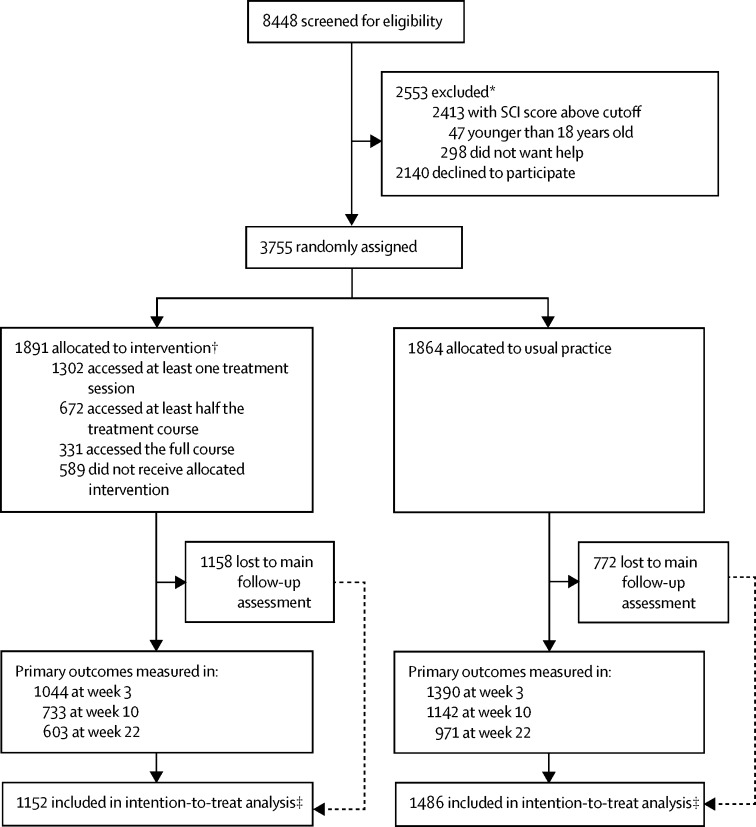
“In the intervention group, 1302 participants (69%) logged on for at least one treatment session, 953 (50%) accessed at least two sessions, 672 (36%) accessed at least three sessions, 497 (26%) accessed at least four sessions, 390 (21%) accessed at least five sessions, and 331 (18%) accessed six sessions (figure).”
§ The effects of improving sleep on mental health (OASIS): a randomised controlled trial with mediation analysis > Results
plainn = 1,302- Asserted: passes — The authors put it forward as true.
- Checkable: passes — It can be checked against evidence.
- Load-bearing: unclear — It is unclear whether the paper’s conclusions depend on it.
- Based: passes — The paper gives a reason why it holds.
It may state two separate claims as one.
A conclusion the paper draws from its own results — it cites no other source for it, so there is none to check. The quote shows it is in the paper.
In the paper
“Insomnia might not be the largest cause of psychotic experiences but it is not an epiphenomenon.”
§ The effects of improving sleep on mental health (OASIS): a randomised controlled trial with mediation analysis > Discussion
hedgedconditional- Asserted: passes — The authors put it forward as true.
- Checkable: passes — It can be checked against evidence.
- Load-bearing: passes — The paper’s conclusions depend on it.
- Based: passes — The paper gives a reason why it holds.
It may state two separate claims as one.
What the paper did — it cites no source for this, so there is none to check. The quote shows it is in the paper.
In the paper
“but the mediation analyses in this trial based on week 10 outcomes cannot fully capture the temporal order of changes or rule out reverse causation.”
§ The effects of improving sleep on mental health (OASIS): a randomised controlled trial with mediation analysis > Discussion
plain- Asserted: passes — The authors put it forward as true.
- Checkable: passes — It can be checked against evidence.
- Load-bearing: passes — The paper’s conclusions depend on it.
- Based: passes — The paper gives a reason why it holds.
It may state two separate claims as one.
A conclusion the paper draws from its own results — it cites no other source for it, so there is none to check. The quote shows it is in the paper.
In the paper
“Overall, this trial indicates the importance of sleep difficulties for mental health in the general population and the need for a reconsideration in clinical services of the priority given to improving sleep.”
§ The effects of improving sleep on mental health (OASIS): a randomised controlled trial with mediation analysis > Discussion
hedgedcorrelational- Asserted: passes — The authors put it forward as true.
- Checkable: fails — It may be too vague to check against evidence.
- Load-bearing: passes — The paper’s conclusions depend on it.
- Based: passes — The paper gives a reason why it holds.
Probably not a substantial claim. It may be too vague to check against evidence. It may state two separate claims as one.
A conclusion the paper draws from its own results — it cites no other source for it, so there is none to check. The quote shows it is in the paper.
In the paper
“In reality, it is difficult in a clinical trial to capture potential temporal changes between mediator and outcomes, since improvements in paranoia and hallucinations are likely to closely parallel the improvement in sleep.”
§ The effects of improving sleep on mental health (OASIS): a randomised controlled trial with mediation analysis > Discussion
hedgedcorrelational- Asserted: passes — The authors put it forward as true.
- Checkable: fails — It may be too vague to check against evidence.
- Load-bearing: passes — The paper’s conclusions depend on it.
- Based: passes — The paper gives a reason why it holds.
Probably not a substantial claim. It may be too vague to check against evidence.
The paper relies on this without support.
Usual practice is likely to mean receiving little or no treatment.
“usual care, which is likely to mean receiving little or no treatment”
“The amount of treatment input was likely to be minimal, with prescription of medication for a small proportion.”
The authors state this as an assumption.
The data are missing at random.
“The method has the advantage of implicitly accounting for data missing at random.”
The paper relies on this without support.
There are multiple, independent psychotic experiences.
“There are multiple, independent, psychotic experiences.”
The authors state this as an assumption.
The sleep treatment first changes the occurrence of insomnia.
“the causal argument rests on the plausible assumption that the sleep treatment first changes the occurrence of insomnia, since that was the topic of the intervention”
The paper relies on this without support.
A gap exists in mental health services regarding intervention for early, relatively non-specific presentations.
“a gap exists in mental health services regarding intervention for early, relatively non-specific presentations”
The paper relies on this without support.
Young people with incipient disorders might be very reluctant to seek help for psychiatric problems.
“Young people with incipient disorders might be very reluctant to seek help for psychiatric problems.”
The paper relies on this without support.
Trouble sleeping is a common complaint with little stigma.
“Trouble sleeping is a common complaint with little stigma.”
Claims other papers make about this one
Each is checked against this paper’s own text: does it say what the citing paper says it does?
The source backs part of the claim, not all of it — or backs it for a different population, condition or comparison.
In the citing paper
“The Japanese version of the WSAS has good internal consistency and construct validity [31].”
From Translated and culturally adapted internet-delivered cognitive therapy for social anxiety disorder in Japanese clinical settings: study protocol for a randomised controlled trial (2024) · cites this paper as [31]
Experimental — accuracy not yet measuredThe source backs part of the claim, not all of it — or backs it for a different population, condition or comparison.
In the citing paper
“Additionally, a role of poor sleep in severe mental disorders is suggested by a recent RCT showing that cognitive behavioral therapy for insomnia (CBT-I) significantly reduces the severity of hallucinations and paranoia in youth experiencing symptoms of psychosis 95 .”
From A meta-review of "lifestyle psychiatry": the role of exercise, smoking, diet and sleep in the prevention and treatment of mental disorders (2020) · cites this paper as [95]
Experimental — accuracy not yet measuredThe cited source says what the claim attributes to it.
In the citing paper
“A different working group could have created a different needs analysis and chosen a different treatment focus, change methods and practical applications (see for example the CRISIS-, the WIT- or the OASIS-study) (150–152).”
From Developing a mechanism-based therapy for acute psychiatric inpatients with psychotic symptoms: an Intervention Mapping approach (2023) · cites this paper as [152]
The cited source says what the claim attributes to it.
In the citing paper
“Overall, poor sleep appears to play an important part in the onset and aggravation of mental illness, and CBT-I may provide an attractive non-pharmacological option (which can also be delivered digitally) for improving sleep and other aspects of mental health 94-96 .”
From A meta-review of "lifestyle psychiatry": the role of exercise, smoking, diet and sleep in the prevention and treatment of mental disorders (2020) · cites this paper as [95]
In the citing paper
“treating insomnia improves psychotic experiences (Freeman et al., 2017)”
From Sleep duration and psychotic experiences in patients at risk of psychosis: a secondary analysis of the EDIE-2 trial (2019) · cites this paper as Freeman et al., 2017
In the citing paper
“Conversely, treating sleep disruption in students with insomnia lessens hallucinatory experiences, with over a third of the reduction in hallucinations attributable to improvements in insomnia. 3”
From Towards an Integrative Account of Potential Mechanisms Mediating the Path From Sleep Dysfunction to Hallucinations (2025) · cites this paper as [3]
In the citing paper
“Manipulation studies in non-clinical populations have since confirmed that sleep dysfunction is indeed a causal factor in the occurrence of hallucinatory experiences.”
From Towards an Integrative Account of Potential Mechanisms Mediating the Path From Sleep Dysfunction to Hallucinations (2025) · cites this paper as [3]
Self-check
Percentages, sums and reported differences re-computed from the paper’s own numbers.
Each contradiction between two passages listed here was confirmed by an independent check.
Rated minor: it would not touch a result — a value no result rests on, a p-value that stays on the same side of the significance level, or a conflict that is clerical, resolved elsewhere in the paper, or outside its own findings.
In the paper
§ The effects of improving sleep on mental health (OASIS): a randomised controlled trial with mediation analysis > Results
“−1·85 (−2·66 to 1·04)”
§ The effects of improving sleep on mental health (OASIS): a randomised controlled trial with mediation analysis > Results
“−1·85 (−2·66 to 1·04) | <0·0001”
Citations
Cites
Baron, R. M., & Kenny, D. A. (1986) · Journal of Personality and Social Psychology · doi:10.1037/0022-3514.51.6.1173 · Cited by 91,532
A Brief Measure for Assessing Generalized Anxiety Disorder: The GAD-7
Spitzer, R. L., Kroenke, K., Williams, J. B. W., & Löwe, B. (2006) · Archives of Internal Medicine · doi:10.1001/archinte.166.10.1092 · Cited by 31,765
Validation of the Insomnia Severity Index as an outcome measure for insomnia research
Bastien, C. (2001) · Sleep Medicine · doi:10.1016/s1389-9457(00)00065-4 · Cited by 8,067
The Warwick-Edinburgh Mental Well-being Scale (WEMWBS): development and UK validation
Tennant, R., Hiller, L., Fishwick, R., Platt, S., Joseph, S., Weich, S., Parkinson, J., Secker, J., & Stewart-Brown, S. (2007) · Health and Quality of Life Outcomes · doi:10.1186/1477-7525-5-63 · Cited by 5,031
Kroenke, K., Spitzer, R. L., Williams, J. B. W., & Löwe, B. (2010) · General Hospital Psychiatry · doi:10.1016/j.genhosppsych.2010.03.006 · Cited by 4,057
The Work and Social Adjustment Scale: a simple measure of impairment in functioning
Mundt, J. C., Marks, I. M., Shear, M. K., & Greist, J. M. (2002) · British Journal of Psychiatry · doi:10.1192/bjp.180.5.461 · Cited by 2,515
Qaseem, A., Kansagara, D., Forciea, M. A., Cooke, M., Denberg, T. D., & for the Clinical Guidelines Committee of the American College of Physicians* (2016) · Annals of Internal Medicine · doi:10.7326/m15-2175 · Cited by 1,965
Gueorguieva, R., & Krystal, J. H. (2004) · Archives of General Psychiatry · doi:10.1001/archpsyc.61.3.310 · Cited by 1,529
The Altman Self-Rating Mania Scale
Altman, E. G., Hedeker, D., Peterson, J. L., & Davis, J. M. (1997) · Biological Psychiatry · doi:10.1016/s0006-3223(96)00548-3 · Cited by 841
Zachariae, R., Lyby, M. S., Ritterband, L. M., & O'Toole, M. S. (2016) · Sleep Medicine Reviews · doi:10.1016/j.smrv.2015.10.004 · Cited by 704
Cited by
Sorted by citations
Firth, J., Solmi, M., Wootton, R. E., Vancampfort, D., Schuch, F. B., Hoare, E., Gilbody, S., Torous, J., Teasdale, S. B., Jackson, S. E., et al. (2020) · World Psychiatry · doi:10.1002/wps.20773 · Cited by 1,242
Importance of investing in adolescence from a developmental science perspective
Dahl, R. E., Allen, N. B., Wilbrecht, L., & Suleiman, A. B. (2018) · Nature · doi:10.1038/nature25770 · Cited by 1,196
Scott, A. J., Webb, T. L., Martyn-St James, M., Rowse, G., & Weich, S. (2021) · Sleep Medicine Reviews · doi:10.1016/j.smrv.2021.101556 · Cited by 1,094
Self-citationSleep disturbance and psychiatric disorders
Freeman, D., Sheaves, B., Waite, F., Harvey, A. G., & Harrison, P. J. (2020) · The Lancet Psychiatry · doi:10.1016/s2215-0366(20)30136-x · Cited by 843
Self-citationThe European Insomnia Guideline: An update on the diagnosis and treatment of insomnia 2023
Riemann, D., Espie, C. A., Altena, E., Arnardottir, E. S., Baglioni, C., Bassetti, C. L. A., Bastien, C., Berzina, N., Bjorvatn, B., Dikeos, D., et al. (2023) · Journal of Sleep Research · doi:10.1111/jsr.14035 · Cited by 834
Self-citationSleep and anxiety: From mechanisms to interventions
Chellappa, S. L., & Aeschbach, D. (2022) · Sleep Medicine Reviews · doi:10.1016/j.smrv.2021.101583 · Cited by 509
Espie, C. A., Emsley, R., Kyle, S. D., Gordon, C., Drake, C. L., Siriwardena, A. N., Cape, J., Ong, J. C., Sheaves, B., Foster, R., et al. (2019) · JAMA Psychiatry · doi:10.1001/jamapsychiatry.2018.2745 · Cited by 466
Self-citationSoh, H. L., Ho, R. C., Ho, C. S., & Tam, W. W. (2020) · Sleep Medicine · doi:10.1016/j.sleep.2020.08.020 · Cited by 482
Sleep Health: An Opportunity for Public Health to Address Health Equity
Hale, L. E., Troxel, W., & Buysse, D. J. (2020) · Annual Review of Public Health · doi:10.1146/annurev-publhealth-040119-094412 · Cited by 523
Harrer, M., Adam, S. H., Baumeister, H., Cuijpers, P., Karyotaki, E., Auerbach, R. P., Kessler, R. C., Bruffaerts, R., Berking, M., & Ebert, D. D. (2019) · International Journal of Methods in Psychiatric Research · doi:10.1002/mpr.1759 · Cited by 445
Insomnia disorder: State of the science and challenges for the future
Riemann, D. W., Benz, F., Dressle, R. J., Espie, C. A., Johann, A. F., Blanken, T. F., Leerssen, J., Wassing, R., Henry, A. L., Kyle, S. D., et al. (2022) · Journal of Sleep Research · doi:10.1111/jsr.13604 · Cited by 398
Self-citationWilson, S., Anderson, K., Baldwin, D., Dijk, D.-J., Espie, A., Espie, C., Gringras, P., Krystal, A., Nutt, D., Selsick, H., et al. (2019) · Journal of Psychopharmacology · doi:10.1177/0269881119855343 · Cited by 312
Self-citationEdinger, J. D., Arnedt, J. T., Bertisch, S. M., Carney, C. E., Harrington, J. J., Lichstein, K. L., Sateia, M. J., Troxel, W. M., Zhou, E. S., Kazmi, U., et al. (2021) · Journal of Clinical Sleep Medicine · doi:10.5664/jcsm.8988 · Cited by 309
Freeman, D. H., Loe, B. S., Kingdon, D., Startup, H. M., Molodynski, A., Rosebrock, L. E., Brown, P., Sheaves, B., Waite, F., & Bird, J. C. (2019) · Psychological Medicine · doi:10.1017/s0033291719003155 · Cited by 327
Self-citationSleep, circadian rhythms and health
Foster, R. G. (2020) · Interface Focus · doi:10.1098/rsfs.2019.0098 · Cited by 286
Gee, B., Orchard, F., Clarke, E., Joy, A., Clarke, T., & Reynolds, S. (2019) · Sleep Medicine Reviews · doi:10.1016/j.smrv.2018.09.004 · Cited by 212
Sleep duration, brain structure, and psychiatric and cognitive problems in children
Cheng, W., Rolls, E., Gong, W., Du, J., Zhang, J., Zhang, X.-Y., Li, F., & Feng, J. (2021) · Molecular Psychiatry · doi:10.1038/s41380-020-0663-2 · Cited by 196
The Promise of Sleep: A Multi-Sensor Approach for Accurate Sleep Stage Detection Using the Oura Ring
Altini, M., & Kinnunen, H. O. (2021) · Sensors · doi:10.3390/s21134302 · Cited by 208
Machine learning and big data in psychiatry: toward clinical applications
Rutledge, R. B., Chekroud, A. M., & Huys, Q. J. M. (2019) · Current Opinion in Neurobiology · doi:10.1016/j.conb.2019.02.006 · Cited by 206
Cheng, P., Luik, A. I., Fellman-Couture, C., Peterson, E. L., Joseph, C. L. M., Tallent, G., Tran, K. M., Ahmedani, B. K., Roehrs, T., Roth, T. G., et al. (2018) · Psychological Medicine · doi:10.1017/s0033291718001113 · Cited by 192
Self-citationSleep disorders in early psychosis: incidence, severity, and association with clinical symptoms
Reeve, S., Sheaves, B., & Freeman, D. (2019) · Schizophrenia Bulletin · doi:10.1093/schbul/sby129 · Cited by 182
Atypical interoception as a common risk factor for psychopathology: A review
Brewer, R., Murphy, J., & Bird, G. (2021) · Neuroscience & Biobehavioral Reviews · doi:10.1016/j.neubiorev.2021.07.036 · Cited by 180
Sleep patterns and insomnia in young adults: A national survey of Norwegian university students
Sivertsen, B., Vedaa, Ø., Harvey, A. G., Glozier, N., Pallesen, S., Aarø, L. E., Lønning, K. J., & Hysing, M. (2019) · Journal of Sleep Research · doi:10.1111/jsr.12790 · Cited by 177
Orchard, F., Gregory, A. M., Gradisar, M., & Reynolds, S. (2020) · Journal of Child Psychology and Psychiatry · doi:10.1111/jcpp.13288 · Cited by 175
Self-citationSleep problem, suicide and self-harm in university students: A systematic review
Russell, K., Allan, S., Beattie, L., Bohan, J., Macmahon, K., & Rasmussen, S. A. (2019) · Sleep Medicine Reviews · doi:10.1016/j.smrv.2018.12.008 · Cited by 195
Self-citationSleep Quality, Mental and Physical Health: A Differential Relationship
Clement-Carbonell, V., Portilla-Tamarit, I., Rubio-Aparicio, M., & Madrid-Valero, J. J. (2021) · International Journal of Environmental Research and Public Health · doi:10.3390/ijerph18020460 · Cited by 175
A randomized controlled trial of digital cognitive behavioral therapy for insomnia in pregnant women
Kalmbach, D. A., Cheng, P., O'Brien, L. M., Swanson, L. M., Sangha, R., Sen, S., Guille, C., Cuamatzi-Castelan, A., Henry, A. L., Roth, T., et al. (2020) · Sleep Medicine · doi:10.1016/j.sleep.2020.03.016 · Cited by 154
Introduction of digital therapeutics
Hong, J. S., Wasden, C. L., & Han, D. H. (2021) · Computer Methods and Programs in Biomedicine · doi:10.1016/j.cmpb.2021.106319 · Cited by 163
Staines, L., Healy, C., Coughlan, H., Clarke, M. C., Kelleher, I., Cotter, D., & Cannon, M. D. (2022) · Psychological Medicine · doi:10.1017/s0033291722002550 · Cited by 185
Cheng, P., Kalmbach, D. A., Tallent, G., Joseph, C. L. M., Espie, C. A., & Drake, C. L. (2019) · SLEEP · doi:10.1093/sleep/zsz150 · Cited by 166
Self-citationBrown, L., & Kuss, D. J. (2020) · International Journal of Environmental Research and Public Health · doi:10.3390/ijerph17124566 · Cited by 201
Sleep and schizophrenia: From epiphenomenon to treatable causal target
Waite, F., Sheaves, B., Isham, L., Reeve, S., & Freeman, D. H. (2019) · Schizophrenia Research · doi:10.1016/j.schres.2019.11.014 · Cited by 165
Self-citationGao, C., & Scullin, M. K. (2020) · Sleep Medicine · doi:10.1016/j.sleep.2020.06.032 · Cited by 147
The Evolving Nexus of Sleep and Depression
Plante, D. T. (2021) · American Journal of Psychiatry · doi:10.1176/appi.ajp.2021.21080821 · Cited by 152
Meyer, N., Faulkner, S., McCutcheon, R. A., Pillinger, T., Dijk, D., & MacCabe, J. H. (2020) · Schizophrenia Bulletin · doi:10.1093/schbul/sbaa024 · Cited by 146
Reinertsen, E., & Clifford, G. D. (2018) · Physiological Measurement · doi:10.1088/1361-6579/aabf64 · Cited by 136
Hasan, F., Tu, Y.-K., Yang, C.-M., James Gordon, C., Wu, D., Lee, H.-C., Yuliana, L. T., Herawati, L., Chen, T.-J., & Chiu, H.-Y. (2022) · Sleep Medicine Reviews · doi:10.1016/j.smrv.2021.101567 · Cited by 137
Treatable clinical intervention targets for patients with schizophrenia
Freeman, D., Taylor, K. M., Molodynski, A., & Waite, F. (2019) · Schizophrenia Research · doi:10.1016/j.schres.2019.07.016 · Cited by 125
Self-citationReeve, S., Emsley, R., Sheaves, B., & Freeman, D. (2017) · Schizophrenia Bulletin · doi:10.1093/schbul/sbx103 · Cited by 131
Self-citationJuul, S., Gluud, C., Simonsen, S., Frandsen, F. W., Kirsch, I., & Jakobsen, J. C. (2021) · BMJ Evidence-Based Medicine · doi:10.1136/bmjebm-2020-111407 · Cited by 135
Simon, L., Steinmetz, L., Feige, B., Benz, F., Spiegelhalder, K., & Baumeister, H. (2023) · Scientific Reports · doi:10.1038/s41598-023-28853-0 · Cited by 145
Associations of health-behavior patterns, mental health and self-rated health
Oftedal, S., Kolt, G. S., Holliday, E. G., Stamatakis, E. A., Vandelanotte, C., Brown, W. J., & Duncan, M. J. (2018) · Preventive Medicine · doi:10.1016/j.ypmed.2018.11.017 · Cited by 122
Telecommunication devices use, screen time and sleep in adolescents
Cabré-Riera, A., Torrent, M., Donaire-Gonzalez, D., Vrijheid, M., Cardis, E., & Guxens, M. (2019) · Environmental Research · doi:10.1016/j.envres.2018.10.036 · Cited by 115
Sleep Abnormalities in Schizophrenia: State of the Art and Next Steps
Ferrarelli, F. (2021) · American Journal of Psychiatry · doi:10.1176/appi.ajp.2020.20070968 · Cited by 125
Vedaa, Ø., Kallestad, H., Scott, J. L., Smith, O. R. F., Pallesen, S., Morken, G., Langsrud, K., Gehrman, P., Thorndike, F. P., Ritterband, L. M., et al. (2020) · The Lancet Digital Health · doi:10.1016/s2589-7500(20)30135-7 · Cited by 118
Salfi, F., Lauriola, M., Amicucci, G., Corigliano, D., Viselli, L., Tempesta, D., & Ferrara, M. (2020) · Neurobiology of Stress · doi:10.1016/j.ynstr.2020.100259 · Cited by 119
Thoma, M. V., Rohleder, N., & Rohner, S. L. (2021) · Frontiers in Psychiatry · doi:10.3389/fpsyt.2021.675936 · Cited by 117
A cluster randomized controlled trial of a theory-based sleep hygiene intervention for adolescents
Lin, C., Strong, C., Scott, A. J., Broström, A., Pakpour, A. H., & Webb, T. L. (2018) · SLEEP · doi:10.1093/sleep/zsy170 · Cited by 122
Faulkner, S., Bee, P., Meyer, N., Dijk, D., & Drake, R. (2019) · Sleep Medicine Reviews · doi:10.1016/j.smrv.2019.04.012 · Cited by 111
Disrupted sleep and circadian rhythms in schizophrenia and their interaction with dopamine signaling
Ashton, A., & Jagannath, A. (2020) · Frontiers in Neuroscience · doi:10.3389/fnins.2020.00636 · Cited by 106
Hypnotic drug risks of mortality, infection, depression, and cancer: but lack of benefit
Kripke, D. F. (2016) · F1000Research · doi:10.12688/f1000research.8729.1 · Cited by 106
Sheaves, B., Freeman, D., Isham, L., McInerney, J., Nickless, A., Yu, L.-M., Rek, S., Bradley, J., Reeve, S., Attard, C., et al. (2018) · Psychological Medicine · doi:10.1017/s0033291717003191 · Cited by 104
“The average age was 40 years, similar to other studies recruiting those with severe mental illnesses (Freeman et al. 2015; Harvey et al. 2015).”
InfluentialSelf-citationSleep disturbances in schizophrenia spectrum and bipolar disorders – a transdiagnostic perspective
Laskemoen, J. F., Simonsen, C., Büchmann, C. B., Barrett, E. A., Bjella, T. D., Lagerberg, T. V., Vedal, T. S. J., Andreassen, O. A., Melle, I. S., & Aas, M. (2019) · Comprehensive Psychiatry · doi:10.1016/j.comppsych.2019.02.006 · Cited by 105
Zhou, T., Yuan, Y. L., Xue, Q., Li, X., Wang, M., Ma, H., Heianza, Y., & Qi, L. (2021) · Journal of Internal Medicine · doi:10.1111/joim.13367 · Cited by 95
Lee, S., Oh, J. W., Park, K., Lee, E. M., & Lee, E. M. (2023) · npj Digital Medicine · doi:10.1038/s41746-023-00800-3 · Cited by 104
Perioperative Sleep Disorder: A Review
Lin, D., Huang, X. D., Sun, Y., Wei, C., & Wu, A. (2021) · Frontiers in Medicine · doi:10.3389/fmed.2021.640416 · Cited by 94
Kyle, S. D., Hurry, M. E. D., Emsley, R., Marsden, A., Omlin, X., Juss, A., Spiegelhalder, K., Bisdounis, L., Luik, A. I., Espie, C. A., et al. (2020) · SLEEP · doi:10.1093/sleep/zsaa034 · Cited by 85
Self-citationRecent Developments in Digital Mental Health Interventions for College and University Students
Becker, T. D., & Torous, J. B. (2019) · Current Treatment Options in Psychiatry · doi:10.1007/s40501-019-00178-8 · Cited by 67
Barrera, A., Gee, C., Wood, A., Gibson, O., Bayley, D., & Geddes, J. (2020) · Evidence-Based Mental Health · doi:10.1136/ebmental-2019-300136 · Cited by 79
Sin, J., Galeazzi, G. M., McGregor, E., Collom, J., Taylor, A. F., Barrett, B. M., Lawrence, V. C., & Henderson, C. (2020) · Journal of Medical Internet Research · doi:10.2196/20581 · Cited by 83
Salfi, F., Amicucci, G., Corigliano, D., D’Atri, A., Viselli, L., Tempesta, D., & Ferrara, M. (2021) · SLEEP · doi:10.1093/sleep/zsab080 · Cited by 79
Treating sleep problems in young people at ultra-high risk of psychosis: a feasibility case series
Bradley, J., Freeman, D., Chadwick, E., Harvey, A. G., Mullins, B., Johns, L., Sheaves, B., Lennox, B., Broome, M., & Waite, F. (2018) · Behavioural and Cognitive Psychotherapy · doi:10.1017/s1352465817000601 · Cited by 78
Self-citationBaiden, P., Tadeo, S. K., & Peters, K. E. (2019) · Psychiatry Research · doi:10.1016/j.psychres.2019.112586 · Cited by 93
Abiddine, F. Z. E., Aljaberi, M. A. A., Gadelrab, H. F., Lin, C., & Muhammed, A. (2022) · Sleep Epidemiology · doi:10.1016/j.sleepe.2022.100030 · Cited by 80
Kalmbach, D. A., Cheng, P., Ahmedani, B. K., Peterson, E. L., Reffi, A. N., Sagong, C., Seymour, G. M., Ruprich, M. K., & Drake, C. L. (2022) · Sleep · doi:10.1093/sleep/zsac251 · Cited by 79
Adolescent sleep and the foundations of prefrontal cortical development and dysfunction
Anastasiades, P. G., de Vivo, L., Bellesi, M., & Jones, M. W. (2022) · Progress in Neurobiology · doi:10.1016/j.pneurobio.2022.102338 · Cited by 89
Meaklim, H., Junge, M. F., Varma, P., Finck, W. A., & Jackson, M. L. (2021) · Journal of Clinical Sleep Medicine · doi:10.5664/jcsm.9354 · Cited by 74
Adolescent Paranoia: Prevalence, Structure, and Causal Mechanisms
Bird, J. C., Evans, R., Waite, F., Loe, B. S., & Freeman, D. H. (2018) · Schizophrenia Bulletin · doi:10.1093/schbul/sby180 · Cited by 75
Self-citationCho, C.-H., Lee, T., Lee, J.-B., Seo, J. Y., Jee, H.-J., Son, S., An, H., Kim, L., & Lee, H.-J. (2020) · doi:10.2196/preprints.21283 · Cited by 69
Reeve, S., Nickless, A., Sheaves, B., & Freeman, D. (2018) · Psychiatry Research · doi:10.1016/j.psychres.2018.08.090 · Cited by 69
Self-citationFoulkes, L., McMillan, D., & Gregory, A. M. (2019) · Sleep Health · doi:10.1016/j.sleh.2019.01.003 · Cited by 77
Self-citationIdentification of Digital Health Priorities for Palliative Care Research: Modified Delphi Study
Nwosu, A. C., McGlinchey, T., Sanders, J. J., Stanley, S., Palfrey, J., Lubbers, P., Chapman, L., Finucane, A., & Mason, S. R. (2021) · JMIR Aging · doi:10.2196/32075 · Cited by 68
The Importance of Sleep for People With Chronic Pain: Current Insights and Evidence
Whale, K., & Gooberman‐Hill, R. (2022) · JBMR Plus · doi:10.1002/jbm4.10658 · Cited by 72
Mental Health During the First Weeks of the COVID-19 Pandemic in the United States
Killgore, W. D. S., Cloonan, S. A., Taylor, E. C., & Dailey, N. S. (2021) · Frontiers in Psychiatry · doi:10.3389/fpsyt.2021.561898 · Cited by 83
Fear and Trembling of Cruise Ship Employees: Psychological Effects of the COVID-19 Pandemic
Radić, A., Lück, M., Ariza‐Montes, A., & Han, H. (2020) · International Journal of Environmental Research and Public Health · doi:10.3390/ijerph17186741 · Cited by 76
Darden, M., Espie, C. A., Carl, J. R., Henry, A. L., Kanady, J. C., Krystal, A. D., & Miller, C. B. (2020) · SLEEP · doi:10.1093/sleep/zsaa223 · Cited by 71
Self-citationOwen, J. E., Kuhn, E. R., Jaworski, B. K., McGee-Vincent, P. A., Juhasz, K. M., Hoffman, J. E., & Rosen, C. S. (2018) · mHealth · doi:10.21037/mhealth.2018.05.07 · Cited by 67
Sleep characteristics of U.S. adults before and during the COVID-19 pandemic
Hisler, G. C., & Twenge, J. M. (2021) · Social Science & Medicine · doi:10.1016/j.socscimed.2021.113849 · Cited by 68
The Safety of Digital Mental Health Interventions: Systematic Review and Recommendations
Taher, R., Hsu, C.-W., Hampshire, C., Fialho, C., Heaysman, C., Stahl, D., Shergill, S., & Yiend, J. (2023) · JMIR Mental Health · doi:10.2196/47433 · Cited by 68
Digital Delivery of Cognitive Behavioral Therapy for Insomnia
Luik, A. I., van der Zweerde, T., van Straten, A., & Lancee, J. (2019) · Current Psychiatry Reports · doi:10.1007/s11920-019-1041-0 · Cited by 72
Self-citationWainberg, M., Jones, S. E., Beaupre, L. M., Hill, S. L., Felsky, D., Rivas, M. A., Lim, A. S. P., Ollila, H. M., & Tripathy, S. J. (2021) · PLOS Medicine · doi:10.1371/journal.pmed.1003782 · Cited by 64
Self-citationCzeisler, M. É., Howard, M. E., & Rajaratnam, S. M. W. (2021) · American Journal of Health Promotion · doi:10.1177/0890117120983982b · Cited by 68
Yao, N., & Wang, Q. (2022) · The Asia-Pacific Education Researcher · doi:10.1007/s40299-022-00654-5 · Cited by 86
Henry, A. L., Miller, C. B., Emsley, R., Sheaves, B., Freeman, D. H., Luik, A. I., Littlewood, D. L., Saunders, K. E. A., Kanady, J. C., Carl, J. R., et al. (2020) · Journal of Sleep Research · doi:10.1111/jsr.13140 · Cited by 63
Self-citationCheng, P., Kalmbach, D. A., Castelan, A. C., Murugan, N., & Drake, C. L. (2020) · Journal of Affective Disorders · doi:10.1016/j.jad.2020.03.184 · Cited by 65
Espie, C. A., Pawlecki, B., Waterfield, D., Fitton, K., Radocchia, M., & Luik, A. I. (2018) · Sleep Health · doi:10.1016/j.sleh.2018.03.003 · Cited by 62
Self-citationVedaa, Ø., Erevik, E. K., Hysing, M., Hayley, A. C., & Sivertsen, B. (2019) · Sleep Medicine X · doi:10.1016/j.sleepx.2019.100005 · Cited by 61
Amicucci, G., Salfi, F., D’Atri, A., Viselli, L., & Ferrara, M. (2021) · Brain Sciences · doi:10.3390/brainsci11101336 · Cited by 66
Cliffe, B., Croker, A., Denne, M., Smith, J., & Stallard, P. (2020) · JMIR Mental Health · doi:10.2196/14842 · Cited by 56
Denis, D., Eley, T. C., Rijsdijk, F. V., Zavos, H. M. S., Keers, R., Espie, C. A., Luik, A. I., Badini, I., Derveeuw, S., Hodsoll, J. P., et al. (2019) · Sleep Medicine · doi:10.1016/j.sleep.2019.10.007 · Cited by 61
Self-citationMuzni, K., Groeger, J. A., Dijk, D., & Lázár, A. S. (2020) · Journal of Sleep Research · doi:10.1111/jsr.13152 · Cited by 74
Meyer, N., Kerz, M., Folarin, A., Joyce, D. W., Jackson, R., Karr, C., Dobson, R., & MacCabe, J. (2018) · JMIR mHealth and uHealth · doi:10.2196/mhealth.8292 · Cited by 58
Sleep disturbance as a therapeutic target to improve opioid use disorder treatment.
Huhn, A. S., & Finan, P. H. (2021) · Experimental and Clinical Psychopharmacology · doi:10.1037/pha0000477 · Cited by 60
Sheaves, B., Rek, S. V., & Freeman, D. H. (2022) · Clinical Psychology Review · doi:10.1016/j.cpr.2022.102241 · Cited by 59
Self-citationUnderstanding how health interventions or exposures produce their effects using mediation analysis
Cashin, A. G., McAuley, J. H., VanderWeele, T. J., & Lee, H. (2023) · BMJ · doi:10.1136/bmj-2022-071757 · Cited by 56
Sleep duration and mental health in young adults.
Vestergaard, C., Skogen, J., Hysing, M., Harvey, A. G., Vedaa, Ø., & Sivertsen, B. (2024) · Sleep Medicine · doi:10.1016/j.sleep.2024.01.021 · Cited by 59
A systematic review of self-report measures of paranoia.
Statham, V., Emerson, L., & Rowse, G. (2018) · Psychological Assessment · doi:10.1037/pas0000645 · Cited by 62
Self-citationmHealth for schizophrenia spectrum disorders management: A systematic review
Chivilgina, O., Wangmo, T., Elger, B. S., Heinrich, T. W., & Jotterand, F. (2020) · International Journal of Social Psychiatry · doi:10.1177/0020764020933287 · Cited by 58
Belief Updating and Paranoia in Individuals With Schizophrenia
Sheffield, J. M., Suthaharan, P., Leptourgos, P., & Corlett, P. R. (2022) · Biological Psychiatry Cognitive Neuroscience and Neuroimaging · doi:10.1016/j.bpsc.2022.03.013 · Cited by 57
Sheaves, B., Holmes, E. A., Rek, S. V., Taylor, K. M., Nickless, A., Waite, F., Germain, A., Espie, C. A., Harrison, P. J., Foster, F., et al. (2019) · The Canadian Journal of Psychiatry · doi:10.1177/0706743719847422 · Cited by 55
Self-citation
Metadata
- Authors
- Freeman, D., Sheaves, B., Goodwin, G. M., Yu, L.-M., Nickless, A., Harrison, P. J., Emsley, R., Luik, A. I., Foster, R. G., Wadekar, V., Hinds, C., Gumley, A., Jones, R., Lightman, S., Jones, S., Bentall, R., Kinderman, P., Rowse, G., Brugha, T., Blagrove, M., Gregory, A. M., Fleming, L., Walklet, E., Glazebrook, C., Davies, E. B., Hollis, C., Haddock, G., John, B., Coulson, M., Fowler, D., Pugh, K., Cape, J., Moseley, P., Brown, G., Hughes, C., Obonsawin, M., Coker, S., Watkins, E., Schwannauer, M., MacMahon, K., Siriwardena, A. N., & Espie, C. A.
- Affiliations
- National Health Service (GB)
- University of Oxford (GB)
- Manchester Academic Health Science Centre (GB)
- Warneford Hospital (GB)
- Gartnavel General Hospital (GB)
- University of Plymouth (GB)
- University of Bristol (GB)
- University of Sheffield (GB)
- University of Liverpool (GB)
- University of Leicester (GB)
- Swansea University (GB)
- Goldsmiths University of London (GB)
- University of Strathclyde (GB)
- University of Worcester (GB)
- University of Nottingham (GB)
- University of Manchester (GB)
- University of South Wales (GB)
- Middlesex University London (GB)
- University of Sussex (GB)
- Sussex Partnership NHS Foundation Trust (GB)
- University College London (GB)
- University of Lancashire (GB)
- Royal Holloway University of London (GB)
- University of Cambridge (GB)
- University of Exeter (GB)
- University of Edinburgh (GB)
- University of Lincoln (GB)
- Corresponding author
- Freeman, Daniel
- ORCID
- Freeman, Daniel
- Sheaves, Bryony
- Goodwin, Guy M
- Yu, Ly-Mee
- Nickless, Alecia
- Harrison, Paul J
- Emsley, Richard
- Luik, Annemarie I
- Gumley, Andrew
- Jones, Ray
- Lightman, Stafford
- Bentall, Richard
- Kinderman, Peter
- Rowse, Georgina
- Brugha, Traolach
- Blagrove, Mark
- Gregory, Alice M
- Fleming, Leanne
- Glazebrook, Cris
- Davies, E Bethan
- Hollis, Chris
- Haddock, Gillian
- John, Bev
- Coulson, Mark
- Fowler, David
- Cape, John
- Moseley, Peter
- Brown, Gary
- Hughes, Claire
- Obonsawin, Marc
- Watkins, Edward
- Schwannauer, Matthias
- MacMahon, Kenneth
- Siriwardena, A Niroshan
- Espie, Colin A
- Venue
- The Lancet Psychiatry
- Publisher
- Elsevier BV
- Published
- 2017-10
- Volume
- 4
- Issue
- 10
- Pages
- 749-758
- ISSN
- 2215-0366 (ISSN-L)
- PMC
- PMC5614772
- OpenAlex
- W2753665614
- Semantic Scholar
- 797208a87ff04f1f341f2798f7ab7f8db93086ba
- Cited by
- 652
- References
- 38
- Citations by year
- 2026: 53 · 2025: 68 · 2024: 73 · 2023: 80 · 2022: 83 · 2021: 98 · 2020: 83 · 2019: 55 · 2018: 46 · 2017: 11
- FWCI
- 69.44
- Type
- journal article
- Language
- en
- Open access
- hybrid
- doi.org
- Locations
- The Lancet Psychiatry (publishedVersion, cc-by)
- Europe PMC (PubMed Central) (publishedVersion, cc-by)
- PubMed Central (publishedVersion, cc-by)
- PubMed (publishedVersion)
- Open Research Exeter (University of Exeter) (publishedVersion, cc-by)
- CLOK (University of Central Lancashire) (acceptedVersion)
- ENLIGHTEN (Jurnal Bimbingan dan Konseling Islam) (acceptedVersion)
- Research Repository (University of Gloucestershire) (acceptedVersion)
- Goldsmiths (University of London) (acceptedVersion)
- Lincoln Repository (University of Lincoln) (acceptedVersion)
- White Rose Research Online (University of Leeds, The University of Sheffield, University of York) (acceptedVersion)
- Northumbria Research Link (Northumbria University) (acceptedVersion)
- Strathprints: The University of Strathclyde institutional repository (University of Strathclyde) (acceptedVersion)
- UEA Digital Repository (University of East Anglia) (acceptedVersion)
- Leicester Research Archive (University of Leicester) (acceptedVersion, other-oa)
- Research Repository (University of Gloucestershire) (submittedVersion, other-oa)
- Explore Bristol Research (submittedVersion, cc-by)
- Sussex Research Online (University of Sussex) (submittedVersion, cc-by)
- Worcester Research and Publications (University of Worcester) (submittedVersion)
- Lancaster EPrints (Lancaster University) (submittedVersion)
- Figshare (submittedVersion, cc-by)
- Figshare (submittedVersion)
- Research Portal (King's College London) (submittedVersion, cc-by)
- PEARL (University of Plymouth) (submittedVersion)
- Research Explorer (The University of Manchester) (submittedVersion, cc-by)
- Edinburgh Research Explorer (University of Edinburgh) (submittedVersion, cc-by)
- Bristol Research (University of Bristol) (submittedVersion, cc-by)
- Funders
- Wellcome Trust (098461/Z/12/Z)
- National Institute for Health and Care Research (RP-2014-05-003, NF-SI-0514-10119)
- University of Oxford
- Topics
- Social Sciences › Psychology › Experimental and Cognitive Psychology › Sleep and related disorders
- Social Sciences › Psychology › Applied Psychology › Digital Mental Health Interventions
- Social Sciences › Psychology › Clinical Psychology › COVID-19 and Mental Health
- Keywords
- insomnia, cognitive behavioral therapy for insomnia, paranoia, hallucinations, psychotic experiences, sleep disruption, university students, mental health, mediation analysis, digital psychological interventions
- MeSH terms
- Adolescent, Adult, Female, United Kingdom, Hallucinations, Humans, Sleep Initiation and Maintenance Disorders, Male, Mental Health, Paranoid Disorders, Sleep, Students, Cognitive Behavioral Therapy, Treatment Outcome, Young Adult
About these checks
Registry, retraction, Cites and statistics results are computed, not judged, with one exception: a printed reference that no index lists is read once by a model before it counts as a citation error. Claims are extracted by a model and kept only when their quote appears verbatim in the text; each cited source is then checked, with a model’s help, for whether it says what the claim relies on. Those verdicts can be wrong — read the claim’s quote and the cited source before relying on one.
A language model drew the claims from the paper on 2026-10-09, under version 3 of the claim definition (model deepseek-v4.1-flash, prompt extract-v3).
A second model labelled each claim on 2026-10-09 (model jev-1.13-20260917, definition revision gold-guideline-v0.2).
Cited sources are checked with a language model’s help (gpt-6-sol).
Statistics and arithmetic are recomputed, not judged.
Confidence bands are shown only for fields calibrated on our annotated test set. None is calibrated yet, so no band is shown.
What counts as a claim ›How we measure confidence ›How we check this ›
Are you an author, or do you see a problem with this page? Request a review
