

Algorithm aversion: People erroneously avoid algorithms after seeing them err.
Open accessThe DOI matches its Crossref record; 23 of the 23 references it cites were found in a registry or an index; none of the 22 sources its claims cite is checked for support yet.
Abstract
Research shows that evidence-based algorithms more accurately predict the future than do human forecasters. Yet when forecasters are deciding whether to use a human forecaster or a statistical algorithm, they often choose the human forecaster. This phenomenon, which we call algorithm aversion, is costly, and it is important to understand its causes. We show that people are especially averse to algorithmic forecasters after seeing them perform, even when they see them outperform a human forecaster. This is because people more quickly lose confidence in algorithmic than human forecasters after seeing them make the same mistake. In 5 studies, participants either saw an algorithm make forecasts, a human make forecasts, both, or neither. They then decided whether to tie their incentives to the future predictions of the algorithm or the human. Participants who saw the algorithm perform were less confident in it, and less likely to choose it over an inferior human forecaster. This was true even among those who saw the algorithm outperform the human.
Overview
CoChat Summary
TL;DR
People become less willing to use a statistical algorithm after seeing it perform and make mistakes, even when it outperforms a human forecaster. This “algorithm aversion” is driven partly by people losing confidence in algorithms more quickly than in humans after observing errors.
Key findings
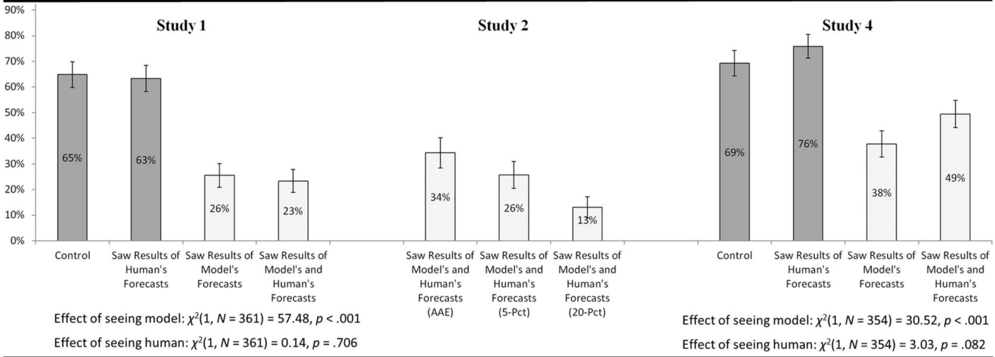
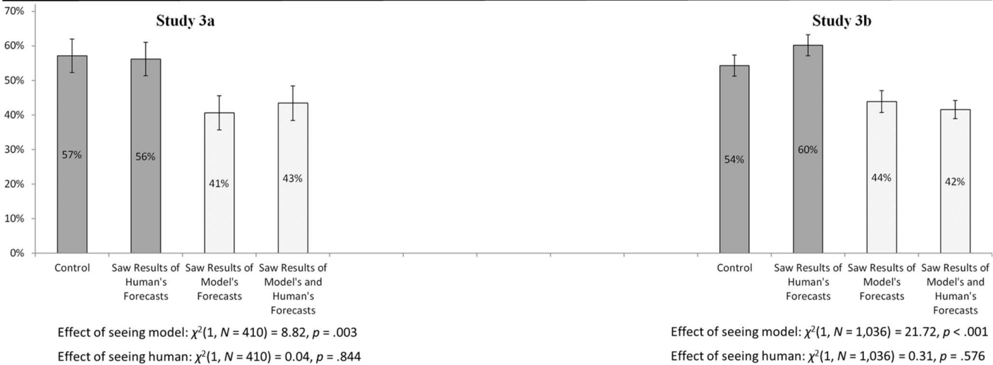
- Across five studies, seeing the algorithm perform reduced participants’ likelihood of choosing it over a human forecaster. In the model-and-human conditions, 610 of 741 participants (83%) saw the model outperform the human, yet these participants were among the least likely to choose the model.
- The model outperformed humans in all five studies. For example, bonuses if choosing model vs. human were Study 1: $1.78 vs. $1.38; Study 2: $1.77 vs. $1.09; Study 3a: $0.48 vs. $0.31; Study 3b: $0.49 vs. $0.30; Study 4: $1.79 vs. $1.38. Human forecasters produced 15–29% more error in the MBA task and 90–97% more error in the airline-passenger task.
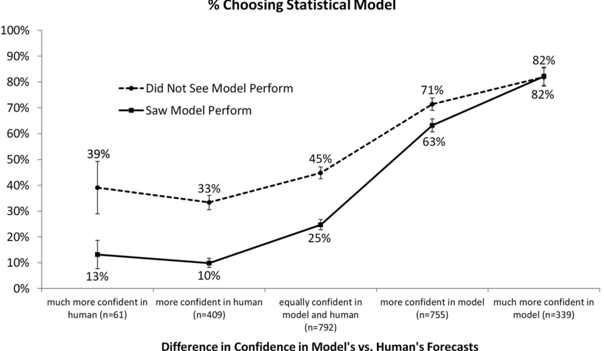
- Seeing the model perform significantly decreased confidence in the model’s forecasts in all four studies where this was tested, whereas seeing the human perform significantly decreased confidence in the human only in Study 4. Confidence in the model’s forecasts significantly mediated the effect of seeing the model perform on choosing the model; confidence in the human did not.
- In Study 2, participants paid for forecasts within 20 percentiles were less likely to choose the model than those paid within 5 percentiles, χ²(1, N = 139) = 3.56, p = .059, and those paid by average absolute error, χ²(1, N = 136) = 8.56, p = .003; this effect was mediated by confidence in their own forecasts, not confidence in the model’s forecasts.
Methods
- Five studies had participants forecast real outcomes: MBA student success (Studies 1, 2, and 4) or U.S. state rank in airline passengers (Studies 3a and 3b). Participants were assigned to control, human, model, or model-and-human conditions, then chose whether to tie incentivized bonuses to the model or the human forecaster (themselves in Studies 1–3, another participant in Study 4).
- Final samples were Study 1: 361; Study 2: 206; Study 3a: 410; Study 3b: 1,036; Study 4: 354. Studies 1, 2, and 4 were run in the Wharton Behavioral Lab; Studies 3a and 3b used Amazon Mechanical Turk.
- Main analyses compared forecasting performance and choice rates, measured confidence and beliefs, and used binary mediation analyses with Preacher and Hayes’s bootstrapping procedure.
Limitations
- The paper states it did not explore all boundaries of the effect, including whether it would persist if algorithms were many times more accurate than humans, and whether results depend on features shared by the two forecasting tasks.
- The paper states it did not explore how algorithm variations—complexity, transparency, forecaster involvement in construction, and designer expertise—affect algorithm aversion.
- The paper states algorithm aversion is not entirely driven by seeing algorithms err, and it has little to say about how best to reduce aversion among those who have seen an algorithm err. The text also cautions that cross-experiment comparisons should be made cautiously.
Model-written summary. Check it against the paper before relying on it.
Integrity signals
Registry
Cites
Statistics
Figures
Verification
Claims the paper makes
0 Valid · 2 Not valid · 16 Not checked · 90 Own results and interpretations
A result the paper reports from its own data — it cites no other source for it, so there is none to check. The quote shows it is in the paper.
In the paper
“the majority of people who were equally confident in the model's and human's forecasts chose to tie their bonuses to the human's forecasts, particularly when they had seen the model perform.”
plainstates an association- Asserted: passes — The authors put it forward as true.
- Checkable: passes — It can be checked against evidence.
- Load-bearing: passes — The paper’s conclusions depend on it.
- Based: passes — The paper gives a reason why it holds.
A result the paper reports from its own data — it cites no other source for it, so there is none to check. The quote shows it is in the paper.
In the paper
“Consistent with research on the adoption of decision aids (see Highhouse, 2008), participants thought that the human forecasters were better than the model at getting better with practice, learning from mistakes, and finding underappreciated candidates.”
plain- Asserted: passes — The authors put it forward as true.
- Checkable: passes — It can be checked against evidence.
- Load-bearing: passes — The paper’s conclusions depend on it.
- Based: passes — The paper gives a reason why it holds.
A result the paper reports from its own data — it cites no other source for it, so there is none to check. The quote shows it is in the paper.
In the paper
“Our studies show that this resistance at least partially arises from greater intolerance for error from algorithms than from humans.”
plainstates a possible cause- Asserted: passes — The authors put it forward as true.
- Checkable: passes — It can be checked against evidence.
- Load-bearing: passes — The paper’s conclusions depend on it.
- Based: passes — The paper gives a reason why it holds.
A result the paper reports from its own data — it cites no other source for it, so there is none to check. The quote shows it is in the paper.
In the paper
“Participants rightfully thought that the model was better than human forecasters at avoiding obvious mistakes, appropriately weighing various attributes, and consistently weighing information.”
plain- Asserted: passes — The authors put it forward as true.
- Checkable: passes — It can be checked against evidence.
- Load-bearing: unclear — It is unclear whether the paper’s conclusions depend on it.
- Based: passes — The paper gives a reason why it holds.
A result the paper reports from its own data — it cites no other source for it, so there is none to check. The quote shows it is in the paper.
In the paper
“This effect was evident in two distinct domains of judgment, including one in which the human forecasters produced nearly twice as much error as the algorithm.”
plain- Asserted: passes — The authors put it forward as true.
- Checkable: passes — It can be checked against evidence.
- Load-bearing: unclear — It is unclear whether the paper’s conclusions depend on it.
- Based: passes — The paper gives a reason why it holds.
75 more claims
Create a free account to see all 108 claims and to verify the 12 references still open.
- It may state two separate claims as one. 13
- Probably not a substantial claim. 16
Claims other papers make about this one
Each is checked against this paper’s own text: does it say what the citing paper says it does?
The source backs part of the claim, not all of it — or backs it for a different population, condition or comparison.
In the citing paper
“Traditional theorizing assumes trade-offs between trust and skepticism (Dietvorst et al., 2015), automation and engagement (Freeman et al., 2014), or efficiency and depth (Ishowo-Oloko et al., 2019)”
From Pedagogical partnerships with generative AI in higher education: how dual cognitive pathways paradoxically enable transformative learning (2026) · cites this paper as Dietvorst et al., 2015
Experimental — accuracy not yet measuredThe source backs part of the claim, not all of it — or backs it for a different population, condition or comparison.
In the citing paper
“Existing research typically examines trust versus skepticism in human-AI interactions as binary constructs (Dietvorst et al., 2015; Logg et al., 2019), missing the possibility that partnerships might simultaneously activate both vigilant and offloading behaviors.”
From Pedagogical partnerships with generative AI in higher education: how dual cognitive pathways paradoxically enable transformative learning (2026) · cites this paper as Dietvorst et al., 2015
Experimental — accuracy not yet measuredThe source backs part of the claim, not all of it — or backs it for a different population, condition or comparison.
In the citing paper
“It aligns with the theoretical rationale on algorithm aversion (Dietvorst et al. 2015;Hohensinn et al. 2024) and appreciation (Logg et al. 2019), which suggests that people are more likely to accept and trust AI systems when they produce desirable results but become skeptical when outcomes are unfavorable.”
From Holding AI Accountable Like Herding Cats: The Contingent Impact on the Legitimacy of Algorithmic Bureaucracy (2026) · cites this paper as Dietvorst et al. 2015
Experimental — accuracy not yet measuredThe source backs part of the claim, not all of it — or backs it for a different population, condition or comparison.
In the citing paper
“Research on algorithm appreciation and algorithm aversion further suggests that people may either defer to algorithms or reject them depending on prior experience, perceived expertise, and error visibility (Dietvorst et al., 2015; Logg et al., 2019).”
From College students' metacognitive awareness of generative-AI reliance: an experimental study of decision confidence and attribution bias (2026) · cites this paper as Dietvorst et al., 2015
Experimental — accuracy not yet measuredThe source backs part of the claim, not all of it — or backs it for a different population, condition or comparison.
In the citing paper
“Earlier research has mentioned gender, self-confidence, expertise, and general algorithm aversion or appreciation.15,28”
From Appropriate trust in artificial intelligence for the optical diagnosis of colorectal polyps: the role of human/artificial intelligence interaction (2024) · cites this paper as [28]
Experimental — accuracy not yet measured
22 more claims about this paper
Create a free account to see every claim other papers make about this one.
Statistics recomputed
Every reported test result, recomputed from its test statistic and degrees of freedom. A result shows as not adding up only once an independent check has confirmed it.
- Consistentt(360) = 4.98reported p < .001 · recomputed p < .001
“t (360) = 4.98, p < .001”
- Consistentt(204) = 6.26reported p < .001 · recomputed p < .001
“t (204) = 6.26, p < .001”
- Consistentt(405) = 7.73reported p < .001 · recomputed p < .001
“t (405) = 7.73, p < .001”
- Consistentt(353) = 5.11reported p < .001 · recomputed p < .001
“t (353) = 5.11, p < .001”
- Consistentχ²(1) = 39.94reported p < .001 · recomputed p < .001
“χ 2 (1, N = 271) = 39.94, p < .001”
19 more recomputed tests
Create a free account to see every test the Stats check recomputed.
Self-check
Percentages, sums and reported differences re-computed from the paper’s own numbers.
Self-check results appear here once an independent check has confirmed them.
Citations
Cites
Preacher, K. J., & Hayes, A. F. (2008) · Behavior Research Methods · doi:10.3758/brm.40.3.879 · Cited by 34,117 · cited 1×
“We then used Preacher and Hayes’s (2008) bootstrapping procedure to obtain unbiased 95% confidence intervals around the mediated effects.”
Method(2023) · doi:10.1126/science · Cited by 6,063
The trouble with overconfidence.
Moore, D. A., & Healy, P. J. (2008) · Psychological Review · doi:10.1037/0033-295x.115.2.502 · Cited by 2,358
“Clinical versus Actuarial Judgment.”
Dawes, R. M., Faust, D., & Meehl, P. E. (1989) · Science · doi:10.1126/science.2648573 · Cited by 2,298
The robust beauty of improper linear models in decision making.
Dawes, R. M. (1979) · American Psychologist · doi:10.1037/0003-066x.34.7.571 · Cited by 1,966
Preference and belief: Ambiguity and competence in choice under uncertainty
Heath, C., & Tversky, A. (1991) · Journal of Risk and Uncertainty · doi:10.1007/bf00057884 · Cited by 1,654
Clinical versus mechanical prediction: a meta-analysis
Grove, W. M., Zald, D. H., Lebow, B. S., Snitz, B. E., & Nelson, C. (2000) · Psychological Assessment · doi:10.1037/1040-3590.12.1.19 · Cited by 1,640
Grove, W. M., & Meehl, P. E. (1996) · Psychology, Public Policy, and Law · doi:10.1037/1076-8971.2.2.293 · Cited by 1,457 · cited 4×
“…1996), the notion that algorithms cannot properly consider individual targets (Grove & Meehl, 1996), concerns about the ethicality of relying on algorithms to make important decisions (Dawes, 1979), and the presumed inability of algorithms to incorporate qualitative data (Grove & Meehl, 1996).”
BackgroundMethodInfluential(2007) · Cited by 1,133
Competing on analytics: the new science of winning
(2007) · Choice Reviews Online · doi:10.5860/choice.44-6322 · Cited by 941
Research works printed but not linked: 1
- Clark, D. (2012, November 7). How Nate Silver won the 2012 presidential election. Harvard Business Review Blog . Retrieved from http://blogs .hbr.org/cs/2012/11/how\_nate\_silver\_won\_the\_2012\_p.html
Cited by
Items 201–300 of 3,918
Helberger, N., Araujo, T., & de Vreese, C. H. (2020) · Computer Law & Security Review · doi:10.1016/j.clsr.2020.105456 · Cited by 118
Choung, H., David, P., & Ross, A. A. (2022) · AI & Society · doi:10.1007/s00146-022-01473-4 · Cited by 164
Enhancing AI-Assisted Group Decision Making through LLM-Powered Devil's Advocate
Chiang, C.-W., Lu, Z., Li, Z., & Yin, M. (2024) · Proceedings of the 29th International Conference on Intelligent User Interfaces · doi:10.1145/3640543.3645199 · Cited by 142
The 3 C's of anthropomorphism: Connection, comprehension, and competition
Yang, L. W., Aggarwal, P., & McGill, A. L. (2020) · Consumer Psychology Review · doi:10.1002/arcp.1054 · Cited by 120
Employment relationships in algorithmic management: A psychological contract perspective
Tomprou, M., & Lee, M. K. (2022) · Computers in Human Behavior · doi:10.1016/j.chb.2021.106997 · Cited by 113
Digital transformation in operations management: Fundamental change through agency reversal
Angelopoulos, S. P., Bendoly, E., Fransoo, J. C., Hoberg, K., Ou, C. X., & Tenhiälä, A. (2023) · Journal of Operations Management · doi:10.1002/joom.1271 · Cited by 168
Why do users trust algorithms? A review and conceptualization of initial trust and trust over time
Cabiddu, F., Moi, L., Patriotta, G., & Allen, D. G. (2022) · European Management Journal · doi:10.1016/j.emj.2022.06.001 · Cited by 138
“…to adjust an algorithm’s forecasts increases their satisfaction with their prediction process, prevents them from losing trust in the algorithm after it makes a mistake, and increases their willingness to continue using it after they have received feedback (Dietvorst et al., 2015; Michelman, 2017).”
Hou, Y. T.-Y., & Jung, M. F. (2021) · Proceedings of the ACM on Human-Computer Interaction · doi:10.1145/3479864 · Cited by 105
Bringing artificial intelligence to business management
Feuerriegel, S., Shrestha, Y. R., von Krogh, G., & Zhang, C. (2022) · Nature Machine Intelligence · doi:10.1038/s42256-022-00512-5 · Cited by 166
Kim, S., Khoreva, V., & Vaiman, V. (2024) · Human Resource Management · doi:10.1002/hrm.22268 · Cited by 164
Understanding artificial intelligence ethics and safety
Leslie, D. (2019) · arXiv (Cornell University) · doi:10.48550/arxiv.1906.05684 · Cited by 134
Yam, K. C., Tan, T., Jackson, J. C., Shariff, A., & Gray, K. (2023) · Management and Organization Review · doi:10.1017/mor.2023.21 · Cited by 121
“The phenomenon of machine aversion was first documented by Dietvorst, Simmons, and Massey (2015).”
BackgroundOchmann, J., Michels, L., Tiefenbeck, V., Maier, C., & Laumer, S. (2024) · Information Systems Journal · doi:10.1111/isj.12482 · Cited by 95
“Algorithms are, in nature, abstract and, as a result, often impersonal and inaccessible for individuals (Dietvorst et al., 2015).”
BackgroundInkpen, K., Chappidi, S., Mallari, K., Nushi, B., Ramesh, D., Michelucci, P., Mandava, V., Vepřek, L. H., & Quinn, G. (2023) · ACM Transactions on Computer-Human Interaction · doi:10.1145/3534561 · Cited by 132
Living and working with service robots: a TCCM analysis and considerations for future research
De Keyser, A., & Kunz, W. H. (2022) · Journal of Service Management · doi:10.1108/josm-12-2021-0488 · Cited by 132
Speciesism: an obstacle to AI and robot adoption
Schmitt, B. H. (2019) · Marketing Letters · doi:10.1007/s11002-019-09499-3 · Cited by 132
Artificial intelligence and the value of transparency
Walmsley, J. (2021) · AI & SOCIETY · doi:10.1007/s00146-020-01066-z · Cited by 131
Making Better Use of the Crowd: How Crowdsourcing Can Advance Machine Learning Research
Vaughan, J. W. (2018) · Journal of Machine Learning Research · Cited by 228
Xie, Z., Yu, Y., Zhang, J., & Chen, M. (2022) · Psychology and Marketing · doi:10.1002/mar.21706 · Cited by 140
A new sociology of humans and machines
Tsvetkova, M., Yasseri, T., Pescetelli, N., & Werner, T. (2024) · Nature Human Behaviour · doi:10.1038/s41562-024-02001-8 · Cited by 189
“…humans exhibit a narrower emotional spectrum with machines than with humans, reacting with lower and flatter levels of social emotions such as gratitude, anger, pride and a sense of fairness 44–47 , yet judging machines more harshly when they commit mistakes, cause harm or incur losses 48,49 .”
How Cognitive Biases Affect XAI-assisted Decision-making: A Systematic Review
Bertrand, A., Belloum, R., Eagan, J. R., & Maxwell, W. (2022) · Proceedings of the 2022 AAAI/ACM Conference on AI, Ethics, and Society · doi:10.1145/3514094.3534164 · Cited by 129
Schmitt, B. (2019) · Journal of Consumer Research · doi:10.1093/jcr/ucz038 · Cited by 128
Humans perceive warmth and competence in artificial intelligence
McKee, K. R., Bai, X., & Fiske, S. T. (2023) · iScience · doi:10.1016/j.isci.2023.107256 · Cited by 93
Building machines that learn and think with people
Collins, K. M., Sucholutsky, I., Bhatt, U., Chandra, K., Wong, L., Lee, M., Zhang, C. E., Zhi-Xuan, T., Ho, M., Mansinghka, V., et al. (2024) · Nature Human Behaviour · doi:10.1038/s41562-024-01991-9 · Cited by 73
“Conversely, it is possible that some people may under-rely on a thought partner, particularly if there is inadequate AI literacy training for how to best make use of new thought partners 251–253 .”
Laux, J. (2024) · AI & SOCIETY · doi:10.1007/s00146-023-01777-z · Cited by 127
“The aversion has been evidenced in both lay people and experts (Dietvorst et al. 2015: 114).”
Collaborating with technology-based autonomous agents: Issues and research opportunities
Seeber, I., Waizenegger, L., Seidel, S., Morana, S., Benbasat, I., & Lowry, P. B. (2020) · Internet Research · doi:10.1108/intr-12-2019-0503 · Cited by 161
Wang, C., Li, Y., Fu, W., & Jin, J. (2023) · Journal of Retailing and Consumer Services · doi:10.1016/j.jretconser.2023.103325 · Cited by 126
Arıkan, E., Altınigne, N., Kuzgun, E., & Okan, M. (2022) · Journal of Retailing and Consumer Services · doi:10.1016/j.jretconser.2022.103175 · Cited by 133
Toward a Better Understanding of Behavioral Ethics in the Workplace
Cremer, D. D., & Moore, C. (2019) · Annual Review of Organizational Psychology and Organizational Behavior · doi:10.1146/annurev-orgpsych-012218-015151 · Cited by 141
Leslie, D. (2019) · Zenodo · doi:10.5281/zenodo.3240529 · Cited by 126
Panigutti, C., Beretta, A., Giannotti, F., & Pedreschi, D. (2022) · CHI Conference on Human Factors in Computing Systems · doi:10.1145/3491102.3502104 · Cited by 126
Cukurova, M., Luckin, R., & Kent, C. (2020) · International Journal of Artificial Intelligence in Education · doi:10.1007/s40593-019-00188-w · Cited by 87
Hofeditz, L., Clausen, S., Rieß, A., Mirbabaie, M., & Stieglitz, S. (2022) · Electronic Markets · doi:10.1007/s12525-022-00600-9 · Cited by 95
Blame It on the Self-Driving Car: How Autonomous Vehicles Can Alter Consumer Morality
Gill, T. (2020) · Journal of Consumer Research · doi:10.1093/jcr/ucaa018 · Cited by 112
So, K. K. F., Kim, H., Liu, S. Q., Fang, X., & Wirtz, J. (2024) · European Journal of Marketing · doi:10.1108/ejm-03-2022-0176 · Cited by 107
Co-creating art with generative artificial intelligence: Implications for artworks and artists
Messer, U. (2024) · Computers in Human Behavior: Artificial Humans · doi:10.1016/j.chbah.2024.100056 · Cited by 122
Langer, M., König, C. J., & Busch, V. (2021) · Journal of Business and Psychology · doi:10.1007/s10869-020-09711-6 · Cited by 99
Algorithmic Transference: People Overgeneralize Failures of AI in the Government
Longoni, C., Cian, L., & Kyung, E. J. (2023) · Journal of Marketing Research · doi:10.1177/00222437221110139 · Cited by 121
“…prior research has focused either on changes in reliance on an algo-rithm (benchmarked on changes in reliance on a person; cf. Berger et al. 2021; Dietvorst, Simmons, and Massey 2015; Prahl and Van Swol 2017) or on moral judgments ensuing from learning of algorithmic (vs. human) failures (Awad…”
BackgroundInfluentialEthics in human–AI teaming: principles and perspectives
Pflanzer, M., Traylor, Z., Lyons, J. B., Dubljević, V., & Nam, C. S. (2022) · AI and Ethics · doi:10.1007/s43681-022-00214-z · Cited by 135
Banker, S., & Khetani, S. (2019) · Journal of Public Policy & Marketing · doi:10.1177/0743915619858057 · Cited by 120
“That is, in cases of algorithm aversion (e.g., Diab et al. 2011; Dietvorst, Simmons, and Massey 2015; Shaffer et al. 2013), people fail to adopt the recommendations of a superior algorithm and instead favor the use of their own personal intuitions, similar to statistical type II error (false…”
BackgroundChugunova, M., & Sele, D. (2022) · Journal of Behavioral and Experimental Economics · doi:10.1016/j.socec.2022.101897 · Cited by 118
Human-robot collaboration: A multilevel and integrated leadership framework
Tsai, C., Marshall, J. D., Choudhury, A., Serban, A., Hou, Y. T.-Y., Jung, M. F., Dionne, S. D., & Yammarino, F. J. (2022) · The Leadership Quarterly · doi:10.1016/j.leaqua.2021.101594 · Cited by 135
The Rise of Deepfakes: A Conceptual Framework and Research Agenda for Marketing
Whittaker, L., Letheren, K., & Mulcahy, R. (2021) · Australasian Marketing Journal · doi:10.1177/1839334921999479 · Cited by 98
Biased Humans, (Un)Biased Algorithms?
Pethig, F., & Kroenung, J. (2022) · Journal of Business Ethics · doi:10.1007/s10551-022-05071-8 · Cited by 134
Rams, hounds and white boxes: investigating human–AI collaboration protocols in medical diagnosis
Cabitza, F., Campagner, A., Ronzio, L., Cameli, M., Mandoli, G. E., Pastore, M. C., Sconfienza, L. M., Folgado, D., Barandas, M., & Gamboa, H. (2023) · Artificial Intelligence in Medicine · doi:10.1016/j.artmed.2023.102506 · Cited by 117
AI in the hands of imperfect users
Kostick-Quenet, K. M., & Gerke, S. (2022) · npj Digital Medicine · doi:10.1038/s41746-022-00737-z · Cited by 101
Nourani, M., King, J., & Ragan, E. (2020) · Proceedings of the AAAI Conference on Human Computation and Crowdsourcing · doi:10.1609/hcomp.v8i1.7469 · Cited by 116
Trust in artificial intelligence for medical diagnoses
(2020) · Progress in Brain Research · doi:10.1016/bs.pbr.2020.06.006 · Cited by 116
“Such results are in line with the traditional findings on algorithm aversion pointing out that we are more likely to trust a human over an algorithm (Bisantz and Seong, 2000; Dietvorst et al., 2015; Dzindolet et al., 2003; Parasuraman and Riley, 1997).”
BackgroundResultBias against AI art can enhance perceptions of human creativity
Horton Jr, C. B., White, M. W., & Iyengar, S. S. (2023) · Scientific Reports · doi:10.1038/s41598-023-45202-3 · Cited by 116
Artificial intelligence or human: when and why consumers prefer AI recommendations
Jin, F., & Zhang, X. (2023) · Information Technology and People · doi:10.1108/itp-01-2023-0022 · Cited by 130
Cheng, M., Li, X., & Xu, J. (2022) · International Journal of Environmental Research and Public Health · doi:10.3390/ijerph192013311 · Cited by 129
Voice-Based AI in Call Center Customer Service: Evidence from a Field Experiment
Wang, L., Huang, N., Hong, Y., Liu, L., Guo, X., & Chen, G. (2020) · Production and Operations Management · doi:10.1111/poms.13953 · Cited by 136
The Effects of Explanations in Automated Essay Scoring Systems on Student Trust and Motivation
Conijn, R., Kahr, P., & Snijders, C. (2023) · Journal of Learning Analytics · doi:10.18608/jla.2023.7801 · Cited by 76
“This could also be used to identify how quickly trust decreases and can be rebuilt after the system made an error (cf., Dietvorst et al., 2015; Dzindolet et al., 2003).”
BackgroundHuman–Robot Interaction: When Investors Adjust the Usage of Robo-Advisors in Peer-to-Peer Lending
Ge, R., Zheng, Z. (., Tian, X., & Liao, L. (2021) · Information Systems Research · doi:10.1287/isre.2021.1009 · Cited by 111
Zhan, E. S., Molina, M. D., Rheu, M., & Peng, W. (2024) · International Journal of Human–Computer Interaction · doi:10.1080/10447318.2023.2261731 · Cited by 92
“Another variable that may influence fear of AI is users’ prior experience with AI, specifically whether they have used the AI-based technology themselves or whether they have heard about it (Dietvorst et al., 2015; Sundar, 2020).”
Effect of AI Explanations on Human Perceptions of Patient-Facing AI-Powered Healthcare Systems
Zhang, Z., Genc, Y., Wang, D., Ahsen, M. E., & Fan, X. (2021) · Journal of Medical Systems · doi:10.1007/s10916-021-01743-6 · Cited by 126
Understanding Human-AI Augmentation in the Workplace: A Review and a Future Research Agenda
Trinh, N. T. T., & Elbanna, A. R. (2025) · Information Systems Frontiers · doi:10.1007/s10796-025-10591-5 · Cited by 132
Yun, J. H., Lee, E., & Kim, D. H. (2021) · Psychology and Marketing · doi:10.1002/mar.21445 · Cited by 126
Li, Y., & Lee, S. O. (2024) · International Journal of Contemporary Hospitality Management · doi:10.1108/ijchm-11-2023-1767 · Cited by 127
How do we assess the trustworthiness of AI? Introducing the trustworthiness assessment model (TrAM)
Schlicker, N., Baum, K., Uhde, A., Sterz, S., Hirsch, M. C., & Langer, M. (2025) · Computers in Human Behavior · doi:10.1016/j.chb.2025.108671 · Cited by 76
Why do we prefer humans to artificial intelligence in telemarketing? A mind perception explanation
Li, S., Peluso, A. M., & Duan, J. (2022) · Journal of Retailing and Consumer Services · doi:10.1016/j.jretconser.2022.103139 · Cited by 120
Predictive maintenance for industry 5.0: behavioural inquiries from a work system perspective
van Oudenhoven, B., de Calseyde, P. P. F. M. V., Basten, R., & Demerouti, E. (2022) · International Journal of Production Research · doi:10.1080/00207543.2022.2154403 · Cited by 129
Mahmud, H., Islam, A. K. M. N., & Mitra, R. K. (2023) · Technological Forecasting and Social Change · doi:10.1016/j.techfore.2023.122641 · Cited by 123
Personalized Robo-Advising: Enhancing Investment Through Client Interaction
Capponi, A., Ólafsson, S., & Zariphopoulou, T. (2021) · Management Science · doi:10.1287/mnsc.2021.4014 · Cited by 132
Lourenço, C. J. S., Dellaert, B. G. C., & Donkers, B. (2020) · Journal of Interactive Marketing · doi:10.1016/j.intmar.2019.10.003 · Cited by 94
Coleman, B., Merkley, K. J., & Pacelli, J. (2020) · The Accounting Review · doi:10.2308/tar-2020-0096 · Cited by 126
Explanations, Fairness, and Appropriate Reliance in Human-AI Decision-Making
Schoeffer, J., De-Arteaga, M., & Kühl, N. (2024) · Proceedings of the CHI Conference on Human Factors in Computing Systems · doi:10.1145/3613904.3642621 · Cited by 68
Yurrita, M., Draws, T., Balayn, A., Murray-Rust, D., Tintarev, N., & Bozzon, A. (2023) · Proceedings of the 2023 CHI Conference on Human Factors in Computing Systems · doi:10.1145/3544548.3581161 · Cited by 108
Knowing About Knowing: An Illusion of Human Competence Can Hinder Appropriate Reliance on AI Systems
He, G., Kuiper, L., & Gadiraju, U. (2023) · Proceedings of the 2023 CHI Conference on Human Factors in Computing Systems · doi:10.1145/3544548.3581025 · Cited by 107
When your boss is a robot: Workers are more spiteful to robot supervisors that seem more human
Yam, K. C., Goh, E.-Y., Fehr, R., Lee, R., Soh, H., & Gray, K. J. (2022) · Journal of Experimental Social Psychology · doi:10.1016/j.jesp.2022.104360 · Cited by 123
Public attitudes value interpretability but prioritize accuracy in Artificial Intelligence
Nussberger, A.-M., Luo, L., Celis, L. E., & Crockett, M. J. (2022) · Nature Communications · doi:10.1038/s41467-022-33417-3 · Cited by 94
Types of teacher-AI collaboration in K-12 classroom instruction: Chinese teachers’ perspective
Kim, J. (2024) · Education and Information Technologies · doi:10.1007/s10639-024-12523-3 · Cited by 120
“Particularly, the teachers’ lower levels of meta-knowl-edge in recognizing and assessing complementarities and shortcomings of working AI lead to poor delegation decisions (Fügener et al., 2022) and distrust toward AI (e.g., algorithm aversion, Dietvorst et al., 2015).”
Bai, B., Dai, H., Zhang, D. J., Zhang, F., & Hu, H. (2022) · Manufacturing & Service Operations Management · doi:10.1287/msom.2022.1120 · Cited by 96
Preference for human, not algorithm aversion
Morewedge, C. K. (2022) · Trends in Cognitive Sciences · doi:10.1016/j.tics.2022.07.007 · Cited by 88
Dietvorst, B. J., & Bartels, D. M. (2022) · Journal of Consumer Psychology · doi:10.1002/jcpy.1266 · Cited by 95
Self-citationFrank, D., Jacobsen, L., Søndergaard, H. A., & Otterbring, T. (2023) · Information Technology and People · doi:10.1108/itp-09-2022-0721 · Cited by 116
When does physician use of AI increase liability?
Tobia, K., Nielsen, A., & Stremitzer, A. (2021) · Journal of Nuclear Medicine · doi:10.2967/jnumed.120.256032 · Cited by 103
“Important recent work in psychology shows that laypeople are algorithm-averse in other forecasting contexts, particularly when they see algorithms err (11).”
BackgroundAnik, A. I., & Bunt, A. (2021) · Proceedings of the 2021 CHI Conference on Human Factors in Computing Systems · doi:10.1145/3411764.3445736 · Cited by 103
González-Gonzalo, C., Thee, E. F., Klaver, C. C. W., Lee, A. Y., Schlingemann, R. O., Tufail, A., Verbraak, F., & Sánchez, C. I. (2022) · Progress in Retinal and Eye Research · doi:10.1016/j.preteyeres.2021.101034 · Cited by 103
“However, clinical tasks at different points of patient care often require multiple contexts, such as imaging data from different modalities, the social background of the patient, and his/her medical record (van Dijk and Boon, 2021).”
Slow response times undermine trust in algorithmic (but not human) predictions
Efendić, E., Van de Calseyde, P. P. F. M., & Evans, A. M. (2020) · Organizational Behavior and Human Decision Processes · doi:10.1016/j.obhdp.2020.01.008 · Cited by 98
ChatGPT for Trip Planning: The Effect of Narrowing Down Options
Shin, S., Kim, J., Lee, E., Yhee, Y., & Koo, C. (2023) · Journal of Travel Research · doi:10.1177/00472875231214196 · Cited by 115
“Another psychological mechanism explaining the avoidance of AI recommendations is ‘‘algorithm aver-sion’’ (Dietvorst et al., 2015, p. 114), which denotes the inclination of consumers to rely more on human advice than on AI-based recommendations.”
A survey of human judgement and quantitative forecasting methods
Zellner, M., Abbas, A. E., Budescu, D. V., & Galstyan, A. (2021) · Royal Society Open Science · doi:10.1098/rsos.201187 · Cited by 129
Wu, X., Liu, Q., Qu, H., & Wang, J. (2022) · Tourism Management · doi:10.1016/j.tourman.2022.104716 · Cited by 114
Yu, S., Xiong, J. (., & Shen, H. (2024) · Journal of Consumer Psychology · doi:10.1002/jcpy.1330 · Cited by 83
The risk of algorithm transparency: How algorithm complexity drives the effects on the use of advice
Lehmann, C. A., Haubitz, C. B., Fügener, A., & Thonemann, U. W. (2022) · Production and Operations Management · doi:10.1111/poms.13770 · Cited by 100
“Dietvorst et al. (2015) observe that people lose confidence in algorithms over time when they see algorithms err.”
BackgroundMethodInfluentialHorváth, L., James, O., BANDUCCI, S. A., & Beduschi, A. (2023) · Government Information Quarterly · doi:10.1016/j.giq.2023.101876 · Cited by 112
Evidence of a social evaluation penalty for using AI
Reif, J. A., Larrick, R. P., & Soll, J. B. (2025) · Proceedings of the National Academy of Sciences · doi:10.1073/pnas.2426766122 · Cited by 129
Artificial Intelligence Across Europe: A Study on Awareness, Attitude and Trust
Scantamburlo, T., Cortés, À., Foffano, F., Barruè, C., Distefano, V., Pham, L., & Fabris, A. (2024) · IEEE Transactions on Artificial Intelligence · doi:10.1109/tai.2024.3461633 · Cited by 121
“This large availability of information sources can contribute to creating big expectations, on the one hand, but can also increase confusion or even resistance and aversion [64], [65], on the other hand.”
Task Decomposition and Newsvendor Decision Making
Lee, Y. S., & Siemsen, E. (2016) · Management Science · doi:10.1287/mnsc.2016.2521 · Cited by 109
Financial education and digital asset management: What's in the black box?
Litterscheidt, R., & Streich, D. J. (2020) · Journal of Behavioral and Experimental Economics · doi:10.1016/j.socec.2020.101573 · Cited by 114
Lu, Z., Min, Q., Jiang, L., & Chen, Q. (2024) · International Journal of Information Management · doi:10.1016/j.ijinfomgt.2024.102767 · Cited by 129
Barr-Pulliam, D., Brown-Liburd, H. L., & Munoko, I. (2022) · Journal of International Financial Management & Accounting · doi:10.1111/jifm.12148 · Cited by 61
Lanz, L., Briker, R., & Gerpott, F. H. (2023) · Journal of Business Ethics · doi:10.1007/s10551-023-05393-1 · Cited by 104
“Appreciation of AI input seems to be particularly strong when human decision-makers are involved in the process or can (even minimally) modify the algorithm when it possesses human-like attributes (e.g., Dietvorst et al., 2015; Yam et al., 2020).”
Chhillar, D., & Aguilera, R. V. (2022) · Business & Society · doi:10.1177/00076503221080959 · Cited by 73
Hemmer, P., Westphal, M., Schemmer, M., Vetter, S., Vössing, M., & Satzger, G. (2023) · Proceedings of the 28th International Conference on Intelligent User Interfaces · doi:10.1145/3581641.3584052 · Cited by 93
Typefaces and the Perception of Humanness in Natural Language Chatbots
Candello, H., Pinhanez, C., & Figueiredo, F. (2017) · Proceedings of the 2017 CHI Conference on Human Factors in Computing Systems · doi:10.1145/3025453.3025919 · Cited by 89
Reinvigorating the Discourse on Human-Centered Artificial Intelligence in Educational Technologies
Renz, A., & Vladova, G. (2021) · Technology Innovation Management Review · doi:10.22215/timreview/1438 · Cited by 73
Langer, M., Baum, K. L., & Schlicker, N. (2024) · Minds and Machines · doi:10.1007/s11023-024-09701-0 · Cited by 117
“More recently, concepts such as algorithm aversion (Dietvorst et al., 2015 ) and algorithm appreciation (Logg et al., 2019 ; see Burton et al., 2020 for a review) continue the tradition of exploring effects that can undermine effective joint human-system per - formance and also pose a challenge to…”
Challenges of human—machine collaboration in risky decision-making
Xiong, W., Fan, H., Ma, L., & Wang, C. (2022) · Frontiers of Engineering Management · doi:10.1007/s42524-021-0182-0 · Cited by 95
Is artificial intelligence more persuasive than humans? A meta-analysis
Huang, G., & Wang, S. (2023) · Journal of Communication · doi:10.1093/joc/jqad024 · Cited by 95
Metadata
- Authors
- Dietvorst, B. J., Simmons, J. P., & Massey, C.
- Affiliations
- University of Pennsylvania (US)
- Venue
- Journal of Experimental Psychology: General
- Published
- 2015
- Volume
- 144
- Issue
- 1
- Pages
- 114-126
- ISSN
- 0096-3445 (ISSN-L)
- 1939-2222
- OpenAlex
- W3125633690
- Cited by
- 3,232
- References
- 22
- Citations by year
- 2026: 1025 · 2025: 563 · 2024: 445 · 2023: 404 · 2022: 266 · 2021: 216 · 2020: 137 · 2019: 88 · 2018: 41 · 2017: 26 · 2016: 14 · 2015: 5
- FWCI
- 13.96
- Type
- journal article
- Language
- en
- Open access
- green
- doi.org
- Locations
- Journal of Experimental Psychology General (publishedVersion)
- SSRN Electronic Journal (publishedVersion)
- PubMed (publishedVersion)
- ScholarlyCommons (University of Pennsylvania) (submittedVersion)
- Funders
- Wharton Behavioral Laboratory
- Wharton Risk Center Ackoff Doctoral Student Fellowship
- Topics
- Social Sciences › Decision Sciences › General Decision Sciences › Decision-Making and Behavioral Economics
- Social Sciences › Decision Sciences › Management Science and Operations Research › Forecasting Techniques and Applications
- Social Sciences › Human Factors and Ergonomics › Human-Automation Interaction and Safety
- Keywords
- algorithm aversion, trust in algorithms, prediction confidence, evidence-based algorithm, decision-making
- MeSH terms
- Algorithms, Avoidance Learning, Culture, Decision Making, Female, Forecasting, Humans, Male, Motivation, Comprehension, Young Adult
About these checks
Registry, retraction, Cites and statistics results are computed, not judged, with one exception: a printed reference that no index lists is read once by a model before it counts as a citation error. Claims are extracted by a model and kept only when their quote appears verbatim in the text; each cited source is then checked, with a model’s help, for whether it says what the claim relies on. Those verdicts can be wrong — read the claim’s quote and the cited source before relying on one.
A language model drew the claims from the paper on 2026-11-14, under version 3 of the claim definition (model deepseek-v4.1-flash, prompt extract-v3).
A second model labelled each claim on 2026-11-14 (model jev-1.13-20260917, definition revision gold-guideline-v0.2).
Statistics and arithmetic are recomputed, not judged.
Confidence bands are shown only for fields calibrated on our annotated test set. None is calibrated yet, so no band is shown.
What counts as a claim ›How we measure confidence ›How we check this ›
Are you an author, or do you see a problem with this page? Request a review
Data sources
Bibliographic data: Semantic Scholar, OpenAlex, Crossref.
Contains information from the Semantic Scholar Academic Graph Datasets, made available under the ODC Attribution License (ODC-BY 1.0).
Semantic Scholar’s data is described in: Kinney, R., et al. (2023). The Semantic Scholar Open Data Platform. arXiv:2301.10140.
