

Algorithm aversion: People erroneously avoid algorithms after seeing them err.
Open accessThe DOI matches its Crossref record; 23 of the 23 references it cites were found in a registry or an index; none of the 22 sources its claims cite is checked for support yet.
Abstract
Research shows that evidence-based algorithms more accurately predict the future than do human forecasters. Yet when forecasters are deciding whether to use a human forecaster or a statistical algorithm, they often choose the human forecaster. This phenomenon, which we call algorithm aversion, is costly, and it is important to understand its causes. We show that people are especially averse to algorithmic forecasters after seeing them perform, even when they see them outperform a human forecaster. This is because people more quickly lose confidence in algorithmic than human forecasters after seeing them make the same mistake. In 5 studies, participants either saw an algorithm make forecasts, a human make forecasts, both, or neither. They then decided whether to tie their incentives to the future predictions of the algorithm or the human. Participants who saw the algorithm perform were less confident in it, and less likely to choose it over an inferior human forecaster. This was true even among those who saw the algorithm outperform the human.
Overview
CoChat Summary
TL;DR
People become less willing to use a statistical algorithm after seeing it perform and make mistakes, even when it outperforms a human forecaster. This “algorithm aversion” is driven partly by people losing confidence in algorithms more quickly than in humans after observing errors.
Key findings
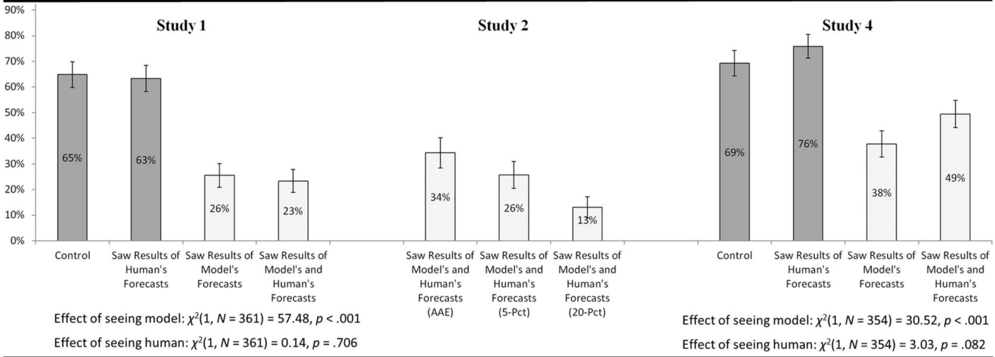
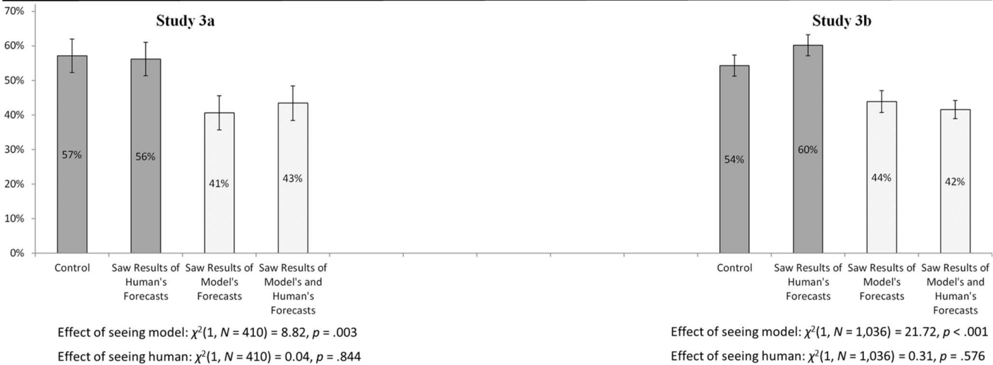
- Across five studies, seeing the algorithm perform reduced participants’ likelihood of choosing it over a human forecaster. In the model-and-human conditions, 610 of 741 participants (83%) saw the model outperform the human, yet these participants were among the least likely to choose the model.
- The model outperformed humans in all five studies. For example, bonuses if choosing model vs. human were Study 1: $1.78 vs. $1.38; Study 2: $1.77 vs. $1.09; Study 3a: $0.48 vs. $0.31; Study 3b: $0.49 vs. $0.30; Study 4: $1.79 vs. $1.38. Human forecasters produced 15–29% more error in the MBA task and 90–97% more error in the airline-passenger task.
- Seeing the model perform significantly decreased confidence in the model’s forecasts in all four studies where this was tested, whereas seeing the human perform significantly decreased confidence in the human only in Study 4. Confidence in the model’s forecasts significantly mediated the effect of seeing the model perform on choosing the model; confidence in the human did not.
- In Study 2, participants paid for forecasts within 20 percentiles were less likely to choose the model than those paid within 5 percentiles, χ²(1, N = 139) = 3.56, p = .059, and those paid by average absolute error, χ²(1, N = 136) = 8.56, p = .003; this effect was mediated by confidence in their own forecasts, not confidence in the model’s forecasts.
Methods
- Five studies had participants forecast real outcomes: MBA student success (Studies 1, 2, and 4) or U.S. state rank in airline passengers (Studies 3a and 3b). Participants were assigned to control, human, model, or model-and-human conditions, then chose whether to tie incentivized bonuses to the model or the human forecaster (themselves in Studies 1–3, another participant in Study 4).
- Final samples were Study 1: 361; Study 2: 206; Study 3a: 410; Study 3b: 1,036; Study 4: 354. Studies 1, 2, and 4 were run in the Wharton Behavioral Lab; Studies 3a and 3b used Amazon Mechanical Turk.
- Main analyses compared forecasting performance and choice rates, measured confidence and beliefs, and used binary mediation analyses with Preacher and Hayes’s bootstrapping procedure.
Limitations
- The paper states it did not explore all boundaries of the effect, including whether it would persist if algorithms were many times more accurate than humans, and whether results depend on features shared by the two forecasting tasks.
- The paper states it did not explore how algorithm variations—complexity, transparency, forecaster involvement in construction, and designer expertise—affect algorithm aversion.
- The paper states algorithm aversion is not entirely driven by seeing algorithms err, and it has little to say about how best to reduce aversion among those who have seen an algorithm err. The text also cautions that cross-experiment comparisons should be made cautiously.
Model-written summary. Check it against the paper before relying on it.
Integrity signals
Registry
Cites
Statistics
Figures
Verification
Claims the paper makes
0 Valid · 2 Not valid · 16 Not checked · 90 Own results and interpretations
A result the paper reports from its own data — it cites no other source for it, so there is none to check. The quote shows it is in the paper.
In the paper
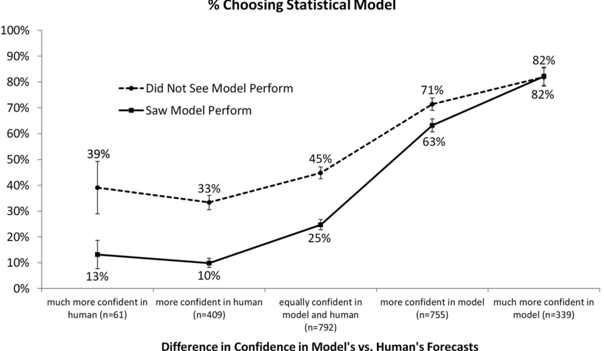
“the majority of people who were equally confident in the model's and human's forecasts chose to tie their bonuses to the human's forecasts, particularly when they had seen the model perform.”
plainstates an association- Asserted: passes — The authors put it forward as true.
- Checkable: passes — It can be checked against evidence.
- Load-bearing: passes — The paper’s conclusions depend on it.
- Based: passes — The paper gives a reason why it holds.
A result the paper reports from its own data — it cites no other source for it, so there is none to check. The quote shows it is in the paper.
In the paper
“Consistent with research on the adoption of decision aids (see Highhouse, 2008), participants thought that the human forecasters were better than the model at getting better with practice, learning from mistakes, and finding underappreciated candidates.”
plain- Asserted: passes — The authors put it forward as true.
- Checkable: passes — It can be checked against evidence.
- Load-bearing: passes — The paper’s conclusions depend on it.
- Based: passes — The paper gives a reason why it holds.
A result the paper reports from its own data — it cites no other source for it, so there is none to check. The quote shows it is in the paper.
In the paper
“Our studies show that this resistance at least partially arises from greater intolerance for error from algorithms than from humans.”
plainstates a possible cause- Asserted: passes — The authors put it forward as true.
- Checkable: passes — It can be checked against evidence.
- Load-bearing: passes — The paper’s conclusions depend on it.
- Based: passes — The paper gives a reason why it holds.
A result the paper reports from its own data — it cites no other source for it, so there is none to check. The quote shows it is in the paper.
In the paper
“Participants rightfully thought that the model was better than human forecasters at avoiding obvious mistakes, appropriately weighing various attributes, and consistently weighing information.”
plain- Asserted: passes — The authors put it forward as true.
- Checkable: passes — It can be checked against evidence.
- Load-bearing: unclear — It is unclear whether the paper’s conclusions depend on it.
- Based: passes — The paper gives a reason why it holds.
A result the paper reports from its own data — it cites no other source for it, so there is none to check. The quote shows it is in the paper.
In the paper
“This effect was evident in two distinct domains of judgment, including one in which the human forecasters produced nearly twice as much error as the algorithm.”
plain- Asserted: passes — The authors put it forward as true.
- Checkable: passes — It can be checked against evidence.
- Load-bearing: unclear — It is unclear whether the paper’s conclusions depend on it.
- Based: passes — The paper gives a reason why it holds.
75 more claims
Create a free account to see all 108 claims and to verify the 12 references still open.
- It may state two separate claims as one. 13
- Probably not a substantial claim. 16
Claims other papers make about this one
Each is checked against this paper’s own text: does it say what the citing paper says it does?
The source backs part of the claim, not all of it — or backs it for a different population, condition or comparison.
In the citing paper
“Traditional theorizing assumes trade-offs between trust and skepticism (Dietvorst et al., 2015), automation and engagement (Freeman et al., 2014), or efficiency and depth (Ishowo-Oloko et al., 2019)”
From Pedagogical partnerships with generative AI in higher education: how dual cognitive pathways paradoxically enable transformative learning (2026) · cites this paper as Dietvorst et al., 2015
Experimental — accuracy not yet measuredThe source backs part of the claim, not all of it — or backs it for a different population, condition or comparison.
In the citing paper
“Existing research typically examines trust versus skepticism in human-AI interactions as binary constructs (Dietvorst et al., 2015; Logg et al., 2019), missing the possibility that partnerships might simultaneously activate both vigilant and offloading behaviors.”
From Pedagogical partnerships with generative AI in higher education: how dual cognitive pathways paradoxically enable transformative learning (2026) · cites this paper as Dietvorst et al., 2015
Experimental — accuracy not yet measuredThe source backs part of the claim, not all of it — or backs it for a different population, condition or comparison.
In the citing paper
“It aligns with the theoretical rationale on algorithm aversion (Dietvorst et al. 2015;Hohensinn et al. 2024) and appreciation (Logg et al. 2019), which suggests that people are more likely to accept and trust AI systems when they produce desirable results but become skeptical when outcomes are unfavorable.”
From Holding AI Accountable Like Herding Cats: The Contingent Impact on the Legitimacy of Algorithmic Bureaucracy (2026) · cites this paper as Dietvorst et al. 2015
Experimental — accuracy not yet measuredThe source backs part of the claim, not all of it — or backs it for a different population, condition or comparison.
In the citing paper
“Research on algorithm appreciation and algorithm aversion further suggests that people may either defer to algorithms or reject them depending on prior experience, perceived expertise, and error visibility (Dietvorst et al., 2015; Logg et al., 2019).”
From College students' metacognitive awareness of generative-AI reliance: an experimental study of decision confidence and attribution bias (2026) · cites this paper as Dietvorst et al., 2015
Experimental — accuracy not yet measuredThe source backs part of the claim, not all of it — or backs it for a different population, condition or comparison.
In the citing paper
“Earlier research has mentioned gender, self-confidence, expertise, and general algorithm aversion or appreciation.15,28”
From Appropriate trust in artificial intelligence for the optical diagnosis of colorectal polyps: the role of human/artificial intelligence interaction (2024) · cites this paper as [28]
Experimental — accuracy not yet measured
22 more claims about this paper
Create a free account to see every claim other papers make about this one.
Statistics recomputed
Every reported test result, recomputed from its test statistic and degrees of freedom. A result shows as not adding up only once an independent check has confirmed it.
- Consistentt(360) = 4.98reported p < .001 · recomputed p < .001
“t (360) = 4.98, p < .001”
- Consistentt(204) = 6.26reported p < .001 · recomputed p < .001
“t (204) = 6.26, p < .001”
- Consistentt(405) = 7.73reported p < .001 · recomputed p < .001
“t (405) = 7.73, p < .001”
- Consistentt(353) = 5.11reported p < .001 · recomputed p < .001
“t (353) = 5.11, p < .001”
- Consistentχ²(1) = 39.94reported p < .001 · recomputed p < .001
“χ 2 (1, N = 271) = 39.94, p < .001”
19 more recomputed tests
Create a free account to see every test the Stats check recomputed.
Self-check
Percentages, sums and reported differences re-computed from the paper’s own numbers.
Self-check results appear here once an independent check has confirmed them.
Citations
Cites
Preacher, K. J., & Hayes, A. F. (2008) · Behavior Research Methods · doi:10.3758/brm.40.3.879 · Cited by 34,117 · cited 1×
“We then used Preacher and Hayes’s (2008) bootstrapping procedure to obtain unbiased 95% confidence intervals around the mediated effects.”
Method(2023) · doi:10.1126/science · Cited by 6,063
The trouble with overconfidence.
Moore, D. A., & Healy, P. J. (2008) · Psychological Review · doi:10.1037/0033-295x.115.2.502 · Cited by 2,358
“Clinical versus Actuarial Judgment.”
Dawes, R. M., Faust, D., & Meehl, P. E. (1989) · Science · doi:10.1126/science.2648573 · Cited by 2,298
The robust beauty of improper linear models in decision making.
Dawes, R. M. (1979) · American Psychologist · doi:10.1037/0003-066x.34.7.571 · Cited by 1,966
Preference and belief: Ambiguity and competence in choice under uncertainty
Heath, C., & Tversky, A. (1991) · Journal of Risk and Uncertainty · doi:10.1007/bf00057884 · Cited by 1,654
Clinical versus mechanical prediction: a meta-analysis
Grove, W. M., Zald, D. H., Lebow, B. S., Snitz, B. E., & Nelson, C. (2000) · Psychological Assessment · doi:10.1037/1040-3590.12.1.19 · Cited by 1,640
Grove, W. M., & Meehl, P. E. (1996) · Psychology, Public Policy, and Law · doi:10.1037/1076-8971.2.2.293 · Cited by 1,457 · cited 4×
“…1996), the notion that algorithms cannot properly consider individual targets (Grove & Meehl, 1996), concerns about the ethicality of relying on algorithms to make important decisions (Dawes, 1979), and the presumed inability of algorithms to incorporate qualitative data (Grove & Meehl, 1996).”
BackgroundMethodInfluential(2007) · Cited by 1,133
Competing on analytics: the new science of winning
(2007) · Choice Reviews Online · doi:10.5860/choice.44-6322 · Cited by 941
Research works printed but not linked: 1
- Clark, D. (2012, November 7). How Nate Silver won the 2012 presidential election. Harvard Business Review Blog . Retrieved from http://blogs .hbr.org/cs/2012/11/how\_nate\_silver\_won\_the\_2012\_p.html
Cited by
Items 401–500 of 3,918
Artificial fairness? Trust in algorithmic police decision-making
Hobson, Z., Yesberg, J. A., Bradford, B., & Jackson, J. (2021) · Journal of Experimental Criminology · doi:10.1007/s11292-021-09484-9 · Cited by 79
Trust in AI and Top Management Support in Generative-AI Adoption
Korzyński, P., Silva, S. C. L. D. C. E., Górska, A. M., & Mazurek, G. (2024) · Journal of Computer Information Systems · doi:10.1080/08874417.2024.2401986 · Cited by 81
“29,30 Such aversion is often rooted in fears related to job displacement, insufficient training, uncertainty, 31,32 inadequate human understanding of AI, 33 poor understanding of AI’s application, 34 fear of poor performance 35 and a deficiency of trust in AI systems, 36 consequently hindering the…”
AI agents, agentic AI, and the future of sales
Gonzalez, G. R., Habel, J., & Hunter, G. K. (2025) · Journal of Business Research · doi:10.1016/j.jbusres.2025.115799 · Cited by 83
Lacroux, A., & Martin-Lacroux, C. (2022) · Frontiers in Psychology · doi:10.3389/fpsyg.2022.895997 · Cited by 67
“…with previous research on trust in selection context, in which participants involved were mainly students or working adults (Diab et al., 2011; Dietvorst et al., 2015; Dietvorst, 2016; Lee, 2018; Langer et al., 2021a) and only a few studies used participants actually involved in recruitment…”
BackgroundResultInfluentialYang, C., & Hu, J. (2021) · Journal of Brand Management · doi:10.1057/s41262-021-00261-7 · Cited by 81
Human evaluations of machine translation in an ethically charged situation
Asscher, O., & Glikson, E. (2021) · New Media & Society · doi:10.1177/14614448211018833 · Cited by 76
Song, Z., Qin, J., Jin, F., Cheung, W. M., & Lin, C. (2025) · Teaching and Teacher Education · doi:10.1016/j.tate.2025.105157 · Cited by 70
The Data Imperative: How Digitalization is Reshaping Management, Organizing, and Work
Schildt, H. A. (2020) · doi:10.1093/oso/9780198840817.001.0001 · Cited by 95
AI and human broadcasters: Relative impact on consumer engagement in live streaming commerce
Xu, Y., & Ruan, Y. (2023) · Electronic Commerce Research and Applications · doi:10.1016/j.elerap.2023.101335 · Cited by 70
Designing Collaborative Intelligence Systems for Employee-AI Service Co-Production
Blaurock, M., Büttgen, M., & Schepers, J. (2025) · Journal of Service Research · doi:10.1177/10946705241238751 · Cited by 55
“In many cases, AI systems are superior to humans, but employees fail to trust the respective advice (Dietvorst, Simmons, and Massey 2015).”
Online dating system design and relational decision making: Choice, algorithms, and control
Tong, S. T., Hancock, J. T., & Slatcher, R. B. (2016) · Personal Relationships · doi:10.1111/pere.12158 · Cited by 73
Bridging the gap: Towards an expanded toolkit for AI-driven decision-making in the public sector
Fischer-Abaigar, U., Kern, C. A., Barda, N., & Kreuter, F. (2024) · Government Information Quarterly · doi:10.1016/j.giq.2024.101976 · Cited by 83
Liu, P., Du, Y., & Xu, Z. (2019) · Accident Analysis & Prevention · doi:10.1016/j.aap.2019.02.012 · Cited by 65
A Slow Algorithm Improves Users' Assessments of the Algorithm's Accuracy
Park, J. S., Barber, R., Kirlik, A., & Karahalios, K. (2019) · Proceedings of the ACM on Human-Computer Interaction · doi:10.1145/3359204 · Cited by 65
Baroni, I., Re Calegari, G., Scandolari, D., & Celino, I. (2022) · Human Computation · doi:10.15346/hc.v9i1.134 · Cited by 65
“…et al., 2019) people declared to prefer a human radiologist even if an AI-powered system executing the same task was proved to be more precise, while in (Dietvorst et al., 2015), participants trusted humansâĂŹ feedback more than AI, even when provided with evidence that the AI performs better.”
BackgroundAhmad, T., Desai, N. R., Yamamoto, Y., Biswas, A., Ghazi, L., Martin, M. C., Simonov, M., Dhar, R., Hsiao, A., Kashyap, N., et al. (2022) · JAMA Cardiology · doi:10.1001/jamacardio.2022.2496 · Cited by 65
Virtual versus human: Unraveling consumer reactions to service failures through influencer types
Zhao, T., Ran, Y., Wu, B., Wang, V. L., Zhou, L., & Wang, C. L. (2024) · Journal of Business Research · doi:10.1016/j.jbusres.2024.114657 · Cited by 67
The influence of algorithms on political and dating decisions
Agudo, U., & Matute, H. (2021) · PLOS ONE · doi:10.1371/journal.pone.0249454 · Cited by 57
Saffarizadeh, K., Keil, M., & Maruping, L. M. (2024) · Journal of Management Information Systems · doi:10.1080/07421222.2024.2376382 · Cited by 79
“Even when an algorithm and a human make the same mistake, users are more likely to stop relying on advice from the algorithm than from the human [25].”
The extent of algorithm aversion in decision-making situations with varying gravity
Filiz, I., Judek, J. R., Lorenz, M., & Spiwoks, M. (2023) · PLoS ONE · doi:10.1371/journal.pone.0278751 · Cited by 76
Automating the B2B Salesperson Pricing Decisions: A Human-Machine Hybrid Approach
Karlinsky-Shichor, Y., & Netzer, O. (2023) · Marketing Science · doi:10.1287/mksc.2023.1449 · Cited by 75
“Moreover, when facing (inevitable) algorithmic errors, people are less likely to trust and use the algorithm (Dietvorst et al., 2015).”
People versus machines: introducing the HIRE framework
Will, P., Krpan, D., & Lordan, G. (2022) · Artificial Intelligence Review · doi:10.1007/s10462-022-10193-6 · Cited by 78
Hang, H., & Chen, Z. (2022) · Journal of Digital Economy · doi:10.1016/j.jdec.2022.11.003 · Cited by 79
Silva, D. E., Chen, C., & Zhu, Y. (2024) · New Media & Society · doi:10.1177/14614448221098042 · Cited by 41
Brains or Beauty: How to Engender Trust in User-Agent Interactions
Yuksel, B. F., Collisson, P., & Czerwinski, M. (2017) · ACM Transactions on Internet Technology · doi:10.1145/2998572 · Cited by 63
Effective Implementation of Predictive Sales Analytics
Habel, J., Alavi, S. H., & Heinitz, N. (2023) · Journal of Marketing Research · doi:10.1177/00222437221151039 · Cited by 70
An approach and decision support tool for forming Industry 4.0 supply chain collaborations
Cisneros-Cabrera, S., Pishchulov, G., Sampaio, P., Mehandjiev, N., Liu, Z., & Kununka, S. (2021) · Computers in Industry · doi:10.1016/j.compind.2020.103391 · Cited by 66
Trusting under risk – comparing human to AI decision support agents
Fahnenstich, H., Rieger, T., & Roesler, E. (2023) · Computers in Human Behavior · doi:10.1016/j.chb.2023.108107 · Cited by 72
How transparency affects algorithmic advice utilization: The mediating roles of trusting beliefs
Ning, X., Lu, Y., Li, W., & Gupta, S. (2024) · Decision Support Systems · doi:10.1016/j.dss.2024.114273 · Cited by 70
Assessing Emotion and Sensitivity of AI Artwork
Agudo, U., Arrese, M., Liberal, K. G., & Matute, H. (2022) · Frontiers in Psychology · doi:10.3389/fpsyg.2022.879088 · Cited by 67
When people and algorithms meet: user-reported problems in intelligent everyday applications
Eiband, M., Völkel, S. T., Buschek, D., Cook, S., & Hussmann, H. (2019) · Proceedings of the 24th International Conference on Intelligent User Interfaces · doi:10.1145/3301275.3302262 · Cited by 62
“Related, researchers have also observed “algorithmic aversion” [12], when users put less confidence in algorithmic than human predictions, even if the latter are less accurate.”
BackgroundA human judgment approach to epidemiological forecasting
Farrow, D., Brooks, L., Hyun, S., Tibshirani, R. J., Burke, D. S., & Rosenfeld, R. (2017) · PLoS Computational Biology · doi:10.1371/journal.pcbi.1005248 · Cited by 71
Lefkeli, D., Karataş, M., & Gürhan-Canli, Z. (2024) · International Journal of Research in Marketing · doi:10.1016/j.ijresmar.2023.08.011 · Cited by 62
Adam, M., Diebel, C., Goutier, M., & Benlian, A. (2024) · Decision Support Systems · doi:10.1016/j.dss.2024.114193 · Cited by 62
Shanks, I., Scott, M. L., Mende, M., van Doorn, J., & Grewal, D. (2024) · Journal of the Academy of Marketing Science · doi:10.1007/s11747-024-01004-1 · Cited by 71
“Some prior work indicates that consumers disregard information provided by algorithms and follow information from humans, even if it might be less accurate (Dietvorst et al., 2015).”
Chen, Y., & Biswas, M. I. (2021) · Sustainability · doi:10.3390/su132212656 · Cited by 83
Koenig, P. D. (2023) · AI & Society · doi:10.1007/s00146-024-01987-z · Cited by 76
“Studies dealing with algorithm aversion and appreciation (Logg et al. 2019; Dietvorst et al. 2015), for instance, have focused on the role of task context and characteristics and personal dispositions.”
Collaborating with AI Agents: Field Experiments on Teamwork, Productivity, and PerformancePreprint
Ju, H., & Aral, S. (2025) · SSRN Electronic Journal · doi:10.2139/ssrn.5187466 · Cited by 78
van Doorn, J., Smailhodžić, E., Puntoni, S., Li, J., Schumann, J. H., & Holthöwer, J. (2023) · Journal of Business Research · doi:10.1016/j.jbusres.2023.114000 · Cited by 70
Chen, C. (2024) · Journal of Business Research · doi:10.1016/j.jbusres.2024.114610 · Cited by 63
Autonomy and control: How political ideology shapes the use of artificial intelligence
Cui, Y. G., & van Esch, P. (2022) · Psychology and Marketing · doi:10.1002/mar.21649 · Cited by 63
Mahmud, H., Islam, A. K. M. N., Luo, X. R., & Mikalef, P. (2024) · Decision Support Systems · doi:10.1016/j.dss.2024.114168 · Cited by 71
“First, drawing upon prior research on algorithmic decision-making [1,5,6,10,19], we provide a theoretical framework demonstrating the influences of different forms of familiarity on trust and algorithm appreciation.”
BackgroundMethodResultInfluentialMarocco, S., Barbieri, B., & Talamo, A. (2024) · AI · doi:10.3390/ai5040123 · Cited by 70
Explainable AI and Adoption of Financial Algorithmic Advisors: An Experimental Study
David, D. B., Resheff, Y. S., & Tron, T. (2021) · Proceedings of the AAAI/ACM Conference on AI Ethics and Society · doi:10.1145/3461702.3462565 · Cited by 79
Good Explanation for Algorithmic Transparency
Lu, J., Lee, D., Kim, T. W., & Danks, D. J. (2019) · Proceedings of the AAAI/ACM Conference on AI Ethics and Society · doi:10.1145/3375627.3375821 · Cited by 63
Cui, Y. (. (2022) · International Journal of Bank Marketing · doi:10.1108/ijbm-09-2021-0451 · Cited by 60
Algorithmic Risk Assessment in the Hands of Humans
Stevenson, M., & Doleac, J. L. (2019) · doi:10.2139/ssrn.3489440 · Cited by 60
Wang, X., Luo, R., Liu, Y., Chen, P., Tao, Y., & He, Y. (2023) · Information Processing & Management · doi:10.1016/j.ipm.2023.103444 · Cited by 63
Liu, N. T. Y., Kirshner, S. N., & Lim, E. T. K. (2023) · Journal of Retailing and Consumer Services · doi:10.1016/j.jretconser.2023.103259 · Cited by 64
Physician Adoption of AI Assistant
Hou, T., Li, M., Tan, Y., & Zhao, H. (2024) · Manufacturing & Service Operations Management · doi:10.1287/msom.2023.0093 · Cited by 68
Liu, Q., Ma, N., & Zhang, X. (2024) · Journal of Retailing and Consumer Services · doi:10.1016/j.jretconser.2024.104107 · Cited by 66
Đerić, E., Frank, D., & Milković, M. (2025) · Information · doi:10.3390/info16070622 · Cited by 60
Wojcieszak, M., Thakur, A., Ferreira Gonçalves, J. F., Casas, A., Menchen-Trevino, E., & Boon, &. M. (2021) · Journal of Computer-Mediated Communication · doi:10.1093/jcmc/zmab006 · Cited by 49
The role of artificial intelligence in effective business operations during COVID-19
Chen, Y., Biswas, M. I., & Talukder, M. S. (2022) · International Journal of Emerging Markets · doi:10.1108/ijoem-11-2021-1666 · Cited by 79
Algorithm fashion designer? ascribed mind and perceived design expertise of AI versus human
Lee, G., & Kim, H. (2024) · Psychology and Marketing · doi:10.1002/mar.22124 · Cited by 62
People think that social media platforms do (but should not) amplify divisive content
Rathje, S., Robertson, C., Brady, W. J., & Van Bavel, J. J. (2024) · Perspectives on Psychological Science · doi:10.1177/17456916231190392 · Cited by 59
“People’s responses might also be shaped by algorithm aversion (Dietvorst et al., 2015), or the general tendency for people to distrust algorithms that make errors (even more so than humans that make errors).”
Yang, J., Amrollahi, A., & Marrone, M. (2024) · The Journal of Strategic Information Systems · doi:10.1016/j.jsis.2024.101864 · Cited by 59
Baek, T. H., Kim, H. J., & Kim, J. (2025) · International Journal of Hospitality Management · doi:10.1016/j.ijhm.2025.104106 · Cited by 63
Algorithm aversion in delegated investing
Germann, M., & Merkle, C. (2022) · Journal of Business Economics · doi:10.1007/s11573-022-01121-9 · Cited by 89
From Tools to Agents: Meta-Analytic Insights into Human Acceptance of AI
Li, B., Lai, E. Y., & Wang, X. (. (2025) · Journal of Marketing · doi:10.1177/00222429251355266 · Cited by 79
Decision-making in organizations: should managers use AI?
Brink, A., Benyayer, L.-D., & Kupp, M. (2023) · Journal of Business Strategy · doi:10.1108/jbs-04-2023-0068 · Cited by 70
Ognibene, D., Wilkens, R., Taibi, D., Hernández‐Leo, D., Kruschwitz, U., Donabauer, G., Theophilou, E., Lomonaco, F., Buršić, S., Lobo, R. A., et al. (2023) · Frontiers in Artificial Intelligence · doi:10.3389/frai.2022.654930 · Cited by 74
Demand forecasting by temporal aggregation: Using optimal or multiple aggregation levels?
Kourentzes, N., Rostami-Tabar, B., & Barrow, D. K. (2017) · Journal of Business Research · doi:10.1016/j.jbusres.2017.04.016 · Cited by 68
An extension of the theory of technology dominance: Capturing the underlying causal complexity
Sutton, S. G., Arnold, V., & Holt, M. (2023) · International Journal of Accounting Information Systems · doi:10.1016/j.accinf.2023.100626 · Cited by 46
Warmth and competence in human-agent cooperation
McKee, K. R., Bai, X., & Fiske, S. T. (2024) · Autonomous Agents and Multi-Agent Systems · doi:10.1007/s10458-024-09649-6 · Cited by 69
Does More Advice Help? The Effects of Second Opinions in AI-Assisted Decision Making
Lu, Z., Wang, D., & Yin, M. (2024) · Proceedings of the ACM on Human-Computer Interaction · doi:10.1145/3653708 · Cited by 39
“Interestingly, both the phenomenon of “algorithm aversion” (i.e., recommendations from humans are used more than those from AI) [21, 24, 111] and “algorithm appreciation” (i.e., recommendations from AI models are used more than those from humans) [55] are observed in different contexts.”
BackgroundNine Potential Pitfalls when Designing Human-AI Co-Creative SystemsPreprint
Buschek, D., Mecke, L., Lehmann, F., & Dang, H. (2021) · ERef Bayreuth (University of Bayreuth) · doi:10.48550/arxiv.2104.00358 · Cited by 74
Exploring the effects of human-centered AI explanations on trust and reliance
Scharowski, N., Perrig, S. A. C., Svab, M., Opwis, K., & Brühlmann, F. (2023) · Frontiers in Computer Science · doi:10.3389/fcomp.2023.1151150 · Cited by 57
Soellner, M., & Koenigstorfer, J. (2021) · BMC Medical Informatics and Decision Making · doi:10.1186/s12911-021-01596-6 · Cited by 53
ChatrEx: Designing Explainable Chatbot Interfaces for Enhancing Usefulness, Transparency, and Trust
Khurana, A., Harjandi, P. A., & Chilana, P. K. (2021) · IEEE Symposium on Visual Languages and Human-Centric Computing (VL/HCC) · doi:10.1109/vl/hcc51201.2021.9576440 · Cited by 68
Gonçalves, J., Weber, I., Masullo, G. M., Torres da Silva, M., & Hofhuis, J. (2023) · New Media & Society · doi:10.1177/14614448211032310 · Cited by 44
Zheng, C., Wu, Y., Shi, C., Ma, S., Luo, J., & Ma, X. (2023) · Proceedings of the 2023 CHI Conference on Human Factors in Computing Systems · doi:10.1145/3544548.3581131 · Cited by 48
He, G., Buijsman, S., & Gadiraju, U. (2023) · Proceedings of the ACM on Human-Computer Interaction · doi:10.1145/3610067 · Cited by 39
“For example, Dietvorst et al. [11] and Dzindolet et al. [13] found that users stop relying on a system after seeing it make a mistake.”
BackgroundResultLi, Y., Deng, X., Hu, X., & Jing, L. (2024) · Journal of theoretical and applied electronic commerce research · doi:10.3390/jtaer19040126 · Cited by 67
The Ethics of Advanced AI Assistants
Gabriel, I., Manzini, A., Keeling, G., Hendricks, L. A., Rieser, V., Iqbal, H., Tomašev, N., Ktena, I., Kenton, Z., Rodriguez, M., et al. (2024) · arXiv · doi:10.48550/arxiv.2404.16244 · Cited by 57
Wang, S. (2020) · Digital Journalism · doi:10.1080/21670811.2020.1851279 · Cited by 63
Botti, S., Iyengar, S. S., & McGill, A. L. (2022) · Journal of Consumer Psychology · doi:10.1002/jcpy.1325 · Cited by 67
Zehnle, M., Hildebrand, C., & Valenzuela, A. (2025) · International Journal of Research in Marketing · doi:10.1016/j.ijresmar.2025.02.005 · Cited by 35
Vuori, N., Burkhard, B., & Pitkäranta, L. (2025) · Journal of Management Studies · doi:10.1111/joms.13177 · Cited by 65
Hasan, M. M., & Fardous, M. (2022) · American Journal of Advanced Technology and Engineering Solutions · doi:10.63125/9mv2qd37 · Cited by 59
Langer, M., Hunsicker, T., Feldkamp, T., König, C. J., & Grgić-Hlača, N. (2022) · CHI Conference on Human Factors in Computing Systems · doi:10.1145/3491102.3517527 · Cited by 55
“[28], machine learning [26], sophisticated statistical model [17], or robot [51] – all to refer to a system that either automates decisionmaking or that supports human decision-making in a variety of application contexts (e.”
BackgroundInfluentialBanovic, N., Yang, Z., Ramesh, A., & Liu, A. (2023) · Proceedings of the ACM on Human-Computer Interaction · doi:10.1145/3579460 · Cited by 55
“Also, the drop in concurrence in the later games shows diminishing reliance on both coaches, since by then most participants already experienced negative outcomes (i.e., game losses) [11].”
BackgroundEffect of Human-AI Interaction on Detection of Malignant Lung Nodules on Chest Radiographs
Lee, J. H., Hong, H., Nam, G., Hwang, E. J., & Park, C. M. (2023) · Radiology · doi:10.1148/radiol.222976 · Cited by 53
Thinking about God increases acceptance of artificial intelligence in decision-making
Karataş, M., & Cutright, K. M. (2023) · Proceedings of the National Academy of Sciences · doi:10.1073/pnas.2218961120 · Cited by 64
Caruelle, D., Shams, P., Gustafsson, A., & Lervik-Olsen, L. (2022) · Marketing Letters · doi:10.1007/s11002-021-09609-0 · Cited by 62
Is Your Machine Better Than You? You May Never Know
de Véricourt, F., & Gürkan, H. (2023) · Management Science · doi:10.1287/mnsc.2023.4791 · Cited by 78
Karunakaran, A., Lebovitz, S., Narayanan, D., & Rahman, H. A. (2025) · Academy of Management Annals · doi:10.5465/annals.2023.0230 · Cited by 66
Balakrishnan, M., Ferreira, K., & Tong, J. D. (2025) · Management Science · doi:10.1287/mnsc.2022.03850 · Cited by 88
Hlosta, M., Herodotou, C., Papathoma, T., Gillespie, A., & Bergamin, P. B. (2022) · Computers and Education Artificial Intelligence · doi:10.1016/j.caeai.2022.100108 · Cited by 64
Human-machine plan conflict and conflict resolution in a visual search task
Pan, Y., & Xu, J. (2025) · International Journal of Human-Computer Studies · doi:10.1016/j.ijhcs.2024.103377 · Cited by 54
American public opinion on artificial intelligence in healthcare
Rojahn, J., Palu, A., Skiena, S., & Jones, J. J. (2023) · PLoS ONE · doi:10.1371/journal.pone.0294028 · Cited by 56
Improving Experienced Auditors’ Detection of Deception in CEO Narratives
Hobson, J. L., Mayew, W. J., Peecher, M. E., & Venkatachalam, M. (2017) · Journal of Accounting Research · doi:10.1111/1475-679x.12181 · Cited by 64
Trust in Public Policy Algorithms
Kennedy, R. P., Waggoner, P. D., & Ward, M. M. (2022) · The Journal of Politics · doi:10.1086/716283 · Cited by 46
Using generative AI as decision-support tools: unraveling users’ trust and AI appreciation
Huynh, M.-T. (2024) · Journal of Decision System · doi:10.1080/12460125.2024.2428166 · Cited by 58
Knowing When to Pass: The Effect of AI Reliability in Risky Decision Contexts
Elder, H., Canfield, C., Shank, D. B., Rieger, T., & Hines, C. (2022) · Human Factors The Journal of the Human Factors and Ergonomics Society · doi:10.1177/00187208221100691 · Cited by 60
Aversion to Hiring Algorithms: Transparency, Gender Profiling, and Self-Confidence
Dargnies, M.-P., Hakimov, R., & Kübler, D. F. (2024) · Management Science · doi:10.1287/mnsc.2022.02774 · Cited by 86
Leveraging Expert Consistency to Improve Algorithmic Decision Support
De‐Arteaga, M., Jeanselme, V., Dubrawski, A. W., & Chouldechova, A. (2025) · Management Science · doi:10.1287/mnsc.2022.01576 · Cited by 56
You’d Better Stop! Understanding Human Reliance on Machine Learning Models under Covariate Shift
Chiang, C.-W., & Yin, M. (2021) · 13th ACM Web Science Conference 2021 · doi:10.1145/3447535.3462487 · Cited by 53
AI-Assisted Decision-making: a Cognitive Modeling Approach to Infer Latent Reliance Strategies
Tejeda, H., Kumar, A., Smyth, P., & Steyvers, M. (2022) · Computational Brain & Behavior · doi:10.1007/s42113-022-00157-y · Cited by 53
“For example, it has been found that people will prefer to use their own (less accurate) forecasts instead of an algorithm if they have seen the algorithm make mistakes (Dietvorst et al., 2015).”
BackgroundNeumann, M., Niessen, A. S. M., & Meijer, R. R. (2020) · Organizational Psychology Review · doi:10.1177/2041386620983419 · Cited by 63
Metadata
- Authors
- Dietvorst, B. J., Simmons, J. P., & Massey, C.
- Affiliations
- University of Pennsylvania (US)
- Venue
- Journal of Experimental Psychology: General
- Published
- 2015
- Volume
- 144
- Issue
- 1
- Pages
- 114-126
- ISSN
- 0096-3445 (ISSN-L)
- 1939-2222
- OpenAlex
- W3125633690
- Cited by
- 3,232
- References
- 22
- Citations by year
- 2026: 1025 · 2025: 563 · 2024: 445 · 2023: 404 · 2022: 266 · 2021: 216 · 2020: 137 · 2019: 88 · 2018: 41 · 2017: 26 · 2016: 14 · 2015: 5
- FWCI
- 13.96
- Type
- journal article
- Language
- en
- Open access
- green
- doi.org
- Locations
- Journal of Experimental Psychology General (publishedVersion)
- SSRN Electronic Journal (publishedVersion)
- PubMed (publishedVersion)
- ScholarlyCommons (University of Pennsylvania) (submittedVersion)
- Funders
- Wharton Behavioral Laboratory
- Wharton Risk Center Ackoff Doctoral Student Fellowship
- Topics
- Social Sciences › Decision Sciences › General Decision Sciences › Decision-Making and Behavioral Economics
- Social Sciences › Decision Sciences › Management Science and Operations Research › Forecasting Techniques and Applications
- Social Sciences › Human Factors and Ergonomics › Human-Automation Interaction and Safety
- Keywords
- algorithm aversion, trust in algorithms, prediction confidence, evidence-based algorithm, decision-making
- MeSH terms
- Algorithms, Avoidance Learning, Culture, Decision Making, Female, Forecasting, Humans, Male, Motivation, Comprehension, Young Adult
About these checks
Registry, retraction, Cites and statistics results are computed, not judged, with one exception: a printed reference that no index lists is read once by a model before it counts as a citation error. Claims are extracted by a model and kept only when their quote appears verbatim in the text; each cited source is then checked, with a model’s help, for whether it says what the claim relies on. Those verdicts can be wrong — read the claim’s quote and the cited source before relying on one.
A language model drew the claims from the paper on 2026-11-14, under version 3 of the claim definition (model deepseek-v4.1-flash, prompt extract-v3).
A second model labelled each claim on 2026-11-14 (model jev-1.13-20260917, definition revision gold-guideline-v0.2).
Statistics and arithmetic are recomputed, not judged.
Confidence bands are shown only for fields calibrated on our annotated test set. None is calibrated yet, so no band is shown.
What counts as a claim ›How we measure confidence ›How we check this ›
Are you an author, or do you see a problem with this page? Request a review
Data sources
Bibliographic data: Semantic Scholar, OpenAlex, Crossref.
Contains information from the Semantic Scholar Academic Graph Datasets, made available under the ODC Attribution License (ODC-BY 1.0).
Semantic Scholar’s data is described in: Kinney, R., et al. (2023). The Semantic Scholar Open Data Platform. arXiv:2301.10140.
