

Algorithm aversion: People erroneously avoid algorithms after seeing them err.
Open accessThe DOI matches its Crossref record; 23 of the 23 references it cites were found in a registry or an index; none of the 22 sources its claims cite is checked for support yet.
Abstract
Research shows that evidence-based algorithms more accurately predict the future than do human forecasters. Yet when forecasters are deciding whether to use a human forecaster or a statistical algorithm, they often choose the human forecaster. This phenomenon, which we call algorithm aversion, is costly, and it is important to understand its causes. We show that people are especially averse to algorithmic forecasters after seeing them perform, even when they see them outperform a human forecaster. This is because people more quickly lose confidence in algorithmic than human forecasters after seeing them make the same mistake. In 5 studies, participants either saw an algorithm make forecasts, a human make forecasts, both, or neither. They then decided whether to tie their incentives to the future predictions of the algorithm or the human. Participants who saw the algorithm perform were less confident in it, and less likely to choose it over an inferior human forecaster. This was true even among those who saw the algorithm outperform the human.
Overview
CoChat Summary
TL;DR
People become less willing to use a statistical algorithm after seeing it perform and make mistakes, even when it outperforms a human forecaster. This “algorithm aversion” is driven partly by people losing confidence in algorithms more quickly than in humans after observing errors.
Key findings
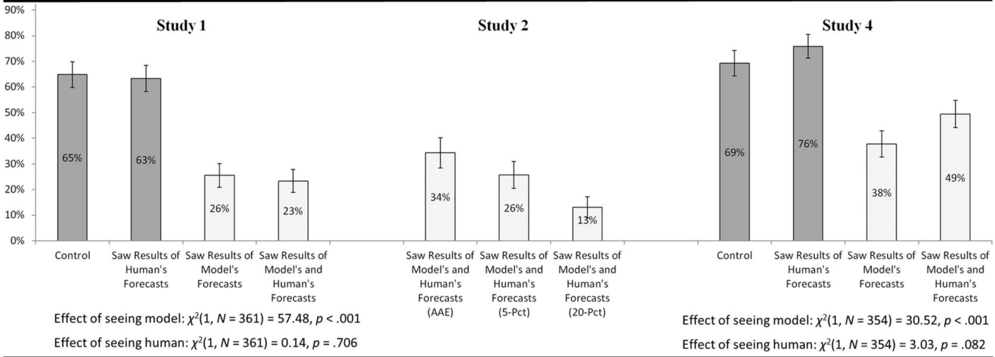
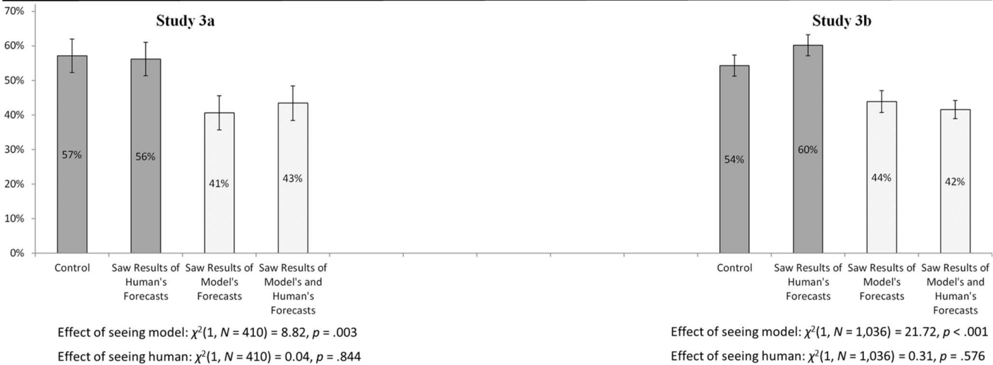
- Across five studies, seeing the algorithm perform reduced participants’ likelihood of choosing it over a human forecaster. In the model-and-human conditions, 610 of 741 participants (83%) saw the model outperform the human, yet these participants were among the least likely to choose the model.
- The model outperformed humans in all five studies. For example, bonuses if choosing model vs. human were Study 1: $1.78 vs. $1.38; Study 2: $1.77 vs. $1.09; Study 3a: $0.48 vs. $0.31; Study 3b: $0.49 vs. $0.30; Study 4: $1.79 vs. $1.38. Human forecasters produced 15–29% more error in the MBA task and 90–97% more error in the airline-passenger task.
- Seeing the model perform significantly decreased confidence in the model’s forecasts in all four studies where this was tested, whereas seeing the human perform significantly decreased confidence in the human only in Study 4. Confidence in the model’s forecasts significantly mediated the effect of seeing the model perform on choosing the model; confidence in the human did not.
- In Study 2, participants paid for forecasts within 20 percentiles were less likely to choose the model than those paid within 5 percentiles, χ²(1, N = 139) = 3.56, p = .059, and those paid by average absolute error, χ²(1, N = 136) = 8.56, p = .003; this effect was mediated by confidence in their own forecasts, not confidence in the model’s forecasts.
Methods
- Five studies had participants forecast real outcomes: MBA student success (Studies 1, 2, and 4) or U.S. state rank in airline passengers (Studies 3a and 3b). Participants were assigned to control, human, model, or model-and-human conditions, then chose whether to tie incentivized bonuses to the model or the human forecaster (themselves in Studies 1–3, another participant in Study 4).
- Final samples were Study 1: 361; Study 2: 206; Study 3a: 410; Study 3b: 1,036; Study 4: 354. Studies 1, 2, and 4 were run in the Wharton Behavioral Lab; Studies 3a and 3b used Amazon Mechanical Turk.
- Main analyses compared forecasting performance and choice rates, measured confidence and beliefs, and used binary mediation analyses with Preacher and Hayes’s bootstrapping procedure.
Limitations
- The paper states it did not explore all boundaries of the effect, including whether it would persist if algorithms were many times more accurate than humans, and whether results depend on features shared by the two forecasting tasks.
- The paper states it did not explore how algorithm variations—complexity, transparency, forecaster involvement in construction, and designer expertise—affect algorithm aversion.
- The paper states algorithm aversion is not entirely driven by seeing algorithms err, and it has little to say about how best to reduce aversion among those who have seen an algorithm err. The text also cautions that cross-experiment comparisons should be made cautiously.
Model-written summary. Check it against the paper before relying on it.
Integrity signals
Registry
Cites
Statistics
Figures
Verification
Claims the paper makes
0 Valid · 2 Not valid · 16 Not checked · 90 Own results and interpretations
A result the paper reports from its own data — it cites no other source for it, so there is none to check. The quote shows it is in the paper.
In the paper
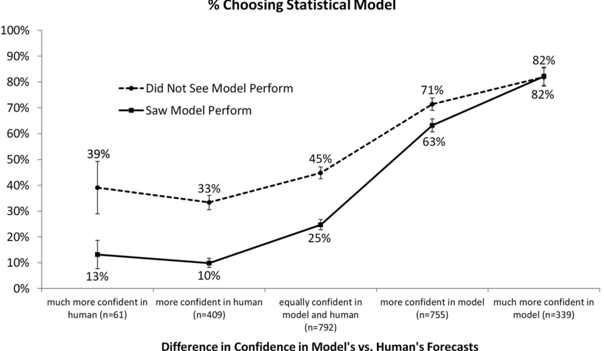
“the majority of people who were equally confident in the model's and human's forecasts chose to tie their bonuses to the human's forecasts, particularly when they had seen the model perform.”
plainstates an association- Asserted: passes — The authors put it forward as true.
- Checkable: passes — It can be checked against evidence.
- Load-bearing: passes — The paper’s conclusions depend on it.
- Based: passes — The paper gives a reason why it holds.
A result the paper reports from its own data — it cites no other source for it, so there is none to check. The quote shows it is in the paper.
In the paper
“Consistent with research on the adoption of decision aids (see Highhouse, 2008), participants thought that the human forecasters were better than the model at getting better with practice, learning from mistakes, and finding underappreciated candidates.”
plain- Asserted: passes — The authors put it forward as true.
- Checkable: passes — It can be checked against evidence.
- Load-bearing: passes — The paper’s conclusions depend on it.
- Based: passes — The paper gives a reason why it holds.
A result the paper reports from its own data — it cites no other source for it, so there is none to check. The quote shows it is in the paper.
In the paper
“Our studies show that this resistance at least partially arises from greater intolerance for error from algorithms than from humans.”
plainstates a possible cause- Asserted: passes — The authors put it forward as true.
- Checkable: passes — It can be checked against evidence.
- Load-bearing: passes — The paper’s conclusions depend on it.
- Based: passes — The paper gives a reason why it holds.
A result the paper reports from its own data — it cites no other source for it, so there is none to check. The quote shows it is in the paper.
In the paper
“Participants rightfully thought that the model was better than human forecasters at avoiding obvious mistakes, appropriately weighing various attributes, and consistently weighing information.”
plain- Asserted: passes — The authors put it forward as true.
- Checkable: passes — It can be checked against evidence.
- Load-bearing: unclear — It is unclear whether the paper’s conclusions depend on it.
- Based: passes — The paper gives a reason why it holds.
A result the paper reports from its own data — it cites no other source for it, so there is none to check. The quote shows it is in the paper.
In the paper
“This effect was evident in two distinct domains of judgment, including one in which the human forecasters produced nearly twice as much error as the algorithm.”
plain- Asserted: passes — The authors put it forward as true.
- Checkable: passes — It can be checked against evidence.
- Load-bearing: unclear — It is unclear whether the paper’s conclusions depend on it.
- Based: passes — The paper gives a reason why it holds.
75 more claims
Create a free account to see all 108 claims and to verify the 12 references still open.
- It may state two separate claims as one. 13
- Probably not a substantial claim. 16
Claims other papers make about this one
Each is checked against this paper’s own text: does it say what the citing paper says it does?
The source backs part of the claim, not all of it — or backs it for a different population, condition or comparison.
In the citing paper
“Traditional theorizing assumes trade-offs between trust and skepticism (Dietvorst et al., 2015), automation and engagement (Freeman et al., 2014), or efficiency and depth (Ishowo-Oloko et al., 2019)”
From Pedagogical partnerships with generative AI in higher education: how dual cognitive pathways paradoxically enable transformative learning (2026) · cites this paper as Dietvorst et al., 2015
Experimental — accuracy not yet measuredThe source backs part of the claim, not all of it — or backs it for a different population, condition or comparison.
In the citing paper
“Existing research typically examines trust versus skepticism in human-AI interactions as binary constructs (Dietvorst et al., 2015; Logg et al., 2019), missing the possibility that partnerships might simultaneously activate both vigilant and offloading behaviors.”
From Pedagogical partnerships with generative AI in higher education: how dual cognitive pathways paradoxically enable transformative learning (2026) · cites this paper as Dietvorst et al., 2015
Experimental — accuracy not yet measuredThe source backs part of the claim, not all of it — or backs it for a different population, condition or comparison.
In the citing paper
“It aligns with the theoretical rationale on algorithm aversion (Dietvorst et al. 2015;Hohensinn et al. 2024) and appreciation (Logg et al. 2019), which suggests that people are more likely to accept and trust AI systems when they produce desirable results but become skeptical when outcomes are unfavorable.”
From Holding AI Accountable Like Herding Cats: The Contingent Impact on the Legitimacy of Algorithmic Bureaucracy (2026) · cites this paper as Dietvorst et al. 2015
Experimental — accuracy not yet measuredThe source backs part of the claim, not all of it — or backs it for a different population, condition or comparison.
In the citing paper
“Research on algorithm appreciation and algorithm aversion further suggests that people may either defer to algorithms or reject them depending on prior experience, perceived expertise, and error visibility (Dietvorst et al., 2015; Logg et al., 2019).”
From College students' metacognitive awareness of generative-AI reliance: an experimental study of decision confidence and attribution bias (2026) · cites this paper as Dietvorst et al., 2015
Experimental — accuracy not yet measuredThe source backs part of the claim, not all of it — or backs it for a different population, condition or comparison.
In the citing paper
“Earlier research has mentioned gender, self-confidence, expertise, and general algorithm aversion or appreciation.15,28”
From Appropriate trust in artificial intelligence for the optical diagnosis of colorectal polyps: the role of human/artificial intelligence interaction (2024) · cites this paper as [28]
Experimental — accuracy not yet measured
22 more claims about this paper
Create a free account to see every claim other papers make about this one.
Statistics recomputed
Every reported test result, recomputed from its test statistic and degrees of freedom. A result shows as not adding up only once an independent check has confirmed it.
- Consistentt(360) = 4.98reported p < .001 · recomputed p < .001
“t (360) = 4.98, p < .001”
- Consistentt(204) = 6.26reported p < .001 · recomputed p < .001
“t (204) = 6.26, p < .001”
- Consistentt(405) = 7.73reported p < .001 · recomputed p < .001
“t (405) = 7.73, p < .001”
- Consistentt(353) = 5.11reported p < .001 · recomputed p < .001
“t (353) = 5.11, p < .001”
- Consistentχ²(1) = 39.94reported p < .001 · recomputed p < .001
“χ 2 (1, N = 271) = 39.94, p < .001”
19 more recomputed tests
Create a free account to see every test the Stats check recomputed.
Self-check
Percentages, sums and reported differences re-computed from the paper’s own numbers.
Self-check results appear here once an independent check has confirmed them.
Citations
Cites
Preacher, K. J., & Hayes, A. F. (2008) · Behavior Research Methods · doi:10.3758/brm.40.3.879 · Cited by 34,117 · cited 1×
“We then used Preacher and Hayes’s (2008) bootstrapping procedure to obtain unbiased 95% confidence intervals around the mediated effects.”
Method(2023) · doi:10.1126/science · Cited by 6,063
The trouble with overconfidence.
Moore, D. A., & Healy, P. J. (2008) · Psychological Review · doi:10.1037/0033-295x.115.2.502 · Cited by 2,358
“Clinical versus Actuarial Judgment.”
Dawes, R. M., Faust, D., & Meehl, P. E. (1989) · Science · doi:10.1126/science.2648573 · Cited by 2,298
The robust beauty of improper linear models in decision making.
Dawes, R. M. (1979) · American Psychologist · doi:10.1037/0003-066x.34.7.571 · Cited by 1,966
Preference and belief: Ambiguity and competence in choice under uncertainty
Heath, C., & Tversky, A. (1991) · Journal of Risk and Uncertainty · doi:10.1007/bf00057884 · Cited by 1,654
Clinical versus mechanical prediction: a meta-analysis
Grove, W. M., Zald, D. H., Lebow, B. S., Snitz, B. E., & Nelson, C. (2000) · Psychological Assessment · doi:10.1037/1040-3590.12.1.19 · Cited by 1,640
Grove, W. M., & Meehl, P. E. (1996) · Psychology, Public Policy, and Law · doi:10.1037/1076-8971.2.2.293 · Cited by 1,457 · cited 4×
“…1996), the notion that algorithms cannot properly consider individual targets (Grove & Meehl, 1996), concerns about the ethicality of relying on algorithms to make important decisions (Dawes, 1979), and the presumed inability of algorithms to incorporate qualitative data (Grove & Meehl, 1996).”
BackgroundMethodInfluential(2007) · Cited by 1,133
Competing on analytics: the new science of winning
(2007) · Choice Reviews Online · doi:10.5860/choice.44-6322 · Cited by 941
Research works printed but not linked: 1
- Clark, D. (2012, November 7). How Nate Silver won the 2012 presidential election. Harvard Business Review Blog . Retrieved from http://blogs .hbr.org/cs/2012/11/how\_nate\_silver\_won\_the\_2012\_p.html
Cited by
Items 301–400 of 3,918
Qin, S. (., Jia, N., Luo, X., Liao, C., & Huang, Z. (2023) · Journal of Management Information Systems · doi:10.1080/07421222.2023.2267316 · Cited by 107
“In organizational contexts, such algorithm aversion is manifested as employees’ skepticism of and resistance to the adoption of algorithms in performing organizational tasks [22, 23, 58, 70], which is determined by characteristics of the algorithm, users, tasks, and environment [50].”
BackgroundInfluentialKim, J. H., Kim, M., Kwak, D. W., & Lee, S. (2022) · Journal of Marketing Research · doi:10.1177/00222437211050351 · Cited by 85
Let virtual creatures stay virtual: tactics to increase trust in virtual influencers
Qu, Y., & Baek, E. (2023) · Journal of Research in Interactive Marketing · doi:10.1108/jrim-09-2022-0280 · Cited by 116
Çiçek, M., Gürsoy, D., & Lu, L. (2024) · Journal of Hospitality Marketing & Management · doi:10.1080/19368623.2024.2368040 · Cited by 128
“Research shows that consumers lose confidence more quickly when the same mistake is made by statistical models (vs. humans) (Dietvorst et al., 2015); likewise, they tend to trust human experts more than statistical models even when both offer the same advice (Önkal et al., 2009).”
How Does AI Improve Human Decision-Making? Evidence from the AI-Powered Go Program
Choi, S., Kang, H., Kim, N., & Kim, J. (2021) · Strategic Management Journal · doi:10.1002/smj.3694 · Cited by 105
“Algorithmic aversion is the tendency of individuals to distrust or avoid algorithms in decision-making (Dietvorst et al., 2015).”
Wang, S., & Huang, G. (2024) · Communication Research · doi:10.1177/00936502241229794 · Cited by 97
“…about machines may also be activated when they are the source of communication, thus resulting in adverse outcomes such as algorithm aversion (i.e., the reluctance to accept algorithmic suggestions even when algorithms exhibit superior performance when compared with humans; Dietvorst et al., 2015).”
Non-task expert physicians benefit from correct explainable AI advice when reviewing X-rays
Gaube, S., Suresh, H., Raue, M., Lermer, E., Koch, T. K., Hudecek, M. F. C., Ackery, A. D., Grover, S. C., Coughlin, J. F., Frey, D., et al. (2023) · Scientific Reports · doi:10.1038/s41598-023-28633-w · Cited by 92
AI Automation and Retailer Regret in Supply Chains
Li, M., & Li, T. (2020) · Production and Operations Management · doi:10.1111/poms.13498 · Cited by 92
Sensible AI: Re-imagining Interpretability and Explainability using Sensemaking Theory
Kaur, H., Adar, E., Gilbert, E., & Lampe, C. (2022) · 2022 ACM Conference on Fairness Accountability and Transparency · doi:10.1145/3531146.3533135 · Cited by 92
Haupt, M., Freidank, J., & Haas, A. (2024) · Review of Managerial Science · doi:10.1007/s11846-024-00748-y · Cited by 120
“Scholars acknowledged this phenomenon in various studies and termed this negative perception of AI as algorithm aversion , which was observed even when algorithms were objectively outperforming humans (Burton et al. 2020; Castelo et al. 2019; Dietvorst et al. 2015, 2016; Yeomans et al. 2019).”
InfluentialBeyond Dr. Google: the evidence on consumer-facing digital tools for diagnosis
Millenson, M. L., Baldwin, J. L., Zipperer, L., & Singh, H. (2018) · Diagnosis · doi:10.1515/dx-2018-0009 · Cited by 91
Huo, W., Zheng, G., Yan, J., Sun, L., & Han, L. (2022) · Computers in Human Behavior · doi:10.1016/j.chb.2022.107253 · Cited by 103
User Trust Dynamics: An Investigation Driven by Differences in System Performance
Yu, K., Berkovsky, S., Taib, R., Conway, D., Zhou, J., & Chen, F. (2017) · Proceedings of the 22nd International Conference on Intelligent User Interfaces · doi:10.1145/3025171.3025219 · Cited by 90
“Their capabilities and availabilities have been expanding relentlessly, with a speed that almost exceeds people’s imagination and hence results in a trust crisis [2,17]: how can we know if a system can manage a job, and how much trust should we have in it?”
BackgroundIs Conversational XAI All You Need? Human-AI Decision Making With a Conversational XAI Assistant
He, G., Aishwarya, N., & Gadiraju, U. (2025) · ACM International Conference on Intelligent User Interfaces (IUI) · doi:10.1145/3708359.3712133 · Cited by 115
“For example, algorithm aversion [23, 31] and algorithm appreciation [129] can cause under-reliance and over-reliance, respectively.”
Past, present and future of AI in marketing and knowledge management
Marvi, R., Foroudi, P., & Cuomo, M. T. (2024) · Journal of Knowledge Management · doi:10.1108/jkm-07-2023-0634 · Cited by 109
Reducing algorithm aversion through experience
Filiz, I., Judek, J. R., Lorenz, M., & Spiwoks, M. (2021) · Journal of Behavioral and Experimental Finance · doi:10.1016/j.jbef.2021.100524 · Cited by 88
Overtrusting robots: Setting a research agenda to mitigate overtrust in automation
Aroyo, A. M., de Bruyne, J., Dheu, O., Fosch‐Villaronga, E., Gudkov, A., Hoch, H., Jones, S., Lutz, C., Sætra, H. S., Solberg, M., et al. (2021) · Paladyn Journal of Behavioral Robotics · doi:10.1515/pjbr-2021-0029 · Cited by 105
Employee-(ro)bot collaboration in service: an interdependence perspective
Le, K. B. Q., Sajtos, L., & Fernandez, K. V. (2022) · Journal of service management · doi:10.1108/josm-06-2021-0232 · Cited by 98
Human vs. Automated Sales Agents: How and Why Customer Responses Shift Across Sales Stages
Adam, M., Roethke, K., & Benlian, A. (2023) · Information Systems Research · doi:10.1287/isre.2022.1171 · Cited by 73
When Post Hoc Explanation Knocks: Consumer Responses to Explainable AI Recommendations
Chen, C., Tian, A. D., & Jiang, R. (2023) · Journal of Interactive Marketing · doi:10.1177/10949968231200221 · Cited by 100
“Prior studies suggest that the black-box nature of AI recommendation systems can lead to distrust (Shin 2021) or even aversion toward AI recommendations due to the ambiguity of their inner workings and processes (Dietvorst, Simmons, and Massey 2015).”
Information Systems Research for Smart Sustainable Mobility: A Framework and Call for Action
Ketter, W., Schroer, K., & Valogianni, K. (2022) · Information Systems Research · doi:10.1287/isre.2022.1167 · Cited by 112
What Makes Videos Accessible to Blind and Visually Impaired People?
Liu, X., Carrington, P., Chen, X. '., & Pavel, A. (2021) · CHI Conference on Human Factors in Computing Systems · doi:10.1145/3411764.3445233 · Cited by 87
Perceptions of Justice By Algorithms
Williams, G. Y., Themeli, E., Stamhuis, E. F., Philipsen, S., & Puntoni, S. (2022) · Artificial Intelligence and Law · doi:10.1007/s10506-022-09312-z · Cited by 102
Automation and Augmentation: Artificial Intelligence, Robots, and Work
Lei, Y.-W., & Kim, R. (2024) · Annual Review of Sociology · doi:10.1146/annurev-soc-090523-050708 · Cited by 97
Use and misuse of information in supply chain forecasting of promotion effects
Fildes, R. A., Goodwin, P. B., & Önkal, D. (2018) · International Journal of Forecasting · doi:10.1016/j.ijforecast.2017.12.006 · Cited by 103
Farah, L., Murris, J. M., Borget, I., Guilloux, A., Martelli, N. M., & Katsahian, S. I. M. (2023) · Mayo Clinic Proceedings: Digital Health · doi:10.1016/j.mcpdig.2023.02.004 · Cited by 72
Effective human–AI work design for collaborative decision-making
Jain, R., Garg, N., & Khera, S. N. (2023) · Kybernetes · doi:10.1108/k-04-2022-0548 · Cited by 85
Keppeler, F. (2022) · Journal of Public Administration Research and Theory · doi:10.1093/jopart/muad009 · Cited by 97
Esch, P. V., Cui, Y. (., & Jain, S. P. (2021) · Journal of Advertising · doi:10.1080/00913367.2020.1832939 · Cited by 73
Corrupted by Algorithms? How AI-generated and Human-written Advice Shape (Dis)honesty
Leib, M., Köbis, N., Rilke, R. M., Hagens, M., & Irlenbusch, B. (2024) · The Economic Journal · doi:10.1093/ej/uead056 · Cited by 69
Trust in artificial intelligence: Literature review and main path analysis
Henrique, B. M., & Santos, E. (2024) · Computers in Human Behavior Artificial Humans · doi:10.1016/j.chbah.2024.100043 · Cited by 105
Humans as teammates: The signal of human–AI teaming enhances consumer acceptance of chatbots
Li, Y., Li, Y., Chen, Q., & Chang, Y. (2024) · International Journal of Information Management · doi:10.1016/j.ijinfomgt.2024.102771 · Cited by 109
A new sociology of humans and machines
Tsvetkova, M., Yasseri, T., Pescetelli, N., & Werner, T. (2024) · arXiv · doi:10.48550/arxiv.2402.14410 · Cited by 83
Ahsen, M. E., Ayvaci, M. U. S., & Raghunathan, S. (2019) · Information Systems Research · doi:10.1287/isre.2018.0789 · Cited by 79
Niszczota, P., & Kaszás, D. (2020) · PLoS ONE · doi:10.1371/journal.pone.0239277 · Cited by 99
Evaluating human behaviour in response to AI recommendations for judgemental forecasting
Khosrowabadi, N., Hoberg, K., & Imdahl, C. (2022) · European Journal of Operational Research · doi:10.1016/j.ejor.2022.03.017 · Cited by 96
Spiekermann, S., Krasnova, H., Hinz, O., Baumann, A., Benlian, A., Gimpel, H., Heimbach, I., Köster, A., Maedche, A., Niehaves, B., et al. (2022) · Business & Information Systems Engineering · doi:10.1007/s12599-021-00734-8 · Cited by 69
Oeldorf-Hirsch, A., & Neubaum, G. (2023) · Journal of Computer-Mediated Communication · doi:10.1093/jcmc/zmad035 · Cited by 89
Wang, D., Bian, C., & Chen, G. (2024) · British Journal of Educational Technology · doi:10.1111/bjet.13466 · Cited by 91
Mirror, Mirror on the Wall: Algorithmic Assessments, Transparency, and Self-Fulfilling Prophecies
Bauer, K., & Gill, A. (2024) · Information Systems Research · doi:10.1287/isre.2023.1217 · Cited by 64
“Algorithm aversion refers to human decision makers’ reluctance to rely on superior yet imperfect algorithms (and prefer human advice) (Dietvorst et al. 2015), whereas algorithm appreciation describes the inclination to adjust more toward advice from algorithms than humans (Logg et al. 2019).”
BackgroundResultCitizens’ Attitudes to Contact Tracing Apps
Horváth, L., BANDUCCI, S. A., & James, O. (2020) · Journal of Experimental Political Science · doi:10.1017/xps.2020.30 · Cited by 80
How Do We Assess the Trustworthiness of AI? Introducing the Trustworthiness Assessment Model (TrAM)
Schlicker, N., Baum, K., Uhde, A., Sterz, S., Hirsch, M. C., & Langer, M. (2022) · doi:10.31234/osf.io/qhwvx · Cited by 79
Bureaucrat or artificial intelligence: people’s preferences and perceptions of government service
Gaozhao, D., Wright, J. E., & Gainey, M. K. (2023) · Public Management Review · doi:10.1080/14719037.2022.2160488 · Cited by 88
AI-enabled investment advice: Will users buy it?
Chua, A. Y. K., Pal, A., & Banerjee, S. (2022) · Computers in Human Behavior · doi:10.1016/j.chb.2022.107481 · Cited by 93
Patient Consent and The Right to Notice and Explanation of AI Systems Used in Health Care
Hurley, M. E., Lang, B. H., Kostick-Quenet, K. M., Smith, J. N., & Blumenthal-Barby, J. (2025) · The American Journal of Bioethics · doi:10.1080/15265161.2024.2399828 · Cited by 63
“…inadequate explanations for how an AI tool works may grow uncom-fortable with the use of AI tools in their care altogether, having somewhat of an opposite effect to the intended goal of increasing AI familiarity and enhancing trust (Starke and Ienca 2022; Dietvorst, Simmons, and Massey 2015).”
Aoki, N., Tatsumi, T., Naruse, G., & Maeda, K. (2024) · Government Information Quarterly · doi:10.1016/j.giq.2024.101965 · Cited by 85
Unveiling the Mind of the Machine
Clegg, M., Hofstetter, R., de Bellis, E., & Schmitt, B. H. (2023) · Journal of Consumer Research · doi:10.1093/jcr/ucad075 · Cited by 87
Pan, C. A., Yakhmi, S., Iyer, T. P., Strasnick, E., Zhang, A. X., & Bernstein, M. S. (2022) · Proceedings of the ACM on Human-Computer Interaction · doi:10.1145/3512929 · Cited by 66
Attitudes Surrounding an Imperfect AI Autograder
Hsu, S., Li, T. W., Zhang, Z., Fowler, M., Zilles, C., & Karahalios, K. (2021) · Proceedings of the 2021 CHI Conference on Human Factors in Computing Systems · doi:10.1145/3411764.3445424 · Cited by 61
The procedural and interpersonal justice of automated application and resume screening
Noble, S. M., Foster, L. L., & Craig, S. B. (2021) · International Journal of Selection and Assessment · doi:10.1111/ijsa.12320 · Cited by 60
To err is human, not algorithmic – Robust reactions to erring algorithms
Renier, L. A., Schmid Mast, M., & Bekbergenova, A. (2021) · Computers in Human Behavior · doi:10.1016/j.chb.2021.106879 · Cited by 62
Automatic Short Answer Grading for Finnish with ChatGPT
Chang, L., & Ginter, F. (2024) · Proceedings of the AAAI Conference on Artificial Intelligence · doi:10.1609/aaai.v38i21.30363 · Cited by 110
“Hsu et al. (2021) offer several explanations for this overestimation: (1) algorithm aversion (Dietvorst, Simmons, and Massey 2015), where individuals tend to distrust algorithms after seeing them err, even when they surpass human performance, (2) students’ perceptions being influenced by complaints…”
BackgroundAI or Human? Evaluating Student Feedback Perceptions in Higher Education
Nazaretsky, T., Mejia-Domenzain, P., Swamy, V., Frej, J., & Käser, T. (2024) · Lecture Notes in Computer Science · doi:10.1007/978-3-031-72315-5_20 · Cited by 76
Algorithm exploitation: Humans are keen to exploit benevolent AI
Karpus, J., Krüger, A., Verba, J. T., Bahrami, B., & Deroy, O. (2021) · iScience · doi:10.1016/j.isci.2021.102679 · Cited by 76
Barrow, D. K., Kourentzes, N., Sandberg, R., & Niklewski, J. (2020) · Expert Systems with Applications · doi:10.1016/j.eswa.2020.113637 · Cited by 83
Zombies in the Loop? Humans Trust Untrustworthy AI-Advisors for Ethical Decisions
Krügel, S., Ostermaier, A., & Uhl, M. (2022) · Philosophy & Technology · doi:10.1007/s13347-022-00511-9 · Cited by 54
Perceptions and detection of AI use in manuscript preparation for academic journals
Chemaya, N., & Martin, D. (2024) · PLOS ONE · doi:10.1371/journal.pone.0304807 · Cited by 54
Multi-stakeholder perspective on responsible artificial intelligence and acceptability in education
Karran, A. J., Charland, P., Martineau, J. T., de Guinea, A. O., Lesage, A., Sénécal, S., & Léger, P. (2025) · npj Science of Learning · doi:10.1038/s41539-025-00333-2 · Cited by 91
“To build trust in AI, stakeholders at all levels must have con fi dence in the integrity of the data used to create an AI, the correctness of analyses performed, and any decisions proposed or taken 40 .”
The anatomy of ‘fake news’: Studying false messages as digital objects
Khan, A., Brohman, M. K., & Addas, S. (2021) · Journal of Information Technology · doi:10.1177/02683962211037693 · Cited by 84
Choung, H., Seberger, J. S., & David, P. (2023) · International Journal of Human-Computer Interaction · doi:10.1080/10447318.2023.2266244 · Cited by 78
“Following an experience in which the algorithm had erred, people’s aversion to the algorithm persisted even in the face of evidence that the algorithm outperforms humans on average (Dietvorst et al., 2015).”
InfluentialSelective Explanations: Leveraging Human Input to Align Explainable AI
Lai, V., Zhang, Y., Chen, C., Liao, Q. V., & Tan, C. (2023) · Proceedings of the ACM on Human-Computer Interaction · doi:10.1145/3610206 · Cited by 53
Frank, B., Torrico, B. C. H., & Schvaneveldt, S. J. (2021) · Technological Forecasting and Social Change · doi:10.1016/j.techfore.2021.121018 · Cited by 87
Hadan, H., Wang, D. M., Mogavi, R. H., Tu, J., Zhang-Kennedy, L., & Nacke, L. E. (2024) · Computers in Human Behavior: Artificial Humans · doi:10.1016/j.chbah.2024.100095 · Cited by 55
“Our RQ2 aims to explore this issue by examining how snippets with various levels of AI involvement in writing influence re-viewers ’ judgments.”
Designing for Confidence: The Impact of Visualizing Artificial Intelligence Decisions
Karran, A. J., Demazure, T., Hudon, A., Sénécal, S., & Léger, P. (2022) · Frontiers in Neuroscience · doi:10.3389/fnins.2022.883385 · Cited by 87
Taylor, S. H., & Chen, Y. A. (2024) · Journal of Computer-Mediated Communication · doi:10.1093/jcmc/zmae017 · Cited by 87
Wu, W., Huang, Y., & Qian, L. (2024) · Decision Support Systems · doi:10.1016/j.dss.2023.114115 · Cited by 73
Cui, Z., Demirer, M., Jaffe, S., Musolff, L., Peng, S., & Salz, T. (2024) · doi:10.2139/ssrn.4945566 · Cited by 73
Algorithm Aversion: Evidence from Ridesharing Drivers
Liu, M., Tang, X., Xia, S., Zhang, S., Zhu, Y., & Meng, Q. (2023) · Management Science · doi:10.1287/mnsc.2022.02475 · Cited by 95
Shariff, A., Bonnefon, J.-F., & Rahwan, I. (2021) · Transportation Research Part C: Emerging Technologies · doi:10.1016/j.trc.2021.103069 · Cited by 62
Olteanu, A., Garcia-Gathright, J. I., de Rijke, M., Ekstrand, M. D., Roegiest, A., Lipani, A., Beutel, A., Olteanu, A., Lučić, A., Stoica, A.-A., et al. (2019) · ACM SIGIR Forum · doi:10.1145/3458553.3458556 · Cited by 97
Job candidates’ reactions to AI-enabled job application processes
van Esch, P., Black, J. S., & Arli, D. (2021) · AI and Ethics · doi:10.1007/s43681-020-00025-0 · Cited by 72
“[24] found that humans often choose a human forecaster over a statistical algorithm.”
BackgroundDifferential Impact of Autonomous Vehicle Malfunctions on Human Trust
Seet, M. S., Harvy, J., Bose, R., Dragomir, A., Bezerianos, A., & Thakor, N. V. (2020) · IEEE Transactions on Intelligent Transportation Systems · doi:10.1109/tits.2020.3013278 · Cited by 77
Ethical dilemmas are really important to potential adopters of autonomous vehicles
Gill, T. (2021) · Ethics and Information Technology · doi:10.1007/s10676-021-09605-y · Cited by 65
Explainable artificial intelligence for photovoltaic fault detection: A comparison of instruments
Utama, C., Meske, C., Schneider, J., Schlatmann, R., & Ulbrich, C. (2022) · Solar Energy · doi:10.1016/j.solener.2022.11.018 · Cited by 77
Awad, E., Levine, S., Anderson, M., Anderson, S. L., Conitzer, V., Crockett, M. J., Everett, J. A. C., Evgeniou, T., Gopnik, A., Jamison, J. C., et al. (2022) · Trends in Cognitive Sciences · doi:10.1016/j.tics.2022.02.009 · Cited by 50
Unlocking Marketing Creativity Using Artificial Intelligence
Pagani, M., & Wind, Y. (2024) · Journal of Interactive Marketing · doi:10.1177/10949968241265855 · Cited by 82
“However, some artists expressed discomfort with relinquishing control to AI algorithms, questioning AI ’ s agency and its impact on traditional notions of creativity (Dietvorst, Simmons, and Massey 2015).”
Do I trust my machine teammate?: an investigation from perception to decision
Yu, K., Berkovsky, S., Taib, R., Zhou, J., & Chen, F. (2019) · Proceedings of the 24th International Conference on Intelligent User Interfaces · doi:10.1145/3301275.3302277 · Cited by 71
Do ‘big losses’ in judgmental adjustments to statistical forecasts affect experts’ behaviour?
Petropoulos, F., Fildes, R., & Goodwin, P. (2016) · European Journal of Operational Research · doi:10.1016/j.ejor.2015.06.002 · Cited by 71
The impact of lay beliefs about AI on adoption of algorithmic advice
von Walter, B., Kremmel, D., & Jäger, B. (2022) · Marketing Letters · doi:10.1007/s11002-021-09589-1 · Cited by 65
Just walk out: the effect of AI-enabled checkouts
Cui, Y. G., van Esch, P., & Jain, S. P. (2021) · European Journal of Marketing · doi:10.1108/ejm-02-2020-0122 · Cited by 59
Decision authority and the returns to algorithms
Kim, H., Glaeser, E. L., Hillis, A., Kominers, S. D., & Luca, M. (2024) · Strategic Management Journal · doi:10.1002/smj.3569 · Cited by 57
Seymour, M., Yuan, L., Riemer, K., & Dennis, A. R. (2024) · Information Systems Research · doi:10.1287/isre.2022.0203 · Cited by 98
AI is Changing the World: For Better or for Worse?
Grewal, D., Guha, A., & Becker, M. (2024) · Journal of Macromarketing · doi:10.1177/02761467241254450 · Cited by 78
“Such forms of algorithm aversion (Dietvorst, Simmons, and Massey 2015) would create a host of new challenges, potentially negating the positive impacts of AI.”
Social impacts of algorithmic decision-making: A research agenda for the social sciences
Gerdon, F., Bach, R. L., Kern, C. A., & Kreuter, F. (2022) · Big Data & Society · doi:10.1177/20539517221089305 · Cited by 90
Let me decide: Increasing user autonomy increases recommendation acceptance
Fink, L., Newman, L., & Haran, U. (2024) · Computers in Human Behavior · doi:10.1016/j.chb.2024.108244 · Cited by 80
Threat of racial and economic inequality increases preference for algorithm decision-making
Bigman, Y. E., Yam, K. C., Marciano, D., Reynolds, S. J., & Gray, K. (2021) · Computers in Human Behavior · doi:10.1016/j.chb.2021.106859 · Cited by 62
Nazaretsky, T., Cukurova, M., Ariely, M., & Alexandron, G. (2021) · doi:10.35542/osf.io/dzqju · Cited by 56
Leavitt, K., Barnes, C. M., & Shapiro, D. L. (2024) · Academy of Management Review · doi:10.5465/amr.2022.0058 · Cited by 86
News recommender systems: a programmatic research review
Mitova, E., Blassnig, S., Strikovic, E., Urman, A., Hannák, A., de Vreese, C. H., & Esser, F. (2022) · Annals of the International Communication Association · doi:10.1080/23808985.2022.2142149 · Cited by 82
Gaczek, P., Leszczyński, G., & Mouakher, A. (2023) · Industrial Marketing Management · doi:10.1016/j.indmarman.2023.09.007 · Cited by 79
Cai, F., Zhang, J., & Zhang, L. (2024) · Sustainability · doi:10.3390/su16093840 · Cited by 90
Kanitz, R., Gonzalez, K., Briker, R., & Straatmann, T. (2023) · The Journal of Applied Behavioral Science · doi:10.1177/00218863231168974 · Cited by 69
“Research has documented that people often disapprove of AI involvement, especially in ethical or HR domains (Bigman & Gray, 2018; Newman et al., 2020) or after seeing it err (Dietvorst et al., 2015) — both of which are likely scenarios in change initiatives.”
BackgroundGreen, B., & Chen, Y. (2021) · Proceedings of the ACM on Human-Computer Interaction · doi:10.1145/3479562 · Cited by 69
Assumptions About Algorithms’ Capacity for Discrimination
Jago, A. S., & Laurin, K. (2021) · Personality and Social Psychology Bulletin · doi:10.1177/01461672211016187 · Cited by 71
The Effects of Warmth and Competence Perceptions on Users' Choice of an AI System
Gilad, Z., Amir, O., & Levontin, L. (2021) · Proceedings of the 2021 CHI Conference on Human Factors in Computing Systems · doi:10.1145/3411764.3446863 · Cited by 53
Kasinidou, M., Kleanthous, S., Barlas, P., & Otterbacher, J. (2021) · Proceedings of the 2021 ACM Conference on Fairness, Accountability, and Transparency · doi:10.1145/3442188.3445931 · Cited by 57
Exploring Peoples' Perception of Autonomy and Reactance in Everyday AI Interactions
Sankaran, S., Zhang, C., Aarts, H., & Markopoulos, P. (2021) · Frontiers in Psychology · doi:10.3389/fpsyg.2021.713074 · Cited by 58
Artificial intelligence and labour market matching
Broecke, S. (2023) · OECD social employment and migration working papers · doi:10.1787/2b440821-en · Cited by 99
Horowitz, M. C., & Kahn, L. (2024) · International Studies Quarterly · doi:10.1093/isq/sqae020 · Cited by 68
Examining perceptions towards hiring algorithms
Zhang, L., & Yencha, C. (2022) · Technology in Society · doi:10.1016/j.techsoc.2021.101848 · Cited by 78
Metadata
- Authors
- Dietvorst, B. J., Simmons, J. P., & Massey, C.
- Affiliations
- University of Pennsylvania (US)
- Venue
- Journal of Experimental Psychology: General
- Published
- 2015
- Volume
- 144
- Issue
- 1
- Pages
- 114-126
- ISSN
- 0096-3445 (ISSN-L)
- 1939-2222
- OpenAlex
- W3125633690
- Cited by
- 3,232
- References
- 22
- Citations by year
- 2026: 1025 · 2025: 563 · 2024: 445 · 2023: 404 · 2022: 266 · 2021: 216 · 2020: 137 · 2019: 88 · 2018: 41 · 2017: 26 · 2016: 14 · 2015: 5
- FWCI
- 13.96
- Type
- journal article
- Language
- en
- Open access
- green
- doi.org
- Locations
- Journal of Experimental Psychology General (publishedVersion)
- SSRN Electronic Journal (publishedVersion)
- PubMed (publishedVersion)
- ScholarlyCommons (University of Pennsylvania) (submittedVersion)
- Funders
- Wharton Behavioral Laboratory
- Wharton Risk Center Ackoff Doctoral Student Fellowship
- Topics
- Social Sciences › Decision Sciences › General Decision Sciences › Decision-Making and Behavioral Economics
- Social Sciences › Decision Sciences › Management Science and Operations Research › Forecasting Techniques and Applications
- Social Sciences › Human Factors and Ergonomics › Human-Automation Interaction and Safety
- Keywords
- algorithm aversion, trust in algorithms, prediction confidence, evidence-based algorithm, decision-making
- MeSH terms
- Algorithms, Avoidance Learning, Culture, Decision Making, Female, Forecasting, Humans, Male, Motivation, Comprehension, Young Adult
About these checks
Registry, retraction, Cites and statistics results are computed, not judged, with one exception: a printed reference that no index lists is read once by a model before it counts as a citation error. Claims are extracted by a model and kept only when their quote appears verbatim in the text; each cited source is then checked, with a model’s help, for whether it says what the claim relies on. Those verdicts can be wrong — read the claim’s quote and the cited source before relying on one.
A language model drew the claims from the paper on 2026-11-14, under version 3 of the claim definition (model deepseek-v4.1-flash, prompt extract-v3).
A second model labelled each claim on 2026-11-14 (model jev-1.13-20260917, definition revision gold-guideline-v0.2).
Statistics and arithmetic are recomputed, not judged.
Confidence bands are shown only for fields calibrated on our annotated test set. None is calibrated yet, so no band is shown.
What counts as a claim ›How we measure confidence ›How we check this ›
Are you an author, or do you see a problem with this page? Request a review
Data sources
Bibliographic data: Semantic Scholar, OpenAlex, Crossref.
Contains information from the Semantic Scholar Academic Graph Datasets, made available under the ODC Attribution License (ODC-BY 1.0).
Semantic Scholar’s data is described in: Kinney, R., et al. (2023). The Semantic Scholar Open Data Platform. arXiv:2301.10140.
