

Algorithm aversion: People erroneously avoid algorithms after seeing them err.
Open accessThe DOI matches its Crossref record; 23 of the 23 references it cites were found in a registry or an index; none of the 22 sources its claims cite is checked for support yet.
Abstract
Research shows that evidence-based algorithms more accurately predict the future than do human forecasters. Yet when forecasters are deciding whether to use a human forecaster or a statistical algorithm, they often choose the human forecaster. This phenomenon, which we call algorithm aversion, is costly, and it is important to understand its causes. We show that people are especially averse to algorithmic forecasters after seeing them perform, even when they see them outperform a human forecaster. This is because people more quickly lose confidence in algorithmic than human forecasters after seeing them make the same mistake. In 5 studies, participants either saw an algorithm make forecasts, a human make forecasts, both, or neither. They then decided whether to tie their incentives to the future predictions of the algorithm or the human. Participants who saw the algorithm perform were less confident in it, and less likely to choose it over an inferior human forecaster. This was true even among those who saw the algorithm outperform the human.
Overview
CoChat Summary
TL;DR
People become less willing to use a statistical algorithm after seeing it perform and make mistakes, even when it outperforms a human forecaster. This “algorithm aversion” is driven partly by people losing confidence in algorithms more quickly than in humans after observing errors.
Key findings
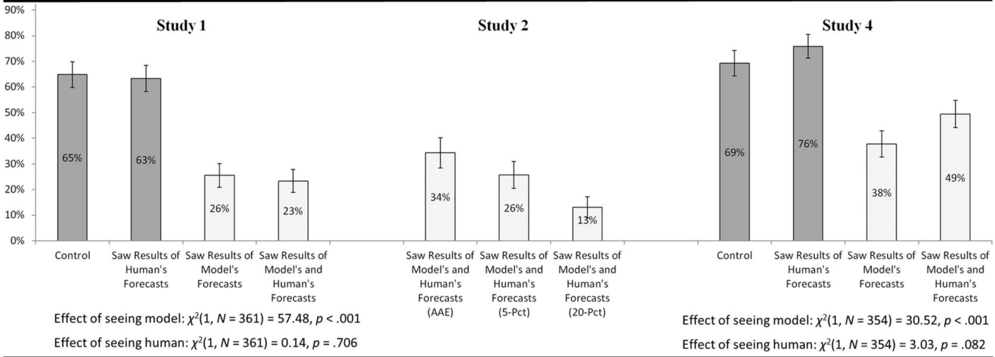
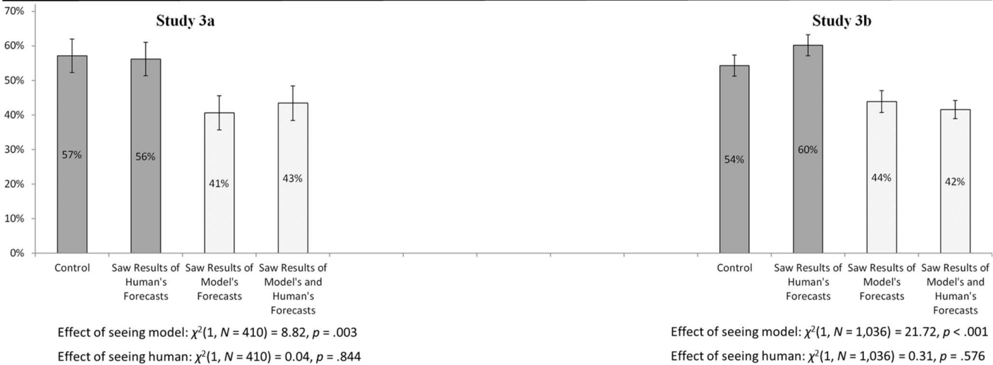
- Across five studies, seeing the algorithm perform reduced participants’ likelihood of choosing it over a human forecaster. In the model-and-human conditions, 610 of 741 participants (83%) saw the model outperform the human, yet these participants were among the least likely to choose the model.
- The model outperformed humans in all five studies. For example, bonuses if choosing model vs. human were Study 1: $1.78 vs. $1.38; Study 2: $1.77 vs. $1.09; Study 3a: $0.48 vs. $0.31; Study 3b: $0.49 vs. $0.30; Study 4: $1.79 vs. $1.38. Human forecasters produced 15–29% more error in the MBA task and 90–97% more error in the airline-passenger task.
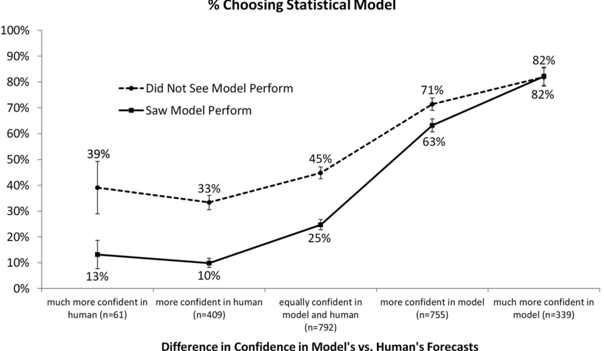
- Seeing the model perform significantly decreased confidence in the model’s forecasts in all four studies where this was tested, whereas seeing the human perform significantly decreased confidence in the human only in Study 4. Confidence in the model’s forecasts significantly mediated the effect of seeing the model perform on choosing the model; confidence in the human did not.
- In Study 2, participants paid for forecasts within 20 percentiles were less likely to choose the model than those paid within 5 percentiles, χ²(1, N = 139) = 3.56, p = .059, and those paid by average absolute error, χ²(1, N = 136) = 8.56, p = .003; this effect was mediated by confidence in their own forecasts, not confidence in the model’s forecasts.
Methods
- Five studies had participants forecast real outcomes: MBA student success (Studies 1, 2, and 4) or U.S. state rank in airline passengers (Studies 3a and 3b). Participants were assigned to control, human, model, or model-and-human conditions, then chose whether to tie incentivized bonuses to the model or the human forecaster (themselves in Studies 1–3, another participant in Study 4).
- Final samples were Study 1: 361; Study 2: 206; Study 3a: 410; Study 3b: 1,036; Study 4: 354. Studies 1, 2, and 4 were run in the Wharton Behavioral Lab; Studies 3a and 3b used Amazon Mechanical Turk.
- Main analyses compared forecasting performance and choice rates, measured confidence and beliefs, and used binary mediation analyses with Preacher and Hayes’s bootstrapping procedure.
Limitations
- The paper states it did not explore all boundaries of the effect, including whether it would persist if algorithms were many times more accurate than humans, and whether results depend on features shared by the two forecasting tasks.
- The paper states it did not explore how algorithm variations—complexity, transparency, forecaster involvement in construction, and designer expertise—affect algorithm aversion.
- The paper states algorithm aversion is not entirely driven by seeing algorithms err, and it has little to say about how best to reduce aversion among those who have seen an algorithm err. The text also cautions that cross-experiment comparisons should be made cautiously.
Model-written summary. Check it against the paper before relying on it.
Integrity signals
Registry
Cites
Statistics
Figures
Verification
Claims the paper makes
0 Valid · 2 Not valid · 16 Not checked · 90 Own results and interpretations
A result the paper reports from its own data — it cites no other source for it, so there is none to check. The quote shows it is in the paper.
In the paper
“the majority of people who were equally confident in the model's and human's forecasts chose to tie their bonuses to the human's forecasts, particularly when they had seen the model perform.”
plainstates an association- Asserted: passes — The authors put it forward as true.
- Checkable: passes — It can be checked against evidence.
- Load-bearing: passes — The paper’s conclusions depend on it.
- Based: passes — The paper gives a reason why it holds.
A result the paper reports from its own data — it cites no other source for it, so there is none to check. The quote shows it is in the paper.
In the paper
“Consistent with research on the adoption of decision aids (see Highhouse, 2008), participants thought that the human forecasters were better than the model at getting better with practice, learning from mistakes, and finding underappreciated candidates.”
plain- Asserted: passes — The authors put it forward as true.
- Checkable: passes — It can be checked against evidence.
- Load-bearing: passes — The paper’s conclusions depend on it.
- Based: passes — The paper gives a reason why it holds.
A result the paper reports from its own data — it cites no other source for it, so there is none to check. The quote shows it is in the paper.
In the paper
“Our studies show that this resistance at least partially arises from greater intolerance for error from algorithms than from humans.”
plainstates a possible cause- Asserted: passes — The authors put it forward as true.
- Checkable: passes — It can be checked against evidence.
- Load-bearing: passes — The paper’s conclusions depend on it.
- Based: passes — The paper gives a reason why it holds.
A result the paper reports from its own data — it cites no other source for it, so there is none to check. The quote shows it is in the paper.
In the paper
“Participants rightfully thought that the model was better than human forecasters at avoiding obvious mistakes, appropriately weighing various attributes, and consistently weighing information.”
plain- Asserted: passes — The authors put it forward as true.
- Checkable: passes — It can be checked against evidence.
- Load-bearing: unclear — It is unclear whether the paper’s conclusions depend on it.
- Based: passes — The paper gives a reason why it holds.
A result the paper reports from its own data — it cites no other source for it, so there is none to check. The quote shows it is in the paper.
In the paper
“This effect was evident in two distinct domains of judgment, including one in which the human forecasters produced nearly twice as much error as the algorithm.”
plain- Asserted: passes — The authors put it forward as true.
- Checkable: passes — It can be checked against evidence.
- Load-bearing: unclear — It is unclear whether the paper’s conclusions depend on it.
- Based: passes — The paper gives a reason why it holds.
75 more claims
Create a free account to see all 108 claims and to verify the 12 references still open.
- It may state two separate claims as one. 13
- Probably not a substantial claim. 16
Claims other papers make about this one
Each is checked against this paper’s own text: does it say what the citing paper says it does?
The source backs part of the claim, not all of it — or backs it for a different population, condition or comparison.
In the citing paper
“Traditional theorizing assumes trade-offs between trust and skepticism (Dietvorst et al., 2015), automation and engagement (Freeman et al., 2014), or efficiency and depth (Ishowo-Oloko et al., 2019)”
From Pedagogical partnerships with generative AI in higher education: how dual cognitive pathways paradoxically enable transformative learning (2026) · cites this paper as Dietvorst et al., 2015
Experimental — accuracy not yet measuredThe source backs part of the claim, not all of it — or backs it for a different population, condition or comparison.
In the citing paper
“Existing research typically examines trust versus skepticism in human-AI interactions as binary constructs (Dietvorst et al., 2015; Logg et al., 2019), missing the possibility that partnerships might simultaneously activate both vigilant and offloading behaviors.”
From Pedagogical partnerships with generative AI in higher education: how dual cognitive pathways paradoxically enable transformative learning (2026) · cites this paper as Dietvorst et al., 2015
Experimental — accuracy not yet measuredThe source backs part of the claim, not all of it — or backs it for a different population, condition or comparison.
In the citing paper
“It aligns with the theoretical rationale on algorithm aversion (Dietvorst et al. 2015;Hohensinn et al. 2024) and appreciation (Logg et al. 2019), which suggests that people are more likely to accept and trust AI systems when they produce desirable results but become skeptical when outcomes are unfavorable.”
From Holding AI Accountable Like Herding Cats: The Contingent Impact on the Legitimacy of Algorithmic Bureaucracy (2026) · cites this paper as Dietvorst et al. 2015
Experimental — accuracy not yet measuredThe source backs part of the claim, not all of it — or backs it for a different population, condition or comparison.
In the citing paper
“Research on algorithm appreciation and algorithm aversion further suggests that people may either defer to algorithms or reject them depending on prior experience, perceived expertise, and error visibility (Dietvorst et al., 2015; Logg et al., 2019).”
From College students' metacognitive awareness of generative-AI reliance: an experimental study of decision confidence and attribution bias (2026) · cites this paper as Dietvorst et al., 2015
Experimental — accuracy not yet measuredThe source backs part of the claim, not all of it — or backs it for a different population, condition or comparison.
In the citing paper
“Earlier research has mentioned gender, self-confidence, expertise, and general algorithm aversion or appreciation.15,28”
From Appropriate trust in artificial intelligence for the optical diagnosis of colorectal polyps: the role of human/artificial intelligence interaction (2024) · cites this paper as [28]
Experimental — accuracy not yet measured
22 more claims about this paper
Create a free account to see every claim other papers make about this one.
Statistics recomputed
Every reported test result, recomputed from its test statistic and degrees of freedom. A result shows as not adding up only once an independent check has confirmed it.
- Consistentt(360) = 4.98reported p < .001 · recomputed p < .001
“t (360) = 4.98, p < .001”
- Consistentt(204) = 6.26reported p < .001 · recomputed p < .001
“t (204) = 6.26, p < .001”
- Consistentt(405) = 7.73reported p < .001 · recomputed p < .001
“t (405) = 7.73, p < .001”
- Consistentt(353) = 5.11reported p < .001 · recomputed p < .001
“t (353) = 5.11, p < .001”
- Consistentχ²(1) = 39.94reported p < .001 · recomputed p < .001
“χ 2 (1, N = 271) = 39.94, p < .001”
19 more recomputed tests
Create a free account to see every test the Stats check recomputed.
Self-check
Percentages, sums and reported differences re-computed from the paper’s own numbers.
Self-check results appear here once an independent check has confirmed them.
Citations
Cites
Preacher, K. J., & Hayes, A. F. (2008) · Behavior Research Methods · doi:10.3758/brm.40.3.879 · Cited by 34,117 · cited 1×
“We then used Preacher and Hayes’s (2008) bootstrapping procedure to obtain unbiased 95% confidence intervals around the mediated effects.”
Method(2023) · doi:10.1126/science · Cited by 6,063
The trouble with overconfidence.
Moore, D. A., & Healy, P. J. (2008) · Psychological Review · doi:10.1037/0033-295x.115.2.502 · Cited by 2,358
“Clinical versus Actuarial Judgment.”
Dawes, R. M., Faust, D., & Meehl, P. E. (1989) · Science · doi:10.1126/science.2648573 · Cited by 2,298
The robust beauty of improper linear models in decision making.
Dawes, R. M. (1979) · American Psychologist · doi:10.1037/0003-066x.34.7.571 · Cited by 1,966
Preference and belief: Ambiguity and competence in choice under uncertainty
Heath, C., & Tversky, A. (1991) · Journal of Risk and Uncertainty · doi:10.1007/bf00057884 · Cited by 1,654
Clinical versus mechanical prediction: a meta-analysis
Grove, W. M., Zald, D. H., Lebow, B. S., Snitz, B. E., & Nelson, C. (2000) · Psychological Assessment · doi:10.1037/1040-3590.12.1.19 · Cited by 1,640
Grove, W. M., & Meehl, P. E. (1996) · Psychology, Public Policy, and Law · doi:10.1037/1076-8971.2.2.293 · Cited by 1,457 · cited 4×
“…1996), the notion that algorithms cannot properly consider individual targets (Grove & Meehl, 1996), concerns about the ethicality of relying on algorithms to make important decisions (Dawes, 1979), and the presumed inability of algorithms to incorporate qualitative data (Grove & Meehl, 1996).”
BackgroundMethodInfluential(2007) · Cited by 1,133
Competing on analytics: the new science of winning
(2007) · Choice Reviews Online · doi:10.5860/choice.44-6322 · Cited by 941
Research works printed but not linked: 1
- Clark, D. (2012, November 7). How Nate Silver won the 2012 presidential election. Harvard Business Review Blog . Retrieved from http://blogs .hbr.org/cs/2012/11/how\_nate\_silver\_won\_the\_2012\_p.html
Cited by
Items 101–200 of 3,918
Defending humankind: Anthropocentric bias in the appreciation of AI art
Millet, K., Buehler, F., Du, G., & Kokkoris, M. D. (2023) · Computers in Human Behavior · doi:10.1016/j.chb.2023.107707 · Cited by 194
The Challenges and Opportunities of AI-Assisted Writing: Developing AI Literacy for the AI Age
Cardon, P., Fleischmann, C., Aritz, J., Logemann, M., & Heidewald, J. (2023) · Business and Professional Communication Quarterly · doi:10.1177/23294906231176517 · Cited by 234
“Historically, people tend to judge AI mistakes more harshly than mistakes made by people (Dietvorst et al., 2015), yet as professionals use AI to communicate in their own names, it is likely that others will not give any leeway in terms of inaccuracies, misinformation, and other forms of unreliable…”
BackgroundAn Initial Model of Trust in Chatbots for Customer Service—Findings from a Questionnaire Study
Nordheim, C. B., Følstad, A., & Bjørkli, C. A. (2019) · Interacting with Computers · doi:10.1093/iwc/iwz022 · Cited by 233
Effect of disclosing AI-generated content on prosocial advertising evaluation
Baek, T. H., Kim, J., & Kim, J. H. (2026) · International Journal of Advertising · doi:10.1080/02650487.2024.2401319 · Cited by 150
Zhang, L., Pentina, I., & Fan, Y. (2021) · Journal of Services Marketing · doi:10.1108/jsm-05-2020-0162 · Cited by 197
Zarouali, B., Boerman, S. C., & de Vreese, C. H. (2021) · Telematics and Informatics · doi:10.1016/j.tele.2021.101607 · Cited by 155
Volkmar, G., Fischer, P. M., & Reinecke, S. (2022) · Journal of Business Research · doi:10.1016/j.jbusres.2022.04.007 · Cited by 163
Artificial Intelligence, Trust, and Perceptions of Agency
Vanneste, B. S., & Puranam, P. (2025) · Academy of Management Review · doi:10.5465/amr.2022.0041 · Cited by 149
Short-Term Electricity Load Forecasting with Machine Learning
Aguilar Madrid, E., & Antonio, N. (2021) · Information · doi:10.3390/info12020050 · Cited by 224
“Studies have shown that many decision-makers exhibit an inherent distrust of automated predictive models, even if they are proven to be more accurate than human forecasters [60].”
BackgroundA Case for Humans-in-the-Loop: Decisions in the Presence of Erroneous Algorithmic Scores
De-Arteaga, M., Fogliato, R., & Chouldechova, A. (2020) · Proceedings of the 2020 CHI Conference on Human Factors in Computing Systems · doi:10.1145/3313831.3376638 · Cited by 221
“Meanwhile, studies focused on the causes of algorithm aversion have found that repeatedly seeing the algorithm make the same mistake leads to decreased reliance of the agent on the system [13], while giving some control over the algorithm can counter this phenomenon [14].”
BackgroundPsychological factors underlying attitudes toward AI tools
De Freitas, J., Agarwal, S., Schmitt, B., & Haslam, N. (2023) · Nature Human Behaviour · doi:10.1038/s41562-023-01734-2 · Cited by 221
“Note: although this is the broad definition used in recent research, algorithm aversion was initially defined more narrowly as the tendency to lose confidence in algorithms faster than in humans after seeing them err 102 .”
MethodValue-Sensitive Algorithm Design: Method, Case Study, and Lessons
Zhu, H., Yu, B., Halfaker, A., & Terveen, L. (2018) · Proceedings of the ACM on Human-Computer Interaction · doi:10.1145/3274463 · Cited by 220
“For instance, a series of studies have shown that even when algorithmic predictions are proved to be more accurate than human predictions, domain experts and laypeople remain resistant to using the algorithms [15, 16, 45].”
BackgroundTo Advance AI Use in Education, Focus on Understanding Educators
Kizilcec, R. F. (2024) · International Journal of Artificial Intelligence in Education · doi:10.1007/s40593-023-00351-4 · Cited by 161
Explainable Recommendation: A Survey and New Perspectives
Zhang, Y., & Chen, X. (2020) · doi:10.1561/9781680836592 · Cited by 199
Three Challenges for AI-Assisted Decision-Making
Steyvers, M., & Kumar, A. (2024) · Perspectives on Psychological Science · doi:10.1177/17456916231181102 · Cited by 217
“For example, Dietvorst et al. (2015) showed that participants prefer to rely on human decision-making than on algorithms after witnessing the performance of an algorithm, which includes cases in which the algorithms make mistakes, despite the fact that the algorithm actually outperforms the human…”
Thumbs Up or Down: Consumer Reactions to Decisions by Algorithms Versus Humans
Yalcin, G., Lim, S., Puntoni, S., & van Osselaer, S. M. J. (2022) · Journal of Marketing Research · doi:10.1177/00222437211070016 · Cited by 175
Kim, H., So, K. K. F., Shin, S., & Li, J. (2024) · Journal of Hospitality & Tourism Research · doi:10.1177/10963480241229235 · Cited by 247
“Notably, despite AI’s ability to make precise decisions, people often override them due to algorithm aversion stemming from a lack of trust in machines (Dietvorst et al., 2015).”
Chatbots and mental health: Insights into the safety of generative AI
De Freitas, J., Uğuralp, A. K., Oğuz‐Uğuralp, Z., & Puntoni, S. (2024) · Journal of Consumer Psychology · doi:10.1002/jcpy.1393 · Cited by 211
“Most previous consumer research on algorithms has studied consumer reactions to algorithms that perform one specialized function, such as medical diagnosis (Longoni, Bonezzi, and Morewedge 2019) or admission to an academic institution (Dietvorst, Simmons, and Massey 2015).”
BackgroundKenny, E. M., Ford, C., Quinn, M., & Keane, M. T. (2021) · Artificial Intelligence · doi:10.1016/j.artint.2021.103459 · Cited by 211
Wang, R., Harper, F. M., & Zhu, H. (2020) · Proceedings of the 2020 CHI Conference on Human Factors in Computing Systems · doi:10.1145/3313831.3376813 · Cited by 211
Artificial Intelligence and Persuasion: A Construal-Level Account
Kim, T. W., & Duhachek, A. (2020) · Psychological Science · doi:10.1177/0956797620904985 · Cited by 190
Managing with Artificial Intelligence: An Integrative Framework
Hillebrand, L., Raisch, S., & Schad, J. (2025) · Academy of Management Annals · doi:10.5465/annals.2022.0072 · Cited by 262
Henry, K. E., Kornfield, R., Sridharan, A., Linton, R. C., Groh, C., Wang, T., Wu, A., Mutlu, B., & Saria, S. (2022) · npj Digital Medicine · doi:10.1038/s41746-022-00597-7 · Cited by 207
Wertenbroch, K., Schrift, R. Y., Alba, J. W., Barasch, A., Bhattacharjee, A., Giesler, M., Knobe, J., Lehmann, D. R., Matz, S., Nave, G., et al. (2020) · Marketing Letters · doi:10.1007/s11002-020-09521-z · Cited by 165
Yu, L., & Li, Y. (2022) · Behavioral Sciences · doi:10.3390/bs12050127 · Cited by 245
Influence of human versus AI recommenders: The roles of product type and cognitive processes
Wien, A. H., & Peluso, A. M. (2021) · Journal of Business Research · doi:10.1016/j.jbusres.2021.08.016 · Cited by 188
Lai, V., Chen, C., Smith-Renner, A., Liao, Q. V., & Tan, C. (2023) · 2023 ACM Conference on Fairness Accountability and Transparency · doi:10.1145/3593013.3594087 · Cited by 204
Kieslich, K., Keller, B., & Starke, C. (2022) · Big Data & Society · doi:10.1177/20539517221092956 · Cited by 203
“Concerning the results of our study, for example, given the case of an algorithmic admission system in universities (Dietvorst et al., 2015), system requirements articulated by the affected public (in this case, students) might widely differ from those of a job seeker categorization system (e.g., the…”
BackgroundPaluch, S., Tuzovic, S., Holz, H. F., Kies, A., & Jörling, M. (2022) · Journal of Service Management · doi:10.1108/josm-11-2020-0406 · Cited by 182
Bad machines corrupt good morals
Köbis, N., Bonnefon, J.-F., & Rahwan, I. (2021) · Nature Human Behaviour · doi:10.1038/s41562-021-01128-2 · Cited by 202
Kim, J. H., Kim, J., Park, J., Kim, C., Jhang, J., & King, B. (2025) · Journal of Travel Research · doi:10.1177/00472875231212996 · Cited by 202
“For example, Dietvorst et al. (2015) suggested that people prefer to make use of humans (vs. algorithms) when they observe forecasting errors.”
How do visual explanations foster end users' appropriate trust in machine learning?
Yang, F., Huang, Z., Scholtz, J., & Arendt, D. L. (2020) · Proceedings of the 25th International Conference on Intelligent User Interfaces · doi:10.1145/3377325.3377480 · Cited by 200
“Empirically, example-based explanations helped users with diverse backgrounds better understand and access an intelligent system[8, 11, 18].”
BackgroundAlgorithmic discrimination causes less moral outrage than human discrimination
Bigman, Y. E., Wilson, D., Arnestad, M. N., Waytz, A., & Gray, K. (2023) · Journal of Experimental Psychology: General · doi:10.1037/xge0001250 · Cited by 198
Artificial intelligence and people management: A critical assessment through the ethical lens
Varma, A., Dawkins, C. E., & Chaudhuri, K. (2022) · Human Resource Management Review · doi:10.1016/j.hrmr.2022.100923 · Cited by 239
Artificial Intelligence in Human Resources Management: Challenges and a Path Forward
Cappelli, P., Tambe, P., & Yakubovich, V. (2018) · SSRN Electronic Journal · doi:10.2139/ssrn.3263878 · Cited by 160
Artificial intelligence, human intelligence and hybrid intelligence based on mutual augmentation
Jarrahi, M. H., Lutz, C., & Newlands, G. (2022) · Big Data & Society · doi:10.1177/20539517221142824 · Cited by 151
When Algorithms Fail: Consumers’ Responses to Brand Harm Crises Caused by Algorithm Errors
Srinivasan, R., & Sarial-Abi, G. (2021) · Journal of Marketing · doi:10.1177/0022242921997082 · Cited by 196
Artificial intelligence in public services: When and why citizens accept its usage
Gesk, T. S., & Leyer, M. (2022) · Government Information Quarterly · doi:10.1016/j.giq.2022.101704 · Cited by 195
Lim, W. M. (2026) · Journal of Business Research · doi:10.1016/j.jbusres.2025.115745 · Cited by 159
Rise of the machines: Delegating decisions to autonomous AI
Candrian, C., & Scherer, A. (2022) · Computers in Human Behavior · doi:10.1016/j.chb.2022.107308 · Cited by 150
Artificial Intelligence and Declined Guilt: Retailing Morality Comparison Between Human and AI
Giroux, M., Kim, J., Lee, J. C., & Park, J. (2022) · Journal of Business Ethics · doi:10.1007/s10551-022-05056-7 · Cited by 194
“…usage, researchers have documented a certain resistance to the adoption of AI not only due to regulation and privacy issues but also due to their inaccuracy to make inferences and predictions (Dietvorst et al., 2015; Longoni et al., 2019) and the inauthenticity of those predictions (Jago, 2019).”
BackgroundPizzi, G., Vannucci, V., Mazzoli, V., & Donvito, R. (2023) · Psychology & Marketing · doi:10.1002/mar.21813 · Cited by 194
Exploring stakeholder attitudes towards AI in clinical practice
Scott, I. A., Carter, S. M., & Coiera, E. (2021) · BMJ Health & Care Informatics · doi:10.1136/bmjhci-2021-100450 · Cited by 193
Jago, A. S. (2019) · Academy of Management Discoveries · doi:10.5465/amd.2017.0002 · Cited by 160
Complementarity in human-AI collaboration: concept, sources, and evidence
Hemmer, P., Schemmer, M., Kühl, N., Vössing, M., & Satzger, G. (2025) · European Journal of Information Systems · doi:10.1080/0960085x.2025.2475962 · Cited by 241
“This is also an insightful observation, as we could have expected that humans may reject even correct AI assistance once they witness the AI committing errors on task instances they can easily solve themselves (Dietvorst et al., 2015).”
Judgmental selection of forecasting models
Petropoulos, F., Kourentzes, N., Nikolopoulos, K., & Siemsen, E. (2018) · Journal of Operations Management · doi:10.1016/j.jom.2018.05.005 · Cited by 165
Rapid Trust Calibration through Interpretable and Uncertainty-Aware AI
Tomsett, R., Preece, A., Braines, D., Cerutti, F., Chakraborty, S., Srivastava, M., Pearson, G., & Kaplan, L. (2020) · Patterns · doi:10.1016/j.patter.2020.100049 · Cited by 186
Lower Artificial Intelligence Literacy Predicts Greater AI Receptivity
Tully, S. M., Longoni, C., & Appel, G. (2025) · Journal of Marketing · doi:10.1177/00222429251314491 · Cited by 193
“…exhibit favorable responses to new technologies (i.e., “ automation bias ” or “ algorithm appreciation ” ; e.g., Longoni and Cian 2022; Mosier and Skitka 2018) and cases in which consumers are averse to new technologies (i.e., “ algo-rithm aversion ” ; e.g., Dietvorst, Simmons, and Massey 2015).”
Watch Me Improve—Algorithm Aversion and Demonstrating the Ability to Learn
Berger, B., Adam, M., Rühr, A., & Benlian, A. (2021) · Business & Information Systems Engineering · doi:10.1007/s12599-020-00678-5 · Cited by 183
The ethical use of artificial intelligence in human resource management: a decision-making framework
Bankins, S. (2021) · Ethics and Information Technology · doi:10.1007/s10676-021-09619-6 · Cited by 181
“Algorithm aversion refers to the “irrational discounting of automation advice” (Prahl & Van Swol, 2017, p. 691), whereby individuals rely more heavily on human-generated advice over algorithmically-generated advice, even when the latter is seen to outperform the former (Dietvorst et al., 2015).”
BackgroundWhat Explains Teachers’ Trust in AI in Education Across Six Countries?
Viberg, O., Cukurova, M., Feldman-Maggor, Y., Alexandron, G., Shirai, S., Kanemune, S., Wasson, B., Tømte, C., Spikol, D., Milrad, M., et al. (2025) · International Journal of Artificial Intelligence in Education · doi:10.1007/s40593-024-00433-x · Cited by 179
“Concerns about AI have also been framed more broadly as algorithm aversion in AI-adoption research in other domains (Dietvorst et al., 2015).”
Behavioural evidence for a transparency–efficiency tradeoff in human–machine cooperation
Ishowo-Oloko, F., Bonnefon, J.-F., Soroye, Z., Crandall, J., Rahwan, I., & Rahwan, T. (2019) · Nature Machine Intelligence · doi:10.1038/s42256-019-0113-5 · Cited by 178
Leyer, M., & Schneider, S. (2021) · Business Horizons · doi:10.1016/j.bushor.2021.02.026 · Cited by 178
Jones-Jang, S. M., & Park, Y. J. (2022) · Journal of Computer-Mediated Communication · doi:10.1093/jcmc/zmac029 · Cited by 178
Gnewuch, U., Morana, S., Hinz, O., Kellner, R., & Maedche, A. (2024) · Information Systems Research · doi:10.1287/isre.2022.0152 · Cited by 144
“For example, our results could serve as a starting point for investigating whether such disclosure causes or exacerbates algorithm aversion (Dietvorst et al. 2015) and whether customers are even more frustrated by failures during an interaction when they know that humans are working in tandem with…”
BackgroundResultZhang, Y., & Gosline, R. (2023) · Judgment and Decision Making · doi:10.1017/jdm.2023.37 · Cited by 176
“Therefore, contrary to the arguments made by the ‘algorithm aversion’ literature (e.g., Castelo et al., 2019; Dietvorst et al., 2015) that people display aversion toward AI, we do not find aversion toward AI’s involvement in generating advertising and persuasive content.”
Jain, R., Garg, N., & Khera, S. N. (2022) · Frontiers in Psychology · doi:10.3389/fpsyg.2022.893691 · Cited by 114
Rajaram, K., & Tinguely, P. N. (2024) · Business Horizons · doi:10.1016/j.bushor.2024.05.008 · Cited by 206
“In performance prediction tasks, evaluators tend to abandon AI systems in favor of a human judge when they realize that such systems are imperfect, even though they outperform human judgment (Dietvorst et al., 2015).”
When Will Workers Follow an Algorithm? A Field Experiment with a Retail Business
Kawaguchi, K. (2021) · Management Science · doi:10.1287/mnsc.2020.3599 · Cited by 147
Third-party evaluators perceive AI as more compassionate than expert humans
Ovsyannikova, D., de Mello, V. O., & Inzlicht, M. (2025) · Communications Psychology · doi:10.1038/s44271-024-00182-6 · Cited by 124
“While AI aversion is common 40,41 , it can be partly overcome with experience 42,43 ,successfuluse 29 ,andframingthatemphasizesAI ’ ssupportive motives 44 .”
What do we know about algorithmic literacy? The status quo and a research agenda for a growing field
Oeldorf-Hirsch, A., & Neubaum, G. (2023) · New Media & Society · doi:10.1177/14614448231182662 · Cited by 199
An Integrative Perspective on Algorithm Aversion and Appreciation in Decision-Making
Jussupow, E., Benbasat, I., & Heinzl, A. (2024) · MIS Quarterly · doi:10.25300/misq/2024/18512 · Cited by 121
Naiseh, M., Al-Thani, D., Jiang, N., & Ali, R. (2023) · International Journal of Human-Computer Studies · doi:10.1016/j.ijhcs.2022.102941 · Cited by 170
Prejudiced against the Machine? Implicit Associations and the Transience of Algorithm Aversion
Turel, O., & Kalhan, S. (2023) · MIS Quarterly · doi:10.25300/misq/2022/17961 · Cited by 205
You, S., Yang, C. L., & Li, X. (2022) · Journal of Management Information Systems · doi:10.1080/07421222.2022.2063553 · Cited by 137
Reliability of LLMs as medical assistants for the general public: a randomized preregistered study
Bean, A. M., Payne, R. E., Parsons, G., Kirk, H. R., Ciro, J., Mosquera-Gómez, R., Sara Hincapié, M., Ekanayaka, A. S., Tarassenko, L., Rocher, L., et al. (2026) · Nature Medicine · doi:10.1038/s41591-025-04074-y · Cited by 236
“…require identifying why humans fail when interacting with LLM-based tools—for example, aversion to technology and implicit biases against algorithms 10,11,25 or LLM affordances undermining trust in interactions 26 —and, crucially, how to design more reliable and deterministic conversational…”
Keding, C., & Meissner, P. (2021) · Technological Forecasting and Social Change · doi:10.1016/j.techfore.2021.120970 · Cited by 168
Nazaretsky, T., Mejia-Domenzain, P., Swamy, V., Frej, J., & Käser, T. (2025) · Computers and Education: Artificial Intelligence · doi:10.1016/j.caeai.2025.100368 · Cited by 96
In artificial intelligence (AI) we trust: A qualitative investigation of AI technology acceptance
Hasija, A., & Esper, T. L. (2022) · Journal of Business Logistics · doi:10.1111/jbl.12301 · Cited by 165
Sun, J., Zhang, D. J., Hu, H., & Van Mieghem, J. A. (2022) · Management Science · doi:10.1287/mnsc.2021.3990 · Cited by 160
News from Generative Artificial Intelligence Is Believed Less
Longoni, C., Fradkin, A., Cian, L., & Pennycook, G. (2022) · 2022 ACM Conference on Fairness Accountability and Transparency · doi:10.1145/3531146.3533077 · Cited by 120
Estep, C., Griffith, E. E., & MacKenzie, N. L. (2023) · Review of Accounting Studies · doi:10.1007/s11142-023-09771-y · Cited by 195
“Further, prior research finds that beliefs about the accuracy of AI influence the responses to AI (e.g., Dietvorst et al. 2015; Kramer et al. 2018).”
InfluentialCombining Human Expertise with Artificial Intelligence: Experimental Evidence from Radiology
Agarwal, N., Moehring, A., Rajpurkar, P., & Salz, T. (2023) · doi:10.3386/w31422 · Cited by 161
Westphal, M., Vössing, M., Satzger, G., Yom‐Tov, G. B., & Rafaeli, A. (2023) · Computers in Human Behavior · doi:10.1016/j.chb.2023.107714 · Cited by 186
Explainable AI improves task performance in human–AI collaboration
Senoner, J., Schallmoser, S., Kratzwald, B., Feuerriegel, S., & Netland, T. H. (2024) · Scientific Reports · doi:10.1038/s41598-024-82501-9 · Cited by 205
“Our work contributes experimental evidence to the literature on human–AI collaboration 30–32 , 67– 75 .”
Combining Human Expertise with Artificial Intelligence: Experimental Evidence from Radiology
Agarwal, N., Moehring, A., Rajpurkar, P., & Salz, T. (2023) · doi:10.2139/ssrn.4505053 · Cited by 161
“6Our finding that radiologists exhibit automation neglect is related to those in Dietvorst et al. (2015), which shows that humans are averse to following algorithmic recommendations as compared to human recommendations.”
BackgroundHow to overcome algorithm aversion: Learning from mistakes
Reich, T., Kaju, A., & Maglio, S. J. (2022) · Journal of Consumer Psychology · doi:10.1002/jcpy.1313 · Cited by 186
Human–machine collaboration for improving semiconductor process development
Kanarik, K. J., Osowiecki, W. T., Lu, Y., Talukder, D., Roschewsky, N., Park, S. N., Kamon, M., Fried, D., & Gottscho, R. A. (2023) · Nature · doi:10.1038/s41586-023-05773-7 · Cited by 184
Trustworthy AI and robotics: Implications for the AEC industry
Emaminejad, N., & Akhavian, R. (2022) · Automation in Construction · doi:10.1016/j.autcon.2022.104298 · Cited by 136
Diverse patients’ attitudes towards Artificial Intelligence (AI) in diagnosis
Robertson, C., Woods, A., Bergstrand, K., Findley, J., Balser, C., & Slepian, M. J. (2023) · PLOS Digital Health · doi:10.1371/journal.pdig.0000237 · Cited by 158
“Despite the promise of AI, there is broad public skepticism about AI in a range of domains from transportation to criminal justice to healthcare [4,5].”
BackgroundResultTowards Algorithmic Experience: Initial Efforts for Social Media Contexts
Alvarado, O., & Waern, A. (2018) · Proceedings of the 2018 CHI Conference on Human Factors in Computing Systems · doi:10.1145/3173574.3173860 · Cited by 127
Sohn, K., Sung, C. E., Koo, G., & Kwon, O. (2020) · International Journal of Retail & Distribution Management · doi:10.1108/ijrdm-03-2020-0091 · Cited by 140
Langer, M., König, C. J., Back, C., & Hemsing, V. (2023) · Journal of Business and Psychology · doi:10.1007/s10869-022-09829-9 · Cited by 122
Lermann Henestrosa, A., Greving, H., & Kimmerle, J. (2023) · Computers in Human Behavior · doi:10.1016/j.chb.2022.107445 · Cited by 113
Interpretability via Model Extraction
Bastani, O., Kim, C., & Bastani, H. (2017) · arXiv (Cornell University) · doi:10.48550/arxiv.1706.09773 · Cited by 85
Christoforakos, L., Gallucci, A., Surmava-Große, T., Ullrich, D., & Diefenbach, S. (2021) · Frontiers in Robotics and AI · doi:10.3389/frobt.2021.640444 · Cited by 154
“…van Pinxteren et al., 2019), and research in different contexts revealed a particular skepticism of machines compared to humans in trustworthiness (Dietvorst et al., 2015) and related variables such as cooperation (Merritt and McGee, 2012; Ishowo-Oloko et al., 2019), particularly relevant in…”
BackgroundResultTrusting Intelligent Machines: Deepening Trust Within Socio-Technical Systems
Andras, P., Esterle, L., Guckert, M., Han, T. A., Lewis, P. R., Milanovic, K., Payne, T., Perret, C., Pitt, J., Powers, S. T., et al. (2018) · IEEE Technology and Society Magazine · doi:10.1109/mts.2018.2876107 · Cited by 153
“For example, people tend to prefer human forecasters to algorithmic forecasters, even when they have seen the algorithm outperform a human forecaster [8].”
BackgroundInfluence of believed AI involvement on the perception of digital medical advice
Reis, M., Reis, F., & Kunde, W. (2024) · Nature Medicine · doi:10.1038/s41591-024-03180-7 · Cited by 118
“Yet, research from various domains indicates reservations against such content as soon as the AI authorship becomes apparent (algorithm aversion 7 ).”
Technology devalues luxury? Exploring consumer responses to AI-designed luxury products
Xu, L., & Mehta, R. (2022) · Journal of the Academy of Marketing Science · doi:10.1007/s11747-022-00854-x · Cited by 167
Adaptive Folk Theorization as a Path to Algorithmic Literacy on Changing Platforms
DeVito, M. A. (2021) · Proceedings of the ACM on Human-Computer Interaction · doi:10.1145/3476080 · Cited by 151
Attitudes towards artificial intelligence at work: Scale development and validation
Park, J., Woo, S. E., & Kim, J. (2024) · Journal of Occupational and Organizational Psychology · doi:10.1111/joop.12502 · Cited by 150
Why trust an algorithm? Performance, cognition, and neurophysiology
Alexander, V., Blinder, C., & Zak, P. J. (2018) · Computers in Human Behavior · doi:10.1016/j.chb.2018.07.026 · Cited by 135
Lou, C., Kang, H., & Tse, C. H. (2022) · International Journal of Advertising · doi:10.1080/02650487.2021.1951510 · Cited by 129
Friend or Foe? Teaming Between Artificial Intelligence and Workers with Variation in Experience
Wang, W., Gao, G. (., & Agarwal, R. (2023) · Management Science · doi:10.1287/mnsc.2021.00588 · Cited by 113
Wischnewski, M., Krämer, N., & Müller, E. (2023) · Proceedings of the 2023 CHI Conference on Human Factors in Computing Systems · doi:10.1145/3544548.3581197 · Cited by 146
“sity to trust and their attitudes towards automation, both factors which afect trust [30, 41].”
BackgroundLee, M. K., & Rich, K. (2021) · Proceedings of the 2021 CHI Conference on Human Factors in Computing Systems · doi:10.1145/3411764.3445570 · Cited by 145
Applicants’ Fairness Perceptions of Algorithm-Driven Hiring Procedures
Lavanchy, M., Reichert, P., Narayanan, J., & Savani, K. (2023) · Journal of Business Ethics · doi:10.1007/s10551-022-05320-w · Cited by 168
Rodway, P., & Schepman, A. (2023) · Computers and Education: Artificial Intelligence · doi:10.1016/j.caeai.2023.100150 · Cited by 144
Kim, J. H., Kim, J., Kim, C., & Kim, S. (. (2023) · Journal of Travel & Tourism Marketing · doi:10.1080/10548408.2023.2293006 · Cited by 144
“For example, research on AI aversion suggests that humans are critical of the instructions and recommendations given by algorithms (Bigman & Gray, 2018; Dietvorst et al., 2015).”
BackgroundMethodResultHumans rely more on algorithms than social influence as a task becomes more difficult
Bogert, E., Schecter, A., & Watson, R. T. (2021) · Scientific Reports · doi:10.1038/s41598-021-87480-9 · Cited by 144
Metadata
- Authors
- Dietvorst, B. J., Simmons, J. P., & Massey, C.
- Affiliations
- University of Pennsylvania (US)
- Venue
- Journal of Experimental Psychology: General
- Published
- 2015
- Volume
- 144
- Issue
- 1
- Pages
- 114-126
- ISSN
- 0096-3445 (ISSN-L)
- 1939-2222
- OpenAlex
- W3125633690
- Cited by
- 3,232
- References
- 22
- Citations by year
- 2026: 1025 · 2025: 563 · 2024: 445 · 2023: 404 · 2022: 266 · 2021: 216 · 2020: 137 · 2019: 88 · 2018: 41 · 2017: 26 · 2016: 14 · 2015: 5
- FWCI
- 13.96
- Type
- journal article
- Language
- en
- Open access
- green
- doi.org
- Locations
- Journal of Experimental Psychology General (publishedVersion)
- SSRN Electronic Journal (publishedVersion)
- PubMed (publishedVersion)
- ScholarlyCommons (University of Pennsylvania) (submittedVersion)
- Funders
- Wharton Behavioral Laboratory
- Wharton Risk Center Ackoff Doctoral Student Fellowship
- Topics
- Social Sciences › Decision Sciences › General Decision Sciences › Decision-Making and Behavioral Economics
- Social Sciences › Decision Sciences › Management Science and Operations Research › Forecasting Techniques and Applications
- Social Sciences › Human Factors and Ergonomics › Human-Automation Interaction and Safety
- Keywords
- algorithm aversion, trust in algorithms, prediction confidence, evidence-based algorithm, decision-making
- MeSH terms
- Algorithms, Avoidance Learning, Culture, Decision Making, Female, Forecasting, Humans, Male, Motivation, Comprehension, Young Adult
About these checks
Registry, retraction, Cites and statistics results are computed, not judged, with one exception: a printed reference that no index lists is read once by a model before it counts as a citation error. Claims are extracted by a model and kept only when their quote appears verbatim in the text; each cited source is then checked, with a model’s help, for whether it says what the claim relies on. Those verdicts can be wrong — read the claim’s quote and the cited source before relying on one.
A language model drew the claims from the paper on 2026-11-14, under version 3 of the claim definition (model deepseek-v4.1-flash, prompt extract-v3).
A second model labelled each claim on 2026-11-14 (model jev-1.13-20260917, definition revision gold-guideline-v0.2).
Statistics and arithmetic are recomputed, not judged.
Confidence bands are shown only for fields calibrated on our annotated test set. None is calibrated yet, so no band is shown.
What counts as a claim ›How we measure confidence ›How we check this ›
Are you an author, or do you see a problem with this page? Request a review
Data sources
Bibliographic data: Semantic Scholar, OpenAlex, Crossref.
Contains information from the Semantic Scholar Academic Graph Datasets, made available under the ODC Attribution License (ODC-BY 1.0).
Semantic Scholar’s data is described in: Kinney, R., et al. (2023). The Semantic Scholar Open Data Platform. arXiv:2301.10140.
