

Clinical applications of stem cell-derived exosomes
Open accessThe DOI matches its Crossref record; 351 of the 352 references it cites were found in a registry or an index.
Abstract
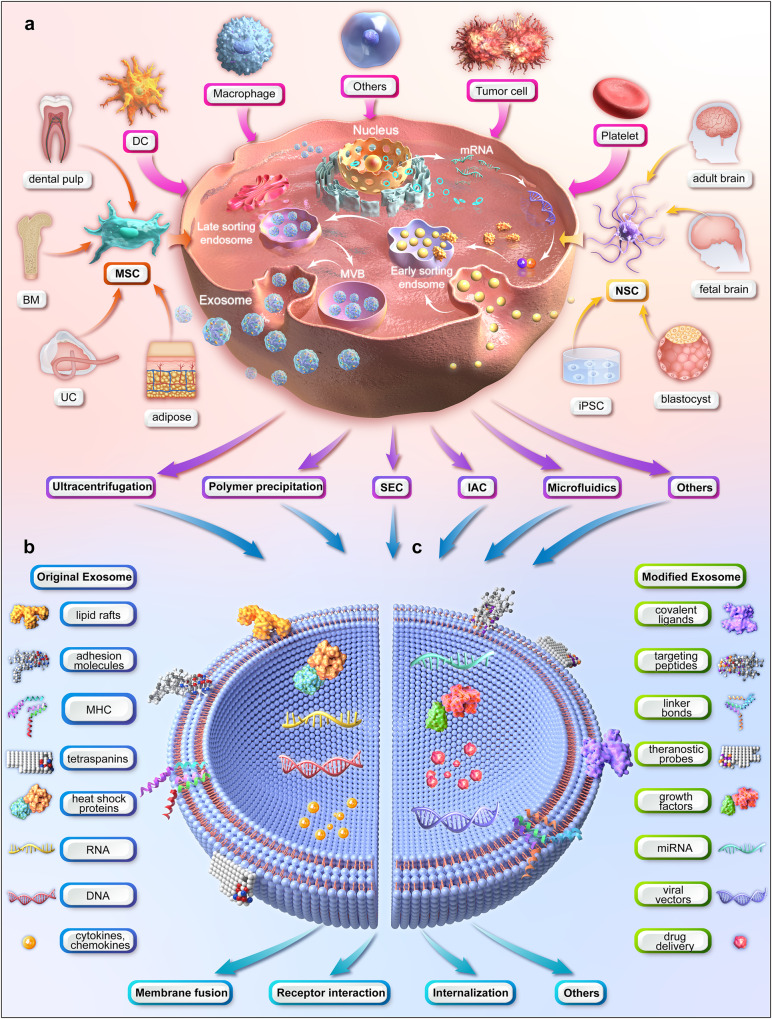
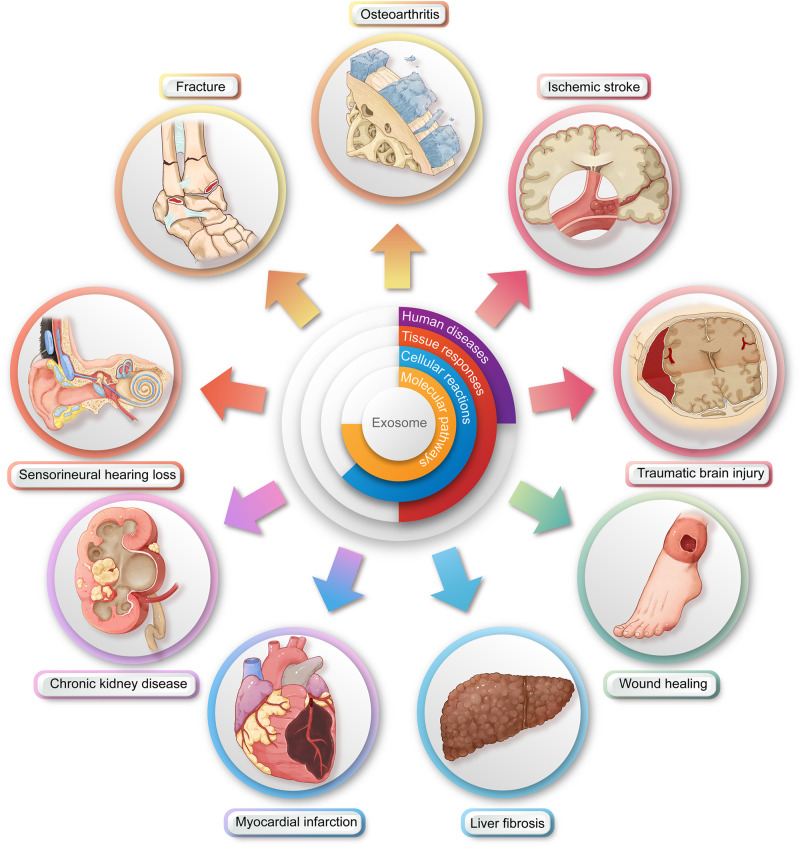
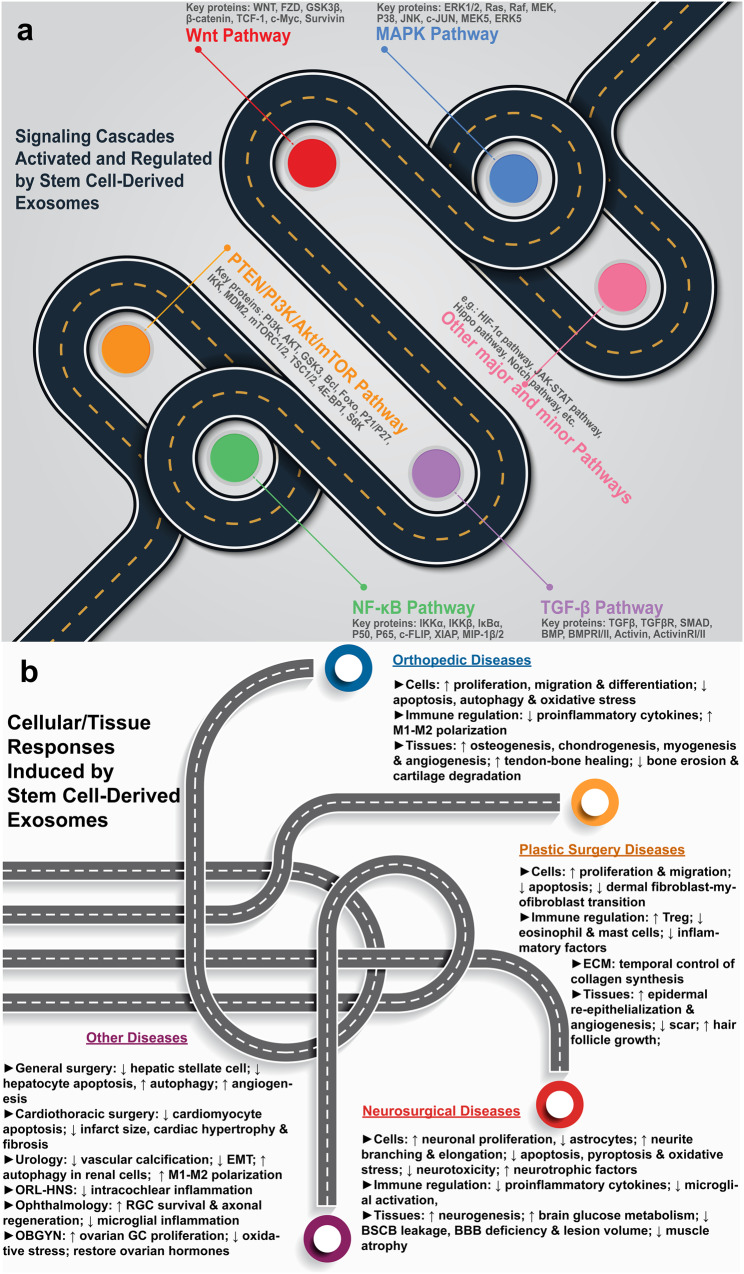
Although stem cell-based therapy has demonstrated considerable potential to manage certain diseases more successfully than conventional surgery, it nevertheless comes with inescapable drawbacks that might limit its clinical translation. Compared to stem cells, stem cell-derived exosomes possess numerous advantages, such as non-immunogenicity, non-infusion toxicity, easy access, effortless preservation, and freedom from tumorigenic potential and ethical issues. Exosomes can inherit similar therapeutic effects from their parental cells such as embryonic stem cells and adult stem cells through vertical delivery of their pluripotency or multipotency. After a thorough search and meticulous dissection of relevant literature from the last five years, we present this comprehensive, up-to-date, specialty-specific and disease-oriented review to highlight the surgical application and potential of stem cell-derived exosomes. Exosomes derived from stem cells (e.g., embryonic, induced pluripotent, hematopoietic, mesenchymal, neural, and endothelial stem cells) are capable of treating numerous diseases encountered in orthopedic surgery, neurosurgery, plastic surgery, general surgery, cardiothoracic surgery, urology, head and neck surgery, ophthalmology, and obstetrics and gynecology. The diverse therapeutic effects of stem cells-derived exosomes are a hierarchical translation through tissue-specific responses, and cell-specific molecular signaling pathways. In this review, we highlight stem cell-derived exosomes as a viable and potent alternative to stem cell-based therapy in managing various surgical conditions. We recommend that future research combines wisdoms from surgeons, nanomedicine practitioners, and stem cell researchers in this relevant and intriguing research area.
Overview
The claims and statistics of this paper haven’t been checked yet.
Free: it reads the open-access text and checks the first 5 claims that cite a source we can check. Create a free account to check every claim.
Integrity signals
Registry
Cites
Statistics
Figures
Verification
Claims the paper makes
The claims and statistics of this paper haven’t been checked yet.
Free: it reads the open-access text and checks the first 5 claims that cite a source we can check. Create a free account to check every claim.
Claims other papers make about this one
Each is checked against this paper’s own text: does it say what the citing paper says it does?
The cited source says what the claim attributes to it.
In the citing paper
“Despite their strong therapeutic promise in AD, the production of stem cell-derived exosomes remains challenging. Their yield from cultured media is extremely low, posing a major challenge for large-scale manufacturing and clinical translation [231].”
From The Impact of Neurotoxin Proteins Trafficked by Primary Cilia and Extracellular Vesicles in Neurodegenerative Diseases (2025) · cites this paper as [231]
Experimental — accuracy not yet measured
Self-check
Percentages, sums and reported differences re-computed from the paper’s own numbers.
The self-check needs the paper’s full text.
Citations
Cites
2 retracted
Ding, J., Wang, X., Chen, B., Zhang, J., & Xu, J. (2019) · BioMed Research International · doi:10.1155/2019/9742765 · Cited by 184 · cited 1×
“215 218 EPC-derived exosomes could accelerate cutaneous wound healing by promoting angiogenesis 219 through the Erk1/2 pathway 220 and p53 pathway.”
BackgroundRetractedJiang, Y., Zhang, J., Li, Z., & Jia, G. (2020) · Frontiers in Medicine · doi:10.3389/fmed.2020.577578 · Cited by 55 · cited 1×
“71 From a lncRNA perspective, especially the bone-speci fi c lncRNA H19, a Chinese group revealed that although a high-fat diet reduced osteogenic differentiation and weakened fracture healing, this could be reversed by MSC-derived exosomal lncRNA H19 via miR-467/ HoxA10 axis in an obesity-induced…”
BackgroundRetractedThéry, C., Witwer, K. W., Aikawa, E., Alcaraz, M. J., Anderson, J. D., Andriantsitohaina, R., Antoniou, A., Arab, T., Archer, F., Atkin‐Smith, G. K., et al. (2018) · Journal of Extracellular Vesicles · doi:10.1080/20013078.2018.1535750 · Cited by 11,099 · cited 1×
“55,56 Storage of exosomes The currently used preservation methods for long-term storage of exosomes mainly include cryopreservation, lyophilization, and spray-drying.”
MethodThe biology , function , and biomedical applications of exosomes
Kalluri, R., & LeBleu, V. S. (2020) · Science · doi:10.1126/science.aau6977 · Cited by 10,770
Poewe, W., Seppi, K., Tanner, C. M., Halliday, G. M., Brundin, P., Volkmann, J., Schrag, A.-E., & Lang, A. E. (2017) · Nature Reviews Disease Primers · doi:10.1038/nrdp.2017.13 · Cited by 5,415
Delivery of siRNA to the mouse brain by systemic injection of targeted exosomes
Alvarez-Erviti, L., Seow, Y., Yin, H., Betts, C., Lakhal, S., & Wood, M. J. A. (2011) · Nature Biotechnology · doi:10.1038/nbt.1807 · Cited by 4,930 · cited 1×
“50 Zhu et al. inserted tumor-targeting peptides, c(RGDyK), into the exosome surface using a chemical reaction to target glioblastoma.”
BackgroundDoyle, L., & Wang, M. (2019) · Cells · doi:10.3390/cells8070727 · Cited by 3,236 · cited 3×
“19 In addition, cargo pro fi ling is further subdivided into proteomic, lipidomic, and genomic analyses including western blotting, ELISA, fl ow cytometry, mass spectroscopy, and PCR. 36 Since each of the above characterization methods has advantages and disadvantages, it is a universal practice to…”
BackgroundMethodInfluentialBlood–brain barrier breakdown in Alzheimer disease and other neurodegenerative disorders
Sweeney, M. D., Sagare, A. P., & Zlokovic, B. V. (2018) · Nature Reviews Neurology · doi:10.1038/nrneurol.2017.188 · Cited by 3,076
Wound Healing: A Cellular Perspective
Rodrigues, M., Kosaric, N., Bonham, C. A., & Gurtner, G. C. (2019) · Physiological Reviews · doi:10.1152/physrev.00067.2017 · Cited by 3,013
Comprehensive Review on Alzheimer’s Disease: Causes and Treatment
Breijyeh, Z., & Karaman, R. (2020) · Molecules · doi:10.3390/molecules25245789 · Cited by 2,789
Research works printed but not linked: 1
- Carr NJ The pathology of healing and repair Surgery 2022 40 13 19
Cited by
Xu, G., Jin, J., Fu, Z., Wang, G., Lei, X., Xu, J., & Wang, J. (2025) · Signal Transduction and Targeted Therapy · doi:10.1038/s41392-025-02312-w · Cited by 269
“These biological properties are integral to two important applications of EVs in the treatment of refractory diseases, such as degeneration, in fl ammation, and tumorigenesis: as a natural therapeutic drug and as a drug delivery tool 16 .”
A comprehensive review of challenges and advances in exosome-based drug delivery systems
Palakurthi, S. S., Shah, B., Kapre, S., Charbe, N., Immanuel, S., Pasham, S., Thalla, M., Jain, A., & Palakurthi, S. (2024) · Nanoscale Advances · doi:10.1039/d4na00501e · Cited by 215
Clinical relevance of extracellular vesicles in cancer — therapeutic and diagnostic potential
Greening, D. W., Xu, R., Rai, A., Suwakulsiri, W., Chen, M., & Simpson, R. J. (2025) · Nature Reviews Clinical Oncology · doi:10.1038/s41571-025-01074-2 · Cited by 144
Pharmacokinetic characteristics of mesenchymal stem cells in translational challenges
Shan, Y., Zhang, M., Tao, E., Wang, J., Wei, N., Lü, Y., Liu, Q., Hao, K., Zhou, F., & Wang, G. (2024) · Signal Transduction and Targeted Therapy · doi:10.1038/s41392-024-01936-8 · Cited by 139
“25 Local administration is commonly employed because it allows direct delivery to the disease site.”
BackgroundRodríguez‐Eguren, A., Bueno-Fernández, C., Gómez‐Álvarez, M., Francés‐Herrero, E., Pellicer, A., Bellver, J., Seli, E. U., & Cervelló, I. (2024) · Human Reproduction Update · doi:10.1093/humupd/dmae013 · Cited by 133
“EVs can be isolated based on their size, surface charge, or immunoaffinity; ultracentrifugation is currently considered the gold standard technique (Tan et al. , 2024).”
MethodExosome isolation and characterization for advanced diagnostic and therapeutic applications
Mukerjee, N., Bhattacharya, A., Maitra, S., Kaur, M., Ganesan, S., Mishra, S., Ashraf, A., Rizwan, M., Kesari, K. K., Tabish, T. A., et al. (2025) · Materials Today Bio · doi:10.1016/j.mtbio.2025.101613 · Cited by 123
“…due to their stability in body fluids and the specificity of their molecular contents, exosomes are ideal candidates for biomarkers in liquid biopsy approaches, providing a non-invasive means to diagnose and monitor diseases, thus opening new frontiers in personalized medicine [62 – 65].”
Sanadgol, N., Abedi, M., Hashemzaei, M., Kamran, Z., Khalseh, R., Beyer, C., & Voelz, C. (2025) · Journal of Nanobiotechnology · doi:10.1186/s12951-025-03528-2 · Cited by 124
“In particular, stem cell-derived exosomes have demonstrated immunomodulatory and regenerative properties, while milk-derived exosomes have shown promise for oral delivery of hydrophilic biomolecules, enhancing bioavailability and transepithelial transport [91, 156].”
Zhang, H., Xiao, X., Wang, L., Shi, X., Fu, N., Wang, S., & Zhao, R. C. (2024) · Signal Transduction and Targeted Therapy · doi:10.1038/s41392-024-01993-z · Cited by 120
“13 MSCs exhibit remarkable healing capacities that apply to various skin diseases.”
BackgroundSha, A., Luo, Y., Xiao, W., He, J. H., Chen, X., Xiong, Z., Peng, L., Zou, L., Liu, B., & Li, Q. (2024) · International Journal of Molecular Sciences · doi:10.3390/ijms252212092 · Cited by 120
“ELNs from animal-cell sources require the culture of a large number of cells, have a low yield, and suffer from the problem of immunogenicity of the isoforms [59].”
Wang, X., Dong, J., Kang, J., Chen, X., Hong, X., Chen, J., Du, W., Cai, H., & Liu, D. (2025) · Journal of the American Chemical Society · doi:10.1021/jacs.5c02184 · Cited by 110
Recent advances in scalable exosome production: Challenges and innovations
Chen, H., & Li, Q. (2025) · Chinese Journal of Plastic and Reconstructive Surgery · doi:10.1016/j.cjprs.2025.05.001 · Cited by 110
Yan, Q., Liu, H., Sun, S., Yang, Y., Fan, D., Yang, Y., Zhao, Y., Song, Z., Chen, Y., Zhu, R., et al. (2024) · Journal of Nanobiotechnology · doi:10.1186/s12951-024-02711-1 · Cited by 105
Extracellular vesicles in cancer´s communication: messages we can read and how to answer
Semerádtová, A., Liegertová, M., Herma, R., Čapková, M., Brignole, C., & Zotto, G. D. (2025) · Molecular Cancer · doi:10.1186/s12943-025-02282-1 · Cited by 103
Tumor dormancy and relapse: understanding the molecular mechanisms of cancer recurrence
Tufail, M., Jiang, C., & Li, N. (2025) · Military Medical Research · doi:10.1186/s40779-025-00595-2 · Cited by 97
Yan, M., Cui, Y., & Xiang, Q. (2025) · Theranostics · doi:10.7150/thno.106597 · Cited by 95
Soltanmohammadi, F., Gharehbaba, A. M., Zangi, A. R., Adibkia, K., & Javadzadeh, Y. (2024) · Biomedicine & Pharmacotherapy · doi:10.1016/j.biopha.2024.117248 · Cited by 96
Sharma, A., Yadav, A., Nandy, A., & Ghatak, S. (2024) · Pharmaceutics · doi:10.3390/pharmaceutics16060709 · Cited by 92
80 years of extracellular vesicles: from discovery to clinical translation
Li, Q., Ding, Y., Shi, Y., Qiu, C., Lei, L., Li, S., Zhu, Z., Zheng, J., Qin, C., Wang, K., et al. (2026) · Extracellular Vesicles and Circulating Nucleic Acids · doi:10.20517/evcna.2025.161 · Cited by 88
Self-citationIL-17 in wound repair: bridging acute and chronic responses
Mu, X., Gu, R., Tang, M., Wu, X., He, W., & Nie, X. (2024) · Cell Communication and Signaling · doi:10.1186/s12964-024-01668-w · Cited by 85
“Specifically, different cells perform distinct functions during hemostasis, inflammation, growth, re-epitheliza-tion, and remodeling [2].”
BackgroundSong, Y., Feng, N., Yu, Q. B., Li, Y., Meng, M., Yang, X. W., Gan, Z., Xu, T., Tang, C., & Zhang, Y. (2025) · International Journal of Nanomedicine · doi:10.2147/ijn.s540094 · Cited by 87
“174 To date, multifunctional exosomes capable of co-delivering small molecules, nucleic acids, and proteins have been investigated for the treatment of complex diseases using synergistic approaches.”
The Yin and Yang of Microglia-Derived Extracellular Vesicles in CNS Injury and Diseases
Ghosh, M., & Pearse, D. D. (2024) · Cells · doi:10.3390/cells13221834 · Cited by 77
Therapeutic Applications of Stem Cell-Derived Exosomes
Abdulmalek, O. A. A. Y., Husain, K. H., AlKhalifa, H. K. A. A., Alturani, M. M. A. B., Butler, A. E., & Moin, A. S. M. (2024) · International Journal of Molecular Sciences · doi:10.3390/ijms25063562 · Cited by 77
“Understanding and comparing these methods will contribute to the advancement of exosome research, thereby aiding their use in clinical settings.”
BackgroundInfluentialKalluri, V. S., Smaglo, B. G., Mahadevan, K. K., Kirtley, M. L., McAndrews, K. M., Mendt, M., Yang, S., Maldonado, A. S., Sugimoto, H., Salvatierra, M. E., et al. (2025) · Nature Communications · doi:10.1038/s41467-025-63718-2 · Cited by 70
Mesenchymal Stem Cell-Derived Exosomes as Drug Delivery Vehicles in Disease Therapy
Zhao, W., Li, K., Li, L., Wang, R., Lei, Y., Yang, H., & Sun, L. (2024) · International Journal of Molecular Sciences · doi:10.3390/ijms25147715 · Cited by 72
“Secondly, low yield and inefficiency are some of the main reasons that prevent exosome-based cell-free therapies from entering clinical practice [156].”
BackgroundExosome-based therapies for inflammatory disorders: a review of recent advances
Saleem, M., Shahzad, K. A., Marryum, M., Singh, S., Zhou, Q., Du, S., Wang, S., Shao, C., & Shaikh, I. I. (2024) · Stem Cell Research & Therapy · doi:10.1186/s13287-024-04107-2 · Cited by 70
Self-citationIsolation methods of exosomes derived from dental stem cells
Ahmad, P., Estrin, N. E., Farshidfar, N., Zhang, Y., & Miron, R. J. (2025) · International Journal of Oral Science · doi:10.1038/s41368-025-00370-y · Cited by 69
“8 In contrast to direct MSCs transplantation, which is associated with challenges such as limited cell engraftment, potential immune rejection, and the risk of tumorigenicity, MSCs-Exos provide a cell-free therapeutic strategy characterized by lower immunogenicity and greater stability.”
Lei, H., Cao, H., Chen, X., Su, Z., Deng, S., Hu, Y., Wu, L., Gui, X., Gao, C., Jia, X., et al. (2025) · Advanced Materials · doi:10.1002/adma.202413238 · Cited by 68
Photoaging: Current Concepts on Molecular Mechanisms, Prevention, and Treatment
Kaltchenko, M. V., & Chien, A. L.-L. (2025) · American Journal of Clinical Dermatology · doi:10.1007/s40257-025-00933-z · Cited by 71
“This cell-free approach offers several advantages over direct stem cell transplantation, including reduced risk of immunogenicity, easier storage and transport, and lower ethical concerns [242–245].”
Exosome-based nanoparticles and cancer immunotherapy
Ye, J., Li, D., Jie, Y., Luo, H., Zhang, W., & Qiu, C. (2024) · Biomedicine & Pharmacotherapy · doi:10.1016/j.biopha.2024.117296 · Cited by 67
Zhang, J., Tian, X., Li, Y., Fang, C., Yang, F., Dong, L., Shen, Y., Pu, S., Li, J., Chang, D., et al. (2025) · International Journal of Nanomedicine · doi:10.2147/ijn.s527137 · Cited by 67
“13,226,227 By regulating inflammation, apoptosis, oxidative stress, and fibrosis, SC-Exos provide novel therapeutic approaches for ovarian function restoration, endometrial repair, protection against chemotherapy-induced reproductive organ damage, and male reproductive function improvement that…”
Self-citationSmall extracellular vesicles: the origins, current status, future prospects, and applications
Zhou, X., Huang, J., Zhang, D., Qian, Z.-Y., Zuo, X., & Sun, Y. (2025) · Stem Cell Research & Therapy · doi:10.1186/s13287-025-04330-5 · Cited by 59
“However, under the influence of the diseased microenvironment, the regenerative effect it can exert is limited. sEVs, as a cell-free alternative to cell transplantation, have gradually come into people’s view with their ability to regulate the microenvironment and their regenerative potential [44].”
Signaling pathways activated and regulated by stem cell-derived exosome therapy
Li, D., Li, D., Wang, Z., Li, J., Shahzad, K. A., Wang, Y., & Tan, F. (2024) · Cell & Bioscience · doi:10.1186/s13578-024-01277-7 · Cited by 58
“Furthermore, multiple studies have demonstrated that hypoxia pre-treatment represents a potent and promising optimization of the therapeutic effects of SC-Exo for bone fracture treatment [93].”
BackgroundInfluentialSelf-citationMesenchymal Stem Cell-Derived Exosomes as a Treatment Option for Osteoarthritis
Vadhan, A., Gupta, T., & Hsu, W. (2024) · International Journal of Molecular Sciences · doi:10.3390/ijms25179149 · Cited by 55
“…in in vitro studies for the treatment of OA, which are usually taken from tissues such as gingival, synovium, infrapatellar fat pads, and bone marrow [188]. for the treatment of OA, which are usually taken from tissues such as gingival, synovium, infrapatellar fat pads, and bone marrow [188].”
BackgroundExploring the interplay between inflammation and male fertility
Fomichova, O., Oliveira, P. F., & Bernardino, R. L. (2024) · FEBS Journal · doi:10.1111/febs.17366 · Cited by 60
“…that exosomes derived from mesenchymal stem cells (MSCs) exhibit potent regenerative and anti-inflammatory properties due to the attenuation of pro-inflammatory cytokine production and bolstering anti-inflammatory pathways, which helps to restore a balanced microenvironment in the testes [319,320].”
Engineered Exosomes as Smart Drug Carriers: Overcoming Biological Barriers in CNS and Cancer Therapy
Premchandani, T., Tatode, A., Taksande, J., Umekar, M. J., Qutub, M., Hussain, U., & Singanwad, P. (2025) · Drugs and Drug Candidates · doi:10.3390/ddc4020019 · Cited by 57
“The trial utilized dendritic cell-derived exosomes loaded with tumor antigens, which increased immune activation and tumor-specific cytotoxic T-cell responses (NCT01159288) [155].”
Huang, H., Xiao, L., Fang, L., Lei, M., Liu, Z., Gao, S., Lei, Q., Lei, J., Wei, R., Lei, Y., et al. (2025) · ACS Nano · doi:10.1021/acsnano.4c15201 · Cited by 54
Therapeutic effect of mesenchymal stem cells and their derived exosomes in diseases
Wang, Y., Wang, H., Tan, J. Y., Cao, Z., Wang, Q., Wang, H., Yue, S., Li, W., & Wang, D. (2025) · Molecular Biomedicine · doi:10.1186/s43556-025-00277-4 · Cited by 56
“Compared to the challenges of iatrogenic tumorigenesis, immune rejection, vascular blockage, and ethical concerns faced by MSCs in clinical applications, MSCs-EXO not only effectively mitigate these issues but also exhibit comparable reparative effects to those of MSCs [94].”
García‐Aponte, O. F., Kahlenberg, S., Kouroupis, D., Egger, D., & Kasper, C. (2025) · Journal of Extracellular Vesicles · doi:10.1002/jev2.70057 · Cited by 55
Shimizu, Y., Inoue, Y., Matsuura, N., Ishii, T., Sowa, Y., Sunami, H., & Ntege, E. H. (2025) · Regenerative Therapy · doi:10.1016/j.reth.2025.101058 · Cited by 57
“Product-specific lyophilisation (trehalose/sucrose) and depot matrices can preserve potency at 4 ◦ C/ambient [118].”
InfluentialYazdanpanah, S., Romano, S., Valentino, A., Galderisi, U., Peluso, G., & Calarco, A. (2025) · Nanomaterials · doi:10.3390/nano15131005 · Cited by 53
Anchoring of Probiotic-Membrane Vesicles in Hydrogels Facilitates Wound Vascularization
Zhou, C., Cao, H., Wang, Y., Yao, C., Zou, Y., Liu, J., Li, N., Yuan, T., Liang, J., Wang, Q., et al. (2025) · ACS Nano · doi:10.1021/acsnano.4c11986 · Cited by 51
Xu, Y. J., Liu, Q., Li, W., Hu, Z., & Shi, C. (2025) · Theranostics · doi:10.7150/thno.108309 · Cited by 51
“Consequently, exosomes derived from stem cells have recently emerged as a promising cell-free strategy for enhancing skin regeneration, thereby addressing the challenges associated with the immunogenicity of stem cells [102].”
Clinical applications of extracellular vesicles: recent advances and emerging trends
Zou, Y., Zhou, Y., Li, G., Dong, Y., & Hu, S. (2025) · Frontiers in Bioengineering and Biotechnology · doi:10.3389/fbioe.2025.1671963 · Cited by 52
Liu, L., An, Z., Zhang, H., Wan, X., Zhao, X., Yang, X., Tian, J., & Song, X. (2025) · Cardiovascular Diabetology · doi:10.1186/s12933-025-02603-0 · Cited by 49
“Over 40 clinical trials are currently underway to explore the use of stem cell-derived exosomes for disease treatment [36].”
Extracellular vesicle therapy in neurological disorders
Putthanbut, N., Lee, J.-Y., & Borlongan, C. V. (2024) · Journal of Biomedical Science · doi:10.1186/s12929-024-01075-w · Cited by 48
“Compared to cell therapy, EVs offer several advantages, including greater versatility in delivery routes, ease of engineering, more concentrated cargo, absence of ethical concerns, and minimal risk of tumorigenesis or alloimmunization [7].”
BackgroundWang, J., Tao, X., Liu, Z., Yan, Y., Cheng, P.-F., Liu, B., Du, H., & Niu, B. (2025) · Pharmacological Research · doi:10.1016/j.phrs.2025.107596 · Cited by 48
Exosomes from mesenchymal stem cells: Potential applications in wound healing
Li, S., Li, Y., Zhu, K., He, W., Guo, X., Wang, T., Gong, S., & Zhu, Z. (2024) · Life Sciences · doi:10.1016/j.lfs.2024.123066 · Cited by 48
Wang, W., Cheng, Z., Yu, M., Liu, K., Duan, H., Zhang, Y., Huang, X., Li, M., Li, C., Hu, Y., et al. (2025) · Nature Communications · doi:10.1038/s41467-025-58447-5 · Cited by 48
“Despite their signi fi cant application potential, the clinical translation of exosome therapeutics remains challenging due to low productivity and insuf fi cient expression of therapeutically relevant exosomal contents 52 – 54 .”
Choudhery, M. S., Arif, T., Mahmood, R., & Harris, D. T. (2024) · Biomolecules · doi:10.3390/biom14070792 · Cited by 46
“The modified exosomes improved their learning and memory concomitant with decreased A β deposition and increased distribution to the cortex and hippocampus [53].”
BackgroundKuang, W., Xu, J., Xu, F., Huang, W., Majid, M., Shi, H., Yuan, X., Ruan, Y., & Hu, X. (2024) · Frontiers in Cell and Developmental Biology · doi:10.3389/fcell.2024.1513426 · Cited by 48
Villani, C., Prasathkumar, M., & George, A. (2024) · International Journal of Molecular Sciences · doi:10.3390/ijms252011092 · Cited by 45
“The main advantage is that they are bio-compatible, nonimmunogenic, nontoxic, and unlike the use of stem cells, they are free from tumorigenic potential and ethical issues [22].”
BackgroundZubair, M., Abouelnazar, F. A., Iqbal, M. A., Pan, J., Zheng, X., Chen, T., Shen, W., Yin, J., Yan, Y., Liu, P., et al. (2025) · Frontiers in Cell and Developmental Biology · doi:10.3389/fcell.2025.1563427 · Cited by 46
Chen, W., Wu, P., Jin, C., Chen, Y. E., Li, C., & Qian, H. (2024) · Journal of Nanobiotechnology · doi:10.1186/s12951-024-02455-y · Cited by 46
“Moreover, EVs should be subjected to strict quality control before clinical applications, but there is a lack of documents on industry-standard quality specifications for EVs [187].”
BackgroundQuek, J., Vizetto‐Duarte, C., Teoh, S. H., & Choo, Y. (2024) · Journal of Functional Biomaterials · doi:10.3390/jfb15060145 · Cited by 46
“If these factors are considered, they will undoubtedly facilitate the clinical translation of BTE, paving the way for standardised and reproducible solutions for critical-sized bone defects.”
BackgroundSafadi, D. E., Krejbich, M., MOKHTARI, A., Lagrave, A., Hirigoyen, U., Lebeau, G., Viranaïcken, W., & Trotot, P. K. (2024) · Vaccines · doi:10.3390/vaccines12030280 · Cited by 43
“Cell-free therapies offer many advantages over cell-based therapies: a higher scale of production, a lesser risk of contamination with CMV and HSV, the possibility for long-term storage and easier transportation, and fewer ethical considerations [213].”
BackgroundT-regulatory cells for the treatment of autoimmune diseases
Fisher, M. S., & Sennikov, S. V. (2025) · Frontiers in Immunology · doi:10.3389/fimmu.2025.1511671 · Cited by 43
Exomeres and supermeres: Current advances and perspectives
Yu, L., Shi, H., Gao, T., Xu, W., Qian, H., Jiang, J., Yang, X., & Zhang, X. (2025) · Bioactive Materials · doi:10.1016/j.bioactmat.2025.04.012 · Cited by 44
“The caption discusses exosomes as a case study to elucidate the different modalities through which EVs are internalized by cells [18,20].”
Wu, Z., Su, Y., Li, J., Liu, X., Liu, Y., Zhao, L., Li, L., & Zhang, L. (2024) · Stem Cell Research & Therapy · doi:10.1186/s13287-024-03968-x · Cited by 40
“Owing to their molecular cargo and capacity to mitigate immune responses linked to direct cell transplantation, EVs have emerged as a prominent therapeutic modality in cell-based therapies[30].”
BackgroundSelf-citationIşık, S., Osman, S., Yeman-Kıyak, B., Shamshir, S. R. M., & Sanchez, N. M. E. (2025) · CNS Neuroscience & Therapeutics · doi:10.1111/cns.70577 · Cited by 39
Liu, G., Cao, R., Liu, Q., Li, H., Yan, P., Wang, K., Tian, R., & Yang, P. (2025) · Bone Research · doi:10.1038/s41413-025-00412-5 · Cited by 38
“50 Thus, with possess numerous advantages such as non-immunogenicity, non-infusion toxicity, easy access and effortless preservation, stem cell-derived exosomes now being extensively exploited to develop novel therapeutic strategies for ONFH.”
Yang, Y., Nicol, C. J. B., & Chiang, M. (2025) · International Journal of Molecular Sciences · doi:10.3390/ijms26083915 · Cited by 38
“SC-Exos mitigates this issue through targeted delivery [34,50].”
InfluentialPang, J., Hong, S., Xu, X., Lin, Z., Chen, X.-Y., Chen, J., Mou, X., & Hu, P.-Y. (2024) · Frontiers in Bioengineering and Biotechnology · doi:10.3389/fbioe.2024.1363742 · Cited by 37
“%) relate speci fi cally to interventional studies that use exosomes as therapeutic agents (Tan et al., 2024).”
BackgroundLi, H., Wang, Y., Che, X., Guo, L., Huang, L., Li, X., & Gao, W. (2024) · Chemical Engineering Journal · doi:10.1016/j.cej.2024.153370 · Cited by 37
Self-citationKršek, A., Jagodic, A., & Batičić, L. (2024) · Medicina · doi:10.3390/medicina60091384 · Cited by 38
Precision exosome engineering for enhanced wound healing and scar revision
Liu, C., Chen, C., Cheng, K., Gao, A. S., Li, Q., Atala, A., & Zhang, Y. (2025) · Journal of Translational Medicine · doi:10.1186/s12967-025-06578-0 · Cited by 38
“Compared with cytotherapy, natural exosomes possess distinct advantages, such as easy access, effortless storage, safety (non-immunogenicity, non-tumorigenicity), biocompatibility, specificity, and freedom from ethical issues (Table 2) [70].”
Stem cell exosomes: new hope and future potential for relieving liver fibrosis
Li, L., Liu, Y., Wang, K., Mo, J., Weng, Z., Jiang, H., & Jin, C. (2024) · Clinical and Molecular Hepatology · doi:10.3350/cmh.2024.0854 · Cited by 37
Recent advances in engineered exosome-based therapies for ocular vascular disease
Guan, J., Meng, F., Wang, C., Zhang, B., Chen, J., & Han, J. (2025) · Journal of Nanobiotechnology · doi:10.1186/s12951-025-03589-3 · Cited by 36
“…significantly restricts the penetration of therapeutic agents, thereby necessitating that exosomes and other nanoparticle-based carriers possess an optimally small size, generally less than 150 nm, along with suitable surface characteristics to facilitate effective retinal permeability [284].”
Zhou, X., Ma, P., Liu, Y., Wang, Z., Chen, S., Cheng, Z., Tseng, S., Wu, H., Zhang, M., Du, F., et al. (2025) · Bioactive Materials · doi:10.1016/j.bioactmat.2025.08.008 · Cited by 37
“It promotes matrix metalloproteinases (MMPs) that degrade the ECM and disrupt collagen – fibronectin organization, thereby impairing cell adhesion and migration [94].”
Self-citationMolecular mechanisms underlying cyclophosphamide-induced ovarian injury and protective strategies
Sharata, E. E., Bakry, T., Atta, H. G., Mohammed, H. A., Diab, N. S., Atef, R. A., Hosney, R. S., Omar, M. M., & Hemeida, R. A. M. (2025) · Naunyn-Schmiedeberg s Archives of Pharmacology · doi:10.1007/s00210-025-04550-9 · Cited by 37
“Secretome abundant in miR-21-5p enhances angiogenesis (Xinyue et al. 2025; Tan et al. 2024).”
Emerging technologies in regenerative medicine: The future of wound care and therapy
Sharma, Y., Ghatak, S., Sen, C. K., & Mohanty, S. (2024) · Journal of Molecular Medicine · doi:10.1007/s00109-024-02493-x · Cited by 35
“In practical therapeutic applications, small EVs are typically administered to patients through various routes, including intravenous injections, local injections, or as part of tissue-engineered constructs [121–123].”
Lin, Y.-H., Chen, Y., Liu, E., Chen, M., Yu, M., Chen, C.-Y., Ho, C., Hsu-Jiang, T.-Y., Lee, J., Cho, D., et al. (2025) · Journal of Nanobiotechnology · doi:10.1186/s12951-025-03097-4 · Cited by 35
“…and MAPK pathways, which aligned with GO terms associated with cellular proliferation and tissue regeneration, which demonstrated elevated secretion of anti-inflammatory cytokines, collectively supporting CSEV’s beneficial role in modulating inflammatory responses during wound healing [66].”
Khalilzad, M. A., Mohammadi, J., Amirsaadat, S., Najafi, S., Zare, S., Nilforoushzadeh, M. A., Khalilzad, M., Amirkhani, M. A., Peyrovan, A., Khalili, S. F. S., et al. (2025) · Journal of Nanobiotechnology · doi:10.1186/s12951-025-03278-1 · Cited by 36
“Hypoxia-preconditioned MSCs release EVs, which have shown a promising efficacy for the treatment of osteoarthritis, fracture repair, as well as for skin reju-venation [62].”
Ma, S., Li, Y., Yao, S., Shang, Y., Li, R., Ling, L., Fu, W., Wei, P., Zhao, B., Zhang, X., et al. (2024) · Bioactive Materials · doi:10.1016/j.bioactmat.2024.12.008 · Cited by 35
“Exosomes are of great interest in the medical field as intercellular communication factors [48].”
Yu, H., Wang, B., Li, Z., Liu, K., Chen, W., Zhao, S., Zhou, Y., Wang, G., Zhou, Y., Chen, Y., et al. (2025) · Materials Today Bio · doi:10.1016/j.mtbio.2025.101585 · Cited by 33
“ADSC-derived Exos offers several advantages over the stem cells themselves, such as reduced immunogenicity, increased safety, ease of storage and transportation, and the potential to act as molecular drug delivery vehicles [7].”
Wang, M., Chen, Y., Xu, B.-Y., Zhu, X., Mou, J., Xie, J., Che, Z., Zuo, L., Li, J., Jia, H., et al. (2025) · Molecular Medicine · doi:10.1186/s10020-025-01200-x · Cited by 33
“However, the differences in therapeutic efficacy between these two types of stem cell-EVs in certain diseases remain unclear (Tan et al., 2024).”
Self-citationExosomes in neurodegenerative diseases: Therapeutic potential and modification methods
Chen, H., Li, N., Cai, Y., Ma, C., Ye, Y., Shi, X., Guo, J., Han, Z., Liu, Y., & Wei, X. (2024) · Neural Regeneration Research · doi:10.4103/nrr.nrr-d-24-00720 · Cited by 33
Trnkova, L., Buociková, V., Mego, M., Čumová, A., Buríková, M., Boháč, M., Miklikova, S., Cihova, M., & Smolková, B. (2024) · Biomedicine & Pharmacotherapy · doi:10.1016/j.biopha.2024.116559 · Cited by 32
Immunomodulatory effects and clinical application of exosomes derived from mesenchymal stem cells
Yi, Y., Fan, Z.-Q., Liu, C., Ding, Y.-T., Chen, Y., Wen, J., Jian, X.-H., & Li, Y.-F. (2025) · World Journal of Stem Cells · doi:10.4252/wjsc.v17.i3.103560 · Cited by 32
Lv, Z., Xu, J., Cai, X., Wang, Y., Yang, X.-D., Wang, H., Zhu, Y., Feng, B., & Weng, X. (2025) · ACS Nano · doi:10.1021/acsnano.5c05416 · Cited by 34
“…regeneration, exosomes are increasingly utilized in bone regeneration, along with seed cells and biomaterials, 144,145 over cell-based therapies due to their noncytotoxic nature, low immunogenicity, nontumorigenicity, high circulation stability, and excellent biocompatibility 146 − 149 (Table 3).”
Xie, M., & Jie, Y. (2025) · Journal of Translational Medicine · doi:10.1186/s12967-025-07102-0 · Cited by 36
“Compared to stem cells, stem cell-derived exosomes offer several advantages, such as non-immunogenicity, lack of infusion toxicity, easy availability, effortless storage, and avoidance of tumorigenic potential and ethical concerns [215, 216].”
The Impact of Diabetes Mellitus‐Related Oxidative Stress on Male Fertility: A Review
Dena, S. M., Adeleye, A. O., Mohlala, K., Langa, B. C., & Opuwari, C. S. (2025) · Journal of Diabetes · doi:10.1111/1753-0407.70157 · Cited by 32
“Experimental models suggest that mesenchymal stem cell-derived factors and exosome-based therapies may attenuate oxidative damage, support Leydig and Sertoli cell function, and improve spermatogenesis [160–162].”
Potential and challenges of utilizing exosomes in osteoarthritis therapy (Review)
Chen, X., Tian, B., Wang, Y., Zheng, J., & Kang, X. (2025) · International Journal of Molecular Medicine · doi:10.3892/ijmm.2025.5484 · Cited by 31
“This ensures that researchers and clinicians prioritize patient rights and soci‑ etal norms while advancing the scientific understanding and therapeutic applications (145).”
Self-citationOdehnalová, N., Šandriková, V., Hromádka, R., Skaličková, M., Dytrych, P., Hoskovec, D., Kejík, Z., Hajduch, J., Vellieux, F. M. D., Vašáková, M., et al. (2025) · Frontiers in Medicine · doi:10.3389/fmed.2025.1539714 · Cited by 31
Wei, R., Wang, Y., Feng, Z., Liu, R., Liu, C., Hu, X., Liu, Y., Kong, B., Zhou, X., & Li, M. (2025) · Journal of Nanobiotechnology · doi:10.1186/s12951-025-03366-2 · Cited by 31
“MSC-Exos have demonstrated their ability to modulate inflammation, promote tissue regeneration, and remodel scar tissue [34].”
Advances in Nanomedicine and Biomaterials for Endometrial Regeneration: A Comprehensive Review
Liu, Y., Jia, D., Li, L., & Wang, M. (2024) · International Journal of Nanomedicine · doi:10.2147/ijn.s473259 · Cited by 31
“26,27 The exosomes of stem cells have played an important role in promoting endometrial regeneration, such as significantly promoting angiogenesis, increasing glandular density, inhibiting local tissue fibrosis, and ultimately restoring partial or complete fertility.”
BackgroundTherapeutic Potential of Mesenchymal Stem Cell-Derived Exosomes in Spinal Cord Injury
An, J., Chen, B., Zhang, R., Tian, D., Shi, K., Zhang, L., Zhang, G., Wang, J., & Yang, H. (2024) · Molecular Neurobiology · doi:10.1007/s12035-024-04490-0 · Cited by 31
Wang, S., Wu, J., Ren, K., Zhang, Y., Gao, F., Chen, Y., Chen, C., & Lü, J. (2025) · ACS Applied Materials & Interfaces · doi:10.1021/acsami.5c02705 · Cited by 29
Redkin, T. S., & Turubanova, V. D. (2025) · Frontiers in Immunology · doi:10.3389/fimmu.2025.1586892 · Cited by 29
Rahgoshay, M., Atashi, A., Vaezi, M., Ajorloo, M., Amini‐Kafiabad, S., & Ahmadvand, M. (2025) · Cancer Nanotechnology · doi:10.1186/s12645-025-00334-1 · Cited by 29
“Despite the effectiveness of natural exosomes in carrying anticancer drugs (Raguraman et al. 2023), they mainly accumulate in the liver, spleen, and lung tissue, leading to weak tumor-targeting ability (Tan et al. 2024).”
Mitsis, A., Sokratous, S., Karmioti, G., Kyriakou, M., Drakomathioulakis, M., Myrianthefs, M. M., Eftychiou, C., Kadoglou, N. P. E., Tzikas, S., Fragakis, N., et al. (2025) · Journal of Clinical Medicine · doi:10.3390/jcm14134795 · Cited by 29
“These exosomes are small extracellular vesicles secreted by stem cells that carry bioactive molecules, including proteins, lipids, and microRNAs, which can modulate cellular responses and promote tissue repair [96].”
The Final Phases of Ovarian Aging: A Tale of Diverging Functional Trajectories
Bochynska, S., García‐Pérez, M. Á., Tarín, J. J., Szeliga, A., Męczekalski, B., & Cano, A. (2025) · Journal of Clinical Medicine · doi:10.3390/jcm14165834 · Cited by 30
“An emerging area of innovation involves the use of exosomes, nano-sized vesicles secreted by stem cells, now recognized as key mediators of their regenerative effects [78].”
Rafati, F., Ghorbani, Z., Manoochehrabadi, T., Khosravi, F., Majidi, J., Eskandari, F., Eftekhary, M., & Nasiri, H. (2025) · Regenerative Therapy · doi:10.1016/j.reth.2025.101045 · Cited by 29
“In addition, biomaterial encapsulation of MSCs within hydrogels or scaffolds protects them from hostile microenvironments and enables sustained release of therapeutic factors [146].”
Nicotinic Acetylcholine Receptors in Glial Cells as Molecular Target for Parkinson’s Disease
Soares, É. N., Costa, A. C. D. S., Ferrolho, G. D. J., Ureshino, R. P., Getachew, B., Costa, S. L., da Silva, V. D. A., & Tizabi, Y. (2024) · Cells · doi:10.3390/cells13060474 · Cited by 29
“Exosomes, by carrying genetic material such as microRNAs, can regulate cell function and may not only serve as a biomarker of disease state but may also be of therapeutic potential [247–249].”
BackgroundSun, M., Li, M., Hu, M., Fan, Y., Liu, Y., Sun, J. Q., & Zhang, J. (2024) · ACS Nano · doi:10.1021/acsnano.4c07408 · Cited by 30
A scalable platform for EPSC-induced MSC extracellular vesicles with therapeutic potential
Gong, S., Li, N., Peng, Q., Wang, F., Du, R., Zhang, B., Wang, J., Han, L., Zhang, Y., Ning, Z., et al. (2025) · Stem Cell Research & Therapy · doi:10.1186/s13287-025-04507-y · Cited by 28
“EVs are nanoscale lipid bilayer-enclosed vesicles that mediate intercellular communication by transferring functional cargoes such as proteins, lipids, and nucleic acids [2, 3].”
Yun, J. H., Lee, H., Yeou, S. H., Jang, J. Y., Kim, C.-H., Shin, Y. S., & DʼLima, D. D. (2024) · Materials Today Bio · doi:10.1016/j.mtbio.2024.101283 · Cited by 28
The Potential of Mesenchymal Stem Cell-Derived Exosomes in Cardiac Repair
Kundu, D., Shin, S. Y., Chilian, W. M., & Dong, F. (2024) · International Journal of Molecular Sciences · doi:10.3390/ijms252413494 · Cited by 29
Extracellular vesicles in age-related diseases: disease pathogenesis, intervention, and biomarker
Putri, P. H. L., Alamudi, S. H., Dong, X., & Fu, Y. L. (2025) · Stem Cell Research & Therapy · doi:10.1186/s13287-025-04374-7 · Cited by 28
“Furthermore, the absence of standardized protocols contributes to inconsistencies in EV quality and composition across different batches and studies, thereby limiting reproducibility and therapeutic reliability [268, 269].”
Ultrasound-responsive piezoelectric analgesic microspheres alleviate osteoarthritis pain
Li, X., Wang, F., Zhang, X., Liao, B., Tan, J., He, X., Wang, H., Ding, X., Wang, Z., Jiang, A., et al. (2025) · Journal of Controlled Release · doi:10.1016/j.jconrel.2025.114049 · Cited by 28
Self-citationHarnessing the Potential of Exosomes in Therapeutic Interventions for Brain Disorders
Bai, L., Yu, L., Ran, M., Zhong, X., Sun, M., Xu, M., Wang, Y., Yan, X., Lee, R. J., Tang, Y., et al. (2025) · International Journal of Molecular Sciences · doi:10.3390/ijms26062491 · Cited by 28
“In summary, a more comprehensive understanding of how exosomes traverse the BBB, along with their mechanisms of action and resultant effects, will be instrumental in the design and development of novel therapeutic strategies for neurological disorders.”
Metadata
- Authors
- Tan, F., Li, X., Wang, Z., Li, J., Shahzad, K., & Zheng, J.
- Affiliations
- Tongji University (CN)
- Corresponding author
- Tan, Fei
- Venue
- Signal Transduction and Targeted Therapy
- Published
- 2024-01-12
- Volume
- 9
- Issue
- 1
- Pages
- 17-17
- ISSN
- 2059-3635 (ISSN-L)
- PMC
- PMC10784577
- OpenAlex
- W4390765704
- Semantic Scholar
- 7d21154a4aa525f5d1c118adcaa16de60d9798de
- Cited by
- 708
- References
- 352
- Citations by year
- 2026: 267 · 2025: 313 · 2024: 128
- FWCI
- 28.81
- Type
- journal article
- Language
- en
- Open access
- gold
- doi.org
- Licence
- cc-by
- creativecommons.org/licenses/by/4.0 (tdm)
- creativecommons.org/licenses/by/4.0 (vor)
- Locations
- Signal Transduction and Targeted Therapy (publishedVersion, cc-by)
- PubMed Central (publishedVersion, cc-by)
- PubMed (publishedVersion)
- DOAJ (DOAJ: Directory of Open Access Journals) (submittedVersion, cc-by-sa)
- Funders
- National Natural Science Foundation of China (82271192)
- Topics
- Life Sciences › Biochemistry, Genetics and Molecular Biology › Molecular Biology › Extracellular vesicles in disease
- Life Sciences › Biochemistry, Genetics and Molecular Biology › Cell Biology › Mesenchymal stem cell research
- Health Sciences › Dentistry › Periodontics › Periodontal Regeneration and Treatments
- Keywords
- stem cell-derived exosomes, exosome therapy, orthopedic surgery, neurosurgery, plastic surgery, cardiothoracic surgery, urology, head and neck surgery, ophthalmology, obstetrics and gynecology, tissue-specific responses, clinical translation
- MeSH terms
- Embryonic Stem Cells, Exosomes, Induced Pluripotent Stem Cells, Mesenchymal Stem Cells
About these checks
Registry, retraction, Cites and statistics results are computed, not judged, with one exception: a printed reference that no index lists is read once by a model before it counts as a citation error. Claims are extracted by a model and kept only when their quote appears verbatim in the text; each cited source is then checked, with a model’s help, for whether it says what the claim relies on. Those verdicts can be wrong — read the claim’s quote and the cited source before relying on one.
Statistics and arithmetic are recomputed, not judged.
Confidence bands are shown only for fields calibrated on our annotated test set. None is calibrated yet, so no band is shown.
What counts as a claim ›How we measure confidence ›How we check this ›
Are you an author, or do you see a problem with this page? Request a review
Data sources
Bibliographic data: Semantic Scholar, OpenAlex, Crossref.
Contains information from the Semantic Scholar Academic Graph Datasets, made available under the ODC Attribution License (ODC-BY 1.0).
Semantic Scholar’s data is described in: Kinney, R., et al. (2023). The Semantic Scholar Open Data Platform. arXiv:2301.10140.
