

Clinical applications of stem cell-derived exosomes
Open accessThe DOI matches its Crossref record; 351 of the 352 references it cites were found in a registry or an index.
Abstract
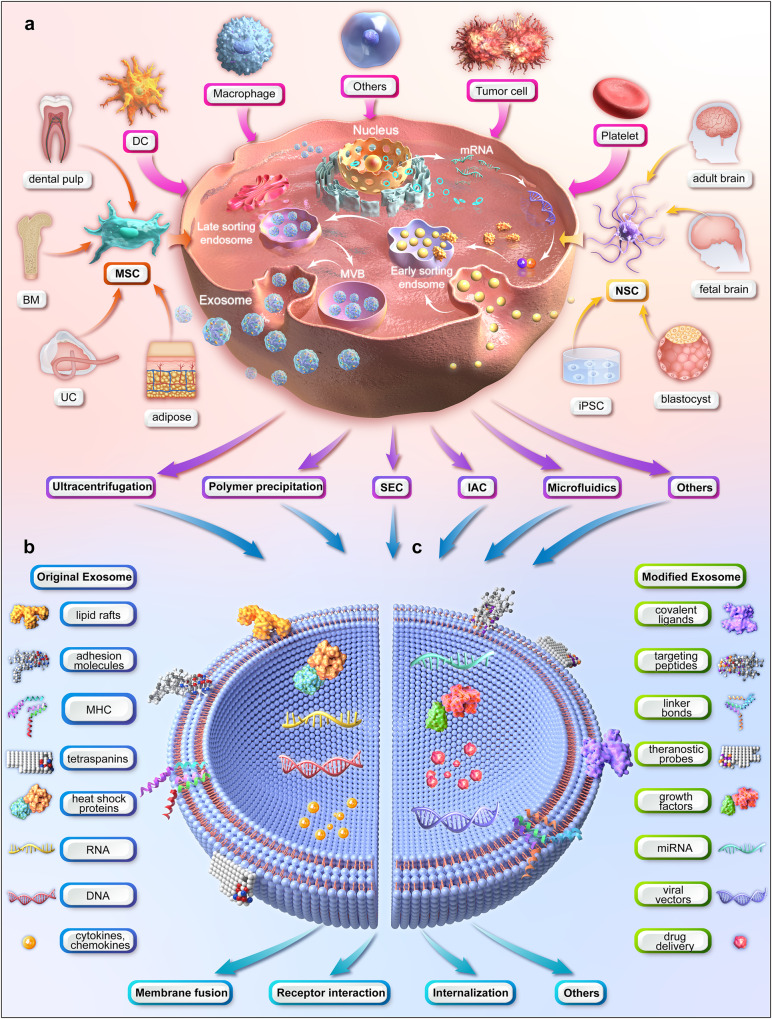
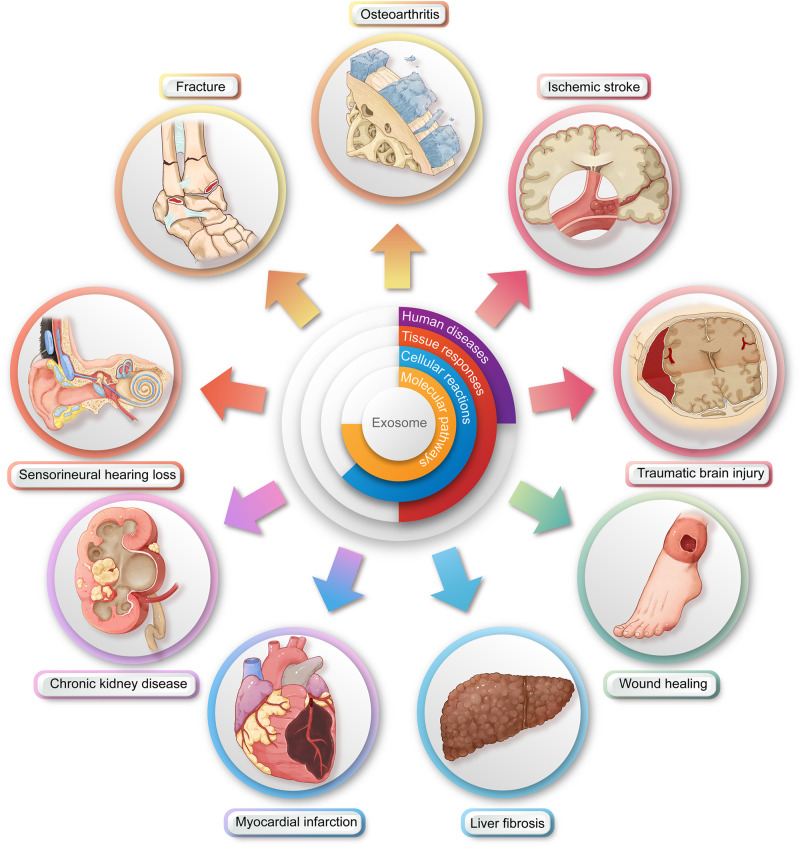
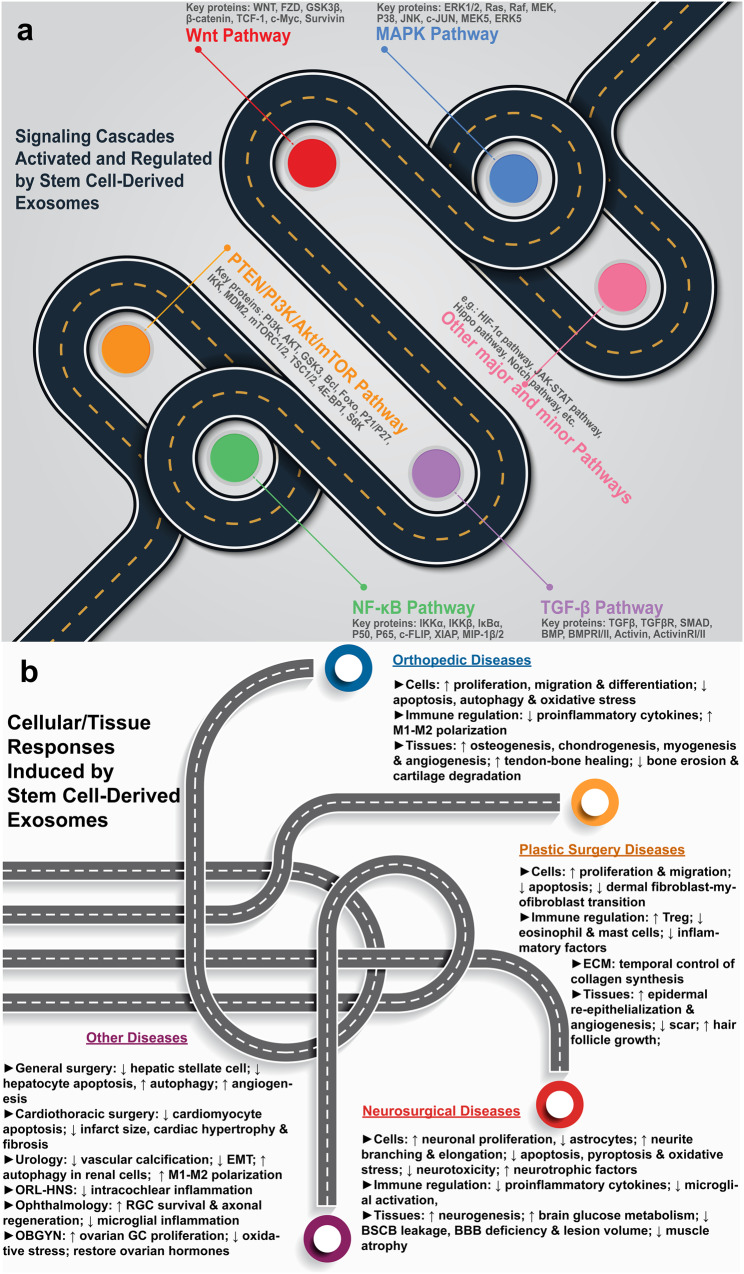
Although stem cell-based therapy has demonstrated considerable potential to manage certain diseases more successfully than conventional surgery, it nevertheless comes with inescapable drawbacks that might limit its clinical translation. Compared to stem cells, stem cell-derived exosomes possess numerous advantages, such as non-immunogenicity, non-infusion toxicity, easy access, effortless preservation, and freedom from tumorigenic potential and ethical issues. Exosomes can inherit similar therapeutic effects from their parental cells such as embryonic stem cells and adult stem cells through vertical delivery of their pluripotency or multipotency. After a thorough search and meticulous dissection of relevant literature from the last five years, we present this comprehensive, up-to-date, specialty-specific and disease-oriented review to highlight the surgical application and potential of stem cell-derived exosomes. Exosomes derived from stem cells (e.g., embryonic, induced pluripotent, hematopoietic, mesenchymal, neural, and endothelial stem cells) are capable of treating numerous diseases encountered in orthopedic surgery, neurosurgery, plastic surgery, general surgery, cardiothoracic surgery, urology, head and neck surgery, ophthalmology, and obstetrics and gynecology. The diverse therapeutic effects of stem cells-derived exosomes are a hierarchical translation through tissue-specific responses, and cell-specific molecular signaling pathways. In this review, we highlight stem cell-derived exosomes as a viable and potent alternative to stem cell-based therapy in managing various surgical conditions. We recommend that future research combines wisdoms from surgeons, nanomedicine practitioners, and stem cell researchers in this relevant and intriguing research area.
Overview
The claims and statistics of this paper haven’t been checked yet.
Free: it reads the open-access text and checks the first 5 claims that cite a source we can check. Create a free account to check every claim.
Integrity signals
Registry
Cites
Statistics
Figures
Verification
Claims the paper makes
The claims and statistics of this paper haven’t been checked yet.
Free: it reads the open-access text and checks the first 5 claims that cite a source we can check. Create a free account to check every claim.
Claims other papers make about this one
Each is checked against this paper’s own text: does it say what the citing paper says it does?
The cited source says what the claim attributes to it.
In the citing paper
“Despite their strong therapeutic promise in AD, the production of stem cell-derived exosomes remains challenging. Their yield from cultured media is extremely low, posing a major challenge for large-scale manufacturing and clinical translation [231].”
From The Impact of Neurotoxin Proteins Trafficked by Primary Cilia and Extracellular Vesicles in Neurodegenerative Diseases (2025) · cites this paper as [231]
Experimental — accuracy not yet measured
Self-check
Percentages, sums and reported differences re-computed from the paper’s own numbers.
The self-check needs the paper’s full text.
Citations
Cites
2 retracted
Ding, J., Wang, X., Chen, B., Zhang, J., & Xu, J. (2019) · BioMed Research International · doi:10.1155/2019/9742765 · Cited by 184 · cited 1×
“215 218 EPC-derived exosomes could accelerate cutaneous wound healing by promoting angiogenesis 219 through the Erk1/2 pathway 220 and p53 pathway.”
BackgroundRetractedJiang, Y., Zhang, J., Li, Z., & Jia, G. (2020) · Frontiers in Medicine · doi:10.3389/fmed.2020.577578 · Cited by 55 · cited 1×
“71 From a lncRNA perspective, especially the bone-speci fi c lncRNA H19, a Chinese group revealed that although a high-fat diet reduced osteogenic differentiation and weakened fracture healing, this could be reversed by MSC-derived exosomal lncRNA H19 via miR-467/ HoxA10 axis in an obesity-induced…”
BackgroundRetractedThéry, C., Witwer, K. W., Aikawa, E., Alcaraz, M. J., Anderson, J. D., Andriantsitohaina, R., Antoniou, A., Arab, T., Archer, F., Atkin‐Smith, G. K., et al. (2018) · Journal of Extracellular Vesicles · doi:10.1080/20013078.2018.1535750 · Cited by 11,099 · cited 1×
“55,56 Storage of exosomes The currently used preservation methods for long-term storage of exosomes mainly include cryopreservation, lyophilization, and spray-drying.”
MethodThe biology , function , and biomedical applications of exosomes
Kalluri, R., & LeBleu, V. S. (2020) · Science · doi:10.1126/science.aau6977 · Cited by 10,770
Poewe, W., Seppi, K., Tanner, C. M., Halliday, G. M., Brundin, P., Volkmann, J., Schrag, A.-E., & Lang, A. E. (2017) · Nature Reviews Disease Primers · doi:10.1038/nrdp.2017.13 · Cited by 5,415
Delivery of siRNA to the mouse brain by systemic injection of targeted exosomes
Alvarez-Erviti, L., Seow, Y., Yin, H., Betts, C., Lakhal, S., & Wood, M. J. A. (2011) · Nature Biotechnology · doi:10.1038/nbt.1807 · Cited by 4,930 · cited 1×
“50 Zhu et al. inserted tumor-targeting peptides, c(RGDyK), into the exosome surface using a chemical reaction to target glioblastoma.”
BackgroundDoyle, L., & Wang, M. (2019) · Cells · doi:10.3390/cells8070727 · Cited by 3,236 · cited 3×
“19 In addition, cargo pro fi ling is further subdivided into proteomic, lipidomic, and genomic analyses including western blotting, ELISA, fl ow cytometry, mass spectroscopy, and PCR. 36 Since each of the above characterization methods has advantages and disadvantages, it is a universal practice to…”
BackgroundMethodInfluentialBlood–brain barrier breakdown in Alzheimer disease and other neurodegenerative disorders
Sweeney, M. D., Sagare, A. P., & Zlokovic, B. V. (2018) · Nature Reviews Neurology · doi:10.1038/nrneurol.2017.188 · Cited by 3,076
Wound Healing: A Cellular Perspective
Rodrigues, M., Kosaric, N., Bonham, C. A., & Gurtner, G. C. (2019) · Physiological Reviews · doi:10.1152/physrev.00067.2017 · Cited by 3,013
Comprehensive Review on Alzheimer’s Disease: Causes and Treatment
Breijyeh, Z., & Karaman, R. (2020) · Molecules · doi:10.3390/molecules25245789 · Cited by 2,789
Research works printed but not linked: 1
- Carr NJ The pathology of healing and repair Surgery 2022 40 13 19
Cited by
Items 401–500 of 841
T., N., DHARA, S., MANNA, P., & Kayal, P. (2026) · International Journal of Applied Pharmaceutics · doi:10.22159/ijap.2026v18i1.56603 · Cited by 4
Shahriar, A., Chen, S., Pei, Y. A., & Pei, M. (2026) · Engineered Regeneration · doi:10.1016/j.engreg.2026.01.003 · Cited by 4
Extracellular Vesicles in Liver Disease: Redefining Diagnostic and Therapeutic Strategies
Kim, A.-R., Kang, M., Kim, D., Yemaneberhan, K. H., & Choi, D. (2026) · International Journal of Stem Cells · doi:10.15283/ijsc25052 · Cited by 4
Wei, J., Zhao, Q., Lu, C., Gao, C., Mu, Z., Dong, D., & Sun, M. (2026) · Biochemical Pharmacology · doi:10.1016/j.bcp.2026.117745 · Cited by 4
Wang, R., Cheng, Y., Chen, H., Shan, W., Qiao, Y., & Wu, J. (2026) · Colloids and Surfaces B Biointerfaces · doi:10.1016/j.colsurfb.2026.115479 · Cited by 4
He, J., Gao, H., & Pan, X. (2026) · Journal of Ovarian Research · doi:10.1186/s13048-026-02032-x · Cited by 4
“Finally, innovating targeted delivery strategies, such as those utilizing stem cell-derived exosomes [123], holds promise for enhancing the efficacy and safety of pathway modulation.”
Engineering BiTE-inspired IPSC-exosomes to potentiate CAR-T cell therapy against lung cancer
Wang, R., Fu, G., Dou, H., Hu, M., Li, Z., Gan, J., He, J., Li, X., Zhang, G., Li, X., et al. (2026) · Journal of Nanobiotechnology · doi:10.1186/s12951-026-04242-3 · Cited by 4
“Specifically, this enrichment aligns with the known biogenesis pathway of exosomes [37].”
Self-citationNanomaterial-Based Precision Drug Delivery for Advanced Nephrology Therapy: A Systematic Review
Feng, J., Zhang, R., Xu, C., Jia, M., Li, L., Zhang, L., & Fu, Y. (2026) · International Journal of Nanomedicine · doi:10.2147/ijn.s583744 · Cited by 4
“63 68 Figure 3 schematically summarizes these mechanisms and applications.”
Engineering strategies for the clinical translation of organoids
Liao, L., Meng, Y., Shi, Y., Wang, B., Liu, C., Qiao, W., & Shen, J. (2026) · Journal of Advanced Research · doi:10.1016/j.jare.2026.03.049 · Cited by 4
Meliciano, A., Jacinto, J. P., Freitas, C., Costa, M. H. G., Fuzeta, M. D. A., & Serra, M. (2026) · Trends in biotechnology · doi:10.1016/j.tibtech.2025.12.032 · Cited by 4
Yang, S., Chen, S., Zhuang, W., Wang, Q., Xu, Y., Zhan, T., Huang, W., & Tan, Y. (2026) · Stem Cell Research & Therapy · doi:10.1186/s13287-026-05033-1 · Cited by 4
“These double-mem-brane-enclosed nanovesicles (30–150 nm in diameter) carry complex proteins, nucleic acids, and lipids, enabling them to convey their contents to recipient cells and exert anti-inflammatory and tissue-repair effects [18].”
Vidiyala, N., Sunkishala, P., Parupathi, P. R., & Nyavanandi, D. (2026) · Cells · doi:10.3390/cells15100872 · Cited by 4
Tang, T., Wang, M., Xu, X., Wang, J., Wang, Y., Wang, F., Wu, D., Zhang, Y., Liu, S., Kong, L., et al. (2026) · Materials Today Bio · doi:10.1016/j.mtbio.2026.103471 · Cited by 4
“Among them, mesenchymal stromal cell-derived EVs (MSC-EVs) inherit the regenerative properties of their parent cells, making them attractive candidates for cell-free therapy [3, 4].”
An, T., Li, D., Wang, N., Ma, F., Tuo, L., He, N., Song, H., & Liu, Q. (2025) · Extracellular Vesicle · doi:10.1016/j.vesic.2025.100078 · Cited by 4
Carvajal, J., & Carvajal, M. (2025) · Aesthetic Surgery Journal Open Forum · doi:10.1093/asjof/ojaf060 · Cited by 4
“5 Although no direct comparisons between PRP and exosomes exist, the researchers suggest PRP efficacy declines with age because of reduced growth factors and platelet concentration found in elderly patients.”
Zhang, Z., Ye, F., Zhang, H., Li, X., Mu, W., Li, K., & Yan, B. (2025) · Pharmacological Research · doi:10.1016/j.phrs.2025.107827 · Cited by 4
Self-citationHuang, T., Qiao, S., Wang, J., Lian, J., Yang, B., & Zhu, S. (2025) · Small · doi:10.1002/smll.202504003 · Cited by 4
Li, W., Shi, Y., Zhan, R., Liu, L., Wang, J., Lee, M. J., Zhang, B., Liang, S., Wang, Z., & Kong, M. (2025) · Marine Life Science & Technology · doi:10.1007/s42995-025-00318-5 · Cited by 4
“EXO could participate in intercellular communication as well as cell repair and regeneration by activating the Wnt/β-catenin signaling pathway (Tan et al. 2024).”
Self-citationKim, D., Baek, H., Lim, S. Y., Lee, M. S., Lyu, S., Lee, J., Sut, T. N., Goncalves, M. C., Kang, J. Y., Jackman, J. A., et al. (2025) · Advanced Healthcare Materials · doi:10.1002/adhm.202500795 · Cited by 4
Wang, W., Tai, S., Cheng, X., Yang, L., Chang, Y. E., Yan, J., Tao, J., & Zhou, J. (2025) · Frontiers in Pharmacology · doi:10.3389/fphar.2025.1653907 · Cited by 5
Wang, M., Izquierdo, S. G., Kara, A., Rios, J. L., de Ruijter, M., Gawlitta, D., Malda, J., & Man, K. (2026) · Regenerative Biomaterials · doi:10.1093/rb/rbag074 · Cited by 4
“…and economic appeal, the clinical translation of mammalian cell-derived EVs remains limited by several practical challenges, including donor variability, low production yields, labor-intensive isolation procedures and difficulties in large-scale manufacturing and long-term storage [18, 31, 32].”
Mesenchymal stem cells in sepsis-induced organ dysfunction: mechanisms and therapeutic potential
Yang, T., Xu, X., An, J., Li, B., & Dou, Z. (2025) · Stem Cell Research & Therapy · doi:10.1186/s13287-025-04752-1 · Cited by 4
“The increasing focus on MSC-exos in SIOD treatment is attributed to their advantageous features, including high histocompatibility, precise targeting, and low immunogenicity [213, 214].”
Amer, A. S., Ali, E. H. A., Zahra, M. M., & Sabry, H. A. (2024) · Scientific African · doi:10.1016/j.sciaf.2024.e02274 · Cited by 4
Fang, X., Liu, C., Wei, K., Shu, Z., Zou, Y., Zhang, Z., Jing, S., Jing, S., Li, W., Wang, T., et al. (2024) · Communications Biology · doi:10.1038/s42003-024-06866-3 · Cited by 4
Hambarsari, Y., Suroto, S., Mirawati, D. K., Soetrisno, S., Wasita, B., Widyaningsih, V., Pamungkasari, E. P., Subandi, S., Danuaji, R., Hamidi, B. L., et al. (2025) · Journal of Applied Pharmaceutical Science · doi:10.7324/japs.2024.194976 · Cited by 4
Shaban, S. F., Abdel‐Fattah, E. A., Ali, M. M., & Dessouky, A. A. (2024) · Ultrastructural Pathology · doi:10.1080/01913123.2024.2426566 · Cited by 4
Regulatory and ethical considerations in exosome-based therapeutics
Sharma, A., Khatri, D. K., & Gugulothu, D. B. (2024) · Elsevier eBooks · doi:10.1016/b978-0-443-29052-7.00020-9 · Cited by 4
Tsubaki, T., Chijimatsu, R., Takeda, T., Abe, M., Ochiya, T., Tsuji, S., Inoue, K., Matsuzaki, T., Iwanaga, Y., Omata, Y., et al. (2024) · Cytotechnology · doi:10.1007/s10616-024-00675-6 · Cited by 5
“…trials as therapeutic targets for MSC-derived extracellular vesicles, including ulcerative colitis, transplant rejection, osteoarthritis, and Alzheimer’s disease (Gimino et al. 2003; Burczynski et al. 2006; Liang et al. 2008; He et al. 2018; Kou et al. 2022; Lotfy et al. 2023; Tan et al. 2024).”
Sharma, Y., & Mohanty, S. (2025) · Cytotherapy · doi:10.1016/j.jcyt.2025.02.002 · Cited by 4
Bakr, M. M., Ankily, M. A., & Shamel, M. (2025) · International Journal of Dentistry · doi:10.1155/ijod/5517092 · Cited by 4
“Recent reviews listed clinical applications of exosomes within 14 different disciplines of health [13], and moreover, the diagnosis, progression, and management of oral diseases [35].”
Wasserman, A. H., Abolibdeh, B., Hamdan, R., & Hong, C. C. (2025) · Current Treatment Options in Cardiovascular Medicine · doi:10.1007/s11936-025-01088-0 · Cited by 4
“To ensure the most benefit for CVD therapy, we suggest stem cells as the ideal source of exosomal miRNA molecules, as they can self-renew, and their EVs are more likely to carry cargo that would promote cell and tissue growth and repair [21, 80].”
Proteomic profiling of small extracellular vesicles from bovine nucleus pulposus cells
Samanta, A., Yoo, M., Koh, J., Lufkin, S., Lufkin, T., & Kraus, P. (2025) · PLoS ONE · doi:10.1371/journal.pone.0324179 · Cited by 4
Yin, X., Yi, J., Mao, F., Tang, Q., Zhang, X., Yang, X., Xie, H., Wang, L., Sun, S., Yu, X., et al. (2025) · Frontiers in Genetics · doi:10.3389/fgene.2024.1407671 · Cited by 3
Nanomaterial application for protein delivery in bone regeneration therapy
Hariawan, B. S., Miatmoko, A., Anjani, Q. K., Annuryanti, F., Kamadjaja, D. B., Nurkanto, A., Purwati, P., & Hariyadi, D. M. (2025) · Brazilian Journal of Medical and Biological Research · doi:10.1590/1414-431x2024e14057 · Cited by 3
EXOSOMES FROM CYCLIC MICE MODULATE LIVER TRANSCRIPTOME IN ESTROUPAUSE MICE INDEPENDENT OF AGE
Zanini, B. M., Ávila, B. M., Hense, J. D., Garcia, D. N., Ashiqueali, S., Alves, P. I. C., Oliveira, T. L., Collares, T. V., Brieño‐Enríquez, M. A., Mason, J. B., et al. (2024) · Molecular and Cellular Endocrinology · doi:10.1016/j.mce.2025.112508 · Cited by 3
Wu, F., Li, Y., Zhang, L., Zhou, Y., Xu, Y., Cai, Y., Ding, L., Zhang, L., Wang, Y., & Qian, H. (2025) · Analytical Chemistry · doi:10.1021/acs.analchem.4c07108 · Cited by 3
Lee, S., Hyun, D., Namkung, Y., Park, B., Lee, B. J., Myung, J., & Hong, S. (2025) · Stem Cells · doi:10.1093/stmcls/sxaf034 · Cited by 4
“36 Given the therapeutic potential of stem cell-derived vesicles in modulating immune responses and promoting skin regeneration, 31,37 we aimed to explore NSCs as a novel stem cell source for AD treatment.”
Therapeutic approaches for liver fibrosis/cirrhosis by targeting pyroptosis
Qiao, G., Li, P., Wang, M., Li, C., Wang, Y., Xin, S., & Liu, H. (2025) · Open Life Sciences · doi:10.1515/biol-2025-1092 · Cited by 3
Dong, Z., Zhou, S., Xia, X., Yip, H. C., Leung, K. K. C., Chan, M. S., & Chiu, P. W. Y. (2025) · Stem Cell Research & Therapy · doi:10.1186/s13287-025-04551-8 · Cited by 3
“While MSC-sEVs safety continues to be debated, emerging clinical evidence supports their tolerability and therapeutic potential in tissue repair, warranting further efficacy and safety validation [62–64].”
Hyperbaric oxygen in combination with exosomes: a new strategy to promote tissue repair
Zhang, S., Zhou, J., Liu, J., Li, T., Liu, Y., & Gao, Y. (2025) · Frontiers in Bioengineering and Biotechnology · doi:10.3389/fbioe.2025.1639060 · Cited by 3
“…remarkable regenerative and immunomodulatory capabilities of stem cells, exosomes generated from stem cells have simpler structure, higher stability, larger yield, easier storage and transportation, and lower immunogenicity, which are key carriers to replace stem cell therapy (Tan et al., 2024).”
Ma, L., Weng, W., Chen, J., Wu, H., Liang, J., & Lu, F. (2025) · BMC Medical Genomics · doi:10.1186/s12920-025-02228-y · Cited by 3
“BMSC-exosomes are widely used in tissue fibrosis therapy, immune regulation, and tissue regeneration by delivering biological information mediators, such as cytokines and regulatory miRNAs [6].”
Parameshwar, K., Das, I. J., Shaik, H. R., & Samal, H. B. (2025) · Next research. · doi:10.1016/j.nexres.2025.100910 · Cited by 3
Chen, Y., Chai, L., Zhang, M., & Chen, H. (2025) · ACS Applied Bio Materials · doi:10.1021/acsabm.5c01508 · Cited by 3
Role of mesenchymal stem cell-derived exosomal non-coding RNAs in bone and bone-related disorders
Chidambaram, D., Subashini, V., Nanthanalaxmi, M., & Selvamurugan, N. (2025) · World Journal of Stem Cells · doi:10.4252/wjsc.v17.i10.111241 · Cited by 3
Chen, K., Ye, W., Chi, L., & Xie, S. (2025) · Frontiers in Bioengineering and Biotechnology · doi:10.3389/fbioe.2025.1662095 · Cited by 3
Jin, X., & Liu, Z. (2025) · Frontiers in Medicine · doi:10.3389/fmed.2025.1729698 · Cited by 4
“Adult stem cells include hematopoietic stem cells (HSC), mesenchymal stem cells (MSC), neural stem cells (NSC), and endothelial stem/progenitor cells (EPC) (3).”
Anti‐Inflammatory and Pro‐Healing Effects of Human Plasma‐Derived Exosomes in a Murine Wound Model
Yang, H., Go, D., Kang, H., Cho, Y., Kim, H. K., Park, J., Park, S. H., Hong, K. Y., & Chang, H. (2025) · Journal of Cosmetic Dermatology · doi:10.1111/jocd.70559 · Cited by 3
Assembly delivery of bioactive matters: Advances, challenges, and prospects
Hu, Y., Zhong, L., Wang, P., Zhan, J., Yang, W., Qiu, X., & Hou, H. (2025) · Journal of Advanced Research · doi:10.1016/j.jare.2025.12.019 · Cited by 3
“…mainstream delivery platforms include lipid-based systems (e.g., lipid nanoparticles, LNPs) [4], polymer-based carriers (e.g., poly (lactic-co-glycolic acid), PLGA) [5], inorganic nanocarriers (e.g., mesoporous silica nanoparticles) [6], and biologically derived systems (e.g., exosomes) [7].”
Biomaterial-assisted neuralization strategies for tissue engineering applications
Ye, J., Ji, L., Liu, L., Zhou, K., Zhu, R., Sun, C., Lei, L., & Dai, M. (2025) · Materials Today Bio · doi:10.1016/j.mtbio.2025.102713 · Cited by 4
“Neurogenic cell-derived exosomes can enhance survival and proliferation of NSCs, facilitate their differentiation into mature neurons, as well as promote integration into neural circuits [184].”
Kundu, D. K., Kiedrowski, M. J., Gadd, J., Gao, M., Evan, M., Wang, Y., Yin, L., Ohanyan, V. A., Chilian, W. M., & Dong, F. (2025) · International Journal of Molecular Sciences · doi:10.3390/ijms27010256 · Cited by 3
“Exosomes can be selectively taken up by neighboring or distant cells, even those far from their release site, and can modulate the properties or function of the recipient cells by delivering their bioactive compounds [21].”
Levy, D., Wang, D., Afzali, H., Do, M. A., Zhang, J., Flojo, R. A. B., Ku, J., Asano, K., Diebold, D., Wang, A., et al. (2026) · Nanoscale · doi:10.1039/d5nr03704b · Cited by 3
Recent advances in dendritic cell-derived exosomes in cancer and cancer stem cell therapy
Kareem, R. A., Sameer, H. N., Athab, Z. H., Adil, M., Yaseen, A., & Allela, O. Q. B. (2026) · International Reviews of Immunology · doi:10.1080/08830185.2026.2614776 · Cited by 3
“Disease-specific customization would be possible if these biomaterials were created based on their sources (natural, synthetic, and hybrid polymers), formats (scaffold, patch, spray, and microneedle), and responsiveness (temperature, pH, and protein) [176].”
Zhang, Y., Ren, T., Xue, J., Yu, Y., Xl, Z., Hu, X. Y., Yu, W., Gao, Z., & Feng, C. (2026) · Molecular Medicine Reports · doi:10.3892/mmr.2026.13798 · Cited by 3
“…the donor cells, MSC‑derived EVs are enriched with functional cargo, including signaling molecules and growth factors, and offer advantages such as long‑term stability for storage and transport, ethical acceptance for infusion, deep‑tissue penetra‑ tion and versatile administration methods (76).”
Abdallah, A. N., Effat, H., Mousbah, A. M., Ahmed, H. H., & Abohashem, R. S. (2026) · Journal of Biochemical and Molecular Toxicology · doi:10.1002/jbt.70705 · Cited by 3
“Furthermore, MSC‐Exos have become an attractive cell‐free treatment for chronic renal disease [21].”
Multiphysics‐Driven Assembly of Biomimetic Vesicles
Solodko, T., Gimino, I., Chandiwala, A., Alkotoub, B., Dezfouli, A. B., Reith, H., Bakhtiar, A., Hicsanmaz, R., Brenner, J., Kaiser, C. J. O., et al. (2026) · Advanced Materials · doi:10.1002/adma.202518755 · Cited by 3
“AEVs, unlike e.g., liposomes or solid lipid nanoparticles, inherit their structural and functional properties from the original cell membrane [7– 9].”
Therapeutic potential of exosomes in malignancies: From drug delivery to clinical application
Bibi, R., Koley, A., & Sarkar, K. (2026) · Pathology - Research and Practice · doi:10.1016/j.prp.2026.156381 · Cited by 3
Zhao, X., Zhang, Y., Dong, Y., Shi, C., & Wu, Y. (2026) · International Immunopharmacology · doi:10.1016/j.intimp.2026.116297 · Cited by 3
Li, M., Liu, X., Xu, J., Zhou, Q., & Wang, Z. (2026) · Stem Cell Research & Therapy · doi:10.1186/s13287-026-04922-9 · Cited by 3
“Recent studies have revealed that mesenchymal stem cell-derived exosomes, via their bioactive cargo, mediate intercellular communication to dually regulate both inflammatory responses and tissue repair processes [29].”
Self-citationSHED-Derived Exosomes Attenuate Osteoclastogenesis to Ameliorate Apical Periodontitis in Rats
Wang, S., Dai, Z., Huo, L., Yang, R., Huang, G., Fang, H., Chen, R., Yang, H., & Wu, J. (2026) · International Dental Journal · doi:10.1016/j.identj.2026.109434 · Cited by 3
“32,33 Hydrogel encapsulation protects EXOs from enzymatic degradation and facilitates release in situ.”
Tendon healing in the era of regenerative medicine: literature review
Ogunsola, A. S., Brady, D. J., Bennett, H. K., Gordon, J. B., Zhang, R., Brown, M. G., Beck, E. C., Gwam, C. U., & Ma, X. (2026) · Annals of Translational Medicine · doi:10.21037/atm-25-124 · Cited by 3
“Many studies have shown that they are as effective as stem cells because of their abundant growth factor and cytokine content (123,180).”
InfluentialAutophagy–exosome crosstalk in neurodegeneration: Mechanisms and therapeutic opportunities
Sedighi, S., Guan, T., Michetti, F., Cordani, M., Behrooz, A. B., Sabouni, F., Eshraghi, M., Saleem, A., Ghavami, S., & Aghanoori, M. (2026) · Pharmacology & Therapeutics · doi:10.1016/j.pharmthera.2026.109025 · Cited by 3
Xu, M., Zhang, X., Liu, Y., Yang, Y., Zhou, Z., Ma, J., & Shen, S. (2026) · Journal of Translational Medicine · doi:10.1186/s12967-026-08030-3 · Cited by 3
Zhang, S., Zhou, M., Li, M., Wang, R., Yang, C., Yang, L., Wang, J., Deng, X., Dai, J., & Liu, Q. (2026) · Materials Today Bio · doi:10.1016/j.mtbio.2026.103046 · Cited by 3
“Previous studies have highlighted the effectiveness of functionalizing extracellular vesicles to endow them with diverse biological activities [29 – 31].”
Kumagai, K., Kawamura, T., Torigata, K., Harada, A., Kishimoto, Y., Miyagawa, S., & Yoshikawa, Y. (2026) · Regenerative Therapy · doi:10.1016/j.reth.2026.101105 · Cited by 4
“In contrast, EV therapy is a cell-free approach that avoids the risks of graft rejection and malignant transformation, making it a safer and more scalable therapeutic platform, although challenges related to durability persist [9].”
Exosomes: Molecular messengers shaping muscle physiology and growth
Afe, A. E., Guo, X., Badshah, F., Li, K., & Zhou, R. (2026) · Tissue and Cell · doi:10.1016/j.tice.2026.103499 · Cited by 3
Wang, L., Shi, Q., Jiang, C., Xu, M., Wang, X., Ren, H., Wang, X., Fang, Q., Sun, J., Kang, L., et al. (2026) · ACS Nano · doi:10.1021/acsnano.5c21479 · Cited by 3
Xing, L., Liu, A., Gao, W., Li, J., Yao, M., Song, J., Duan, P., & Li, H. (2026) · Alzheimer s & Dementia · doi:10.1002/alz.71330 · Cited by 3
Self-citationSu, G., & Xu, W. (2026) · International Journal of Nanomedicine · doi:10.2147/ijn.s577320 · Cited by 3
Liu, H., Zang, Z., Zhao, D., Zhang, J., Wang, Z., Fu, Q., & Zhang, K. (2026) · Journal of Nanobiotechnology · doi:10.1186/s12951-026-04414-1 · Cited by 3
“MSCs-derived EVs carry diverse paracrine factors, including proteins and various RNA species, which enter target cells to exert significant biological effects [18, 19].”
Self-citationPan, J., Wang, Y., Feng, Y., Wang, J., Huang, Q., Yan, L., Zhou, X., Sun, H., Wang, H., & Qu, W. (2026) · Bioactive Materials · doi:10.1016/j.bioactmat.2026.04.027 · Cited by 3
“Exosomes, particularly those derived from mammalian sources such as mesenchymal stem cells, have emerged as promising nanocarriers owing to their intrinsic biocompatibility, nanoscale size, native lipid bilayer membrane, and capacity to carry functional biomolecules [15 – 17].”
Huang, Y., Cui, X., You, J., Xu, L., Luo, J., Yue, P., Cao, H., Cai, J., Wu, S., & Ye, Q. (2026) · ACS Nano · doi:10.1021/acsnano.5c13406 · Cited by 3
Yao, C., Yu, J., Xie, D., Zhang, S., Tao, J., Kong, L., Fang, L., Zhu, Q., & Fang, M. (2026) · International Journal of Nanomedicine · doi:10.2147/ijn.s598699 · Cited by 3
“Concurrently, inflammation-induced oxidative stress generates excess ROS that damage neuronal membranes, proteins, and DNA.”
InfluentialThe potential of bioengineered exosomes in regenerative medicine: a next generation therapy
Kumari, S., Agnihotri, A., Sharma, A., Dongre, S., Tiwari, A., Soni, N., & Bissa, B. (2026) · Human Cell · doi:10.1007/s13577-026-01400-5 · Cited by 3
“MSC-derived exosomes are the most thoroughly researched because of their anti-inflammatory and regenerative properties [20–22].”
Wang, Z., Ma, T., Wan, D., Chen, X., Xu, Z., Liang, S., Fareed, M. S., Li, M., Ren, Y., Ji, Q., et al. (2026) · Journal of Controlled Release · doi:10.1016/j.jconrel.2026.115092 · Cited by 3
Self-citationContreras, C., & Ariza‐Donado, A. (2026) · International Journal of Molecular Sciences · doi:10.3390/ijms27125541 · Cited by 3
“Preclinical and translational research has also highlighted potential roles for EVs in wound healing and skin regeneration, osteoarthritis and cartilage repair, post-infarction cardiac repair, neurologic regeneration, kidney and liver injury, and ophthalmologic disorders [17].”
Wang, C., Zhao, X., Wang, K., Liang, H., Chen, S., Liu, Y., Yao, H., & Jiang, J. (2024) · International Journal of Nanomedicine · doi:10.2147/ijn.s467158 · Cited by 3
“51 They are rich in bioactive molecules, such as mRNA, micro RNAs, long non-coding RNAs, lipids, and proteins, 4 and play a role in regulating inflammation, apoptosis, antigen presentation, and immune responses.”
Unravelling the role of stem cell-derived exosomes in oral cancer treatment: A review
Memon, M. A., Shahidan, W. N. S., Mahmood, R., Kannan, T. P., Mustaffa, K. M. F., Mohamad, S., & Mizusawa, N. (2025) · Biomedical Research and Therapy · doi:10.15419/bmrat.v12i1.950 · Cited by 3
Chinese medicine boosts regenerative medicine in stem cell - based therapy
Bi, Z., Tang, H., Wang, E., Wang, Y., Meng, Y., Yuan, J., & Liu, Z. (2025) · Stem Cell Research & Therapy · doi:10.1186/s13287-025-04618-6 · Cited by 3
“They encapsulate bioactive molecules, including proteins, lipids, mRNAs, and miRNAs, and mediate intercellular communication, playing crucial roles in signal transduction [136], tissue repair [137], and immune regulation [138].”
Iron-oxide-nanoparticle-tagged Mesenchymal Stem Cell Exosomes in Therapeutics
Mehta, K. J. (2024) · Current Stem Cell Reports · doi:10.1007/s40778-024-00242-x · Cited by 3
Exosomes from Different Sources in Promoting Wound Healing
Yi, R., Yang, X., Tian, Y., Zhang, F., Anayyat, U., Zhang, X., & Wang, X. (2025) · Recent Advances in Drug Delivery and Formulation · doi:10.2174/0126673878366772250116082511 · Cited by 3
Wang, Y., Wang, W., Zheng, D., & Gao, Y. (2025) · Oncology Letters · doi:10.3892/ol.2025.15001 · Cited by 3
“MSCs‑Exo possess numerous advantages, consisting of non‑immunogenicity, easy acces‑ sibility for isolation and preparation, convenient storage at low temperature, non‑infusion toxicity and freedom from tumorigenic potential and ethical issues (8).”
Danna, R., Kondle, S., Amar, O., Mabourakh, M., Chen, G., Fadol, W. B., & Mohieldin, A. M. (2025) · Biology · doi:10.3390/biology14121787 · Cited by 2
“Their yield from cultured media is extremely low, posing a major challenge for large-scale manufacturing and clinical translation [231].”
USP38 protects intestinal epithelial cells from ischemia/reperfusion injury by stabilizing BIRC5
Pan, M., Huang, X., Huang, X., Liu, X., & Lin, J. (2025) · Gastroenterology report · doi:10.1093/gastro/goaf024 · Cited by 2
“Consequently, stem-cell-derived EVs have attracted considerable attention as an ideal alternative to stem-cell-based therapy [16].”
Liu, C., Zhang, T., Meng, L., Ullah, I., Li, H., Sui, F., & Zhang, Y. (2025) · Growth Factors · doi:10.1080/08977194.2025.2484614 · Cited by 2
“In the context of OA therapy, MSCs stand out for their effective implantation, prolonged survival, and low risk of immune rejection owing to minimal major histocompatibility complex (MHC) antigen expression (Tan et al. 2024).”
Zhang, C., Wang, G., Xu, J., Wang, W., Sun, P., & Hu, S. (2025) · Critical Reviews in Oncology/Hematology · doi:10.1016/j.critrevonc.2025.104774 · Cited by 2
Wang, L., Bai, Y., Sun, Y., Li, L., He, Y., Li, G., Liu, D., Huang, Z., Song, J., Wu, H. P., et al. (2025) · Science Progress · doi:10.1177/00368504251358007 · Cited by 2
Galimberti, D. R., Gallo, G., Fusco, I., Madeddu, F., Colombo, C., & Zingoni, T. (2025) · Photobiomodulation Photomedicine and Laser Surgery · doi:10.1177/15578550251362371 · Cited by 2
“15 Some studies have shown that exosomes dispersed in the skin have a role in mediating skin diseases via intercellular interaction between different types of skin cells.”
Exosomal miR-133b-3p modulates TGF-β1/Treg immunomodulation to ameliorate osteoporosis
Zhao, Y., Yang, X., Wang, J., Chen, F., Shi, G., Cheng, J., Xing, S., & Liu, X. (2025) · Bone · doi:10.1016/j.bone.2025.117658 · Cited by 2
Ergin, İ., Sainkaplan, S., Işık, M., Çınar, Ö. Ö., BAYRAKTAROĞLU, A. G., Derkuş, B., & Şenel, O. O. (2025) · Veterinary Research Communications · doi:10.1007/s11259-025-10908-4 · Cited by 2
“More importantly, they have gained recognition as a promising therapeutic tool in modern biotechnology and have become a focal point of scientific research in recent years (Chavda et al. 2023; Tan et al. 2024).”
Cheng, Z., & Lai, D. (2025) · Journal of Zhejiang University (Medical Sciences) · doi:10.3724/zdxbyxb-2025-0148 · Cited by 2
Li, Y., Hua, Y., Wang, Y., Qiao, H., Lin, S., Liu, Y., Zhou, M., & Jiang, X. (2025) · Materials Today Communications · doi:10.1016/j.mtcomm.2025.114386 · Cited by 2
Fajkić, A., Belančić, A., Lam, Y. W., Rački, V., Pilipović, K., Janković, T., Mežnarić, S., Mršić‐Pelčić, J., & Vitezić, D. (2025) · Biomedicines · doi:10.3390/biomedicines13122876 · Cited by 2
“Circulating exosomal signatures, including SMN-containing vesicles and miRNA panels, could enable treatment stratification and serve as surrogate endpoints, yet remain unvalidated in SMA cohorts [190,191].”
Jakubechova, J., Altanerova, U., Andrezal, M., Vanova, D., Zeleznikova, T., Bartek, P., Cihova, M., Smolková, B., Buociková, V., Makovicky, P., et al. (2025) · Cancer Cell International · doi:10.1186/s12935-025-04130-0 · Cited by 2
“Exosomes derived from mesenchymal stem cells are entering the clinic as effective anti-inflammatory agents for tissue regeneration or as effective immunomodulatory drugs [10].”
Engineered stem cells and exosomes: novel atherosclerosis therapy
Yang, Z., Yu, L., & Li, J. (2025) · Vessel Plus · doi:10.20517/2574-1209.2025.77 · Cited by 2
Self-citationYao, P., Yang, Y., Yuan, F., Lin, Z., Qin, Y., Liu, S., Mao, Y., Wang, L., Du, R., Xu, Y., et al. (2026) · Biomaterials · doi:10.1016/j.biomaterials.2026.123977 · Cited by 2
Lin, Q., Sun, W., Lei, C., Huang, H., Zhao, B., Zhao, S., Wang, H., Huang, J., Zhu, X., Zhang, R., et al. (2026) · Journal of Ethnopharmacology · doi:10.1016/j.jep.2025.121140 · Cited by 2
Self-citationMolecular crosstalk via exosomes in lung cancer progression
Dhar, R., Kumarasamy, V., Oliver, B. G. G., & Subramaniyan, V. (2026) · Interdisciplinary medicine · doi:10.1002/inmd.70088 · Cited by 2
Vemuri, S. K., Kumar, P. P., Adusumalli, R., Neeredu, U. K., Manohar, K. M., Subbaiah, G. P. V., Reddy, A. G., Pradhan, L., Banala, R. R., Devi, M. I., et al. (2026) · Colloids and Surfaces B Biointerfaces · doi:10.1016/j.colsurfb.2026.115482 · Cited by 2
Seminal plasma exosomes and male infertility: current progress and future directions
Gong, Z., Feng, Q., Colonnello, E., Wang, F., Liu, S., & Guo, J. (2026) · Journal of Men s Health · doi:10.22514/jomh.2026.002 · Cited by 2
“Studies have indicated that exosomes derived from mesenchymal stem cells (MSCs) promote spermatogenesis through several mechanisms, such as anti-apoptotic effects, stimulation of testosterone secretion, and reduction of oxidative stress [90].”
Chen, B., Chen, J., Shen, Z., Liu, S., Mei, Y., Cai, H., Li, K., Peng, Z., Zhang, L., Wang, W., et al. (2026) · Stem Cell Research & Therapy · doi:10.1186/s13287-026-04931-8 · Cited by 3
“Their multi-target and multi-pathway mechanisms of action significantly alleviate post-IRI tissue damage and functional impairment [4].”
Metadata
- Authors
- Tan, F., Li, X., Wang, Z., Li, J., Shahzad, K., & Zheng, J.
- Affiliations
- Tongji University (CN)
- Corresponding author
- Tan, Fei
- Venue
- Signal Transduction and Targeted Therapy
- Published
- 2024-01-12
- Volume
- 9
- Issue
- 1
- Pages
- 17-17
- ISSN
- 2059-3635 (ISSN-L)
- PMC
- PMC10784577
- OpenAlex
- W4390765704
- Semantic Scholar
- 7d21154a4aa525f5d1c118adcaa16de60d9798de
- Cited by
- 708
- References
- 352
- Citations by year
- 2026: 267 · 2025: 313 · 2024: 128
- FWCI
- 28.81
- Type
- journal article
- Language
- en
- Open access
- gold
- doi.org
- Licence
- cc-by
- creativecommons.org/licenses/by/4.0 (tdm)
- creativecommons.org/licenses/by/4.0 (vor)
- Locations
- Signal Transduction and Targeted Therapy (publishedVersion, cc-by)
- PubMed Central (publishedVersion, cc-by)
- PubMed (publishedVersion)
- DOAJ (DOAJ: Directory of Open Access Journals) (submittedVersion, cc-by-sa)
- Funders
- National Natural Science Foundation of China (82271192)
- Topics
- Life Sciences › Biochemistry, Genetics and Molecular Biology › Molecular Biology › Extracellular vesicles in disease
- Life Sciences › Biochemistry, Genetics and Molecular Biology › Cell Biology › Mesenchymal stem cell research
- Health Sciences › Dentistry › Periodontics › Periodontal Regeneration and Treatments
- Keywords
- stem cell-derived exosomes, exosome therapy, orthopedic surgery, neurosurgery, plastic surgery, cardiothoracic surgery, urology, head and neck surgery, ophthalmology, obstetrics and gynecology, tissue-specific responses, clinical translation
- MeSH terms
- Embryonic Stem Cells, Exosomes, Induced Pluripotent Stem Cells, Mesenchymal Stem Cells
About these checks
Registry, retraction, Cites and statistics results are computed, not judged, with one exception: a printed reference that no index lists is read once by a model before it counts as a citation error. Claims are extracted by a model and kept only when their quote appears verbatim in the text; each cited source is then checked, with a model’s help, for whether it says what the claim relies on. Those verdicts can be wrong — read the claim’s quote and the cited source before relying on one.
Statistics and arithmetic are recomputed, not judged.
Confidence bands are shown only for fields calibrated on our annotated test set. None is calibrated yet, so no band is shown.
What counts as a claim ›How we measure confidence ›How we check this ›
Are you an author, or do you see a problem with this page? Request a review
Data sources
Bibliographic data: Semantic Scholar, OpenAlex, Crossref.
Contains information from the Semantic Scholar Academic Graph Datasets, made available under the ODC Attribution License (ODC-BY 1.0).
Semantic Scholar’s data is described in: Kinney, R., et al. (2023). The Semantic Scholar Open Data Platform. arXiv:2301.10140.
