

Clinical applications of stem cell-derived exosomes
Open accessThe DOI matches its Crossref record; 351 of the 352 references it cites were found in a registry or an index.
Abstract
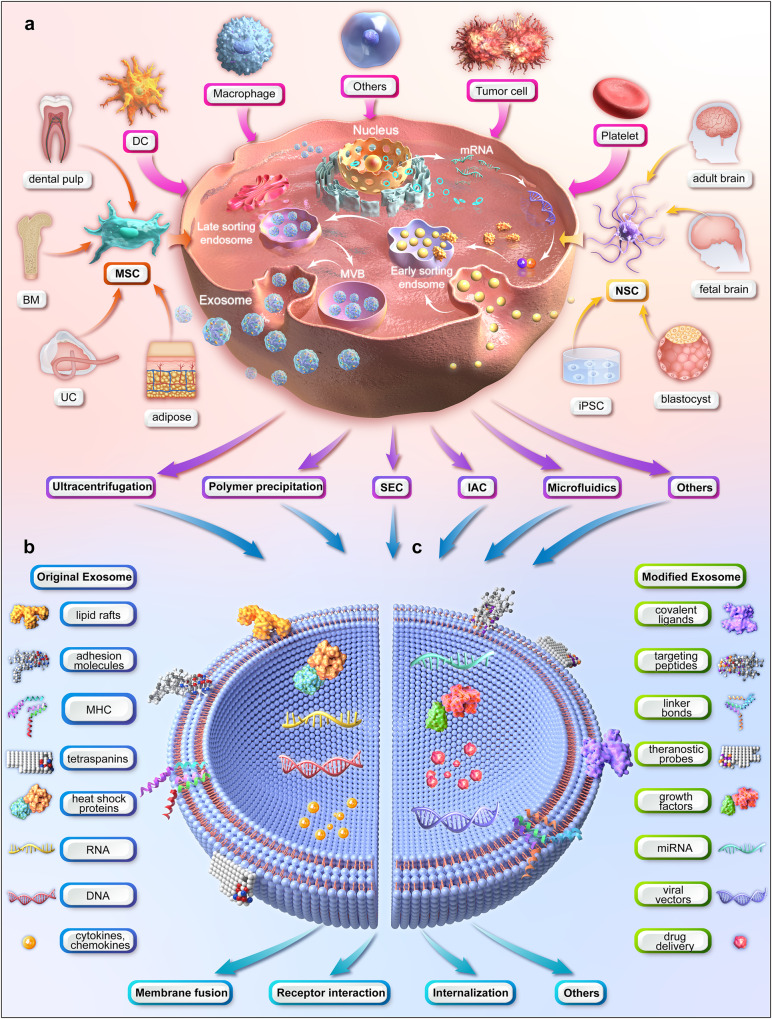
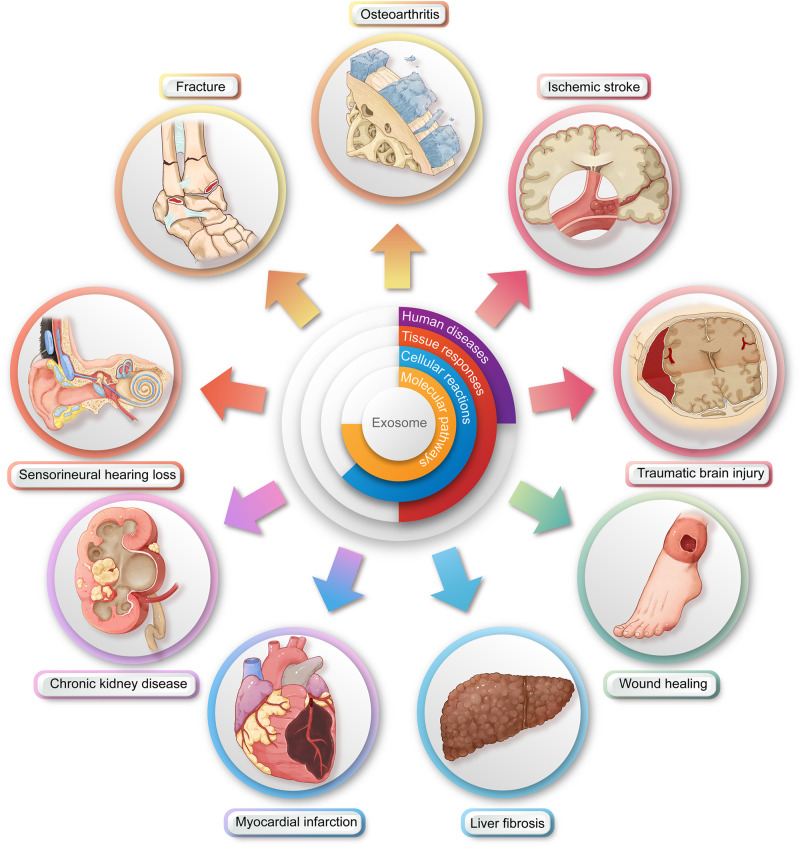
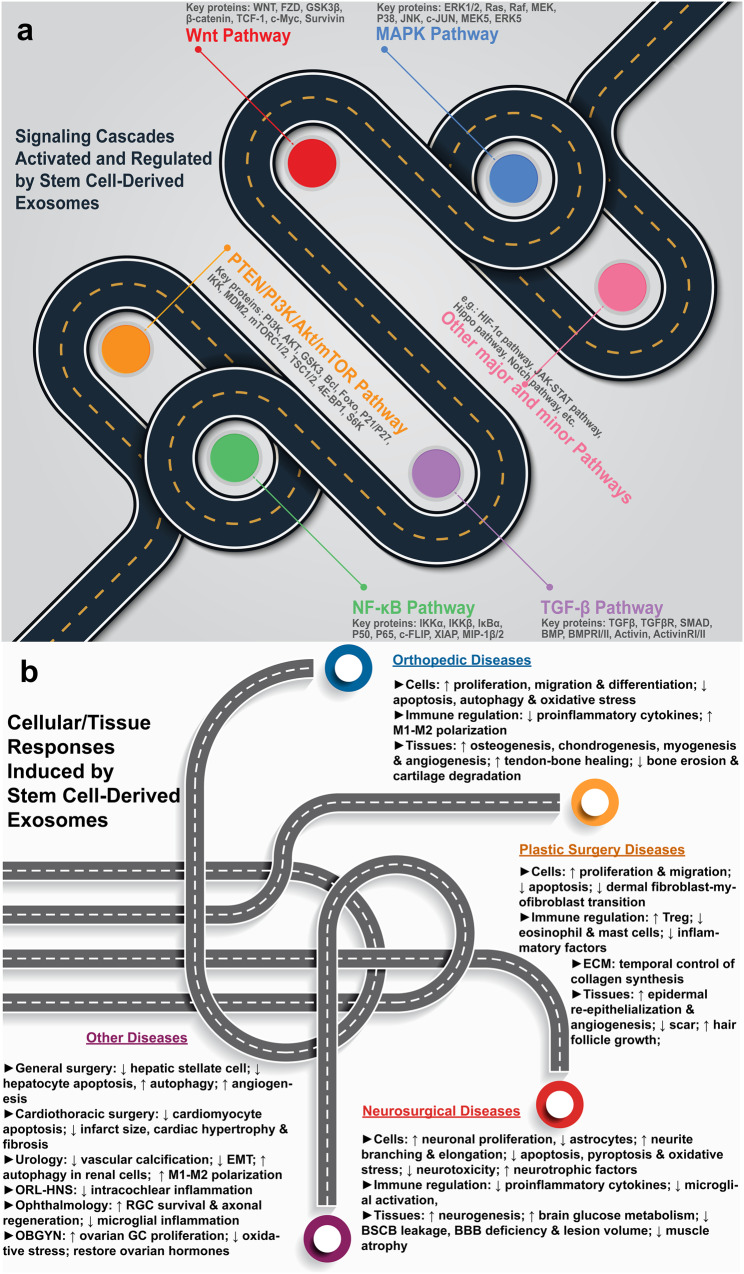
Although stem cell-based therapy has demonstrated considerable potential to manage certain diseases more successfully than conventional surgery, it nevertheless comes with inescapable drawbacks that might limit its clinical translation. Compared to stem cells, stem cell-derived exosomes possess numerous advantages, such as non-immunogenicity, non-infusion toxicity, easy access, effortless preservation, and freedom from tumorigenic potential and ethical issues. Exosomes can inherit similar therapeutic effects from their parental cells such as embryonic stem cells and adult stem cells through vertical delivery of their pluripotency or multipotency. After a thorough search and meticulous dissection of relevant literature from the last five years, we present this comprehensive, up-to-date, specialty-specific and disease-oriented review to highlight the surgical application and potential of stem cell-derived exosomes. Exosomes derived from stem cells (e.g., embryonic, induced pluripotent, hematopoietic, mesenchymal, neural, and endothelial stem cells) are capable of treating numerous diseases encountered in orthopedic surgery, neurosurgery, plastic surgery, general surgery, cardiothoracic surgery, urology, head and neck surgery, ophthalmology, and obstetrics and gynecology. The diverse therapeutic effects of stem cells-derived exosomes are a hierarchical translation through tissue-specific responses, and cell-specific molecular signaling pathways. In this review, we highlight stem cell-derived exosomes as a viable and potent alternative to stem cell-based therapy in managing various surgical conditions. We recommend that future research combines wisdoms from surgeons, nanomedicine practitioners, and stem cell researchers in this relevant and intriguing research area.
Overview
The claims and statistics of this paper haven’t been checked yet.
Free: it reads the open-access text and checks the first 5 claims that cite a source we can check. Create a free account to check every claim.
Integrity signals
Registry
Cites
Statistics
Figures
Verification
Claims the paper makes
The claims and statistics of this paper haven’t been checked yet.
Free: it reads the open-access text and checks the first 5 claims that cite a source we can check. Create a free account to check every claim.
Claims other papers make about this one
Each is checked against this paper’s own text: does it say what the citing paper says it does?
The cited source says what the claim attributes to it.
In the citing paper
“Despite their strong therapeutic promise in AD, the production of stem cell-derived exosomes remains challenging. Their yield from cultured media is extremely low, posing a major challenge for large-scale manufacturing and clinical translation [231].”
From The Impact of Neurotoxin Proteins Trafficked by Primary Cilia and Extracellular Vesicles in Neurodegenerative Diseases (2025) · cites this paper as [231]
Experimental — accuracy not yet measured
Self-check
Percentages, sums and reported differences re-computed from the paper’s own numbers.
The self-check needs the paper’s full text.
Citations
Cites
2 retracted
Ding, J., Wang, X., Chen, B., Zhang, J., & Xu, J. (2019) · BioMed Research International · doi:10.1155/2019/9742765 · Cited by 184 · cited 1×
“215 218 EPC-derived exosomes could accelerate cutaneous wound healing by promoting angiogenesis 219 through the Erk1/2 pathway 220 and p53 pathway.”
BackgroundRetractedJiang, Y., Zhang, J., Li, Z., & Jia, G. (2020) · Frontiers in Medicine · doi:10.3389/fmed.2020.577578 · Cited by 55 · cited 1×
“71 From a lncRNA perspective, especially the bone-speci fi c lncRNA H19, a Chinese group revealed that although a high-fat diet reduced osteogenic differentiation and weakened fracture healing, this could be reversed by MSC-derived exosomal lncRNA H19 via miR-467/ HoxA10 axis in an obesity-induced…”
BackgroundRetractedThéry, C., Witwer, K. W., Aikawa, E., Alcaraz, M. J., Anderson, J. D., Andriantsitohaina, R., Antoniou, A., Arab, T., Archer, F., Atkin‐Smith, G. K., et al. (2018) · Journal of Extracellular Vesicles · doi:10.1080/20013078.2018.1535750 · Cited by 11,099 · cited 1×
“55,56 Storage of exosomes The currently used preservation methods for long-term storage of exosomes mainly include cryopreservation, lyophilization, and spray-drying.”
MethodThe biology , function , and biomedical applications of exosomes
Kalluri, R., & LeBleu, V. S. (2020) · Science · doi:10.1126/science.aau6977 · Cited by 10,770
Poewe, W., Seppi, K., Tanner, C. M., Halliday, G. M., Brundin, P., Volkmann, J., Schrag, A.-E., & Lang, A. E. (2017) · Nature Reviews Disease Primers · doi:10.1038/nrdp.2017.13 · Cited by 5,415
Delivery of siRNA to the mouse brain by systemic injection of targeted exosomes
Alvarez-Erviti, L., Seow, Y., Yin, H., Betts, C., Lakhal, S., & Wood, M. J. A. (2011) · Nature Biotechnology · doi:10.1038/nbt.1807 · Cited by 4,930 · cited 1×
“50 Zhu et al. inserted tumor-targeting peptides, c(RGDyK), into the exosome surface using a chemical reaction to target glioblastoma.”
BackgroundDoyle, L., & Wang, M. (2019) · Cells · doi:10.3390/cells8070727 · Cited by 3,236 · cited 3×
“19 In addition, cargo pro fi ling is further subdivided into proteomic, lipidomic, and genomic analyses including western blotting, ELISA, fl ow cytometry, mass spectroscopy, and PCR. 36 Since each of the above characterization methods has advantages and disadvantages, it is a universal practice to…”
BackgroundMethodInfluentialBlood–brain barrier breakdown in Alzheimer disease and other neurodegenerative disorders
Sweeney, M. D., Sagare, A. P., & Zlokovic, B. V. (2018) · Nature Reviews Neurology · doi:10.1038/nrneurol.2017.188 · Cited by 3,076
Wound Healing: A Cellular Perspective
Rodrigues, M., Kosaric, N., Bonham, C. A., & Gurtner, G. C. (2019) · Physiological Reviews · doi:10.1152/physrev.00067.2017 · Cited by 3,013
Comprehensive Review on Alzheimer’s Disease: Causes and Treatment
Breijyeh, Z., & Karaman, R. (2020) · Molecules · doi:10.3390/molecules25245789 · Cited by 2,789
Research works printed but not linked: 1
- Carr NJ The pathology of healing and repair Surgery 2022 40 13 19
Cited by
Items 101–200 of 841
Role of Glial Cells in Neuronal Function, Mood Disorders, and Drug Addiction
Tizabi, Y., Getachew, B., Hauser, S. R., Tsytsarev, V., Manhães, A. C., & da Silva, V. D. A. (2024) · Brain Sciences · doi:10.3390/brainsci14060558 · Cited by 27
“…exosomes in general surgery, neurosurgery, orthopedic surgery, head and neck surgery, cardiothoracic surgery, plastic surgery, acute skin wound healing, urology, ophthalmology, obstetrics and gynecology, and other diseases induced by cancer, ischemia, or inflammation have been suggested [235,236].”
BackgroundVučemilović, A. (2024) · Archives of Industrial Hygiene and Toxicology · doi:10.2478/aiht-2024-75-3923 · Cited by 27
Exosomes for Aesthetic Dermatology: A Comprehensive Literature Review and Update
Shah, M., Dukharan, V., Broughton, L., Stegura, C., Schur, N., Samman, L., Garcia‐Meraz, C., Macaraeg‐Jimenez, J. L. D., Belo, V. G., Majewska, L., et al. (2025) · Journal of Cosmetic Dermatology · doi:10.1111/jocd.16766 · Cited by 27
“Additionally, written informed consent was collected from all patients in the included cases.”
Wang, Z., Hu, Z., Niu, L., Xu, Y., & Qi, Y. (2025) · Frontiers in Pharmacology · doi:10.3389/fphar.2025.1588841 · Cited by 26
Self-citationTao, Y., Liu, T., Jing, F., Tan, X., Zhao, X., Bernaerts, K. V., Jia, R., Zhao, J., Yin, Y., & Zhang, T. (2025) · ACS Nano · doi:10.1021/acsnano.4c16058 · Cited by 26
Site-specific adaptive nanovesicles for oral insulin delivery
Xia, B., Xu, F., Chen, J., Shan, S., Shen, J., Zhang, Y., Wang, J., Zhou, Z., Sun, W., Jia, Y., et al. (2025) · Science Advances · doi:10.1126/sciadv.ady6386 · Cited by 26
Engineering stem cell-based nanotherapeutics to overcome myocardial ischemia-reperfusion injury
Li, X., Li, Z., Liu, J., Zang, H., Guo, S., Yang, Y., Tan, X., Liao, J., & Wang, C. (2026) · Biomaterials · doi:10.1016/j.biomaterials.2026.124121 · Cited by 28
Self-citationMesenchymal stem cell-derived exosomes: a novel therapeutic frontier in hematological disorders
Saadh, M. J., Hussein, A., Bayani, A., Dastafkan, S., Amiri, M., Akbari, A., Shahsavan, S., Samarkhazan, H. S., & Asl, V. S. (2025) · Medical Oncology · doi:10.1007/s12032-025-02742-0 · Cited by 27
“Lab-scale methods yield less than 1 μg of exosomal protein per ml of culture medium, while standard isolation techniques like ultracentrifugation are costly, time-consuming, and prone to contamination [108, 109].”
Tang, B., Huang, R., & Wen-juan, M. (2024) · RSC Advances · doi:10.1039/d4ra07193j · Cited by 25
Morabbi, A., & Karimian, M. (2025) · Stem Cell Research & Therapy · doi:10.1186/s13287-025-04200-0 · Cited by 25
“Compared to stem cells, exosomes derived from stem cells offer several advantages, including non-immunogenicity, lack of infusion toxicity, ease of access, and the absence of tumorigenic risk and ethical concerns [14].”
Yang, J., Yun, X., Zheng, W., Zhang, H., Yan, Z., Chen, Y., Xue, W., Mi, S., Li, Z., Sun, H., et al. (2025) · Journal of Nanobiotechnology · doi:10.1186/s12951-025-03474-z · Cited by 25
“Compared with MSCs, MSC-Exo exhibits lower immunogenicity, no tumorigenic risk, ease of preparation and storage, and adjustable therapeutic concentrations [9].”
Mitochondrial Extracellular Vesicles: A Novel Approach to Mitochondrial Quality Control
Kong, J., Sun, R., Du, C., Tang, Y., Xie, C., Li, Q., Lin, L., & Wang, H. (2025) · Biomolecules · doi:10.3390/biom15081145 · Cited by 26
Generalizable anchor aptamer strategy for loading nucleic acid therapeutics on exosomes
Han, G., Zhang, Y., Li, Z., Wang, B., Qiu, S., Song, J., Lin, C., Zou, F., Wu, J., Yu, H., et al. (2024) · EMBO Molecular Medicine · doi:10.1038/s44321-024-00049-7 · Cited by 25
“Exosomes have been extensively tested in clinical trials for a myriad of diseases (Tan et al, 2024), and also being actively exploited for treating DMD either as therapeutics or delivery vehicles (Yedigaryan and Sampaolesi, 2023).”
The Therapeutic Potential of Exosomes from Mesenchymal Stem Cells in Multiple Sclerosis
Kråkenes, T., Sandvik, C. E., Ytterdal, M., Gavasso, S., Evjenth, E. C., Bø, L., & Kvistad, C. E. (2024) · International Journal of Molecular Sciences · doi:10.3390/ijms251910292 · Cited by 25
“Exosomes function as mediators of cell communication and regulate the fate of recipient cells by inducing changes in gene expression and cellular function [34].”
BackgroundZhang, A., Li, Q., & Chen, Z. (2024) · International Journal of Molecular Sciences · doi:10.3390/ijms26010225 · Cited by 26
“Meanwhile, HUCMSC-EVs have numerous advantages including lower immunogenicity, higher biological stability, better bioavailability, easier access, and freedom from tumorigenic potential and ethical issues over their parental cells [39].”
Liao, Z., Zeng, J., Lin, A., Zou, Y., & Zhou, Z. (2025) · European Journal of Pharmacology · doi:10.1016/j.ejphar.2025.177349 · Cited by 24
Expanding the role of exosomes in drug, biomolecule, and nanoparticle delivery
Saka, O. M., Dora, D. D., Kibar, G., & Tevlek, A. (2025) · Life Sciences · doi:10.1016/j.lfs.2025.123499 · Cited by 24
Engineered exosomes: a promising design platform for overcoming cancer therapy resistance
Zhang, P., Chen, K., Liu, W., Niu, X., Wang, X., Wang, J., Yao, W., Tang, X., & Tian, W. (2025) · Frontiers in Cell and Developmental Biology · doi:10.3389/fcell.2025.1608480 · Cited by 26
“Advances in synthetic biology have also offered the possibility of creating “immune-quiet” exosomes that can circulate in the bloodstream without triggering an immune response (Tan et al., 2024; Lin et al., 2022).”
Kim, M., Choi, H., Jang, D., Kim, H., Sub, Y., Gee, H. Y., & Choi, C. (2024) · Stem Cells Translational Medicine · doi:10.1093/stcltm/szae027 · Cited by 24
“7 Particularly, exosomes secreted by bone marrow derived mesenchymal stromal/stem cells (BM-MSCs) have demonstrated tissue repair and immunomodulatory functions in several diseases, including multiple signaling regulation by miRNA or long non-coding RNAs (lncRNAs) in bone fracture healing, 8-11…”
BackgroundTherapeutic effect of exosomes derived from Schwann cells in the repair of peripheral nerve injury
Wang, J., Huang, Q.-M., Hu, D.-X., & Zhang, W.-J. (2024) · Life Sciences · doi:10.1016/j.lfs.2024.123086 · Cited by 24
Psoriasis: The Versatility of Mesenchymal Stem Cell and Exosome Therapies
Dairov, A., Sekenova, A., Alimbek, S., Nurkina, A., Shakhatbayev, M., Kumasheva, V., Kuanysh, S., Adish, Z., Issabekova, A., & Ogay, V. B. (2024) · Biomolecules · doi:10.3390/biom14111351 · Cited by 27
“This is mostly because stem-cell-derived exosomes have various advantages over stem cells, including non-immunogenicity, non-infusion toxicity, easy access, easy storage, and the absence of tumorigenic potential and ethical problems [16].”
Genetically Engineered Stromal Cell Exosomes from High-Throughput Herringbone Microfluidics
Huang, J., Chen, H., Luo, Z., Nie, M., Wang, J., Lü, L., & Zhao, Y. (2025) · ACS Nano · doi:10.1021/acsnano.5c01773 · Cited by 23
Sankaranarayanan, J., Kim, H. K., Kang, J. Y., Kuppa, S. S., Yang, H.-Y., & Seon, J. (2025) · International Journal of Molecular Sciences · doi:10.3390/ijms26125447 · Cited by 23
“Numerous studies have assessed their therapeutic potential in both in vitro and in vivo models, yielding promising outcomes [18].”
Hyun, S., Choi, H., Sub, Y., Hong, D., Ahn, S., Choi, K., Ryu, S., Kim, Y., Park, C., Gee, H. Y., et al. (2025) · Journal of Extracellular Vesicles · doi:10.1002/jev2.70141 · Cited by 23
Xu, Y., Xu, X., Chai, R., & Wu, X. (2025) · International Journal of Biological Sciences · doi:10.7150/ijbs.107021 · Cited by 24
“Stem cell-derived exosomes act as intercellular messengers and provide similar therapeutic effects to their parent MSCs, such as tissue regeneration, immunomodulation, and anti-inflammation [62-64].”
Jiang, Y., Wei, Z.-Y., Song, Z., Yu, M., Ji, H., & Qian, H. (2025) · Drug Delivery and Translational Research · doi:10.1007/s13346-025-01792-1 · Cited by 23
Zhang, Y., Song, J., Wang, B., Wen, Y., Jiang, W., Zhang, Y.-L., Li, Z., Hong, Y., Qin, S.-F., Lv, L.-L., et al. (2025) · ACS Nano · doi:10.1021/acsnano.5c02532 · Cited by 22
Mesenchymal stem cell-derived exosomes as a potential therapeutic strategy for ferroptosis
Zayed, M., Elwakeel, E., Ezzat, P., & Jeong, B. (2025) · Stem Cell Research & Therapy · doi:10.1186/s13287-025-04511-2 · Cited by 24
“MSC-Exos, which are nano-sized extracellular vesicles (30–150 nm) loaded with bioactive materials such as proteins, lipids, and nucleic acids, have demonstrated significant therapeutic potential in tissue repair and immunomodulation [7–9].”
Modulation of Stem Cell Survival and Engraftment: Implications for Stem Cell-Based Therapy
Xu, Q., Zhang, C., Liu, X., Sun, Y., Li, B., Nian, S., Wang, Y., & Yu, C. (2025) · Theranostics · doi:10.7150/thno.120805 · Cited by 23
“Although numerous preclinical and clinical studies support the potential of SCs as a novel therapeutic modality, clinical translation remains significantly limited by poor post-transplantation cell survival and engraftment [5-7].”
Alshahrani, M. Y., Jasim, S. A., Altalbawy, F. M. A., Bansal, P., Kaur, H., Al‐Hamdani, M. M., Deorari, M., Abosaoda, M. K., Hamzah, H. F., & Mohammed, B. A. (2024) · Cell Biochemistry and Function · doi:10.1002/cbf.4029 · Cited by 22
Ma, Y., Hu, X., Karako, K., Song, P., Tang, W., & Xia, Y. (2024) · BioScience Trends · doi:10.5582/bst.2024.01306 · Cited by 23
Nanomedicine-based strategies for the treatment of vein graft disease
Zhou, Z., Chen, W., Cao, Y., Abdi, R., & Tao, W. (2024) · Nature Reviews Cardiology · doi:10.1038/s41569-024-01094-y · Cited by 21
“Notably, with a nanoscale size of 30–150 nm, the secreted exosomes are considered as biological nanomaterials produced by living organisms 172 .”
Sun, W., Xu, W., Xiao, M., Zhang, X., Chen, J., Zhang, J., Yang, L., & Na, Q. (2025) · Journal of Nanobiotechnology · doi:10.1186/s12951-025-03603-8 · Cited by 21
“Stem cell-derived exosomes offer several advantages over their parent cells, including lack of immunogenicity, absence of infusion toxicity, ease of procurement and storage, and avoidance of ethical concerns and tumorigenic potential [75].”
Lin, H., Wang, Z., Li, P., Zhang, Y., Kong, W., Yue, X., Feng, L., Chen, Z., Zheng, Y., Hu, Z., et al. (2026) · Bioactive Materials · doi:10.1016/j.bioactmat.2026.03.034 · Cited by 21
“They exhibit superior physicochemical stability, insignificant immunogenicity, a complete absence of tumorigenic risk, and significantly easier storage and transportation [72].”
Self-citationEnigmatic exosomal connection in lung cancer drug resistance
Patra, S. K., Sahoo, R. K., Biswal, S., Panda, S. S., & Biswal, B. K. (2024) · Molecular Therapy — Nucleic Acids · doi:10.1016/j.omtn.2024.102177 · Cited by 21
Exploring Stem-Cell-Based Therapies for Retinal Regeneration
Radu, M., Brănişteanu, D. C., Pîrvulescu, R. A., Dumitrescu, O.-M., Ionescu, M. A., & Zemba, M. (2024) · Life · doi:10.3390/life14060668 · Cited by 24
“MSC-exosomes, which are extracellular vesicles released by MSCs, encapsulate a variety of bioactive molecules including proteins, mRNAs, and microRNAs that can modulate inflammation, angiogenesis, and cellular repair processes [68].”
BackgroundWu, Y., Cao, Y., Chen, L., Lai, X., Zhang, S., & Wang, S. (2024) · Biological Procedures Online · doi:10.1186/s12575-024-00245-2 · Cited by 21
“In addition, the source of exosome with safe should be taken into consideration [431].”
BackgroundExosome: an overview on enhanced biogenesis by small molecules
Bavafa, A., Izadpanahi, M., Hosseini, E., Hajinejad, M., Abedi, M., Forouzanfar, F., & Negah, S. S. (2025) · Naunyn-Schmiedeberg s Archives of Pharmacology · doi:10.1007/s00210-024-03762-9 · Cited by 22
“TEM and scanning electron microscopy (SEM) have been used to visualize exosome morphology, which is primarily spheroid (Malenica et al. 2021; Tan et al. 2024).”
Sheikhi, K., Ghaderi, S., Firouzi, H., Rahimibarghani, S., Shabani, E., Afkhami, H., & Yarahmadi, A. (2025) · Frontiers in Cell and Developmental Biology · doi:10.3389/fcell.2025.1517369 · Cited by 20
Li, J., Lin, X., Wang, J., Li, X., Zhang, Z., Ji, L., Yu, R., Kou, X., & Yang, Y. (2025) · International Journal of Nanomedicine · doi:10.2147/ijn.s522994 · Cited by 20
“59 Compared with other stem cell therapies, pretreatment methods like TNF-α offer remarkable advantages in simplification and efficacy.”
Self-citationDing, L., Zhang, T., Pan, Y., Liu, J., Ma, T., Zhou, H., Zhu, Q., Tai, Z., & Chen, Z. (2025) · Materials Today Bio · doi:10.1016/j.mtbio.2025.102298 · Cited by 22
“Exosomes derived from bone marrow mesenchymal stem cells (BMSCs) are rich in miR-136-5p, which facilitates osteoblast proliferation via the Wnt/ β -catenin signaling pathway, thereby expediting tissue repair [58].”
Chang, J., Feng, Z., Li, Y., Lv, H., Liu, S., Luo, Y., Hao, N., Zhao, L., & Liu, J. (2024) · Biochemical Pharmacology · doi:10.1016/j.bcp.2024.116064 · Cited by 21
Current Non-Metal Nanoparticle-Based Therapeutic Approaches for Glioblastoma Treatment
Gaweł, A. M., Bętkowska, A., Gajda, E., Godlewska, M., & Gaweł, D. (2024) · Biomedicines · doi:10.3390/biomedicines12081822 · Cited by 20
“Most importantly for their potential use as nanovehicles, they can carry multiple molecules, including proteins, lipids, nucleic acids (RNAs; DNAs) inside their aqueous core or within the lipid membrane bilayer [20,21].”
BackgroundSong, Y., Yin, C., & Kong, N. (2024) · International Journal of Nanomedicine · doi:10.2147/ijn.s475234 · Cited by 21
“23”
BackgroundThe role of natural exosomes from SHED-MSC in immunoregulation of M0/M1 polarized macrophage cells
Fallah, A., Colagar, A. H., Khosravi, A., Mohammad‐Hasani, A., & Saeidi, M. (2025) · Frontiers in Immunology · doi:10.3389/fimmu.2025.1550280 · Cited by 20
“However, concerns regarding potential side effects associated with MSC-based treatments led to exploring alternative therapeutic options, such as the SHED-MSC-derived exosomes (23).”
Shi, S., Zhu, C., Shi, S., Li, X., Muhammad, I., Xu, Q., Li, X., Zhao, Z., Liu, H., Fu, G., et al. (2025) · Stem Cell Research & Therapy · doi:10.1186/s13287-025-04202-y · Cited by 20
“The functions of USCs primarily rely on their paracrine activity, with exosomes being a key paracrine factor of USCs [17, 18].”
Self-citationYang, T., Ma, H., Li, K., Xiang, J., Qiu, J., Ding, Y., Wang, C., Lai, H., Hu, X., Liu, S., et al. (2025) · Materials Today Bio · doi:10.1016/j.mtbio.2025.101944 · Cited by 20
Exosomes in aging and age-related disorders: mechanisms, therapeutic potentials, and challenges
Safaei, S., Sohrabi, S., Zahmatkesh, P., Soltani‐Zangbar, M. S., & Maleki, L. A. (2025) · Journal of Translational Medicine · doi:10.1186/s12967-025-07379-1 · Cited by 19
“…activating the BMP2/Smad1/5/8 pathways (increasing Smad1 phosphorylation) and Wnt/β-catenin signaling (stabilizing β-catenin and driving TCF/LEF-mediated Runx2 transcription), which leads to increased expression of osteocalcin and alkaline phosphatase for the formation of new bone [121, 122].”
Advancing diabetes treatment: the role of mesenchymal stem cells in islet transplantation
Mou, L., Wang, T. B., Wang, X., & Pu, Z. (2024) · Frontiers in Immunology · doi:10.3389/fimmu.2024.1389134 · Cited by 19
Stem Cell-Derived Exosomes: An Advanced Horizon to Cancer Regenerative Medicine
Ramachandran, A., Dhar, R., & Devi, A. (2024) · ACS Applied Bio Materials · doi:10.1021/acsabm.4c00089 · Cited by 19
Auto-loaded TRAIL-exosomes derived from induced neural stem cells for brain cancer therapy
Zhang, X., Taylor, H., Valdivia, A., Dasari, R., Buckley, A., Bonacquisti, E. E., Nguyen, J., Kanchi, K., Corcoran, D. L., Herring, L. E., et al. (2024) · Journal of Controlled Release · doi:10.1016/j.jconrel.2024.06.048 · Cited by 19
Zhang, W., Chen, Z., Liu, Z., Qian, X., Ge, Y., Zhang, H., Xu, W., Shan, L., & Zhao, D. (2024) · International Immunopharmacology · doi:10.1016/j.intimp.2024.112651 · Cited by 19
Application of mesenchymal stem cells in liver fibrosis and regeneration
Liu, Z., Ren, J., Qiu, C., Wang, Y., & Zhang, T. (2024) · Liver Research · doi:10.1016/j.livres.2024.11.004 · Cited by 20
Exosome‐Based Vaccines: Pioneering New Frontiers in Combating Infectious Diseases and Cancer
Wang, X., Li, A., Wang, A., He, M., Zeng, Y., Li, D., Rong, R., & Liu, J. (2025) · Small Methods · doi:10.1002/smtd.202402222 · Cited by 19
Chen, Z., Chang, K. P., Yang, S., Deng, R., He, Y., Zhang, L., Chen, M., Bai, D., & Pi, Y. (2025) · Journal of Extracellular Vesicles · doi:10.1002/jev2.70099 · Cited by 18
Mitochondrial dysfunction in fibrotic diseases: Research progress and MSC-exos therapy
Zhang, X., Wang, Y., Guo, X., Xiao, Y., Wan, W., Zou, H., & Yang, X. (2025) · Experimental and Molecular Pathology · doi:10.1016/j.yexmp.2025.104983 · Cited by 19
Wang, W., Han, Z., Aafreen, S., Zivko, C., Gololobova, O. A., Wei, Z., Cotin, G., Felder‐Flesch, D., Mahairaki, V., Witwer, K. W., et al. (2025) · Journal of Extracellular Vesicles · doi:10.1002/jev2.70178 · Cited by 18
Mitochondrial and ER stress crosstalk in TBI: mechanistic insights and therapeutic opportunities
Wenzhe, L., Boyang, X., Yuchao, G., Bimcle, R., & Yue, Y. (2025) · Frontiers in Cellular Neuroscience · doi:10.3389/fncel.2025.1697060 · Cited by 19
Clinical translational research on stem cell products: prospects and challenges
Chen, S., ZHANG, L., Ren, Y., Bai, X., Wei, X., Chai, M., 崔苏甦, Zhao, X., & Deng, H. (2026) · Signal Transduction and Targeted Therapy · doi:10.1038/s41392-026-02582-y · Cited by 18
“8 For metabolic disorders, especially diabetes, stem cells adjust their metabolic functions and repair damaged tissues while also differentiating into the required cell types to replace damaged tissues.”
Kuang, J., Zhao, L. H., Ruan, S., Sun, Y., Wu, Z., Zhang, H., Zhang, M., & Hu, P. (2024) · Analytica Chimica Acta · doi:10.1016/j.aca.2024.343234 · Cited by 18
Wang, Z., Shahzad, K. A., Li, X., Cai, B., Xu, M., Li, J., & Tan, F. (2024) · Scandinavian Journal of Immunology · doi:10.1111/sji.13416 · Cited by 18
“14 Currently, mesenchymal stem cell-derived extracellular vesicles (MSC-EVs) have attracted attention as a potential alternative to cell-based therapy for the immunomodulation of inflammatory diseases.”
Self-citationHoseini, S. M., & Montazeri, F. (2024) · Tissue and Cell · doi:10.1016/j.tice.2024.102709 · Cited by 19
Li, H., Zhang, P., Lin, M., Li, K., Zhang, C., He, X., & Gao, K. (2025) · Stem Cell Research & Therapy · doi:10.1186/s13287-025-04167-y · Cited by 18
Jimenez, M. I., Dion, G. R., Mora‐Navarro, C., Wang, Z., Nolan, M. W., & Freytes, D. O. (2025) · Cancers · doi:10.3390/cancers17071108 · Cited by 18
“…interferon-gamma MSCs or fibroblasts EVs isolated from primed cells have been shown to modulate the TGF-β 1 pathway through their molecular cargos [94,95] Matrix-bound vesicles (BVs) MBVs and macromolecules isolated from the VF lamina propria ECM have been reported to inhibit alpha-smooth muscle…”
Self-citationXu, Y., Cheung, C. Y. M., Liu, L., Cheung, H. P., Tam, K. Y., Ker, D. F. E., Cartmell, S. H., Mao, C., Zhang, Z., & Wang, D. M. (2025) · BMEMat · doi:10.1002/bmm2.70012 · Cited by 18
Stem Cell-Derived Extracellular Vesicles in Skin Antiaging Treatments
Park, J. Y., Jung, S. Y., Yoo, D., Lee, S., Go, D., Bui, V. D., Jung, W., You, D. G., Park, J. H., & Um, W. (2025) · ACS Nano · doi:10.1021/acsnano.4c17406 · Cited by 21
Research landscape and trends of human umbilical cord mesenchymal stem cell-derived exosomes
Chen, D., Chen, Z., Yuan, J., Chen, G., Chen, Y., He, K., Hu, Y., Ye, L., & Yang, Y. (2025) · Stem Cell Research & Therapy · doi:10.1186/s13287-025-04379-2 · Cited by 18
“Exosomes (Exos) are a key mechanism by which hUC-MSCs deliver therapeutic benefits in disease management [12]. hUCMSC-derived Exos (hUCMSC-Exos) exhibit superior proliferative capacity and reduced immunogenicity compared to Exos derived from other MSC origins and can be obtained by noninvasive…”
Hassan, N., Hussein, D. M., Malak, F. A., Abdelaziz, M., Boushra, M. I., Shaalan, W., & Elzayat, E. M. (2025) · Stem Cell Reviews and Reports · doi:10.1007/s12015-025-10944-2 · Cited by 19
“A growing body of preclinical research supports the therapeutic potential of MSC-exosomes in POI [ 121 , 122 ].”
Elakkawi, M. M. J., Zhu, Y., Xiong, Y., Li, C., Li, H., Chen, J., Xu, T., & Qi, X. (2025) · Bioactive Materials · doi:10.1016/j.bioactmat.2025.09.031 · Cited by 17
Jang, E., Yu, H. J., Kim, E., Hwang, J., Yoo, J. H., Choi, J., Jeong, H., & Jang, S. (2024) · International Journal of Molecular Sciences · doi:10.3390/ijms25126362 · Cited by 17
“To advance to clinical trials, it’s essential to identify an exosome isolation method that demonstrates significant therapeutic benefits for ischemic stroke, establish strict product quality control through validated quantitative and qualitative analyses, and secure regulatory approval [100,101].”
BackgroundExtracellular vesicles‐based theranostics for neurodegenerative diseases
Zhao, H., Zhu, L., Wang, C., & Yang, Y. (2024) · Wiley Interdisciplinary Reviews Nanomedicine and Nanobiotechnology · doi:10.1002/wnan.1993 · Cited by 17
Zhang, Y., Xu, Y., Hu, W., Ma, X., Hu, J., Ye, Y., Yang, S., Yu, Y., Li, N., Zheng, D., et al. (2025) · International Journal of Pharmaceutics · doi:10.1016/j.ijpharm.2025.125315 · Cited by 17
Emerging Frontiers in acute kidney injury: The role of extracellular vesicles
Li, S., Zhou, L., Huang, Y., & Tang, S. (2025) · Bioactive Materials · doi:10.1016/j.bioactmat.2025.02.018 · Cited by 17
“They have become a cornerstone in regenerative medicine, particularly noted for the paracrine effects of their EV secretions, which have an important role in tissue repair across a spectrum of diseases affecting the musculoskeletal, nervous, and urinary systems, among others [40].”
Regenerative Medicine: A New Horizon in Peripheral Nerve Injury and Repair
Widodo, W., Aprilya, D., & Satria, O. (2025) · Orthopedic Reviews · doi:10.52965/001c.133572 · Cited by 17
Chen, L., Ma, S., Yu, J., Zuo, D., Yin, Z.-J., Li, F.-Y., He, X., Peng, H.-T., Shi, X., Huang, W., et al. (2025) · World Journal of Stem Cells · doi:10.4252/wjsc.v17.i4.103919 · Cited by 17
“…treatment of OA. hUC-MSCs often play a therapeutic role through a paracrine mechanism, and exosomes are paracrine factors that not only have similar biological functions to those of hUC-MSCs but also have the unique advantage of being more stable under different pathophysiological conditions[13].”
Repair mechanisms of the central nervous system: From axon sprouting to remyelination
Gluck, L., Gerstein, B., & Kaunzner, U. W. (2025) · Neurotherapeutics · doi:10.1016/j.neurot.2025.e00583 · Cited by 17
Luo, Y., Liu, C., Kirby, J. A., Chu, C., Zang, D., & Chen, J. (2025) · Cancers · doi:10.3390/cancers17132186 · Cited by 17
“Engineering EVs can achieve more accurate tumor targeting under external physical conditions, such as electrostatic, magnetic, ultrasound, and laser irradiation [186].”
Tang, R., Liu, G., Wang, C., Chao, M., Ma, G., Wei, P., Du, S., Li, J., Liu, Y., Jing, C., et al. (2025) · Advanced Science · doi:10.1002/advs.202511327 · Cited by 16
Self-citationYang, K., Chu, X., Wang, X., Zhang, W., Lu, J., Xu, C., Hu, S., Pan, G., Yang, C., Zhang, X., et al. (2025) · Advanced Science · doi:10.1002/advs.202511169 · Cited by 17
Xu, Y., Ma, L., Wang, Y., & Shi, C. (2024) · Chinese Chemical Letters · doi:10.1016/j.cclet.2024.109766 · Cited by 16
Exosomes in the pathogenesis and treatment of cancer-related cachexia
Ru, Q., Chen, L., Xu, G., & Wu, Y. (2024) · Journal of Translational Medicine · doi:10.1186/s12967-024-05201-y · Cited by 16
“Mean-while, stem cell-derived exosomes have demonstrated therapeutic effects in improving skeletal muscle regeneration [30, 31].”
BackgroundEdge advances in nanodrug therapies for osteoarthritis treatment
Liao, J., Gu, Q., Liu, Z., Wang, H., Yang, X. Q., Yan, R., Zhang, X., Song, S., Wen, L., & Wang, Y. (2024) · Frontiers in Pharmacology · doi:10.3389/fphar.2024.1402825 · Cited by 17
Wu, Q.-X., de Isla, N., & Zhang, L. (2025) · International Journal of Molecular Sciences · doi:10.3390/ijms26157384 · Cited by 16
Tati, V., Sai, S. S. S., & Shukla, S. (2024) · Experimental Eye Research · doi:10.1016/j.exer.2024.110027 · Cited by 15
Gowtham, A., & Kaundal, R. K. (2024) · International Journal of Biological Macromolecules · doi:10.1016/j.ijbiomac.2024.139206 · Cited by 16
Yang, S., Xue, B., Zhang, Y., Wu, H., Yu, B., Li, S., Ma, T., Gao, X. J., Hao, Y., Guo, L., et al. (2025) · ACS Nano · doi:10.1021/acsnano.4c10298 · Cited by 16
Self-citationPark, S., Yoon, Y., Hong, Y., Yu, J., Cho, J.-M., Jeong, Y. J., Yu, H., Jeong, H., Lee, H.-J., Hwang, S., et al. (2025) · Bioactive Materials · doi:10.1016/j.bioactmat.2025.01.019 · Cited by 16
“…diseases associated with that organ [64], obtaining and culturing sufficient quantities of tissue-specific epithelial or mesenchymal stem cells for EV isolation is considerably more challenging than sourcing them from readily available tissues like discarded fat or Wharton ’ s jelly [65 – 67].”
Fatima, A., Sanyal, S., Jha, G. K., Kaliki, S., & Pallavi, R. (2025) · FEBS Letters · doi:10.1002/1873-3468.70004 · Cited by 15
Zhang, Q., He, P., Shi, S., Xu, Q., Granquist, E. J., Winkelstein, B. A., Shanti, R. M., & Le, A. D. (2025) · Journal of Nanobiotechnology · doi:10.1186/s12951-025-03515-7 · Cited by 17
“…advantages of MSC-derived EVs/ exosomes versus the parental MSCs in the treatment of a broad spectrum of human disease models [14], there is still lack of promising outcomes from a limited number of clinical trials that directly use MSC-derived EVs/ exosomes as therapeutics for human diseases [16].”
Shokati, A., Rahnama, M. A., Jalali, L., Hoseinzadeh, S., Masoudifar, S., & Ahmadvand, M. (2025) · Cancer Cell International · doi:10.1186/s12935-025-03900-0 · Cited by 15
“The cancer cell growth inhibition was enhanced when paclitaxel (PTX) was loaded into small EVs as opposed to using the drug in its free form [91, 92].”
Chang, S., Xie, W., Qu, H., Ban, J., Ma, P., Fei, S., & Liu, F. (2024) · Ecotoxicology and Environmental Safety · doi:10.1016/j.ecoenv.2024.116971 · Cited by 14
Unlocking exosome therapeutics: The critical role of pharmacokinetics in clinical applications
Yadav, K., Sahu, K. K., Sucheta, Minz, S., & Pradhan, M. (2025) · Tissue and Cell · doi:10.1016/j.tice.2025.102749 · Cited by 14
The Recent Applications of Stem Cell-Derived Exosomes and Hydrogels in Neurological Disorders
Ajwad, N., Mustapha, M., Idris, Z., & Lee, S. (2025) · Tissue Engineering Part B Reviews · doi:10.1089/ten.teb.2024.0353 · Cited by 14
“42,43 44 – 46 Furthermore, current clinical trials have investigated the potential of MSC-Exos as a therapeutic agent in various types of diseases, such as eye diseases (NCT05738629, NCT05413148), heart and blood diseases (NCT05669144), and orthopedic diseases (NCT05060107).”
Advancements in extracellular vesicle therapy for neurodegenerative diseases
Hu, N., Chen, L., Hu, G., & Ma, R. (2025) · Exploration of Neuroprotective Therapy · doi:10.37349/ent.2025.1004104 · Cited by 15
“…neurotrophic factor, nerve growth factor), growth factors (e.g., insulin-like growth factor 1, fibroblast growth factor), and anti-apoptotic proteins (e.g., Bcl-2, XIAP) for promoting neuronal survival, axonal regeneration, and functional recovery in neurodegenerative diseases [120, 121].”
Yang, Z., Li, X., Lin, Q., Zhou, F., Liang, K., Li, J. J., Niu, Y., Meng, Q., Zhao, T., Li, H., et al. (2025) · Journal of Extracellular Vesicles · doi:10.1002/jev2.70109 · Cited by 14
“Compared to the parent cells, sEVs derived from MSCs have exhibited comparable therapeutic effects in various disease models, including their anti-inflammatory, immunomodulatory and tissue regeneration functions (Tan et al. 2024).”
Self-citationChennamsetty, S., Keerikkadu, M., Shetty, A., Bangera, P. D., Tippavajhala, V. K., & Rathnanand, M. (2025) · International Journal of Pharmaceutics · doi:10.1016/j.ijpharm.2025.126400 · Cited by 15
Cui, X., Liu, L., Duan, C., Mao, S., Wang, G., Li, H., Miao, C., & Cao, Y. (2024) · Journal of Dental Sciences · doi:10.1016/j.jds.2024.10.001 · Cited by 13
Hao, X., Li, P., Wang, Y., Zhang, Q., & Fang, Y. (2024) · International Journal of Molecular Sciences · doi:10.3390/ijms252312626 · Cited by 14
“TGF-β 1-treated NIH-3T3 cells were cultured in the six-well plate, while MSCs were cultured in the upper chamber of the transwell, and NIH-3T3 cells were collected 24 h later for analysis.”
Ikezaki, T., Kuroda, Y., Kawai, T., Okuzu, Y., Morita, Y., Goto, K., & Matsuda, S. (2024) · Journal of Orthopaedic Surgery and Research · doi:10.1186/s13018-024-05267-w · Cited by 13
“ADSC-Exos reportedly promotes angiogenesis in many tissues by enhancing secretion of vascular endothelial growth factor from vascular endothelial cells [41, 42].”
Enhancing hair regrowth using rapamycin-primed mesenchymal stem cell-derived exosomes
Shrestha, M., Nguyen, T. T., Kausar, R., Chaudhary, D., Puspitasari, I. F., Jiang, H., Kim, H., Yook, S., & Jeong, J. (2025) · Theranostics · doi:10.7150/thno.107659 · Cited by 13
“Exosomes are paracrine agents derived from MSCs and offer a promising alternative due to their stability, ease of administration, and potent bioactivity [60, 61].”
Metadata
- Authors
- Tan, F., Li, X., Wang, Z., Li, J., Shahzad, K., & Zheng, J.
- Affiliations
- Tongji University (CN)
- Corresponding author
- Tan, Fei
- Venue
- Signal Transduction and Targeted Therapy
- Published
- 2024-01-12
- Volume
- 9
- Issue
- 1
- Pages
- 17-17
- ISSN
- 2059-3635 (ISSN-L)
- PMC
- PMC10784577
- OpenAlex
- W4390765704
- Cited by
- 708
- References
- 352
- Citations by year
- 2026: 267 · 2025: 313 · 2024: 128
- FWCI
- 28.81
- Type
- journal article
- Language
- en
- Open access
- gold
- doi.org
- Licence
- cc-by
- creativecommons.org/licenses/by/4.0 (tdm)
- creativecommons.org/licenses/by/4.0 (vor)
- Locations
- Signal Transduction and Targeted Therapy (publishedVersion, cc-by)
- PubMed Central (publishedVersion, cc-by)
- PubMed (publishedVersion)
- DOAJ (DOAJ: Directory of Open Access Journals) (submittedVersion, cc-by-sa)
- Funders
- National Natural Science Foundation of China (82271192)
- Topics
- Life Sciences › Biochemistry, Genetics and Molecular Biology › Molecular Biology › Extracellular vesicles in disease
- Life Sciences › Biochemistry, Genetics and Molecular Biology › Cell Biology › Mesenchymal stem cell research
- Health Sciences › Dentistry › Periodontics › Periodontal Regeneration and Treatments
- Keywords
- stem cell-derived exosomes, exosome therapy, orthopedic surgery, neurosurgery, plastic surgery, cardiothoracic surgery, urology, head and neck surgery, ophthalmology, obstetrics and gynecology, tissue-specific responses, clinical translation
- MeSH terms
- Embryonic Stem Cells, Exosomes, Induced Pluripotent Stem Cells, Mesenchymal Stem Cells
About these checks
Registry, retraction, Cites and statistics results are computed, not judged, with one exception: a printed reference that no index lists is read once by a model before it counts as a citation error. Claims are extracted by a model and kept only when their quote appears verbatim in the text; each cited source is then checked, with a model’s help, for whether it says what the claim relies on. Those verdicts can be wrong — read the claim’s quote and the cited source before relying on one.
Statistics and arithmetic are recomputed, not judged.
Confidence bands are shown only for fields calibrated on our annotated test set. None is calibrated yet, so no band is shown.
What counts as a claim ›How we measure confidence ›How we check this ›
Are you an author, or do you see a problem with this page? Request a review
Data sources
Bibliographic data: Semantic Scholar, OpenAlex, Crossref.
Contains information from the Semantic Scholar Academic Graph Datasets, made available under the ODC Attribution License (ODC-BY 1.0).
Semantic Scholar’s data is described in: Kinney, R., et al. (2023). The Semantic Scholar Open Data Platform. arXiv:2301.10140.
