

Clinical applications of stem cell-derived exosomes
Open accessThe DOI matches its Crossref record; 351 of the 352 references it cites were found in a registry or an index.
Abstract
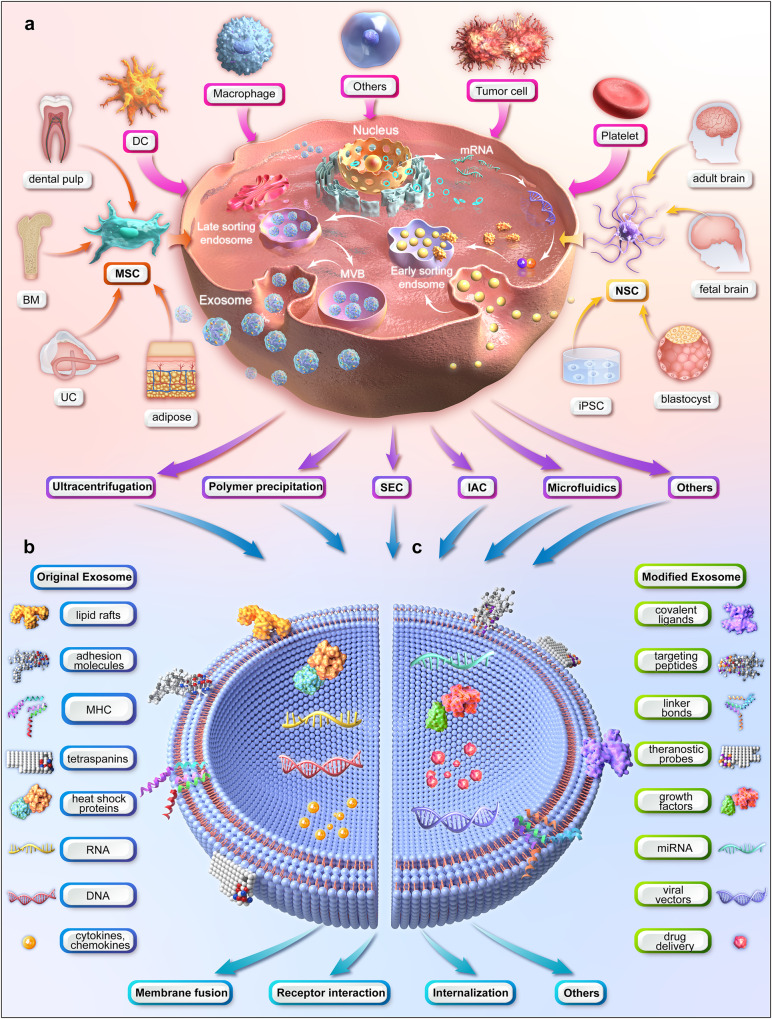
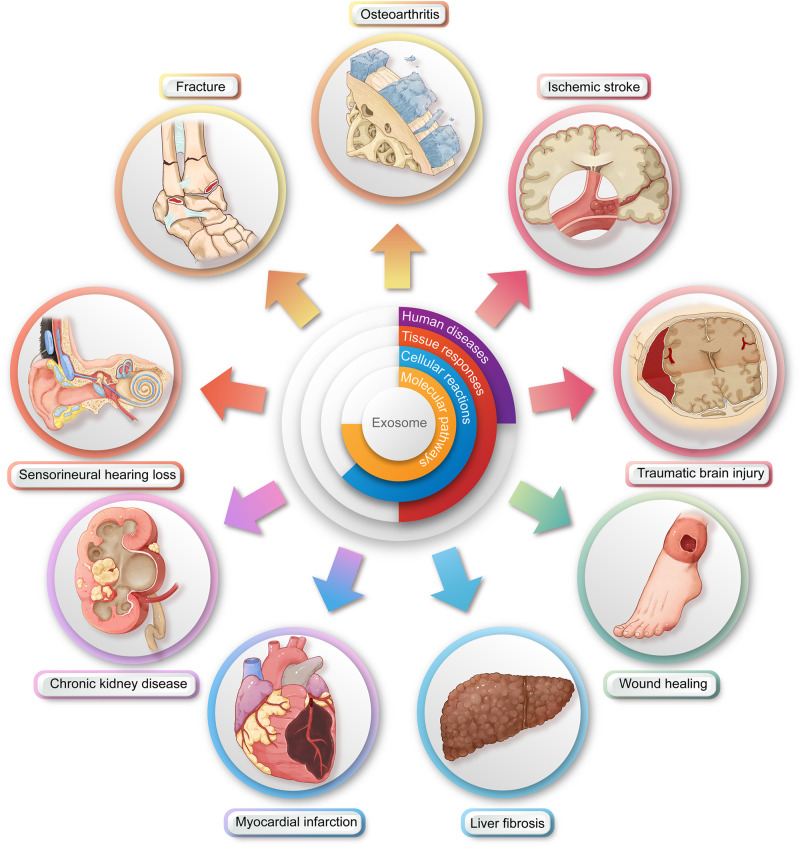
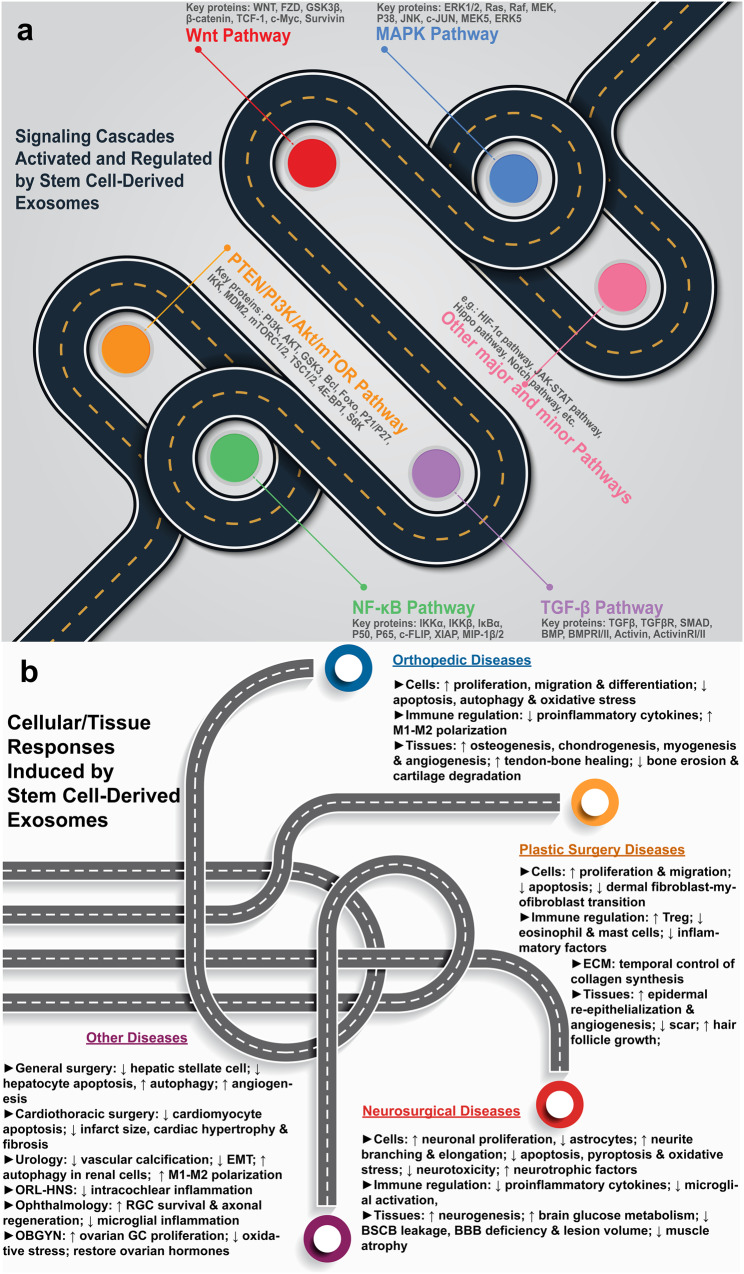
Although stem cell-based therapy has demonstrated considerable potential to manage certain diseases more successfully than conventional surgery, it nevertheless comes with inescapable drawbacks that might limit its clinical translation. Compared to stem cells, stem cell-derived exosomes possess numerous advantages, such as non-immunogenicity, non-infusion toxicity, easy access, effortless preservation, and freedom from tumorigenic potential and ethical issues. Exosomes can inherit similar therapeutic effects from their parental cells such as embryonic stem cells and adult stem cells through vertical delivery of their pluripotency or multipotency. After a thorough search and meticulous dissection of relevant literature from the last five years, we present this comprehensive, up-to-date, specialty-specific and disease-oriented review to highlight the surgical application and potential of stem cell-derived exosomes. Exosomes derived from stem cells (e.g., embryonic, induced pluripotent, hematopoietic, mesenchymal, neural, and endothelial stem cells) are capable of treating numerous diseases encountered in orthopedic surgery, neurosurgery, plastic surgery, general surgery, cardiothoracic surgery, urology, head and neck surgery, ophthalmology, and obstetrics and gynecology. The diverse therapeutic effects of stem cells-derived exosomes are a hierarchical translation through tissue-specific responses, and cell-specific molecular signaling pathways. In this review, we highlight stem cell-derived exosomes as a viable and potent alternative to stem cell-based therapy in managing various surgical conditions. We recommend that future research combines wisdoms from surgeons, nanomedicine practitioners, and stem cell researchers in this relevant and intriguing research area.
Overview
The claims and statistics of this paper haven’t been checked yet.
Free: it reads the open-access text and checks the first 5 claims that cite a source we can check. Create a free account to check every claim.
Integrity signals
Registry
Cites
Statistics
Figures
Verification
Claims the paper makes
The claims and statistics of this paper haven’t been checked yet.
Free: it reads the open-access text and checks the first 5 claims that cite a source we can check. Create a free account to check every claim.
Claims other papers make about this one
Each is checked against this paper’s own text: does it say what the citing paper says it does?
The cited source says what the claim attributes to it.
In the citing paper
“Despite their strong therapeutic promise in AD, the production of stem cell-derived exosomes remains challenging. Their yield from cultured media is extremely low, posing a major challenge for large-scale manufacturing and clinical translation [231].”
From The Impact of Neurotoxin Proteins Trafficked by Primary Cilia and Extracellular Vesicles in Neurodegenerative Diseases (2025) · cites this paper as [231]
Experimental — accuracy not yet measured
Self-check
Percentages, sums and reported differences re-computed from the paper’s own numbers.
The self-check needs the paper’s full text.
Citations
Cites
2 retracted
Ding, J., Wang, X., Chen, B., Zhang, J., & Xu, J. (2019) · BioMed Research International · doi:10.1155/2019/9742765 · Cited by 184 · cited 1×
“215 218 EPC-derived exosomes could accelerate cutaneous wound healing by promoting angiogenesis 219 through the Erk1/2 pathway 220 and p53 pathway.”
BackgroundRetractedJiang, Y., Zhang, J., Li, Z., & Jia, G. (2020) · Frontiers in Medicine · doi:10.3389/fmed.2020.577578 · Cited by 55 · cited 1×
“71 From a lncRNA perspective, especially the bone-speci fi c lncRNA H19, a Chinese group revealed that although a high-fat diet reduced osteogenic differentiation and weakened fracture healing, this could be reversed by MSC-derived exosomal lncRNA H19 via miR-467/ HoxA10 axis in an obesity-induced…”
BackgroundRetractedThéry, C., Witwer, K. W., Aikawa, E., Alcaraz, M. J., Anderson, J. D., Andriantsitohaina, R., Antoniou, A., Arab, T., Archer, F., Atkin‐Smith, G. K., et al. (2018) · Journal of Extracellular Vesicles · doi:10.1080/20013078.2018.1535750 · Cited by 11,099 · cited 1×
“55,56 Storage of exosomes The currently used preservation methods for long-term storage of exosomes mainly include cryopreservation, lyophilization, and spray-drying.”
MethodThe biology , function , and biomedical applications of exosomes
Kalluri, R., & LeBleu, V. S. (2020) · Science · doi:10.1126/science.aau6977 · Cited by 10,770
Poewe, W., Seppi, K., Tanner, C. M., Halliday, G. M., Brundin, P., Volkmann, J., Schrag, A.-E., & Lang, A. E. (2017) · Nature Reviews Disease Primers · doi:10.1038/nrdp.2017.13 · Cited by 5,415
Delivery of siRNA to the mouse brain by systemic injection of targeted exosomes
Alvarez-Erviti, L., Seow, Y., Yin, H., Betts, C., Lakhal, S., & Wood, M. J. A. (2011) · Nature Biotechnology · doi:10.1038/nbt.1807 · Cited by 4,930 · cited 1×
“50 Zhu et al. inserted tumor-targeting peptides, c(RGDyK), into the exosome surface using a chemical reaction to target glioblastoma.”
BackgroundDoyle, L., & Wang, M. (2019) · Cells · doi:10.3390/cells8070727 · Cited by 3,236 · cited 3×
“19 In addition, cargo pro fi ling is further subdivided into proteomic, lipidomic, and genomic analyses including western blotting, ELISA, fl ow cytometry, mass spectroscopy, and PCR. 36 Since each of the above characterization methods has advantages and disadvantages, it is a universal practice to…”
BackgroundMethodInfluentialBlood–brain barrier breakdown in Alzheimer disease and other neurodegenerative disorders
Sweeney, M. D., Sagare, A. P., & Zlokovic, B. V. (2018) · Nature Reviews Neurology · doi:10.1038/nrneurol.2017.188 · Cited by 3,076
Wound Healing: A Cellular Perspective
Rodrigues, M., Kosaric, N., Bonham, C. A., & Gurtner, G. C. (2019) · Physiological Reviews · doi:10.1152/physrev.00067.2017 · Cited by 3,013
Comprehensive Review on Alzheimer’s Disease: Causes and Treatment
Breijyeh, Z., & Karaman, R. (2020) · Molecules · doi:10.3390/molecules25245789 · Cited by 2,789
Research works printed but not linked: 1
- Carr NJ The pathology of healing and repair Surgery 2022 40 13 19
Cited by
Items 701–800 of 841
Yuan, L.-Y., Yuan, Q., Guo, D.-W., Tan, H.-L., & Guan, X. (2026) · Frontiers in Cell and Developmental Biology · doi:10.3389/fcell.2026.1821763
“Exosomes carry diverse bioactive cargos, and as a cell-free therapeutic platform, generally exhibit lower immunogenicity, reduced infusion-related toxicity, and favorable biocompatibility during in vivo delivery (Tan et al., 2024).”
Shi, Y., Ni, Z., Wang, F., Li, Z., Li, S., Li, K., Chen, X., Xu, C., & Wang, F. (2026) · Stem Cell Research & Therapy · doi:10.1186/s13287-026-05050-0
“Moreover, their lower immunogenicity and tumorigenic potential further position them as promising therapeutic agents [153, 154].”
Xu, X., Li, L., Cao, Y., Wang, Y., Yang, C., Orekhov, A. N., Lu, Y., Chu, H., Zhao, C., Wang, G., et al. (2026) · Interdisciplinary medicine · doi:10.1002/inmd.70129
Zheng, J., Xiong, S., Yang, Q., & Su, W. (2026) · doi:10.20517/scierxiv202605.0303.v1
Self-citationChemically induced site-specific homing of systemically administered extracellular vesicles
Bansal, A., DeGrado, T. R., & Pandey, M. K. (2026) · Frontiers in Chemical Biology · doi:10.3389/fchbi.2026.1778431
Deng, J., Huang, X., Yang, Y., Li, L., Shen, J., Zeng, W. R., Yu, X. H., Deng, F., Xu, R., & Zhang, Z. (2026) · Materials & Design · doi:10.1016/j.matdes.2026.116247
Cao, W., Li, D., Yang, Q., Qiu, H., Guo, Q., Fu, S., Wang, J., & Lei, W. (2026) · International Journal of Bioprinting · doi:10.36922/ijb026150134
Zhao, X., Li, X., Yang, C., & Wang, B. (2026) · Scientific Reports · doi:10.1038/s41598-026-54462-8
“Compared with exosome-based therapies, CM demonstrates comparable or superior efficacy in enhancing cell proliferation and tissue regeneration while eliminating the risks associated with live-cell administration 60,61 .”
Self-citationZanotti, F., Erdem, A., Morganti, C., Bonora, M., Totani, H., Nakamura, T., & Keisuke, I. (2026) · Extracellular Vesicle · doi:10.1016/j.vesic.2026.100108
“173,174 Emerging approaches including tangential flow filtration, size-exclusion chromatography, and microfluidics improve purity and scalability, even if each brings tradeoffs in yield, cost, and infrastructure requirements, and none has yet been validated at GMP-compliant scale for hematological…”
Therapeutic Applications of Exosomes for Women’s Reproductive Health
Harrison, A. M., Xu, Y., Fisher, A. A., & Bailey‐Hytholt, C. M. (2026) · Springer eBooks · doi:10.1007/978-3-032-10745-9_21
Neri, S., Bartolotti, I., Pedrini, E., Manferdini, C., Assirelli, E., & Ursini, F. (2026) · Stem Cell Research & Therapy · doi:10.1186/s13287-026-05065-7
“Therefore, limiting expansion to early passages ([2 In three cases (two VUS and the deletion in the KIT gene), variants were detected from the onset of culture, suggesting their occurrence in vivo.”
Bang, J., Choi, H., Song, Y., Choi, J., & Kim, C.-S. (2026) · Journal of Voice · doi:10.1016/j.jvoice.2026.05.001
Stem cell extracellular vesicles for neuropsychiatric disorders and translation
Fan, H., Wang, S., Li, Z., Yu, T., Ma, C., & Sun, C. (2026) · Extracellular Vesicles and Circulating Nucleic Acids · doi:10.20517/evcna.2026.14
Leveraging engineered small EVs to mitigate cancer pain: a new paradigm
Sarkar, S., Roy, S., & Choudhury, L. (2026) · Journal of Microencapsulation · doi:10.1080/02652048.2026.2677813
“…particularly those derived from immunomodulatory cells like mesenchymal stem cells (MScs), can even actively suppress inflammation (Ha et al. 2020; Roszkowski 2024; tan et al. 2024). the exosomal membrane can be engineered to display specific ligands, allowing for exquisitely precise targeting.”
Wu, Q., Li, G., Yang, X., Jin, C., Ding, R., Li, G., Crețoiu, D., Li, X. C., Wang, H., & Xiao, J. N. (2026) · Bratislavské lekárske listy/Bratislava medical journal · doi:10.1007/s44411-026-00678-z
“NSC-EVs carrying anti-tumor cargo, including tumor suppressor microRNAs and pro-apoptotic proteins, have shown efficacy in reducing glioma growth and inva - siveness [82].”
Self-citationZhang, L., Li, J., Aldali, F., Li, Y., 韩肖华, & Deng, C. (2026) · Journal of Neuroinflammation · doi:10.1186/s12974-026-03896-y
“EV yield and cargo are not fixed; they shift with microenvironmental cues such as hypoxia, which can alter both vesicle abundance and molecular composition—features that may matter in post-stroke repair settings [177].”
Self-citationGao, P., Feng, W., Zhao, X., Shen, J., Wang, X., Wu, X., Zhou, W., Wang, Y., Chen, J., & An, W. (2026) · Advanced Healthcare Materials · doi:10.1002/adhm.202504092
“During the remodeling phase, the microenvironment shifts toward ECM remodeling and tissue maturation [52].”
Wang, S.-F., Guo, H.-C., Gong, X.-Q., & Peng, X.-W. (2026) · World Journal of Stem Cells · doi:10.4252/wjsc.115628
Doshi, R. B., Yee, B. E., Warburton, N., Ruan, J., Tilley, R. D., Sidhu, K., & Kilian, K. A. (2026) · Cellular and Molecular Bioengineering · doi:10.1007/s12195-026-00917-x
“…for wide range of therapeutics applications namely, acute and chronic wound healing, musculoskeletal and neurological disorders, immune diseases, and degenerative conditions, etc. due to their capability to cross biological barriers and present therapeutically relevant molecular signatures [13].”
Recent advances in cellular and gene therapies for cancer
Rui, M. I. A. O., Xing, S.-P., ZHEGN, S.-G., & Lian-Hui, S. U. N. (2026) · Shengming kexue · doi:10.3724/cbls.2026071
Zhang, Y., Wang, L., Mao, J., Wu, Y., Foo, W., Wang, Z., Wu, J., Guo, Y., You, J., & Luo, L. (2026) · Journal of Controlled Release · doi:10.1016/j.jconrel.2026.115091
Self-citationGao, B., Sun, J., Wei, P., Zhang, Y., Tian, Y., Lin, Y. Y., Ashrafizadeh, M., Kang, D., Conde, J., & Niu, X. (2026) · Matter · doi:10.1016/j.matt.2026.102868
Vijayasimha, M., Srikanth, M., & Kaur, R. A. (2026) · Stem Cell Reviews and Reports · doi:10.1007/s12015-026-11178-6
“They are increasingly being suggested as cell-free options to cellular therapies and offer several potential ben - efits in storage, immunogenicity, delivery, and safety [ 4].”
Exosome Therapy: A Novel Investigational Approach in Acute Myocardial Infarction
Joshi, A., Gupta, R., Sangdup, T., Jacob, J., & Aggarwal, A. (2026) · Cardiology in Review · doi:10.1097/crd.0000000000001365
He, G., Fan, R., Zhao, J., He, J., Shi, Z., Liu, P., Zhang, H., Wu, C., 贾孟, Ao, X., et al. (2026) · ACS Omega · doi:10.1021/acsomega.6c01420
“22,23 Exosomes and other EVs have emerged as acellular mediators of intercellular communication and are capable of transferring RNAs, proteins, and lipids to recipient cells.”
Xu, Z., Qi, H., Zhang, X., Qu, F., Wu, Y., & Xu, C. (2026) · Discover Nano · doi:10.1186/s11671-026-04733-0
“Tangential-flow filtration combined with size-exclusion chromatography under good manufacturing practice (GMP) conditions can yield high-purity vesicles with reduced protein aggregates [108].”
Zhang, H., Wang, Y., Wang, X., Duan, H., Yu, D., Kuang, X., He, L., Zhang, W., Chen, J. K., & Dai, J. (2026) · Journal of Translational Medicine · doi:10.1186/s12967-026-08430-5
Abdelbaky, N. W., Nabil, A., Ahmed, O. M., & Zanaty, M. I. (2026) · Scientific Reports · doi:10.1038/s41598-026-58433-x
“The therapeutic potential of MSC-derived exosomes has been demonstrated in many pathological conditions 20,25 .”
Measuring antiaging effects through changes in telomere length after mesenchymal stem cells therapy
Kim, S. (2026) · Journal of Exercise Rehabilitation · doi:10.12965/jer.2652394.197
“These results suggest that MSCs-mediated telomere homeostasis regulatory effects may appear within weeks, which is consistent with the rapid response rate of extracellular vesicle-mediated gene expression changes (Tan et al., 2024).”
InfluentialLi, X., Lian, F.-W., Lv, F., Luo, X.-L., Hu, B.-L., Zhang, L., & Ning, S. (2026) · Stem Cell Research & Therapy · doi:10.1186/s13287-026-05129-8
“…exosomes possess numerous advantages: inherent biocompatibility and enhanced safety, minimal side effects, reduced immunogenicity, the ability to traverse biological barriers, high modification flexibility as well as enhancing targeting effects to selectively reach target cells or tissues [4, 5].”
Self-citationIsolation of Mesenchymal Stem Cell-Derived Extracellular Vesicles
Gebologlu, I. K., Demirden, S. F., & Öncel, S. Ş. (2026) · Methods in molecular biology · doi:10.1007/7651_2026_712
Bioreactors in mesenchymal stem cells and extracellular vesicles for therapeutic applications
Sanap, A. P., Bhonde, R., & Kharat, A. H. (2026) · Elsevier eBooks · doi:10.1016/b978-0-443-45056-3.00003-0
Potential and recent advances of stem cell exosomes in the repair of lung injury
Cai, W., Liao, S., Ran, J., Tan, B., Hong, L., Huang, A., Liao, X., Huang, J., Xiong, Y., Liang, J., et al. (2026) · TransMed · doi:10.1016/j.tmed.2026.100036
Biomaterials in mesenchymal stem cell and extracellular vesicle research
Kundu, B. (2026) · Elsevier eBooks · doi:10.1016/b978-0-443-45056-3.00006-6
Intan, Y. S. N., Soetrisno, S., Laqif, A., Indarto, D., Dirgahayu, P., Pamungkasari, E. P., & Putra, A. (2026) · Trends in Sciences · doi:10.48048/tis.2026.13489
Nie, M., Huang, D., Yang, H. W., Zhao, Y., & Sun, L. (2026) · Chemical Engineering Journal · doi:10.1016/j.cej.2026.179078
Cheng, C. K. L. (2026) · IntechOpen eBooks · doi:10.5772/intechopen.1016322
Wu, Y., Chen, S. Y., Hao, R., Wang, R., & Mai, L. (2026) · Frontiers in Medicine · doi:10.3389/fmed.2026.1775277
“These small vesicles contain bioactive molecules linked to tissue repair, offering a viable and scalable solution for regenerative medicine (61).”
Wang, Y., Yang, H., Tang, K., Tang, T., & Guo, J. (2026) · Frontiers in Bioengineering and Biotechnology · doi:10.3389/fbioe.2026.1847706
“…skin damage across multiple biological fronts—including the activation of the Nrf2/GPX4 axis to restore redox homeostasis, suppression of inflammatory cascades, and promotion of collagen synthesis and angiogenesis (Huynh et al., 2025; Han et al., 2024a; Yan et al., 2023a; Gui et al., 2025).”
Engineering EVs Via ZnBGs‐Integrated 3D Dynamic Culture for Type II Diabetic Pressure Ulcer Therapy
Sun, Z., Ding, Y., Chen, X., Wu, Z., Huang, Y. Q., Luo, H., & Cao, X. (2026) · Small · doi:10.1002/smll.74430
Huang, X., chen, Q., & Lü, H. (2026) · Frontiers in Immunology · doi:10.3389/fimmu.2026.1856373
“The miRNAs they carry, such as miR – 216a – 5p and miR – 146a – 5p, can suppress in fl ammatory pathways including TLR/NF – k B/PI3K – Akt, regulate macrophage polarization, signi fi - cantly reduce pro – in fl ammatory cytokines, and increase IL – 10 and TGF – b (109).”
Sima, J., Chen, J., Liu, X., Li, D., Huang, W., Wang, Y., Ma, Y., Zhang, Y., & Wang, X. (2026) · International Journal of Nanomedicine · doi:10.2147/ijn.s614120
Immunomodulatory efficacy of culture condition-dependent modulation of mesenchymal stem cells
Sun, Q., Zhang, X., Dong, H., Mi, C., Geng, S., Li, Q., Zhang, J., Wang, X., & Wang, T. (2026) · Stem Cell Research & Therapy · doi:10.1186/s13287-026-05169-0
“…disease, ALS, chronic heart failure caused by chronic ischemic cardiomyopathy, chronic obstructive pulmonary disease, acute respiratory distress syndrome (ARDS), stroke, liver failure, periodontal disease, rheumatoid arthritis, diabetes foot ulcer, traumatic spinal cord injury, etc [24–27, 31 ].”
Exosome Nanotechnology in Molecular Medicine: Advances, Applications and Challenges in Gene Therapy
Karabagh, E., Alibayov, B., & Allahverdiyev, A. (2026) · Expert Reviews in Molecular Medicine · doi:10.1017/erm.2026.10066
“Plant-derived exosomes (PDEs) are plant extracellular nanovesicles that share several structural and functional similarities with mammalian EVs but differ in biogenesis pathways, lipid composition, protein markers and cargo signatures.”
Extracellular Vesicles in Stroke: Drivers of Brain–Body Network Crosstalk
Xu, Z. Y., Yu-Jia, J., Zhang, W., Ye, X.-H., & Gao, F. (2026) · Translational Stroke Research · doi:10.1007/s12975-026-01452-7
“Translational approaches now focus on optimizing delivery—intranasal administration can achieve partial CNS exposure—and on engineering vesicles to display targeting ligands or load regulatory microRNAs such as miR-124, miR-126, or miR-210 [129].”
Stem cell-derived exosome therapy for traumatic brain injury and its auditory complications
Zhang, H., Xu, M., Cai, B., Wang, Z., Li, T., Jung, S., & Tan, F. (2026) · Biomedicine & Pharmacotherapy · doi:10.1016/j.biopha.2026.119755
Self-citationEvidence-Based Role Of Stem Cell Therapy In Perioperative Care – A Scientific Analysis
Farrisa, D. M., Krubaa, P., & Parthasarathy, S. (2026) · Adolescencia e Saude · doi:10.67440/ahj.v21i2.1132
Pawar, S. D., S, A. F. M., C, N. A., Shehanas Banu, A., Dhanasekar, J., Lathamani, L., Ruban, S., & Arvinthkumar, R. (2026) · The Bioscan. · doi:10.63001/tbs.2026.v21.i03.s.i(3).pp380-423
hanzaii, F. P., Soleimani, M., & Zomorrod, M. S. (2026) · Stem Cells International · doi:10.1155/sci/2596453
“Additionally, the immunological pro fi le of exosomes is favorable; they typically lack MHC molecules, including HLA class I and II antigens, thereby minimizing the risk of eliciting immune responses upon administration to allogeneic recipients [65].”
Guo, H., Li, J. S., Gu, C., Liu, N., Sun, J., Wang, D., Meng, S., Geng, D., Lian, Y., Lv, F., et al. (2026) · Journal of Nanobiotechnology · doi:10.1186/s12951-026-04817-0
Self-citationExosomes: Biology, Sources and Isolation Techniques
Sharma, A., Kaul, R., & Akhoon, N. (2026) · Dermatological Reviews · doi:10.1002/der2.70086
“Compared with cell‐based therapies, MSC‐derived exosomes offer advantages including lower immunogenicity, easier storage, and reduced safety concerns [28, 29].”
Research Prospectives of Biomaterials in Robotic Surgery
Amon, M., & Petrič, M. (2026) · doi:10.55295/psl.14.2026.ii1
A programmable DNA tetrahedron platform for selective and efficient capture of cells and proteins
Chen, X., Yin, W., Li, S., Cai, X., Lin, Y., & Tian, T. (2026) · Nature Protocols · doi:10.1038/s41596-026-01410-5
Chen, Y., Tang, F., & Li, X. (2026) · Stem Cell Research & Therapy · doi:10.1186/s13287-026-05198-9
“exhibit favorable biocompatibility [5].”
Self-citationWei, M., Peng, H., Tian, H., Wei, Y., Jia, L., Li, H., Cheng, D., Wang, B., & Wang, K. (2026) · Journal of Reproductive Immunology · doi:10.1016/j.jri.2026.104942
Pawar, S. D., S, A. F. M., C, N. A., Shehanas Banu, A., Dhanasekar, J., Lathamani, L., Ruban, S., & Arvinthkumar, R. (2026) · The Bioscan. · doi:10.63001/tbs.2026.v21.i02.s.i(2).pp21485-21528
Fang, J., Wu, Y., Jin, X., Wu, X., Xu, B., Shan, J., Nan, L., Liu, S., Nie, W., Liu, J., et al. (2026) · Research Square · doi:10.21203/rs.3.rs-10428498/v1
Stem cell-derived exosomes in the therapy of renal diseases: a comprehensive review
Luo, Q., Yang, N., Shang, Y., Gao, Y., He, Q., & Jin, J. (2026) · Stem Cell Research & Therapy · doi:10.1186/s13287-026-05199-8
“Currently, SC-exosomes have been investigated in multiple disease models, including kidney injury, endocrine disorders, gastrointestinal disorders, cardiovascular diseases, lung diseases, cancer, orthopedic conditions, and neurodegenerative diseases [9, 16, 37].”
InfluentialEstrella-Guisado, G., Pulido-Escribano, V., Ferrari, B., Casado‐Díaz, A., & González, Z. M. (2026) · International Journal of Biological Macromolecules · doi:10.1016/j.ijbiomac.2026.153915
Yuele, M., Yan, W., Hongwei, C., Hui, Z., Guang, L., Li, Y., Ma, T., & Jianxiong, M. (2026) · Molecular Biology Reports · doi:10.1007/s11033-026-12513-3
Zhao, F., Sun, Y., Wang, H., Hou, D., Zhang, R., Xia, W., 张永臣, Li, L., Zhao, X., Wang, K., et al. (2026) · 中国科学通报:英文版 · doi:10.1016/j.scib.2026.08.013
Self-citationChen, S., Zhao, Z., Tian, L., Cui, S., Liu, X., Meng, H., Xie, Y., Chen, D., Ran, X., Zhao, C., et al. (2026) · Bioactive Materials · doi:10.1016/j.bioactmat.2026.06.042
“EVs are rich in numerous functional molecules, such as proteins, lipids and nucleic acids [136].”
Sarvestani, F. S., Yaghobi, R., Maharlooei, M. K., Golshan, M., & Karimi, M. H. (2026) · Diabetes/Metabolism Research and Reviews · doi:10.1002/dmrr.70215
Zhang, X., Xu, M., Wang, L., Wu, C., Yang, H., Zhu, J., Zhang, M., & Zhang, M. (2026) · Cell & Bioscience · doi:10.1186/s13578-026-01630-y
Pop Rocks-Inspired Bubble Driven Exosome Propulsion via Microneedles for Synergistic Wound Healing
Wu, L., Hu, W.-H., Zhang, L., Zhou, B., He, Q., Ye, H., & Guo, W. (2026) · ACS Applied Materials & Interfaces · doi:10.1021/acsami.6c08673
Nanotechnology in Pediatric Neurology: Applications and Innovations
Teleanu, R. I., Lungescu, I. A., Niculescu, A.-G., Cojocaru, A.-M., Perjoc, R., Chenescu, B. T., Roza, E., Vladâcenco, O. A., Grumezescu, A. M., & Teleanu, D. M. (2026) · Pharmaceutics · doi:10.3390/pharmaceutics18080999
“Preclinical research proposed using human stem cell-derived exosomes as a therapeutic strategy to mitigate neuroinflammation [124,125].”
Jin, X., & Wang, J. (2026) · Journal of Burn Care & Research · doi:10.1093/jbcr/irag133
Zhong, P., Chen, J., Cai, S., Zou, J., Zhong, X., & Zhang, G. (2026) · Stem Cell Reviews and Reports · doi:10.1007/s12015-026-11209-2
“Compared with cell-based therapies, MSC-EVs exhibit superior biosafety and stability, while avoiding limitations such as low cell survival rates and immune rejection, and have thus emerged as a promising strategy for tissue repair [40].”
Wang, X., Zhao, X., Zhang, F., Wang, S., Meng, F., Deng, C., Ye, M., & Zhong, Z. (2026) · Science Advances · doi:10.1126/sciadv.aec3712
“Exosome formulations partially address these issues yet confront heterogeneity, scale-up challenges, and regulatory complexity, underscoring the critical demand for advanced pulmonary delivery systems for therapeutic proteins like CD24 ( 22 , 23 ).”
Orange-Derived Extracellular Vesicles Labeled with MRI Gd-Containing Contrast Agents
Romiti, C., Alberti, D., Pomatto, M. A. C., Carrera, C., Massari, L., Cedrino, M., Aime, S., Camussi, G., & Crich, S. G. (2026) · Chemical & Biomedical Imaging · doi:10.1021/cbmi.6c00126
Plaisance, C., Pezzanite, L. M., Dow, S. W., & Santangelo, K. S. (2026) · doi:10.25675/3.027291
Molecular and Cellular Mechanisms for Maintaining and Restoring Dynamic States of Tissue Homeostasis
Ситдикова, К. К., Черкашенко, В. Н., & Saburina, I. N. (2026) · Biology Bulletin Reviews · doi:10.1134/s2079086425601541
“Exosomes from neural stem cells contain neurotrophic factors and miRs that promote neurogenesis, making them promising for stroke and neurodegeneration (Tan et al., 2024).”
Li, H., Liang, R., Li, Z., Wang, M., Tang, X., Zuo, G., Zhu, H., Cui, W., Hu, Y., & Zhang, X. (2026) · Neurochemical Research · doi:10.1007/s11064-026-04872-x
“In particular, stem cell-derived exosomes have become an effective alternative to various cell therapies because of their lack of immunogenicity, infusion toxicity, and tumor risk [31].”
Bhuchakra, H. P., Anwar, A. I., Hegazi, A.-R. A., Lentz, I. B., Robinson, C. L., Hasoon, J. J., Ehrhardt, K. P., & Kaye, A. D. (2026) · Biophysica · doi:10.3390/biophysica6050081
Gift of nature: non-human-derived exosomes showing application prospects in periodontitis treatment
Fei, H., Wang, Z., Li, Y., Sun, H., Meng, X., & Lin, H. (2026) · Frontiers in Immunology · doi:10.3389/fimmu.2026.1814654
“For instance, exosomes derived from MSCs show promise in numerous medical applications, including neuroprotection and tissue repair (12).”
Self-citationLeón, C. G. A.-D., Zahorchak, A. F., Mitsufuji, S., Ramaswami, B., Yazdani, H. O., Hadjiyannis, Y., Camirand, G., Geller, D. A., & Thomson, A. W. (2026) · The Journal of Immunology · doi:10.1093/jimmun/vkag224
Alvites, R., & Maurício, A. C. (2025) · Directory of Open access Books (OAPEN Foundation)
PEBP1 Regulates Ferroptosis in Acute Glaucoma: Targeted Therapy Using Engineered Exosomes
Huang, Y., Gong, D., Guo, J., Huang, W., Hu, T., Tang, S., Li, L., Feng, B., Dang, K., Deng, S., et al. (2026) · The FASEB Journal · doi:10.1096/fj.202602807r
“These nanoscale vesicles, approximately 30– 150 nm in diameter, are actively secreted by cells and mediate intercellular communication through the transport of bioactive cargo, including nucleic acids, proteins, and lipids [17].”
Proximity Proteomics Maps Candidate Cellular Uptake Pathways for Cell‐Derived Nanovesicles
Kanao, E., Mizuta, R., Tarao, S., Hara, Y., Li, Y., Akiyoshi, K., Ishihama, Y., Imami, K., & Sasaki, Y. (2026) · Small Methods · doi:10.1002/smtd.71014
Liu, Y., Pan, Y., 贾润清, Li, X., Hao, Y., & Wang, M. (2026) · ACS Applied Bio Materials · doi:10.1021/acsabm.6c01452
Self-citationWang, G., Duan, J., Sun, L., Xu, T., Chen, J., Xu, A., Liu, Q., Qin, M., Huo, S., Li, W., et al. (2026) · Antioxidants · doi:10.3390/antiox15091115
“EVs have a huge advantage over traditional drug therapy, and their homing and targeting characteristics greatly avoid the defects that are easy to spread during drug therapy [18,19].”
Self-citationYi, J., Lu, F., Tian, Y., Wang, Y., Zhang, Z., Deng, X., Wang, Z., Xia, S., Zhang, J., & Xiao, Q. (2026) · Stem Cells International · doi:10.1155/sci/2026673
“MSC-Exos are nanovesicles actively secreted by mesenchymal stem cells, ~30 – 150nm in diameter, with a typical phospholipid bilayer structure and carrying various bioactive molecules, including proteins, lipids, mRNA, miRNA, and long noncoding RNA [25].”
Self-citationZaobo, P., & Ma, D. (2026) · Journal of Tissue Viability · doi:10.1016/j.jtv.2026.101048
Bach, D., Hoang, V. H., & Nguyễn, T. L. (2026) · Molecular Neurobiology · doi:10.1007/s12035-026-06193-0
Zhang, Y., Sun, M., Yang, Q., Li, Y., Li, M., Zhang, S., & Zhang, J. (2026) · Materials Today Advances · doi:10.1016/j.mtadv.2026.100966
Adelipour, M., & Kim, J. (2026) · Skin Pharmacology and Physiology · doi:10.1159/spp/aetag010
Song, Y., Kim, I.-K., Miah, R., & Park, S. (2026) · Journal of Neuroscience Methods · doi:10.1016/j.jneumeth.2026.110905
Moghadam, R., Moghadam, M., Shahmir, C., Seyhoun, I., & Zolbin, M. M. (2026) · Regenerative Engineering and Translational Medicine · doi:10.1007/s40883-026-00628-9
Korkutata, M., & Dilsiz, N. (2026) · Molecular Neurobiology · doi:10.1007/s12035-026-06175-2
“Researchers are actively exploring modified exosomes for the targeted delivery of therapeutic compounds to specific cell types, which could reduce side effects compared with traditional therapies [150].”
Jiang, G., Huang, R., Wang, K., Gui, Y., Tang, Y., Jiang, G., Liu, Y., & Xu, J. (2026) · Frontiers in Cellular Neuroscience · doi:10.3389/fncel.2026.1893849
“As an important type of extracellular vesicle, exosomes are relatively stable, have low immunogenicity, and are amenable to engineering modification; therefore, they have been widely applied in peripheral nerve injury repair in recent years (Tan et al., 2024).”
Organelle-targeted nanomedicine for metabolic reprogramming in regenerative medicine
Chandrasekaran, S., Duraisamy, N., Jagadeesan, M., Palukuri, Y. K., Santhoshkumar, M., Sah, A. K., Sundaram, T., & Senthilkumar, D. (2026) · Nano Today · doi:10.1016/j.nantod.2026.103190
Asghar, A. (2026) · Zenodo (CERN European Organization for Nuclear Research) · doi:10.5281/zenodo.22842181
Lee, J. H., Ha, D. H., Cui, S.-Y., Yoon, S.-H., Cho, B. S., & Kim, S. (2026) · Scientific Reports · doi:10.1038/s41598-026-72593-w
Baek, H., Lee, E.-C., Gonçalves, M., Ong, Y. T., Jeon, S., Jang, Y.-J., Kim, S., Seok, Y. J., Hong, S., Bhang, S. H., et al. (2026) · Chemical Engineering Journal · doi:10.1016/j.cej.2026.182254
Comparative effects of selenium compounds on human umbilical cord mesenchymal stem cell expansion
Ni, B., Li, H., Xu, R., Yang, L., Li, C., Lin, H., Chen, X., Lu, J., Chen, W., & Yang, F. (2026) · Journal of Trace Elements in Medicine and Biology · doi:10.1016/j.jtemb.2026.127964
Radiation‐Induced Skin Injury in Cancer Radiotherapy: From Mechanisms to Management
Toutoungi, Z. M., Aykin‐Burns, N., Chen, J., & Song, Y. H. (2026) · Advanced Oncology · doi:10.1002/adon.70006
Quercetin-loaded exosomes prevent endometrial fibrosis by downregulating EGFR
Zhang, X., Zhu, Y., Zhang, X., Zhuang, Q., Wang, X., Zhang, X., Hu, Y., & Zhao, G. (2026) · International Immunopharmacology · doi:10.1016/j.intimp.2026.117483
Gelatin‐Based Electrospun Nanofibrous Membranes for Treatment of Intrauterine Adhesion
Dongye, H., Wu, Y., Hu, J., Lv, C., Wang, Y., Gai, M., Sa, S., Zhang, W., Li, M., Zhu, X., et al. (2026) · The FASEB Journal · doi:10.1096/fj.202603136r
“Despite progress in the design of ECM-derived biomaterials for endometrial regeneration, these materials still pose greater risks of immunogenicity, zoonotic pathogen transmission, and batch- to-batch inconsistency, which hinder their practical applications [15].”
Ciarrochi, E., & Ciarrochi, J. B. (2026) · Cureus · doi:10.7759/cureus.117095
Application of Dental Stem Cell-Derived Extracellular Vesicles in Oral Tissue Engineering
Sun, J., Shen, T., 孙源南, & Luo, L. (2026) · International Dental Journal · doi:10.1016/j.identj.2026.111201
Metadata
- Authors
- Tan, F., Li, X., Wang, Z., Li, J., Shahzad, K., & Zheng, J.
- Affiliations
- Tongji University (CN)
- Corresponding author
- Tan, Fei
- Venue
- Signal Transduction and Targeted Therapy
- Published
- 2024-01-12
- Volume
- 9
- Issue
- 1
- Pages
- 17-17
- ISSN
- 2059-3635 (ISSN-L)
- PMC
- PMC10784577
- OpenAlex
- W4390765704
- Semantic Scholar
- 7d21154a4aa525f5d1c118adcaa16de60d9798de
- Cited by
- 708
- References
- 352
- Citations by year
- 2026: 267 · 2025: 313 · 2024: 128
- FWCI
- 28.81
- Type
- journal article
- Language
- en
- Open access
- gold
- doi.org
- Licence
- cc-by
- creativecommons.org/licenses/by/4.0 (tdm)
- creativecommons.org/licenses/by/4.0 (vor)
- Locations
- Signal Transduction and Targeted Therapy (publishedVersion, cc-by)
- PubMed Central (publishedVersion, cc-by)
- PubMed (publishedVersion)
- DOAJ (DOAJ: Directory of Open Access Journals) (submittedVersion, cc-by-sa)
- Funders
- National Natural Science Foundation of China (82271192)
- Topics
- Life Sciences › Biochemistry, Genetics and Molecular Biology › Molecular Biology › Extracellular vesicles in disease
- Life Sciences › Biochemistry, Genetics and Molecular Biology › Cell Biology › Mesenchymal stem cell research
- Health Sciences › Dentistry › Periodontics › Periodontal Regeneration and Treatments
- Keywords
- stem cell-derived exosomes, exosome therapy, orthopedic surgery, neurosurgery, plastic surgery, cardiothoracic surgery, urology, head and neck surgery, ophthalmology, obstetrics and gynecology, tissue-specific responses, clinical translation
- MeSH terms
- Embryonic Stem Cells, Exosomes, Induced Pluripotent Stem Cells, Mesenchymal Stem Cells
About these checks
Registry, retraction, Cites and statistics results are computed, not judged, with one exception: a printed reference that no index lists is read once by a model before it counts as a citation error. Claims are extracted by a model and kept only when their quote appears verbatim in the text; each cited source is then checked, with a model’s help, for whether it says what the claim relies on. Those verdicts can be wrong — read the claim’s quote and the cited source before relying on one.
Statistics and arithmetic are recomputed, not judged.
Confidence bands are shown only for fields calibrated on our annotated test set. None is calibrated yet, so no band is shown.
What counts as a claim ›How we measure confidence ›How we check this ›
Are you an author, or do you see a problem with this page? Request a review
Data sources
Bibliographic data: Semantic Scholar, OpenAlex, Crossref.
Contains information from the Semantic Scholar Academic Graph Datasets, made available under the ODC Attribution License (ODC-BY 1.0).
Semantic Scholar’s data is described in: Kinney, R., et al. (2023). The Semantic Scholar Open Data Platform. arXiv:2301.10140.
