

Clinical applications of stem cell-derived exosomes
Open accessThe DOI matches its Crossref record; 351 of the 352 references it cites were found in a registry or an index.
Abstract
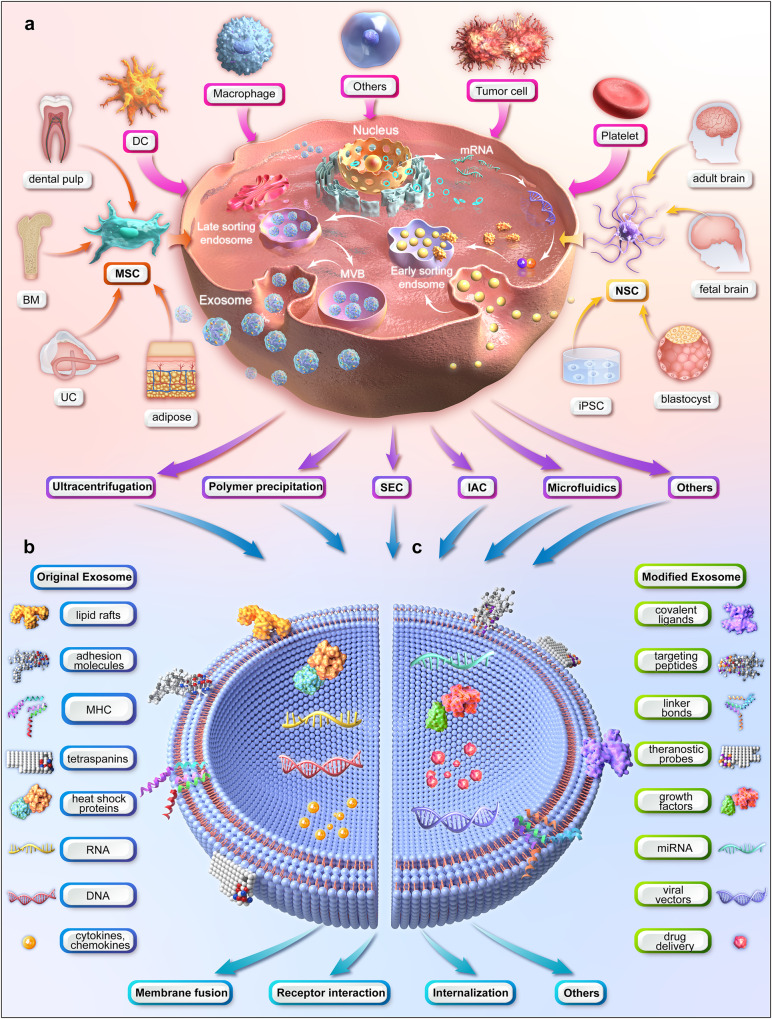
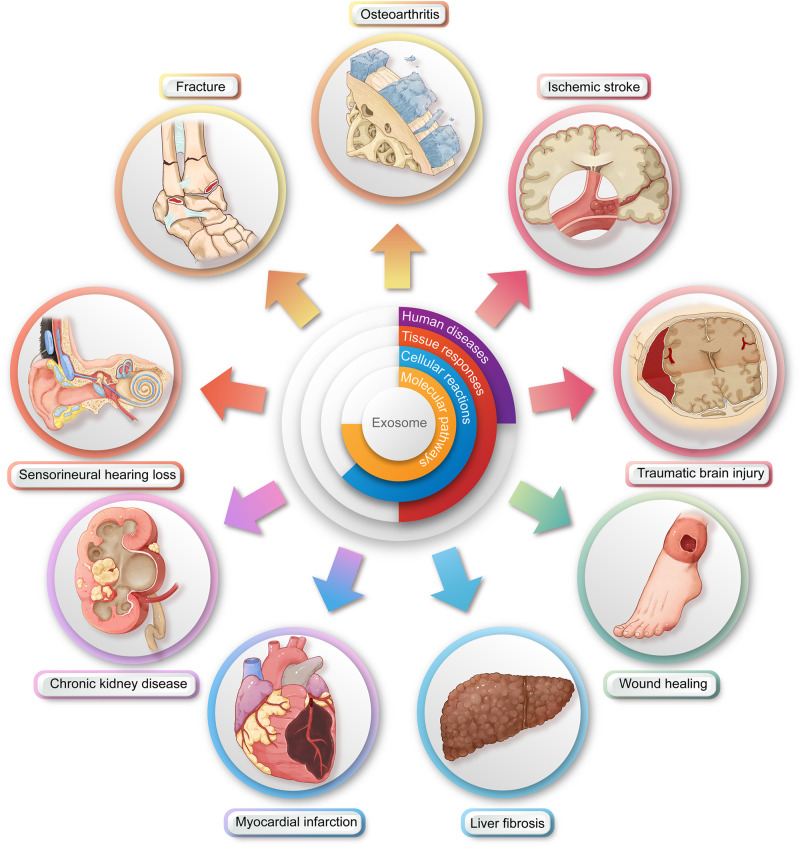
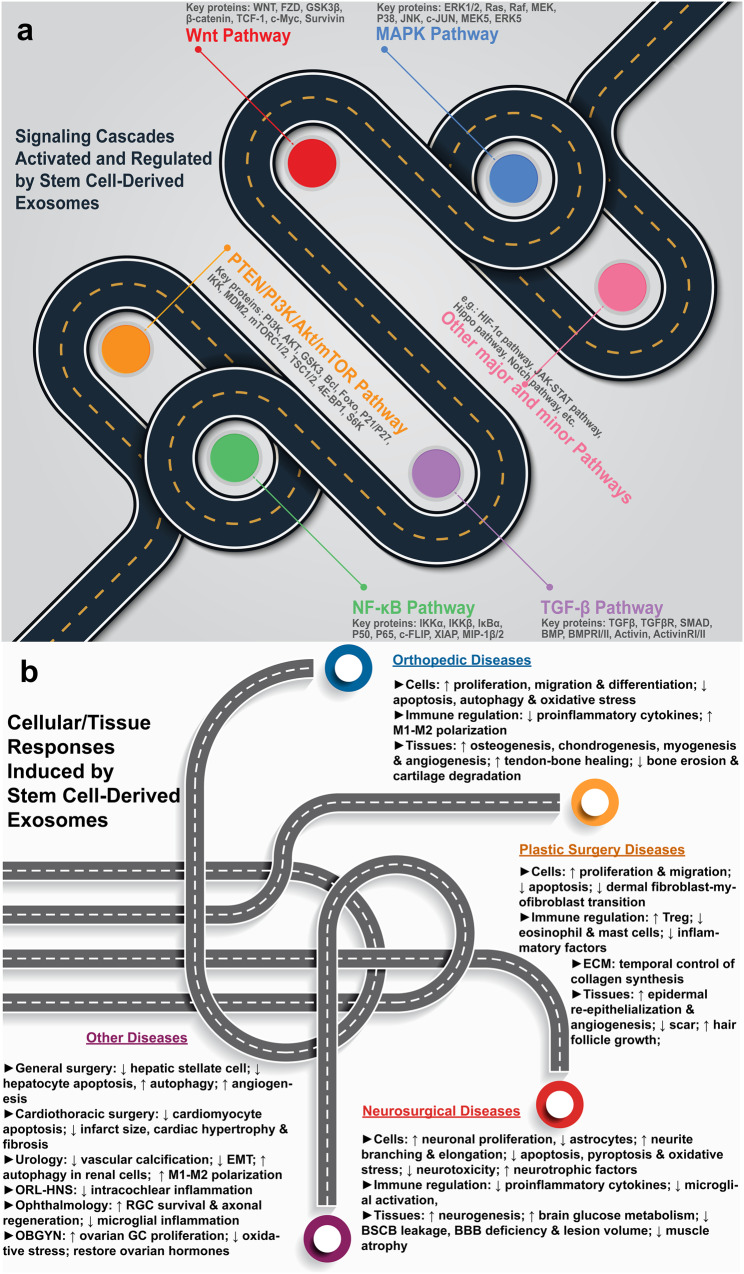
Although stem cell-based therapy has demonstrated considerable potential to manage certain diseases more successfully than conventional surgery, it nevertheless comes with inescapable drawbacks that might limit its clinical translation. Compared to stem cells, stem cell-derived exosomes possess numerous advantages, such as non-immunogenicity, non-infusion toxicity, easy access, effortless preservation, and freedom from tumorigenic potential and ethical issues. Exosomes can inherit similar therapeutic effects from their parental cells such as embryonic stem cells and adult stem cells through vertical delivery of their pluripotency or multipotency. After a thorough search and meticulous dissection of relevant literature from the last five years, we present this comprehensive, up-to-date, specialty-specific and disease-oriented review to highlight the surgical application and potential of stem cell-derived exosomes. Exosomes derived from stem cells (e.g., embryonic, induced pluripotent, hematopoietic, mesenchymal, neural, and endothelial stem cells) are capable of treating numerous diseases encountered in orthopedic surgery, neurosurgery, plastic surgery, general surgery, cardiothoracic surgery, urology, head and neck surgery, ophthalmology, and obstetrics and gynecology. The diverse therapeutic effects of stem cells-derived exosomes are a hierarchical translation through tissue-specific responses, and cell-specific molecular signaling pathways. In this review, we highlight stem cell-derived exosomes as a viable and potent alternative to stem cell-based therapy in managing various surgical conditions. We recommend that future research combines wisdoms from surgeons, nanomedicine practitioners, and stem cell researchers in this relevant and intriguing research area.
Overview
The claims and statistics of this paper haven’t been checked yet.
Free: it reads the open-access text and checks the first 5 claims that cite a source we can check. Create a free account to check every claim.
Integrity signals
Registry
Cites
Statistics
Figures
Verification
Claims the paper makes
The claims and statistics of this paper haven’t been checked yet.
Free: it reads the open-access text and checks the first 5 claims that cite a source we can check. Create a free account to check every claim.
Claims other papers make about this one
Each is checked against this paper’s own text: does it say what the citing paper says it does?
The cited source says what the claim attributes to it.
In the citing paper
“Despite their strong therapeutic promise in AD, the production of stem cell-derived exosomes remains challenging. Their yield from cultured media is extremely low, posing a major challenge for large-scale manufacturing and clinical translation [231].”
From The Impact of Neurotoxin Proteins Trafficked by Primary Cilia and Extracellular Vesicles in Neurodegenerative Diseases (2025) · cites this paper as [231]
Experimental — accuracy not yet measured
Self-check
Percentages, sums and reported differences re-computed from the paper’s own numbers.
The self-check needs the paper’s full text.
Citations
Cites
2 retracted
Ding, J., Wang, X., Chen, B., Zhang, J., & Xu, J. (2019) · BioMed Research International · doi:10.1155/2019/9742765 · Cited by 184 · cited 1×
“215 218 EPC-derived exosomes could accelerate cutaneous wound healing by promoting angiogenesis 219 through the Erk1/2 pathway 220 and p53 pathway.”
BackgroundRetractedJiang, Y., Zhang, J., Li, Z., & Jia, G. (2020) · Frontiers in Medicine · doi:10.3389/fmed.2020.577578 · Cited by 55 · cited 1×
“71 From a lncRNA perspective, especially the bone-speci fi c lncRNA H19, a Chinese group revealed that although a high-fat diet reduced osteogenic differentiation and weakened fracture healing, this could be reversed by MSC-derived exosomal lncRNA H19 via miR-467/ HoxA10 axis in an obesity-induced…”
BackgroundRetractedThéry, C., Witwer, K. W., Aikawa, E., Alcaraz, M. J., Anderson, J. D., Andriantsitohaina, R., Antoniou, A., Arab, T., Archer, F., Atkin‐Smith, G. K., et al. (2018) · Journal of Extracellular Vesicles · doi:10.1080/20013078.2018.1535750 · Cited by 11,099 · cited 1×
“55,56 Storage of exosomes The currently used preservation methods for long-term storage of exosomes mainly include cryopreservation, lyophilization, and spray-drying.”
MethodThe biology , function , and biomedical applications of exosomes
Kalluri, R., & LeBleu, V. S. (2020) · Science · doi:10.1126/science.aau6977 · Cited by 10,770
Poewe, W., Seppi, K., Tanner, C. M., Halliday, G. M., Brundin, P., Volkmann, J., Schrag, A.-E., & Lang, A. E. (2017) · Nature Reviews Disease Primers · doi:10.1038/nrdp.2017.13 · Cited by 5,415
Delivery of siRNA to the mouse brain by systemic injection of targeted exosomes
Alvarez-Erviti, L., Seow, Y., Yin, H., Betts, C., Lakhal, S., & Wood, M. J. A. (2011) · Nature Biotechnology · doi:10.1038/nbt.1807 · Cited by 4,930 · cited 1×
“50 Zhu et al. inserted tumor-targeting peptides, c(RGDyK), into the exosome surface using a chemical reaction to target glioblastoma.”
BackgroundDoyle, L., & Wang, M. (2019) · Cells · doi:10.3390/cells8070727 · Cited by 3,236 · cited 3×
“19 In addition, cargo pro fi ling is further subdivided into proteomic, lipidomic, and genomic analyses including western blotting, ELISA, fl ow cytometry, mass spectroscopy, and PCR. 36 Since each of the above characterization methods has advantages and disadvantages, it is a universal practice to…”
BackgroundMethodInfluentialBlood–brain barrier breakdown in Alzheimer disease and other neurodegenerative disorders
Sweeney, M. D., Sagare, A. P., & Zlokovic, B. V. (2018) · Nature Reviews Neurology · doi:10.1038/nrneurol.2017.188 · Cited by 3,076
Wound Healing: A Cellular Perspective
Rodrigues, M., Kosaric, N., Bonham, C. A., & Gurtner, G. C. (2019) · Physiological Reviews · doi:10.1152/physrev.00067.2017 · Cited by 3,013
Comprehensive Review on Alzheimer’s Disease: Causes and Treatment
Breijyeh, Z., & Karaman, R. (2020) · Molecules · doi:10.3390/molecules25245789 · Cited by 2,789
Research works printed but not linked: 1
- Carr NJ The pathology of healing and repair Surgery 2022 40 13 19
Cited by
Items 801–841 of 841
Zheng, J., Wu, B.-S., Xu, Y., Zhang, C., Lin, H., & Liu, F. (2026) · Stem Cells International · doi:10.1155/sci/1665875
“First, they lack replicative DNA, eliminating the risk of tumorigenicity, arrhythmias, and microvascular occlusion associated with stem cell engraftment [75].”
Self-citationSTEM CELL-DERIVED EXOSOMES: BIOGENESIS, CHARACTERIZATION, ISOLATION AND PRECONDITIONING
Mittal, P., Shevchuk, O. O., Dovgalyuk, А. І., Ivankiv, Y. I., & Korda, М. М. (2026) · Medical and Clinical Chemistry · doi:10.11603/mcch.2410-681x.2026.i3.16728
Choonara, Y. E., Mnqiwu, K., Chougule, M. B., Kashikar, R., Aggarwal, A., Mosharraf, M., Salem, A. K., Dusane, A., Janardhanam, L. S. L., Sachdeva, M. S., et al. (2026) · International Journal of Pharmaceutics · doi:10.1016/j.ijpharm.2026.127492
Exosomes Derived From Mesenchymal Stem Cells: The Next Frontiers in Regenerative Therapies
Rasouli, A., Yousefi, M. H., Kavianpour, M., Farsad, S., Afkhami, H., & Sheykhhasan, M. (2026) · Current Treatment Options in Cardiovascular Medicine · doi:10.1007/s11936-026-01160-3
“While exosomes can be derived from various stem cell sources, mesenchymal stem cell (MSC)-derived exosomes have emerged as prominent therapeutic candidates in regenerative medicine because of their diverse cargo profiles, immunomodulatory properties, and broad reparative potential [81].”
Rieuwpassa, I. E., Alimuddin, M. A., Fausiah, A., Gunawan, M. A. I., Bobolangi, S., & Sutan, E. A. (2026) · Makassar Dental Journal
Gold Nanorods-Encapsulated Extracellular Vesicles: A Smart Approach to Cancer Therapy
Gul, S. (n.d.) · Institutional Research Information System University of Turin (University of Turin)
Stem Cell Therapy Used For Treatment of Heart Disease
Mahale", N. S., Chothave Sayali, J., Muthe Sakshi, S., Barokar Pooja, G., & Kapadi Suvarna, S. (2025) · Asian Journal of Pharmaceutical Research and Development
Cando, L. E. P., Bruque, V. A. B., Plazarte, J. L. V., Torres, R. P. S., & Avilés, J. A. G. (2026) · Ciencia y Educación · doi:10.5281/zenodo.23172853
Kim, W., Sharma, H., Kim, D., Lee, S., Bhakuni, S., & Kim, J. (2026) · Materials Today Bio · doi:10.1016/j.mtbio.2026.103723
Rebello, L., Chepyala, S., Polineni, S., & Jangala, R. (2026) · International Journal of Pharmacy and Industrial Research · doi:10.61096/ijpir.v16.iss3.2026.1195-1213
Beyond the Cell: Stem Cell‐Derived Exosomes as Next‐Generation Tools in Regenerative Therapy
El-Kady, H. A., Abdelgilil, M. E., Mandour, H. W., Altartoor, R. A. I., El-Wahab, Z. M. A., Alosman, S., Abdelzaher, S. M., Fangary, I. M., & Hosny, Y. (2026) · Stem Cells International · doi:10.1155/sci/1054968
Robert W. Alexander, M., & Peter A. Everts, P. (2026) · Journal of Immunology · doi:10.52338/joi.2026.6088
Cai, B., Wang, Z., Xu, M., Li, J., Li, D., & Tan, F. (2026) · International Immunopharmacology · doi:10.1016/j.intimp.2026.117511
Self-citationHuman Neural Cells Engineered In Vitro: Emerging Pathways for Neuroimmunology and Repair
Wang, Y., Jiang, M., Liu, J., Dong, Z., Puwei, S., Meng, H., Wang, Z., Zhou, W., & Dong, X. (2026) · Journal of Tissue Engineering · doi:10.1177/20417314261491541
Self-citationZhang, J., Huang, L., Wen, G., Zhang, X., Wang, J., Gao, C., Yang, H., Mao, Y., Xiong, F., Lu, T., et al. (2026) · Communications Materials · doi:10.1038/s43246-026-01381-w
Zhou, W., Zhao, Y., Yang, F., Zhang, W., & Zhang, X. (2026) · Cells · doi:10.3390/cells15201843
Croix, A. E. L., Gouveia, M. E. T., Bertone, P. M., Nemanic, N. M., Bahney, C. S., & Hixon, K. R. (2026) · Bioactive Materials · doi:10.1016/j.bioactmat.2026.09.020
“Stem cells are undifferentiated cells characterized by their capacity for self-renewal and differentiation, and are broadly classified into embryonic stem cells (ESCs) and adult stem cells (ASCs) [129].”
Yan, X., Zhou, X., Zeng, W., Wang, J., Zhou, L., Li, L., Zou, Z., Chen, C., Zhang, Y., He, Z., et al. (2026) · International Journal of Molecular Medicine · doi:10.3892/ijmm.2026.6016
Lu, X., Li, P., Cao, L., Liu, T., Ma, Y., Zhang, J., & Wang, H. (2026) · Antioxidants · doi:10.3390/antiox15101335
XoGlo® Pro, Placental MSC-Derived Exosomes: Moving Towards Longevity
Betancourt, D., Chernoff, G., & Ross, D. B. (2026) · International Journal of Translational Science · doi:10.13052/ijts2246-8765.2026.006
“…as cell-free biologic candidates that may retain selected paracrine functions of MSCs while avoiding some challenges associated with viable cell administration, including cell persistence, differentiation uncertainty, complex viability-dependent release testing, and variable engraftment [20, 21].”
Ma, L., Hou, N., Zhang, X., Zhao, X., Liu, Q., Zhang, Y., Dong, J., Li, Z., & Wang, Q. (2026) · Frontiers in Immunology · doi:10.3389/fimmu.2026.1918124
Yang, W., Li, J., Zhang, Y., Wang, Z., Song, Y., Wang, X., Zhou, J., Du, Z., Fang, S., & Zhang, Y. (2026) · Biomaterials · doi:10.1016/j.biomaterials.2026.124715
Self-citationChen, Y., He, Y., Pan, X., Wen, C., Wang, H., Chen, H., Chen, Y., Lai, Y., Pan, C., Zou, S., et al. (2026) · ACS Applied Materials & Interfaces · doi:10.1021/acsami.6c16731
From mesenchymal roots to pluripotent reprogramming: exosomal crossroads in regenerative medicine
Vardhan, M. H., & Srivastava, P. (2026) · SLAS TECHNOLOGY · doi:10.1016/j.slast.2026.100474
Wu, B., Ruan, J., Zhang, K., Wang, X., You, S., Chen, R., Wang, H., He, Z., Yang, Q., Wu, W., et al. (2026) · Advanced Healthcare Materials · doi:10.1002/adhm.71859
Exosome-amyloid interplay: Mechanisms, pathological roles, and materials-driven opportunities
Nazari, M., & Rabiee, N. (2026) · Colloids and Surfaces B Biointerfaces · doi:10.1016/j.colsurfb.2026.116274
Ünlü, E., Elumar, F., Çelik, K., Özmen, Ö., Garlı, S., & Güvelioğlu, A. M. (2026) · Ankara Üniversitesi Veteriner Fakültesi Dergisi · doi:10.33988/auvfd.2011584
Mehta, S., Thangudu, S., Haghverdi, G., Sekar, P. D. M., & Paulmurugan, R. (2026) · ACS Nano Medicine · doi:10.1021/acsnanomed.6c00189
Li, H., Tao, J., 朱慧娟, 杨永向, Yang, X., Li, Y., Li, F., & Zhang, X. (2026) · Chemical Engineering Journal · doi:10.1016/j.cej.2026.183578
Karami, F., Pooyan, P., Akbari‐Gharalari, N., Bayat, K., Zomorrod, M. S., Mahmoudifard, M., Nemati, A., Adibi, A., Zali, H., Niknam, Z., et al. (2026) · Scientific Reports · doi:10.1038/s41598-026-78264-0
Seth, P., Nigam, S., Arora, Y., & Sharma, P. (2026) · Biotechnology for Sustainable Materials · doi:10.1186/s44316-026-00065-2
“Stem cells are pres-ent in both embryonic and adult tissues [173].”
Huang, H., Meng, M.-Y., Meng, Q., Liu, C.-Y., Cheng, S., Yang, G.-M., Gui-yao, W., Cheng, R., Gao, H., Liu, B., et al. (2026) · World Journal of Stem Cells · doi:10.4252/wjsc.122681
Exosomes in Traumatic Brain Injury: From Secondary Injury Mechanisms to Cell‐Free Neurorepair
Gu, G., Tang, H., & 范海霞 (2026) · Brain and Behavior · doi:10.1002/brb3.71897
Peveri, E., Beiner, D., Huang, A., Ma, J.-X., Asthana, A., Atala, A., Orlando, G., & Zhang, Y. (2026) · International Journal of Molecular Sciences · doi:10.3390/ijms27219837
Zhang, Z., Zheng, L., Xu, Z., Han, X., Xiang, G., Chang, Y., Chen, H., Yang, M., Cheng, W. Y., Lai, N. C., et al. (2026) · BMEMat · doi:10.1002/bmm2.70150
S., H. R., Shailesh, T., S., G. M., & Hemanth Kumar, S. (2026) · International Journal of Applied Pharmaceutics · doi:10.22159/ijap.2026v18i6.59193
Feng, W., Zong, W., Li, Y., Qin, X., Qi, J., Chen, G., Tan, X., Hou, Y., Chen, L., Shao, J., et al. (2026) · Materials Today Bio · doi:10.1016/j.mtbio.2026.103833
Chen, J., Zeng, K., Chao, J., Zhang, X., Zhou, Z., Li, X., Liu, W., Xie, X., Wang, L., & Ye, M. (2026) · Exploration · doi:10.1002/exp2.70249
Self-citationAltahla, R., Lixiang, Y., Mehran, M. J., Li, C., Bolideei, M., & Alshorman, J. (2026) · Clinical and Translational Discovery · doi:10.1002/ctd2.70231
Su, H.-K., Cui, C., Yu, Z., & Huang, K.-R. (2026) · World Journal of Stem Cells · doi:10.4252/wjsc.127968
Chan, S.-M., Tsai, C., Lee, T.-P., Huang, Z.-R., & Lin, C.-T. (2026) · Pharmaceutics · doi:10.3390/pharmaceutics18111480
Metadata
- Authors
- Tan, F., Li, X., Wang, Z., Li, J., Shahzad, K., & Zheng, J.
- Affiliations
- Tongji University (CN)
- Corresponding author
- Tan, Fei
- Venue
- Signal Transduction and Targeted Therapy
- Published
- 2024-01-12
- Volume
- 9
- Issue
- 1
- Pages
- 17-17
- ISSN
- 2059-3635 (ISSN-L)
- PMC
- PMC10784577
- OpenAlex
- W4390765704
- Cited by
- 708
- References
- 352
- Citations by year
- 2026: 267 · 2025: 313 · 2024: 128
- FWCI
- 28.81
- Type
- journal article
- Language
- en
- Open access
- gold
- doi.org
- Licence
- cc-by
- creativecommons.org/licenses/by/4.0 (tdm)
- creativecommons.org/licenses/by/4.0 (vor)
- Locations
- Signal Transduction and Targeted Therapy (publishedVersion, cc-by)
- PubMed Central (publishedVersion, cc-by)
- PubMed (publishedVersion)
- DOAJ (DOAJ: Directory of Open Access Journals) (submittedVersion, cc-by-sa)
- Funders
- National Natural Science Foundation of China (82271192)
- Topics
- Life Sciences › Biochemistry, Genetics and Molecular Biology › Molecular Biology › Extracellular vesicles in disease
- Life Sciences › Biochemistry, Genetics and Molecular Biology › Cell Biology › Mesenchymal stem cell research
- Health Sciences › Dentistry › Periodontics › Periodontal Regeneration and Treatments
- Keywords
- stem cell-derived exosomes, exosome therapy, orthopedic surgery, neurosurgery, plastic surgery, cardiothoracic surgery, urology, head and neck surgery, ophthalmology, obstetrics and gynecology, tissue-specific responses, clinical translation
- MeSH terms
- Embryonic Stem Cells, Exosomes, Induced Pluripotent Stem Cells, Mesenchymal Stem Cells
About these checks
Registry, retraction, Cites and statistics results are computed, not judged, with one exception: a printed reference that no index lists is read once by a model before it counts as a citation error. Claims are extracted by a model and kept only when their quote appears verbatim in the text; each cited source is then checked, with a model’s help, for whether it says what the claim relies on. Those verdicts can be wrong — read the claim’s quote and the cited source before relying on one.
Statistics and arithmetic are recomputed, not judged.
Confidence bands are shown only for fields calibrated on our annotated test set. None is calibrated yet, so no band is shown.
What counts as a claim ›How we measure confidence ›How we check this ›
Are you an author, or do you see a problem with this page? Request a review
Data sources
Bibliographic data: Semantic Scholar, OpenAlex, Crossref.
Contains information from the Semantic Scholar Academic Graph Datasets, made available under the ODC Attribution License (ODC-BY 1.0).
Semantic Scholar’s data is described in: Kinney, R., et al. (2023). The Semantic Scholar Open Data Platform. arXiv:2301.10140.
