

Psychobiological factors of resilience and depression in late life
Open accessThe DOI matches its Crossref record; 346 of the 362 references it cites were found in a registry or an index; 38 of the 355 sources its claims cite were checked for support.
Abstract
In contrast to traditional perspectives of resilience as a stable, trait-like characteristic, resilience is now recognized as a multidimentional, dynamic capacity influenced by life-long interactions between internal and environmental resources. We review psychosocial and neurobiological factors associated with resilience to late-life depression (LLD). Recent research has identified both psychosocial characteristics associated with elevated LLD risk (e.g., insecure attachment, neuroticism) and psychosocial processes that may be useful intervention targets (e.g., self-efficacy, sense of purpose, coping behaviors, social support). Psychobiological factors include a variety of endocrine, genetic, inflammatory, metabolic, neural, and cardiovascular processes that bidirectionally interact to affect risk for LLD onset and course of illness. Several resilience-enhancing intervention modalities show promise for the prevention and treatment of LLD, including cognitive/psychological or mind–body (positive psychology; psychotherapy; heart rate variability biofeedback; meditation), movement-based (aerobic exercise; yoga; tai chi), and biological approaches (pharmacotherapy, electroconvulsive therapy). Additional research is needed to further elucidate psychosocial and biological factors that affect risk and course of LLD. In addition, research to identify psychobiological factors predicting differential treatment response to various interventions will be essential to the development of more individualized and effective approaches to the prevention and treatment of LLD.
Overview
CoChat Summary
TL;DR
This review synthesizes psychosocial and psychobiological factors associated with resilience and risk for late-life depression (LLD), framing resilience as a multidimensional, dynamic capacity. It also reviews resilience-enhancing interventions and calls for research to identify psychobiological predictors of differential treatment response.
Key findings
- Resilience correlates include secure attachment, positive emotionality, extraversion/conscientiousness/grit, self-efficacy, mastery, sense of purpose, active/accommodative coping, social support, and volunteering; LLD risk correlates include insecure attachment, neuroticism, passive coping, loneliness, Val/Met allele, APOE-e4, SLC6A4, female sex, neurodegeneration, white matter hyperintensities, shortened telomeres, lower heart rate variability, hippocampal atrophy, lower DHEA, and low or very high estrogen availability.
- Positive psychology interventions showed moderate effects on well-being (r = 0.29) and depressive symptoms (r = 0.31); psychotherapy had a number needed to treat of 3, with effects for CBT (g = 0.45), problem-solving therapy (g = 0.46), and life review therapy (g = 0.59); mindfulness-based CBT had g = 0.55.
- Second-generation antidepressants produced response rates of 44% vs 35% for placebo, with higher response in 10–12-week trials (55%) than 6–8-week trials (38%); discontinuation due to adverse events was 8–27% vs 1–11% for placebo.
- ECT was associated with remission rates of 51% overall and 73–90% in older adults, with standardized effect sizes of 0.91 compared to sham ECT.
Methods
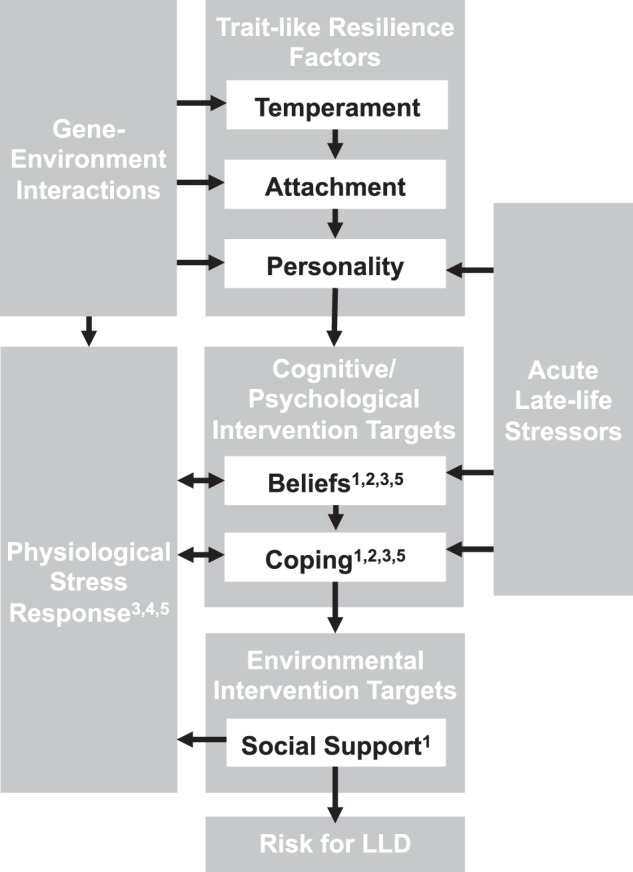
- Design: narrative review of psychosocial and neurobiological factors associated with resilience to LLD, including a proposed biopsychosocial model (Table 1, Fig. 1).
- Data/sample: no primary sample; synthesizes prior meta-analyses, longitudinal studies, randomized controlled trials, and reviews across general, older adult, and LLD populations.
- Analysis: narrative synthesis of resilience/vulnerability correlates and intervention efficacy; no systematic search strategy or meta-analytic pooling is reported.
Limitations
- Stated: “Additional research is needed to further elucidate psychosocial and biological factors that affect risk and course of LLD” and to identify psychobiological factors predicting differential treatment response.
- Stated: no RCTs to date have examined the efficacy of HRV biofeedback in LLD; one meta-analysis could not estimate psychotherapy effects on HPA/ANS regulation due to methodological heterogeneity.
- Evident from text: as a narrative review, it does not report a systematic search, inclusion criteria, or formal quality assessment, and findings are synthesized across heterogeneous studies and populations.
Model-written summary. Check it against the paper before relying on it.
Integrity signals
Registry
Cites
Statistics
Figures
Verification
Claims the paper makes
30 Valid · 6 Not valid · 191 Not checked · 13 Own results and interpretations
At least one cited source doesn’t support this claim or points to a different paper, and none confirmed it — see the verdicts below.
In the paper
“In LLD, correlates included low amygdala blood perfusion at rest and greater functional connectivity between the amygdala and the ventral default mode network228.”
§ Psychobiological factors of resilience and depression in late life > Psychobiological resilience factors > Neuroimaging biomarkers of emotion regulation, coping, and grit
What the sources say
- Disputedcites [228] 228. Leaver AM Resilience and amygdala function in older healthy and depressed adults J. Affect. Disord. 2018 237 27 34 10.1016/j.jad.2018.04.109 29754022 PMC5995579 sourceExperimental — accuracy not yet measured
The Results (Amygdalar Functional Connectivity with Prefrontal Networks) report the opposite direction: greater amygdala–ventral default-mode-network connectivity was associated with lower resilience scores. The paper says this negative relationship was present in both depressed and nondepressed volunteers, rather than greater connectivity being a correlate of higher resilience in late-life depression. (LLM, conf=0.88)
Checked by a reasoning model — may be wrong.
plainstates an association- Asserted: passes — The authors put it forward as true.
- Checkable: passes — It can be checked against evidence.
- Load-bearing: unclear — It is unclear whether the paper’s conclusions depend on it.
- Based: passes — The paper gives a reason why it holds.
- Disputed
The cited sources support only part of this claim — read each source’s verdict below.
In the paper
“Longitudinal studies27 as well as studies of children raised in orphanages28 indicate that disorganized attachment during infancy predicts greater amygdala volume—a hypothesized biomarker of difficulty with emotion regulation28.”
§ Psychobiological factors of resilience and depression in late life > Psychological resilience factors > Attachment
What the sources say
- Supportedcites [27] 27. Lyons-Ruth K Pechtel P Yoon SA Anderson CM Teicher MH Disorganized attachment in infancy predicts greater amygdala volume in adulthood Behav. Brain Res. 2016 308 83 93 10.1016/j.bbr.2016.03.050 27060720 PMC5017306 source
The Abstract and Results §3.3 of our copy state exactly this: in a 30-year longitudinal study of impoverished, highly stressed families, increased left amygdala volume in adulthood was associated with disorganized infant attachment behavior and disrupted maternal communication at 18 months (overall partial r = .679, p = .004; infant disorganization alone partial r = .543, p = .030), and the Conclusions frame it as disorganized early attachment promoting increased amygdala volume. The paper's own title asserts the same prediction. Two qualifiers the citing sentence drops are worth noting but do not contradict it: the effect was left-lateralized (right amygdala relations were non-significant) and the cohort was small (n = 18, described in the Discussion as a 'proof of construct' preliminary study) drawn from a high-risk low-income sample. (LLM, conf=0.85)
- Partly supportedcites [28] 28. Tottenham N Prolonged institutional rearing is associated with atypically large amygdala volume and difficulties in emotion regulation Dev. Sci. 2010 13 46 61 10.1111/j.1467-7687.2009.00852.x 20121862 PMC2817950 sourceExperimental — accuracy not yet measured
Our copy of Tottenham et al. (2010) supports the orphanage-rearing arm of the claim: Results > Morphometry reports that adjusted amygdala volume was associated with age adopted out of the orphanage (F(1,33)=8.43, p<0.007), and the Introduction/Hypothesis frames larger amygdala volume as an index of emotion-regulation difficulty and anxiety (with only a trend, r(28)=-0.34, p=0.06, for go-nogo errors to negative faces, per Results > Behavior). However, the paper never measures or reports attachment: 'disorganized attachment' does not appear, and attachment is mentioned only in the Introduction as an area of concern for PI children, credited to other works (Smyke, Dumitrescu, & Zeanah, 2002; O'Connor & Rutter, 2000). So the predictor the citing sentence attributes to this source — disorganized attachment in infancy — is not what this study tested; its predictor was duration/timing of institutional rearing. (LLM, conf=0.82)
hedgedstates a cause- Asserted: passes — The authors put it forward as true.
- Checkable: passes — It can be checked against evidence.
- Load-bearing: unclear — It is unclear whether the paper’s conclusions depend on it.
- Based: passes — The paper gives a reason why it holds.
- Supported
The cited sources support only part of this claim — read each source’s verdict below.
In the paper
“Religion and spirituality have been shown to prospectively reduce risk for depression73.”
§ Psychobiological factors of resilience and depression in late life > Psychological resilience factors > Religion and spirituality
What the sources say
- Partly supportedcites [73] 73. Miller L Religiosity and major depression in adults at high risk: a ten-year prospective study Am. J. Psychiatry 2012 169 89 94 10.1176/appi.ajp.2011.10121823 21865527 PMC3547523 sourceExperimental — accuracy not yet measured
Our copy does report a 10-year prospective protective effect: high personal importance of religion/spirituality predicted about one-fourth the odds of major depression overall (OR=0.24, 95% CI=0.06–0.95) and about one-tenth in the high-risk group. But the claim's breadth is not matched: the effect was 'found to exist primarily against recurrence rather than onset' and was significant only in the high-risk-with-prior-episode stratum, frequent attendance at religious services and denomination were not significantly associated, and the authors hedge in their conclusion ('may have a protective effect… particularly in adults with a history of parental depression'). So the source supports a prospective protective association for personal importance of religion/spirituality in a high-risk sample, not a general, demonstrated reduction in depression risk by 'religion and spirituality'. (LLM, conf=0.72)
plainstates a cause- Asserted: passes — The authors put it forward as true.
- Checkable: passes — It can be checked against evidence.
- Load-bearing: passes — The paper’s conclusions depend on it.
- Based: passes — The paper gives a reason why it holds.
- Partly supported
The cited sources support only part of this claim — read each source’s verdict below.
In the paper
“Research suggests that chronic stress-associated stimulation of the hypothalamic pituitary adrenal (HPA) axis and associated over-secretion of the stress hormone cortisol contribute to neurodegeneration120,121 that may increase risk for both LLD and cognitive decline.”
§ Psychobiological factors of resilience and depression in late life > Cognitive factors affecting resilience in LLD
What the sources say
- Partly supportedcites [120] 120. Smith SM Vale WW The role of the hypothalamic-pituitary-adrenal axis in neuroendocrine responses to stress Dialogues Clin. Neurosci. 2006 8 383 17290797 10.31887/DCNS.2006.8.4/ssmith PMC3181830 sourceExperimental — accuracy not yet measured
Our copy (Smith & Vale 2006) supports only the generic upstream part of the claim: the HPA axis section states that 'inadequate or excessive activation of the HPA axis may contribute to the development of pathologies,' the limbic-system section notes that hippocampal, prefrontal and amygdalar neurons 'may serve as a link between the stress system and neuropsychiatric disorders,' and the Conclusions link inappropriate stress-response regulation to affective disorders and major depression. The decisive parts of the claim are not in our copy: searches for neurodegeneration, neuronal death/toxicity, cognitive decline, dementia and late-life depression returned no passage stating that chronic HPA stimulation and cortisol over-secretion cause neurodegeneration or thereby raise risk for LLD or cognitive decline; the paper's treatment of chronic stress and glucocorticoids (limbic sections) concerns feedback regulation of HPA output, not neurodegeneration. The paper is also a mechanistic review of neuroendocrine stress regulation, so the risk statement is not its finding. (LLM, conf=0.68)
- Not checked yetcites [121] 121. Salvat-Pujol N Hypothalamic-pituitary-adrenal axis activity and cognition in major depression: the role of remission status Psychoneuroendocrinology 2017 76 38 48 10.1016/j.psyneuen.2016.11.007 27883963 source
hedgedstates a possible cause- Asserted: passes — The authors put it forward as true.
- Checkable: passes — It can be checked against evidence.
- Load-bearing: passes — The paper’s conclusions depend on it.
- Based: passes — The paper gives a reason why it holds.
- Partly supported
The cited sources support only part of this claim — read each source’s verdict below.
In the paper
“Individual differences in cognitive reserve are determined by such factors as early-life general cognitive ability/intelligence, education level, occupation complexity, physical exercise, social engagement, and ongoing cognitive engagement126.”
§ Psychobiological factors of resilience and depression in late life > Cognitive factors affecting resilience in LLD
What the sources say
- Partly supportedcites [126] 126. Stern Y Cognitive reserve Neuropsychologia 2009 47 2015 2028 10.1016/j.neuropsychologia.2009.03.004 19467352 PMC2739591 sourceExperimental — accuracy not yet measured
The 'Measures of Reserve' section and the 'Epidemiologic Evidence for CR' section support most of the list: IQ/premorbid and childhood cognition, educational attainment, occupational attainment, and leisure activities split into intellectual and social (visiting friends/relatives) are all described as contributing independently to CR, with the statement that CR 'at any point in one's lifetime it results from a combination of exposures'. Two items are not supported as stated: the paper's own rCBF work found that 'substantive complexity of occupation ... correlated very strongly with education and, therefore, did not contribute significantly in this model' (Evidence for CR From Studies of Regional Cerebral Blood Flow), so occupation complexity rather than occupational attainment is not what the paper attributes reserve to; and physical exercise appears only as a biological mechanism (neurogenesis, BDNF) and as a correlate of the 'physical demands' occupational feature, not as one of the listed CR proxies in 'Measures of Reserve'. The claim's 'determined by' is also stronger than the paper's hedged 'associated with'/'contributes to'. (LLM, conf=0.72)
plainstates a cause- Asserted: passes — The authors put it forward as true.
- Checkable: passes — It can be checked against evidence.
- Load-bearing: passes — The paper’s conclusions depend on it.
- Based: passes — The paper gives a reason why it holds.
- Partly supported
161 more claims · 19 with their cited sources checked
Create a free account to see all 240 claims and to verify the 317 references still open.
- It may state two separate claims as one. 62
- Probably not a substantial claim. 17
Claims other papers make about this one
Each is checked against this paper’s own text: does it say what the citing paper says it does?
The source backs part of the claim, not all of it — or backs it for a different population, condition or comparison.
In the citing paper
“Although challenging to translate into humans, healthy lifestyle factors such as moderate physical activity, dietary quality and cognitive stimulation are associated with resilience-building.61”
From The role of epigenetics in psychological resilience (2021) · cites this paper as [61]
Experimental — accuracy not yet measured
Self-check
Percentages, sums and reported differences re-computed from the paper’s own numbers.
Each contradiction between two passages listed here was confirmed by an independent check.
Rated minor: it would not touch a result — a value no result rests on, a p-value that stays on the same side of the significance level, or a conflict that is clerical, resolved elsewhere in the paper, or outside its own findings.
In the paper
§ Psychobiological factors of resilience and depression in late life > Psychobiological resilience factors > Endocrine changes in aging and depression
“Individuals with LLD demonstrate lower DHEA levels compared to non-depressed older adults, and DHEA levels increase with remission163.”
§ Psychobiological factors of resilience and depression in late life > References
“163. Fabian TJ Endogenous concentrations of DHEA and DHEA-S decrease with remission of depression in older adults”
Citations
Cites
1 retracted
Items 201–349 of 349
Attachment across the Life Span: Factors that Contribute to Stability and Change.
McConnell, M., & Moss, E. (2011) · Australian journal of educational and developmental psychology · Cited by 142
Organizational Support and Volunteering Benefits for Older Adults
Tang, F., Choi, E., & Morrow-Howell, N. (2010) · The Gerontologist · doi:10.1093/geront/gnq020 · Cited by 141
Kampman, O., & Poutanen, O. (2011) · Journal of Affective Disorders · doi:10.1016/j.jad.2010.12.021 · Cited by 140
Sneed, J. R., Rutherford, B. R., Rindskopf, D., Lane, D. T., Sackeim, H. A., & Roose, S. P. (2008) · The American Journal of Geriatric Psychiatry · doi:10.1097/jgp.0b013e3181256b1d · Cited by 140
Testing a Model of Pain Appraisal and Coping in Children With Chronic Abdominal Pain.
Walker, L. S., Smith, C. A., Garber, J., & Claar, R. L. (2005) · Health Psychology · doi:10.1037/0278-6133.24.4.364 · Cited by 140
BDNF promoter methylation and genetic variation in late-life depression
Januar, V, Ancelin, M.-L., Ritchie, K., Saffery, R., & Ryan, J. (2015) · Translational Psychiatry · doi:10.1038/tp.2015.114 · Cited by 139
Clarke, J., Proudfoot, J., Birch, M.-R., Whitton, A. E., Parker, G., Manicavasagar, V., Harrison, V., Christensen, H., & Hadzi-Pavlovic, D. (2014) · BMC Psychiatry · doi:10.1186/s12888-014-0272-1 · Cited by 138
Geerlings, M. I., & Gerritsen, L. (2017) · Biological Psychiatry · doi:10.1016/j.biopsych.2016.12.032 · Cited by 138
McDougall, F. A., Matthews, F. E., Kvaal, K., Dewey, M. E., & Brayne, C. (2007) · Age and Ageing · doi:10.1093/ageing/afm111 · Cited by 137
Cell pathology in mood disorders
Rajkowska, G. (2002) · Seminars in Clinical Neuropsychiatry · doi:10.1053/scnp.2002.35228 · Cited by 135
Recovering From Spousal Bereavement in Later Life: Does Volunteer Participation Play a Role?
Li, Y. (2007) · The Journals of Gerontology Series B: Psychological Sciences and Social Sciences · doi:10.1093/geronb/62.4.s257 · Cited by 135
Social Robots for Depression in Older Adults: A Systematic Review
Chen, S., Jones, C., & Moyle, W. (2018) · Journal of Nursing Scholarship · doi:10.1111/jnu.12423 · Cited by 130
The efficacy and safety of ECT in depressed older adults: a literature review
van der Wurff, F. B., Stek, M. L., Hoogendijk, W. J. G., & Beekman, A. T. F. (2003) · International Journal of Geriatric Psychiatry · doi:10.1002/gps.944 · Cited by 129
Targeting the neuropeptide Y system in stress-related psychiatric disorders
Enman, N. M., Sabban, E. L., McGonigle, P., & Van Bockstaele, E. J. (2015) · Neurobiology of Stress · doi:10.1016/j.ynstr.2014.09.007 · Cited by 128
Hazlett-Stevens, H., Singer, J., & Chong, A. (2019) · Clinical Gerontologist · doi:10.1080/07317115.2018.1518282 · Cited by 123
Volunteerism and Socioemotional Selectivity in Later Life
Hendricks, J., & Cutler, S. J. (2004) · The Journals of Gerontology: Series B · doi:10.1093/geronb/59.5.s251 · Cited by 121
Mason, J. W., Wang, S., Yehuda, R., Riney, S., Charney, D. S., & Southwick, S. M. (2001) · Psychosomatic Medicine · doi:10.1097/00006842-200105000-00008 · Cited by 121
Samaras, N., Samaras, D., Frangos, E., Forster, A., & Philippe, J. (2013) · Rejuvenation Research · doi:10.1089/rej.2013.1425 · Cited by 120
Zhang, J.-X., Liu, X.-H., Xie, X.-H., Zhao, D., Shan, M.-S., Zhang, X.-L., Kong, X.-M., & Cui, H. (2015) · EXPLORE · doi:10.1016/j.explore.2015.02.005 · Cited by 119
Hickie, I., Mason, C., Parker, G., & Brodaty, H. (1996) · British Journal of Psychiatry · doi:10.1192/bjp.169.1.68 · Cited by 118
Autonomic and Brain Morphological Predictors of Stress Resilience
Carnevali, L., Koenig, J., Sgoifo, A., & Ottaviani, C. (2018) · Frontiers in Neuroscience · doi:10.3389/fnins.2018.00228 · Cited by 117
Emotion Processing, Major Depression, and Functional Genetic Variation of Neuropeptide Y
Mickey, B. J., Zhou, Z., Heitzeg, M. M., Heinz, E., Hodgkinson, C. A., Hsu, D. T., Langenecker, S. A., Love, T. M., Peciña, M., Shafir, T., et al. (2011) · Archives of General Psychiatry · doi:10.1001/archgenpsychiatry.2010.197 · Cited by 115
Bouckaert, F., De Winter, F.-L., Emsell, L., Dols, A., Rhebergen, D., Wampers, M., Sunaert, S., Stek, M., Sienaert, P., & Vandenbulcke, M. (2016) · Journal of Psychiatry and Neuroscience · doi:10.1503/jpn.140322 · Cited by 115
Janssen, J., Hulshoff Pol, H. E., de Leeuw, F.-E., Schnack, H. G., Lampe, I. K., Kok, R. M., Kahn, R. S., & Heeren, T. J. (2007) · Journal of Neurology, Neurosurgery & Psychiatry · doi:10.1136/jnnp.2006.098087 · Cited by 113
Fischer, S., Strawbridge, R., Vives, A. H., & Cleare, A. J. (2017) · British Journal of Psychiatry · doi:10.1192/bjp.bp.115.180653 · Cited by 112
Heart rate variability alterations in late life depression: A meta-analysis
Brown, L., Karmakar, C., Gray, R., Jindal, R., Lim, T., & Bryant, C. (2018) · Journal of Affective Disorders · doi:10.1016/j.jad.2018.04.071 · Cited by 108
Psycho-physical and neurophysiological effects of qigong on depressed elders with chronic illness
Tsang, H. W. H., Tsang, W. W. N., Jones, A. Y. M., Fung, K. M. T., Chan, A. H. L., Chan, E. P., & Au, D. W. H. (2013) · Aging & Mental Health · doi:10.1080/13607863.2012.732035 · Cited by 107
Reynolds, C. F., Dew, M. A., Frank, E., Begley, A. E., Miller, M. D., Cornes, C., Mazumdar, S., Perel, J. M., & Kupfer, D. J. (1998) · American Journal of Psychiatry · doi:10.1176/ajp.155.6.795 · Cited by 104
Effects of Yoga on Psychological Health in Older Adults
Bonura, K. B., & Tenenbaum, G. (2014) · Journal of Physical Activity and Health · doi:10.1123/jpah.2012-0365 · Cited by 102
Seltzer, M. M., Greenberg, J. S., Floyd, F. J., & Hong, J. (2004) · American Journal of Orthopsychiatry · doi:10.1037/0002-9432.74.2.187 · Cited by 100
Wang, S., Dai, J., Li, J., Wang, X., Chen, T., Yang, X., He, M., & Gong, Q. (2018) · Human Brain Mapping · doi:10.1002/hbm.23944 · Cited by 99
Apathy in Late-Life Depression: Common, Persistent, and Disabling
Yuen, G. S., Bhutani, S., Lucas, B. J., Gunning, F. M., AbdelMalak, B., Seirup, J. K., Klimstra, S. A., & Alexopoulos, G. S. (2015) · The American Journal of Geriatric Psychiatry · doi:10.1016/j.jagp.2014.06.005 · Cited by 97
Peters, M. L., Meevissen, Y. M. C., & Hanssen, M. M. (2013) · Terapia psicológica · doi:10.4067/s0718-48082013000100009 · Cited by 97
The Psychological Consequences of Multiple Roles: The Nonnormative Case
Hong, J., & Seltzer, M. M. (1995) · Journal of Health and Social Behavior · doi:10.2307/2137327 · Cited by 95
Nobuhara, K., Okugawa, G., Minami, T., Takase, K., Yoshida, T., Yagyu, T., Tajika, A., Sugimoto, T., Tamagaki, C., Ikeda, K., et al. (2004) · Neuropsychobiology · doi:10.1159/000077941 · Cited by 94
Yoo, H. J., Thayer, J. F., Greening, S., Lee, T.-H., Ponzio, A., Min, J., Sakaki, M., Nga, L., Mather, M., & Koenig, J. (2018) · Brain Structure and Function · doi:10.1007/s00429-017-1519-7 · Cited by 94
On the Malleability of Performance: Implications for Seniors
Horton, S., Baker, J., Pearce, G. W., & Deakin, J. M. (2008) · Journal of Applied Gerontology · doi:10.1177/0733464808315291 · Cited by 93
Clinical correlates of resilience factors in geriatric depression
Laird, K. T., Lavretsky, H., Paholpak, P., Vlasova, R. M., Roman, M., St. Cyr, N., & Siddarth, P. (2019) · International Psychogeriatrics · doi:10.1017/s1041610217002873 · Cited by 93
Self-citationAssociation of allostatic load with brain structure and cognitive ability in later life
Booth, T., Royle, N. A., Corley, J., Gow, A. J., Valdés Hernández, M. D. C., Muñoz Maniega, S., Ritchie, S. J., Bastin, M. E., Starr, J. M., Wardlaw, J. M., et al. (2015) · Neurobiology of Aging · doi:10.1016/j.neurobiolaging.2014.12.020 · Cited by 88
Lavretsky, H., & Irwin, M. R. (2007) · Aging Health · doi:10.2217/1745509x.3.3.309 · Cited by 88
Self-citationLavretsky, H. (2014) · Johns Hopkins University Press eBooks · doi:10.1353/book.34895 · Cited by 87
Self-citationEndogenous concentrations of DHEA and DHEA-S Decrease with remission of depression in older adults
Fabian, T. J., Dew, M. A., Pollock, B. G., Reynolds, C. F., Mulsant, B. H., Butters, M. A., Zmuda, M. D., Linares, A. M., Trottini, M., & Kroboth, P. D. (2001) · Biological Psychiatry · doi:10.1016/s0006-3223(01)01198-2 · Cited by 87
Involvement of Brain-Derived Neurotrophic Factor in Late-Life Depression
Dwivedi, Y. (2013) · The American Journal of Geriatric Psychiatry · doi:10.1016/j.jagp.2012.10.026 · Cited by 86
Attachment and pain: Recent findings and future directions
Porter, L. S., Davis, D., & Keefe, F. J. (2007) · Pain · doi:10.1016/j.pain.2007.02.001 · Cited by 86
Geriatric Depression Treatment in Nonresponders to Selective Serotonin Reuptake Inhibitors
Whyte, E. M., Basinski, J., Farhi, P., Dew, M. A., Begley, A., Mulsant, B. H., & Reynolds, C. F. (2004) · The Journal of Clinical Psychiatry · doi:10.4088/jcp.v65n1208 · Cited by 86
Brain functional connectivity correlates of coping styles
Santarnecchi, E., Sprugnoli, G., Tatti, E., Mencarelli, L., Neri, F., Momi, D., Di Lorenzo, G., Pascual-Leone, A., Rossi, S., & Rossi, A. (2018) · Cognitive, Affective, & Behavioral Neuroscience · doi:10.3758/s13415-018-0583-7 · Cited by 85
Peripheral Inflammatory Parameters in Late-Life Depression: A Systematic Review
Martínez-Cengotitabengoa, M., Carrascón, L., O’Brien, J., Díaz-Gutiérrez, M.-J., Bermúdez-Ampudia, C., Sanada, K., Arrasate, M., & González-Pinto, A. (2016) · International Journal of Molecular Sciences · doi:10.3390/ijms17122022 · Cited by 85
How Late-Life Depression Affects Cognition: Neural Mechanisms
Crocco, E. A., Castro, K., & Loewenstein, D. A. (2010) · Current Psychiatry Reports · doi:10.1007/s11920-009-0081-2 · Cited by 82
HPA axis hyperactivity as suicide predictor in elderly mood disorder inpatients
Jokinen, J., & Nordström, P. (2008) · Psychoneuroendocrinology · doi:10.1016/j.psyneuen.2008.07.012 · Cited by 82
Estrogen, Stress, and Depression: A Neurocognitive Model
Newhouse, P., & Albert, K. (2015) · JAMA Psychiatry · doi:10.1001/jamapsychiatry.2015.0487 · Cited by 81
Stress, Synaptic Plasticity, and Psychopathology
Garcia, R. (2002) · Reviews in the Neurosciences · doi:10.1515/revneuro.2002.13.3.195 · Cited by 81
Wrosch, C., Dunne, E., Scheier, M. F., & Schulz, R. (2006) · Journal of Behavioral Medicine · doi:10.1007/s10865-006-9051-x · Cited by 81
Simonelli, L. E., Fowler, J., Maxwell, G. L., & Andersen, B. L. (2008) · Annals of Behavioral Medicine · doi:10.1007/s12160-008-9029-8 · Cited by 80
Allard, E. S., & Kensinger, E. A. (2014) · Frontiers in Psychology · doi:10.3389/fpsyg.2014.00296 · Cited by 80
Moderators of Outcome in Late-Life Depression: A Patient-Level Meta-Analysis
Nelson, J. C., Delucchi, K. L., & Schneider, L. S. (2013) · American Journal of Psychiatry · doi:10.1176/appi.ajp.2012.12070927 · Cited by 80
Prevalence of the metabolic syndrome in unipolar major depression
Kahl, K. G., Greggersen, W., Schweiger, U., Cordes, J., Balijepalli, C., Lösch, C., & Moebus, S. (2012) · European Archives of Psychiatry and Clinical Neuroscience · doi:10.1007/s00406-011-0277-4 · Cited by 79
Environmental Stressors and Epigenetic Control of the Hypothalamic-Pituitary-Adrenal Axis
Lee, R. S., & Sawa, A. (2014) · Neuroendocrinology · doi:10.1159/000369585 · Cited by 79
Association of Vascular Factors With Apathy in Community-Dwelling Elderly Individuals
Ligthart, S. A., Richard, E., Fransen, N. L., Eurelings, L. S. M., Beem, L., Eikelenboom, P., van Gool, W. A., & Moll van Charante, E. P. (2012) · Archives of General Psychiatry · doi:10.1001/archgenpsychiatry.2011.1858 · Cited by 79
Exploring age‐related brain degeneration in meditation practitioners
Luders, E. (2014) · Annals of the New York Academy of Sciences · doi:10.1111/nyas.12217 · Cited by 79
Depression trajectories and obesity among the elderly in Taiwan
Kuo, S.-Y., Lin, K.-M., Chen, C.-Y., Chuang, Y.-L., & Chen, W. J. (2011) · Psychological Medicine · doi:10.1017/s0033291710002473 · Cited by 78
The Neural Mechanisms of Meditative Practices: Novel Approaches for Healthy Aging
Acevedo, B. P., Pospos, S., & Lavretsky, H. (2016) · Current Behavioral Neuroscience Reports · doi:10.1007/s40473-016-0098-x · Cited by 78
Self-citationCross-cultural differences in memory: The role of culture-based stereotypes about aging.
Yoon, C., Hasher, L., Feinberg, F., Rahhal, T. A., & Winocur, G. (2000) · Psychology and Aging · doi:10.1037/0882-7974.15.4.694 · Cited by 77
Pathobiological targets of depression
Chopra, K., Kumar, B., & Kuhad, A. (2011) · Expert Opinion on Therapeutic Targets · doi:10.1517/14728222.2011.553603 · Cited by 76
Bower, J. E., & Segerstrom, S. C. (2004) · Journal of Psychosomatic Research · doi:10.1016/s0022-3999(03)00120-x · Cited by 75
Elbejjani, M., Fuhrer, R., Abrahamowicz, M., Mazoyer, B., Crivello, F., Tzourio, C., & Dufouil, C. (2015) · Psychological Medicine · doi:10.1017/s0033291714003055 · Cited by 73
The role of arousal in the spontaneous regulation of emotions in healthy aging: a fMRI investigation
Dolcos, S., Katsumi, Y., & Dixon, R. A. (2014) · Frontiers in Psychology · doi:10.3389/fpsyg.2014.00681 · Cited by 73
Structural MRI correlates of apathy symptoms in older persons without dementia: AGES-Reykjavik Study
Grool, A. M., Geerlings, M. I., Sigurdsson, S., Eiriksdottir, G., Jonsson, P. V., Garcia, M. E., Siggeirsdottir, K., Harris, T. B., Sigmundsson, T., Gudnason, V., et al. (2014) · Neurology · doi:10.1212/wnl.0000000000000378 · Cited by 73
Neuroanatomical correlates of apathy in late-life depression and antidepressant treatment response
Yuen, G. S., Gunning, F. M., Woods, E., Klimstra, S. A., Hoptman, M. J., & Alexopoulos, G. S. (2014) · Journal of Affective Disorders · doi:10.1016/j.jad.2014.05.008 · Cited by 73
Patron, E., Messerotti Benvenuti, S., Favretto, G., Valfrè, C., Bonfà, C., Gasparotto, R., & Palomba, D. (2013) · Applied Psychophysiology and Biofeedback · doi:10.1007/s10484-012-9202-5 · Cited by 70
Bower, J. E., Moskowitz, J. T., & Epel, E. (2009) · Current Directions in Psychological Science · doi:10.1111/j.1467-8721.2009.01663.x · Cited by 70
Association of depressive symptoms and metabolic syndrome in men
Viinamäki, H., Heiskanen, T., Lehto, S. M., Niskanen, L., Koivumaa‐Honkanen, H., Tolmunen, T., Honkalampi, K., Saharinen, T., Haatainen, K., & Hintikka, J. (2009) · Acta Psychiatrica Scandinavica · doi:10.1111/j.1600-0447.2008.01333.x · Cited by 68
Pei, Y., Smith, A. K., Wang, Y., Pan, Y., Yang, J., Chen, Q., Pan, W., Bao, F., Zhao, L., Tie, C., et al. (2012) · American Journal of Medical Genetics Part B: Neuropsychiatric Genetics · doi:10.1002/ajmg.b.32062 · Cited by 67
Cognitive Behavioral Therapy of Depression: Theory, Treatment, and Empirical Status
McGinn, L. K. (2000) · American Journal of Psychotherapy · doi:10.1176/appi.psychotherapy.2000.54.2.257 · Cited by 65
Morphological Brain Changes in Depression: Can Antidepressants Reverse Them?
Miguel-Hidalgo, J. J., & Rajkowska, G. (2002) · CNS Drugs · doi:10.2165/00023210-200216060-00001 · Cited by 64
Berk, L., Warmenhoven, F., van Os, J., & van Boxtel, M. (2018) · Frontiers in Psychology · doi:10.3389/fpsyg.2018.00982 · Cited by 63
Chronicity and relapse in geriatric depression
Alexopoulos, G. S., Young, R. C., Abrams, R. C., Meyers, B., & Shamoian, C. A. (1989) · Biological Psychiatry · doi:10.1016/0006-3223(89)90080-2 · Cited by 60
A meta-analysis of third wave mindfulness-based cognitive behavioral therapies for older people
Kishita, N., Takei, Y., & Stewart, I. (2017) · International Journal of Geriatric Psychiatry · doi:10.1002/gps.4621 · Cited by 60
Transdiagnostic pathways from early social stress to psychopathology: a 20‐year prospective study
Conway, C. C., Raposa, E. B., Hammen, C., & Brennan, P. A. (2018) · Journal of Child Psychology and Psychiatry · doi:10.1111/jcpp.12862 · Cited by 60
Work, Retirement, and Depression
Lee, J., & Smith, J. P. (2009) · Journal of Population Ageing · doi:10.1007/s12062-010-9018-0 · Cited by 59
Chapter 4 Psychological Resilience in Adulthood and Later Life: Implications for Health
Ryff, C. D., Friedman, E. M., Morozink, J. A., & Tsenkova, V. (2012) · Annual Review of Gerontology and Geriatrics · doi:10.1891/0198-8794.32.73 · Cited by 59
Cognitive style predictors of affect change in older adults
Isaacowitz, D. M., & Seligman, M. E. P. (2002) · The International Journal of Aging and Human Development · doi:10.2190/j6e5-np5k-2uc4-2f8b · Cited by 58
Relationship of Age, Age at Onset, and Sex to Depression in Older Adults
Lavretsky, H., Lesser, I. M., Wohl, M. A., & Miller, B. L. (1998) · American Journal of Geriatric Psychiatry · doi:10.1097/00019442-199800630-00007 · Cited by 58
Self-citationEffective Use of Electroconvulsive Therapy in Late-Life Depression
Flint, A. J., & Gagnon, N. (2002) · The Canadian Journal of Psychiatry · doi:10.1177/070674370204700804 · Cited by 58
Late-onset major depression: clinical and treatment-response variability
Driscoll, H. C., Basinski, J., Mulsant, B. H., Butters, M. A., Dew, M. A., Houck, P. R., Mazumdar, S., Miller, M. D., Pollock, B. G., Stack, J. A., et al. (2005) · International Journal of Geriatric Psychiatry · doi:10.1002/gps.1334 · Cited by 57
Depression among Centenarians and the Oldest Old: Contributions of Cognition and Personality
Margrett, J., Martin, P., Woodard, J. L., Miller, L. S., MacDonald, M., Baenziger, J., Siegler, I. C., Davey, A., & Poon, L. (2010) · Gerontology · doi:10.1159/000272018 · Cited by 57
Altered Magnetic Resonance White-Matter T1 Values in Patients with Affective Disorder
Dolan, R. J., Poynton, A. M., Bridges, P. K., & Trimble, M. R. (1990) · British Journal of Psychiatry · doi:10.1192/bjp.157.1.107 · Cited by 57
Hsieh, H., Huang, I.-Y., Liu, Y., Chen, W., Lee, Y.-W., & Hsu, H. (2020) · International Journal of Environmental Research and Public Health · doi:10.3390/ijerph17082905 · Cited by 57
Psychiatric Disease in the Twenty-First Century: The Case for Subcortical Ischemic Depression
Taylor, W. D., Steffens, D. C., & Krishnan, K. R. (2006) · Biological Psychiatry · doi:10.1016/j.biopsych.2006.05.028 · Cited by 56
Relationship of Age, Age at Onset, and Sex to Depression in Older Adults
Lavretsky, H., Lesser, I. M., Wohl, M., & Miller, B. L. (1998) · American Journal of Geriatric Psychiatry · doi:10.1097/00019442-199808000-00007 · Cited by 56
Self-citationEmotion and aging: Evidence from brain and behavior
Ebner, N. C., & Fischer, H. (2014) · Frontiers in Psychology · doi:10.3389/fpsyg.2014.00996 · Cited by 56
The Perceived Benefits of Participating in Volunteer and Educational Activities
Morrow-Howell, N., Kinnevy, S., & Mann, M. (1999) · Journal of Gerontological Social Work · doi:10.1300/j083v32n02_06 · Cited by 54
Mind-Body Therapies for Late-Life Mental and Cognitive Health
Laird, K. T., Paholpak, P., Roman, M., Rahi, B., & Lavretsky, H. (2018) · Current Psychiatry Reports · doi:10.1007/s11920-018-0864-4 · Cited by 54
Self-citationSystematic review and meta-analysis of genetic studies of late-life depression
Tsang, R. S. M., Mather, K. A., Sachdev, P. S., & Reppermund, S. (2017) · Neuroscience & Biobehavioral Reviews · doi:10.1016/j.neubiorev.2017.01.028 · Cited by 54
Lifetime hormonal factors may predict late-life depression in women
Ryan, J. L., Carrière, I., Scali, J., Ritchie, K. A., & Ancelin, M. (2008) · International Psychogeriatrics · doi:10.1017/s1041610208007412 · Cited by 53
Neuropeptide Y: History and Overview
Tatemoto, K. (2004) · Handbook of Experimental Pharmacology · doi:10.1007/978-3-642-18764-3_1 · Cited by 52
Böger, A., & Huxhold, O. (2018) · Psychology and Aging · doi:10.1037/pag0000222 · Cited by 51
Murphy, G. M., Sarginson, J. E., Ryan, H. S., O’Hara, R., Schatzberg, A. F., & Lazzeroni, L. C. (2013) · Pharmacogenetics and Genomics · doi:10.1097/fpc.0b013e328360b175 · Cited by 50
Khundakar, A. A., & Thomas, A. J. (2009) · International Psychogeriatrics · doi:10.1017/s104161020999007x · Cited by 50
Chapter 1 Resilience in Adulthood and Later Life: What Does it Mean and Where Are We Heading?
Smith, G. C., & Hayslip, B. (2012) · Annual Review of Gerontology and Geriatrics · doi:10.1891/0198-8794.32.3 · Cited by 48
Kamat, R., Brown, G. G., Bolden, K., Fennema-Notestein, C., Archibald, S., Marcotte, T. D., Letendre, S. L., Ellis, R. J., Woods, S. P., Grant, I., et al. (2014) · Journal of Clinical and Experimental Neuropsychology · doi:10.1080/13803395.2014.950636 · Cited by 47
Salvat-Pujol, N., Labad, J., Urretavizcaya, M., de Arriba-Arnau, A., Segalàs, C., Real, E., Ferrer, A., Crespo, J. M., Jiménez-Murcia, S., Soriano-Mas, C., et al. (2017) · Psychoneuroendocrinology · doi:10.1016/j.psyneuen.2016.11.007 · Cited by 47
Quality of Life in Community-Dwelling Older Persons with Apathy
Groeneweg-Koolhoven, I., de Waal, M. W. M., van der Weele, G. M., Gussekloo, J., & van der Mast, R. C. (2014) · The American Journal of Geriatric Psychiatry · doi:10.1016/j.jagp.2012.10.024 · Cited by 46
Randomized Controlled Trial of Inner Resources Meditation for Family Dementia Caregivers
Waelde, L. C., Meyer, H., Thompson, J. M., Thompson, L., & Gallagher‐Thompson, D. (2017) · Journal of Clinical Psychology · doi:10.1002/jclp.22470 · Cited by 46
Emotional awareness as a pathway linking adult attachment to subsequent depression.
Monti, J. D., & Rudolph, K. D. (2014) · Journal of Counseling Psychology · doi:10.1037/cou0000016 · Cited by 46
Late- versus early-onset geriatric depression in a memory research center
Dillon, C. (2009) · Neuropsychiatric Disease and Treatment · doi:10.2147/ndt.s7320 · Cited by 45
Resilience and amygdala function in older healthy and depressed adults
Leaver, A. M., Yang, H., Siddarth, P., Vlasova, R. M., Krause, B., St. Cyr, N., Narr, K. L., & Lavretsky, H. (2018) · Journal of Affective Disorders · doi:10.1016/j.jad.2018.04.109 · Cited by 44
Self-citationAccommodative coping in early adolescence: An investigation of possible developmental components
Thomsen, T., & Greve, W. (2013) · Journal of Adolescence · doi:10.1016/j.adolescence.2013.08.003 · Cited by 43
Optimal Length of Antidepressant Trials in Late-Life Depression
Sackeim, H. A., Roose, S. P., & Burt, T. (2005) · Journal of Clinical Psychopharmacology · doi:10.1097/01.jcp.0000170683.25802.12 · Cited by 42
Tierney, S. M., Woods, S. P., Weinborn, M., & Bucks, R. S. (2018) · Journal of Clinical and Experimental Neuropsychology · doi:10.1080/13803395.2018.1444736 · Cited by 42
Systematic review of dyadic and family‐oriented interventions for late‐life depression
Stahl, S. T., Rodakowski, J., Saghafi, E. M., Park, M., Reynolds, C. F., & Dew, M. A. (2016) · International Journal of Geriatric Psychiatry · doi:10.1002/gps.4434 · Cited by 40
Oestrogen receptor polymorphisms and late-life depression
Ryan, J. L., Scali, J., Carrière, I., Pérès, K., Rouaud, O., Scarabin, P., Ritchie, K. A., & Ancelin, M. (2011) · The British Journal of Psychiatry · doi:10.1192/bjp.bp.111.091751 · Cited by 38
Neuro-, Cardio-, and Immunoplasticity: Effects of Early Adversity
Pakulak, E., Stevens, C., & Neville, H. (2018) · Annual Review of Psychology · doi:10.1146/annurev-psych-010416-044115 · Cited by 37
Liang, B., Zou, F.-H., Fu, L., & Liao, H.-L. (2020) · BioMed Research International · doi:10.1155/2020/5358467 · Cited by 35
Cortisol and alpha-amylase assessment in psychotherapeutic intervention studies: A systematic review
Laufer, S., Engel, S., Knaevelsrud, C., & Schumacher, S. (2018) · Neuroscience & Biobehavioral Reviews · doi:10.1016/j.neubiorev.2018.09.023 · Cited by 34
Karp, J. F., Frank, E., Anderson, B., George, C. J., Reynolds, C. F., Mazumdar, S., & Kupfer, D. J. (1993) · Depression · doi:10.1002/depr.3050010503 · Cited by 33
Adult attachment predicts the seven-year course of recurrent depression in primary care
Conradi, H. J., Kamphuis, J. H., & de Jonge, P. (2018) · Journal of Affective Disorders · doi:10.1016/j.jad.2017.08.009 · Cited by 33
Cognitive correlates of hypothalamic–pituitary–adrenal axis in major depression
Schlosser, N., Wolf, O. T., & Wingenfeld, K. (2011) · Expert Review of Endocrinology & Metabolism · doi:10.1586/eem.10.79 · Cited by 33
Late-life depression symptom profiles are differentially associated with immunometabolic functioning
Vogelzangs, N., Comijs, H. C., Oude Voshaar, R. C., Stek, M. L., & Penninx, B. W. J. H. (2014) · Brain, Behavior, and Immunity · doi:10.1016/j.bbi.2014.05.004 · Cited by 32
Giltay, E. J., van Reedt Dortland, A. K. B., Nissinen, A., Giampaoli, S., van Veen, T., Zitman, F. G., Bots, S., & Kromhout, D. (2009) · Journal of Affective Disorders · doi:10.1016/j.jad.2008.10.004 · Cited by 30
Kidd, T., Poole, L., Ronaldson, A., Leigh, E., Jahangiri, M., & Steptoe, A. (2016) · British Journal of Health Psychology · doi:10.1111/bjhp.12191 · Cited by 30
Amin, A., Kumar, S. S., Rajagopalan, A., Rajan, S., Mishra, S., Reddy, U. K., & Mukkadan, J. K. (2016) · Indian Journal of Clinical Anatomy and Physiology · doi:10.5958/2394-2126.2016.00056.6 · Cited by 29
Wang, T., Long, S., Zhao, N., Wang, Y., Sun, H., Zou, Z., Wang, J., Ran, X., & Su, Y. (2015) · International Journal of Molecular Sciences · doi:10.3390/ijms17010008 · Cited by 29
Is benefit finding good for individuals with chronic disease?
Algoe, S. B., & Stanton, A. L. (2009) · Medical illness and positive life change: Can crisis lead to personal transformation? · doi:10.1037/11854-010 · Cited by 27
Pocket Handbook of Psychiatric Drug Treatment, 2nd ed.
REYNOLDS, G. P. (1998) · American Journal of Psychiatry · doi:10.1176/ajp.155.11.1621 · Cited by 27
Salutogenic constructs across Pakistan and Germany: A cross sectional study
Bibi, A., Lin, M., & Margraf, J. (2019) · International Journal of Clinical and Health Psychology · doi:10.1016/j.ijchp.2019.10.001 · Cited by 27
Depression in Later Life: A Comparison of Symptoms and Risk Factors in Early and Late Onset Cases
Baldwin, R. C., & Tomenson, B. (1995) · British Journal of Psychiatry · doi:10.1192/bjp.167.5.649 · Cited by 26
Apathy in Older Patients with Type 2 Diabetes
Bruce, D. G., Nelson, M. E., Mace, J. L., Davis, W. A., Davis, T. M. E., & Starkstein, S. E. (2015) · The American Journal of Geriatric Psychiatry · doi:10.1016/j.jagp.2014.09.010 · Cited by 26
Resilience and White Matter Integrity in Geriatric Depression
Vlasova, R. M., Siddarth, P., Krause, B., Leaver, A. M., Laird, K. T., St Cyr, N., Narr, K. L., & Lavretsky, H. (2018) · The American Journal of Geriatric Psychiatry · doi:10.1016/j.jagp.2018.04.004 · Cited by 25
Self-citationAnderson, J. R., Novak, J. R., Johnson, M. D., Deitz, S. L., Walker, A., Wilcox, A., Lewis, V. L., & Robbins, D. C. (2016) · Journal of Behavioral Medicine · doi:10.1007/s10865-016-9796-9 · Cited by 25
Laird, K. T., Preacher, K. J., & Walker, L. S. (2015) · The Clinical Journal of Pain · doi:10.1097/ajp.0000000000000090 · Cited by 23
Self-citationResilience predicts remission in antidepressant treatment of geriatric depression
Laird, K. T., Lavretsky, H., St. Cyr, N., & Siddarth, P. (2018) · International Journal of Geriatric Psychiatry · doi:10.1002/gps.4953 · Cited by 23
Self-citationNegative association between resilience and event-related potentials evoked by negative emotion
Chen, D., Wu, J., Yao, Z., Lei, K., Luo, Y., & Li, Z. (2018) · Scientific Reports · doi:10.1038/s41598-018-25555-w · Cited by 23
Waist circumference and Neutrophil Gelatinase-Associated Lipocalin in late-life depression
Marijnissen, R. M., Naudé, P. J. W., Comijs, H. C., Schoevers, R. A., & Oude Voshaar, R. C. (2014) · Brain, Behavior, and Immunity · doi:10.1016/j.bbi.2013.12.021 · Cited by 22
Lifetime romantic attachment style and social adaptation in late‐onset depression
Paradiso, S., Naridze, R., & Holm‐Brown, E. (2012) · International Journal of Geriatric Psychiatry · doi:10.1002/gps.2814 · Cited by 21
Neuroanatomic Substrates of Late-Life Mental Disorders
Narayan, M., Bremner, J. D., & Kumar, A. (1999) · Journal of Geriatric Psychiatry and Neurology · doi:10.1177/089198879901200303 · Cited by 21
Does cognitive reserve moderate the association between mood and cognition? A systematic review
Opdebeeck, C., Quinn, C., Nelis, S. M., & Clare, L. (2015) · Reviews in Clinical Gerontology · doi:10.1017/s0959259815000155 · Cited by 20
[Electroconvulsive therapy in late life depression: a review].
Stek, M. L., Beekman, A. T. F., & Verwey, B. (1997) · PubMed · Cited by 18
Afanasiev, S., Aharon-Peretz, J., & Granot, M. (2013) · The American Journal of Geriatric Psychiatry · doi:10.1016/j.jagp.2013.04.012 · Cited by 17
Raeifar, E., Halkett, A., Lohman, M. C., & Sirey, J. A. (2017) · Journal of Nervous & Mental Disease · doi:10.1097/nmd.0000000000000686 · Cited by 17
Siennicki-Lantz, A., André-Petersson, L., & Elmståhl, S. (2013) · The American Journal of Geriatric Psychiatry · doi:10.1016/j.jagp.2012.11.007 · Cited by 16
Clinical characteristics in subcortical ischemic white matter disease
Alves, G. S., Alves, C. E. D. O., Lanna, M. E. D. O., Ericeira-Valente, L., Sudo, F. K., Moreira, D., Engelhardt, E., & Laks, J. (2009) · Arquivos de Neuro-Psiquiatria · doi:10.1590/s0004-282x2009000200001 · Cited by 16
Personality Characteristics of Depressed and Non-Depressed Patients With Parkinson’s Disease
Damholdt, M. F., Callesen, M. B., & Møller, A. (2014) · The Journal of Neuropsychiatry and Clinical Neurosciences · doi:10.1176/appi.neuropsych.13040085 · Cited by 16
Neurocognitive Correlates of Resilience in Late-Life Depression
Laird, K. T., Lavretsky, H., Wu, P., Krause, B., & Siddarth, P. (2019) · The American Journal of Geriatric Psychiatry · doi:10.1016/j.jagp.2018.08.009 · Cited by 14
Self-citationAging Mindfully to Minimize Cognitive Decline
Kurth, F., Cherbuin, N., & Luders, E. (2017) · Journal of Cognitive Enhancement · doi:10.1007/s41465-017-0027-2 · Cited by 10
Buchman, A. S., Yu, L., Wilson, R. S., Shulman, J. M., Boyle, P. A., & Bennett, D. A. (2014) · BMC Geriatrics · doi:10.1186/1471-2318-14-54 · Cited by 9
Schmidt, M. G. (1982) · Journal of Gerontological Social Work · doi:10.1300/j083v03n04_07 · Cited by 6
Role Involvement, Gender, and Well-being
Coleman, L. M., Antonucci, T. C., & Adelmann, P. K. (2018) · Spouse, Parent, Worker · doi:10.2307/j.ctt211qw5z.14 · Cited by 5
Henriques-Calado, J., Duarte-Silva, M. E., Campos, R. C., Sacoto, C., Keong, A. M., & Junqueira, D. (2013) · Bulletin of the Menninger Clinic · doi:10.1521/bumc.2013.77.3.269 · Cited by 5
Rosoklija, G., Toomayan, G., Ellis, S. P., Keilp, J., Mann, J. J., Latov, N., Hays, A. P., & Dwork, A. J. (2000) · Archives of General Psychiatry · doi:10.1001/archpsyc.57.4.349 · Cited by 1
Research works printed but not linked: 3
- 18. Bowlby J Attachment and Loss: Attachment 1969 New York, NY Basic Books
- 19. Bowlby J Attachment and Loss: Separation 1973 New York, NY Basic Books
- 314. Sackeim HA Electroconvulsive therapy in late-life depression Clin. Geriatr. Psychopharmacol. 2004 4 385 422
Cited by
Older Adults and the Mental Health Effects of COVID-19
Vahia, I. V., Jeste, D. V., & Reynolds, C. F. (2020) · JAMA · doi:10.1001/jama.2020.21753 · Cited by 519
Szymkowicz, S. M., Gerlach, A. R., Homiack, D., & Taylor, W. D. (2023) · Translational Psychiatry · doi:10.1038/s41398-023-02464-9 · Cited by 196
“Resilience factors may decrease the risk of a depressive episode, reduce severity or duration of that episode, or increase likelihood of recovery [267, 268].”
BackgroundThe role of epigenetics in psychological resilience
Smeeth, D., Beck, S., Karam, E. G., & Pluess, M. (2021) · The Lancet Psychiatry · doi:10.1016/s2215-0366(20)30515-0 · Cited by 108
The geroscience agenda: Toxic stress, hormetic stress, and the rate of aging
Epel, E. S. (2020) · Ageing Research Reviews · doi:10.1016/j.arr.2020.101167 · Cited by 120
Gabriel, I., Creedy, D., & Coyne, E. (2020) · Nursing Open · doi:10.1002/nop2.543 · Cited by 103
Metadata
- Authors
- Laird, K. T., Krause, B., Funes, C., & Lavretsky, H.
- Affiliations
- University of California, Los Angeles (US)
- Corresponding author
- Lavretsky, Helen
- Venue
- Translational Psychiatry
- Published
- 2019-02-14
- Volume
- 9
- Issue
- 1
- Pages
- 88-88
- ISSN
- 2158-3188 (ISSN-L)
- PMC
- PMC6375932
- OpenAlex
- W2912992939
- Cited by
- 229
- References
- 362
- Citations by year
- 2026: 23 · 2025: 27 · 2024: 35 · 2023: 40 · 2022: 38 · 2021: 40 · 2020: 23 · 2019: 2
- FWCI
- 30.05
- Type
- journal article
- Language
- en
- Open access
- gold
- doi.org
- Licence
- cc-by
- creativecommons.org/licenses/by/4.0 (tdm)
- creativecommons.org/licenses/by/4.0 (vor)
- Locations
- Translational Psychiatry (publishedVersion, cc-by)
- Europe PMC (PubMed Central) (publishedVersion, cc-by)
- PubMed Central (publishedVersion, cc-by)
- PubMed (publishedVersion)
- DOAJ (DOAJ: Directory of Open Access Journals) (submittedVersion)
- eScholarship (California Digital Library) (submittedVersion)
- eScholarship (California Digital Library) (submittedVersion, cc-by)
- Funders
- U.S. Department of Health & Human Services | NIH | National Center for Complementary and Integrative Health (AT009198)
- Topics
- Social Sciences › Psychology › Clinical Psychology › Resilience and Mental Health
- Health Sciences › Medicine › Public Health, Environmental and Occupational Health › Aging, Health, and Disability
- Social Sciences › Psychology › Developmental and Educational Psychology › Aging and Gerontology Research
- Keywords
- resilience, geriatric depression, psychobiological factors, insecure attachment, neuroticism, self-efficacy, sense of purpose, coping, social support, neuroinflammation, genetic risk, hormonal factors, positive psychology, heart rate variability biofeedback, meditation, aerobic exercise, yoga, Tai Chi, pharmacotherapy, electroconvulsive therapy, depression prevention, personalized treatment
- MeSH terms
- Neuroticism, Aging, Depression, Electroconvulsive Therapy, Humans, Psychotherapy, Mind-Body Therapies, Resilience, Psychological
About these checks
Registry, retraction, Cites and statistics results are computed, not judged, with one exception: a printed reference that no index lists is read once by a model before it counts as a citation error. Claims are extracted by a model and kept only when their quote appears verbatim in the text; each cited source is then checked, with a model’s help, for whether it says what the claim relies on. Those verdicts can be wrong — read the claim’s quote and the cited source before relying on one.
The claim verdicts this report counts are experimental: their accuracy is not yet measured.
A language model drew the claims from the paper on 2026-10-04, under version 3 of the claim definition (model deepseek-v4.1-flash, prompt extract-v3).
A second model labelled each claim on 2026-10-04 (model jev-1.13-20260917, definition revision gold-guideline-v0.2).
Cited sources are checked with a language model’s help (gpt-6-sol and qwen3.8-omni-flash).
Statistics and arithmetic are recomputed, not judged.
Confidence bands are shown only for fields calibrated on our annotated test set. None is calibrated yet, so no band is shown.
What counts as a claim ›How we measure confidence ›How we check this ›
Are you an author, or do you see a problem with this page? Request a review
Data sources
Bibliographic data: Semantic Scholar, OpenAlex, Crossref.
Contains information from the Semantic Scholar Academic Graph Datasets, made available under the ODC Attribution License (ODC-BY 1.0).
Semantic Scholar’s data is described in: Kinney, R., et al. (2023). The Semantic Scholar Open Data Platform. arXiv:2301.10140.
