

Physics-informed neural network for lithium-ion battery degradation stable modeling and prognosis
Open accessThe DOI matches its Crossref record; 55 of the 56 references it cites were found in a registry or an index.
Abstract
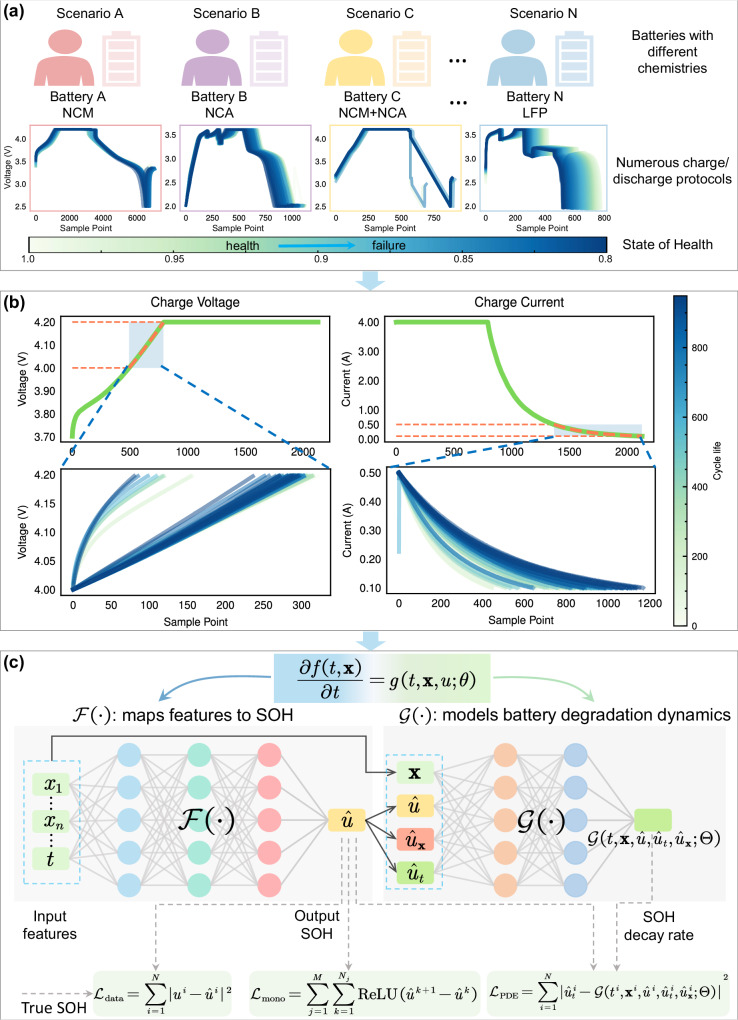
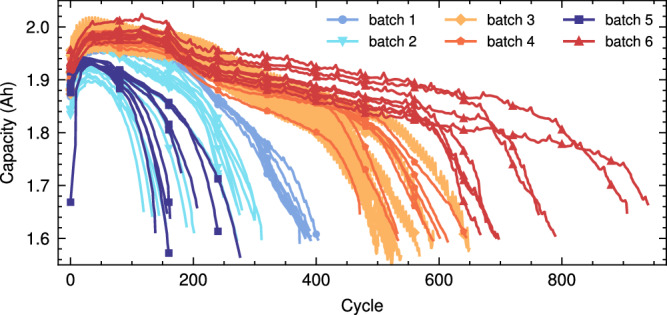
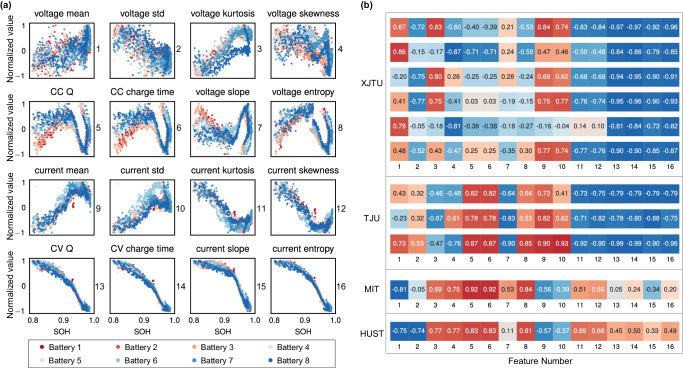
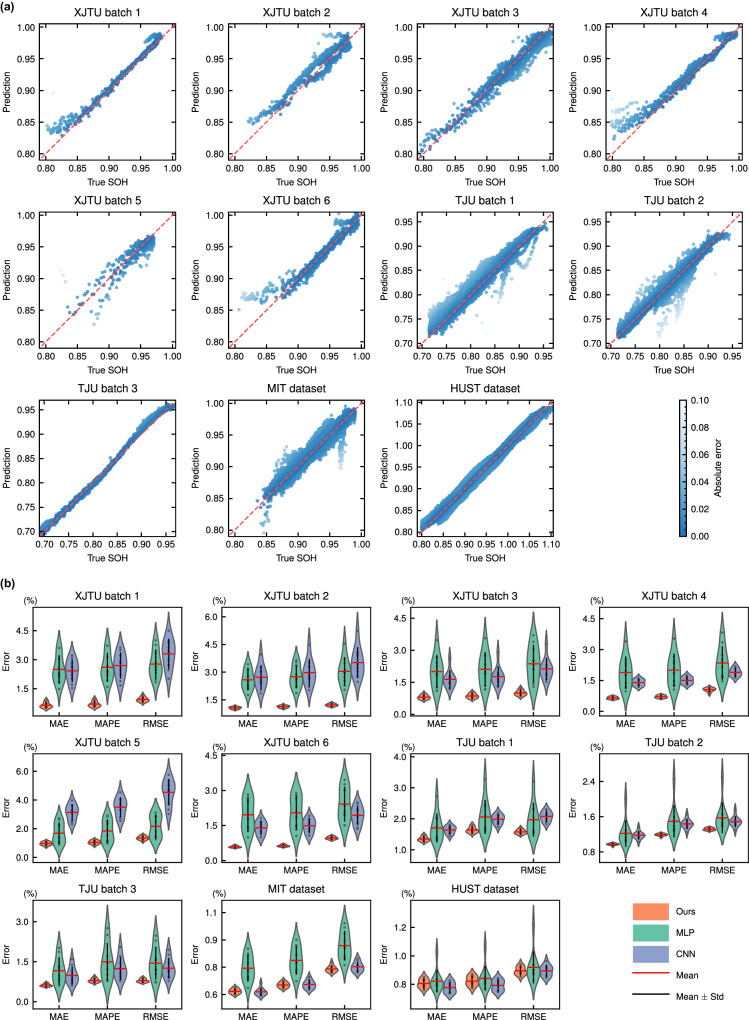
Accurate state-of-health (SOH) estimation is critical for reliable and safe operation of lithium-ion batteries. However, reliable and stable battery SOH estimation remains challenging due to diverse battery types and operating conditions. In this paper, we propose a physics-informed neural network (PINN) for accurate and stable estimation of battery SOH. Specifically, we model the attributes that affect the battery degradation from the perspective of empirical degradation and state space equations, and utilize neural networks to capture battery degradation dynamics. A general feature extraction method is designed to extract statistical features from a short period of data before the battery is fully charged, enabling our method applicable to different battery types and charge/discharge protocols. Additionally, we generate a comprehensive dataset consisting of 55 lithium-nickel-cobalt-manganese-oxide (NCM) batteries. Combined with three other datasets from different manufacturers, we use a total of 387 batteries with 310,705 samples to validate our method. The mean absolute percentage error (MAPE) is 0.87%. Our proposed PINN has demonstrated remarkable performance in regular experiments, small sample experiments, and transfer experiments when compared to alternative neural networks. This study highlights the promise of physics-informed machine learning for battery degradation modeling and SOH estimation.
Overview
The claims and statistics of this paper haven’t been checked yet.
Free: it reads the open-access text and checks the first 5 claims that cite a source we can check. Create a free account to check every claim.
Integrity signals
Registry
Cites
Statistics
Figures
Verification
Claims the paper makes
The claims and statistics of this paper haven’t been checked yet.
Free: it reads the open-access text and checks the first 5 claims that cite a source we can check. Create a free account to check every claim.
Claims other papers make about this one
Each is checked against this paper’s own text: does it say what the citing paper says it does?
The cited source says what the claim attributes to it.
In the citing paper
“Battery aging is a complex, multi-factor process involving the loss of active materials, lithium-ion depletion, increased internal resistance, and changes in the solid electrolyte interphase (SEI) layer [17-23]”
From The State of Health Estimation of Lithium-Ion Batteries: A Review of Health Indicators, Estimation Methods, Development Trends and Challenges (2025) · cites this paper as [17]
Self-check
Percentages, sums and reported differences re-computed from the paper’s own numbers.
The self-check needs the paper’s full text.
Citations
Cites
Raissi, M., Perdikaris, P., & Karniadakis, G. E. (2019) · Journal of Computational Physics · doi:10.1016/j.jcp.2018.10.045 · Cited by 20,384 · cited 2×
“Inspired by 54,55 , we propose to use a more generalized function approximator g 0 ð(cid:2)Þ with parameters θ 0 to represent the non-linear dynamics g ( ⋅ ).”
Physics-informed machine learning
Karniadakis, G. E., Kevrekidis, I. G., Lu, L., Perdikaris, P., Wang, S., & Yang, L. (2021) · Nature Reviews Physics · doi:10.1038/s42254-021-00314-5 · Cited by 8,718 · cited 2×
“The promising prospect of physics-informed neural network (PINN) 36,37 lies in amalgamating the strengths of physics-based and data-driven approaches, potentially addressing the aforementioned challenges.”
Recycling lithium-ion batteries from electric vehicles
Harper, G., Sommerville, R., Kendrick, E., Driscoll, L., Slater, P., Stolkin, R., Walton, A., Christensen, P., Heidrich, O., Lambert, S., et al. (2019) · Nature · doi:10.1038/s41586-019-1682-5 · Cited by 3,890 · cited 1×
“With the advantages of high energy density, low self-discharge rate, and long service life 1 , lithium-ion batteries have become the main energy storage devices in portable electronic devices, electric vehicles, aero-space, and many other fi elds 2 – 8 .”
Performance and cost of materials for lithium-based rechargeable automotive batteries
Schmuch, R., Wagner, R., Hörpel, G., Placke, T., & Winter, M. (2018) · Nature Energy · doi:10.1038/s41560-018-0107-2 · Cited by 3,233 · cited 1×
“With the advantages of high energy density, low self-discharge rate, and long service life 1 , lithium-ion batteries have become the main energy storage devices in portable electronic devices, electric vehicles, aero-space, and many other fi elds 2 – 8 .”
Data-driven prediction of battery cycle life before capacity degradation
Severson, K. A., Attia, P. M., Jin, N., Perkins, N., Jiang, B., Yang, Z., Chen, M. H., Aykol, M., Herring, P. K., Fraggedakis, D., et al. (2019) · Nature Energy · doi:10.1038/s41560-019-0356-8 · Cited by 3,228 · cited 3×
“For convenience, we refer to the four datasets as the XJTU battery dataset, TJU dataset 44 , HUST dataset 45 , and MIT dataset 25 .”
Simulation and Optimization of the Dual Lithium Ion Insertion Cell
Fuller, T. F., Doyle, M., & Newman, J. (1994) · Journal of The Electrochemical Society · doi:10.1149/1.2054684 · Cited by 2,057 · cited 1×
“Physics-based models are stable and accurate, but batteries with different chemical compositions require different model parameters, and the models have high computational costs 32 .”
Closed-loop optimization of fast-charging protocols for batteries with machine learning
Attia, P. M., Grover, A., Jin, N., Severson, K. A., Markov, T. M., Liao, Y.-H., Chen, M. H., Cheong, B., Perkins, N., Yang, Z., et al. (2020) · Nature · doi:10.1038/s41586-020-1994-5 · Cited by 1,180 · cited 1×
“Given the dif fi culty in establishing physical models and the dif fi - culty in obtaining complete discharge capacity, many studies have used data-driven methods 20 – 24 to estimate SOH based on current and voltage curves during charge and discharge.”
A review of rechargeable batteries for portable electronic devices
Liang, Y., Zhao, C., Yuan, H., Chen, Y., Zhang, W., Huang, J., Yu, D., Liu, Y., Titirici, M., Chueh, Y., et al. (2019) · InfoMat · doi:10.1002/inf2.12000 · Cited by 1,174
Modeling of Lithium-Ion Battery Degradation for Cell Life Assessment
Xu, B., Oudalov, A., Ulbig, A., Andersson, G., & Kirschen, D. S. (2018) · IEEE Transactions on Smart Grid · doi:10.1109/tsg.2016.2578950 · Cited by 1,162
Critical review of state of health estimation methods of Li-ion batteries for real applications
Berecibar, M., Gandiaga, I., Villarreal, I., Omar, N., Van Mierlo, J., & Van den Bossche, P. (2016) · Renewable and Sustainable Energy Reviews · doi:10.1016/j.rser.2015.11.042 · Cited by 1,126 · cited 1×
“In recent years, various SOH estimation methods of lithium-ion batterieshavebeenproposed,whichgreatlyadvancethedevelopment of this fi eld 12 – 15 .”
Research works printed but not linked: 1
- Raissi M Deep hidden physics models: deep learning of nonlinear partial differential equations J. Mach. Learn. Res. 2018 19 932 955
Cited by
Items 101–200 of 1,001
Towards digitized electrochemical power source for electric vehicles
Zhu, J., Xu, W., Tao, S., Cai, J., Shen, Y., Tian, M., Jiang, Y., Jiang, B., Wang, X., Schade, W., et al. (2025) · eTransportation · doi:10.1016/j.etran.2025.100426 · Cited by 23
Feasibility, cost and decarbonization potential of clean pathways for heavy-duty road transportation
Zhang, S., Zhao, P., Wang, F., Basma, H., Rodriguez, F., Wallington, T. J., Keoleian, G. A., & Wu, Y. (2025) · Nature Reviews Clean Technology · doi:10.1038/s44359-025-00119-0 · Cited by 23
Self-citationWei, L., Sun, Y., Diao, Q., Xu, H., Tan, X., & Fan, Y. (2024) · IEEE Sensors Journal · doi:10.1109/jsen.2024.3472648 · Cited by 20
How Sophisticated Are Neural Networks Needed to Predict Long-Term Nonadiabatic Dynamics?
Zeng, H., Kou, Y., & Sun, X. (2024) · Journal of Chemical Theory and Computation · doi:10.1021/acs.jctc.4c01223 · Cited by 19
Zhou, R., Wang, S., Ren, Y., Liu, K., Peng, X. X., He, L., Lian, C., & Liu, H. (2025) · Chemical Engineering Science · doi:10.1016/j.ces.2025.121878 · Cited by 22
Wei, C., Pang, H., Huang, T., Quan, Z., & Qian, Z. (2025) · Expert Systems with Applications · doi:10.1016/j.eswa.2025.128969 · Cited by 32
Fan, Y., Huang, Z., Li, H., Kaleem, M. B., & Wu, Y. (2025) · Energy · doi:10.1016/j.energy.2025.138328 · Cited by 25
Fast and generalisable parameter-embedded neural operators for lithium-ion battery simulation
Panahi, A. A., Luder, D., Wu, B., Offer, G. J., Sauer, D. U., & Li, W. (2025) · Energy and AI · doi:10.1016/j.egyai.2025.100647 · Cited by 20
Pandit, R., & Ahlawat, N. (2025) · Future Batteries · doi:10.1016/j.fub.2025.100099 · Cited by 20
Feng, H., & Xue, D. (2025) · Journal of Energy Storage · doi:10.1016/j.est.2025.116210 · Cited by 18
Navidi, S., Bajarunas, K., Chao, M. A., & Hu, C. K. (2025) · eTransportation · doi:10.1016/j.etran.2025.100432 · Cited by 18
Applications of generative artificial intelligence in battery research: Current status and prospects
Zhang, H., Xu, X., Li, X., & Gao, X. (2025) · Acta Physico-Chimica Sinica · doi:10.1016/j.actphy.2025.100115 · Cited by 18
Electromagnetic-Thermal Cosimulation via Divide-and-Conquer PINNs
Jia, Z. L., Wu, B., Liu, Y., & Zhang, H. H. (2025) · IEEE Antennas and Wireless Propagation Letters · doi:10.1109/lawp.2025.3595089 · Cited by 17
“In recent years, the rapid rise of artificial intelligence and deep learning has brought about transformative technologies, demonstrating significant potential in scientific computing [18], [19], [20], [21], [22], [23], [24], [25], [26], [27], [28], [29].”
Guo, W., Vilsen, S. B., Li, Y., Verma, A., Stroe, D., & Brandell, D. (2025) · Energy & Environmental Science · doi:10.1039/d5ee03268g · Cited by 18
Tang, S., Shi, S., Xu, X., Sun, X., Chang, J., Yu, C., Han, X., & Ouyang, M. (2025) · Journal of Energy Storage · doi:10.1016/j.est.2025.117050 · Cited by 17
Dong, W., Shen, J., Xu, Y., Wu, Z., Xu, X., Long, Y., Wang, X., & Zhou, F. (2025) · Applied Thermal Engineering · doi:10.1016/j.applthermaleng.2025.128455 · Cited by 16
Towards artificial intelligence-enabled autonomous battery prognostics and management
Shi, D., Cai, M., Che, Y., Xie, L., & Zhao, J. (2025) · Journal of Energy Chemistry · doi:10.1016/j.jechem.2025.09.081 · Cited by 16
A cycle-aware and physics-informed framework for battery remaining useful life prediction
Chen, Y., Wu, Y., & Li, C. (2025) · Scientific Reports · doi:10.1038/s41598-025-28505-5 · Cited by 19
Wang, Y., Lei, Y., Li, N., Li, X., & Yang, B. (2024) · IEEE Transactions on Neural Networks and Learning Systems · doi:10.1109/tnnls.2024.3453604 · Cited by 20
“Wang et al. [12] focused on battery health prognosis.”
Wang, X.-Y., Mi, Y., Zhao, Z., Cai, J., Yang, D., Tu, F., Jiang, Y., Xiang, J., Mi, S., & Wang, R. (2024) · Journal of Electronic Materials · doi:10.1007/s11664-024-11497-9 · Cited by 16
Self-citationA novel high-accuracy intelligent estimation method for battery state of health
Liu, Y., Ding, J., Yao, L., Su, H., Chen, Y., & Wang, Z. (2024) · Measurement · doi:10.1016/j.measurement.2024.116620 · Cited by 17
Qin, L., Sun, T., Sun, X., & Xia, W. (2025) · IEEE Transactions on Transportation Electrification · doi:10.1109/tte.2025.3525742 · Cited by 16
“This phenomenon has been observed in various battery types [7] and across multiple health indicators, such as capacity and internal resistance [8].”
Shan, R., Wang, Y., Guo, S., Cui, Y., Zhao, L., Li, J., & Wang, Z. (2025) · Energies · doi:10.3390/en18133542 · Cited by 17
Ding, Y., Zhu, J., Liu, Y., Ning, D., & Qin, M. (2025) · AI · doi:10.3390/ai6070149 · Cited by 15
Chen, H., She, C., Yue, W., Bin, G., Tang, J., & Zhang, L. (2025) · Energy · doi:10.1016/j.energy.2025.138294 · Cited by 15
Yu, S., Duan, X., Wang, X., Qiu, Z., Xu, J. E., Zheng, Y., Whittingham, M. S., & Li, Y. (2025) · National Science Open · doi:10.1360/nso/20250054 · Cited by 17
Chen, J., Peng, X., Zhang, H., Kang, L., Jun, S. C., Yamauchi, Y., & Liu, S. (2025) · Progress in Materials Science · doi:10.1016/j.pmatsci.2025.101611 · Cited by 15
Li, X., Li, X., Dong, Y., Hang, H., Tian, Y., & Tian, J. (2025) · Energy · doi:10.1016/j.energy.2025.139376 · Cited by 24
Jing, H., Hu, J., Ou, S. S., Qian, X., Qi, H., Zhu, J., & Dong, H. (2025) · Journal of Energy Storage · doi:10.1016/j.est.2025.119680 · Cited by 16
Merging physics and neural network: A promising tool for prognostics and health management
Wang, F., Liu, W., Sun, M., Zhai, Z., Zhao, Z., & Chen, X. (2025) · Engineering Applications of Artificial Intelligence · doi:10.1016/j.engappai.2025.113385 · Cited by 16
Self-citationNaanani, H., KAYSOUNY, M., ABERHOUCH, A., Sair, S., & Faik, A. (2026) · Computers & Chemical Engineering · doi:10.1016/j.compchemeng.2026.109582 · Cited by 18
Liu, C., Xu, Z., Zhou, J., Yuan, Y., Ma, K., & Yuan, M. (2026) · Applied Energy · doi:10.1016/j.apenergy.2026.127463 · Cited by 15
Yang, S., Ling, L., Li, X., Han, J., & Tong, S. (2024) · Journal of Dynamics Monitoring and Diagnostics · doi:10.37965/jdmd.2024.562 · Cited by 45
Wang, Z., Zhao, Z. J., Zhou, M., Wang, J., & Shen, Y. (2024) · IEEE Transactions on Reliability · doi:10.1109/tr.2024.3451650 · Cited by 16
“obtained from the NASA Prognostics Center of Excellence Wang et al. [42], and Zhu et al. [43], including different battery types, charge and discharge rates, and experimental temperatures.”
Self-citationBao, Z., Luo, T., Gao, M., He, Z., Gao, K., & Nie, J. (2025) · IEEE Transactions on Instrumentation and Measurement · doi:10.1109/tim.2025.3556835 · Cited by 20
“Wang et al. [24] proposed integrating the physical knowledge of batteries into DL through a physics-informed neural network (PINN).”
Ding, P., Xia, M., Wang, X., Pan, H., Gao, Q., Guo, W., Shi, P., & Min, Y. (2025) · Journal of Energy Storage · doi:10.1016/j.est.2025.116562 · Cited by 19
Battery state of health estimation using deep transfer learning on short-term charging data
Chen, K., Luo, Y., Long, Z., Wang, H., Li, Y., Gao, G., & Wu, G. (2025) · Measurement · doi:10.1016/j.measurement.2025.118233 · Cited by 15
Zhan, Y., Yan, K., & Zheng, X. (2025) · International Journal of Electrical Power & Energy Systems · doi:10.1016/j.ijepes.2025.111173 · Cited by 14
SiMBA-Augmented Physics-Informed Neural Networks for Industrial Remaining Useful Life Prediction
Li, M., Qin, J., Fan, H., & Ke, T. (2025) · Machines · doi:10.3390/machines13060452 · Cited by 15
Tao, S., Zhu, J., Li, Y., Jiang, B., Chang, W. S., Dai, H., & Wei, X. (2025) · eTransportation · doi:10.1016/j.etran.2025.100471 · Cited by 18
Wang, C., Bao, Z., Lin, H., Nie, J., & Zhu, C. (2025) · IEEE Transactions on Transportation Electrification · doi:10.1109/tte.2025.3610457 · Cited by 14
“…the CALCE dataset [28] (available at URL https://calce.umd.edu/battery-data), the XJTU dataset [29] (available at URL https://github.com/wang-fujin/PINN4SOH), the Oxford dataset [30] (available at URL…”
Shang, J., Xu, D., Shang, X., Zhao, C., Jiang, C., Qiu, H., & Gao, L. (2025) · Mechanical Systems and Signal Processing · doi:10.1016/j.ymssp.2025.113527 · Cited by 15
Wang, Q., Yan, H., Yang, Y., Zhao, X., Huang, G., Huang, Z., Zhu, Z., Liu, S. V., Yi, B., Huang, G., et al. (2025) · Batteries · doi:10.3390/batteries11110414 · Cited by 17
“If the inferred internal state goes beyond safe limits, that effectively detects a fault [203].”
Lyu, Z., Jin, Z., Li, X. R., Wang, H., Wu, L., & Chen, Y. (2025) · Journal of Energy Storage · doi:10.1016/j.est.2025.119730 · Cited by 14
Tian, H., Xi, C., & Zhang, Q. (2025) · Journal of Energy Storage · doi:10.1016/j.est.2025.118449 · Cited by 15
Foundation models knowledge distillation for battery capacity degradation forecast
Chan, J., Chen, Z., & Pan, E. (2025) · Reliability Engineering & System Safety · doi:10.1016/j.ress.2025.112139 · Cited by 17
Ding, T., von Jouanne, A., Dong, L. F., Fang, X., Fang, T., Rivas, P., & Yokochi, A. (2026) · Energies · doi:10.3390/en19020562 · Cited by 15
“Beyond data-driven structures, physics-informed MLPs that embed degradation dynamics and physical constraints as part of their architecture are emerging, demonstrating robustness and fidelity in SoH forecasting [54].”
Tao, D., Li, J., Du, K., & Lu, Z. (2026) · Bulletin of Earthquake Engineering · doi:10.1007/s10518-026-02408-w · Cited by 14
“Studies by Cai et al. ( 2021), Wang et al. (2024), and Alimin et al. (2025) further demonstrated their advantages over purely data-driven methods in fields such as thermodynamics and chemistry.”
Shang, J., Xu, D., Qiu, H., Jiang, C., Gao, L., & Zio, E. (2026) · IEEE Transactions on Systems Man and Cybernetics Systems · doi:10.1109/tsmc.2026.3663567 · Cited by 14
“Model-based methods construct physical or mathematical representations of degradation mechanisms and thus o ff er strong interpretability, but they rely heavily on expert knowledge and are often di ffi cult to scale to complex, nonlinear industrial systems [5].”
Yang, G., Wang, X., Li, R., & Zhang, X. (2024) · Sustainability · doi:10.3390/su16156316 · Cited by 16
Physics-Informed LSTM-Based Time-Series Forecasting Model for Power Transformers
Lei, L., He, Y., Xing, Z., Li, Z., & Zhou, Y. (2025) · IEEE Transactions on Industrial Informatics · doi:10.1109/tii.2025.3555981 · Cited by 14
“Inspired by [16], the article adopts a deep multilayer perceptron network for modeling to more clearly describe the nonlinear dynamic change law of dissolved gas in oil.”
Liu, R., Zhang, D., Wang, L., Mi, C. C., Bauer, P., & Qin, Z. (2025) · Journal of Energy Storage · doi:10.1016/j.est.2025.116313 · Cited by 15
Ma, X., Ding, X., Tian, C., Tian, C., & Zhu, R. (2025) · Sustainability · doi:10.3390/su17094014 · Cited by 17
He, J., Ma, Z., Liu, Y., Ma, C., & Gao, W. (2025) · Journal of Energy Storage · doi:10.1016/j.est.2025.117086 · Cited by 21
Su, L., Tao, S., Li, W., Sauer, D. U., Zhou, G., & Zhang, X. (2025) · Cell Reports Physical Science · doi:10.1016/j.xcrp.2025.102901 · Cited by 29
Fan, Y., Li, Y., Yan, C., Liang, Y., Yuan, Y., Li, Z., Sun, M., Wang, L., Wu, X., Ren, Z., et al. (2025) · Applied Energy · doi:10.1016/j.apenergy.2025.126533 · Cited by 13
Wang, L., Liu, J., Liu, G., Huang, Y., Yu, X., & Fan, L. (2025) · Advanced Materials · doi:10.1002/adma.202511928 · Cited by 24
Jiang, W., Tan, C., Su, E., Lu, J., Shi, H., Wang, Y., Song, J., & Wang, K. (2026) · Coatings · doi:10.3390/coatings16010059 · Cited by 15
“The second equation represents the convective boundary condition at the cooling interface, where h is the convective heat transfer coefficient, T ∞ is the coolant temperature, and n is the normal direction at the boundary [53].”
Zhou, P., Liang, J., Liu, Y., Wu, J., Song, Q., & Li, X. (2025) · Cell Reports Physical Science · doi:10.1016/j.xcrp.2025.102444 · Cited by 26
Zhao, J., Zhang, X., & Hu, C. (2025) · Journal of Energy Storage · doi:10.1016/j.est.2025.117296 · Cited by 15
Wang, S., Zhang, H., Cai, S., Yin, Q., & Zeng, L. (2025) · Journal of Energy Storage · doi:10.1016/j.est.2025.118059 · Cited by 14
Health state estimation of retired batteries based on physical constraints
Xia, F., Dong, Q., Xia, L., An, Z., Xia, Z., & Gong, C. (2025) · Engineering Applications of Artificial Intelligence · doi:10.1016/j.engappai.2025.112390 · Cited by 16
Li, Y., Zhang, Y., & Yin, M. (2025) · Renewable Energy · doi:10.1016/j.renene.2025.124851 · Cited by 13
Weng, Q., Cao, Y., Jiang, P., Li, Z., & Xu, R. (2025) · AI Thermal Fluids · doi:10.1016/j.aitf.2025.100003 · Cited by 16
Zhang, L., Yang, K., & Zhang, X. (2025) · Journal of Power Sources · doi:10.1016/j.jpowsour.2025.237798 · Cited by 12
Ma, Y., Liu, Z., Ye, S., An, D., & Zhang, G. (2025) · IEEE Sensors Journal · doi:10.1109/jsen.2025.3585543 · Cited by 12
“This technique enables accurate estimation of SOH even under data-scarce conditions while maintaining physical inter-pretability [29], [30], [31].”
Seo, Y., Kim, T., & Barde, S. (2025) · Energy · doi:10.1016/j.energy.2025.138316 · Cited by 15
Gu, X., Huan, X., Ren, Y., Zhou, W., Jiang, W., & Song, Z. (2026) · eTransportation · doi:10.1016/j.etran.2026.100555 · Cited by 16
“For example, Wang et al. proposed a PINN framework for SOH prediction across different battery types and conditions; however, the lack of explicit physics limited its interpretability [17].”
Li, H., Chen, B., Chen, J., Long, Y., Li, S., He, F., & Hu, Y. (2025) · Measurement · doi:10.1016/j.measurement.2025.119769 · Cited by 16
Yuan, Z., Deng, Z., He, Y., Ning, Z., & Liu, J.-C. (2025) · Energy · doi:10.1016/j.energy.2025.139410 · Cited by 14
Exploration-guided adaptive learning from mixed-quality data for satellite multi-battery management
Zou, Y., Lin, Z., Zhang, Q., Liu, Z., & Xu, Z. (2026) · Journal of Energy Storage · doi:10.1016/j.est.2026.120546 · Cited by 13
Guo, R., Zhang, K., He, S., Peng, D., Song, J., Tian, J., Rayeem, S. K., Wang, H., Shen, W., & Chung, C. Y. (2026) · eTransportation · doi:10.1016/j.etran.2026.100582 · Cited by 16
Multi-Scenario Digital Modeling and Simulation of Lithium-Ion Batteries
Li, W., Bao, Z., Wang, D., Wang, Y., Yu, Y., Li, H., Du, Q., Jin, Z., & Jiao, K. (2026) · Electrochemical Energy Reviews · doi:10.1007/s41918-026-00284-1 · Cited by 12
Li, T., Cai, Z., Zeng, Z., Zhang, Z., & Si, X. (2025) · Mechanical Systems and Signal Processing · doi:10.1016/j.ymssp.2025.112431 · Cited by 11
Xiang, L., Zhang, B., Zha, Y., Xing, G., Yang, X., Wang, Z., Cheng, Y., Yu, X., Hu, R., & Luo, X. (2025) · ASME Journal of Heat and Mass Transfer · doi:10.1115/1.4068266 · Cited by 11
Huang, J., & Kuang, Z. (2025) · Journal of Power Sources · doi:10.1016/j.jpowsour.2025.237818 · Cited by 11
Bayesian Physics Informed Neural Networks for Reliable Transformer Prognostics
Ramirez, I., Alcibar, J., Gómez, J. P., Sanz, M., Pardo, D., & Aizpurua, J. I. (2025) · Annual Conference of the PHM Society · doi:10.36001/phmconf.2025.v17i1.4344 · Cited by 14
“There have been solutions focused on battery prog-nostics through imposing a monotonic degradation constraint in the loss function Wang et al. [2024] and transformer prognostics through heat diffusion PDEs Ramirez et al. [2025].”
Yang, Y., Guo, Z., Zhao, Y., Dong, H., Titirici, M., Cegla, F., Pinfield, V. J., & Lan, B. (2025) · Energy & Environmental Science · doi:10.1039/d5ee03563e · Cited by 12
Artificial Intelligence in the Analysis of Energy Consumption of Electric Vehicles
Diouf, B. (2025) · Energies · doi:10.3390/en18236338 · Cited by 11
A review of thermal runaway gases and detection methods for lithium-ion batteries
Tao, Z., Zhou, H., Cao, Y., Huang, X., Wang, W., & Zhang, H. (2025) · Thermal Science and Engineering Progress · doi:10.1016/j.tsep.2025.104427 · Cited by 11
Fan, Z., Guo, Y., Song, L., Du, J., Wang, H., & Li, X. (2025) · Energy and AI · doi:10.1016/j.egyai.2025.100646 · Cited by 12
Azad, A., Nia, F. F., Anvari‐Moghaddam, A., Flynn, D., Longo, M., & Shafie‐khah, M. (2026) · Journal of Energy Storage · doi:10.1016/j.est.2025.120190 · Cited by 12
Govindaswamy, T. R., & Ramadoss, R. (2026) · Journal of Vibration Engineering & Technologies · doi:10.1007/s42417-025-02322-6 · Cited by 11
“Bayesian fusion, physics-informed neural networks (Wang et al. 2024), and attention-based mechanisms (Ragab et al. 2021) allow models to dynamically adjust reliance on physical priors or learned data under varying operating conditions, improving robustness in real-world PdM applications.”
Exploiting physics-knowledge from unlabeled data to enhance battery lifetime prediction
Tang, A., Li, Y., Tian, J., Yu, Q., Yu, N., & Xu, Y. (2026) · eTransportation · doi:10.1016/j.etran.2026.100560 · Cited by 11
Recent Progress in the Physics-Constrained State of Health Estimation for Lithium-Ion Batteries
Chen, Y., Lu, J., Tang, Z., Zhu, J., Wang, S., Dong, H., & Wang, K. (2026) · Energies · doi:10.3390/en19081920 · Cited by 17
State of Health Estimation of Lithium-Ion Batteries Using Fusion Health Indicator by PSO-ELM Model
Chen, J., Liu, Y., Yong, J., Yang, C., Yan, L., & Zheng, Y. (2024) · Batteries · doi:10.3390/batteries10110380 · Cited by 13
“Wang et al. [40] proposed a method using PINNs that integrates physical equations governing battery dynamics into the neural network training process.”
State of Health Estimations for Lithium-Ion Batteries Based on MSCNN
Wang, J., Li, H., Wu, C., Shi, Y., Zhang, L., & An, Y. (2024) · Energies · doi:10.3390/en17174220 · Cited by 15
Wang, Y., Wei, M., Dai, F., Zou, D., Chen, L., Han, X., Chen, Y., & Ji, C. (2025) · Fractal and Fractional · doi:10.3390/fractalfract9020091 · Cited by 12
Causal Physics-Infused Hybrid Learning (CPIHL) Framework for Next-Gen Battery Health Forecasting
Qaadan, S., Alshare, A., Alazrai, R., Popp, A., & Schmuelling, B. (2025) · IEEE Access · doi:10.1109/access.2025.3556314 · Cited by 10
“This approach has been adapted to various domains [21], [22], [23], [24], [25], including fluid dynamics [20], quantum mechanics as presentented by [26] and [27], and more recently, in battery degradation modeling as given by [28] and [29].”
A Lightweight Multitask Learning Framework for Battery Degradation Prediction With Limited Data
Gu, P., Zhang, Y., Duan, B., Zhang, C., Kang, Y., & Li, C. (2025) · IEEE Transactions on Transportation Electrification · doi:10.1109/tte.2025.3591534 · Cited by 10
“As inherently time-varying and nonlinear electrochemical systems, LIBs inevitably experience performance degradation due to the coupling of external stress factors and internal side reactions [3].”
Luan, W., Cai, H., Wang, X., & Zhao, B. (2025) · Sensors · doi:10.3390/s25195953 · Cited by 13
“In this paper, the Xi’an Jiaotong University (XJTU) dataset [39] and Center for Advanced Life Cycle Engineering (CALCE) dataset [40] are selected for validation.”
Yao, J., Zhao, H., & Kowal, J. (2025) · Journal of Power Sources · doi:10.1016/j.jpowsour.2025.238569 · Cited by 13
Physics-informed operator learning for real-time battery state estimation
Brancato, L., Harej, A. G., Giglio, M., & Cadini, F. (2025) · Applied Energy · doi:10.1016/j.apenergy.2025.126987 · Cited by 14
Physical Information-Guided Kolmogorov–Arnold Networks for Battery State of Health Estimation
Liu, Z., Ye, S., Cui, F., & Ma, Y. (2025) · Energies · doi:10.3390/en18225865 · Cited by 10
“…generalization ability of KAN-PINN across different battery chemistries or data acquisition protocols, we conducted experiments on an open-access lithium-ion battery dataset (hereinafter referred to as the XTJU dataset (Xi’an Jiaotong University, Xi’an, China)) generated by Wang, F. et al. [22].”
Tang, Q., He, T., Huang, J., & Zhu, W. (2025) · Journal of Energy Storage · doi:10.1016/j.est.2025.119415 · Cited by 10
Le, H., Deng, W., Nguyen, K. T. P., Medjaher, K., Gogu, C., & Wu, D. (2025) · Applied Energy · doi:10.1016/j.apenergy.2025.127161 · Cited by 10
Ametefe, D. S., Sukor, N. S. A., John, D., Ametefe, G. D., Aliu, A. A., Owen, M. M., & Salaudeen, T. O. (2026) · Battery energy · doi:10.1002/bte2.70099 · Cited by 10
“E m e r g i n g r e s e a r c h d i r e c t i o n [ 34 , 144 ] P r e d i c t i v e m a n a g e m e n t”
Pang, H., Qu, X., Chen, K., Yan, X., Burke, A. F., & Zhao, J. (2026) · Energy · doi:10.1016/j.energy.2026.141079 · Cited by 12
Song, Y., Sun, Y., Zhu, J.-Y., Qiao, H.-B., Gao, Z., & Liu, L. (2024) · Journal of Engineering Design · doi:10.1080/09544828.2024.2436968 · Cited by 10
“Wang et al. (2024) combined traditional physical models with neural network models to capture the complex dynamic behaviour of battery systems.”
Yang, Y., Han, B., Liu, Z., & Zhou, H. (2025) · Journal of The Electrochemical Society · doi:10.1149/1945-7111/adce38 · Cited by 10
Metadata
- Authors
- Wang, F., Zhai, Z., Zhao, Z., Di, Y., & Chen, X.
- Affiliations
- Xi'an Jiaotong University (CN)
- Corresponding author
- Zhao, Zhibin
- Chen, Xuefeng
- Venue
- Nature Communications
- Published
- 2024-05-21
- Volume
- 15
- Issue
- 1
- Pages
- 4332-4332
- ISSN
- 2041-1723 (ISSN-L)
- PMC
- PMC11109204
- OpenAlex
- W4398164319
- Cited by
- 897
- References
- 56
- Citations by year
- 2026: 532 · 2025: 322 · 2024: 43
- FWCI
- 96.71
- Type
- journal article
- Language
- en
- Open access
- gold
- doi.org
- Licence
- cc-by
- creativecommons.org/licenses/by/4.0 (tdm)
- creativecommons.org/licenses/by/4.0 (vor)
- Locations
- Nature Communications (publishedVersion, cc-by)
- PubMed Central (publishedVersion, cc-by)
- PubMed (publishedVersion)
- RePEc: Research Papers in Economics (submittedVersion)
- DOAJ (DOAJ: Directory of Open Access Journals) (submittedVersion, cc-by-sa)
- Funders
- Fundamental Research Funds for the Central Universities
- National Natural Science Foundation of China (52105113, U22B2013)
- China Postdoctoral Science Foundation (2021M692557, 2021TQ0263)
- Topics
- Physical Sciences › Engineering › Automotive Engineering › Battery Modeling and Management
- Physical Sciences › Engineering › Electrical and Electronic Engineering › Advancements in Battery Materials
- Physical Sciences › Engineering › Civil and Structural Engineering › Structural Health Monitoring Techniques
- Keywords
- lithium-ion batteries, state of health estimation, battery degradation modeling, physics-informed neural networks, NCM batteries, statistical feature extraction, transfer learning, small sample learning, battery datasets
About these checks
Registry, retraction, Cites and statistics results are computed, not judged, with one exception: a printed reference that no index lists is read once by a model before it counts as a citation error. Claims are extracted by a model and kept only when their quote appears verbatim in the text; each cited source is then checked, with a model’s help, for whether it says what the claim relies on. Those verdicts can be wrong — read the claim’s quote and the cited source before relying on one.
Statistics and arithmetic are recomputed, not judged.
Confidence bands are shown only for fields calibrated on our annotated test set. None is calibrated yet, so no band is shown.
What counts as a claim ›How we measure confidence ›How we check this ›
Are you an author, or do you see a problem with this page? Request a review
Data sources
Bibliographic data: Semantic Scholar, OpenAlex, Crossref.
Contains information from the Semantic Scholar Academic Graph Datasets, made available under the ODC Attribution License (ODC-BY 1.0).
Semantic Scholar’s data is described in: Kinney, R., et al. (2023). The Semantic Scholar Open Data Platform. arXiv:2301.10140.
